PROJECT :
MOVIE RECOMMENDER
SYSTEM
USING PYTHON
PYTHON
PROJECT
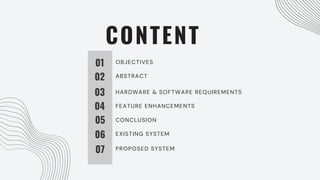
CONTENT
01
02
03
04
05
06
07
OBJECTIVES
ABSTRACT
HARDWARE & SOFTWARE REQUIREMENTS
FEATURE ENHANCEMENTS
CONCLUSION
EXISTING SYSTEM
PROPOSED SYSTEM
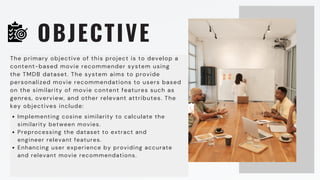
OBJECTIVE
The primary objective of this project is to develop a
content-based movie recommender system using
the TMDB dataset. The system aims to provide
personalized movie recommendations to users based
on the similarity of movie content features such as
genres, overview, and other relevant attributes. The
key objectives include:
Implementing cosine similarity to calculate the
similarity between movies.
Preprocessing the dataset to extract and
engineer relevant features.
Enhancing user experience by providing accurate
and relevant movie recommendations.
ABSTRACT
UNLIKE COLLABORATIVE FILTERING METHODS, WHICH RELY ON
USER-ITEM INTERACTIONS, THIS SYSTEM LEVERAGES MOVIE
CONTENT FEATURES TO GENERATE RECOMMENDATIONS. BY
ANALYZING ATTRIBUTES SUCH AS GENRES, OVERVIEW, AND OTHER
TEXTUAL INFORMATION, THE SYSTEM COMPUTES THE SIMILARITY
BETWEEN MOVIES USING COSINE SIMILARITY.
THROUGH THIS APPROACH, USERS CAN DISCOVER NEW MOVIES
BASED ON THE CONTENT THEY ENJOY, ENHANCING THEIR OVERALL
VIEWING EXPERIENCE.
IN THE ERA OF DIGITAL ENTERTAINMENT, USERS OFTEN FACE THE
CHALLENGE OF FINDING MOVIES TAILORED TO THEIR PREFERENCES
AMIDST A VAST ARRAY OF OPTIONS. TO ADDRESS THIS ISSUE, THIS
PROJECT PROPOSES A CONTENT-BASED MOVIE RECOMMENDER
SYSTEM.
Hardware
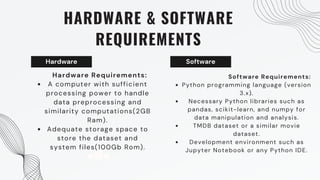
HARDWARE & SOFTWARE
REQUIREMENTS
Hardware Requirements:
A computer with sufficient
processing power to handle
data preprocessing and
similarity computations(2GB
Ram).
Adequate storage space to
store the dataset and
system files(100Gb Rom).
Software
Software Requirements:
Python programming language (version
3.x).
Necessary Python libraries such as
pandas, scikit-learn, and numpy for
data manipulation and analysis.
TMDB dataset or a similar movie
dataset.
Development environment such as
Jupyter Notebook or any Python IDE.
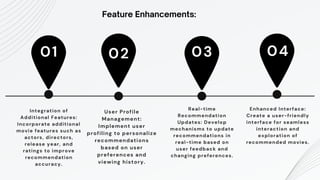
Integration of
Additional Features:
Incorporate additional
movie features such as
actors, directors,
release year, and
ratings to improve
recommendation
accuracy.
01 02 03 04
User Profile
Management:
Implement user
profiling to personalize
recommendations
based on user
preferences and
viewing history.
Feature Enhancements:
Real-time
Recommendation
Updates: Develop
mechanisms to update
recommendations in
real-time based on
user feedback and
changing preferences.
Enhanced Interface:
Create a user-friendly
interface for seamless
interaction and
exploration of
recommended movies.
CONCLUSION:
The content-based movie recommender system presented in
this project offers a valuable solution to the challenge of movie
discovery. By leveraging movie content features and cosine
similarity, the system provides users with personalized
recommendations, thereby enhancing their movie-watching
experience. With further feature enhancements and user
feedback integration, the system can continuously improve its
recommendation accuracy and adaptability to evolving user
preferences.
EXISTING SYSTEM:
The existing movie recommendation systems
predominantly rely on collaborative filtering techniques,
which analyze user-item interactions to generate
recommendations. While effective, these systems may suffer
from cold start problems and sparsity issues, particularly for
new users or items with limited interactions.
Content-based recommendation systems offer an
alternative approach by focusing on the intrinsic
characteristics of items. However, they may face challenges
in capturing complex user preferences and serendipitous
recommendations
PROPOSED SYSTEM:
In contrast to traditional collaborative filtering methods, the
proposed content-based movie recommender system
utilizes cosine similarity to measure the similarity between
movies based on their content features. By analyzing
attributes such as genres, overview, and textual information,
the system generates personalized recommendations
tailored to users' preferences. This approach addresses the
limitations of collaborative filtering systems and provides
users with relevant and diverse movie recommendations,
ultimately enhancing their movie-watching experience.
THANK'S FOR
WATCHING
PYTHON
Lorem ipsum dolor sit amet,
consectetur adipiscing elit. Duis
vulputate nulla at ante rhoncus, vel
efficitur felis condimentum. Proin
odio odio.
THANK'S FOR
WATCHING
LARANA, INC.

Project Synopsis Content-Based Movie Recommender System.pdf

  • 1.
  • 2.
    CONTENT 01 02 03 04 05 06 07 OBJECTIVES ABSTRACT HARDWARE & SOFTWAREREQUIREMENTS FEATURE ENHANCEMENTS CONCLUSION EXISTING SYSTEM PROPOSED SYSTEM
  • 3.
    OBJECTIVE The primary objectiveof this project is to develop a content-based movie recommender system using the TMDB dataset. The system aims to provide personalized movie recommendations to users based on the similarity of movie content features such as genres, overview, and other relevant attributes. The key objectives include: Implementing cosine similarity to calculate the similarity between movies. Preprocessing the dataset to extract and engineer relevant features. Enhancing user experience by providing accurate and relevant movie recommendations.
  • 4.
    ABSTRACT UNLIKE COLLABORATIVE FILTERINGMETHODS, WHICH RELY ON USER-ITEM INTERACTIONS, THIS SYSTEM LEVERAGES MOVIE CONTENT FEATURES TO GENERATE RECOMMENDATIONS. BY ANALYZING ATTRIBUTES SUCH AS GENRES, OVERVIEW, AND OTHER TEXTUAL INFORMATION, THE SYSTEM COMPUTES THE SIMILARITY BETWEEN MOVIES USING COSINE SIMILARITY. THROUGH THIS APPROACH, USERS CAN DISCOVER NEW MOVIES BASED ON THE CONTENT THEY ENJOY, ENHANCING THEIR OVERALL VIEWING EXPERIENCE. IN THE ERA OF DIGITAL ENTERTAINMENT, USERS OFTEN FACE THE CHALLENGE OF FINDING MOVIES TAILORED TO THEIR PREFERENCES AMIDST A VAST ARRAY OF OPTIONS. TO ADDRESS THIS ISSUE, THIS PROJECT PROPOSES A CONTENT-BASED MOVIE RECOMMENDER SYSTEM.
  • 5.
    Hardware HARDWARE & SOFTWARE REQUIREMENTS HardwareRequirements: A computer with sufficient processing power to handle data preprocessing and similarity computations(2GB Ram). Adequate storage space to store the dataset and system files(100Gb Rom). Software Software Requirements: Python programming language (version 3.x). Necessary Python libraries such as pandas, scikit-learn, and numpy for data manipulation and analysis. TMDB dataset or a similar movie dataset. Development environment such as Jupyter Notebook or any Python IDE.
  • 6.
    Integration of Additional Features: Incorporateadditional movie features such as actors, directors, release year, and ratings to improve recommendation accuracy. 01 02 03 04 User Profile Management: Implement user profiling to personalize recommendations based on user preferences and viewing history. Feature Enhancements: Real-time Recommendation Updates: Develop mechanisms to update recommendations in real-time based on user feedback and changing preferences. Enhanced Interface: Create a user-friendly interface for seamless interaction and exploration of recommended movies.
  • 7.
    CONCLUSION: The content-based movierecommender system presented in this project offers a valuable solution to the challenge of movie discovery. By leveraging movie content features and cosine similarity, the system provides users with personalized recommendations, thereby enhancing their movie-watching experience. With further feature enhancements and user feedback integration, the system can continuously improve its recommendation accuracy and adaptability to evolving user preferences.
  • 8.
    EXISTING SYSTEM: The existingmovie recommendation systems predominantly rely on collaborative filtering techniques, which analyze user-item interactions to generate recommendations. While effective, these systems may suffer from cold start problems and sparsity issues, particularly for new users or items with limited interactions. Content-based recommendation systems offer an alternative approach by focusing on the intrinsic characteristics of items. However, they may face challenges in capturing complex user preferences and serendipitous recommendations
  • 9.
    PROPOSED SYSTEM: In contrastto traditional collaborative filtering methods, the proposed content-based movie recommender system utilizes cosine similarity to measure the similarity between movies based on their content features. By analyzing attributes such as genres, overview, and textual information, the system generates personalized recommendations tailored to users' preferences. This approach addresses the limitations of collaborative filtering systems and provides users with relevant and diverse movie recommendations, ultimately enhancing their movie-watching experience.
  • 10.
  • 11.
    Lorem ipsum dolorsit amet, consectetur adipiscing elit. Duis vulputate nulla at ante rhoncus, vel efficitur felis condimentum. Proin odio odio. THANK'S FOR WATCHING LARANA, INC.