In this busy world, entertainment is essential for each of us to refresh our mood and energy. Having fun can
restore confidence at work and work with more enthusiasm. To rejuvenate ourselves, we watch our favorite
movies. To watch favorable movies online, we can take advantage of more reliable movie recommendation
systems, because searching for preferred movies takes more time and cannot be wasted. In this project, a hybrid
approach combining content-based filtering and collaborative filtering is presented to improve the quality of a
movie recommendation system. Along with that sentiment analysis is done using Bayes Algorithm and Cosine
Similarity. The proposed approach shows improvement over pure approaches in the accuracy, quality, and
scalability of the movie recommendation system. Three different ones datasets are using in this system. Hybrid
approach helps to gain advantages from both approaches and eliminate the disadvantages of both methods.
2
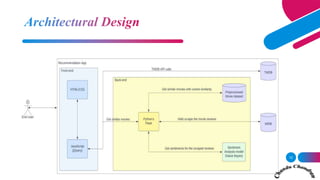
• A Content-based filtering and Collaborative filtering combine recommender system that recommends movies
similar to the movie the user likes and analyze the sentiment of the reviews given by the user.
• Movie details such as title, genre, runtime, rating, poster and cast from TMDB for content-based filtering
approach and user reviews of each individual movie from IMDB website for collaborative filtering approach
are "web scraped" with the help of 'beautifulsoup4'.
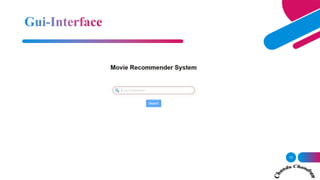
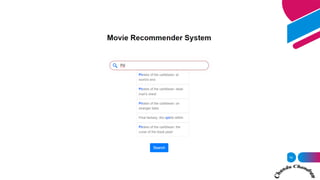
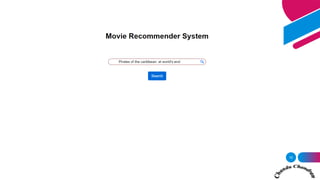
• Full movie details, top 10 cast, full details of that cast, movie reviews, user sentimental emoji's and top 10
movie recommendations related to the searched movie.
3
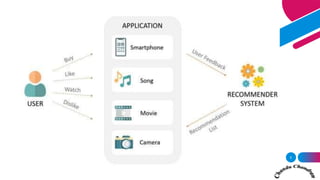
A recommendation system is a subclass of Information filtering Systems that seeks to predict the rating or the
preference a user might give to an item. In simple words, it is an algorithm that suggests relevant items to users.
Eg: In the case of Netflix which movie to watch, In the case of e-commerce which product to buy, or In the
case of kindle which book to read, etc.
4
5
The recommendation system mainly classified into two types
1. Content-Based Filtering
2. Collaborative Based Filtering
Content-Based Filtering
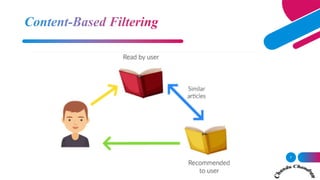
Content-based filtering is a recommendation system that suggests items to users based on their preferences and
past behavior.
6
7
8
Collaborative Based Filtering
Collaborative filtering is a recommendation system that makes suggestions based on the preferences and
behaviors of multiple users.
There are two main types of collaborative filtering
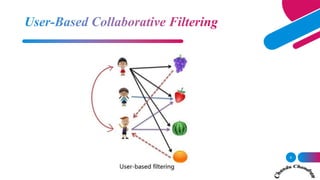
User-User:- User-user collaborative filtering identifies similar users based on their past interactions with items
and recommends items that those similar users have interacted with.
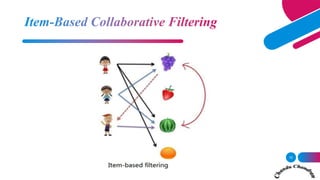
Item-item:- Item-item collaborative filtering identifies similar items based on their interactions with users and
recommends those items to a user who has interacted with similar items in the past.
9
10
11
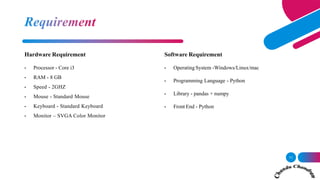
Hardware Requirement
• Processor - Core i3
• RAM - 8 GB
• Speed - 2GHZ
• Mouse - Standard Mouse
• Keyboard - Standard Keyboard
• Monitor – SVGA Color Monitor
Software Requirement
• Operating System -Windows/Linux/mac
• Programming Language - Python
• Library - pandas + numpy
• Front End - Python
12
13
14
15
16
17
18
19
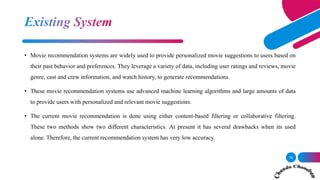
• Movie recommendation systems are widely used to provide personalized movie suggestions to users based on
their past behavior and preferences. They leverage a variety of data, including user ratings and reviews, movie
genre, cast and crew information, and watch history, to generate recommendations.
• These movie recommendation systems use advanced machine learning algorithms and large amounts of data
to provide users with personalized and relevant movie suggestions.
• The current movie recommendation is done using either content-based filtering or collaborative filtering.
These two methods show two different characteristics. At present it has several drawbacks when its used
alone. Therefore, the current recommendation system has very low accuracy.
20
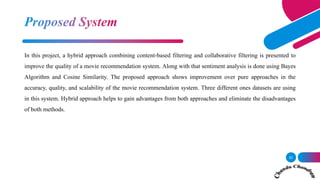
In this project, a hybrid approach combining content-based filtering and collaborative filtering is presented to
improve the quality of a movie recommendation system. Along with that sentiment analysis is done using Bayes
Algorithm and Cosine Similarity. The proposed approach shows improvement over pure approaches in the
accuracy, quality, and scalability of the movie recommendation system. Three different ones datasets are using
in this system. Hybrid approach helps to gain advantages from both approaches and eliminate the disadvantages
of both methods.
21
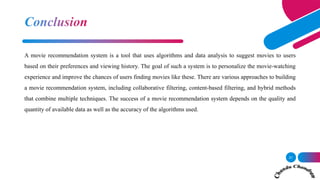
A movie recommendation system is a tool that uses algorithms and data analysis to suggest movies to users
based on their preferences and viewing history. The goal of such a system is to personalize the movie-watching
experience and improve the chances of users finding movies like these. There are various approaches to building
a movie recommendation system, including collaborative filtering, content-based filtering, and hybrid methods
that combine multiple techniques. The success of a movie recommendation system depends on the quality and
quantity of available data as well as the accuracy of the algorithms used.
22

Movie Recommendation System Using Hybrid Approch.pptx

  • 2.
    In this busyworld, entertainment is essential for each of us to refresh our mood and energy. Having fun can restore confidence at work and work with more enthusiasm. To rejuvenate ourselves, we watch our favorite movies. To watch favorable movies online, we can take advantage of more reliable movie recommendation systems, because searching for preferred movies takes more time and cannot be wasted. In this project, a hybrid approach combining content-based filtering and collaborative filtering is presented to improve the quality of a movie recommendation system. Along with that sentiment analysis is done using Bayes Algorithm and Cosine Similarity. The proposed approach shows improvement over pure approaches in the accuracy, quality, and scalability of the movie recommendation system. Three different ones datasets are using in this system. Hybrid approach helps to gain advantages from both approaches and eliminate the disadvantages of both methods. 2
  • 3.
    • A Content-basedfiltering and Collaborative filtering combine recommender system that recommends movies similar to the movie the user likes and analyze the sentiment of the reviews given by the user. • Movie details such as title, genre, runtime, rating, poster and cast from TMDB for content-based filtering approach and user reviews of each individual movie from IMDB website for collaborative filtering approach are "web scraped" with the help of 'beautifulsoup4'. • Full movie details, top 10 cast, full details of that cast, movie reviews, user sentimental emoji's and top 10 movie recommendations related to the searched movie. 3
  • 4.
    A recommendation systemis a subclass of Information filtering Systems that seeks to predict the rating or the preference a user might give to an item. In simple words, it is an algorithm that suggests relevant items to users. Eg: In the case of Netflix which movie to watch, In the case of e-commerce which product to buy, or In the case of kindle which book to read, etc. 4
  • 5.
  • 6.
    The recommendation systemmainly classified into two types 1. Content-Based Filtering 2. Collaborative Based Filtering Content-Based Filtering Content-based filtering is a recommendation system that suggests items to users based on their preferences and past behavior. 6
  • 7.
  • 8.
    8 Collaborative Based Filtering Collaborativefiltering is a recommendation system that makes suggestions based on the preferences and behaviors of multiple users. There are two main types of collaborative filtering User-User:- User-user collaborative filtering identifies similar users based on their past interactions with items and recommends items that those similar users have interacted with. Item-item:- Item-item collaborative filtering identifies similar items based on their interactions with users and recommends those items to a user who has interacted with similar items in the past.
  • 9.
  • 10.
  • 11.
    11 Hardware Requirement • Processor- Core i3 • RAM - 8 GB • Speed - 2GHZ • Mouse - Standard Mouse • Keyboard - Standard Keyboard • Monitor – SVGA Color Monitor Software Requirement • Operating System -Windows/Linux/mac • Programming Language - Python • Library - pandas + numpy • Front End - Python
  • 12.
  • 13.
  • 14.
  • 15.
  • 16.
  • 17.
  • 18.
  • 19.
    19 • Movie recommendationsystems are widely used to provide personalized movie suggestions to users based on their past behavior and preferences. They leverage a variety of data, including user ratings and reviews, movie genre, cast and crew information, and watch history, to generate recommendations. • These movie recommendation systems use advanced machine learning algorithms and large amounts of data to provide users with personalized and relevant movie suggestions. • The current movie recommendation is done using either content-based filtering or collaborative filtering. These two methods show two different characteristics. At present it has several drawbacks when its used alone. Therefore, the current recommendation system has very low accuracy.
  • 20.
    20 In this project,a hybrid approach combining content-based filtering and collaborative filtering is presented to improve the quality of a movie recommendation system. Along with that sentiment analysis is done using Bayes Algorithm and Cosine Similarity. The proposed approach shows improvement over pure approaches in the accuracy, quality, and scalability of the movie recommendation system. Three different ones datasets are using in this system. Hybrid approach helps to gain advantages from both approaches and eliminate the disadvantages of both methods.
  • 21.
    21 A movie recommendationsystem is a tool that uses algorithms and data analysis to suggest movies to users based on their preferences and viewing history. The goal of such a system is to personalize the movie-watching experience and improve the chances of users finding movies like these. There are various approaches to building a movie recommendation system, including collaborative filtering, content-based filtering, and hybrid methods that combine multiple techniques. The success of a movie recommendation system depends on the quality and quantity of available data as well as the accuracy of the algorithms used.
  • 22.