


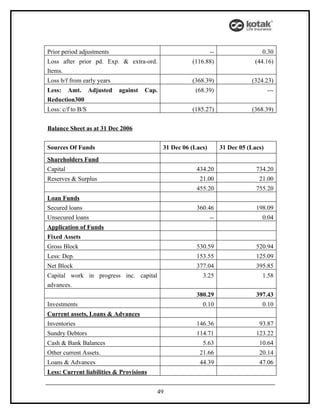
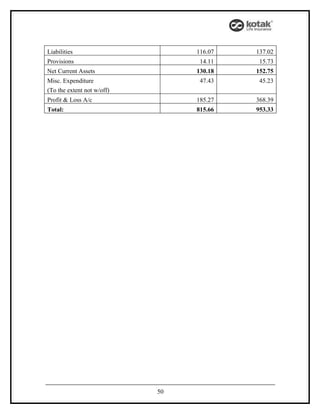

Kotak Mahindra Group


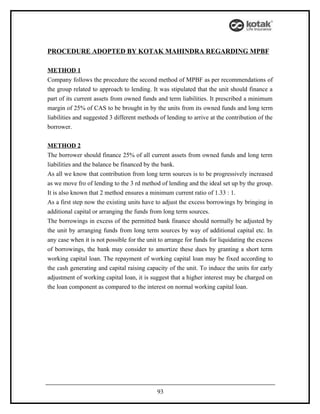
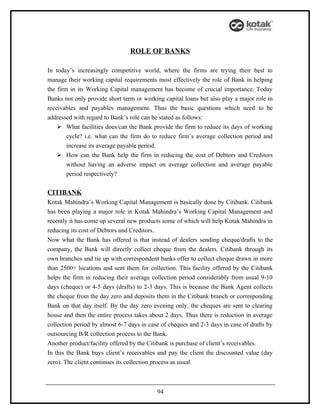
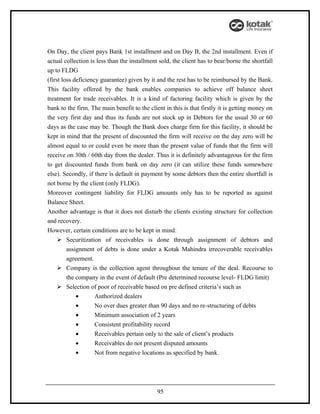
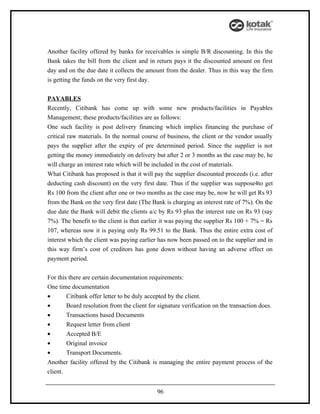
         1
TABLE OF CONTENTS


Chapter No.    Subject                                               Page No.

Ch No.1        Executive Summary………………….                                 6
Ch No.2        Research Methodology………………                                7
    2.1               Primary Objective(s)………….
    2.2               Hypothesis……………………
    2.3               Research Design………………
    2.4               Sample Design………………..
    2.5               Scope of the Study…………….
    2.6               Limitations…………………….
Ch No.3        Critical Review of Literature………..                        9
Ch No.4        Company Profile …………………….                                18
Ch No.5        Industry Profile………………..                                 21
Ch No.6        SWOT Analysis………………….                                    45
Ch No.7        Data…………………………………..                                      46
    7.1               Collection………………………
    7.2               Primary Data……………………
    7.3               Secondary Data….……………..
Ch No.8        Working Capital- Overall View………                         53
Ch No.9        Findings & Analysis………………….                             100
Ch No.10       Recommendations……………………                                 112
Ch No.11       Bibliography………………………….                                 114
Ch No.12       Annexure……………………………..                                   115
    12.1              Tables………………………….
    12.2              Graphs…………………………
Ch No.13       Case Study...….....................................    117
Ch No.14       Synopsis of the Project……………….                         122


                                       2
CH NO.1: EXECUTIVE SUMMARY

The Indian Life Insurance Company has seen a remarkable shift since the time of
establishment of the first company, Oriental Life Insurance Company in 1823. At the
time of Independence and thereafter, there were more than 200 companies operating in India
and not all of them on sound ethical principles. Many factors combined together to prompt
the then Government to nationalize the life insurance industry in 1956 to form the Life
Insurance Corporation of India.


Insurance sector was once a monopoly, with LIC as the only company, a public sector
enterprise. But nowadays the market opened up and there are many private players
competing in the market. There are thirteen private life insurance companies who has
entered the industry.


The study in the first part gives detail information on the on-job training provided the
competitive analysis of product of Kotak Mahindra Old Mutual Life Insurance Ltd. with
ICICI Prudential Life Insurance. Also, analysis of financial statements.


In the second part, is a project on “How does the Indian mutual fund industry compare vis -
a - vis global standards and what should be our future expectations from it?”


The paper begins by analyzing the current scenario in the industry characterized by
problems with distribution, low investor awareness and concentration of corporate
investors. In the next section, a comparison of the Mutual Fund Industry with global
standards reveals that the industry still compares unfavorably with developed countries in
terms of penetration, investor awareness and diversity of products and the extent of use of
risk management techniques. Further comparison reveals that the attitude of regulator
towards investor protection and the governance of mutual funds are at par with global
standards. The paper then analysis the future expectations from the mutual fund industry
in terms of increased investor awareness, product diversity and improvement in
penetration and distribution. In the end I recommend certain steps that SEBI and AMCs
should take in order to build investor confidence and trust.


                                            3
CH NO. 2: RESEARCH METHODOLOGY

Primary Objective(s)
The Basic objective of cash management is two fold:
   • To meet the cash disbursement needs (payment schedule);
   • To minimize funds committed to cash balances.
   These are conflicting and    mutually      contradictory   and   the   task   of   cash
   management is to reconcile them.

Hypothesis:
   1. Customers have basis of preference in selection of the final Kotak Mahindra Old
      Mutual Life Insurance
   2. The choice of the Kotak Mahindra Old Mutual Life Insurance might have an
      effect either of the personal preference or the country of origin
   3. The final decision is based on prior experience

Sample Size:
The size of the sample was around 70 people considering the time constraint.

Research Design:
Data Collection: Data has been collected through both primary and secondary approach.


Data Sources
The research involved gathering Secondary data as well as Primary data. For the purpose
two types of survey was conducted by me to collect the data -
• Customer survey and
• Consumer survey


Primary Data
Consumer survey was done to know their purchasing behaviour because they are the one
who constitute the market and are the target of the business . In Insurance Industry untill
and unless we have the knowledge of the consumer behaviour and factor which influence
them to buy a paticular brand ,companies cannot focus upon the target market. Hence a
consumer survey was done to know their wants, purchasing power, and buying habits in
order to segment the market , and based on this consumer profile was identified.


                                            4
Secondary Data
Secondary data regarding sales figures, promotional expenses and other related expenses
was collected from the company’s own record to analyse the impact on sales due to the
running schemes and make cost benefit analysis.

Scope of the Study
Both primary and Secondary data has been be used for the study. Primary data was
collected through direct interaction with the company’s finance and accounts department.
If needed schedule/questionnaires would be devised to get the information on all the
relevant areas of the study such as receivable management, inventory management,
management of cash etc.
And I collected the data from the secondary sources comprising Annual Reports of the
firm, other journals and peridocials.
Apart from the conducting this research work on the basis of these informations, various
techniques of financial management e.g., comparative statement, trend analysis and ratio
analysis etc. were used in the present study. To present a broad view so far the purpose of
the analysis and to make it easy to understand the problem/concept of a few graphs and
tables shall also be presented. In each chapter, the analysis has been compared with
actual management practices of the company under study.

Limitation of the Study
 The present study is limited to one Co., i.e. Kotak Mahindra Life Insurance Ltd., and
  covers a period from 2005 and 2006 due to limitation of time and accessibility to data
  base.
 The authenticity of the suggestions and recommendations depend upon the rationality
  of the data provided to me.
 Have to rely upon the data supplied.
 Executives are not ready to part with the information beyond a limit.


                                            5
CH NO. 3: CRITICAL REVIEW OF LITERATURE

WORKING CAPITAL - OVERALL VIEW


Working Capital management is the management of assets that are current in nature.
Current assets, by accounting definition are the assets normally converted in to cash in a
period of one year. Hence working capital management can be considered as the
management of cash, market securities receivable, inventories and current liabilities. In
fact, the management of current assets is similar to that of fixed assets the sense that is
both in cases the firm analyses their effect on its profitability and risk factors, hence they
differ on three major aspects:
1.      In managing fixed assets, time is an important factor discounting and
        compounding aspects of time play an important role in capital budgeting and a
        minor part in the management of current assets.
2.      The large holdings of current assets, especially cash, may strengthen the firm’s
        liquidity position, but is bound to reduce profitability of the firm as ideal car yield
        nothing.
3.      The level of fixed assets as well as current assets depends upon the expected
        sales, but it is only current assets that add fluctuation in the short run to a
        business.
To understand working capital better we should have basic knowledge about the various
aspects of working capital. To start with, there are two concepts of working capital:
     Gross Working Capital
     Net working Capital


Gross Working Capital: Gross working capital, which is also simply known as working
capital, refers to the firm’s investment in current assets: Another aspect of gross working
capital points out the need of arranging funds to finance the current assets. The gross
working capital concept focuses attention on two aspects of current assets management,
firstly optimum investment in current assets and secondly in financing the current assets.
These two aspects will help in remaining away from the two danger points of excessive
or inadequate investment in current assets. Whenever a need of working capital funds
arises due to increase in level of business activity or for any other reason the arrangement
should be made quickly, and similarly if some surpluses are available, they should not be
allowed to lie ideal but should be put to some effective use.


                                              6
Net Working Capital: The term net working capital refers to the difference between the
current assets and current liabilities. Net working capital can be positive as well as
negative. Positive working capital refers to the situation where current assets exceed
current liabilities and negative working capital refers to the situation where current
liabilities exceed current assets. The net working capital helps in comparing the liquidity
of the same firm over time. For purposes of the working capital management, therefore
Working Capital can be said to measure the liquidity of the firm. In other words, the goal
of working capital management is to manage the current assets and liabilities in such a
way that a acceptable level of net working capital is maintained.


Importance of working capital management:
Management of working capital is very much important for the success of the business. It
has been emphasized that a business should maintain sound working capital position and
also that there should not be an excessive level of investment in the working capital
components. As pointed out by Ralph Kennedy and Stewart MC Muller, “the inadequacy
or mis-management of working capital is one of a few leading causes of business failure.
Current assets, in fact, account for a very large portion of the total investment of the firm.


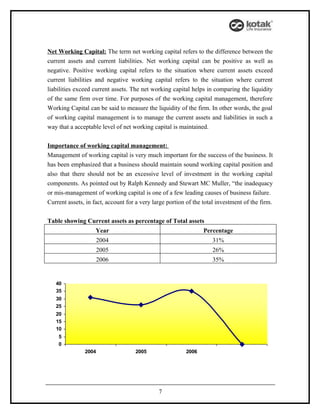
Table showing Current assets as percentage of Total assets
                    Year                                         Percentage
                      2004                                          31%
                      2005                                          26%
                      2006                                          35%


   40
   35
   30
   25
   20
   15
   10
    5
    0
               2004                 2005                 2006


                                              7
It can be visualized from the table that in the first year of our study i.e. 2004 it was 31%
which was reduced to 26% in the next year and in 2006 it is 35% shows fluctuating trend.


Determinants of Working Capital:
There is no specific method to determine working capital requirement for a business.
There are a number of factors affecting the working capital requirement. These factors
have different importance in different businesses and at different times. So a thorough
analysis of all these factors should be made before trying to estimate the amount of
working capital needed. Some of the different factors are mentioned here below:-


   1. Nature of business: Nature of business is an important factor in determining the
      working capital requirements. There are some businesses which require a very
      nominal amount to be invested in fixed assets but a large chunk of the total
      investment is in the form of working capital. There businesses, for example, are
      of the trading and financing type. There are businesses which require large
      investment in fixed assets and normal investment in the form of working capital.
   2. Size of business: It is another important factor in determining the working capital
      requirements of a business. Size is usually measured in terms of scale of
      operating cycle. The amount of working capital needed is directly proportional to
      the scale of operating cycle i.e. the larger the scale of operating cycle the large
      will be the amount working capital and vice versa.
   3. Business Fluctuations: Most business experience cyclical and seasonal
      fluctuations in demand for their goods and services. These fluctuations affect the
      business with respect to working capital because during the time of boom, due to
      an increase in business activity the amount of working capital requirement
      increases and the reverse is true in the case of recession. Financial arrangement
      for seasonal working capital requirements are to be made in advance.
   4. Production Policy: As stated above, every business has to cope with different
      types of fluctuations. Hence it is but obvious that production policy has to be
      planned well in advance with respect to fluctuation. No two companies can have
      similar production policy in all respects because it depends upon the
      circumstances of an individual company.


                                             8
5. Firm’s Credit Policy: The credit policy of a firm affects working capital by
   influencing the level of book debts. The credit term is fairly constant in an
   industry but individuals also have their role in framing their credit policy. A
   liberal credit policy will lead to more amount being committed to working capital
   requirements whereas a stern credit policy may decrease the amount of working
   capital requirement appreciably but the repercussions of the two are not simple.
   Hence a firm should always frame a rational credit policy based on the credit
   worthiness of the customer.
6. Availability of Credit: The terms on which a company is able to avail credit
   from its suppliers of goods and devices credit/also affects the working capital
   requirement. If a company in a position to get credit on liberal terms and in a
   short span of time then it will be in a position to work with less amount of
   working capital. Hence the amount of working capital needed will depend upon
   the terms a firm is granted credit by its creditors.
7. Growth and Expansion activities: The working capital needs of a firm increases
   as it grows in term of sale or fixed assets. There is no precise way to determine
   the relation between the amount of sales and working capital requirement but one
   thing is sure that an increase in sales never precedes the increase in working
   capital but it is always the other way round. So in case of growth or expansion the
   aspect of working capital needs to be planned in advance.
8. Price Level Changes: Generally increase in price level makes the commodities
   dearer. Hence with increase in price level the working capital requirements also
   increases. The companies which are in a position to alter the price of these
   commodities in accordance with the price level changes will face fewer problems
   as compared to others. The changes in price level may not affect all the firms in
   same way. The reactions of all firms with regards to price level changes will be
   different from one other.


                                        9
CIRCULATION SYSTEM OF WORKING CAPITAL


In the beginning the funds are obtained by issuing shares, often supplemented by long
term borrowings. Much of these collected funds are used in purchasing fixed assets and
remaining funds are used for day to day operation as pay for raw material, wages
overhead expenses. After this finished goods are ready for sale and by selling the finished
goods either account receivable are created and cash is received. In this process profit is
earned. This account of profit is used for paying taxes, dividend and the balance is
ploughed in the business.
Working capital is considered to efficiently circulate when it turns over quickly. As
circulation increases, the investment in current assets will decrease. Current assets
turnover ratio speaks about the efficiency of Kotak Mahindra in the utilisation of current
assets. Fast turnover current assets results in a better rate on investment.


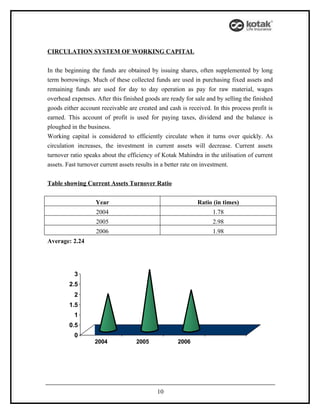
Table showing Current Assets Turnover Ratio


                   Year                                     Ratio (in times)
                   2004                                           1.78
                   2005                                           2.98
                   2006                                           1.98
Average: 2.24


          3
        2.5
          2
        1.5
          1
        0.5
          0
                   2004            2005             2006


                                            10
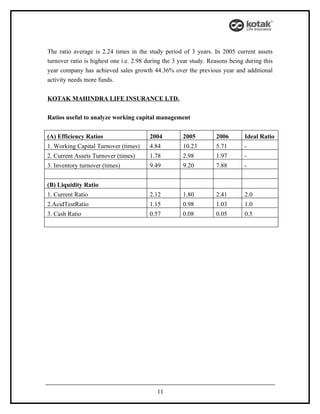
The ratio average is 2.24 times in the study period of 3 years. In 2005 current assets
turnover ratio is highest one i.e. 2.98 during the 3 year study. Reasons being during this
year company has achieved sales growth 44.36% over the previous year and additional
activity needs more funds.


KOTAK MAHINDRA LIFE INSURANCE LTD.


Ratios useful to analyze working capital management


(A) Efficiency Ratios                   2004          2005         2006       Ideal Ratio
1. Working Capital Turnover (times)     4.84          10.23        5.71       -
2. Current Assets Turnover (times)      1.78          2.98         1.97       -
3. Inventory turnover (times)           9.49          9.20         7.88       -


(B) Liquidity Ratio
1. Current Ratio                        2.12          1.80         2.41       2.0
2.AcidTestRatio                         1.15          0.98         1.03       1.0
3. Cash Ratio                           0.57          0.08         0.05       0.5


                                           11
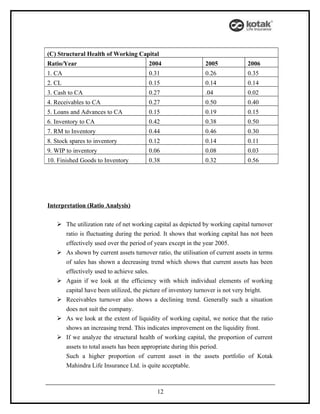
(C) Structural Health of Working Capital
Ratio/Year                              2004                  2005             2006
1. CA                                   0.31                  0.26             0.35
2. CL                                   0.15                  0.14             0.14
3. Cash to CA                           0.27                  .04              0.02
4. Receivables to CA                    0.27                  0.50             0.40
5. Loans and Advances to CA             0.15                  0.19             0.15
6. Inventory to CA                      0.42                  0.38             0.50
7. RM to Inventory                      0.44                  0.46             0.30
8. Stock spares to inventory            0.12                  0.14             0.11
9. WIP to inventory                     0.06                  0.08             0.03
10. Finished Goods to Inventory         0.38                  0.32             0.56


Interpretation (Ratio Analysis)


    The utilization rate of net working capital as depicted by working capital turnover
     ratio is fluctuating during the period. It shows that working capital has not been
     effectively used over the period of years except in the year 2005.
    As shown by current assets turnover ratio, the utilisation of current assets in terms
     of sales has shown a decreasing trend which shows that current assets has been
     effectively used to achieve sales.
    Again if we look at the efficiency with which individual elements of working
     capital have been utilized, the picture of inventory turnover is not very bright.
    Receivables turnover also shows a declining trend. Generally such a situation
     does not suit the company.
    As we look at the extent of liquidity of working capital, we notice that the ratio
     shows an increasing trend. This indicates improvement on the liquidity front.
    If we analyze the structural health of working capital, the proportion of current
     assets to total assets has been appropriate during this period.
     Such a higher proportion of current asset in the assets portfolio of Kotak
     Mahindra Life Insurance Ltd. is quite acceptable.


                                           12
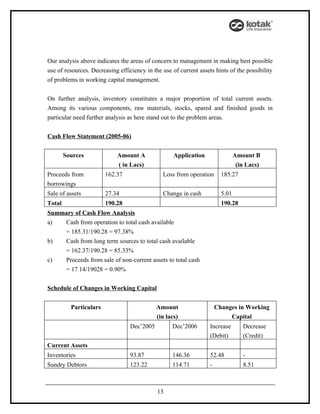
Our analysis above indicates the areas of concern to management in making best possible
use of resources. Decreasing efficiency in the use of current assets hints of the possibility
of problems in working capital management.


On further analysis, inventory constitutes a major proportion of total current assets.
Among its various components, raw materials, stocks, spared and finished goods in
particular need further analysis as here stand out to the problem areas.


Cash Flow Statement (2005-06)


        Sources             Amount A                Application                 Amount B
                            ( in Lacs)                                           (in Lacs)
Proceeds from           162.37                 Loss from operation       185.27
borrowings
Sale of assets          27.34                  Change in cash            5.01
Total                   190.28                                           190.28
Summary of Cash Flow Analysis
a)  Cash from operation to total cash available
    = 185.31/190.28 = 97.38%
b)  Cash from long term sources to total cash available
    = 162.37/190.28 = 85.33%
c)  Proceeds from sale of non-current assets to total cash
    = 17 14/19028 = 0.90%


Schedule of Changes in Working Capital


          Particulars                        Amount                    Changes in Working
                                             (in lacs)                      Capital
                                  Dec’2005         Dec’2006        Increase        Decrease
                                                                   (Debit)         (Credit)
Current Assets
Inventories                       93.87            146.36          52.48           -
Sundry Debtors                    123.22           114.71          -               8.51


                                             13
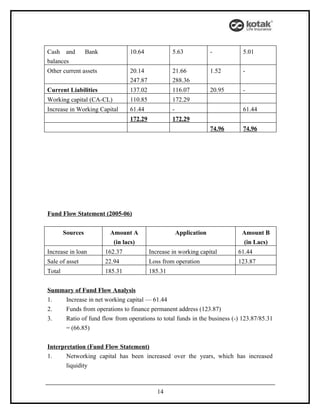
Cash and          Bank            10.64             5.63              -        5.01
balances
Other current assets              20.14             21.66             1.52     -
                                  247.87            288.36
Current Liabilities               137.02            116.07            20.95    -
Working capital (CA-CL)           110.85            172.29
Increase in Working Capital       61.44             -                          61.44
                                  172.29            172.29
                                                                      74.96    74.96


Fund Flow Statement (2005-06)


        Sources           Amount A                      Application            Amount B
                           (in lacs)                                           (in Lacs)
Increase in loan         162.37            Increase in working capital        61.44
Sale of asset            22.94             Loss from operation                123.87
Total                    185.31            185.31


Summary of Fund Flow Analysis
1.  Increase in net working capital — 61.44
2.  Funds from operations to finance permanent address (123.87)
3.  Ratio of fund flow from operations to total funds in the business (-) 123.87/85.31
    = (66.85)


Interpretation (Fund Flow Statement)
1.     Networking capital has been increased over the years, which has increased
       liquidity


                                              14
2.   Company should take corrective actions to covert loss from operation to funds
     from operation.


                                      15
CH NO. 4: COMPANY PROFILE

CREATING BANKING HISTORY


Established in 1985, The Kotak Mahindra group has long been one of India's most
reputed financial organizations. In February 2006, Kotak Mahindra Finance Ltd, the
group's flagship company was given the license to carry on banking business by the
Reserve Bank of India (RBI). This approval creates banking history since Kotak
Mahindra Finance Ltd. is the first company in India to convert to a bank.


The Complete Bank
At Kotak Mahindra Bank, we address the entire spectrum of financial needs for
individuals and corporates. We have the products, the experience, the infrastructure and
most importantly the commitment to deliver pragmatic, end-to-end solutions that really
work.
* A license authorizing the bank to carry on banking business has been obtained from the
Reserve Bank of India in terms of Section 22 if the Banking Regulation Act, 1949. It
must be distinctly understood, however, that in issuing the license, the Reserve Bank of
India does not undertake any responsibility for the financial soundness of the bank or the
correctness of any of the statements made or opinion expressed in this connection.


The Kotak Mahindra Group
Kotak Mahindra is one of India's leading financial conglomerates, offering complete
financial solutions that encompass every sphere of life. From commercial banking, to
stock broking, to mutual funds, to life insurance, to investment banking, the group caters
to the financial needs of individuals and corporates.
The group has a net worth of over Rs. 3,200 crore, employs around 10,800 people in its
various businesses and has a distribution network of branches, franchisees, representative
offices and satellite offices across 300 cities and towns in India and offices in New York,
London, Dubai, Mauritius and Singapore. The Group services around 2.6 million
customer accounts.


                                            16
Our Story
The Kotak Mahindra Group was born in 1985 as Kotak Capital Management Finance
Limited. This company was promoted by Uday Kotak, Sidney A. A. Pinto and Kotak &
Company. Industrialists Harish Mahindra and Anand Mahindra took a stake in 1986, and
that's when the company changed its name to Kotak Mahindra Finance Limited.
Since then it's been a steady and confident journey to growth and success.


1986    Kotak Mahindra Finance Limited starts the activity of Bill Discounting

1987    Kotak Mahindra Finance Limited enters the Lease and Hire Purchase market

1990    The Auto Finance division is started

        The Investment Banking Division is started. Takes over FICOM, one of India's
1991
        largest financial retail marketing networks

1992    Enters the Funds Syndication sector

        Brokerage and Distribution businesses incorporated into a separate company -
1995    Kotak Securities. Investment Banking division incorporated into a separate
        company - Kotak Mahindra Capital Company

        The Auto Finance Business is hived off into a separate company - Kotak
        Mahindra Prime Limited (formerly known as Kotak Mahindra Primus Limited).
1996    Kotak Mahindra takes a significant stake in Ford Credit Kotak Mahindra
        Limited, for financing Ford vehicles. The launch of Matrix Information Services
        Limited marks the Group's entry into information distribution.

        Enters the mutual fund market with the launch of Kotak Mahindra Asset
1998
        Management Company.

        Kotak Mahindra ties up with Old Mutual plc. for the Life Insurance business.
        Kotak Securities launches its on-line broking site (now
2000
        www.kotaksecurities.com). Commencement of private equity activity through
        setting up of Kotak Mahindra Venture Capital Fund.

2004    Matrix sold to Friday Corporation Launches Insurance Services.

        Kotak Mahindra Finance Ltd. converts to a commercial bank - the first Indian
2006
        company to do so.


                                          17
2004   Launches India Growth Fund, a private equity fund.

       Kotak Group realigns joint venture in Ford Credit; Buys Kotak Mahindra Prime
       (formerly known as Kotak Mahindra Primus Limited) and sells Ford credit
2005
       Kotak Mahindra.
       Launches a real estate fund

       Bought the 25% stake held by Goldman Sachs in Kotak Mahindra Capital
2006
       Company and Kotak Securities


                                        18
CH NO. 5: INDUSTRY PROFILE


Our Corporate Identity


Kotak Mahindra Bank
At Kotak Mahindra Bank, we address the entire spectrum of financial needs for
individuals and corporates. We have the products, the experience, the infrastructure and
most importantly the commitment to deliver pragmatic, end-to-end solutions that really
work.

Kotak Mahindra Old Mutual Life Insurance Ltd.
Kotak Mahindra Old Mutual Life Insurance is a 76:24 joint venture between Kotak
Mahindra Bank Ltd. and Old Mutual plc. Kotak Mahindra Old Mutual Life Insurance is
one of the fastest growing insurance companies in India and has shown remarkable
growth since its inception in 2004.
Old Mutual, a company with 160 years experience in life insurance, is an international
financial services group listed on the London Stock Exchange and included in the FTSE
100 list of companies, with assets under management worth $ 400 Billion as on 30th
June, 2006. For customers, this joint venture translates into a company that combines
international expertise with the understanding of the local market.
 Every child is different. Each has their own set of dreams and aspirations. As a parent
you would like to provide your child with all the building blocks that could develop his
or her potential to the fullest. This could mean extra coaching or tuition for talented
children, special training or equipment for natural athletes or professional training for
born singers.


                                           19
 HEADSTART CHILD PLANS
 A specially tailored, cost-effective plan, aims to give your children the financial means
to pursue his or her dreams and live them.


The Headstart Advantage:
  • Choice of 2 plan variants
         o Future Protect
         o Assure Wealth
   •   Maximizes wealth while providing protection
   •   Joint life option
   •   Save for 2 children with one plan
   •   Additional bonus units
   •   Flexible Withdrawal


Life is unpredictable, but the earlier you start planning for your future, the more likely
are you and your family to reap the rewards.

    SUKHI JEEVAN
 It is a long-term savings and protection plan that keeps pace with your changing needs at
every step of life - be it saving for your kids’ future, or your retirement. This plan helps
you prepare for important milestones in your life. And, most importantly, it ensures your
family is secure when life dishes up harsh misfortunes.


Benefits
  • Fulfill your children’s dreams or plan your retirement
  • Small savings to meet your varying needs
  • Regular bonuses
  • Easy application:
         o Simple documentation
         o No medical tests*
         o Hassle–free sign-up
   •   Premium payment options: yearly, half-yearly or monthly (through ECS only)


                                            20
 KOTAK PRIVILEGED ASSURANCE PLAN
“In this policy, the investment risk in the investment portfolio is borne by the
policyholder.”
 Kotak Privileged Assurance Plan is exclusively crafted to ensure that while your money
is protected, it multiplies. Concocting the best mix of steady and stable growth with
dynamic and flexible management of your funds, the plan strives to give you that extra
bit of return, protection and flexibility, in a single plan made specially for discerning
customers like you. The plan offers you access to two# funds to provide you avenue for
growth while offering you Capital Guarantee.
 Please note that in this policy, the investment risk in the investment portfolio is to be
borne by the policyholder. However, Kotak Life Insurance offers you a capital guarantee
on this plan to safeguard against the downside risk of falling markets.
 "Why should you invest in the Kotak Privileged Assurance Plan?"
 This plan is ideal if you want
    • Low cost structure on an investment plus insurance package
    • A short investment horizon
    • Flexibility of investment amounts
    • Protection of your hard earned money
    • Aggressive growth with calculated risks
    • Smart protection for your family


    KOTAK TERM PLAN
 Kotak Term Plan is a pure risk product that aims to cover your life at a nominal cost.
You may want to take this plan to cover your outstanding debts like a mortgage, a home
loan etc. Since this is a pure risk cover product, there is no maturity benefits payable on
survival. This is a non-participating plan.


"Who can avail of this plan?"
  • HOW OLD DO YOU HAVE TO BE TO AVAIL OF THIS PLAN?
        Minimum age - 18 years
        Maximum age - 60 years

    •   FOR WHAT TERM CAN I AVAIL OF THIS PLAN?
        10 - 30 years for regular premium
        5 - 30 years for single premium


                                            21
•   WHAT IS THE MINIMUM PREMIUM THAT I NEED TO PAY AND AT
       WHAT INTERVALS CAN I PAY THEM?
       Quarterly      Rs.540
       Half Yearly    Rs.1055
       Annually       Rs.2000
       Single Premium Rs.10000

   •   WHAT IS THE MAXIMUM AGE THAT THE PLAN CAN COVER YOU
       TILL?
       70 years


"What are the advantages of this plan?"
  1. It is a low-cost insurance plan.
  2 You can choose between a regular premium payment option or a single premium
     payment option.
  3 In case you opt for the regular premium payment option, you may pay your
     premiums either annually, or in half yearly or quarterly installments.
  4 Your Kotak Term Plan can be converted into any other plan offered by Kotak
     Life Insurance (except for another Term plan) provided there are at least 5 years
     before cover ceases*.
  5 In case you forget to pay your premium by the due date, you are entitled to a
     grace period of 30 days from the date of unpaid premiums.
  6 In case of a financial emergency, you have the option to surrender the policy
     provided you have taken the single premium payment option*.


 "What value-adds can you opt for?"
 You may avail of the following non-participating value-adds for a nominal premium at
the time of taking your policy, subject to aggregate premium on all value-adds (except
Critical Illness Benefit) not exceeding 30% of the basic Kotak Term Plan premium.


    Accidental Death Benefit: This benefit provides an additional amount (over and
     above the basic sum assured) to the beneficiary in the event of the accidental
     death of the life insured. The maximum cover available under this rider is equal
     to the basic sum assured (subject to a maximum of Rs.10 lakhs).


                                         22
 Permanent Disability Benefit: This benefit can be added to your basic life
      insurance policy to provide financial support in case of disability due to an
      accident. The amount payable under this benefit would be paid out as an annuity.
      The maximum permanent disability benefit that you can avail of is equal to the
      basic sum assured (subject to a maximum of Rs.10 lakhs).
     Critical Illness Benefit: This benefit can be added to your basic life insurance
      policy to provide financial support in the event of a medical emergency. On the
      first occurrence of critical illness during the term of the policy, you would
      receive a portion of the sum assured to reduce your financial burden in this
      emergency.


"What do you receive on maturity of the policy?"
Since this is a pure risk cover plan, there are no maturity benefits.


"What happens in the event of death of the life insured?"
In the event of death during the term of the policy, the beneficiary would receive the sum
assured.


 "Are there any Tax Benefits?"
 Section 80C, 10(10D) of Income Tax Act would apply. Premiums paid for Critical
Illness Benefit qualify for benefits under Section 80D. These benefits are as per the
currently prevailing tax regulations and you are advised to consult your tax advisor for
details.
 "How does this plan work?"
 To explain, how his plan works….
 Mr. Sanjay Gupta, a 30-year-old male, decides to buy the Kotak Term Plan for a sum
assured of Rs.10, 00,000 for a 10 year term. The annual premium that Mr.Gupta pays is
Rs.3, 747 annually. In the event of his unfortunate death during the next ten years, his
family would receive Rs.10, 00,000.
 In the illustration, some benefits are guaranteed and some are variable. Guaranteed
Returns are marked "guaranteed" in the illustration. Variable returns are shown at two
different rates of assumed future returns. These assumed rates of return are not
guaranteed and they are not the upper or lower limits of what you might get back .The
actual return may be different depending on a number of factors including future
investment performance.


                                             23
"What do you do next?"
To find out more about this plan, you can call us at any Kotak Life Insurance Branch
Offices or send us an e-mail at lifeexpert@kotak.com.


 "Exclusions"
In case the life insured commits suicide within 1 (one) year of the plan, no benefits
outlined in the plan would be payable.


Exclusions for Accidental Death Benefit, Permanent Disability Benefit & Critical
Illness Benefit:
he Accidental Death Benefit, Permanent Disability Benefit & Critical Illness Benefit
would not be paid out in the following circumstances:
a) Self inflicted injuries, suicide, insanity, immorality, committing any breach of law or
    being under the influence of drugs, liquor etc.
b) When the life insured is engaged in aviation or aeronautics other than as a passenger
    on a licensed commercial aircraft operating on a scheduled route.
c) Due to injuries from war (whether war is declared or not), invasion, hunting, other
    dangerous hobbies or activities, or having been on duty in military, para-military,
    security or police organization.


Additional Exclusions for Critical Illness:
a) Unreasonable failure to seek or follow medical advice.
b) Any pre-existing medical conditions not disclosed at inception.
c) Infection with Human Immunodeficiency Virus (HIV) or conditions due to acquired
    Immune Deficiency Syndrome (AIDS).
In addition, no benefit would be paid in respect of the exclusions specific to each critical
illness.


"Prohibition of Rebates"
Section 41 of the Insurance Act, 1938 states: -
       (1) No person shall allow or offer to allow, either directly or indirectly, as an
           inducement to any person to take out or renew or continue an insurance in
           respect of any kind of risk relating to lives or property in India, any rebate of
           the whole or part of the commission payable or any rebate of the premium


                                            24
shown on the policy, nor shall any person taking out or renewing or
           continuing a policy accept any rebate, except such rebate as may be allowed
           in accordance with the published prospectuses or tables of the insurer.
       (2) Any person making default in complying with the provision of this section
           shall be punishable with fine, which may extend to five hundred rupees.
           The product leaflet gives only the salient features of the plan. The policy
           document is the conclusive document, and provides in detail all the
           conditions relating to the Kotak Term Plan.

    KOTAK PREFFERED TERM PLAN
 The Kotak Preferred Term Plan is designed to provide you with reduced premium rates
for a sum assured of Rs.10 lakhs and above.


"Who is eligible for Kotak Preferred Term Plan?"
1) Males over the age of 18 years, who do not use tobacco in any form.
2) Females over the age of 18 years.


"What are the advantages of this plan?"
  • It is a low-cost insurance plan.
  • You can choose between a regular premium payment option or a single premium
     payment option. In case you opt for the regular premium payment option, you
     may pay your premiums either annually, or in half yearly or quarterly
     installments.
  • Your Kotak Term Plan can be converted into any other plan offered by Kotak
     Life Insurance (except for another Term plan) provided there are at least 5 years
     before cover ceases*.
  • In case you forget to pay your premium by the due date, you are entitled to a
     grace period of 30 days from the date of unpaid premiums.
  • In case of a financial emergency, you have the option to surrender the policy
     provided you have taken the single premium payment option*.


 "What value-adds can you opt for?"
 You may avail of the following non-participating value-adds for a nominal premium at
the time of taking your policy, subject to aggregate premium on all value-adds (except
Critical Illness Benefit) not exceeding 30% of the basic Kotak Term Plan premium.


                                         25
 Accidental Death Benefit: This benefit provides an additional amount (over and
     above the basic sum assured) to the beneficiary in the event of the accidental
     death of the life insured. The maximum cover available under this rider is equal to
     the basic sum assured (subject to a maximum of Rs.10 lakhs).
    Permanent Disability Benefit: This benefit can be added to your basic life
     insurance policy to provide financial support in case of disability due to an
     accident. The amount payable under this benefit would be paid out as an annuity.
     The maximum permanent disability benefit that you can avail of is equal to the
     basic sum assured (subject to a maximum of Rs.10 lakhs).
      Permanent disability is defined as permanent and immediate inability to work or
      permanent loss of use of two limbs or total and permanent loss of sight.
    Critical Illness Benefit: This benefit can be added to your basic life insurance
     policy to provide financial support in the event of a medical emergency. On the
     first occurrence of critical illness during the term of the policy, you would receive
     a portion of the sum assured to reduce your financial burden in this emergency.


"What do you receive on maturity of the policy?"
Since this is a pure risk cover plan, there are no maturity benefits.


"What happens in the event of death of the life insured?"
In the event of death during the term of the policy, the beneficiary would receive the sum
assured.


 "Are there any Tax Benefits?"
 Section 80C, 10(10D) of Income Tax Act would apply. Premiums paid for Critical
Illness Benefit qualify for benefits under Section 80D. These benefits are as per the
currently prevailing tax regulations and you are advised to consult your tax advisor for
details.
* Please consult your tax advisor for details


 "How does this plan work?"
 Mr.Rajiv Sharma, 30 years old, is eligible for the Kotak Preferred Term Plan. He decides
to take up this policy for a sum assured of Rs.10, 00,000 for a term of 10 years. His
annual premium would be Rs.2, 645. In case of Mr. Sharma’s unfortunate death during


                                             26
the next ten years, his family would receive Rs.10, 00,000.
 In the illustration, some benefits are guaranteed and some are variable. Guaranteed
Returns are marked "guaranteed" in the illustration. Variable returns are shown at two
different rates of assumed future returns. These assumed rates of return are not
guaranteed and they are not the upper or lower limits of what you might get back .The
actual return may be different depending on a number of factors including future
investment performance.


 "What do you do next?"
 To find out more about this plan, you can call us at any Kotak Life Insurance Branch
Offices or send us an e-mail at lifeexpert@kotak.com.
 "Exclusions"
In case the life insured commits suicide within 1 (one) year of the plan, no benefits
outlined in the plan would be payable.


 Exclusions for Accidental Death Benefit, Permanent Disability Benefit & Critical
Illness Benefit:
 The Accidental Death Benefit, Permanent Disability Benefit & Critical Illness Benefit
would not be paid out in the following circumstances:
         a) Self inflicted injuries, suicide, insanity, immortality, committing any breach
            of law or being under the influence of drugs, liquor etc.
         b) When the life insured is engaged in aviation or aeronautics other than as a
            passenger on a licensed commercial aircraft operating on a scheduled route.
         c) Due to injuries from war (whether war is declared or not), invasion, hunting,
            other dangerous hobbies or activities, or having been on duty in military,
            para-military, security or police organization.
Additional Exclusions for Critical Illness:
         a) Unreasonable failure to seek or follow medical advice.
         b) Any pre-existing medical conditions not disclosed at inception.
         c) Infection with Human Immunodeficiency Virus (HIV) or conditions due to
            acquired Immune Deficiency Syndrome (AIDS).
In addition, no benefit would be paid in respect of the exclusions specific to each critical
illness.


                                            27
"Prohibition of Rebates"
Section 41 of the Insurance Act, 1938 states: -
       (1) No person shall allow or offer to allow, either directly or indirectly, as an
           inducement to any person to take out or renew or continue an insurance in
           respect of any kind of risk relating to lives or property in India, any rebate of
           the whole or part of the commission payable or any rebate of the premium
           shown on the policy, nor shall any person taking out or renewing or
           continuing a policy accept any rebate, except such rebate as may be allowed
           in accordance with the published prospectuses or tables of the insurer.
       (2) Any person making default in complying with the provision of this section
           shall be punishable with fine, which may extend to five hundred rupees.

How to live for today and plan for an independent tomorrow.

     KOTAK MONEY BACK PLAN
 The Kotak Money Back Plan not only covers your life, it also assures you a certain
percent of the sum assured as cash payment at regular intervals of every 5 years. It is a
savings plan with the added advantage of life cover and regular cash inflow. This plan is
ideal for planning special moments like a wedding, your child's education or purchase of
an asset etc. This is a participating plan (with profits).


"Who can avail of this Plan?"

    •   HOW OLD DO YOU HAVE TO BE TO AVAIL OF THIS PLAN?
        Minimum age- 18 years
        Maximum age- 60 years

    •   FOR WHAT TERM CAN I AVAIL OF THIS PLAN?
        15, 20 & 25 years

    •   WHAT IS THE MAXIMUM AGE THAT THE PLAN CAN COVER YOU
        TILL?
        75 years


                                            28
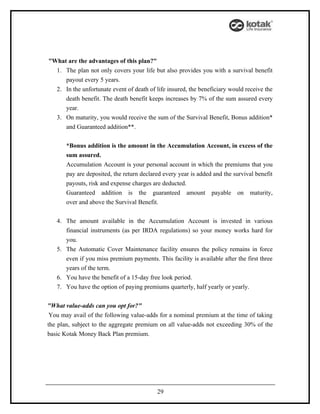
"What are the advantages of this plan?"
  1. The plan not only covers your life but also provides you with a survival benefit
     payout every 5 years.
  2. In the unfortunate event of death of life insured, the beneficiary would receive the
     death benefit. The death benefit keeps increases by 7% of the sum assured every
     year.
  3. On maturity, you would receive the sum of the Survival Benefit, Bonus addition*
     and Guaranteed addition**.


       *Bonus addition is the amount in the Accumulation Account, in excess of the
       sum assured.
       Accumulation Account is your personal account in which the premiums that you
       pay are deposited, the return declared every year is added and the survival benefit
       payouts, risk and expense charges are deducted.
       Guaranteed addition is the guaranteed amount payable on maturity,
       over and above the Survival Benefit.


   4. The amount available in the Accumulation Account is invested in various
      financial instruments (as per IRDA regulations) so your money works hard for
      you.
   5. The Automatic Cover Maintenance facility ensures the policy remains in force
      even if you miss premium payments. This facility is available after the first three
      years of the term.
   6. You have the benefit of a 15-day free look period.
   7. You have the option of paying premiums quarterly, half yearly or yearly.


"What value-adds can you opt for?"
 You may avail of the following value-adds for a nominal premium at the time of taking
the plan, subject to the aggregate premium on all value-adds not exceeding 30% of the
basic Kotak Money Back Plan premium.


                                           29
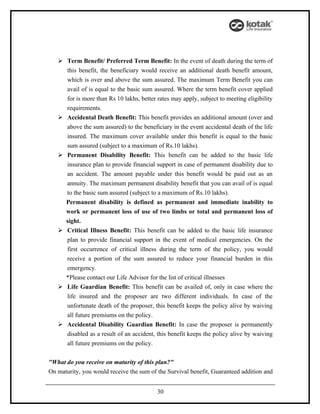
 Term Benefit/ Preferred Term Benefit: In the event of death during the term of
     this benefit, the beneficiary would receive an additional death benefit amount,
     which is over and above the sum assured. The maximum Term Benefit you can
     avail of is equal to the basic sum assured. Where the term benefit cover applied
     for is more than Rs 10 lakhs, better rates may apply, subject to meeting eligibility
     requirements.
    Accidental Death Benefit: This benefit provides an additional amount (over and
     above the sum assured) to the beneficiary in the event accidental death of the life
     insured. The maximum cover available under this benefit is equal to the basic
     sum assured (subject to a maximum of Rs.10 lakhs).
    Permanent Disability Benefit: This benefit can be added to the basic life
     insurance plan to provide financial support in case of permanent disability due to
     an accident. The amount payable under this benefit would be paid out as an
     annuity. The maximum permanent disability benefit that you can avail of is equal
     to the basic sum assured (subject to a maximum of Rs.10 lakhs).
     Permanent disability is defined as permanent and immediate inability to
     work or permanent loss of use of two limbs or total and permanent loss of
     sight.
    Critical Illness Benefit: This benefit can be added to the basic life insurance
     plan to provide financial support in the event of medical emergencies. On the
     first occurrence of critical illness during the term of the policy, you would
     receive a portion of the sum assured to reduce your financial burden in this
     emergency.
     *Please contact our Life Advisor for the list of critical illnesses
    Life Guardian Benefit: This benefit can be availed of, only in case where the
     life insured and the proposer are two different individuals. In case of the
     unfortunate death of the proposer, this benefit keeps the policy alive by waiving
     all future premiums on the policy.
    Accidental Disability Guardian Benefit: In case the proposer is permanently
     disabled as a result of an accident, this benefit keeps the policy alive by waiving
     all future premiums on the policy.


"What do you receive on maturity of this plan?"
On maturity, you would receive the sum of the Survival benefit, Guaranteed addition and


                                          30
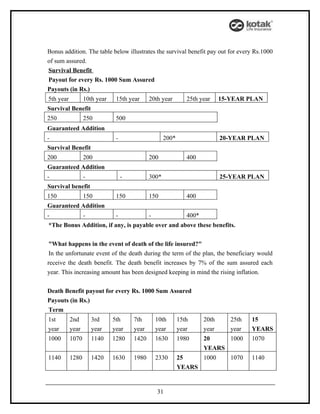
Bonus addition. The table below illustrates the survival benefit pay out for every Rs.1000
of sum assured.
Survival Benefit
Payout for every Rs. 1000 Sum Assured
Payouts (in Rs.)
5th year          10th year    15th year      20th year        25th year     15-YEAR PLAN
Survival Benefit
250               250          500
Guaranteed Addition
-                              -                     200*                    20-YEAR PLAN
Survival Benefit
200               200                         200              400
Guaranteed Addition
-                 -                -          300*                           25-YEAR PLAN
Survival benefit
150               150          150            150              400
Guaranteed Addition
-                 -            -              -                400*
*The Bonus Addition, if any, is payable over and above these benefits.


 "What happens in the event of death of the life insured?"
 In the unfortunate event of the death during the term of the plan, the beneficiary would
receive the death benefit. The death benefit increases by 7% of the sum assured each
year. This increasing amount has been designed keeping in mind the rising inflation.


Death Benefit payout for every Rs. 1000 Sum Assured
Payouts (in Rs.)
Term
1st        2nd        3rd     5th      7th        10th      15th      20th      25th   15
year       year       year    year     year       year      year      year      year   YEARS
1000       1070       1140    1280     1420       1630      1980      20    1000       1070
                                                                      YEARS
1140       1280       1420    1630     1980       2330      25    1000          1070   1140
                                                            YEARS


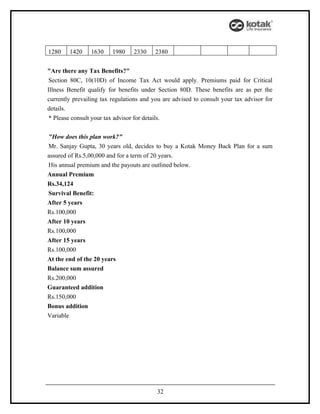
                                                  31
1280    1420     1630    1980    2330     2380


"Are there any Tax Benefits?"
 Section 80C, 10(10D) of Income Tax Act would apply. Premiums paid for Critical
Illness Benefit qualify for benefits under Section 80D. These benefits are as per the
currently prevailing tax regulations and you are advised to consult your tax advisor for
details.
 * Please consult your tax advisor for details.


"How does this plan work?"
Mr. Sanjay Gupta, 30 years old, decides to buy a Kotak Money Back Plan for a sum
assured of Rs.5,00,000 and for a term of 20 years.
His annual premium and the payouts are outlined below.
Annual Premium
Rs.34,124
Survival Benefit:
After 5 years
Rs.100,000
After 10 years
Rs.100,000
After 15 years
Rs.100,000
At the end of the 20 years
Balance sum assured
Rs.200,000
Guaranteed addition
Rs.150,000
Bonus addition
Variable


                                          32
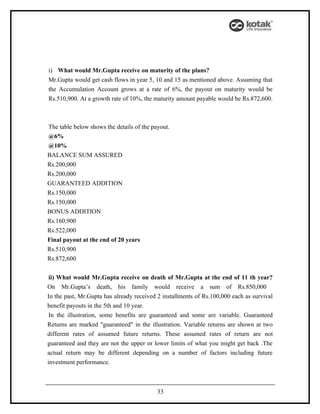
i) What would Mr.Gupta receive on maturity of the plans?
Mr.Gupta would get cash flows in year 5, 10 and 15 as mentioned above. Assuming that
the Accumulation Account grows at a rate of 6%, the payout on maturity would be
Rs.510,900. At a growth rate of 10%, the maturity amount payable would be Rs.872,600.


The table below shows the details of the payout.
@6%
@10%
BALANCE SUM ASSURED
Rs.200,000
Rs.200,000
GUARANTEED ADDITION
Rs.150,000
Rs.150,000
BONUS ADDITION
Rs.160,900
Rs.522,000
Final payout at the end of 20 years
Rs.510,900
Rs.872,600


 ii) What would Mr.Gupta receive on death of Mr.Gupta at the end of 11 th year?
On Mr.Gupta’s death, his family would receive a sum of Rs.850,000
In the past, Mr.Gupta has already received 2 installments of Rs.100,000 each as survival
benefit payouts in the 5th and 10 year.
 In the illustration, some benefits are guaranteed and some are variable. Guaranteed
Returns are marked "guaranteed" in the illustration. Variable returns are shown at two
different rates of assumed future returns. These assumed rates of return are not
guaranteed and they are not the upper or lower limits of what you might get back .The
actual return may be different depending on a number of factors including future
investment performance.


                                           33
"What do you do next?"
To find out more about our plans, you can call us at any of our branch offices or e-mail
us at lifeexpert@kotak.com.


"General exclusion"
In case the life insured commits suicide within 1 (one) year of the plan, no benefits
outlined in the plan would be payable.


Exclusions for Accidental Death Benefit, Permanent Disability Benefit & Critical
Illness Benefit:
The Accidental Death Benefit, Permanent Disability Benefit & Critical illness Benefit
would not be paid out in the following circumstances:
    a. Self inflicted injuries, suicide, insanity, immorality, committing any breach of law
        or being under the influence of drugs, liquor etc.
    b. When the life insured is engaged in aviation or aeronautics other than as a
        passenger on a licensed commercial aircraft operating on a scheduled route.
    c. Due to injuries from war (whether war is declared or not), invasion, hunting,
        other dangerous hobbies or activities, or having been on duty in military, para-
        military, security or police organization.


 Additional Exclusions for Critical Illness:
     a. Unreasonable failure to seek or follow medical advice.
     b. Any pre-existing medical conditions not disclosed at inception.
     c. Infection with Human Immunodeficiency Virus (HIV) or conditions due to
         acquired Immune Deficiency Syndrome (AIDS).
 In addition, no benefit would be paid in respect of the exclusions specific to each critical
illness.
 No claim under the Kotak Life Guardian Benefit would be admitted if, within one year
of the date of issue of this policy, the premium payer commits suicide, whether being
sane or insane at the time of committing suicide.
 No claim under the Kotak Accidental Disability Guardian Benefit would be admissible
in the following circumstances:


                                             34
a. The premium payer suffers from self-inflicted injuries, suicide, insanity,
      immorality, committing any breach of law or being under the influence of drugs,
      liquor etc.
   b. Where the premium payer is engaged in aviation or aeronautics other than as a
      passenger on a licensed commercial aircraft operating on a scheduled route.
   c. The premium payer suffers injuries from war (whether war is declared or not),
      invasion, hunting, mountaineering, motor racing of any kind, other dangerous
      hobbies or activities, or having been on duty in military, para-military, security or
      police organization.


"Prohibition of Rebates"
Section 41 of the Insurance Act, 1938 states: -
       (1) No person shall allow or offer to allow, either directly or indirectly, as an
           inducement to any person to take out or renew or continue an insurance in
           respect of any kind of risk relating to lives or property in India, any rebate of
           the whole or part of the commission payable or any rebate of the premium
           shown on the policy, nor shall any person taking out or renewing or
           continuing a policy accept any rebate, except such rebate as may be allowed
           in accordance with the published prospectuses or tables of the insurer.
       (2) Any person making default in complying with the provision of this section
           shall be punishable with fine, which may extend to five hundred rupees.

     KOTAK CHILD ADVNTAGE PLAN
 The Kotak Child Advantage Plan is an investment plan designed to meet your child's
future financial needs. It's a plan that gives your child the "azaadi" to realize his dreams.
The plan is a participating plan with a 15-day free look period.


"Who can avail of this plan?"
  • HOW OLD DOES THE CHILD HAVE TO BE TO AVAIL OF THIS PLAN?
       Minimum age - 0 years
       Maximum age -17 years


                                             35
•   FOR WHAT TERM CAN I AVAIL OF THIS PLAN?
      10 - 30 years
    • WHAT IS THE MAXIMUM SUM ASSURED ALLOWED UNDER THIS
        PLAN?
        Rs.25,00,000


"What are the advantages of this plan?"
  1. On Maturity, you would receive the sum assured plus the bonus addition. Bonus
     addition is the amount in the Accumulation Account*, in excess of the sum
     assured.
  2. The balance available in the Accumulation Account is invested in various
     financial instruments (as per IRDA regulations) so your money works hard to
     earn more for your child.
  3. The Automatic Cover Maintenance facility ensures the policy remains in force
     even if you miss premium payments. This facility is available after the first three
     years of the Term.
  4. You can take a loan against this plan, after the policy has been in force for at least
     three years.
  5. You have the option of paying premiums quarterly, half yearly or yearly.


      *Accumulation Account is your personal account in which the premiums
      that you pay are deposited,
      the return declared every year is added and risk and expense charges are
      deducted.
   6. You have the benefit of a 15 day free look period.


"What value-adds can you opt for?"
You may avail of these value adds for a nominal premium at the time of taking the plan.
The aggregate premium of the value-adds should not exceed 30% of the basic policy
premium.


     Life Guardian Benefit: In case of the unfortunate death of the premium payer,
      this benefit keeps the policy alive by waiving all future premiums on the policy.
     Accidental Disability Guardian Benefit: In case the premium payer is
      permanently disabled as a result of accident, this benefit keeps the policy alive by


                                            36
waiving all future premiums on the policy.


   "Are there any Tax Benefits?"
Section 80C, 10(10D) of Income Tax Act, 1961 would apply. You are advised to consult
your tax advisor for details.
Please consult your tax advisor for details


"How does this plan work?"
Mr.Sanjay Gupta is a 30-year-old professional and has a 6-year-old son. To secure his
child's future, Mr.Gupta decides to buy the Kotak Child Advantage Plan. He wants to
buy a plan with a sum assured of 5 lakh, term of 15 years, so that when the child is 21
years old, he has at least Rs.5 lakh to invest in his education/ career etc.
Mr. Gupta buys the Kotak Child Advantage Plan along with both the value-adds offered
with the basic plan.
Description
Premium
Kotak child advantage plan premium
Rs.31,857/-
Life guardian benefit premium
Rs.1,225/-
Accidental disability guardian benefit premium
Rs.155/-
Total Annual Premium Paid
Rs.33,237/-


i) What would be the payout on maturity of the plan?
Assuming that the Accumulation Account grows at 6%p.a., the maturity amount would
be Rs.6, 34,800/- at the end of 15 years. At a growth rate of 10%, the maturity amount
payable would be Rs. 8, 82,100/-.


 ii) In the unfortunate event of the death/ disability of the parent (premium payer),
what would the beneficiary receive?
 Mr.Gupta has taken the benefit of waiver of premium by paying a minimal additional
amount of Rs.1, 380/- per year. In the event of Mr.Gupta’s death or accidental disability,
future premiums payable on his son’s policy will be waived and the policy will continue


                                           37
to be in force. On maturity the beneficiary would get the sum assured of Rs.5,00,000
along with bonuses accrued during the term of the policy (as discussed in (i) above).
 In the illustration, some benefits are guaranteed and some are variable. Guaranteed
Returns are marked "guaranteed" in the illustration. Variable returns are shown at two
different rates of assumed future returns. These assumed rates of return are not
guaranteed and they are not the upper or lower limits of what you might get back .The
actual return may be different depending on a number of factors including future
investment performance.


"What happens in the event of death of the life insured?"
 In the event of the unfortunate death of the insured during the term of the plan, the
following would become payable:
    • If the policy has been in force for five years or if the life insured is at least 18
        years old, the beneficiary will receive either the Sum Assured or Accumulation
        Account whichever is higher, as on the date of death.
    • If the death occurs within five years from commencement of policy and if the
        insured is less than 18 years old, the death benefit would be either the total of all
        premiums paid so far or the surrender value at that time, whichever is higher.
   •
"What do you do next?"
To find out more about this plan, you can call us at any Kotak Life Insurance Branch
Offices or send us an e-mail at lifeexpert@kotak.com


 "General exclusion"
 In case the life insured commits suicide within 1 (one) year of the plan, no benefits
outlined in the plan would be payable.
 No claim under the Kotak Life Guardian Benefit would be admitted if, within one year
of the date of issue of this policy, the premium payer commits suicide, whether being
sane or insane at the time of committing suicide.
 No claim under the Kotak Accidental Disability Guardian Benefit would be admissible
in the following circumstances:
(1) The premium payer suffers from self-inflicted injuries, attempt to suicide, insanity,
     immorality, committing any breach of law or being under the influence of drugs,
     liquor etc.
(2) Where the premium payer is engaged in aviation or aeronautics other than as a


                                             38
passenger on a licensed commercial aircraft operating on a scheduled route.
(3) The premium payer suffers injuries from war (whether war is declared or not),
    invasion, hunting, mountaineering, motor racing of any kind, other dangerous
    hobbies or activities, or having been on duty in military, para-military, security or
    police organization.


"Prohibition of Rebates"
Section 41 of the Insurance Act, 1938 states: -
        (1) No person shall allow or offer to allow, either directly or indirectly, as an
            inducement to any person to take out or renew or continue an insurance in
            respect of any kind of risk relating to lives or property in India, any rebate of
            the whole or part of the commission payable or any rebate of the premium
            shown on the policy, nor shall any person taking out or renewing or
            continuing a policy accept any rebate, except such rebate as may be allowed
            in accordance with the published prospectuses or tables of the insurer.
       (2) Any person making default in complying with the provision of this section
            shall be punishable with fine, which may extend to five hundred rupees.


        KOTAK ENDOWMENT PLAN
 Kotak Endowment Plan is a protection plan that covers your life and at the same time
ensures that your money does not lie idle. It invests a portion of your premium in
financial instruments and ensures a considerable growth in savings. This is a participating
plan (with profits).
"Who can avail of this plan?"
How old do you have to be to avail of this Minimum age - 18 years
plan?                                      Maximum age - 65 years
For what term can i avail of this plan?        10-30 years
What is the maximum age that the plan can
                                          75 years
cover you till?


"What are the advantages of this plan?"
  1. On maturity, you would receive the sum assured plus the bonus addition. Bonus
     addition is the amount in the Accumulation Account*, in excess of the sum
     assured. Accumulation Account is your personal account, in which the premiums
     that you pay are deposited, the return declared every year is added and risk and


                                             39
expense charges are deducted.
   2.   The amount available in the Accumulation Account is invested in various
        financial instruments (as per IRDA regulations) so your money works harder for
        you.
   3.   The Automatic Cover Maintenance facility ensures the policy remains in force
        even if you miss premium payments. This facility is available after the first three
        years of the term.
   4.   You can take a loan against your policy, after the policy has been in force for at
        least three years.
   5.   You have the option of paying premiums quarterly, half yearly or yearly. You
        also have the flexibility to pay premiums through the full term of the policy or
        pay it for a fixed term of 3, 5, 7, 10 or 15 years.
   6.   You have the benefit of a 15-day free look period.


"What value-adds can you opt for?"
 You may avail of the following value-adDs for a nominal premium at the time of taking
the plan, subject to the aggregate premium on all value-adds not exceeding 30% of the
basic plan premium.
     Term Benefit / Preferred Term Benefit: In the event of death during the term
        of this benefit, the beneficiary would receive an additional death benefit amount,
        which is over and above the sum assured. The maximum term benefit you can
        avail of is equal to the basic sum assured. Where the Term Benefit cover applied
        for is more than Rs.10 lakhs, better rates may apply, subject to meeting eligibility
        requirements.
     Accidental Death Benefit: This benefit provides an additional amount (over and
        above the basic sum assured) to the beneficiary in the event of the accidental
        death of the life insured. The maximum cover available under this benefit is equal
        to the basic sum assured (subject to a maximum of Rs.10 lakhs).
     Permanent Disability Benefit: This benefit provides financial support in case of
        your permanent disability due to an accident. The amount payable is over and
        above the basic sum assured and would be paid out as an annuity. The maximum
        Permanent Disability Benefit that you can avail of is equal to the basic sum
        assured (subject to a maximum of Rs.10 lakhs).
        Permanent disability is defined as a permanent and immediate inability to
        work, the permanent loss of use of two limbs or a total and permanent loss of


                                            40
sight.
     Critical Illness Benefit: This benefit can be taken with the basic life insurance
      policy to provide financial support in the event of medical emergencies. On the
      first occurrence of critical illness during the term of the policy, you would
      receive a portion of the sum assured to reduce your financial burden in this
      emergency.
      The maximum Critical Illness Benefit that you can avail of is equal to half the
      basic sum assured subject to maximum of Rs. 20 lakhs.
     Life Guardian Benefit: This benefit can be availed of, only in a case where the
      life insured and the proposer are two different individuals. In case of the
      unfortunate death of the proposer, this benefit keeps the policy alive by waiving
      all future premiums on the policy.
     Accidental Disability Guardian Benefit: In case the proposer is permanently
      disabled as a result of an accident, this benefit keeps the policy alive by waiving
      all future premiums on the policy. This benefit is available also where the life
      insured is the proposer.


 "What happens in the event of death of the life insured?"
 In the event of death of the life insured during the term of the plan, the beneficiary would
receive the sum assured or the amount in the Accumulation Account, whichever is
higher.


"Are there any Tax Benefits?"
 Section 80C, 10(10D) of Income Tax Act would apply. Premiums paid for Critical
Illness Benefit qualify for benefits under Section 80D. These benefits are as per the
currently prevailing tax regulations and you are advised to consult your tax advisor for
details.


"How does this plan work?"
Mr. Sanjay Gupta, who is 30 years old, decides to buy a Kotak Endowment Plan for a
sum assured of Rs. 5,00,000 for a 20-year term for his wife, who is aged 28. Mr. Gupta
decides to take the Life Guardian Benefit as a rider to the plan. He does this to provide
enhanced security and protection to his wife.


                                             41
The annual premiums paid by Mr. Gupta are as follows
                                              Amount (Rs.)


KOTAK ENDOWMENT PLAN PREMIUM 22,552


LIFE GUARDIAN BENEFIT PREMIUM                 1,106


TOTAL ANNUAL PREMIUM PAID                     23,658


i) What would be the payout maturity?
 On maturity Sanjay Gupta would receive the sum assured or Accumulation Account,
whichever is higher.
 Assuming that the Accumulation Account grows at a rate of 6%, the payout on maturity
would be Rs. 6,93,800. At a growth rate of 10%, the maturity amount payable would be
Rs. 10,97,700.


ii) What would happen in the event of Mr.Gupta’s unfortunate death at the end of
10th year?
 Since Mr. Gupta is the proposer on Mrs. Gupta’s policy and has availed of the Life
Guardian Benefit, all future premiums on Mrs. Gupta’s policy would be waived.
Thereafter the policy will continue as if the premiums are being paid regularly. On
maturity of her policy Mrs. Gupta would receive amounts as discussed above.*


* Assuming that the Accumulation Account grows at 6% and 10% respectively p.a.


 In the illustration, some benefits are guaranteed and some are variable. Guaranteed
Returns are marked "guaranteed" in the illustration. Variable returns are shown at two
different rates of assumed future returns. These assumed rates of return are not
guaranteed and they are not the upper or lower limits of what you might get back .The
actual return may be different depending on a number of factors including future
investment performance.


                                         42
CH NO. 6: SWOT ANALYSIS

STRENGTHS
  •   Market position is strong
  •   Aggressive foreign bank
  •   Shareholders return has grown more than 7 times
  •   Maintains a position as a leading Asian Cash Management provider
  •   Brand – Kotak Bank modern and dynamic look appeals to the growing middle
      income earners
  •   Improved product proposition
  •   Better geographic balances

WEAKNESS
  •   HDFC, IDBI, ABN-AMBRO, Citibank and ICICI Bank are dominant players
  •   Has disadvantage due to last entry
  •   Fewer locations as compared to other MNC banks
  •   Service delivery perception is weak

OPPORTUNITIES
  •   Branch expansion for rapid growth
  •   Increase focus on value creation in whole banking
  •   Improve shareholders return
  •   Build market share in consumer banking as consumer banking continues to offer
      highest potential for growth
  •   Broadening of the demographic base
  •   Tie ups with master card networks
  •   Integrated sales and service approach
  •   Can offer a complete corporate package under proposed corporate relationship
  •
THREATS
  •   ICICI is pitching in quite aggressively
  •   Citibank is expanding in new markets
  •   Competitive products and offers from IDBI and HDFC
  •   Proposed networking of all branches in next 6 months


                                         43
CH NO. 7: DATA COLLECTION

A semi-structured kind of questionnaire was designed which contain both open- ended
and multiple choice questions.
The questionnaire designed was to provide dual information sharing type, it is seriously
undertaken that anyone who in undergoing the process, should find his interest or else he
might show disinterest towards the programme. Actually, I have been dressing my
project as the awareness programme. This awareness programme provided all those
filling up of the questionnaire with enough information about the services of the Kotak
Mahindra Old Mutual Life Insurance. Thus the questionnaire was equally important both
ways to the customers as well as to the bank to draw out its prospects.
The questionnaire designed to know the potential of the customer and help as a
successful programme visiting the offices and small business enterprises without pre-
appointment also provided me with information about that they demand from a new bank
where they would prefer to open an account.
For those already holding a relationship with the Kotak Mahindra Old Mutual Life
Insurance, shared with me their opinion about the back and its services as well as
suggestions were also obtained from them of how to attract more potentiality for the
bank.

                               SAMPLING PLAN

I have been assigned to visit the offices and small business firms in Delhi. I was free to
choose my area. Hence I choose areas near the Bank or places where I could feel greater
prospects, such a places where small shopping malls or new business firms have come
out and over the industrial belts where several offices could be found out.
The sample areas I choose was the following:
           • Noida
           • Punjabi Bagh
           • Lawrence Road
           • Gurgaon
I was advised not to visit the bigger companies because they were not our target
customers.


                                           44
FIELD WORK PLAN

The field work was carried according the sampling plan formed. I visited the offices and
small business enterprises /firms under my own limitations and time constraint at the
following places.
    (a) Noida
    (b) Punjabi Bagh
    (c) Lawrence Road
    (d) Gurgaon
At some of the offices appointment were already made while at many places I visited,
without pre-appointments.
The main motive for these visits was to identify the potential customers or the potential
market. A two-way discussion was done through which the customers were made aware
of the services of Kotak Mahindra. The questionnaires are either directly filled up or
indirectly filled up by the people through this as well as the prospect of the areas as such
were these campaigns were put up.


                                            45
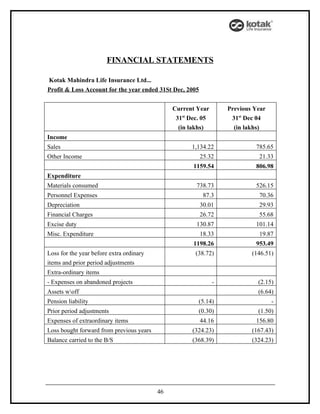
FINANCIAL STATEMENTS

Kotak Mahindra Life Insurance Ltd...
Profit & Loss Account for the year ended 31St Dec, 2005


                                               Current Year        Previous Year
                                                31st Dec. 05        31st Dec 04
                                                 (in lakhs)          (in lakhs)
Income
Sales                                                1,134.22               785.65
Other Income                                              25.32              21.33
                                                      1159.54               806.98
Expenditure
Materials consumed                                     738.73               526.15
Personnel Expenses                                         87.3              70.36
Depreciation                                              30.01              29.93
Financial Charges                                         26.72              55.68
Excise duty                                            130.87               101.14
Misc. Expenditure                                         18.33              19.87
                                                      1198.26               953.49
Loss for the year before extra ordinary                (38.72)             (146.51)
items and prior period adjustments
Extra-ordinary items
- Expenses on abandoned projects                               -             (2.15)
Assets woff                                                                 (6.64)
Pension liability                                       (5.14)                     -
Prior period adjustments                                (0.30)               (1.50)
Expenses of extraordinary items                           44.16             156.80
Loss bought forward from previous years               (324.23)             (167.43)
Balance carried to the B/S                            (368.39)             (324.23)


                                          46
Balance Sheet as at 31 Dec 2005


                                          As on 31st Dec 05   As on 31st Dec 04
                                              (In Lacs)           (In Lacs)
Source of Funds
Shareholders funds
Share capital                                        734.20               834.20
Reserve and surplus                                   21.00
                                                     755.20               855.20
Loan Funds
Secured loans                                        198.09               217.96
Unsecured loans                                        0.04                 2.95
                                                     198.13               220.91
                                                     953.33               976.11
Application of funds
Fixed Asset
Gross block                                          520.94               493.93
Less: Depreciation                                   125.09                95.21
                                                     395.85               398.72
Capital W.I.P.                                         1.58                 2.69
Net book value                                       397.43               401.41
Investments                                            0.10                       -
Current Assets, Loans and Advances
Inventories                                           93.87               129.57
Sundry Debtors                                       123.22                82.75
Cash& Bank Balances                                   10.64                82.20
Other current Assets                                  20.14                11.42
Loans and advances                                    47.06                45.68
                                                     294.93               351.62


                                     47
As at Dec 31 2005    As at Dec 31.2004
Less: Current Liabilities Provisions
Current Liabilities                                       137.02               143.68
Provisions                                                 15.73                  8.56
                                                          152.75               152.24
Net current assets                                        142.18               199.38
Miscellaneous Expenditure (Total extent                    45.23                 51.09
not written off adjusted)
Profit and loss                                           368.39               324.23
                                                          953.33              1076.11

Profit & Loss Account for the year ended 31st Dec, 2006


                                               Current Year 31      Previous Year 31
                                                   Dec 06                Dec 05
                                                  (In Lacs)            (In Lacs)
Income
Sales                                                     903.92              1134.22
Other Income                                               34.09                 25.32
                                                          987.04              1159.54
Expenditure
Materials Consumed                                        621.23               738.73
Personnel Expenses                                        104.58                 87.33
Mfg Other expenses                                        172.48               166.27
Dep / Amortisation                                         34.38                 30.01
Financial Charges                                          30.57                 26.72
Excise duty                                               120.04               130.87
Mis Expenditure W/off                                      20.28                 18.33
                                                         1224.32              1198.26
Loss for the year before extra ordinary                 (116.88)               (38.72)
items and prior period adjustments
Extra ordinary items:
Expenses on abandoned project W/off                            --                   --
Assets W/off                                                   --                   --
Pension liability                                              --                 5.14


                                          48
Prior period adjustments                                        --                  0.30
Loss after prior pd. Exp. & extra-ord.                 (116.88)                  (44.16)
Items.
Loss b/f from early years                              (368.39)                 (324.23)
Less: Amt. Adjusted         against   Cap.              (68.39)                         ---
Reduction300
Loss: c/f to B/S                                       (185.27)                 (368.39)


Balance Sheet as at 31 Dec 2006


Sources Of Funds                             31 Dec 06 (Lacs)        31 Dec 05 (Lacs)
Shareholders Fund
Capital                                                  434.20                   734.20
Reserves & Surplus                                        21.00                    21.00
                                                         455.20                   755.20
Loan Funds
Secured loans                                            360.46                   198.09
Unsecured loans                                                 --                  0.04
Application of Funds
Fixed Assets
Gross Block                                              530.59                   520.94
Less: Dep.                                               153.55                   125.09
Net Block                                                377.04                   395.85
Capital work in progress inc. capital                      3.25                     1.58
advances.
                                                         380.29                   397.43
Investments                                                0.10                     0.10
Current assets, Loans & Advances
Inventories                                              146.36                    93.87
Sundry Debtors                                           114.71                   123.22
Cash & Bank Balances                                       5.63                    10.64
Other current Assets.                                     21.66                    20.14
Loans & Advances                                          44.39                    47.06
Less: Current liabilities & Provisions


                                         49
Liabilities                      116.07   137.02
Provisions                        14.11    15.73
Net Current Assets               130.18   152.75
Misc. Expenditure                 47.43    45.23
(To the extent not w/off)
Profit & Loss A/c                185.27   368.39
Total:                           815.66   953.33


                            50
CH NO. 8: WORKING CAPITAL- OVERALL VIEW

                             CASH MANAGEMENT

Cash is the important current asset for the operations of the business. Cash is the basic
input needed to keep the business running on a continuous basis It is also the ultimate
output expected to be realised by selling the service or product manufactured by the firm.
The firm should keep sufficient cash, neither more nor less. Cash shortage will disrupt
the firm’s operations while excessive cash will simply remain idle, without contributing
anything towards the firm’s profitability. Thus a major function of the Financial Manager
is to maintain a sound cash position.
Cash is the money which a firm can disburse immediately without any restriction The
term cash includes currency and cheques held by the firm and balances in its bank
accounts. Sometimes near cash items, such as marketable securities or bank time deposits
are also included in cash. The basic characteristics of near cash assets are that they can
readily be converted into cash. Cash management is concerned with managing of:


i)      Cash flows in and out of the firm
ii)     Cash flows within the firm
iii)    Cash balances held by the firm at a point of time by financing deficit or inverting
        surplus cash.
Sales generate cash which has to be disbursed out. The surplus cash has to be invested
while deficit cash has to be borrowed. Cash management seeks to accomplish this cycle
at a minimum cost. At the same time it also seeks to achieve liquidity and control.
Therefore the aim of Cash Management is to maintain adequate control over cash
position to keep firm sufficiently liquid and to use excess cash in some profitable way.
The Cash Management is also important because it is difficult to predict cash flows
accurately. Particularly the inflows and that there is no perfect coincidence between the
inflows and outflows of the cash. During some periods cash outflows will exceed cash
inflows because payment for taxes, dividends or seasonal inventory build up etc. On the
other hand cash inflows will be more than cash payment because there may be large cash
sales and more debtors’ realization at any point of time. Cash Management is also
important because cash constitutes the smallest portion of the current assets, yet
management’s considerable time is devoted in managing it. An obvious aim of the firm
now-a-days is to manage its cash affairs in such a way as to keep cash balance at a


                                            51
minimum level and to invest the surplus cash funds in profitable opportunities. In order
to resolve the uncertainty about cash flow prediction and lack of synchronization
between cash receipts and payments, the firm should develop appropriate strategies
regarding the following four facets of cash management.


1. Cash Planning: - Cash inflows and cash outflows should be planned to project cash
   surplus or deficit for each period of the planning period. Cash budget should prepared
   for this purpose.
2. Managing the cash flows: - The flow of cash should be properly managed. The cash
   inflows should be accelerated while, as far as possible decelerating the cash outflows.
3. Optimum cash level: - The firm should decide about the appropriate level of cash
   balances. The cost of excess cash and danger of cash deficiency should be matched to
   determine the optimum level of cash balances.
4. Investing surplus cash: - The surplus cash balance should be properly invested to
   earn profits. The firm should decide about the division of such cash balance between
   bank deposits, marketable securities and inter corporate lending.


The ideal Cash Management system will depend on the firm’s products, organisation
structure, competition, culture and options available. The task is complex and decision
taken can effect important areas of the firm.


Functions of Cash Management:
Cash Management functions are intimately, interrelated and intertwined Linkage among
different Cash Management functions have led to the adoption of the following methods
for efficient Cash Management:
     Use of techniques of cash mobilization to reduce operating requirement of cash
     Major efforts to increase the precision and reliability of cash forecasting.
     Maximum effort to define and quantify the liquidity reserve needs of the firm.
     Development of explicit alternative sources of liquidity
     Aggressive search for relatively more productive uses for surplus money assets.


                                           52
The above approaches involve the following actions which a finance manager has to
perform.
1. To forecast cash inflows and outflows
2. To plan cash requirements
3. To determine the safety level for cash.
4. To monitor safety level for cash
5. To locate the needed funds
6. To regulate cash inflows
7. To regulate cash outflows
8. To determine criteria for investment of excess cash
9. To avail banking facilities and maintain good relations with bankers


Motives for holding cash:
There are four primary motives for maintaining cash balances:
1. Transaction motive
2 .Precautionary motive
3. Speculative motive
4. Compensating motive


1.     Transaction motive: - The transaction motive refers to the holding of cash to
       meet anticipated obligations whose timing is not perfectly synchronised with cash
       receipts. If the receipts of cash and its disbursements could exactly coincide in the
       normal course of operations, a firm would not need cash for transaction purposes.
       Although a major part of transaction balances are held in cash, a part may also be
       in such marketable securities whose maturity conforms to the timing of the
       anticipated payments.


2.     Precautionary motive: - Precautionary motive of holding cash implies the need
       to hold cash to meet unpredictable obligations and the cash balance held in
       reserve for such random and unforeseen fluctuations in cash flows are called as
       precautionary balances. Thus, precautionary cash balance serves to provide a
       cushion to meet unexpected contingencies. The unexpected cash needs at short
       notice may be the result of various reasons as : unexpected slowdown in
       collection of accounts receivable, cancellations of some purchase orders, sharp
       increase in cost of raw materials etc. The more unpredictable the cash flows, the


                                            53
larger the need for such balances. Another factor which has a bearing on the level
     of precautionary balances is the availability of short term credit. Precautionary
     cash balances are usually held in the form of marketable securities so that they
     earn a return.


3.   Speculative motive: - It refers to the desire of a firm to take advantage of
     opportunities which present themselves at unexpected movements and which are
     typically outside the normal course of business. The speculative motive represents
     a positive and aggressive approach. Firms aim to exploit profitable opportunities
     and keep cash in reserve to do so. The speculative motive helps to take advantage
     of :In opportunity to purchase raw materials at a reduced price on payment of
     immediate cash; A chance to speculate on interest rate movements by buying
     securities when interest rates are expected to decline; delay purchases of raw
     materials on the anticipation of decline in prices; etc.


4.   Compensation motive: - Yet another motive to hold cash balances is to
     compensate banks for providing certain services and loans. Banks provide a
     variety of services to business firms , such as clearances of cheques, supply of
     credit information, transfer of funds, etc. While for some of the services banks
     charge a commission of fee for others they seek indirect compensation. Usually
     clients are required to maintain a minimum balance of cash at the bank. Since this
     balance can not be utilised by the firms for transaction purposes, the bank
     themselves can use the amount for services rendered. To be compensated for their
     services indirectly in this form, they require the clients to always keep a bank
     balance sufficient to earn a return equal to the cost of services. Such balances are
     compensating balances. Compensating balances are also required by some loan
     agreements between a bank and its customer.


                                          54
CASH MANAGEMENT: OBJECTIVES

The Basic objective of cash management is two fold:


(a) To meet the cash disbursement needs (payment schedule);
(b) To minimize funds committed to cash balances. These are conflicting and mutually
contradictory and the task of cash management is to reconcile them.


Meeting the payments schedule: - A basic objective of the cash management is to meet
the payment schedule, i.e. to have sufficient cash to meet the cash disbursement needs of
the firm. The importance of sufficient cash to meet the payment schedule can hardly be
over emphasized. The advantages of adequate cash are : (i) it prevents insolvency or
bankruptcy arising out of the inability of the firm to meet its obligations; (ii) the
relationship with the bank is not strained; (iii) it helps in fostering good relations with
trade creditors and suppliers of raw materials, as prompt payment may also help their
cash management; (v) it leads to a strong credit rating which enables the firm to purchase
goods on favorable terms and to maintain its line of credit with banks and other sources
of credit; (vi) to take advantage of favorable business opportunities that may be available
periodically; and (vi) finally the firm can meet unanticipated cash expenditure with a
minimum of strain during emergencies, such as strikes , fires or a new marketing
campaign by competitors.


Minimizing funds committed to cash balances: - The second objective of cash
management is to minimize cash balances. In minimizing cash balances two conflicting
aspects have to be reconciled. A high level of cash balance will, ensure prompt payment
together with all the advantages, but it also implies that large funds will remain idle
ultimately results less to the expected. A low level of cash balances, on the other hand,
may mean failure to meet the payment schedule that aim of cash management should be
to have an optimal amount of cash balances


                                            55
CASH MANAGEMENT TECHNIQUES & PROCESSES

The following are the basic cash management techniques and process which are helpful
in better cash management:
Speedy cash collection: In managing cash efficiently the cash in flow process can be
accelerated through systematic planning and refined techniques. These are two broad
approaches to do this which are narrated as under:
Prompt payment by customer: One way to ensure prompt payment by customer is
prompt billing with clearly defined credit policy. Another and more important technique
to encourage prompt payment the by customer is the practice of offering trade
discount/cash discount.
Early conversion of payment into cash: Once the customer has makes the payment by
writing its cheques in favor of the firm, the collection can be expedited by prompt
encashment of the cheque. It will be recalled that there is a lack between the time and
cheque is prepared and mailed by the customer and the time funds are included in the
cash reservoir of the firm.
Concentration Banking: In this system of decentralised collection of accounts
receivable, large firms which have a large no. of branches at different places, select some
of these which are strategically located as collection centers for receiving payment for
customers. Instead of all the payments being collected at the head office of the firm, the
cheques for a certain geographical areas are collected at a specified local collection
centers. Under this arrangement the customers are required to send their payments at
local collection center covering the area in which they live and these are deposited in the
local account of concerned collection, after meeting local expenses, if any. Funds beyond
a predetermined minimum are transferred daily to a central or disbursing or concentration
bank or account. A concentration banking is one with which the firm has a major account
usually a disbursement account. Hence this arrangement is referred to as concentration
banking.
Lock-Box System: The concentration banking arrangement is instrumental in reducing
the time involve in mailing and collection. But with this system of collection of accounts
receivable, processing for purposes of internal accounting is involved i.e. sometime in
elapses before a cheque is deposited by the local collection center in its account. The
lock-box system takes care of these kind of problem, apart from effecting economy in
mailing and clearance times. Under this arrangement, firms hire a post office box at
important collection centers. The customers are required to remit payments to lock-box.


                                            56
The local banks of the firm, at respective places, are authorized to open the box and pick
up the remittance received from the customers. Usually the authorised bank picks up the
cheques several times a day and deposits them in the firm’s account. After crediting the
account of the firm the banks send a deposit 4epo slip along with the list of payments and
other enclosures, if any, to the firm by way of proof and record of the collection.
Slowing disbursements: A basic strategy of cash management is to delay payments as
long as possible without impairing the credit rating/standing of the firm. In fact, slow
disbursement represents a source of funds requiring no interest payments. There are
several techniques to delay payment of accounts payable namely (1) avoidance of early
payments; (2) centralized disbursements; (3) floats; (4) accruals.
Avoidance of early payments: One way to delay payments is to avoid early payments.
According to the terms of credit, a firm is required to make a payment within a stipulated
period. It entitles a firm to cash discounts. If however payments are delayed beyond the
due date, the credit standing may be adversely affected so that the firms would find it
difficult to secure trade credit later. But if the firm pays its accounts payable before the
due date it has no special advantage. Thus a firm would be well advised not to make
payments early i.e. before the due date.
Centralized disbursements: Another method to slow down disbursements is to have
centralized disbursements. All the payments should be made by the head office from a
centralized disbursement account. Such an arrangement would enable a firm to delay
payments and conserve cash for several reasons. Firstly it involves increase in the transit
time. The remittances from the head office to the customers in distant places would
involve more mailing time than a decentralized payment by a local branch. The second
reason for reduction in operating cash requirement is that since the firm has a centralized
bank account, a relatively smaller total cash balance will be needed. In the case of a
decentralized arrangement, a minimum cash balance will have to be maintained at each
branch which will add to a large operating cash balance. Finally, schedules can be tightly
controlled and disbursements made exactly on the right day.
Float: A very important technique of slow disbursements is float. The term float refers
to amount of money tied up in the cheque that have been written, but have yet to be
collected and encashed. Alternatively, float represents the difference between the bank
balance and book balance of cash of a firm. The difference between the balance as shown
in the firm’s record and the actual bank balance is due to transit and processing delays.
There is time lag between the issue of a cheque by the firm and its presentation to its
bank by the customer’s bank for payment. The implication is that although a cheque has


                                            57
been issued cash would be required later when the cheque resented for encashment.
Therefore, a firm can send remittance although it does not have cash in its bank at the
time of issuance of cheque. Meanwhile, funds can be arranged to make payments when
the cheque is presented for collection after a few days. Float used in this sense is called
cheque kitting.
Accruals: Finally, a potential tool for stretching accounts payable is accruals which are
defined as current liabilities that represent a service or goods received by a firm but not
yet paid for. For instance, payroll, i.e. remuneration to employees, who render services in
advance and receive payment later. In a way they extend credit to the firm for a period at
the end of which they are paid, say, a week or month. The longer the period after which
payment is made, the greater the amount of free financing and the smaller the amount of
cash balances required. Thus, less frequent payrolls, i.e. monthly as compared to weekly,
are important sources of accruals. They can be manipulated to slow down disbursements.

DETERMINING THEOPTIMAL LEVEL OF CASH BALANCE:
Cash balance is maintained for the transaction purposes and additional amount may be
maintained as a buffer or safety stock.
The Finance manager should determine the appropriate amount of cash balance. Such a
decision is influenced by trade-off between risk and return. If the firm maintains a small
cash balance , its liquidity position becomes week and suffers from a paucity of cash to
make payments. But a higher profitability can be attained by investing released funds in
some profitable opportunities. When the firm runs out of cash it may have to sell its
marketable securities, if available, or borrow. This involves transaction cost.
On the other hand if the firm maintains a higher level of cash balance, it will have a
sound liquidity position but forego the opportunities to earn interests. The potential
interest lost on holding large cash balance involves opportunities cost to the firm.
Thus the firm should maintain an optimum cash balance, neither a large nor a small cash
balance.
To find out the optimum cash balance the transaction cost and risk of too small balance
should be matched with opportunity costs of too large a balance should be matched with
opportunity cost of too large a balance. Figure shows this trade-off graphically. If the
firm maintains larger cash balances its transaction cost would decline, but the opportunity
cost would increase. At point X the sum of two costs is minimum. This is the point of
optimum cash balance. Receipts and disbursement of cash are hardly in perfect
synchronization.


                                            58
Despite the absence of synchronization it is not difficult to determine the optimum level
of cash balance.
If cash flows are predictable it is simply a problem of minimizing the total costs - the
transaction cost and the opportunity cost.
The determination of optimum working cash balance under certainty can thus be viewed
as an inventory problem in which we balance the cost of too little cash ( transaction cost)
against the cost of too much cash( opportunity cash)
Cash flows, in practice, are not completely predictable. At times they may be completely
random. Under such a situation, a different model based on the technique of control
theory is needed to solve the problem of appropriate level of working cash balance.
With unpredictable variability of cash flows, we need information on transaction costs,
opportunity costs and degree of variability of net cash flows to determine the appropriate
cash balance. Given such data the minimum and maximum of cash balances should be
set. Greater the degree of variability, higher the minimum cash balance. Whenever the
cash balance reaches a maximum level, the differences between maximum and minimum
levels should be invested in marketable securities. When balance is falls to zero,
marketable securities should be sold and proceed should be transferred to the working
cash balances.

EVALUATION OF CASH MANAGEMENT PERFORMANCES

To assess the cash management performance this phase is divided as follows:
a) Size of Cash
b) Liquidity and Adequacy of cash
c) Control of cash


 A) Size of cash: The quantum of cash held by KOTAK MAHINDRA during the study
    period is presented in the table. The trend percentage also calculated and shown in
    the table:


                                            59
Size of cash balance (Rs. in Crores)
             Year                  Cash (In Lacs)           Trend
             2004                      82.20                 100
             2005                      10.64                -87.83
             2006                       5.63                -93.15
Source : Annual report


      200


      150


      100


       50
                                                           Trend
                                                           Cash
        0
         2004                   2005                2006

       -50


      -100


      -150


                                        60
Size of sales (Rs. in Lacs)
                              Sales                 Trend
Year
2004                          785.65                100
2005                          1134.23               44.36
2006                          903.92                15.05
Source Annual Reports


  1400


  1200


  1000


   800
                                                            Trend
                                                            Sales
   600


   400


   200


       0
                 2004                  2005        2006


                                              61
(B) Liquidity and Adequacy of Cash:
One of the most important jobs of the Finance Manager is to maintain sufficient liquidity
to enable the firm to pay off its obligations when they fall due. To test a firm’s liquidity
and solvency we commonly use current and quick ratios. Traditionally 2:1 current ratio
and 1:1 quick ratio are taken as satisfactory standards for the purpose. The former
indicates the extent of the soundness of the current financial position of a firm and the
degree of safety provided to the creditors, the later signifies the ability of a firm to settle
all its current obligations on a particular date.


Current ratio and quick ratio


            Year                         Current ratio                   Quick ratio
            2004                             2.12                            1.51
            2005                             1.80                            0.97
            2006                             2.41                            1.03
Source: Annual Reports


 4

3.5

 3

2.5

                                                                                 Quick Ratio
 2
                                                                                 Current Ratio

1.5

 1

0.5

 0
            2004                  2005                   2006

                                              62
Our analysis clearly shows that the company has very sound position regarding liquidity
and solvency. Further, all the ratios fluctuate throughout the period.


(C) Control of Cash:
One of the major objectives of cash management from the stand point of increasing
return on investment is to economize on the cash holding without impairing the overall
liquidity requirements of the firms. This is possible by effecting tighter controls over
cash flows. The following ratio has been applied to assess the efficiency of cash control:
     Cash to Current Assets ratio
     Cash turnover ratio
     Cash to current liabilities ratio


Cash to Current assets ratio
                   Year                                   Cash to CA Ratio
                   2004                                          26.89
                   2005                                           4.29
                   2006                                           1.95
Average : 9.43
Source : Annual Reports


    30


    25


    20


    15


    10


     5


     0
               2004                 2005                2006


                                           63
Conclusion: It can be inferred from the above table that cash to current assets ratio is
decreasing which shows dark position of liquidity, which ultimately affect the
operational efficiency of the firm.


Cash to Current Liability Ratio (%)
                    Year                                     Cash to CL ratio
                    2004                                            57.21
                    2005                                             7.76
                    2006                                             4.85
Average: 23.27
Source: Annual Reports


Conclusion:
Cash to current liability ratio shows the cash balance maintained by company at a certain
point of time for meeting its current liabilities. The lesser the ratio, proves the efficiency
of the company for maintaining liquidity at a minimum level of cash balance. It is
reducing during the study period and is at the minimum level of 4.85% in the year 2006.


Overall Conclusion: The analysis of financial data reveals that the company has very
sound position regarding liquidity and solvency as shown by the current and quick ratios.
The cash to current liabilities ratio is nearly on decreasing trend shows the efficiency of
operations.


                                             64
MANAGEMENT OF INVENTORY

Inventories are the stock of the product made for sale by the company or semi finished
goods or raw materials. Inventory of finished goods which are ready for sale is required
to maintain smooth marketing operation. The inventory of raw material and work in
progress is required in order to maintain an unobstructed flow of material in the
production line. These inventories serve as a link between the production and
consumption of goods.
The aspect of management of inventory is especially important in respect to the fact that
in country like India, the capital block in terms of inventory is about 70% of the current
assets. It is therefore, absolutely imperative to manage efficiently and effectively in order
to avoid unnecessary investment in them. Although to maintain low inventories may
prove to be profitable but to maintain very low inventories may prove risky on the
contrary.
This aspect of management if tackled in a proper way may prove to be a boon its
effective and efficient management would result in the maintaining of optimum level of
inventories. At this level the profitability of the organisation will not be jeopardised at the
cost of inventory.
Now from the above stated facts it is clear that maintaining of optimum level of
inventory involves huge cost, so why should keep the inventories at all. Basically there
are three main reasons for which inventories are stocked and they are:-


1.     Transaction Motive: This motive lays emphasis on maintaining of inventories in
       order to maintain a smooth and unobstructed supply of materials for the sales and
       production operations.
2.     Precautionary Motive: This motive emphasizes on the stocking goods in order
       to guard against the uncertainties of future i.e. unpredictable changes in the forces
       of demand, supply and other forces.
3.     Speculative Motive: This motive influences the decisions regarding the increase
       or decrease in the level of inventory in order to take advantage of price
       fluctuations.


                                              65
A company should maintain adequate stock of materials for a continuous supply to the
factory for an uninterrupted production. It is not possible for a company to procure raw
material instantaneously whenever needed. A time lag exists between demand and supply
of material. Also, there exists an uncertainty in procuring raw material in time at many
occasions. The procurement of materials may be delayed because of factors beyond
company’s control e.g. transport disruption, strike etc. Therefore, the firm should keep a
sufficient stock of raw material at a time to have streamline Other factors which may
incite us to keep stock of inventories is the quantity discounts, expected rise is price.
The work in process inventory builds up because of the production cycle. Production
cycle is the time span between the introduction of raw material in to the production and
the emergence of finished goods at the completion of production cycle. Till the
production cycle completes, the stock of work in process has to be maintained.
Efficient firms constantly try to make the production cycle smaller by improving their
production techniques.
The stock of finished goods has to be held because production and sales are not
instantaneous. A firm can not produce immediately when goods are demanded by
customers. Therefore to supply finished goods on regular basis, their stock has to
maintain for sudden demand of customers, in case the firm sales are seasonal in nature,
substantial finished goods inventory should be kept to meet the peak demand. Failure to
supply products to customer, when demanded, would mean loss of the firm’s sales to the
competitors.
The basic objective in holding raw material inventory is separate purchase and
production activities and in holding finished goods inventory is to separate production
and sales activities. If raw material inventory is not held, purchase would have to be
made regularly at the time of usage. This would mean production intereptions and high
cost of ordering.
A sufficiently large inventory has to be maintained of finished goods so as to meet the
fluctuating demands. If a close link is maintained between the sales and the production
department then an organisation can do with a small inventory also. In the process,
inventory is also necessary because production can not be instantaneous. But it should be
seen that the size of production cycle should be small.


                                           66
OBJECTIVES OF INVENTORY MANAGEMENT
In the modern business world there is practically nothing that is done without objective.
The objective is also one that would help the organization in reaching its goals in a better
way. Hence it can be inferred that the importance given to management of inventory in
the business world is not devoid of a concrete reasons behind it.
The two main reasons behind all this are, firstly, to maintain a inventory big enough that
the production and sales operation are carried on without any hindrance and secondly, to
minimize the investment in inventory, in order to maximize the profits. Both, excessive
as well as inadequate inventory level is not good. They are the two danger points that a
company should try to avoid and should always try to maintain optimum level of
inventory. The excessive investment in the inventory has the following drawbacks:
      Unnecessary tie up of firm’s fund and loss of profit.
      Excessive carrying cost.
      The risk of liquidity.
The over investment of funds in inventory eat up the precious funds which could have
been put to some profitable use. The carrying cost incurred, can not be ignored, this is the
cost of storage, handling insurance, recording and inspecting. These all costs incurred in
order to have large inventories impair the profitability of the firm. Another danger of
carrying excessive inventory is the deterioration, obsolescence and pilferage of raw
materials.
Maintaining inadequate inventory is also dangerous. The consequences of under
investment in inventory are
      Production hold ups;
      Failure to meet commitment
If the inventory of finished goods is not adequate than the demand of customer is peak
periods may be left unmet and it the under investment is in the area of raw materials that
is likely that the production process may be held up frequently.
The aim of inventory management thus should be to avoid excessive and inadequate level
of inventory and to maintain sufficient inventory for smooth production and sales
operation efforts should be made to place an order at the right time to right source to
acquire right amount at the right price and for right quantity. The aspects of a effective
inventory management should take care of are as:


                                            67
 Ensure continuous supply of material to facilitate uninterrupted production.
 To maintain sufficient stocks of raw material in the periods of short supply and
  evident price rise.
 To maintain sufficient inventory of finished goods for smooth sales operation.
 Minimize carrying cost and time.
 Control investment and keep it to the optimum level.


Before discussing the inventory control technique, here is the discussion of the various
terms such as economic order quantity, carrying cost etc.
1.     Economic Order Quantity: It is the inventory level which minimises the total of
       ordering and carrying cost. Determining economic order quantity involves two
       types of costs i.e. ordering cost and carrying cost.
2.     Ordering Cost: This is used especially in the case of raw materials and is
       included in the cost incurred in acquiring the raw material. It is proportional to the
       number of orders and inversely proportional to the size of inventory. Apart from
       the cost of acquired raw material this also includes requisitioning, purchasing
       order, transporting receiving, inspecting and sorting cost.
3.     Carrying Cost: This is used in the case of all types of inventories. there are the
       costs which are incurred for holding a given amount of inventory, they include
       opportunity cost of funds invested is inventories insurance, taxes, storage cost and
       the cost of deterioration and obsolescence. It is directly proportional to the size of
       inventory.
4.     Reorder Points: Reorder point is the inventory level at which an order must be
       placed to replenish the inventory and evade the risk of running out of raw
       material. To determine the reorder point under uncertainty we should know the
       lead time, the average usage, economic order quantity etc.
5.     Safety Stocks: It is difficult to predict usage and the lead time accurately. The
       demand for material is never constant. Similarly the actual delivery time may be
       different firm the normal lead time. In case of increased usage or delivery
       delayed, there is bound to be problem of stock out. Stockout can prove to be
       costly affair for a company. Therefore in order to guard against the stock out, the
       company may keep some buffer stock as a cushion against expected increased
       and/or delay in delivery .This buffer stock is called as safety stock.


                                             68
The various techniques or approaches used in the management of inventory by different
firms to calculate the economic order quantity are here given below: -


1).    Trial and Error Approach: This is the technique to resolve the economic order
       quantity problem. In this technique we take the annual requirement, purchasing
       cost per unit, ordering cost per order and carrying cost per unit for the
       computation of economic order quantity. We suppose a constant usage and then
       considering different sizes of orders and calculate the different total costs. The
       order corresponding to the minimum total cost has the economic order quantity.
2).    EOQ Model: This is quite an easy approach to calculate the economic order
       quantity than the trial and error approach. Here we find the economic order
       quantity with the help of the formula
       EQ = Sqrt (2AO / C)
       Where A -> Total Annual Requirement
       O -> Ordering cost order
       C -> Carrying cost per unit
3).    Graphic Approach: Here the economic order quantity is found out with the help
       of a graph. We take the order size on horizontal axis and cost incurred on the
       vertical axis. Now we plot the graph regarding the carrying cost and the ordering
       costs. Now with the help of these two we draw a graph of minimum total cost.
       The economic order point is the point at the lowest value of the total minimum
       costs.


                                           69
EVALUATION OF INVENTORY MANAGEMENT:
In this section of this chapter, a attempt has been made to judge the efficiency of
inventory management in kotak mahindra by examine composition movement and level
of inventory held by the firm.


Composition of Inventory:
Composition of inventory generally depends upon the nature of business. The proportion
of each component in the total inventory varies from industry to industry. In order to
assure effective control on the total investment in inventories it is desirable to maintain a
proper balance in all the components. The structure of inventory show us that which part
of the inventory is more in the organisation. Such knowledge helps us in the efficient
management of inventory. Table shows the composition of inventory in KOTAK
MAHINDRA


Composition of Inventory:


    Year          Raw             Semi            Finished        Stores           Total
                 Material        Material          Goods         Spares &
                                                                  Scarp
    2004             44              6               38              12           100.00
    2005             46              8               32              14           100.00
    2006             30              3               56              11           100.00
  Average            40              5               42              12           100.00


Conclusions: Table reveals the proportion of each component of inventory to total of
inventory in percentage terms. On the opposite, the percentage share of finished goods in
the total inventory has increased significantly during last 3 years of the study period. The
percentage share of store/scrap/spares etc. is moving between 10-12%. The increasing
share of finished goods is to be checked and controlled, that shows the blockage of goods
at finished stage.


                                             70
Inventory Turnover Ratio


           Year                           Ratio                         In days
           2004                            4.06                            90
           2005                            6.61                            55
           2006                            4.76                            77
Average :74 days
Inventory turnover ratio is generally regarded as indicator of inventory efficiencies. It
establishes a relationship between the total sales during a period and average inventory
hold to meet that quantum at 4.06 times, that signifies the slow moving of inventory. In
other words, the stock held during 2006 is for 77 days as comparison of average at 74
days for the view of 3 years.


Overall Conclusion:


This can be concluded that overall composition includes the highest factor of finished
goods and that is too on increasing trend. Moreover, the inventory level is maintained for
77 days for the year 2006 that is the highest during the study period. The to overall
position of inventory is that adequate on following basis:
 The factor of finished goods in the composition of inventory in total is at higher level
    and also having an increasing trend.
 The stock is also very slow moving and the stock retention period is on fluctuating
    trend.
The above two factors increases the cost of production and decreases the profitability,
therefore, these should be taken in to consideration for better productivity and efficiency
of operation.


                                            71
MANAGEMENT OF RECEIVABLES

Trade credit, the tool which as a bridge for movement of goods through production and
distribution stages to customer, is a force in the present day business and a essential
device. Trade credit is granted with a motive of protecting the sale from ones,
competitors and attaching more of the potential customers. Trade credit is said to be
extended to a customer when a firm sell its services or goods and does not receive the
payment for them immediately. Thus trade credit creates receivable which refer to the
amount which a firm is expected to collect in near future.
The book debt or receivable which arise a result of trade credit have the following
features:


 It involves a element of risk and hence should never to be fiddled with. As credit sale
    leave a sum to be recovered in future and future can never be the certainty, hence it is
    risky.
 It is based on economic value, while for the buyer, the economic value in goods
    passes immediately at the time of purchase, while the seller expects an equivalent
    value to be received later on.
 It represents futurity. The cash payments for the goods or services received by the
    buyer will be made in future.
The management of receivable gain more importance in the view of the fact that more
than one third of the total current assets is blocked in the form of trade debtors. The
interval between the date of sale and the date of payment is financed by working capital.
Thus trade debtors represents the investment. As substantial amount are tied up as trade
credit hence it requires careful analysis and proper management.

GOALS OF MANAGEMENT OF RECEIVABLES
As all other aspects of management, this also aims at the maximisation of wealth by a
beneficial trade off between liquidity risk and profitability. The main aim of management
is not to maximise sales or minimise bad debt risk but in a way it is to expand sale to the
extent that the bad debt risk remained within the limits. So in a effort to maximise the
wealth, the goals of management of receivable are:


                                            72
 To obtain optimum value of sales
     To control the cost of credit and keep it to the minimum level.
     To maintain investment in debtors at optimum level.
Sales maximization is not the purpose of credit management but an effective and efficient
credit management helps in expanding sales and acts as a marketing tool. A good and
well administered credit means profitable credit accounts.
In order to maximize the wealth of the firm, the cost involved in the credit and its
management has to be controlled within the acceptable limits. These costs can brought to
zero level but that would adversely affect the sales, therefore the objective should be to
kept receivable to the minimum level. A dynamic credit policy and its management will
help to optimize the sale at a minimum cost.
Debtors involve funds, which have an opportunity cost. Therefore the investment in
debtors should be never be excessive. Extending liberal credit pushes the sale and results
in higher profitability but the increase in level of investment in debtors result in increased
cost. Thus we are to bring the investment at a optimum level by doing trade off between
the costs and benefits. The level of debtors to a large extent depends on external factors
such an industry norms, level of activity, seasonal variations etc. But there are lot of
internal factors which affects the firm’ credit policy. These factors include credit terms,
standard, limits and collection procedures. The internal factors should be well
administered to optimise the investment in debtors.

OPTIMUM CREDIT POLICY
The whole set of decision variables that affects the investment in receivable is termed as
credit policy. Generally, we can divide the credit policy into two types
• Lenient Credit Policy
• Stringent Credit Policy
The firms following Lenient Credit Policy tend to sell on credit to its customers very
readily, without even knowing the credit worthiness of the customers. The firms with
lenient credit policy will have more sales and higher profits. But they can also incur high
bad debts losses and face the problem of liquidity. The firm which follows Stringent
Credit policy are very selective in extending credit, and credit is extended to those
customer only whose credit worthiness is well proven. These firms follow tight credit
standards and terms as a result, minimize cost and chances of bad debts.
The stringent credit policy never poses the problem of liquidity but restrict the sale and
profit margins.


                                             73
Extension of credit increases the sale of the firm. The number of customers purchasing
the firm’s goods and services increases as it makes its credit policy liberal. If the cost do
not increase at a greater rate, the increased revenue will increase the profit of the firm. As
a consequence, the market value of firm’s share will rise.
The extent to which the sales will be affected by pursuing a particular credit policy can
not be gauged with accuracy. Sales forecast with respect to a particular credit policy can
be made with regards to prevailing economic condition. However, cost benefit analysis
has to be done in order to anticipate the acceptability of a credit policy.
Credit extension involves cost, the incurred cost can be of many types such as bad debt
losses, production and selling costs., administrative expenses, cash discounts, opportunity
cost etc.
Bad debt losses are incurred when a firm is unable to collect the book debts. Bad debt
losses are more if the credit policy is lenient. This never means that a company should its
credit policy, in case the profit generated by additional sales are more than corresponding
costs the firm should surely go in for credit policy relaxation.
The additional sales resulting from the relaxed credit policy will increase the production
and selling costs. Only the incremental production or selling costs should be estimated.
Similarly, the expenses incurred in the administration of credit should be included in the
costs of extending credit. The cost of administration generally includes the credit
supervision costs and collection costs. Again, these costs will be nil if the credit policy
simply utilize the idle capacity of the credit department.
The opportunity cost is the cost of foregone profits of the amount blocked as trade credit
to customers in order to sustain or increase sales. As a result of the funds tied up in credit
accounts often the firms have to go in for credit from banks in order to sustain their
operations.
In order to collect the trade credits at an early date, often cash discounts have to be
extended. As a result of these cash discounts firms are not in a position to collect the
remuneration for their sales in full. This is essentially a tool to bring the trade credit to a
optimum level.


                                              74
Aspects of Credit Policy:
The important aspects of credit policy should be identified before establishing an
optimum credit policy. The important decision variables of the credit policy are:


    Credit Terms: Credit terms are the conditions or stipulations under which the
     firm extends credit. The terms and conditions can be clubbed according to the
     period for which they are extended and according to the amount of discount
     offered thereby there are two important components of trade credit namely cash
     period and cash discounts. Credit terms can be effectively used as a tool to boost
     sales. The most desirable credit terms which increases the overall profitability of
     the firm, should be offered to the customers cost benefit trade off between credit
     terms should be done to choose the best one. If the action of relaxation of the
     credit terms is followed by the competitors. Then the firm may have to pay
     instead of gaining anything.
     The time duration for which the credit is extended to the customers is referred to
     as credit period. Usually the credit period of the firm is governed by the industry
     norms, but firms can extend credit duration to stimulate its sales. If the firm’ bad
     debts build up, it may tighten up its credit policy as against the industry norms.
     Cash discounts is the offer made by the firm to customer to pay less if the
     required amount is paid earlier. The cash discount terms indicate the rate of
     discount and the period for which discount has been offered. If the customer does
     not avail this offer, he is expected to make the payment by the due date.
    Credit Standards: The credit standards followed by the firm has an impact on
     sales and receivable. The sales and receivable levels are likely to be high if the
     credit standards of the firm are relatively loose. In contrast, If the firm has
     relatively tight credit standards, the sales and receivable are expected to be low.
     The credit standards are governed by various aspects such as the to willingness of
     the customer to pay, the ability of the customer to pay in the economic conditions
     etc.
     The credit Kotak Mahindra can be liberalised to the extent that the profits earned
     by them remain more than the cost incurred. Usually cost incurred in the case of
     making the credit standards more liberal are bad debt looses, selling and
     production costs etc. The result of a credit policy with loose standards is the
     lengthening of collection period.


                                          75
 Collection Policy: The need to collect the payments early gave rise to a policy
       regarding it, called as the collection policy. It aims at the speed recovery from
       slow payers and reduction of bad debts losses. The firm has to very cautious
       while it goes in for collection from slow payers. The various aspects such as
       willingness, capabilities, and external conditions should be taken care of before
       you go in collection procedure. The optimum collection policy will maximize the
       profitability and will be consistent with the objective of maximizing the value of
       the firm.

CREDIT PROCEDURE
A clear cut guiding policy regarding the granting of credit to individual customers and
the collection from individual account should be laid down. The collection procedure of
the firm differs from customer to customer. The credit evaluation procedure before
extending of credit is done in the following ways:


1)      Credit Information : In extending credit to customers, the firm would ensure
        that the receivable are collected in full and on due date. To ensure this, the firm
        should have credit information concerning each customer to whom credit is
        given. Collection of credit information involves expenses. The cost of collecting
        information should therefore be less than the potential profitability. In addition to
        the cost, the time required to collect information should be considered. This
        information can be collected from financial statement, bank references, trade
        references, credit bureau reports etc.


2)      Credit Investigation: After the collection of credit information the firm needs to
        go in for further investigation. These investigations are different for different
        people and depend upon the type of customers, customer’s background, nature of
        our product, size of the other, firm’s credit policy etc.
        Credit investigations involve cost. But a credit decision without adequate
        investigations can be more expensive in terms of excessive collection costs and
        possible bad debts losses. Therefore credit investigations should be cared so long
        as the savings, in terms of speedy collection and prevention of bad debts losses,
        from it exceed the cost incurred in the process.


                                             76
3)   Credit Analysis: In the credit procedure, the next step is of credit analysis. The
     appraisal regarding the financial strength, nature of business, type of management
     regarding the other party are to be considered. The decision to extend credit to the
     customers will basically depend upon the judgment of the credit analyst, although
     numerical, credit evaluation systems exist, if it is expected that more and more of
     qualitative systems will evolve in near future.


4)   Credit Limits: Once the decision regarding the extending of credit has been
     taken then the decision regarding the duration and the amount of credit are to be
     taken. The credit limit is to be periodically reviewed and alterations, continuously
     done. The decision on the magnitude of credit will depend upon the amount of
     contemplated sale and the customers financial strength.


5)   Collection Procedure: A clear cut and well administered collection procedure
     will speed up the rate of dues collection if collection is delayed then the chances
     of bad debts also increases. The procedure of collection can not be same for
     everyone, it has to down according to the relation of the firm with its customer
     the responsibility of follow up and collection should be clearly designated. To
     speed up the process of collection after we use discount schemes etc.


                                          77
PERFORMANCE EVALUATION OF RECEIVABLES MANAGEMENT
Evaluation of the performance of the credit department is a difficult task. There is no
Kotak Mahindra yardstick to compare with the actual performance. Yet a successful
receivable management must ensure a comparatively slow growth of receivable as
against sales, as factory collection period and receivable task over minimum bad debts
losses and effective use of capital invested in receivable. To what extent the concern have
been successful in their efforts, can be gauged by their actual performance. Accordingly
the following criterion have been employed to evaluate the performance of receivable
management in KOTAK MAHINDRA :


1.     Composition of Receivable : It helps in showing the point where receivable are
       concentrated most.
2.     Ageing of accounts receivable : To have a detail idea of a quality of accounts
       receivable through agency schedule.
3.     Average collection period : To measure the effectiveness of collection efforts.
4.     Relationship between debtors and sales : To know growth rate and also co-
       efficient of correlation and determination.
5.     Receivable as percentage of sales ratio: To examine the level of investment is
       receivable

AVERAGE COLLECTION PERIOD
Average collection period explains how many days of credit, a company is allowing to
the customer, a higher collection period indicates towards a liberal and inefficient credit
and collection performances shorter the collection period the better the credit
management and liquidity of accounts receivable.


Average collection period


                    Year                                          Days
                    2004                                           38
                    2005                                           40
                    2006                                           46
Average : 41 days


                                            78
50

      45

      40

      35

      30

      25

      20

      15

      10

       5

       0
                   2004                    2005                    2006


Conclusion : The receivable collection period at an average level is for 41 days during
five years of study. The period is increasing


                                          79
DEBTORS TURNOVER RATIO

This ratio is calculated the effective utilisation of funds involved in receivable. An
effective credit management result in a higher turnover of accounts receivable.


           Year                 Debtors Turnover Ratio            Average collection period
                                                                         (in days)
           2004                             9.49                                 38
           2005                             9.20                                 40
           2006                             7.88                                 46


    50

    45

    40

    35

    30

    25

    20

    15

    10

     5

     0
                  2004                      2005                          2006

                  Debtors Turnover Ratio   Average Collection Period (in days)


Conclusion: The debtors turnover ratio is decreasing which signifies dark side of debtor.
The average collection period is at level of 41 days for the 3 years of study. The
collection period of debtors should be kept at lowest level for the reduction in cost of
capital and better productivity.


                                             80
MANAGEMENT OF PAYABLES

A substantial part of purchase of goods and services in business are on credit terms rather
than against cash payment. While the supplier of goods and services tends to perceive
credit as a lever for enhancing sales or as a form of non-price instrument of competition,
the buyer tends to look upon it as a loaning of goods or inventory. The supplier’s credit is
referred to as Accounts payable, Trade Credit, Trade Bill, Trade Acceptance, commercial
drafts of bills payable depending on the nature of the credit. The extent to which this
‘buy-now, pay- later’ facility is provided will depend upon a variety of factors such as
the nature, quality and volumes of items to be purchased, the prevalent practices in the
trade, the degree of competition and the financial status of the parties concerned. Trade
credits or Payables constitutes a major segment of current liabilities in many business
enterprises. And they primarily finance inventories which form a major components of
current assets in many cases.

TYPES OF TRADE CREDITS
Trade credits or Payables could be of three types : Open Accounts, Promissory notes and
Bills Payables.
Open Account or open credit operates as an informal arrangement wherein the supplier,
after satisfying himself about the credit-worthiness of the buyer, dispatches the goods as
required by the buyer and sends the invoice with particulars of quantity dispatched, the
rate and the total price payable and the payment terms. The buyer records his liability to
the supplier in his books of accounts and this is shown as Payables on open account. the
buyer is then expected to meet his obligations on the due date.
The promissory notes is a formal document signed by the buyer promising to pay the
amount to the seller at a fixed or determinable future times. Where the client fails to meet
his obligations as per open credit on the due date, the supplier may require a formal
acknowledgment of debt and a commitment of payment by a fixed date. The promissory
note is thus an instrument of acknowledgment of debt and a promise to pay. The supplier
may even stipulate an interest payment for the delay involved in payment.
Bills payable or commercial drafts are instrument drawn by the seller and accepted by the
buyer for payment on the expiry of the specified duration. the bill or draft will indicate
the banker to whom the amount is to be paid on the due date, and the goods will be
delivered to the buyer against acceptance of the bill.


                                            81
The seller may either retain the bill present it for payment on the due date or may raise
funs immediately thereon by discounting it with the banker. The buyer will then pay the
amount of the bill to the banker on due date.

DETERMINANTS OF TRADE CREDIT

Size of the firm:
Smaller firms have increasing dependence on trade credits as they find it difficult to
obtain alternative sources of finance as easily as medium or large sized firms. At the
same time, larger firms that are less vulnerable to adverse turns in business can command
prompt credit facility from supplier, while smaller firms may find it difficult to sustain
creditworthiness during periods of financial strain and may have reduced access to credit
due to weak financial position.
Industrial Credits:
Different categories of industries or commercial enterprises show varying degree of
dependence on trade credit. In certain lines of business the prevailing commercial
practices may stipulate purchases against payment in most cases. Monopoly firms may
insist on cash on delivery. There could be instances where the firms inventory turns over
every fortnight but the firm enjoys thirty days credit from suppliers, whereby the trade
credit not only finances the firms inventory but also provides part of the operating funds
or additional working capital.
Nature of Product:
Products that sell faster or which have higher turnover may need shorter term credit.
Products with slower turnover take longer to generate cash flows and will need extended
credit terms.
Financial Position of Seller:
The financial position of the seller will influence the quantities and periods of credits he
wishes to extend. Financially weak suppliers will have to be strict and operate on higher
credit terms to buyers. Financially stronger suppliers, on the other hand, can dictate
stringent credit terms but may prefer to extend liberal credit so long as the transactions
provide benefits in excess of the costs of extending credit. They can, afford to extend
credits to smaller firms and assume higher risks, suppliers with working capital crunch
will be willing to offer higher cash discounts to encourage early payments.


                                            82
Financial position of the buyer:
Buyer’s creditworthiness is an important factor in determining the credit quantum and
period. It may be logical to expect large buyers not to insist on extending credit terms for
small suppliers with weak bargaining power. Where goods are supplied on a consignment
basis, the supplier provides extra finance for the merchandise and pays commission to
consignee for the goods sold. Small retailers are thus enabled carry much larger levels of
stocks then they will be able to finance by themselves. Slow paying or delinquent
accounts may be compelled to accept stricter credit terms or higher prices for products, to
cover risk.
Cash discounts:
Cash discount influences the effective length of credit. Failure to take advantage of the
cash discount could result in the buyer using the funds at an effective rate of interest
higher than the alternative sources of finance available. By providing cash discount and
inducing good credit risks to pay within the discount period, the supplier will also save
on the costs of administration connected with keeping records of dues and collecting
overdue accounts.
Degree of risk:
Estimates of credit risk associated with the buyer will indicate what credit policy is to
adopt the risk may be with reference to the buyer’s financial standing or with reference to
the nature of the business the buyer is in.
Nature and Extent of competition:
Monopoly status facilitates imposition of tight credit terms where as intense competition
will promote the tendency to liberalize credit. Newly established companies in
competitive fields may more readily resort to liberal trade credit for promoting sales than
established firms which are more formal in deciding on credit policies.


                                            83
ADVANTAGES OF PAYABLES

Easy to obtain:
Payable or trade credit is readily obtainable, in most cases, without extended procedural
formalities. During periods of credit crunch or paucity of working capital, trade credit
from large suppliers can be boon to small buyers.
Suppliers Assume the risk:
Where the suppliers have the advantage of high gross margins on their products, they
would be able to assume greater risk and extend more liberal credit.
Informality:
In trade credit, there is no rigidity in the matter of repayment of scheduled dates,
occasional delays are not frowned upon. It serves as an extendible, convenient source of
unsecured credit.
Continuous Financing:
Even as the current dues are paid, fresh credit flows in as further purchases are made. It is
continuous source of finance. With a steady credit terms and the expectation of
continuous circulation of trade credit backing up repeat purchases, trade credit does, in
affect, operate as long term source.

EFFECTIVE MANAGEMENT OF PAYABLES
The salient points to be noted on affective management of Payables are:


 Negotiate and obtain the most favorable credit terms consistent with the prevailing
  commercial practice pertaining to the concerned product line.
 Where cash discount is offered for prompt payment, take advantage of the offer and
  derive the savings there from.
 Where cash discount is not provided, settle the payment on its date of maturity and
  not earlier. It pays to avail the full credit terms.
 Do not stretch Payables beyond due dates, except in inescapable situations, as such
  delays in meeting obligations has adverse affect on buyer’s credibility and may result
  in more stringent credit terms, denial of credit or higher prices on goods and services
  procured.
 Sustain healthy financial status and a good track record of past dealings with the
  supplier such as would maintain his confidence. the quantum and the terms of credit
  are mainly influenced by suppliers’ assessment of buyer’s financial health and ability


                                             84
to meet maturing obligations promptly.
   Avoid the tendency to divert Payables. Maintain the self liquidating character of
    Payables and do not use the funds obtained therefrom for acquiring fixed assets.
    Payables are meant to flow through current assets and speedily get converted into
    cash through sales for meeting maturing short terms obligations.
   In highly competitive situations, suppliers may be willing to stretch credit limits and
    periods. Assess your bargaining strength and get the best possible deal.
   Provide full information to suppliers and concerned credit agency to facilitate a frank
    and fair assessment of financial status and associated problems. With fuller
    appreciation of client’s initiatives to honor his obligations and the occasional
    financial strains which he might be subjected to for a variety of reasons, the supplier
    will be more considerate and flexible in the matter of credit extension.
   Keep a constant check on incidence of delinquency. Delays in settlement of Payables
    with references to due dates can be classified into age groups to identify delays
    exceeding one month, two month, three month, etc. Once overdue Payables are given
    priority of attention for payment, the delinquency rate can be minimised or eliminated
    altogether.


Evaluation of Payables Management:


Creditor’s turnover ratio & Average Payment Period
            Year                Creditors Turnover Ratio        Average Payment Period
            2004                           3.95                             92
            2005                           5.33                             68
Average : 80 days
Source : Annual reports


Conclusion: Table shows that the minimum average creditor period is
68 days and maximum is 92 days. Table reveals the decreasing trend in average payment
period which is not good for the company.


                                            85
FINANCING OF WORKING CAPITAL


WORKING CAPITAL FINANCE
Funds available for a period of one year or less are called short-term finance. In India,
short-term funds are used to finance working capital the sources of finance that are used
to finance current assets are as follows.

BANK FINANCE AND MARGIN REQUIREMENT
The Bank finances only that portion of the asset which are not financed by the creditors,
Banker finances the working capital requirement after taking the net current assets into
consideration. The bank will not finance the net working capital to the extent of 100% of
net current assets. It will like the company and the rest of the amount put in that some
amount o the asset may be financed by the bank.
The term margin money for working capital’ will imply the position of the current assets
which are to be financed by the promoter / company. The Tandon and Chore committee
are two notes worthy committees which had made important and significant
recommendations in this regard .The prime importance of the margin money is that the
amount to some extent should be brought in by the promoter to see that the current assets
are not double financed. Thus the actual bank borrowings are, say 75% of the net current
assets. The balance 25% of the contribution is to be brought in by the promoter company.


Following steps are involved on financing working capital
1.    Receiving applications
2.    Brief assessment of requirement as per application.
3.    Processing of application — which involve:
      (a) Assessment of financial parameters
      (b)Assessment of need (on the basis of site visit)
      (c) Assessment of creditworthiness of party
      (d)Assessment of economic viability
      (e) Assessment of technical feasibility
      (f) Assessment on managerial competency.
4.    Security — which involves
      (a) Scrutiny of securities
      (b) Valuation of stocks and securities


                                           86
(c) Obtaining legal opinion
       (d) Assessment of personal guarantors.
5.     Forming opinion about the proposal
6.     Sanction of credit
7.     Documentation — which involves inspecting and acquiescing all legal document.
8.     Release of credit
9.     Follow up

ASSESSMENT OF WORKING CAPITAL
Recognizing the need for making the loan policy of the bank responsive, at the same time
ensuring that it affords a comprehensive credit risk management, observing accepted
prudential norms and exposure guidelines with regard to assessment of working capital
requirements of the borrowers has to be followed by banks. The following method has
been in effect since January 1998 and. may change with new guideline from RBI. But
before new guidelines from RBI banks will follow these methods for assessing working
capital requirements of borrowers.

ASSESSMENT OF WORKING CAPITAL FINANCE: METHODLOGIES
The following methods has been adopted, depending on the quantum of finance
requested for assessing working capital requirements of the borrowers
Quantum of limits requested
(Rs in lacs)
1.      Upto Rs. 200 from the banking system Turnover method
2.      Rs. 200 and above from the banking system But upto and inclusive of Rs 200000
        lacs from the bank. Eligible working capital Limit.
3.      For limits above Rs 2OO lacs EWCL or cash budget method may be decided by
        the bank.

BASIC FINANCIAL PARAMETERS
The steadfast adherence to stipulated current ratios under the erstwhile MPBF system as
mandated by RBI had rendered the system inflexible to the needs of the borrowers and at
the same time did not afford any scope for the lending banker to exercise credit
judgment. The raised assessment methodology envisages adoptions of a basket of basic
financial parameters with broad bands to facilitate better risk management and to imbibe
requisite flexibility in credit dispensation.


                                          87
The following are the basic financial parameters to be observed in case of borrower
assessment.
1. LIQUIDITY
The liquidity of any borrower is reflected in his current ratio and lowers the current ratio,
tighter the liquidity is indicating a lower net working capital (NWC) in the business.
If other basic financial parameters are satisfactory, the bank may make available full
sanctioned limits at lower than assessed NWC provided the resulting current ratio
semained within the band fixed by the bank. The bank may on merits of the case make
available additional finance either in the form of a short term loan or additional OD limit,
provided other basic financial parameters are satisfactory and at the same time
commensurate collateral security cover is available to the extent of 1.5 times of the value
of credit facilities availed by the borrower.
2. INDEBTEDNESS
The ratio of total outside liability to tangible net worth (TOL TNW) is reflective of total
in debtender of a borrower. A higher TOL : TNW ratio is cridicative of a higher level of
indebtedness on the part of the borrower generally on TOL : TNW ratio upto 5:1 to 10:1
may be accepted as reasonable. But sanctioning authority is vested with necessary
discretion to decide the ratio on a case to case basis.
3. SECURITY
The security coverage (Primary / esllateral put together) vis-à-vis the credit facilities
enjoyed by a particular borrower shall not be less than the value of advance. This is a
minimum requirement and a stronger security position should be tried for wherever
possible for the purpose of arriving at security courage ratio, the value of the second
change should be reckoned with after adjusting the quantum of first / prior charges. The
value of primary security plus collateral security shall be taken into account to determine
whether an advance is secured or clean.
4. PROFITABILITY
While sanctioning any credit proposal the minimum requirement shall be that the
business is making profit and not incurring loss. However, exception may be made
wherever a borrower suffers a temporary set back leading to an operating loss during a
particular year. The credit proposals of used / sick units will however remain subjected to
relevant guidelines mandated by RBI.


                                             88
CREDIT MONITORING ARRANGEMENT (CMA)
The RBI regulates the overall credit granted by commercial banks to firms. It has
replaced is credit authorization scheme (CAS) by its credit monitoring arrangement
(CMA) in Oct 1988. Nov, RBI will oversee the sanction of the term loans and working
limits beyond the levels as post sanction scrutiny.The banks are required to report to RBI
about the cases, where the borrowers are enjoying the fund based limits from the banking
system which is in excess of Rs, 10 cr, etc. the key issues examined in scrutiny are
(1) Whether the minimum CR is 1:33:1; (2) whether the estimates, of sales, production
etc are in line with past trends if not, reason for deviation; (3) whether unit has complied
with chore committee of information system. (4) Whether renewal of limits is in time?
(5) Whether the bank is following norms of inventory and receivable procedures by RBI
standing committee.
No working capital loan is available without entering into a credit monitoring
arrangement with the banks. To enable complete control over the banking sector, the
Reserve Bank of India, has a universal format for CMA. The same format is applicable to
PSU banks, nationalized banks, private and foreign banks.
The format has 5 portions, which are described below:
A.      Request:
        The corporate seeking the working capital has to make a formal request to the
        bank indicating its need for the loan.
B.      Operating Statements:
        Operating statement of the corporate for 4 years has to be given, out of which for
        2 years the actual results (audited past results) are to be given while for the 2
        future year an estimated operating System (1st year) and a projected operating
        system (2nd year) have to be given.
C.      Balance sheet spread:
        An analysis of the balance sheet for 4 years has to be given (last 2 years actual, as
        per audited balance sheet, current year estimates and following year projections).
D.      MPBF:
        A statement showing the calculation of the maximum permissible bank finance
        for working capital for 3 years has to be given
E.      Funds Flow Statement:
        Funds Flow statement of the corporate for 3 years has to be given (last year
        actuals as per audited balance sheet, current year estimates and following year
        projections).


                                             89
DRAWING POWER OF COMPANY:
S.NO                  Jan (in   Feb (in       Mar (in   Apr (in   May (in   June (in
                      lakhs)    lakhs)        lakhs)    lakhs)    lakhs)     lakhs)
 1.       Total       201.5     220.33         235.9    238.67    275.91    282.94
        Inventory
       Less: 50% of   24.18     24.26          24.27    23.99      23.99     24.04
           JDF
                      177.32    196.07        211.63    214.68    251.92    258.90
 2.      Debtors
       Less :Exp. &   69.31     87.76          92.88    136.34    119.18    111.19
        DEB over
         120 days
 3.       Total       246.63    283.83        304.51    351.02    371.10    370.09
 4.    25% of CAS     55.62     64.90          70.06    81.76      86.78     86.52
 5.     Creditors     77.57     75.21          58.28    73.48      67.05     51.55
 6.    Total Net      169.06    208.62        246.23    277.54    304.05    318.54
       WCG (3-5)
 7.     Drawing       113.45    143.73        176.17    195.78    217.28    232.03
       power (6-4)
           Add
 8.      Export       19.80     25.98          21.00    26.00      23.79     25.00
         Debtors
 9.       Total       133.25    169.71        197.17    221.78    241.06    257.03
         Drawing
          power


                                         90
S.NO            July(in   Aug (in       Sept. (in   Oct (in   Nov (in   Dec(in
                      lakhs)    lakhs)         lakhs)     lakhs)    lakhs)    lakhs)
1.       Total        269.64    249.36         228.03     196.52    213.19    193.91
       Inventory
     Less: 50% of     24.06      24.22         24.13      24.61     24.99     24.92
         JDF
                      245.88    225.14         203.90     171.91    188.20    168.99
2.      Debtors
     Less : Exp. &    96.36     113.36         161.54     165.32    128.47    109.58
     Deb over 120
         days
3.       Total        342.24    338.50         365.44     337.23    316.67    278.57
4.   25% of WCG       39.87      47.47         78.49      75.21     77.83     34.76
5.     Creditors      39.87      47.47         78.49      75.21     77.83     34.76
6.    Total Net       302.37    291.03         286.95     262.02    238.84    243.81
      WGC (3-5)
7.      Drawing       222.82    212.46         201.62     183.87    165.92    180.40
      power (6-74)
          Add
8.   Export Debtors   25.00      15.00         12.00       9.00      4.00      6.00
9.   Total Drawing    247.82    227.46         213.62     192.87    169.92    186.40
         Power


                                         91
MPBF of Company


                    Jan (in      Feb(in     Mar(in   Apr(in   May(in   June(in
                    lakhs)       lakhs)     lakhs)   lakhs)   lakhs)    lakhs)
  Current Asset     222.46       222.46      222.4   222.46   222.46    222.4
Less : 25% of WCG   55.62        55.62       55.6    55.62    55.62     55.6
    Net WCG         166.85       166.85      166.8   166.85   166.85    166.8
      ADD:
    50% JDF         24.18        24.26       24.2    23.99    23.99     24.0
  Export Debtors     19.8        25.98         2       26     23.79      2
  Total Net NCG     210.83       217.09      212.1   216.84   214.63    215.8
 Total Net WCG      210.83       217.03      212.1   216.84   214.63    215.8
    Less : CL       77.57        75.21       58.2    73.48    67.05     51.5
 Total Net WCG      210.83       217.09      212.1   216.64   214.63    215.8
    Less : CL       77.57        75.21       58.2    73.48    67.05     51.5
     MPBF           133.26       141.88      153.8   143.36   147.58    164.3


                    July (in    Aug(in      Sep(in   Oct(in   Nov(in   Dec(in
                    lakhs)      lakhs)      lakhs)   lakhs)   lakhs)   lakhs)
  Current Asset     222.46      222.46      222.4    222.46   222.46   222.46
Less : 25% of WCG    55.62       55.62       55.6    55.62    55.62     55.62
    Net WCG         166.85      166.85      166.8    166.85   166.85   166.85
      ADD:
    50% JDF          24.06       24.22       24.1    24.61    24.99     24.92
  Export Debtors      25          15          1        9        4         6
 Total Net WCG      215.91      206.07      202.9    200.46   195.84   197.77
    Less : CL        39.87       47.47       78.4    75.21    77.83     34.76
      MPBF          176.04      158.60      124.4    125.25   118.01   163.01


                                       92
PROCEDURE ADOPTED BY KOTAK MAHINDRA REGARDING MPBF

METHOD 1
Company follows the procedure the second method of MPBF as per recommendations of
the group related to approach to lending. It was stipulated that the unit should finance a
part of its current assets from owned funds and term liabilities. It prescribed a minimum
margin of 25% of CAS to be brought in by the units from its owned funds and long term
liabilities and suggested 3 different methods of lending to arrive at the contribution of the
borrower.


METHOD 2
The borrower should finance 25% of all current assets from owned funds and long term
liabilities and the balance be financed by the bank.
As all we know that contribution from long term sources is to be progressively increased
as we move fro of lending to the 3 rd method of lending and the ideal set up by the group.
It is also known that 2 method ensures a minimum current ratio of 1.33 : 1.
As a first step now the existing units have to adjust the excess borrowings by bringing in
additional capital or arranging the funds from long term sources.
The borrowings in excess of the permitted bank finance should normally be adjusted by
the unit by arranging funds from long term sources by way of additional capital etc. In
any case when it is not possible for the unit to arrange for funds for liquidating the excess
of borrowings, the bank may consider to amortize these dues by granting a short term
working capital loan. The repayment of working capital loan may be fixed according to
the cash generating and capital raising capacity of the unit. To induce the units for early
adjustment of working capital loan, it is suggest that a higher interest may be charged on
the loan component as compared to the interest on normal working capital loan.


                                             93
ROLE OF BANKS

In today’s increasingly competitive world, where the firms are trying their best to
manage their working capital requirements most effectively the role of Bank in helping
the firm in its Working Capital management has become of crucial importance. Today
Banks not only provide short term or working capital loans but also play a major role in
receivables and payables management. Thus the basic questions which need to be
addressed with regard to Bank’s role can be stated as follows:
     What facilities does/can the Bank provide the firm to reduce its days of working
        cycle? i.e. what can the firm do to reduce firm’s average collection period and
        increase its average payable period.
     How can the Bank help the firm in reducing the cost of Debtors and Creditors
        without having an adverse impact on average collection and average payable
        period respectively?

CITIBANK
Kotak Mahindra’s Working Capital Management is basically done by Citibank. Citibank
has been playing a major role in Kotak Mahindra’s Working Capital Management and
recently it has come up several new products some of which will help Kotak Mahindra in
reducing its cost of Debtors and Creditors.
Now what the Bank has offered is that instead of dealers sending cheque/drafts to the
company, the Bank will directly collect cheque from the dealers. Citibank through its
own branches and tie up with correspondent banks offer to collect cheque drawn in more
than 2500+ locations and sent them for collection. This facility offered by the Citibank
helps the firm in reducing their average collection period considerably from usual 9-10
days (cheque) or 4-5 days (drafts) to 2-3 days. This is because the Bank Agent collects
the cheque from the day zero and deposits them in the Citibank branch or corresponding
Bank on that day itself. By the day zero evening only, the cheques are sent to clearing
house and then the entire process takes about 2 days. Thus there is reduction in average
collection period by almost 6-7 days in case of cheques and 2-3 days in case of drafts by
outsourcing B/R collection process to the Bank.
Another product/facility offered by the Citibank is purchase of client’s receivables.
In this the Bank buys client’s receivables and pay the client the discounted value (day
zero). The client continues its collection process as usual.


                                           94
On Day, the client pays Bank 1st installment and on Day B, the 2nd installment. Even if
actual collection is less than the installment sold, the client has to bear/borne the shortfall
up to FLDG
(first loss deficiency guarantee) given by it and the rest has to be reimbursed by the Bank.
This facility offered by the bank enables companies to achieve off balance sheet
treatment for trade receivables. It is a kind of factoring facility which is given by the
bank to the firm. The main benefit to the client in this is that firstly it is getting money on
the very first day and thus its funds are not stock up in Debtors for the usual 30 or 60
days as the case may be. Though the Bank does charge firm for this facility, it should be
kept in mind that the present of discounted the firm will receive on the day zero will be
almost equal to or could even be more than the present value of funds that the firm will
receive on 30th / 60th day from the dealer. Thus it is definitely advantageous for the firm
to get discounted funds from bank on day zero (it can utilize these funds somewhere
else). Secondly, if there is default in payment by some debtors then the entire shortfall is
not borne by the client (only FLDG).
Moreover contingent liability for FLDG amounts only has to be reported as against
Balance Sheet.
Another advantage is that it does not disturb the clients existing structure for collection
and recovery.
However, certain conditions are to be kept in mind:
      Securitization of receivables is done through assignment of debtors and
         assignment of debts is done under a Kotak Mahindra irrecoverable receivables
         agreement.
      Company is the collection agent throughout the tenure of the deal. Recourse to
         the company in the event of default (Pre determined recourse level- FLDG limit)
      Selection of poor of receivable based on pre defined criteria’s such as
             •       Authorized dealers
             •       No over dues greater than 90 days and no re-structuring of debts
             •       Minimum association of 2 years
             •       Consistent profitability record
             •       Receivables pertain only to the sale of client’s products
             •       Receivables do not present disputed amounts
             •       Not from negative locations as specified by bank.


                                              95
Another facility offered by banks for receivables is simple B/R discounting. In this the
Bank takes the bill from the client and in return pays it the discounted amount on first
day and on the due date it collects the amount from the dealer. Thus in this way the firm
is getting the funds on the very first day.


PAYABLES
Recently, Citibank has come up with some new products/facilities in Payables
Management; these products/facilities are as follows:
One such facility is post delivery financing which implies financing the purchase of
critical raw materials. In the normal course of business, the client or the vendor usually
pays the supplier after the expiry of pre determined period. Since the supplier is not
getting the money immediately on delivery but after 2 or 3 months as the case may be, he
will charge an interest rate which will be included in the cost of materials.
What Citibank has proposed is that it will pay the supplier discounted proceeds (i.e. after
deducting cash discount) on the very first date. Thus if the supplier was suppose4to get
Rs 100 from the client after one or two months as the case may be, now he will get Rs 93
from the Bank on the very first date (The Bank is charging an interest rate of 7%). On the
due date the Bank will debit the clients a/c by Rs 93 plus the interest rate on Rs 93 (say
7%). The benefit to the client is that earlier it was paying the supplier Rs 100 + 7% = Rs
107, whereas now it is paying only Rs 99.51 to the Bank. Thus the entire extra cost of
interest which the client was paying earlier has now been passed on to the supplier and in
this way firm’s cost of creditors has gone down without having an adverse effect on
payment period.


For this there are certain documentation requirements:
One time documentation
•       Citibank offer letter to be duly accepted by the client.
•       Board resolution from the client for signature verification on the transaction does.
•       Transactions based Documents
•       Request letter from client
•       Accepted B/E
•       Original invoice
•       Transport Documents.
Another facility offered by the Citibank is managing the entire payment process of the
client.


                                             96
In other words the Bank works as a “Back Office”. It involves everything from printing
cheque, electronic authorization to payment advice generation and delivery.
Apart from these, Citibank also provide services in import and export finance by giving
credit to both suppliers and buyers and they directly benefit as their cost of borrowing is
lower in this case.


                                            97
CH NO. 9: FINDINGS & ANALYSIS

The study conducted on working capital management of Kotak Mahindra shows the
evaluation of management performance in this regard. Major findings and suggestions
thereon are narrated as under: (Questionnaire given in Annexure A)


1.    Do you know about Insurance?
      (a) Yes-    92%
      (b) No   -     8%


                   8%


                                                                            Yes
              92%
                                                                            No


                                        98
2.   Have you ever opted for Insurance from any Company?
     (a) Yes-     61%
     (b) No -     39%


               39%


                                                           61%   Yes
                                                                 No


                                   99
3. If Yes, Which Company have you taken Insurance from?


       LIC                                                42%
       TATA AIG Life Insurance                            7%
       HDFC Standard Life Insurance                       12%
       ICICI Pur                                          19%
       Kotak Mahindra Old Mutual Life                     8%
       Insurance
       Birla sun life Insurance                           10%
       Met life insurance                                 2%


         45%
                   42%

         40%


         35%


         30%


         25%

                                     19%
         20%


         15%
                                                               12%
                                                                        10%
         10%                                      8%
                             7%

          5%
                                                                                   2%

          0%
                   LIC   TATA AIG ICICI Pur     Kotak      HDFC       Birla Sun Met Life
                                              Mahindra                   life  Insurance
                                                 Old                 Insurance
                                                Mutual
                                                 Life
                                              Insurance


                                        100
4.   How did you come to know about Insurance?
     (a) Advertisement                     -     76%
     (b) Word of Mouth                     -     14%
     (c) Referred by your company / Friend -     10%


                                 10%
                                                       Advertisem ent
                  14%
                                                       Word of Mouth


                                                       Referred by your
                                                       com pany/friend


                 76%


                                   101
5.         What made you select a particular Company for the Insurance?
           (a) EMI                   -       78%
           (b) Brand name            -       3%
           (c) Procedures            -       9%
           (d) Facilities            -       1%
           (e) Policies              -       7%
           (f) Advertisement         -       2%


                78%
     80%


     70%


     60%


     50%


     40%


     30%


     20%


                                                 9%
     10%                                                                           7%
                                3%
                                                                                                       2%
                                                                  1%

     0%
               EMI      B ra nd N a me   P ro c e dure s   F a c ilit ie s   P o lic ie s   A dv e rt is e me nt


                                                   102
6.   How do you like the Marketing strategy by different Companies?
     (a) Good            -     68%
     (b) Average         -     19%
     (c) Bad             -     13%


                            13%                                             Good

                                                                            Average

                                                                            Bad

        19%


                                                                      68%


                                    103
7.        What made you select this particular bank for the services & products?
     •    Conveneint location
     •    Procedures
     •    Facilities
     •    Working hours
     •    Advertisement


         80%        76%

         70%


         60%


         50%


         40%


         30%


         20%

                                                        9%                             8%
         10%                         4%                                3%

         0%
               Conveneint      Procedures          Facilities   Working hours   Advertisem ent
                location


8.        Advantages or Comment about Insurances
          (a) Advertisement should be more on the advantages and fact rather the features.
          (b) There is a Tax saving factors while opting for Insurance.
          (c) Procedure should be made easier for the normal public as it consumes a lot of
          time and effort for providing all the documents.
          (d) Insurance is a need and not Luxury.


                                             104
9.         Which Company would you prefer if you have never applied for
           Insurance?


     LIC                                                 56%
     Birla sun life Insurance                             7%
     HDFC Standard Life Insurance                        12%
     Icici Prudential                                    17%
     Kotak Mahindra Old Mutual Life                       8%
     Insurance
     TATA AIG life Insurance                              5%


     60%
               56%


     50%


     40%


     30%


     20%                                17%
                           12%
                                                                                   8%
     10%                                               7%
                                                                     5%


     0%
               LIC      HDFC Bank   ICICI Bank   Birla sun life   TATA AIG      Kotak
                                                  insurance                  Mahindra Old
                                                                              Mutual Life
                                                                              Insurance


                     FINDINGS & SUGGESTIONS

                                         105
This chapter deals with the concluded aspects of the study carried out on “General
perception about Life Insurance”. The basic objective for which the study was carried out
has been fulfilled in the earlier chapter, based on the objective interview schedule was
designed. Data collected based on schedule was analyzed and some findings have
emerged.


Major Findings of the Study
Based on the quantitative analysis the major findings of the study have been highlighted
below….


•   Most of the people are satisfied with the extent of their life insurance cover. They are
    not interested in buying more life insurance.
•   People do not consider life insurance as a good savings because of low returns.
•   As life insurance is a long term contract. Maximum people do not have faith on
    private life insurance companies, they still prefer LIC.
•   Because of less advertising not many people are aware about private life insurance
    companies.
•   Most of the people do not know about broker, corporate agents and banc assurance,
    they rely on their agents only
•   The most preferred type of plan is money back. The reason being availability of funds
    after every five years which can be used for paying further premium, thus saving the
    regular income.
•   Some people have no idea about what type of cover they have.
•   Most of the people feel that life insurance is essential but they think returns are low.
•   Some people have their doubts on the credibility and long stay of private insurance
    companies.


Suggestions


                                            106
•   Advertising of the insurance product should stress on the need of security.
•   Insurance should be popularized as the means of securing future rather than saving
    tax.
•   New entrants should come out with innovative riders.
•   Policies should be issued quickly and with less formalities
•   Other service should also be improved.
•   Newspaper/Magazines and television are the most effective medium of advertising
    life insurance.
•   Insurance agents should be well trained.


Dividend for the Financial Year 2004-05
The Board of Directors of the Corporation has recommended payment of dividend of
170% (Rs. 17 per share), for the financial year ended March 31, 2007, for approval of the
shareholders at the AGM. [Previous year 135% (Rs. 13.50 per share)].


Dividend entitlement is as follows:
   • For shares held in physical form: shareholders whose names appear on the
      register of members of the Corporation as at the close of business hours on June
      30, 2007.
   • For shares held in electronic form: beneficial owners whose names appear in the
      statements of beneficial position furnished by NSDL and CDSL as at the close of
      business hours on June 30, 2007.


Findings:
•     Current assets comprise a significant portion i.e. 30.89% (average for three years
       of study) of total investment in assets of the company. There is fluctuating and
       rather increasing trend of this ratio during the period which shows management
       in-efficiency in managing working capital in relation to total investment. Further
       current assets to fixed assets ratio also shows on fluctuating trend during the study
       period which substantiate above mentioned criterion of in-effectiveness in
       management of working capital by the company.
•      Current assets turnover ratio for the first three years of study shows fluctuating
       trend which is due to significant increase in sales. In 2005 current assets turnover
       ratio is highest one i.e. 2.98 during the study, reasons being during this year
       company has achieved sales growth 44.36% over the previous year.


                                           107
•      The ratio used for analysis of liquidity position are current ratio and quick ratio.
       These ratio reveals that company has sound liquidity position throughout the
       period of study. Both the ratio shows fluctuating trend within reasonable limit but
       these ratio are higher than conventionally accepted norms i.e. 2:1 in case of
       current ratio & 1:1 in case of quick ratio, which shows ineffectiveness of the
       management in managing current/quick assets in relation to current liabilities.
•      The ratios used for cash management are cash to current assets ratio, cash to
       current liabilities ratio. Cash to current liabilities also shows decreasing trend and
       cash to current assets ratio also shows decreasing trend. All these ratios reveals
       that management has no definite cash policy.
•      Inventory turnover ratio depict the fluctuating trend which indicates the
       accumulation of inventory in turn which cause loss to the company by way of
       deterioration of stock, interest loss on blockage of stock etc. Further composition
       of inventory reveals that portion of individual element of inventory has
       fluctuating trend which indicates that management has no policy in respect of
       inventory management.
•      Debtors Turnover ratio reveals a decreasing trend during the period of study and
       average collection period ranges from 38 to 46 days. Keeping in view of
       INSURANCE industry trend credit period of 41 days is quite very higher. It
       reveals that management has no specific policy in respect of debtors management.


Keeping in view of detailed analysis of our study and our findings mentioned in above
paragraphs, the following suggestions shall be helpful in increasing the efficiency in
working capital management.
•      Company should make a policy in respect of investment of excess cash, if any; in
       marketable securities and overall cash policy should be introduced.
•      In case of inventory management ABC analysis, FSN technique, VED technique
       should be adopted to increase the efficiency of inventory management. Further a
       inventory monitoring system should be introduced to avoid holding of excess
       inventory.
•      Management should develop a credit policy and proper self realisation system
       from customers so that efficient and effective management of accounts receivable
       can be ensured. This will significantly improve the profitability and liquidity of
       the company.


                                            108
•   Purchase policy regarding raw material, consumables, and tools and packing
    materials etc. should be introduced which ultimately helps in planning of
    inventory, availment of maximum trade cash discount and availment of maximum
    credit period from suppliers.


                                    109
CH NO. 10: RECOMMENDATIONS

1.   System of lending cash credit/loans/ bills
     The study group found that there was a substantial gap between the sanctioned
     limit of cash credit and the extent of their utilization. They recommended that the
     bank should strictly ensure that a review of all borrowers accounts, enjoying
     working capital credit limits of Rs 10 Lac and over from the banking system is
     made at least once a year. A working capital limit will include all fund-based
     limits for working capital purposes. It will verify the continued viability of the
     borrowers and also assess the need-based character of their limit.
2.   Bifurcation of credit limits
     Bifurcation of cash credit limits into a demand loan portion and a fluctuating cash
     credit component has not found acceptance either on the part of the banks or the
     borrowers. Such bifurcation may not serve the purpose of better credit planning
     by narrowing gap between sanctioned limits and the extent of utilization thereof.
3.   Reduction in over dependence on bank finances
     The need for reducing the over dependence of the medium and large borrowers
     both in private and public sectors on bank finance for their production / trading
     purposes is recognized. The net surplus cash generation on established industrial
     unit should be utilized partly at least for reducing borrowing for working capital
     purposes.
4.   Increase in owner’s contribution
     In order to ensure that the borrowers do enhance their contributions working
     capital and to improve their current ratio, it is necessary to place them under the
     second method of sending recommended by hand on committee which would
     give a minimum current ration of 1.33:1. As many of the borrowers may not be
     immediately in a position to work under the second method of lending the excess
     borrowings should be segregated and treated as working capital term loan which
     should be made repayable loan, it should be charged at higher rate of interest. The
     committee recommends that the additional interest may be fixed at 2% per annum
     over the rate applicable on the relative cash credit limits. The procedure should be
     made compulsory for all borrowers (except sick units) having aggregate working
     capital limits of Rs 10 Lac and over.


                                         110
5.   Separation of Normal, Non-Peak Level & Peak Level Requirements
     While assessing the credit requirement, the bank should appraise and the separate
     limits or the normal non-peak level as also or the ‘peak level’ or requirement
     indicating also the periods during which the separate limits would be extended to
     all borrowers having working capital of Rs. 10 lacs and above. One of the imp.
     Criteria for deciding such limit should be the borrowers’ utilization of cr. Limits
     in the past.
6.   Temporary Accommodation through loan
     If any ad-hoc or temporary accommodation is req. in excess of the sanctioned
     limit to meet unproven contingencies the additional finance should be given,
     where necessary, through a separate demand loan A/C or a separate non-operable
     cash Cr. A/C. There should be a stiff penalty for such demand loan or non-
     operable cash cr. Portion, ablest 2% above the normal rate unless the RBI
     exempts such penalty. The discipline may be made applicable in cases involving
     working capital limits of Rs. 10 lacs and above.
7.   Penal Information
     The borrower should be asked to give his quarterly requirements of funds before
     the commencement of the quarter on the basis of his budget, the actual
     requirements being within the sanctioned limit for the particular peak level/non-
     peak level periods. Drawings of less than or in excess of the operative limit so
     fined (with a tolerance o 10% either way) but not exceeding the sanctioned limit
     would be subject to a penalty to be fined by the RBI from time to time. For the
     time being, the penalty may be fixed at 2% p.a. The borrower would be required
     to submit his budgeted requirements in triplicate & a copy of each would be sent
     immediately by the branch to the controlling office and head office for record.
     The penalty would be applicable only in respect of parties enjoying cr. Limits of
     Rs. 10 lacs and above subject to certain exemptions.
8.   Info. Systems
     The non-submission of the returns in time is partly due to certain features in the
     forms themselves. Simplified forms have been proposed to overcome this prob.
     As the quarterly info. System is part and parcel of the revised style of lending
     under the cash cr. System, if the borrower does not submit the return within the
     prescribed time, he should be penalized by charging the whole outstanding in the
     A/C at a penal rate of int., 1% p.a. more than the contracted date for the advance
     from the due date of the return till the date of its actual submission.


                                        111
CH NO. 11: BIBLIOGRAPHY

BOOKS& REFERENCES:

   Khan M.Y. and Jam P.K., Financial Management
   Banerjee, Cash Management
   Kulkarni P.V., Financial Management
   Pandey I.M. Financial Management
   Business India
   Business Today
   Capital Market
   Business Standards
   Economic Times
   Dalal Street Journal
   Annual Report- Kotak Mahindra


WEBSITES:

www.kotakmahindra.com
www.karvy.com
www.camsonline.com
www.sbimf.com
www.dundeefunds-India.com
www.kotak.com
www.utittrustofindia.com
www.birlaglobat.com
www.www.kotakmahindra.com
www.hdfc-India.com
www.licofindia.com
www.icra.com
www.crisil.com
www.icici.com
www.idbi.com
www.reservebank.com
www.sebi.gov.in
www.icicibank.com
www.bankofpunjab.com


                                       112
www.statebankofindia.com
                      CH NO. 12: QUESTIONNAIRE
                                (ANNEXURE A)
   1. Name:
   2. Occupation
   3. Do you know about Insurance?
                Yes
                No
   4. Have you ever opted for Insurance from any company?
                Yes
                No
   5. If Yes,
      Which company have you taken Insurance from?
                LIC
                SBI Insurance
                HDFC Standard Life Insurance
                Icici Pur
                Max New York Life Insurance
                Kotak Mahindra Old Mutual Life Insurance
                TATA AIG life Insurance
   6. How did you come to know about Insurance?
                Advertisement
                Word of Mouth
                Referred by your company / Friend
   7. What made you select a particular company for the Insurance?
                EMI
                Brand name
                Procedures
                Facilities
                Policies


                                          113
Advertisement
8. How do you like the Marketing strategy by different Insurance Company?
          Good
          Average
          Bad
9. What motivates you for selecting any Company for Insurance?
          EMI
          Brand name
          Procedures
          Facilities
          Policies
10. Advantages or Comment about Insurances


11. Which Company would you prefer if you have never applied for Insurance?
          LIC
          SBI Insurance
          HDFC Standard Life Insurance
          HDFC Prudential
          Kotak Mahindra Old Mutual Life Insurance
          TATA AIG life Insurance


                                     114
CH NO. 13: CASE STUDY

In spite of the vast potential, the retirement solutions category remained virtually
untapped by the Indian Insurance players - until Kotak Mahindra Old Mutual Life
Insurance decided to build and explore this hidden goldmine. The following case study
discusses how Kotak Mahindra Old Mutual Life Insurance used smart strategies to
exploit this opportunity to its advantage.

KOTAK MAHINDRA OLD MUTUAL LIFE INSURANCE.

Market Scenario
With increasing life expectancy on one hand and rising inflation and medical costs on the
other, the need for planning one’s retirement was emerging as an important one.
However, it was quite surprising to know only 11 per cent of India’s total working
population was adequately covered for post-retirement life. This was mainly due to low
awareness of and attitudinal barriers with respect to these issues among consumers.


Opportunities
About 90 per cent of the working population in India was without retirement cover. Of
this, a sizeable portion belonged to the age group of 30-40 yrs - a big market left
unexploited so far. Even the market leader LIC, which has been in the country for
decades, had failed to truly drive growth of the retirement products category. Proof being
the mere 4.16 per cent contribution of pension products to its entire portfolio (as of end
2005).


Barriers
The task of capturing the unexploited market however, turned out to be an uphill one.
The first barrier was low awareness of the need for early retirement planning among
consumers. Add to it the consumer’s notion that planning for retirement starts only in
your 50s. The bigger issue however, was the consumer’s perceptions and fears as far as
retirement was concerned. The word ‘retirement’ itself brought to mind all the negatives
associated with old age – loss of independence (social, financial and physical), causing
‘avoidance’ or deferment of decisions regarding the same.


                                           115
The Challenge
       To re-position the traditional concept of retirement planning and thus create relevance
for    it among the 30-40 yrs age group.
       To change behavior, inducing consumers to invest in retirement planning early in life.


   Campaign objectives
   Bring the concept of planning for retirement into the consideration set of 30-40 year old
   working men/ women thereby creating a new market
   50 per cent of pension’s contributions to come from persons below 40 years Sales and
   market share targets within six months post campaign (for the period Sep 2005 to Mar
   2006):
      1. Sales target: INR 400 million
      2. Share of total pensions market: 10 per cent
      3. Contribution of pensions to portfolio: 20 per cent.


   Target Audience
   SEC A, B, 30-40 year old, chief wage earner, who: is at the prime of his working life,
   with a higher disposable income and majority of work life still at hand.
   Currently thinks that retirement planning holds very low importance, as compared to
   other needs of asset acquisition, child’s education etc.


   Creative Strategy
   Consumer Insight “Retirement is a long way off – why plan for it now?” Retirement
   means the end of all good things in life” Creative strategy.
   To a younger target group, for whom retirement is synonymous with growing old, the
   strategy was to offer a fresh perspective by mirroring the never say die attitude of the 35
   yr old. If age doesn’t stop him from sharing in the joys of life now, why should it stop
   him later? Proposition Kotak Mahindra Old Mutual Life Insurance Retirement solutions
   help you plan early for retirement, ensuring that you will continue to live life the way you
   always wanted to. The advertising message “Retire from work – not life!”


                                               116
Other Communication Programmes
The laddered task of share gain through changing consumer attitudes and behavior, called
for a multi-dimensional communication strategy that went beyond traditional mass
media.
1. Retirement Solutions Seminars: Through a tie up with The Times of India, full-page
educative advertorials were released in three metros inviting consumers for a free
seminar on early retirement planning. Over 2000 consumers attended these seminars.
2. Direct Marketing Campaign: More than 15 databases were carefully chosen to
accurately target the 30-40 yr old. Customers of/subscribers to KOTAK MAHINDRA
Bank credit card holders, Safety Bond holders, Money control and Myiris are few of the
databases that were used.
3. Retirement Planner: An educative booklet in the form of a planner was created
explaining why it made better sense to start planning for retirement several years in
advance. The mode of distribution was an innovation in Brand Equity (The Economic
Times).
4. Retirement calculator: A user-friendly calculator was designed to help customers
calculate the current savings required in order to meet post-retirement expenses. This was
made available on the brand website and used extensively as a needs analysis tool at the
time of sale.
Media Strategy
The overriding objective of the media strategy was customer interaction through various
touch points using a 24-hour cycle. So a multi media strategy was developed to contact
the target at every possible touch point.


1. TV: This was the main for reach, impact and demonstrates the emotional pay off. For
the first month of launch a high reach, high frequency plan was implemented, followed
up with three months of sustained activity. The activity started with 40-second
commercials and then moved to 20 and 30 seconds edits aimed at increasing frequency.
2. Print: Press reinforced the rational benefit of saving early to cushion your retirement
by highlighting the product’s comprehensive features. Vehicles were chosen based on the
best cost per response i.e. the publication which would generate the maximum no of call
ins.
3. Radio: The new FM channels launched in the previous year were explored to reach


                                           117
audiences out of home. The spots were aired so as to get the morning and evening office-
going traffic.
4. Outdoor: A high visibility-high impact outdoor strategy was implemented across 21
cities. Morning traffic sites were specifically selected to target the office going consumer.
5. Internet: Used innovatively to seek responses via click-through. Financial sites and
general interest sites were chosen considering the net is used both in office and at home.
6. Direct Marketing: Mailers and brochures played the dual role of educating the
consumer on the rationale behind planning early for retirement and the advantages of
Kotak Mahindra Old Mutual Life Insurance Retirement Solutions.
7. Public Relations: Was effectively used to educate consumers on early retirement
planning, making them more receptive towards the brand’s communication. Competitive
Media Spends: The combined spend of just the top 2 competitors put together amounted
to Rs 16 crores approx. comparatively the spends on the Kotak Mahindra Old Mutual
Life Insurance campaign was Rs 4.8 crores.


Media


   1.   Television
   2.   Newspaper
   3.   Consumer Magazine
   4.   Radio
   5.   Point-of-Purchase
   6.   Out-of-Home
   7.   Public Relations
   8.   Sales Promotion
   9.   Consumer Seminars


                                            118
Evidence of Results -Overwhelming Response
To begin with, the campaign triggered a large number of consumer response calls and e-
mails (35000 calls and 3000 emails).
The response rate for mailers sent out (Direct Marketing) varied from five per cent to 7.5
per cent, far higher than both domestic and international norms across categories.


Changing Attitudes
The average age of a person investing in Kotak Mahindra Old Mutual Life Insurance
retirement solutions rose to 38.5 years.


Sales and Market Shares
The success of the campaign was not limited to phone calls alone. The campaign
contributed greatly to the organization’s top line and bottom-line as is evident form the
charts below: 1. Sales achieved for the period Sept ‘02 to Mar ’03, were INR 740 million
as compared to a target of INR 400 million. 2. Market share Gain: The brand increased
its share of pensions market to 23 per cent against target of 10 per cent for the period Sep
2005 to Mar 2006. The table below which compares Kotak Mahindra Old Mutual Life
Insurance share in the pensions market with the overall life insurance category puts the
campaign’s success in perspective.


                                            119
CH NO. 14: SYNOPSIS OF THE PROJECT


            KOTAK MAHINDRA LIFE INSURANCE


                   WORKING CAPITAL MANAGEMENT AT
                    KOTAK MAHINDRA LIFE INSURANCE


OBJECTIVE:

    To meet the cash disbursement needs (payment schedule);
    To minimize funds committed to cash balances.
    The present study is limited to one Co., i.e. Kotak Mahindra Life Insurance, and
     covers a period from 2003 and 2006 due to limitation of time and accessibility to
     data base.


   The authenticity of the suggestions and recommendations depend upon the rationality
   of the data provided to me.


FINDINGS:
 The relative growth rate of short term trade credit and value industrial production.
 The relative growth rates of short term trade credit & inventories with industry &
  trade.
 The diversion of short-term credit for fixed asset acquisition & for lower and
  Investments.
 The incidence or multiple financing,
 The elongation of credit period.


                                         120
RECOMMENDATIONS:
The study group found that there was a substantial gap between the sanctioned limit of
cash credit and the extent of their utilization. They recommended that the bank should
strictly ensure that a review of all borrowers accounts, enjoying working capital credit
limits of Rs 10 Lac and over from the banking system is made at least once a year. A
working capital limit will include all fund-based limits for working capital purposes. It
will verify the continued viability of the borrowers and also assess the need-based
character of their limit.

IMPLICATIONS:
The Bank finances only that portion of the asset that is not financed by the creditors,
Banker finances the working capital requirement after taking the net current assets into
consideration. The bank will not finance the net working capital to the extent of 100% of
net current assets. It will like the company and the rest of the amount put in that the bank
may finance some amount of the asset.


                                            121

Project report on working capital management

  • 1.
  • 2.
    TABLE OF CONTENTS ChapterNo. Subject Page No. Ch No.1 Executive Summary…………………. 6 Ch No.2 Research Methodology……………… 7 2.1 Primary Objective(s)…………. 2.2 Hypothesis…………………… 2.3 Research Design……………… 2.4 Sample Design……………….. 2.5 Scope of the Study……………. 2.6 Limitations……………………. Ch No.3 Critical Review of Literature……….. 9 Ch No.4 Company Profile ……………………. 18 Ch No.5 Industry Profile……………….. 21 Ch No.6 SWOT Analysis…………………. 45 Ch No.7 Data………………………………….. 46 7.1 Collection……………………… 7.2 Primary Data…………………… 7.3 Secondary Data….…………….. Ch No.8 Working Capital- Overall View……… 53 Ch No.9 Findings & Analysis…………………. 100 Ch No.10 Recommendations…………………… 112 Ch No.11 Bibliography…………………………. 114 Ch No.12 Annexure…………………………….. 115 12.1 Tables…………………………. 12.2 Graphs………………………… Ch No.13 Case Study...…..................................... 117 Ch No.14 Synopsis of the Project………………. 122 2
  • 3.
    CH NO.1: EXECUTIVESUMMARY The Indian Life Insurance Company has seen a remarkable shift since the time of establishment of the first company, Oriental Life Insurance Company in 1823. At the time of Independence and thereafter, there were more than 200 companies operating in India and not all of them on sound ethical principles. Many factors combined together to prompt the then Government to nationalize the life insurance industry in 1956 to form the Life Insurance Corporation of India. Insurance sector was once a monopoly, with LIC as the only company, a public sector enterprise. But nowadays the market opened up and there are many private players competing in the market. There are thirteen private life insurance companies who has entered the industry. The study in the first part gives detail information on the on-job training provided the competitive analysis of product of Kotak Mahindra Old Mutual Life Insurance Ltd. with ICICI Prudential Life Insurance. Also, analysis of financial statements. In the second part, is a project on “How does the Indian mutual fund industry compare vis - a - vis global standards and what should be our future expectations from it?” The paper begins by analyzing the current scenario in the industry characterized by problems with distribution, low investor awareness and concentration of corporate investors. In the next section, a comparison of the Mutual Fund Industry with global standards reveals that the industry still compares unfavorably with developed countries in terms of penetration, investor awareness and diversity of products and the extent of use of risk management techniques. Further comparison reveals that the attitude of regulator towards investor protection and the governance of mutual funds are at par with global standards. The paper then analysis the future expectations from the mutual fund industry in terms of increased investor awareness, product diversity and improvement in penetration and distribution. In the end I recommend certain steps that SEBI and AMCs should take in order to build investor confidence and trust. 3
  • 4.
    CH NO. 2:RESEARCH METHODOLOGY Primary Objective(s) The Basic objective of cash management is two fold: • To meet the cash disbursement needs (payment schedule); • To minimize funds committed to cash balances. These are conflicting and mutually contradictory and the task of cash management is to reconcile them. Hypothesis: 1. Customers have basis of preference in selection of the final Kotak Mahindra Old Mutual Life Insurance 2. The choice of the Kotak Mahindra Old Mutual Life Insurance might have an effect either of the personal preference or the country of origin 3. The final decision is based on prior experience Sample Size: The size of the sample was around 70 people considering the time constraint. Research Design: Data Collection: Data has been collected through both primary and secondary approach. Data Sources The research involved gathering Secondary data as well as Primary data. For the purpose two types of survey was conducted by me to collect the data - • Customer survey and • Consumer survey Primary Data Consumer survey was done to know their purchasing behaviour because they are the one who constitute the market and are the target of the business . In Insurance Industry untill and unless we have the knowledge of the consumer behaviour and factor which influence them to buy a paticular brand ,companies cannot focus upon the target market. Hence a consumer survey was done to know their wants, purchasing power, and buying habits in order to segment the market , and based on this consumer profile was identified. 4
  • 5.
    Secondary Data Secondary dataregarding sales figures, promotional expenses and other related expenses was collected from the company’s own record to analyse the impact on sales due to the running schemes and make cost benefit analysis. Scope of the Study Both primary and Secondary data has been be used for the study. Primary data was collected through direct interaction with the company’s finance and accounts department. If needed schedule/questionnaires would be devised to get the information on all the relevant areas of the study such as receivable management, inventory management, management of cash etc. And I collected the data from the secondary sources comprising Annual Reports of the firm, other journals and peridocials. Apart from the conducting this research work on the basis of these informations, various techniques of financial management e.g., comparative statement, trend analysis and ratio analysis etc. were used in the present study. To present a broad view so far the purpose of the analysis and to make it easy to understand the problem/concept of a few graphs and tables shall also be presented. In each chapter, the analysis has been compared with actual management practices of the company under study. Limitation of the Study  The present study is limited to one Co., i.e. Kotak Mahindra Life Insurance Ltd., and covers a period from 2005 and 2006 due to limitation of time and accessibility to data base.  The authenticity of the suggestions and recommendations depend upon the rationality of the data provided to me.  Have to rely upon the data supplied.  Executives are not ready to part with the information beyond a limit. 5
  • 6.
    CH NO. 3:CRITICAL REVIEW OF LITERATURE WORKING CAPITAL - OVERALL VIEW Working Capital management is the management of assets that are current in nature. Current assets, by accounting definition are the assets normally converted in to cash in a period of one year. Hence working capital management can be considered as the management of cash, market securities receivable, inventories and current liabilities. In fact, the management of current assets is similar to that of fixed assets the sense that is both in cases the firm analyses their effect on its profitability and risk factors, hence they differ on three major aspects: 1. In managing fixed assets, time is an important factor discounting and compounding aspects of time play an important role in capital budgeting and a minor part in the management of current assets. 2. The large holdings of current assets, especially cash, may strengthen the firm’s liquidity position, but is bound to reduce profitability of the firm as ideal car yield nothing. 3. The level of fixed assets as well as current assets depends upon the expected sales, but it is only current assets that add fluctuation in the short run to a business. To understand working capital better we should have basic knowledge about the various aspects of working capital. To start with, there are two concepts of working capital:  Gross Working Capital  Net working Capital Gross Working Capital: Gross working capital, which is also simply known as working capital, refers to the firm’s investment in current assets: Another aspect of gross working capital points out the need of arranging funds to finance the current assets. The gross working capital concept focuses attention on two aspects of current assets management, firstly optimum investment in current assets and secondly in financing the current assets. These two aspects will help in remaining away from the two danger points of excessive or inadequate investment in current assets. Whenever a need of working capital funds arises due to increase in level of business activity or for any other reason the arrangement should be made quickly, and similarly if some surpluses are available, they should not be allowed to lie ideal but should be put to some effective use. 6
  • 7.
    Net Working Capital:The term net working capital refers to the difference between the current assets and current liabilities. Net working capital can be positive as well as negative. Positive working capital refers to the situation where current assets exceed current liabilities and negative working capital refers to the situation where current liabilities exceed current assets. The net working capital helps in comparing the liquidity of the same firm over time. For purposes of the working capital management, therefore Working Capital can be said to measure the liquidity of the firm. In other words, the goal of working capital management is to manage the current assets and liabilities in such a way that a acceptable level of net working capital is maintained. Importance of working capital management: Management of working capital is very much important for the success of the business. It has been emphasized that a business should maintain sound working capital position and also that there should not be an excessive level of investment in the working capital components. As pointed out by Ralph Kennedy and Stewart MC Muller, “the inadequacy or mis-management of working capital is one of a few leading causes of business failure. Current assets, in fact, account for a very large portion of the total investment of the firm. Table showing Current assets as percentage of Total assets Year Percentage 2004 31% 2005 26% 2006 35% 40 35 30 25 20 15 10 5 0 2004 2005 2006 7
  • 8.
    It can bevisualized from the table that in the first year of our study i.e. 2004 it was 31% which was reduced to 26% in the next year and in 2006 it is 35% shows fluctuating trend. Determinants of Working Capital: There is no specific method to determine working capital requirement for a business. There are a number of factors affecting the working capital requirement. These factors have different importance in different businesses and at different times. So a thorough analysis of all these factors should be made before trying to estimate the amount of working capital needed. Some of the different factors are mentioned here below:- 1. Nature of business: Nature of business is an important factor in determining the working capital requirements. There are some businesses which require a very nominal amount to be invested in fixed assets but a large chunk of the total investment is in the form of working capital. There businesses, for example, are of the trading and financing type. There are businesses which require large investment in fixed assets and normal investment in the form of working capital. 2. Size of business: It is another important factor in determining the working capital requirements of a business. Size is usually measured in terms of scale of operating cycle. The amount of working capital needed is directly proportional to the scale of operating cycle i.e. the larger the scale of operating cycle the large will be the amount working capital and vice versa. 3. Business Fluctuations: Most business experience cyclical and seasonal fluctuations in demand for their goods and services. These fluctuations affect the business with respect to working capital because during the time of boom, due to an increase in business activity the amount of working capital requirement increases and the reverse is true in the case of recession. Financial arrangement for seasonal working capital requirements are to be made in advance. 4. Production Policy: As stated above, every business has to cope with different types of fluctuations. Hence it is but obvious that production policy has to be planned well in advance with respect to fluctuation. No two companies can have similar production policy in all respects because it depends upon the circumstances of an individual company. 8
  • 9.
    5. Firm’s CreditPolicy: The credit policy of a firm affects working capital by influencing the level of book debts. The credit term is fairly constant in an industry but individuals also have their role in framing their credit policy. A liberal credit policy will lead to more amount being committed to working capital requirements whereas a stern credit policy may decrease the amount of working capital requirement appreciably but the repercussions of the two are not simple. Hence a firm should always frame a rational credit policy based on the credit worthiness of the customer. 6. Availability of Credit: The terms on which a company is able to avail credit from its suppliers of goods and devices credit/also affects the working capital requirement. If a company in a position to get credit on liberal terms and in a short span of time then it will be in a position to work with less amount of working capital. Hence the amount of working capital needed will depend upon the terms a firm is granted credit by its creditors. 7. Growth and Expansion activities: The working capital needs of a firm increases as it grows in term of sale or fixed assets. There is no precise way to determine the relation between the amount of sales and working capital requirement but one thing is sure that an increase in sales never precedes the increase in working capital but it is always the other way round. So in case of growth or expansion the aspect of working capital needs to be planned in advance. 8. Price Level Changes: Generally increase in price level makes the commodities dearer. Hence with increase in price level the working capital requirements also increases. The companies which are in a position to alter the price of these commodities in accordance with the price level changes will face fewer problems as compared to others. The changes in price level may not affect all the firms in same way. The reactions of all firms with regards to price level changes will be different from one other. 9
  • 10.
    CIRCULATION SYSTEM OFWORKING CAPITAL In the beginning the funds are obtained by issuing shares, often supplemented by long term borrowings. Much of these collected funds are used in purchasing fixed assets and remaining funds are used for day to day operation as pay for raw material, wages overhead expenses. After this finished goods are ready for sale and by selling the finished goods either account receivable are created and cash is received. In this process profit is earned. This account of profit is used for paying taxes, dividend and the balance is ploughed in the business. Working capital is considered to efficiently circulate when it turns over quickly. As circulation increases, the investment in current assets will decrease. Current assets turnover ratio speaks about the efficiency of Kotak Mahindra in the utilisation of current assets. Fast turnover current assets results in a better rate on investment. Table showing Current Assets Turnover Ratio Year Ratio (in times) 2004 1.78 2005 2.98 2006 1.98 Average: 2.24 3 2.5 2 1.5 1 0.5 0 2004 2005 2006 10
  • 11.
    The ratio averageis 2.24 times in the study period of 3 years. In 2005 current assets turnover ratio is highest one i.e. 2.98 during the 3 year study. Reasons being during this year company has achieved sales growth 44.36% over the previous year and additional activity needs more funds. KOTAK MAHINDRA LIFE INSURANCE LTD. Ratios useful to analyze working capital management (A) Efficiency Ratios 2004 2005 2006 Ideal Ratio 1. Working Capital Turnover (times) 4.84 10.23 5.71 - 2. Current Assets Turnover (times) 1.78 2.98 1.97 - 3. Inventory turnover (times) 9.49 9.20 7.88 - (B) Liquidity Ratio 1. Current Ratio 2.12 1.80 2.41 2.0 2.AcidTestRatio 1.15 0.98 1.03 1.0 3. Cash Ratio 0.57 0.08 0.05 0.5 11
  • 12.
    (C) Structural Healthof Working Capital Ratio/Year 2004 2005 2006 1. CA 0.31 0.26 0.35 2. CL 0.15 0.14 0.14 3. Cash to CA 0.27 .04 0.02 4. Receivables to CA 0.27 0.50 0.40 5. Loans and Advances to CA 0.15 0.19 0.15 6. Inventory to CA 0.42 0.38 0.50 7. RM to Inventory 0.44 0.46 0.30 8. Stock spares to inventory 0.12 0.14 0.11 9. WIP to inventory 0.06 0.08 0.03 10. Finished Goods to Inventory 0.38 0.32 0.56 Interpretation (Ratio Analysis)  The utilization rate of net working capital as depicted by working capital turnover ratio is fluctuating during the period. It shows that working capital has not been effectively used over the period of years except in the year 2005.  As shown by current assets turnover ratio, the utilisation of current assets in terms of sales has shown a decreasing trend which shows that current assets has been effectively used to achieve sales.  Again if we look at the efficiency with which individual elements of working capital have been utilized, the picture of inventory turnover is not very bright.  Receivables turnover also shows a declining trend. Generally such a situation does not suit the company.  As we look at the extent of liquidity of working capital, we notice that the ratio shows an increasing trend. This indicates improvement on the liquidity front.  If we analyze the structural health of working capital, the proportion of current assets to total assets has been appropriate during this period. Such a higher proportion of current asset in the assets portfolio of Kotak Mahindra Life Insurance Ltd. is quite acceptable. 12
  • 13.
    Our analysis aboveindicates the areas of concern to management in making best possible use of resources. Decreasing efficiency in the use of current assets hints of the possibility of problems in working capital management. On further analysis, inventory constitutes a major proportion of total current assets. Among its various components, raw materials, stocks, spared and finished goods in particular need further analysis as here stand out to the problem areas. Cash Flow Statement (2005-06) Sources Amount A Application Amount B ( in Lacs) (in Lacs) Proceeds from 162.37 Loss from operation 185.27 borrowings Sale of assets 27.34 Change in cash 5.01 Total 190.28 190.28 Summary of Cash Flow Analysis a) Cash from operation to total cash available = 185.31/190.28 = 97.38% b) Cash from long term sources to total cash available = 162.37/190.28 = 85.33% c) Proceeds from sale of non-current assets to total cash = 17 14/19028 = 0.90% Schedule of Changes in Working Capital Particulars Amount Changes in Working (in lacs) Capital Dec’2005 Dec’2006 Increase Decrease (Debit) (Credit) Current Assets Inventories 93.87 146.36 52.48 - Sundry Debtors 123.22 114.71 - 8.51 13
  • 14.
    Cash and Bank 10.64 5.63 - 5.01 balances Other current assets 20.14 21.66 1.52 - 247.87 288.36 Current Liabilities 137.02 116.07 20.95 - Working capital (CA-CL) 110.85 172.29 Increase in Working Capital 61.44 - 61.44 172.29 172.29 74.96 74.96 Fund Flow Statement (2005-06) Sources Amount A Application Amount B (in lacs) (in Lacs) Increase in loan 162.37 Increase in working capital 61.44 Sale of asset 22.94 Loss from operation 123.87 Total 185.31 185.31 Summary of Fund Flow Analysis 1. Increase in net working capital — 61.44 2. Funds from operations to finance permanent address (123.87) 3. Ratio of fund flow from operations to total funds in the business (-) 123.87/85.31 = (66.85) Interpretation (Fund Flow Statement) 1. Networking capital has been increased over the years, which has increased liquidity 14
  • 15.
    2. Company should take corrective actions to covert loss from operation to funds from operation. 15
  • 16.
    CH NO. 4:COMPANY PROFILE CREATING BANKING HISTORY Established in 1985, The Kotak Mahindra group has long been one of India's most reputed financial organizations. In February 2006, Kotak Mahindra Finance Ltd, the group's flagship company was given the license to carry on banking business by the Reserve Bank of India (RBI). This approval creates banking history since Kotak Mahindra Finance Ltd. is the first company in India to convert to a bank. The Complete Bank At Kotak Mahindra Bank, we address the entire spectrum of financial needs for individuals and corporates. We have the products, the experience, the infrastructure and most importantly the commitment to deliver pragmatic, end-to-end solutions that really work. * A license authorizing the bank to carry on banking business has been obtained from the Reserve Bank of India in terms of Section 22 if the Banking Regulation Act, 1949. It must be distinctly understood, however, that in issuing the license, the Reserve Bank of India does not undertake any responsibility for the financial soundness of the bank or the correctness of any of the statements made or opinion expressed in this connection. The Kotak Mahindra Group Kotak Mahindra is one of India's leading financial conglomerates, offering complete financial solutions that encompass every sphere of life. From commercial banking, to stock broking, to mutual funds, to life insurance, to investment banking, the group caters to the financial needs of individuals and corporates. The group has a net worth of over Rs. 3,200 crore, employs around 10,800 people in its various businesses and has a distribution network of branches, franchisees, representative offices and satellite offices across 300 cities and towns in India and offices in New York, London, Dubai, Mauritius and Singapore. The Group services around 2.6 million customer accounts. 16
  • 17.
    Our Story The KotakMahindra Group was born in 1985 as Kotak Capital Management Finance Limited. This company was promoted by Uday Kotak, Sidney A. A. Pinto and Kotak & Company. Industrialists Harish Mahindra and Anand Mahindra took a stake in 1986, and that's when the company changed its name to Kotak Mahindra Finance Limited. Since then it's been a steady and confident journey to growth and success. 1986 Kotak Mahindra Finance Limited starts the activity of Bill Discounting 1987 Kotak Mahindra Finance Limited enters the Lease and Hire Purchase market 1990 The Auto Finance division is started The Investment Banking Division is started. Takes over FICOM, one of India's 1991 largest financial retail marketing networks 1992 Enters the Funds Syndication sector Brokerage and Distribution businesses incorporated into a separate company - 1995 Kotak Securities. Investment Banking division incorporated into a separate company - Kotak Mahindra Capital Company The Auto Finance Business is hived off into a separate company - Kotak Mahindra Prime Limited (formerly known as Kotak Mahindra Primus Limited). 1996 Kotak Mahindra takes a significant stake in Ford Credit Kotak Mahindra Limited, for financing Ford vehicles. The launch of Matrix Information Services Limited marks the Group's entry into information distribution. Enters the mutual fund market with the launch of Kotak Mahindra Asset 1998 Management Company. Kotak Mahindra ties up with Old Mutual plc. for the Life Insurance business. Kotak Securities launches its on-line broking site (now 2000 www.kotaksecurities.com). Commencement of private equity activity through setting up of Kotak Mahindra Venture Capital Fund. 2004 Matrix sold to Friday Corporation Launches Insurance Services. Kotak Mahindra Finance Ltd. converts to a commercial bank - the first Indian 2006 company to do so. 17
  • 18.
    2004 Launches India Growth Fund, a private equity fund. Kotak Group realigns joint venture in Ford Credit; Buys Kotak Mahindra Prime (formerly known as Kotak Mahindra Primus Limited) and sells Ford credit 2005 Kotak Mahindra. Launches a real estate fund Bought the 25% stake held by Goldman Sachs in Kotak Mahindra Capital 2006 Company and Kotak Securities 18
  • 19.
    CH NO. 5:INDUSTRY PROFILE Our Corporate Identity Kotak Mahindra Bank At Kotak Mahindra Bank, we address the entire spectrum of financial needs for individuals and corporates. We have the products, the experience, the infrastructure and most importantly the commitment to deliver pragmatic, end-to-end solutions that really work. Kotak Mahindra Old Mutual Life Insurance Ltd. Kotak Mahindra Old Mutual Life Insurance is a 76:24 joint venture between Kotak Mahindra Bank Ltd. and Old Mutual plc. Kotak Mahindra Old Mutual Life Insurance is one of the fastest growing insurance companies in India and has shown remarkable growth since its inception in 2004. Old Mutual, a company with 160 years experience in life insurance, is an international financial services group listed on the London Stock Exchange and included in the FTSE 100 list of companies, with assets under management worth $ 400 Billion as on 30th June, 2006. For customers, this joint venture translates into a company that combines international expertise with the understanding of the local market. Every child is different. Each has their own set of dreams and aspirations. As a parent you would like to provide your child with all the building blocks that could develop his or her potential to the fullest. This could mean extra coaching or tuition for talented children, special training or equipment for natural athletes or professional training for born singers. 19
  • 20.
     HEADSTART CHILDPLANS A specially tailored, cost-effective plan, aims to give your children the financial means to pursue his or her dreams and live them. The Headstart Advantage: • Choice of 2 plan variants o Future Protect o Assure Wealth • Maximizes wealth while providing protection • Joint life option • Save for 2 children with one plan • Additional bonus units • Flexible Withdrawal Life is unpredictable, but the earlier you start planning for your future, the more likely are you and your family to reap the rewards.  SUKHI JEEVAN It is a long-term savings and protection plan that keeps pace with your changing needs at every step of life - be it saving for your kids’ future, or your retirement. This plan helps you prepare for important milestones in your life. And, most importantly, it ensures your family is secure when life dishes up harsh misfortunes. Benefits • Fulfill your children’s dreams or plan your retirement • Small savings to meet your varying needs • Regular bonuses • Easy application: o Simple documentation o No medical tests* o Hassle–free sign-up • Premium payment options: yearly, half-yearly or monthly (through ECS only) 20
  • 21.
     KOTAK PRIVILEGEDASSURANCE PLAN “In this policy, the investment risk in the investment portfolio is borne by the policyholder.” Kotak Privileged Assurance Plan is exclusively crafted to ensure that while your money is protected, it multiplies. Concocting the best mix of steady and stable growth with dynamic and flexible management of your funds, the plan strives to give you that extra bit of return, protection and flexibility, in a single plan made specially for discerning customers like you. The plan offers you access to two# funds to provide you avenue for growth while offering you Capital Guarantee. Please note that in this policy, the investment risk in the investment portfolio is to be borne by the policyholder. However, Kotak Life Insurance offers you a capital guarantee on this plan to safeguard against the downside risk of falling markets. "Why should you invest in the Kotak Privileged Assurance Plan?" This plan is ideal if you want • Low cost structure on an investment plus insurance package • A short investment horizon • Flexibility of investment amounts • Protection of your hard earned money • Aggressive growth with calculated risks • Smart protection for your family  KOTAK TERM PLAN Kotak Term Plan is a pure risk product that aims to cover your life at a nominal cost. You may want to take this plan to cover your outstanding debts like a mortgage, a home loan etc. Since this is a pure risk cover product, there is no maturity benefits payable on survival. This is a non-participating plan. "Who can avail of this plan?" • HOW OLD DO YOU HAVE TO BE TO AVAIL OF THIS PLAN? Minimum age - 18 years Maximum age - 60 years • FOR WHAT TERM CAN I AVAIL OF THIS PLAN? 10 - 30 years for regular premium 5 - 30 years for single premium 21
  • 22.
    WHAT IS THE MINIMUM PREMIUM THAT I NEED TO PAY AND AT WHAT INTERVALS CAN I PAY THEM? Quarterly Rs.540 Half Yearly Rs.1055 Annually Rs.2000 Single Premium Rs.10000 • WHAT IS THE MAXIMUM AGE THAT THE PLAN CAN COVER YOU TILL? 70 years "What are the advantages of this plan?" 1. It is a low-cost insurance plan. 2 You can choose between a regular premium payment option or a single premium payment option. 3 In case you opt for the regular premium payment option, you may pay your premiums either annually, or in half yearly or quarterly installments. 4 Your Kotak Term Plan can be converted into any other plan offered by Kotak Life Insurance (except for another Term plan) provided there are at least 5 years before cover ceases*. 5 In case you forget to pay your premium by the due date, you are entitled to a grace period of 30 days from the date of unpaid premiums. 6 In case of a financial emergency, you have the option to surrender the policy provided you have taken the single premium payment option*. "What value-adds can you opt for?" You may avail of the following non-participating value-adds for a nominal premium at the time of taking your policy, subject to aggregate premium on all value-adds (except Critical Illness Benefit) not exceeding 30% of the basic Kotak Term Plan premium.  Accidental Death Benefit: This benefit provides an additional amount (over and above the basic sum assured) to the beneficiary in the event of the accidental death of the life insured. The maximum cover available under this rider is equal to the basic sum assured (subject to a maximum of Rs.10 lakhs). 22
  • 23.
     Permanent DisabilityBenefit: This benefit can be added to your basic life insurance policy to provide financial support in case of disability due to an accident. The amount payable under this benefit would be paid out as an annuity. The maximum permanent disability benefit that you can avail of is equal to the basic sum assured (subject to a maximum of Rs.10 lakhs).  Critical Illness Benefit: This benefit can be added to your basic life insurance policy to provide financial support in the event of a medical emergency. On the first occurrence of critical illness during the term of the policy, you would receive a portion of the sum assured to reduce your financial burden in this emergency. "What do you receive on maturity of the policy?" Since this is a pure risk cover plan, there are no maturity benefits. "What happens in the event of death of the life insured?" In the event of death during the term of the policy, the beneficiary would receive the sum assured. "Are there any Tax Benefits?" Section 80C, 10(10D) of Income Tax Act would apply. Premiums paid for Critical Illness Benefit qualify for benefits under Section 80D. These benefits are as per the currently prevailing tax regulations and you are advised to consult your tax advisor for details. "How does this plan work?" To explain, how his plan works…. Mr. Sanjay Gupta, a 30-year-old male, decides to buy the Kotak Term Plan for a sum assured of Rs.10, 00,000 for a 10 year term. The annual premium that Mr.Gupta pays is Rs.3, 747 annually. In the event of his unfortunate death during the next ten years, his family would receive Rs.10, 00,000. In the illustration, some benefits are guaranteed and some are variable. Guaranteed Returns are marked "guaranteed" in the illustration. Variable returns are shown at two different rates of assumed future returns. These assumed rates of return are not guaranteed and they are not the upper or lower limits of what you might get back .The actual return may be different depending on a number of factors including future investment performance. 23
  • 24.
    "What do youdo next?" To find out more about this plan, you can call us at any Kotak Life Insurance Branch Offices or send us an e-mail at lifeexpert@kotak.com. "Exclusions" In case the life insured commits suicide within 1 (one) year of the plan, no benefits outlined in the plan would be payable. Exclusions for Accidental Death Benefit, Permanent Disability Benefit & Critical Illness Benefit: he Accidental Death Benefit, Permanent Disability Benefit & Critical Illness Benefit would not be paid out in the following circumstances: a) Self inflicted injuries, suicide, insanity, immorality, committing any breach of law or being under the influence of drugs, liquor etc. b) When the life insured is engaged in aviation or aeronautics other than as a passenger on a licensed commercial aircraft operating on a scheduled route. c) Due to injuries from war (whether war is declared or not), invasion, hunting, other dangerous hobbies or activities, or having been on duty in military, para-military, security or police organization. Additional Exclusions for Critical Illness: a) Unreasonable failure to seek or follow medical advice. b) Any pre-existing medical conditions not disclosed at inception. c) Infection with Human Immunodeficiency Virus (HIV) or conditions due to acquired Immune Deficiency Syndrome (AIDS). In addition, no benefit would be paid in respect of the exclusions specific to each critical illness. "Prohibition of Rebates" Section 41 of the Insurance Act, 1938 states: - (1) No person shall allow or offer to allow, either directly or indirectly, as an inducement to any person to take out or renew or continue an insurance in respect of any kind of risk relating to lives or property in India, any rebate of the whole or part of the commission payable or any rebate of the premium 24
  • 25.
    shown on thepolicy, nor shall any person taking out or renewing or continuing a policy accept any rebate, except such rebate as may be allowed in accordance with the published prospectuses or tables of the insurer. (2) Any person making default in complying with the provision of this section shall be punishable with fine, which may extend to five hundred rupees. The product leaflet gives only the salient features of the plan. The policy document is the conclusive document, and provides in detail all the conditions relating to the Kotak Term Plan.  KOTAK PREFFERED TERM PLAN The Kotak Preferred Term Plan is designed to provide you with reduced premium rates for a sum assured of Rs.10 lakhs and above. "Who is eligible for Kotak Preferred Term Plan?" 1) Males over the age of 18 years, who do not use tobacco in any form. 2) Females over the age of 18 years. "What are the advantages of this plan?" • It is a low-cost insurance plan. • You can choose between a regular premium payment option or a single premium payment option. In case you opt for the regular premium payment option, you may pay your premiums either annually, or in half yearly or quarterly installments. • Your Kotak Term Plan can be converted into any other plan offered by Kotak Life Insurance (except for another Term plan) provided there are at least 5 years before cover ceases*. • In case you forget to pay your premium by the due date, you are entitled to a grace period of 30 days from the date of unpaid premiums. • In case of a financial emergency, you have the option to surrender the policy provided you have taken the single premium payment option*. "What value-adds can you opt for?" You may avail of the following non-participating value-adds for a nominal premium at the time of taking your policy, subject to aggregate premium on all value-adds (except Critical Illness Benefit) not exceeding 30% of the basic Kotak Term Plan premium. 25
  • 26.
     Accidental DeathBenefit: This benefit provides an additional amount (over and above the basic sum assured) to the beneficiary in the event of the accidental death of the life insured. The maximum cover available under this rider is equal to the basic sum assured (subject to a maximum of Rs.10 lakhs).  Permanent Disability Benefit: This benefit can be added to your basic life insurance policy to provide financial support in case of disability due to an accident. The amount payable under this benefit would be paid out as an annuity. The maximum permanent disability benefit that you can avail of is equal to the basic sum assured (subject to a maximum of Rs.10 lakhs). Permanent disability is defined as permanent and immediate inability to work or permanent loss of use of two limbs or total and permanent loss of sight.  Critical Illness Benefit: This benefit can be added to your basic life insurance policy to provide financial support in the event of a medical emergency. On the first occurrence of critical illness during the term of the policy, you would receive a portion of the sum assured to reduce your financial burden in this emergency. "What do you receive on maturity of the policy?" Since this is a pure risk cover plan, there are no maturity benefits. "What happens in the event of death of the life insured?" In the event of death during the term of the policy, the beneficiary would receive the sum assured. "Are there any Tax Benefits?" Section 80C, 10(10D) of Income Tax Act would apply. Premiums paid for Critical Illness Benefit qualify for benefits under Section 80D. These benefits are as per the currently prevailing tax regulations and you are advised to consult your tax advisor for details. * Please consult your tax advisor for details "How does this plan work?" Mr.Rajiv Sharma, 30 years old, is eligible for the Kotak Preferred Term Plan. He decides to take up this policy for a sum assured of Rs.10, 00,000 for a term of 10 years. His annual premium would be Rs.2, 645. In case of Mr. Sharma’s unfortunate death during 26
  • 27.
    the next tenyears, his family would receive Rs.10, 00,000. In the illustration, some benefits are guaranteed and some are variable. Guaranteed Returns are marked "guaranteed" in the illustration. Variable returns are shown at two different rates of assumed future returns. These assumed rates of return are not guaranteed and they are not the upper or lower limits of what you might get back .The actual return may be different depending on a number of factors including future investment performance. "What do you do next?" To find out more about this plan, you can call us at any Kotak Life Insurance Branch Offices or send us an e-mail at lifeexpert@kotak.com. "Exclusions" In case the life insured commits suicide within 1 (one) year of the plan, no benefits outlined in the plan would be payable. Exclusions for Accidental Death Benefit, Permanent Disability Benefit & Critical Illness Benefit: The Accidental Death Benefit, Permanent Disability Benefit & Critical Illness Benefit would not be paid out in the following circumstances: a) Self inflicted injuries, suicide, insanity, immortality, committing any breach of law or being under the influence of drugs, liquor etc. b) When the life insured is engaged in aviation or aeronautics other than as a passenger on a licensed commercial aircraft operating on a scheduled route. c) Due to injuries from war (whether war is declared or not), invasion, hunting, other dangerous hobbies or activities, or having been on duty in military, para-military, security or police organization. Additional Exclusions for Critical Illness: a) Unreasonable failure to seek or follow medical advice. b) Any pre-existing medical conditions not disclosed at inception. c) Infection with Human Immunodeficiency Virus (HIV) or conditions due to acquired Immune Deficiency Syndrome (AIDS). In addition, no benefit would be paid in respect of the exclusions specific to each critical illness. 27
  • 28.
    "Prohibition of Rebates" Section41 of the Insurance Act, 1938 states: - (1) No person shall allow or offer to allow, either directly or indirectly, as an inducement to any person to take out or renew or continue an insurance in respect of any kind of risk relating to lives or property in India, any rebate of the whole or part of the commission payable or any rebate of the premium shown on the policy, nor shall any person taking out or renewing or continuing a policy accept any rebate, except such rebate as may be allowed in accordance with the published prospectuses or tables of the insurer. (2) Any person making default in complying with the provision of this section shall be punishable with fine, which may extend to five hundred rupees. How to live for today and plan for an independent tomorrow.  KOTAK MONEY BACK PLAN The Kotak Money Back Plan not only covers your life, it also assures you a certain percent of the sum assured as cash payment at regular intervals of every 5 years. It is a savings plan with the added advantage of life cover and regular cash inflow. This plan is ideal for planning special moments like a wedding, your child's education or purchase of an asset etc. This is a participating plan (with profits). "Who can avail of this Plan?" • HOW OLD DO YOU HAVE TO BE TO AVAIL OF THIS PLAN? Minimum age- 18 years Maximum age- 60 years • FOR WHAT TERM CAN I AVAIL OF THIS PLAN? 15, 20 & 25 years • WHAT IS THE MAXIMUM AGE THAT THE PLAN CAN COVER YOU TILL? 75 years 28
  • 29.
    "What are theadvantages of this plan?" 1. The plan not only covers your life but also provides you with a survival benefit payout every 5 years. 2. In the unfortunate event of death of life insured, the beneficiary would receive the death benefit. The death benefit keeps increases by 7% of the sum assured every year. 3. On maturity, you would receive the sum of the Survival Benefit, Bonus addition* and Guaranteed addition**. *Bonus addition is the amount in the Accumulation Account, in excess of the sum assured. Accumulation Account is your personal account in which the premiums that you pay are deposited, the return declared every year is added and the survival benefit payouts, risk and expense charges are deducted. Guaranteed addition is the guaranteed amount payable on maturity, over and above the Survival Benefit. 4. The amount available in the Accumulation Account is invested in various financial instruments (as per IRDA regulations) so your money works hard for you. 5. The Automatic Cover Maintenance facility ensures the policy remains in force even if you miss premium payments. This facility is available after the first three years of the term. 6. You have the benefit of a 15-day free look period. 7. You have the option of paying premiums quarterly, half yearly or yearly. "What value-adds can you opt for?" You may avail of the following value-adds for a nominal premium at the time of taking the plan, subject to the aggregate premium on all value-adds not exceeding 30% of the basic Kotak Money Back Plan premium. 29
  • 30.
     Term Benefit/Preferred Term Benefit: In the event of death during the term of this benefit, the beneficiary would receive an additional death benefit amount, which is over and above the sum assured. The maximum Term Benefit you can avail of is equal to the basic sum assured. Where the term benefit cover applied for is more than Rs 10 lakhs, better rates may apply, subject to meeting eligibility requirements.  Accidental Death Benefit: This benefit provides an additional amount (over and above the sum assured) to the beneficiary in the event accidental death of the life insured. The maximum cover available under this benefit is equal to the basic sum assured (subject to a maximum of Rs.10 lakhs).  Permanent Disability Benefit: This benefit can be added to the basic life insurance plan to provide financial support in case of permanent disability due to an accident. The amount payable under this benefit would be paid out as an annuity. The maximum permanent disability benefit that you can avail of is equal to the basic sum assured (subject to a maximum of Rs.10 lakhs). Permanent disability is defined as permanent and immediate inability to work or permanent loss of use of two limbs or total and permanent loss of sight.  Critical Illness Benefit: This benefit can be added to the basic life insurance plan to provide financial support in the event of medical emergencies. On the first occurrence of critical illness during the term of the policy, you would receive a portion of the sum assured to reduce your financial burden in this emergency. *Please contact our Life Advisor for the list of critical illnesses  Life Guardian Benefit: This benefit can be availed of, only in case where the life insured and the proposer are two different individuals. In case of the unfortunate death of the proposer, this benefit keeps the policy alive by waiving all future premiums on the policy.  Accidental Disability Guardian Benefit: In case the proposer is permanently disabled as a result of an accident, this benefit keeps the policy alive by waiving all future premiums on the policy. "What do you receive on maturity of this plan?" On maturity, you would receive the sum of the Survival benefit, Guaranteed addition and 30
  • 31.
    Bonus addition. Thetable below illustrates the survival benefit pay out for every Rs.1000 of sum assured. Survival Benefit Payout for every Rs. 1000 Sum Assured Payouts (in Rs.) 5th year 10th year 15th year 20th year 25th year 15-YEAR PLAN Survival Benefit 250 250 500 Guaranteed Addition - - 200* 20-YEAR PLAN Survival Benefit 200 200 200 400 Guaranteed Addition - - - 300* 25-YEAR PLAN Survival benefit 150 150 150 150 400 Guaranteed Addition - - - - 400* *The Bonus Addition, if any, is payable over and above these benefits. "What happens in the event of death of the life insured?" In the unfortunate event of the death during the term of the plan, the beneficiary would receive the death benefit. The death benefit increases by 7% of the sum assured each year. This increasing amount has been designed keeping in mind the rising inflation. Death Benefit payout for every Rs. 1000 Sum Assured Payouts (in Rs.) Term 1st 2nd 3rd 5th 7th 10th 15th 20th 25th 15 year year year year year year year year year YEARS 1000 1070 1140 1280 1420 1630 1980 20 1000 1070 YEARS 1140 1280 1420 1630 1980 2330 25 1000 1070 1140 YEARS 31
  • 32.
    1280 1420 1630 1980 2330 2380 "Are there any Tax Benefits?" Section 80C, 10(10D) of Income Tax Act would apply. Premiums paid for Critical Illness Benefit qualify for benefits under Section 80D. These benefits are as per the currently prevailing tax regulations and you are advised to consult your tax advisor for details. * Please consult your tax advisor for details. "How does this plan work?" Mr. Sanjay Gupta, 30 years old, decides to buy a Kotak Money Back Plan for a sum assured of Rs.5,00,000 and for a term of 20 years. His annual premium and the payouts are outlined below. Annual Premium Rs.34,124 Survival Benefit: After 5 years Rs.100,000 After 10 years Rs.100,000 After 15 years Rs.100,000 At the end of the 20 years Balance sum assured Rs.200,000 Guaranteed addition Rs.150,000 Bonus addition Variable 32
  • 33.
    i) What wouldMr.Gupta receive on maturity of the plans? Mr.Gupta would get cash flows in year 5, 10 and 15 as mentioned above. Assuming that the Accumulation Account grows at a rate of 6%, the payout on maturity would be Rs.510,900. At a growth rate of 10%, the maturity amount payable would be Rs.872,600. The table below shows the details of the payout. @6% @10% BALANCE SUM ASSURED Rs.200,000 Rs.200,000 GUARANTEED ADDITION Rs.150,000 Rs.150,000 BONUS ADDITION Rs.160,900 Rs.522,000 Final payout at the end of 20 years Rs.510,900 Rs.872,600 ii) What would Mr.Gupta receive on death of Mr.Gupta at the end of 11 th year? On Mr.Gupta’s death, his family would receive a sum of Rs.850,000 In the past, Mr.Gupta has already received 2 installments of Rs.100,000 each as survival benefit payouts in the 5th and 10 year. In the illustration, some benefits are guaranteed and some are variable. Guaranteed Returns are marked "guaranteed" in the illustration. Variable returns are shown at two different rates of assumed future returns. These assumed rates of return are not guaranteed and they are not the upper or lower limits of what you might get back .The actual return may be different depending on a number of factors including future investment performance. 33
  • 34.
    "What do youdo next?" To find out more about our plans, you can call us at any of our branch offices or e-mail us at lifeexpert@kotak.com. "General exclusion" In case the life insured commits suicide within 1 (one) year of the plan, no benefits outlined in the plan would be payable. Exclusions for Accidental Death Benefit, Permanent Disability Benefit & Critical Illness Benefit: The Accidental Death Benefit, Permanent Disability Benefit & Critical illness Benefit would not be paid out in the following circumstances: a. Self inflicted injuries, suicide, insanity, immorality, committing any breach of law or being under the influence of drugs, liquor etc. b. When the life insured is engaged in aviation or aeronautics other than as a passenger on a licensed commercial aircraft operating on a scheduled route. c. Due to injuries from war (whether war is declared or not), invasion, hunting, other dangerous hobbies or activities, or having been on duty in military, para- military, security or police organization. Additional Exclusions for Critical Illness: a. Unreasonable failure to seek or follow medical advice. b. Any pre-existing medical conditions not disclosed at inception. c. Infection with Human Immunodeficiency Virus (HIV) or conditions due to acquired Immune Deficiency Syndrome (AIDS). In addition, no benefit would be paid in respect of the exclusions specific to each critical illness. No claim under the Kotak Life Guardian Benefit would be admitted if, within one year of the date of issue of this policy, the premium payer commits suicide, whether being sane or insane at the time of committing suicide. No claim under the Kotak Accidental Disability Guardian Benefit would be admissible in the following circumstances: 34
  • 35.
    a. The premiumpayer suffers from self-inflicted injuries, suicide, insanity, immorality, committing any breach of law or being under the influence of drugs, liquor etc. b. Where the premium payer is engaged in aviation or aeronautics other than as a passenger on a licensed commercial aircraft operating on a scheduled route. c. The premium payer suffers injuries from war (whether war is declared or not), invasion, hunting, mountaineering, motor racing of any kind, other dangerous hobbies or activities, or having been on duty in military, para-military, security or police organization. "Prohibition of Rebates" Section 41 of the Insurance Act, 1938 states: - (1) No person shall allow or offer to allow, either directly or indirectly, as an inducement to any person to take out or renew or continue an insurance in respect of any kind of risk relating to lives or property in India, any rebate of the whole or part of the commission payable or any rebate of the premium shown on the policy, nor shall any person taking out or renewing or continuing a policy accept any rebate, except such rebate as may be allowed in accordance with the published prospectuses or tables of the insurer. (2) Any person making default in complying with the provision of this section shall be punishable with fine, which may extend to five hundred rupees.  KOTAK CHILD ADVNTAGE PLAN The Kotak Child Advantage Plan is an investment plan designed to meet your child's future financial needs. It's a plan that gives your child the "azaadi" to realize his dreams. The plan is a participating plan with a 15-day free look period. "Who can avail of this plan?" • HOW OLD DOES THE CHILD HAVE TO BE TO AVAIL OF THIS PLAN? Minimum age - 0 years Maximum age -17 years 35
  • 36.
    FOR WHAT TERM CAN I AVAIL OF THIS PLAN? 10 - 30 years • WHAT IS THE MAXIMUM SUM ASSURED ALLOWED UNDER THIS PLAN? Rs.25,00,000 "What are the advantages of this plan?" 1. On Maturity, you would receive the sum assured plus the bonus addition. Bonus addition is the amount in the Accumulation Account*, in excess of the sum assured. 2. The balance available in the Accumulation Account is invested in various financial instruments (as per IRDA regulations) so your money works hard to earn more for your child. 3. The Automatic Cover Maintenance facility ensures the policy remains in force even if you miss premium payments. This facility is available after the first three years of the Term. 4. You can take a loan against this plan, after the policy has been in force for at least three years. 5. You have the option of paying premiums quarterly, half yearly or yearly. *Accumulation Account is your personal account in which the premiums that you pay are deposited, the return declared every year is added and risk and expense charges are deducted. 6. You have the benefit of a 15 day free look period. "What value-adds can you opt for?" You may avail of these value adds for a nominal premium at the time of taking the plan. The aggregate premium of the value-adds should not exceed 30% of the basic policy premium.  Life Guardian Benefit: In case of the unfortunate death of the premium payer, this benefit keeps the policy alive by waiving all future premiums on the policy.  Accidental Disability Guardian Benefit: In case the premium payer is permanently disabled as a result of accident, this benefit keeps the policy alive by 36
  • 37.
    waiving all futurepremiums on the policy. "Are there any Tax Benefits?" Section 80C, 10(10D) of Income Tax Act, 1961 would apply. You are advised to consult your tax advisor for details. Please consult your tax advisor for details "How does this plan work?" Mr.Sanjay Gupta is a 30-year-old professional and has a 6-year-old son. To secure his child's future, Mr.Gupta decides to buy the Kotak Child Advantage Plan. He wants to buy a plan with a sum assured of 5 lakh, term of 15 years, so that when the child is 21 years old, he has at least Rs.5 lakh to invest in his education/ career etc. Mr. Gupta buys the Kotak Child Advantage Plan along with both the value-adds offered with the basic plan. Description Premium Kotak child advantage plan premium Rs.31,857/- Life guardian benefit premium Rs.1,225/- Accidental disability guardian benefit premium Rs.155/- Total Annual Premium Paid Rs.33,237/- i) What would be the payout on maturity of the plan? Assuming that the Accumulation Account grows at 6%p.a., the maturity amount would be Rs.6, 34,800/- at the end of 15 years. At a growth rate of 10%, the maturity amount payable would be Rs. 8, 82,100/-. ii) In the unfortunate event of the death/ disability of the parent (premium payer), what would the beneficiary receive? Mr.Gupta has taken the benefit of waiver of premium by paying a minimal additional amount of Rs.1, 380/- per year. In the event of Mr.Gupta’s death or accidental disability, future premiums payable on his son’s policy will be waived and the policy will continue 37
  • 38.
    to be inforce. On maturity the beneficiary would get the sum assured of Rs.5,00,000 along with bonuses accrued during the term of the policy (as discussed in (i) above). In the illustration, some benefits are guaranteed and some are variable. Guaranteed Returns are marked "guaranteed" in the illustration. Variable returns are shown at two different rates of assumed future returns. These assumed rates of return are not guaranteed and they are not the upper or lower limits of what you might get back .The actual return may be different depending on a number of factors including future investment performance. "What happens in the event of death of the life insured?" In the event of the unfortunate death of the insured during the term of the plan, the following would become payable: • If the policy has been in force for five years or if the life insured is at least 18 years old, the beneficiary will receive either the Sum Assured or Accumulation Account whichever is higher, as on the date of death. • If the death occurs within five years from commencement of policy and if the insured is less than 18 years old, the death benefit would be either the total of all premiums paid so far or the surrender value at that time, whichever is higher. • "What do you do next?" To find out more about this plan, you can call us at any Kotak Life Insurance Branch Offices or send us an e-mail at lifeexpert@kotak.com "General exclusion" In case the life insured commits suicide within 1 (one) year of the plan, no benefits outlined in the plan would be payable. No claim under the Kotak Life Guardian Benefit would be admitted if, within one year of the date of issue of this policy, the premium payer commits suicide, whether being sane or insane at the time of committing suicide. No claim under the Kotak Accidental Disability Guardian Benefit would be admissible in the following circumstances: (1) The premium payer suffers from self-inflicted injuries, attempt to suicide, insanity, immorality, committing any breach of law or being under the influence of drugs, liquor etc. (2) Where the premium payer is engaged in aviation or aeronautics other than as a 38
  • 39.
    passenger on alicensed commercial aircraft operating on a scheduled route. (3) The premium payer suffers injuries from war (whether war is declared or not), invasion, hunting, mountaineering, motor racing of any kind, other dangerous hobbies or activities, or having been on duty in military, para-military, security or police organization. "Prohibition of Rebates" Section 41 of the Insurance Act, 1938 states: - (1) No person shall allow or offer to allow, either directly or indirectly, as an inducement to any person to take out or renew or continue an insurance in respect of any kind of risk relating to lives or property in India, any rebate of the whole or part of the commission payable or any rebate of the premium shown on the policy, nor shall any person taking out or renewing or continuing a policy accept any rebate, except such rebate as may be allowed in accordance with the published prospectuses or tables of the insurer. (2) Any person making default in complying with the provision of this section shall be punishable with fine, which may extend to five hundred rupees.  KOTAK ENDOWMENT PLAN Kotak Endowment Plan is a protection plan that covers your life and at the same time ensures that your money does not lie idle. It invests a portion of your premium in financial instruments and ensures a considerable growth in savings. This is a participating plan (with profits). "Who can avail of this plan?" How old do you have to be to avail of this Minimum age - 18 years plan? Maximum age - 65 years For what term can i avail of this plan? 10-30 years What is the maximum age that the plan can 75 years cover you till? "What are the advantages of this plan?" 1. On maturity, you would receive the sum assured plus the bonus addition. Bonus addition is the amount in the Accumulation Account*, in excess of the sum assured. Accumulation Account is your personal account, in which the premiums that you pay are deposited, the return declared every year is added and risk and 39
  • 40.
    expense charges arededucted. 2. The amount available in the Accumulation Account is invested in various financial instruments (as per IRDA regulations) so your money works harder for you. 3. The Automatic Cover Maintenance facility ensures the policy remains in force even if you miss premium payments. This facility is available after the first three years of the term. 4. You can take a loan against your policy, after the policy has been in force for at least three years. 5. You have the option of paying premiums quarterly, half yearly or yearly. You also have the flexibility to pay premiums through the full term of the policy or pay it for a fixed term of 3, 5, 7, 10 or 15 years. 6. You have the benefit of a 15-day free look period. "What value-adds can you opt for?" You may avail of the following value-adDs for a nominal premium at the time of taking the plan, subject to the aggregate premium on all value-adds not exceeding 30% of the basic plan premium.  Term Benefit / Preferred Term Benefit: In the event of death during the term of this benefit, the beneficiary would receive an additional death benefit amount, which is over and above the sum assured. The maximum term benefit you can avail of is equal to the basic sum assured. Where the Term Benefit cover applied for is more than Rs.10 lakhs, better rates may apply, subject to meeting eligibility requirements.  Accidental Death Benefit: This benefit provides an additional amount (over and above the basic sum assured) to the beneficiary in the event of the accidental death of the life insured. The maximum cover available under this benefit is equal to the basic sum assured (subject to a maximum of Rs.10 lakhs).  Permanent Disability Benefit: This benefit provides financial support in case of your permanent disability due to an accident. The amount payable is over and above the basic sum assured and would be paid out as an annuity. The maximum Permanent Disability Benefit that you can avail of is equal to the basic sum assured (subject to a maximum of Rs.10 lakhs). Permanent disability is defined as a permanent and immediate inability to work, the permanent loss of use of two limbs or a total and permanent loss of 40
  • 41.
    sight.  Critical Illness Benefit: This benefit can be taken with the basic life insurance policy to provide financial support in the event of medical emergencies. On the first occurrence of critical illness during the term of the policy, you would receive a portion of the sum assured to reduce your financial burden in this emergency. The maximum Critical Illness Benefit that you can avail of is equal to half the basic sum assured subject to maximum of Rs. 20 lakhs.  Life Guardian Benefit: This benefit can be availed of, only in a case where the life insured and the proposer are two different individuals. In case of the unfortunate death of the proposer, this benefit keeps the policy alive by waiving all future premiums on the policy.  Accidental Disability Guardian Benefit: In case the proposer is permanently disabled as a result of an accident, this benefit keeps the policy alive by waiving all future premiums on the policy. This benefit is available also where the life insured is the proposer. "What happens in the event of death of the life insured?" In the event of death of the life insured during the term of the plan, the beneficiary would receive the sum assured or the amount in the Accumulation Account, whichever is higher. "Are there any Tax Benefits?" Section 80C, 10(10D) of Income Tax Act would apply. Premiums paid for Critical Illness Benefit qualify for benefits under Section 80D. These benefits are as per the currently prevailing tax regulations and you are advised to consult your tax advisor for details. "How does this plan work?" Mr. Sanjay Gupta, who is 30 years old, decides to buy a Kotak Endowment Plan for a sum assured of Rs. 5,00,000 for a 20-year term for his wife, who is aged 28. Mr. Gupta decides to take the Life Guardian Benefit as a rider to the plan. He does this to provide enhanced security and protection to his wife. 41
  • 42.
    The annual premiumspaid by Mr. Gupta are as follows Amount (Rs.) KOTAK ENDOWMENT PLAN PREMIUM 22,552 LIFE GUARDIAN BENEFIT PREMIUM 1,106 TOTAL ANNUAL PREMIUM PAID 23,658 i) What would be the payout maturity? On maturity Sanjay Gupta would receive the sum assured or Accumulation Account, whichever is higher. Assuming that the Accumulation Account grows at a rate of 6%, the payout on maturity would be Rs. 6,93,800. At a growth rate of 10%, the maturity amount payable would be Rs. 10,97,700. ii) What would happen in the event of Mr.Gupta’s unfortunate death at the end of 10th year? Since Mr. Gupta is the proposer on Mrs. Gupta’s policy and has availed of the Life Guardian Benefit, all future premiums on Mrs. Gupta’s policy would be waived. Thereafter the policy will continue as if the premiums are being paid regularly. On maturity of her policy Mrs. Gupta would receive amounts as discussed above.* * Assuming that the Accumulation Account grows at 6% and 10% respectively p.a. In the illustration, some benefits are guaranteed and some are variable. Guaranteed Returns are marked "guaranteed" in the illustration. Variable returns are shown at two different rates of assumed future returns. These assumed rates of return are not guaranteed and they are not the upper or lower limits of what you might get back .The actual return may be different depending on a number of factors including future investment performance. 42
  • 43.
    CH NO. 6:SWOT ANALYSIS STRENGTHS • Market position is strong • Aggressive foreign bank • Shareholders return has grown more than 7 times • Maintains a position as a leading Asian Cash Management provider • Brand – Kotak Bank modern and dynamic look appeals to the growing middle income earners • Improved product proposition • Better geographic balances WEAKNESS • HDFC, IDBI, ABN-AMBRO, Citibank and ICICI Bank are dominant players • Has disadvantage due to last entry • Fewer locations as compared to other MNC banks • Service delivery perception is weak OPPORTUNITIES • Branch expansion for rapid growth • Increase focus on value creation in whole banking • Improve shareholders return • Build market share in consumer banking as consumer banking continues to offer highest potential for growth • Broadening of the demographic base • Tie ups with master card networks • Integrated sales and service approach • Can offer a complete corporate package under proposed corporate relationship • THREATS • ICICI is pitching in quite aggressively • Citibank is expanding in new markets • Competitive products and offers from IDBI and HDFC • Proposed networking of all branches in next 6 months 43
  • 44.
    CH NO. 7:DATA COLLECTION A semi-structured kind of questionnaire was designed which contain both open- ended and multiple choice questions. The questionnaire designed was to provide dual information sharing type, it is seriously undertaken that anyone who in undergoing the process, should find his interest or else he might show disinterest towards the programme. Actually, I have been dressing my project as the awareness programme. This awareness programme provided all those filling up of the questionnaire with enough information about the services of the Kotak Mahindra Old Mutual Life Insurance. Thus the questionnaire was equally important both ways to the customers as well as to the bank to draw out its prospects. The questionnaire designed to know the potential of the customer and help as a successful programme visiting the offices and small business enterprises without pre- appointment also provided me with information about that they demand from a new bank where they would prefer to open an account. For those already holding a relationship with the Kotak Mahindra Old Mutual Life Insurance, shared with me their opinion about the back and its services as well as suggestions were also obtained from them of how to attract more potentiality for the bank. SAMPLING PLAN I have been assigned to visit the offices and small business firms in Delhi. I was free to choose my area. Hence I choose areas near the Bank or places where I could feel greater prospects, such a places where small shopping malls or new business firms have come out and over the industrial belts where several offices could be found out. The sample areas I choose was the following: • Noida • Punjabi Bagh • Lawrence Road • Gurgaon I was advised not to visit the bigger companies because they were not our target customers. 44
  • 45.
    FIELD WORK PLAN Thefield work was carried according the sampling plan formed. I visited the offices and small business enterprises /firms under my own limitations and time constraint at the following places. (a) Noida (b) Punjabi Bagh (c) Lawrence Road (d) Gurgaon At some of the offices appointment were already made while at many places I visited, without pre-appointments. The main motive for these visits was to identify the potential customers or the potential market. A two-way discussion was done through which the customers were made aware of the services of Kotak Mahindra. The questionnaires are either directly filled up or indirectly filled up by the people through this as well as the prospect of the areas as such were these campaigns were put up. 45
  • 46.
    FINANCIAL STATEMENTS Kotak MahindraLife Insurance Ltd... Profit & Loss Account for the year ended 31St Dec, 2005 Current Year Previous Year 31st Dec. 05 31st Dec 04 (in lakhs) (in lakhs) Income Sales 1,134.22 785.65 Other Income 25.32 21.33 1159.54 806.98 Expenditure Materials consumed 738.73 526.15 Personnel Expenses 87.3 70.36 Depreciation 30.01 29.93 Financial Charges 26.72 55.68 Excise duty 130.87 101.14 Misc. Expenditure 18.33 19.87 1198.26 953.49 Loss for the year before extra ordinary (38.72) (146.51) items and prior period adjustments Extra-ordinary items - Expenses on abandoned projects - (2.15) Assets woff (6.64) Pension liability (5.14) - Prior period adjustments (0.30) (1.50) Expenses of extraordinary items 44.16 156.80 Loss bought forward from previous years (324.23) (167.43) Balance carried to the B/S (368.39) (324.23) 46
  • 47.
    Balance Sheet asat 31 Dec 2005 As on 31st Dec 05 As on 31st Dec 04 (In Lacs) (In Lacs) Source of Funds Shareholders funds Share capital 734.20 834.20 Reserve and surplus 21.00 755.20 855.20 Loan Funds Secured loans 198.09 217.96 Unsecured loans 0.04 2.95 198.13 220.91 953.33 976.11 Application of funds Fixed Asset Gross block 520.94 493.93 Less: Depreciation 125.09 95.21 395.85 398.72 Capital W.I.P. 1.58 2.69 Net book value 397.43 401.41 Investments 0.10 - Current Assets, Loans and Advances Inventories 93.87 129.57 Sundry Debtors 123.22 82.75 Cash& Bank Balances 10.64 82.20 Other current Assets 20.14 11.42 Loans and advances 47.06 45.68 294.93 351.62 47
  • 48.
    As at Dec31 2005 As at Dec 31.2004 Less: Current Liabilities Provisions Current Liabilities 137.02 143.68 Provisions 15.73 8.56 152.75 152.24 Net current assets 142.18 199.38 Miscellaneous Expenditure (Total extent 45.23 51.09 not written off adjusted) Profit and loss 368.39 324.23 953.33 1076.11 Profit & Loss Account for the year ended 31st Dec, 2006 Current Year 31 Previous Year 31 Dec 06 Dec 05 (In Lacs) (In Lacs) Income Sales 903.92 1134.22 Other Income 34.09 25.32 987.04 1159.54 Expenditure Materials Consumed 621.23 738.73 Personnel Expenses 104.58 87.33 Mfg Other expenses 172.48 166.27 Dep / Amortisation 34.38 30.01 Financial Charges 30.57 26.72 Excise duty 120.04 130.87 Mis Expenditure W/off 20.28 18.33 1224.32 1198.26 Loss for the year before extra ordinary (116.88) (38.72) items and prior period adjustments Extra ordinary items: Expenses on abandoned project W/off -- -- Assets W/off -- -- Pension liability -- 5.14 48
  • 49.
    Prior period adjustments -- 0.30 Loss after prior pd. Exp. & extra-ord. (116.88) (44.16) Items. Loss b/f from early years (368.39) (324.23) Less: Amt. Adjusted against Cap. (68.39) --- Reduction300 Loss: c/f to B/S (185.27) (368.39) Balance Sheet as at 31 Dec 2006 Sources Of Funds 31 Dec 06 (Lacs) 31 Dec 05 (Lacs) Shareholders Fund Capital 434.20 734.20 Reserves & Surplus 21.00 21.00 455.20 755.20 Loan Funds Secured loans 360.46 198.09 Unsecured loans -- 0.04 Application of Funds Fixed Assets Gross Block 530.59 520.94 Less: Dep. 153.55 125.09 Net Block 377.04 395.85 Capital work in progress inc. capital 3.25 1.58 advances. 380.29 397.43 Investments 0.10 0.10 Current assets, Loans & Advances Inventories 146.36 93.87 Sundry Debtors 114.71 123.22 Cash & Bank Balances 5.63 10.64 Other current Assets. 21.66 20.14 Loans & Advances 44.39 47.06 Less: Current liabilities & Provisions 49
  • 50.
    Liabilities 116.07 137.02 Provisions 14.11 15.73 Net Current Assets 130.18 152.75 Misc. Expenditure 47.43 45.23 (To the extent not w/off) Profit & Loss A/c 185.27 368.39 Total: 815.66 953.33 50
  • 51.
    CH NO. 8:WORKING CAPITAL- OVERALL VIEW CASH MANAGEMENT Cash is the important current asset for the operations of the business. Cash is the basic input needed to keep the business running on a continuous basis It is also the ultimate output expected to be realised by selling the service or product manufactured by the firm. The firm should keep sufficient cash, neither more nor less. Cash shortage will disrupt the firm’s operations while excessive cash will simply remain idle, without contributing anything towards the firm’s profitability. Thus a major function of the Financial Manager is to maintain a sound cash position. Cash is the money which a firm can disburse immediately without any restriction The term cash includes currency and cheques held by the firm and balances in its bank accounts. Sometimes near cash items, such as marketable securities or bank time deposits are also included in cash. The basic characteristics of near cash assets are that they can readily be converted into cash. Cash management is concerned with managing of: i) Cash flows in and out of the firm ii) Cash flows within the firm iii) Cash balances held by the firm at a point of time by financing deficit or inverting surplus cash. Sales generate cash which has to be disbursed out. The surplus cash has to be invested while deficit cash has to be borrowed. Cash management seeks to accomplish this cycle at a minimum cost. At the same time it also seeks to achieve liquidity and control. Therefore the aim of Cash Management is to maintain adequate control over cash position to keep firm sufficiently liquid and to use excess cash in some profitable way. The Cash Management is also important because it is difficult to predict cash flows accurately. Particularly the inflows and that there is no perfect coincidence between the inflows and outflows of the cash. During some periods cash outflows will exceed cash inflows because payment for taxes, dividends or seasonal inventory build up etc. On the other hand cash inflows will be more than cash payment because there may be large cash sales and more debtors’ realization at any point of time. Cash Management is also important because cash constitutes the smallest portion of the current assets, yet management’s considerable time is devoted in managing it. An obvious aim of the firm now-a-days is to manage its cash affairs in such a way as to keep cash balance at a 51
  • 52.
    minimum level andto invest the surplus cash funds in profitable opportunities. In order to resolve the uncertainty about cash flow prediction and lack of synchronization between cash receipts and payments, the firm should develop appropriate strategies regarding the following four facets of cash management. 1. Cash Planning: - Cash inflows and cash outflows should be planned to project cash surplus or deficit for each period of the planning period. Cash budget should prepared for this purpose. 2. Managing the cash flows: - The flow of cash should be properly managed. The cash inflows should be accelerated while, as far as possible decelerating the cash outflows. 3. Optimum cash level: - The firm should decide about the appropriate level of cash balances. The cost of excess cash and danger of cash deficiency should be matched to determine the optimum level of cash balances. 4. Investing surplus cash: - The surplus cash balance should be properly invested to earn profits. The firm should decide about the division of such cash balance between bank deposits, marketable securities and inter corporate lending. The ideal Cash Management system will depend on the firm’s products, organisation structure, competition, culture and options available. The task is complex and decision taken can effect important areas of the firm. Functions of Cash Management: Cash Management functions are intimately, interrelated and intertwined Linkage among different Cash Management functions have led to the adoption of the following methods for efficient Cash Management:  Use of techniques of cash mobilization to reduce operating requirement of cash  Major efforts to increase the precision and reliability of cash forecasting.  Maximum effort to define and quantify the liquidity reserve needs of the firm.  Development of explicit alternative sources of liquidity  Aggressive search for relatively more productive uses for surplus money assets. 52
  • 53.
    The above approachesinvolve the following actions which a finance manager has to perform. 1. To forecast cash inflows and outflows 2. To plan cash requirements 3. To determine the safety level for cash. 4. To monitor safety level for cash 5. To locate the needed funds 6. To regulate cash inflows 7. To regulate cash outflows 8. To determine criteria for investment of excess cash 9. To avail banking facilities and maintain good relations with bankers Motives for holding cash: There are four primary motives for maintaining cash balances: 1. Transaction motive 2 .Precautionary motive 3. Speculative motive 4. Compensating motive 1. Transaction motive: - The transaction motive refers to the holding of cash to meet anticipated obligations whose timing is not perfectly synchronised with cash receipts. If the receipts of cash and its disbursements could exactly coincide in the normal course of operations, a firm would not need cash for transaction purposes. Although a major part of transaction balances are held in cash, a part may also be in such marketable securities whose maturity conforms to the timing of the anticipated payments. 2. Precautionary motive: - Precautionary motive of holding cash implies the need to hold cash to meet unpredictable obligations and the cash balance held in reserve for such random and unforeseen fluctuations in cash flows are called as precautionary balances. Thus, precautionary cash balance serves to provide a cushion to meet unexpected contingencies. The unexpected cash needs at short notice may be the result of various reasons as : unexpected slowdown in collection of accounts receivable, cancellations of some purchase orders, sharp increase in cost of raw materials etc. The more unpredictable the cash flows, the 53
  • 54.
    larger the needfor such balances. Another factor which has a bearing on the level of precautionary balances is the availability of short term credit. Precautionary cash balances are usually held in the form of marketable securities so that they earn a return. 3. Speculative motive: - It refers to the desire of a firm to take advantage of opportunities which present themselves at unexpected movements and which are typically outside the normal course of business. The speculative motive represents a positive and aggressive approach. Firms aim to exploit profitable opportunities and keep cash in reserve to do so. The speculative motive helps to take advantage of :In opportunity to purchase raw materials at a reduced price on payment of immediate cash; A chance to speculate on interest rate movements by buying securities when interest rates are expected to decline; delay purchases of raw materials on the anticipation of decline in prices; etc. 4. Compensation motive: - Yet another motive to hold cash balances is to compensate banks for providing certain services and loans. Banks provide a variety of services to business firms , such as clearances of cheques, supply of credit information, transfer of funds, etc. While for some of the services banks charge a commission of fee for others they seek indirect compensation. Usually clients are required to maintain a minimum balance of cash at the bank. Since this balance can not be utilised by the firms for transaction purposes, the bank themselves can use the amount for services rendered. To be compensated for their services indirectly in this form, they require the clients to always keep a bank balance sufficient to earn a return equal to the cost of services. Such balances are compensating balances. Compensating balances are also required by some loan agreements between a bank and its customer. 54
  • 55.
    CASH MANAGEMENT: OBJECTIVES TheBasic objective of cash management is two fold: (a) To meet the cash disbursement needs (payment schedule); (b) To minimize funds committed to cash balances. These are conflicting and mutually contradictory and the task of cash management is to reconcile them. Meeting the payments schedule: - A basic objective of the cash management is to meet the payment schedule, i.e. to have sufficient cash to meet the cash disbursement needs of the firm. The importance of sufficient cash to meet the payment schedule can hardly be over emphasized. The advantages of adequate cash are : (i) it prevents insolvency or bankruptcy arising out of the inability of the firm to meet its obligations; (ii) the relationship with the bank is not strained; (iii) it helps in fostering good relations with trade creditors and suppliers of raw materials, as prompt payment may also help their cash management; (v) it leads to a strong credit rating which enables the firm to purchase goods on favorable terms and to maintain its line of credit with banks and other sources of credit; (vi) to take advantage of favorable business opportunities that may be available periodically; and (vi) finally the firm can meet unanticipated cash expenditure with a minimum of strain during emergencies, such as strikes , fires or a new marketing campaign by competitors. Minimizing funds committed to cash balances: - The second objective of cash management is to minimize cash balances. In minimizing cash balances two conflicting aspects have to be reconciled. A high level of cash balance will, ensure prompt payment together with all the advantages, but it also implies that large funds will remain idle ultimately results less to the expected. A low level of cash balances, on the other hand, may mean failure to meet the payment schedule that aim of cash management should be to have an optimal amount of cash balances 55
  • 56.
    CASH MANAGEMENT TECHNIQUES& PROCESSES The following are the basic cash management techniques and process which are helpful in better cash management: Speedy cash collection: In managing cash efficiently the cash in flow process can be accelerated through systematic planning and refined techniques. These are two broad approaches to do this which are narrated as under: Prompt payment by customer: One way to ensure prompt payment by customer is prompt billing with clearly defined credit policy. Another and more important technique to encourage prompt payment the by customer is the practice of offering trade discount/cash discount. Early conversion of payment into cash: Once the customer has makes the payment by writing its cheques in favor of the firm, the collection can be expedited by prompt encashment of the cheque. It will be recalled that there is a lack between the time and cheque is prepared and mailed by the customer and the time funds are included in the cash reservoir of the firm. Concentration Banking: In this system of decentralised collection of accounts receivable, large firms which have a large no. of branches at different places, select some of these which are strategically located as collection centers for receiving payment for customers. Instead of all the payments being collected at the head office of the firm, the cheques for a certain geographical areas are collected at a specified local collection centers. Under this arrangement the customers are required to send their payments at local collection center covering the area in which they live and these are deposited in the local account of concerned collection, after meeting local expenses, if any. Funds beyond a predetermined minimum are transferred daily to a central or disbursing or concentration bank or account. A concentration banking is one with which the firm has a major account usually a disbursement account. Hence this arrangement is referred to as concentration banking. Lock-Box System: The concentration banking arrangement is instrumental in reducing the time involve in mailing and collection. But with this system of collection of accounts receivable, processing for purposes of internal accounting is involved i.e. sometime in elapses before a cheque is deposited by the local collection center in its account. The lock-box system takes care of these kind of problem, apart from effecting economy in mailing and clearance times. Under this arrangement, firms hire a post office box at important collection centers. The customers are required to remit payments to lock-box. 56
  • 57.
    The local banksof the firm, at respective places, are authorized to open the box and pick up the remittance received from the customers. Usually the authorised bank picks up the cheques several times a day and deposits them in the firm’s account. After crediting the account of the firm the banks send a deposit 4epo slip along with the list of payments and other enclosures, if any, to the firm by way of proof and record of the collection. Slowing disbursements: A basic strategy of cash management is to delay payments as long as possible without impairing the credit rating/standing of the firm. In fact, slow disbursement represents a source of funds requiring no interest payments. There are several techniques to delay payment of accounts payable namely (1) avoidance of early payments; (2) centralized disbursements; (3) floats; (4) accruals. Avoidance of early payments: One way to delay payments is to avoid early payments. According to the terms of credit, a firm is required to make a payment within a stipulated period. It entitles a firm to cash discounts. If however payments are delayed beyond the due date, the credit standing may be adversely affected so that the firms would find it difficult to secure trade credit later. But if the firm pays its accounts payable before the due date it has no special advantage. Thus a firm would be well advised not to make payments early i.e. before the due date. Centralized disbursements: Another method to slow down disbursements is to have centralized disbursements. All the payments should be made by the head office from a centralized disbursement account. Such an arrangement would enable a firm to delay payments and conserve cash for several reasons. Firstly it involves increase in the transit time. The remittances from the head office to the customers in distant places would involve more mailing time than a decentralized payment by a local branch. The second reason for reduction in operating cash requirement is that since the firm has a centralized bank account, a relatively smaller total cash balance will be needed. In the case of a decentralized arrangement, a minimum cash balance will have to be maintained at each branch which will add to a large operating cash balance. Finally, schedules can be tightly controlled and disbursements made exactly on the right day. Float: A very important technique of slow disbursements is float. The term float refers to amount of money tied up in the cheque that have been written, but have yet to be collected and encashed. Alternatively, float represents the difference between the bank balance and book balance of cash of a firm. The difference between the balance as shown in the firm’s record and the actual bank balance is due to transit and processing delays. There is time lag between the issue of a cheque by the firm and its presentation to its bank by the customer’s bank for payment. The implication is that although a cheque has 57
  • 58.
    been issued cashwould be required later when the cheque resented for encashment. Therefore, a firm can send remittance although it does not have cash in its bank at the time of issuance of cheque. Meanwhile, funds can be arranged to make payments when the cheque is presented for collection after a few days. Float used in this sense is called cheque kitting. Accruals: Finally, a potential tool for stretching accounts payable is accruals which are defined as current liabilities that represent a service or goods received by a firm but not yet paid for. For instance, payroll, i.e. remuneration to employees, who render services in advance and receive payment later. In a way they extend credit to the firm for a period at the end of which they are paid, say, a week or month. The longer the period after which payment is made, the greater the amount of free financing and the smaller the amount of cash balances required. Thus, less frequent payrolls, i.e. monthly as compared to weekly, are important sources of accruals. They can be manipulated to slow down disbursements. DETERMINING THEOPTIMAL LEVEL OF CASH BALANCE: Cash balance is maintained for the transaction purposes and additional amount may be maintained as a buffer or safety stock. The Finance manager should determine the appropriate amount of cash balance. Such a decision is influenced by trade-off between risk and return. If the firm maintains a small cash balance , its liquidity position becomes week and suffers from a paucity of cash to make payments. But a higher profitability can be attained by investing released funds in some profitable opportunities. When the firm runs out of cash it may have to sell its marketable securities, if available, or borrow. This involves transaction cost. On the other hand if the firm maintains a higher level of cash balance, it will have a sound liquidity position but forego the opportunities to earn interests. The potential interest lost on holding large cash balance involves opportunities cost to the firm. Thus the firm should maintain an optimum cash balance, neither a large nor a small cash balance. To find out the optimum cash balance the transaction cost and risk of too small balance should be matched with opportunity costs of too large a balance should be matched with opportunity cost of too large a balance. Figure shows this trade-off graphically. If the firm maintains larger cash balances its transaction cost would decline, but the opportunity cost would increase. At point X the sum of two costs is minimum. This is the point of optimum cash balance. Receipts and disbursement of cash are hardly in perfect synchronization. 58
  • 59.
    Despite the absenceof synchronization it is not difficult to determine the optimum level of cash balance. If cash flows are predictable it is simply a problem of minimizing the total costs - the transaction cost and the opportunity cost. The determination of optimum working cash balance under certainty can thus be viewed as an inventory problem in which we balance the cost of too little cash ( transaction cost) against the cost of too much cash( opportunity cash) Cash flows, in practice, are not completely predictable. At times they may be completely random. Under such a situation, a different model based on the technique of control theory is needed to solve the problem of appropriate level of working cash balance. With unpredictable variability of cash flows, we need information on transaction costs, opportunity costs and degree of variability of net cash flows to determine the appropriate cash balance. Given such data the minimum and maximum of cash balances should be set. Greater the degree of variability, higher the minimum cash balance. Whenever the cash balance reaches a maximum level, the differences between maximum and minimum levels should be invested in marketable securities. When balance is falls to zero, marketable securities should be sold and proceed should be transferred to the working cash balances. EVALUATION OF CASH MANAGEMENT PERFORMANCES To assess the cash management performance this phase is divided as follows: a) Size of Cash b) Liquidity and Adequacy of cash c) Control of cash A) Size of cash: The quantum of cash held by KOTAK MAHINDRA during the study period is presented in the table. The trend percentage also calculated and shown in the table: 59
  • 60.
    Size of cashbalance (Rs. in Crores) Year Cash (In Lacs) Trend 2004 82.20 100 2005 10.64 -87.83 2006 5.63 -93.15 Source : Annual report 200 150 100 50 Trend Cash 0 2004 2005 2006 -50 -100 -150 60
  • 61.
    Size of sales(Rs. in Lacs) Sales Trend Year 2004 785.65 100 2005 1134.23 44.36 2006 903.92 15.05 Source Annual Reports 1400 1200 1000 800 Trend Sales 600 400 200 0 2004 2005 2006 61
  • 62.
    (B) Liquidity andAdequacy of Cash: One of the most important jobs of the Finance Manager is to maintain sufficient liquidity to enable the firm to pay off its obligations when they fall due. To test a firm’s liquidity and solvency we commonly use current and quick ratios. Traditionally 2:1 current ratio and 1:1 quick ratio are taken as satisfactory standards for the purpose. The former indicates the extent of the soundness of the current financial position of a firm and the degree of safety provided to the creditors, the later signifies the ability of a firm to settle all its current obligations on a particular date. Current ratio and quick ratio Year Current ratio Quick ratio 2004 2.12 1.51 2005 1.80 0.97 2006 2.41 1.03 Source: Annual Reports 4 3.5 3 2.5 Quick Ratio 2 Current Ratio 1.5 1 0.5 0 2004 2005 2006 62
  • 63.
    Our analysis clearlyshows that the company has very sound position regarding liquidity and solvency. Further, all the ratios fluctuate throughout the period. (C) Control of Cash: One of the major objectives of cash management from the stand point of increasing return on investment is to economize on the cash holding without impairing the overall liquidity requirements of the firms. This is possible by effecting tighter controls over cash flows. The following ratio has been applied to assess the efficiency of cash control:  Cash to Current Assets ratio  Cash turnover ratio  Cash to current liabilities ratio Cash to Current assets ratio Year Cash to CA Ratio 2004 26.89 2005 4.29 2006 1.95 Average : 9.43 Source : Annual Reports 30 25 20 15 10 5 0 2004 2005 2006 63
  • 64.
    Conclusion: It canbe inferred from the above table that cash to current assets ratio is decreasing which shows dark position of liquidity, which ultimately affect the operational efficiency of the firm. Cash to Current Liability Ratio (%) Year Cash to CL ratio 2004 57.21 2005 7.76 2006 4.85 Average: 23.27 Source: Annual Reports Conclusion: Cash to current liability ratio shows the cash balance maintained by company at a certain point of time for meeting its current liabilities. The lesser the ratio, proves the efficiency of the company for maintaining liquidity at a minimum level of cash balance. It is reducing during the study period and is at the minimum level of 4.85% in the year 2006. Overall Conclusion: The analysis of financial data reveals that the company has very sound position regarding liquidity and solvency as shown by the current and quick ratios. The cash to current liabilities ratio is nearly on decreasing trend shows the efficiency of operations. 64
  • 65.
    MANAGEMENT OF INVENTORY Inventoriesare the stock of the product made for sale by the company or semi finished goods or raw materials. Inventory of finished goods which are ready for sale is required to maintain smooth marketing operation. The inventory of raw material and work in progress is required in order to maintain an unobstructed flow of material in the production line. These inventories serve as a link between the production and consumption of goods. The aspect of management of inventory is especially important in respect to the fact that in country like India, the capital block in terms of inventory is about 70% of the current assets. It is therefore, absolutely imperative to manage efficiently and effectively in order to avoid unnecessary investment in them. Although to maintain low inventories may prove to be profitable but to maintain very low inventories may prove risky on the contrary. This aspect of management if tackled in a proper way may prove to be a boon its effective and efficient management would result in the maintaining of optimum level of inventories. At this level the profitability of the organisation will not be jeopardised at the cost of inventory. Now from the above stated facts it is clear that maintaining of optimum level of inventory involves huge cost, so why should keep the inventories at all. Basically there are three main reasons for which inventories are stocked and they are:- 1. Transaction Motive: This motive lays emphasis on maintaining of inventories in order to maintain a smooth and unobstructed supply of materials for the sales and production operations. 2. Precautionary Motive: This motive emphasizes on the stocking goods in order to guard against the uncertainties of future i.e. unpredictable changes in the forces of demand, supply and other forces. 3. Speculative Motive: This motive influences the decisions regarding the increase or decrease in the level of inventory in order to take advantage of price fluctuations. 65
  • 66.
    A company shouldmaintain adequate stock of materials for a continuous supply to the factory for an uninterrupted production. It is not possible for a company to procure raw material instantaneously whenever needed. A time lag exists between demand and supply of material. Also, there exists an uncertainty in procuring raw material in time at many occasions. The procurement of materials may be delayed because of factors beyond company’s control e.g. transport disruption, strike etc. Therefore, the firm should keep a sufficient stock of raw material at a time to have streamline Other factors which may incite us to keep stock of inventories is the quantity discounts, expected rise is price. The work in process inventory builds up because of the production cycle. Production cycle is the time span between the introduction of raw material in to the production and the emergence of finished goods at the completion of production cycle. Till the production cycle completes, the stock of work in process has to be maintained. Efficient firms constantly try to make the production cycle smaller by improving their production techniques. The stock of finished goods has to be held because production and sales are not instantaneous. A firm can not produce immediately when goods are demanded by customers. Therefore to supply finished goods on regular basis, their stock has to maintain for sudden demand of customers, in case the firm sales are seasonal in nature, substantial finished goods inventory should be kept to meet the peak demand. Failure to supply products to customer, when demanded, would mean loss of the firm’s sales to the competitors. The basic objective in holding raw material inventory is separate purchase and production activities and in holding finished goods inventory is to separate production and sales activities. If raw material inventory is not held, purchase would have to be made regularly at the time of usage. This would mean production intereptions and high cost of ordering. A sufficiently large inventory has to be maintained of finished goods so as to meet the fluctuating demands. If a close link is maintained between the sales and the production department then an organisation can do with a small inventory also. In the process, inventory is also necessary because production can not be instantaneous. But it should be seen that the size of production cycle should be small. 66
  • 67.
    OBJECTIVES OF INVENTORYMANAGEMENT In the modern business world there is practically nothing that is done without objective. The objective is also one that would help the organization in reaching its goals in a better way. Hence it can be inferred that the importance given to management of inventory in the business world is not devoid of a concrete reasons behind it. The two main reasons behind all this are, firstly, to maintain a inventory big enough that the production and sales operation are carried on without any hindrance and secondly, to minimize the investment in inventory, in order to maximize the profits. Both, excessive as well as inadequate inventory level is not good. They are the two danger points that a company should try to avoid and should always try to maintain optimum level of inventory. The excessive investment in the inventory has the following drawbacks:  Unnecessary tie up of firm’s fund and loss of profit.  Excessive carrying cost.  The risk of liquidity. The over investment of funds in inventory eat up the precious funds which could have been put to some profitable use. The carrying cost incurred, can not be ignored, this is the cost of storage, handling insurance, recording and inspecting. These all costs incurred in order to have large inventories impair the profitability of the firm. Another danger of carrying excessive inventory is the deterioration, obsolescence and pilferage of raw materials. Maintaining inadequate inventory is also dangerous. The consequences of under investment in inventory are  Production hold ups;  Failure to meet commitment If the inventory of finished goods is not adequate than the demand of customer is peak periods may be left unmet and it the under investment is in the area of raw materials that is likely that the production process may be held up frequently. The aim of inventory management thus should be to avoid excessive and inadequate level of inventory and to maintain sufficient inventory for smooth production and sales operation efforts should be made to place an order at the right time to right source to acquire right amount at the right price and for right quantity. The aspects of a effective inventory management should take care of are as: 67
  • 68.
     Ensure continuoussupply of material to facilitate uninterrupted production.  To maintain sufficient stocks of raw material in the periods of short supply and evident price rise.  To maintain sufficient inventory of finished goods for smooth sales operation.  Minimize carrying cost and time.  Control investment and keep it to the optimum level. Before discussing the inventory control technique, here is the discussion of the various terms such as economic order quantity, carrying cost etc. 1. Economic Order Quantity: It is the inventory level which minimises the total of ordering and carrying cost. Determining economic order quantity involves two types of costs i.e. ordering cost and carrying cost. 2. Ordering Cost: This is used especially in the case of raw materials and is included in the cost incurred in acquiring the raw material. It is proportional to the number of orders and inversely proportional to the size of inventory. Apart from the cost of acquired raw material this also includes requisitioning, purchasing order, transporting receiving, inspecting and sorting cost. 3. Carrying Cost: This is used in the case of all types of inventories. there are the costs which are incurred for holding a given amount of inventory, they include opportunity cost of funds invested is inventories insurance, taxes, storage cost and the cost of deterioration and obsolescence. It is directly proportional to the size of inventory. 4. Reorder Points: Reorder point is the inventory level at which an order must be placed to replenish the inventory and evade the risk of running out of raw material. To determine the reorder point under uncertainty we should know the lead time, the average usage, economic order quantity etc. 5. Safety Stocks: It is difficult to predict usage and the lead time accurately. The demand for material is never constant. Similarly the actual delivery time may be different firm the normal lead time. In case of increased usage or delivery delayed, there is bound to be problem of stock out. Stockout can prove to be costly affair for a company. Therefore in order to guard against the stock out, the company may keep some buffer stock as a cushion against expected increased and/or delay in delivery .This buffer stock is called as safety stock. 68
  • 69.
    The various techniquesor approaches used in the management of inventory by different firms to calculate the economic order quantity are here given below: - 1). Trial and Error Approach: This is the technique to resolve the economic order quantity problem. In this technique we take the annual requirement, purchasing cost per unit, ordering cost per order and carrying cost per unit for the computation of economic order quantity. We suppose a constant usage and then considering different sizes of orders and calculate the different total costs. The order corresponding to the minimum total cost has the economic order quantity. 2). EOQ Model: This is quite an easy approach to calculate the economic order quantity than the trial and error approach. Here we find the economic order quantity with the help of the formula EQ = Sqrt (2AO / C) Where A -> Total Annual Requirement O -> Ordering cost order C -> Carrying cost per unit 3). Graphic Approach: Here the economic order quantity is found out with the help of a graph. We take the order size on horizontal axis and cost incurred on the vertical axis. Now we plot the graph regarding the carrying cost and the ordering costs. Now with the help of these two we draw a graph of minimum total cost. The economic order point is the point at the lowest value of the total minimum costs. 69
  • 70.
    EVALUATION OF INVENTORYMANAGEMENT: In this section of this chapter, a attempt has been made to judge the efficiency of inventory management in kotak mahindra by examine composition movement and level of inventory held by the firm. Composition of Inventory: Composition of inventory generally depends upon the nature of business. The proportion of each component in the total inventory varies from industry to industry. In order to assure effective control on the total investment in inventories it is desirable to maintain a proper balance in all the components. The structure of inventory show us that which part of the inventory is more in the organisation. Such knowledge helps us in the efficient management of inventory. Table shows the composition of inventory in KOTAK MAHINDRA Composition of Inventory: Year Raw Semi Finished Stores Total Material Material Goods Spares & Scarp 2004 44 6 38 12 100.00 2005 46 8 32 14 100.00 2006 30 3 56 11 100.00 Average 40 5 42 12 100.00 Conclusions: Table reveals the proportion of each component of inventory to total of inventory in percentage terms. On the opposite, the percentage share of finished goods in the total inventory has increased significantly during last 3 years of the study period. The percentage share of store/scrap/spares etc. is moving between 10-12%. The increasing share of finished goods is to be checked and controlled, that shows the blockage of goods at finished stage. 70
  • 71.
    Inventory Turnover Ratio Year Ratio In days 2004 4.06 90 2005 6.61 55 2006 4.76 77 Average :74 days Inventory turnover ratio is generally regarded as indicator of inventory efficiencies. It establishes a relationship between the total sales during a period and average inventory hold to meet that quantum at 4.06 times, that signifies the slow moving of inventory. In other words, the stock held during 2006 is for 77 days as comparison of average at 74 days for the view of 3 years. Overall Conclusion: This can be concluded that overall composition includes the highest factor of finished goods and that is too on increasing trend. Moreover, the inventory level is maintained for 77 days for the year 2006 that is the highest during the study period. The to overall position of inventory is that adequate on following basis:  The factor of finished goods in the composition of inventory in total is at higher level and also having an increasing trend.  The stock is also very slow moving and the stock retention period is on fluctuating trend. The above two factors increases the cost of production and decreases the profitability, therefore, these should be taken in to consideration for better productivity and efficiency of operation. 71
  • 72.
    MANAGEMENT OF RECEIVABLES Tradecredit, the tool which as a bridge for movement of goods through production and distribution stages to customer, is a force in the present day business and a essential device. Trade credit is granted with a motive of protecting the sale from ones, competitors and attaching more of the potential customers. Trade credit is said to be extended to a customer when a firm sell its services or goods and does not receive the payment for them immediately. Thus trade credit creates receivable which refer to the amount which a firm is expected to collect in near future. The book debt or receivable which arise a result of trade credit have the following features:  It involves a element of risk and hence should never to be fiddled with. As credit sale leave a sum to be recovered in future and future can never be the certainty, hence it is risky.  It is based on economic value, while for the buyer, the economic value in goods passes immediately at the time of purchase, while the seller expects an equivalent value to be received later on.  It represents futurity. The cash payments for the goods or services received by the buyer will be made in future. The management of receivable gain more importance in the view of the fact that more than one third of the total current assets is blocked in the form of trade debtors. The interval between the date of sale and the date of payment is financed by working capital. Thus trade debtors represents the investment. As substantial amount are tied up as trade credit hence it requires careful analysis and proper management. GOALS OF MANAGEMENT OF RECEIVABLES As all other aspects of management, this also aims at the maximisation of wealth by a beneficial trade off between liquidity risk and profitability. The main aim of management is not to maximise sales or minimise bad debt risk but in a way it is to expand sale to the extent that the bad debt risk remained within the limits. So in a effort to maximise the wealth, the goals of management of receivable are: 72
  • 73.
     To obtainoptimum value of sales  To control the cost of credit and keep it to the minimum level.  To maintain investment in debtors at optimum level. Sales maximization is not the purpose of credit management but an effective and efficient credit management helps in expanding sales and acts as a marketing tool. A good and well administered credit means profitable credit accounts. In order to maximize the wealth of the firm, the cost involved in the credit and its management has to be controlled within the acceptable limits. These costs can brought to zero level but that would adversely affect the sales, therefore the objective should be to kept receivable to the minimum level. A dynamic credit policy and its management will help to optimize the sale at a minimum cost. Debtors involve funds, which have an opportunity cost. Therefore the investment in debtors should be never be excessive. Extending liberal credit pushes the sale and results in higher profitability but the increase in level of investment in debtors result in increased cost. Thus we are to bring the investment at a optimum level by doing trade off between the costs and benefits. The level of debtors to a large extent depends on external factors such an industry norms, level of activity, seasonal variations etc. But there are lot of internal factors which affects the firm’ credit policy. These factors include credit terms, standard, limits and collection procedures. The internal factors should be well administered to optimise the investment in debtors. OPTIMUM CREDIT POLICY The whole set of decision variables that affects the investment in receivable is termed as credit policy. Generally, we can divide the credit policy into two types • Lenient Credit Policy • Stringent Credit Policy The firms following Lenient Credit Policy tend to sell on credit to its customers very readily, without even knowing the credit worthiness of the customers. The firms with lenient credit policy will have more sales and higher profits. But they can also incur high bad debts losses and face the problem of liquidity. The firm which follows Stringent Credit policy are very selective in extending credit, and credit is extended to those customer only whose credit worthiness is well proven. These firms follow tight credit standards and terms as a result, minimize cost and chances of bad debts. The stringent credit policy never poses the problem of liquidity but restrict the sale and profit margins. 73
  • 74.
    Extension of creditincreases the sale of the firm. The number of customers purchasing the firm’s goods and services increases as it makes its credit policy liberal. If the cost do not increase at a greater rate, the increased revenue will increase the profit of the firm. As a consequence, the market value of firm’s share will rise. The extent to which the sales will be affected by pursuing a particular credit policy can not be gauged with accuracy. Sales forecast with respect to a particular credit policy can be made with regards to prevailing economic condition. However, cost benefit analysis has to be done in order to anticipate the acceptability of a credit policy. Credit extension involves cost, the incurred cost can be of many types such as bad debt losses, production and selling costs., administrative expenses, cash discounts, opportunity cost etc. Bad debt losses are incurred when a firm is unable to collect the book debts. Bad debt losses are more if the credit policy is lenient. This never means that a company should its credit policy, in case the profit generated by additional sales are more than corresponding costs the firm should surely go in for credit policy relaxation. The additional sales resulting from the relaxed credit policy will increase the production and selling costs. Only the incremental production or selling costs should be estimated. Similarly, the expenses incurred in the administration of credit should be included in the costs of extending credit. The cost of administration generally includes the credit supervision costs and collection costs. Again, these costs will be nil if the credit policy simply utilize the idle capacity of the credit department. The opportunity cost is the cost of foregone profits of the amount blocked as trade credit to customers in order to sustain or increase sales. As a result of the funds tied up in credit accounts often the firms have to go in for credit from banks in order to sustain their operations. In order to collect the trade credits at an early date, often cash discounts have to be extended. As a result of these cash discounts firms are not in a position to collect the remuneration for their sales in full. This is essentially a tool to bring the trade credit to a optimum level. 74
  • 75.
    Aspects of CreditPolicy: The important aspects of credit policy should be identified before establishing an optimum credit policy. The important decision variables of the credit policy are:  Credit Terms: Credit terms are the conditions or stipulations under which the firm extends credit. The terms and conditions can be clubbed according to the period for which they are extended and according to the amount of discount offered thereby there are two important components of trade credit namely cash period and cash discounts. Credit terms can be effectively used as a tool to boost sales. The most desirable credit terms which increases the overall profitability of the firm, should be offered to the customers cost benefit trade off between credit terms should be done to choose the best one. If the action of relaxation of the credit terms is followed by the competitors. Then the firm may have to pay instead of gaining anything. The time duration for which the credit is extended to the customers is referred to as credit period. Usually the credit period of the firm is governed by the industry norms, but firms can extend credit duration to stimulate its sales. If the firm’ bad debts build up, it may tighten up its credit policy as against the industry norms. Cash discounts is the offer made by the firm to customer to pay less if the required amount is paid earlier. The cash discount terms indicate the rate of discount and the period for which discount has been offered. If the customer does not avail this offer, he is expected to make the payment by the due date.  Credit Standards: The credit standards followed by the firm has an impact on sales and receivable. The sales and receivable levels are likely to be high if the credit standards of the firm are relatively loose. In contrast, If the firm has relatively tight credit standards, the sales and receivable are expected to be low. The credit standards are governed by various aspects such as the to willingness of the customer to pay, the ability of the customer to pay in the economic conditions etc. The credit Kotak Mahindra can be liberalised to the extent that the profits earned by them remain more than the cost incurred. Usually cost incurred in the case of making the credit standards more liberal are bad debt looses, selling and production costs etc. The result of a credit policy with loose standards is the lengthening of collection period. 75
  • 76.
     Collection Policy:The need to collect the payments early gave rise to a policy regarding it, called as the collection policy. It aims at the speed recovery from slow payers and reduction of bad debts losses. The firm has to very cautious while it goes in for collection from slow payers. The various aspects such as willingness, capabilities, and external conditions should be taken care of before you go in collection procedure. The optimum collection policy will maximize the profitability and will be consistent with the objective of maximizing the value of the firm. CREDIT PROCEDURE A clear cut guiding policy regarding the granting of credit to individual customers and the collection from individual account should be laid down. The collection procedure of the firm differs from customer to customer. The credit evaluation procedure before extending of credit is done in the following ways: 1) Credit Information : In extending credit to customers, the firm would ensure that the receivable are collected in full and on due date. To ensure this, the firm should have credit information concerning each customer to whom credit is given. Collection of credit information involves expenses. The cost of collecting information should therefore be less than the potential profitability. In addition to the cost, the time required to collect information should be considered. This information can be collected from financial statement, bank references, trade references, credit bureau reports etc. 2) Credit Investigation: After the collection of credit information the firm needs to go in for further investigation. These investigations are different for different people and depend upon the type of customers, customer’s background, nature of our product, size of the other, firm’s credit policy etc. Credit investigations involve cost. But a credit decision without adequate investigations can be more expensive in terms of excessive collection costs and possible bad debts losses. Therefore credit investigations should be cared so long as the savings, in terms of speedy collection and prevention of bad debts losses, from it exceed the cost incurred in the process. 76
  • 77.
    3) Credit Analysis: In the credit procedure, the next step is of credit analysis. The appraisal regarding the financial strength, nature of business, type of management regarding the other party are to be considered. The decision to extend credit to the customers will basically depend upon the judgment of the credit analyst, although numerical, credit evaluation systems exist, if it is expected that more and more of qualitative systems will evolve in near future. 4) Credit Limits: Once the decision regarding the extending of credit has been taken then the decision regarding the duration and the amount of credit are to be taken. The credit limit is to be periodically reviewed and alterations, continuously done. The decision on the magnitude of credit will depend upon the amount of contemplated sale and the customers financial strength. 5) Collection Procedure: A clear cut and well administered collection procedure will speed up the rate of dues collection if collection is delayed then the chances of bad debts also increases. The procedure of collection can not be same for everyone, it has to down according to the relation of the firm with its customer the responsibility of follow up and collection should be clearly designated. To speed up the process of collection after we use discount schemes etc. 77
  • 78.
    PERFORMANCE EVALUATION OFRECEIVABLES MANAGEMENT Evaluation of the performance of the credit department is a difficult task. There is no Kotak Mahindra yardstick to compare with the actual performance. Yet a successful receivable management must ensure a comparatively slow growth of receivable as against sales, as factory collection period and receivable task over minimum bad debts losses and effective use of capital invested in receivable. To what extent the concern have been successful in their efforts, can be gauged by their actual performance. Accordingly the following criterion have been employed to evaluate the performance of receivable management in KOTAK MAHINDRA : 1. Composition of Receivable : It helps in showing the point where receivable are concentrated most. 2. Ageing of accounts receivable : To have a detail idea of a quality of accounts receivable through agency schedule. 3. Average collection period : To measure the effectiveness of collection efforts. 4. Relationship between debtors and sales : To know growth rate and also co- efficient of correlation and determination. 5. Receivable as percentage of sales ratio: To examine the level of investment is receivable AVERAGE COLLECTION PERIOD Average collection period explains how many days of credit, a company is allowing to the customer, a higher collection period indicates towards a liberal and inefficient credit and collection performances shorter the collection period the better the credit management and liquidity of accounts receivable. Average collection period Year Days 2004 38 2005 40 2006 46 Average : 41 days 78
  • 79.
    50 45 40 35 30 25 20 15 10 5 0 2004 2005 2006 Conclusion : The receivable collection period at an average level is for 41 days during five years of study. The period is increasing 79
  • 80.
    DEBTORS TURNOVER RATIO Thisratio is calculated the effective utilisation of funds involved in receivable. An effective credit management result in a higher turnover of accounts receivable. Year Debtors Turnover Ratio Average collection period (in days) 2004 9.49 38 2005 9.20 40 2006 7.88 46 50 45 40 35 30 25 20 15 10 5 0 2004 2005 2006 Debtors Turnover Ratio Average Collection Period (in days) Conclusion: The debtors turnover ratio is decreasing which signifies dark side of debtor. The average collection period is at level of 41 days for the 3 years of study. The collection period of debtors should be kept at lowest level for the reduction in cost of capital and better productivity. 80
  • 81.
    MANAGEMENT OF PAYABLES Asubstantial part of purchase of goods and services in business are on credit terms rather than against cash payment. While the supplier of goods and services tends to perceive credit as a lever for enhancing sales or as a form of non-price instrument of competition, the buyer tends to look upon it as a loaning of goods or inventory. The supplier’s credit is referred to as Accounts payable, Trade Credit, Trade Bill, Trade Acceptance, commercial drafts of bills payable depending on the nature of the credit. The extent to which this ‘buy-now, pay- later’ facility is provided will depend upon a variety of factors such as the nature, quality and volumes of items to be purchased, the prevalent practices in the trade, the degree of competition and the financial status of the parties concerned. Trade credits or Payables constitutes a major segment of current liabilities in many business enterprises. And they primarily finance inventories which form a major components of current assets in many cases. TYPES OF TRADE CREDITS Trade credits or Payables could be of three types : Open Accounts, Promissory notes and Bills Payables. Open Account or open credit operates as an informal arrangement wherein the supplier, after satisfying himself about the credit-worthiness of the buyer, dispatches the goods as required by the buyer and sends the invoice with particulars of quantity dispatched, the rate and the total price payable and the payment terms. The buyer records his liability to the supplier in his books of accounts and this is shown as Payables on open account. the buyer is then expected to meet his obligations on the due date. The promissory notes is a formal document signed by the buyer promising to pay the amount to the seller at a fixed or determinable future times. Where the client fails to meet his obligations as per open credit on the due date, the supplier may require a formal acknowledgment of debt and a commitment of payment by a fixed date. The promissory note is thus an instrument of acknowledgment of debt and a promise to pay. The supplier may even stipulate an interest payment for the delay involved in payment. Bills payable or commercial drafts are instrument drawn by the seller and accepted by the buyer for payment on the expiry of the specified duration. the bill or draft will indicate the banker to whom the amount is to be paid on the due date, and the goods will be delivered to the buyer against acceptance of the bill. 81
  • 82.
    The seller mayeither retain the bill present it for payment on the due date or may raise funs immediately thereon by discounting it with the banker. The buyer will then pay the amount of the bill to the banker on due date. DETERMINANTS OF TRADE CREDIT Size of the firm: Smaller firms have increasing dependence on trade credits as they find it difficult to obtain alternative sources of finance as easily as medium or large sized firms. At the same time, larger firms that are less vulnerable to adverse turns in business can command prompt credit facility from supplier, while smaller firms may find it difficult to sustain creditworthiness during periods of financial strain and may have reduced access to credit due to weak financial position. Industrial Credits: Different categories of industries or commercial enterprises show varying degree of dependence on trade credit. In certain lines of business the prevailing commercial practices may stipulate purchases against payment in most cases. Monopoly firms may insist on cash on delivery. There could be instances where the firms inventory turns over every fortnight but the firm enjoys thirty days credit from suppliers, whereby the trade credit not only finances the firms inventory but also provides part of the operating funds or additional working capital. Nature of Product: Products that sell faster or which have higher turnover may need shorter term credit. Products with slower turnover take longer to generate cash flows and will need extended credit terms. Financial Position of Seller: The financial position of the seller will influence the quantities and periods of credits he wishes to extend. Financially weak suppliers will have to be strict and operate on higher credit terms to buyers. Financially stronger suppliers, on the other hand, can dictate stringent credit terms but may prefer to extend liberal credit so long as the transactions provide benefits in excess of the costs of extending credit. They can, afford to extend credits to smaller firms and assume higher risks, suppliers with working capital crunch will be willing to offer higher cash discounts to encourage early payments. 82
  • 83.
    Financial position ofthe buyer: Buyer’s creditworthiness is an important factor in determining the credit quantum and period. It may be logical to expect large buyers not to insist on extending credit terms for small suppliers with weak bargaining power. Where goods are supplied on a consignment basis, the supplier provides extra finance for the merchandise and pays commission to consignee for the goods sold. Small retailers are thus enabled carry much larger levels of stocks then they will be able to finance by themselves. Slow paying or delinquent accounts may be compelled to accept stricter credit terms or higher prices for products, to cover risk. Cash discounts: Cash discount influences the effective length of credit. Failure to take advantage of the cash discount could result in the buyer using the funds at an effective rate of interest higher than the alternative sources of finance available. By providing cash discount and inducing good credit risks to pay within the discount period, the supplier will also save on the costs of administration connected with keeping records of dues and collecting overdue accounts. Degree of risk: Estimates of credit risk associated with the buyer will indicate what credit policy is to adopt the risk may be with reference to the buyer’s financial standing or with reference to the nature of the business the buyer is in. Nature and Extent of competition: Monopoly status facilitates imposition of tight credit terms where as intense competition will promote the tendency to liberalize credit. Newly established companies in competitive fields may more readily resort to liberal trade credit for promoting sales than established firms which are more formal in deciding on credit policies. 83
  • 84.
    ADVANTAGES OF PAYABLES Easyto obtain: Payable or trade credit is readily obtainable, in most cases, without extended procedural formalities. During periods of credit crunch or paucity of working capital, trade credit from large suppliers can be boon to small buyers. Suppliers Assume the risk: Where the suppliers have the advantage of high gross margins on their products, they would be able to assume greater risk and extend more liberal credit. Informality: In trade credit, there is no rigidity in the matter of repayment of scheduled dates, occasional delays are not frowned upon. It serves as an extendible, convenient source of unsecured credit. Continuous Financing: Even as the current dues are paid, fresh credit flows in as further purchases are made. It is continuous source of finance. With a steady credit terms and the expectation of continuous circulation of trade credit backing up repeat purchases, trade credit does, in affect, operate as long term source. EFFECTIVE MANAGEMENT OF PAYABLES The salient points to be noted on affective management of Payables are:  Negotiate and obtain the most favorable credit terms consistent with the prevailing commercial practice pertaining to the concerned product line.  Where cash discount is offered for prompt payment, take advantage of the offer and derive the savings there from.  Where cash discount is not provided, settle the payment on its date of maturity and not earlier. It pays to avail the full credit terms.  Do not stretch Payables beyond due dates, except in inescapable situations, as such delays in meeting obligations has adverse affect on buyer’s credibility and may result in more stringent credit terms, denial of credit or higher prices on goods and services procured.  Sustain healthy financial status and a good track record of past dealings with the supplier such as would maintain his confidence. the quantum and the terms of credit are mainly influenced by suppliers’ assessment of buyer’s financial health and ability 84
  • 85.
    to meet maturingobligations promptly.  Avoid the tendency to divert Payables. Maintain the self liquidating character of Payables and do not use the funds obtained therefrom for acquiring fixed assets. Payables are meant to flow through current assets and speedily get converted into cash through sales for meeting maturing short terms obligations.  In highly competitive situations, suppliers may be willing to stretch credit limits and periods. Assess your bargaining strength and get the best possible deal.  Provide full information to suppliers and concerned credit agency to facilitate a frank and fair assessment of financial status and associated problems. With fuller appreciation of client’s initiatives to honor his obligations and the occasional financial strains which he might be subjected to for a variety of reasons, the supplier will be more considerate and flexible in the matter of credit extension.  Keep a constant check on incidence of delinquency. Delays in settlement of Payables with references to due dates can be classified into age groups to identify delays exceeding one month, two month, three month, etc. Once overdue Payables are given priority of attention for payment, the delinquency rate can be minimised or eliminated altogether. Evaluation of Payables Management: Creditor’s turnover ratio & Average Payment Period Year Creditors Turnover Ratio Average Payment Period 2004 3.95 92 2005 5.33 68 Average : 80 days Source : Annual reports Conclusion: Table shows that the minimum average creditor period is 68 days and maximum is 92 days. Table reveals the decreasing trend in average payment period which is not good for the company. 85
  • 86.
    FINANCING OF WORKINGCAPITAL WORKING CAPITAL FINANCE Funds available for a period of one year or less are called short-term finance. In India, short-term funds are used to finance working capital the sources of finance that are used to finance current assets are as follows. BANK FINANCE AND MARGIN REQUIREMENT The Bank finances only that portion of the asset which are not financed by the creditors, Banker finances the working capital requirement after taking the net current assets into consideration. The bank will not finance the net working capital to the extent of 100% of net current assets. It will like the company and the rest of the amount put in that some amount o the asset may be financed by the bank. The term margin money for working capital’ will imply the position of the current assets which are to be financed by the promoter / company. The Tandon and Chore committee are two notes worthy committees which had made important and significant recommendations in this regard .The prime importance of the margin money is that the amount to some extent should be brought in by the promoter to see that the current assets are not double financed. Thus the actual bank borrowings are, say 75% of the net current assets. The balance 25% of the contribution is to be brought in by the promoter company. Following steps are involved on financing working capital 1. Receiving applications 2. Brief assessment of requirement as per application. 3. Processing of application — which involve: (a) Assessment of financial parameters (b)Assessment of need (on the basis of site visit) (c) Assessment of creditworthiness of party (d)Assessment of economic viability (e) Assessment of technical feasibility (f) Assessment on managerial competency. 4. Security — which involves (a) Scrutiny of securities (b) Valuation of stocks and securities 86
  • 87.
    (c) Obtaining legalopinion (d) Assessment of personal guarantors. 5. Forming opinion about the proposal 6. Sanction of credit 7. Documentation — which involves inspecting and acquiescing all legal document. 8. Release of credit 9. Follow up ASSESSMENT OF WORKING CAPITAL Recognizing the need for making the loan policy of the bank responsive, at the same time ensuring that it affords a comprehensive credit risk management, observing accepted prudential norms and exposure guidelines with regard to assessment of working capital requirements of the borrowers has to be followed by banks. The following method has been in effect since January 1998 and. may change with new guideline from RBI. But before new guidelines from RBI banks will follow these methods for assessing working capital requirements of borrowers. ASSESSMENT OF WORKING CAPITAL FINANCE: METHODLOGIES The following methods has been adopted, depending on the quantum of finance requested for assessing working capital requirements of the borrowers Quantum of limits requested (Rs in lacs) 1. Upto Rs. 200 from the banking system Turnover method 2. Rs. 200 and above from the banking system But upto and inclusive of Rs 200000 lacs from the bank. Eligible working capital Limit. 3. For limits above Rs 2OO lacs EWCL or cash budget method may be decided by the bank. BASIC FINANCIAL PARAMETERS The steadfast adherence to stipulated current ratios under the erstwhile MPBF system as mandated by RBI had rendered the system inflexible to the needs of the borrowers and at the same time did not afford any scope for the lending banker to exercise credit judgment. The raised assessment methodology envisages adoptions of a basket of basic financial parameters with broad bands to facilitate better risk management and to imbibe requisite flexibility in credit dispensation. 87
  • 88.
    The following arethe basic financial parameters to be observed in case of borrower assessment. 1. LIQUIDITY The liquidity of any borrower is reflected in his current ratio and lowers the current ratio, tighter the liquidity is indicating a lower net working capital (NWC) in the business. If other basic financial parameters are satisfactory, the bank may make available full sanctioned limits at lower than assessed NWC provided the resulting current ratio semained within the band fixed by the bank. The bank may on merits of the case make available additional finance either in the form of a short term loan or additional OD limit, provided other basic financial parameters are satisfactory and at the same time commensurate collateral security cover is available to the extent of 1.5 times of the value of credit facilities availed by the borrower. 2. INDEBTEDNESS The ratio of total outside liability to tangible net worth (TOL TNW) is reflective of total in debtender of a borrower. A higher TOL : TNW ratio is cridicative of a higher level of indebtedness on the part of the borrower generally on TOL : TNW ratio upto 5:1 to 10:1 may be accepted as reasonable. But sanctioning authority is vested with necessary discretion to decide the ratio on a case to case basis. 3. SECURITY The security coverage (Primary / esllateral put together) vis-à-vis the credit facilities enjoyed by a particular borrower shall not be less than the value of advance. This is a minimum requirement and a stronger security position should be tried for wherever possible for the purpose of arriving at security courage ratio, the value of the second change should be reckoned with after adjusting the quantum of first / prior charges. The value of primary security plus collateral security shall be taken into account to determine whether an advance is secured or clean. 4. PROFITABILITY While sanctioning any credit proposal the minimum requirement shall be that the business is making profit and not incurring loss. However, exception may be made wherever a borrower suffers a temporary set back leading to an operating loss during a particular year. The credit proposals of used / sick units will however remain subjected to relevant guidelines mandated by RBI. 88
  • 89.
    CREDIT MONITORING ARRANGEMENT(CMA) The RBI regulates the overall credit granted by commercial banks to firms. It has replaced is credit authorization scheme (CAS) by its credit monitoring arrangement (CMA) in Oct 1988. Nov, RBI will oversee the sanction of the term loans and working limits beyond the levels as post sanction scrutiny.The banks are required to report to RBI about the cases, where the borrowers are enjoying the fund based limits from the banking system which is in excess of Rs, 10 cr, etc. the key issues examined in scrutiny are (1) Whether the minimum CR is 1:33:1; (2) whether the estimates, of sales, production etc are in line with past trends if not, reason for deviation; (3) whether unit has complied with chore committee of information system. (4) Whether renewal of limits is in time? (5) Whether the bank is following norms of inventory and receivable procedures by RBI standing committee. No working capital loan is available without entering into a credit monitoring arrangement with the banks. To enable complete control over the banking sector, the Reserve Bank of India, has a universal format for CMA. The same format is applicable to PSU banks, nationalized banks, private and foreign banks. The format has 5 portions, which are described below: A. Request: The corporate seeking the working capital has to make a formal request to the bank indicating its need for the loan. B. Operating Statements: Operating statement of the corporate for 4 years has to be given, out of which for 2 years the actual results (audited past results) are to be given while for the 2 future year an estimated operating System (1st year) and a projected operating system (2nd year) have to be given. C. Balance sheet spread: An analysis of the balance sheet for 4 years has to be given (last 2 years actual, as per audited balance sheet, current year estimates and following year projections). D. MPBF: A statement showing the calculation of the maximum permissible bank finance for working capital for 3 years has to be given E. Funds Flow Statement: Funds Flow statement of the corporate for 3 years has to be given (last year actuals as per audited balance sheet, current year estimates and following year projections). 89
  • 90.
    DRAWING POWER OFCOMPANY: S.NO Jan (in Feb (in Mar (in Apr (in May (in June (in lakhs) lakhs) lakhs) lakhs) lakhs) lakhs) 1. Total 201.5 220.33 235.9 238.67 275.91 282.94 Inventory Less: 50% of 24.18 24.26 24.27 23.99 23.99 24.04 JDF 177.32 196.07 211.63 214.68 251.92 258.90 2. Debtors Less :Exp. & 69.31 87.76 92.88 136.34 119.18 111.19 DEB over 120 days 3. Total 246.63 283.83 304.51 351.02 371.10 370.09 4. 25% of CAS 55.62 64.90 70.06 81.76 86.78 86.52 5. Creditors 77.57 75.21 58.28 73.48 67.05 51.55 6. Total Net 169.06 208.62 246.23 277.54 304.05 318.54 WCG (3-5) 7. Drawing 113.45 143.73 176.17 195.78 217.28 232.03 power (6-4) Add 8. Export 19.80 25.98 21.00 26.00 23.79 25.00 Debtors 9. Total 133.25 169.71 197.17 221.78 241.06 257.03 Drawing power 90
  • 91.
    S.NO July(in Aug (in Sept. (in Oct (in Nov (in Dec(in lakhs) lakhs) lakhs) lakhs) lakhs) lakhs) 1. Total 269.64 249.36 228.03 196.52 213.19 193.91 Inventory Less: 50% of 24.06 24.22 24.13 24.61 24.99 24.92 JDF 245.88 225.14 203.90 171.91 188.20 168.99 2. Debtors Less : Exp. & 96.36 113.36 161.54 165.32 128.47 109.58 Deb over 120 days 3. Total 342.24 338.50 365.44 337.23 316.67 278.57 4. 25% of WCG 39.87 47.47 78.49 75.21 77.83 34.76 5. Creditors 39.87 47.47 78.49 75.21 77.83 34.76 6. Total Net 302.37 291.03 286.95 262.02 238.84 243.81 WGC (3-5) 7. Drawing 222.82 212.46 201.62 183.87 165.92 180.40 power (6-74) Add 8. Export Debtors 25.00 15.00 12.00 9.00 4.00 6.00 9. Total Drawing 247.82 227.46 213.62 192.87 169.92 186.40 Power 91
  • 92.
    MPBF of Company Jan (in Feb(in Mar(in Apr(in May(in June(in lakhs) lakhs) lakhs) lakhs) lakhs) lakhs) Current Asset 222.46 222.46 222.4 222.46 222.46 222.4 Less : 25% of WCG 55.62 55.62 55.6 55.62 55.62 55.6 Net WCG 166.85 166.85 166.8 166.85 166.85 166.8 ADD: 50% JDF 24.18 24.26 24.2 23.99 23.99 24.0 Export Debtors 19.8 25.98 2 26 23.79 2 Total Net NCG 210.83 217.09 212.1 216.84 214.63 215.8 Total Net WCG 210.83 217.03 212.1 216.84 214.63 215.8 Less : CL 77.57 75.21 58.2 73.48 67.05 51.5 Total Net WCG 210.83 217.09 212.1 216.64 214.63 215.8 Less : CL 77.57 75.21 58.2 73.48 67.05 51.5 MPBF 133.26 141.88 153.8 143.36 147.58 164.3 July (in Aug(in Sep(in Oct(in Nov(in Dec(in lakhs) lakhs) lakhs) lakhs) lakhs) lakhs) Current Asset 222.46 222.46 222.4 222.46 222.46 222.46 Less : 25% of WCG 55.62 55.62 55.6 55.62 55.62 55.62 Net WCG 166.85 166.85 166.8 166.85 166.85 166.85 ADD: 50% JDF 24.06 24.22 24.1 24.61 24.99 24.92 Export Debtors 25 15 1 9 4 6 Total Net WCG 215.91 206.07 202.9 200.46 195.84 197.77 Less : CL 39.87 47.47 78.4 75.21 77.83 34.76 MPBF 176.04 158.60 124.4 125.25 118.01 163.01 92
  • 93.
    PROCEDURE ADOPTED BYKOTAK MAHINDRA REGARDING MPBF METHOD 1 Company follows the procedure the second method of MPBF as per recommendations of the group related to approach to lending. It was stipulated that the unit should finance a part of its current assets from owned funds and term liabilities. It prescribed a minimum margin of 25% of CAS to be brought in by the units from its owned funds and long term liabilities and suggested 3 different methods of lending to arrive at the contribution of the borrower. METHOD 2 The borrower should finance 25% of all current assets from owned funds and long term liabilities and the balance be financed by the bank. As all we know that contribution from long term sources is to be progressively increased as we move fro of lending to the 3 rd method of lending and the ideal set up by the group. It is also known that 2 method ensures a minimum current ratio of 1.33 : 1. As a first step now the existing units have to adjust the excess borrowings by bringing in additional capital or arranging the funds from long term sources. The borrowings in excess of the permitted bank finance should normally be adjusted by the unit by arranging funds from long term sources by way of additional capital etc. In any case when it is not possible for the unit to arrange for funds for liquidating the excess of borrowings, the bank may consider to amortize these dues by granting a short term working capital loan. The repayment of working capital loan may be fixed according to the cash generating and capital raising capacity of the unit. To induce the units for early adjustment of working capital loan, it is suggest that a higher interest may be charged on the loan component as compared to the interest on normal working capital loan. 93
  • 94.
    ROLE OF BANKS Intoday’s increasingly competitive world, where the firms are trying their best to manage their working capital requirements most effectively the role of Bank in helping the firm in its Working Capital management has become of crucial importance. Today Banks not only provide short term or working capital loans but also play a major role in receivables and payables management. Thus the basic questions which need to be addressed with regard to Bank’s role can be stated as follows:  What facilities does/can the Bank provide the firm to reduce its days of working cycle? i.e. what can the firm do to reduce firm’s average collection period and increase its average payable period.  How can the Bank help the firm in reducing the cost of Debtors and Creditors without having an adverse impact on average collection and average payable period respectively? CITIBANK Kotak Mahindra’s Working Capital Management is basically done by Citibank. Citibank has been playing a major role in Kotak Mahindra’s Working Capital Management and recently it has come up several new products some of which will help Kotak Mahindra in reducing its cost of Debtors and Creditors. Now what the Bank has offered is that instead of dealers sending cheque/drafts to the company, the Bank will directly collect cheque from the dealers. Citibank through its own branches and tie up with correspondent banks offer to collect cheque drawn in more than 2500+ locations and sent them for collection. This facility offered by the Citibank helps the firm in reducing their average collection period considerably from usual 9-10 days (cheque) or 4-5 days (drafts) to 2-3 days. This is because the Bank Agent collects the cheque from the day zero and deposits them in the Citibank branch or corresponding Bank on that day itself. By the day zero evening only, the cheques are sent to clearing house and then the entire process takes about 2 days. Thus there is reduction in average collection period by almost 6-7 days in case of cheques and 2-3 days in case of drafts by outsourcing B/R collection process to the Bank. Another product/facility offered by the Citibank is purchase of client’s receivables. In this the Bank buys client’s receivables and pay the client the discounted value (day zero). The client continues its collection process as usual. 94
  • 95.
    On Day, theclient pays Bank 1st installment and on Day B, the 2nd installment. Even if actual collection is less than the installment sold, the client has to bear/borne the shortfall up to FLDG (first loss deficiency guarantee) given by it and the rest has to be reimbursed by the Bank. This facility offered by the bank enables companies to achieve off balance sheet treatment for trade receivables. It is a kind of factoring facility which is given by the bank to the firm. The main benefit to the client in this is that firstly it is getting money on the very first day and thus its funds are not stock up in Debtors for the usual 30 or 60 days as the case may be. Though the Bank does charge firm for this facility, it should be kept in mind that the present of discounted the firm will receive on the day zero will be almost equal to or could even be more than the present value of funds that the firm will receive on 30th / 60th day from the dealer. Thus it is definitely advantageous for the firm to get discounted funds from bank on day zero (it can utilize these funds somewhere else). Secondly, if there is default in payment by some debtors then the entire shortfall is not borne by the client (only FLDG). Moreover contingent liability for FLDG amounts only has to be reported as against Balance Sheet. Another advantage is that it does not disturb the clients existing structure for collection and recovery. However, certain conditions are to be kept in mind:  Securitization of receivables is done through assignment of debtors and assignment of debts is done under a Kotak Mahindra irrecoverable receivables agreement.  Company is the collection agent throughout the tenure of the deal. Recourse to the company in the event of default (Pre determined recourse level- FLDG limit)  Selection of poor of receivable based on pre defined criteria’s such as • Authorized dealers • No over dues greater than 90 days and no re-structuring of debts • Minimum association of 2 years • Consistent profitability record • Receivables pertain only to the sale of client’s products • Receivables do not present disputed amounts • Not from negative locations as specified by bank. 95
  • 96.
    Another facility offeredby banks for receivables is simple B/R discounting. In this the Bank takes the bill from the client and in return pays it the discounted amount on first day and on the due date it collects the amount from the dealer. Thus in this way the firm is getting the funds on the very first day. PAYABLES Recently, Citibank has come up with some new products/facilities in Payables Management; these products/facilities are as follows: One such facility is post delivery financing which implies financing the purchase of critical raw materials. In the normal course of business, the client or the vendor usually pays the supplier after the expiry of pre determined period. Since the supplier is not getting the money immediately on delivery but after 2 or 3 months as the case may be, he will charge an interest rate which will be included in the cost of materials. What Citibank has proposed is that it will pay the supplier discounted proceeds (i.e. after deducting cash discount) on the very first date. Thus if the supplier was suppose4to get Rs 100 from the client after one or two months as the case may be, now he will get Rs 93 from the Bank on the very first date (The Bank is charging an interest rate of 7%). On the due date the Bank will debit the clients a/c by Rs 93 plus the interest rate on Rs 93 (say 7%). The benefit to the client is that earlier it was paying the supplier Rs 100 + 7% = Rs 107, whereas now it is paying only Rs 99.51 to the Bank. Thus the entire extra cost of interest which the client was paying earlier has now been passed on to the supplier and in this way firm’s cost of creditors has gone down without having an adverse effect on payment period. For this there are certain documentation requirements: One time documentation • Citibank offer letter to be duly accepted by the client. • Board resolution from the client for signature verification on the transaction does. • Transactions based Documents • Request letter from client • Accepted B/E • Original invoice • Transport Documents. Another facility offered by the Citibank is managing the entire payment process of the client. 96
  • 97.
    In other wordsthe Bank works as a “Back Office”. It involves everything from printing cheque, electronic authorization to payment advice generation and delivery. Apart from these, Citibank also provide services in import and export finance by giving credit to both suppliers and buyers and they directly benefit as their cost of borrowing is lower in this case. 97
  • 98.
    CH NO. 9:FINDINGS & ANALYSIS The study conducted on working capital management of Kotak Mahindra shows the evaluation of management performance in this regard. Major findings and suggestions thereon are narrated as under: (Questionnaire given in Annexure A) 1. Do you know about Insurance? (a) Yes- 92% (b) No - 8% 8% Yes 92% No 98
  • 99.
    2. Have you ever opted for Insurance from any Company? (a) Yes- 61% (b) No - 39% 39% 61% Yes No 99
  • 100.
    3. If Yes,Which Company have you taken Insurance from? LIC 42% TATA AIG Life Insurance 7% HDFC Standard Life Insurance 12% ICICI Pur 19% Kotak Mahindra Old Mutual Life 8% Insurance Birla sun life Insurance 10% Met life insurance 2% 45% 42% 40% 35% 30% 25% 19% 20% 15% 12% 10% 10% 8% 7% 5% 2% 0% LIC TATA AIG ICICI Pur Kotak HDFC Birla Sun Met Life Mahindra life Insurance Old Insurance Mutual Life Insurance 100
  • 101.
    4. How did you come to know about Insurance? (a) Advertisement - 76% (b) Word of Mouth - 14% (c) Referred by your company / Friend - 10% 10% Advertisem ent 14% Word of Mouth Referred by your com pany/friend 76% 101
  • 102.
    5. What made you select a particular Company for the Insurance? (a) EMI - 78% (b) Brand name - 3% (c) Procedures - 9% (d) Facilities - 1% (e) Policies - 7% (f) Advertisement - 2% 78% 80% 70% 60% 50% 40% 30% 20% 9% 10% 7% 3% 2% 1% 0% EMI B ra nd N a me P ro c e dure s F a c ilit ie s P o lic ie s A dv e rt is e me nt 102
  • 103.
    6. How do you like the Marketing strategy by different Companies? (a) Good - 68% (b) Average - 19% (c) Bad - 13% 13% Good Average Bad 19% 68% 103
  • 104.
    7. What made you select this particular bank for the services & products? • Conveneint location • Procedures • Facilities • Working hours • Advertisement 80% 76% 70% 60% 50% 40% 30% 20% 9% 8% 10% 4% 3% 0% Conveneint Procedures Facilities Working hours Advertisem ent location 8. Advantages or Comment about Insurances (a) Advertisement should be more on the advantages and fact rather the features. (b) There is a Tax saving factors while opting for Insurance. (c) Procedure should be made easier for the normal public as it consumes a lot of time and effort for providing all the documents. (d) Insurance is a need and not Luxury. 104
  • 105.
    9. Which Company would you prefer if you have never applied for Insurance? LIC 56% Birla sun life Insurance 7% HDFC Standard Life Insurance 12% Icici Prudential 17% Kotak Mahindra Old Mutual Life 8% Insurance TATA AIG life Insurance 5% 60% 56% 50% 40% 30% 20% 17% 12% 8% 10% 7% 5% 0% LIC HDFC Bank ICICI Bank Birla sun life TATA AIG Kotak insurance Mahindra Old Mutual Life Insurance FINDINGS & SUGGESTIONS 105
  • 106.
    This chapter dealswith the concluded aspects of the study carried out on “General perception about Life Insurance”. The basic objective for which the study was carried out has been fulfilled in the earlier chapter, based on the objective interview schedule was designed. Data collected based on schedule was analyzed and some findings have emerged. Major Findings of the Study Based on the quantitative analysis the major findings of the study have been highlighted below…. • Most of the people are satisfied with the extent of their life insurance cover. They are not interested in buying more life insurance. • People do not consider life insurance as a good savings because of low returns. • As life insurance is a long term contract. Maximum people do not have faith on private life insurance companies, they still prefer LIC. • Because of less advertising not many people are aware about private life insurance companies. • Most of the people do not know about broker, corporate agents and banc assurance, they rely on their agents only • The most preferred type of plan is money back. The reason being availability of funds after every five years which can be used for paying further premium, thus saving the regular income. • Some people have no idea about what type of cover they have. • Most of the people feel that life insurance is essential but they think returns are low. • Some people have their doubts on the credibility and long stay of private insurance companies. Suggestions 106
  • 107.
    Advertising of the insurance product should stress on the need of security. • Insurance should be popularized as the means of securing future rather than saving tax. • New entrants should come out with innovative riders. • Policies should be issued quickly and with less formalities • Other service should also be improved. • Newspaper/Magazines and television are the most effective medium of advertising life insurance. • Insurance agents should be well trained. Dividend for the Financial Year 2004-05 The Board of Directors of the Corporation has recommended payment of dividend of 170% (Rs. 17 per share), for the financial year ended March 31, 2007, for approval of the shareholders at the AGM. [Previous year 135% (Rs. 13.50 per share)]. Dividend entitlement is as follows: • For shares held in physical form: shareholders whose names appear on the register of members of the Corporation as at the close of business hours on June 30, 2007. • For shares held in electronic form: beneficial owners whose names appear in the statements of beneficial position furnished by NSDL and CDSL as at the close of business hours on June 30, 2007. Findings: • Current assets comprise a significant portion i.e. 30.89% (average for three years of study) of total investment in assets of the company. There is fluctuating and rather increasing trend of this ratio during the period which shows management in-efficiency in managing working capital in relation to total investment. Further current assets to fixed assets ratio also shows on fluctuating trend during the study period which substantiate above mentioned criterion of in-effectiveness in management of working capital by the company. • Current assets turnover ratio for the first three years of study shows fluctuating trend which is due to significant increase in sales. In 2005 current assets turnover ratio is highest one i.e. 2.98 during the study, reasons being during this year company has achieved sales growth 44.36% over the previous year. 107
  • 108.
    The ratio used for analysis of liquidity position are current ratio and quick ratio. These ratio reveals that company has sound liquidity position throughout the period of study. Both the ratio shows fluctuating trend within reasonable limit but these ratio are higher than conventionally accepted norms i.e. 2:1 in case of current ratio & 1:1 in case of quick ratio, which shows ineffectiveness of the management in managing current/quick assets in relation to current liabilities. • The ratios used for cash management are cash to current assets ratio, cash to current liabilities ratio. Cash to current liabilities also shows decreasing trend and cash to current assets ratio also shows decreasing trend. All these ratios reveals that management has no definite cash policy. • Inventory turnover ratio depict the fluctuating trend which indicates the accumulation of inventory in turn which cause loss to the company by way of deterioration of stock, interest loss on blockage of stock etc. Further composition of inventory reveals that portion of individual element of inventory has fluctuating trend which indicates that management has no policy in respect of inventory management. • Debtors Turnover ratio reveals a decreasing trend during the period of study and average collection period ranges from 38 to 46 days. Keeping in view of INSURANCE industry trend credit period of 41 days is quite very higher. It reveals that management has no specific policy in respect of debtors management. Keeping in view of detailed analysis of our study and our findings mentioned in above paragraphs, the following suggestions shall be helpful in increasing the efficiency in working capital management. • Company should make a policy in respect of investment of excess cash, if any; in marketable securities and overall cash policy should be introduced. • In case of inventory management ABC analysis, FSN technique, VED technique should be adopted to increase the efficiency of inventory management. Further a inventory monitoring system should be introduced to avoid holding of excess inventory. • Management should develop a credit policy and proper self realisation system from customers so that efficient and effective management of accounts receivable can be ensured. This will significantly improve the profitability and liquidity of the company. 108
  • 109.
    Purchase policy regarding raw material, consumables, and tools and packing materials etc. should be introduced which ultimately helps in planning of inventory, availment of maximum trade cash discount and availment of maximum credit period from suppliers. 109
  • 110.
    CH NO. 10:RECOMMENDATIONS 1. System of lending cash credit/loans/ bills The study group found that there was a substantial gap between the sanctioned limit of cash credit and the extent of their utilization. They recommended that the bank should strictly ensure that a review of all borrowers accounts, enjoying working capital credit limits of Rs 10 Lac and over from the banking system is made at least once a year. A working capital limit will include all fund-based limits for working capital purposes. It will verify the continued viability of the borrowers and also assess the need-based character of their limit. 2. Bifurcation of credit limits Bifurcation of cash credit limits into a demand loan portion and a fluctuating cash credit component has not found acceptance either on the part of the banks or the borrowers. Such bifurcation may not serve the purpose of better credit planning by narrowing gap between sanctioned limits and the extent of utilization thereof. 3. Reduction in over dependence on bank finances The need for reducing the over dependence of the medium and large borrowers both in private and public sectors on bank finance for their production / trading purposes is recognized. The net surplus cash generation on established industrial unit should be utilized partly at least for reducing borrowing for working capital purposes. 4. Increase in owner’s contribution In order to ensure that the borrowers do enhance their contributions working capital and to improve their current ratio, it is necessary to place them under the second method of sending recommended by hand on committee which would give a minimum current ration of 1.33:1. As many of the borrowers may not be immediately in a position to work under the second method of lending the excess borrowings should be segregated and treated as working capital term loan which should be made repayable loan, it should be charged at higher rate of interest. The committee recommends that the additional interest may be fixed at 2% per annum over the rate applicable on the relative cash credit limits. The procedure should be made compulsory for all borrowers (except sick units) having aggregate working capital limits of Rs 10 Lac and over. 110
  • 111.
    5. Separation of Normal, Non-Peak Level & Peak Level Requirements While assessing the credit requirement, the bank should appraise and the separate limits or the normal non-peak level as also or the ‘peak level’ or requirement indicating also the periods during which the separate limits would be extended to all borrowers having working capital of Rs. 10 lacs and above. One of the imp. Criteria for deciding such limit should be the borrowers’ utilization of cr. Limits in the past. 6. Temporary Accommodation through loan If any ad-hoc or temporary accommodation is req. in excess of the sanctioned limit to meet unproven contingencies the additional finance should be given, where necessary, through a separate demand loan A/C or a separate non-operable cash Cr. A/C. There should be a stiff penalty for such demand loan or non- operable cash cr. Portion, ablest 2% above the normal rate unless the RBI exempts such penalty. The discipline may be made applicable in cases involving working capital limits of Rs. 10 lacs and above. 7. Penal Information The borrower should be asked to give his quarterly requirements of funds before the commencement of the quarter on the basis of his budget, the actual requirements being within the sanctioned limit for the particular peak level/non- peak level periods. Drawings of less than or in excess of the operative limit so fined (with a tolerance o 10% either way) but not exceeding the sanctioned limit would be subject to a penalty to be fined by the RBI from time to time. For the time being, the penalty may be fixed at 2% p.a. The borrower would be required to submit his budgeted requirements in triplicate & a copy of each would be sent immediately by the branch to the controlling office and head office for record. The penalty would be applicable only in respect of parties enjoying cr. Limits of Rs. 10 lacs and above subject to certain exemptions. 8. Info. Systems The non-submission of the returns in time is partly due to certain features in the forms themselves. Simplified forms have been proposed to overcome this prob. As the quarterly info. System is part and parcel of the revised style of lending under the cash cr. System, if the borrower does not submit the return within the prescribed time, he should be penalized by charging the whole outstanding in the A/C at a penal rate of int., 1% p.a. more than the contracted date for the advance from the due date of the return till the date of its actual submission. 111
  • 112.
    CH NO. 11:BIBLIOGRAPHY BOOKS& REFERENCES:  Khan M.Y. and Jam P.K., Financial Management  Banerjee, Cash Management  Kulkarni P.V., Financial Management  Pandey I.M. Financial Management  Business India  Business Today  Capital Market  Business Standards  Economic Times  Dalal Street Journal  Annual Report- Kotak Mahindra WEBSITES: www.kotakmahindra.com www.karvy.com www.camsonline.com www.sbimf.com www.dundeefunds-India.com www.kotak.com www.utittrustofindia.com www.birlaglobat.com www.www.kotakmahindra.com www.hdfc-India.com www.licofindia.com www.icra.com www.crisil.com www.icici.com www.idbi.com www.reservebank.com www.sebi.gov.in www.icicibank.com www.bankofpunjab.com 112
  • 113.
    www.statebankofindia.com CH NO. 12: QUESTIONNAIRE (ANNEXURE A) 1. Name: 2. Occupation 3. Do you know about Insurance? Yes No 4. Have you ever opted for Insurance from any company? Yes No 5. If Yes, Which company have you taken Insurance from? LIC SBI Insurance HDFC Standard Life Insurance Icici Pur Max New York Life Insurance Kotak Mahindra Old Mutual Life Insurance TATA AIG life Insurance 6. How did you come to know about Insurance? Advertisement Word of Mouth Referred by your company / Friend 7. What made you select a particular company for the Insurance? EMI Brand name Procedures Facilities Policies 113
  • 114.
    Advertisement 8. How doyou like the Marketing strategy by different Insurance Company? Good Average Bad 9. What motivates you for selecting any Company for Insurance? EMI Brand name Procedures Facilities Policies 10. Advantages or Comment about Insurances 11. Which Company would you prefer if you have never applied for Insurance? LIC SBI Insurance HDFC Standard Life Insurance HDFC Prudential Kotak Mahindra Old Mutual Life Insurance TATA AIG life Insurance 114
  • 115.
    CH NO. 13:CASE STUDY In spite of the vast potential, the retirement solutions category remained virtually untapped by the Indian Insurance players - until Kotak Mahindra Old Mutual Life Insurance decided to build and explore this hidden goldmine. The following case study discusses how Kotak Mahindra Old Mutual Life Insurance used smart strategies to exploit this opportunity to its advantage. KOTAK MAHINDRA OLD MUTUAL LIFE INSURANCE. Market Scenario With increasing life expectancy on one hand and rising inflation and medical costs on the other, the need for planning one’s retirement was emerging as an important one. However, it was quite surprising to know only 11 per cent of India’s total working population was adequately covered for post-retirement life. This was mainly due to low awareness of and attitudinal barriers with respect to these issues among consumers. Opportunities About 90 per cent of the working population in India was without retirement cover. Of this, a sizeable portion belonged to the age group of 30-40 yrs - a big market left unexploited so far. Even the market leader LIC, which has been in the country for decades, had failed to truly drive growth of the retirement products category. Proof being the mere 4.16 per cent contribution of pension products to its entire portfolio (as of end 2005). Barriers The task of capturing the unexploited market however, turned out to be an uphill one. The first barrier was low awareness of the need for early retirement planning among consumers. Add to it the consumer’s notion that planning for retirement starts only in your 50s. The bigger issue however, was the consumer’s perceptions and fears as far as retirement was concerned. The word ‘retirement’ itself brought to mind all the negatives associated with old age – loss of independence (social, financial and physical), causing ‘avoidance’ or deferment of decisions regarding the same. 115
  • 116.
    The Challenge To re-position the traditional concept of retirement planning and thus create relevance for it among the 30-40 yrs age group. To change behavior, inducing consumers to invest in retirement planning early in life. Campaign objectives Bring the concept of planning for retirement into the consideration set of 30-40 year old working men/ women thereby creating a new market 50 per cent of pension’s contributions to come from persons below 40 years Sales and market share targets within six months post campaign (for the period Sep 2005 to Mar 2006): 1. Sales target: INR 400 million 2. Share of total pensions market: 10 per cent 3. Contribution of pensions to portfolio: 20 per cent. Target Audience SEC A, B, 30-40 year old, chief wage earner, who: is at the prime of his working life, with a higher disposable income and majority of work life still at hand. Currently thinks that retirement planning holds very low importance, as compared to other needs of asset acquisition, child’s education etc. Creative Strategy Consumer Insight “Retirement is a long way off – why plan for it now?” Retirement means the end of all good things in life” Creative strategy. To a younger target group, for whom retirement is synonymous with growing old, the strategy was to offer a fresh perspective by mirroring the never say die attitude of the 35 yr old. If age doesn’t stop him from sharing in the joys of life now, why should it stop him later? Proposition Kotak Mahindra Old Mutual Life Insurance Retirement solutions help you plan early for retirement, ensuring that you will continue to live life the way you always wanted to. The advertising message “Retire from work – not life!” 116
  • 117.
    Other Communication Programmes Theladdered task of share gain through changing consumer attitudes and behavior, called for a multi-dimensional communication strategy that went beyond traditional mass media. 1. Retirement Solutions Seminars: Through a tie up with The Times of India, full-page educative advertorials were released in three metros inviting consumers for a free seminar on early retirement planning. Over 2000 consumers attended these seminars. 2. Direct Marketing Campaign: More than 15 databases were carefully chosen to accurately target the 30-40 yr old. Customers of/subscribers to KOTAK MAHINDRA Bank credit card holders, Safety Bond holders, Money control and Myiris are few of the databases that were used. 3. Retirement Planner: An educative booklet in the form of a planner was created explaining why it made better sense to start planning for retirement several years in advance. The mode of distribution was an innovation in Brand Equity (The Economic Times). 4. Retirement calculator: A user-friendly calculator was designed to help customers calculate the current savings required in order to meet post-retirement expenses. This was made available on the brand website and used extensively as a needs analysis tool at the time of sale. Media Strategy The overriding objective of the media strategy was customer interaction through various touch points using a 24-hour cycle. So a multi media strategy was developed to contact the target at every possible touch point. 1. TV: This was the main for reach, impact and demonstrates the emotional pay off. For the first month of launch a high reach, high frequency plan was implemented, followed up with three months of sustained activity. The activity started with 40-second commercials and then moved to 20 and 30 seconds edits aimed at increasing frequency. 2. Print: Press reinforced the rational benefit of saving early to cushion your retirement by highlighting the product’s comprehensive features. Vehicles were chosen based on the best cost per response i.e. the publication which would generate the maximum no of call ins. 3. Radio: The new FM channels launched in the previous year were explored to reach 117
  • 118.
    audiences out ofhome. The spots were aired so as to get the morning and evening office- going traffic. 4. Outdoor: A high visibility-high impact outdoor strategy was implemented across 21 cities. Morning traffic sites were specifically selected to target the office going consumer. 5. Internet: Used innovatively to seek responses via click-through. Financial sites and general interest sites were chosen considering the net is used both in office and at home. 6. Direct Marketing: Mailers and brochures played the dual role of educating the consumer on the rationale behind planning early for retirement and the advantages of Kotak Mahindra Old Mutual Life Insurance Retirement Solutions. 7. Public Relations: Was effectively used to educate consumers on early retirement planning, making them more receptive towards the brand’s communication. Competitive Media Spends: The combined spend of just the top 2 competitors put together amounted to Rs 16 crores approx. comparatively the spends on the Kotak Mahindra Old Mutual Life Insurance campaign was Rs 4.8 crores. Media 1. Television 2. Newspaper 3. Consumer Magazine 4. Radio 5. Point-of-Purchase 6. Out-of-Home 7. Public Relations 8. Sales Promotion 9. Consumer Seminars 118
  • 119.
    Evidence of Results-Overwhelming Response To begin with, the campaign triggered a large number of consumer response calls and e- mails (35000 calls and 3000 emails). The response rate for mailers sent out (Direct Marketing) varied from five per cent to 7.5 per cent, far higher than both domestic and international norms across categories. Changing Attitudes The average age of a person investing in Kotak Mahindra Old Mutual Life Insurance retirement solutions rose to 38.5 years. Sales and Market Shares The success of the campaign was not limited to phone calls alone. The campaign contributed greatly to the organization’s top line and bottom-line as is evident form the charts below: 1. Sales achieved for the period Sept ‘02 to Mar ’03, were INR 740 million as compared to a target of INR 400 million. 2. Market share Gain: The brand increased its share of pensions market to 23 per cent against target of 10 per cent for the period Sep 2005 to Mar 2006. The table below which compares Kotak Mahindra Old Mutual Life Insurance share in the pensions market with the overall life insurance category puts the campaign’s success in perspective. 119
  • 120.
    CH NO. 14:SYNOPSIS OF THE PROJECT KOTAK MAHINDRA LIFE INSURANCE WORKING CAPITAL MANAGEMENT AT KOTAK MAHINDRA LIFE INSURANCE OBJECTIVE:  To meet the cash disbursement needs (payment schedule);  To minimize funds committed to cash balances.  The present study is limited to one Co., i.e. Kotak Mahindra Life Insurance, and covers a period from 2003 and 2006 due to limitation of time and accessibility to data base. The authenticity of the suggestions and recommendations depend upon the rationality of the data provided to me. FINDINGS:  The relative growth rate of short term trade credit and value industrial production.  The relative growth rates of short term trade credit & inventories with industry & trade.  The diversion of short-term credit for fixed asset acquisition & for lower and Investments.  The incidence or multiple financing,  The elongation of credit period. 120
  • 121.
    RECOMMENDATIONS: The study groupfound that there was a substantial gap between the sanctioned limit of cash credit and the extent of their utilization. They recommended that the bank should strictly ensure that a review of all borrowers accounts, enjoying working capital credit limits of Rs 10 Lac and over from the banking system is made at least once a year. A working capital limit will include all fund-based limits for working capital purposes. It will verify the continued viability of the borrowers and also assess the need-based character of their limit. IMPLICATIONS: The Bank finances only that portion of the asset that is not financed by the creditors, Banker finances the working capital requirement after taking the net current assets into consideration. The bank will not finance the net working capital to the extent of 100% of net current assets. It will like the company and the rest of the amount put in that the bank may finance some amount of the asset. 121