SUMMER TRAINING PROJECT REPORT

                                      (M.B.A 035)

   “Comparative Study of Customer Behaviors

towards LIFE INSURANCE, MUTUAL FUND &

                      EQUITY MARKET”
               Submitted in partial fulfillment of the requirement for

                           MBA Degree Programme

      O f U t t a r P r a d e s h Te c h n i c a l U n i v e r s i t y, L u c k n o w


                                     By

                               Swati Gupta
                             ROLL NO.-0806770068
                             MBA-III Semester
                                (2008-2010)


                                                                                        1
Hindustan Institute of Management & Computer Studies,

                                 Farah, Mathura, (U.P)

                               Acknowledgement


“Knowledge is an experience gained in life, it is the choicest possession, which should not        be

shelved but should be happily shared with others”.

Planning and motivation are two key factors in making any activity a success. Goal is a result of a

group effort rather than individual effort. It has been same in the case of this report. The operation

and support of many individual has made this project a success.

As we know that the employees are the foundation of an organization and the whole of the organization

is depended on the employees.

In preparation of this report by me, I feel great pleasure because it gives me extensive practical

knowledge in my career. I get idea about Indian financial Industry by this project.

I would like to express my sincere gratitude to my project guide MR.SHALABH SRIVASTAVA

(Senior Branch Manager of Pinnacle Wealth management Channel Partner of Kotak Life Insurance) &

MR. SHAKEEL RATEEYA For valuable inspiration and guidance provided me throughout the course

of this project. They have patient and critically gone the subject matter.

I would like to take opportunity to express my gratitude towards all of them who have contributed

directly or indirectly in my project work.

I also thank (Kotak Mahindra Old Mutual Life Insurance ltd.) for providing me the opportunity to

work for this project which was an excellent learning experience for me.


Regard,

Swati Gupta,

HIMCS, Farah, Mathura. (U.P)
                                                                                                         2
Declaration


I, Swati Gupta, Student of MBA III Semester, Hindustan Institute of Management & Computer

Studies Mathura, hereby solemnly declare that the Summer Training Project Report titled

“Comparative study of Consumer behavior towards Life Insurance, Mutual Fund & Equity

Market” is my own original work and has not been submitted to any other University or institute for

the award of any degree or diploma.


PLACE: - Agra

DATE: 28 /10/2009

Name of Student: Swati Gupta

Roll NO.0806770068


                                                                                                 3
Preface

                 The Harder You Work…… The Luckier You Get.


In this era of globalization as a marketer it is essential to know the pulse of the consumer and the

market trends. Thus it is essential not only to have theoretical knowledge but also to have the feel of

the market as well.

 It was a privilege for us to work in a reputed organization- Kotak Mahindra Old Mutual Life

Insurance Ltd. This has given us an opportunity to work in a truly professional environment where

team work score over individual effort, where there is a helpful atmosphere.

A well planned, properly executed and evaluated training helps a lot in inoculating good work culture.

It provides linkage between student and industry in order to develop the awareness of individual

approach to problem solving based on the broad understanding of plant machinery, process and mode

of operation of individual organization. The project on “Comparative study of customer behavior

towards life insurance, mutual fund & equity market” has been made to facilitate effective

understanding about the marketing aspects.

The project training has provided me an opportunity to gain practical experience, which has helped me

to increase my sphere of knowledge to a greater extent. I have tried to summarize all our experience

and knowledge acquired up till now, in this report. This project is a keen effort to obtain the expected

results and fulfill all the information required.

 At the end annexure and bibliography are given for effective understanding.

 I am grateful to Kotak Mahindra Old Mutual Life Insurance Ltd for providing required support.

I have tried to present this report to the best of my capabilitity .In case of any errors kindly pardon me.

Thank you for your interest in my project report.
                                                                                                          4
Swati Gupta

                                 TABLE OF CONTENT

          CONTENTS                                       PAGE

 Abstract                                          6-7

 Introduction                                      8-22

             Financial market

             About Insurance Market

 Insurance Sector Reforms                          23-24

      IRDA                                              25-26

      COMPANY PROFILE                                   30-40

                 History, Group Structure

                 Mission, Vision& Values

                 Management

     Concept of Human Life Value                   41

         Kotak Products-KSAP                               45-49

         Mutual Fund                                       50-61

         Equity Market                                     62-73

         Objective of the study                            74

         Research Methodology                              75

         Data Analysis                                     83-87

         Findings                                          88

         SWOT Analysis                                     90-92

         Conclusion                                        93

         References                                        94

         Appendix                                          95-100
                                                                       5
ABSTRACT

The basic objective of any financial services company would be to provide an absolute tailor made

products and services to the customer and to retain them into the organization, but to retain a particular

customer is not easy because customer expectations change by time and it becomes a tough job for the

companies to curb the needs of their customers

This research is conducted to understand the customer’s perception towards mutual fund. Till yesterday

people are having very less knowledge for mutual funds because of brokerage companies in India have

not made efforts to expand the market

Customer satisfaction is a measure of how products and services supplied by a company can meet the

customer’s expectations.
Customer satisfaction is still one of the single strongest predictors of customer retention. It’s

considerably more expensive to attract new customers than it is to keep old ones happy. In a climate of

decreasing brand loyalties, understanding customer service and measuring customer satisfaction are

very crucial.

There is obviously a strong link between customer satisfaction and customer retention. Customer's

perception of Service and Quality of product will determine the success of the product or service in the

market.

With better understanding of customers' perceptions, companies can determine the actions required to

meet the customers' needs. They can identify their own strengths and weaknesses, where they stand in

comparison to their competitors, chart out path future progress and improvement. Customer satisfaction

measurement helps to promote an increased focus on customer outcomes and stimulate improvements

in the work practices and processes used within the company.


Customer expectations are the customer-defined attributes of your product or service you must meet or

exceed to achieve customer satisfaction.1

                                                                                                         6
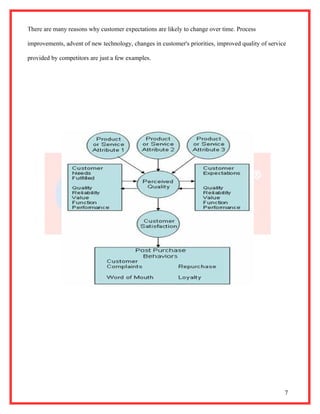
There are many reasons why customer expectations are likely to change over time. Process

improvements, advent of new technology, changes in customer's priorities, improved quality of service

provided by competitors are just a few examples.


                                                                                                    7
Introduction

Financial market:


Financial market is a mechanism that allows people to easily buy and sell (trade)

Financial securities (such as stocks and bonds), commodities (such as precious metals or agricultural

goods), and other fungible items of value at low transaction cost and at prices that reflect the efficient

market hypothesis. Financial markets have evolved significantly over several hundred years and are

undergoing constant innovation to improve liquidity.


India Financial Market promotes the savings of the economy, providing an effective channel for

transmitting the financial policies. It is a well-developed, competitive, efficient and integrated financial

sector. There are large numbers of buyers and sellers of the financial product, the prices are fixed by

the market forces of demand and supply within the Indian Financial Market.

Financial markets facilitate –


           •   The raising of capital (in the capital markets);

           •   The transfer of risk (in the derivatives markets);

           •   International trade (in the currency markets)


                                                                                                          8
Types of financial markets-


The financial markets can be divided into different subtypes:


   •   Capital markets which consist of:

   •   Stock markets, which provide financing through the issuance of shares or common stock, and

                              enable the subsequent trading thereof.

   •   Bond markets, which provide financing through the issuance of bonds, and enable the

                      subsequent trading thereof.

   •   Commodity markets, which facilitate the trading of commodities.

   •   Money markets, which provide short term debt financing and investment.

   •   Derivatives markets, which provide instruments for the management of financial risk.

   •   Futures markets, which provide standardized contracts for trading products at some future

                              date.

   •   Insurance markets, which facilitate the redistribution of various risks.

   •   Foreign exchange markets, which facilitate the trading of foreign exchange


                                                                                                9
The Financial Market in India focuses on these features:


  •   Real-time India Financial Indices – BSE 30 Index, Sector Indexes, Stock Quotes, Sensex

      Charts, Bond prices, Foreign Exchange, Rupee Dollar Chart

  •   Indian Financial Market news

  •   Stock News – Bombay Stock Exchange, BSE Sensex 30 closing index, S&P CNX-Nifty NSE,

      stock quotes, company information, issues on market capitalization, corporate earning

      statements, Indian Business Directory


  •   Fixed Income – Corporate Bond Prices, Corporate Debt details, Debt trading activities,

      Interest Rates, Money Market, Government Securities, Public Sector Debt, External Debt

      Service


  •   Foreign Investment – Foreign Debt Database composed by BIS, IMF, OECD,& World Bank,

      Investments in India & Abroad

  •   Global Equity Indexes – Dow Jones Global indexes, Morgan Stanley Equity Indexes

  •   Currency Indexes – FX & Gold Chart Plotter, J. P. Morgan Currency Indexes

  •   National and Global Market Relations

  •   Mutual Funds

  •   Insurance

  •   Loans

  •   Forex and Bullion


                                                                                               10
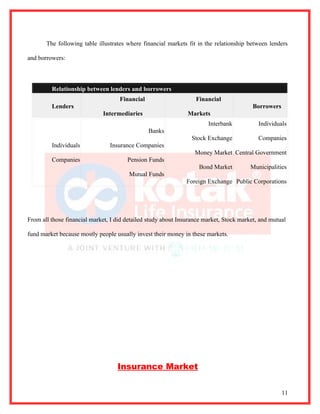
The following table illustrates where financial markets fit in the relationship between lenders

and borrowers:


         Relationship between lenders and borrowers
                                    Financial                     Financial
         Lenders                                                                        Borrowers
                             Intermediaries                    Markets
                                                                       Interbank           Individuals
                                                Banks
                                                                Stock Exchange             Companies
         Individuals            Insurance Companies
                                                                  Money Market Central Government
         Companies                     Pension Funds
                                                                   Bond Market          Municipalities
                                        Mutual Funds
                                                              Foreign Exchange Public Corporations


From all those financial market, I did detailed study about Insurance market, Stock market, and mutual

fund market because mostly people usually invest their money in these markets.


                                   Insurance Market


                                                                                                    11
Insurance may be defines as social device to protect the economic value of the Life and other assets.

Under the plan of Insurance a group of people are brought together and their share of money is pooled

to manage the loss suffered by any of them.

In its basic form is defined as “ A contract between two parties whereby one party called Insurance

insurer undertakes in exchange for a fixed sum called premiums, to pay the other party called insured a

fixed amount of money on the happening of a certain event."

Insurance, in law and economics, is a form of risk management primarily used to hedge against the risk

of potential financial loss. Insurance is defined as the equitable transfer of the risk of a potential loss,

from one entity to another, in exchange for a premium and duty of care

In simple terms it is a contract between the person who buys Insurance and an Insurance company who

sold the Policy. By entering into contract the Insurance Company agrees to pay the Policy holder or his

family members a predetermined sum of money in case of any unfortunate event for a predetermined

fixed sum payable which is in normal term called Insurance Premiums.

Insurance is basically a protection against a financial loss which can arise on the happening of an

unexpected event. Insurance companies collect premiums to provide for this protection. By paying a

very small sum of money a person can safeguard himself and his family financially from an

unfortunate event.

For Example if a person buys a Life Insurance Policy by paying a premium to the Insurance

company , the family members of insured person receive a fixed compensation in case of any

unfortunate event like death. There are different kinds of Insurance Products available such as Life

Insurance, Vehicle Insurance, Home Insurance, Travel Insurance, Health or Med claim Insurance etc.


                          Characteristics of Insurance


                                                                                                         12
1. Sharing of Risk

2. Cooperative device

4. Payment on event of happening of any special event

5. The amount of payment depends on the size and type of loss.

6. The success of Insurance business depends on the law of large number of people insured against

       similar risk.

7. Insurance is a business which spreads the loss and the risk of few people in the large Number of

       people.

8. The insurance is a plan in which insured transfer his risk to insurer.

9. Insurance is a legal contract.


                              ORIGINE OF INSURANCE


                                                                                                  13
Almost 4,500 years ago, in the ancient land of Babylonia, traders used to bear risk of the

caravan trade by giving loans that had to be later repaid with interest when the goods arrived safely. In

2100 BC, the Code of Hammurabi granted legal status to the practice. That, perhaps, was how

insurance made its beginning.

Life insurance had its origins in ancient Rome, where citizens formed burial clubs that would meet the

funeral expenses of its members as well as help survivors by making some payments.

As European civilization progressed, its social institutions and welfare practices also got more and

more refined. With the discovery of new lands, sea routes and the consequent growth in trade,

medieval guilds took it upon themselves to protect their member traders from loss on account of fire,

shipwrecks and the like.


                              Brief History of the Insurance Sector in India


       The business of life insurance in India in its existing form started in India in the year 1818 with

the establishment of the Oriental Life Insurance Company in Calcutta.

       The story of insurance is probably as old as the story of mankind. The same instinct that

prompts modern businessmen today to secure themselves against loss and disaster existed in primitive

men also. They too sought to avert the evil consequences of fire and flood and loss of life and were

willing to make some sort of sacrifice in order to achieve security. Though the concept of insurance is

largely a development of the recent past, particularly after the industrial era – past few centuries – yet

its beginnings date back almost 6000 years.

       Life Insurance in its modern form came to India from England in the year 1818. Oriental Life

Insurance Company started by Europeans in Calcutta was the first life insurance company on Indian

Soil. All the insurance companies established during that period were brought up with the purpose of

looking after the needs of European community and these companies were not insuring Indian natives.

However, later with the efforts of eminent people like Babu Muttylal Seal, the foreign life insurance
                                                                                                       14
companies started insuring Indian lives. But Indian lives were being treated as sub-standard lives and

heavy extra premiums were being charged on them. Bombay Mutual Life Assurance Society heralded

the birth of first Indian life insurance company in the year 1870, and covered Indian lives at normal

rates. Starting as Indian enterprise with highly patriotic motives, insurance companies came into

existence to carry the message of insurance and social security through insurance to various sectors of

society. Bharat Insurance Company (1896) was also one of such companies inspired by nationalism.

The Swadeshi movement of 1905-1907 gave rise to more insurance companies. The United India in

Madras, National Indian and National Insurance in Calcutta and the Co-operative Assurance at Lahore

were established in 1906. In 1907, Hindustan Co-operative Insurance Company took its birth in one of

the rooms of the Jorasanko, house of the great poet Rabindranath Tagore, in Calcutta. The Indian

Mercantile, General Assurance and Swadeshi Life (later Bombay Life) were some of the companies

established during the same period. Prior to 1912 India had no legislation to regulate insurance

business. In the year 1912, the Life Insurance Companies Act, and the Provident Fund Act were

passed. The Life Insurance Companies Act 1912 made it necessary that the premium rate tables and

periodical valuations of companies should be certified by an actuary. But the Act discriminated

between foreign and Indian companies on many accounts, putting the Indian companies at a

disadvantage.

                The first two decades of the twentieth century saw lot of growth in insurance business.

From 44 companies with total business-in-force as Rs.22.44 Crore, it rose to 176 companies with total

business-in-force as Rs.298 Crore in 1938. During the mushrooming of insurance companies many

financially unsound concerns were also floated which failed miserably. The Insurance Act 1938 was

the first legislation governing not only life insurance but also non-life insurance to provide strict state

control over insurance business. The demand for nationalization of life insurance industry was made

repeatedly in the past but it gathered momentum in 1944 when a bill to amend the Life Insurance Act

1938 was introduced in the Legislative Assembly. However, it was much later on the 19th of January

                                                                                                        15
1956 that life insurance in India was nationalized. About 154 Indian insurance companies, 16 non-

Indian companies and 75 provident were operating in India at the time of nationalization.

Nationalization was accomplished in two stages; initially the management of the companies was taken

over by means of an Ordinance, and later, the ownership too by means of a comprehensive bill. The

Parliament of India passed the Life Insurance Corporation Act on the 19th of June 1956, and the Life

Insurance Corporation of India was created on 1st September, 1956, with the objective of spreading life

insurance much more widely and in particular to the rural areas with a view to reach all insurable

persons in the country, providing them adequate financial cover at a reasonable cost.

       LIC had 5 zonal offices, 33 divisional offices and 212 branch offices, apart from its corporate

office in the year 1956. Since life insurance contracts are long-term contracts and during the currency

of the policy it requires a variety of services need was felt in the later years to expand the operations

and place a branch office at each district headquarter. Re-organization of LIC took place and large

numbers of new branch offices were opened. As a result of re-organization servicing functions were

transferred to the branches, and branches were made accounting units. It worked wonders with the

performance of the corporation. It may be seen that from about 200.00 Crore of New Business in 1957

the corporation crossed 1000.00 Crore only in the year 1969-70, and it took another 10 years for LIC to

cross 2000.00 Crore mark of new business. But with re-organization happening in the early eighties, by

1985-86 LIC had already crossed 7000.00 Crore Sum Assured on new policies.

        Today LIC functions with 2048 fully computerized branch offices, 100 divisional offices, 7

zonal offices and the corporate office. LIC’s Wide Area Network covers 100 divisional offices and

connects all the branches through a Metro Area Network. LIC has tied up with some Banks and Service

providers to offer on-line premium collection facility in selected cities. LIC’s ECS and ATM premium

payment facility is an addition to customer convenience. Apart from on-line Kiosks and IVRS, Info

Centers have been commissioned at Mumbai, Ahmadabad, Bangalore, Chennai, Hyderabad, Kolkata,

New Delhi, Pune and many other cities. With a vision of providing easy access to its policyholders,

                                                                                                      16
LIC has launched its SATELLITE SAMPARK offices. The satellite offices are smaller, leaner and

closer to the customer. The digitalized records of the satellite offices will facilitate anywhere servicing

and many other conveniences in the future.

        From then to now, LIC has crossed many milestones and has set unprecedented performance

records in various aspects of life insurance business. The same motives which inspired our forefathers

to bring insurance into existence in this country inspire us at LIC to take this message of protection to

light the lamps of security in as many homes as possible and to help the people in providing security to

their families.


Some of the important milestones in the life insurance business

                                             in India are

1850    Non life insurance debuts with triton insurance company. 1870 Bombay         mutual life assurance
society is the first Indian owned life insurer
                                                                                                        17
1912   The Indian Life Assurance Companies Act enacted as the first statute to     regulate the life
insurance business.

1928   The Indian Insurance Companies Act enacted to enable the government to collect statistical
information about both life and non-life insurance businesses.

1938   Earlier legislation consolidated and amended to by the Insurance Act with the objective of
protecting the interests of the insuring public.

1956   245 Indian and foreign insurers and provident societies taken over by the central government
and nationalized. LIC formed by an Act of Parliament, viz. LIC Act, 1956, with a capital contribution
of Rs. 5 Crore from the Government of India. The General insurance business in India, on the other
hand, can trace its roots to the Triton Insurance Company Ltd., the first general insurance company
established in the year 1850 in Calcutta by the British. Some of the important milestones in the general
insurance business in India are:

1907   The Indian Mercantile Insurance Ltd. set up, the first company to transact all classes of general
insurance business.

1957   General Insurance Council, a wing of the Insurance Association of India, frames a code of
conduct for ensuring fair conduct and sound business practices.

1968   The Insurance Act amended to regulate investments and set minimum           solvency      margins
and the Tariff Advisory Committee set up.

1972   The General Insurance Business (Nationalization) Act, 1972 nationalized the genera insurance
business in India with effect from 1st January 1973. 107    insurers amalgamated and grouped into
four companies’


                                KINDS OF INSURANCE


Insurance is divided in two basic zones:-

                                                                                                       18
1. General Insurance.

       2. Life Insurance.

General Insurance

Insurance of the non life assets are called general insurance, this includes loss of asset against water,

fire, earthquake etc. With the detarrification in the Indian   Market in General Insurance the monopoly

of the general Insurance public sector’s companies has been broken. With the entrance of the new

private player market innovative technique has been introduced to capture the mark Non-life insurance

companies have products that cover property against Fire and allied perils, flood storm and inundation,

earthquake and so on. There are products that          cover property against burglary, theft etc. The non-

life companies also offer policies covering machinery against breakdown, there are policies that cover

the    hull of ships and so on. A Marine Cargo policy covers goods in transit including by sea, air

and road. Further, insurance of motor vehicles against damages and theft forms a major chunk of non-

life insurance business.

In respect of insurance of property, it is important that the cover is taken for the actual value of the

property to avoid being imposed a penalty should there be a claim. Where a property is undervalued for

the purposes of insurance, the insured will have to bear a ratable proportion of the loss. For instance if

the value of a property is Rs.100 and it is insured for Rs.50/-, in the event of a loss to the extent of say

Rs.50/-, the maximum claim amount payable would be Rs.25/- (50% of the loss being borne by the

insured for underinsuring the property by 50%). This           concept is quite often not understood by

most insured.

Personal insurance covers include policies for Accident, Health etc. Products offering Personal

Accident cover are benefit policies. Health insurance covers offered by non-life insurers are mainly

hospitalization covers either on reimbursement or cashless basis. The cashless service is offered

through Third Party Administrators who have arrangements with various service providers, i.e.,


                                                                                                           19
hospitals. The Third Party Administrators also provide service for reimbursement claims. Sometimes

the insurers themselves process reimbursement claims.

Accident and health insurance policies are available for individuals as well as groups. A group could be

a group of employees of an organization or holders of          credit cards or deposit holders in a bank

etc. Normally when a group is covered, insurers offer group discounts.

Liability insurance covers such as Motor Third Party Liability Insurance, Workmen’s          Compensation

Policy etc offer cover against legal liabilities that may arise under the respective statutes— Motor

Vehicles Act, The Workmen’s Compensation Act etc. Some of the covers such as the foregoing (Motor

Third Party and Workmen’s Compensation policy) are compulsory by statute. Liability Insurance not

compulsory by statute is also gaining popularity these days. Many industries insure against Public

liability. There are liability covers available for Products as well.

There are general insurance products that are in the nature of package policies offering a combination

of the covers mentioned above. For instance, there are package policies available for householders,

shop keepers and also for      professionals such as doctors, chartered accountants etc. Apart from

offering standard covers, insurers also offer customized or tailor-made ones.

Suitable general Insurance covers are necessary for every family. It is important     to   protect    one’s

property, which one might have acquired from one’s hard earned          income. A loss or damage to one’s

property can leave one shattered. Losses created by catastrophes such as the tsunami, earthquakes,

cyclones etc have left many homeless and penniless. Such losses can be devastating but insurance

could help mitigate them. Property can be covered, so also the people against Personal Accident.


Life Insurance


                                                                                                           20
What Is Life Insurance?

Life insurance can be defined as “life insurance provides a sum of money if the      person     who     is

insured dies while the policy is in effect”.

Life insurance provides protection against financial loss resulting from death. It is an insurance

company's promise to pay a beneficiary a specific amount of money When an insured dies in exchange

for timely payment of premiums. The primary Purpose of life insurance is therefore protection of the

family in the event of death.

Insurance is also seen as a tool to plan effectively for future years, your   retirement, and for your

children's future needs. Today, the market offers        insurance plans that not just cover your life and

but at the same time grow your wealth too.

What Is It Intended To Do?

Life insurance offers security in the event of the insured’s death. Life insurance Offers financial

protection to survivors. It provides dependents with the necessary Funds to settle financial obligations

and to cover the loss of income created by the Insured’s death. Life insurance policies are usually

purchased with a specific Intention in mind - to protect a mortgage or an estate, to provide for

educational Costs, for retirement or for charity, etc.

Why is Life Insurance Necessary?

People carry life insurance for many reasons. Among the most common are to pay Off a mortgage, or

personal debts (car loan, credit cards…), educational costs for Young children, for beneficiaries to be

able to maintain their current standard of living, for child care, for immediate financial needs, and

medical or funeral costs.


How Might Life Insurance Needs Change Over Time?

If an individual has finished raising their family, has paid off their mortgage and No longer has major

financial obligations, then their life insurance needs will be Lower than when they were younger. An
                                                                                                  21
individual may choose to no longer carry their insurance or to reduce their coverage amount to a level

just sufficient to ensure that their survivors have enough money to pay final expenses (burial, Medical,

estate taxes…).

How Does Life Insurance Work?

All aspects of life involve risk, e.g., fire, theft, auto accidents, injury. Insurance provides a means of

transferring the financial consequences of certain risks from the individual to an insurance company.

When an individual buys life insurance, they are grouped together with other people who are similar in

age,    sex, and health. Actuaries calculate how many people in each group are likely to dyeing

period of time. The more deaths there are in a group, the more money will be needed to pay death

claims, and therefore, more money will have to be collected as premiums.

Since younger people are less likely to die than older people,

Insurance premiums are generally lower at younger ages. Each year, the insured Pays the insurance

company for their insurance policy. This money is called a Premium. The insured also informs the

insurance company who should get the Insurance money if they (the insured) die. This is a called

designating a Beneficiary. If the insured dies while their policy is active, the insurance company will

pay the beneficiaries the insurance money. Insurance companies can do this because only a small

number of people die each year, while many more people pay those premiums. The “risk” of death is

spread out among many people in order to prevent a financial loss to the beneficiaries of the few who

will die.


Insurance Sector Reforms:


                                                                                                       22
In 1993, Malhotra Committee, headed by former Finance Secretary and RBI Governor R. N. Malhotra,

was formed to evaluate the Indian insurance industry and recommend its future direction. The Malhotra

committee was set up with the objective of complementing the reforms initiated in the financial sector.

The reforms were aimed at “creating a more efficient and competitive financial system suitable for the

requirements of the economy keeping in mind the structural changes currently underway and

recognizing that insurance is an important part of the overall financial system where it was necessary to

address the need for similar reforms…”.

In 1994, the committee submitted the report and some of the key recommendation included:

i) Structure

Government stake in the insurance Companies to be brought down to 50%.

Government should take over the holdings of GIC and its subsidiaries so that these subsidiaries can act

as independent corporations.
All the insurance companies should be given greater freedom to operate.

ii) Competition

Private Companies with a minimum paid up capital of Rs.1bn should be allowed to enter the industry

No Company should deal in both Life and General Insurance through single entity foreign companies

may be allowed to enter the industry in collaboration with the domestic companies.

Postal Life Insurance should be allowed to operate in the rural market.

Only one State Level Life Insurance Company should be allowed to operate in        each state.


iii) Regulatory Body

The Insurance Act should be changed
                                                                                                      23
An Insurance Regulatory body should be set up

Controller of Insurance (Currently a part from the Finance Ministry) should be made independent.

iv) Investments

Mandatory Investments of LIC Life Fund in government securities to be reduced from 75% to

50%.GIC and its subsidiaries are not to hold more than 5% in any company (There current holdings to

be brought down to this level over a period of time).

v) Customer Service

LIC should pay interest on delays in payments beyond 30 days

Insurance companies must be encouraged to set up unit linked pension plans

Computerization of operations and updating of technology to be carried out in the insurance industry.

The committee emphasized that in order to improve the customer services and increase the coverage of

the insurance industry should be opened up to competition. But at the same time, the committee felt the

need to exercise caution as any failure on the part of new players could ruin the public confidence in

the industry.

Hence, it was decided to allow competition in a limited way by stipulating the minimum capital

requirement of Rs.100 Crores. The committee felt the need to provide greater autonomy to insurance

companies in order to improve their performance and enable them to act as independent companies

with economic motives. For this purpose, it had proposed setting up an independent regulatory body.


   The Insurance Regulatory and Development Authority

                                              (IRDA):
                                                                                                      24
Reforms in the Insurance sector were initiated with the passage of the IRDA Bill in Parliament in

December 1999. The IRDA since its incorporation as a statutory body in April 2000 has fastidiously

stuck to its schedule of framing regulations and registering the private sector insurance companies. The

other decision taken simultaneously to provide the supporting systems to the insurance sector and in

particular the life insurance companies was the launch of the IRDA’s online service for issue and

renewal of licenses to agents.

 The approval of institutions for imparting training to agents has also ensured that the insurance

companies would have a trained workforce of insurance agents in place to sell their products, which are

expected to be introduced by early next year. Since being set up as an independent statutory body the

IRDA has put in a framework of globally compatible regulations. In the private sector 12 life insurance
and 6 general insurance companies have been registered.

With the Insurance Regulatory and Development Act, the focus shifted to the following:

    * The Insurance Regulatory and Development Authority (IRDA) should give priority to health

insurance while issuing certificates of registration;

  * Policyholders' funds will be invested in the social sector and infrastructure. The percentage may be

specified by the IRDA and such regulations will apply to all insurers operating in the country;

  * Insurers will be expected to undertake a certain percentage of business in the rural or social sector

and provide policies to persons residing in rural areas, workers in the unorganized and informal

economically back

In case the insurers fail to meet the social sector obligation a fine of Rs.2.5 mn.Would be imposed the

first time. Subsequent failures would result in cancellation of licensees.


                                         ROLE OF IRDA

Section 14 of IRFDA Act, 1999 lays down the duties, powers & functions of IRDA.


                                                                                                      25
•   Subject to the provisions of the Act & any other law for the time being in force, the Authority

       shall have the duty to regulate, promote & ensure orderly growth of the insurance business &

       re-insurance business.

   •   The power & functions of the Authority shall include:

1. Issue to the applicant a certificate of registration, renew, modify, withdraw, suspend or cancel such

   registration.

2. Protection of the interests of the policy holders, insurable interest, settlement of insurance claim,

   surrender value of policy & other terms & conditions of contracts of insurance.

3. Specifying requisite qualifications, code of conduct, & practical training for intermediary or

   insurance intermediaries & agents;

4. Specifying the code of conduct for surveyors & loss assessors

5. Promoting & regulating organizations connected with the insurance & re-insurance business;

6. Calling for information from, undertaking inspection of, conducting enquiries & investigations

   including audit of the insurers, intermediaries, insurance intermediaries & other organizations

   connected with the insurance businnes;

7. Control & regulations of the rates, advantages, terms & conditions that may be offered by insurer in

   respect of general insurance business not so controlled & regulated by the Tariff Advisory

   Committee under the section 64U of the Insurance Act, 1938 (4 of 1938);

8. Specifying the firm & manner in which books of account shall be maintained & statement of

   accounts shall be rendered by insures & other insurance intermediaries;

9. Regulating maintenance of margin of solvency;

10. Adjudications of disputes between insurers & intermediaries or insurance intermediaries;


                              ROLE OF LIFE INSURANCE:


                                                                                                           26
► Role 1: Life insurance as "Investment":

Insurance is an attractive option for investment. While most people recognize the risk hedging and tax

saving potential of insurance, many are not aware of its advantages as an investment option as well.

Insurance products yield more compared to regular investment options, and this is besides the added

incentives offered by insurers. You cannot compare an insurance product with other investment

schemes for the simple reason that it offers financial protection from risks, something that is missing in

non-insurance products. In fact, the premium you pay for an insurance policy is an investment against

risk.

Thus, before comparing with other schemes, you must accept that a part of the total amount invested in

life insurance goes towards providing for the risk cover, while the rest is used for savings. In life

insurance, unlike non-life products, you get maturity benefits on survival at the end of the term. In

other words, if you take a life insurance policy for 20 years and survive the term, the amount invested

as premium in the policy will come back to you with added returns. In the unfortunate event of death
within the tenure of the policy, the family of the deceased will receive the sum assured. Thus insurance

is a unique investment avenue that delivers sound returns in addition to protection.


► Role 2: Life insurance as "Risk cover”:

First and foremost, insurance is about risk cover and protection - financial protection, to be more

precise - to help outlast life's unpredictable losses. Designed to safeguard against losses suffered on
account of any unforeseen event, insurance provides you with that unique sense of security that no

other form of investment provides. By buying life insurance, you buy peace of mind and are prepared
to face any financial demand that would hit the family in case of an untimely demise.


Insurance also provides a safeguard in the case of accidents or a drop in income after retirement. An

accident or disability can be devastating, and an insurance policy can lend timely support to the family
                                                                                                       27
in such times. It also comes as a great help when you retire, in case no untoward incident happens

during the term of the policy.

With the entry of private sector players in insurance, you have a wide range of products and services to

choose from. Further, many of these can be further customized to fit individual/group specific needs.

Considering the amount you have to pay now, it's worth buying some extra sleep.


► Role 3: Life insurance as "Tax planning"

Insurance serves as an excellent tax saving mechanism too. The Government of India has offered tax

incentives to life insurance products in order to facilitate the flow of funds into productive assets.

Under Section 88 of Income Tax Act 1961, an individual is entitled to a rebate of 20 per cent on the

annual premium payable on his/her life and life of his/her children or adult children.

The rebate is deductible from tax payable by the individual or a Hindu Undivided Family. This rebate

is can be availed up to a maximum of Rs 12,000 on payment of yearly premium of Rs 60,000. By

paying Rs 60,000 a year, you can buy anything upwards of Rs 10 lakh in sum assured. (Depending

upon the age of the insured and term of the policy) This means that you get Rs 12,000 tax benefit. The

rebate is deductible from the tax payable by an individual or a Hindu Undivided Family.

Risks and uncertainties are part of life's great adventure -- accident, illness, theft, natural

disaster - they're all built into the working of the Universe, waiting to happen.


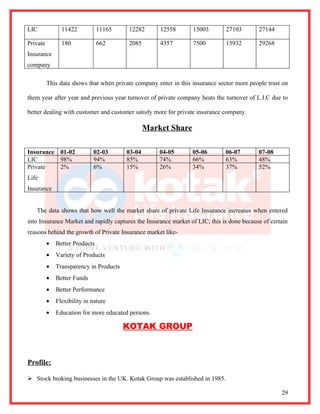
                        Turnover of Insurance Market :( 000’crores)


Insurance    Year          2002-03       2003-04      2004-05      2005-06      2006-07     2007-08
              2001-02

                                                                                                      28
LIC             11422           11165    12282       12558        15003        27103       27144

Private         180             662      2085        4357         7500         15932       29268
Insurance
company

          This data shows that when private company enter in this insurance sector more people trust on

them year after year and previous year turnover of private company beats the turnover of L.I.C due to

better dealing with customer and customer satisfy more for private insurance company.

                                                 Market Share

Insurance 01-02              02-03       03-04       04-05        05-06        06-07       07-08
LIC       98%                94%         85%         74%          66%          63%         48%
Private   2%                 6%          15%         26%          34%          37%         52%
Life
Insurance


   The data shows that how well the market share of private Life Insurance increases when entered
into Insurance Market and rapidly captures the Insurance market of LIC; this is done because of certain
reasons behind the growth of Private Insurance market like-
          •   Better Products
          •   Variety of Products
          •   Transparency in Products
          •   Better Funds
          •   Better Performance
          •   Flexibility in nature
          •   Education for more educated persons.

                                         KOTAK GROUP


Profile:

 Stock broking businesses in the UK. Kotak Group was established in 1985.

                                                                                                    29
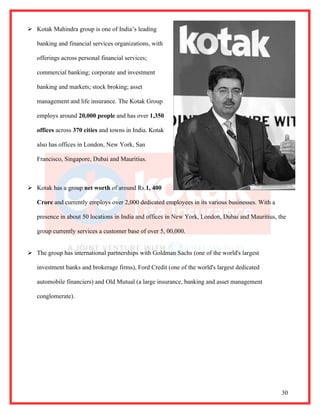
 Kotak Mahindra group is one of India’s leading

   banking and financial services organizations, with

   offerings across personal financial services;

   commercial banking; corporate and investment

   banking and markets; stock broking; asset

   management and life insurance. The Kotak Group

   employs around 20,000 people and has over 1,350

   offices across 370 cities and towns in India. Kotak

   also has offices in London, New York, San

   Francisco, Singapore, Dubai and Mauritius.


 Kotak has a group net worth of around Rs.1, 400

   Crore and currently employs over 2,000 dedicated employees in its various businesses. With a

   presence in about 50 locations in India and offices in New York, London, Dubai and Mauritius, the

   group currently services a customer base of over 5, 00,000.


 The group has international partnerships with Goldman Sachs (one of the world's largest

   investment banks and brokerage firms), Ford Credit (one of the world's largest dedicated

   automobile financiers) and Old Mutual (a large insurance, banking and asset management

   conglomerate).


                                                                                                  30
31
32
 Using Brand name KOTAK and its effect can be seen as previously Kotak Life Insurance

    needed a name Old Mutual with its name but now people Kotak by the name of Kotak only not

    by the name of OM Kotak.

KOTAK MAHINDRA OLD MUTUAL LIFE INSURANCE LTD.


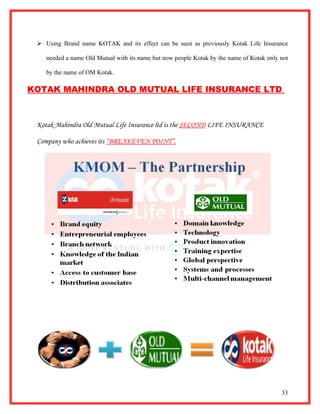
 Kotak Mahindra Old Mutual Life Insurance ltd is the SECOND LIFE INSURANCE

 Company who achieves its “BREAKEVEN POINT”.


                                                                                          33
KOTAK MAHINDRA                OLD MUTAL PLC                      KOTAK LIFE

                 BANK                                            INSURANCE

 ( 74% )                            ( 26% )                                     ( 100% )


 OM Kotak Mahindra Life Insurance Company Limited (OMKM) is a joint venture between

   Kotak Mahindra Finance Ltd., and Old Mutual plc aims to help customers take important

   financial decisions at every stage in life by offering them a wide range of innovative life

   insurance products, to make them financially independent. Jeene Ki Azaadi.

 Kotak Mahindra Bank is the parent company of the group.

 Kotak Group entered into the life insurance business in 2001.

 Kotak Mahindra Old Mutual Life Insurance Ltd. is a joint venture between

       Kotak Mahindra Bank Ltd. (76%) and Old Mutual plc. (24%)

 Old Mutual plc.Is a world-Class international financial services company. It

   Was established in South Africa before 160 years.

 OLD MUTUAL is the largest financial services business in South Africa, through its life

   insurance, asset management, banking and general insurance operations. The company serves
   4 million life insurance policyholders and employs over 13 000 South Africans in its local

   operations.
 In the USA, OLD MUTUAL is one of the top ten fixed annuity busineses offering an array of

   specialist asset management skills through its 23 asset management businesses. The company’s

   US Life business recorded sales of $4 billion at the end of 2002.

 Operations in the United Kingdom are focused on wealth management,through Gerrard as one

   of the leading private client The OLD MUTUAL Group has the ability to cater for a variety of

   Consumer segments and offers a comprehensive and innovative range of Products for all

   income groups.
                                                                                                 34
 TURNOVER OF KOTAK LIFE INSURANCE IN 2008-2009 is 1,400 Crores.

       In this TIDE CHANNEL contributes 500 Crores and

       ALTERNATE CHANNEL contributes 900 Crores.


Old Mutual Plc:-

Old Mutual was established more than 150 years ago. Old mutual plc, Is a world-class international

financial service company. It owns the largest companies in the following areas in South Africa.

They are:

1. Life Insurance Company

2. Asset Management Company

3. Bank

4. Non-life insurance company

It has been developed into an International financial services group whose activities are focused on

asset gathering and asset management. The Old Mutual Group offers a diverse range of financial

services in three principal geographies: South Africa, the United States and the United Kingdom. The

company is listed on the London Stock Exchange with a market capitalization of approximately $6

billion and is a member of the elite FTSE 100 index. In the 2003 rankings of the World's 500 largest

corporations by Fortune magazine, Old Mutual climbed 87 places to position number 366 and was also

listed as the 14th largest insurance company in the world.

Old Mutual is the largest financial services business in South Africa, through its life insurance, asset

management, banking and general insurance operations. The company serves 4 million life insurance

policyholders and employs over 13 000 South Africans in its local operations. In the USA, Old Mutual

is one of the top ten fixed annuity businesses offering an array of specialist asset management skills

through its 23 asset management businesses. The company’s US Life business recorded sales of $4
billion at the end of 2002.

                                                                                                     35
Operations in the United Kingdom are focused on wealth management, through Gerrard as one of the

leading private client stock broking businesses in the UK.


The Old Mutual Group has the ability to cater for a variety of consumer segments and offers a

comprehensive and innovative range of products for all income groups.


•   A 26%-74% Joint venture between Old Mutual plc and KotaK Mahindra Bank Ltd.

•   Started operations May 2001

•   209% growth in premium income (year ending March 2005)

•   Presence in 55 cities across the country.

•   More than 1,60,000 policies issue (year ending March 2005)

•   More than 7000 Life Advisors ( year ending March 2005)

•   Over 1000 professional employees (year ending March 2005)


 44 branches in 31 cities.

 7500 life advisors.

 1000employees of very good quality.

 Ranks 2nd in terms of average premium per policy.

 Ranks 4th in total advertising awareness.

     First year premium income

       2001-02: 7Crores

       2002-03: 35Crores

       2003-04: 125Crores

       2005-06: 373Crores

       2006-07: 396Crores
                                                                                             36
2007-08: 614 Crores


                                                Mission


“At Kotak Life Insurance, we aim to help customers take important financial decisions at every stage in

life by offering them a wide range of innovative life insurance products, to make them financially

independent.”


                                     Vision & Values


Our Vision:-

Kotak Life Insurance has a deep rooted commitment to improve the quality of life of its customers,

employees and stakeholders. We aim at improving the long term value in our relationship by

continuous innovation and improvements. We do this by our three-prong effort which strives to make

Kotak Life Insurance a corporate with values.

Increase Customer Value:

Kotak Life Insurance has gone to the heart of its customer's requirements and developed products

which are unique and serve the customer needs perfectly. We built a relationship of mutual trust and

benefit to serve the Indian customer. At Kotak Life Insurance the customer always comes first.

Cohesive Work Environment: -


                                                                                                     37
We form long-term partnership with our employees by offering them an invigorating work experience.

We not only demand loyalty, sincerity and values but also give it back in equal measures. Kotak Life

Insurance will like to offer its employees space to grow, innovate and build a long-term career.


Work with Honor: -

Kotak Life Insurance delivers everyday services in the marketplace with the high sense of duty and

commitment. Our employees strive to build the long-term value for all those come in contact with

Kotak Life Insurance. Our consumers, distributors, employees, shareholders and the nation have our

commitment that we will uphold the values of trust, integrity and a Sense of Honor in every thought,

act and deed in order to positively contribute to individual, society and nation growth.


Our values:-

     Every member of the Kotak Group team is committed to 5 core values: Integrity, Customer First,

Boundary less, Ownership, and Passion. These values shine forth in all we do, and have become the

keystones of our success.


                                                                                                   38
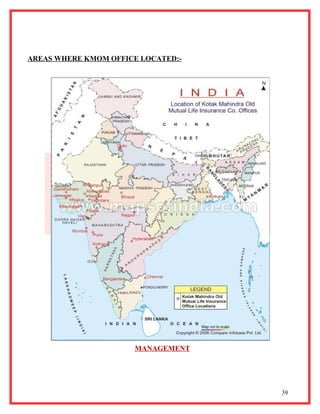
AREAS WHERE KMOM OFFICE LOCATED:-


                      MANAGEMENT


                                    39
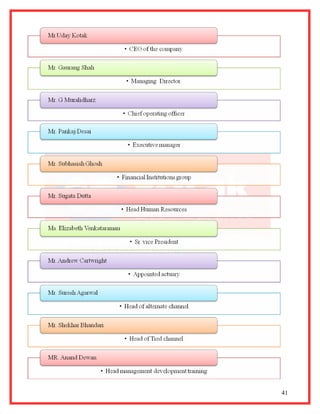
We at Kotak Life Insurance work as a team and have a flat management structure. Our top

management has many years of experience which has helped guide the company into a position of

leadership.


                                                                                                40
41
CONCEPT OF HUMAN LIFE VALUES


       Generally speaking , one can estimate the extent of life insurance by calculating one’s

“HUMAN LIFE VALUE” (HLV) .This is the net present value of one’s future earnings.

Put simply,it is the amount that a person’s family would permanently lose,should anything unfortunate

happen to that person.

As a thumb rule, a 30 year old should insure oneself for about 8 ties his or her annual income. At

35,this is about 6 times.Of course,the exact amount must be adjusted acording to the number of

dependents ,existing investments and one’s life stage.

For instance,if at 30, a person has two children and parents to provide for, the amount of insurance

should also be higher.

You can calculate your Human life value by multiplying your current annual income with the number

of years remaining for your retirement-

Let’s assume that you are 30 years old and you earn Rs.4,00,000 per annnum.Now, if your retirement

age is 55 you have 25 years to go before retirement. So your Human Life value is (25 X 4,00,000)=

100,00,000 (One crore Rupees)


So, your Present Human Life Value is ONE CRORE RUPEES,provided you stay healthy.


If you take factors like Inflation and Increase in Income over a eriod of time into Accont, your Human

Life Value is a lot more.


                                                                                                       42
INSURANCE SOLUTION FOR INDIVIDUALS

 Kotak Life Insurance offers a range of innovative, customer-centric products that meet the needs of

 customers at every life stage. Its products can be enhanced with up to 4 riders, to create a customized

                                    Solution for each policyholder.


                             Protection                                 Savings & Investments

                  Helping you to grow and protect                       Manage today for a better

                            your wealth.                                       tomorrow.

                            Retirement                                            Child

                The road to retirement, Make it easy                Plan a good future for your child.


Protection Plans


   •   Kotak Loan Protection Plan

   •   Kotak Term/Preferred Term Plan

   •   Kotak Eternal Life Plans


Retirement Plans


   •   Kotak Secure Retirement Plan

   •   Kotak Retirement Income (Unit Linked)

   •   Kotak Long Life Secure Plus

   •   Kotak Long Life Wealth Plus

   •   Kotak Retirement Income Plan


                                                                                                         43
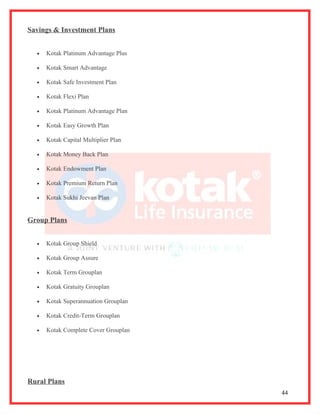
Savings & Investment Plans


  •   Kotak Platinum Advantage Plus

  •   Kotak Smart Advantage

  •   Kotak Safe Investment Plan

  •   Kotak Flexi Plan

  •   Kotak Platinum Advantage Plan

  •   Kotak Easy Growth Plan

  •   Kotak Capital Multiplier Plan

  •   Kotak Money Back Plan

  •   Kotak Endowment Plan

  •   Kotak Premium Return Plan

  •   Kotak Sukhi Jeevan Plan


Group Plans


  •   Kotak Group Shield

  •   Kotak Group Assure

  •   Kotak Term Grouplan

  •   Kotak Gratuity Grouplan

  •   Kotak Superannuation Grouplan

  •   Kotak Credit-Term Grouplan

  •   Kotak Complete Cover Grouplan


Rural Plans
                                      44
•   Kotak Gramin Bima Yojana


Child Plans


   •   Kotak Head start Child Plans

   •   Kotak Child Advantage Plan


In all these above product the Best product of Kotak life insurance is KOTAK SMART

ADVANTAGE PLAN (KSAP)


In our summer training program we found that there is positive response towards this product by the

customers because this product has many beneficial features:-


                                                                                                      45
KOTAK SMART ADVANTAGE PLAN (KSAP)


                          Make every rupee work for your happiness


Every step in your life brings with it new learnings. You are determined to make the best of it, so that

you can look forward to a great future. How you shape your Tomorrow depends greatly on how you

build on your today.

Kotak Life Insurance introduces Kotak Smart Advantage offering you a smart solution to put your

savings to work today for a brighter tomorrow. It is a market linked plan with 100%1 premium

allocations helping you accumulate wealth systematically, over the long-term.


Kotak Smart Advantage is a great combination of investment with insurance Designed to enable you to

make the best use of your hard-earned money that puts you right ahead.


KEY FEATURES:-

   •   Guaranteed returns of up to 275% of your first year premium at maturity.

   •   Assured bonus additions at regular intervals during the policy term to enhance your fund value.

   •   100% allocation of your premiums from second year onwards.

   •   Unique fund offering you the maximum opportunity for growth and choice for your investment

       needs.

   •   Maximum protection for your loved ones to choose from.


                                                                                                       46
INSURANCE:-


   •    Life Cover (Financial Protection for loved ones).

   •    Tax Benefit under Sec 80(c) (total premium paid will be deducted from annual income for

        I.T.R).

   •    Tax Benefit under sec 10 (10) d (100% tax free returns).


The Assured Addition Advantage is a powerful combination of two benefits:


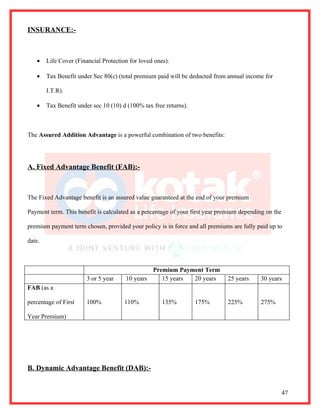
A. Fixed Advantage Benefit (FAB):-


The Fixed Advantage benefit is an assured value guaranteed at the end of your premium

Payment term. This benefit is calculated as a percentage of your first year premium depending on the

premium payment term chosen, provided your policy is in force and all premiums are fully paid up to

date.

Premium Payment Term3

                                                Premium Payment Term
                        3 or 5 year    10 years    15 years 20 years          25 years     30 years
FAB (as a

percentage of First     100%           110%           135%         175%       225%         275%

Year Premium)


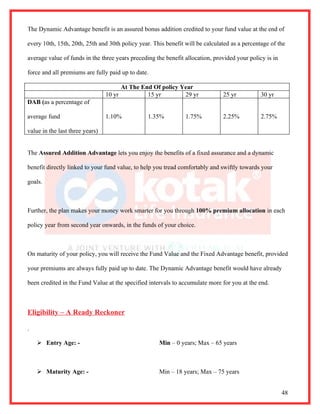
B. Dynamic Advantage Benefit (DAB):-


                                                                                                       47
The Dynamic Advantage benefit is an assured bonus addition credited to your fund value at the end of

every 10th, 15th, 20th, 25th and 30th policy year. This benefit will be calculated as a percentage of the

average value of funds in the three years preceding the benefit allocation, provided your policy is in

force and all premiums are fully paid up to date.

                                       At The End Of policy Year
                                 10 yr          15 yr        29 yr             25 yr           30 yr
DAB (as a percentage of

average fund                     1.10%           1.35%          1.75%          2.25%           2.75%

value in the last three years)


The Assured Addition Advantage lets you enjoy the benefits of a fixed assurance and a dynamic

benefit directly linked to your fund value, to help you tread comfortably and swiftly towards your

goals.


Further, the plan makes your money work smarter for you through 100% premium allocation in each

policy year from second year onwards, in the funds of your choice.


On maturity of your policy, you will receive the Fund Value and the Fixed Advantage benefit, provided

your premiums are always fully paid up to date. The Dynamic Advantage benefit would have already

been credited in the Fund Value at the specified intervals to accumulate more for you at the end.


Eligibility – A Ready Reckoner

.

     Entry Age: -                                   Min – 0 years; Max – 65 years


     Maturity Age: -                                Min – 18 years; Max – 75 years


                                                                                                         48
 Policy Term: -                  Regular – 10 / 15 / 20 / 25 / 30 years

                                    For Minors, minimum term – 10 years


   Premium Payment Term (PPT):-          Regular – Full Policy Term

                                     Limited Premium Payment – 3 or 5 years


   Minimum Premium: -             Regular PPT – Rs.10,000 p.a.

                                    Limited PPT – Rs. 36,000 p.a.


   Basic Sum Assured: -           Min – 5 x Annual premium

                                     Max – Any multiple of premium


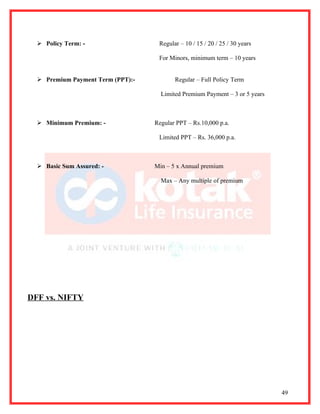
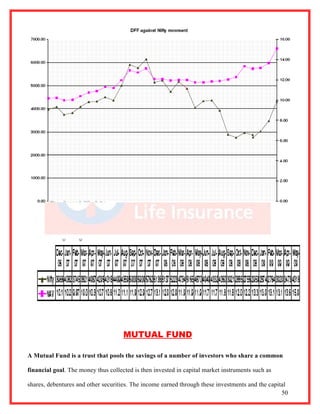
DFF vs. NIFTY


                                                                              49
MUTUAL FUND

A Mutual Fund is a trust that pools the savings of a number of investors who share a common

financial goal. The money thus collected is then invested in capital market instruments such as

shares, debentures and other securities. The income earned through these investments and the capital
                                                                                                  50
appreciations realized are shared by its unit holders in proportion to the number of units owned by

them. Thus a Mutual Fund is the most suitable investment for the common man as it offers an

opportunity to invest in a diversified, professionally managed basket of securities at a relatively low

cost.

The Mutual Fund industry in India started in 1963 with the formation of Unit Trust of India,

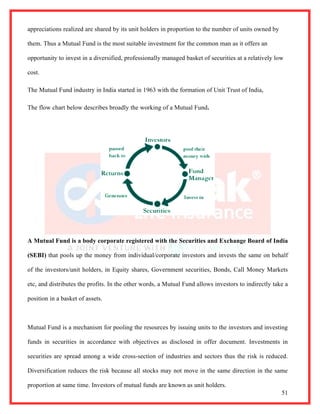
The flow chart below describes broadly the working of a Mutual Fund.


A Mutual Fund is a body corporate registered with the Securities and Exchange Board of India

(SEBI) that pools up the money from individual/corporate investors and invests the same on behalf

of the investors/unit holders, in Equity shares, Government securities, Bonds, Call Money Markets

etc, and distributes the profits. In the other words, a Mutual Fund allows investors to indirectly take a

position in a basket of assets.


Mutual Fund is a mechanism for pooling the resources by issuing units to the investors and investing

funds in securities in accordance with objectives as disclosed in offer document. Investments in

securities are spread among a wide cross-section of industries and sectors thus the risk is reduced.

Diversification reduces the risk because all stocks may not move in the same direction in the same

proportion at same time. Investors of mutual funds are known as unit holders.
                                                                                                      51
The investors in proportion to their investments share the profits or losses. The mutual funds

normally come out with a number of schemes with different investment objectives which are

launched from time to time. A Mutual Fund is required to be registered with Securities Exchange

Board of India (SEBI) which regulates securities markets before it can collect funds from the public.


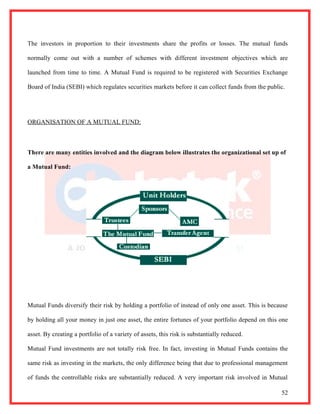
ORGANISATION OF A MUTUAL FUND:


There are many entities involved and the diagram below illustrates the organizational set up of

a Mutual Fund:


Mutual Funds diversify their risk by holding a portfolio of instead of only one asset. This is because

by holding all your money in just one asset, the entire fortunes of your portfolio depend on this one

asset. By creating a portfolio of a variety of assets, this risk is substantially reduced.

Mutual Fund investments are not totally risk free. In fact, investing in Mutual Funds contains the

same risk as investing in the markets, the only difference being that due to professional management

of funds the controllable risks are substantially reduced. A very important risk involved in Mutual

                                                                                                   52
Fund investments is the market risk. However, the company specific risks are largely eliminated due

to professional fund management.


IMPORTANT CHARACTERISTICS OF A MUTUAL FUND

   •   A Mutual Fund actually belongs to the investors who have pooled their

       Funds. The ownership of the mutual fund is in the hands of the Investors.

   •   A Mutual Fund is managed by investment professional and other

       Service providers, who earns a fee for their services, from the funds.

   •   The pool of Funds is invested in a portfolio of marketable investments.

   •   The value of the portfolio is updated every day.

   •   The investor’s share in the fund is denominated by “units”. The value of the units changes

       with change in the portfolio value, every day. The value of one unit of investment is called

       net asset value (NAV).

   •   The investment portfolio of the mutual fund is created according to The stated

       Investment objectives of the Fund.


       OBJECTIVES OF A MUTUAL FUND:


   •   To provide an opportunity for lower income groups to acquire without much difficulty,

       property in the form of shares.


                                                                                                53
•   To Cater mainly of the need of individual investors, whose means are small?

   •   To manage investors portfolio that provides regular income, growth, Safety, liquidity, tax

       advantage, professional management and diversification.


       ADVANTAGES OF MUTUAL FUNDS:

   •   Reduced Risk.

   •   Diversified investment.

   •   Botheration free investment.

   •   Revolving type of investment (Reinvestment).

   •   Selection and timings of investment.

   •   Wide investment opportunities.

   •   Investments care.

   •   Tax benefits.


 TYPES OF MUTUAL FUNDS:

1. OPEN-ENDED MUTUAL FUNDS:-

The holders of the shares in the Fund can resell them to the issuing Mutual Fund Company at the

time. They receive in turn the net assets value (NAV) of the shares at the time of re-sale. Such

Mutual Fund Companies place their funds in the secondary securities market. Open-end investment

                                                                                                    54
companies can sell an unlimited number of Shares and thus keep going larger. The open-end Mutual

Fund Company Buys or sells their shares. These companies sell new shares NAV plus a Loading or

management fees and redeem shares at NAV.In other words, the target amount and the period both

are indefinite in such funds


2. CLOSED-ENDED MUTUAL FUNDS:-

A closed–end Fund is open for sale to investors for a specific period, after which further sales are

closed. Any further transaction for buying the units or repurchasing them, Happen in the secondary

markets, where closed end Funds are listed. Therefore new investors buy from the existing investors,

and existing investors can liquidate their units by selling them to other willing buyers. In a closed

end Funds, thus the pool of Funds can technically be kept constant. The asset management company

(AMC) however, can buy out the units from the investors, in the secondary markets, thus reducing

the amount of funds held by outside investors. The price at which units can be sold or redeemed

Depends on the market prices, which are fundamentally linked to the NAV. Investors in closed end

Funds receive either certificates or Depository receipts, for their holdings in a closed end mutual

Fund.


ORGANISATION AND MANAGEMENT OF MUTUAL FUNDS:-

In India Mutual Fund usually formed as trusts, three parties are generally involved viz.

   •    Settler of the trust or the sponsoring organization.

   •    The trust formed under the Indian trust act, 1982 or the trust company registered under the

        Indian companies act, 1956

   •    Fund mangers or The merchant-banking unit
                                                                                                  55
•   Custodians.


MUTUAL FUNDS TRUST:-

Mutual fund trust is created by the sponsors under the Indian trust act, 1982

Which is the main body in the creation of Mutual Fund Trust?

The main functions of Mutual Fund trust are as follows:

   ♦ Planning and formulating Mutual Funds schemes.

   ♦ Seeking SEBI’s approval and authorization to these schemes.

   ♦ Marketing the schemes for public subscription.

   ♦ Seeking RBI approval in case NRI’s subscription to Mutual Fund is Invited


FUND MANAGERS (OR) THE ASSES MANAGEMENT COMPANY (AMC)

AMC has to discharge mainly three functions as under:

    I. Taking investment decisions and making investments of the funds through market

       dealer/brokers in the secondary market securities or directly in the primary capital market or

       money market instruments


   II. Realize fund position by taking account of all receivables and realizations, moving corporate

       actions involving declaration of dividends,etc to compensate investors for their investments in

       units; and

  III. Maintaining proper accounting and information for pricing the units and arriving at net asset

       value (NAV), the information about the listed schemes and the transactions of units in the

       secondary market. AMC has to feed back the trustees about its fund management operations

       and has to maintain a perfect information system.
                                                                                                   56
CUSTODIANS OF MUTUAL FUNDS:-

    Mutual funds run by the subsidiaries of the nationalized banks had their respective sponsor

    banks as custodians like canara bank, SBI, PNB, etc. Foreign banks with higher degree of

    automation in handling the securities have assumed the role of custodians for mutual funds.

    With the establishment of stock Holding Corporation of India the work of custodian for mutual

    funds is now being handled by it for various mutual funds. Besides, industrial investment trust

    company acts as sub-custodian for stock Holding Corporation of India for domestic schemes of

    UTI, BOI MF, LIC MF, etc

    Fee structure:-

    Custodian charges range between 0.15% to 0.20% on the net value of the customer’s holding

    for custodian services space is one important factor which has fixed cost element.

    RESPONSIBILITY OF CUSTODIANS:-

  ♦ Receipt and delivery of securities

  ♦ Holding of securities.

  ♦ Collecting income

  ♦ Holding and processing cost

  ♦ Corporate actions etc

  RATE OF RETURN ON MUTUAL FUNDS:-

  An investor in mutual fund earns return from two sources:

     ♦ Income from dividend paid by the mutual fund.

     ♦ Capital gains arising out of selling the units at a price higher than the acquisition price


Formation and regulations:


                                                                                                     57
1. Mutual funds are to be established in the form of trusts under the Indian trusts act and are to

       be operated by separate asset management companies (AMC s)

   2. AMC’s shall have a minimum Net worth of Rs. 5 Crores;

   3. AMC’s and Trustees of Mutual Funds are to be two separate legal entities and that an AMC

       or its affiliate cannot act as a manager in any other fund;

   4. Mutual funds dealing exclusively with money market instruments are to be regulated by the

       Reserve Bank Of India

   5. Mutual fund dealing primarily in the capital market and also partly money market instruments

       are to be regulated by the Securities Exchange Board Of India (SEBI)

   6. All schemes floated by Mutual funds are to be registered with SEBI


MUTUAL FUND SCHEME TYPES:


Equity Diversified Schemes

These schemes mainly invest in equity. They seek to achieve long-term capital appreciation by

responding to the dynamically changing Indian economy by moving across sectors such as Lifestyle,

Pharma, Cyclical, Technology, etc.


   Sector Schemes

These schemes focus on particular sector as IT, Banking, etc. They seek to generate long-term capital

appreciation by investing in equity and related securities of companies in that particular sector.


   Index Schemes


                                                                                                     58
These schemes aim to provide returns that closely correspond to the return of a particular stock

market index such as BSE Sensex, NSE Nifty, etc. Such schemes invest in all the stocks comprising

the index in approximately the same weightage as they are given in that index.


   Exchange Traded Funds (ETFs)

ETFs invest in stocks underlying a particular stock index like NSE Nifty or BSE Sensex. They are

similar to an index fund with one crucial difference. ETFs are listed and traded on a stock exchange.

In contrast, an index fund is bought and sold by the fund and its distributors.

   Equity Tax Saving Schemes

These work on similar lines as diversified equity funds and seek to achieve long-term capital

appreciation by investing in the entire universe of stocks. The only difference between these funds

and equity-diversified funds is that they demand a lock-in of 3 years to gain tax benefits.

   Dynamic Funds

These schemes alter their exposure to different asset classes based on the market scenario. Such

funds typically try to book profits when the markets are overvalued and remain fully invested in

equities when the markets are undervalued. This is suitable for investors who find it difficult to

decide when to quit from equity.


   Balanced Schemes

These schemes seek to achieve long-term capital appreciation with stability of investment and

current income from a balanced portfolio of high quality equity and fixed-income securities.

   Medium-Term Debt Schemes

These schemes have a portfolio of debt and money market instruments where the average maturity of

the underlying portfolio is in the range of five to seven years.

                                                                                                  59
Short-Term Debt Schemes

These schemes have a portfolio of debt and money market instruments where the average maturity of

the underlying portfolio is in the range of one to two years.

    Money Market Debt Schemes

These schemes invest in debt securities of a short-term nature, which generally means securities of

less than one-year maturity. The typical short-term interest-bearing instruments these funds invest in

Treasury Bills, Certificates of Deposit, Commercial Paper and Inter-Bank Call Money Market.

    Medium-Term Gilt Schemes

These schemes invest in government securities. The average maturity of the securities in the scheme

is over three years.

    Short-Term Gilt Schemes

These schemes invest in government securities. The securities invested in are of short to medium

term maturities.

    Floating Rate Funds

They invest in debt securities with floating interest rates, which are generally linked to some

benchmark rate like MIBOR. Floating rate funds have a high relevance when interest rates are on the

rise helping investors to ride the interest rate rise.

    Monthly Income Plans (MIPS)

These are basically debt schemes, which make marginal investments in the range of 10-25% in

equity to boost the scheme’s returns. MIP schemes are ideal for investors who seek slightly higher

return that pure long-term debt schemes at marginally higher risk.

RISKS ASSOCIATED WITH MUTUAL FUNDS:-


                                                                                                      60
Investing in Mutual Funds, as with any security, does not come without risk. One of the most basic

economic principles is that risk and reward are directly correlated. In other words, the greater the

potential risk the greater the potential return. The types of risk commonly associated with Mutual

Funds are:


   1) MARKET RISK

Market risk relates to the market value of a security in the future. Market prices fluctuate and are

susceptible to economic and financial trends, supply and demand, and many other factors that cannot

be precisely predicted or controlled.


   2) POLITICAL RISK

Changes in the tax laws, trade regulations, administered prices, etc are some of the many political

factors that create market risk. Although collectively, as citizens, we have indirect control through

the power of our vote individually, as investors, we have virtually no control.


   3) INFLATION RISK

Interest rate risk relates to future changes in interest rates. For instance, if an investor invests in a

long-term debt Mutual Fund scheme and interest rates increase, the NAV of the scheme will fall

because the scheme will be end up holding debt offering lower interest rates.


   4) BUSINESS RISK


                                                                                                            61
Business risk is the uncertainty concerning the future existence, stability, and profitability of the

issuer of the security. Business risk is inherent in all business ventures. The future financial stability

of a company cannot be predicted or guaranteed, nor can the price of its securities. Adverse changes

in business circumstances will reduce the market price of the company’s equity resulting in

proportionate fall in the NAV of the Mutual Fund scheme, which has invested in the equity of such a

company.


   5) ECONOMIC RISK

Economic risk involves uncertainty in the economy, which, in turn, can have an adverse effect on a

company’s business. For instance, if monsoons fail in a year, equity stocks of agriculture-based

companies will fall and NAVs of Mutual Funds, which have invested in such stocks, will fall

proportionately.


                                   EQUITY MARKET


                                             Introduction


                                                                                                         62
This publication reviews the reforms and other market developments in the securities market in India

during April 2003 to June 2004. As a result of the reforms/initiatives taken by the Government and the

Regulators, the market microstructure has been refined and modernized.


The investment choices for the investors have also broadened. The securities market moved from T+3

settlement period to T+2 rolling settlement with effect from April 1, 2003. Further, straight through

processing has been made mandatory for all institutional trades executed on the stock exchange. Real

time gross settlement has also been introduced by RBI to settle inter-bank transactions online at real

time mode. These reforms along with other market developments have been discussed in detail in the

following chapters. This chapter, however, takes a general review of the stock market developments.

These developments in the securities market provide the necessary impetus for growth and

development, and thereby strengthen the emerging market economy in India.


Products and Participants

Mobilization of savings from surplus savers to deficit savers is most efficiently carried out by the

securities market through a range of complex products called “securities”. The definition of securities

as per the SCRA, 1956 includes shares, bonds, scripts, stocks or other marketable securities of like

nature in or of any incorporate company or body corporate, government securities, derivatives of

securities, units of collective investment scheme, interest and rights in securities, security receipt or any

other instruments so declared by the central government.

The securities market has essentially three categories of participants, viz., the issuer of securities,

investors in securities and the intermediaries. The issuers are the borrowers or deficit savers, who issue

securities to raise funds. The investors, who are surplus savers, deploy their savings by subscribing to

these securities. The intermediaries are the agents who match the needs of users and suppliers of funds

for a commission. These intermediaries pack and unpack securities to help both the issuers and

                                                                                                          63
investors to achieve their respective goals. There are a large variety and number of intermediaries

providing various services in the Indian securities market.

This process of mobilization of resources is carried out under the supervision and overview of the

regulators. The regulators develop fair market practices and regulate the conduct of issuers of securities

and the intermediaries. They are also in charge of protecting the interests of the investors. The regulator

ensures a high

service standard from the intermediaries and supply of quality securities and non-manipulated demand

for them in the market.

                           Market Segments

The securities market has two interdependent segments: the primary and the secondary market. The

primary market is the channel for creation of new securities. These securities are issued by public

limited companies or by government agencies. In the primary market the resources are mobilized either

through the public issue or through private placement route. It is a public issue if anybody and

everybody can subscribe for it, whereas if the issue is made available to a selected group of persons it

is termed as private placement.


There are two major types of issuers of securities, the corporate entities who issue mainly debt and

equity instruments and the government (central as well as state) who issue debt securities. These new

securities issued in the primary market are traded in the secondary market.

The secondary market enables participants who hold securities to adjust their holdings in response to

changes in their assessment of risks and returns. The secondary market operates through two mediums,

namely, the over-the-counter (OTC) market and the exchange-traded.


International Scenario


                                                                                                        64
Following the implementation of reforms in the securities industry during the last decade, Indian stock

markets have graduated to a better position vis-à-vis the securities market in developed and emerging

markets. As may be seen from Table 1-2, India has a turnover ratio, which is comparable to the other

developed market, and also one of the highest in the emerging markets. At the end of 2003, Standard

and Poor’s (S&P) ranked India 17th in terms of market capitalization (19th in 2002), 16th in terms of

total value traded in stock exchanges (17th in 2002) and 6th in terms of turnover ratio (7th in 2002).

India has the number one ranking in terms of listed securities on the Exchanges followed by the USA.


These data, though quite impressive, do not reflect the full Indian market, as S&P (even other

international publications) does not cover the whole market. For example, India has more than 9000

listed companies at the end of March 2004, while S&P considers only 5,644 companies. If whole

market were taken into consideration, India’s position vis-à-vis other countries would be much better.


                               Dependence on Securities Market


                                         Corporate Sector


                                                                                                     65
The 1990s witnessed the emergence of the securities market as a major source of finance for trade and

industry in India. A growing number of companies have been accessing the securities market rather

than depending on loans from financial institutions (FIs)/banks. The corporate sector is increasingly

depending on external sources (domestic market borrowings and loans) for meeting its funding

requirements. According to CMIE data (Table 1-5), the share of capital market based instruments in

resources raised externally had been quite significant in the 1990s, however it declined to 21% in

2001-02. However, the year 2002-03 witnessed the erosion of the corporates to raise money from

capital market, which was mainly because of the subdued conditions prevalent in the primary and

secondary market Table 1-6 presents sector-wise shareholding pattern of companies listed on NSE. It is

observed that on an average the promoters hold more than 55% of total shares. Though the non-

promoter holding is about 44.9%, the public held only 17.7% and the institutional holdings (by FIIs,

MFs, FIs) accounted for 16.4%. There is not much significant difference in the shareholding pattern of

companies in different sectors.


Governments

Due to the increase in fiscal deficits of the Governments, their dependence on market borrowings to

finance fiscal deficits has also increased over the years (Table 1-5). During the year 1990-91,


Households

According to the RBI data, household sector accounted for 85.6% of gross domestic savings during

2002-03. They invested 41.5% of financial savings in deposits, 29.8% in insurance provident funds,

14.3% on small savings, and 5.9% in securities (out of which the investment in Gilts has been 4.3%),

                                                                                                   66
including government securities and units of mutual funds during 2002-03 (Table 1-7). Thus the fixed

income bearing instruments are the most preferred assets of the

Household sector.

Functions of Securities Market

Securities Markets is a place where buyers and sellers of securities can enter into transactions to

purchase and sell shares, bonds, debentures etc.

Further, it performs an important role of enabling corporate, entrepreneurs to raise resources for their

companies and business

Ventures through public issues. Transfer of resources from those having idle resources (investors) to

others who have a need for them (corporate) is most efficiently achieved through the securities market.

Stated formally, securities markets provide channels for reallocation of savings to investments and

entrepreneurship.

Savings are linked to investments by a variety of intermediaries,

Through a range of financial products, called ‘Securities’.

The securities one can invest in.

T Shares

T Government Securities

T Derivative products

            T Units of Mutual Funds etc., are some of the securities

              investors in the securities market can invest in.


                                       PRIMARY MARKET


The primary market provides the channel for sale of new securities. Primary market provides

opportunity to issuers of securities; Government as well as corporate, to raise resources to meet their
                                                                                                    67
requirements of investment and/or discharge some obligation. They may issue the securities at face

value, or at a discount/premium and these securities may take a variety of forms such as equity, debt

etc. They may issue the securities in domestic market and/or I international market.


Issue of Shares

Most companies are usually started privately by their promoter(s). However, the promoters’ capital and

the borrowings from banks and financial institutions may not be sufficient for setting up or running the

business over a long term. So companies invite the public to contribute towards the equity and issue

shares to individual investors. The way to invite share capital from the public is through a ‘Public

Issue’. Simply stated, a public issue is an offer to the public to subscribe to the share capital of a

company. Once this is done, the company allots shares to the applicants as per the prescribed rules and

regulations laid down by SEBI.


Different kinds of issues

Primarily, issues can be classified as a Public, Rights or Preferential Issues (also known as private

placements). While public and rights issues involve a detailed procedure, private placements or

preferential issues are relatively simpler. The classification of issues is illustrated below:


Initial Public Offering (IPO)

When an unlisted company makes either a fresh issue of securities or an offer for sale of its existing

securities or both for the first time to the public. This paves way for listing and trading of the issuer’s

securities.


A follow on public offering (Further Issue)
                                                                                                        68
When an already listed company makes either a fresh issue of securities to the public or an offer for

sale to the public, through an offer document.


Rights Issue

When a listed company which proposes to issue fresh securities to its existing shareholders as on a

record date. The rights are normally offered in a particular ratio to the number of securities held prior

to the issue. This route is best suited for companies who would like to raise capital without diluting

stake of its existing shareholders.

Preferential issue

An issue of shares or of convertible securities by listed companies to a select group of persons under

Section 81 of the Companies Act, 1956 which is neither a rights issue nor a public issue. This is a faster

way for a company to raise equity capital.


The issuer company has to comply with the Companies Act and the requirements contained in the

Chapter pertaining to preferential allotment in SEBI guidelines which inter-alia include pricing,

disclosures in notice etc.


                                      SECONDARY MARKET

                                             Introduction


Secondary market refers to a market where securities are traded after being initially offered to the

public in the primary market and/or listed on the Stock Exchange. Majority of the trading is done in the

secondary market. Secondary market comprises of equity markets and the debt markets.


                                                                                                       69
Role of the Secondary Market

For the general investor, the secondary market provides an efficient platform for trading of his

securities. For the management of the company, Secondary equity markets serve as a monitoring and

control conduit—by facilitating value-enhancing control activities, enabling implementation of

incentive-based management contracts, and aggregating information (via price discovery) that guides

management decisions.


Difference between the Primary Market and the Secondary Market

In the primary market, securities are offered to public for subscription for the purpose of raising capital

or fund. Secondary market is an equity trading venue in which already existing/pre-issued securities are

traded among investors. Secondary market could be either auction or dealer market. While stock

exchange is the part of an auction market, Over-the-Counter (OTC) is a part of the dealer market.


                                         Stock Exchange

Role of a Stock Exchange in buying and selling shares The stock exchanges in India, under the overall

supervision of the regulatory authority, the Securities and Exchange Board of India (SEBI), provide a

trading platform, where buyers and sellers can meet to transact in securities. The trading platform

provided by NSE is an electronic one and there is no need for buyers and sellers to meet at a physical

                                                                                                        70
location to trade. They can trade through the computerized trading screens available with the NSE

trading members or the internet based trading facility provided by the trading members of

NSE.Demutualisation of stock exchanges Demutualisation refers to the legal structure of an exchange

whereby the ownership, the management and the trading rights at the exchange are segregated from

one another.


                               Bombay Stock Exchange (BSE)

Bombay Stock Exchange Limited is the oldest stock exchange in Asia with a rich heritage. Popularly

known as "BSE", it was established as "The Native Share & Stock Brokers Association" in 1875. It is

the first stock exchange in the country to obtain permanent recognition in 1956 from the Government

of India under the Securities Contracts (Regulation) Act, 1956.The Exchange's pivotal and pre-eminent

role in the development of the Indian capital market is widely recognized and its index, SENSEX, is

tracked worldwide. Earlier an Association of Persons (AOP), the Exchange is now a demutualised and

corporatised entity incorporated under the provisions of the Companies Act, 1956, pursuant to the BSE

(Corporatisation and Demutualization) Scheme, 2005 notified by the Securities and Exchange Board of

India (SEBI).With demutualization, the trading rights and ownership rights have been de-linked

effectively addressing concerns regarding perceived and real conflicts of interest. The Exchange is

professionally managed under the overall direction of the Board of Directors. The Board comprises

eminent professionals, representatives of Trading Members and the Managing Director of the

Exchange. The Board is inclusive and is designed to benefit from the participation of market

intermediaries. In terms of organization structure, the Board formulates larger policy issues and

exercises over-all control. The committees constituted by the Board are broad-based. The day-to-day

operations of the Exchange are managed by the Managing Director and a management team of

professionals. The Exchange has a nation-wide reach with a presence in 417 cities and towns of India.

The systems and processes of the Exchange are designed to safeguard market integrity and enhance
                                                                                                  71
transparency in operations. During the year 2004-2005, the trading volumes on the Exchange showed

robust growth. The Exchange provides an efficient and transparent market for trading in equity, debt

instruments and derivatives. The BSE's On Line Trading System (BOLT) is a proprietary system of the

Exchange and is BS 7799-2-2002 certified. The surveillance and clearing & settlement functions of the

Exchange are ISO 9001:2000 certified


                                                                                                  72
SENSEX

                                             Introduction

For the premier Stock Exchange that pioneered the stock broking activity in India, 128 years of

experience seems to be a proud milestone. A lot has changed since 1875 when 318 persons became

members of what today is called "The Stock Exchange, Mumbai" by paying a princely amount of Re1

since then, the country's capital markets have passed through both good and bad periods. The journey

in the 20th century has not been an easy one. Till the decade of eighties, there was no scale to measure

the ups and downs in the Indian stock market. The Stock Exchange, Mumbai (BSE) in 1986 came out

with a stock index that subsequently became the barometer of the Indian stock market. SENSEX is not

only scientifically designed but also based on globally accepted construction and review methodology.

First compiled in 1986, SENSEX is a basket of 30 constituent stocks representing a sample of large,

liquid and representative companies. The base year of SENSEX is 1978-79 and the base value is 100.

The index is widely reported in both domestic and international markets through print as well as

electronic media. The Index was initially calculated based on the "Full Market Capitalization"

methodology but was shifted to the free-float methodology with effect from September 1, 2003. The

"Free-float Market Capitalization" methodology of index construction is regarded as an industry best

practice globally. All major index providers like MSCI, FTSE, STOXX, S&P and Dow Jones use the

Free-float methodology. Due to is wide acceptance amongst the Indian investors; SENSEX is regarded

to be the pulse of the Indian stock market. As the oldest index in the country, it provides the time series

data over a fairly long period of time (From 1979 onwards). Small wonder, the SENSEX has over the

years become one of the most prominent brands in the country. The growth of equity markets in India

has been phenomenal in the decade gone by. Right from early nineties the stock market witnessed

heightened activity in terms of various bull and bear runs.


                                                                                                        73
National Stock Exchange (NSE)


The National Stock Exchange of India Limited has genesis in the report of the High Powered Study

Group on Establishment of New Stock Exchanges, which recommended promotion of a National Stock

Exchange by financial institutions (FIs) to provide access to investors from all across the country on an

equal footing. Based on the recommendations, NSE was promoted by leading Financial Institutions at

the behest of the Government of India and was incorporated in November 1992 as a tax-paying

company other stock exchanges in the country. On its recognition as a stock exchange under the

Securities Contracts (Regulation) Act, 1956 in April 1993, NSE commenced              operations in the

Wholesale Debt Market (WDM) segment in June 1994. The Capital Market (Equities) segment

commenced operations in November 1994 and operations in Derivatives segment commenced in June

2000.

S&P CNX Nifty

S&P CNX Nifty is a well diversified 50 stock index accounting for 25 sectors of the economy. It is

used for a variety of purposes such as benchmarking fund portfolios, index based derivatives &

IndexFunds.

S&P CNX Nifty is owned and managed by India Index Services and Products Ltd. (IISL), which is a

joint venture between NSE and CRISIL. IISL is India's first specialized company focused upon the

index as a core product. IISL have a consulting and licensing agreement with Standard & Poor's (S&P),

who are world leaders in index services.

 w The average total traded value for the last six months of all Nifty stocks is approximately 49.8% of

 the traded value of all stocks on the NSE

 t         Nifty stocks represent about 56.5% of the total market capitalization as on March 31, 2006.

 N      Impact cost of the S&P CNX Nifty for a portfolio size of Rs.5 million is 0.07%


                                                                                                      74
Objective of the Study


 To know the Consumer behavior towards financial products.


 To create awareness of the brand among the customers who are not aware of the

   Brand & its products-


                        •   Building a good relation with the customers.


                        •   .Understanding the customers to enable pitching the right

                            Set of products

                       •    Educating the customers about the Health wise Policy

                                    (Most selling policy Of General Insurance) for them as

                            well as for their family


 Analysis of Investment pattern of an individual

 To know about the satisfaction of individual on financial products.

 To know about various aspects regarding investments like whether people Prefer

 Speculative market or they prefer secure market.


                                                                                        75
Research Methodology


       Primary Sources:

           Using structured questionnaire for the customer


       Secondary Source:

           Website

           Books

           Newspaper


       Sample size:

       Sample size for the survey is 100.

Nature of the Study:

       The study undertaken is descriptive in nature, which tends to use data based on interaction

       with the customers

       Statistical Tools Used

        The main statistical tools used for the collection and analyses of data in this project are:


   •    Questionnaire

   •    Pie Charts

   •    Bar Diagrams


                                                                                                       76
Limitations of study:


    Due to the following unavoidable and uncontrollable factors the factors,the result might not be

    accurate. Some of the problems faced while conducting the survey are as follows:-


•    Time and cost constraints were also there.


•    Chances of some biasness could not be eliminated.

•    A Samples size of fifty has been use due to time limitations.

•    A majority of respondents show lack of cooperation and are biased towards their own opinions.

•    My study is based on responses of client and guidance of corporation only, which may not give

     a true picture.

•    Since the study involved a through analysis of the insurance market and relative study of

     various players offering the similar products and that of similar, it required a dedicated labor in

     term of both time and effort. Since the curriculum did not permit more time, the study had to be

     very limited


                                                                                                     77
Data Analysis


 CUSTOMER PERCEPTION TOWARDS LIFE INSURANCE:-


INTERPRETATION

•   Of the sample size of 100 surveyed respondents 67% of the respondents are having Insurance

    policy.

•   33% of the respondents are either not having any Insurance policy at present or their policy is

    already matured.

•   And at present 100% of the respondents are with the view that Insurance is a tool to protect your

    family.


                                                                                                  78
   DATA        GIVES        BENEFITS          OF      INSURANCE           PERCEIVED            BY

    RESPONDENTS


INTERPRETATION

    •   34% of the respondents believe that covering future uncertainty is the biggest benefit of an

        insurance policy.

    •   Whereas, 13% and 6% of them believe that the other benefits are Tax deduction and future

        investments respectively.

    •   34% of total are comprehensive Investment & risk coverage instrument.


                                                                                                 79
From the survey it was found that amongst 100 respondents

a) 9% of the respondents are less than 25 years old.

b) 29% of the respondents are between 25 and 35 years of age.

c) 10% of the respondents are between 35 and 45 years of age.

d) 52% of the respondents are more than 45 years of age.


                                                                80
 DATA SHOWS RESPONDENTS PERCEPTION ABOUT BEST FORM OF

    INVESTMENT FOR SECURING THEIR FUTURE

                                             NO. OF                  SHARE (%)
                                          RESPONDENTS
    Fixed Assets                                  75                        75%


    Bank deposits                                 11                        11%
    Jewellery                                     25                        25%
    Securities i.e. bonds, MFs                    40.                       40%
    Shares                                        10                        10%
    Insurance                                     70                        70%

         80
         70
         60                                                     Fixed Assets
         50                                                     Bank deposits
         40
                                                                Jewellery
         30
                                                                Securities i.e. bonds, MFs
         20
                                                                Shares
         10
          0                                                     Insurance
                   NO. OF            SHARE (%)
                RESPONDENTS


INTERPRETATION

•    75.25% of the respondents as with the view that Fixed Assets is the best form of investment for

     securing their future.

•    70.5% of the respondents are with the perception that Insurance is the best form of investment for

     securing their future, which is one of the highest and this shows that insurance is an important key

     for securing your future.


                                                                                                      81
 DATA SHOW RESPONDENT ACCORDING TO HIS PROFESSION


Interpretation:

    From the above graph, mostly customers want to invest your money into the gold, they purchased

gold, according to customers, price of gold always increase and this is always profitable in future.

Youngsters and business men have interest in mutual fund; they like to take risk because they know

that, if risk is high then return may be high. 28% business men,16% government employees, 40%

youngsters, 20% private employees like to invest money into the mutual fund


                                                                                                 82
 % OF INVESTMENT PATTERN OF CONSUMER TOWARDS DIFFERENT

  FINANCIAL PRODUCTS


                                      % Investment pattern of
                                            Consumer
         Investment pattern


                              0.5
                              0.4
                              0.3                                       Series1
                              0.2                                       Series2
                              0.1
                               0
                                                    nd


                                                                    d
                                         e


                                                                  un
                                      nc


                                                     u
                                                   lf


                                                             F
                                    ra


                                                 ua


                                                           it y
                                su


                                              ut


                                                         qu
                              In


                                             M


                                                         E


                                             Financial Instrument


 Insurance                                                                        45%
 Mutual fund                                                                      25%
 Equity Fund                                                                      30%


    Interpretation:

    According to my survey we analyze that customers are more interested towards investment in

    insurance because it has more benefit than any other financial instrument like Mutual fund and

    equity market because there is no risk and Tax benefit is also receive by customer.


  QUALIFICATION OF THE RESPONDENTS.

                                                                                                     83
PARTICUALR                  NO.OF.RESPONDENT           PERCENTAGE
 Graduate                       52                          52%
 Post Graduate                  29                          29%
 Diploma                         8                           8%
 Other discipline               11                          11%
 TOTAL                         100                         100%


                    Qualification of the Respondents
              Graduate           Post Graduate       Diploma
              Other discipline   TOTAL

               100
                80
                60
                40
                20
                    0
                                              PERCENTAGE
                    NO.OF.RESPONDENT


     Interpretation: From the survey it was found that amongst 100 respondents


   a) 52% of the respondents were graduate
   b) 29% of the respondents were post graduate

   c) 8% of the respondents were diploma

   d) 10% of the respondents were other discipline


 AVERAGE ANNUAL INCOME OF RESPONDENTS.

  PARTICULARS              NO.OF.RESPONDENT            PERCENTAGE
Up to 1 lakh                     33                        33%
1 lakh - 3 lakh                  43                        43%
3 lakh - 5 lakh                  20                        20%
5 lakh & above                    4                         4%
TOTAL                           100                       100%
                                                                                 84
Average annual income of
                         respondents.

                          100

                          80
        Up to 1 lakh
        1 lakh - 3 lakh   60
        3 lakh - 5 lakh
                          40
        5 lakh & above
        TOTAL             20

                            0
                           NO.OF.RESPONDENT


    Interpretation: From the survey it was found that amongst 100 respondents


    a) 33% of the respondents have an average annual income up to 1 lakh

    b) 43% of the respondents have an average annual income from 1 lakh to 3 lakh

    c) 20% of the respondents have an average annual income from 3 lakh to 5 lakh

    d) 4% of the respondents have an average annual income above 5 lakh


 RANK THE COMPANY "KOTAK SECURITIES" ACCORDING TO THE

   QUALITY OF SERVICE?

                                                             Valid
                            Frequency         Percent        Percent        Cumulative Percent
Valid       Excellent       7                 6.7            6.7            6.7
            Very Good       13                12.5           12.5           19.2
                                                                                             85
Good             24                 23.1           23.1          42.3
             Average          52                 50.0           50.0          92.3
             Below
                              8                  7.7            7.7           100.0
             Average
             Total            104                100.0          100.0


    60


    50


    40


    30
F
n
u
q
e
y
c


                                                           52
r


    20


    10                                         24

                                     13
                       7                                                8
    0
                  Excellent       Very Good   Good       Average   Below Average


Interpretation

Kotak Securities was viewed as a low quality service provider as a mere 20 people voted in favour of

this company as far as service offering was concerned.


 FAMILY SIZE OF RESPONDENTS


   PARTICULARS                NO.OF.RESPONDENT           PERCENTAGE
Below 5 members                    50                         50%
5 - 10 members                     32                         32%
Above 10 members                   28                         28%
TOTAL                             100                        100%


                                                                                                 86
FAMILY SIZE


         28%

                                                          50%

                                                                below 5 members
                                                                5- 10 member
                                                                above 10 member

            32%


ANANLYSIS: From the survey it was found that amongst 100 respondents


   a) 50% of the respondents are below 5 members.

   b) 32% of the respondents are between 5 to 10 members.

   c) 28% of the respondents are above 10 members.


 REDEMPTION SATISFACTION OF THE CUSTOMERS


     Satisfaction about Redemption facilities     No of Investors
     Yes                                          65
     No                                           35


                                                Chart-9


                                                                                  87
Interpretation

    : Sixty five percent of the customers are happy with the redemption facilities of KMOM


                                             Findings


•    Most of the people buy life insurance as just a tax benefit tool or as a life cover while only a

     few of the respondent take it as a saving option. The reason for this is lack of knowledge of

     insurance benefits among the people.

•    A Majority of the respondent buy insurance products because of the need reason while rest of

     the respondents buy for the brand purpose.

•    A Majority of the people are satisfied by the incentives associated with their policies.


                                                                                                  88
•   Most of the respondents are satisfied by the services offered by there insurance company while

       some says that they are not satisfied by the services.

   •   Most of the respondents want more Transparency from the side of the company

   •   Total 100 respondents have been approached out of which 75 are the potential respondents w

       Above 20% of respondents are shown interest for investment and financial plan

   •   About 33.33% of respondents are not interest to give their personal records.

   •   About 12.67% of respondents have already been covered by other insurance companies.

   •   About 10% of respondents have given invalid records.

   •   ho have shown interest for investment and finance plan


                                        Suggestions:


In the light of the finding mentioned above, the following suggestions are offered to improve the

functioning of the Kotak Mahindra Life Insurance in terms of operating efficiency:

    Advertising of the insurance product should be used to create awareness with brand identity.

    Insurance should be popularized as the means of securing future rather than saving tax.

    Information should be correctly communicated with their respective people for increasing brand

       loyalty.


                                                                                                    89
 With the help of excellent services they can develop the position in front of customer. This is

   one thing that private players can do.

 The processing fees for becoming an advisor is Rs.1000.This should be borne by the company

   as it acts as a deterrent in converting prospects into advisors.

 Newspaper/Magazines and television are the most effective medium of advertising life

   insurance. So they utilize these medium for popularity.

 Insurance advisors should be well trained because they are the people who directly fulfill the

   motive of concern.


                                                                                              90
STRENGTHS:


  I.   Financial Acumen - Holds a stable and diversified portfolio and has received some of the

       highest ratings in financial strength from industry’s independent rating agencies.

 II.   Disciplined fund management - Years of experience in asset management, and a strong track

       record in managing funds - backed by the acclaimed expertise of Old Mutual plc

III.   Innovativeness - Known for being an innovator in providing world-class pragmatic financial

       solutions, with a constant focus on customization and flexibility

IV.    Unrelenting Customer Focus - A highly committed sales force, with customer satisfaction as

       the key driving force - a major differentiator

V.     Transparency in Services - Daily declaration of fund performances, regular performance

       benchmarking, well regulated asset management, and monthly newsletter on market updates


                                          WEAKNESSES:
                                                                                                    91
 Industry in nascent stage.

 Rural areas still not covered.

 Not very known among Indian population.

 Lack of credibility among the people because Kotak being a private player.

 Premiums are high as compared to its competitors.

 Very few branches in the country.

 Products:

       » The policy doesn’t have the surrender option before third year.

       » Plan does not offer any guarantee or assured return.

       » Product profile is not very comprehensive.

       » Mortality, management and administrative charges are sky scrapping as compared to its

           competitors.

                                        OPPORTUNITIES:


 Liberalization of Indian economy.

 As the industry is growing the whole market is virgin.

 The whole private sector is opened to be trapped even though the competition is fierce from

   government owned insurance companies.

 It’s a volume business that is even if the company has few good corporate the turnover cease to

   increase by manifold.


                                                                                                92
THREATS


 The government players will become aggressive thus growth is going to be tough.

 Entry of other players is not ruled out.

 Apprehension towards Kotak being a private life insurance company.

 We expect the industry to rationalize in future that is mergers and acquisitions will happen,

   which will impact the industry and Kotak life fortunes.

 Products:

       » Past performance of these plans is not indicative of the future performance of the plan.

       » The sum invested in the funds is subject to market risks and there can be no assurance

           that the objective of plan will be achieve


                                                                                                  93
CONCLUSIONS

In the growing competitive world, as India’s financial sector is booming with 9% of GDP, savings and

investment sector at a rate of 32.4% & 33.8% respectively. So there is a need of financial planning for

each individual by choosing the right platform and product for investment purpose (basically in stock

market) involving high risk & high return.

During the data collected, it has been found that people have great awareness about various companies

but a lot more has to be done, especially by smaller companies like Kotak Life Insurance to establish

their market presence.

People are beginning to look beyond LIC for their insurance needs and are willing to trust private

players with their hard earned money.

People in general have been influenced by the marketing activities of insurance companies. A high

penetration of print, radio and TV ad campaigns over the years is beginning to have its impact now.

Another important trend was in terms of people viewing insurance as a tax saving and investment

instrument as much as protective one.

The general satisfaction levels among public with regards to policy and agents still requires

improvement. Here lies the opportunity for a relatively new comer like Kotak Life Insurance. LIC has

never been known for prompt service or customer oriented methods but Kotak Life Insurance can build

its reputation based on these factors.

There are very tough competitions among the private insurance companies on the level of new trend of

advertising to lull a major part of Customers.

     Kotak is not left behind in the present race of advertisement


                                                                                                      94
•   Kotak has vast market and very firm grip on its traditional customers and monopoly of life

           insurance products.


                                     REFERENCES


BOOKS

    •   Insurance Distribution (ICFAI publications)


    •   Insurance Industry (ICFAI publications)


    •   Study Guide- Principles and Practices of Life/ General Insurance by AIMA


WEBSITES

    •   www.kotaklife.com


    •   www.google.co.in


    •   www.insurance.ind.com


    •   www.irda.org


    •   www.insuranceworld.com


    •   www.findarticles.com


    •      www.amfiindia.com


                                                                                            95
Questionnaire for customer


 Dear Sir/Madam,

     I am a student of Hindustan Institute of Management and Computer studies ,Farah ,Mathura,

 conducting a marketing survey on “Comparative study of Consumer Behavior towards life

 Insurance ,Mutual fund And Equity Market”. I request you to fill this questionnaire & I assure that this

 data will be used only for study purpose & it will be kept confidential.


1.   Name        _________________________________


2. Address     _________________________________

                        _________________________________


           Phone no. ___________________________________

           Email._______________________________________

                   _________________________________

3.   Age


     a. Less than 25                 c. 35-45

     b. 25 – 35                      d. 45 and above


                                                                                                      96
4. Qualification


       a. Graduate                  c. Diploma

       b. Postgraduate              d. Other discipline


5. Occupation


       a. Business               c. Job holder

       b. Professional           d. Other


6.   What is your average annual income?


       a. Up to 1 lakh

       b. 1 lakh to 3 lakh

       c. 3 lakh to 5 lakh

       d. 5 lakh and more


  7. Your family size

             a.   Below 5 members

             b. 5 – 10 members

             c. Above 10 members


                                                          97
8.    Do you want to invest your money into the given following sector?


             a) Mutual fund


             b) Property


             c) Gold


             d) Shares


             e) Insurance


9.    Are you currently insured?

      -    Yes

      -    No

     If yes, please give the details of company, plan, premium etc.


10.       WHICH CO’S INSURANCE POLICY YOU PREFER THE MOST?

          (RANK THEM)

           a) LIC

           b) ICICIPRUDENTIAL

           c) SBI LIFE INSURANCE

           d) ING VYSYA LIFE

           e) RELIANCE LIFE INSURANCE

           f) KOTAK LIFE INSURENCE


          g) ANY OTHER                                 ________ (Specify)

                                                                            98
11.   FOR HOW MANY YEARS DO YOU HAVE INSURANCE POLICY?              (Please Tick)


      a) <5Yrs   b) 5-10 Yrs   c) 10-15 Yrs d) Any Other______

                                     (Specify)


12. WHICH FEATURE OF YOUR POLICY ATTRACTED YOU TO BUY IT?

                                                      (RANK THEM)


      a) LOW PREMIUM


      b) LARGER RISK COVERANCE


      c) MONEY BACK GUARNTEE


      d) REPUTATION OF COMPANY


      e) EASY ACCESS TO AGENTS


      f) ANY OTHER                        _________ (Specify)


                                                                                    99
13.       What is your main concern while taking an insurance policy ?


      -     Tax benefit

      -     Security

      -     Investment/Savings


14.       WHAT’S THE RIGHT AGE TO BUY INSURANCE?


   a) AFTER 25 Yrs


   b) AFTER 35 Yrs


   c) AFTER 45 Yrs


   d) ANYTIME


15.            Does this policy satisfy your financial needs? (Please rate on the scale of 1 to 10

                   with 1 being least satisfied)


                                                                                              100
Your comments on Kotak Mahindra old mutual Life Insurance-


__________________________________________________________________


__________________________________________________________________


Thank you

Date:                                                 Signature


                                                                     101

Swati Kotak Project

  • 1.
    SUMMER TRAINING PROJECTREPORT (M.B.A 035) “Comparative Study of Customer Behaviors towards LIFE INSURANCE, MUTUAL FUND & EQUITY MARKET” Submitted in partial fulfillment of the requirement for MBA Degree Programme O f U t t a r P r a d e s h Te c h n i c a l U n i v e r s i t y, L u c k n o w By Swati Gupta ROLL NO.-0806770068 MBA-III Semester (2008-2010) 1
  • 2.
    Hindustan Institute ofManagement & Computer Studies, Farah, Mathura, (U.P) Acknowledgement “Knowledge is an experience gained in life, it is the choicest possession, which should not be shelved but should be happily shared with others”. Planning and motivation are two key factors in making any activity a success. Goal is a result of a group effort rather than individual effort. It has been same in the case of this report. The operation and support of many individual has made this project a success. As we know that the employees are the foundation of an organization and the whole of the organization is depended on the employees. In preparation of this report by me, I feel great pleasure because it gives me extensive practical knowledge in my career. I get idea about Indian financial Industry by this project. I would like to express my sincere gratitude to my project guide MR.SHALABH SRIVASTAVA (Senior Branch Manager of Pinnacle Wealth management Channel Partner of Kotak Life Insurance) & MR. SHAKEEL RATEEYA For valuable inspiration and guidance provided me throughout the course of this project. They have patient and critically gone the subject matter. I would like to take opportunity to express my gratitude towards all of them who have contributed directly or indirectly in my project work. I also thank (Kotak Mahindra Old Mutual Life Insurance ltd.) for providing me the opportunity to work for this project which was an excellent learning experience for me. Regard, Swati Gupta, HIMCS, Farah, Mathura. (U.P) 2
  • 3.
    Declaration I, Swati Gupta,Student of MBA III Semester, Hindustan Institute of Management & Computer Studies Mathura, hereby solemnly declare that the Summer Training Project Report titled “Comparative study of Consumer behavior towards Life Insurance, Mutual Fund & Equity Market” is my own original work and has not been submitted to any other University or institute for the award of any degree or diploma. PLACE: - Agra DATE: 28 /10/2009 Name of Student: Swati Gupta Roll NO.0806770068 3
  • 4.
    Preface The Harder You Work…… The Luckier You Get. In this era of globalization as a marketer it is essential to know the pulse of the consumer and the market trends. Thus it is essential not only to have theoretical knowledge but also to have the feel of the market as well. It was a privilege for us to work in a reputed organization- Kotak Mahindra Old Mutual Life Insurance Ltd. This has given us an opportunity to work in a truly professional environment where team work score over individual effort, where there is a helpful atmosphere. A well planned, properly executed and evaluated training helps a lot in inoculating good work culture. It provides linkage between student and industry in order to develop the awareness of individual approach to problem solving based on the broad understanding of plant machinery, process and mode of operation of individual organization. The project on “Comparative study of customer behavior towards life insurance, mutual fund & equity market” has been made to facilitate effective understanding about the marketing aspects. The project training has provided me an opportunity to gain practical experience, which has helped me to increase my sphere of knowledge to a greater extent. I have tried to summarize all our experience and knowledge acquired up till now, in this report. This project is a keen effort to obtain the expected results and fulfill all the information required. At the end annexure and bibliography are given for effective understanding. I am grateful to Kotak Mahindra Old Mutual Life Insurance Ltd for providing required support. I have tried to present this report to the best of my capabilitity .In case of any errors kindly pardon me. Thank you for your interest in my project report. 4
  • 5.
    Swati Gupta TABLE OF CONTENT CONTENTS PAGE  Abstract 6-7  Introduction 8-22  Financial market  About Insurance Market  Insurance Sector Reforms 23-24  IRDA 25-26  COMPANY PROFILE 30-40  History, Group Structure  Mission, Vision& Values  Management  Concept of Human Life Value 41  Kotak Products-KSAP 45-49  Mutual Fund 50-61  Equity Market 62-73  Objective of the study 74  Research Methodology 75  Data Analysis 83-87  Findings 88  SWOT Analysis 90-92  Conclusion 93  References 94  Appendix 95-100 5
  • 6.
    ABSTRACT The basic objectiveof any financial services company would be to provide an absolute tailor made products and services to the customer and to retain them into the organization, but to retain a particular customer is not easy because customer expectations change by time and it becomes a tough job for the companies to curb the needs of their customers This research is conducted to understand the customer’s perception towards mutual fund. Till yesterday people are having very less knowledge for mutual funds because of brokerage companies in India have not made efforts to expand the market Customer satisfaction is a measure of how products and services supplied by a company can meet the customer’s expectations. Customer satisfaction is still one of the single strongest predictors of customer retention. It’s considerably more expensive to attract new customers than it is to keep old ones happy. In a climate of decreasing brand loyalties, understanding customer service and measuring customer satisfaction are very crucial. There is obviously a strong link between customer satisfaction and customer retention. Customer's perception of Service and Quality of product will determine the success of the product or service in the market. With better understanding of customers' perceptions, companies can determine the actions required to meet the customers' needs. They can identify their own strengths and weaknesses, where they stand in comparison to their competitors, chart out path future progress and improvement. Customer satisfaction measurement helps to promote an increased focus on customer outcomes and stimulate improvements in the work practices and processes used within the company. Customer expectations are the customer-defined attributes of your product or service you must meet or exceed to achieve customer satisfaction.1 6
  • 7.
    There are manyreasons why customer expectations are likely to change over time. Process improvements, advent of new technology, changes in customer's priorities, improved quality of service provided by competitors are just a few examples. 7
  • 8.
    Introduction Financial market: Financial marketis a mechanism that allows people to easily buy and sell (trade) Financial securities (such as stocks and bonds), commodities (such as precious metals or agricultural goods), and other fungible items of value at low transaction cost and at prices that reflect the efficient market hypothesis. Financial markets have evolved significantly over several hundred years and are undergoing constant innovation to improve liquidity. India Financial Market promotes the savings of the economy, providing an effective channel for transmitting the financial policies. It is a well-developed, competitive, efficient and integrated financial sector. There are large numbers of buyers and sellers of the financial product, the prices are fixed by the market forces of demand and supply within the Indian Financial Market. Financial markets facilitate – • The raising of capital (in the capital markets); • The transfer of risk (in the derivatives markets); • International trade (in the currency markets) 8
  • 9.
    Types of financialmarkets- The financial markets can be divided into different subtypes: • Capital markets which consist of: • Stock markets, which provide financing through the issuance of shares or common stock, and enable the subsequent trading thereof. • Bond markets, which provide financing through the issuance of bonds, and enable the subsequent trading thereof. • Commodity markets, which facilitate the trading of commodities. • Money markets, which provide short term debt financing and investment. • Derivatives markets, which provide instruments for the management of financial risk. • Futures markets, which provide standardized contracts for trading products at some future date. • Insurance markets, which facilitate the redistribution of various risks. • Foreign exchange markets, which facilitate the trading of foreign exchange 9
  • 10.
    The Financial Marketin India focuses on these features: • Real-time India Financial Indices – BSE 30 Index, Sector Indexes, Stock Quotes, Sensex Charts, Bond prices, Foreign Exchange, Rupee Dollar Chart • Indian Financial Market news • Stock News – Bombay Stock Exchange, BSE Sensex 30 closing index, S&P CNX-Nifty NSE, stock quotes, company information, issues on market capitalization, corporate earning statements, Indian Business Directory • Fixed Income – Corporate Bond Prices, Corporate Debt details, Debt trading activities, Interest Rates, Money Market, Government Securities, Public Sector Debt, External Debt Service • Foreign Investment – Foreign Debt Database composed by BIS, IMF, OECD,& World Bank, Investments in India & Abroad • Global Equity Indexes – Dow Jones Global indexes, Morgan Stanley Equity Indexes • Currency Indexes – FX & Gold Chart Plotter, J. P. Morgan Currency Indexes • National and Global Market Relations • Mutual Funds • Insurance • Loans • Forex and Bullion 10
  • 11.
    The following tableillustrates where financial markets fit in the relationship between lenders and borrowers: Relationship between lenders and borrowers Financial Financial Lenders Borrowers Intermediaries Markets Interbank Individuals Banks Stock Exchange Companies Individuals Insurance Companies Money Market Central Government Companies Pension Funds Bond Market Municipalities Mutual Funds Foreign Exchange Public Corporations From all those financial market, I did detailed study about Insurance market, Stock market, and mutual fund market because mostly people usually invest their money in these markets. Insurance Market 11
  • 12.
    Insurance may bedefines as social device to protect the economic value of the Life and other assets. Under the plan of Insurance a group of people are brought together and their share of money is pooled to manage the loss suffered by any of them. In its basic form is defined as “ A contract between two parties whereby one party called Insurance insurer undertakes in exchange for a fixed sum called premiums, to pay the other party called insured a fixed amount of money on the happening of a certain event." Insurance, in law and economics, is a form of risk management primarily used to hedge against the risk of potential financial loss. Insurance is defined as the equitable transfer of the risk of a potential loss, from one entity to another, in exchange for a premium and duty of care In simple terms it is a contract between the person who buys Insurance and an Insurance company who sold the Policy. By entering into contract the Insurance Company agrees to pay the Policy holder or his family members a predetermined sum of money in case of any unfortunate event for a predetermined fixed sum payable which is in normal term called Insurance Premiums. Insurance is basically a protection against a financial loss which can arise on the happening of an unexpected event. Insurance companies collect premiums to provide for this protection. By paying a very small sum of money a person can safeguard himself and his family financially from an unfortunate event. For Example if a person buys a Life Insurance Policy by paying a premium to the Insurance company , the family members of insured person receive a fixed compensation in case of any unfortunate event like death. There are different kinds of Insurance Products available such as Life Insurance, Vehicle Insurance, Home Insurance, Travel Insurance, Health or Med claim Insurance etc. Characteristics of Insurance 12
  • 13.
    1. Sharing ofRisk 2. Cooperative device 4. Payment on event of happening of any special event 5. The amount of payment depends on the size and type of loss. 6. The success of Insurance business depends on the law of large number of people insured against similar risk. 7. Insurance is a business which spreads the loss and the risk of few people in the large Number of people. 8. The insurance is a plan in which insured transfer his risk to insurer. 9. Insurance is a legal contract. ORIGINE OF INSURANCE 13
  • 14.
    Almost 4,500 yearsago, in the ancient land of Babylonia, traders used to bear risk of the caravan trade by giving loans that had to be later repaid with interest when the goods arrived safely. In 2100 BC, the Code of Hammurabi granted legal status to the practice. That, perhaps, was how insurance made its beginning. Life insurance had its origins in ancient Rome, where citizens formed burial clubs that would meet the funeral expenses of its members as well as help survivors by making some payments. As European civilization progressed, its social institutions and welfare practices also got more and more refined. With the discovery of new lands, sea routes and the consequent growth in trade, medieval guilds took it upon themselves to protect their member traders from loss on account of fire, shipwrecks and the like. Brief History of the Insurance Sector in India The business of life insurance in India in its existing form started in India in the year 1818 with the establishment of the Oriental Life Insurance Company in Calcutta. The story of insurance is probably as old as the story of mankind. The same instinct that prompts modern businessmen today to secure themselves against loss and disaster existed in primitive men also. They too sought to avert the evil consequences of fire and flood and loss of life and were willing to make some sort of sacrifice in order to achieve security. Though the concept of insurance is largely a development of the recent past, particularly after the industrial era – past few centuries – yet its beginnings date back almost 6000 years. Life Insurance in its modern form came to India from England in the year 1818. Oriental Life Insurance Company started by Europeans in Calcutta was the first life insurance company on Indian Soil. All the insurance companies established during that period were brought up with the purpose of looking after the needs of European community and these companies were not insuring Indian natives. However, later with the efforts of eminent people like Babu Muttylal Seal, the foreign life insurance 14
  • 15.
    companies started insuringIndian lives. But Indian lives were being treated as sub-standard lives and heavy extra premiums were being charged on them. Bombay Mutual Life Assurance Society heralded the birth of first Indian life insurance company in the year 1870, and covered Indian lives at normal rates. Starting as Indian enterprise with highly patriotic motives, insurance companies came into existence to carry the message of insurance and social security through insurance to various sectors of society. Bharat Insurance Company (1896) was also one of such companies inspired by nationalism. The Swadeshi movement of 1905-1907 gave rise to more insurance companies. The United India in Madras, National Indian and National Insurance in Calcutta and the Co-operative Assurance at Lahore were established in 1906. In 1907, Hindustan Co-operative Insurance Company took its birth in one of the rooms of the Jorasanko, house of the great poet Rabindranath Tagore, in Calcutta. The Indian Mercantile, General Assurance and Swadeshi Life (later Bombay Life) were some of the companies established during the same period. Prior to 1912 India had no legislation to regulate insurance business. In the year 1912, the Life Insurance Companies Act, and the Provident Fund Act were passed. The Life Insurance Companies Act 1912 made it necessary that the premium rate tables and periodical valuations of companies should be certified by an actuary. But the Act discriminated between foreign and Indian companies on many accounts, putting the Indian companies at a disadvantage. The first two decades of the twentieth century saw lot of growth in insurance business. From 44 companies with total business-in-force as Rs.22.44 Crore, it rose to 176 companies with total business-in-force as Rs.298 Crore in 1938. During the mushrooming of insurance companies many financially unsound concerns were also floated which failed miserably. The Insurance Act 1938 was the first legislation governing not only life insurance but also non-life insurance to provide strict state control over insurance business. The demand for nationalization of life insurance industry was made repeatedly in the past but it gathered momentum in 1944 when a bill to amend the Life Insurance Act 1938 was introduced in the Legislative Assembly. However, it was much later on the 19th of January 15
  • 16.
    1956 that lifeinsurance in India was nationalized. About 154 Indian insurance companies, 16 non- Indian companies and 75 provident were operating in India at the time of nationalization. Nationalization was accomplished in two stages; initially the management of the companies was taken over by means of an Ordinance, and later, the ownership too by means of a comprehensive bill. The Parliament of India passed the Life Insurance Corporation Act on the 19th of June 1956, and the Life Insurance Corporation of India was created on 1st September, 1956, with the objective of spreading life insurance much more widely and in particular to the rural areas with a view to reach all insurable persons in the country, providing them adequate financial cover at a reasonable cost. LIC had 5 zonal offices, 33 divisional offices and 212 branch offices, apart from its corporate office in the year 1956. Since life insurance contracts are long-term contracts and during the currency of the policy it requires a variety of services need was felt in the later years to expand the operations and place a branch office at each district headquarter. Re-organization of LIC took place and large numbers of new branch offices were opened. As a result of re-organization servicing functions were transferred to the branches, and branches were made accounting units. It worked wonders with the performance of the corporation. It may be seen that from about 200.00 Crore of New Business in 1957 the corporation crossed 1000.00 Crore only in the year 1969-70, and it took another 10 years for LIC to cross 2000.00 Crore mark of new business. But with re-organization happening in the early eighties, by 1985-86 LIC had already crossed 7000.00 Crore Sum Assured on new policies. Today LIC functions with 2048 fully computerized branch offices, 100 divisional offices, 7 zonal offices and the corporate office. LIC’s Wide Area Network covers 100 divisional offices and connects all the branches through a Metro Area Network. LIC has tied up with some Banks and Service providers to offer on-line premium collection facility in selected cities. LIC’s ECS and ATM premium payment facility is an addition to customer convenience. Apart from on-line Kiosks and IVRS, Info Centers have been commissioned at Mumbai, Ahmadabad, Bangalore, Chennai, Hyderabad, Kolkata, New Delhi, Pune and many other cities. With a vision of providing easy access to its policyholders, 16
  • 17.
    LIC has launchedits SATELLITE SAMPARK offices. The satellite offices are smaller, leaner and closer to the customer. The digitalized records of the satellite offices will facilitate anywhere servicing and many other conveniences in the future. From then to now, LIC has crossed many milestones and has set unprecedented performance records in various aspects of life insurance business. The same motives which inspired our forefathers to bring insurance into existence in this country inspire us at LIC to take this message of protection to light the lamps of security in as many homes as possible and to help the people in providing security to their families. Some of the important milestones in the life insurance business in India are 1850 Non life insurance debuts with triton insurance company. 1870 Bombay mutual life assurance society is the first Indian owned life insurer 17
  • 18.
    1912 The Indian Life Assurance Companies Act enacted as the first statute to regulate the life insurance business. 1928 The Indian Insurance Companies Act enacted to enable the government to collect statistical information about both life and non-life insurance businesses. 1938 Earlier legislation consolidated and amended to by the Insurance Act with the objective of protecting the interests of the insuring public. 1956 245 Indian and foreign insurers and provident societies taken over by the central government and nationalized. LIC formed by an Act of Parliament, viz. LIC Act, 1956, with a capital contribution of Rs. 5 Crore from the Government of India. The General insurance business in India, on the other hand, can trace its roots to the Triton Insurance Company Ltd., the first general insurance company established in the year 1850 in Calcutta by the British. Some of the important milestones in the general insurance business in India are: 1907 The Indian Mercantile Insurance Ltd. set up, the first company to transact all classes of general insurance business. 1957 General Insurance Council, a wing of the Insurance Association of India, frames a code of conduct for ensuring fair conduct and sound business practices. 1968 The Insurance Act amended to regulate investments and set minimum solvency margins and the Tariff Advisory Committee set up. 1972 The General Insurance Business (Nationalization) Act, 1972 nationalized the genera insurance business in India with effect from 1st January 1973. 107 insurers amalgamated and grouped into four companies’ KINDS OF INSURANCE Insurance is divided in two basic zones:- 18
  • 19.
    1. General Insurance. 2. Life Insurance. General Insurance Insurance of the non life assets are called general insurance, this includes loss of asset against water, fire, earthquake etc. With the detarrification in the Indian Market in General Insurance the monopoly of the general Insurance public sector’s companies has been broken. With the entrance of the new private player market innovative technique has been introduced to capture the mark Non-life insurance companies have products that cover property against Fire and allied perils, flood storm and inundation, earthquake and so on. There are products that cover property against burglary, theft etc. The non- life companies also offer policies covering machinery against breakdown, there are policies that cover the hull of ships and so on. A Marine Cargo policy covers goods in transit including by sea, air and road. Further, insurance of motor vehicles against damages and theft forms a major chunk of non- life insurance business. In respect of insurance of property, it is important that the cover is taken for the actual value of the property to avoid being imposed a penalty should there be a claim. Where a property is undervalued for the purposes of insurance, the insured will have to bear a ratable proportion of the loss. For instance if the value of a property is Rs.100 and it is insured for Rs.50/-, in the event of a loss to the extent of say Rs.50/-, the maximum claim amount payable would be Rs.25/- (50% of the loss being borne by the insured for underinsuring the property by 50%). This concept is quite often not understood by most insured. Personal insurance covers include policies for Accident, Health etc. Products offering Personal Accident cover are benefit policies. Health insurance covers offered by non-life insurers are mainly hospitalization covers either on reimbursement or cashless basis. The cashless service is offered through Third Party Administrators who have arrangements with various service providers, i.e., 19
  • 20.
    hospitals. The ThirdParty Administrators also provide service for reimbursement claims. Sometimes the insurers themselves process reimbursement claims. Accident and health insurance policies are available for individuals as well as groups. A group could be a group of employees of an organization or holders of credit cards or deposit holders in a bank etc. Normally when a group is covered, insurers offer group discounts. Liability insurance covers such as Motor Third Party Liability Insurance, Workmen’s Compensation Policy etc offer cover against legal liabilities that may arise under the respective statutes— Motor Vehicles Act, The Workmen’s Compensation Act etc. Some of the covers such as the foregoing (Motor Third Party and Workmen’s Compensation policy) are compulsory by statute. Liability Insurance not compulsory by statute is also gaining popularity these days. Many industries insure against Public liability. There are liability covers available for Products as well. There are general insurance products that are in the nature of package policies offering a combination of the covers mentioned above. For instance, there are package policies available for householders, shop keepers and also for professionals such as doctors, chartered accountants etc. Apart from offering standard covers, insurers also offer customized or tailor-made ones. Suitable general Insurance covers are necessary for every family. It is important to protect one’s property, which one might have acquired from one’s hard earned income. A loss or damage to one’s property can leave one shattered. Losses created by catastrophes such as the tsunami, earthquakes, cyclones etc have left many homeless and penniless. Such losses can be devastating but insurance could help mitigate them. Property can be covered, so also the people against Personal Accident. Life Insurance 20
  • 21.
    What Is LifeInsurance? Life insurance can be defined as “life insurance provides a sum of money if the person who is insured dies while the policy is in effect”. Life insurance provides protection against financial loss resulting from death. It is an insurance company's promise to pay a beneficiary a specific amount of money When an insured dies in exchange for timely payment of premiums. The primary Purpose of life insurance is therefore protection of the family in the event of death. Insurance is also seen as a tool to plan effectively for future years, your retirement, and for your children's future needs. Today, the market offers insurance plans that not just cover your life and but at the same time grow your wealth too. What Is It Intended To Do? Life insurance offers security in the event of the insured’s death. Life insurance Offers financial protection to survivors. It provides dependents with the necessary Funds to settle financial obligations and to cover the loss of income created by the Insured’s death. Life insurance policies are usually purchased with a specific Intention in mind - to protect a mortgage or an estate, to provide for educational Costs, for retirement or for charity, etc. Why is Life Insurance Necessary? People carry life insurance for many reasons. Among the most common are to pay Off a mortgage, or personal debts (car loan, credit cards…), educational costs for Young children, for beneficiaries to be able to maintain their current standard of living, for child care, for immediate financial needs, and medical or funeral costs. How Might Life Insurance Needs Change Over Time? If an individual has finished raising their family, has paid off their mortgage and No longer has major financial obligations, then their life insurance needs will be Lower than when they were younger. An 21
  • 22.
    individual may chooseto no longer carry their insurance or to reduce their coverage amount to a level just sufficient to ensure that their survivors have enough money to pay final expenses (burial, Medical, estate taxes…). How Does Life Insurance Work? All aspects of life involve risk, e.g., fire, theft, auto accidents, injury. Insurance provides a means of transferring the financial consequences of certain risks from the individual to an insurance company. When an individual buys life insurance, they are grouped together with other people who are similar in age, sex, and health. Actuaries calculate how many people in each group are likely to dyeing period of time. The more deaths there are in a group, the more money will be needed to pay death claims, and therefore, more money will have to be collected as premiums. Since younger people are less likely to die than older people, Insurance premiums are generally lower at younger ages. Each year, the insured Pays the insurance company for their insurance policy. This money is called a Premium. The insured also informs the insurance company who should get the Insurance money if they (the insured) die. This is a called designating a Beneficiary. If the insured dies while their policy is active, the insurance company will pay the beneficiaries the insurance money. Insurance companies can do this because only a small number of people die each year, while many more people pay those premiums. The “risk” of death is spread out among many people in order to prevent a financial loss to the beneficiaries of the few who will die. Insurance Sector Reforms: 22
  • 23.
    In 1993, MalhotraCommittee, headed by former Finance Secretary and RBI Governor R. N. Malhotra, was formed to evaluate the Indian insurance industry and recommend its future direction. The Malhotra committee was set up with the objective of complementing the reforms initiated in the financial sector. The reforms were aimed at “creating a more efficient and competitive financial system suitable for the requirements of the economy keeping in mind the structural changes currently underway and recognizing that insurance is an important part of the overall financial system where it was necessary to address the need for similar reforms…”. In 1994, the committee submitted the report and some of the key recommendation included: i) Structure Government stake in the insurance Companies to be brought down to 50%. Government should take over the holdings of GIC and its subsidiaries so that these subsidiaries can act as independent corporations. All the insurance companies should be given greater freedom to operate. ii) Competition Private Companies with a minimum paid up capital of Rs.1bn should be allowed to enter the industry No Company should deal in both Life and General Insurance through single entity foreign companies may be allowed to enter the industry in collaboration with the domestic companies. Postal Life Insurance should be allowed to operate in the rural market. Only one State Level Life Insurance Company should be allowed to operate in each state. iii) Regulatory Body The Insurance Act should be changed 23
  • 24.
    An Insurance Regulatorybody should be set up Controller of Insurance (Currently a part from the Finance Ministry) should be made independent. iv) Investments Mandatory Investments of LIC Life Fund in government securities to be reduced from 75% to 50%.GIC and its subsidiaries are not to hold more than 5% in any company (There current holdings to be brought down to this level over a period of time). v) Customer Service LIC should pay interest on delays in payments beyond 30 days Insurance companies must be encouraged to set up unit linked pension plans Computerization of operations and updating of technology to be carried out in the insurance industry. The committee emphasized that in order to improve the customer services and increase the coverage of the insurance industry should be opened up to competition. But at the same time, the committee felt the need to exercise caution as any failure on the part of new players could ruin the public confidence in the industry. Hence, it was decided to allow competition in a limited way by stipulating the minimum capital requirement of Rs.100 Crores. The committee felt the need to provide greater autonomy to insurance companies in order to improve their performance and enable them to act as independent companies with economic motives. For this purpose, it had proposed setting up an independent regulatory body. The Insurance Regulatory and Development Authority (IRDA): 24
  • 25.
    Reforms in theInsurance sector were initiated with the passage of the IRDA Bill in Parliament in December 1999. The IRDA since its incorporation as a statutory body in April 2000 has fastidiously stuck to its schedule of framing regulations and registering the private sector insurance companies. The other decision taken simultaneously to provide the supporting systems to the insurance sector and in particular the life insurance companies was the launch of the IRDA’s online service for issue and renewal of licenses to agents. The approval of institutions for imparting training to agents has also ensured that the insurance companies would have a trained workforce of insurance agents in place to sell their products, which are expected to be introduced by early next year. Since being set up as an independent statutory body the IRDA has put in a framework of globally compatible regulations. In the private sector 12 life insurance and 6 general insurance companies have been registered. With the Insurance Regulatory and Development Act, the focus shifted to the following: * The Insurance Regulatory and Development Authority (IRDA) should give priority to health insurance while issuing certificates of registration; * Policyholders' funds will be invested in the social sector and infrastructure. The percentage may be specified by the IRDA and such regulations will apply to all insurers operating in the country; * Insurers will be expected to undertake a certain percentage of business in the rural or social sector and provide policies to persons residing in rural areas, workers in the unorganized and informal economically back In case the insurers fail to meet the social sector obligation a fine of Rs.2.5 mn.Would be imposed the first time. Subsequent failures would result in cancellation of licensees. ROLE OF IRDA Section 14 of IRFDA Act, 1999 lays down the duties, powers & functions of IRDA. 25
  • 26.
    Subject to the provisions of the Act & any other law for the time being in force, the Authority shall have the duty to regulate, promote & ensure orderly growth of the insurance business & re-insurance business. • The power & functions of the Authority shall include: 1. Issue to the applicant a certificate of registration, renew, modify, withdraw, suspend or cancel such registration. 2. Protection of the interests of the policy holders, insurable interest, settlement of insurance claim, surrender value of policy & other terms & conditions of contracts of insurance. 3. Specifying requisite qualifications, code of conduct, & practical training for intermediary or insurance intermediaries & agents; 4. Specifying the code of conduct for surveyors & loss assessors 5. Promoting & regulating organizations connected with the insurance & re-insurance business; 6. Calling for information from, undertaking inspection of, conducting enquiries & investigations including audit of the insurers, intermediaries, insurance intermediaries & other organizations connected with the insurance businnes; 7. Control & regulations of the rates, advantages, terms & conditions that may be offered by insurer in respect of general insurance business not so controlled & regulated by the Tariff Advisory Committee under the section 64U of the Insurance Act, 1938 (4 of 1938); 8. Specifying the firm & manner in which books of account shall be maintained & statement of accounts shall be rendered by insures & other insurance intermediaries; 9. Regulating maintenance of margin of solvency; 10. Adjudications of disputes between insurers & intermediaries or insurance intermediaries; ROLE OF LIFE INSURANCE: 26
  • 27.
    ► Role 1:Life insurance as "Investment": Insurance is an attractive option for investment. While most people recognize the risk hedging and tax saving potential of insurance, many are not aware of its advantages as an investment option as well. Insurance products yield more compared to regular investment options, and this is besides the added incentives offered by insurers. You cannot compare an insurance product with other investment schemes for the simple reason that it offers financial protection from risks, something that is missing in non-insurance products. In fact, the premium you pay for an insurance policy is an investment against risk. Thus, before comparing with other schemes, you must accept that a part of the total amount invested in life insurance goes towards providing for the risk cover, while the rest is used for savings. In life insurance, unlike non-life products, you get maturity benefits on survival at the end of the term. In other words, if you take a life insurance policy for 20 years and survive the term, the amount invested as premium in the policy will come back to you with added returns. In the unfortunate event of death within the tenure of the policy, the family of the deceased will receive the sum assured. Thus insurance is a unique investment avenue that delivers sound returns in addition to protection. ► Role 2: Life insurance as "Risk cover”: First and foremost, insurance is about risk cover and protection - financial protection, to be more precise - to help outlast life's unpredictable losses. Designed to safeguard against losses suffered on account of any unforeseen event, insurance provides you with that unique sense of security that no other form of investment provides. By buying life insurance, you buy peace of mind and are prepared to face any financial demand that would hit the family in case of an untimely demise. Insurance also provides a safeguard in the case of accidents or a drop in income after retirement. An accident or disability can be devastating, and an insurance policy can lend timely support to the family 27
  • 28.
    in such times.It also comes as a great help when you retire, in case no untoward incident happens during the term of the policy. With the entry of private sector players in insurance, you have a wide range of products and services to choose from. Further, many of these can be further customized to fit individual/group specific needs. Considering the amount you have to pay now, it's worth buying some extra sleep. ► Role 3: Life insurance as "Tax planning" Insurance serves as an excellent tax saving mechanism too. The Government of India has offered tax incentives to life insurance products in order to facilitate the flow of funds into productive assets. Under Section 88 of Income Tax Act 1961, an individual is entitled to a rebate of 20 per cent on the annual premium payable on his/her life and life of his/her children or adult children. The rebate is deductible from tax payable by the individual or a Hindu Undivided Family. This rebate is can be availed up to a maximum of Rs 12,000 on payment of yearly premium of Rs 60,000. By paying Rs 60,000 a year, you can buy anything upwards of Rs 10 lakh in sum assured. (Depending upon the age of the insured and term of the policy) This means that you get Rs 12,000 tax benefit. The rebate is deductible from the tax payable by an individual or a Hindu Undivided Family. Risks and uncertainties are part of life's great adventure -- accident, illness, theft, natural disaster - they're all built into the working of the Universe, waiting to happen. Turnover of Insurance Market :( 000’crores) Insurance Year 2002-03 2003-04 2004-05 2005-06 2006-07 2007-08 2001-02 28
  • 29.
    LIC 11422 11165 12282 12558 15003 27103 27144 Private 180 662 2085 4357 7500 15932 29268 Insurance company This data shows that when private company enter in this insurance sector more people trust on them year after year and previous year turnover of private company beats the turnover of L.I.C due to better dealing with customer and customer satisfy more for private insurance company. Market Share Insurance 01-02 02-03 03-04 04-05 05-06 06-07 07-08 LIC 98% 94% 85% 74% 66% 63% 48% Private 2% 6% 15% 26% 34% 37% 52% Life Insurance The data shows that how well the market share of private Life Insurance increases when entered into Insurance Market and rapidly captures the Insurance market of LIC; this is done because of certain reasons behind the growth of Private Insurance market like- • Better Products • Variety of Products • Transparency in Products • Better Funds • Better Performance • Flexibility in nature • Education for more educated persons. KOTAK GROUP Profile:  Stock broking businesses in the UK. Kotak Group was established in 1985. 29
  • 30.
     Kotak Mahindragroup is one of India’s leading banking and financial services organizations, with offerings across personal financial services; commercial banking; corporate and investment banking and markets; stock broking; asset management and life insurance. The Kotak Group employs around 20,000 people and has over 1,350 offices across 370 cities and towns in India. Kotak also has offices in London, New York, San Francisco, Singapore, Dubai and Mauritius.  Kotak has a group net worth of around Rs.1, 400 Crore and currently employs over 2,000 dedicated employees in its various businesses. With a presence in about 50 locations in India and offices in New York, London, Dubai and Mauritius, the group currently services a customer base of over 5, 00,000.  The group has international partnerships with Goldman Sachs (one of the world's largest investment banks and brokerage firms), Ford Credit (one of the world's largest dedicated automobile financiers) and Old Mutual (a large insurance, banking and asset management conglomerate). 30
  • 31.
  • 32.
  • 33.
     Using Brandname KOTAK and its effect can be seen as previously Kotak Life Insurance needed a name Old Mutual with its name but now people Kotak by the name of Kotak only not by the name of OM Kotak. KOTAK MAHINDRA OLD MUTUAL LIFE INSURANCE LTD. Kotak Mahindra Old Mutual Life Insurance ltd is the SECOND LIFE INSURANCE Company who achieves its “BREAKEVEN POINT”. 33
  • 34.
    KOTAK MAHINDRA OLD MUTAL PLC KOTAK LIFE BANK INSURANCE ( 74% ) ( 26% ) ( 100% )  OM Kotak Mahindra Life Insurance Company Limited (OMKM) is a joint venture between Kotak Mahindra Finance Ltd., and Old Mutual plc aims to help customers take important financial decisions at every stage in life by offering them a wide range of innovative life insurance products, to make them financially independent. Jeene Ki Azaadi.  Kotak Mahindra Bank is the parent company of the group.  Kotak Group entered into the life insurance business in 2001.  Kotak Mahindra Old Mutual Life Insurance Ltd. is a joint venture between Kotak Mahindra Bank Ltd. (76%) and Old Mutual plc. (24%)  Old Mutual plc.Is a world-Class international financial services company. It Was established in South Africa before 160 years.  OLD MUTUAL is the largest financial services business in South Africa, through its life insurance, asset management, banking and general insurance operations. The company serves 4 million life insurance policyholders and employs over 13 000 South Africans in its local operations.  In the USA, OLD MUTUAL is one of the top ten fixed annuity busineses offering an array of specialist asset management skills through its 23 asset management businesses. The company’s US Life business recorded sales of $4 billion at the end of 2002.  Operations in the United Kingdom are focused on wealth management,through Gerrard as one of the leading private client The OLD MUTUAL Group has the ability to cater for a variety of Consumer segments and offers a comprehensive and innovative range of Products for all income groups. 34
  • 35.
     TURNOVER OFKOTAK LIFE INSURANCE IN 2008-2009 is 1,400 Crores. In this TIDE CHANNEL contributes 500 Crores and ALTERNATE CHANNEL contributes 900 Crores. Old Mutual Plc:- Old Mutual was established more than 150 years ago. Old mutual plc, Is a world-class international financial service company. It owns the largest companies in the following areas in South Africa. They are: 1. Life Insurance Company 2. Asset Management Company 3. Bank 4. Non-life insurance company It has been developed into an International financial services group whose activities are focused on asset gathering and asset management. The Old Mutual Group offers a diverse range of financial services in three principal geographies: South Africa, the United States and the United Kingdom. The company is listed on the London Stock Exchange with a market capitalization of approximately $6 billion and is a member of the elite FTSE 100 index. In the 2003 rankings of the World's 500 largest corporations by Fortune magazine, Old Mutual climbed 87 places to position number 366 and was also listed as the 14th largest insurance company in the world. Old Mutual is the largest financial services business in South Africa, through its life insurance, asset management, banking and general insurance operations. The company serves 4 million life insurance policyholders and employs over 13 000 South Africans in its local operations. In the USA, Old Mutual is one of the top ten fixed annuity businesses offering an array of specialist asset management skills through its 23 asset management businesses. The company’s US Life business recorded sales of $4 billion at the end of 2002. 35
  • 36.
    Operations in theUnited Kingdom are focused on wealth management, through Gerrard as one of the leading private client stock broking businesses in the UK. The Old Mutual Group has the ability to cater for a variety of consumer segments and offers a comprehensive and innovative range of products for all income groups. • A 26%-74% Joint venture between Old Mutual plc and KotaK Mahindra Bank Ltd. • Started operations May 2001 • 209% growth in premium income (year ending March 2005) • Presence in 55 cities across the country. • More than 1,60,000 policies issue (year ending March 2005) • More than 7000 Life Advisors ( year ending March 2005) • Over 1000 professional employees (year ending March 2005)  44 branches in 31 cities.  7500 life advisors.  1000employees of very good quality.  Ranks 2nd in terms of average premium per policy.  Ranks 4th in total advertising awareness. First year premium income 2001-02: 7Crores 2002-03: 35Crores 2003-04: 125Crores 2005-06: 373Crores 2006-07: 396Crores 36
  • 37.
    2007-08: 614 Crores Mission “At Kotak Life Insurance, we aim to help customers take important financial decisions at every stage in life by offering them a wide range of innovative life insurance products, to make them financially independent.” Vision & Values Our Vision:- Kotak Life Insurance has a deep rooted commitment to improve the quality of life of its customers, employees and stakeholders. We aim at improving the long term value in our relationship by continuous innovation and improvements. We do this by our three-prong effort which strives to make Kotak Life Insurance a corporate with values. Increase Customer Value: Kotak Life Insurance has gone to the heart of its customer's requirements and developed products which are unique and serve the customer needs perfectly. We built a relationship of mutual trust and benefit to serve the Indian customer. At Kotak Life Insurance the customer always comes first. Cohesive Work Environment: - 37
  • 38.
    We form long-termpartnership with our employees by offering them an invigorating work experience. We not only demand loyalty, sincerity and values but also give it back in equal measures. Kotak Life Insurance will like to offer its employees space to grow, innovate and build a long-term career. Work with Honor: - Kotak Life Insurance delivers everyday services in the marketplace with the high sense of duty and commitment. Our employees strive to build the long-term value for all those come in contact with Kotak Life Insurance. Our consumers, distributors, employees, shareholders and the nation have our commitment that we will uphold the values of trust, integrity and a Sense of Honor in every thought, act and deed in order to positively contribute to individual, society and nation growth. Our values:- Every member of the Kotak Group team is committed to 5 core values: Integrity, Customer First, Boundary less, Ownership, and Passion. These values shine forth in all we do, and have become the keystones of our success. 38
  • 39.
    AREAS WHERE KMOMOFFICE LOCATED:- MANAGEMENT 39
  • 40.
    We at KotakLife Insurance work as a team and have a flat management structure. Our top management has many years of experience which has helped guide the company into a position of leadership. 40
  • 41.
  • 42.
    CONCEPT OF HUMANLIFE VALUES Generally speaking , one can estimate the extent of life insurance by calculating one’s “HUMAN LIFE VALUE” (HLV) .This is the net present value of one’s future earnings. Put simply,it is the amount that a person’s family would permanently lose,should anything unfortunate happen to that person. As a thumb rule, a 30 year old should insure oneself for about 8 ties his or her annual income. At 35,this is about 6 times.Of course,the exact amount must be adjusted acording to the number of dependents ,existing investments and one’s life stage. For instance,if at 30, a person has two children and parents to provide for, the amount of insurance should also be higher. You can calculate your Human life value by multiplying your current annual income with the number of years remaining for your retirement- Let’s assume that you are 30 years old and you earn Rs.4,00,000 per annnum.Now, if your retirement age is 55 you have 25 years to go before retirement. So your Human Life value is (25 X 4,00,000)= 100,00,000 (One crore Rupees) So, your Present Human Life Value is ONE CRORE RUPEES,provided you stay healthy. If you take factors like Inflation and Increase in Income over a eriod of time into Accont, your Human Life Value is a lot more. 42
  • 43.
    INSURANCE SOLUTION FORINDIVIDUALS Kotak Life Insurance offers a range of innovative, customer-centric products that meet the needs of customers at every life stage. Its products can be enhanced with up to 4 riders, to create a customized Solution for each policyholder. Protection Savings & Investments Helping you to grow and protect Manage today for a better your wealth. tomorrow. Retirement Child The road to retirement, Make it easy Plan a good future for your child. Protection Plans • Kotak Loan Protection Plan • Kotak Term/Preferred Term Plan • Kotak Eternal Life Plans Retirement Plans • Kotak Secure Retirement Plan • Kotak Retirement Income (Unit Linked) • Kotak Long Life Secure Plus • Kotak Long Life Wealth Plus • Kotak Retirement Income Plan 43
  • 44.
    Savings & InvestmentPlans • Kotak Platinum Advantage Plus • Kotak Smart Advantage • Kotak Safe Investment Plan • Kotak Flexi Plan • Kotak Platinum Advantage Plan • Kotak Easy Growth Plan • Kotak Capital Multiplier Plan • Kotak Money Back Plan • Kotak Endowment Plan • Kotak Premium Return Plan • Kotak Sukhi Jeevan Plan Group Plans • Kotak Group Shield • Kotak Group Assure • Kotak Term Grouplan • Kotak Gratuity Grouplan • Kotak Superannuation Grouplan • Kotak Credit-Term Grouplan • Kotak Complete Cover Grouplan Rural Plans 44
  • 45.
    Kotak Gramin Bima Yojana Child Plans • Kotak Head start Child Plans • Kotak Child Advantage Plan In all these above product the Best product of Kotak life insurance is KOTAK SMART ADVANTAGE PLAN (KSAP) In our summer training program we found that there is positive response towards this product by the customers because this product has many beneficial features:- 45
  • 46.
    KOTAK SMART ADVANTAGEPLAN (KSAP) Make every rupee work for your happiness Every step in your life brings with it new learnings. You are determined to make the best of it, so that you can look forward to a great future. How you shape your Tomorrow depends greatly on how you build on your today. Kotak Life Insurance introduces Kotak Smart Advantage offering you a smart solution to put your savings to work today for a brighter tomorrow. It is a market linked plan with 100%1 premium allocations helping you accumulate wealth systematically, over the long-term. Kotak Smart Advantage is a great combination of investment with insurance Designed to enable you to make the best use of your hard-earned money that puts you right ahead. KEY FEATURES:- • Guaranteed returns of up to 275% of your first year premium at maturity. • Assured bonus additions at regular intervals during the policy term to enhance your fund value. • 100% allocation of your premiums from second year onwards. • Unique fund offering you the maximum opportunity for growth and choice for your investment needs. • Maximum protection for your loved ones to choose from. 46
  • 47.
    INSURANCE:- • Life Cover (Financial Protection for loved ones). • Tax Benefit under Sec 80(c) (total premium paid will be deducted from annual income for I.T.R). • Tax Benefit under sec 10 (10) d (100% tax free returns). The Assured Addition Advantage is a powerful combination of two benefits: A. Fixed Advantage Benefit (FAB):- The Fixed Advantage benefit is an assured value guaranteed at the end of your premium Payment term. This benefit is calculated as a percentage of your first year premium depending on the premium payment term chosen, provided your policy is in force and all premiums are fully paid up to date. Premium Payment Term3 Premium Payment Term 3 or 5 year 10 years 15 years 20 years 25 years 30 years FAB (as a percentage of First 100% 110% 135% 175% 225% 275% Year Premium) B. Dynamic Advantage Benefit (DAB):- 47
  • 48.
    The Dynamic Advantagebenefit is an assured bonus addition credited to your fund value at the end of every 10th, 15th, 20th, 25th and 30th policy year. This benefit will be calculated as a percentage of the average value of funds in the three years preceding the benefit allocation, provided your policy is in force and all premiums are fully paid up to date. At The End Of policy Year 10 yr 15 yr 29 yr 25 yr 30 yr DAB (as a percentage of average fund 1.10% 1.35% 1.75% 2.25% 2.75% value in the last three years) The Assured Addition Advantage lets you enjoy the benefits of a fixed assurance and a dynamic benefit directly linked to your fund value, to help you tread comfortably and swiftly towards your goals. Further, the plan makes your money work smarter for you through 100% premium allocation in each policy year from second year onwards, in the funds of your choice. On maturity of your policy, you will receive the Fund Value and the Fixed Advantage benefit, provided your premiums are always fully paid up to date. The Dynamic Advantage benefit would have already been credited in the Fund Value at the specified intervals to accumulate more for you at the end. Eligibility – A Ready Reckoner .  Entry Age: - Min – 0 years; Max – 65 years  Maturity Age: - Min – 18 years; Max – 75 years 48
  • 49.
     Policy Term:- Regular – 10 / 15 / 20 / 25 / 30 years For Minors, minimum term – 10 years  Premium Payment Term (PPT):- Regular – Full Policy Term Limited Premium Payment – 3 or 5 years  Minimum Premium: - Regular PPT – Rs.10,000 p.a. Limited PPT – Rs. 36,000 p.a.  Basic Sum Assured: - Min – 5 x Annual premium Max – Any multiple of premium DFF vs. NIFTY 49
  • 50.
    MUTUAL FUND A MutualFund is a trust that pools the savings of a number of investors who share a common financial goal. The money thus collected is then invested in capital market instruments such as shares, debentures and other securities. The income earned through these investments and the capital 50
  • 51.
    appreciations realized areshared by its unit holders in proportion to the number of units owned by them. Thus a Mutual Fund is the most suitable investment for the common man as it offers an opportunity to invest in a diversified, professionally managed basket of securities at a relatively low cost. The Mutual Fund industry in India started in 1963 with the formation of Unit Trust of India, The flow chart below describes broadly the working of a Mutual Fund. A Mutual Fund is a body corporate registered with the Securities and Exchange Board of India (SEBI) that pools up the money from individual/corporate investors and invests the same on behalf of the investors/unit holders, in Equity shares, Government securities, Bonds, Call Money Markets etc, and distributes the profits. In the other words, a Mutual Fund allows investors to indirectly take a position in a basket of assets. Mutual Fund is a mechanism for pooling the resources by issuing units to the investors and investing funds in securities in accordance with objectives as disclosed in offer document. Investments in securities are spread among a wide cross-section of industries and sectors thus the risk is reduced. Diversification reduces the risk because all stocks may not move in the same direction in the same proportion at same time. Investors of mutual funds are known as unit holders. 51
  • 52.
    The investors inproportion to their investments share the profits or losses. The mutual funds normally come out with a number of schemes with different investment objectives which are launched from time to time. A Mutual Fund is required to be registered with Securities Exchange Board of India (SEBI) which regulates securities markets before it can collect funds from the public. ORGANISATION OF A MUTUAL FUND: There are many entities involved and the diagram below illustrates the organizational set up of a Mutual Fund: Mutual Funds diversify their risk by holding a portfolio of instead of only one asset. This is because by holding all your money in just one asset, the entire fortunes of your portfolio depend on this one asset. By creating a portfolio of a variety of assets, this risk is substantially reduced. Mutual Fund investments are not totally risk free. In fact, investing in Mutual Funds contains the same risk as investing in the markets, the only difference being that due to professional management of funds the controllable risks are substantially reduced. A very important risk involved in Mutual 52
  • 53.
    Fund investments isthe market risk. However, the company specific risks are largely eliminated due to professional fund management. IMPORTANT CHARACTERISTICS OF A MUTUAL FUND • A Mutual Fund actually belongs to the investors who have pooled their Funds. The ownership of the mutual fund is in the hands of the Investors. • A Mutual Fund is managed by investment professional and other Service providers, who earns a fee for their services, from the funds. • The pool of Funds is invested in a portfolio of marketable investments. • The value of the portfolio is updated every day. • The investor’s share in the fund is denominated by “units”. The value of the units changes with change in the portfolio value, every day. The value of one unit of investment is called net asset value (NAV). • The investment portfolio of the mutual fund is created according to The stated Investment objectives of the Fund. OBJECTIVES OF A MUTUAL FUND: • To provide an opportunity for lower income groups to acquire without much difficulty, property in the form of shares. 53
  • 54.
    To Cater mainly of the need of individual investors, whose means are small? • To manage investors portfolio that provides regular income, growth, Safety, liquidity, tax advantage, professional management and diversification. ADVANTAGES OF MUTUAL FUNDS: • Reduced Risk. • Diversified investment. • Botheration free investment. • Revolving type of investment (Reinvestment). • Selection and timings of investment. • Wide investment opportunities. • Investments care. • Tax benefits. TYPES OF MUTUAL FUNDS: 1. OPEN-ENDED MUTUAL FUNDS:- The holders of the shares in the Fund can resell them to the issuing Mutual Fund Company at the time. They receive in turn the net assets value (NAV) of the shares at the time of re-sale. Such Mutual Fund Companies place their funds in the secondary securities market. Open-end investment 54
  • 55.
    companies can sellan unlimited number of Shares and thus keep going larger. The open-end Mutual Fund Company Buys or sells their shares. These companies sell new shares NAV plus a Loading or management fees and redeem shares at NAV.In other words, the target amount and the period both are indefinite in such funds 2. CLOSED-ENDED MUTUAL FUNDS:- A closed–end Fund is open for sale to investors for a specific period, after which further sales are closed. Any further transaction for buying the units or repurchasing them, Happen in the secondary markets, where closed end Funds are listed. Therefore new investors buy from the existing investors, and existing investors can liquidate their units by selling them to other willing buyers. In a closed end Funds, thus the pool of Funds can technically be kept constant. The asset management company (AMC) however, can buy out the units from the investors, in the secondary markets, thus reducing the amount of funds held by outside investors. The price at which units can be sold or redeemed Depends on the market prices, which are fundamentally linked to the NAV. Investors in closed end Funds receive either certificates or Depository receipts, for their holdings in a closed end mutual Fund. ORGANISATION AND MANAGEMENT OF MUTUAL FUNDS:- In India Mutual Fund usually formed as trusts, three parties are generally involved viz. • Settler of the trust or the sponsoring organization. • The trust formed under the Indian trust act, 1982 or the trust company registered under the Indian companies act, 1956 • Fund mangers or The merchant-banking unit 55
  • 56.
    Custodians. MUTUAL FUNDS TRUST:- Mutual fund trust is created by the sponsors under the Indian trust act, 1982 Which is the main body in the creation of Mutual Fund Trust? The main functions of Mutual Fund trust are as follows: ♦ Planning and formulating Mutual Funds schemes. ♦ Seeking SEBI’s approval and authorization to these schemes. ♦ Marketing the schemes for public subscription. ♦ Seeking RBI approval in case NRI’s subscription to Mutual Fund is Invited FUND MANAGERS (OR) THE ASSES MANAGEMENT COMPANY (AMC) AMC has to discharge mainly three functions as under: I. Taking investment decisions and making investments of the funds through market dealer/brokers in the secondary market securities or directly in the primary capital market or money market instruments II. Realize fund position by taking account of all receivables and realizations, moving corporate actions involving declaration of dividends,etc to compensate investors for their investments in units; and III. Maintaining proper accounting and information for pricing the units and arriving at net asset value (NAV), the information about the listed schemes and the transactions of units in the secondary market. AMC has to feed back the trustees about its fund management operations and has to maintain a perfect information system. 56
  • 57.
    CUSTODIANS OF MUTUALFUNDS:- Mutual funds run by the subsidiaries of the nationalized banks had their respective sponsor banks as custodians like canara bank, SBI, PNB, etc. Foreign banks with higher degree of automation in handling the securities have assumed the role of custodians for mutual funds. With the establishment of stock Holding Corporation of India the work of custodian for mutual funds is now being handled by it for various mutual funds. Besides, industrial investment trust company acts as sub-custodian for stock Holding Corporation of India for domestic schemes of UTI, BOI MF, LIC MF, etc Fee structure:- Custodian charges range between 0.15% to 0.20% on the net value of the customer’s holding for custodian services space is one important factor which has fixed cost element. RESPONSIBILITY OF CUSTODIANS:- ♦ Receipt and delivery of securities ♦ Holding of securities. ♦ Collecting income ♦ Holding and processing cost ♦ Corporate actions etc RATE OF RETURN ON MUTUAL FUNDS:- An investor in mutual fund earns return from two sources: ♦ Income from dividend paid by the mutual fund. ♦ Capital gains arising out of selling the units at a price higher than the acquisition price Formation and regulations: 57
  • 58.
    1. Mutual fundsare to be established in the form of trusts under the Indian trusts act and are to be operated by separate asset management companies (AMC s) 2. AMC’s shall have a minimum Net worth of Rs. 5 Crores; 3. AMC’s and Trustees of Mutual Funds are to be two separate legal entities and that an AMC or its affiliate cannot act as a manager in any other fund; 4. Mutual funds dealing exclusively with money market instruments are to be regulated by the Reserve Bank Of India 5. Mutual fund dealing primarily in the capital market and also partly money market instruments are to be regulated by the Securities Exchange Board Of India (SEBI) 6. All schemes floated by Mutual funds are to be registered with SEBI MUTUAL FUND SCHEME TYPES: Equity Diversified Schemes These schemes mainly invest in equity. They seek to achieve long-term capital appreciation by responding to the dynamically changing Indian economy by moving across sectors such as Lifestyle, Pharma, Cyclical, Technology, etc. Sector Schemes These schemes focus on particular sector as IT, Banking, etc. They seek to generate long-term capital appreciation by investing in equity and related securities of companies in that particular sector. Index Schemes 58
  • 59.
    These schemes aimto provide returns that closely correspond to the return of a particular stock market index such as BSE Sensex, NSE Nifty, etc. Such schemes invest in all the stocks comprising the index in approximately the same weightage as they are given in that index. Exchange Traded Funds (ETFs) ETFs invest in stocks underlying a particular stock index like NSE Nifty or BSE Sensex. They are similar to an index fund with one crucial difference. ETFs are listed and traded on a stock exchange. In contrast, an index fund is bought and sold by the fund and its distributors. Equity Tax Saving Schemes These work on similar lines as diversified equity funds and seek to achieve long-term capital appreciation by investing in the entire universe of stocks. The only difference between these funds and equity-diversified funds is that they demand a lock-in of 3 years to gain tax benefits. Dynamic Funds These schemes alter their exposure to different asset classes based on the market scenario. Such funds typically try to book profits when the markets are overvalued and remain fully invested in equities when the markets are undervalued. This is suitable for investors who find it difficult to decide when to quit from equity. Balanced Schemes These schemes seek to achieve long-term capital appreciation with stability of investment and current income from a balanced portfolio of high quality equity and fixed-income securities. Medium-Term Debt Schemes These schemes have a portfolio of debt and money market instruments where the average maturity of the underlying portfolio is in the range of five to seven years. 59
  • 60.
    Short-Term Debt Schemes Theseschemes have a portfolio of debt and money market instruments where the average maturity of the underlying portfolio is in the range of one to two years. Money Market Debt Schemes These schemes invest in debt securities of a short-term nature, which generally means securities of less than one-year maturity. The typical short-term interest-bearing instruments these funds invest in Treasury Bills, Certificates of Deposit, Commercial Paper and Inter-Bank Call Money Market. Medium-Term Gilt Schemes These schemes invest in government securities. The average maturity of the securities in the scheme is over three years. Short-Term Gilt Schemes These schemes invest in government securities. The securities invested in are of short to medium term maturities. Floating Rate Funds They invest in debt securities with floating interest rates, which are generally linked to some benchmark rate like MIBOR. Floating rate funds have a high relevance when interest rates are on the rise helping investors to ride the interest rate rise. Monthly Income Plans (MIPS) These are basically debt schemes, which make marginal investments in the range of 10-25% in equity to boost the scheme’s returns. MIP schemes are ideal for investors who seek slightly higher return that pure long-term debt schemes at marginally higher risk. RISKS ASSOCIATED WITH MUTUAL FUNDS:- 60
  • 61.
    Investing in MutualFunds, as with any security, does not come without risk. One of the most basic economic principles is that risk and reward are directly correlated. In other words, the greater the potential risk the greater the potential return. The types of risk commonly associated with Mutual Funds are: 1) MARKET RISK Market risk relates to the market value of a security in the future. Market prices fluctuate and are susceptible to economic and financial trends, supply and demand, and many other factors that cannot be precisely predicted or controlled. 2) POLITICAL RISK Changes in the tax laws, trade regulations, administered prices, etc are some of the many political factors that create market risk. Although collectively, as citizens, we have indirect control through the power of our vote individually, as investors, we have virtually no control. 3) INFLATION RISK Interest rate risk relates to future changes in interest rates. For instance, if an investor invests in a long-term debt Mutual Fund scheme and interest rates increase, the NAV of the scheme will fall because the scheme will be end up holding debt offering lower interest rates. 4) BUSINESS RISK 61
  • 62.
    Business risk isthe uncertainty concerning the future existence, stability, and profitability of the issuer of the security. Business risk is inherent in all business ventures. The future financial stability of a company cannot be predicted or guaranteed, nor can the price of its securities. Adverse changes in business circumstances will reduce the market price of the company’s equity resulting in proportionate fall in the NAV of the Mutual Fund scheme, which has invested in the equity of such a company. 5) ECONOMIC RISK Economic risk involves uncertainty in the economy, which, in turn, can have an adverse effect on a company’s business. For instance, if monsoons fail in a year, equity stocks of agriculture-based companies will fall and NAVs of Mutual Funds, which have invested in such stocks, will fall proportionately. EQUITY MARKET Introduction 62
  • 63.
    This publication reviewsthe reforms and other market developments in the securities market in India during April 2003 to June 2004. As a result of the reforms/initiatives taken by the Government and the Regulators, the market microstructure has been refined and modernized. The investment choices for the investors have also broadened. The securities market moved from T+3 settlement period to T+2 rolling settlement with effect from April 1, 2003. Further, straight through processing has been made mandatory for all institutional trades executed on the stock exchange. Real time gross settlement has also been introduced by RBI to settle inter-bank transactions online at real time mode. These reforms along with other market developments have been discussed in detail in the following chapters. This chapter, however, takes a general review of the stock market developments. These developments in the securities market provide the necessary impetus for growth and development, and thereby strengthen the emerging market economy in India. Products and Participants Mobilization of savings from surplus savers to deficit savers is most efficiently carried out by the securities market through a range of complex products called “securities”. The definition of securities as per the SCRA, 1956 includes shares, bonds, scripts, stocks or other marketable securities of like nature in or of any incorporate company or body corporate, government securities, derivatives of securities, units of collective investment scheme, interest and rights in securities, security receipt or any other instruments so declared by the central government. The securities market has essentially three categories of participants, viz., the issuer of securities, investors in securities and the intermediaries. The issuers are the borrowers or deficit savers, who issue securities to raise funds. The investors, who are surplus savers, deploy their savings by subscribing to these securities. The intermediaries are the agents who match the needs of users and suppliers of funds for a commission. These intermediaries pack and unpack securities to help both the issuers and 63
  • 64.
    investors to achievetheir respective goals. There are a large variety and number of intermediaries providing various services in the Indian securities market. This process of mobilization of resources is carried out under the supervision and overview of the regulators. The regulators develop fair market practices and regulate the conduct of issuers of securities and the intermediaries. They are also in charge of protecting the interests of the investors. The regulator ensures a high service standard from the intermediaries and supply of quality securities and non-manipulated demand for them in the market. Market Segments The securities market has two interdependent segments: the primary and the secondary market. The primary market is the channel for creation of new securities. These securities are issued by public limited companies or by government agencies. In the primary market the resources are mobilized either through the public issue or through private placement route. It is a public issue if anybody and everybody can subscribe for it, whereas if the issue is made available to a selected group of persons it is termed as private placement. There are two major types of issuers of securities, the corporate entities who issue mainly debt and equity instruments and the government (central as well as state) who issue debt securities. These new securities issued in the primary market are traded in the secondary market. The secondary market enables participants who hold securities to adjust their holdings in response to changes in their assessment of risks and returns. The secondary market operates through two mediums, namely, the over-the-counter (OTC) market and the exchange-traded. International Scenario 64
  • 65.
    Following the implementationof reforms in the securities industry during the last decade, Indian stock markets have graduated to a better position vis-à-vis the securities market in developed and emerging markets. As may be seen from Table 1-2, India has a turnover ratio, which is comparable to the other developed market, and also one of the highest in the emerging markets. At the end of 2003, Standard and Poor’s (S&P) ranked India 17th in terms of market capitalization (19th in 2002), 16th in terms of total value traded in stock exchanges (17th in 2002) and 6th in terms of turnover ratio (7th in 2002). India has the number one ranking in terms of listed securities on the Exchanges followed by the USA. These data, though quite impressive, do not reflect the full Indian market, as S&P (even other international publications) does not cover the whole market. For example, India has more than 9000 listed companies at the end of March 2004, while S&P considers only 5,644 companies. If whole market were taken into consideration, India’s position vis-à-vis other countries would be much better. Dependence on Securities Market Corporate Sector 65
  • 66.
    The 1990s witnessedthe emergence of the securities market as a major source of finance for trade and industry in India. A growing number of companies have been accessing the securities market rather than depending on loans from financial institutions (FIs)/banks. The corporate sector is increasingly depending on external sources (domestic market borrowings and loans) for meeting its funding requirements. According to CMIE data (Table 1-5), the share of capital market based instruments in resources raised externally had been quite significant in the 1990s, however it declined to 21% in 2001-02. However, the year 2002-03 witnessed the erosion of the corporates to raise money from capital market, which was mainly because of the subdued conditions prevalent in the primary and secondary market Table 1-6 presents sector-wise shareholding pattern of companies listed on NSE. It is observed that on an average the promoters hold more than 55% of total shares. Though the non- promoter holding is about 44.9%, the public held only 17.7% and the institutional holdings (by FIIs, MFs, FIs) accounted for 16.4%. There is not much significant difference in the shareholding pattern of companies in different sectors. Governments Due to the increase in fiscal deficits of the Governments, their dependence on market borrowings to finance fiscal deficits has also increased over the years (Table 1-5). During the year 1990-91, Households According to the RBI data, household sector accounted for 85.6% of gross domestic savings during 2002-03. They invested 41.5% of financial savings in deposits, 29.8% in insurance provident funds, 14.3% on small savings, and 5.9% in securities (out of which the investment in Gilts has been 4.3%), 66
  • 67.
    including government securitiesand units of mutual funds during 2002-03 (Table 1-7). Thus the fixed income bearing instruments are the most preferred assets of the Household sector. Functions of Securities Market Securities Markets is a place where buyers and sellers of securities can enter into transactions to purchase and sell shares, bonds, debentures etc. Further, it performs an important role of enabling corporate, entrepreneurs to raise resources for their companies and business Ventures through public issues. Transfer of resources from those having idle resources (investors) to others who have a need for them (corporate) is most efficiently achieved through the securities market. Stated formally, securities markets provide channels for reallocation of savings to investments and entrepreneurship. Savings are linked to investments by a variety of intermediaries, Through a range of financial products, called ‘Securities’. The securities one can invest in. T Shares T Government Securities T Derivative products T Units of Mutual Funds etc., are some of the securities investors in the securities market can invest in. PRIMARY MARKET The primary market provides the channel for sale of new securities. Primary market provides opportunity to issuers of securities; Government as well as corporate, to raise resources to meet their 67
  • 68.
    requirements of investmentand/or discharge some obligation. They may issue the securities at face value, or at a discount/premium and these securities may take a variety of forms such as equity, debt etc. They may issue the securities in domestic market and/or I international market. Issue of Shares Most companies are usually started privately by their promoter(s). However, the promoters’ capital and the borrowings from banks and financial institutions may not be sufficient for setting up or running the business over a long term. So companies invite the public to contribute towards the equity and issue shares to individual investors. The way to invite share capital from the public is through a ‘Public Issue’. Simply stated, a public issue is an offer to the public to subscribe to the share capital of a company. Once this is done, the company allots shares to the applicants as per the prescribed rules and regulations laid down by SEBI. Different kinds of issues Primarily, issues can be classified as a Public, Rights or Preferential Issues (also known as private placements). While public and rights issues involve a detailed procedure, private placements or preferential issues are relatively simpler. The classification of issues is illustrated below: Initial Public Offering (IPO) When an unlisted company makes either a fresh issue of securities or an offer for sale of its existing securities or both for the first time to the public. This paves way for listing and trading of the issuer’s securities. A follow on public offering (Further Issue) 68
  • 69.
    When an alreadylisted company makes either a fresh issue of securities to the public or an offer for sale to the public, through an offer document. Rights Issue When a listed company which proposes to issue fresh securities to its existing shareholders as on a record date. The rights are normally offered in a particular ratio to the number of securities held prior to the issue. This route is best suited for companies who would like to raise capital without diluting stake of its existing shareholders. Preferential issue An issue of shares or of convertible securities by listed companies to a select group of persons under Section 81 of the Companies Act, 1956 which is neither a rights issue nor a public issue. This is a faster way for a company to raise equity capital. The issuer company has to comply with the Companies Act and the requirements contained in the Chapter pertaining to preferential allotment in SEBI guidelines which inter-alia include pricing, disclosures in notice etc. SECONDARY MARKET Introduction Secondary market refers to a market where securities are traded after being initially offered to the public in the primary market and/or listed on the Stock Exchange. Majority of the trading is done in the secondary market. Secondary market comprises of equity markets and the debt markets. 69
  • 70.
    Role of theSecondary Market For the general investor, the secondary market provides an efficient platform for trading of his securities. For the management of the company, Secondary equity markets serve as a monitoring and control conduit—by facilitating value-enhancing control activities, enabling implementation of incentive-based management contracts, and aggregating information (via price discovery) that guides management decisions. Difference between the Primary Market and the Secondary Market In the primary market, securities are offered to public for subscription for the purpose of raising capital or fund. Secondary market is an equity trading venue in which already existing/pre-issued securities are traded among investors. Secondary market could be either auction or dealer market. While stock exchange is the part of an auction market, Over-the-Counter (OTC) is a part of the dealer market. Stock Exchange Role of a Stock Exchange in buying and selling shares The stock exchanges in India, under the overall supervision of the regulatory authority, the Securities and Exchange Board of India (SEBI), provide a trading platform, where buyers and sellers can meet to transact in securities. The trading platform provided by NSE is an electronic one and there is no need for buyers and sellers to meet at a physical 70
  • 71.
    location to trade.They can trade through the computerized trading screens available with the NSE trading members or the internet based trading facility provided by the trading members of NSE.Demutualisation of stock exchanges Demutualisation refers to the legal structure of an exchange whereby the ownership, the management and the trading rights at the exchange are segregated from one another. Bombay Stock Exchange (BSE) Bombay Stock Exchange Limited is the oldest stock exchange in Asia with a rich heritage. Popularly known as "BSE", it was established as "The Native Share & Stock Brokers Association" in 1875. It is the first stock exchange in the country to obtain permanent recognition in 1956 from the Government of India under the Securities Contracts (Regulation) Act, 1956.The Exchange's pivotal and pre-eminent role in the development of the Indian capital market is widely recognized and its index, SENSEX, is tracked worldwide. Earlier an Association of Persons (AOP), the Exchange is now a demutualised and corporatised entity incorporated under the provisions of the Companies Act, 1956, pursuant to the BSE (Corporatisation and Demutualization) Scheme, 2005 notified by the Securities and Exchange Board of India (SEBI).With demutualization, the trading rights and ownership rights have been de-linked effectively addressing concerns regarding perceived and real conflicts of interest. The Exchange is professionally managed under the overall direction of the Board of Directors. The Board comprises eminent professionals, representatives of Trading Members and the Managing Director of the Exchange. The Board is inclusive and is designed to benefit from the participation of market intermediaries. In terms of organization structure, the Board formulates larger policy issues and exercises over-all control. The committees constituted by the Board are broad-based. The day-to-day operations of the Exchange are managed by the Managing Director and a management team of professionals. The Exchange has a nation-wide reach with a presence in 417 cities and towns of India. The systems and processes of the Exchange are designed to safeguard market integrity and enhance 71
  • 72.
    transparency in operations.During the year 2004-2005, the trading volumes on the Exchange showed robust growth. The Exchange provides an efficient and transparent market for trading in equity, debt instruments and derivatives. The BSE's On Line Trading System (BOLT) is a proprietary system of the Exchange and is BS 7799-2-2002 certified. The surveillance and clearing & settlement functions of the Exchange are ISO 9001:2000 certified 72
  • 73.
    SENSEX Introduction For the premier Stock Exchange that pioneered the stock broking activity in India, 128 years of experience seems to be a proud milestone. A lot has changed since 1875 when 318 persons became members of what today is called "The Stock Exchange, Mumbai" by paying a princely amount of Re1 since then, the country's capital markets have passed through both good and bad periods. The journey in the 20th century has not been an easy one. Till the decade of eighties, there was no scale to measure the ups and downs in the Indian stock market. The Stock Exchange, Mumbai (BSE) in 1986 came out with a stock index that subsequently became the barometer of the Indian stock market. SENSEX is not only scientifically designed but also based on globally accepted construction and review methodology. First compiled in 1986, SENSEX is a basket of 30 constituent stocks representing a sample of large, liquid and representative companies. The base year of SENSEX is 1978-79 and the base value is 100. The index is widely reported in both domestic and international markets through print as well as electronic media. The Index was initially calculated based on the "Full Market Capitalization" methodology but was shifted to the free-float methodology with effect from September 1, 2003. The "Free-float Market Capitalization" methodology of index construction is regarded as an industry best practice globally. All major index providers like MSCI, FTSE, STOXX, S&P and Dow Jones use the Free-float methodology. Due to is wide acceptance amongst the Indian investors; SENSEX is regarded to be the pulse of the Indian stock market. As the oldest index in the country, it provides the time series data over a fairly long period of time (From 1979 onwards). Small wonder, the SENSEX has over the years become one of the most prominent brands in the country. The growth of equity markets in India has been phenomenal in the decade gone by. Right from early nineties the stock market witnessed heightened activity in terms of various bull and bear runs. 73
  • 74.
    National Stock Exchange(NSE) The National Stock Exchange of India Limited has genesis in the report of the High Powered Study Group on Establishment of New Stock Exchanges, which recommended promotion of a National Stock Exchange by financial institutions (FIs) to provide access to investors from all across the country on an equal footing. Based on the recommendations, NSE was promoted by leading Financial Institutions at the behest of the Government of India and was incorporated in November 1992 as a tax-paying company other stock exchanges in the country. On its recognition as a stock exchange under the Securities Contracts (Regulation) Act, 1956 in April 1993, NSE commenced operations in the Wholesale Debt Market (WDM) segment in June 1994. The Capital Market (Equities) segment commenced operations in November 1994 and operations in Derivatives segment commenced in June 2000. S&P CNX Nifty S&P CNX Nifty is a well diversified 50 stock index accounting for 25 sectors of the economy. It is used for a variety of purposes such as benchmarking fund portfolios, index based derivatives & IndexFunds. S&P CNX Nifty is owned and managed by India Index Services and Products Ltd. (IISL), which is a joint venture between NSE and CRISIL. IISL is India's first specialized company focused upon the index as a core product. IISL have a consulting and licensing agreement with Standard & Poor's (S&P), who are world leaders in index services. w The average total traded value for the last six months of all Nifty stocks is approximately 49.8% of the traded value of all stocks on the NSE t Nifty stocks represent about 56.5% of the total market capitalization as on March 31, 2006. N Impact cost of the S&P CNX Nifty for a portfolio size of Rs.5 million is 0.07% 74
  • 75.
    Objective of theStudy  To know the Consumer behavior towards financial products.  To create awareness of the brand among the customers who are not aware of the Brand & its products- • Building a good relation with the customers. • .Understanding the customers to enable pitching the right Set of products • Educating the customers about the Health wise Policy (Most selling policy Of General Insurance) for them as well as for their family  Analysis of Investment pattern of an individual  To know about the satisfaction of individual on financial products.  To know about various aspects regarding investments like whether people Prefer Speculative market or they prefer secure market. 75
  • 76.
    Research Methodology Primary Sources:  Using structured questionnaire for the customer Secondary Source:  Website  Books  Newspaper Sample size: Sample size for the survey is 100. Nature of the Study: The study undertaken is descriptive in nature, which tends to use data based on interaction with the customers Statistical Tools Used The main statistical tools used for the collection and analyses of data in this project are: • Questionnaire • Pie Charts • Bar Diagrams 76
  • 77.
    Limitations of study: Due to the following unavoidable and uncontrollable factors the factors,the result might not be accurate. Some of the problems faced while conducting the survey are as follows:- • Time and cost constraints were also there. • Chances of some biasness could not be eliminated. • A Samples size of fifty has been use due to time limitations. • A majority of respondents show lack of cooperation and are biased towards their own opinions. • My study is based on responses of client and guidance of corporation only, which may not give a true picture. • Since the study involved a through analysis of the insurance market and relative study of various players offering the similar products and that of similar, it required a dedicated labor in term of both time and effort. Since the curriculum did not permit more time, the study had to be very limited 77
  • 78.
    Data Analysis  CUSTOMERPERCEPTION TOWARDS LIFE INSURANCE:- INTERPRETATION • Of the sample size of 100 surveyed respondents 67% of the respondents are having Insurance policy. • 33% of the respondents are either not having any Insurance policy at present or their policy is already matured. • And at present 100% of the respondents are with the view that Insurance is a tool to protect your family. 78
  • 79.
    DATA GIVES BENEFITS OF INSURANCE PERCEIVED BY RESPONDENTS INTERPRETATION • 34% of the respondents believe that covering future uncertainty is the biggest benefit of an insurance policy. • Whereas, 13% and 6% of them believe that the other benefits are Tax deduction and future investments respectively. • 34% of total are comprehensive Investment & risk coverage instrument. 79
  • 80.
    From the surveyit was found that amongst 100 respondents a) 9% of the respondents are less than 25 years old. b) 29% of the respondents are between 25 and 35 years of age. c) 10% of the respondents are between 35 and 45 years of age. d) 52% of the respondents are more than 45 years of age. 80
  • 81.
     DATA SHOWSRESPONDENTS PERCEPTION ABOUT BEST FORM OF INVESTMENT FOR SECURING THEIR FUTURE NO. OF SHARE (%) RESPONDENTS Fixed Assets 75 75% Bank deposits 11 11% Jewellery 25 25% Securities i.e. bonds, MFs 40. 40% Shares 10 10% Insurance 70 70% 80 70 60 Fixed Assets 50 Bank deposits 40 Jewellery 30 Securities i.e. bonds, MFs 20 Shares 10 0 Insurance NO. OF SHARE (%) RESPONDENTS INTERPRETATION • 75.25% of the respondents as with the view that Fixed Assets is the best form of investment for securing their future. • 70.5% of the respondents are with the perception that Insurance is the best form of investment for securing their future, which is one of the highest and this shows that insurance is an important key for securing your future. 81
  • 82.
     DATA SHOWRESPONDENT ACCORDING TO HIS PROFESSION Interpretation: From the above graph, mostly customers want to invest your money into the gold, they purchased gold, according to customers, price of gold always increase and this is always profitable in future. Youngsters and business men have interest in mutual fund; they like to take risk because they know that, if risk is high then return may be high. 28% business men,16% government employees, 40% youngsters, 20% private employees like to invest money into the mutual fund 82
  • 83.
     % OFINVESTMENT PATTERN OF CONSUMER TOWARDS DIFFERENT FINANCIAL PRODUCTS % Investment pattern of Consumer Investment pattern 0.5 0.4 0.3 Series1 0.2 Series2 0.1 0 nd d e un nc u lf F ra ua it y su ut qu In M E Financial Instrument Insurance 45% Mutual fund 25% Equity Fund 30% Interpretation: According to my survey we analyze that customers are more interested towards investment in insurance because it has more benefit than any other financial instrument like Mutual fund and equity market because there is no risk and Tax benefit is also receive by customer.  QUALIFICATION OF THE RESPONDENTS. 83
  • 84.
    PARTICUALR NO.OF.RESPONDENT PERCENTAGE Graduate 52 52% Post Graduate 29 29% Diploma 8 8% Other discipline 11 11% TOTAL 100 100% Qualification of the Respondents Graduate Post Graduate Diploma Other discipline TOTAL 100 80 60 40 20 0 PERCENTAGE NO.OF.RESPONDENT Interpretation: From the survey it was found that amongst 100 respondents a) 52% of the respondents were graduate b) 29% of the respondents were post graduate c) 8% of the respondents were diploma d) 10% of the respondents were other discipline  AVERAGE ANNUAL INCOME OF RESPONDENTS. PARTICULARS NO.OF.RESPONDENT PERCENTAGE Up to 1 lakh 33 33% 1 lakh - 3 lakh 43 43% 3 lakh - 5 lakh 20 20% 5 lakh & above 4 4% TOTAL 100 100% 84
  • 85.
    Average annual incomeof respondents. 100 80 Up to 1 lakh 1 lakh - 3 lakh 60 3 lakh - 5 lakh 40 5 lakh & above TOTAL 20 0 NO.OF.RESPONDENT Interpretation: From the survey it was found that amongst 100 respondents a) 33% of the respondents have an average annual income up to 1 lakh b) 43% of the respondents have an average annual income from 1 lakh to 3 lakh c) 20% of the respondents have an average annual income from 3 lakh to 5 lakh d) 4% of the respondents have an average annual income above 5 lakh  RANK THE COMPANY "KOTAK SECURITIES" ACCORDING TO THE QUALITY OF SERVICE? Valid Frequency Percent Percent Cumulative Percent Valid Excellent 7 6.7 6.7 6.7 Very Good 13 12.5 12.5 19.2 85
  • 86.
    Good 24 23.1 23.1 42.3 Average 52 50.0 50.0 92.3 Below 8 7.7 7.7 100.0 Average Total 104 100.0 100.0 60 50 40 30 F n u q e y c 52 r 20 10 24 13 7 8 0 Excellent Very Good Good Average Below Average Interpretation Kotak Securities was viewed as a low quality service provider as a mere 20 people voted in favour of this company as far as service offering was concerned.  FAMILY SIZE OF RESPONDENTS PARTICULARS NO.OF.RESPONDENT PERCENTAGE Below 5 members 50 50% 5 - 10 members 32 32% Above 10 members 28 28% TOTAL 100 100% 86
  • 87.
    FAMILY SIZE 28% 50% below 5 members 5- 10 member above 10 member 32% ANANLYSIS: From the survey it was found that amongst 100 respondents a) 50% of the respondents are below 5 members. b) 32% of the respondents are between 5 to 10 members. c) 28% of the respondents are above 10 members.  REDEMPTION SATISFACTION OF THE CUSTOMERS Satisfaction about Redemption facilities No of Investors Yes 65 No 35 Chart-9 87
  • 88.
    Interpretation : Sixty five percent of the customers are happy with the redemption facilities of KMOM Findings • Most of the people buy life insurance as just a tax benefit tool or as a life cover while only a few of the respondent take it as a saving option. The reason for this is lack of knowledge of insurance benefits among the people. • A Majority of the respondent buy insurance products because of the need reason while rest of the respondents buy for the brand purpose. • A Majority of the people are satisfied by the incentives associated with their policies. 88
  • 89.
    Most of the respondents are satisfied by the services offered by there insurance company while some says that they are not satisfied by the services. • Most of the respondents want more Transparency from the side of the company • Total 100 respondents have been approached out of which 75 are the potential respondents w Above 20% of respondents are shown interest for investment and financial plan • About 33.33% of respondents are not interest to give their personal records. • About 12.67% of respondents have already been covered by other insurance companies. • About 10% of respondents have given invalid records. • ho have shown interest for investment and finance plan Suggestions: In the light of the finding mentioned above, the following suggestions are offered to improve the functioning of the Kotak Mahindra Life Insurance in terms of operating efficiency:  Advertising of the insurance product should be used to create awareness with brand identity.  Insurance should be popularized as the means of securing future rather than saving tax.  Information should be correctly communicated with their respective people for increasing brand loyalty. 89
  • 90.
     With thehelp of excellent services they can develop the position in front of customer. This is one thing that private players can do.  The processing fees for becoming an advisor is Rs.1000.This should be borne by the company as it acts as a deterrent in converting prospects into advisors.  Newspaper/Magazines and television are the most effective medium of advertising life insurance. So they utilize these medium for popularity.  Insurance advisors should be well trained because they are the people who directly fulfill the motive of concern. 90
  • 91.
    STRENGTHS: I. Financial Acumen - Holds a stable and diversified portfolio and has received some of the highest ratings in financial strength from industry’s independent rating agencies. II. Disciplined fund management - Years of experience in asset management, and a strong track record in managing funds - backed by the acclaimed expertise of Old Mutual plc III. Innovativeness - Known for being an innovator in providing world-class pragmatic financial solutions, with a constant focus on customization and flexibility IV. Unrelenting Customer Focus - A highly committed sales force, with customer satisfaction as the key driving force - a major differentiator V. Transparency in Services - Daily declaration of fund performances, regular performance benchmarking, well regulated asset management, and monthly newsletter on market updates WEAKNESSES: 91
  • 92.
     Industry innascent stage.  Rural areas still not covered.  Not very known among Indian population.  Lack of credibility among the people because Kotak being a private player.  Premiums are high as compared to its competitors.  Very few branches in the country.  Products: » The policy doesn’t have the surrender option before third year. » Plan does not offer any guarantee or assured return. » Product profile is not very comprehensive. » Mortality, management and administrative charges are sky scrapping as compared to its competitors. OPPORTUNITIES:  Liberalization of Indian economy.  As the industry is growing the whole market is virgin.  The whole private sector is opened to be trapped even though the competition is fierce from government owned insurance companies.  It’s a volume business that is even if the company has few good corporate the turnover cease to increase by manifold. 92
  • 93.
    THREATS  The governmentplayers will become aggressive thus growth is going to be tough.  Entry of other players is not ruled out.  Apprehension towards Kotak being a private life insurance company.  We expect the industry to rationalize in future that is mergers and acquisitions will happen, which will impact the industry and Kotak life fortunes.  Products: » Past performance of these plans is not indicative of the future performance of the plan. » The sum invested in the funds is subject to market risks and there can be no assurance that the objective of plan will be achieve 93
  • 94.
    CONCLUSIONS In the growingcompetitive world, as India’s financial sector is booming with 9% of GDP, savings and investment sector at a rate of 32.4% & 33.8% respectively. So there is a need of financial planning for each individual by choosing the right platform and product for investment purpose (basically in stock market) involving high risk & high return. During the data collected, it has been found that people have great awareness about various companies but a lot more has to be done, especially by smaller companies like Kotak Life Insurance to establish their market presence. People are beginning to look beyond LIC for their insurance needs and are willing to trust private players with their hard earned money. People in general have been influenced by the marketing activities of insurance companies. A high penetration of print, radio and TV ad campaigns over the years is beginning to have its impact now. Another important trend was in terms of people viewing insurance as a tax saving and investment instrument as much as protective one. The general satisfaction levels among public with regards to policy and agents still requires improvement. Here lies the opportunity for a relatively new comer like Kotak Life Insurance. LIC has never been known for prompt service or customer oriented methods but Kotak Life Insurance can build its reputation based on these factors. There are very tough competitions among the private insurance companies on the level of new trend of advertising to lull a major part of Customers. Kotak is not left behind in the present race of advertisement 94
  • 95.
    Kotak has vast market and very firm grip on its traditional customers and monopoly of life insurance products. REFERENCES BOOKS • Insurance Distribution (ICFAI publications) • Insurance Industry (ICFAI publications) • Study Guide- Principles and Practices of Life/ General Insurance by AIMA WEBSITES • www.kotaklife.com • www.google.co.in • www.insurance.ind.com • www.irda.org • www.insuranceworld.com • www.findarticles.com • www.amfiindia.com 95
  • 96.
    Questionnaire for customer Dear Sir/Madam, I am a student of Hindustan Institute of Management and Computer studies ,Farah ,Mathura, conducting a marketing survey on “Comparative study of Consumer Behavior towards life Insurance ,Mutual fund And Equity Market”. I request you to fill this questionnaire & I assure that this data will be used only for study purpose & it will be kept confidential. 1. Name _________________________________ 2. Address _________________________________ _________________________________ Phone no. ___________________________________ Email._______________________________________ _________________________________ 3. Age a. Less than 25 c. 35-45 b. 25 – 35 d. 45 and above 96
  • 97.
    4. Qualification a. Graduate c. Diploma b. Postgraduate d. Other discipline 5. Occupation a. Business c. Job holder b. Professional d. Other 6. What is your average annual income? a. Up to 1 lakh b. 1 lakh to 3 lakh c. 3 lakh to 5 lakh d. 5 lakh and more 7. Your family size a. Below 5 members b. 5 – 10 members c. Above 10 members 97
  • 98.
    8. Do you want to invest your money into the given following sector? a) Mutual fund b) Property c) Gold d) Shares e) Insurance 9. Are you currently insured? - Yes - No If yes, please give the details of company, plan, premium etc. 10. WHICH CO’S INSURANCE POLICY YOU PREFER THE MOST? (RANK THEM) a) LIC b) ICICIPRUDENTIAL c) SBI LIFE INSURANCE d) ING VYSYA LIFE e) RELIANCE LIFE INSURANCE f) KOTAK LIFE INSURENCE g) ANY OTHER ________ (Specify) 98
  • 99.
    11. FOR HOW MANY YEARS DO YOU HAVE INSURANCE POLICY? (Please Tick) a) <5Yrs b) 5-10 Yrs c) 10-15 Yrs d) Any Other______ (Specify) 12. WHICH FEATURE OF YOUR POLICY ATTRACTED YOU TO BUY IT? (RANK THEM) a) LOW PREMIUM b) LARGER RISK COVERANCE c) MONEY BACK GUARNTEE d) REPUTATION OF COMPANY e) EASY ACCESS TO AGENTS f) ANY OTHER _________ (Specify) 99
  • 100.
    13. What is your main concern while taking an insurance policy ? - Tax benefit - Security - Investment/Savings 14. WHAT’S THE RIGHT AGE TO BUY INSURANCE? a) AFTER 25 Yrs b) AFTER 35 Yrs c) AFTER 45 Yrs d) ANYTIME 15. Does this policy satisfy your financial needs? (Please rate on the scale of 1 to 10 with 1 being least satisfied) 100
  • 101.
    Your comments onKotak Mahindra old mutual Life Insurance- __________________________________________________________________ __________________________________________________________________ Thank you Date: Signature 101