Copyright © 2005, TWI Ltd World Centre for Materials Joining Technology
QUESTION TIME!!
MULTI CHOICE QUESTIONS
Copyright © 2005, TWI Ltd World Centre for Materials Joining Technology
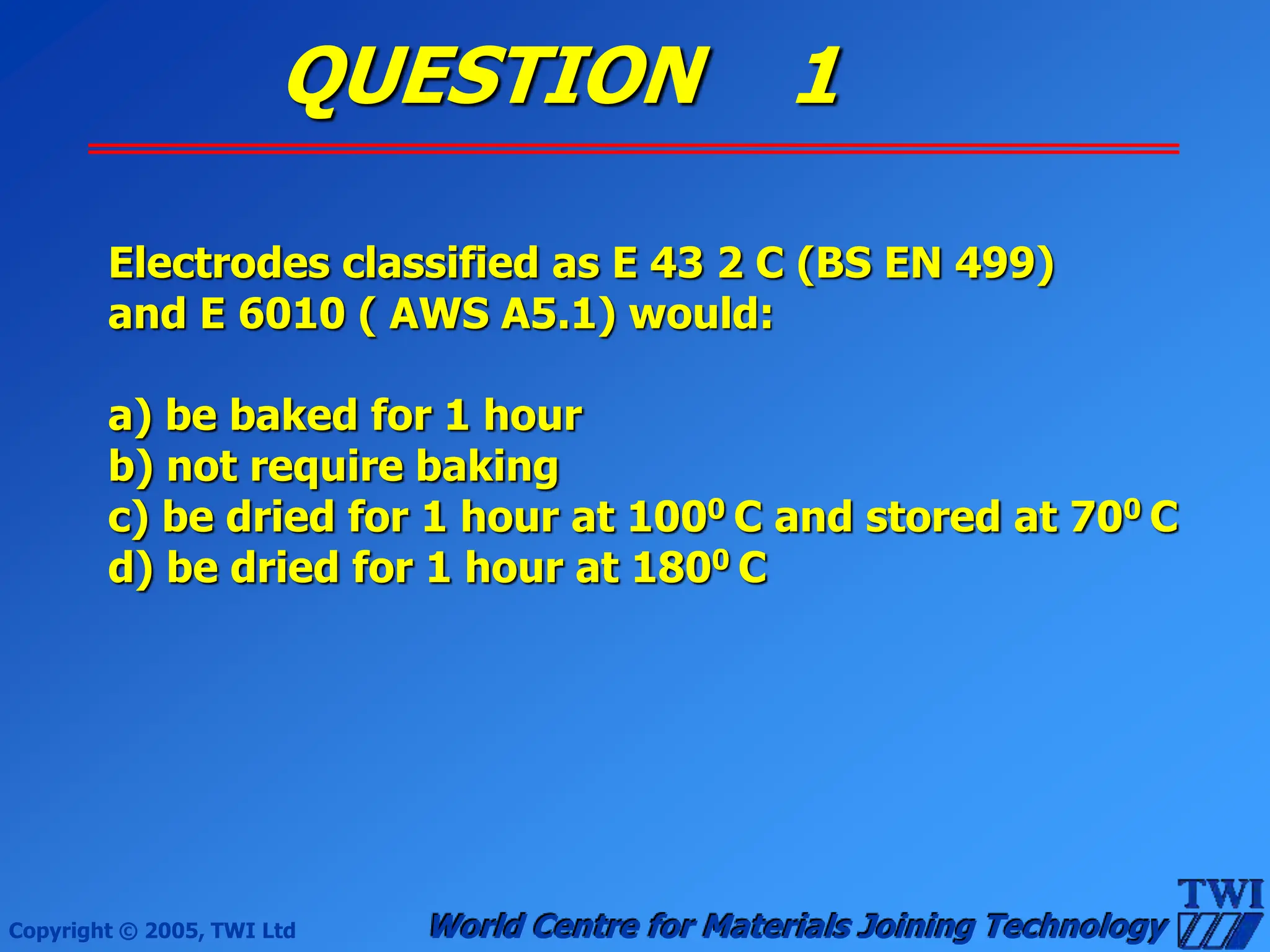
Electrodes classified as E 43 2 C (BS EN 499)
and E 6010 ( AWS A5.1) would:
a) be baked for 1 hour
b) not require baking
c) be dried for 1 hour at 1000 C and stored at 700 C
d) be dried for 1 hour at 1800 C
QUESTION 1
Copyright © 2005, TWI Ltd World Centre for Materials Joining Technology
In order to calculate arc energy, it is necessary
to know:
a) Current and Voltage
b) Current, Voltage , and Travel speed
c) Current , Voltage, and weave width
d) Wire feed, Voltage, and burn-off time
QUESTION 2
Copyright © 2005, TWI Ltd World Centre for Materials Joining Technology
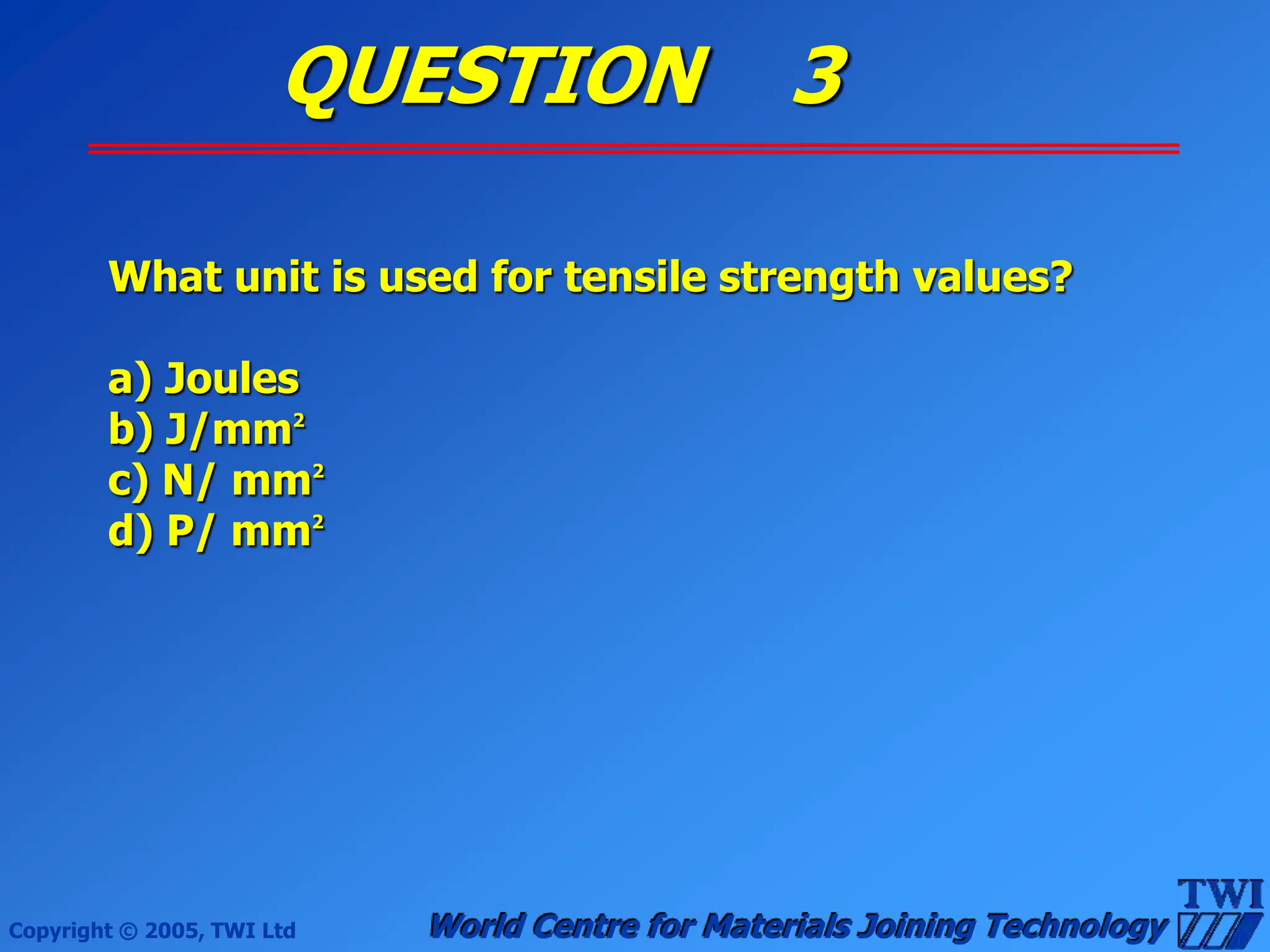
What unit is used for tensile strength values?
a) Joules
b) J/mm2
c) N/ mm2
d) P/ mm2
QUESTION 3
Copyright © 2005, TWI Ltd World Centre for Materials Joining Technology
The quality of a radiographic technique is
assessed:
a) By using a densitometer
b) From the kVA used, and the film-to-focus
distance
c) From the IQI
d) From the object-to-film distance
QUESTION 4
Copyright © 2005, TWI Ltd World Centre for Materials Joining Technology
Which of the following heating methods would
not be allowed for PWHT?
a) Electrical resistance mats
b) Hand-held gas torch
c) Gas fired heating
d) Induction furnace
QUESTION 5
Copyright © 2005, TWI Ltd World Centre for Materials Joining Technology
Which of the following statements about
Lamellar tearing is correct?
a) They are caused by the removal of strong-
backs
b) They are located in the centre of the weld
metal
c) They are formed during steel manufacture
d) They are formed during, or immediately after
welding
QUESTION 6
Copyright © 2005, TWI Ltd World Centre for Materials Joining Technology
Before carrying out Ultrasonic testing, it is
important:
a) To remove all excess weld metal
b) To carry out penetrant testing first
c) To calibrate the densitometer
d) To carry out some surface preparation
QUESTION 7
Copyright © 2005, TWI Ltd World Centre for Materials Joining Technology
When a weld imperfection is located:
a) It must always be repaired
b) It must be rejected
c) The welder’s qualification documents should be
reviewed
d) It should be assessed against the relevant code
QUESTION 8
Copyright © 2005, TWI Ltd World Centre for Materials Joining Technology
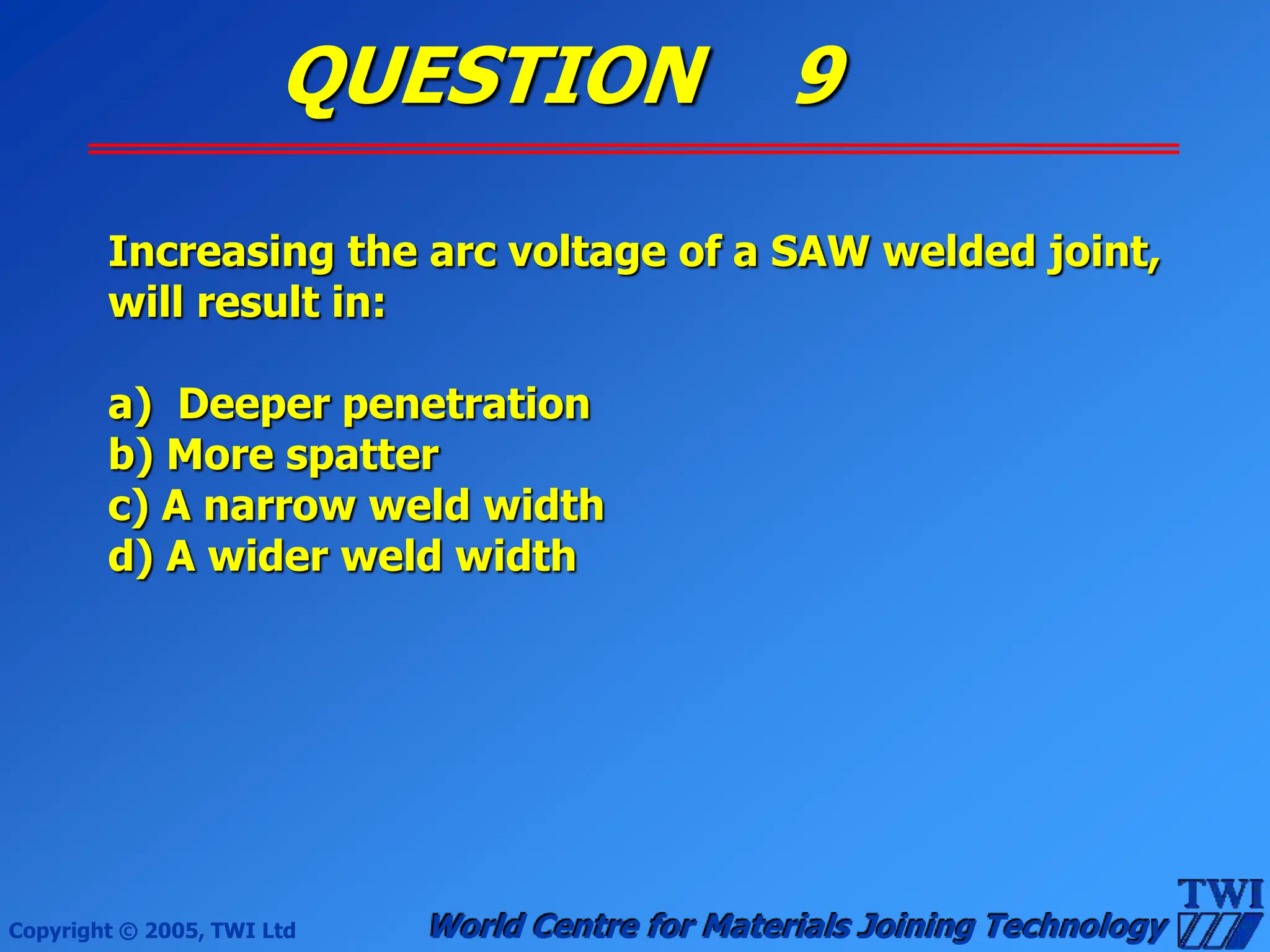
Increasing the arc voltage of a SAW welded joint,
will result in:
a) Deeper penetration
b) More spatter
c) A narrow weld width
d) A wider weld width
QUESTION 9
Copyright © 2005, TWI Ltd World Centre for Materials Joining Technology
Which of the following is NOT an essential
variable:
a) Welding process
b) Bevel angle
c) Material type
d) PWHT
QUESTION 10
Copyright © 2005, TWI Ltd World Centre for Materials Joining Technology
What does a large Z through the dual reference
line to BS EN 22553 indicate?
a) Throat thickness
b) Intermittent welds which must be staggered
c) Leg length
d) Toes must be blended
QUESTION 11
Copyright © 2005, TWI Ltd World Centre for Materials Joining Technology
Which defect is NOT normally associated with the
TIG welding process?
a) Tungsten inclusions
b) Crater pipe
c) Spatter
d) Porosity
QUESTION 12
Copyright © 2005, TWI Ltd World Centre for Materials Joining Technology
According to AWS A5.1, what type of covering
would an E6013 electrode have?
a) Fused
b) Basic
c) Rutile
d) Cellulosic
QUESTION 13
Copyright © 2005, TWI Ltd World Centre for Materials Joining Technology
Welding procedures must be qualified, because:
a) The welder needs to practice before production
begins
b) To prove that the NDT method can locate defects
c) To prove that the fabricator can control welding
d) To ensure that the joint properties satisfy the
specification
QUESTION 14
Copyright © 2005, TWI Ltd World Centre for Materials Joining Technology
Cyclic stress loading can lead to:
a) Fatigue failure
b) Brittle fracture
c) Ductile tearing
d) Stress corrosion cracking
QUESTION 15
Copyright © 2005, TWI Ltd World Centre for Materials Joining Technology
Hydrogen cracking is most likely in:
a) Aluminium
b) High strength low alloy steel
c) Low carbon steel
d) Austenitic stainless steel
QUESTION 16
Copyright © 2005, TWI Ltd World Centre for Materials Joining Technology
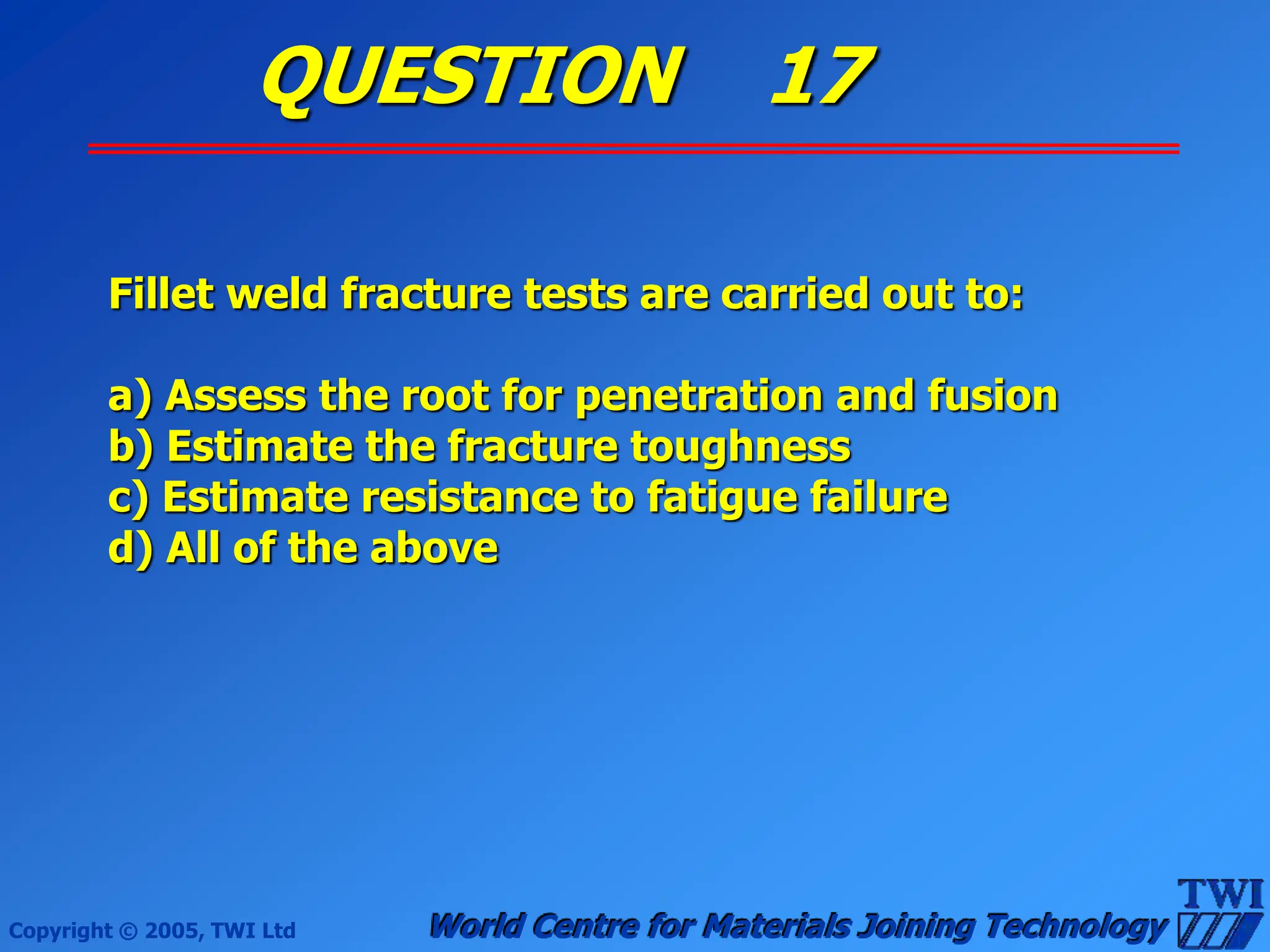
Fillet weld fracture tests are carried out to:
a) Assess the root for penetration and fusion
b) Estimate the fracture toughness
c) Estimate resistance to fatigue failure
d) All of the above
QUESTION 17
Copyright © 2005, TWI Ltd World Centre for Materials Joining Technology
In the TIG welding process, slope - in / slope -out
capability would be useful in order to:
a) Avoid start porosity and crater pipes
b) Reduce the risk of tungsten inclusions
c) Stabilise the arc
d) Allow more time for the filler metal to melt
QUESTION 18
Copyright © 2005, TWI Ltd World Centre for Materials Joining Technology
Which of the following MMA covered electrodes will
give deeper penetration compared to the others?
a) High iron powder
b) Rutile
c) Cellulosic
d) Basic
QUESTION 19
Copyright © 2005, TWI Ltd World Centre for Materials Joining Technology
Ultra-Violet and Infra-Red radiation created during
welding:
a) Help arc initiation
b) Can cause skin burns
c) Increase the welding speed
d) Be used for NDT
QUESTION 20
Copyright © 2005, TWI Ltd World Centre for Materials Joining Technology
With which NDT method would you use a “probe”?
a) X-Ray radiography
b) Magnetic Particle Inspection
c) Ultrasonic testing
d) Gamma radiography
QUESTION 21
Copyright © 2005, TWI Ltd World Centre for Materials Joining Technology
TIG welding of Aluminium would normally require
which polarity?
a) AC
b) DC electrode negative
c) DC electrode positive
d) All of the above
QUESTION 22
Copyright © 2005, TWI Ltd World Centre for Materials Joining Technology
What would be the required leg length of a fillet weld
with a design throat of 9 mm?
a) 9.5 mm
b) 12.6 mm
c) 6.3 mm
d) 7.8 mm
QUESTION 23
Copyright © 2005, TWI Ltd World Centre for Materials Joining Technology
A BS EN 22553 weld symbol reference line has the
number 131 at the end of it. What does this represent?
a) MMA process to be used
b) The welding position
c) The weld shall be made using the MIG process
d) The total weld length
QUESTION 24
Copyright © 2005, TWI Ltd World Centre for Materials Joining Technology
Which test is carried out to determine a materials
susceptibility to lamellar tearing?
a) Charpy test
b) Transverse tensile test
c) STRA test
d) Vickers test
QUESTION 25
Copyright © 2005, TWI Ltd World Centre for Materials Joining Technology
Which standard is concerned with Welder Approval?
a) BS EN 499
b) BS EN 288
c) BS EN 970
d) BS EN 287
QUESTION 26
Copyright © 2005, TWI Ltd World Centre for Materials Joining Technology
The included angle of a typical 15mm carbon steel
Single-Vee butt joint would be?
a) 30
0
b) 70
0
c) 120
0
d) 90
0
QUESTION 27
Copyright © 2005, TWI Ltd World Centre for Materials Joining Technology
Which element may result in a carbon steel weld
having “hot shortness”?
a) Silicon
b) Martensite
c) Sulphur
d) Manganese
QUESTION 28
Copyright © 2005, TWI Ltd World Centre for Materials Joining Technology
What does the term back-step refer to?
a) The use of step wedges for radiography
b) The use of step wedges to open up the joint root
faces
c) The weld run sequence
d) The welder returning to the completed joint
QUESTION 29
Copyright © 2005, TWI Ltd World Centre for Materials Joining Technology
Which welding position would normally give the
highest heat input during MMA welding?
a) PA (1G)
b) PC (2G)
c) PF (3G)
d) All positions would be the same
QUESTION 30
Copyright © 2005, TWI Ltd World Centre for Materials Joining Technology
PREPARE FOR THE ANSWERS!!
WRITE YOUR NAME ON YOUR PAPER
SWAP YOUR PAPER WITH
SOMEONE ELSE
Copyright © 2005, TWI Ltd World Centre for Materials Joining Technology
Electrodes classified as E 43 2 C (BS 499)
and E 6010 ( AWS A5.1) would usually:
a) Be baked for 1 hour
b) Not require baking
c) Be dried for 1 hour at 100 0C and stored at 70 0C
d) Be dried for 1 hour at 180 0C
QUESTION 1
ANSWER: B
Copyright © 2005, TWI Ltd World Centre for Materials Joining Technology
In order to calculate arc energy, it is necessary
to know:
a) Current and Voltage
b) Current, Voltage , and Travel speed
c) Current , Voltage, and weave width
d) Wire feed, Voltage, and burn-off time
QUESTION 2
ANSWER: B
Copyright © 2005, TWI Ltd World Centre for Materials Joining Technology
What unit is used for tensile strength values?
a) Joules
b) J/mm2
c) N/ mm2
d) P/ mm2
QUESTION 3
ANSWER: C
Copyright © 2005, TWI Ltd World Centre for Materials Joining Technology
The quality of a radiographic technique is
assessed:
a) By using a densitometer
b) From the kVA used, and the film-to-focus
distance
c) From the IQI
d) From the object-to-film distance
QUESTION 4
ANSWER: C
Copyright © 2005, TWI Ltd World Centre for Materials Joining Technology
Which of the following heating methods would
not be allowed for PWHT?
a) Electrical resistance mats
b) Hand-held gas torch
c) Gas fired heating
d) Induction furnace
QUESTION 5
ANSWER: B
Copyright © 2005, TWI Ltd World Centre for Materials Joining Technology
Which of the following statements about
Lamellar tearing is correct?
a) They are caused by the removal of strong-
backs
b) They are located in the centre of the weld
metal
c) They are formed during steel manufacture
d) They are formed during, or immediately after
welding
QUESTION 6
ANSWER: D
Copyright © 2005, TWI Ltd World Centre for Materials Joining Technology
Before carrying out Ultrasonic testing, it is
important:
a) To remove all excess weld metal
b) To carry out penetrant testing first
c) To calibrate the densitometer
d) To carry out some surface preparation
QUESTION 7
ANSWER: D
Copyright © 2005, TWI Ltd World Centre for Materials Joining Technology
When a weld imperfection is located:
a) It must always be repaired
b) It must be rejected
c) The welder’s qualification documents should be
reviewed
d) It should be assessed against the relevant code
QUESTION 8
ANSWER: D
Copyright © 2005, TWI Ltd World Centre for Materials Joining Technology
Increasing the arc voltage of a SAW welded joint,
will result in:
a) Deeper penetration
b) More spatter
c) A narrow weld width
d) A wider weld width
QUESTION 9
ANSWER: D
Copyright © 2005, TWI Ltd World Centre for Materials Joining Technology
Which of the following is NOT an essential
variable:
a) Welding process
b) Bevel angle
c) Material type
d) PWHT
QUESTION 10
ANSWER: B
Copyright © 2005, TWI Ltd World Centre for Materials Joining Technology
What does a large Z through the dual reference
line to BS EN 22553 represent?
a) Throat thickness
b) Intermittent welds which must be staggered
c) Leg length
d) Toes must be blended
QUESTION 11
ANSWER: B
Copyright © 2005, TWI Ltd World Centre for Materials Joining Technology
Which defect is NOT normally associated with
TIG?
a) Tungsten inclusions
b) Crater pipe
c) Spatter
d) Lack of fusion
QUESTION 12
ANSWER: C
Copyright © 2005, TWI Ltd World Centre for Materials Joining Technology
According to AWS A5.1, what type of covering
would an E6013 electrode have?
a) Fused
b) Basic
c) Rutile
d) Cellulosic
QUESTION 13
ANSWER: C
Copyright © 2005, TWI Ltd World Centre for Materials Joining Technology
Welding procedures must be qualified, because:
a) The welder needs to practice before production
begins
b) To prove that the NDT method can locate defects
c) To prove that the fabricator can control welding
d) To ensure that the joint properties satisfy the
specification
QUESTION 14
ANSWER: D
Copyright © 2005, TWI Ltd World Centre for Materials Joining Technology
Cyclic stress loading can lead to:
a) Fatigue failure
b) Brittle fracture
c) Ductile tearing
d) Stress corrosion cracking
QUESTION 15
ANSWER: A
Copyright © 2005, TWI Ltd World Centre for Materials Joining Technology
Hydrogen cracking is most likely in:
a) Aluminium
b) High strength low alloy steel
c) Low carbon steel
d) Austenitic stainless steel
QUESTION 16
ANSWER: B
Copyright © 2005, TWI Ltd World Centre for Materials Joining Technology
Fillet weld fracture tests are carried out to:
a) Assess the root for penetration and fusion
b) Estimate the fracture toughness
c) Estimate resistance to fatigue failure
d) All of the above
QUESTION 17
ANSWER: A
Copyright © 2005, TWI Ltd World Centre for Materials Joining Technology
In the TIG welding process, slope-in / slope - out
capability is useful in order to:
a) Avoid start porosity and crater pipes
b) Reduce the risk of tungsten inclusions
c) Stabilise the arc
d) Allow more time for the filler metal to melt
QUESTION 18
ANSWER: A
Copyright © 2005, TWI Ltd World Centre for Materials Joining Technology
Which of the following covered MMA electrodes will
give deeper penetration compared with the others?
a) High iron powder
b) Rutile
c) Cellulosic
d) Basic
QUESTION 19
ANSWER: C
Copyright © 2005, TWI Ltd World Centre for Materials Joining Technology
Ultra-Violet and Infra-Red radiation created during
welding:
a) Help arc initiation
b) Can cause skin burns
c) Increase the welding speed
d) Be used for NDT
QUESTION 20
ANSWER: B
Copyright © 2005, TWI Ltd World Centre for Materials Joining Technology
With which NDT method would you use a “probe”?
a) X-Ray radiography
b) Magnetic Particle Inspection
c) Ultrasonic testing
d) Gamma radiography
QUESTION 21
ANSWER: C
Copyright © 2005, TWI Ltd World Centre for Materials Joining Technology
TIG welding of Aluminium normally requires which
polarity?
a) AC
b) DC electrode negative
c) DC electrode positive
d) All of the above
QUESTION 22
ANSWER: A
Copyright © 2005, TWI Ltd World Centre for Materials Joining Technology
What would be the required leg length of a fillet weld
with a design throat of 9 mm?
a) 9.5 mm
b) 12.6 mm
c) 6.3 mm
d) 7.8 mm
QUESTION 23
ANSWER: B
Copyright © 2005, TWI Ltd World Centre for Materials Joining Technology
A BS EN 22553 weld symbol reference line has the
number 131 at the end of it. This symbolises what?
a) MMA process to be used
b) The welding position
c) The weld shall be made using the MIG process
d) The total weld length
QUESTION 24
ANSWER: C
Copyright © 2005, TWI Ltd World Centre for Materials Joining Technology
Which test is carried out to determine a materials
susceptibility to lamellar tearing?
a) Charpy test
b) Transverse tensile test
c) STRA test
d) Vickers test
QUESTION 25
ANSWER: C
Copyright © 2005, TWI Ltd World Centre for Materials Joining Technology
Which standard is concerned with Welder Approval?
a) BS EN 499
b) BS EN 288
c) BS EN 970
d) BS EN 287
QUESTION 26
ANSWER: D
Copyright © 2005, TWI Ltd World Centre for Materials Joining Technology
The included angle of a typical 15mm carbon steel
Single-Vee MMA butt joint would be?
a) 30
0
b) 70
0
c) 120
0
d) 90
0
QUESTION 27
ANSWER: B
Copyright © 2005, TWI Ltd World Centre for Materials Joining Technology
Which element may result in a carbon steel weld
having “hot shortness”?
a) Silicon
b) Martensite
c) Sulphur
d) Manganese
QUESTION 28
ANSWER: C
Copyright © 2005, TWI Ltd World Centre for Materials Joining Technology
What does the term back-step refer to?
a) The use of step wedges for radiography
b) The use of step wedges to open up the joint root
faces
c) The weld run sequence
d) The welder returning to the completed joint
QUESTION 29
ANSWER: C
Copyright © 2005, TWI Ltd World Centre for Materials Joining Technology
Which welding position would normally give the
highest heat input during MMA welding?
a) PA (1G)
b) PC (2G)
c) PF (3G)
d) All positions would be the same
QUESTION 30
ANSWER: c

Project Quality Plan for Welding and Control.ppt

  • 1.
    Copyright © 2005,TWI Ltd World Centre for Materials Joining Technology QUESTION TIME!! MULTI CHOICE QUESTIONS
  • 2.
    Copyright © 2005,TWI Ltd World Centre for Materials Joining Technology Electrodes classified as E 43 2 C (BS EN 499) and E 6010 ( AWS A5.1) would: a) be baked for 1 hour b) not require baking c) be dried for 1 hour at 1000 C and stored at 700 C d) be dried for 1 hour at 1800 C QUESTION 1
  • 3.
    Copyright © 2005,TWI Ltd World Centre for Materials Joining Technology In order to calculate arc energy, it is necessary to know: a) Current and Voltage b) Current, Voltage , and Travel speed c) Current , Voltage, and weave width d) Wire feed, Voltage, and burn-off time QUESTION 2
  • 4.
    Copyright © 2005,TWI Ltd World Centre for Materials Joining Technology What unit is used for tensile strength values? a) Joules b) J/mm2 c) N/ mm2 d) P/ mm2 QUESTION 3
  • 5.
    Copyright © 2005,TWI Ltd World Centre for Materials Joining Technology The quality of a radiographic technique is assessed: a) By using a densitometer b) From the kVA used, and the film-to-focus distance c) From the IQI d) From the object-to-film distance QUESTION 4
  • 6.
    Copyright © 2005,TWI Ltd World Centre for Materials Joining Technology Which of the following heating methods would not be allowed for PWHT? a) Electrical resistance mats b) Hand-held gas torch c) Gas fired heating d) Induction furnace QUESTION 5
  • 7.
    Copyright © 2005,TWI Ltd World Centre for Materials Joining Technology Which of the following statements about Lamellar tearing is correct? a) They are caused by the removal of strong- backs b) They are located in the centre of the weld metal c) They are formed during steel manufacture d) They are formed during, or immediately after welding QUESTION 6
  • 8.
    Copyright © 2005,TWI Ltd World Centre for Materials Joining Technology Before carrying out Ultrasonic testing, it is important: a) To remove all excess weld metal b) To carry out penetrant testing first c) To calibrate the densitometer d) To carry out some surface preparation QUESTION 7
  • 9.
    Copyright © 2005,TWI Ltd World Centre for Materials Joining Technology When a weld imperfection is located: a) It must always be repaired b) It must be rejected c) The welder’s qualification documents should be reviewed d) It should be assessed against the relevant code QUESTION 8
  • 10.
    Copyright © 2005,TWI Ltd World Centre for Materials Joining Technology Increasing the arc voltage of a SAW welded joint, will result in: a) Deeper penetration b) More spatter c) A narrow weld width d) A wider weld width QUESTION 9
  • 11.
    Copyright © 2005,TWI Ltd World Centre for Materials Joining Technology Which of the following is NOT an essential variable: a) Welding process b) Bevel angle c) Material type d) PWHT QUESTION 10
  • 12.
    Copyright © 2005,TWI Ltd World Centre for Materials Joining Technology What does a large Z through the dual reference line to BS EN 22553 indicate? a) Throat thickness b) Intermittent welds which must be staggered c) Leg length d) Toes must be blended QUESTION 11
  • 13.
    Copyright © 2005,TWI Ltd World Centre for Materials Joining Technology Which defect is NOT normally associated with the TIG welding process? a) Tungsten inclusions b) Crater pipe c) Spatter d) Porosity QUESTION 12
  • 14.
    Copyright © 2005,TWI Ltd World Centre for Materials Joining Technology According to AWS A5.1, what type of covering would an E6013 electrode have? a) Fused b) Basic c) Rutile d) Cellulosic QUESTION 13
  • 15.
    Copyright © 2005,TWI Ltd World Centre for Materials Joining Technology Welding procedures must be qualified, because: a) The welder needs to practice before production begins b) To prove that the NDT method can locate defects c) To prove that the fabricator can control welding d) To ensure that the joint properties satisfy the specification QUESTION 14
  • 16.
    Copyright © 2005,TWI Ltd World Centre for Materials Joining Technology Cyclic stress loading can lead to: a) Fatigue failure b) Brittle fracture c) Ductile tearing d) Stress corrosion cracking QUESTION 15
  • 17.
    Copyright © 2005,TWI Ltd World Centre for Materials Joining Technology Hydrogen cracking is most likely in: a) Aluminium b) High strength low alloy steel c) Low carbon steel d) Austenitic stainless steel QUESTION 16
  • 18.
    Copyright © 2005,TWI Ltd World Centre for Materials Joining Technology Fillet weld fracture tests are carried out to: a) Assess the root for penetration and fusion b) Estimate the fracture toughness c) Estimate resistance to fatigue failure d) All of the above QUESTION 17
  • 19.
    Copyright © 2005,TWI Ltd World Centre for Materials Joining Technology In the TIG welding process, slope - in / slope -out capability would be useful in order to: a) Avoid start porosity and crater pipes b) Reduce the risk of tungsten inclusions c) Stabilise the arc d) Allow more time for the filler metal to melt QUESTION 18
  • 20.
    Copyright © 2005,TWI Ltd World Centre for Materials Joining Technology Which of the following MMA covered electrodes will give deeper penetration compared to the others? a) High iron powder b) Rutile c) Cellulosic d) Basic QUESTION 19
  • 21.
    Copyright © 2005,TWI Ltd World Centre for Materials Joining Technology Ultra-Violet and Infra-Red radiation created during welding: a) Help arc initiation b) Can cause skin burns c) Increase the welding speed d) Be used for NDT QUESTION 20
  • 22.
    Copyright © 2005,TWI Ltd World Centre for Materials Joining Technology With which NDT method would you use a “probe”? a) X-Ray radiography b) Magnetic Particle Inspection c) Ultrasonic testing d) Gamma radiography QUESTION 21
  • 23.
    Copyright © 2005,TWI Ltd World Centre for Materials Joining Technology TIG welding of Aluminium would normally require which polarity? a) AC b) DC electrode negative c) DC electrode positive d) All of the above QUESTION 22
  • 24.
    Copyright © 2005,TWI Ltd World Centre for Materials Joining Technology What would be the required leg length of a fillet weld with a design throat of 9 mm? a) 9.5 mm b) 12.6 mm c) 6.3 mm d) 7.8 mm QUESTION 23
  • 25.
    Copyright © 2005,TWI Ltd World Centre for Materials Joining Technology A BS EN 22553 weld symbol reference line has the number 131 at the end of it. What does this represent? a) MMA process to be used b) The welding position c) The weld shall be made using the MIG process d) The total weld length QUESTION 24
  • 26.
    Copyright © 2005,TWI Ltd World Centre for Materials Joining Technology Which test is carried out to determine a materials susceptibility to lamellar tearing? a) Charpy test b) Transverse tensile test c) STRA test d) Vickers test QUESTION 25
  • 27.
    Copyright © 2005,TWI Ltd World Centre for Materials Joining Technology Which standard is concerned with Welder Approval? a) BS EN 499 b) BS EN 288 c) BS EN 970 d) BS EN 287 QUESTION 26
  • 28.
    Copyright © 2005,TWI Ltd World Centre for Materials Joining Technology The included angle of a typical 15mm carbon steel Single-Vee butt joint would be? a) 30 0 b) 70 0 c) 120 0 d) 90 0 QUESTION 27
  • 29.
    Copyright © 2005,TWI Ltd World Centre for Materials Joining Technology Which element may result in a carbon steel weld having “hot shortness”? a) Silicon b) Martensite c) Sulphur d) Manganese QUESTION 28
  • 30.
    Copyright © 2005,TWI Ltd World Centre for Materials Joining Technology What does the term back-step refer to? a) The use of step wedges for radiography b) The use of step wedges to open up the joint root faces c) The weld run sequence d) The welder returning to the completed joint QUESTION 29
  • 31.
    Copyright © 2005,TWI Ltd World Centre for Materials Joining Technology Which welding position would normally give the highest heat input during MMA welding? a) PA (1G) b) PC (2G) c) PF (3G) d) All positions would be the same QUESTION 30
  • 32.
    Copyright © 2005,TWI Ltd World Centre for Materials Joining Technology PREPARE FOR THE ANSWERS!! WRITE YOUR NAME ON YOUR PAPER SWAP YOUR PAPER WITH SOMEONE ELSE
  • 33.
    Copyright © 2005,TWI Ltd World Centre for Materials Joining Technology Electrodes classified as E 43 2 C (BS 499) and E 6010 ( AWS A5.1) would usually: a) Be baked for 1 hour b) Not require baking c) Be dried for 1 hour at 100 0C and stored at 70 0C d) Be dried for 1 hour at 180 0C QUESTION 1 ANSWER: B
  • 34.
    Copyright © 2005,TWI Ltd World Centre for Materials Joining Technology In order to calculate arc energy, it is necessary to know: a) Current and Voltage b) Current, Voltage , and Travel speed c) Current , Voltage, and weave width d) Wire feed, Voltage, and burn-off time QUESTION 2 ANSWER: B
  • 35.
    Copyright © 2005,TWI Ltd World Centre for Materials Joining Technology What unit is used for tensile strength values? a) Joules b) J/mm2 c) N/ mm2 d) P/ mm2 QUESTION 3 ANSWER: C
  • 36.
    Copyright © 2005,TWI Ltd World Centre for Materials Joining Technology The quality of a radiographic technique is assessed: a) By using a densitometer b) From the kVA used, and the film-to-focus distance c) From the IQI d) From the object-to-film distance QUESTION 4 ANSWER: C
  • 37.
    Copyright © 2005,TWI Ltd World Centre for Materials Joining Technology Which of the following heating methods would not be allowed for PWHT? a) Electrical resistance mats b) Hand-held gas torch c) Gas fired heating d) Induction furnace QUESTION 5 ANSWER: B
  • 38.
    Copyright © 2005,TWI Ltd World Centre for Materials Joining Technology Which of the following statements about Lamellar tearing is correct? a) They are caused by the removal of strong- backs b) They are located in the centre of the weld metal c) They are formed during steel manufacture d) They are formed during, or immediately after welding QUESTION 6 ANSWER: D
  • 39.
    Copyright © 2005,TWI Ltd World Centre for Materials Joining Technology Before carrying out Ultrasonic testing, it is important: a) To remove all excess weld metal b) To carry out penetrant testing first c) To calibrate the densitometer d) To carry out some surface preparation QUESTION 7 ANSWER: D
  • 40.
    Copyright © 2005,TWI Ltd World Centre for Materials Joining Technology When a weld imperfection is located: a) It must always be repaired b) It must be rejected c) The welder’s qualification documents should be reviewed d) It should be assessed against the relevant code QUESTION 8 ANSWER: D
  • 41.
    Copyright © 2005,TWI Ltd World Centre for Materials Joining Technology Increasing the arc voltage of a SAW welded joint, will result in: a) Deeper penetration b) More spatter c) A narrow weld width d) A wider weld width QUESTION 9 ANSWER: D
  • 42.
    Copyright © 2005,TWI Ltd World Centre for Materials Joining Technology Which of the following is NOT an essential variable: a) Welding process b) Bevel angle c) Material type d) PWHT QUESTION 10 ANSWER: B
  • 43.
    Copyright © 2005,TWI Ltd World Centre for Materials Joining Technology What does a large Z through the dual reference line to BS EN 22553 represent? a) Throat thickness b) Intermittent welds which must be staggered c) Leg length d) Toes must be blended QUESTION 11 ANSWER: B
  • 44.
    Copyright © 2005,TWI Ltd World Centre for Materials Joining Technology Which defect is NOT normally associated with TIG? a) Tungsten inclusions b) Crater pipe c) Spatter d) Lack of fusion QUESTION 12 ANSWER: C
  • 45.
    Copyright © 2005,TWI Ltd World Centre for Materials Joining Technology According to AWS A5.1, what type of covering would an E6013 electrode have? a) Fused b) Basic c) Rutile d) Cellulosic QUESTION 13 ANSWER: C
  • 46.
    Copyright © 2005,TWI Ltd World Centre for Materials Joining Technology Welding procedures must be qualified, because: a) The welder needs to practice before production begins b) To prove that the NDT method can locate defects c) To prove that the fabricator can control welding d) To ensure that the joint properties satisfy the specification QUESTION 14 ANSWER: D
  • 47.
    Copyright © 2005,TWI Ltd World Centre for Materials Joining Technology Cyclic stress loading can lead to: a) Fatigue failure b) Brittle fracture c) Ductile tearing d) Stress corrosion cracking QUESTION 15 ANSWER: A
  • 48.
    Copyright © 2005,TWI Ltd World Centre for Materials Joining Technology Hydrogen cracking is most likely in: a) Aluminium b) High strength low alloy steel c) Low carbon steel d) Austenitic stainless steel QUESTION 16 ANSWER: B
  • 49.
    Copyright © 2005,TWI Ltd World Centre for Materials Joining Technology Fillet weld fracture tests are carried out to: a) Assess the root for penetration and fusion b) Estimate the fracture toughness c) Estimate resistance to fatigue failure d) All of the above QUESTION 17 ANSWER: A
  • 50.
    Copyright © 2005,TWI Ltd World Centre for Materials Joining Technology In the TIG welding process, slope-in / slope - out capability is useful in order to: a) Avoid start porosity and crater pipes b) Reduce the risk of tungsten inclusions c) Stabilise the arc d) Allow more time for the filler metal to melt QUESTION 18 ANSWER: A
  • 51.
    Copyright © 2005,TWI Ltd World Centre for Materials Joining Technology Which of the following covered MMA electrodes will give deeper penetration compared with the others? a) High iron powder b) Rutile c) Cellulosic d) Basic QUESTION 19 ANSWER: C
  • 52.
    Copyright © 2005,TWI Ltd World Centre for Materials Joining Technology Ultra-Violet and Infra-Red radiation created during welding: a) Help arc initiation b) Can cause skin burns c) Increase the welding speed d) Be used for NDT QUESTION 20 ANSWER: B
  • 53.
    Copyright © 2005,TWI Ltd World Centre for Materials Joining Technology With which NDT method would you use a “probe”? a) X-Ray radiography b) Magnetic Particle Inspection c) Ultrasonic testing d) Gamma radiography QUESTION 21 ANSWER: C
  • 54.
    Copyright © 2005,TWI Ltd World Centre for Materials Joining Technology TIG welding of Aluminium normally requires which polarity? a) AC b) DC electrode negative c) DC electrode positive d) All of the above QUESTION 22 ANSWER: A
  • 55.
    Copyright © 2005,TWI Ltd World Centre for Materials Joining Technology What would be the required leg length of a fillet weld with a design throat of 9 mm? a) 9.5 mm b) 12.6 mm c) 6.3 mm d) 7.8 mm QUESTION 23 ANSWER: B
  • 56.
    Copyright © 2005,TWI Ltd World Centre for Materials Joining Technology A BS EN 22553 weld symbol reference line has the number 131 at the end of it. This symbolises what? a) MMA process to be used b) The welding position c) The weld shall be made using the MIG process d) The total weld length QUESTION 24 ANSWER: C
  • 57.
    Copyright © 2005,TWI Ltd World Centre for Materials Joining Technology Which test is carried out to determine a materials susceptibility to lamellar tearing? a) Charpy test b) Transverse tensile test c) STRA test d) Vickers test QUESTION 25 ANSWER: C
  • 58.
    Copyright © 2005,TWI Ltd World Centre for Materials Joining Technology Which standard is concerned with Welder Approval? a) BS EN 499 b) BS EN 288 c) BS EN 970 d) BS EN 287 QUESTION 26 ANSWER: D
  • 59.
    Copyright © 2005,TWI Ltd World Centre for Materials Joining Technology The included angle of a typical 15mm carbon steel Single-Vee MMA butt joint would be? a) 30 0 b) 70 0 c) 120 0 d) 90 0 QUESTION 27 ANSWER: B
  • 60.
    Copyright © 2005,TWI Ltd World Centre for Materials Joining Technology Which element may result in a carbon steel weld having “hot shortness”? a) Silicon b) Martensite c) Sulphur d) Manganese QUESTION 28 ANSWER: C
  • 61.
    Copyright © 2005,TWI Ltd World Centre for Materials Joining Technology What does the term back-step refer to? a) The use of step wedges for radiography b) The use of step wedges to open up the joint root faces c) The weld run sequence d) The welder returning to the completed joint QUESTION 29 ANSWER: C
  • 62.
    Copyright © 2005,TWI Ltd World Centre for Materials Joining Technology Which welding position would normally give the highest heat input during MMA welding? a) PA (1G) b) PC (2G) c) PF (3G) d) All positions would be the same QUESTION 30 ANSWER: c