The HL Business &
Management IA
How important is this IA?
• The Extended Essay is worth:
1.5 points
• The Business IA is worth:
2.5 points
Your Task:
• You have to write a report on a
current problem facing a real
business.
• Your report must include a
recommendation to solve the
problem.
There are two parts to the IA:
Research
Proposal
4 / 25
Business
report
21 / 25
Research
Project
25 / 25
4% of the
final mark
21% of
the final
mark
+ =
25 % of
the final
mark
+ =
Or think of it like this:
What do they mean?
• The Research Proposal - is a document
that states what and why you are writing
your report.
• There is a maximum limit of 500 words.
• The Report itself – states how you are
proposing to solve the problem identified.
• There is a maximum limit of 2,000 words.
How will you do this?
• Stage 1 – Produce the Research Proposal
May – June
• Stage 2 – Collect the data and produce a
1st
draft
June – August
• Stage 3 – Write up final draft of the Report
September - October
An Example question
Should company ‘x’
improve its marketing
strategy in order to
make more profits?
An Example question
Should company ‘x’
improve its marketing
strategy?
An Example question
Should company ‘x’
improve its pricing
strategy?
An Example question
Should company ‘x’
introduce a ‘destroyer’
pricing strategy to
product ‘y’?
Stage 1 -
The Research Proposal:
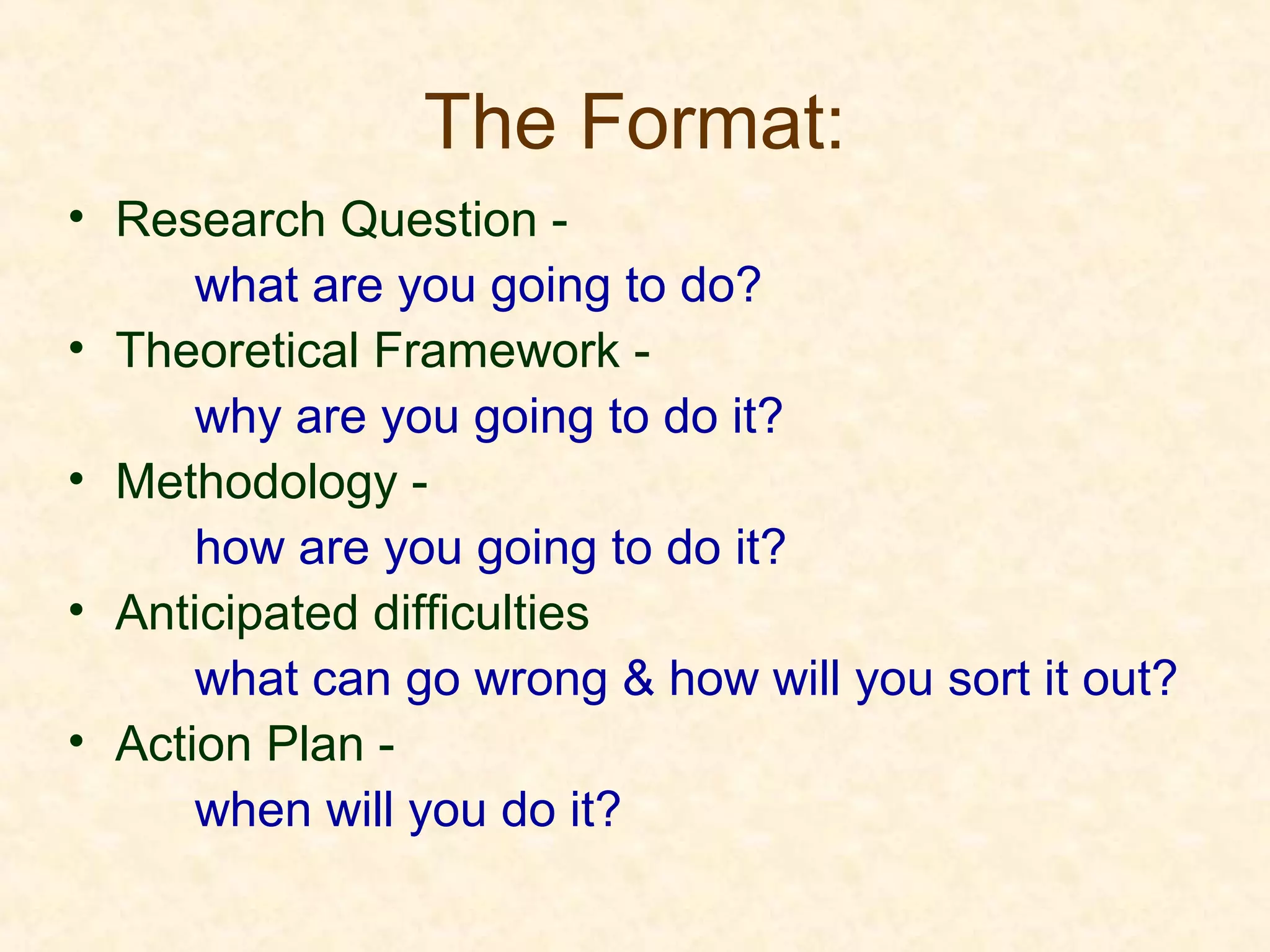
The Format:
• Research Question -
what are you going to do?
• Theoretical Framework -
why are you going to do it?
• Methodology -
how are you going to do it?
• Anticipated difficulties
what can go wrong & how will you sort it out?
• Action Plan -
when will you do it?
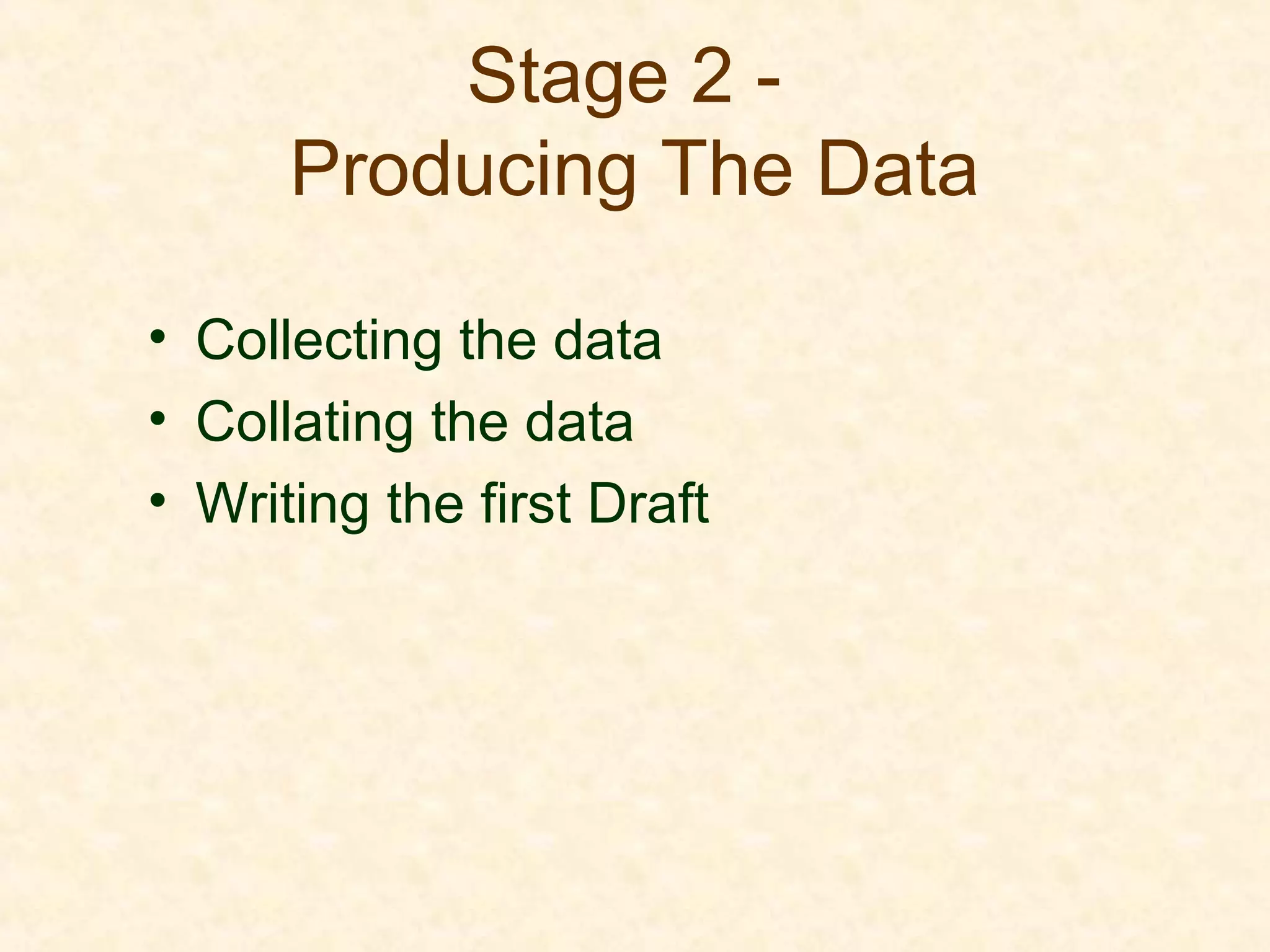
Stage 2 -
Producing The Data
• Collecting the data
• Collating the data
• Writing the first Draft
The data
• You must collect both primary and
secondary data.
• There are two factors that are
important when deciding what type of
data to collect:
1. How is it to be used?
2. How reliable is the data?
Collecting data
Examples of single source & unreliable
data are when the source for your
information is only:
• a survey
• an interview
• a textbook
• a website (the company)
• one person (the manager)
• only the business itself
An example – A Product
Positioning Map
High Price
Low
Quality
High
Quality
Low Price
Apple
Oregon
Creative
iriver
Source:
• “I did a survey of 20 ’randomly’ selected
students from my school – as they are the
ones who use MP3 players the most.”
High Price
Low
Quality
High
Quality
Low Price
Apple Nano
MPman
Oregon
Rio
Sharp
Creative (Muvo)
Beosound
Archos
iriver
Ministry of
Sound
Apple Shuffle
Apple Photo
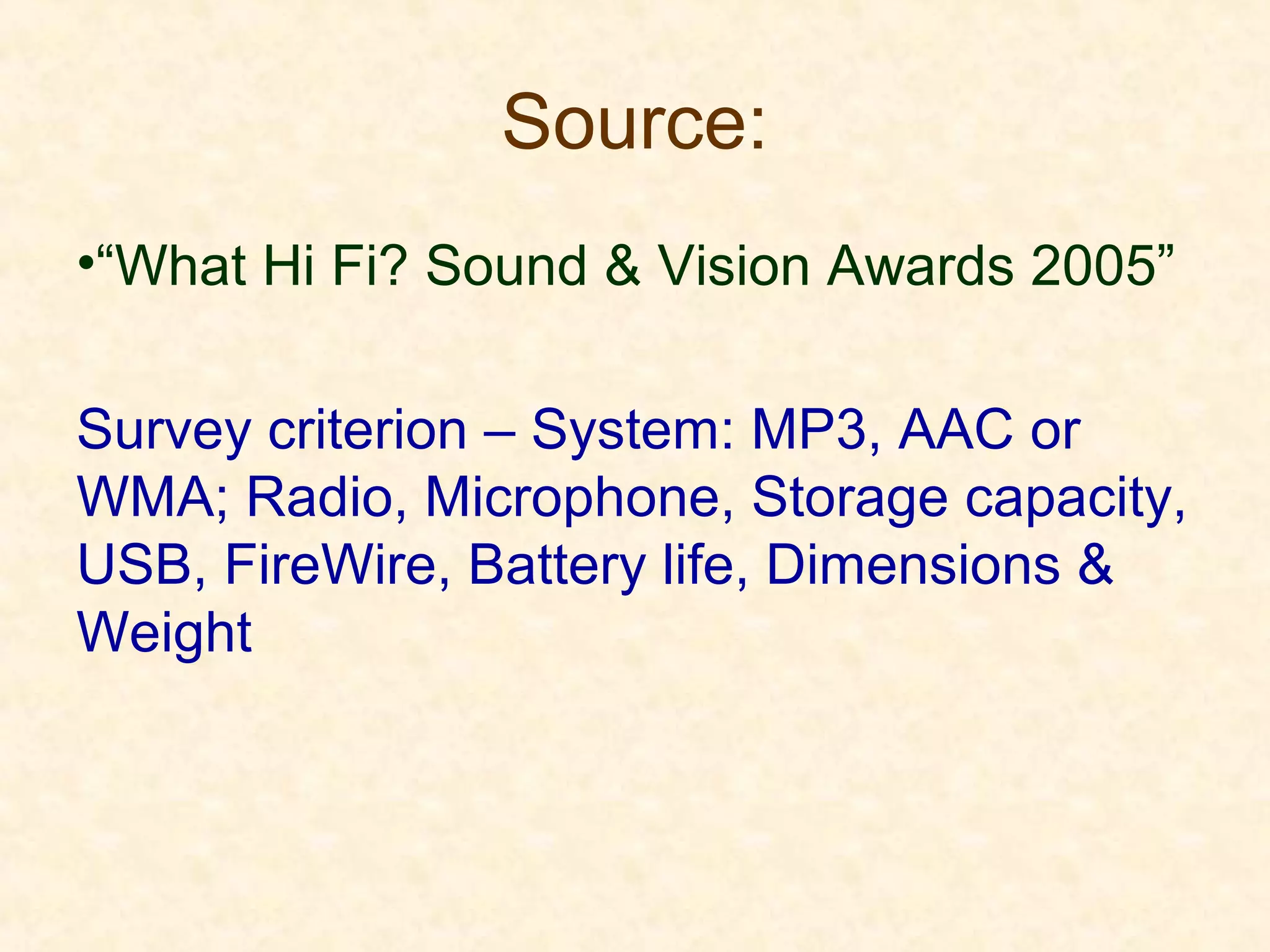
Source:
•“What Hi Fi? Sound & Vision Awards 2005”
Survey criterion – System: MP3, AAC or
WMA; Radio, Microphone, Storage capacity,
USB, FireWire, Battery life, Dimensions &
Weight
The Techniques to use
We recommend two general points
1. Use 3 or 4 techniques.
2. Use at least 1 qualitative and 1
quantitative technique.
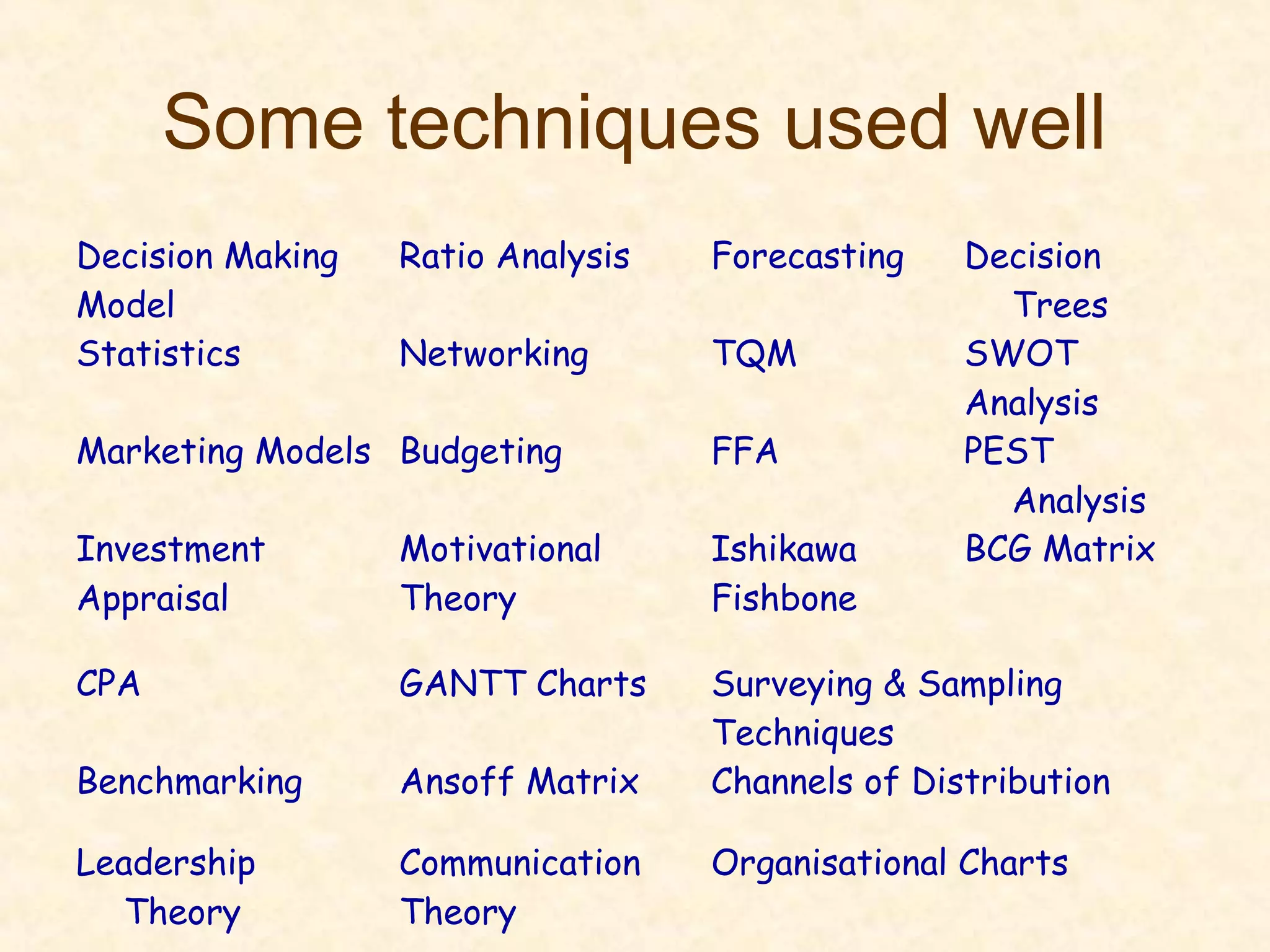
Some techniques used well
Decision Making
Model
Ratio Analysis Forecasting Decision
Trees
Statistics Networking TQM SWOT
Analysis
Marketing Models Budgeting FFA PEST
Analysis
Investment
Appraisal
Motivational
Theory
Ishikawa
Fishbone
BCG Matrix
CPA GANTT Charts Surveying & Sampling
Techniques
Benchmarking Ansoff Matrix Channels of Distribution
Leadership
Theory
Communication
Theory
Organisational Charts
Stage 3 -
The final write-up
There are four elements in this stage:
1. Reworking the first draft
2. Writing the analysis & evaluation
3. Writing a conclusion & recommendation
4. Producing the completed project
Writing the analysis & evaluation
You need to consider:
• Link the analysis to your research data
• Be succinct and ordered
• Integrate your data, analysis and evaluation
• Avoid relying too heavily on a single source
(the business)
• Use independent sources
• Avoid unsupported generalisations
• Be critical – don’t take everything for granted
Assessment criterion ‘A’:
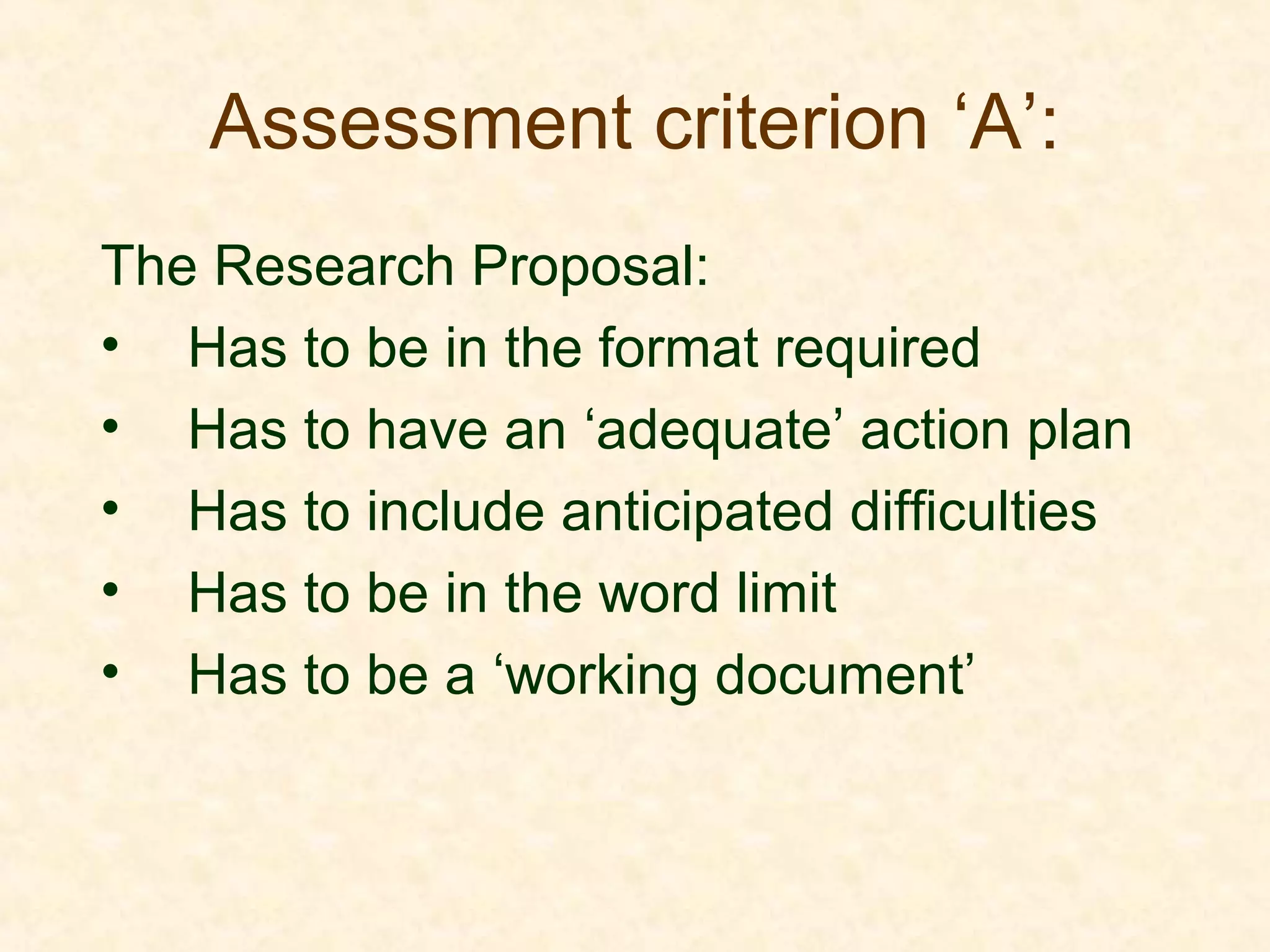
The Research Proposal:
• Has to be in the format required
• Has to have an ‘adequate’ action plan
• Has to include anticipated difficulties
• Has to be in the word limit
• Has to be a ‘working document’
Assessment criterion ‘B’:
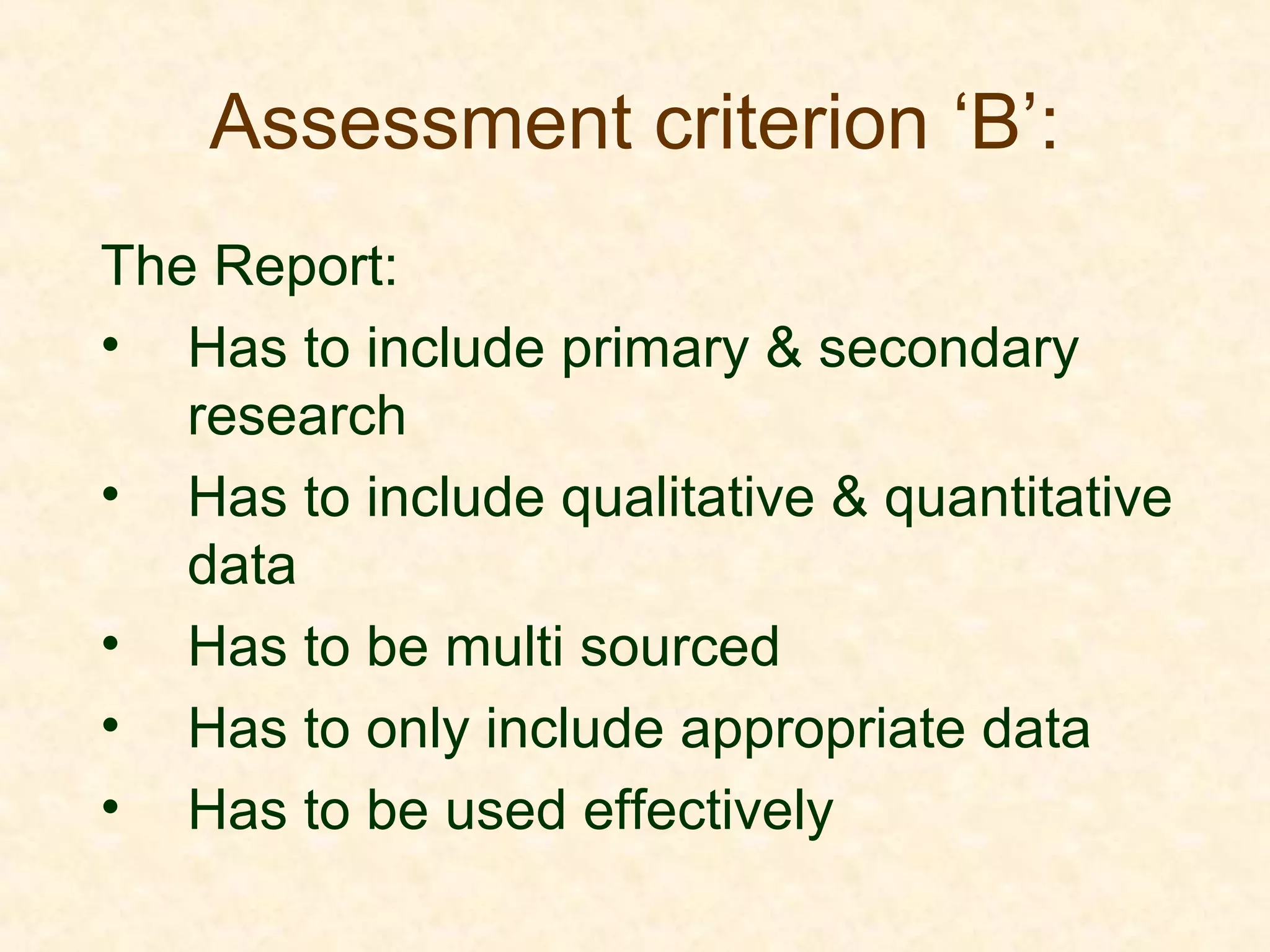
The Report:
• Has to include primary & secondary
research
• Has to include qualitative & quantitative
data
• Has to be multi sourced
• Has to only include appropriate data
• Has to be used effectively
Assessment criterion ‘C’:
The Report:
• Has to be ‘probing’ – not descriptive
• Has to be objective
• Has to be realistic
• Has to be ‘critically reflective’
• Has to be informative
Assessment criterion ‘D’:
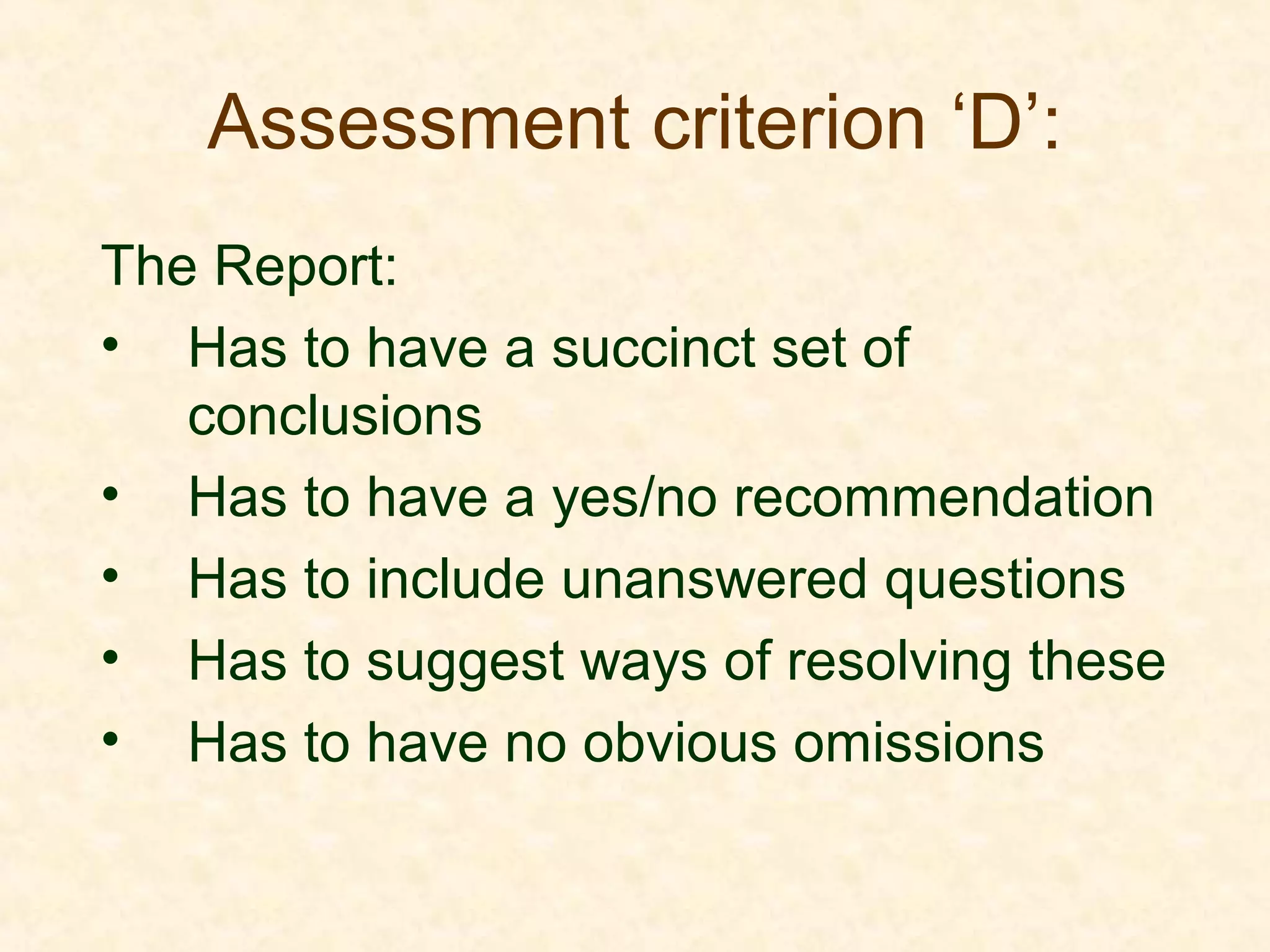
The Report:
• Has to have a succinct set of
conclusions
• Has to have a yes/no recommendation
• Has to include unanswered questions
• Has to suggest ways of resolving these
• Has to have no obvious omissions
Assessment criterion ‘E’:
The report:
• Has to have an ‘Executive Summary’
• Has to have accurate & consistent
referencing
• Has to include relevant appendices
• Has to be in the word limit

The Business IA (HL)

  • 1.
    The HL Business& Management IA
  • 2.
    How important isthis IA? • The Extended Essay is worth: 1.5 points • The Business IA is worth: 2.5 points
  • 3.
    Your Task: • Youhave to write a report on a current problem facing a real business. • Your report must include a recommendation to solve the problem.
  • 4.
    There are twoparts to the IA: Research Proposal 4 / 25 Business report 21 / 25 Research Project 25 / 25 4% of the final mark 21% of the final mark + = 25 % of the final mark + = Or think of it like this:
  • 5.
    What do theymean? • The Research Proposal - is a document that states what and why you are writing your report. • There is a maximum limit of 500 words. • The Report itself – states how you are proposing to solve the problem identified. • There is a maximum limit of 2,000 words.
  • 6.
    How will youdo this? • Stage 1 – Produce the Research Proposal May – June • Stage 2 – Collect the data and produce a 1st draft June – August • Stage 3 – Write up final draft of the Report September - October
  • 7.
    An Example question Shouldcompany ‘x’ improve its marketing strategy in order to make more profits?
  • 8.
    An Example question Shouldcompany ‘x’ improve its marketing strategy?
  • 9.
    An Example question Shouldcompany ‘x’ improve its pricing strategy?
  • 10.
    An Example question Shouldcompany ‘x’ introduce a ‘destroyer’ pricing strategy to product ‘y’?
  • 11.
    Stage 1 - TheResearch Proposal:
  • 12.
    The Format: • ResearchQuestion - what are you going to do? • Theoretical Framework - why are you going to do it? • Methodology - how are you going to do it? • Anticipated difficulties what can go wrong & how will you sort it out? • Action Plan - when will you do it?
  • 13.
    Stage 2 - ProducingThe Data • Collecting the data • Collating the data • Writing the first Draft
  • 14.
    The data • Youmust collect both primary and secondary data. • There are two factors that are important when deciding what type of data to collect: 1. How is it to be used? 2. How reliable is the data?
  • 15.
    Collecting data Examples ofsingle source & unreliable data are when the source for your information is only: • a survey • an interview • a textbook • a website (the company) • one person (the manager) • only the business itself
  • 16.
    An example –A Product Positioning Map
  • 17.
  • 18.
    Source: • “I dida survey of 20 ’randomly’ selected students from my school – as they are the ones who use MP3 players the most.”
  • 19.
    High Price Low Quality High Quality Low Price AppleNano MPman Oregon Rio Sharp Creative (Muvo) Beosound Archos iriver Ministry of Sound Apple Shuffle Apple Photo
  • 20.
    Source: •“What Hi Fi?Sound & Vision Awards 2005” Survey criterion – System: MP3, AAC or WMA; Radio, Microphone, Storage capacity, USB, FireWire, Battery life, Dimensions & Weight
  • 21.
    The Techniques touse We recommend two general points 1. Use 3 or 4 techniques. 2. Use at least 1 qualitative and 1 quantitative technique.
  • 22.
    Some techniques usedwell Decision Making Model Ratio Analysis Forecasting Decision Trees Statistics Networking TQM SWOT Analysis Marketing Models Budgeting FFA PEST Analysis Investment Appraisal Motivational Theory Ishikawa Fishbone BCG Matrix CPA GANTT Charts Surveying & Sampling Techniques Benchmarking Ansoff Matrix Channels of Distribution Leadership Theory Communication Theory Organisational Charts
  • 23.
    Stage 3 - Thefinal write-up There are four elements in this stage: 1. Reworking the first draft 2. Writing the analysis & evaluation 3. Writing a conclusion & recommendation 4. Producing the completed project
  • 24.
    Writing the analysis& evaluation You need to consider: • Link the analysis to your research data • Be succinct and ordered • Integrate your data, analysis and evaluation • Avoid relying too heavily on a single source (the business) • Use independent sources • Avoid unsupported generalisations • Be critical – don’t take everything for granted
  • 25.
    Assessment criterion ‘A’: TheResearch Proposal: • Has to be in the format required • Has to have an ‘adequate’ action plan • Has to include anticipated difficulties • Has to be in the word limit • Has to be a ‘working document’
  • 26.
    Assessment criterion ‘B’: TheReport: • Has to include primary & secondary research • Has to include qualitative & quantitative data • Has to be multi sourced • Has to only include appropriate data • Has to be used effectively
  • 27.
    Assessment criterion ‘C’: TheReport: • Has to be ‘probing’ – not descriptive • Has to be objective • Has to be realistic • Has to be ‘critically reflective’ • Has to be informative
  • 28.
    Assessment criterion ‘D’: TheReport: • Has to have a succinct set of conclusions • Has to have a yes/no recommendation • Has to include unanswered questions • Has to suggest ways of resolving these • Has to have no obvious omissions
  • 29.
    Assessment criterion ‘E’: Thereport: • Has to have an ‘Executive Summary’ • Has to have accurate & consistent referencing • Has to include relevant appendices • Has to be in the word limit

Editor's Notes

  • #23 Five forces analysis!