THE AMERICAN COLLEGE
(AN AUTONOMOUS INSTITUTION AFFILIATED TO MADURAI KAMARAJ UNIVERSITY) REACCREDITED
WITH (3RD CYCLE) BY NAAC WITH GRADE “A+”, CGPA-3.47 ON A 4-POINT SCALE MADURAI-625002
DEPARTMENT OF
COMPUTER APPLICATION
PROJECT REPORT ON
AN INTELLIGENT SYSTEM FOR EARTHQUAKE PREDICTION
BY
ROLL NO: 21BCA201 ROLL NO: 21BCA247
NAME: A.AJITH KUMAR NAME: R.GOWTHAM
OUTLINE
• Introduction and Objective
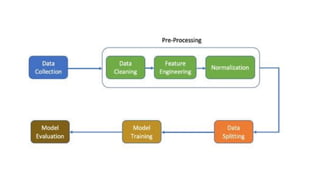
• Data collection and Data pre-processing
• Proposing system
• Algorithm
• Workflow Diagram
• Additional Information
• Expected output
• Reference
INTRODUCTION AND OBJECTIVE
Earthquakes are one of the most destructive natural hazards on Earth. They can cause widespread
damage and loss of life. In recent years, there has been growing interest in using machine learning to
predict earthquakes. This project will use machine learning models to predict future earthquakes using
the Ultimate Earthquake Dataset
he model will be trained on the dataset and it's performance will be evaluated on a held-out test set. The best
model will be deployed to production so that it can be used to predict future earthquakes.
This project has the potential to make a significant contribution to earthquake prediction. By using machine
learning, it may be possible to develop more accurate and reliable earthquake prediction models. This could help
to save lives and reduce the damage caused by earthquakes.
Data collection and Data pre-processing
About Dataset
Datasets contain records of 782 earthquakes from 1/1/2001 to 1/1/2023. The meaning of all columns is as follows:
•magnitude: The magnitude of the earthquake
•Dividing data into training set (70%) and testing set (30%)
•date_time: date and time
•cdi: The maximum reported intensity for the event range
•mmi: The maximum estimated instrumental intensity for the event
•alert: The alert level - “green”, “yellow”, “orange”, and “red”
•magType: The method or algorithm used to calculate the preferred magnitude for the event
•depth: The depth where the earthquake begins to rupture
•latitude / longitude: coordinate system by means of which the position or location of any place on Earth's surface can
be determined and described
•location: location within the country
•continent: continent of the earthquake hit country
•country: affected country
ALGORITHM
• Random forest algorithm
• Here, we used the random forest model to predict the outputs, we see
the strange prediction from this with score above 80% which can be
assumed to be best fit but not due to its predicted values.
Linear regression’s
• Linear regression is a type of supervised machine learning algorithm that is
used to model the linear relationship between a dependent variable (in this
case, earthquake magnitude) and one or more independent variables (in this
case, latitude, longitude, depth, and the number of seismic stations that
recorded the
EXPECTED OUTPUT
The insights derived from the analysis will contribute to a deeper
understanding of seismic events,
aiding in efforts to minimize the impact of earthquakes on affected regions
and populations.
This project's outcomes aim to provide valuable insights into potential
earthquake occurrences in 2023 and contribute to global efforts in disaster
risk reduction and mitigation
REFERENCE
• Kaggle
• Git hub
• Stanford cs229 Machine learning by Andrew ng’s

project on pneumonia detection using machine learning ppt 2.pdf

  • 1.
    THE AMERICAN COLLEGE (ANAUTONOMOUS INSTITUTION AFFILIATED TO MADURAI KAMARAJ UNIVERSITY) REACCREDITED WITH (3RD CYCLE) BY NAAC WITH GRADE “A+”, CGPA-3.47 ON A 4-POINT SCALE MADURAI-625002 DEPARTMENT OF COMPUTER APPLICATION PROJECT REPORT ON AN INTELLIGENT SYSTEM FOR EARTHQUAKE PREDICTION BY ROLL NO: 21BCA201 ROLL NO: 21BCA247 NAME: A.AJITH KUMAR NAME: R.GOWTHAM
  • 2.
    OUTLINE • Introduction andObjective • Data collection and Data pre-processing • Proposing system • Algorithm • Workflow Diagram • Additional Information • Expected output • Reference
  • 3.
    INTRODUCTION AND OBJECTIVE Earthquakesare one of the most destructive natural hazards on Earth. They can cause widespread damage and loss of life. In recent years, there has been growing interest in using machine learning to predict earthquakes. This project will use machine learning models to predict future earthquakes using the Ultimate Earthquake Dataset he model will be trained on the dataset and it's performance will be evaluated on a held-out test set. The best model will be deployed to production so that it can be used to predict future earthquakes. This project has the potential to make a significant contribution to earthquake prediction. By using machine learning, it may be possible to develop more accurate and reliable earthquake prediction models. This could help to save lives and reduce the damage caused by earthquakes.
  • 4.
    Data collection andData pre-processing About Dataset Datasets contain records of 782 earthquakes from 1/1/2001 to 1/1/2023. The meaning of all columns is as follows: •magnitude: The magnitude of the earthquake •Dividing data into training set (70%) and testing set (30%) •date_time: date and time •cdi: The maximum reported intensity for the event range •mmi: The maximum estimated instrumental intensity for the event •alert: The alert level - “green”, “yellow”, “orange”, and “red” •magType: The method or algorithm used to calculate the preferred magnitude for the event •depth: The depth where the earthquake begins to rupture •latitude / longitude: coordinate system by means of which the position or location of any place on Earth's surface can be determined and described •location: location within the country •continent: continent of the earthquake hit country •country: affected country
  • 5.
    ALGORITHM • Random forestalgorithm • Here, we used the random forest model to predict the outputs, we see the strange prediction from this with score above 80% which can be assumed to be best fit but not due to its predicted values. Linear regression’s • Linear regression is a type of supervised machine learning algorithm that is used to model the linear relationship between a dependent variable (in this case, earthquake magnitude) and one or more independent variables (in this case, latitude, longitude, depth, and the number of seismic stations that recorded the
  • 7.
    EXPECTED OUTPUT The insightsderived from the analysis will contribute to a deeper understanding of seismic events, aiding in efforts to minimize the impact of earthquakes on affected regions and populations. This project's outcomes aim to provide valuable insights into potential earthquake occurrences in 2023 and contribute to global efforts in disaster risk reduction and mitigation
  • 8.
    REFERENCE • Kaggle • Github • Stanford cs229 Machine learning by Andrew ng’s