PROJECT PLANNING &
MANAGEMENT:
GOLLIS UNIVERSITY
FACULTY OF BUSINESS & ECONOMICS
SEMESTER SIX
CHAPTER 1: INTRODUCTION TO
PROJECT MANAGEMENT:
 Management
 Key management concepts
 Functions of management
 Comparison of 20th and 21st century
organizations
2
GOLLIS UNIVERSITY, BURAOCAMPUS, SOMALILAND
CHAPTER 1:
GOLLIS UNIVERSITY, BURAOCAMPUS, SOMALILAND
3
INTRODUCTION TO PROJECT
MANAGEMENT
CHAPTER OBJECTIVES:
GOLLIS UNIVERSITY, BURAOCAMPUS, SOMALILAND
4
At the end of this Chapter, you should able
to:
 Identify the meaning of the word
“Management”
 Explain Management Concepts
 Discuss the Functions of Management
 Distinguish between the 20th and 21st Century
Organizations.
WHAT IS MANAGEMENT?
 Management is the art of getting things done
through and with people in formally organized
groups.
 Management is the process of designing and
maintaining an environment in which individuals,
working together in groups, efficiently
accomplish selected aims towards any project. It
is the art of creating an environment in which
people can perform as individuals and yet
cooperate towards the attainment of group
goals.
5
GOLLIS UNIVERSITY, BURAOCAMPUS, SOMALILAND
Management as a Process:
GOLLIS UNIVERSITY, BURAOCAMPUS, SOMALILAND
6
 According to this, management is the process
of using organizational resources to achieve
the organization’s goals through planning,
organizing, staffing, leading, and
controlling.
 It is thus, a set of activities directed at an
organization’s resources with the aim of
achieving organizational goals in an efficient
and effective manner.
Management as People:
GOLLIS UNIVERSITY, BURAOCAMPUS, SOMALILAND
7
 This refers to a group of people who
engage in the Process of
Management.
Key Management Concepts:
GOLLIS UNIVERSITY, BURAOCAMPUS, SOMALILAND
8
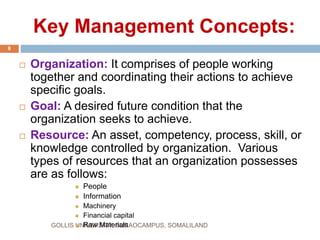
 Organization: It comprises of people working
together and coordinating their actions to achieve
specific goals.
 Goal: A desired future condition that the
organization seeks to achieve.
 Resource: An asset, competency, process, skill, or
knowledge controlled by organization. Various
types of resources that an organization possesses
are as follows:
 People
 Information
 Machinery
 Financial capital
 Raw Materials
Evolution of Management
Concept in the Modern Era:
GOLLIS UNIVERSITY, BURAOCAMPUS, SOMALILAND
9
 Frederick Taylor – Father of Scientific
Management was a Mechanical Engineer. He
invented high speed steel cutting tools. He got
the opportunity to know first hand problems and
attitudes of the workers. Based on these he
identified that in order to improve the quality of
management, the major concern was to increase
efficiency in production, lower cost, raise profits
through higher productivity, and also increase the
pays/salaries of the workforce.
GOLLIS UNIVERSITY, BURAOCAMPUS, SOMALILAND
10
 Taylor’s message of management was to give
people their best opportunities to be productive,
and in turn reward workers for their individual
productivity. This increase in labor productivity is
not possible without the following:
 Providing sufficient or full rewards
 Adequate trainings
 Continuous managerial support
 Thus, Fredrick Taylor concluded that “low
productivity in any project is matter of
ignorance on part of labor and
management”.
Key Aspects of the Management
Process:
GOLLIS UNIVERSITY, BURAOCAMPUS, SOMALILAND
11
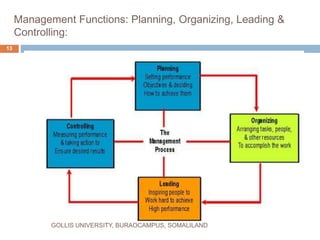
 The key aspects of the Management Process
can be explained with the help of the following
diagram:
Functions of Management:
GOLLIS UNIVERSITY, BURAOCAMPUS, SOMALILAND
12
 The process of management consists of four
basic managerial functions. These are:
Planning
Organizing
Staffing
Directing/Leading
Controlling
Management Functions: Planning, Organizing, Leading &
Controlling:
GOLLIS UNIVERSITY, BURAOCAMPUS, SOMALILAND
13
Levels of Management:
GOLLIS UNIVERSITY, BURAOCAMPUS, SOMALILAND
14
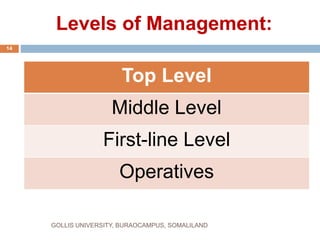
Top Level
Middle Level
First-line Level
Operatives
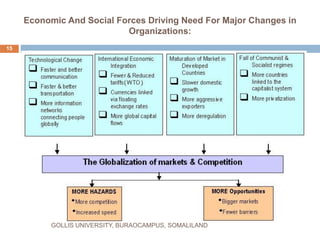
Economic And Social Forces Driving Need For Major Changes in
Organizations:
GOLLIS UNIVERSITY, BURAOCAMPUS, SOMALILAND
15

CONCLUSION:
 In the light of the above discussions on
the concepts and aspects of management,
we can conclude that effective
management is inevitable in every
organization.
16
GOLLIS UNIVERSITY, BURAOCAMPUS, SOMALILAND
DISCUSSION QUESTIONS:
 Critically discuss the concept of
management from your own perspective.
 Is management negative or positive to
organizational existence? Discuss.
 Discuss the importance of management to
organizations.
17
GOLLIS UNIVERSITY, BURAOCAMPUS, SOMALILAND
18
END

Project Management Chapter One BBA .pptx

  • 1.
    PROJECT PLANNING & MANAGEMENT: GOLLISUNIVERSITY FACULTY OF BUSINESS & ECONOMICS SEMESTER SIX
  • 2.
    CHAPTER 1: INTRODUCTIONTO PROJECT MANAGEMENT:  Management  Key management concepts  Functions of management  Comparison of 20th and 21st century organizations 2 GOLLIS UNIVERSITY, BURAOCAMPUS, SOMALILAND
  • 3.
    CHAPTER 1: GOLLIS UNIVERSITY,BURAOCAMPUS, SOMALILAND 3 INTRODUCTION TO PROJECT MANAGEMENT
  • 4.
    CHAPTER OBJECTIVES: GOLLIS UNIVERSITY,BURAOCAMPUS, SOMALILAND 4 At the end of this Chapter, you should able to:  Identify the meaning of the word “Management”  Explain Management Concepts  Discuss the Functions of Management  Distinguish between the 20th and 21st Century Organizations.
  • 5.
    WHAT IS MANAGEMENT? Management is the art of getting things done through and with people in formally organized groups.  Management is the process of designing and maintaining an environment in which individuals, working together in groups, efficiently accomplish selected aims towards any project. It is the art of creating an environment in which people can perform as individuals and yet cooperate towards the attainment of group goals. 5 GOLLIS UNIVERSITY, BURAOCAMPUS, SOMALILAND
  • 6.
    Management as aProcess: GOLLIS UNIVERSITY, BURAOCAMPUS, SOMALILAND 6  According to this, management is the process of using organizational resources to achieve the organization’s goals through planning, organizing, staffing, leading, and controlling.  It is thus, a set of activities directed at an organization’s resources with the aim of achieving organizational goals in an efficient and effective manner.
  • 7.
    Management as People: GOLLISUNIVERSITY, BURAOCAMPUS, SOMALILAND 7  This refers to a group of people who engage in the Process of Management.
  • 8.
    Key Management Concepts: GOLLISUNIVERSITY, BURAOCAMPUS, SOMALILAND 8  Organization: It comprises of people working together and coordinating their actions to achieve specific goals.  Goal: A desired future condition that the organization seeks to achieve.  Resource: An asset, competency, process, skill, or knowledge controlled by organization. Various types of resources that an organization possesses are as follows:  People  Information  Machinery  Financial capital  Raw Materials
  • 9.
    Evolution of Management Conceptin the Modern Era: GOLLIS UNIVERSITY, BURAOCAMPUS, SOMALILAND 9  Frederick Taylor – Father of Scientific Management was a Mechanical Engineer. He invented high speed steel cutting tools. He got the opportunity to know first hand problems and attitudes of the workers. Based on these he identified that in order to improve the quality of management, the major concern was to increase efficiency in production, lower cost, raise profits through higher productivity, and also increase the pays/salaries of the workforce.
  • 10.
    GOLLIS UNIVERSITY, BURAOCAMPUS,SOMALILAND 10  Taylor’s message of management was to give people their best opportunities to be productive, and in turn reward workers for their individual productivity. This increase in labor productivity is not possible without the following:  Providing sufficient or full rewards  Adequate trainings  Continuous managerial support  Thus, Fredrick Taylor concluded that “low productivity in any project is matter of ignorance on part of labor and management”.
  • 11.
    Key Aspects ofthe Management Process: GOLLIS UNIVERSITY, BURAOCAMPUS, SOMALILAND 11  The key aspects of the Management Process can be explained with the help of the following diagram:
  • 12.
    Functions of Management: GOLLISUNIVERSITY, BURAOCAMPUS, SOMALILAND 12  The process of management consists of four basic managerial functions. These are: Planning Organizing Staffing Directing/Leading Controlling
  • 13.
    Management Functions: Planning,Organizing, Leading & Controlling: GOLLIS UNIVERSITY, BURAOCAMPUS, SOMALILAND 13
  • 14.
    Levels of Management: GOLLISUNIVERSITY, BURAOCAMPUS, SOMALILAND 14 Top Level Middle Level First-line Level Operatives
  • 15.
    Economic And SocialForces Driving Need For Major Changes in Organizations: GOLLIS UNIVERSITY, BURAOCAMPUS, SOMALILAND 15 
  • 16.
    CONCLUSION:  In thelight of the above discussions on the concepts and aspects of management, we can conclude that effective management is inevitable in every organization. 16 GOLLIS UNIVERSITY, BURAOCAMPUS, SOMALILAND
  • 17.
    DISCUSSION QUESTIONS:  Criticallydiscuss the concept of management from your own perspective.  Is management negative or positive to organizational existence? Discuss.  Discuss the importance of management to organizations. 17 GOLLIS UNIVERSITY, BURAOCAMPUS, SOMALILAND
  • 18.