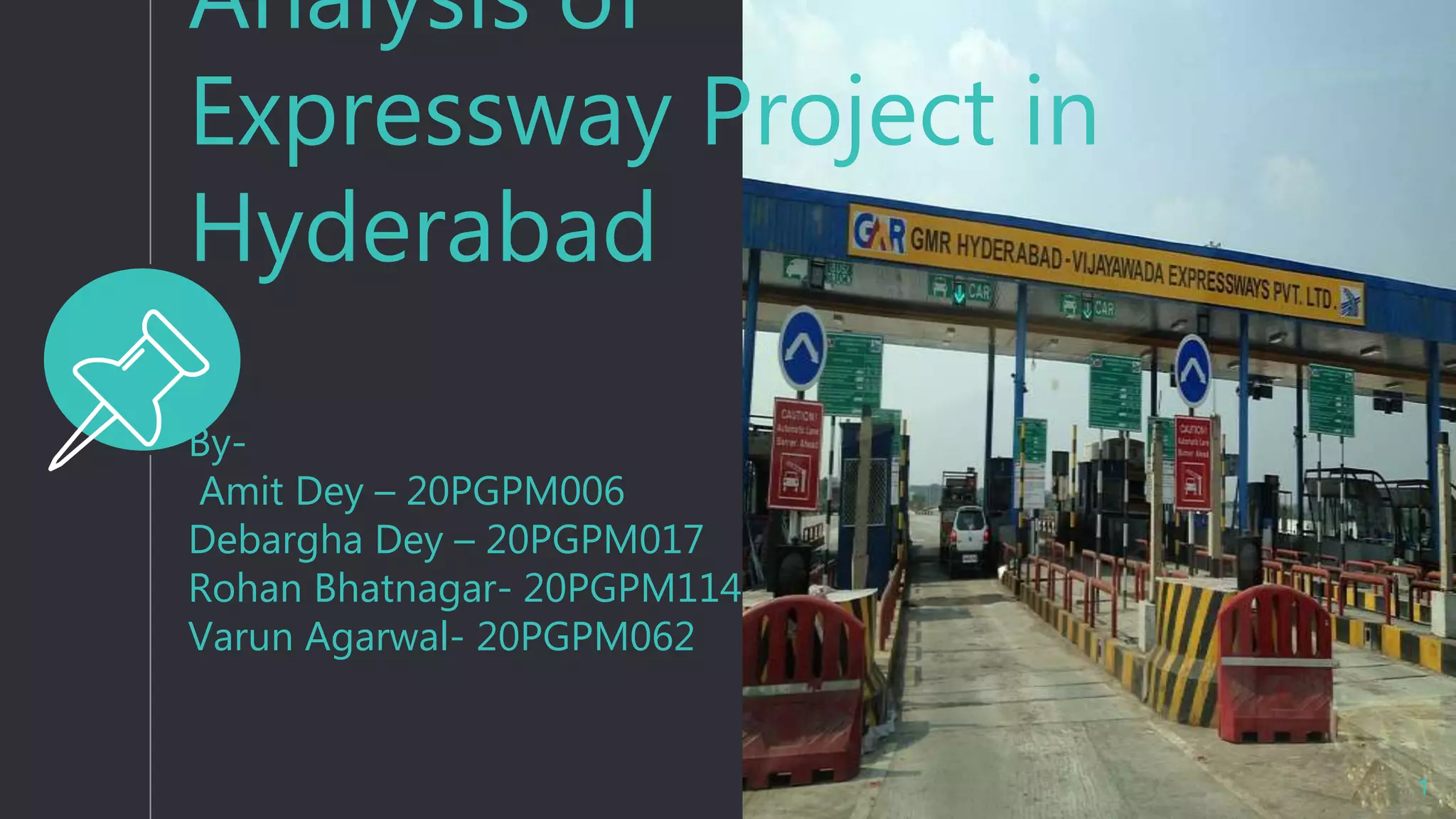
Analysis of
Expressway Project in
Hyderabad
By-
Amit Dey – 20PGPM006
Debargha Dey – 20PGPM017
Rohan Bhatnagar- 20PGPM114
Varun Agarwal- 20PGPM062
1
Introduction
• Techvardhan Infra Pvt. Ltd (Any Company) “CLIENT” has been
alloted a project of building and operating(for20years) a new
expressway between Hyderabad and Anantapur AP.
• They can charge different charges to the vehicles using the
expressway through their Schedule of Charges, which is averagely
calculated as Rs. 160 per vehicle.
• They are expecting to have a vehicle traffic of 10000 vehicles per day
with an increase of 5% every year.
• The expected CapEx is Rs. 200 Crore and OpEx is Rs. 28 Crores / per
annum for the whole project.
2
Stakeholders
• SPONSERS
• LENDERS
• SUPPLIERS
• GOVERNMENT
• CONSTRUCTION COMPANIES
• OFF TAKE COMPANIES
3
FEASIBILITY ANALYSIS
Assumptions
Following are the assumptions made for the project:
◦ Vehicle is expected to grow at 5% p.a.
◦ Charge per vehicle is to grow at 5% p.a.
◦ Revenue to increase at 5% p.a.
◦ The debt rate is 10% p.a., and would be serviced each quarter
◦ The moratorium period is 0.25 year
◦ The depreciation rate is 10%.
4
Financial Analysis
Revenue
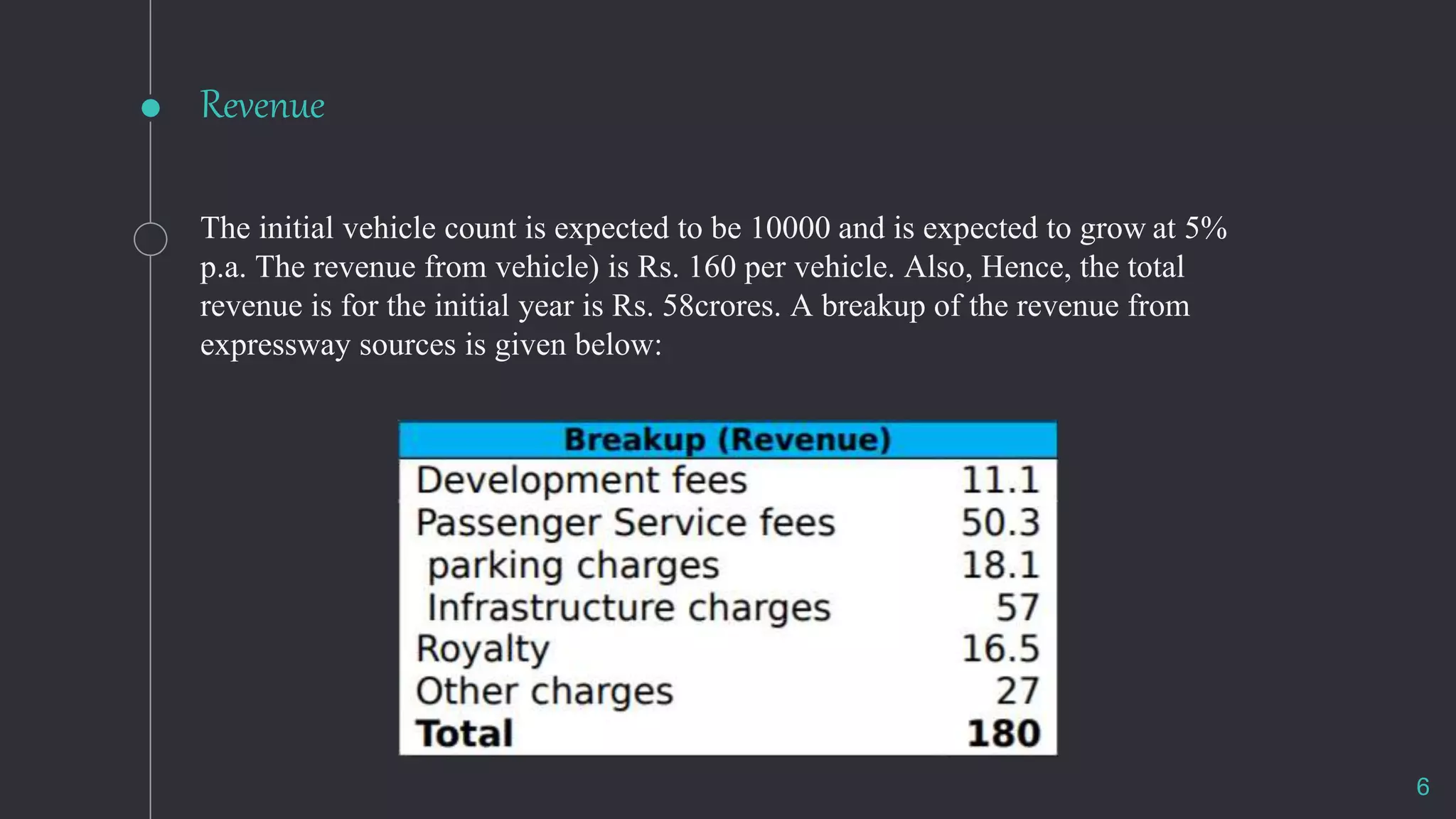
The initial vehicle count is expected to be 10000 and is expected to grow at 5%
p.a. The revenue from vehicle) is Rs. 160 per vehicle. Also, Hence, the total
revenue is for the initial year is Rs. 58crores. A breakup of the revenue from
expressway sources is given below:
6
Revenue Per Year Demonstrated by a Graph
7
Cost
◦ The total project cost for construction is Rs. 200 crores,
while the cost of operating and maintenance is Rs. 28
crores.
8
FinFlows
• The cash flows are the most important aspect for any project, and they depict
how much the Client would earn every year. The operating expenses are
subtracted from the revenue, through which we get EBITDA of the project for
every year.
• When we subtract non-operating expenses like interest payments and
depreciation, we get the taxable income. The taxes are deducted, which gives
us the Net Income.
• After deducting all other types of expenses like principal payments and CSR,
we add back depreciation to arrive at the final project cash flows. These cash
flows when compared against Equity and Debt investment by the sponsors and
lenders would give the IRR of the project.
9
Debt Service Coverage Ratio
◦ We calculate the Debt Service Coverage Ratio (DSCR) for each year of servicing of debt.
The minimum DSCR is 1.48 in year 1 and the maximum is 4.64. Since in all these years
DSCR>1, we conclude that the Client never faced an issue in servicing the debt.
◦ The results for the project are as follows: Equity IRR is 30.77% and the project IRR is
20.81%This shows that the project has an IRR which is greater than the discount rate of
10%, hence indicating that the project is feasible for the Client to undertake.
◦ The project has an average DSCR of 1.48, which was minimum in the initial year of
project operation. Hence, this signifies that the project was at all times able to cover the
servicing of debt.
◦ Hence, we conclude that the project is suitable for the Client, who should invest in the
project.
10
11
Debt
To fund the project the company needs to take a term loan of 70 crores lasting 12
years, at the rate of 10% p.a. and the debt is serviced quarterly. Since the
construction of the project lasts for 1 year, the lenders do not ask for service of the
loan during the 1 year. Also, a moratorium period of 0.25 year i.e. 1 quarter has
been given, during which the lender charges only interest on the loan. The project
construction runs from 1st July 2020 to 1st July 2021, after which interest and
principal is paid back by the Client.
12
KEY LEARNINGS
1. In the above case we see that only one private party bid for the project in spite of
many incentives provided by the government. This problem mainly stems from
deficiency in project structuring.
2. In the case of Telangana expressway we saw that only Techvardhan Infra Pvt Ltd
bid for the project and that too they quoted an amount, which was unacceptable to
the government.
3. A number of reasons may be cited for the failure to attract private participants.
Foremost among them is the uncertainty related with toll-based system where the
developers are themselves responsible for recovering their investment.
4. Private participants are unsure as to if they would be able to recover their
investment due to uncertainty in traffic density and attendant risk.
Conclusion & Recommendations
Highly Favoured for
Infrastructure Projects
Project finance is highly favored for
infrastructure projects, due to their
limited liability conditions, as well
as the high amount of debts they
require, which can hamper the
company’s growth and give a
negative image to the public.
Major Stakeholders
The project covers the major
stakeholders in a project, namely
sponsors, lenders, government, and
suppliers among others. These
parties have a huge involvement in
the project and their cooperation is
necessary to ensure the completion
of project with least possible cost
and maximum revenue.
Project Feasibility
On discounting the cash flows at
the rate of 10% in order to get them
in present time, we compute the
IRR of the project. The IRR of the
project comes out to be 20.81%
which is far greater than the 10%
discount rate used, indicating that
the project is feasible for the
sponsors.
13
The project has an average DSCR of 4.93, which was minimum in the initial year of project
operation. Hence, this signifies that the project was at all times able to cover the servicing of
debt. Hence, we conclude that the project is suitable for the Client, who should invest in the
project.

Project finance final

  • 1.
    Analysis of Expressway Projectin Hyderabad By- Amit Dey – 20PGPM006 Debargha Dey – 20PGPM017 Rohan Bhatnagar- 20PGPM114 Varun Agarwal- 20PGPM062 1
  • 2.
    Introduction • Techvardhan InfraPvt. Ltd (Any Company) “CLIENT” has been alloted a project of building and operating(for20years) a new expressway between Hyderabad and Anantapur AP. • They can charge different charges to the vehicles using the expressway through their Schedule of Charges, which is averagely calculated as Rs. 160 per vehicle. • They are expecting to have a vehicle traffic of 10000 vehicles per day with an increase of 5% every year. • The expected CapEx is Rs. 200 Crore and OpEx is Rs. 28 Crores / per annum for the whole project. 2
  • 3.
    Stakeholders • SPONSERS • LENDERS •SUPPLIERS • GOVERNMENT • CONSTRUCTION COMPANIES • OFF TAKE COMPANIES 3
  • 4.
    FEASIBILITY ANALYSIS Assumptions Following arethe assumptions made for the project: ◦ Vehicle is expected to grow at 5% p.a. ◦ Charge per vehicle is to grow at 5% p.a. ◦ Revenue to increase at 5% p.a. ◦ The debt rate is 10% p.a., and would be serviced each quarter ◦ The moratorium period is 0.25 year ◦ The depreciation rate is 10%. 4
  • 5.
  • 6.
    Revenue The initial vehiclecount is expected to be 10000 and is expected to grow at 5% p.a. The revenue from vehicle) is Rs. 160 per vehicle. Also, Hence, the total revenue is for the initial year is Rs. 58crores. A breakup of the revenue from expressway sources is given below: 6
  • 7.
    Revenue Per YearDemonstrated by a Graph 7
  • 8.
    Cost ◦ The totalproject cost for construction is Rs. 200 crores, while the cost of operating and maintenance is Rs. 28 crores. 8
  • 9.
    FinFlows • The cashflows are the most important aspect for any project, and they depict how much the Client would earn every year. The operating expenses are subtracted from the revenue, through which we get EBITDA of the project for every year. • When we subtract non-operating expenses like interest payments and depreciation, we get the taxable income. The taxes are deducted, which gives us the Net Income. • After deducting all other types of expenses like principal payments and CSR, we add back depreciation to arrive at the final project cash flows. These cash flows when compared against Equity and Debt investment by the sponsors and lenders would give the IRR of the project. 9
  • 10.
    Debt Service CoverageRatio ◦ We calculate the Debt Service Coverage Ratio (DSCR) for each year of servicing of debt. The minimum DSCR is 1.48 in year 1 and the maximum is 4.64. Since in all these years DSCR>1, we conclude that the Client never faced an issue in servicing the debt. ◦ The results for the project are as follows: Equity IRR is 30.77% and the project IRR is 20.81%This shows that the project has an IRR which is greater than the discount rate of 10%, hence indicating that the project is feasible for the Client to undertake. ◦ The project has an average DSCR of 1.48, which was minimum in the initial year of project operation. Hence, this signifies that the project was at all times able to cover the servicing of debt. ◦ Hence, we conclude that the project is suitable for the Client, who should invest in the project. 10
  • 11.
    11 Debt To fund theproject the company needs to take a term loan of 70 crores lasting 12 years, at the rate of 10% p.a. and the debt is serviced quarterly. Since the construction of the project lasts for 1 year, the lenders do not ask for service of the loan during the 1 year. Also, a moratorium period of 0.25 year i.e. 1 quarter has been given, during which the lender charges only interest on the loan. The project construction runs from 1st July 2020 to 1st July 2021, after which interest and principal is paid back by the Client.
  • 12.
    12 KEY LEARNINGS 1. Inthe above case we see that only one private party bid for the project in spite of many incentives provided by the government. This problem mainly stems from deficiency in project structuring. 2. In the case of Telangana expressway we saw that only Techvardhan Infra Pvt Ltd bid for the project and that too they quoted an amount, which was unacceptable to the government. 3. A number of reasons may be cited for the failure to attract private participants. Foremost among them is the uncertainty related with toll-based system where the developers are themselves responsible for recovering their investment. 4. Private participants are unsure as to if they would be able to recover their investment due to uncertainty in traffic density and attendant risk.
  • 13.
    Conclusion & Recommendations HighlyFavoured for Infrastructure Projects Project finance is highly favored for infrastructure projects, due to their limited liability conditions, as well as the high amount of debts they require, which can hamper the company’s growth and give a negative image to the public. Major Stakeholders The project covers the major stakeholders in a project, namely sponsors, lenders, government, and suppliers among others. These parties have a huge involvement in the project and their cooperation is necessary to ensure the completion of project with least possible cost and maximum revenue. Project Feasibility On discounting the cash flows at the rate of 10% in order to get them in present time, we compute the IRR of the project. The IRR of the project comes out to be 20.81% which is far greater than the 10% discount rate used, indicating that the project is feasible for the sponsors. 13 The project has an average DSCR of 4.93, which was minimum in the initial year of project operation. Hence, this signifies that the project was at all times able to cover the servicing of debt. Hence, we conclude that the project is suitable for the Client, who should invest in the project.