Client Confidential
Project
Development
Routemap
Infrastructure Foundation
Masterclass
Project
Development
Routemap
Infrastructure Foundation
Masterclass
in partnership with
Client Confidential
Infrastructure Foundation Masterclass
2 |
Agenda
1. Introduction
2. Background and overview of Project Routemap
3. Complexity & Capability
4. The Rationale Module
5. Action Planning
6. Wrap up
We will have five minutes discussions spread across the talk
Client Confidential
Infrastructure Foundation Masterclass
3 |
Introductions
Steve Lee
Director
Programme Advisory
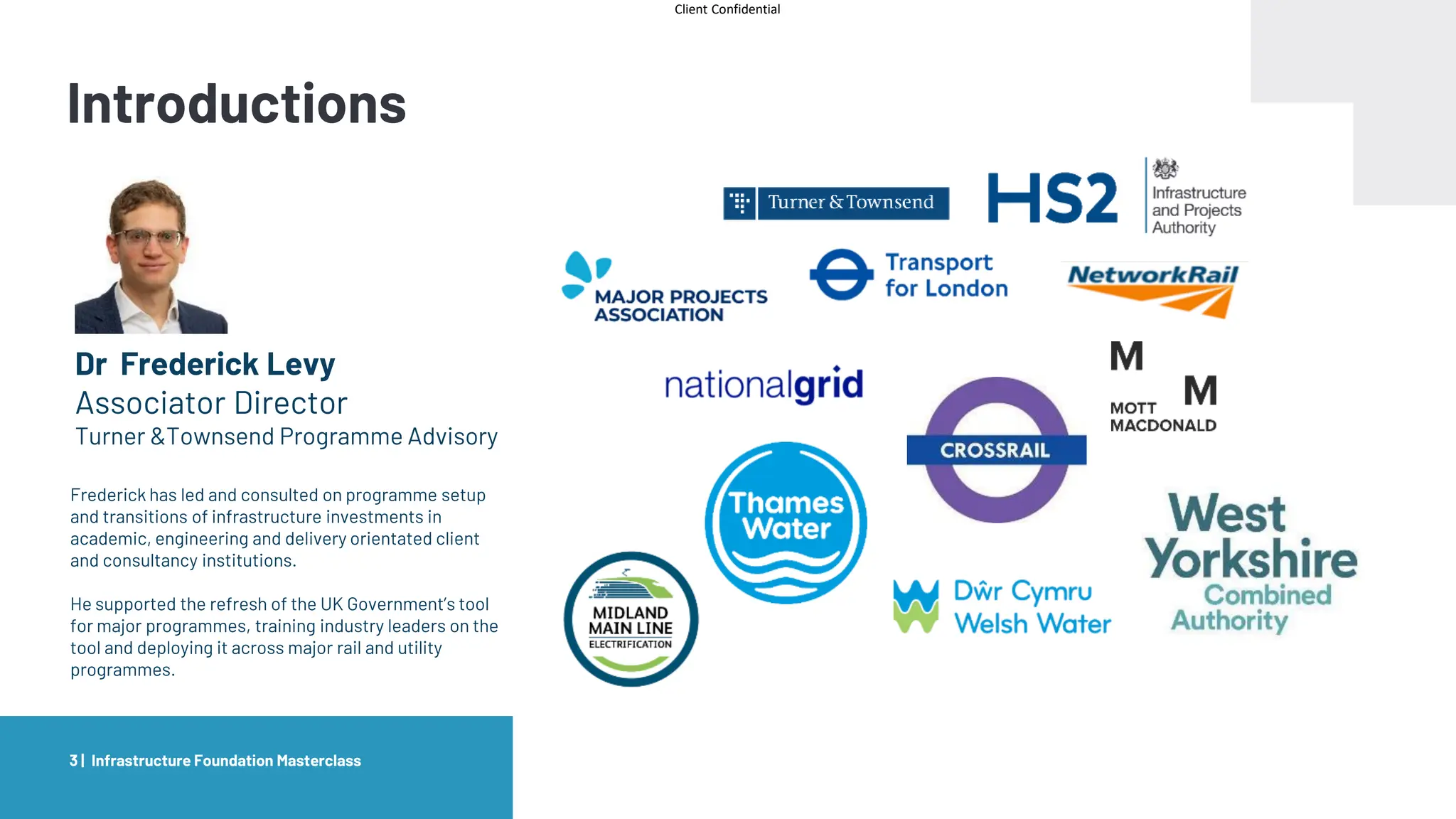
Dr Frederick Levy
Associator Director
Turner &Townsend Programme Advisory
Frederick has led and consulted on programme setup
and transitions of infrastructure investments in
academic, engineering and delivery orientated client
and consultancy institutions.
He supported the refresh of the UK Government’s tool
for major programmes, training industry leaders on the
tool and deploying it across major rail and utility
programmes.
Client Confidential
Infrastructure Foundation Masterclass
4 |
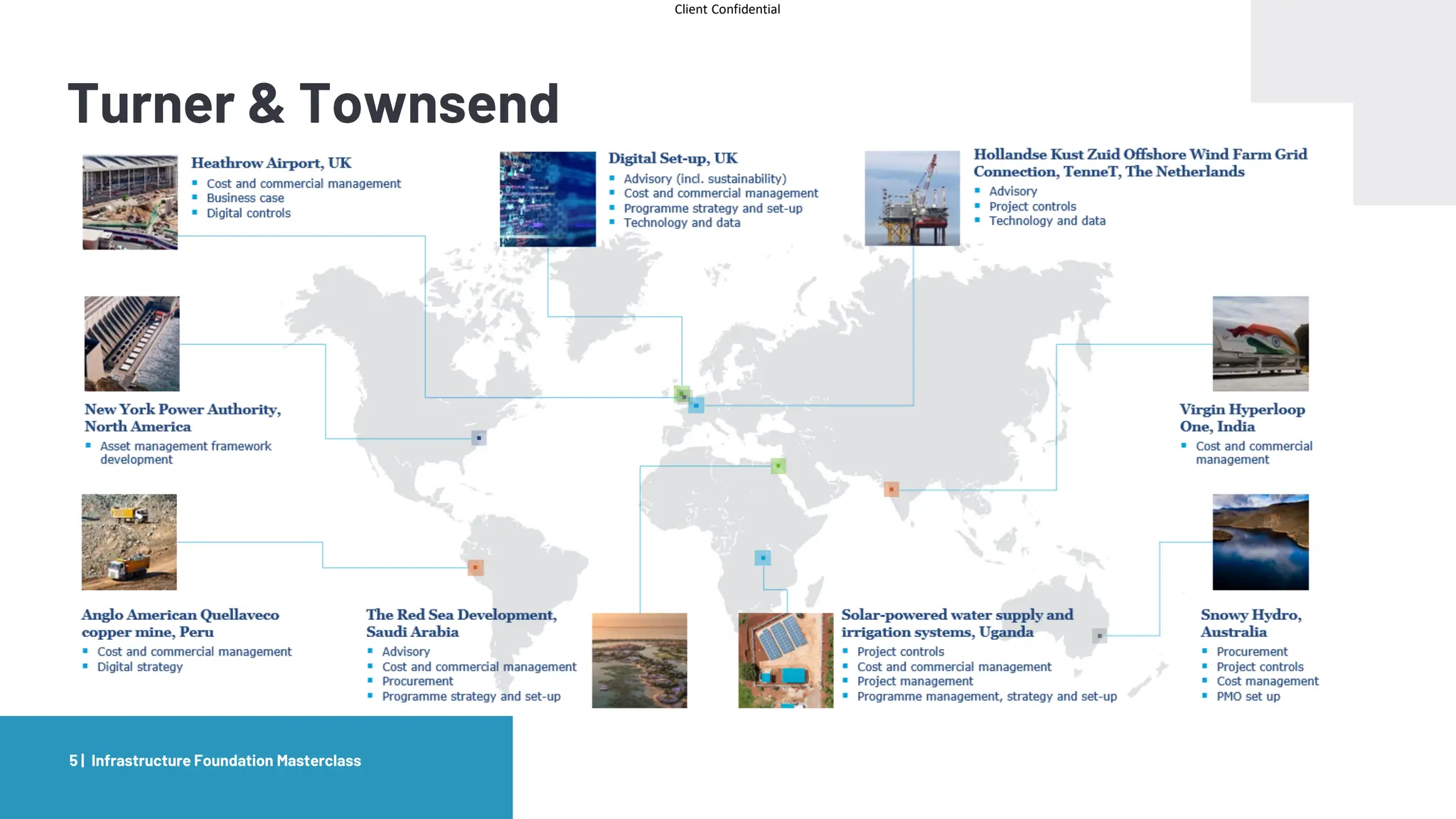
Turner & Townsend
“All major projects that are complex or novel (should) use the Routemap methodology, a
project initiation tool developed by industry and the IPA.”
UK National Infrastructure Strategy: Fairer, faster, greener
We are a market-leading capital programmes professional services company trusted to
drive better business outcomes for our clients across all sectors. With a heritage
rooted in cost and commercial management we have a deep and tacit understanding of
capital programmes.
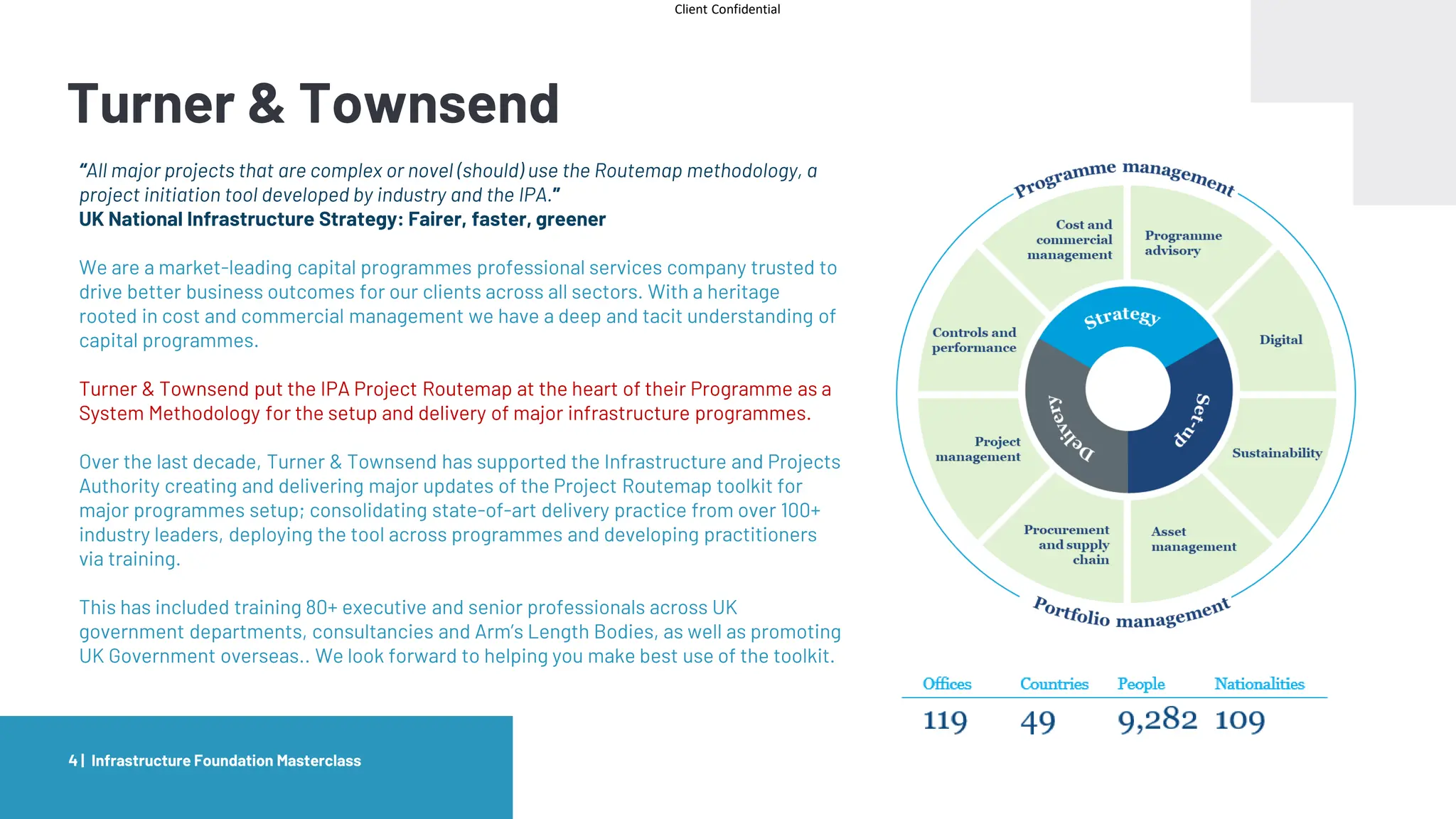
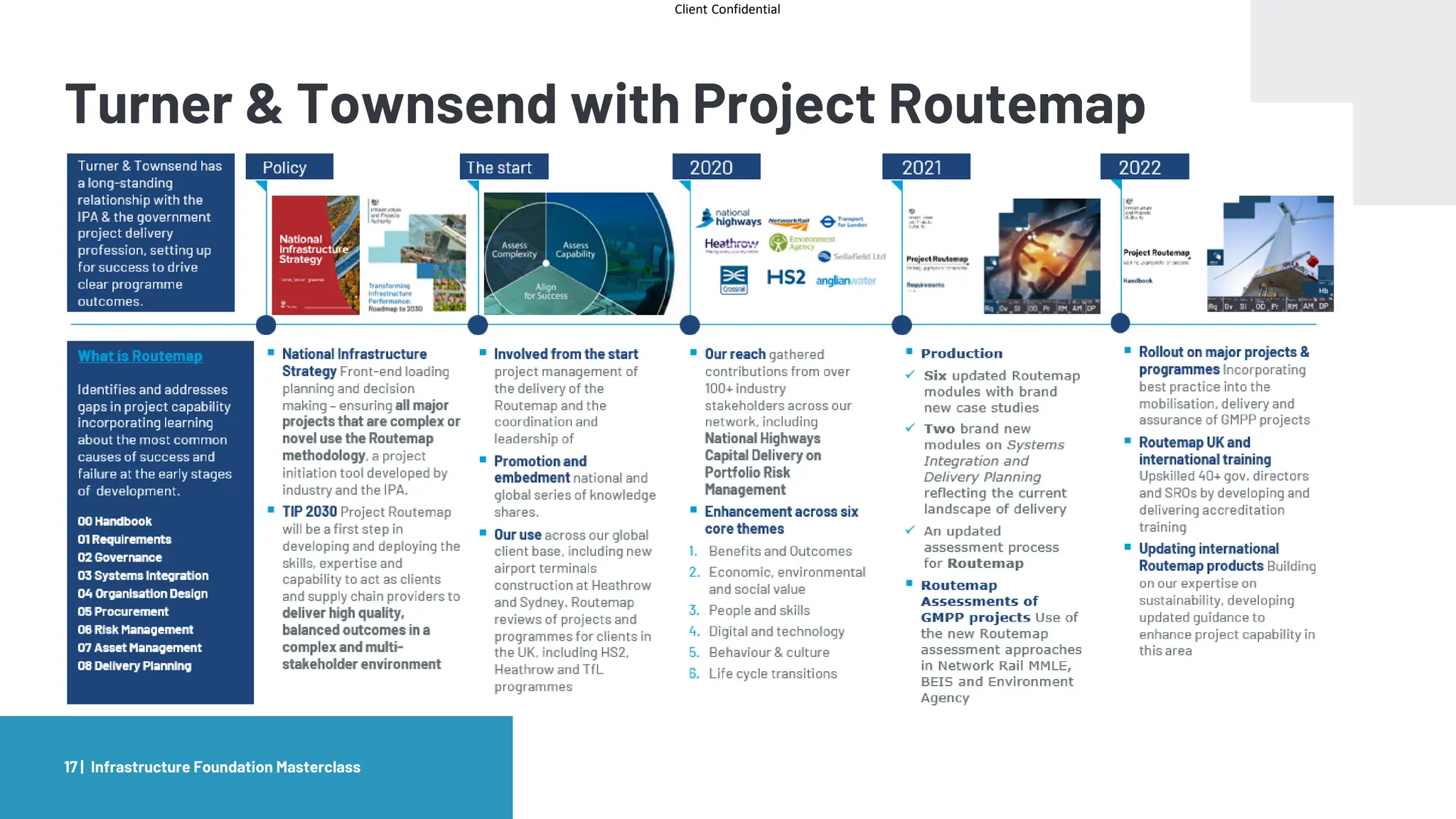
Turner & Townsend put the IPA Project Routemap at the heart of their Programme as a
System Methodology for the setup and delivery of major infrastructure programmes.
Over the last decade, Turner & Townsend has supported the Infrastructure and Projects
Authority creating and delivering major updates of the Project Routemap toolkit for
major programmes setup; consolidating state-of-art delivery practice from over 100+
industry leaders, deploying the tool across programmes and developing practitioners
via training.
This has included training 80+ executive and senior professionals across UK
government departments, consultancies and Arm’s Length Bodies, as well as promoting
UK Government overseas.. We look forward to helping you make best use of the toolkit.
Client Confidential
Infrastructure Foundation Masterclass
5 |
Turner & Townsend
Client Confidential
Infrastructure Foundation Masterclass
6 |
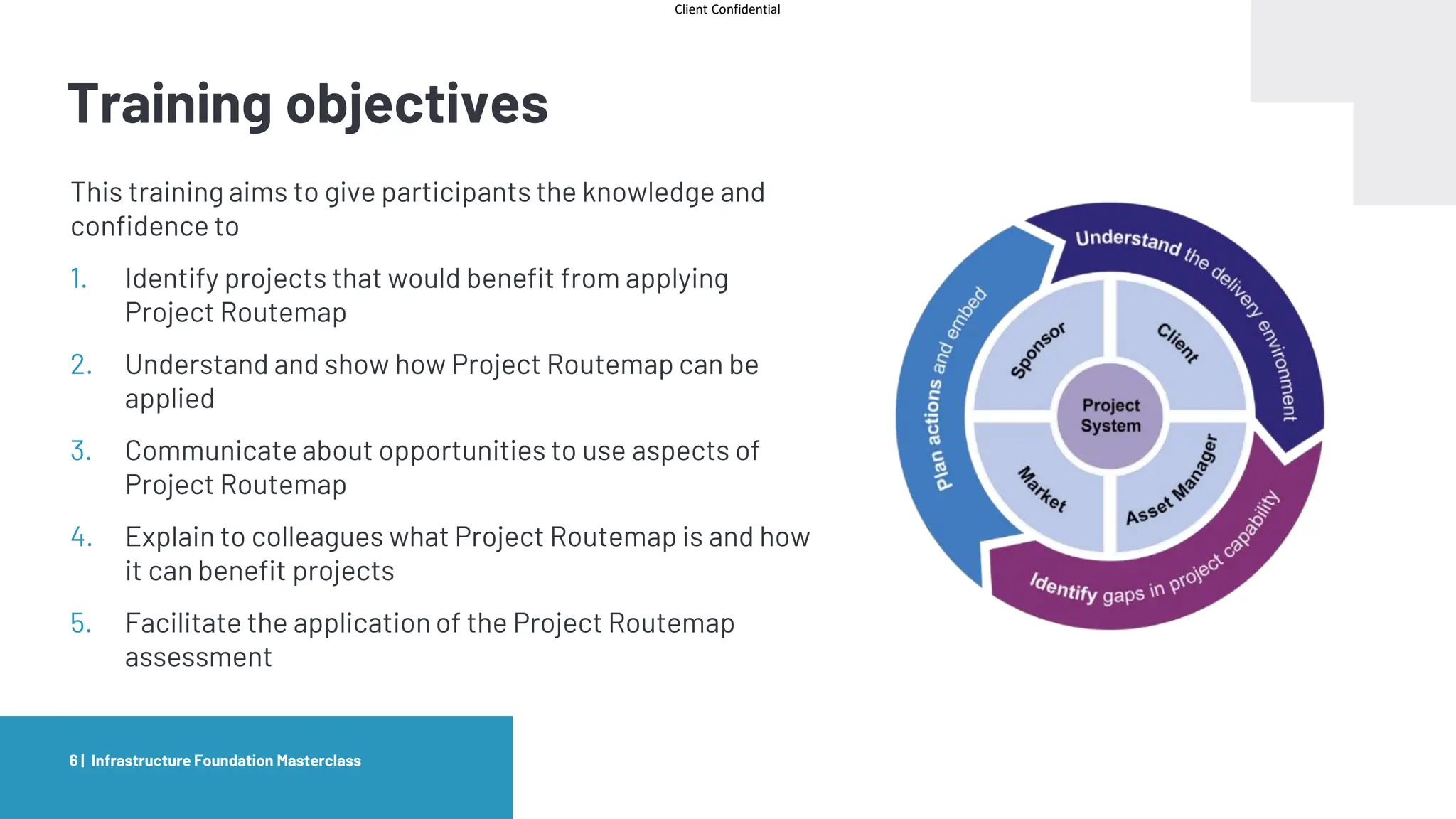
Training objectives
This training aims to give participants the knowledge and
confidence to
1. Identify projects that would benefit from applying
Project Routemap
2. Understand and show how Project Routemap can be
applied
3. Communicate about opportunities to use aspects of
Project Routemap
4. Explain to colleagues what Project Routemap is and how
it can benefit projects
5. Facilitate the application of the Project Routemap
assessment
Client Confidential
Introduction to
IPA Project Routemap
Infrastructure Foundation Masterclass
7 |
Client Confidential
IPA
Setup
Toolkit
How does Routemap fit with key concepts
8 | Infrastructure Foundation Masterclass
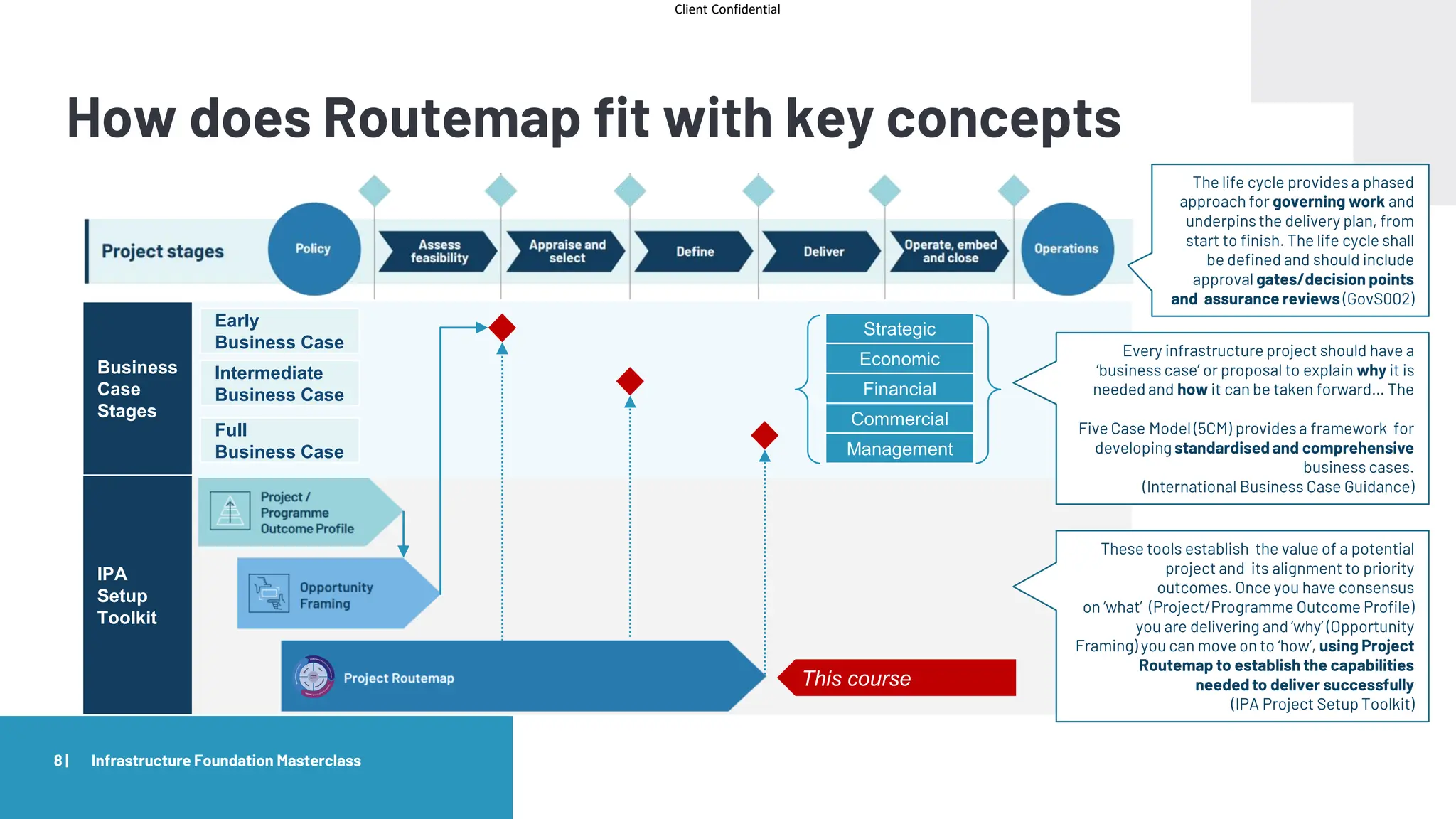
The life cycle provides a phased
approach for governing work and
underpins the delivery plan, from
start to finish. The life cycle shall
be defined and should include
approval gates/decision points
and assurance reviews (GovS002)
Strategic
Economic
Financial
Commercial
Management
Early
Business Case
Intermediate
Business Case
Full
Business Case
Every infrastructure project should have a
‘business case’ or proposal to explain why it is
needed and how it can be taken forward… The
Five Case Model (5CM) providesa framework for
developing standardisedand comprehensive
business cases.
(International Business Case Guidance)
Business
Case
Stages
These tools establish the value of a potential
project and its alignment to priority
outcomes. Once you have consensus
on ‘what’ (Project/Programme Outcome Profile)
you are delivering and ‘why’ (Opportunity
Framing) you can move on to ‘how’, using Project
Routemap to establish the capabilities
neededto deliver successfully
(IPA Project Setup Toolkit)
This course
Client Confidential
Background
Infrastructure Foundation Masterclass
9 |
▪ Project Development Routemap (2022) is helping to improve
international infrastructure project planning, preparation
and delivery.
▪ Under UK Government’s Global Infrastructure Programme,
the Infrastructure and Project’s Authority adapted world
leading, proven UK methodologies for international
infrastructure development, and trained officials in their
use.
▪ It has been updated as part of the UK Project Routemap to
consider impacts from Covid-19 and the Glasgow Climate
Pact at COP26 to limit global temperature rise to 1.5oC
Client Confidential
Background
Infrastructure Foundation Masterclass
10 |
▪ Enhance prosperity on a national, regional and global basis.
Unlocking economic opportunities, through facilitating better
development, design, finance, procurement and operation of
major infrastructure projects/programmes
▪ Routemap supports governments to meet commitments to the UN
SDGs, Paris Agreement and Glasgow Climate Pact and aligns with
the IFC Performance Standards for environmental and social
sustainability.
▪ Routemap aligns with G20 Principles for Quality Infrastructure
Investment and Principles for the Infrastructure Project
Preparation Phase.
▪ It is recognised as best practice on the Global Infrastructure Hub
Client Confidential
Background
Infrastructure Foundation Masterclass
11 |
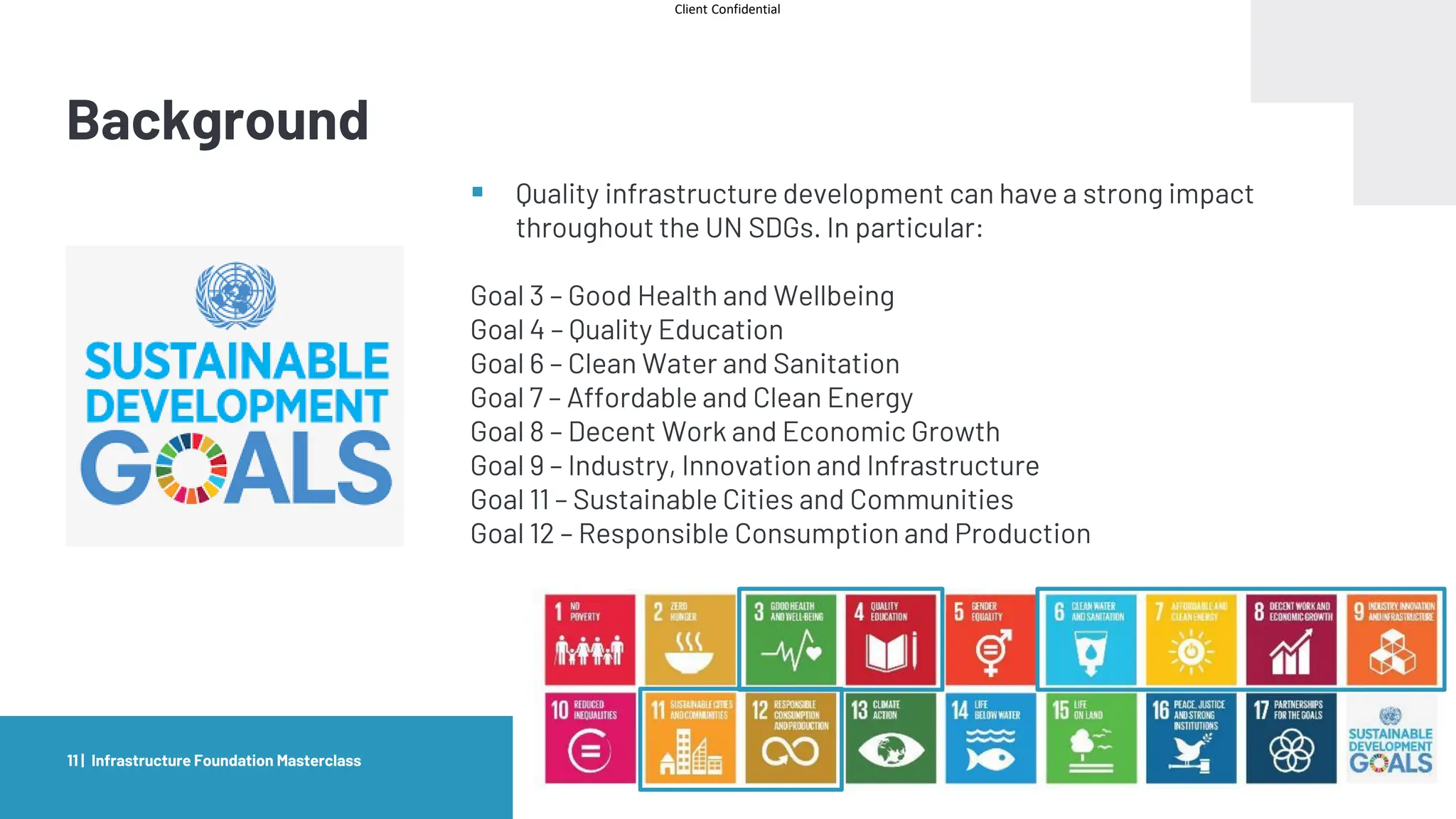
▪ Quality infrastructure development can have a strong impact
throughout the UN SDGs. In particular:
Goal 3 – Good Health and Wellbeing
Goal 4 – Quality Education
Goal 6 – Clean Water and Sanitation
Goal 7 – Affordable and Clean Energy
Goal 8 – Decent Work and Economic Growth
Goal 9 – Industry, Innovation and Infrastructure
Goal 11 – Sustainable Cities and Communities
Goal 12 – Responsible Consumption and Production
Client Confidential
What is Routemap?
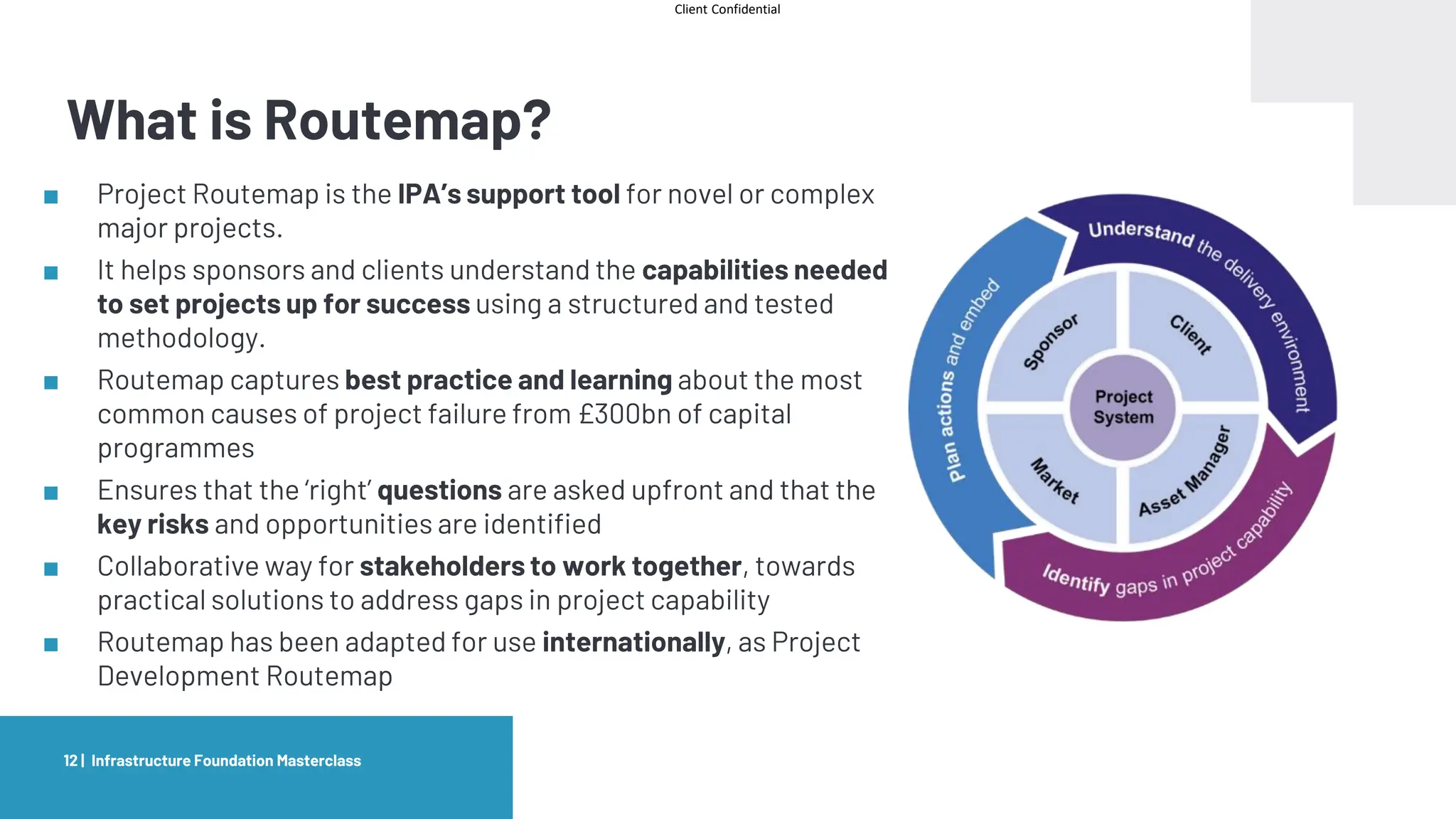
■ Project Routemap is the IPA’s support tool for novel or complex
major projects.
■ It helps sponsors and clients understand the capabilities needed
to set projects up for success using a structured and tested
methodology.
■ Routemap captures best practice and learning about the most
common causes of project failure from £300bn of capital
programmes
■ Ensures that the ‘right’ questions are asked upfront and that the
key risks and opportunities are identified
■ Collaborative way for stakeholders to work together, towards
practical solutions to address gaps in project capability
■ Routemap has been adapted for use internationally, as Project
Development Routemap
Infrastructure Foundation Masterclass
12 |
Client Confidential
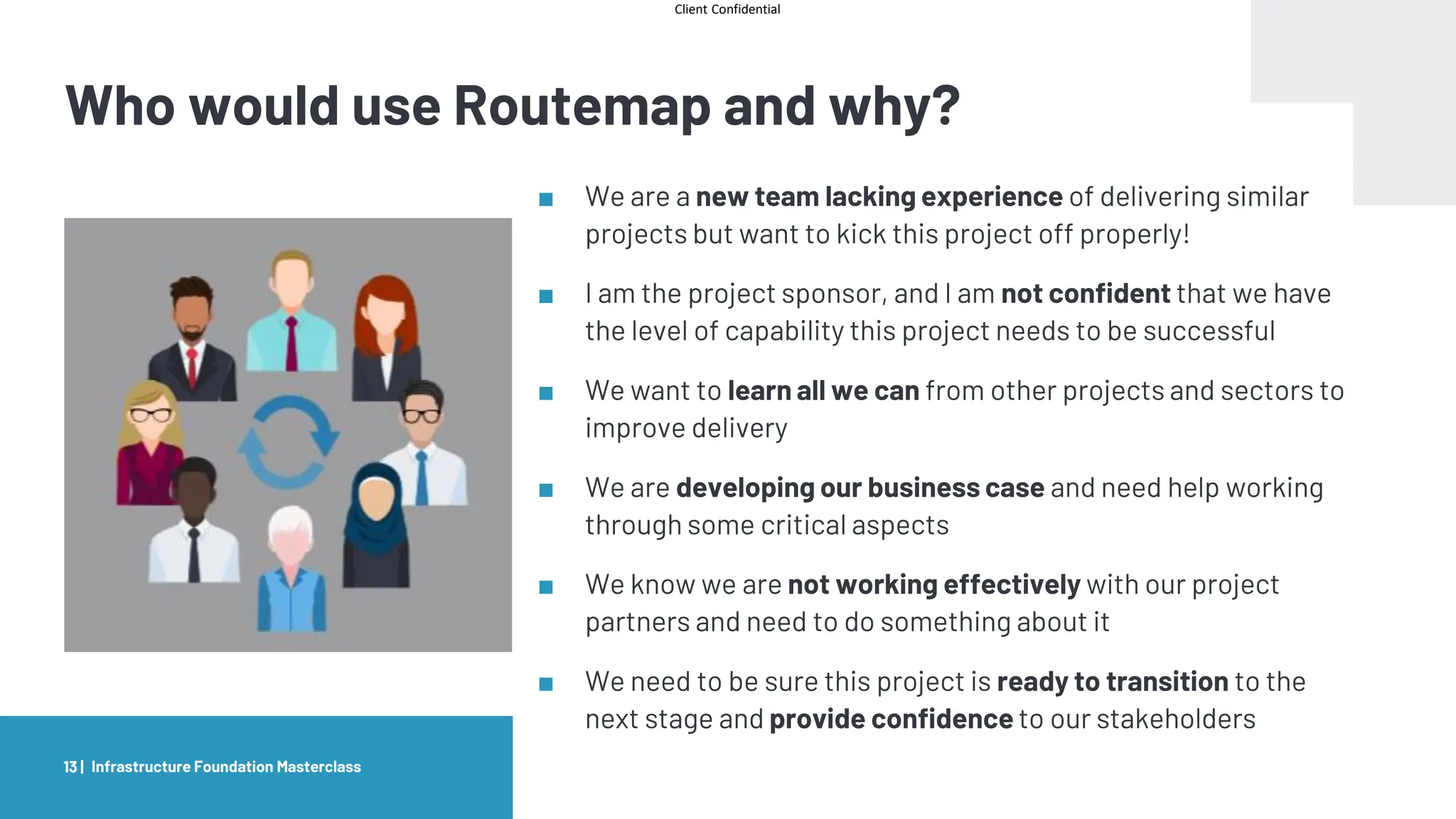
Who would use Routemap and why?
■ We are a new team lacking experience of delivering similar
projects but want to kick this project off properly!
■ I am the project sponsor, and I am not confident that we have
the level of capability this project needs to be successful
■ We want to learn all we can from other projects and sectors to
improve delivery
■ We are developing our business case and need help working
through some critical aspects
■ We know we are not working effectively with our project
partners and need to do something about it
■ We need to be sure this project is ready to transition to the
next stage and provide confidence to our stakeholders
13 | Infrastructure Foundation Masterclass
Client Confidential
Routemap benefits
Infrastructure Foundation Masterclass
14 |
Link: Benefits of Project Routemap - YouTube
Client Confidential
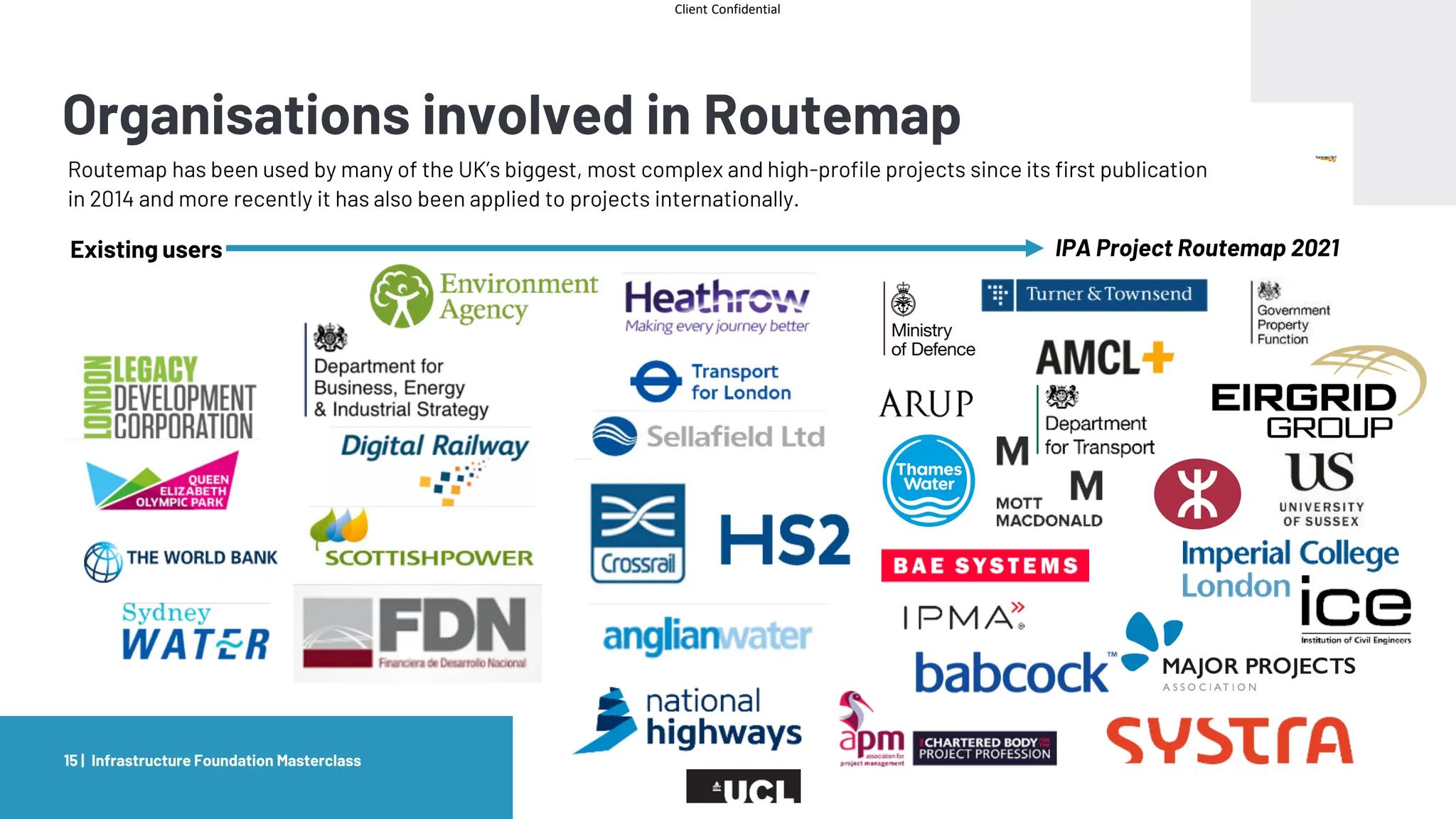
Organisations involved in Routemap
Infrastructure Foundation Masterclass
15 |
Routemap has been used by many of the UK’s biggest, most complex and high-profile projects since its first publication
in 2014 and more recently it has also been applied to projects internationally.
Existing users IPA Project Routemap 2021
Client Confidential
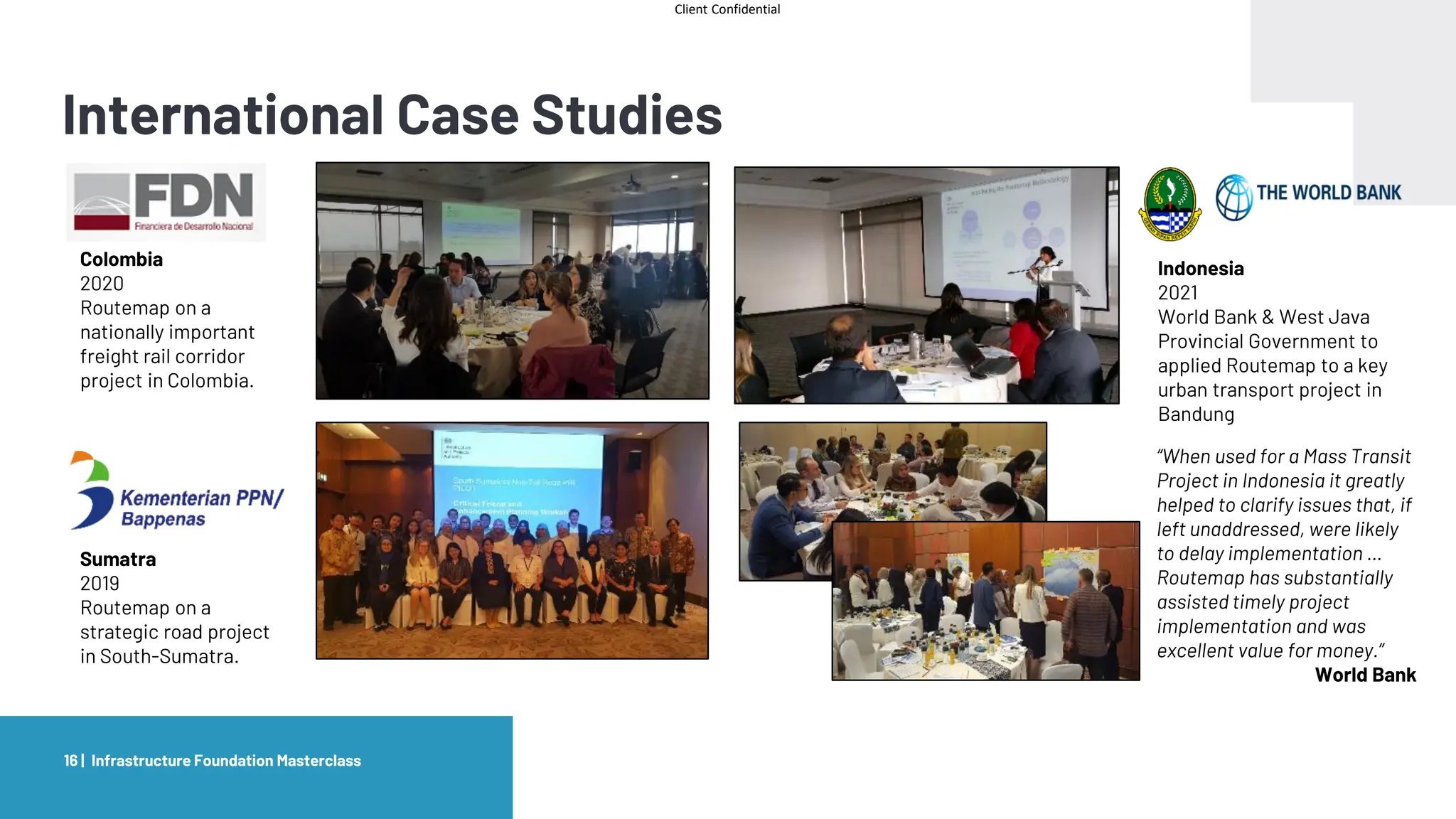
International Case Studies
Infrastructure Foundation Masterclass
16 |
Colombia
2020
Routemap on a
nationally important
freight rail corridor
project in Colombia.
Sumatra
2019
Routemap on a
strategic road project
in South-Sumatra.
Indonesia
2021
World Bank & West Java
Provincial Government to
applied Routemap to a key
urban transport project in
Bandung
“When used for a Mass Transit
Project in Indonesia it greatly
helped to clarify issues that, if
left unaddressed, were likely
to delay implementation …
Routemap has substantially
assisted timely project
implementation and was
excellent value for money.”
World Bank
Client Confidential
Turner & Townsend with Project Routemap
Infrastructure Foundation Masterclass
17 |
Client Confidential
International and UK Routemaps
Infrastructure Foundation Masterclass
18 |
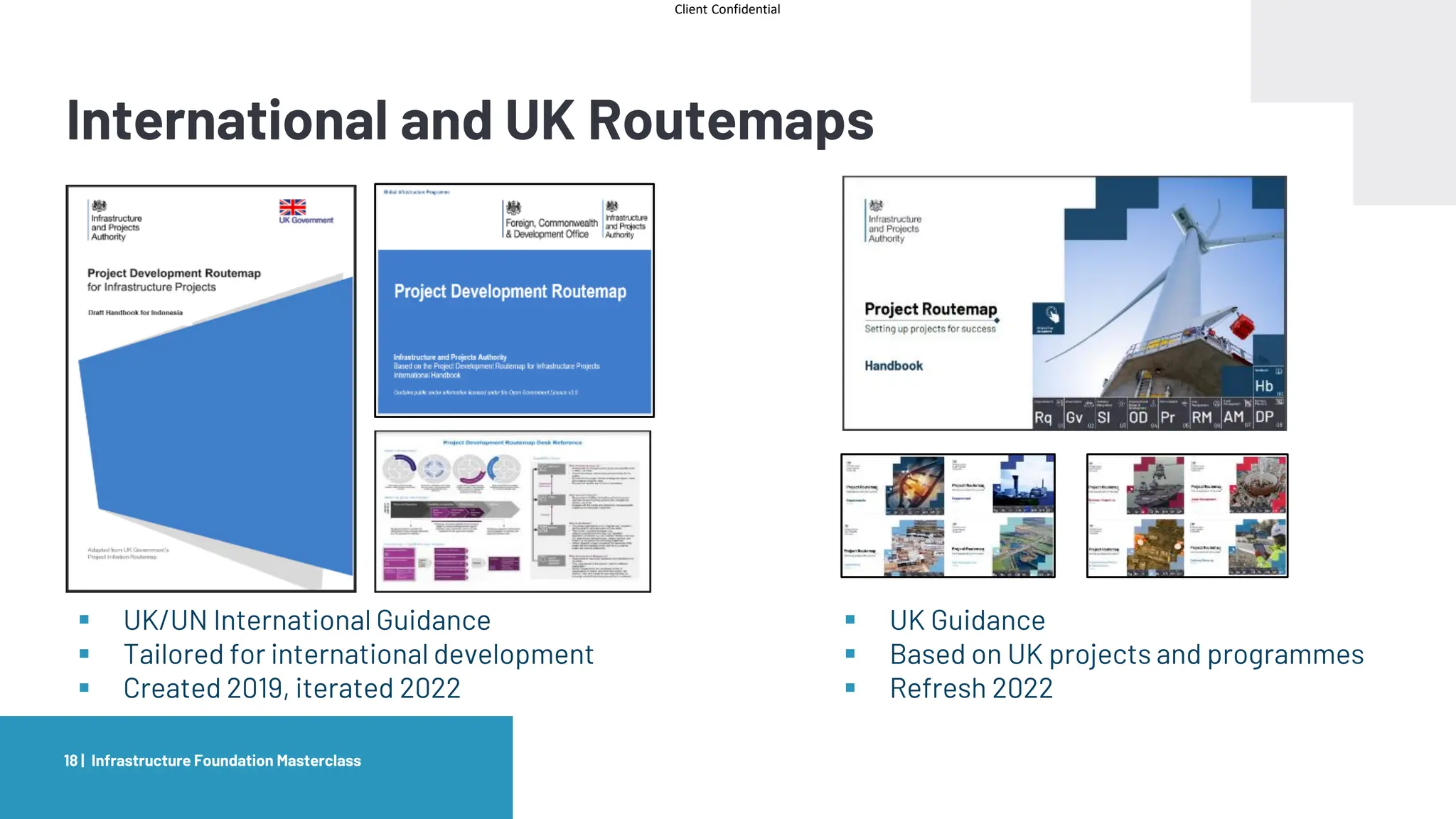
▪ UK/UN International Guidance
▪ Tailored for international development
▪ Created 2019, iterated 2022
▪ UK Guidance
▪ Based on UK projects and programmes
▪ Refresh 2022
Client Confidential
Other IPA Project Set Up tools
Infrastructure Foundation Masterclass
19 |
Routemap is part of an integrated set of tools to set projects up
for success:
■ Project / Programme Outcome Profile - focuses on why
the project should be delivered
■ Opportunity Framing (APM) - focuses on what the project
will deliver (NB Not Open Source)
■ Project Development Routemap - focuses on how the
project will be delivered
Find out how the tools work together to help you develop your
business case in this brochure
Client Confidential
Recent applications
Infrastructure Foundation Masterclass
20 |
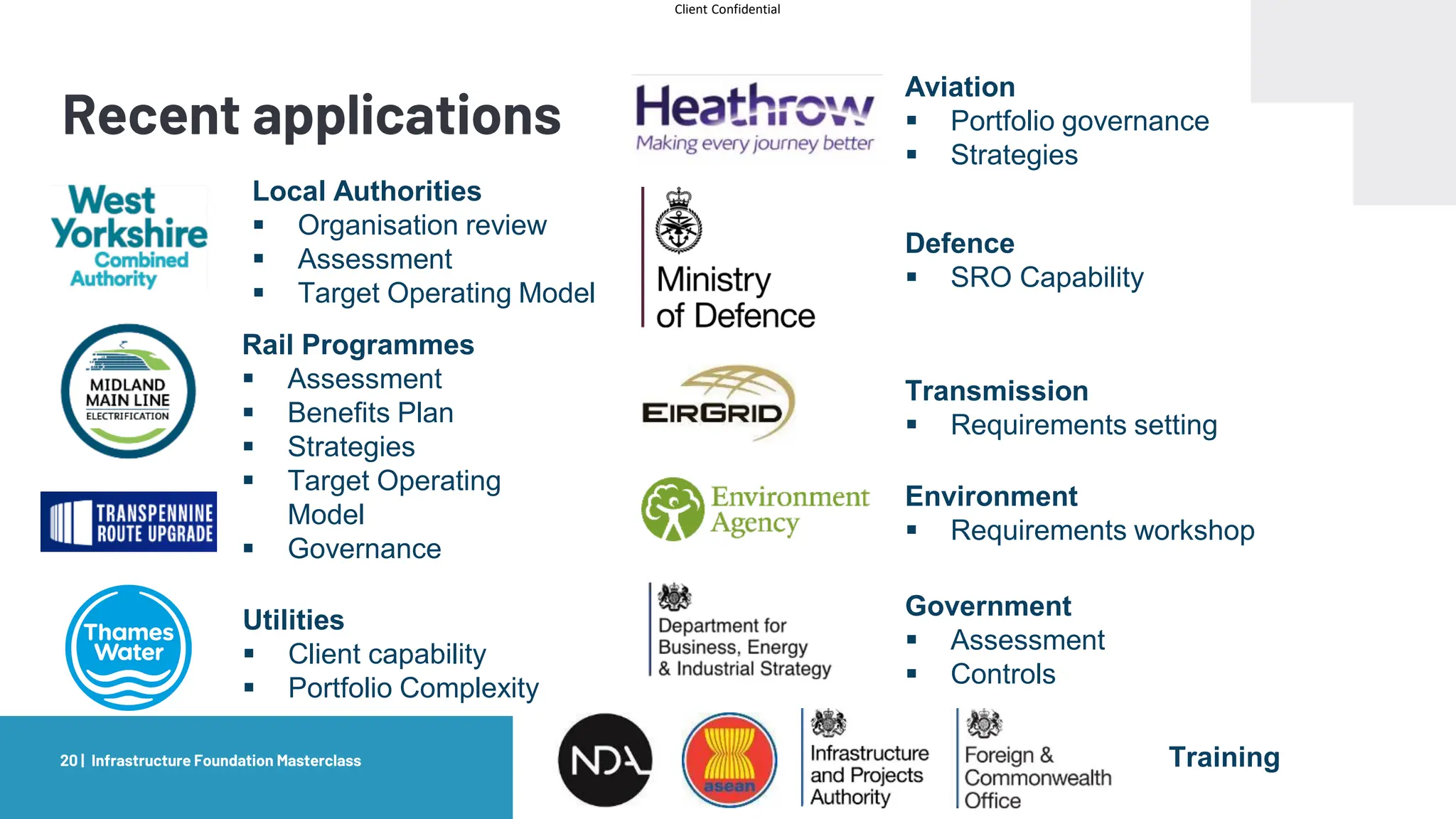
Environment
▪ Requirements workshop
Aviation
▪ Portfolio governance
▪ Strategies
Utilities
▪ Client capability
▪ Portfolio Complexity
Defence
▪ SRO Capability
Transmission
▪ Requirements setting
Local Authorities
▪ Organisation review
▪ Assessment
▪ Target Operating Model
Rail Programmes
▪ Assessment
▪ Benefits Plan
▪ Strategies
▪ Target Operating
Model
▪ Governance
Government
▪ Assessment
▪ Controls
Training
Client Confidential
Project Routemap vs Assurance
InfrastructureFoundationMasterclass
21 |
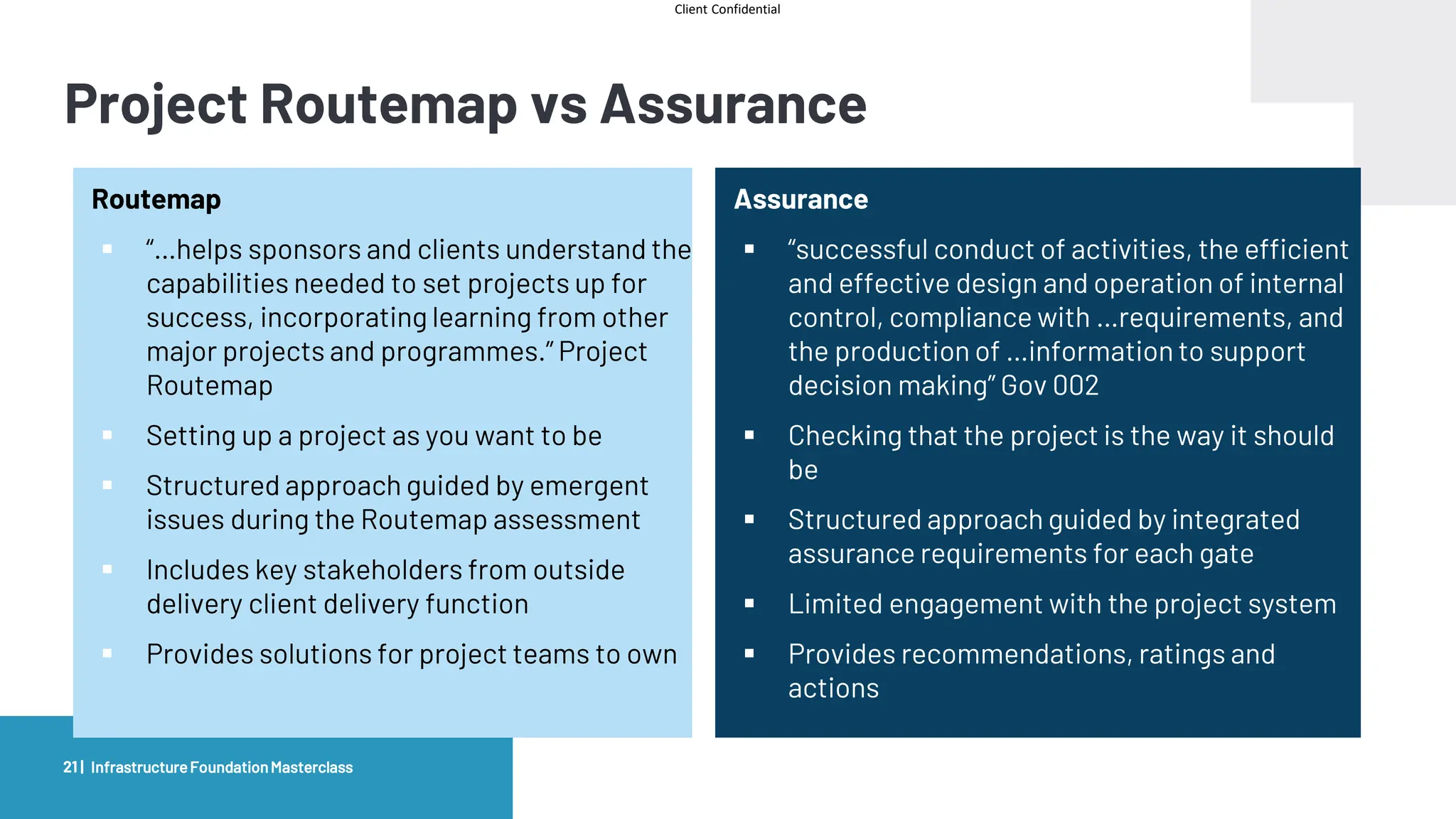
Routemap
▪ “…helps sponsors and clients understand the
capabilities needed to set projects up for
success, incorporating learning from other
major projects and programmes.” Project
Routemap
▪ Setting up a project as you want to be
▪ Structured approach guided by emergent
issues during the Routemap assessment
▪ Includes key stakeholders from outside
delivery client delivery function
▪ Provides solutions for project teams to own
Assurance
▪ “successful conduct of activities, the efficient
and effective design and operation of internal
control, compliance with …requirements, and
the production of …information to support
decision making” Gov 002
▪ Checking that the project is the way it should
be
▪ Structured approach guided by integrated
assurance requirements for each gate
▪ Limited engagement with the project system
▪ Provides recommendations, ratings and
actions
Client Confidential
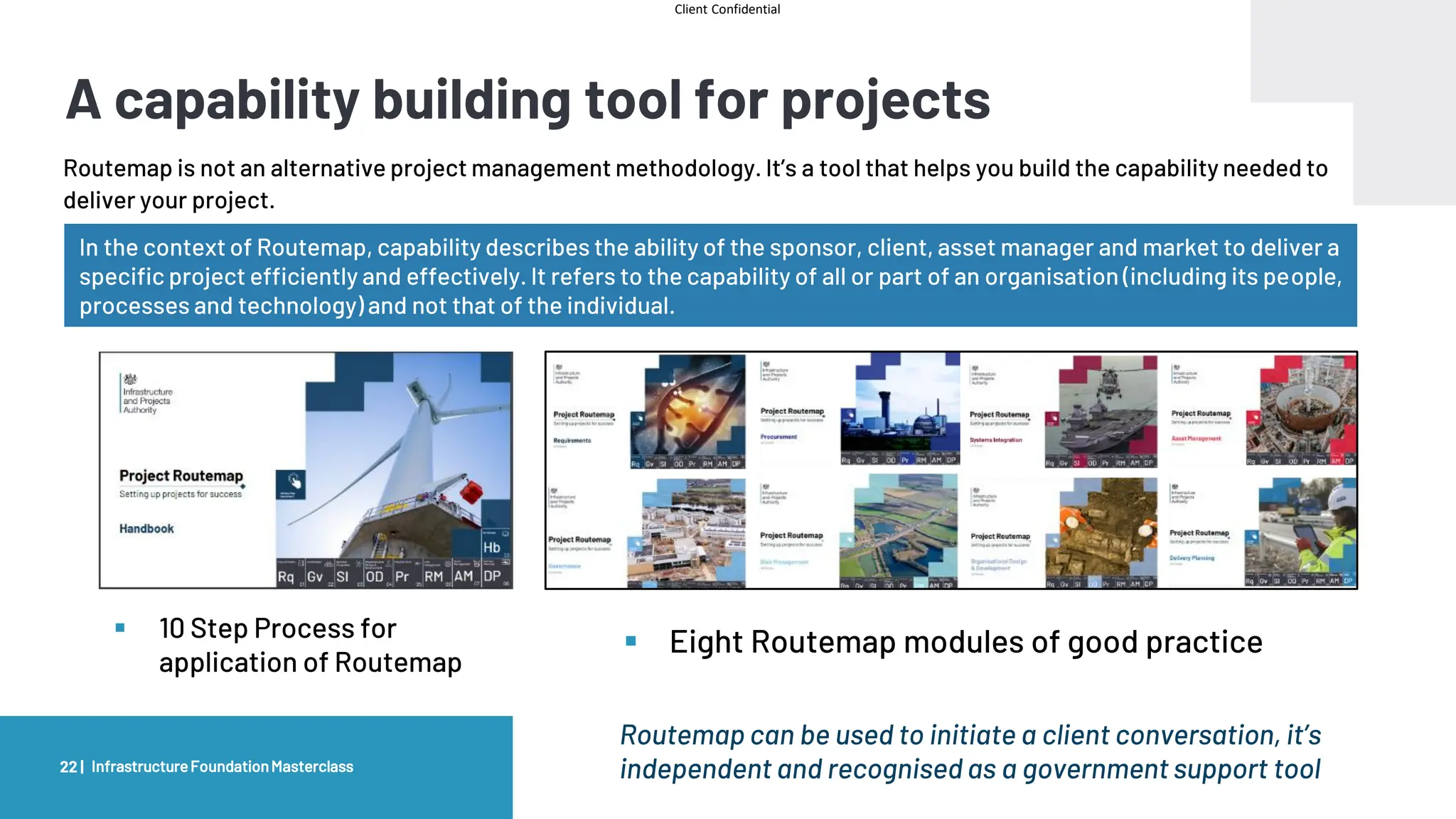
A capability building tool for projects
Routemap is not an alternative project management methodology. It’s a tool that helps you build the capability needed to
deliver your project.
22 |
▪ 10 Step Process for
application of Routemap
▪ Eight Routemap modules of good practice
InfrastructureFoundationMasterclass
In the context of Routemap, capability describes the ability of the sponsor, client, asset manager and market to deliver a
specific project efficiently and effectively. It refers to the capability of all or part of an organisation (including its people,
processes and technology) and not that of the individual.
Routemap can be used to initiate a client conversation, it’s
independent and recognised as a government support tool
Client Confidential
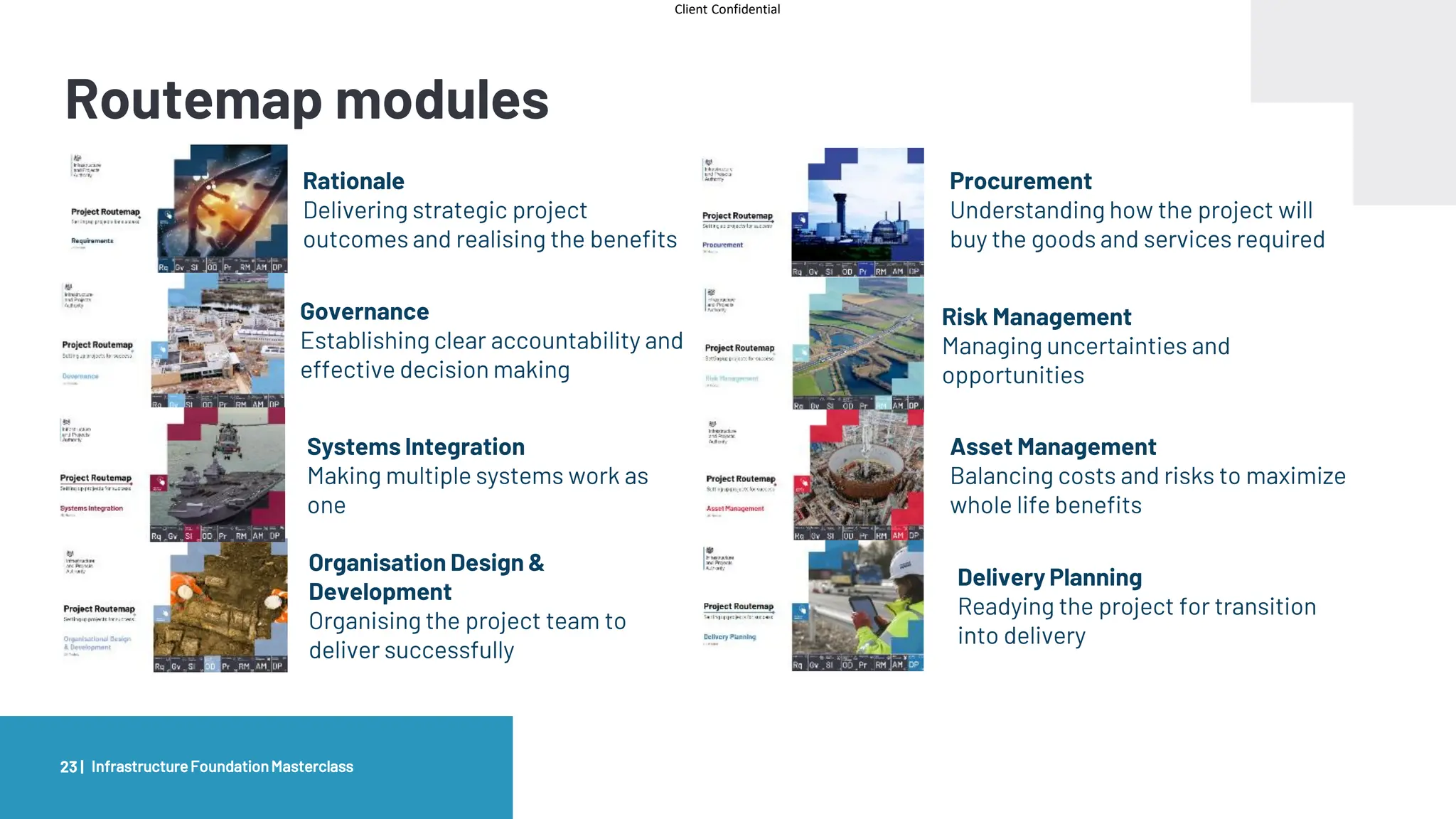
Routemap modules
23 | InfrastructureFoundationMasterclass
Rationale
Delivering strategic project
outcomes and realising the benefits
Governance
Establishing clear accountability and
effective decision making
Delivery Planning
Readying the project for transition
into delivery
Organisation Design &
Development
Organising the project team to
deliver successfully
Procurement
Understanding how the project will
buy the goods and services required
Risk Management
Managing uncertainties and
opportunities
Asset Management
Balancing costs and risks to maximize
whole life benefits
Systems Integration
Making multiple systems work as
one
Client Confidential
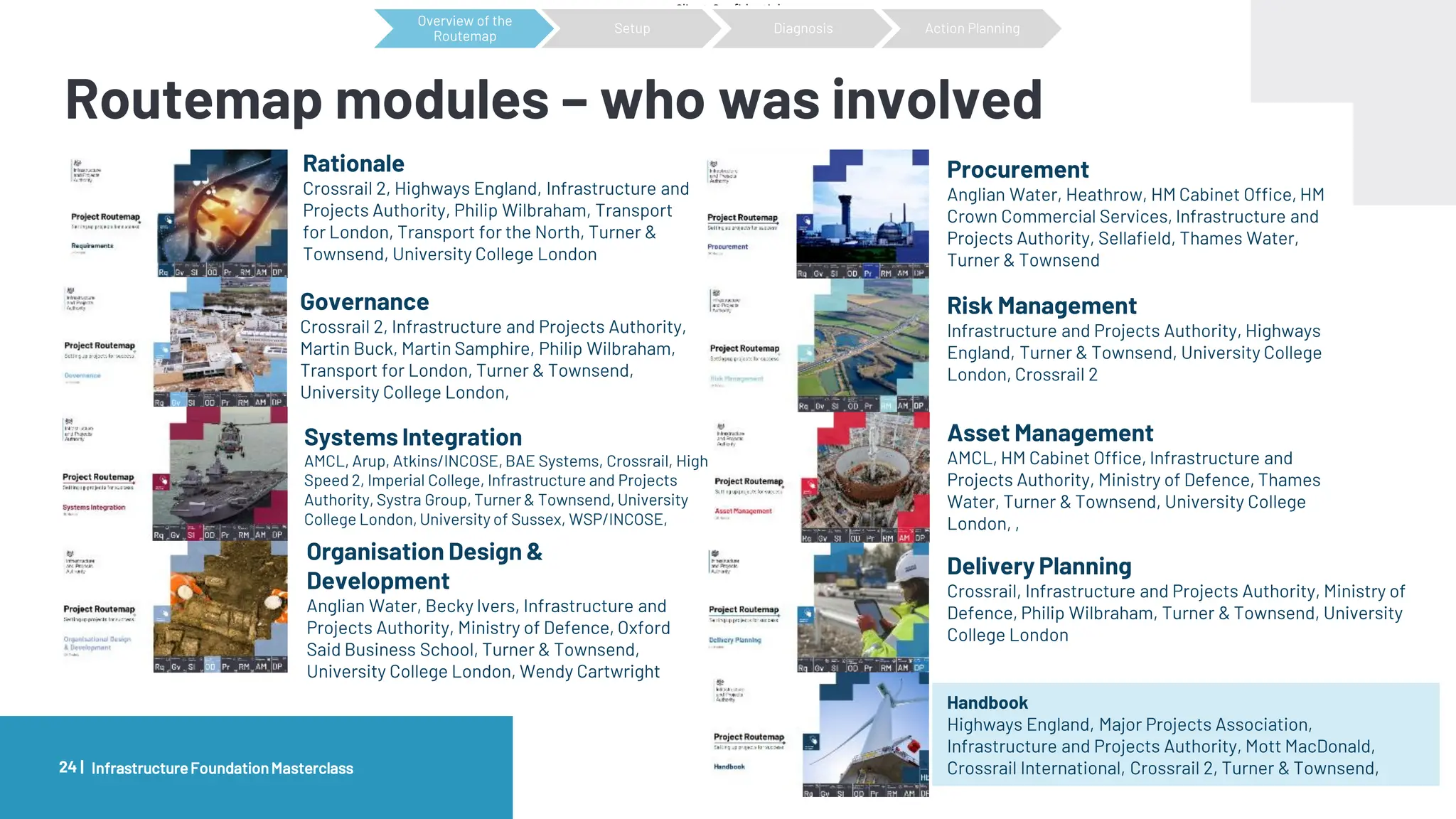
Routemap modules – who was involved
24 | InfrastructureFoundationMasterclass
Overview of the
Routemap
Setup Diagnosis Action Planning
Rationale
Crossrail 2, Highways England, Infrastructure and
Projects Authority, Philip Wilbraham, Transport
for London, Transport for the North, Turner &
Townsend, University College London
Governance
Crossrail 2, Infrastructure and Projects Authority,
Martin Buck, Martin Samphire, Philip Wilbraham,
Transport for London, Turner & Townsend,
University College London,
Delivery Planning
Crossrail, Infrastructure and Projects Authority, Ministry of
Defence, Philip Wilbraham, Turner & Townsend, University
College London
Organisation Design &
Development
Anglian Water, Becky Ivers, Infrastructure and
Projects Authority, Ministry of Defence, Oxford
Said Business School, Turner & Townsend,
University College London, Wendy Cartwright
Procurement
Anglian Water, Heathrow, HM Cabinet Office, HM
Crown Commercial Services, Infrastructure and
Projects Authority, Sellafield, Thames Water,
Turner & Townsend
Risk Management
Infrastructure and Projects Authority, Highways
England, Turner & Townsend, University College
London, Crossrail 2
Asset Management
AMCL, HM Cabinet Office, Infrastructure and
Projects Authority, Ministry of Defence, Thames
Water, Turner & Townsend, University College
London, ,
Systems Integration
AMCL, Arup, Atkins/INCOSE, BAE Systems, Crossrail, High
Speed 2, Imperial College, Infrastructure and Projects
Authority, Systra Group, Turner & Townsend, University
College London, University of Sussex, WSP/INCOSE,
Handbook
Highways England, Major Projects Association,
Infrastructure and Projects Authority, Mott MacDonald,
Crossrail International, Crossrail 2, Turner & Townsend,
Client Confidential
Routemap modules
[…], and why it’s important
Introduction to the topic of the module
including a list of key documents that will
help you to understand how this area is
managed on your project
Typical findings
Indicators that issues might arise
during delivery
Pillars of effective […]
Hallmarks of effective project set up
Considerations
Detailed list of questions to understand
root causes and suggest improvements.
Together with signposts to other
materials you may find helpful.
Good practice examples and suggested
reading
Context to support your wider understanding
Overview of the
Routemap
Setup Diagnosis Action Planning
Infrastructure Foundation Masterclass
25 |
Client Confidential
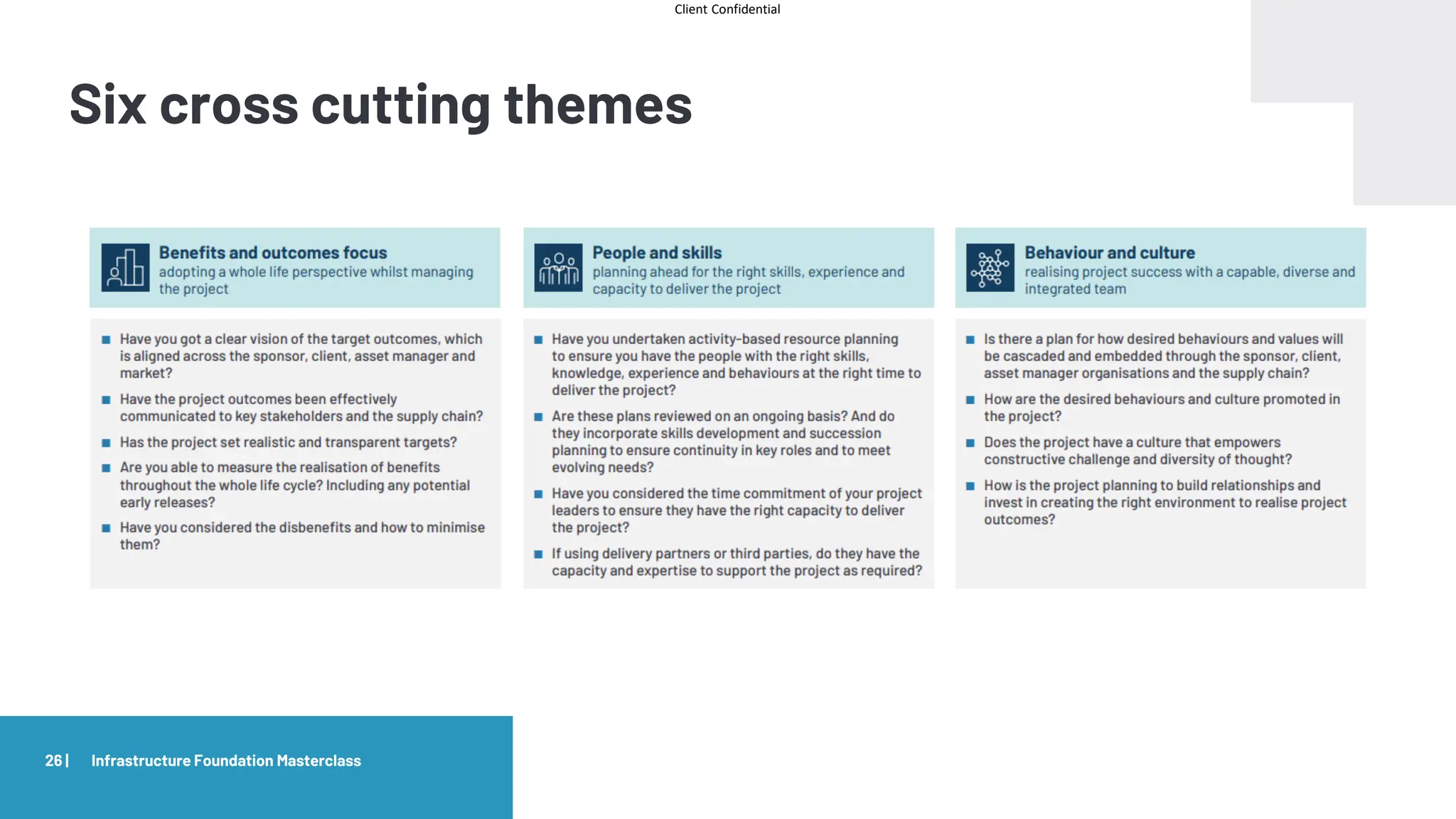
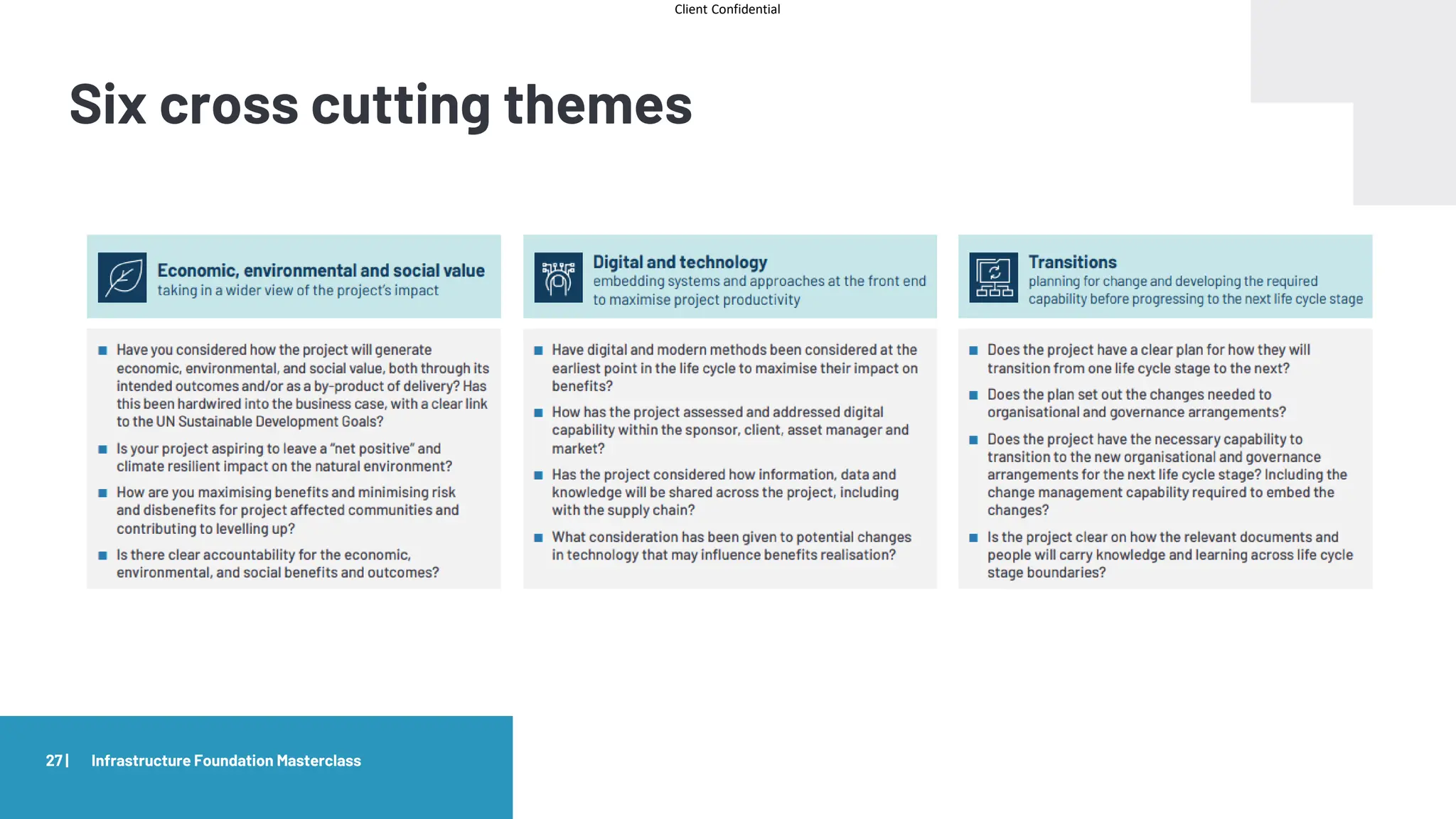
Six cross cutting themes
26 | Infrastructure Foundation Masterclass
Client Confidential
Six cross cutting themes
27 | Infrastructure Foundation Masterclass
Client Confidential
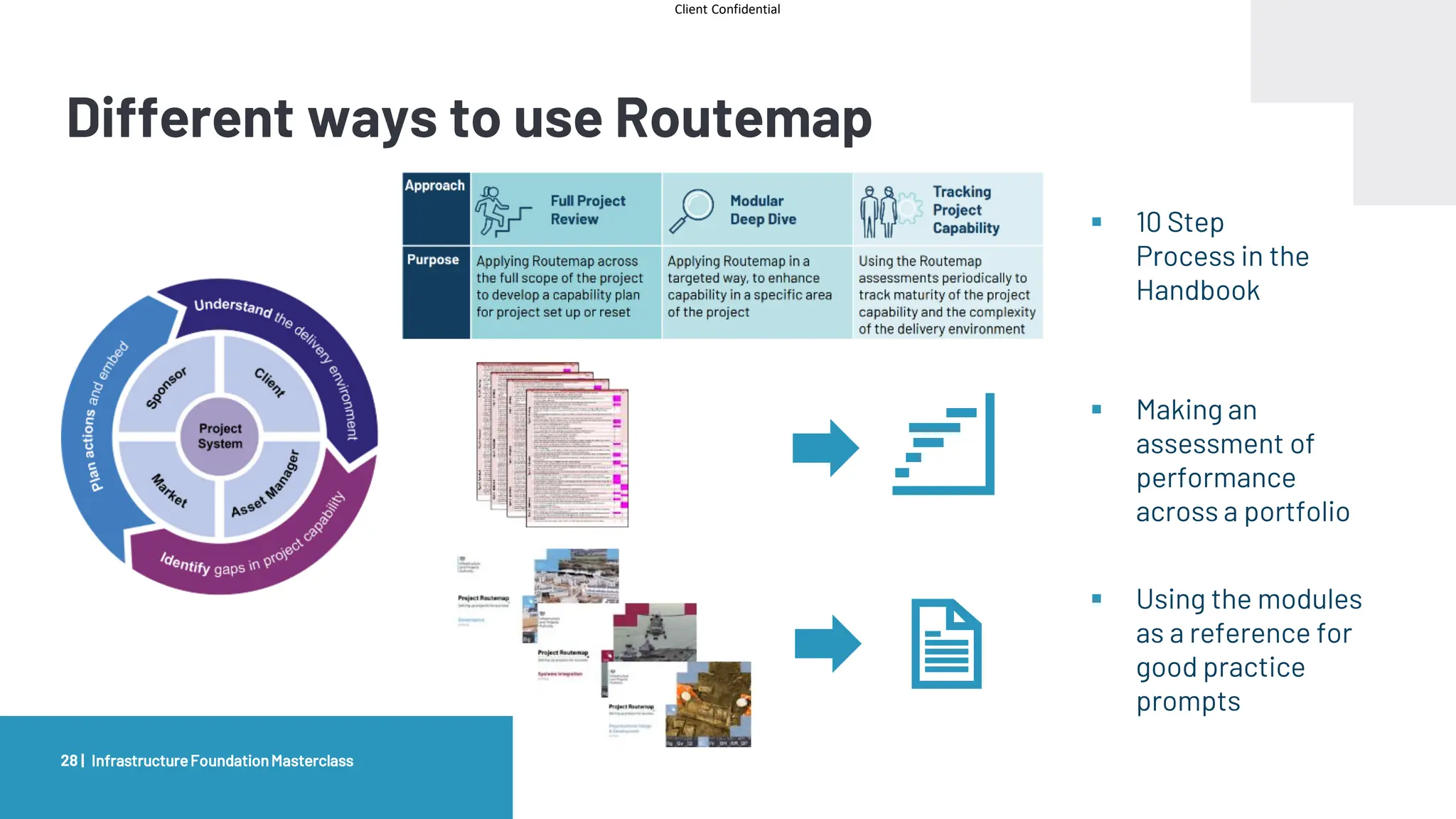
Different ways to use Routemap
InfrastructureFoundationMasterclass
28 |
▪ 10 Step
Process in the
Handbook
▪ Using the modules
as a reference for
good practice
prompts
▪ Making an
assessment of
performance
across a portfolio
Client Confidential
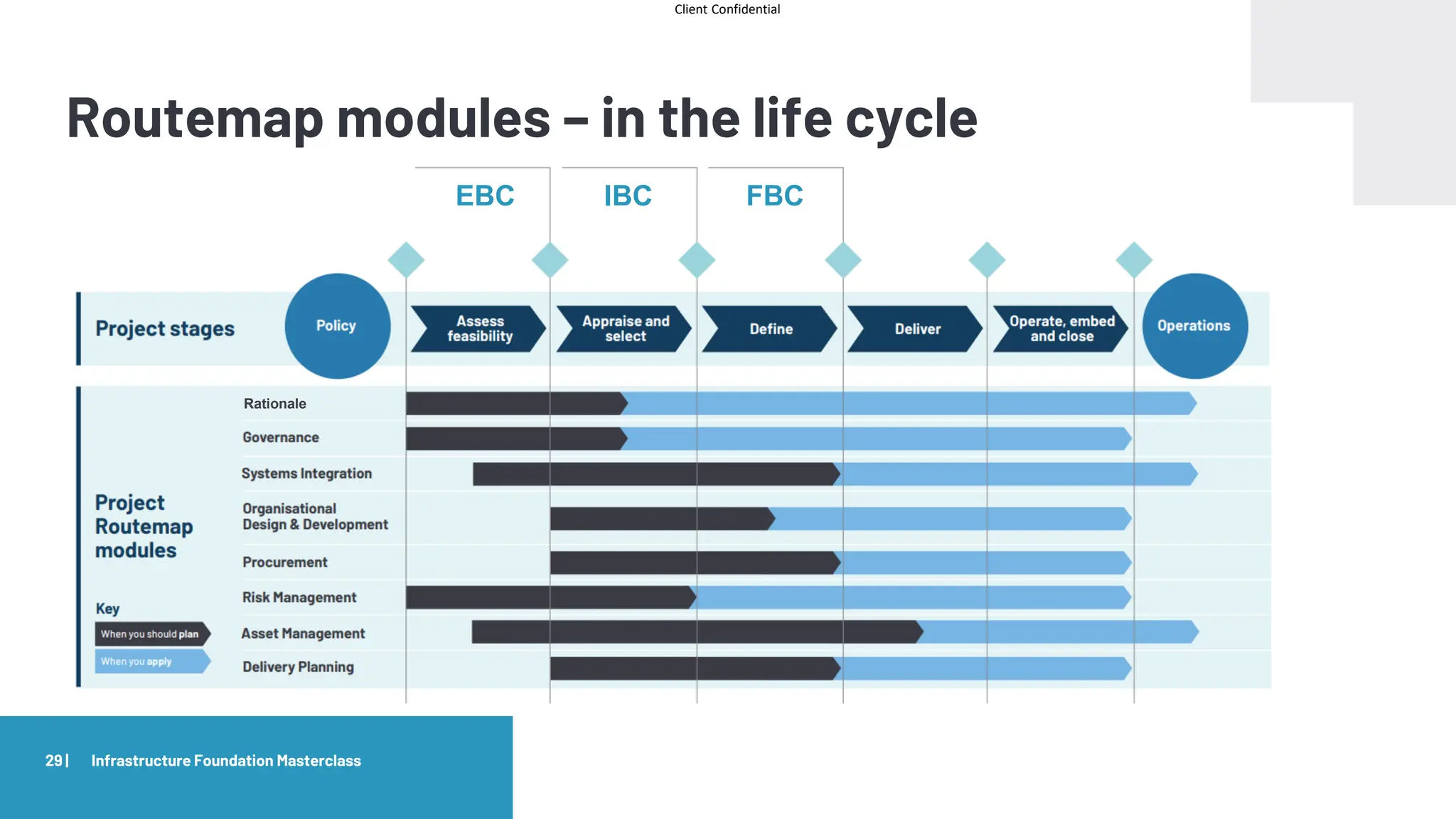
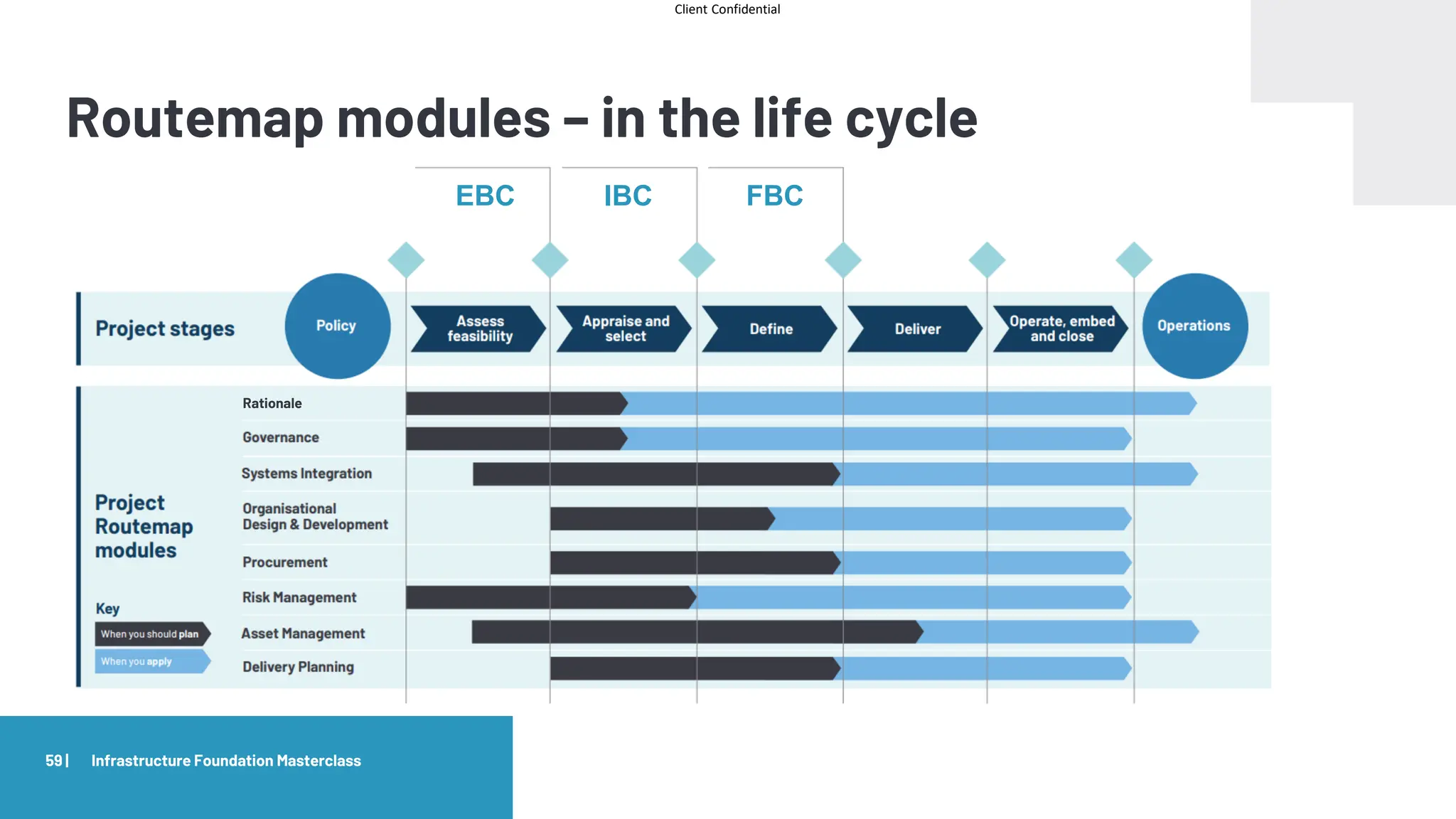
Routemap modules – in the life cycle
29 | Infrastructure Foundation Masterclass
EBC IBC FBC
Rationale
Client Confidential
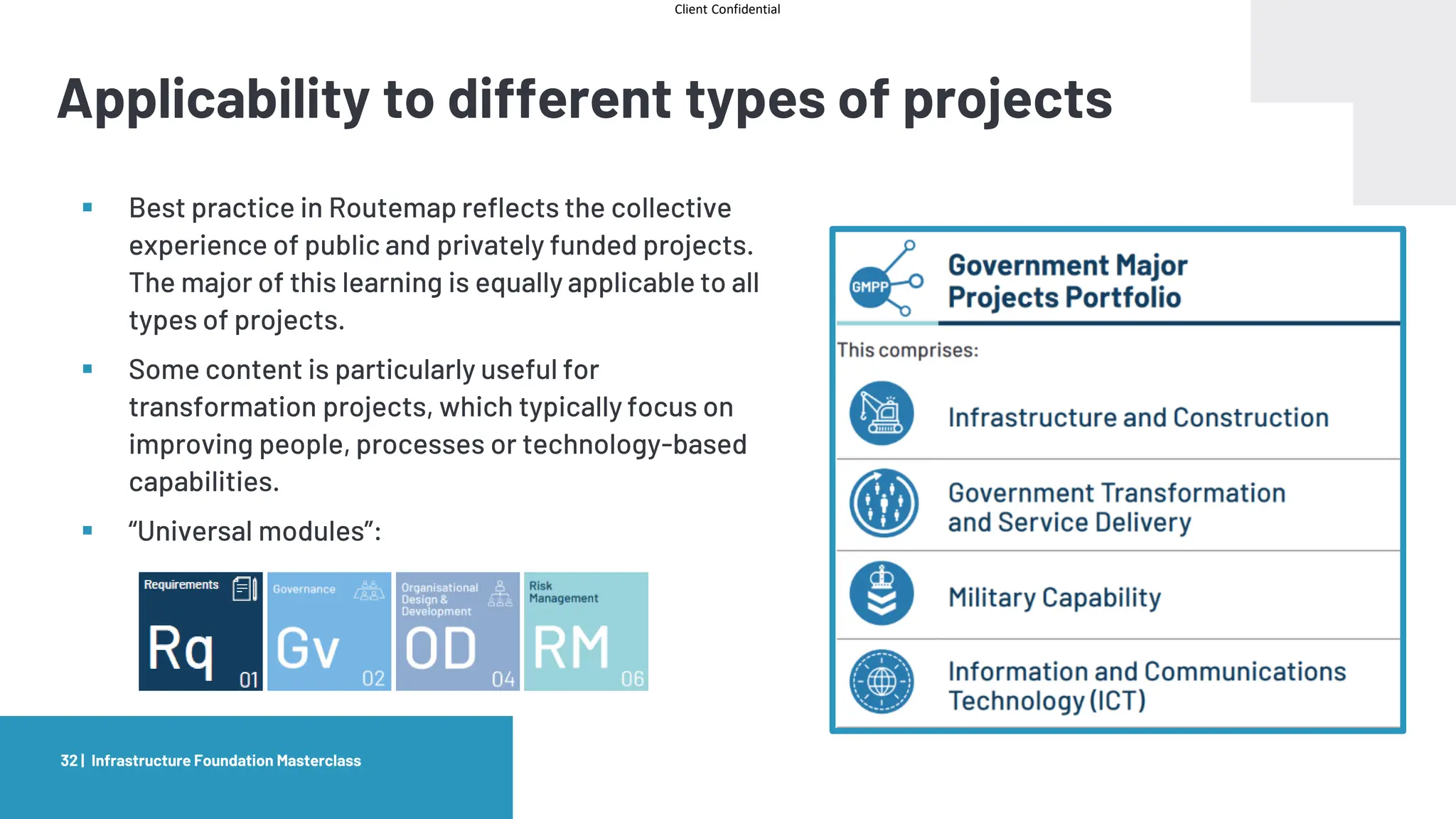
Applicability to different types of projects
Infrastructure Foundation Masterclass
32 |
▪ Best practice in Routemap reflects the collective
experience of public and privately funded projects.
The major of this learning is equally applicable to all
types of projects.
▪ Some content is particularly useful for
transformation projects, which typically focus on
improving people, processes or technology-based
capabilities.
▪ “Universal modules”:
Client Confidential
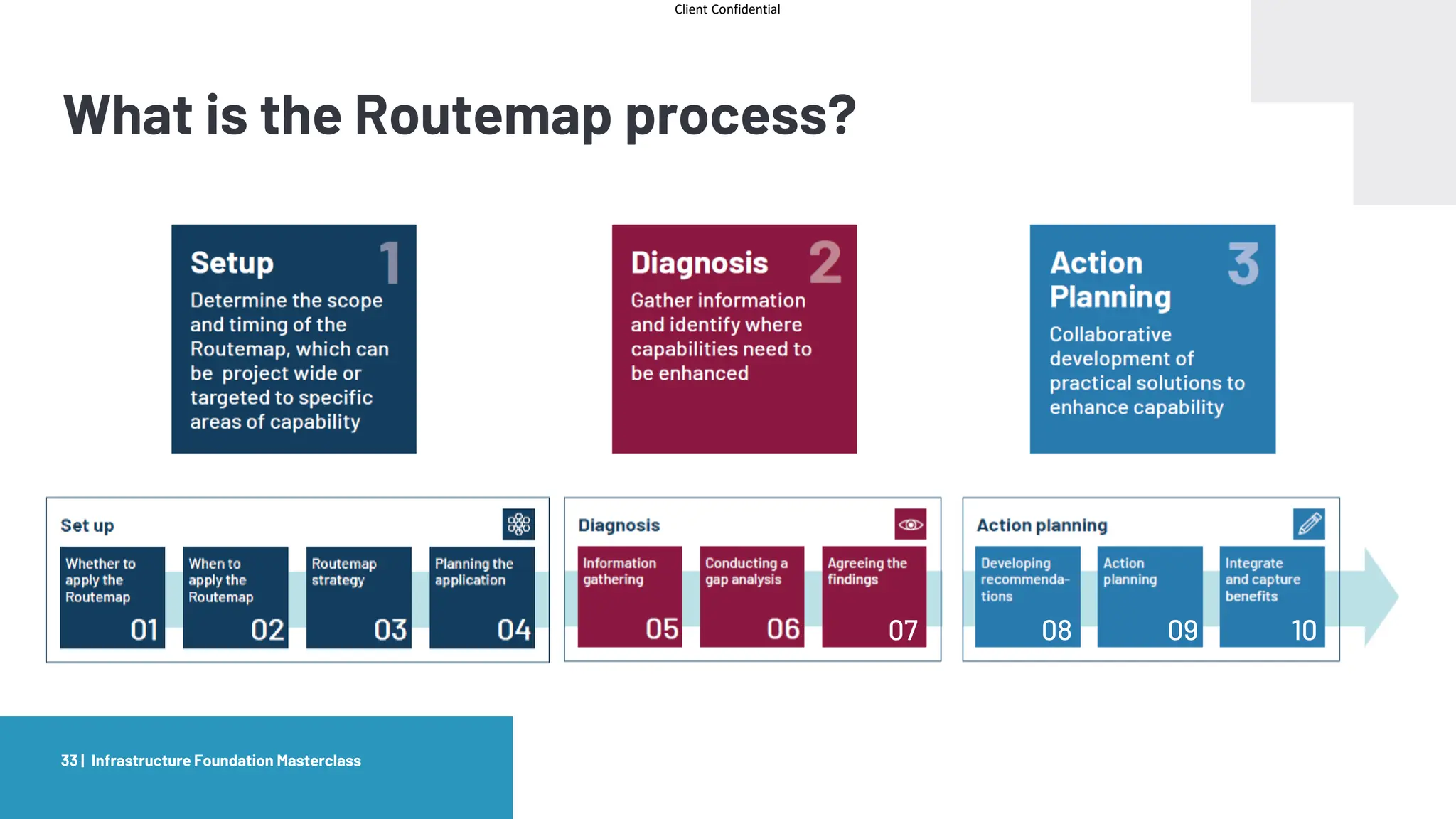
What is the Routemap process?
Infrastructure Foundation Masterclass
33 |
07 08 09 10
Client Confidential
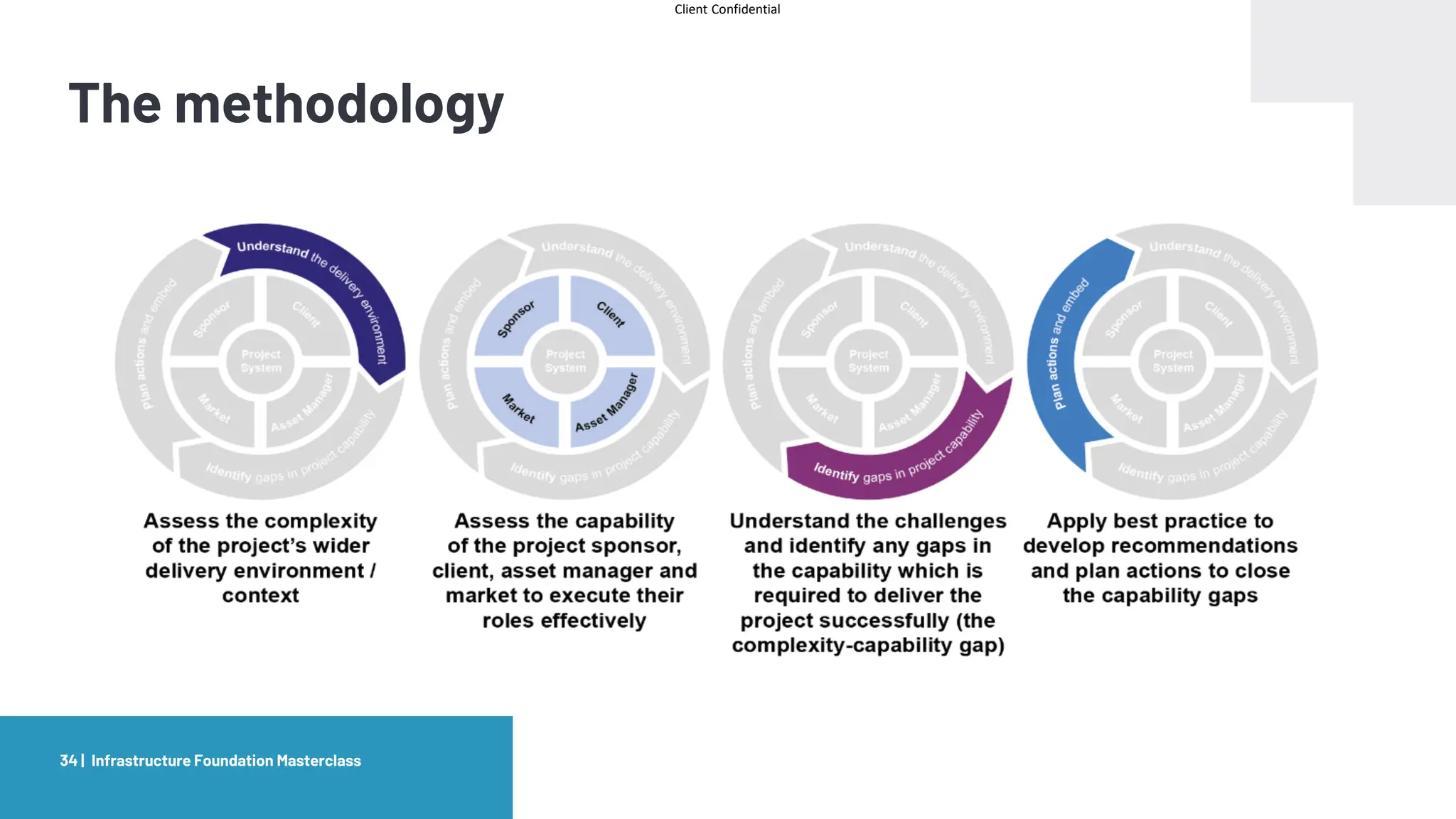
The methodology
Infrastructure Foundation Masterclass
34 |
Client Confidential
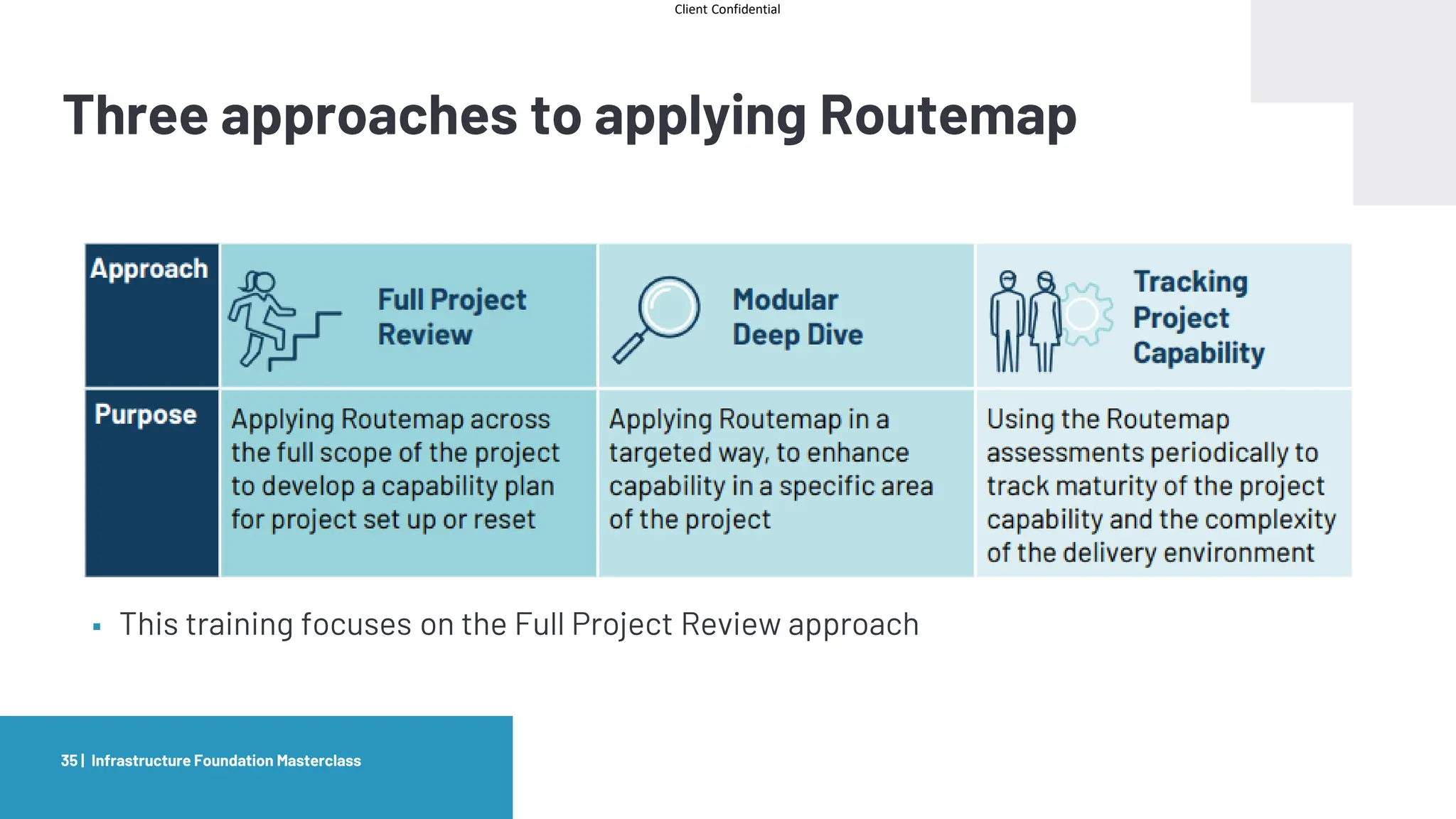
Three approaches to applying Routemap
Infrastructure Foundation Masterclass
35 |
▪ This training focuses on the Full Project Review approach
Client Confidential
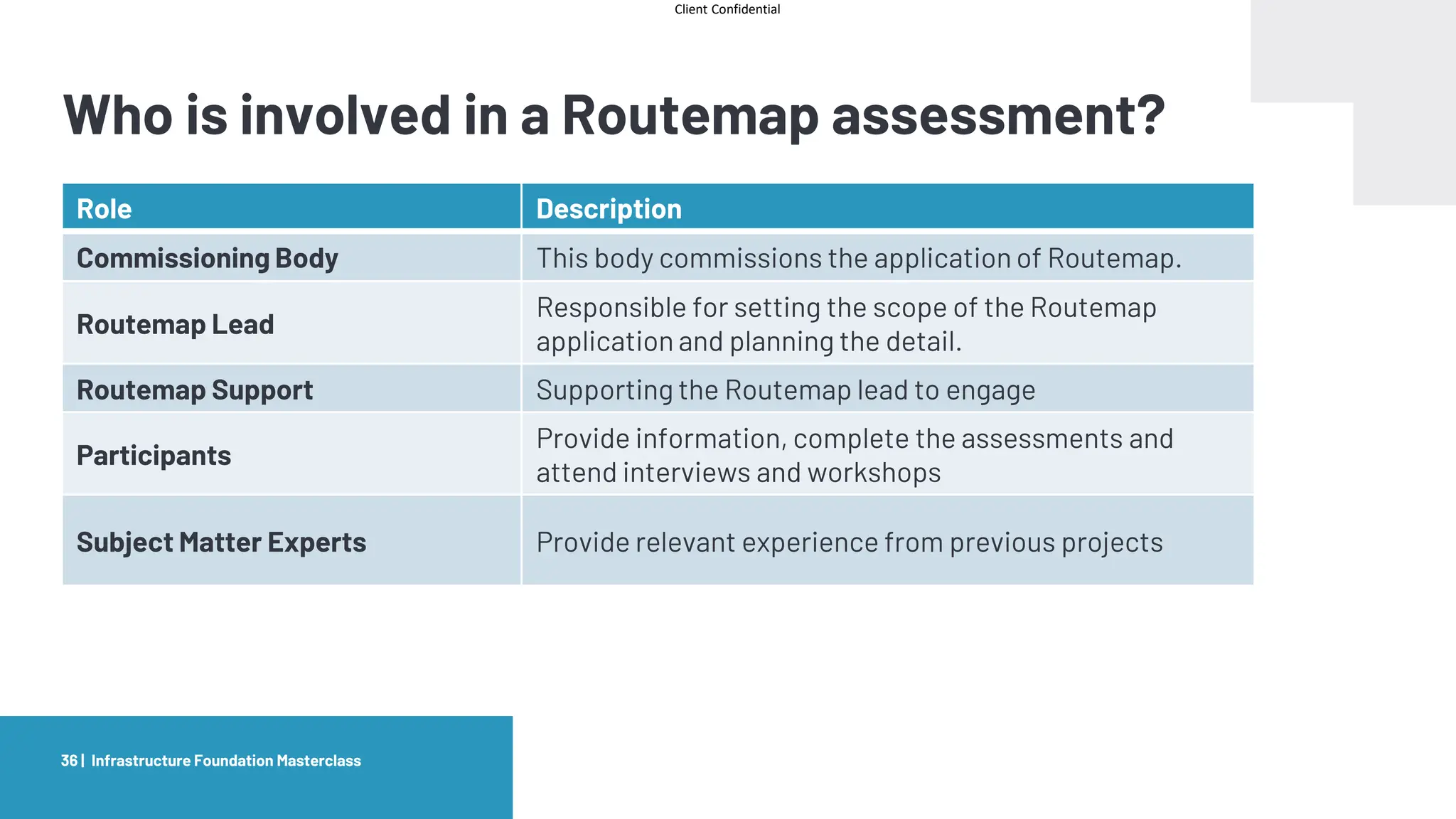
Infrastructure Foundation Masterclass
36 |
Role Description
Commissioning Body This body commissions the application of Routemap.
Routemap Lead
Responsible for setting the scope of the Routemap
application and planning the detail.
Routemap Support Supporting the Routemap lead to engage
Participants
Provide information, complete the assessments and
attend interviews and workshops
Subject Matter Experts Provide relevant experience from previous projects
Who is involved in a Routemap assessment?
Client Confidential
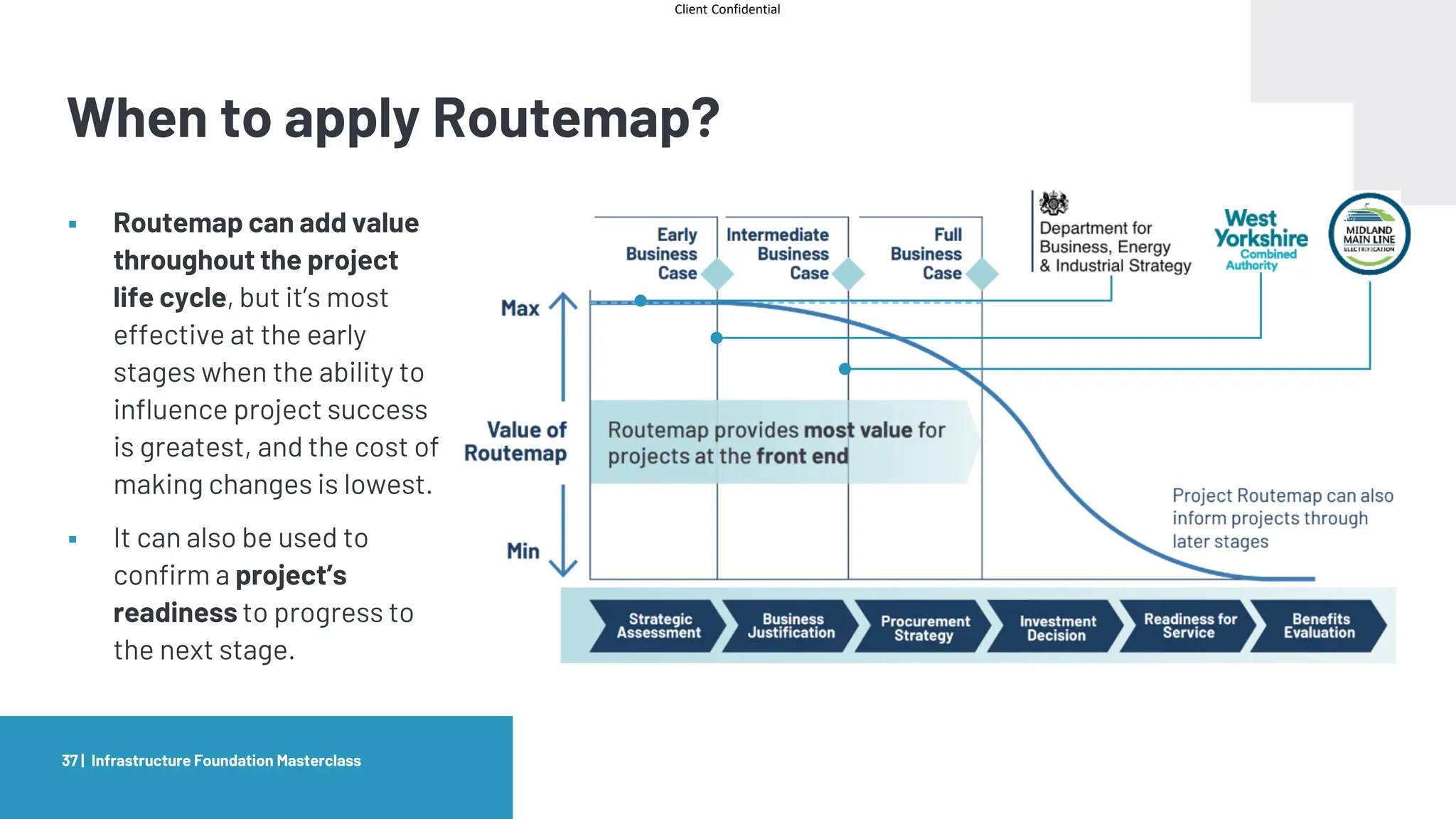
When to apply Routemap?
▪ Routemap can add value
throughout the project
life cycle, but it’s most
effective at the early
stages when the ability to
influence project success
is greatest, and the cost of
making changes is lowest.
▪ It can also be used to
confirm a project’s
readiness to progress to
the next stage.
Infrastructure Foundation Masterclass
37 |
Client Confidential
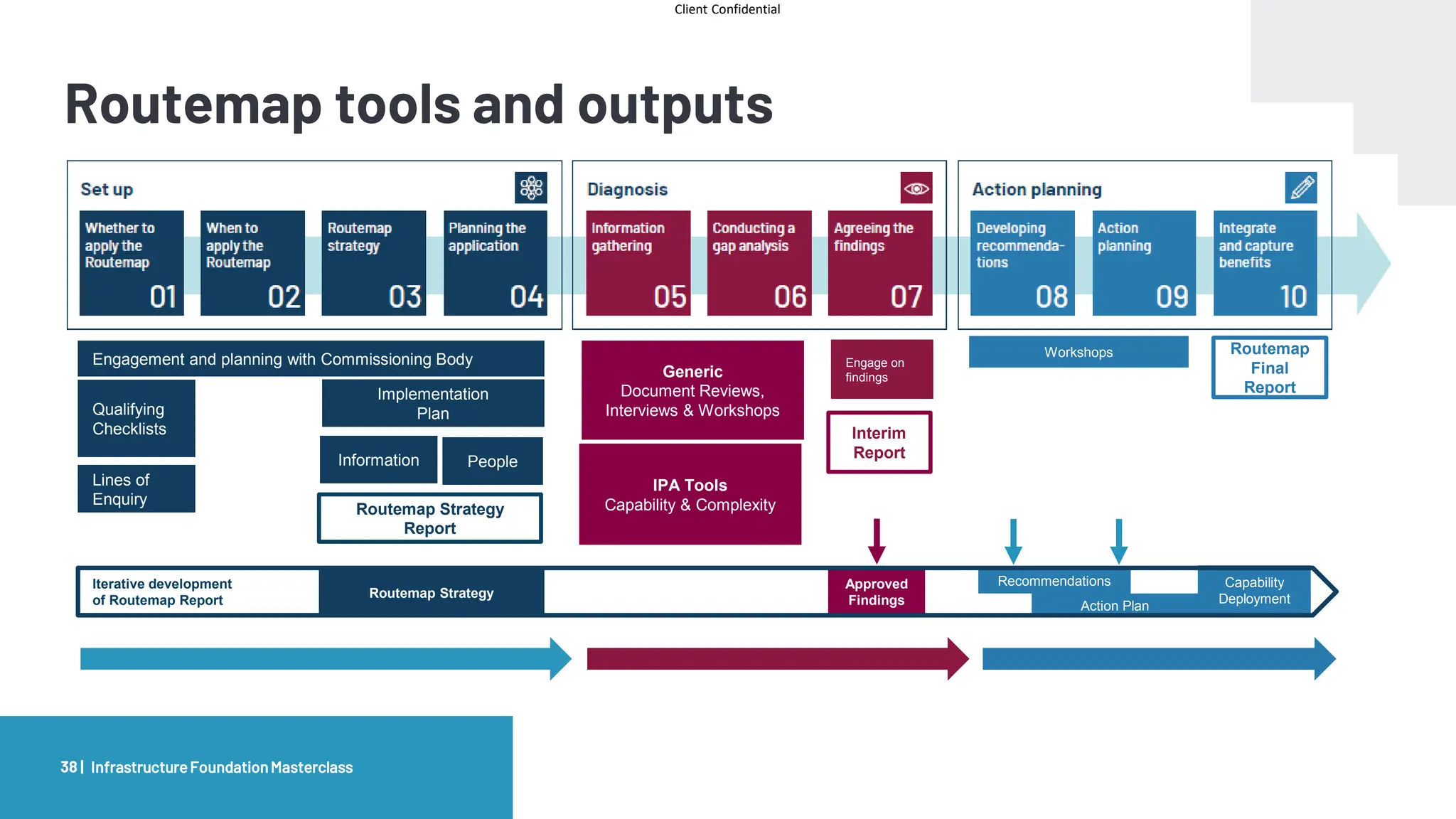
Routemap tools and outputs
InfrastructureFoundationMasterclass
38 |
Routemap Strategy
IPA Tools
Capability & Complexity
Generic
Document Reviews,
Interviews & Workshops
Workshops
Qualifying
Checklists
Implementation
Plan
Engage on
findings
Engagement and planning with Commissioning Body
Action Plan
Approved
Findings
Recommendations Capability
Deployment
Iterative development
of Routemap Report
Lines of
Enquiry
Information People
Interim
Report
Routemap
Final
Report
Routemap Strategy
Report
Client Confidential
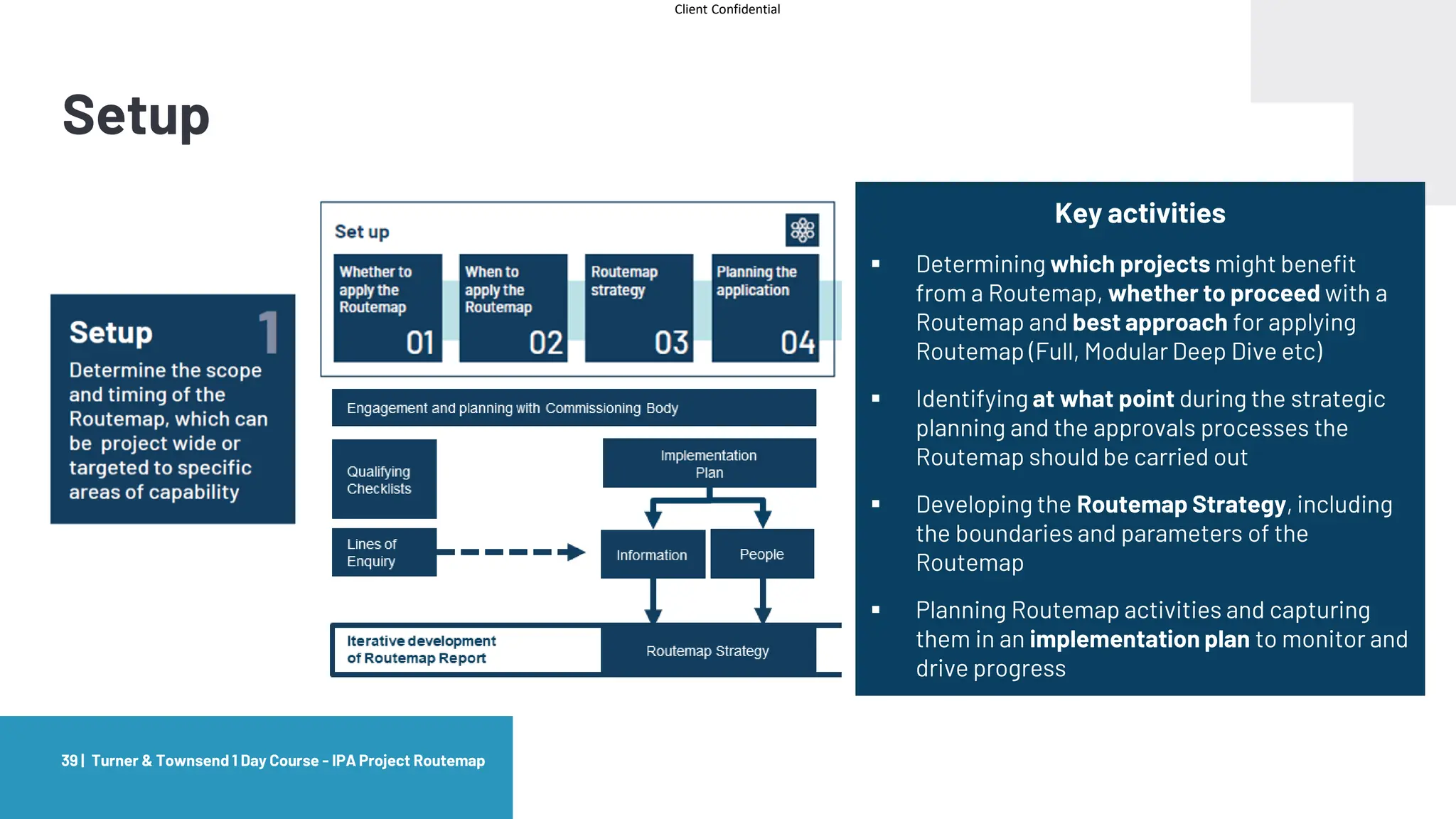
Setup
Turner & Townsend 1 Day Course - IPA Project Routemap
39 |
Key activities
▪ Determining which projects might benefit
from a Routemap, whether to proceed with a
Routemap and best approach for applying
Routemap (Full, Modular Deep Dive etc)
▪ Identifying at what point during the strategic
planning and the approvals processes the
Routemap should be carried out
▪ Developing the Routemap Strategy, including
the boundaries and parameters of the
Routemap
▪ Planning Routemap activities and capturing
them in an implementation plan to monitor and
drive progress
Client Confidential
Questions?
InfrastructureFoundationMasterclass
40 |
Client Confidential
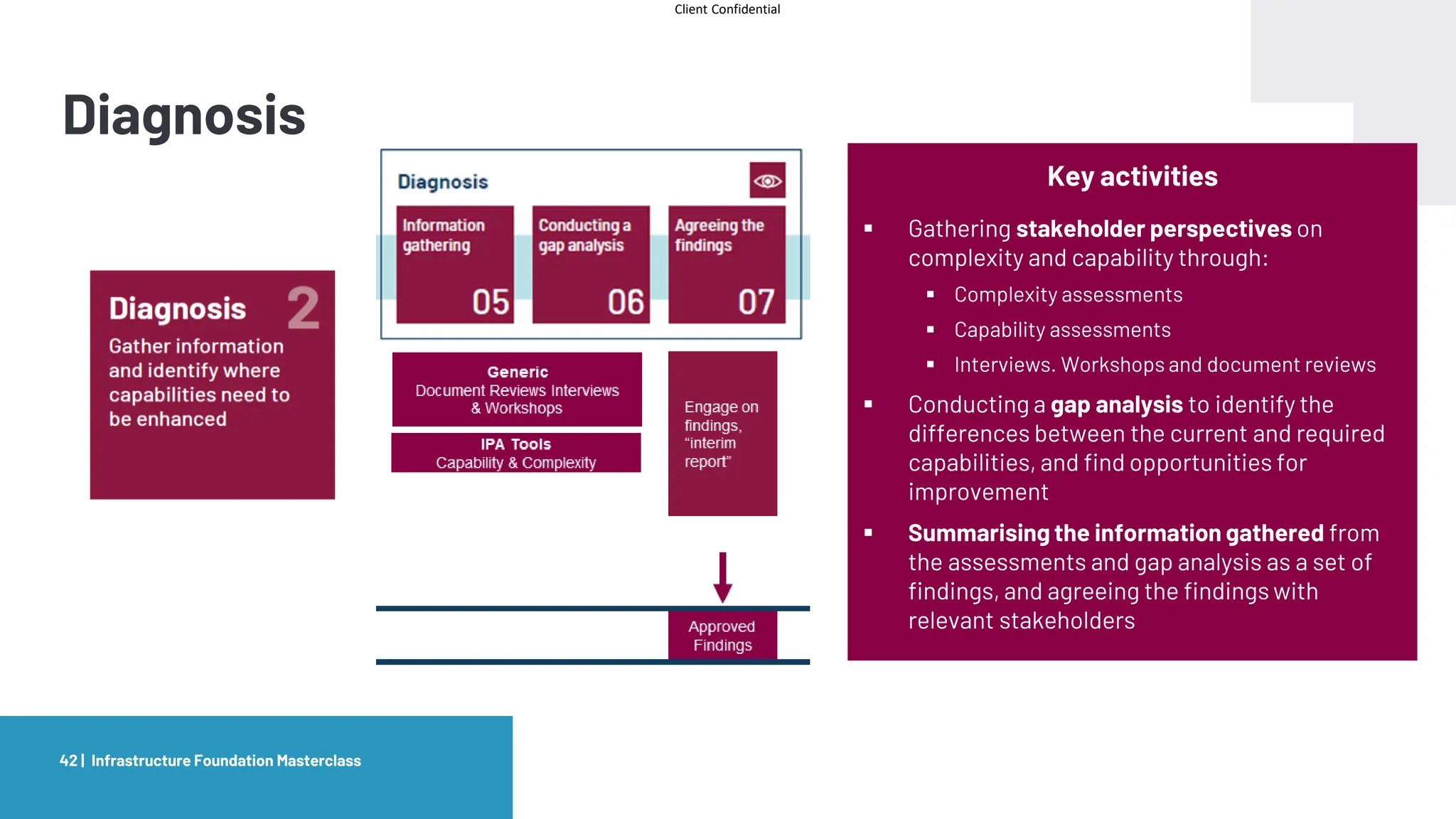
Diagnosis
Complexity & Capability
InfrastructureFoundationMasterclass
41 |
Client Confidential
Diagnosis
Infrastructure Foundation Masterclass
42 |
Key activities
▪ Gathering stakeholder perspectives on
complexity and capability through:
▪ Complexity assessments
▪ Capability assessments
▪ Interviews. Workshops and document reviews
▪ Conducting a gap analysis to identify the
differences between the current and required
capabilities, and find opportunities for
improvement
▪ Summarising the information gathered from
the assessments and gap analysis as a set of
findings, and agreeing the findings with
relevant stakeholders
Client Confidential
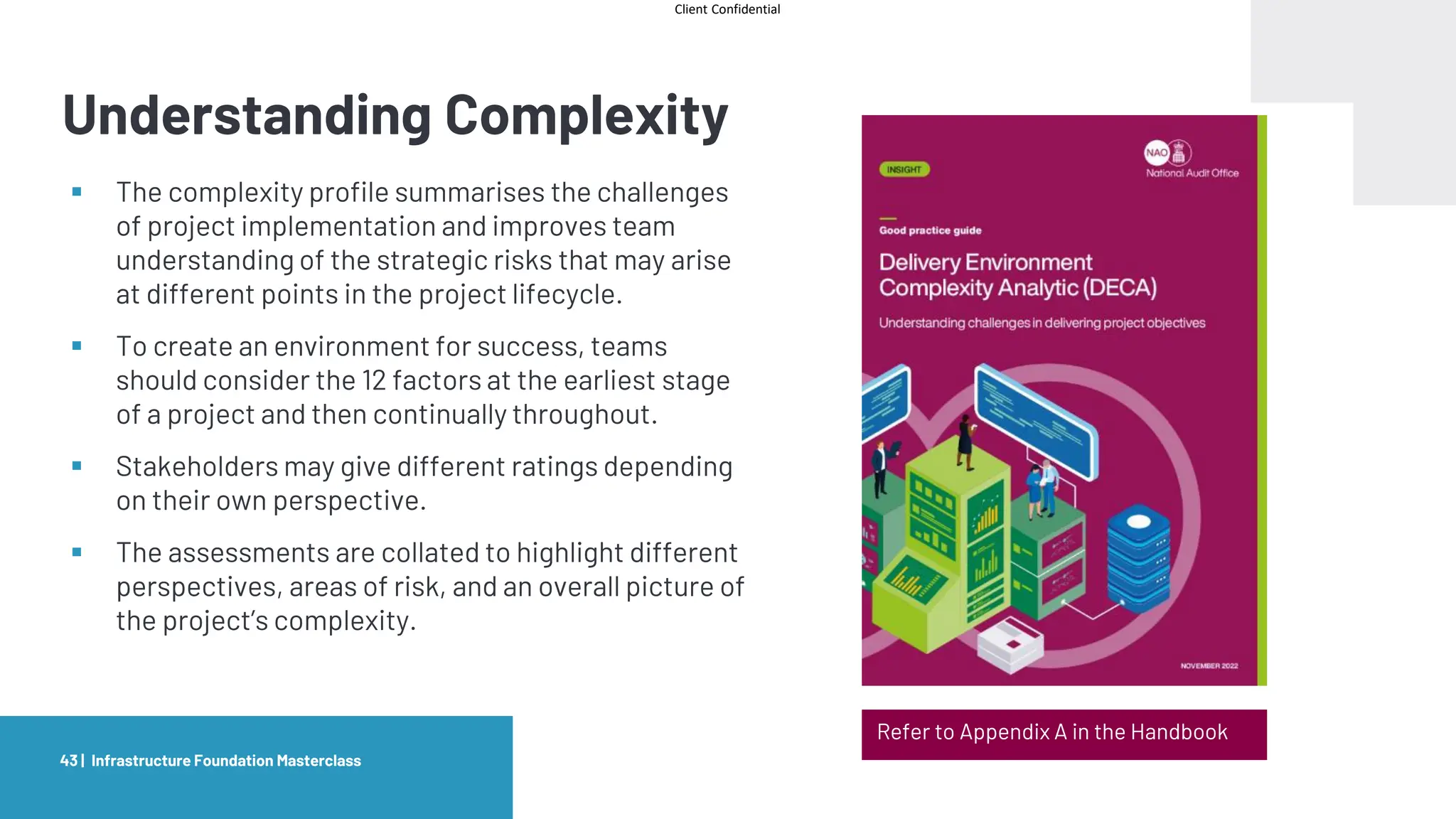
Understanding Complexity
Infrastructure Foundation Masterclass
43 |
Refer to Appendix A in the Handbook
▪ The complexity profile summarises the challenges
of project implementation and improves team
understanding of the strategic risks that may arise
at different points in the project lifecycle.
▪ To create an environment for success, teams
should consider the 12 factors at the earliest stage
of a project and then continually throughout.
▪ Stakeholders may give different ratings depending
on their own perspective.
▪ The assessments are collated to highlight different
perspectives, areas of risk, and an overall picture of
the project’s complexity.
Client Confidential
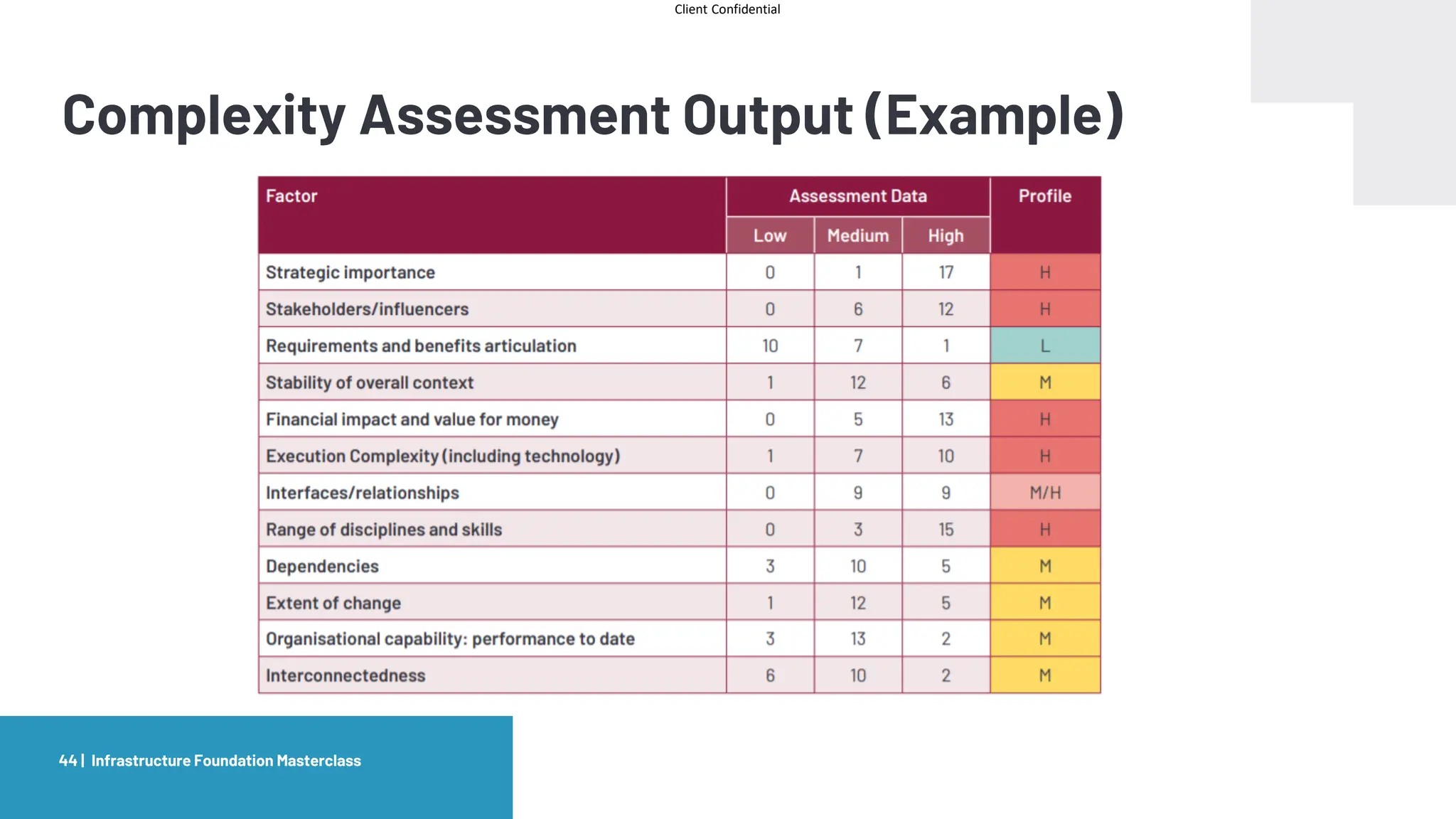
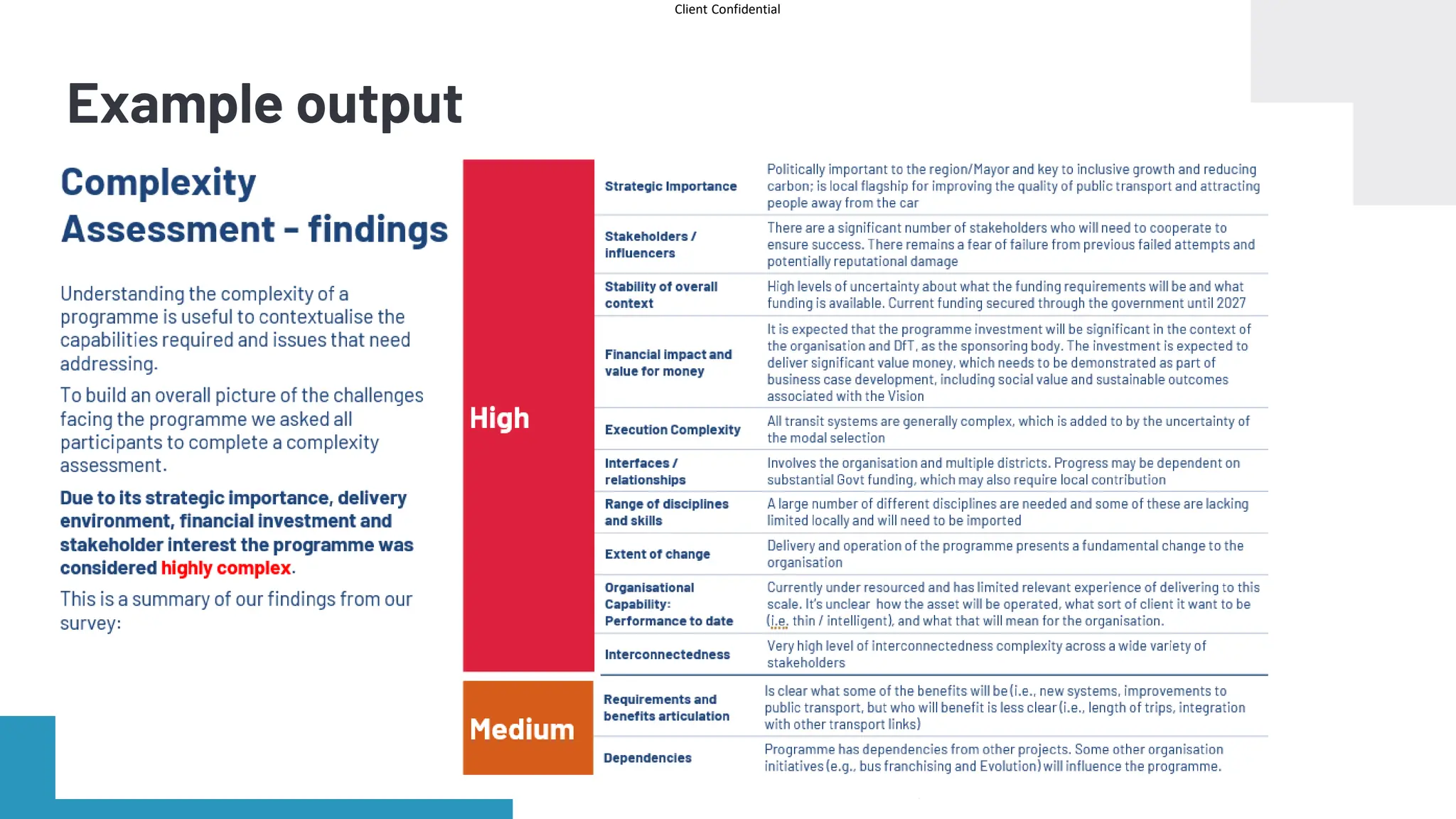
Complexity Assessment Output (Example)
Infrastructure Foundation Masterclass
44 |
Client Confidential
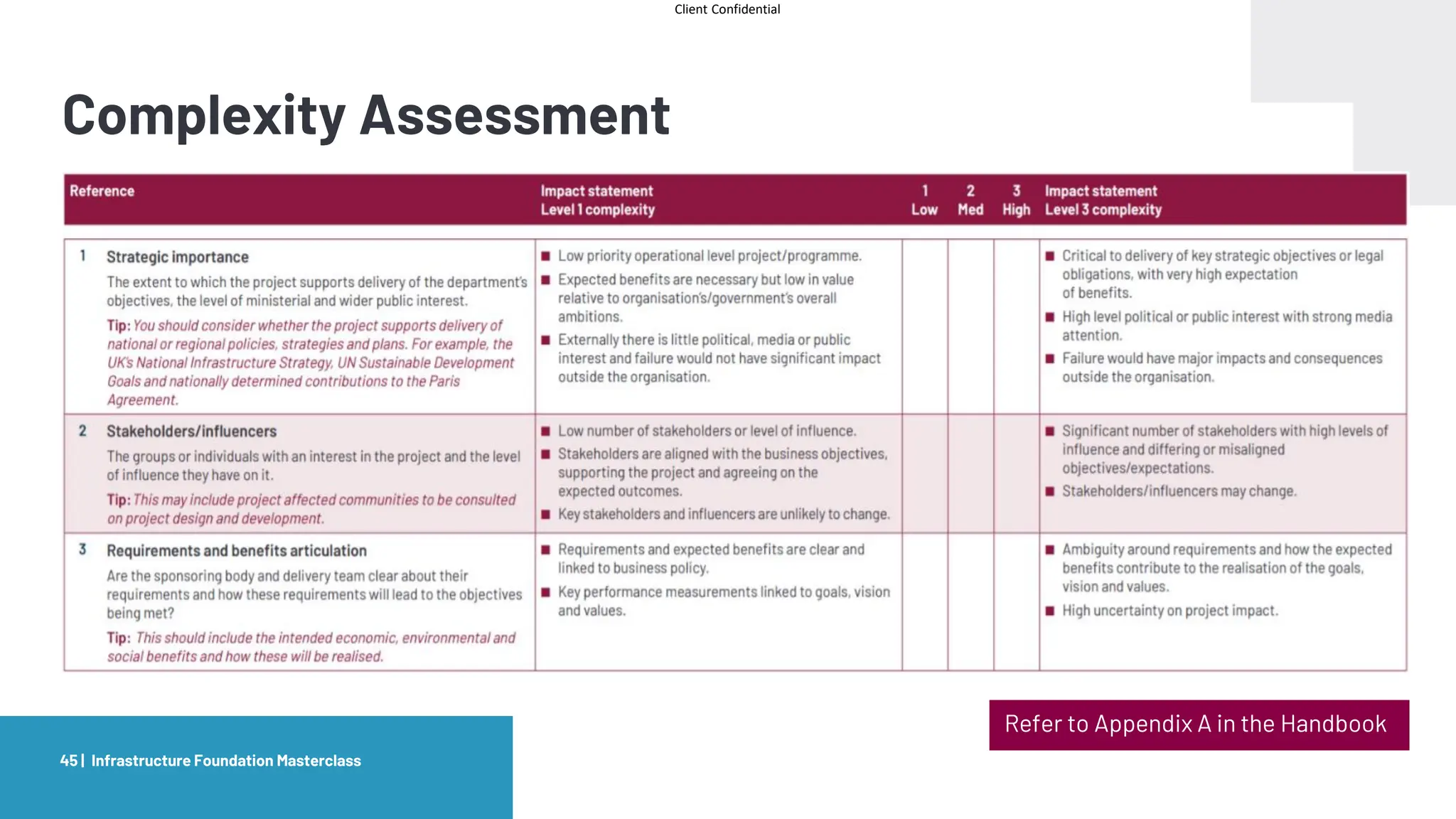
Complexity Assessment
Infrastructure Foundation Masterclass
45 |
Refer to Appendix A in the Handbook
Client Confidential
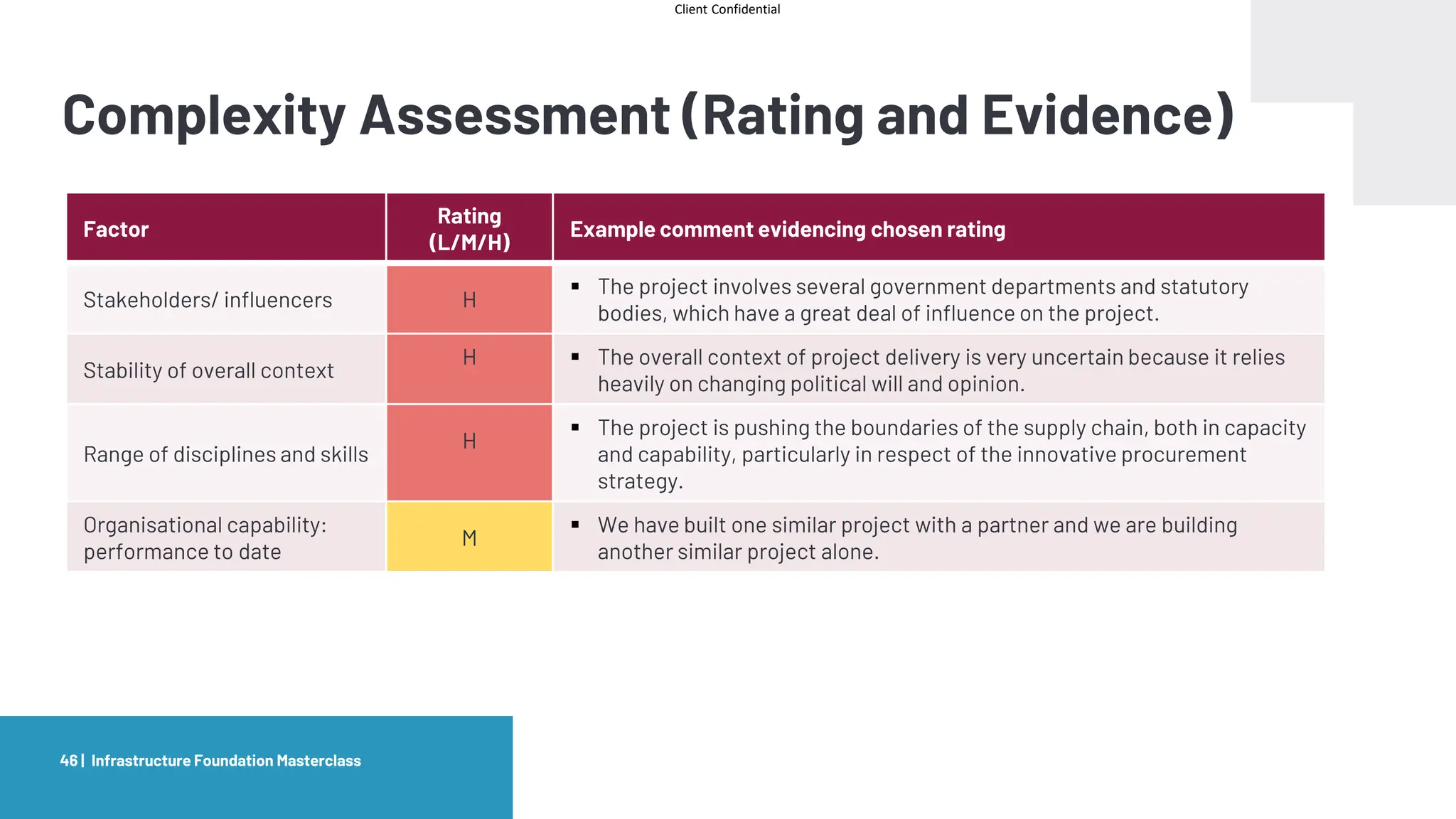
Complexity Assessment (Rating and Evidence)
Infrastructure Foundation Masterclass
46 |
Factor
Rating
(L/M/H)
Example comment evidencing chosen rating
Stakeholders/ influencers H
▪ The project involves several government departments and statutory
bodies, which have a great deal of influence on the project.
Stability of overall context
H ▪ The overall context of project delivery is very uncertain because it relies
heavily on changing political will and opinion.
Range of disciplines and skills
H
▪ The project is pushing the boundaries of the supply chain, both in capacity
and capability, particularly in respect of the innovative procurement
strategy.
Organisational capability:
performance to date
M
▪ We have built one similar project with a partner and we are building
another similar project alone.
Client Confidential
Infrastructure Foundation Masterclass
47 |
Example output
Client Confidential
Infrastructure Foundation Masterclass
48 |
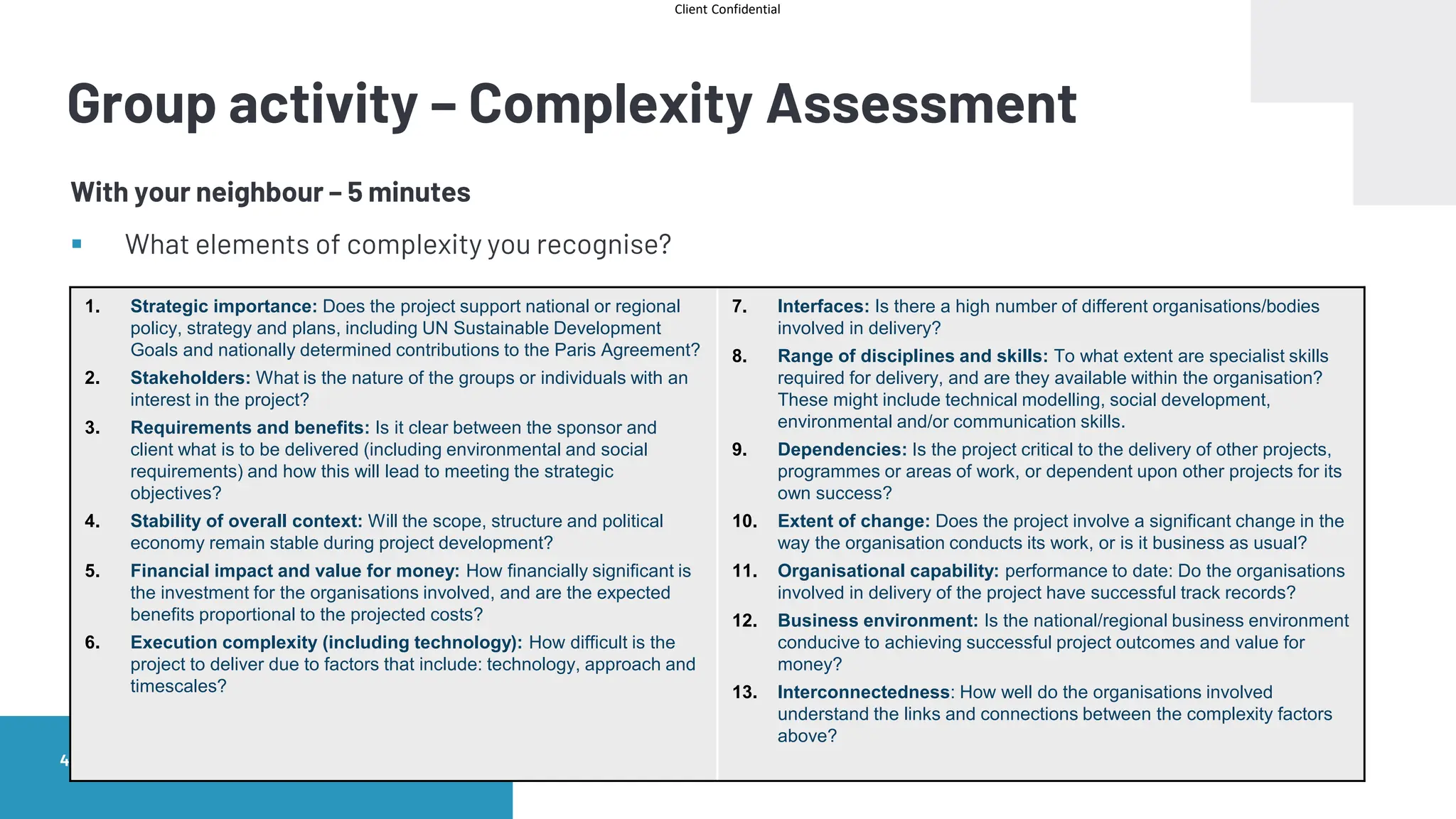
Group activity – Complexity Assessment
With your neighbour – 5 minutes
▪ What elements of complexity you recognise?
1. Strategic importance: Does the project support national or regional
policy, strategy and plans, including UN Sustainable Development
Goals and nationally determined contributions to the Paris Agreement?
2. Stakeholders: What is the nature of the groups or individuals with an
interest in the project?
3. Requirements and benefits: Is it clear between the sponsor and
client what is to be delivered (including environmental and social
requirements) and how this will lead to meeting the strategic
objectives?
4. Stability of overall context: Will the scope, structure and political
economy remain stable during project development?
5. Financial impact and value for money: How financially significant is
the investment for the organisations involved, and are the expected
benefits proportional to the projected costs?
6. Execution complexity (including technology): How difficult is the
project to deliver due to factors that include: technology, approach and
timescales?
7. Interfaces: Is there a high number of different organisations/bodies
involved in delivery?
8. Range of disciplines and skills: To what extent are specialist skills
required for delivery, and are they available within the organisation?
These might include technical modelling, social development,
environmental and/or communication skills.
9. Dependencies: Is the project critical to the delivery of other projects,
programmes or areas of work, or dependent upon other projects for its
own success?
10. Extent of change: Does the project involve a significant change in the
way the organisation conducts its work, or is it business as usual?
11. Organisational capability: performance to date: Do the organisations
involved in delivery of the project have successful track records?
12. Business environment: Is the national/regional business environment
conducive to achieving successful project outcomes and value for
money?
13. Interconnectedness: How well do the organisations involved
understand the links and connections between the complexity factors
above?
Client Confidential
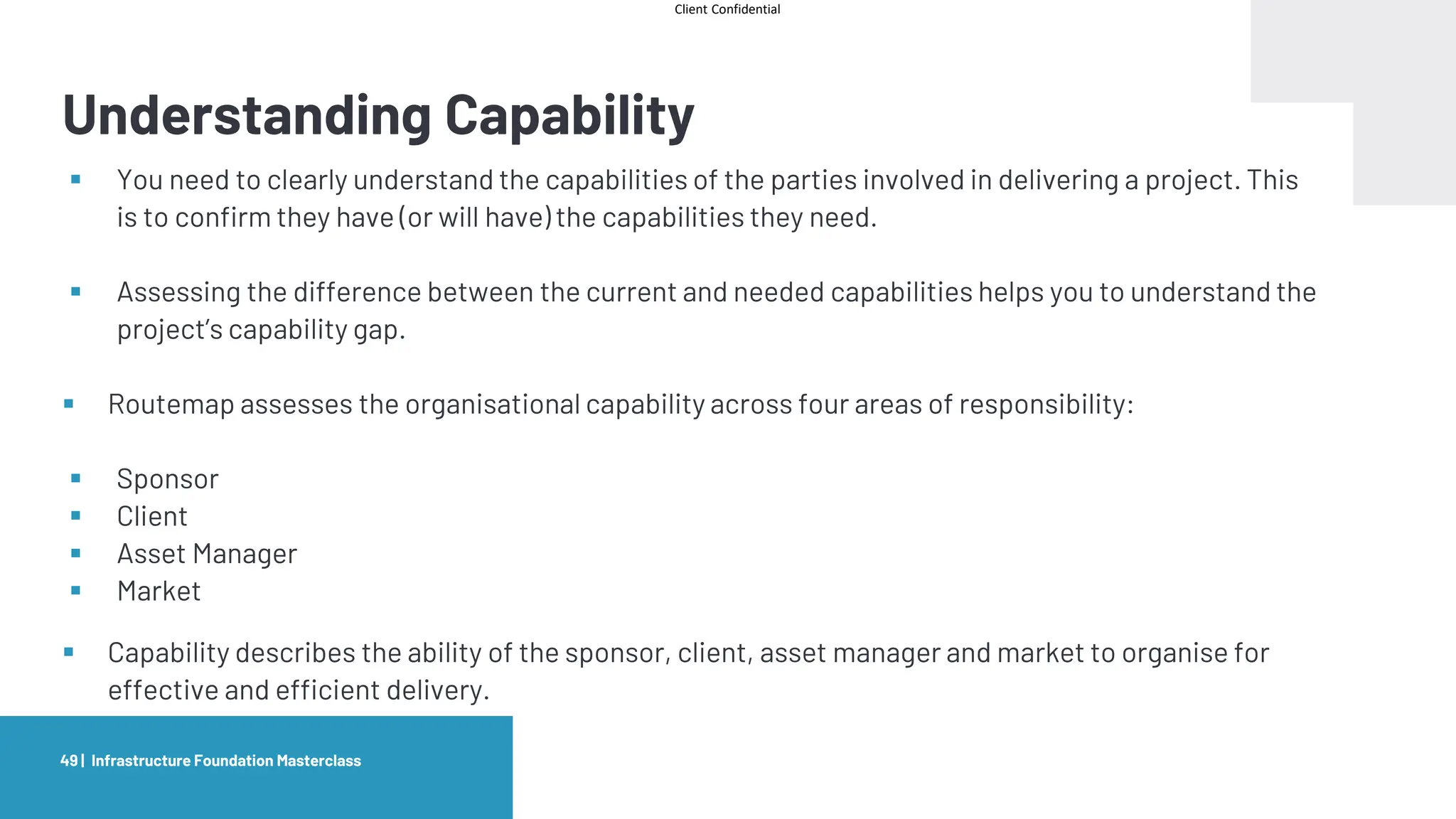
Understanding Capability
Infrastructure Foundation Masterclass
49 |
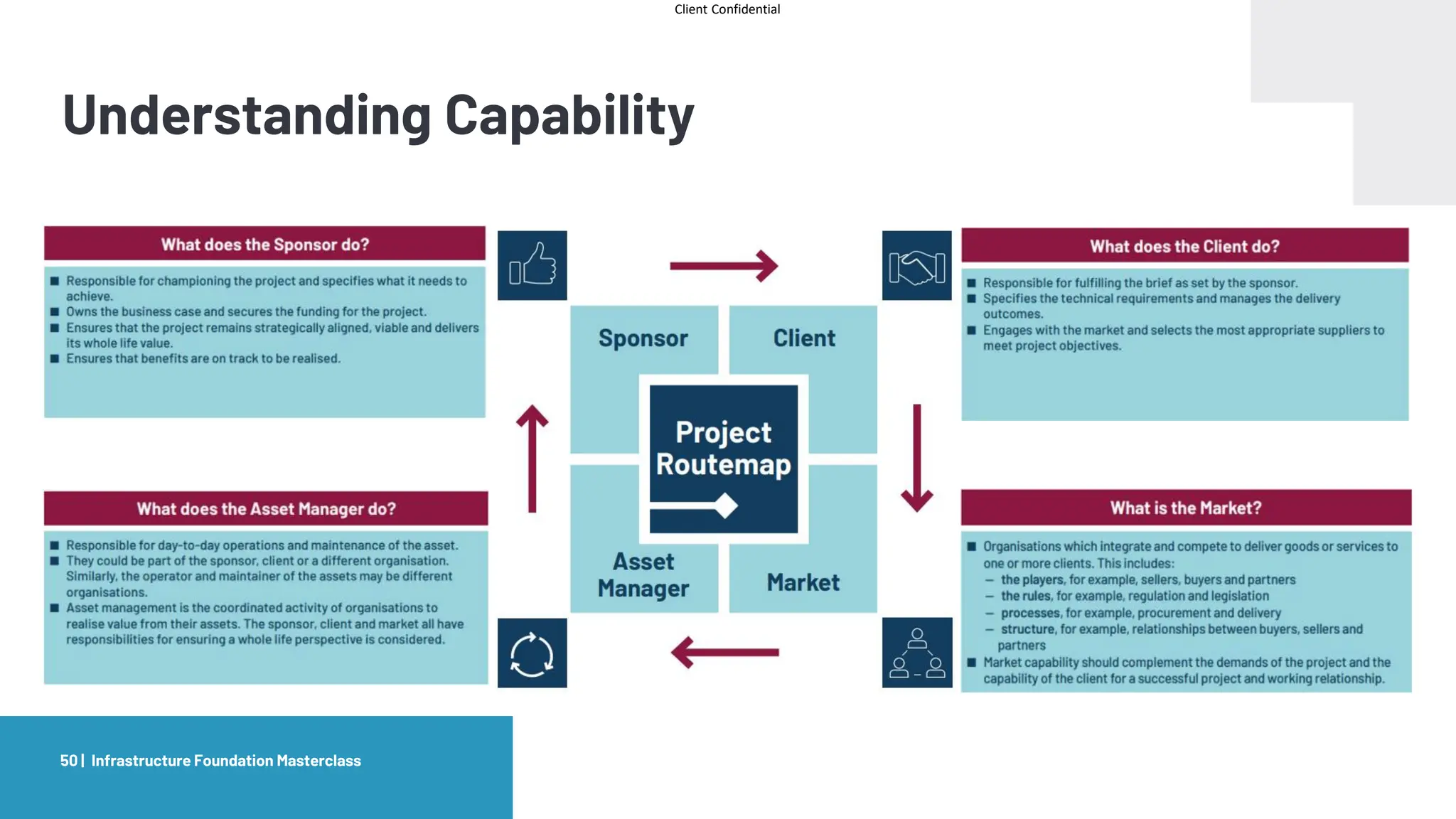
▪ You need to clearly understand the capabilities of the parties involved in delivering a project. This
is to confirm they have (or will have) the capabilities they need.
▪ Assessing the difference between the current and needed capabilities helps you to understand the
project’s capability gap.
▪ Routemap assesses the organisational capability across four areas of responsibility:
▪ Sponsor
▪ Client
▪ Asset Manager
▪ Market
▪ Capability describes the ability of the sponsor, client, asset manager and market to organise for
effective and efficient delivery.
Client Confidential
Understanding Capability
Infrastructure Foundation Masterclass
50 |
Client Confidential
Example of Roles
Infrastructure Foundation Masterclass
51 |
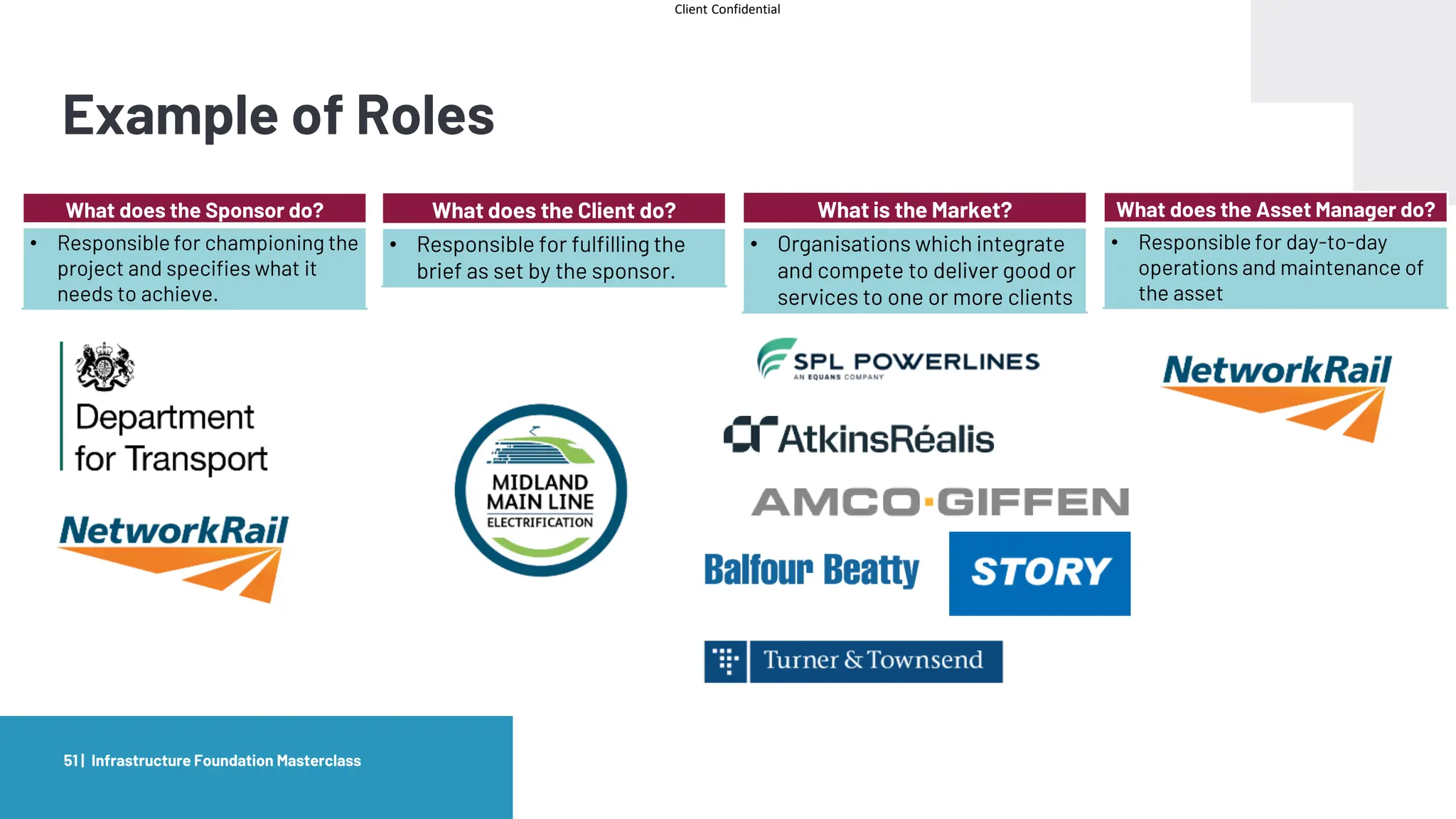
What does the Sponsor do?
• Responsible for championing the
project and specifies what it
needs to achieve.
What does the Client do?
• Responsible for fulfilling the
brief as set by the sponsor.
What is the Market?
• Organisations which integrate
and compete to deliver good or
services to one or more clients
What does the Asset Manager do?
• Responsible for day-to-day
operations and maintenance of
the asset
Client Confidential
Understanding Capability
Infrastructure Foundation Masterclass
52 |
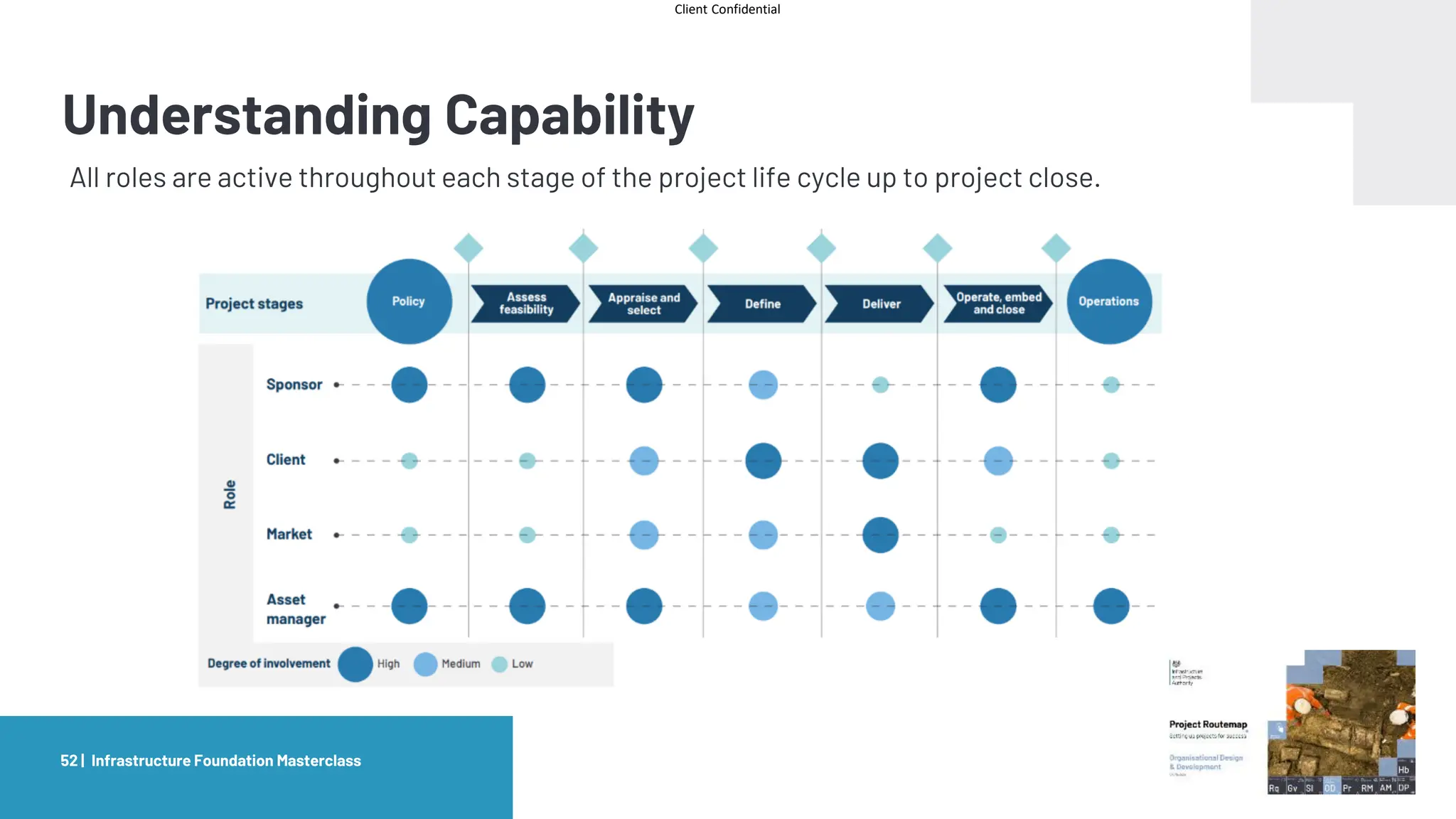
All roles are active throughout each stage of the project life cycle up to project close.
Client Confidential
Example of Roles
Infrastructure Foundation Masterclass
53 |
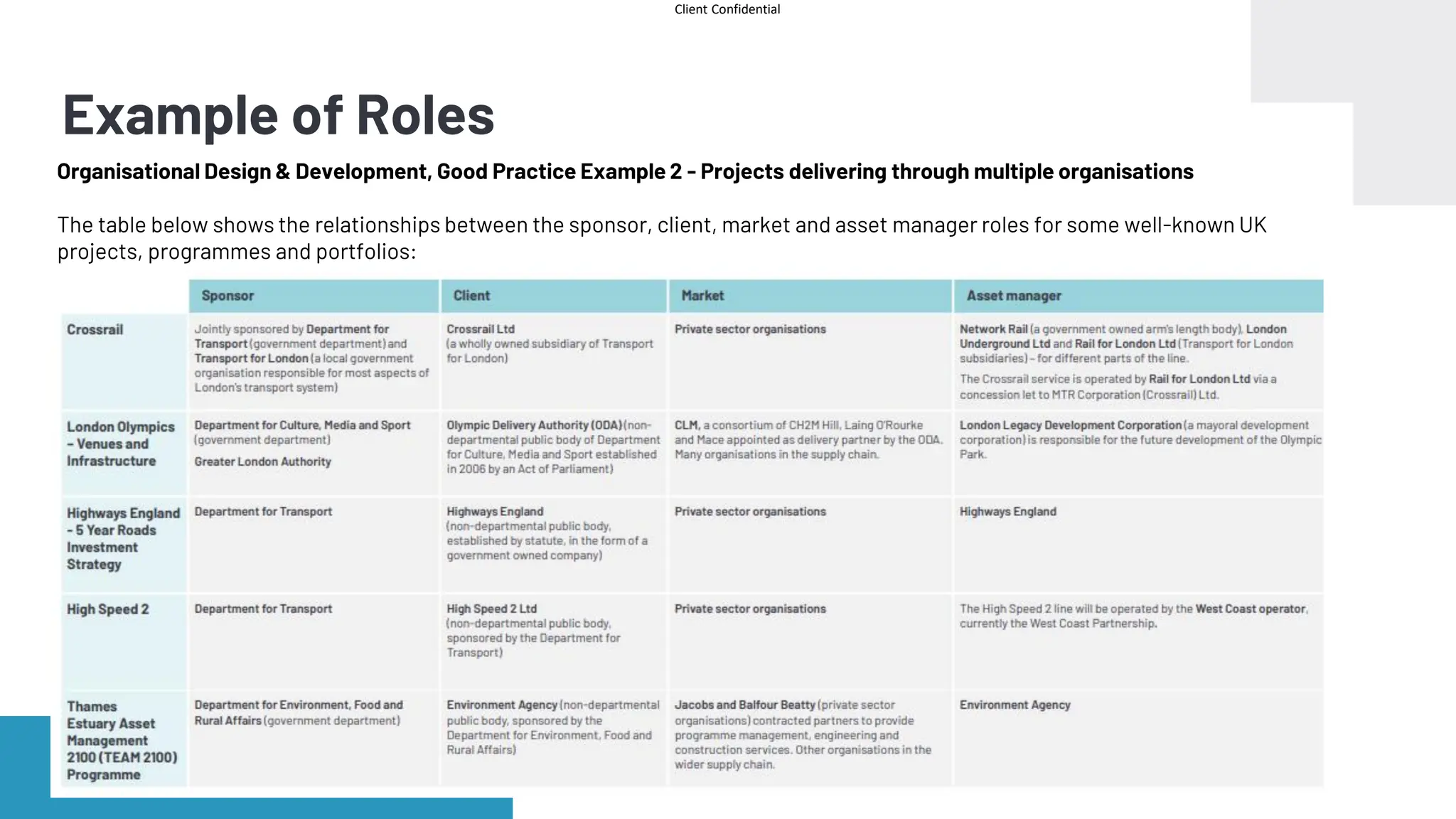
Organisational Design & Development, Good Practice Example 2 - Projects delivering through multiple organisations
The table below shows the relationships between the sponsor, client, market and asset manager roles for some well-known UK
projects, programmes and portfolios:
Client Confidential
Infrastructure Foundation Masterclass
54 |
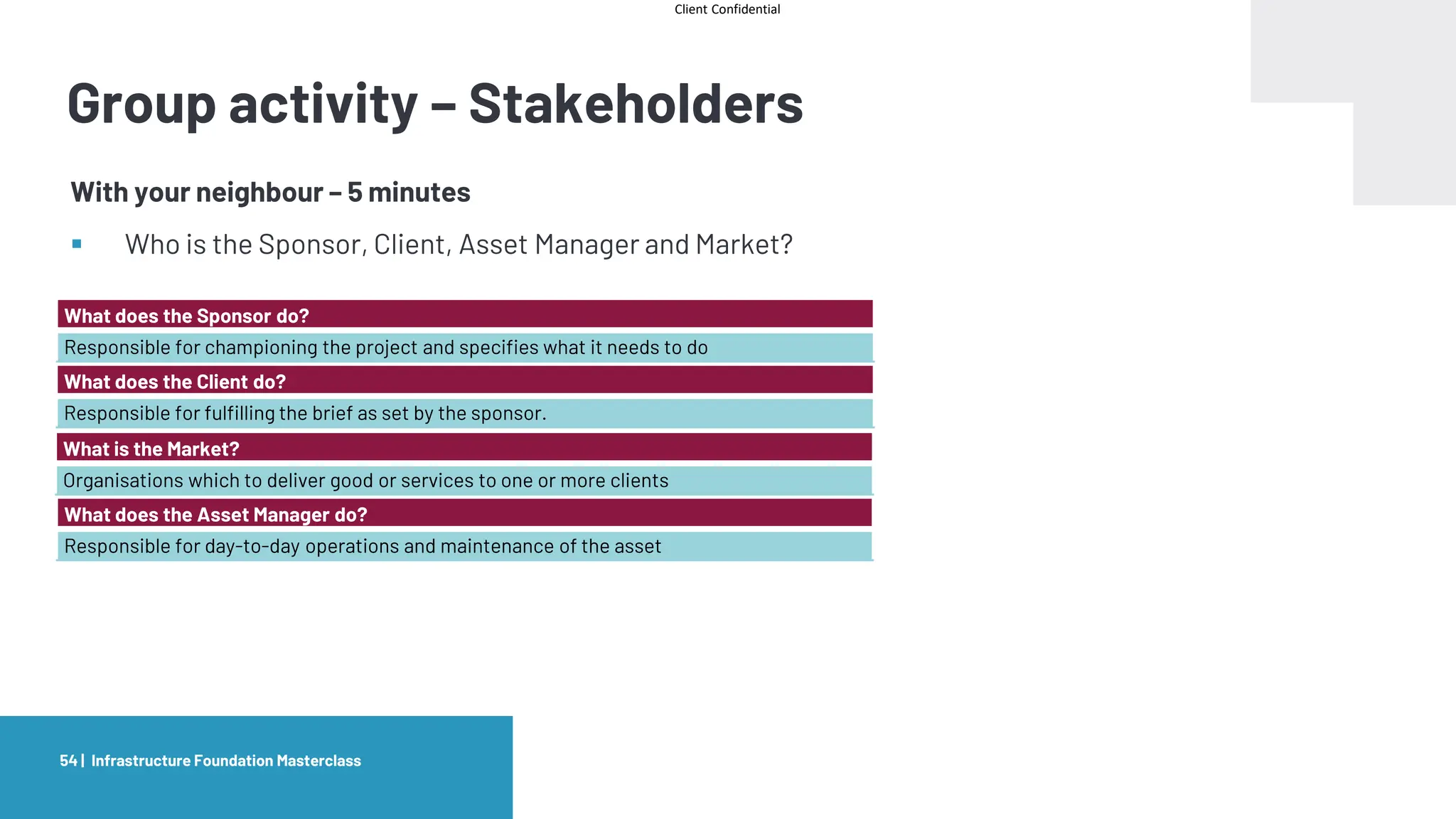
Group activity – Stakeholders
With your neighbour – 5 minutes
▪ Who is the Sponsor, Client, Asset Manager and Market?
What does the Sponsor do?
Responsible for championing the project and specifies what it needs to do
What does the Client do?
Responsible for fulfilling the brief as set by the sponsor.
What does the Asset Manager do?
Responsible for day-to-day operations and maintenance of the asset
What is the Market?
Organisations which to deliver good or services to one or more clients
Client Confidential
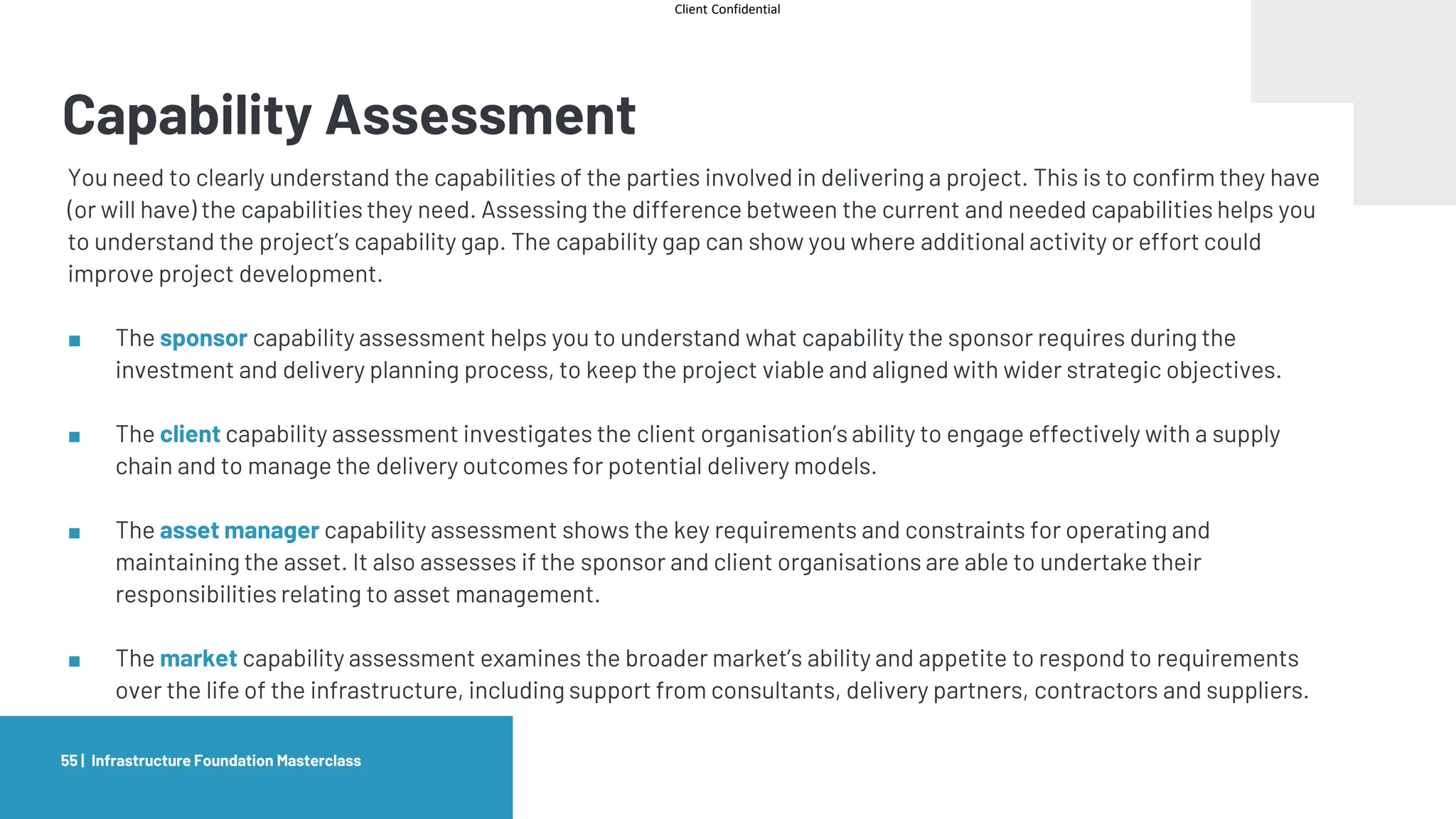
Capability Assessment
Infrastructure Foundation Masterclass
55 |
You need to clearly understand the capabilities of the parties involved in delivering a project. This is to confirm they have
(or will have) the capabilities they need. Assessing the difference between the current and needed capabilities helps you
to understand the project’s capability gap. The capability gap can show you where additional activity or effort could
improve project development.
■ The sponsor capability assessment helps you to understand what capability the sponsor requires during the
investment and delivery planning process, to keep the project viable and aligned with wider strategic objectives.
■ The client capability assessment investigates the client organisation’s ability to engage effectively with a supply
chain and to manage the delivery outcomes for potential delivery models.
■ The asset manager capability assessment shows the key requirements and constraints for operating and
maintaining the asset. It also assesses if the sponsor and client organisations are able to undertake their
responsibilities relating to asset management.
■ The market capability assessment examines the broader market’s ability and appetite to respond to requirements
over the life of the infrastructure, including support from consultants, delivery partners, contractors and suppliers.
Client Confidential
Capability Assessment
Infrastructure Foundation Masterclass
56 |
Each Assessment identifies observable
characteristics that either support or
undermine effective and efficient project
delivery.
■ These characteristics help determine the
‘current’ and ‘needed’ capabilities for
successful delivery of the project.
■ Assessments should be project-specific
and not just representative of overall
organisational maturity.
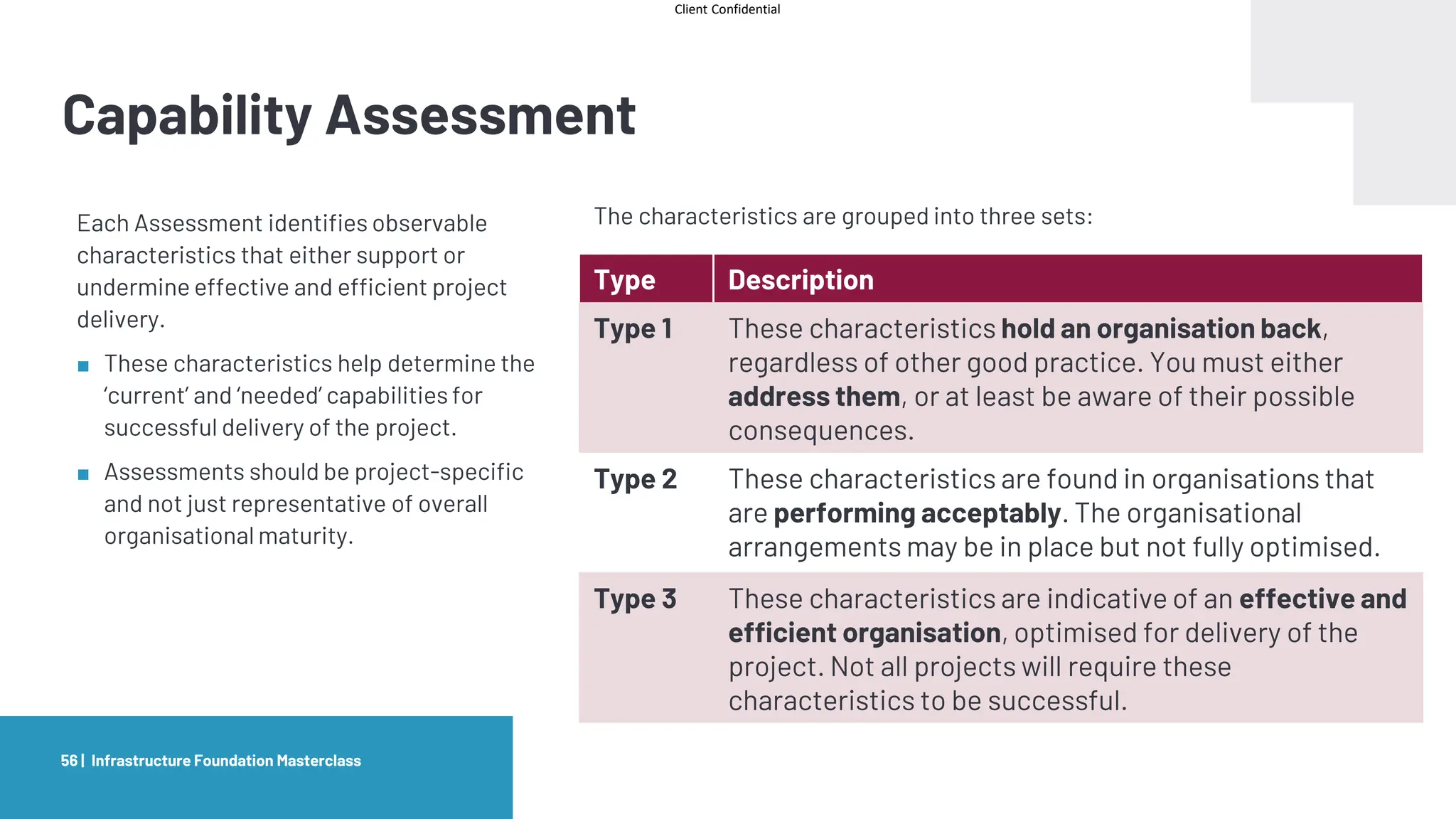
The characteristics are grouped into three sets:
Type Description
Type 1 These characteristics hold an organisation back,
regardless of other good practice. You must either
address them, or at least be aware of their possible
consequences.
Type 2 These characteristics are found in organisations that
are performing acceptably. The organisational
arrangements may be in place but not fully optimised.
Type 3 These characteristics are indicative of an effective and
efficient organisation, optimised for delivery of the
project. Not all projects will require these
characteristics to be successful.
Client Confidential
Infrastructure Foundation Masterclass
57 |
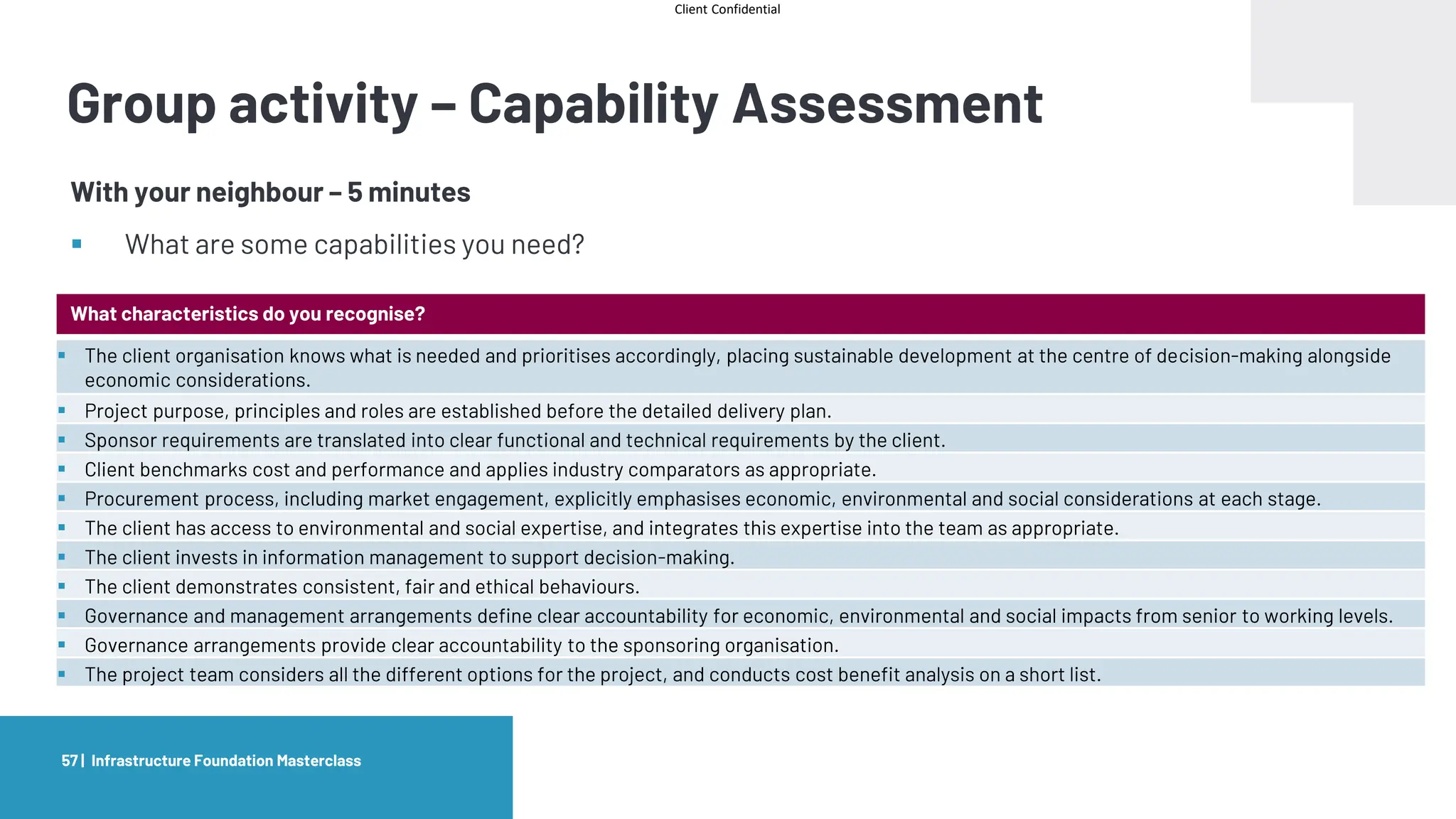
Group activity – Capability Assessment
With your neighbour – 5 minutes
▪ What are some capabilities you need?
What characteristics do you recognise?
▪ The client organisation knows what is needed and prioritises accordingly, placing sustainable development at the centre of decision-making alongside
economic considerations.
▪ Project purpose, principles and roles are established before the detailed delivery plan.
▪ Sponsor requirements are translated into clear functional and technical requirements by the client.
▪ Client benchmarks cost and performance and applies industry comparators as appropriate.
▪ Procurement process, including market engagement, explicitly emphasises economic, environmental and social considerations at each stage.
▪ The client has access to environmental and social expertise, and integrates this expertise into the team as appropriate.
▪ The client invests in information management to support decision-making.
▪ The client demonstrates consistent, fair and ethical behaviours.
▪ Governance and management arrangements define clear accountability for economic, environmental and social impacts from senior to working levels.
▪ Governance arrangements provide clear accountability to the sponsoring organisation.
▪ The project team considers all the different options for the project, and conducts cost benefit analysis on a short list.
Client Confidential
What is needed for Setup
Rationale focus
InfrastructureFoundationMasterclass
58 |
Client Confidential
Routemap modules – in the life cycle
59 | Infrastructure Foundation Masterclass
Rationale
EBC IBC FBC
Client Confidential
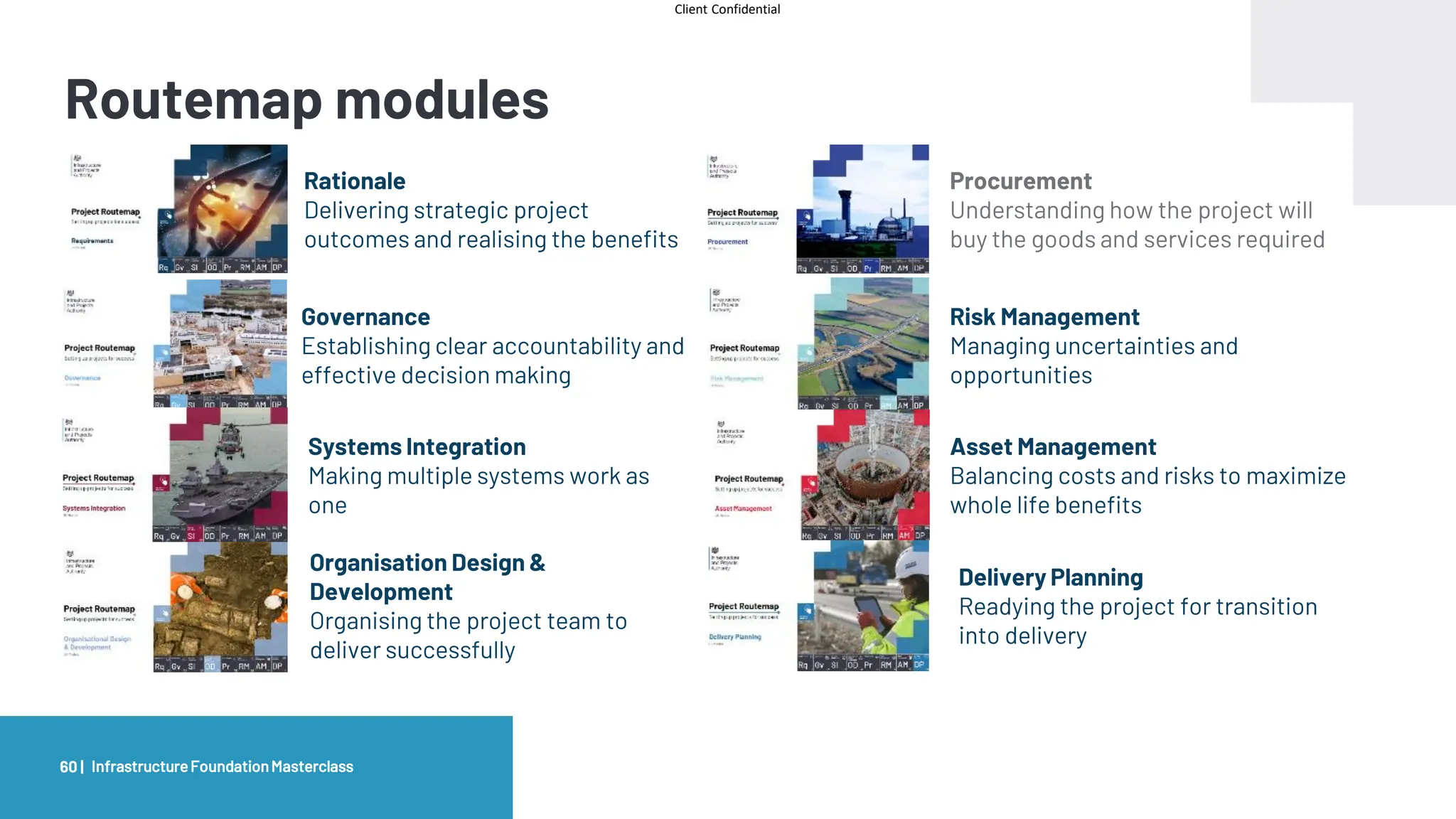
Routemap modules
60 | InfrastructureFoundationMasterclass
Rationale
Delivering strategic project
outcomes and realising the benefits
Governance
Establishing clear accountability and
effective decision making
Delivery Planning
Readying the project for transition
into delivery
Organisation Design &
Development
Organising the project team to
deliver successfully
Procurement
Understanding how the project will
buy the goods and services required
Risk Management
Managing uncertainties and
opportunities
Asset Management
Balancing costs and risks to maximize
whole life benefits
Systems Integration
Making multiple systems work as
one
Client Confidential
Why is the Rationale important?
61 | Infrastructure Foundation Masterclass
“Establishclear requirements and iterate these to secure an affordable project, and then hold steady the requirementsand funding to
provide a stable and predictable environment.” Lessons from transport for the sponsorship of major projects
Department for Transport and Infrastructure and Projects Authority 2019
Typical findings
▪ Requirements are not well defined, so the purpose of the project and/or what it needs to deliver is confusing.
▪ Not aligned to national or international goals regarding economic, environmental and social value
▪ Difficult to prove success because the benefits are not defined in tangible or measurable terms.
▪ No clear process, nor responsibilities, for prioritising requirements
▪ Not clear how the deliverables align or contribute to the expected benefits
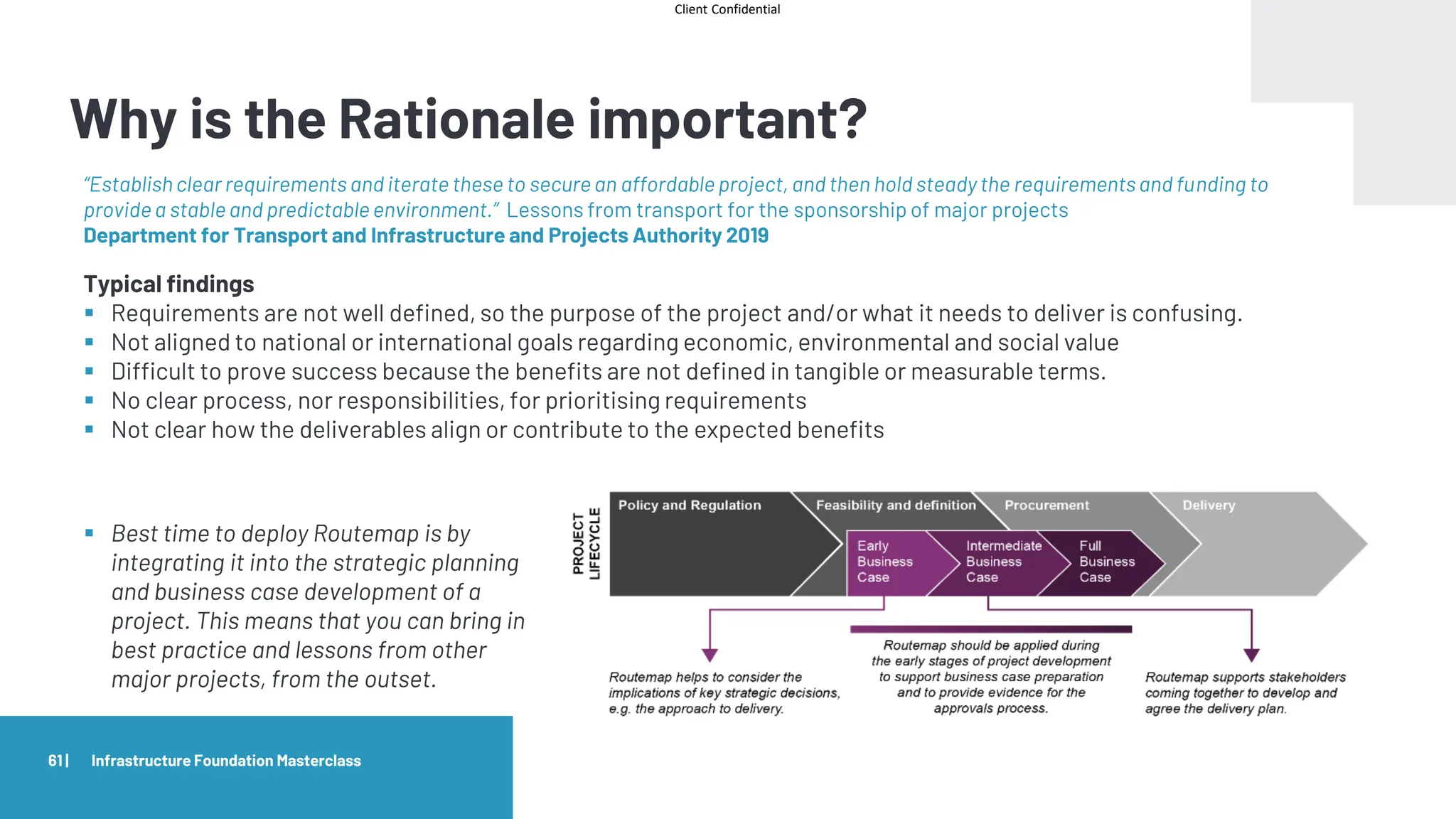
▪ Best time to deploy Routemap is by
integrating it into the strategic planning
and business case development of a
project. This means that you can bring in
best practice and lessons from other
major projects, from the outset.
Client Confidential
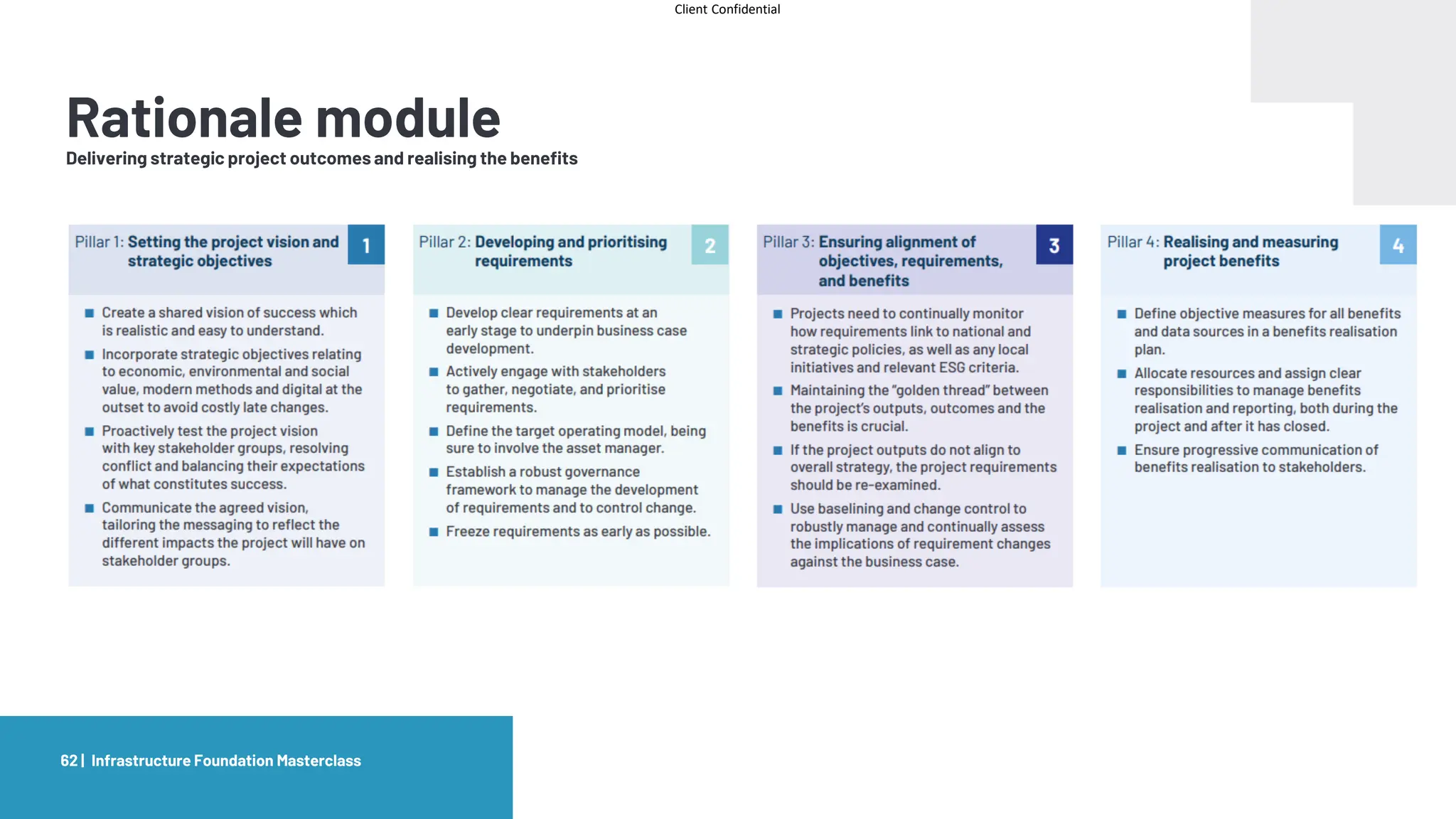
Rationale module
Delivering strategic project outcomes and realising the benefits
Infrastructure Foundation Masterclass
62 |
Client Confidential
Rationale module
Developing a project vision
Infrastructure Foundation Masterclass
63 |
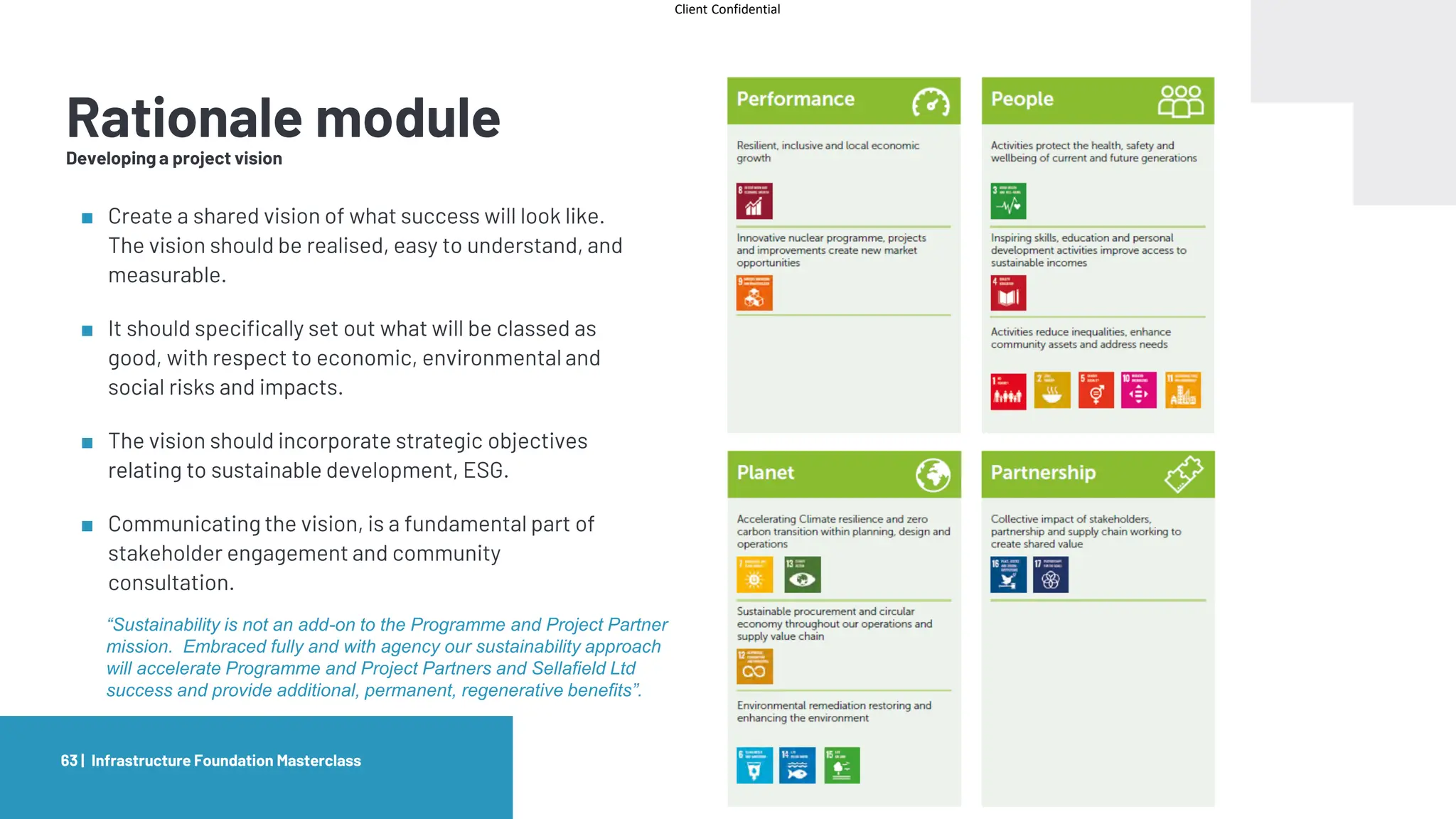
■ Create a shared vision of what success will look like.
The vision should be realised, easy to understand, and
measurable.
■ It should specifically set out what will be classed as
good, with respect to economic, environmental and
social risks and impacts.
■ The vision should incorporate strategic objectives
relating to sustainable development, ESG.
■ Communicating the vision, is a fundamental part of
stakeholder engagement and community
consultation.
“Sustainability is not an add-on to the Programme and Project Partner
mission. Embraced fully and with agency our sustainability approach
will accelerate Programme and Project Partners and Sellafield Ltd
success and provide additional, permanent, regenerative benefits”.
Client Confidential
Rationale module
Aligning requirements
Infrastructure Foundation Masterclass
64 |
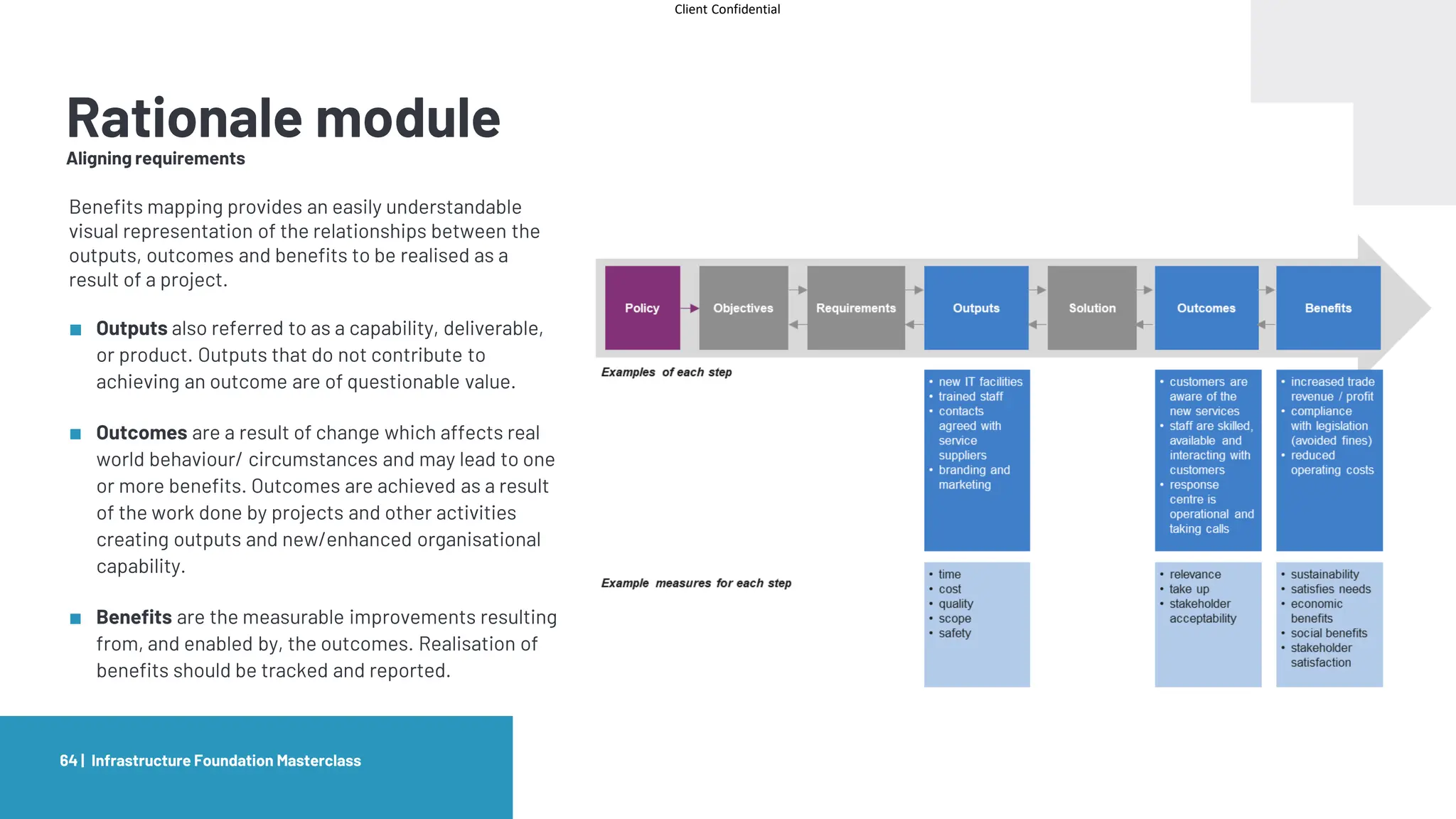
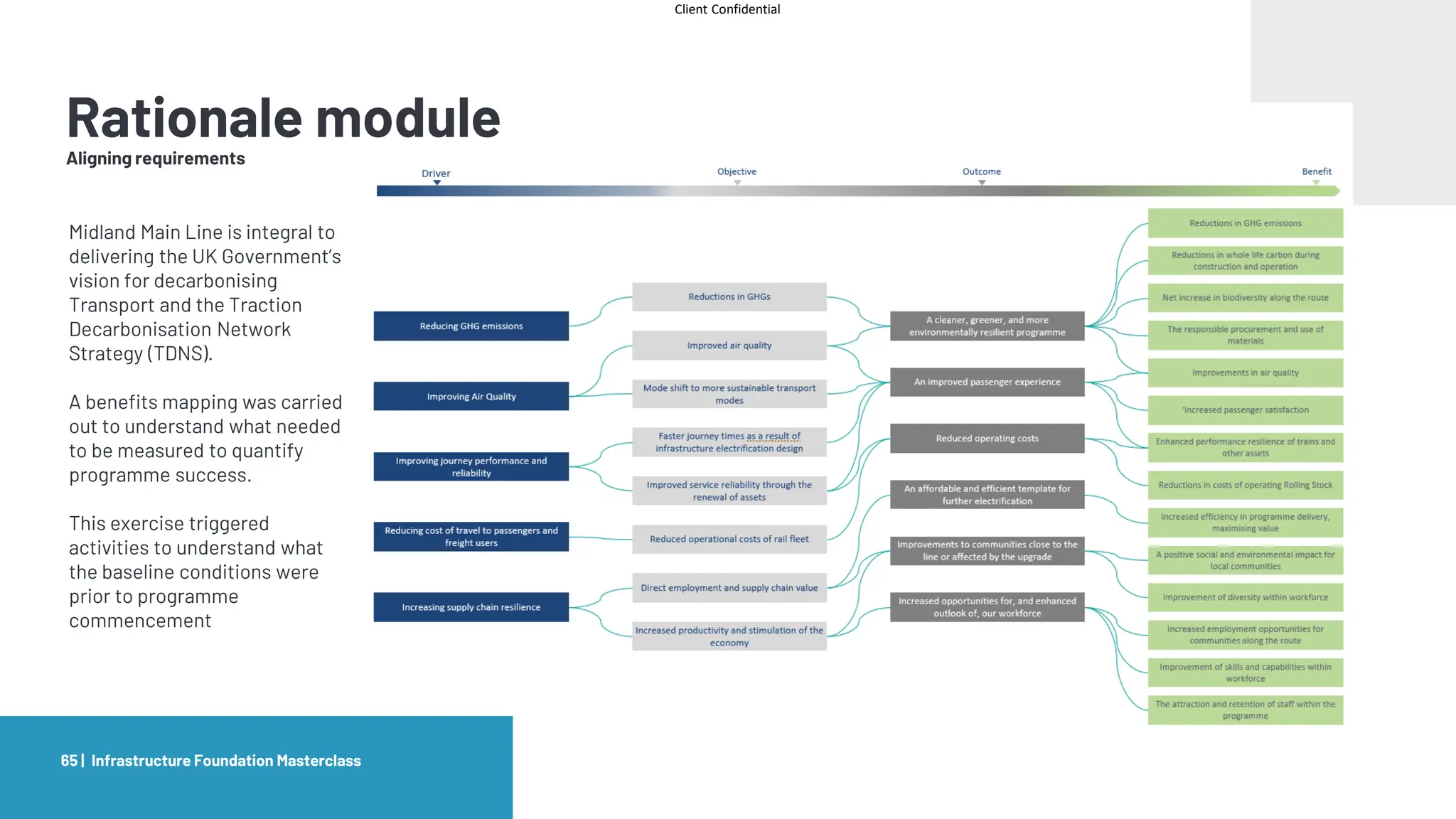
Benefits mapping provides an easily understandable
visual representation of the relationships between the
outputs, outcomes and benefits to be realised as a
result of a project.
■ Outputs also referred to as a capability, deliverable,
or product. Outputs that do not contribute to
achieving an outcome are of questionable value.
■ Outcomes are a result of change which affects real
world behaviour/ circumstances and may lead to one
or more benefits. Outcomes are achieved as a result
of the work done by projects and other activities
creating outputs and new/enhanced organisational
capability.
■ Benefits are the measurable improvements resulting
from, and enabled by, the outcomes. Realisation of
benefits should be tracked and reported.
Client Confidential
Rationale module
Aligning requirements
Infrastructure Foundation Masterclass
65 |
Midland Main Line is integral to
delivering the UK Government’s
vision for decarbonising
Transport and the Traction
Decarbonisation Network
Strategy (TDNS).
A benefits mapping was carried
out to understand what needed
to be measured to quantify
programme success.
This exercise triggered
activities to understand what
the baseline conditions were
prior to programme
commencement
Client Confidential
Infrastructure Foundation Masterclass
66 |
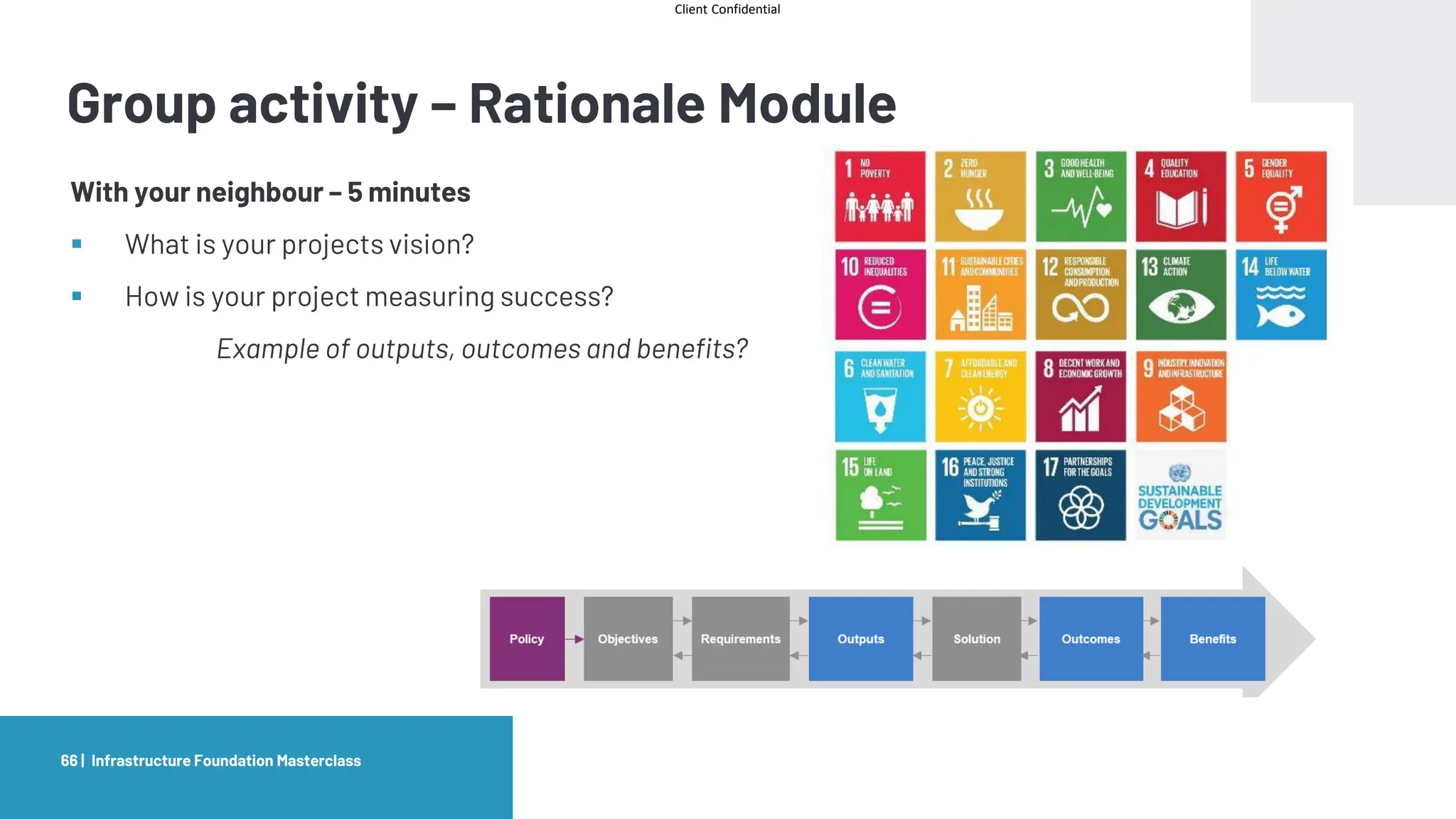
Group activity – Rationale Module
With your neighbour – 5 minutes
▪ What is your projects vision?
▪ How is your project measuring success?
Example of outputs, outcomes and benefits?
Client Confidential
Questions?
InfrastructureFoundationMasterclass
67 |
Client Confidential
InfrastructureFoundationMasterclass
68 |
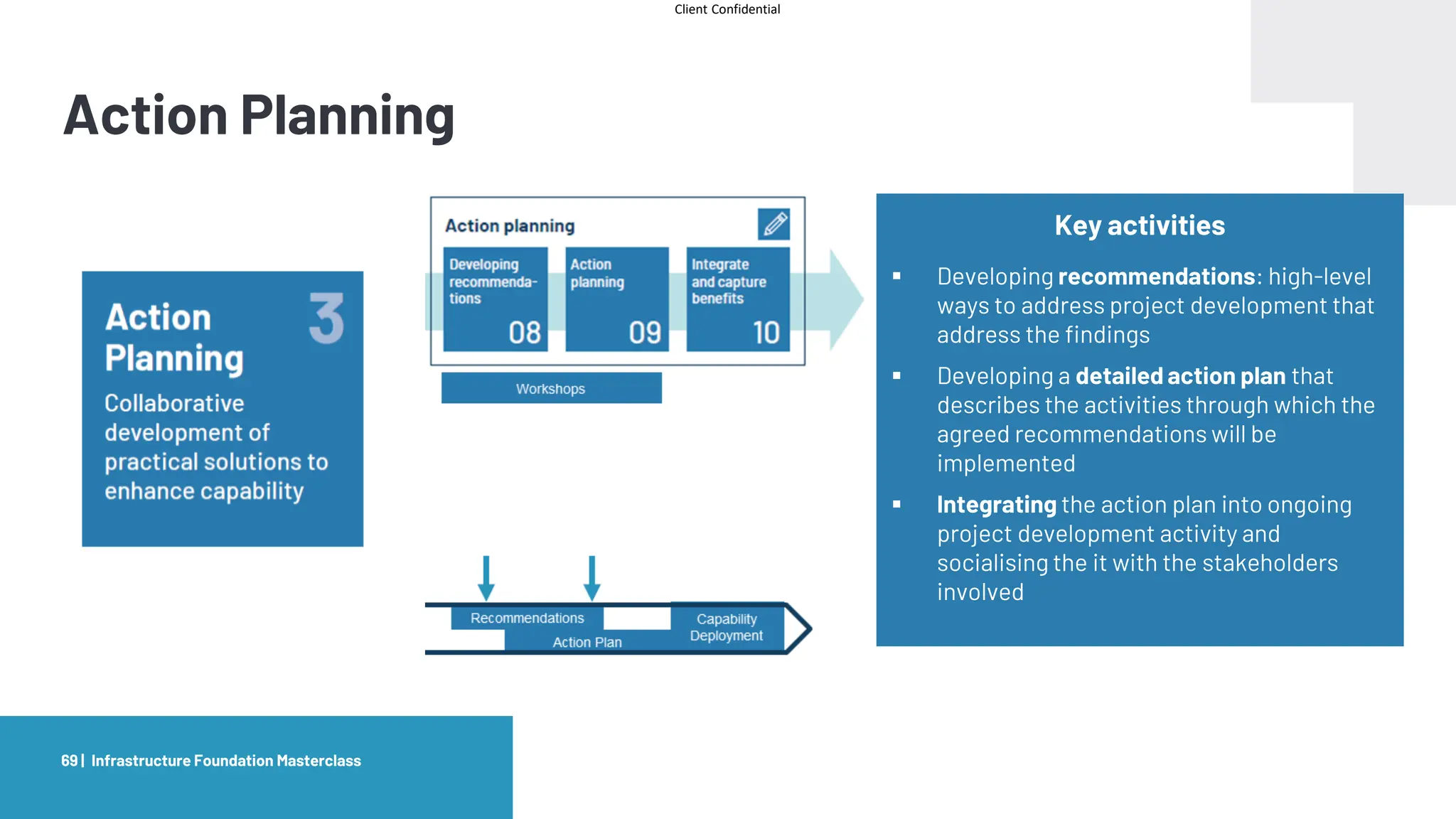
Stage 3 Action Planning
Collaborative development of
practical solutions to enhance
capability
Client Confidential
Action Planning
Infrastructure Foundation Masterclass
69 |
Key activities
▪ Developing recommendations: high-level
ways to address project development that
address the findings
▪ Developing a detailed action plan that
describes the activities through which the
agreed recommendations will be
implemented
▪ Integrating the action plan into ongoing
project development activity and
socialising the it with the stakeholders
involved
Client Confidential
Workshops
Infrastructure Foundation Masterclass
70 |
▪ A workshop, or series of workshops, are often the best way to bring
stakeholders together to develop and agree recommendations (and in Step
9, an action plan)
▪ You should invite participants, the Commissioning Body and other key,
appropriate stakeholders, to ensure the recommendations have senior level
support and are achievable.
▪ Subject matter experts can also guide participants in developing the
recommendations. They will provide a different perspective and introduce
real world examples of best practice they have used previously
Client Confidential
Workshops
Infrastructure Foundation Masterclass
71 |
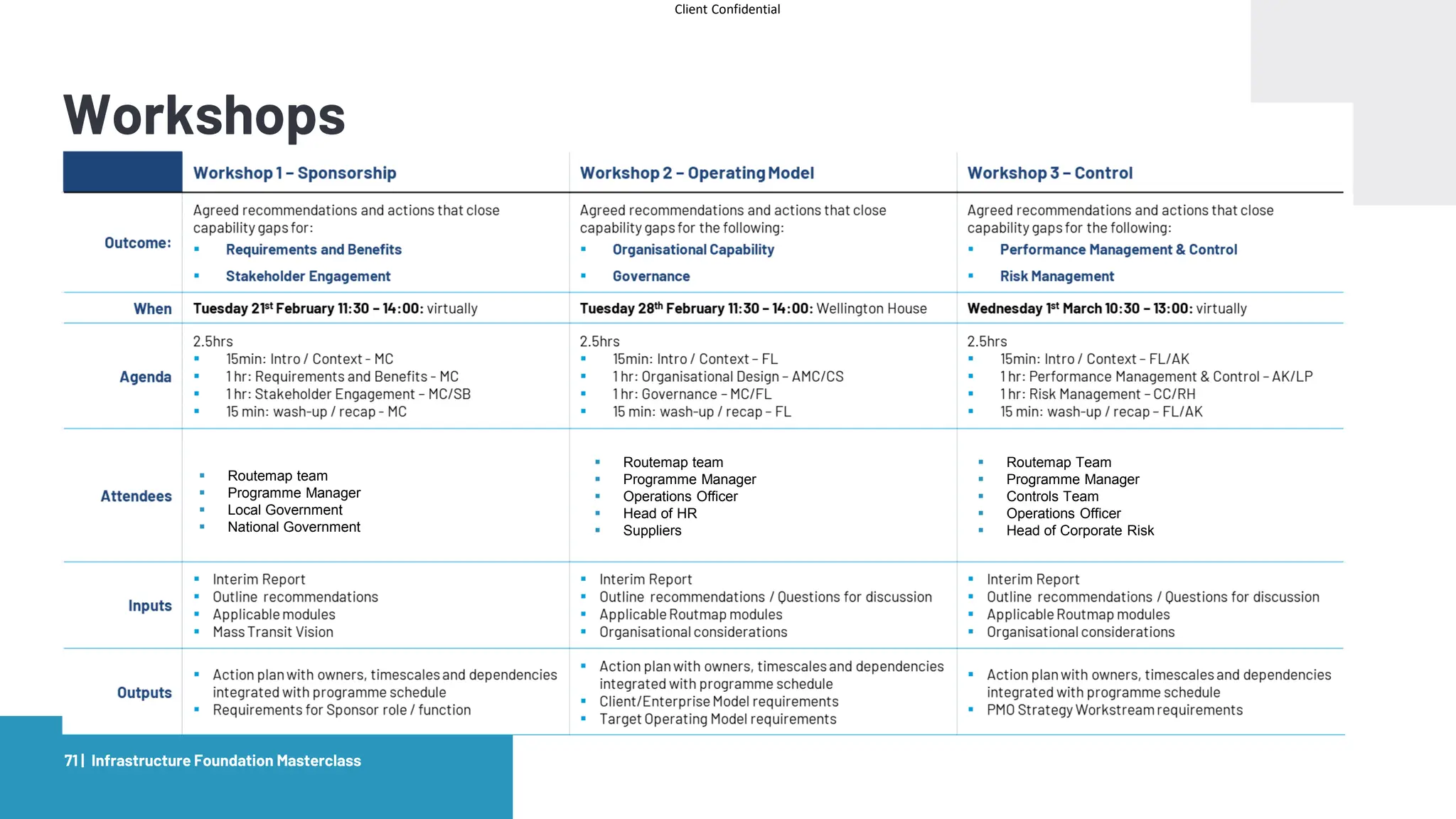
▪ Routemap team
▪ Programme Manager
▪ Local Government
▪ National Government
▪ Routemap team
▪ Programme Manager
▪ Operations Officer
▪ Head of HR
▪ Suppliers
▪ Routemap Team
▪ Programme Manager
▪ Controls Team
▪ Operations Officer
▪ Head of Corporate Risk
Client Confidential
Example
72 |
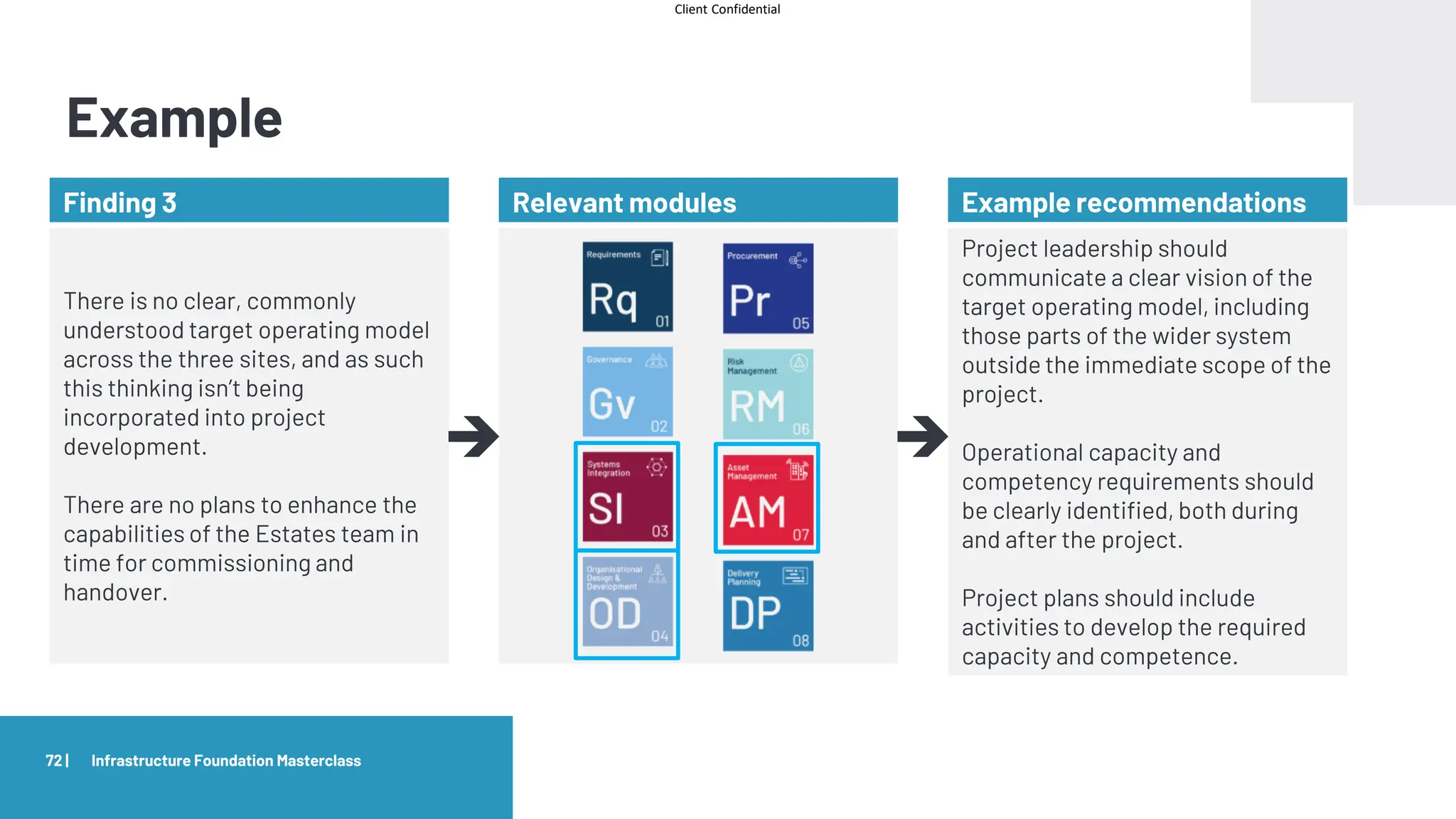
Finding 3
There is no clear, commonly
understood target operating model
across the three sites, and as such
this thinking isn’t being
incorporated into project
development.
There are no plans to enhance the
capabilities of the Estates team in
time for commissioning and
handover.
Infrastructure Foundation Masterclass
Relevant modules Example recommendations
Project leadership should
communicate a clear vision of the
target operating model, including
those parts of the wider system
outside the immediate scope of the
project.
Operational capacity and
competency requirements should
be clearly identified, both during
and after the project.
Project plans should include
activities to develop the required
capacity and competence.
➔ ➔
Client Confidential
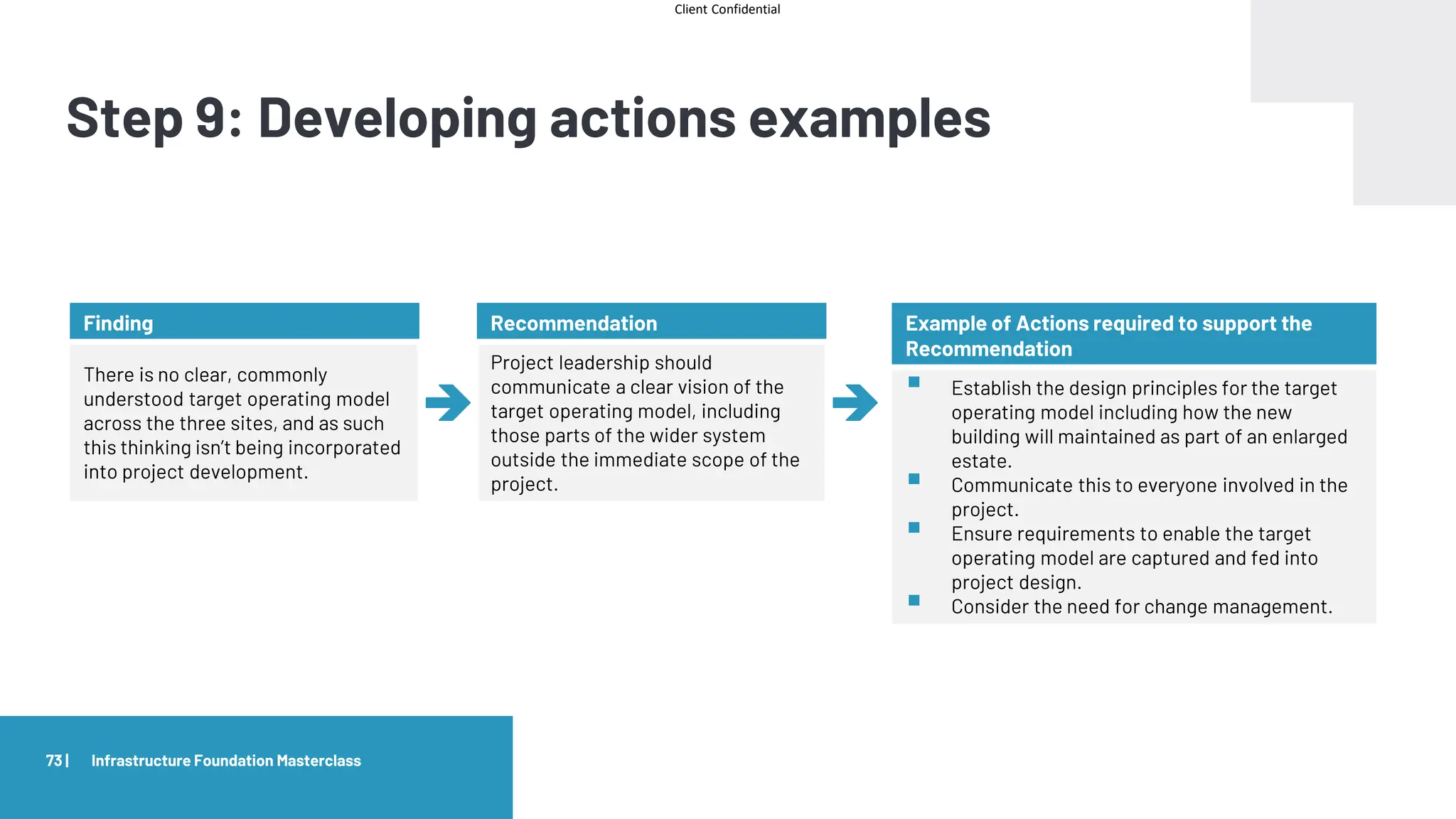
Step 9: Developing actions examples
73 |
Finding
➔
Recommendation
➔
There is no clear, commonly
understood target operating model
across the three sites, and as such
this thinking isn’t being incorporated
into project development.
Project leadership should
communicate a clear vision of the
target operating model, including
those parts of the wider system
outside the immediate scope of the
project.
Infrastructure Foundation Masterclass
Example of Actions required to support the
Recommendation
▪ Establish the design principles for the target
operating model including how the new
building will maintained as part of an enlarged
estate.
▪ Communicate this to everyone involved in the
project.
▪ Ensure requirements to enable the target
operating model are captured and fed into
project design.
▪ Consider the need for change management.
Client Confidential
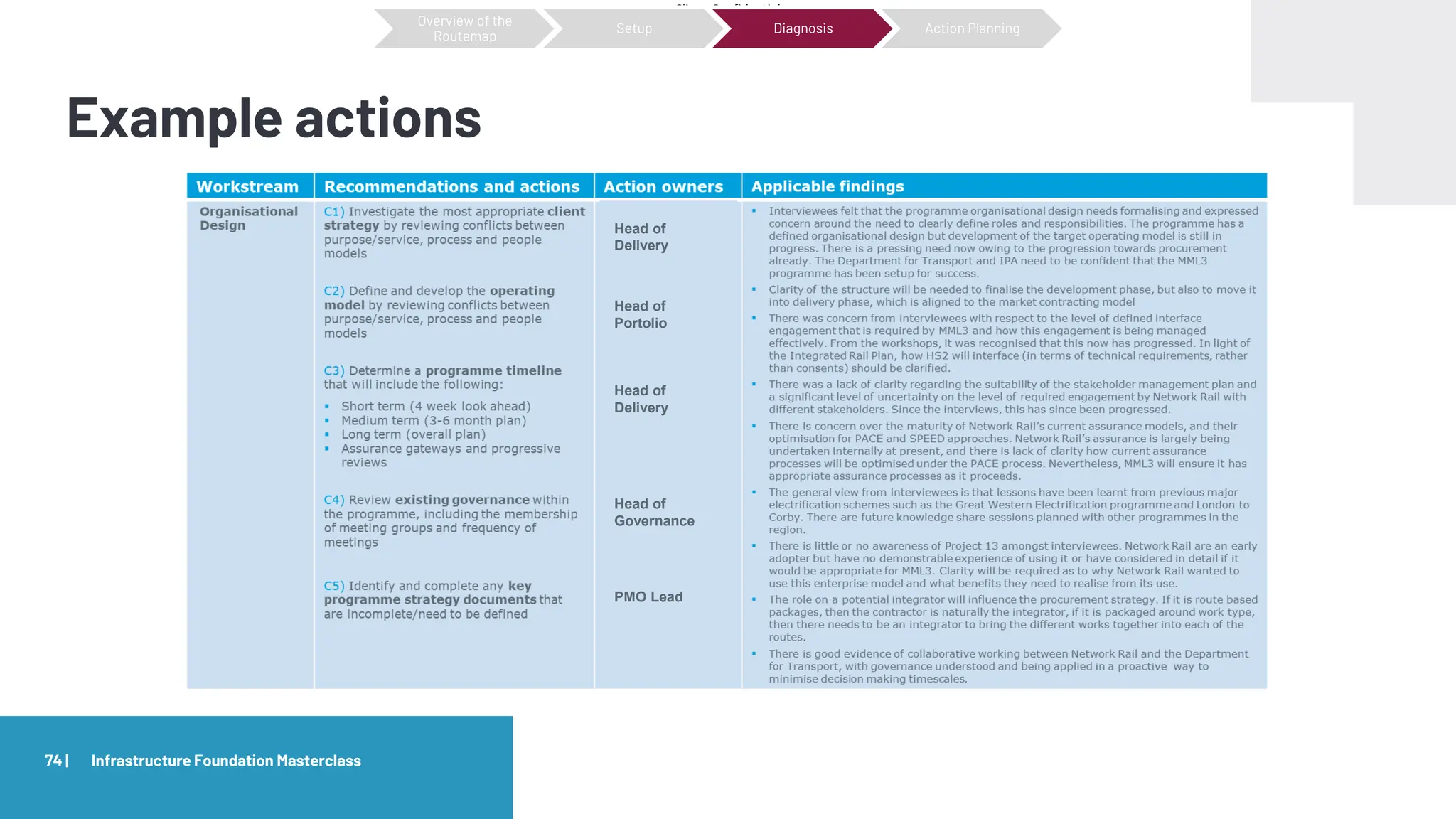
Example actions
74 |
Overview of the
Routemap
Setup Diagnosis Action Planning
Infrastructure Foundation Masterclass
Head of
Governance
PMO Lead
Head of
Delivery
Head of
Portolio
Head of
Delivery
Client Confidential
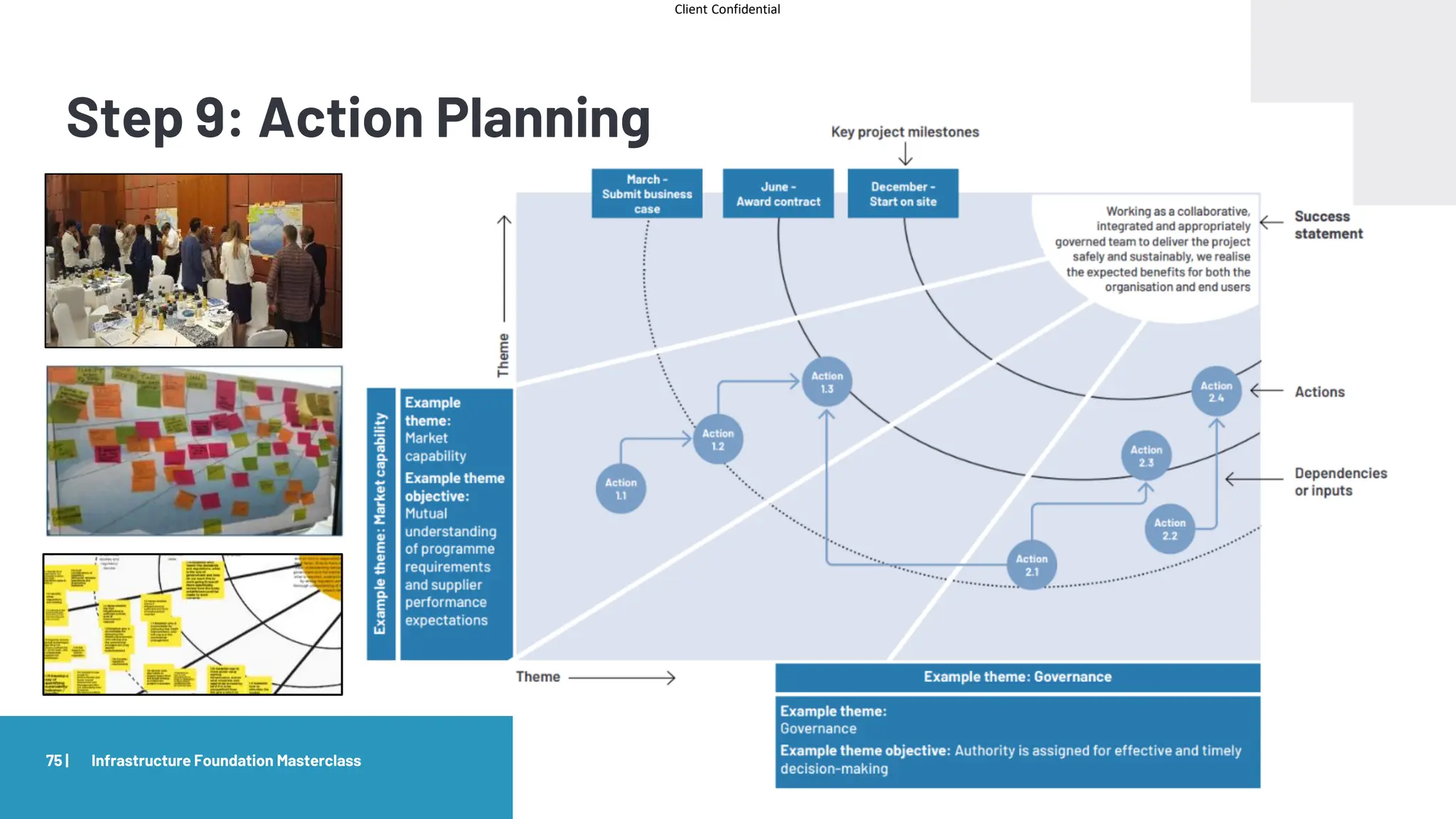
Step 9: Action Planning
75 | Infrastructure Foundation Masterclass
Client Confidential
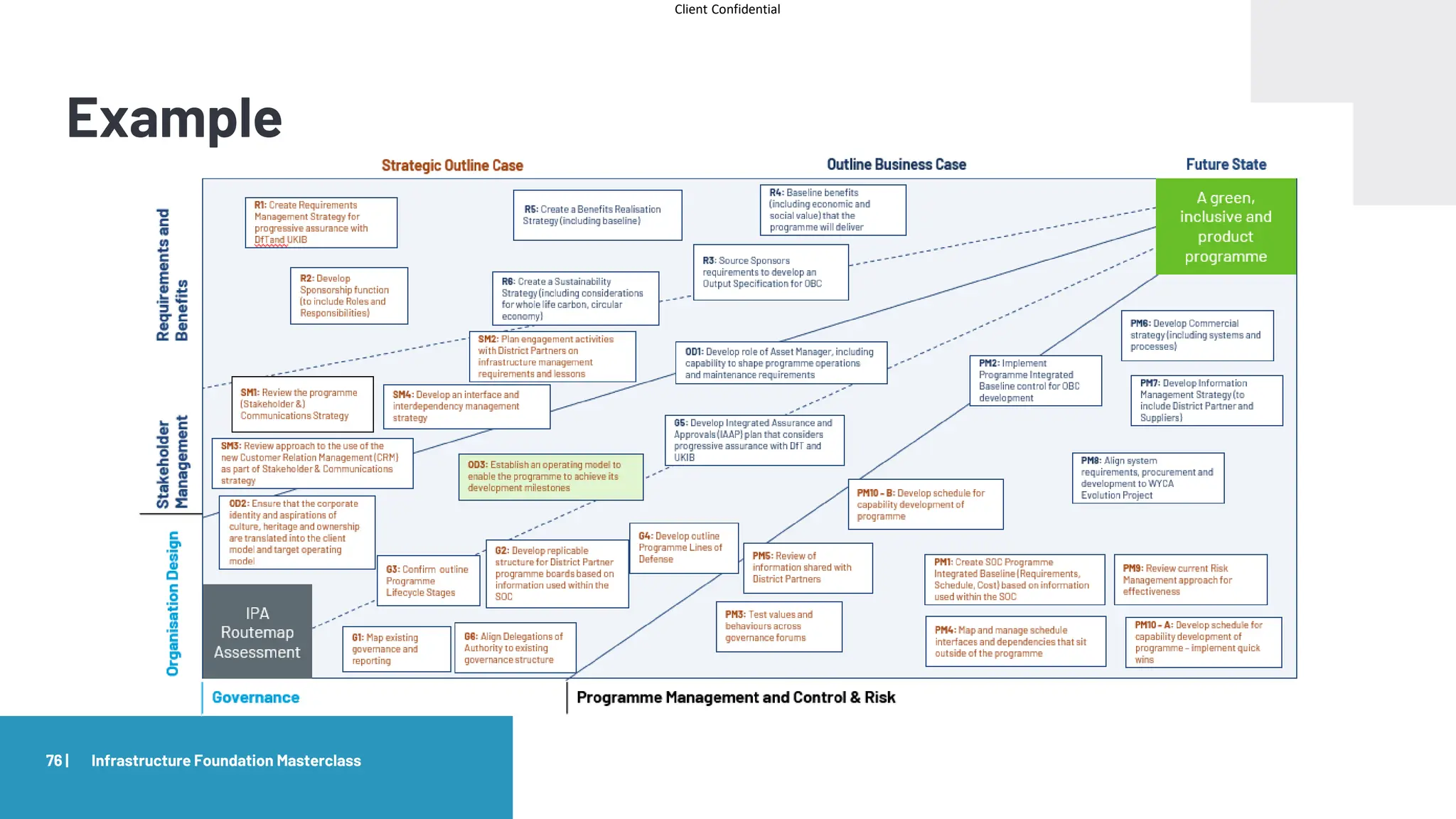
Example
76 | Infrastructure Foundation Masterclass
Client Confidential
Infrastructure Foundation Masterclass
77 |
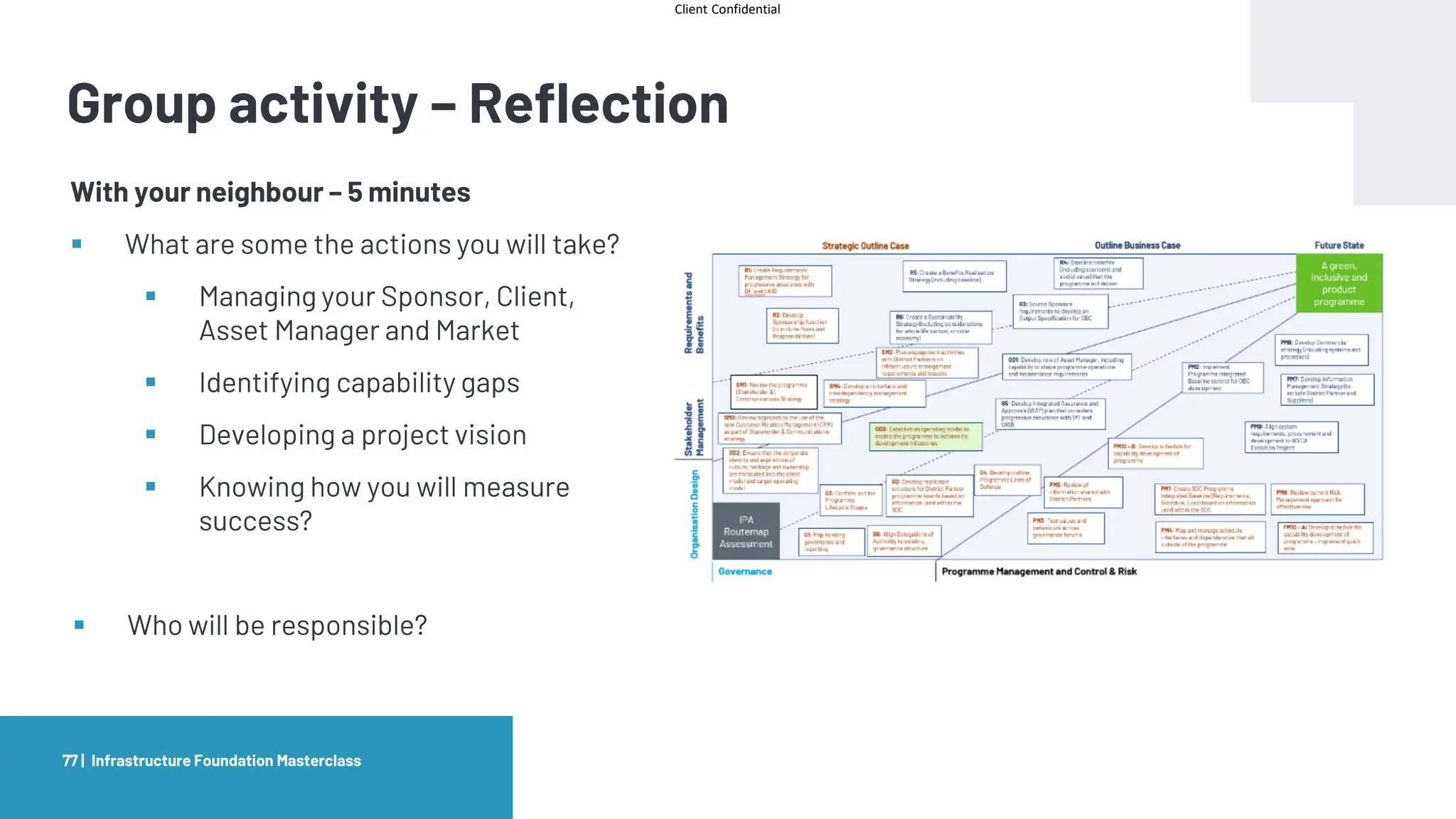
Group activity – Reflection
With your neighbour – 5 minutes
▪ What are some the actions you will take?
▪ Managing your Sponsor, Client,
Asset Manager and Market
▪ Identifying capability gaps
▪ Developing a project vision
▪ Knowing how you will measure
success?
▪ Who will be responsible?
Client Confidential
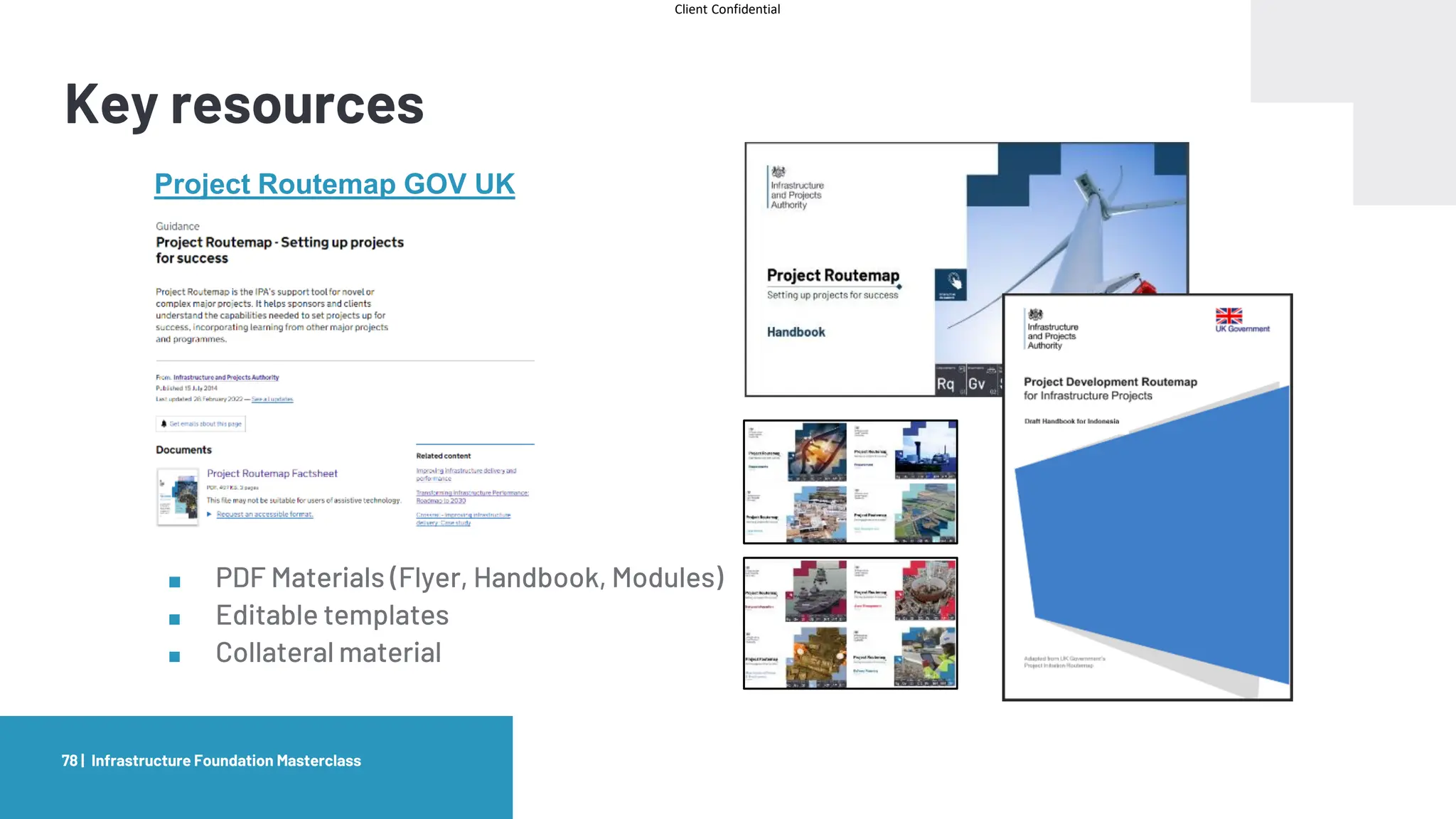
Key resources
Project Routemap GOV UK
■ PDF Materials (Flyer, Handbook, Modules)
■ Editable templates
■ Collateral material
Infrastructure Foundation Masterclass
78 |
Client Confidential
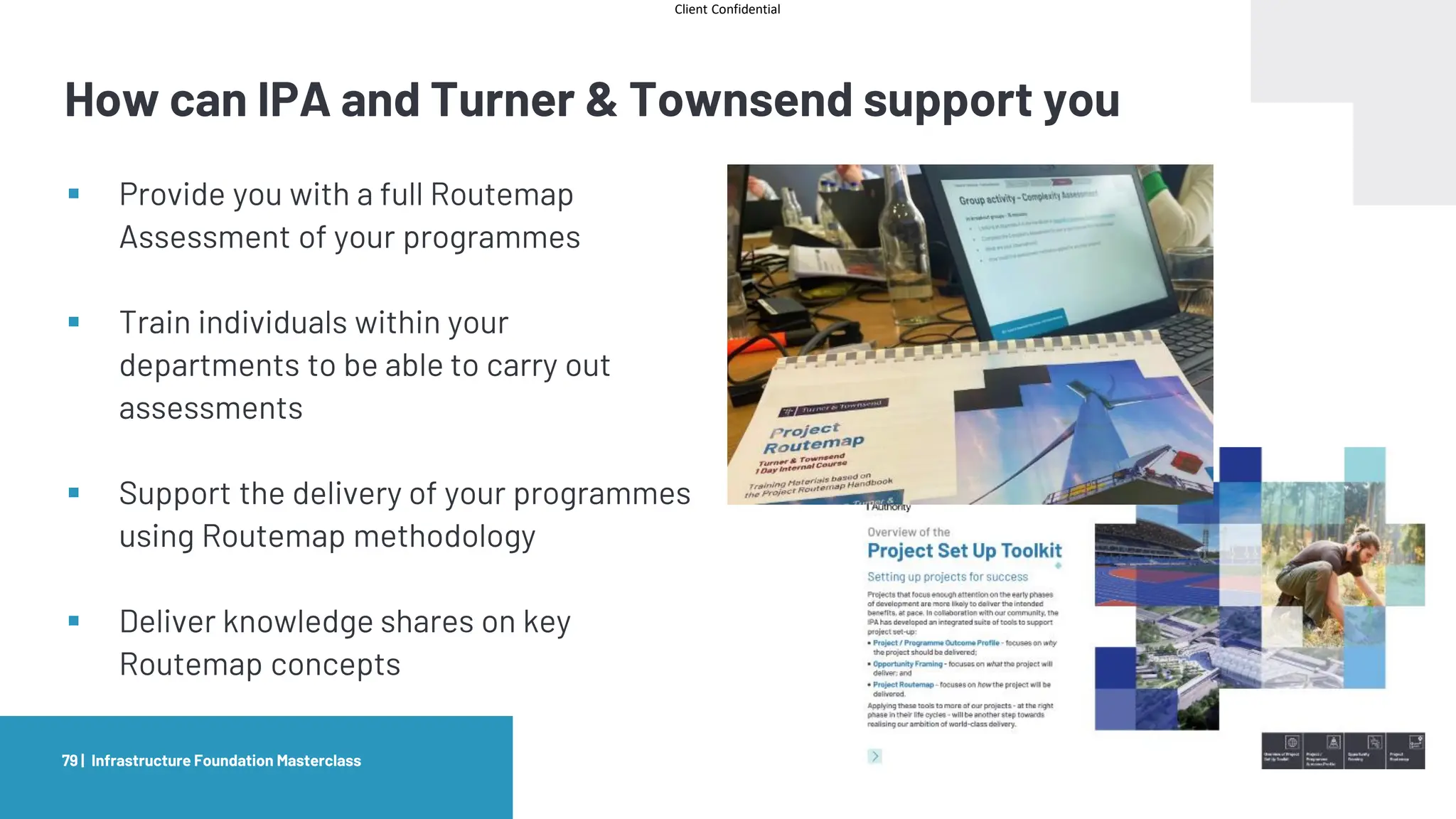
How can IPA and Turner & Townsend support you
Infrastructure Foundation Masterclass
79 |
▪ Provide you with a full Routemap
Assessment of your programmes
▪ Train individuals within your
departments to be able to carry out
assessments
▪ Support the delivery of your programmes
using Routemap methodology
▪ Deliver knowledge shares on key
Routemap concepts
Client Confidential
Questions?
InfrastructureFoundationMasterclass
80 |
Client Confidential
Further Routemap
specific support
InfrastructureFoundationMasterclass
81 |
Dr Frederick Levy
Programme Advisory
Turner & Townsend
frederick.levy@turntown.co.uk
Nina Ciuffardi
Project Initiation Capability,
Infrastructure & Projects Authority
nina.ciuffardi@ipa.gov.uk

Project Development Routemap - Infrastructure Foundation Masterclass

  • 1.
  • 2.
    Client Confidential Infrastructure FoundationMasterclass 2 | Agenda 1. Introduction 2. Background and overview of Project Routemap 3. Complexity & Capability 4. The Rationale Module 5. Action Planning 6. Wrap up We will have five minutes discussions spread across the talk
  • 3.
    Client Confidential Infrastructure FoundationMasterclass 3 | Introductions Steve Lee Director Programme Advisory Dr Frederick Levy Associator Director Turner &Townsend Programme Advisory Frederick has led and consulted on programme setup and transitions of infrastructure investments in academic, engineering and delivery orientated client and consultancy institutions. He supported the refresh of the UK Government’s tool for major programmes, training industry leaders on the tool and deploying it across major rail and utility programmes.
  • 4.
    Client Confidential Infrastructure FoundationMasterclass 4 | Turner & Townsend “All major projects that are complex or novel (should) use the Routemap methodology, a project initiation tool developed by industry and the IPA.” UK National Infrastructure Strategy: Fairer, faster, greener We are a market-leading capital programmes professional services company trusted to drive better business outcomes for our clients across all sectors. With a heritage rooted in cost and commercial management we have a deep and tacit understanding of capital programmes. Turner & Townsend put the IPA Project Routemap at the heart of their Programme as a System Methodology for the setup and delivery of major infrastructure programmes. Over the last decade, Turner & Townsend has supported the Infrastructure and Projects Authority creating and delivering major updates of the Project Routemap toolkit for major programmes setup; consolidating state-of-art delivery practice from over 100+ industry leaders, deploying the tool across programmes and developing practitioners via training. This has included training 80+ executive and senior professionals across UK government departments, consultancies and Arm’s Length Bodies, as well as promoting UK Government overseas.. We look forward to helping you make best use of the toolkit.
  • 5.
    Client Confidential Infrastructure FoundationMasterclass 5 | Turner & Townsend
  • 6.
    Client Confidential Infrastructure FoundationMasterclass 6 | Training objectives This training aims to give participants the knowledge and confidence to 1. Identify projects that would benefit from applying Project Routemap 2. Understand and show how Project Routemap can be applied 3. Communicate about opportunities to use aspects of Project Routemap 4. Explain to colleagues what Project Routemap is and how it can benefit projects 5. Facilitate the application of the Project Routemap assessment
  • 7.
    Client Confidential Introduction to IPAProject Routemap Infrastructure Foundation Masterclass 7 |
  • 8.
    Client Confidential IPA Setup Toolkit How doesRoutemap fit with key concepts 8 | Infrastructure Foundation Masterclass The life cycle provides a phased approach for governing work and underpins the delivery plan, from start to finish. The life cycle shall be defined and should include approval gates/decision points and assurance reviews (GovS002) Strategic Economic Financial Commercial Management Early Business Case Intermediate Business Case Full Business Case Every infrastructure project should have a ‘business case’ or proposal to explain why it is needed and how it can be taken forward… The Five Case Model (5CM) providesa framework for developing standardisedand comprehensive business cases. (International Business Case Guidance) Business Case Stages These tools establish the value of a potential project and its alignment to priority outcomes. Once you have consensus on ‘what’ (Project/Programme Outcome Profile) you are delivering and ‘why’ (Opportunity Framing) you can move on to ‘how’, using Project Routemap to establish the capabilities neededto deliver successfully (IPA Project Setup Toolkit) This course
  • 9.
    Client Confidential Background Infrastructure FoundationMasterclass 9 | ▪ Project Development Routemap (2022) is helping to improve international infrastructure project planning, preparation and delivery. ▪ Under UK Government’s Global Infrastructure Programme, the Infrastructure and Project’s Authority adapted world leading, proven UK methodologies for international infrastructure development, and trained officials in their use. ▪ It has been updated as part of the UK Project Routemap to consider impacts from Covid-19 and the Glasgow Climate Pact at COP26 to limit global temperature rise to 1.5oC
  • 10.
    Client Confidential Background Infrastructure FoundationMasterclass 10 | ▪ Enhance prosperity on a national, regional and global basis. Unlocking economic opportunities, through facilitating better development, design, finance, procurement and operation of major infrastructure projects/programmes ▪ Routemap supports governments to meet commitments to the UN SDGs, Paris Agreement and Glasgow Climate Pact and aligns with the IFC Performance Standards for environmental and social sustainability. ▪ Routemap aligns with G20 Principles for Quality Infrastructure Investment and Principles for the Infrastructure Project Preparation Phase. ▪ It is recognised as best practice on the Global Infrastructure Hub
  • 11.
    Client Confidential Background Infrastructure FoundationMasterclass 11 | ▪ Quality infrastructure development can have a strong impact throughout the UN SDGs. In particular: Goal 3 – Good Health and Wellbeing Goal 4 – Quality Education Goal 6 – Clean Water and Sanitation Goal 7 – Affordable and Clean Energy Goal 8 – Decent Work and Economic Growth Goal 9 – Industry, Innovation and Infrastructure Goal 11 – Sustainable Cities and Communities Goal 12 – Responsible Consumption and Production
  • 12.
    Client Confidential What isRoutemap? ■ Project Routemap is the IPA’s support tool for novel or complex major projects. ■ It helps sponsors and clients understand the capabilities needed to set projects up for success using a structured and tested methodology. ■ Routemap captures best practice and learning about the most common causes of project failure from £300bn of capital programmes ■ Ensures that the ‘right’ questions are asked upfront and that the key risks and opportunities are identified ■ Collaborative way for stakeholders to work together, towards practical solutions to address gaps in project capability ■ Routemap has been adapted for use internationally, as Project Development Routemap Infrastructure Foundation Masterclass 12 |
  • 13.
    Client Confidential Who woulduse Routemap and why? ■ We are a new team lacking experience of delivering similar projects but want to kick this project off properly! ■ I am the project sponsor, and I am not confident that we have the level of capability this project needs to be successful ■ We want to learn all we can from other projects and sectors to improve delivery ■ We are developing our business case and need help working through some critical aspects ■ We know we are not working effectively with our project partners and need to do something about it ■ We need to be sure this project is ready to transition to the next stage and provide confidence to our stakeholders 13 | Infrastructure Foundation Masterclass
  • 14.
    Client Confidential Routemap benefits InfrastructureFoundation Masterclass 14 | Link: Benefits of Project Routemap - YouTube
  • 15.
    Client Confidential Organisations involvedin Routemap Infrastructure Foundation Masterclass 15 | Routemap has been used by many of the UK’s biggest, most complex and high-profile projects since its first publication in 2014 and more recently it has also been applied to projects internationally. Existing users IPA Project Routemap 2021
  • 16.
    Client Confidential International CaseStudies Infrastructure Foundation Masterclass 16 | Colombia 2020 Routemap on a nationally important freight rail corridor project in Colombia. Sumatra 2019 Routemap on a strategic road project in South-Sumatra. Indonesia 2021 World Bank & West Java Provincial Government to applied Routemap to a key urban transport project in Bandung “When used for a Mass Transit Project in Indonesia it greatly helped to clarify issues that, if left unaddressed, were likely to delay implementation … Routemap has substantially assisted timely project implementation and was excellent value for money.” World Bank
  • 17.
    Client Confidential Turner &Townsend with Project Routemap Infrastructure Foundation Masterclass 17 |
  • 18.
    Client Confidential International andUK Routemaps Infrastructure Foundation Masterclass 18 | ▪ UK/UN International Guidance ▪ Tailored for international development ▪ Created 2019, iterated 2022 ▪ UK Guidance ▪ Based on UK projects and programmes ▪ Refresh 2022
  • 19.
    Client Confidential Other IPAProject Set Up tools Infrastructure Foundation Masterclass 19 | Routemap is part of an integrated set of tools to set projects up for success: ■ Project / Programme Outcome Profile - focuses on why the project should be delivered ■ Opportunity Framing (APM) - focuses on what the project will deliver (NB Not Open Source) ■ Project Development Routemap - focuses on how the project will be delivered Find out how the tools work together to help you develop your business case in this brochure
  • 20.
    Client Confidential Recent applications InfrastructureFoundation Masterclass 20 | Environment ▪ Requirements workshop Aviation ▪ Portfolio governance ▪ Strategies Utilities ▪ Client capability ▪ Portfolio Complexity Defence ▪ SRO Capability Transmission ▪ Requirements setting Local Authorities ▪ Organisation review ▪ Assessment ▪ Target Operating Model Rail Programmes ▪ Assessment ▪ Benefits Plan ▪ Strategies ▪ Target Operating Model ▪ Governance Government ▪ Assessment ▪ Controls Training
  • 21.
    Client Confidential Project Routemapvs Assurance InfrastructureFoundationMasterclass 21 | Routemap ▪ “…helps sponsors and clients understand the capabilities needed to set projects up for success, incorporating learning from other major projects and programmes.” Project Routemap ▪ Setting up a project as you want to be ▪ Structured approach guided by emergent issues during the Routemap assessment ▪ Includes key stakeholders from outside delivery client delivery function ▪ Provides solutions for project teams to own Assurance ▪ “successful conduct of activities, the efficient and effective design and operation of internal control, compliance with …requirements, and the production of …information to support decision making” Gov 002 ▪ Checking that the project is the way it should be ▪ Structured approach guided by integrated assurance requirements for each gate ▪ Limited engagement with the project system ▪ Provides recommendations, ratings and actions
  • 22.
    Client Confidential A capabilitybuilding tool for projects Routemap is not an alternative project management methodology. It’s a tool that helps you build the capability needed to deliver your project. 22 | ▪ 10 Step Process for application of Routemap ▪ Eight Routemap modules of good practice InfrastructureFoundationMasterclass In the context of Routemap, capability describes the ability of the sponsor, client, asset manager and market to deliver a specific project efficiently and effectively. It refers to the capability of all or part of an organisation (including its people, processes and technology) and not that of the individual. Routemap can be used to initiate a client conversation, it’s independent and recognised as a government support tool
  • 23.
    Client Confidential Routemap modules 23| InfrastructureFoundationMasterclass Rationale Delivering strategic project outcomes and realising the benefits Governance Establishing clear accountability and effective decision making Delivery Planning Readying the project for transition into delivery Organisation Design & Development Organising the project team to deliver successfully Procurement Understanding how the project will buy the goods and services required Risk Management Managing uncertainties and opportunities Asset Management Balancing costs and risks to maximize whole life benefits Systems Integration Making multiple systems work as one
  • 24.
    Client Confidential Routemap modules– who was involved 24 | InfrastructureFoundationMasterclass Overview of the Routemap Setup Diagnosis Action Planning Rationale Crossrail 2, Highways England, Infrastructure and Projects Authority, Philip Wilbraham, Transport for London, Transport for the North, Turner & Townsend, University College London Governance Crossrail 2, Infrastructure and Projects Authority, Martin Buck, Martin Samphire, Philip Wilbraham, Transport for London, Turner & Townsend, University College London, Delivery Planning Crossrail, Infrastructure and Projects Authority, Ministry of Defence, Philip Wilbraham, Turner & Townsend, University College London Organisation Design & Development Anglian Water, Becky Ivers, Infrastructure and Projects Authority, Ministry of Defence, Oxford Said Business School, Turner & Townsend, University College London, Wendy Cartwright Procurement Anglian Water, Heathrow, HM Cabinet Office, HM Crown Commercial Services, Infrastructure and Projects Authority, Sellafield, Thames Water, Turner & Townsend Risk Management Infrastructure and Projects Authority, Highways England, Turner & Townsend, University College London, Crossrail 2 Asset Management AMCL, HM Cabinet Office, Infrastructure and Projects Authority, Ministry of Defence, Thames Water, Turner & Townsend, University College London, , Systems Integration AMCL, Arup, Atkins/INCOSE, BAE Systems, Crossrail, High Speed 2, Imperial College, Infrastructure and Projects Authority, Systra Group, Turner & Townsend, University College London, University of Sussex, WSP/INCOSE, Handbook Highways England, Major Projects Association, Infrastructure and Projects Authority, Mott MacDonald, Crossrail International, Crossrail 2, Turner & Townsend,
  • 25.
    Client Confidential Routemap modules […],and why it’s important Introduction to the topic of the module including a list of key documents that will help you to understand how this area is managed on your project Typical findings Indicators that issues might arise during delivery Pillars of effective […] Hallmarks of effective project set up Considerations Detailed list of questions to understand root causes and suggest improvements. Together with signposts to other materials you may find helpful. Good practice examples and suggested reading Context to support your wider understanding Overview of the Routemap Setup Diagnosis Action Planning Infrastructure Foundation Masterclass 25 |
  • 26.
    Client Confidential Six crosscutting themes 26 | Infrastructure Foundation Masterclass
  • 27.
    Client Confidential Six crosscutting themes 27 | Infrastructure Foundation Masterclass
  • 28.
    Client Confidential Different waysto use Routemap InfrastructureFoundationMasterclass 28 | ▪ 10 Step Process in the Handbook ▪ Using the modules as a reference for good practice prompts ▪ Making an assessment of performance across a portfolio
  • 29.
    Client Confidential Routemap modules– in the life cycle 29 | Infrastructure Foundation Masterclass EBC IBC FBC Rationale
  • 30.
    Client Confidential Applicability todifferent types of projects Infrastructure Foundation Masterclass 32 | ▪ Best practice in Routemap reflects the collective experience of public and privately funded projects. The major of this learning is equally applicable to all types of projects. ▪ Some content is particularly useful for transformation projects, which typically focus on improving people, processes or technology-based capabilities. ▪ “Universal modules”:
  • 31.
    Client Confidential What isthe Routemap process? Infrastructure Foundation Masterclass 33 | 07 08 09 10
  • 32.
  • 33.
    Client Confidential Three approachesto applying Routemap Infrastructure Foundation Masterclass 35 | ▪ This training focuses on the Full Project Review approach
  • 34.
    Client Confidential Infrastructure FoundationMasterclass 36 | Role Description Commissioning Body This body commissions the application of Routemap. Routemap Lead Responsible for setting the scope of the Routemap application and planning the detail. Routemap Support Supporting the Routemap lead to engage Participants Provide information, complete the assessments and attend interviews and workshops Subject Matter Experts Provide relevant experience from previous projects Who is involved in a Routemap assessment?
  • 35.
    Client Confidential When toapply Routemap? ▪ Routemap can add value throughout the project life cycle, but it’s most effective at the early stages when the ability to influence project success is greatest, and the cost of making changes is lowest. ▪ It can also be used to confirm a project’s readiness to progress to the next stage. Infrastructure Foundation Masterclass 37 |
  • 36.
    Client Confidential Routemap toolsand outputs InfrastructureFoundationMasterclass 38 | Routemap Strategy IPA Tools Capability & Complexity Generic Document Reviews, Interviews & Workshops Workshops Qualifying Checklists Implementation Plan Engage on findings Engagement and planning with Commissioning Body Action Plan Approved Findings Recommendations Capability Deployment Iterative development of Routemap Report Lines of Enquiry Information People Interim Report Routemap Final Report Routemap Strategy Report
  • 37.
    Client Confidential Setup Turner &Townsend 1 Day Course - IPA Project Routemap 39 | Key activities ▪ Determining which projects might benefit from a Routemap, whether to proceed with a Routemap and best approach for applying Routemap (Full, Modular Deep Dive etc) ▪ Identifying at what point during the strategic planning and the approvals processes the Routemap should be carried out ▪ Developing the Routemap Strategy, including the boundaries and parameters of the Routemap ▪ Planning Routemap activities and capturing them in an implementation plan to monitor and drive progress
  • 38.
  • 39.
    Client Confidential Diagnosis Complexity &Capability InfrastructureFoundationMasterclass 41 |
  • 40.
    Client Confidential Diagnosis Infrastructure FoundationMasterclass 42 | Key activities ▪ Gathering stakeholder perspectives on complexity and capability through: ▪ Complexity assessments ▪ Capability assessments ▪ Interviews. Workshops and document reviews ▪ Conducting a gap analysis to identify the differences between the current and required capabilities, and find opportunities for improvement ▪ Summarising the information gathered from the assessments and gap analysis as a set of findings, and agreeing the findings with relevant stakeholders
  • 41.
    Client Confidential Understanding Complexity InfrastructureFoundation Masterclass 43 | Refer to Appendix A in the Handbook ▪ The complexity profile summarises the challenges of project implementation and improves team understanding of the strategic risks that may arise at different points in the project lifecycle. ▪ To create an environment for success, teams should consider the 12 factors at the earliest stage of a project and then continually throughout. ▪ Stakeholders may give different ratings depending on their own perspective. ▪ The assessments are collated to highlight different perspectives, areas of risk, and an overall picture of the project’s complexity.
  • 42.
    Client Confidential Complexity AssessmentOutput (Example) Infrastructure Foundation Masterclass 44 |
  • 43.
    Client Confidential Complexity Assessment InfrastructureFoundation Masterclass 45 | Refer to Appendix A in the Handbook
  • 44.
    Client Confidential Complexity Assessment(Rating and Evidence) Infrastructure Foundation Masterclass 46 | Factor Rating (L/M/H) Example comment evidencing chosen rating Stakeholders/ influencers H ▪ The project involves several government departments and statutory bodies, which have a great deal of influence on the project. Stability of overall context H ▪ The overall context of project delivery is very uncertain because it relies heavily on changing political will and opinion. Range of disciplines and skills H ▪ The project is pushing the boundaries of the supply chain, both in capacity and capability, particularly in respect of the innovative procurement strategy. Organisational capability: performance to date M ▪ We have built one similar project with a partner and we are building another similar project alone.
  • 45.
    Client Confidential Infrastructure FoundationMasterclass 47 | Example output
  • 46.
    Client Confidential Infrastructure FoundationMasterclass 48 | Group activity – Complexity Assessment With your neighbour – 5 minutes ▪ What elements of complexity you recognise? 1. Strategic importance: Does the project support national or regional policy, strategy and plans, including UN Sustainable Development Goals and nationally determined contributions to the Paris Agreement? 2. Stakeholders: What is the nature of the groups or individuals with an interest in the project? 3. Requirements and benefits: Is it clear between the sponsor and client what is to be delivered (including environmental and social requirements) and how this will lead to meeting the strategic objectives? 4. Stability of overall context: Will the scope, structure and political economy remain stable during project development? 5. Financial impact and value for money: How financially significant is the investment for the organisations involved, and are the expected benefits proportional to the projected costs? 6. Execution complexity (including technology): How difficult is the project to deliver due to factors that include: technology, approach and timescales? 7. Interfaces: Is there a high number of different organisations/bodies involved in delivery? 8. Range of disciplines and skills: To what extent are specialist skills required for delivery, and are they available within the organisation? These might include technical modelling, social development, environmental and/or communication skills. 9. Dependencies: Is the project critical to the delivery of other projects, programmes or areas of work, or dependent upon other projects for its own success? 10. Extent of change: Does the project involve a significant change in the way the organisation conducts its work, or is it business as usual? 11. Organisational capability: performance to date: Do the organisations involved in delivery of the project have successful track records? 12. Business environment: Is the national/regional business environment conducive to achieving successful project outcomes and value for money? 13. Interconnectedness: How well do the organisations involved understand the links and connections between the complexity factors above?
  • 47.
    Client Confidential Understanding Capability InfrastructureFoundation Masterclass 49 | ▪ You need to clearly understand the capabilities of the parties involved in delivering a project. This is to confirm they have (or will have) the capabilities they need. ▪ Assessing the difference between the current and needed capabilities helps you to understand the project’s capability gap. ▪ Routemap assesses the organisational capability across four areas of responsibility: ▪ Sponsor ▪ Client ▪ Asset Manager ▪ Market ▪ Capability describes the ability of the sponsor, client, asset manager and market to organise for effective and efficient delivery.
  • 48.
  • 49.
    Client Confidential Example ofRoles Infrastructure Foundation Masterclass 51 | What does the Sponsor do? • Responsible for championing the project and specifies what it needs to achieve. What does the Client do? • Responsible for fulfilling the brief as set by the sponsor. What is the Market? • Organisations which integrate and compete to deliver good or services to one or more clients What does the Asset Manager do? • Responsible for day-to-day operations and maintenance of the asset
  • 50.
    Client Confidential Understanding Capability InfrastructureFoundation Masterclass 52 | All roles are active throughout each stage of the project life cycle up to project close.
  • 51.
    Client Confidential Example ofRoles Infrastructure Foundation Masterclass 53 | Organisational Design & Development, Good Practice Example 2 - Projects delivering through multiple organisations The table below shows the relationships between the sponsor, client, market and asset manager roles for some well-known UK projects, programmes and portfolios:
  • 52.
    Client Confidential Infrastructure FoundationMasterclass 54 | Group activity – Stakeholders With your neighbour – 5 minutes ▪ Who is the Sponsor, Client, Asset Manager and Market? What does the Sponsor do? Responsible for championing the project and specifies what it needs to do What does the Client do? Responsible for fulfilling the brief as set by the sponsor. What does the Asset Manager do? Responsible for day-to-day operations and maintenance of the asset What is the Market? Organisations which to deliver good or services to one or more clients
  • 53.
    Client Confidential Capability Assessment InfrastructureFoundation Masterclass 55 | You need to clearly understand the capabilities of the parties involved in delivering a project. This is to confirm they have (or will have) the capabilities they need. Assessing the difference between the current and needed capabilities helps you to understand the project’s capability gap. The capability gap can show you where additional activity or effort could improve project development. ■ The sponsor capability assessment helps you to understand what capability the sponsor requires during the investment and delivery planning process, to keep the project viable and aligned with wider strategic objectives. ■ The client capability assessment investigates the client organisation’s ability to engage effectively with a supply chain and to manage the delivery outcomes for potential delivery models. ■ The asset manager capability assessment shows the key requirements and constraints for operating and maintaining the asset. It also assesses if the sponsor and client organisations are able to undertake their responsibilities relating to asset management. ■ The market capability assessment examines the broader market’s ability and appetite to respond to requirements over the life of the infrastructure, including support from consultants, delivery partners, contractors and suppliers.
  • 54.
    Client Confidential Capability Assessment InfrastructureFoundation Masterclass 56 | Each Assessment identifies observable characteristics that either support or undermine effective and efficient project delivery. ■ These characteristics help determine the ‘current’ and ‘needed’ capabilities for successful delivery of the project. ■ Assessments should be project-specific and not just representative of overall organisational maturity. The characteristics are grouped into three sets: Type Description Type 1 These characteristics hold an organisation back, regardless of other good practice. You must either address them, or at least be aware of their possible consequences. Type 2 These characteristics are found in organisations that are performing acceptably. The organisational arrangements may be in place but not fully optimised. Type 3 These characteristics are indicative of an effective and efficient organisation, optimised for delivery of the project. Not all projects will require these characteristics to be successful.
  • 55.
    Client Confidential Infrastructure FoundationMasterclass 57 | Group activity – Capability Assessment With your neighbour – 5 minutes ▪ What are some capabilities you need? What characteristics do you recognise? ▪ The client organisation knows what is needed and prioritises accordingly, placing sustainable development at the centre of decision-making alongside economic considerations. ▪ Project purpose, principles and roles are established before the detailed delivery plan. ▪ Sponsor requirements are translated into clear functional and technical requirements by the client. ▪ Client benchmarks cost and performance and applies industry comparators as appropriate. ▪ Procurement process, including market engagement, explicitly emphasises economic, environmental and social considerations at each stage. ▪ The client has access to environmental and social expertise, and integrates this expertise into the team as appropriate. ▪ The client invests in information management to support decision-making. ▪ The client demonstrates consistent, fair and ethical behaviours. ▪ Governance and management arrangements define clear accountability for economic, environmental and social impacts from senior to working levels. ▪ Governance arrangements provide clear accountability to the sponsoring organisation. ▪ The project team considers all the different options for the project, and conducts cost benefit analysis on a short list.
  • 56.
    Client Confidential What isneeded for Setup Rationale focus InfrastructureFoundationMasterclass 58 |
  • 57.
    Client Confidential Routemap modules– in the life cycle 59 | Infrastructure Foundation Masterclass Rationale EBC IBC FBC
  • 58.
    Client Confidential Routemap modules 60| InfrastructureFoundationMasterclass Rationale Delivering strategic project outcomes and realising the benefits Governance Establishing clear accountability and effective decision making Delivery Planning Readying the project for transition into delivery Organisation Design & Development Organising the project team to deliver successfully Procurement Understanding how the project will buy the goods and services required Risk Management Managing uncertainties and opportunities Asset Management Balancing costs and risks to maximize whole life benefits Systems Integration Making multiple systems work as one
  • 59.
    Client Confidential Why isthe Rationale important? 61 | Infrastructure Foundation Masterclass “Establishclear requirements and iterate these to secure an affordable project, and then hold steady the requirementsand funding to provide a stable and predictable environment.” Lessons from transport for the sponsorship of major projects Department for Transport and Infrastructure and Projects Authority 2019 Typical findings ▪ Requirements are not well defined, so the purpose of the project and/or what it needs to deliver is confusing. ▪ Not aligned to national or international goals regarding economic, environmental and social value ▪ Difficult to prove success because the benefits are not defined in tangible or measurable terms. ▪ No clear process, nor responsibilities, for prioritising requirements ▪ Not clear how the deliverables align or contribute to the expected benefits ▪ Best time to deploy Routemap is by integrating it into the strategic planning and business case development of a project. This means that you can bring in best practice and lessons from other major projects, from the outset.
  • 60.
    Client Confidential Rationale module Deliveringstrategic project outcomes and realising the benefits Infrastructure Foundation Masterclass 62 |
  • 61.
    Client Confidential Rationale module Developinga project vision Infrastructure Foundation Masterclass 63 | ■ Create a shared vision of what success will look like. The vision should be realised, easy to understand, and measurable. ■ It should specifically set out what will be classed as good, with respect to economic, environmental and social risks and impacts. ■ The vision should incorporate strategic objectives relating to sustainable development, ESG. ■ Communicating the vision, is a fundamental part of stakeholder engagement and community consultation. “Sustainability is not an add-on to the Programme and Project Partner mission. Embraced fully and with agency our sustainability approach will accelerate Programme and Project Partners and Sellafield Ltd success and provide additional, permanent, regenerative benefits”.
  • 62.
    Client Confidential Rationale module Aligningrequirements Infrastructure Foundation Masterclass 64 | Benefits mapping provides an easily understandable visual representation of the relationships between the outputs, outcomes and benefits to be realised as a result of a project. ■ Outputs also referred to as a capability, deliverable, or product. Outputs that do not contribute to achieving an outcome are of questionable value. ■ Outcomes are a result of change which affects real world behaviour/ circumstances and may lead to one or more benefits. Outcomes are achieved as a result of the work done by projects and other activities creating outputs and new/enhanced organisational capability. ■ Benefits are the measurable improvements resulting from, and enabled by, the outcomes. Realisation of benefits should be tracked and reported.
  • 63.
    Client Confidential Rationale module Aligningrequirements Infrastructure Foundation Masterclass 65 | Midland Main Line is integral to delivering the UK Government’s vision for decarbonising Transport and the Traction Decarbonisation Network Strategy (TDNS). A benefits mapping was carried out to understand what needed to be measured to quantify programme success. This exercise triggered activities to understand what the baseline conditions were prior to programme commencement
  • 64.
    Client Confidential Infrastructure FoundationMasterclass 66 | Group activity – Rationale Module With your neighbour – 5 minutes ▪ What is your projects vision? ▪ How is your project measuring success? Example of outputs, outcomes and benefits?
  • 65.
  • 66.
    Client Confidential InfrastructureFoundationMasterclass 68 | Stage3 Action Planning Collaborative development of practical solutions to enhance capability
  • 67.
    Client Confidential Action Planning InfrastructureFoundation Masterclass 69 | Key activities ▪ Developing recommendations: high-level ways to address project development that address the findings ▪ Developing a detailed action plan that describes the activities through which the agreed recommendations will be implemented ▪ Integrating the action plan into ongoing project development activity and socialising the it with the stakeholders involved
  • 68.
    Client Confidential Workshops Infrastructure FoundationMasterclass 70 | ▪ A workshop, or series of workshops, are often the best way to bring stakeholders together to develop and agree recommendations (and in Step 9, an action plan) ▪ You should invite participants, the Commissioning Body and other key, appropriate stakeholders, to ensure the recommendations have senior level support and are achievable. ▪ Subject matter experts can also guide participants in developing the recommendations. They will provide a different perspective and introduce real world examples of best practice they have used previously
  • 69.
    Client Confidential Workshops Infrastructure FoundationMasterclass 71 | ▪ Routemap team ▪ Programme Manager ▪ Local Government ▪ National Government ▪ Routemap team ▪ Programme Manager ▪ Operations Officer ▪ Head of HR ▪ Suppliers ▪ Routemap Team ▪ Programme Manager ▪ Controls Team ▪ Operations Officer ▪ Head of Corporate Risk
  • 70.
    Client Confidential Example 72 | Finding3 There is no clear, commonly understood target operating model across the three sites, and as such this thinking isn’t being incorporated into project development. There are no plans to enhance the capabilities of the Estates team in time for commissioning and handover. Infrastructure Foundation Masterclass Relevant modules Example recommendations Project leadership should communicate a clear vision of the target operating model, including those parts of the wider system outside the immediate scope of the project. Operational capacity and competency requirements should be clearly identified, both during and after the project. Project plans should include activities to develop the required capacity and competence. ➔ ➔
  • 71.
    Client Confidential Step 9:Developing actions examples 73 | Finding ➔ Recommendation ➔ There is no clear, commonly understood target operating model across the three sites, and as such this thinking isn’t being incorporated into project development. Project leadership should communicate a clear vision of the target operating model, including those parts of the wider system outside the immediate scope of the project. Infrastructure Foundation Masterclass Example of Actions required to support the Recommendation ▪ Establish the design principles for the target operating model including how the new building will maintained as part of an enlarged estate. ▪ Communicate this to everyone involved in the project. ▪ Ensure requirements to enable the target operating model are captured and fed into project design. ▪ Consider the need for change management.
  • 72.
    Client Confidential Example actions 74| Overview of the Routemap Setup Diagnosis Action Planning Infrastructure Foundation Masterclass Head of Governance PMO Lead Head of Delivery Head of Portolio Head of Delivery
  • 73.
    Client Confidential Step 9:Action Planning 75 | Infrastructure Foundation Masterclass
  • 74.
    Client Confidential Example 76 |Infrastructure Foundation Masterclass
  • 75.
    Client Confidential Infrastructure FoundationMasterclass 77 | Group activity – Reflection With your neighbour – 5 minutes ▪ What are some the actions you will take? ▪ Managing your Sponsor, Client, Asset Manager and Market ▪ Identifying capability gaps ▪ Developing a project vision ▪ Knowing how you will measure success? ▪ Who will be responsible?
  • 76.
    Client Confidential Key resources ProjectRoutemap GOV UK ■ PDF Materials (Flyer, Handbook, Modules) ■ Editable templates ■ Collateral material Infrastructure Foundation Masterclass 78 |
  • 77.
    Client Confidential How canIPA and Turner & Townsend support you Infrastructure Foundation Masterclass 79 | ▪ Provide you with a full Routemap Assessment of your programmes ▪ Train individuals within your departments to be able to carry out assessments ▪ Support the delivery of your programmes using Routemap methodology ▪ Deliver knowledge shares on key Routemap concepts
  • 78.
  • 79.
    Client Confidential Further Routemap specificsupport InfrastructureFoundationMasterclass 81 | Dr Frederick Levy Programme Advisory Turner & Townsend frederick.levy@turntown.co.uk Nina Ciuffardi Project Initiation Capability, Infrastructure & Projects Authority nina.ciuffardi@ipa.gov.uk