



Project-Based Learning
By Dawn Bartz
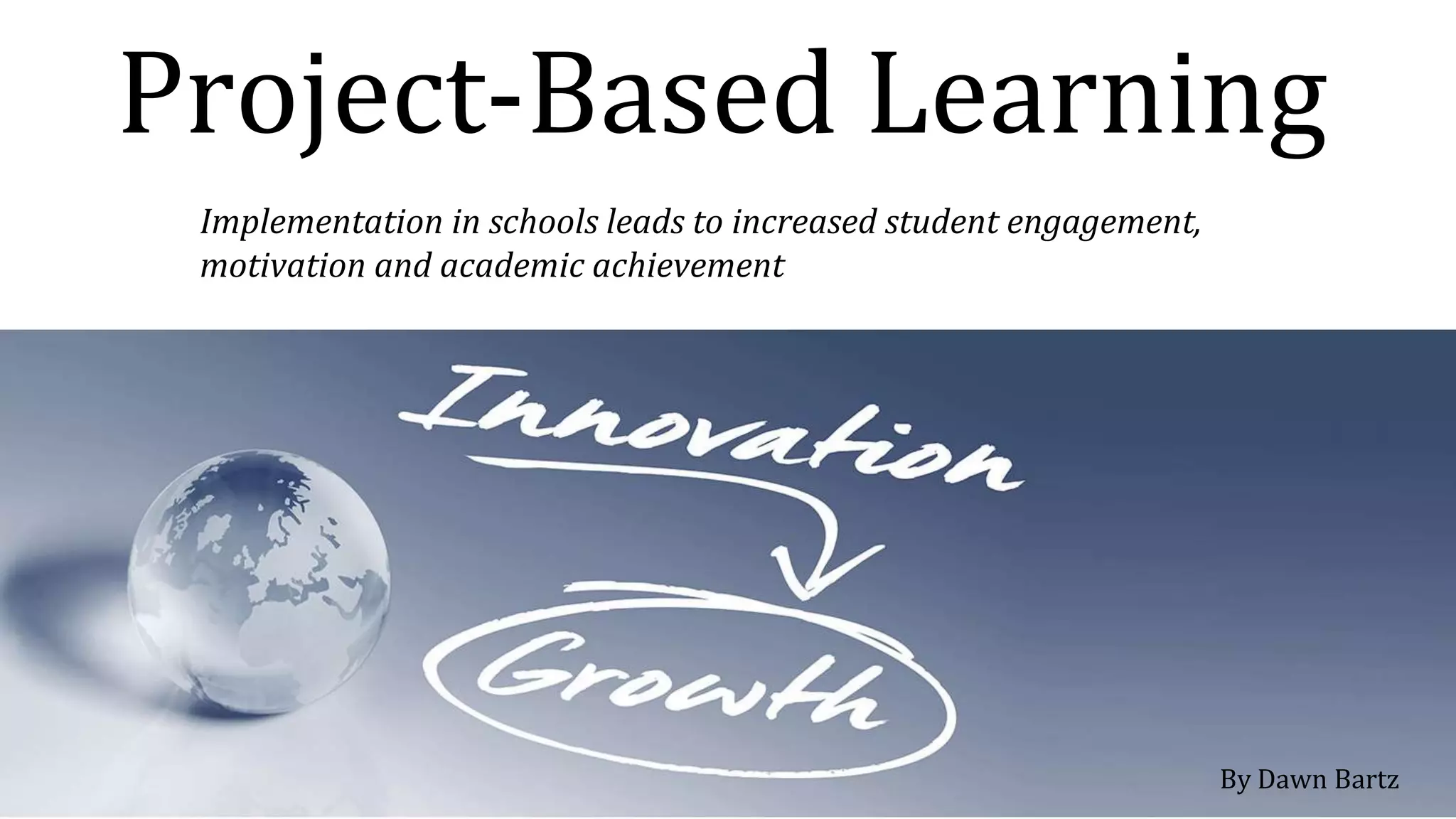
Implementation in schools leads to increased student engagement,
motivation and academic achievement
Project-based learning (PBL) has the potential to transform education.
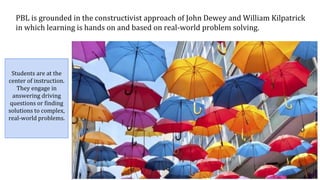
PBL is grounded in the constructivist approach of John Dewey and William Kilpatrick
in which learning is hands on and based on real-world problem solving.
Students are at the
center of instruction.
They engage in
answering driving
questions or finding
solutions to complex,
real-world problems.
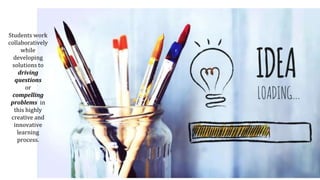
Students work
collaboratively
while
developing
solutions to
driving
questions
or
compelling
problems in
this highly
creative and
innovative
learning
process.
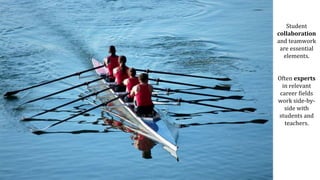
Student
collaboration
and teamwork
are essential
elements.
Often experts
in relevant
career fields
work side-by-
side with
students and
teachers.
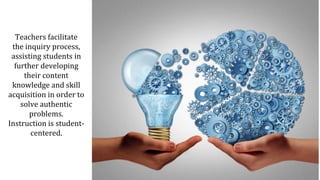
Teachers facilitate
the inquiry process,
assisting students in
further developing
their content
knowledge and skill
acquisition in order to
solve authentic
problems.
Instruction is student-
centered.
In PBL classrooms, the process of inquiry is as important as the
final product. “Mistakes” often lead to innovation.
Students learn to become reflective thinkers.
Formative
assessments are
ongoing and varied in
PBL classrooms.
Learning is
differentiated and
personalized.
PBL is
interdisciplinary,
connecting school
subjects to each
other and to the
outside world in
meaningful ways.
Students engaged
in PBL learning
activities develop
higher order
thinking skills
such as problem-
solving,
critical thinking,
analyzing, and
innovating.
Reading, writing, and research
are naturally integrated into the
learning process.
The connections that are found between academic disciplines and between school
and the outside world engage and motivate students. Students want to learn more.
High motivation in school is directly linked to increased academic achievement.
Students who are engaged in learning
see meaning in it and want to know
more and achieve at a higher level.
Project-based learning can increase
cognitive development in ALL students.
The answers to driving questions or solutions to compelling problems are as varied
in a PBL classroom as they are in the 21st century global society.
Students
showcase
their
finished
projects to a
larger,
community-
based
audience
and receive
feedback.
Student
reflection is
part of the
process.
Creativity and
innovation are
prized in this
constructivist
pedagogy.
And in a
Global Society.
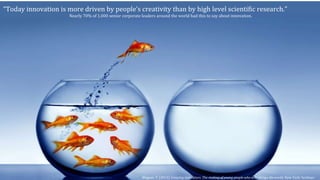
“Today innovation is more driven by people’s creativity than by high level scientific research.”
Nearly 70% of 1,000 senior corporate leaders around the world had this to say about innovation.
Wagner, T. (2012). Creating innovators: The making of young people who will change the world. New York: Scribner.

Project based learning increases student engagement and achievement