Project based learning in 2nd
grade - Storytelling
With a focus on adjectives and adverbs
What are we going to do?
 We're going to tell stories to the Kindergarten class! (In person AND through a video recorded on
our iPads
 We've seen how stories can improve with adjectives and adverbs
 In groups of two or three, you will create your own stories
 It must have a beginning, middle and an end
 Each page (or "scene") must use at least one adjective or adverb
 The rest is up to you!
Why are we doing it?
 To build a sense of community between the
kindergarteners and second graders
 Create and learn about leadership and
responsibility
 To make reading interesting, fun and unique
 Practice becoming great storytellers!
How can we do it?
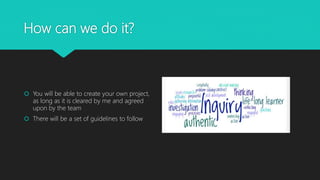
 You will be able to create your own project,
as long as it is cleared by me and agreed
upon by the team
 You will use resources in and outside the
classroom
 IPads, computers, books, past projects
So, we're in charge of our own project?
 Yes! Just make sure you...
1. Record your story on one of the class iPads
2. Use at least one adjective and one adverb in
each scene
3. The story can be about any topic you have
learned inside or outside of the English class
4. Make sure it's "OK'd" by the teacher
5. Have fun!
Here are your options
 Create a folklore
 Use a science/ math/ music class theme in
your story
 Record it "live" or draw pictures and use
another application on the iPad to give it a
cartoon effect
 Decide which of the themes it will be that we
have learned about as a class (funny, scary,
romantic, suspense)
How we can use technology
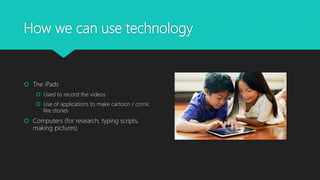
 The iPads
 Used to record the videos
 Use of applications to make cartoon / comic
like stories
 Computers
 Research
 Typing scripts
 Creating / finding pictures
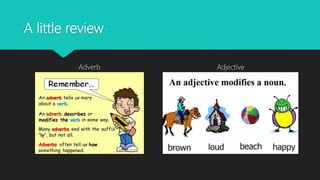
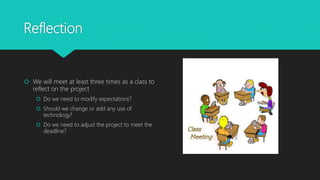
A little review
Adverb Adjective
Reflection
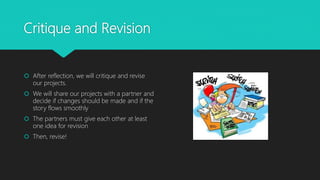
 We will meet at least three times as a class to
reflect on the project
 Do we need to modify expectations?
 Should we change or add any use of
technology?
 Do we need to adjust the project to meet the
deadline?
Critique and Revision
 After reflection, we will critique and revise
our projects.
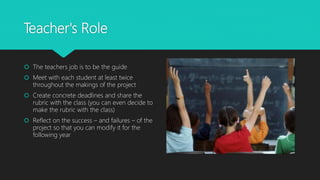
 We will share our projects with a partner and
decide if changes should be made and if the
story flows smoothly
 The partners must give each other at least
one idea for revision
 Then, revise!
Teacher's Role
 The teachers job is to be the guide
 Meet with each student at least twice
throughout the makings of the project
 Create concrete deadlines and share the
rubric with the class (you can even decide to
make the rubric with the class)
 Reflect on the success – and failures – of the
project so that you can modify it for the
following year
References
 5 Keys to Rigorous Project-Based Learning. (2017). Edutopia. Retrieved 25 March 2017, from
https://www.edutopia.org/video/5-keys-rigorous-project-based-learning
 Johnson, S. (2017). Where good ideas come from. YouTube. Retrieved 25 March 2017, from
xhttps://www.youtube.com/watch?v=NugRZGDbPFU&feature=youtu.be
 Larner, J., & Mergendoller, J. (2017). Educational Leadership:Giving Students Meaningful Work:Seven Essentials
for Project-Based Learning. Ascd.org. Retrieved 25 March 2017, from
http://www.ascd.org/publications/educational_leadership/sept10/vol68/num01/Seven_Essentials_for_Project-
Based_Learning.aspx
 Project Based Learning: Explained.. (2017). YouTube. Retrieved 25 March 2017, from
https://www.youtube.com/watch?v=LMCZvGesRz8
 What is PBL? | Project Based Learning | BIE. (2017). Bie.org. Retrieved 25 March 2017, from
http://www.bie.org/about/what_pbl

Project Based Learning in 2nd Grade

  • 1.
    Project based learningin 2nd grade - Storytelling With a focus on adjectives and adverbs
  • 2.
    What are wegoing to do?  We're going to tell stories to the Kindergarten class! (In person AND through a video recorded on our iPads  We've seen how stories can improve with adjectives and adverbs  In groups of two or three, you will create your own stories  It must have a beginning, middle and an end  Each page (or "scene") must use at least one adjective or adverb  The rest is up to you!
  • 3.
    Why are wedoing it?  To build a sense of community between the kindergarteners and second graders  Create and learn about leadership and responsibility  To make reading interesting, fun and unique  Practice becoming great storytellers!
  • 4.
    How can wedo it?  You will be able to create your own project, as long as it is cleared by me and agreed upon by the team  You will use resources in and outside the classroom  IPads, computers, books, past projects
  • 5.
    So, we're incharge of our own project?  Yes! Just make sure you... 1. Record your story on one of the class iPads 2. Use at least one adjective and one adverb in each scene 3. The story can be about any topic you have learned inside or outside of the English class 4. Make sure it's "OK'd" by the teacher 5. Have fun!
  • 6.
    Here are youroptions  Create a folklore  Use a science/ math/ music class theme in your story  Record it "live" or draw pictures and use another application on the iPad to give it a cartoon effect  Decide which of the themes it will be that we have learned about as a class (funny, scary, romantic, suspense)
  • 7.
    How we canuse technology  The iPads  Used to record the videos  Use of applications to make cartoon / comic like stories  Computers  Research  Typing scripts  Creating / finding pictures
  • 8.
  • 9.
    Reflection  We willmeet at least three times as a class to reflect on the project  Do we need to modify expectations?  Should we change or add any use of technology?  Do we need to adjust the project to meet the deadline?
  • 10.
    Critique and Revision After reflection, we will critique and revise our projects.  We will share our projects with a partner and decide if changes should be made and if the story flows smoothly  The partners must give each other at least one idea for revision  Then, revise!
  • 11.
    Teacher's Role  Theteachers job is to be the guide  Meet with each student at least twice throughout the makings of the project  Create concrete deadlines and share the rubric with the class (you can even decide to make the rubric with the class)  Reflect on the success – and failures – of the project so that you can modify it for the following year
  • 12.
    References  5 Keysto Rigorous Project-Based Learning. (2017). Edutopia. Retrieved 25 March 2017, from https://www.edutopia.org/video/5-keys-rigorous-project-based-learning  Johnson, S. (2017). Where good ideas come from. YouTube. Retrieved 25 March 2017, from xhttps://www.youtube.com/watch?v=NugRZGDbPFU&feature=youtu.be  Larner, J., & Mergendoller, J. (2017). Educational Leadership:Giving Students Meaningful Work:Seven Essentials for Project-Based Learning. Ascd.org. Retrieved 25 March 2017, from http://www.ascd.org/publications/educational_leadership/sept10/vol68/num01/Seven_Essentials_for_Project- Based_Learning.aspx  Project Based Learning: Explained.. (2017). YouTube. Retrieved 25 March 2017, from https://www.youtube.com/watch?v=LMCZvGesRz8  What is PBL? | Project Based Learning | BIE. (2017). Bie.org. Retrieved 25 March 2017, from http://www.bie.org/about/what_pbl