Projects & Programs are two different animals,
don't underestimate the gap
May 2015, London
Thomas Walenta, PgMP, PMP, PMI Fellow
thwalenta@online.de
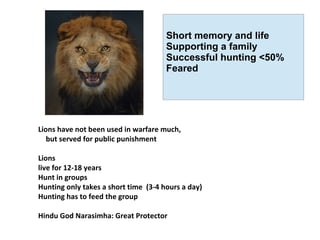
Lions have not been used in warfare much,
but served for public punishment
Lions
live for 12-18 years
Hunt in groups
Hunting only takes a short time (3-4 hours a day)
Hunting has to feed the group
Hindu God Narasimha: Great Protector
Short memory and life
Supporting a family
Successful hunting <50%
Feared
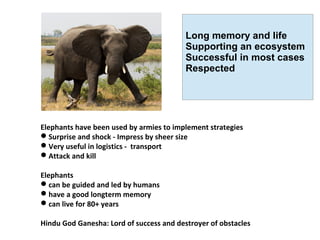
Elephants have been used by armies to implement strategies
Surprise and shock - Impress by sheer size
Very useful in logistics - transport
Attack and kill
Elephants
can be guided and led by humans
have a good longterm memory
can live for 80+ years
Hindu God Ganesha: Lord of success and destroyer of obstacles
Long memory and life
Supporting an ecosystem
Successful in most cases
Respected
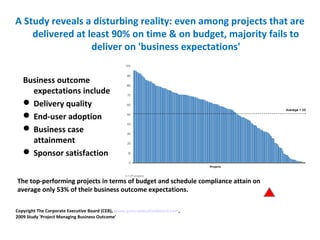
A Study reveals a disturbing reality: even among projects that are
delivered at least 90% on time & on budget, majority fails to
deliver on 'business expectations'
Business outcome
expectations include
 Delivery quality
 End-user adoption
 Business case
attainment
 Sponsor satisfaction
Challenged
53%
Succeeded
29%
Failed
18%
Copyright The Corporate Executive Board (CEB), www.pmo.executiveboard.com,
2009 Study 'Project Managing Business Outcome'
The top-performing projects in terms of budget and schedule compliance attain on
average only 53% of their business outcome expectations.
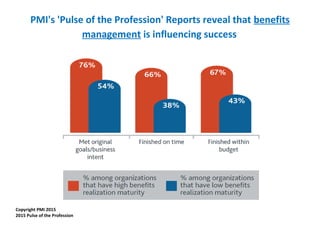
PMI's 'Pulse of the Profession' Reports reveal that benefits
management is influencing success
Copyright PMI 2015
2015 Pulse of the Profession
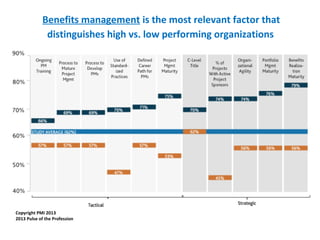
Benefits management is the most relevant factor that
distinguishes high vs. low performing organizations
Copyright PMI 2013
2013 Pulse of the Profession
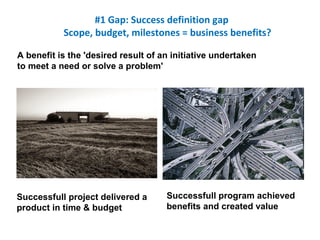
#1 Gap: Success definition gap
Scope, budget, milestones = business benefits?
Successfull project delivered a
product in time & budget
Successfull program achieved
benefits and created value
A benefit is the 'desired result of an initiative undertaken
to meet a need or solve a problem'
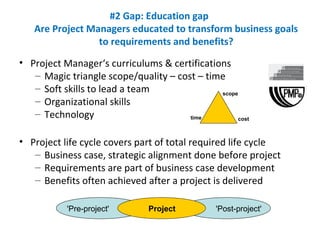
'Pre-project'
#2 Gap: Education gap
Are Project Managers educated to transform business goals
to requirements and benefits?
• Project Manager‘s curriculums & certifications
– Magic triangle scope/quality – cost – time
– Soft skills to lead a team
– Organizational skills
– Technology
• Project life cycle covers part of total required life cycle
– Business case, strategic alignment done before project
– Requirements are part of business case development
– Benefits often achieved after a project is delivered
costtime
scope
'Post-project'Project
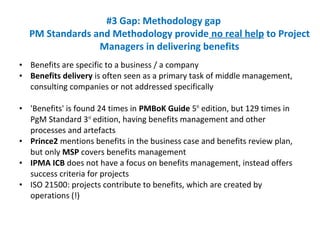
• Benefits are specific to a business / a company
• Benefits delivery is often seen as a primary task of middle management,
consulting companies or not addressed specifically
• 'Benefits' is found 24 times in PMBoK Guide 5th
edition, but 129 times in
PgM Standard 3rd
edition, having benefits management and other
processes and artefacts
• Prince2 mentions benefits in the business case and benefits review plan,
but only MSP covers benefits management
• IPMA ICB does not have a focus on benefits management, instead offers
success criteria for projects
• ISO 21500: projects contribute to benefits, which are created by
operations (!)
#3 Gap: Methodology gap
PM Standards and Methodology provide no real help to Project
Managers in delivering benefits
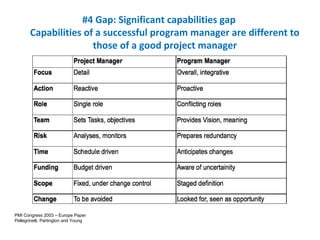
#4 Gap: Significant capabilities gap
Capabilities of a successful program manager are different to
those of a good project manager
PMI Congress 2003 – Europe Paper
Pellegrinelli, Partington and Young
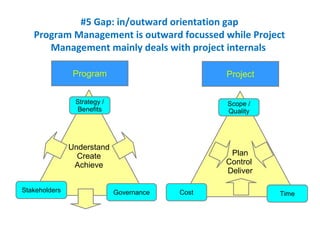
Program Project
Plan
Control
Deliver
Scope /
Quality
TimeCost
Understand
Create
Achieve
Strategy /
Benefits
GovernanceStakeholders
#5 Gap: in/outward orientation gap
Program Management is outward focussed while Project
Management mainly deals with project internals
?
Stake-
holders
(sponsors)
Stake-
holders
(users)
Strategy
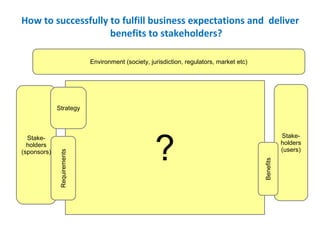
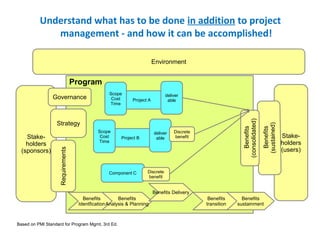
How to successfully to fulfill business expectations and deliver
benefits to stakeholders?
Environment (society, jurisdiction, regulators, market etc)Requirements
Benefits
Program
Stake-
holders
(sponsors)
Requirements
Stake-
holders
(users)
Strategy
Project A
deliver
able
Scope
Cost
Time
Benefits
(sustained)
Benefits
(consolidated)
Project B
deliver
able
Scope
Cost
Time
Discrete
benefit
Benefits
Identfication
Benefits
Analysis & Planning
Benefits
transition
Benefits
sustainment
Benefits Delivery
Understand what has to be done in addition to project
management - and how it can be accomplished!
Component C Discrete
benefit
Environment
Based on PMI Standard for Program Mgmt, 3rd Ed.
Governance
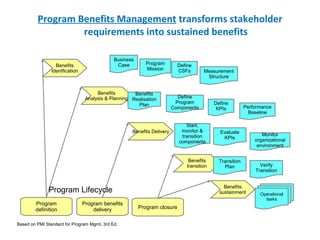
Program Benefits Management transforms stakeholder
requirements into sustained benefits
Based on PMI Standard for Program Mgmt, 3rd Ed.
Benefits
Identfication
Benefits
Analysis & Planning
Benefits
transition
Benefits
sustainment
Benefits Delivery
Business
Case Program
Mission
Define
CSFs Measurement
Structure
Benefits
Realisation
Plan
Define
Program
Components
Define
KPIs Performance
Baseline
Start,
monitor &
transition
components
Evaluate
KPIs
Monitor
organizational
environment
Program
definition
Program benefits
delivery Program closure
Transition
Plan Verify
Transition
Operational
tasks
Program Lifecycle
!
Stake-
holder
Engage-
ment
Stake-
holders
(users)
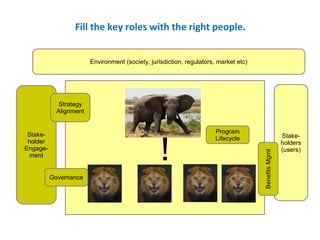
Fill the key roles with the right people.
Environment (society, jurisdiction, regulators, market etc)
BenefitsMgmt
Strategy
Alignment
Governance
Program
Lifecycle
SLF4
Relationship
Management
Specialist
Team
Program Management
SLF3
Organizational
Change
Management
SLF2
Architectual
Solution
Board
SLF7
Test &
Transition
Management
SLF5
Quality
Assurance
/ Risk
SLF6
Program
Mgmt
Office
SLF8
Resource
Management
Oper-
ations
Applic.
Mainten.
User
Help
DeskProject 4
.........Project 1
Operational Layer Functions
(Projects, Teams, Production)
Strategic Layer Functions
Project 3
Project 5
Project 6
Project 2 Enduser
Training
Team
SponsorsStakeholders,
e.g. Users
Business Steering
Committee
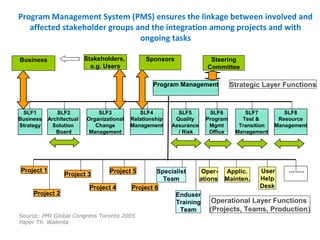
Program Management System (PMS) ensures the linkage between involved and
affected stakeholder groups and the integration among projects and with
ongoing tasks
SLF1
Business
Strategy
Source: PMI Global Congress Toronto 2005
Paper Th. Walenta
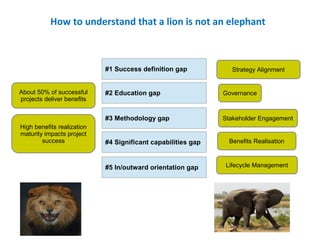
#1 Success definition gap
#2 Education gap
#3 Methodology gap
#4 Significant capabilities gap
#5 In/outward orientation gap
How to understand that a lion is not an elephant
Strategy Alignment
Governance
Stakeholder Engagement
Benefits Realisation
Lifecycle Management
About 50% of successful
projects deliver benefits
High benefits realization
maturity impacts project
success

Project and programme management are 2 different animals Thomas Walenta

  • 1.
    Projects & Programsare two different animals, don't underestimate the gap May 2015, London Thomas Walenta, PgMP, PMP, PMI Fellow thwalenta@online.de
  • 2.
    Lions have notbeen used in warfare much, but served for public punishment Lions live for 12-18 years Hunt in groups Hunting only takes a short time (3-4 hours a day) Hunting has to feed the group Hindu God Narasimha: Great Protector Short memory and life Supporting a family Successful hunting <50% Feared
  • 3.
    Elephants have beenused by armies to implement strategies Surprise and shock - Impress by sheer size Very useful in logistics - transport Attack and kill Elephants can be guided and led by humans have a good longterm memory can live for 80+ years Hindu God Ganesha: Lord of success and destroyer of obstacles Long memory and life Supporting an ecosystem Successful in most cases Respected
  • 4.
    A Study revealsa disturbing reality: even among projects that are delivered at least 90% on time & on budget, majority fails to deliver on 'business expectations' Business outcome expectations include  Delivery quality  End-user adoption  Business case attainment  Sponsor satisfaction Challenged 53% Succeeded 29% Failed 18% Copyright The Corporate Executive Board (CEB), www.pmo.executiveboard.com, 2009 Study 'Project Managing Business Outcome' The top-performing projects in terms of budget and schedule compliance attain on average only 53% of their business outcome expectations.
  • 5.
    PMI's 'Pulse ofthe Profession' Reports reveal that benefits management is influencing success Copyright PMI 2015 2015 Pulse of the Profession
  • 6.
    Benefits management isthe most relevant factor that distinguishes high vs. low performing organizations Copyright PMI 2013 2013 Pulse of the Profession
  • 7.
    #1 Gap: Successdefinition gap Scope, budget, milestones = business benefits? Successfull project delivered a product in time & budget Successfull program achieved benefits and created value A benefit is the 'desired result of an initiative undertaken to meet a need or solve a problem'
  • 8.
    'Pre-project' #2 Gap: Educationgap Are Project Managers educated to transform business goals to requirements and benefits? • Project Manager‘s curriculums & certifications – Magic triangle scope/quality – cost – time – Soft skills to lead a team – Organizational skills – Technology • Project life cycle covers part of total required life cycle – Business case, strategic alignment done before project – Requirements are part of business case development – Benefits often achieved after a project is delivered costtime scope 'Post-project'Project
  • 9.
    • Benefits arespecific to a business / a company • Benefits delivery is often seen as a primary task of middle management, consulting companies or not addressed specifically • 'Benefits' is found 24 times in PMBoK Guide 5th edition, but 129 times in PgM Standard 3rd edition, having benefits management and other processes and artefacts • Prince2 mentions benefits in the business case and benefits review plan, but only MSP covers benefits management • IPMA ICB does not have a focus on benefits management, instead offers success criteria for projects • ISO 21500: projects contribute to benefits, which are created by operations (!) #3 Gap: Methodology gap PM Standards and Methodology provide no real help to Project Managers in delivering benefits
  • 10.
    #4 Gap: Significantcapabilities gap Capabilities of a successful program manager are different to those of a good project manager PMI Congress 2003 – Europe Paper Pellegrinelli, Partington and Young
  • 11.
    Program Project Plan Control Deliver Scope / Quality TimeCost Understand Create Achieve Strategy/ Benefits GovernanceStakeholders #5 Gap: in/outward orientation gap Program Management is outward focussed while Project Management mainly deals with project internals
  • 12.
    ? Stake- holders (sponsors) Stake- holders (users) Strategy How to successfullyto fulfill business expectations and deliver benefits to stakeholders? Environment (society, jurisdiction, regulators, market etc)Requirements Benefits
  • 13.
    Program Stake- holders (sponsors) Requirements Stake- holders (users) Strategy Project A deliver able Scope Cost Time Benefits (sustained) Benefits (consolidated) Project B deliver able Scope Cost Time Discrete benefit Benefits Identfication Benefits Analysis& Planning Benefits transition Benefits sustainment Benefits Delivery Understand what has to be done in addition to project management - and how it can be accomplished! Component C Discrete benefit Environment Based on PMI Standard for Program Mgmt, 3rd Ed. Governance
  • 14.
    Program Benefits Managementtransforms stakeholder requirements into sustained benefits Based on PMI Standard for Program Mgmt, 3rd Ed. Benefits Identfication Benefits Analysis & Planning Benefits transition Benefits sustainment Benefits Delivery Business Case Program Mission Define CSFs Measurement Structure Benefits Realisation Plan Define Program Components Define KPIs Performance Baseline Start, monitor & transition components Evaluate KPIs Monitor organizational environment Program definition Program benefits delivery Program closure Transition Plan Verify Transition Operational tasks Program Lifecycle
  • 15.
    ! Stake- holder Engage- ment Stake- holders (users) Fill the keyroles with the right people. Environment (society, jurisdiction, regulators, market etc) BenefitsMgmt Strategy Alignment Governance Program Lifecycle
  • 16.
    SLF4 Relationship Management Specialist Team Program Management SLF3 Organizational Change Management SLF2 Architectual Solution Board SLF7 Test & Transition Management SLF5 Quality Assurance /Risk SLF6 Program Mgmt Office SLF8 Resource Management Oper- ations Applic. Mainten. User Help DeskProject 4 .........Project 1 Operational Layer Functions (Projects, Teams, Production) Strategic Layer Functions Project 3 Project 5 Project 6 Project 2 Enduser Training Team SponsorsStakeholders, e.g. Users Business Steering Committee Program Management System (PMS) ensures the linkage between involved and affected stakeholder groups and the integration among projects and with ongoing tasks SLF1 Business Strategy Source: PMI Global Congress Toronto 2005 Paper Th. Walenta
  • 17.
    #1 Success definitiongap #2 Education gap #3 Methodology gap #4 Significant capabilities gap #5 In/outward orientation gap How to understand that a lion is not an elephant Strategy Alignment Governance Stakeholder Engagement Benefits Realisation Lifecycle Management About 50% of successful projects deliver benefits High benefits realization maturity impacts project success