FOUR-LEVEL PROTECTION VOTING
MACHINE WITH DEEP LEARNING
PERSON IDENTIFICATION
ABSTRACT
 Voting machines are the total combination of mechanical,
electromechanical, or electronic equipment (including software,
firmware, and documentation required to program control, and
support equipment), that is used to define ballots; to cast and count
votes; to report or display election results; and to maintain and
produce any audit trail information. The first voting machines were
mechanical but it is increasingly more common to use electronic
voting machines. Moreover it is also important that a false entry
should not be made so for this one of the most secure methods for
voting is using a biometric sensor like a fingerprint reader. In this
project we will be using a Fingerprint reader for providing access to
the voter as well as making a log if the person has voted or not.
 KEYWORDS: VOTING, IoT, wireless.
INTRODUCTION
 The Four-Level Protection Voting Machine with Deep Learning Person
Identification using RFID Technology is an innovative project designed to
enhance the security, accuracy, and efficiency of the voting process. This
advanced system integrates four layers of protection mechanisms, ensuring
a robust defense against unauthorized access and tampering. Leveraging
RFID technology, the system offers secure and streamlined authentication
of voters while employing deep learning algorithms to accurately identify
individuals. This integration of cutting-edge technologies aims to
revolutionize the conventional voting system, providing a more secure,
reliable, and inclusive electoral experience for all stakeholders involved.
SCOPE OF THE PROJECT:
 The main scope of this project is to make full encryption for voting machine. There are
four level protection in this voting machine.
EXISTING SYSTEM
 Votes are casted by just pressing a button.
 It does not have security features.
EXISTING SYSTEM DISADVANTAGES
 Casting false votes are possible.
 Finding Non-eligible candidates is difficult.
 In today method doesn’t provide the security.
LITERATURE SURVEY
 Title 1: Design and Implementation of Arduino Based Voting Machine
 Authors: Santosh Kumar Shaw, Sashank Poddar, Vivek Singh, Sudip Dogra
 Year: 2018
 Description:
 India being the largest democracy faces a lot of issues during elections. Lot of controversies are
reported about voting system, voting machines, authentication of voting, corruptions during
elections etc [1]. In our paper we have described a secured system that can eliminate such
controversies involving elections in our country. In our present work we have developed a
prototype and tested successfully an Arduino UNO based Aadhar facilitated electronic voting
machine possessing a Two-Tier fingerprint security. The main purpose of this system is to give a
straight and fair elections and to curb all other factors that affect it, this goal has been achieved by
providing dual verification of the voters based on their fingerprint and unique id. In this System
all the relevant information are taken from the voters and are stored in the database, then they are
provided with unique ID. The process of verification involves matching of this id and fingerprint
from the database. This is a faster and more secured way of holding elections. Our system is
secured, reliable and also cost- effective.
 Title 2 HCA: Hashchain-based Consensus Acceleration via Re-voting
 Authors: Zijian Zhang, Xuyang Liu, Meng Li, Hao Yin, Liehuang Zhu, Bakh Khoussainov, and Keke
Gai
 Year: 2021
 Description:
 —In the context of consortium blockchain, consensus protocols set permission mechanisms to maintain a
relatively fixed group of participants. They can easily use distributed consistent algorithms for achieving
deterministic and efficient consensus and generate incessant blocks as the ledger. However, most of the
existing consensus protocols do not sufficiently leverage the chain structure of blocks, and therefore
leaving room for performance improvement. In this paper, we first propose a Hashchain-based
Consensus Acceleration (HCA) protocol. The HCA protocol enables a leader to generate blocks that
contain a quorum of votes on the previous block, and allow voters to re-vote for accelerating the block
generation to Byzantine Fault Tolerance (BFT) consensus protocols. Then, we present a rolling-based
leader selection (RLS) scheme to further optimize the HCA protocol. In the RLS scheme, the leader is
changed in a round-robin fashion. Finally, theoretical analysis proves the safety, liveness and
responsiveness of the optimized HCA protocol, while experimental evaluation shows that the optimized
HCA protocol outperforms the existing BFT consensus protocols, from the viewpoint of efficiency.
 Title 3: Prototyping of Indian Electronic Voting Machine
 Authors: Tushar Puri, Jaspreet Singh, Hemant Kaushal
 Year: 2017
 Description:
 The Voting System of a country consists of certain regulations which define how the
preference of people is collected and how outcome of the polling process is indicating the will of
people. To implement such a system in the largest democracy in the world is a cumbersome task. An
indigenous Electronic Voting Machine was introduced by the Election Commission of India to
overcome the issues with manual voting which was slower and inefficient. In this paper the Indian
Electronic Voting Machine’s Protocol for voting is implemented on a field programmable gate array.
The ASIC based design is known to be faster than a microcontroller based design. Furthermore the
use of an ASIC based design will make the Electronic Voting Machine a more reliable and tamper
resistant machine. The new Voter-verified paper audit trail (VVPAT) system could also be interfaced
with the ASIC based design. The protocol of Indian Electronic Voting Machine has been successfully
implemented on a Basys 2 board using Verilog HDL. The FPGA based implementation gets half the
job done for ASIC based EVM. The tool used for simulation and implementation is Xilinx ISE Design
Suite with ISim as a Simulator
 Title 4: Smart Online Voting System
 Authors: Ganesh Prabhu S, Nizarahammed.A, Prabu.S, Raghul.S
 Year: 2021
 Description:
 —Our country, India is the largest democratic country in the world. So it is essential to make
sure that the governing body is elected through a fair election. India has only offline voting system
which is not effective and upto the mark as it requires large man force and it also requires more time to
process and publish the results. Therefore, to be made effective, the system needs a change, which
overcomes these disadvantages. The new method does not force the person's physical appearance to
vote, which makes the things easier. This paper focusses on a system where the user can vote remotely
from anywhere using his/her computer or mobile phone and doesn’t require the voter to got to the
polling station through two step authentication of face recognition and OTP system. This project also
allows the user to vote offline as well if he/she feels that is comfortable. The face scanning system is
used to record the voters face prior to the election and is useful at the time of voting. The offline voting
system is improvised with the help of RFID tags instead of voter id. This system also enables the user
the citizens to see the results anytime which can avoid situations that pave way to vote tampering.
 Title 5: Election Voting Machine - A Review
 Authors: Sanket M. Gawade, Ninad S. Mandavkar, Sanket S. Mane, Chinmayee N. Manjarekar
 Year: 2017
 Description:
 — Electronic Voting Machine (EVM) is a simple electronic machine used to record votes in place of
ballot papers and boxes which were used earlier in conventional voting system. The problem with
conventional voting machine is unreliable use of ballot papers which makes process time consuming
and costlier. These problems solved by using biometrics identifier which is more reliable for person
identification than traditional voting technology methods. The focus of this paper is to summarize the
emerging election voting machine, presents these new election voting machine and survey the recent
trends for EVM for advance voting machine. This paper also discusses the issues and comparison
among the different voting machines.
PROPOSED METHOD
 Votes are cast using fingerprints.
 Biometric security feature is implemented and uploaded data to the cloud
using GSM module.
 The face identification give the extra security protection for the voting
machine.
PROPOSED METHOD ADVANTAGES:
 No chance of casting false votes.
 Only the eligible candidates can caste vote.
 Four level security give the more responsible for the security losses
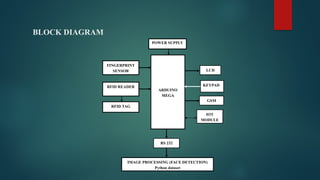
BLOCK DIAGRAM
ARDUINO
MEGA
POWER SUPPLY
GSM
FINGERPRINT
SENSOR LCD
RFID READER
RFID TAG
KEYPAD
RS 232
IOT
MODULE
IMAGE PROCESSING (FACE DETECTION)
Python dataset
MODULES NAME
 Biometric system
 Messaging system
 Updating data to IOT
MODULE DESCRIPTION
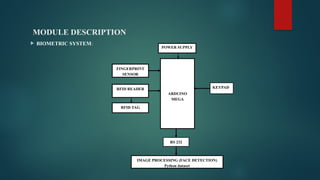
 BIOMETRIC SYSTEM:
ARDUINO
MEGA
POWER SUPPLY
FINGERPRINT
SENSOR
RFID READER
RFID TAG
KEYPAD
RS 232
IMAGE PROCESSING (FACE DETECTION)
Python dataset
 In this part, ARDUINO MEGA microcontroller is used to control all over
system. RFID TAG acts as a voter ID card. To take fingerprint authentication,
we use fingerprint sensor here. Python image processing helps for face
recognition. Keypad is used to put the votes for particular parties.
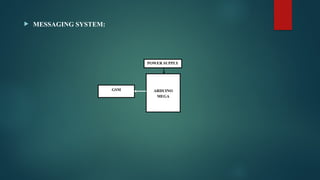
 MESSAGING SYSTEM:
ARDUINO
MEGA
POWER SUPPLY
GSM
 In this section, ARDUINO MEGA microcontroller controlls all over system.
GLOBAL SYSTEM FOR MOBILE COMMUNICATION (GSM) is used to send
vote confirmation message to voters or to send alert message to management if
unauthorized votes detected.
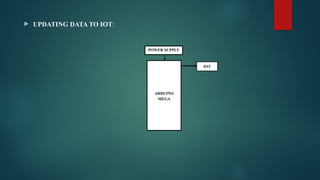
 UPDATING DATA TO IOT:
ARDUINO
MEGA
POWER SUPPLY
IOT
 In this section, ARDUINO MEGA microcontroller controlls all over system. We
will manage the database using a open source online website for this system. We
will store voting details to this webpage using IOT technology.
BLOCK DIAGRAM DESCRIPTION AND WORKING
 In our system, we have Arduino mega microcontroller which acts as brain of our
system, hence entire system program is stored in it. Initially each voter has unique
ID i.e. RFID which is accessed by reader, then he/she has to place thumb on
fingerprint sensor if that ID and finger matched and the image processing used to
detect the voters face ID and confirmed the voter identification means the voter
will receive conformation message to his/her registered mobile number via GSM,
they have to type it through keypad, then they can vote for favorable candidate by
keypad, switch is used to send the vote count to the controller via GSM. The IoT
module is used to monitor the voting status and control the voting machine.
APPLICATIONS
 This system is used to secure the voting system for making the
country leader selection more acceptable.
FUTURE ENHANCEMENT:
 We can develop a user-friendly interface with multilingual options, audio
guidance, and accessibility features to ensure that all voters, including those with
disabilities, can easily navigate and participate in the voting process.
ADVANTAGES:
 We can prevent unauthorized votes.
 Time efficiency.
CONCLUSION
 In conclusion, the integration of an Arduino Mega microcontroller as the central
processing unit forms the core of this innovative voting system. The multi-step
identification process involving RFID, fingerprint, and facial recognition
technologies ensures a highly secure and accurate verification of voters. The
seamless communication through GSM technology, coupled with IoT integration
for real-time monitoring, enhances transparency and accessibility in the electoral
process. This project not only modernizes traditional voting methods but also
emphasizes the significance of robust security measures and technological
advancements in the realm of democratic participation.
REFERENCES OR BIBLIOGRAPHY:
 [1] Z. Zheng, S. Xie, H. Dai, X. Chen, and H. Wang, “An overview of blockchain technology:
Architecture, consensus, and future trends,” in 2017 IEEE international congress on big data (BigData
congress). IEEE, 2017, pp. 557–564.
 [2] G.-T. Nguyen and K. Kim, “A survey about consensus algorithms used in blockchain.” Journal of
Information processing systems, vol. 14, no. 1, 2018.
 [3] S. Bano, A. Sonnino, M. Al-Bassam, S. Azouvi, P. McCorry, S. Meiklejohn, and G. Danezis,
“Sok: Consensus in the age of blockchains,” in Proceedings of the 1st ACM Conference on Advances
in Financial Technologies, 2019, pp. 183–198. [4] S. Nakamoto and A. Bitcoin, “A peer-to-peer
electronic cash system,” Bitcoin.–URL: https://bitcoin. org/bitcoin. pdf, vol. 4, 2008.
 [5] A. M. Antonopoulos, Mastering Bitcoin: Programming the open blockchain. ” O’Reilly Media,
Inc.”, 2017.
 [6] V. Gramoli, “From blockchain consensus back to byzantine consensus,” Future Generation
Computer Systems, vol. 107, pp. 760–769, 2020.
 [7] M. Castro, B. Liskov et al., “Practical byzantine fault tolerance,” in OSDI, vol. 99, no. 1999, 1999,
pp. 173–186.
 [8] E. Buchman, “Tendermint: Byzantine fault tolerance in the age of blockchains,” Ph.D. dissertation,
2016.
 [9] G. Wood et al., “Ethereum: A secure decentralised generalised transaction ledger,” Ethereum project
yellow paper, vol. 151, no. 2014, pp. 1–32, 2014.
 [10] D. Schwartz, N. Youngs, A. Britto et al., “The ripple protocol consensus algorithm,” Ripple Labs
Inc White Paper, vol. 5, no. 8, 2014.

project _ for level protected voting machine_PPT.pptx

  • 1.
    FOUR-LEVEL PROTECTION VOTING MACHINEWITH DEEP LEARNING PERSON IDENTIFICATION
  • 2.
    ABSTRACT  Voting machinesare the total combination of mechanical, electromechanical, or electronic equipment (including software, firmware, and documentation required to program control, and support equipment), that is used to define ballots; to cast and count votes; to report or display election results; and to maintain and produce any audit trail information. The first voting machines were mechanical but it is increasingly more common to use electronic voting machines. Moreover it is also important that a false entry should not be made so for this one of the most secure methods for voting is using a biometric sensor like a fingerprint reader. In this project we will be using a Fingerprint reader for providing access to the voter as well as making a log if the person has voted or not.  KEYWORDS: VOTING, IoT, wireless.
  • 3.
    INTRODUCTION  The Four-LevelProtection Voting Machine with Deep Learning Person Identification using RFID Technology is an innovative project designed to enhance the security, accuracy, and efficiency of the voting process. This advanced system integrates four layers of protection mechanisms, ensuring a robust defense against unauthorized access and tampering. Leveraging RFID technology, the system offers secure and streamlined authentication of voters while employing deep learning algorithms to accurately identify individuals. This integration of cutting-edge technologies aims to revolutionize the conventional voting system, providing a more secure, reliable, and inclusive electoral experience for all stakeholders involved.
  • 4.
    SCOPE OF THEPROJECT:  The main scope of this project is to make full encryption for voting machine. There are four level protection in this voting machine.
  • 5.
    EXISTING SYSTEM  Votesare casted by just pressing a button.  It does not have security features.
  • 6.
    EXISTING SYSTEM DISADVANTAGES Casting false votes are possible.  Finding Non-eligible candidates is difficult.  In today method doesn’t provide the security.
  • 7.
    LITERATURE SURVEY  Title1: Design and Implementation of Arduino Based Voting Machine  Authors: Santosh Kumar Shaw, Sashank Poddar, Vivek Singh, Sudip Dogra  Year: 2018  Description:  India being the largest democracy faces a lot of issues during elections. Lot of controversies are reported about voting system, voting machines, authentication of voting, corruptions during elections etc [1]. In our paper we have described a secured system that can eliminate such controversies involving elections in our country. In our present work we have developed a prototype and tested successfully an Arduino UNO based Aadhar facilitated electronic voting machine possessing a Two-Tier fingerprint security. The main purpose of this system is to give a straight and fair elections and to curb all other factors that affect it, this goal has been achieved by providing dual verification of the voters based on their fingerprint and unique id. In this System all the relevant information are taken from the voters and are stored in the database, then they are provided with unique ID. The process of verification involves matching of this id and fingerprint from the database. This is a faster and more secured way of holding elections. Our system is secured, reliable and also cost- effective.
  • 8.
     Title 2HCA: Hashchain-based Consensus Acceleration via Re-voting  Authors: Zijian Zhang, Xuyang Liu, Meng Li, Hao Yin, Liehuang Zhu, Bakh Khoussainov, and Keke Gai  Year: 2021  Description:  —In the context of consortium blockchain, consensus protocols set permission mechanisms to maintain a relatively fixed group of participants. They can easily use distributed consistent algorithms for achieving deterministic and efficient consensus and generate incessant blocks as the ledger. However, most of the existing consensus protocols do not sufficiently leverage the chain structure of blocks, and therefore leaving room for performance improvement. In this paper, we first propose a Hashchain-based Consensus Acceleration (HCA) protocol. The HCA protocol enables a leader to generate blocks that contain a quorum of votes on the previous block, and allow voters to re-vote for accelerating the block generation to Byzantine Fault Tolerance (BFT) consensus protocols. Then, we present a rolling-based leader selection (RLS) scheme to further optimize the HCA protocol. In the RLS scheme, the leader is changed in a round-robin fashion. Finally, theoretical analysis proves the safety, liveness and responsiveness of the optimized HCA protocol, while experimental evaluation shows that the optimized HCA protocol outperforms the existing BFT consensus protocols, from the viewpoint of efficiency.
  • 9.
     Title 3:Prototyping of Indian Electronic Voting Machine  Authors: Tushar Puri, Jaspreet Singh, Hemant Kaushal  Year: 2017  Description:  The Voting System of a country consists of certain regulations which define how the preference of people is collected and how outcome of the polling process is indicating the will of people. To implement such a system in the largest democracy in the world is a cumbersome task. An indigenous Electronic Voting Machine was introduced by the Election Commission of India to overcome the issues with manual voting which was slower and inefficient. In this paper the Indian Electronic Voting Machine’s Protocol for voting is implemented on a field programmable gate array. The ASIC based design is known to be faster than a microcontroller based design. Furthermore the use of an ASIC based design will make the Electronic Voting Machine a more reliable and tamper resistant machine. The new Voter-verified paper audit trail (VVPAT) system could also be interfaced with the ASIC based design. The protocol of Indian Electronic Voting Machine has been successfully implemented on a Basys 2 board using Verilog HDL. The FPGA based implementation gets half the job done for ASIC based EVM. The tool used for simulation and implementation is Xilinx ISE Design Suite with ISim as a Simulator
  • 10.
     Title 4:Smart Online Voting System  Authors: Ganesh Prabhu S, Nizarahammed.A, Prabu.S, Raghul.S  Year: 2021  Description:  —Our country, India is the largest democratic country in the world. So it is essential to make sure that the governing body is elected through a fair election. India has only offline voting system which is not effective and upto the mark as it requires large man force and it also requires more time to process and publish the results. Therefore, to be made effective, the system needs a change, which overcomes these disadvantages. The new method does not force the person's physical appearance to vote, which makes the things easier. This paper focusses on a system where the user can vote remotely from anywhere using his/her computer or mobile phone and doesn’t require the voter to got to the polling station through two step authentication of face recognition and OTP system. This project also allows the user to vote offline as well if he/she feels that is comfortable. The face scanning system is used to record the voters face prior to the election and is useful at the time of voting. The offline voting system is improvised with the help of RFID tags instead of voter id. This system also enables the user the citizens to see the results anytime which can avoid situations that pave way to vote tampering.
  • 11.
     Title 5:Election Voting Machine - A Review  Authors: Sanket M. Gawade, Ninad S. Mandavkar, Sanket S. Mane, Chinmayee N. Manjarekar  Year: 2017  Description:  — Electronic Voting Machine (EVM) is a simple electronic machine used to record votes in place of ballot papers and boxes which were used earlier in conventional voting system. The problem with conventional voting machine is unreliable use of ballot papers which makes process time consuming and costlier. These problems solved by using biometrics identifier which is more reliable for person identification than traditional voting technology methods. The focus of this paper is to summarize the emerging election voting machine, presents these new election voting machine and survey the recent trends for EVM for advance voting machine. This paper also discusses the issues and comparison among the different voting machines.
  • 12.
    PROPOSED METHOD  Votesare cast using fingerprints.  Biometric security feature is implemented and uploaded data to the cloud using GSM module.  The face identification give the extra security protection for the voting machine.
  • 13.
    PROPOSED METHOD ADVANTAGES: No chance of casting false votes.  Only the eligible candidates can caste vote.  Four level security give the more responsible for the security losses
  • 14.
    BLOCK DIAGRAM ARDUINO MEGA POWER SUPPLY GSM FINGERPRINT SENSORLCD RFID READER RFID TAG KEYPAD RS 232 IOT MODULE IMAGE PROCESSING (FACE DETECTION) Python dataset
  • 15.
    MODULES NAME  Biometricsystem  Messaging system  Updating data to IOT
  • 16.
    MODULE DESCRIPTION  BIOMETRICSYSTEM: ARDUINO MEGA POWER SUPPLY FINGERPRINT SENSOR RFID READER RFID TAG KEYPAD RS 232 IMAGE PROCESSING (FACE DETECTION) Python dataset
  • 17.
     In thispart, ARDUINO MEGA microcontroller is used to control all over system. RFID TAG acts as a voter ID card. To take fingerprint authentication, we use fingerprint sensor here. Python image processing helps for face recognition. Keypad is used to put the votes for particular parties.
  • 18.
  • 19.
     In thissection, ARDUINO MEGA microcontroller controlls all over system. GLOBAL SYSTEM FOR MOBILE COMMUNICATION (GSM) is used to send vote confirmation message to voters or to send alert message to management if unauthorized votes detected.
  • 20.
     UPDATING DATATO IOT: ARDUINO MEGA POWER SUPPLY IOT
  • 21.
     In thissection, ARDUINO MEGA microcontroller controlls all over system. We will manage the database using a open source online website for this system. We will store voting details to this webpage using IOT technology.
  • 22.
    BLOCK DIAGRAM DESCRIPTIONAND WORKING  In our system, we have Arduino mega microcontroller which acts as brain of our system, hence entire system program is stored in it. Initially each voter has unique ID i.e. RFID which is accessed by reader, then he/she has to place thumb on fingerprint sensor if that ID and finger matched and the image processing used to detect the voters face ID and confirmed the voter identification means the voter will receive conformation message to his/her registered mobile number via GSM, they have to type it through keypad, then they can vote for favorable candidate by keypad, switch is used to send the vote count to the controller via GSM. The IoT module is used to monitor the voting status and control the voting machine.
  • 23.
    APPLICATIONS  This systemis used to secure the voting system for making the country leader selection more acceptable.
  • 24.
    FUTURE ENHANCEMENT:  Wecan develop a user-friendly interface with multilingual options, audio guidance, and accessibility features to ensure that all voters, including those with disabilities, can easily navigate and participate in the voting process.
  • 25.
    ADVANTAGES:  We canprevent unauthorized votes.  Time efficiency.
  • 26.
    CONCLUSION  In conclusion,the integration of an Arduino Mega microcontroller as the central processing unit forms the core of this innovative voting system. The multi-step identification process involving RFID, fingerprint, and facial recognition technologies ensures a highly secure and accurate verification of voters. The seamless communication through GSM technology, coupled with IoT integration for real-time monitoring, enhances transparency and accessibility in the electoral process. This project not only modernizes traditional voting methods but also emphasizes the significance of robust security measures and technological advancements in the realm of democratic participation.
  • 27.
    REFERENCES OR BIBLIOGRAPHY: [1] Z. Zheng, S. Xie, H. Dai, X. Chen, and H. Wang, “An overview of blockchain technology: Architecture, consensus, and future trends,” in 2017 IEEE international congress on big data (BigData congress). IEEE, 2017, pp. 557–564.  [2] G.-T. Nguyen and K. Kim, “A survey about consensus algorithms used in blockchain.” Journal of Information processing systems, vol. 14, no. 1, 2018.  [3] S. Bano, A. Sonnino, M. Al-Bassam, S. Azouvi, P. McCorry, S. Meiklejohn, and G. Danezis, “Sok: Consensus in the age of blockchains,” in Proceedings of the 1st ACM Conference on Advances in Financial Technologies, 2019, pp. 183–198. [4] S. Nakamoto and A. Bitcoin, “A peer-to-peer electronic cash system,” Bitcoin.–URL: https://bitcoin. org/bitcoin. pdf, vol. 4, 2008.  [5] A. M. Antonopoulos, Mastering Bitcoin: Programming the open blockchain. ” O’Reilly Media, Inc.”, 2017.
  • 28.
     [6] V.Gramoli, “From blockchain consensus back to byzantine consensus,” Future Generation Computer Systems, vol. 107, pp. 760–769, 2020.  [7] M. Castro, B. Liskov et al., “Practical byzantine fault tolerance,” in OSDI, vol. 99, no. 1999, 1999, pp. 173–186.  [8] E. Buchman, “Tendermint: Byzantine fault tolerance in the age of blockchains,” Ph.D. dissertation, 2016.  [9] G. Wood et al., “Ethereum: A secure decentralised generalised transaction ledger,” Ethereum project yellow paper, vol. 151, no. 2014, pp. 1–32, 2014.  [10] D. Schwartz, N. Youngs, A. Britto et al., “The ripple protocol consensus algorithm,” Ripple Labs Inc White Paper, vol. 5, no. 8, 2014.