Module
2
Smart Objects: The “Things” in IoT
⚫Sensors are fundamental building blocks of IoT networks
⚫Sensors are the foundational elements found in
smart objects—the “things” in the Internet of Things
⚫Smart objects are any physical objects that contain
embedded technology to sense and/or interact
with their environment in a meaningful way by
being interconnected and enabling
communication among themselves or an
external agent.
SENSORS, ACTUATORS, AND SMART
OBJECTS
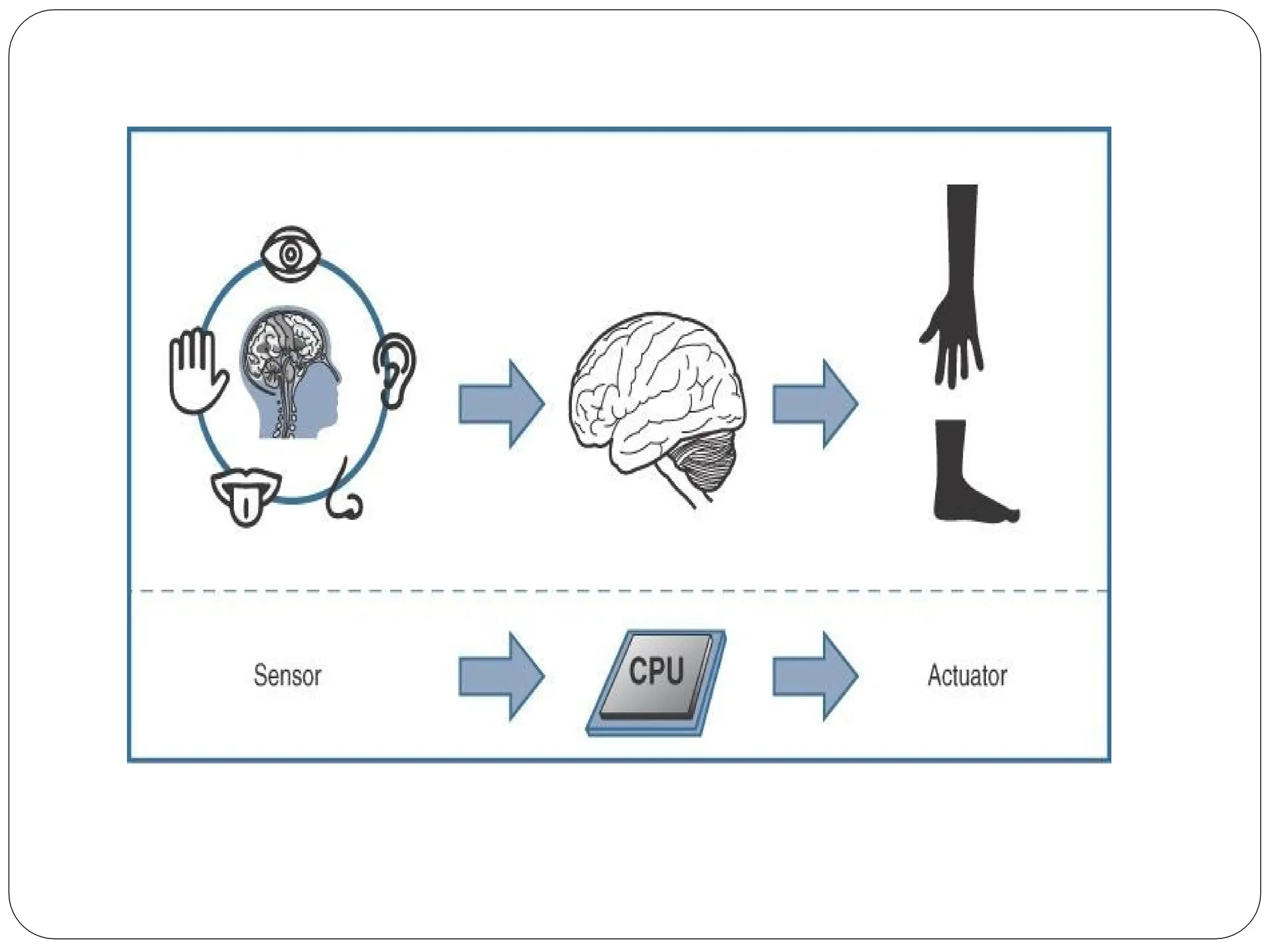
⚫A sensor: It senses
⚫More specifically, a sensor measures some physical
quantity and converts that measurement reading
into a digital representation.
⚫That digital representation is typically passed to
another device for transformation into useful data
that can be consumed by intelligent devices or
humans
⚫Sensors are not limited to human-like sensory data.
⚫They are able to provide an extremely wide spectrum of
rich and diverse measurement data with far greater
precision than human senses
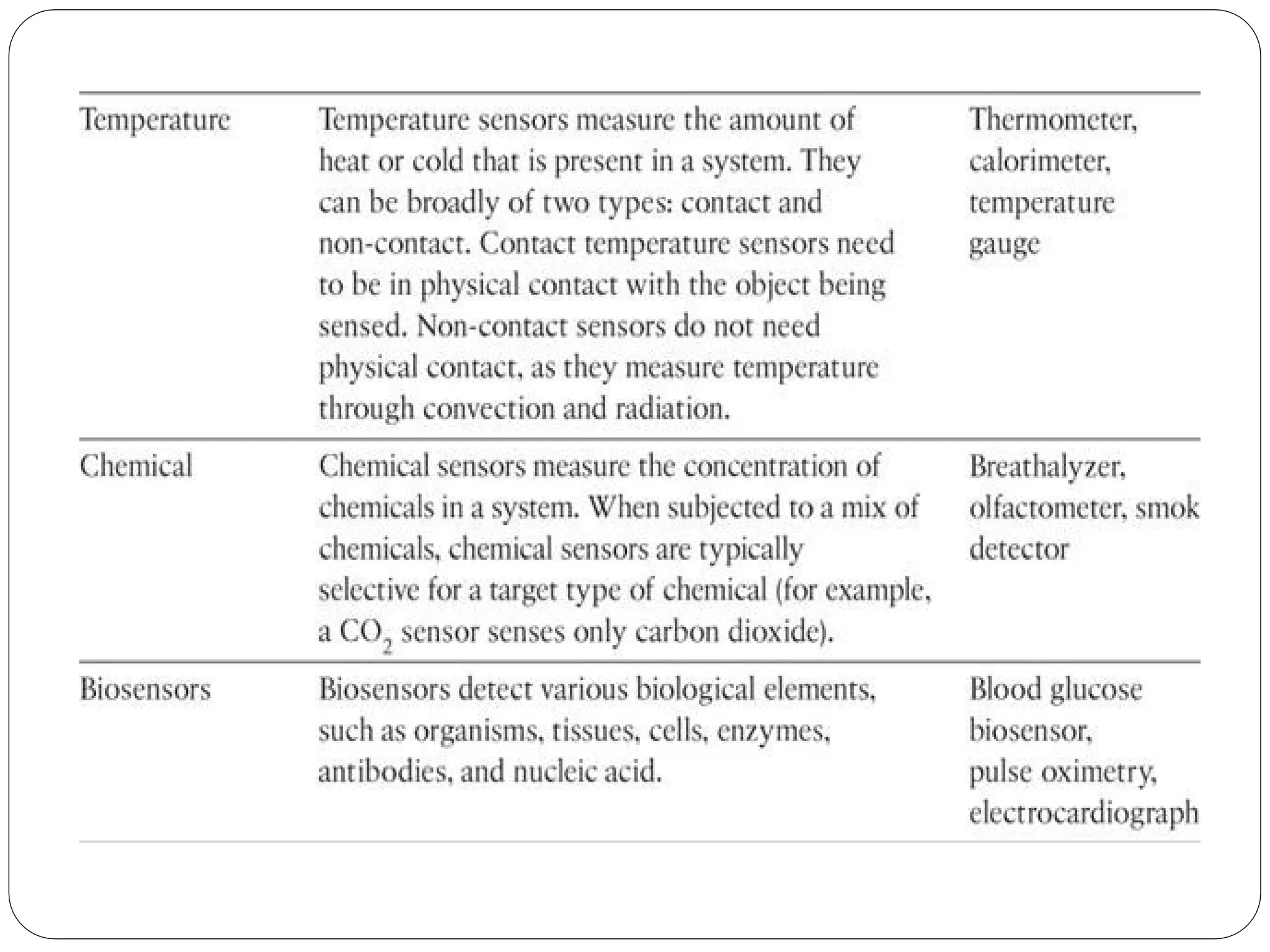
Categorie
s
⚫Active or passive:
⚫Sensors can be categorized based on whether they produce
an energy output and typically require an external
power supply (active) or
⚫Whether they simply receive energy and typically require
no external power supply (passive).
⚫Invasive or non-invasive:
⚫Sensors can be categorized based on whether a sensor is
part of the environment it is measuring (invasive) or
⚫External to it (non-invasive).
⚫Contact or no-contact:
⚫Sensors can be categorized based on whether they
require physical contact with what they are
measuring (contact) or not (no-contact).
⚫Absolute or relative:
⚫Sensors can be categorized based on whether they
measure on an absolute scale (absolute) or based on
a difference with a fixed or variable reference value
(relative).
⚫Area of application:
⚫Sensors can be categorized based on the specific industry
or vertical where they are being used.
⚫How sensors measure:
⚫Sensors can be categorized based on the physical
mechanism used to measure sensory input (for
example, thermoelectric, electrochemical, piezoresistive, optic,
electric, fluid mechanic, photoelastic).
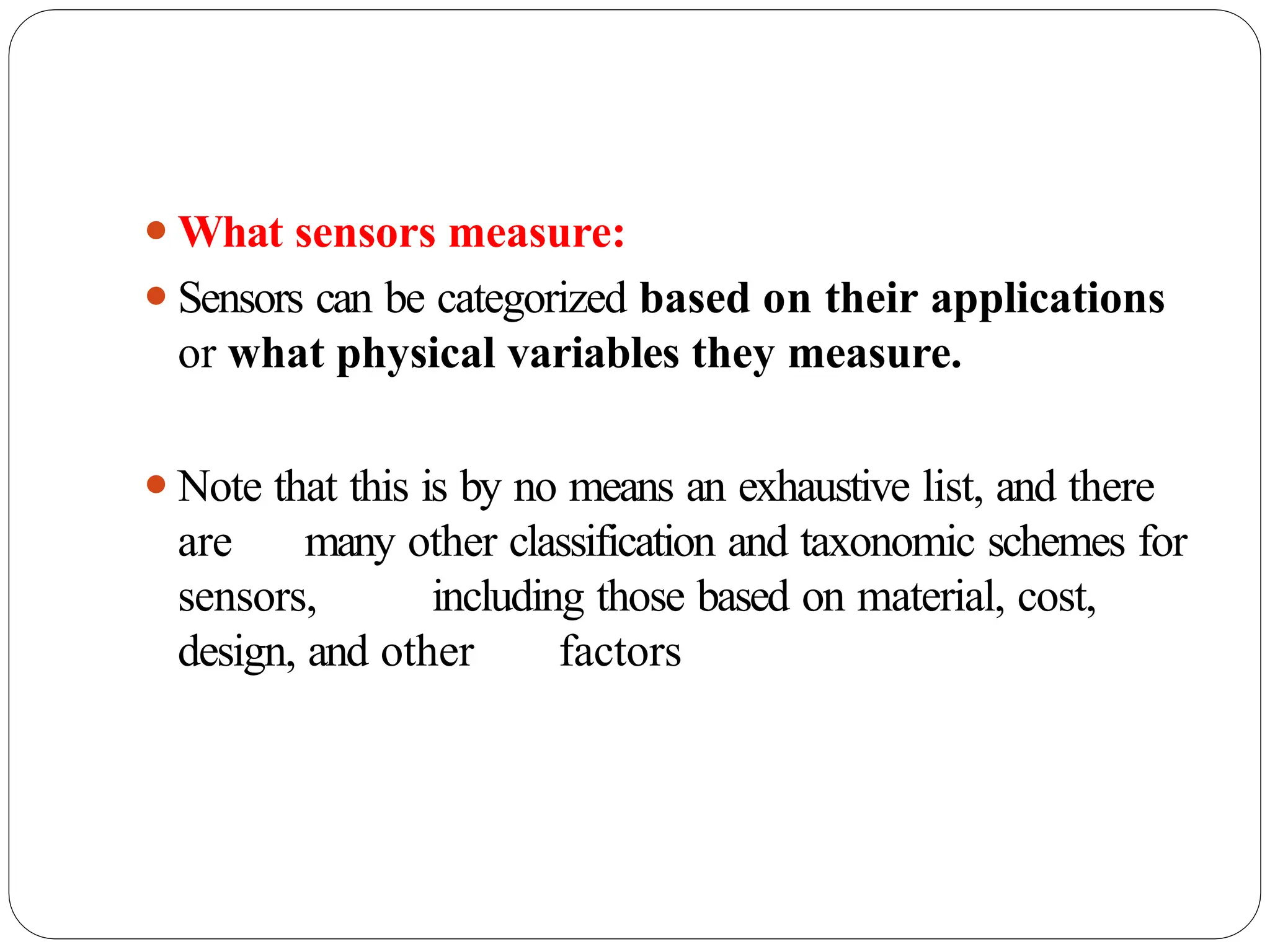
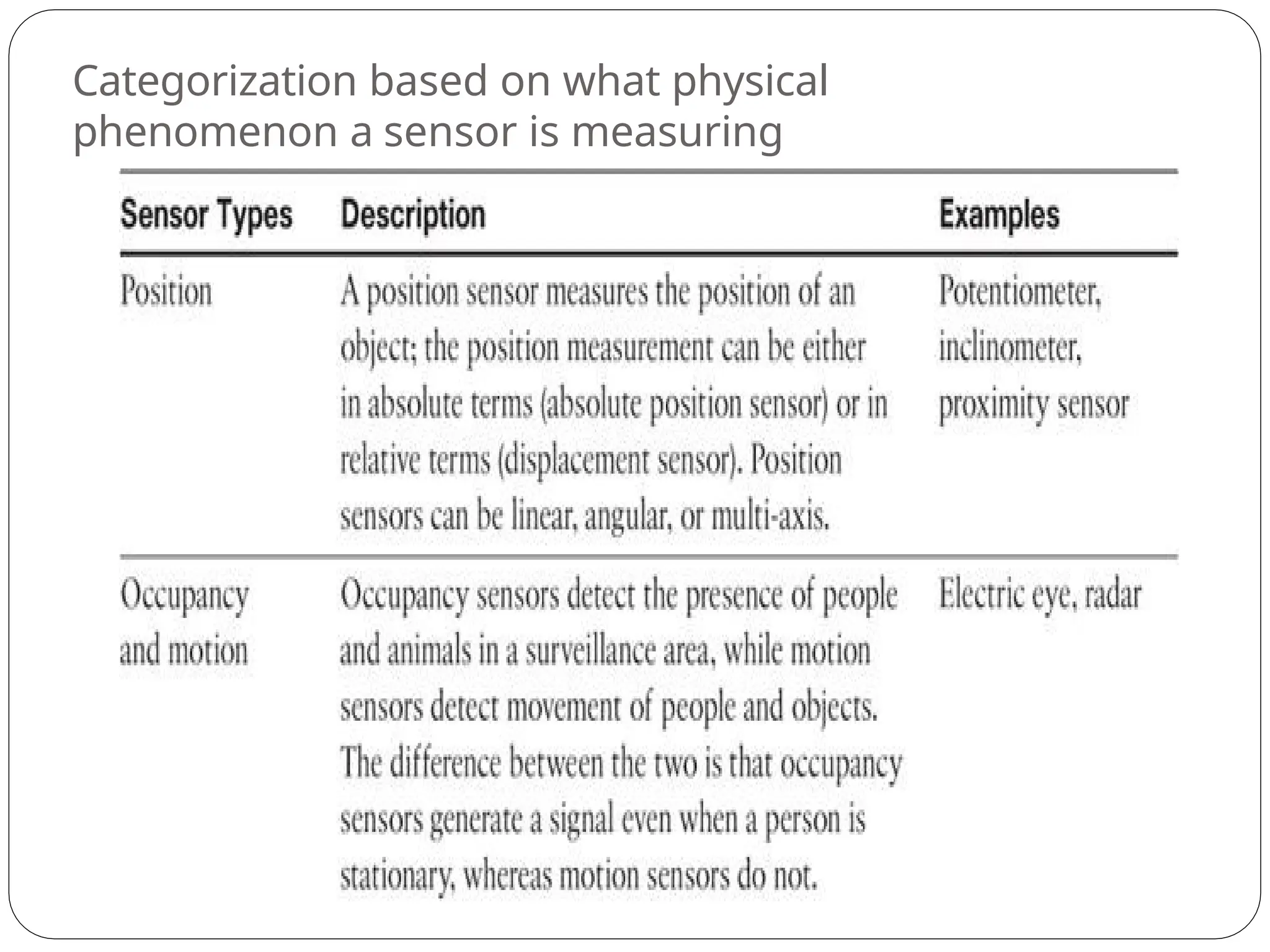
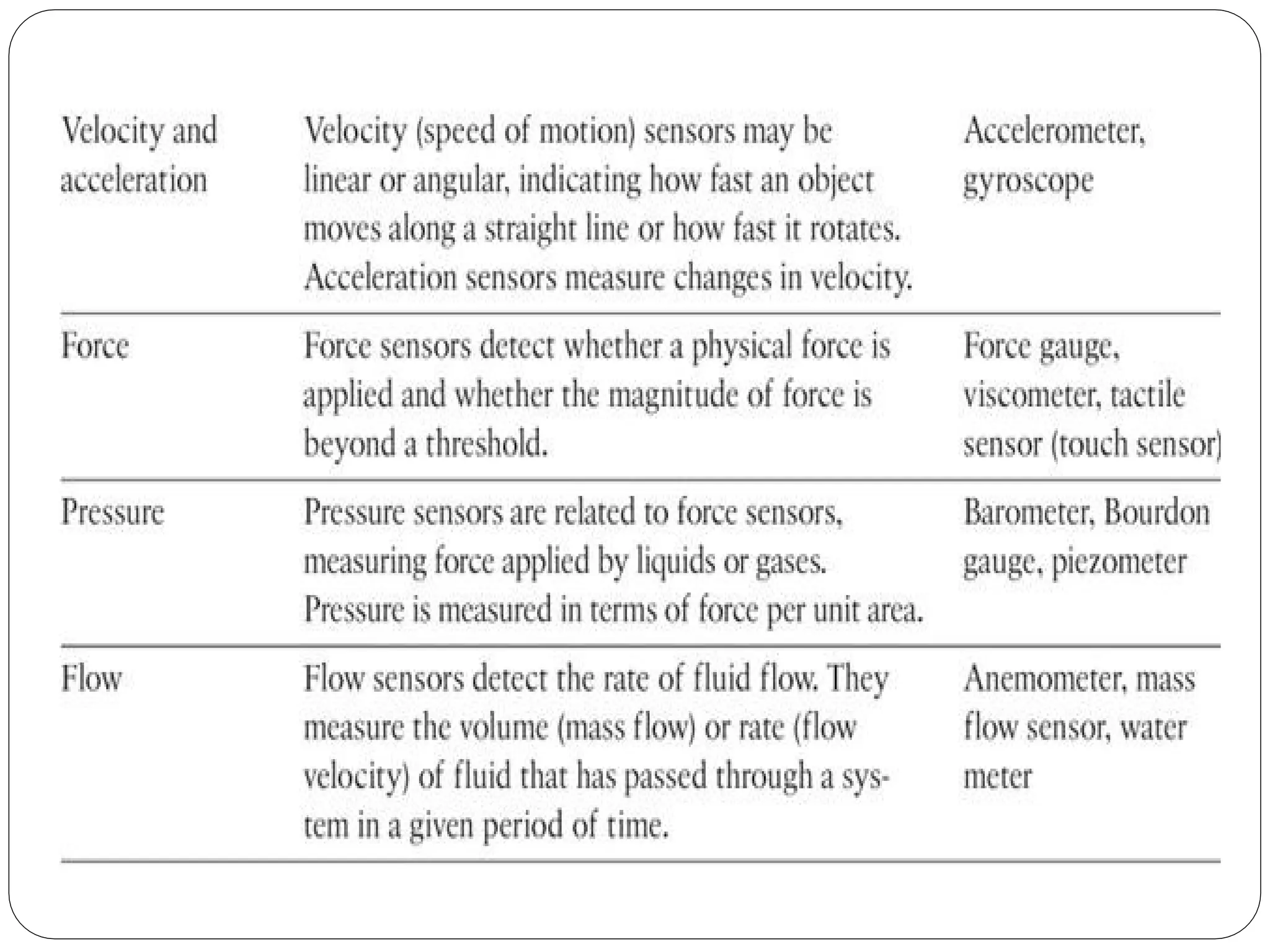
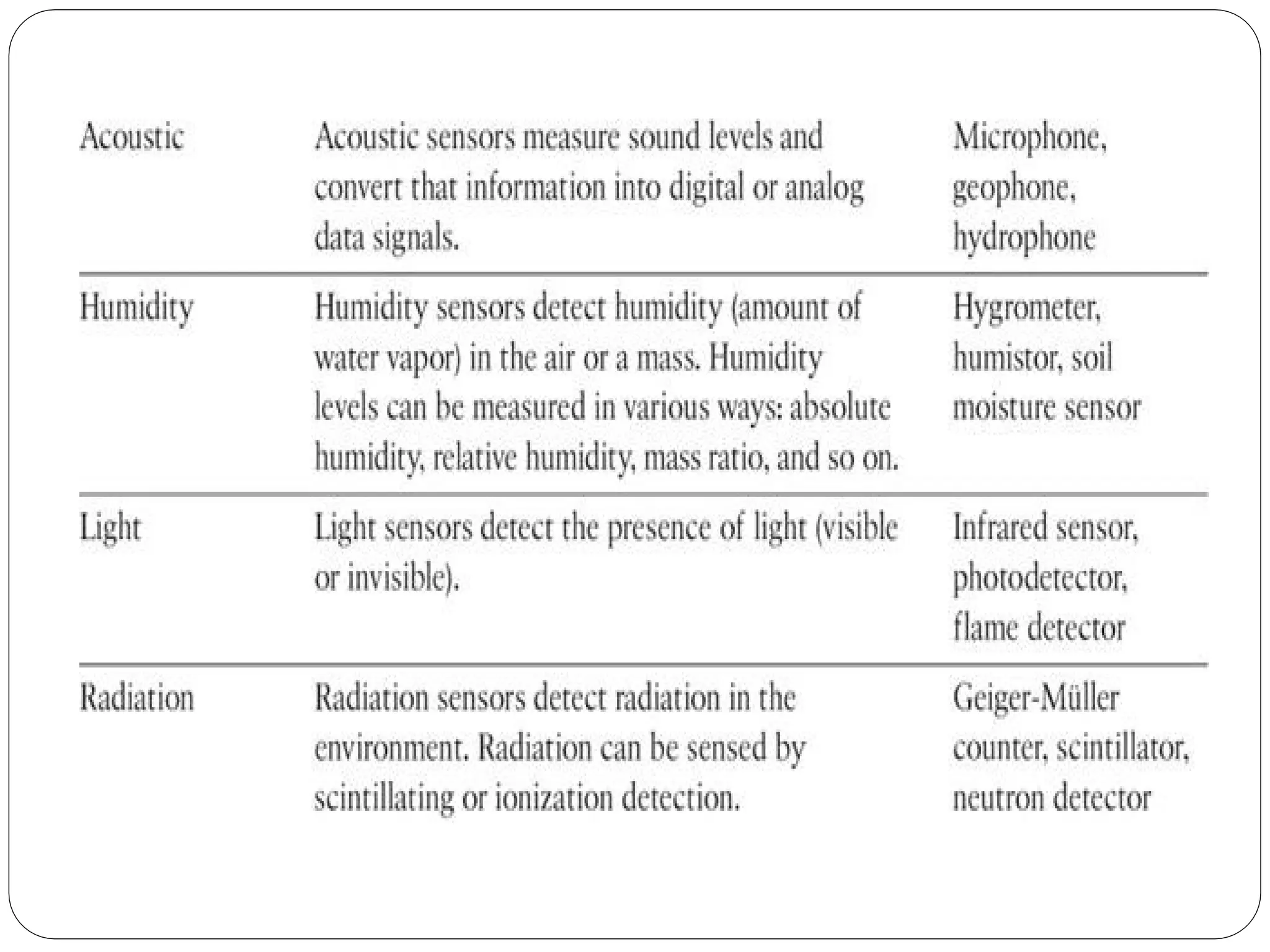
⚫What sensors measure:
⚫Sensors can be categorized based on their applications
or what physical variables they measure.
⚫Note that this is by no means an exhaustive list, and there
are many other classification and taxonomic schemes for
sensors, including those based on material, cost,
design, and other factors
Categorization based on what physical
phenomenon a sensor is measuring
11
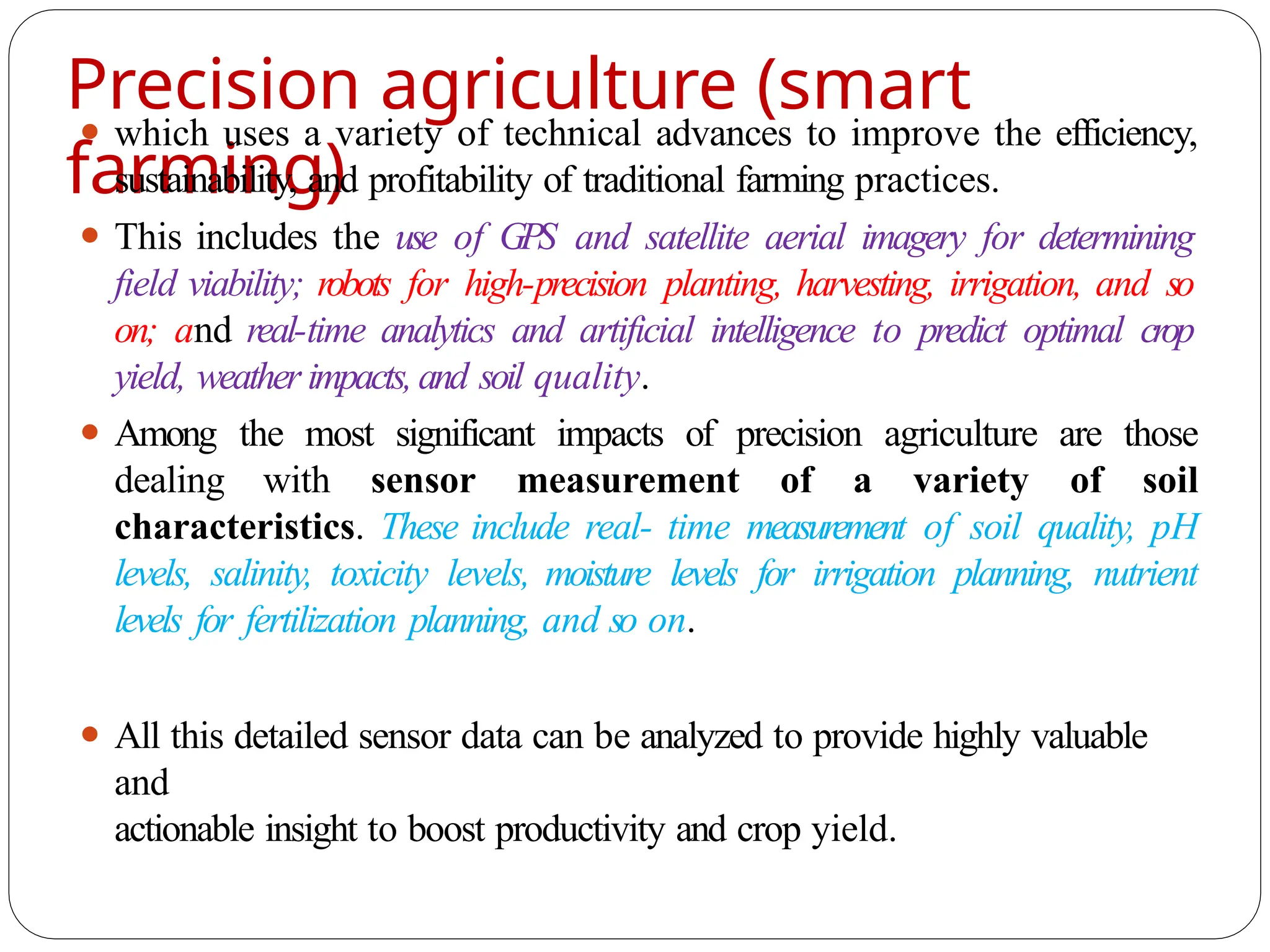
Precision agriculture (smart
farming)
⚫ which uses a variety of technical advances to improve the efficiency,
sustainability, and profitability of traditional farming practices.
⚫ This includes the use of GPS and satellite aerial imagery for determining
field viability; robots for high-precision planting, harvesting, irrigation, and so
on; and real-time analytics and artificial intelligence to predict optimal crop
yield, weather impacts,and soil quality.
⚫ Among the most significant impacts of precision agriculture are those
dealing with sensor measurement of a variety of soil
characteristics. These include real- time measurement of soil quality, pH
levels, salinity, toxicity levels, moisture levels for irrigation planning, nutrient
levels for fertilization planning, and so on.
⚫ All this detailed sensor data can be analyzed to provide highly valuable
and
actionable insight to boost productivity and crop yield.
IoT Use Case: Area of precision
agriculture (smart farming)
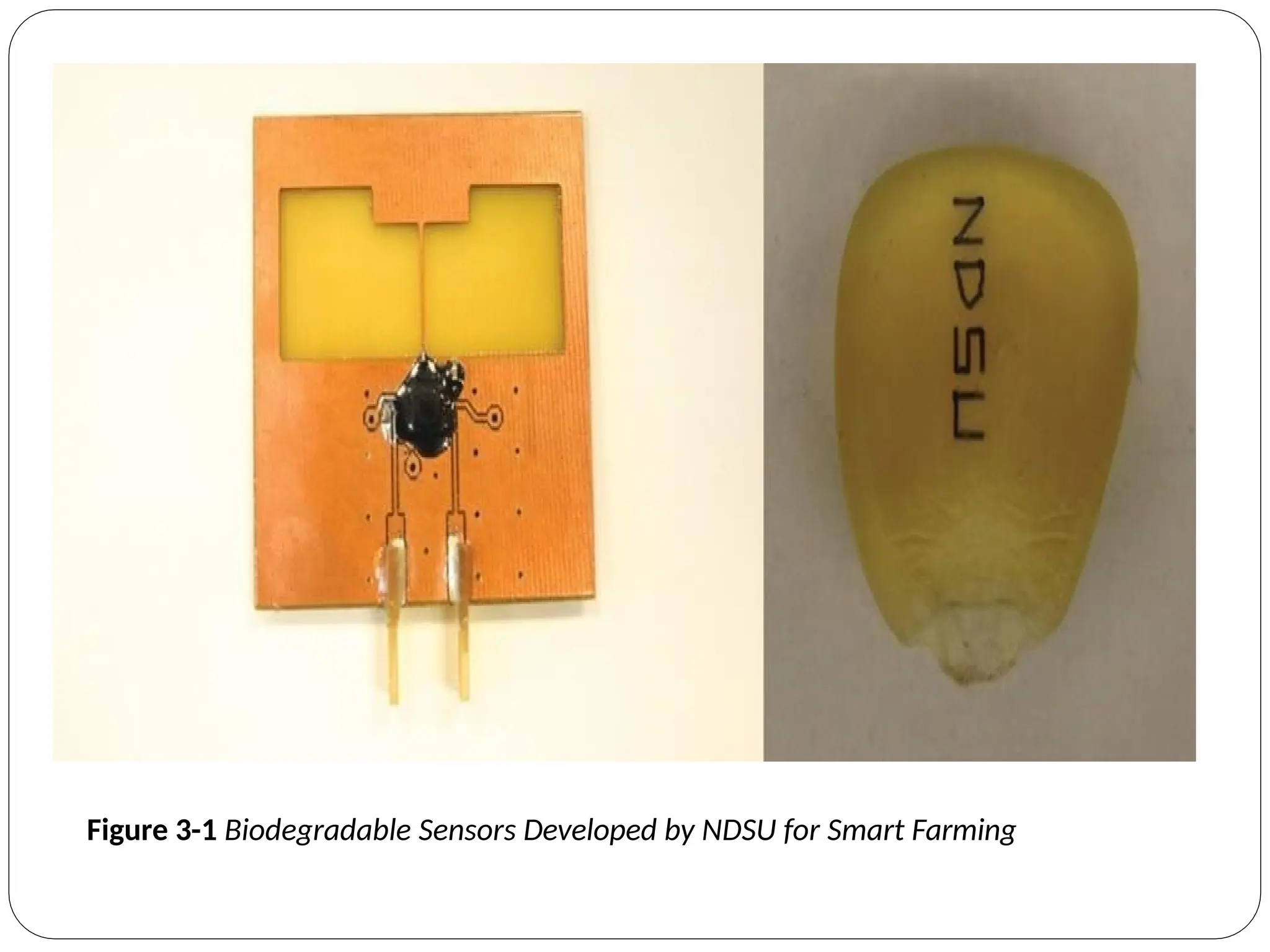
⚫ biodegradable, passive microsensors to measure soil and crop
and conditions
.
⚫ These sensors, developed at North Dakota State University
(NDSU), can be planted directly in the soil and left in the
ground to biodegrade without any harm to soil quality.
Figure 3-1 Biodegradable Sensors Developed by NDSU for Smart Farming
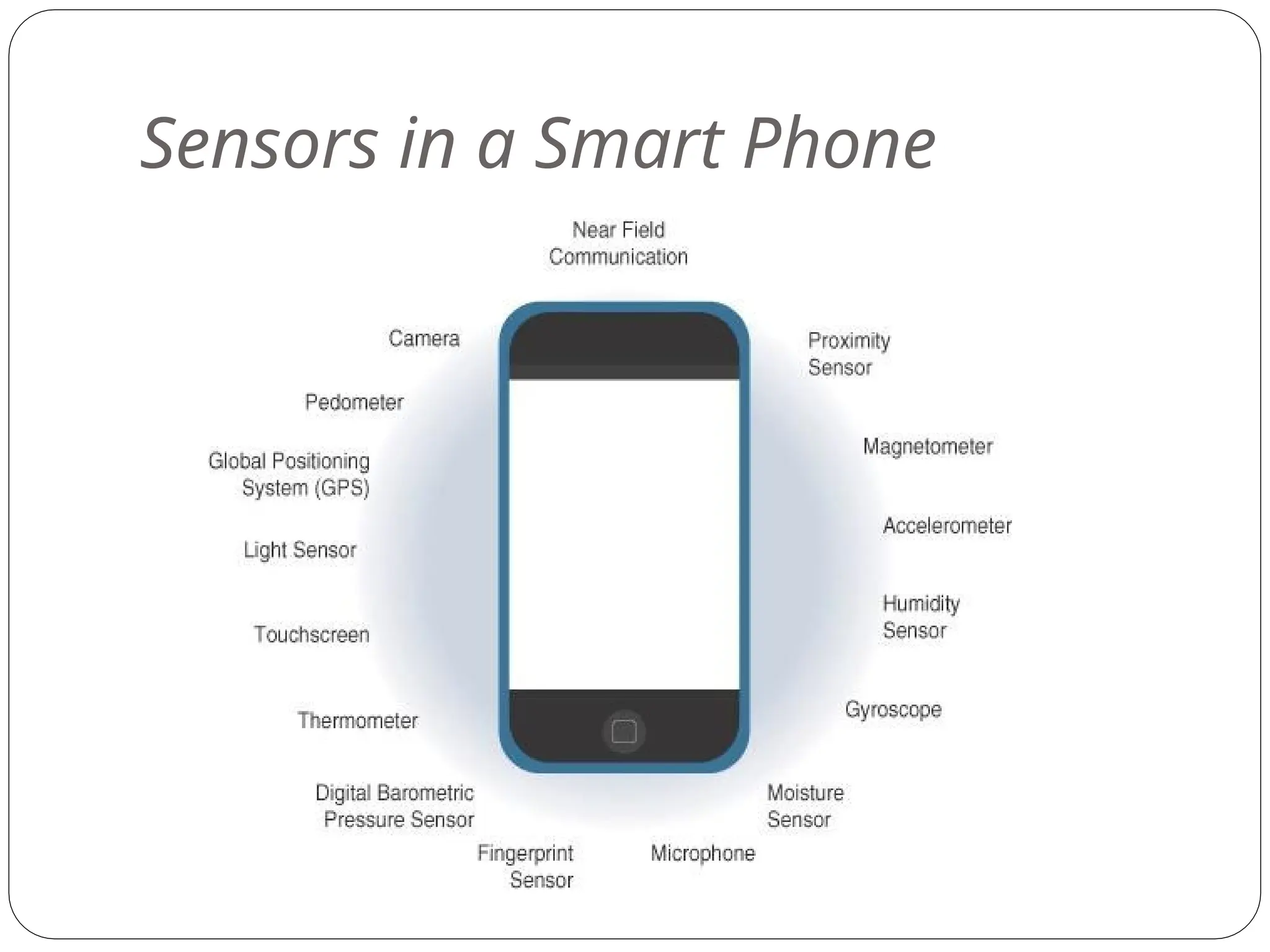
Sensors in a Smart Phone
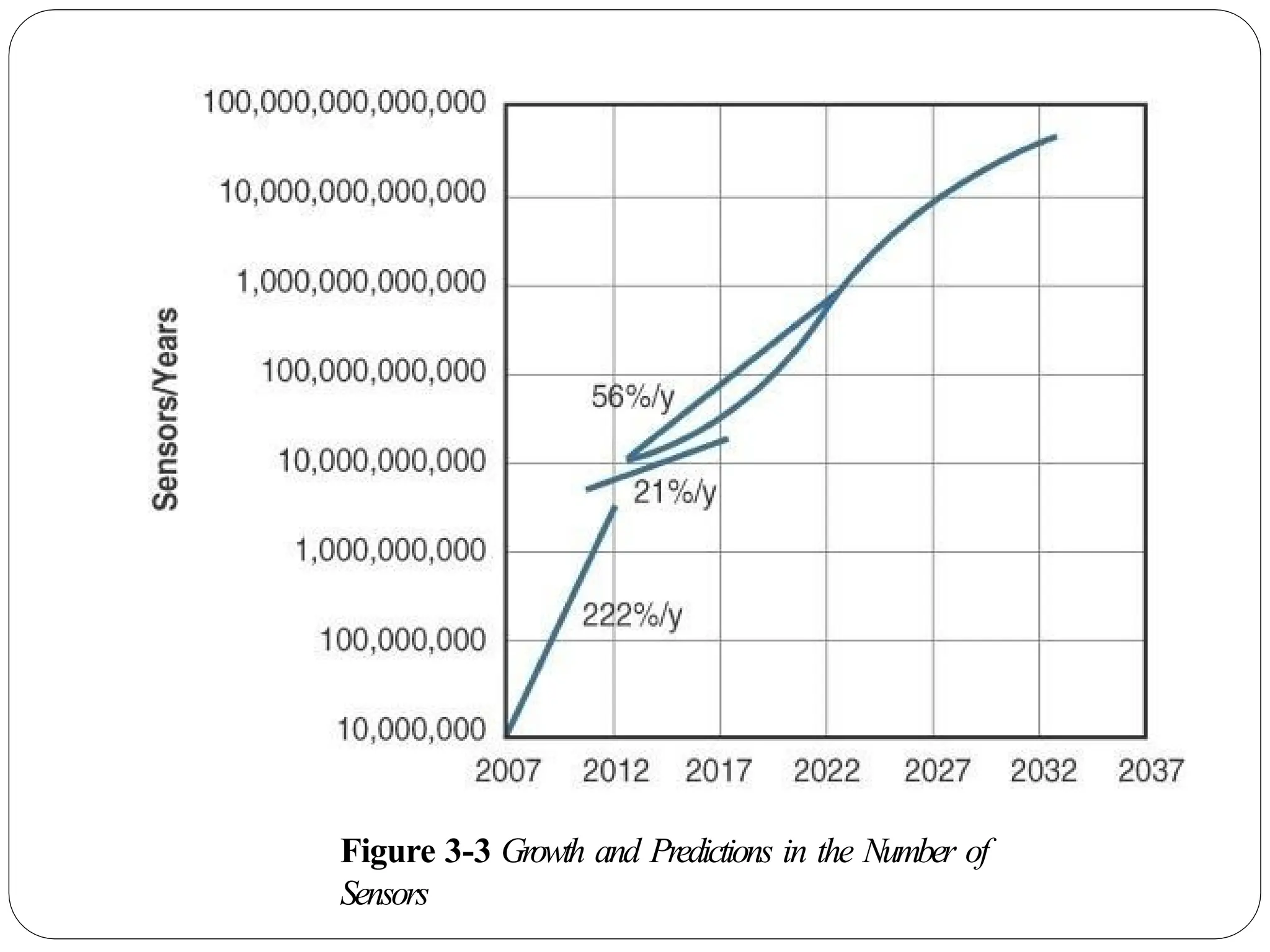
Figure 3-3 Growth and Predictions in the Number of
Sensors
Actuator
s
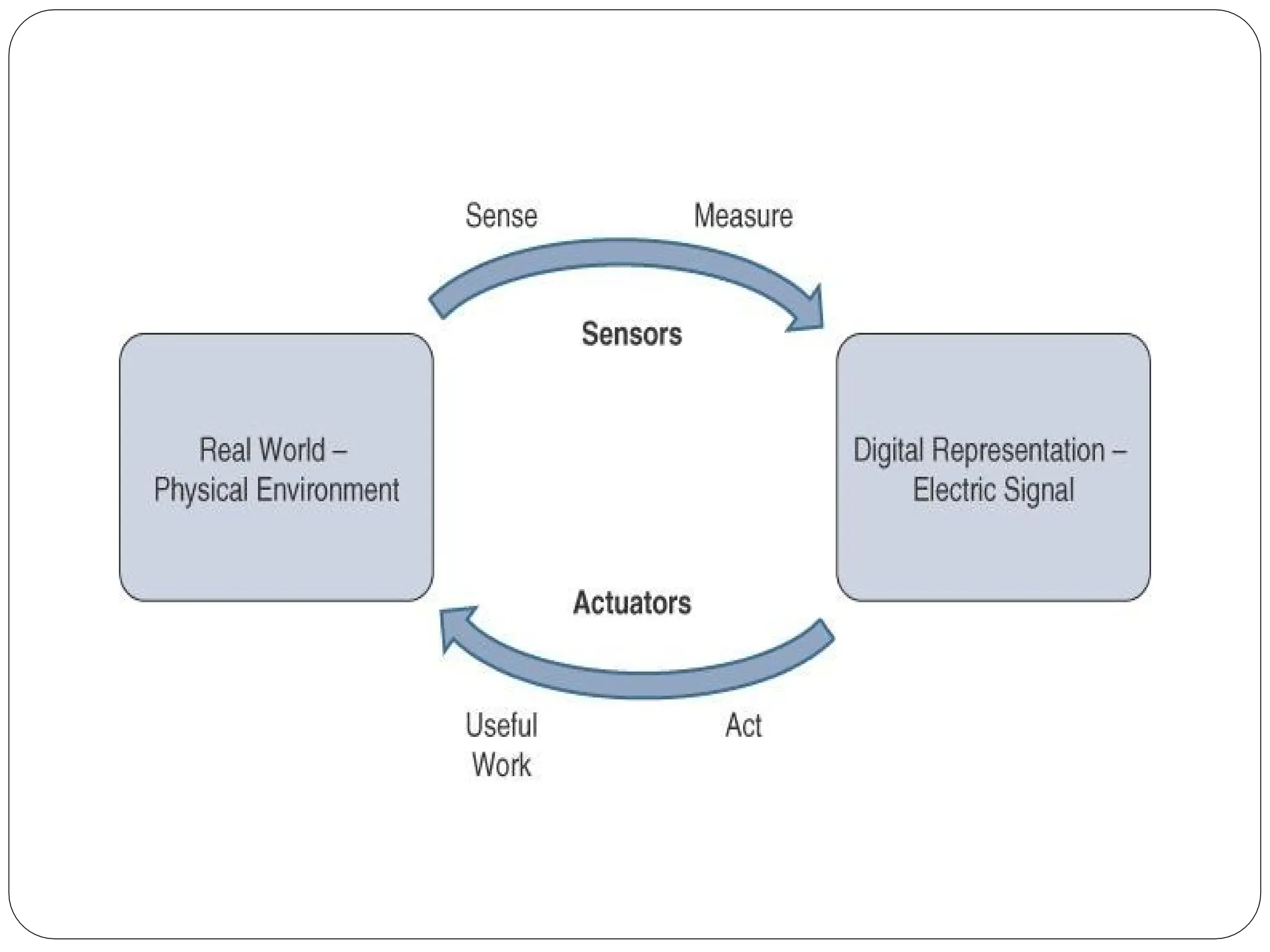
⚫Actuators are natural complements to sensors
⚫Sensors are designed to sense and measure practically
any measurable variable in the physical world.
⚫They convert their measurements (typically analog)
into electric signals or digital representations that
can be consumed by an intelligent agent (a device or a
human).
⚫Actuators, on the others hand, receive some type of
control signal (commonly an electric signal or
digital command) that triggers a physical effect,
usually some type of motion, force, and so on.
⚫/ensors provide the information, actuators provide
the action
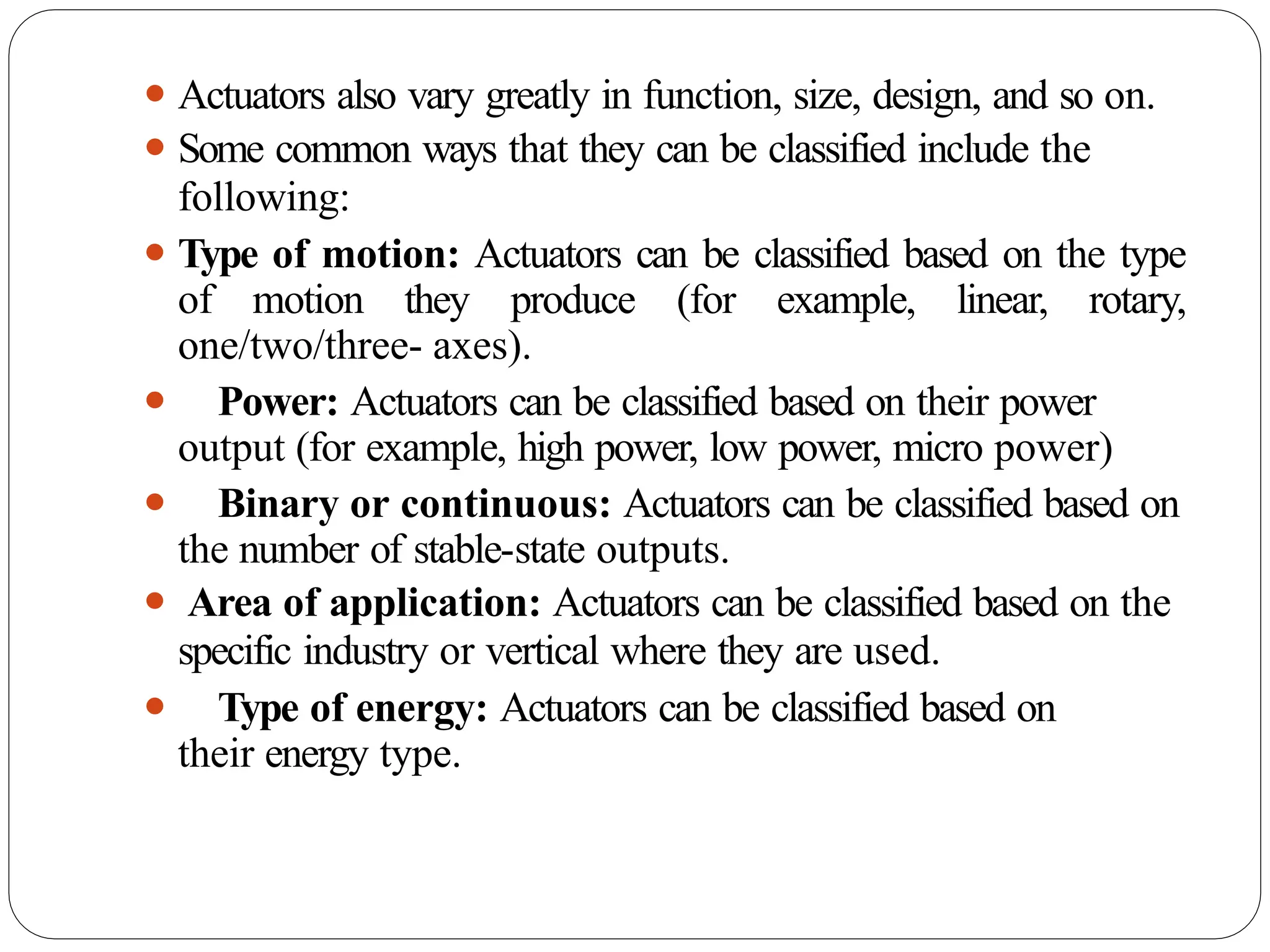
⚫ Actuators also vary greatly in function, size, design, and so on.
⚫ Some common ways that they can be classified include the
following:
⚫ Type of motion: Actuators can be classified based on the type
of motion they produce (for example, linear, rotary,
one/two/three- axes).
⚫ Power: Actuators can be classified based on their power
output (for example, high power, low power, micro power)
⚫ Binary or continuous: Actuators can be classified based on
the number of stable-state outputs.
⚫ Area of application: Actuators can be classified based on the
specific industry or vertical where they are used.
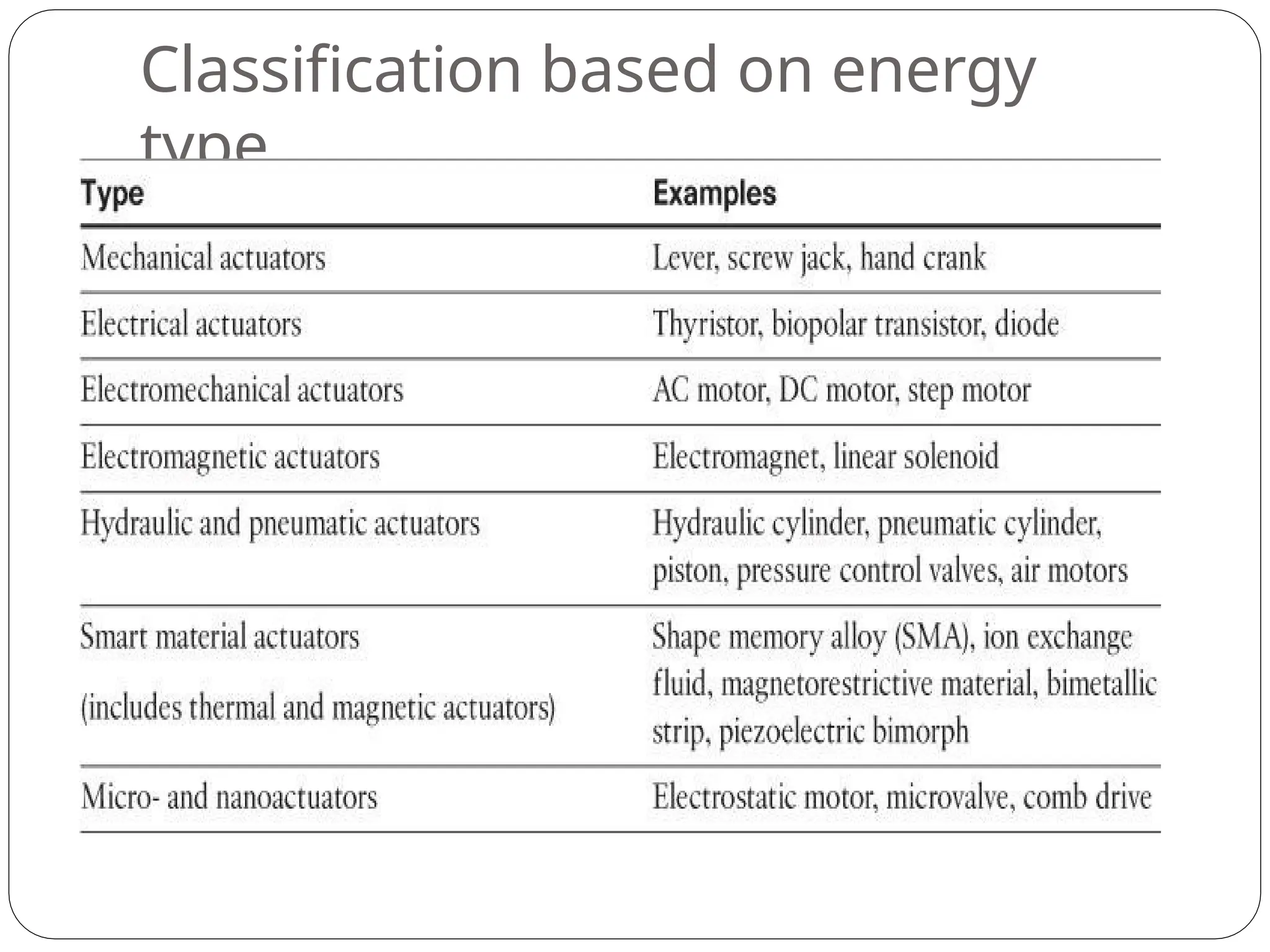
⚫ Type of energy: Actuators can be classified based on
their energy type.
Classification based on energy
type
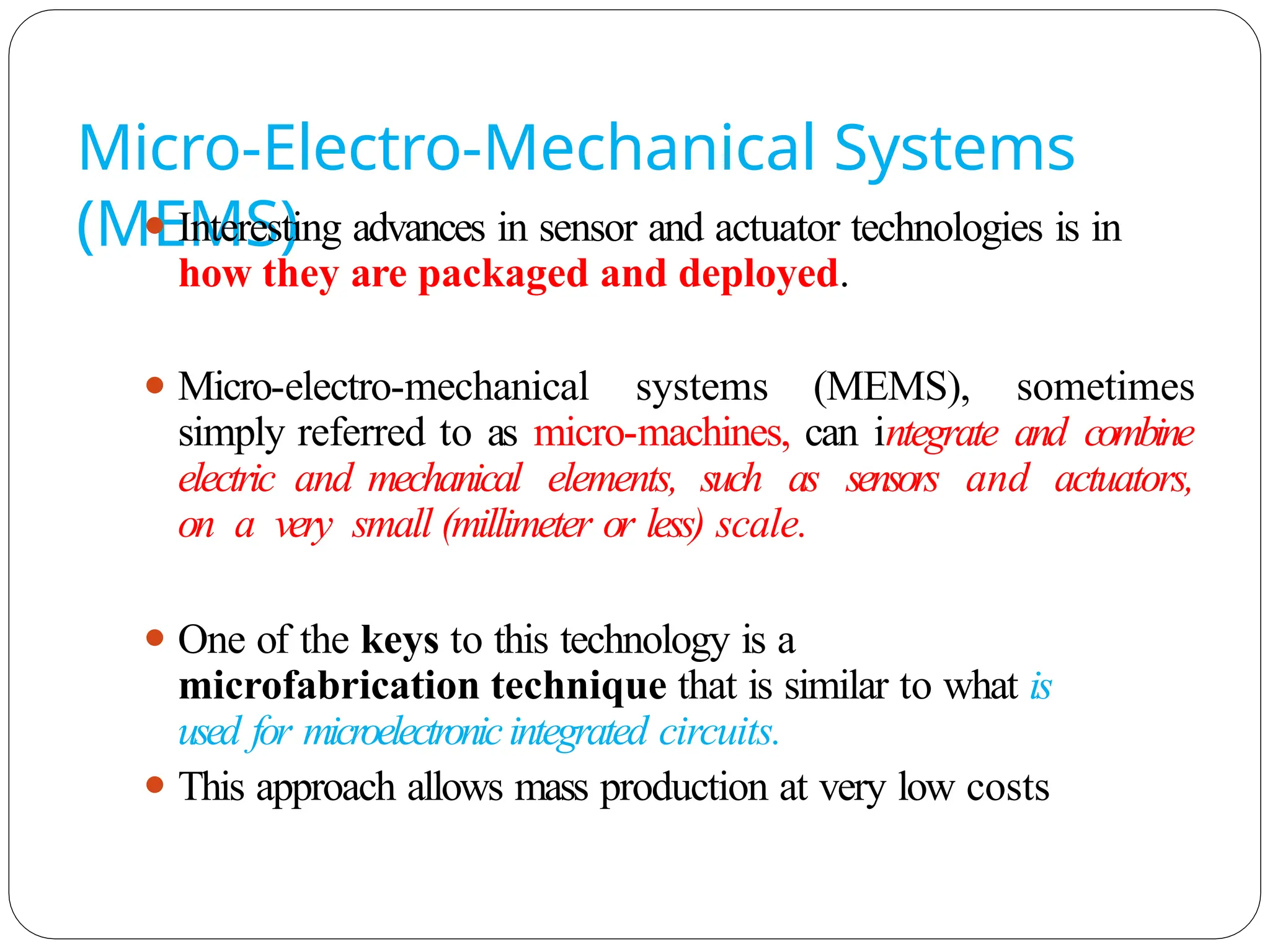
Micro-Electro-Mechanical Systems
(MEMS)
⚫ Interesting advances in sensor and actuator technologies is in
how they are packaged and deployed.
⚫ Micro-electro-mechanical systems (MEMS), sometimes
simply referred to as micro-machines, can integrate and combine
electric and mechanical elements, such as sensors and actuators,
on a very small (millimeter or less) scale.
⚫ One of the keys to this technology is a
microfabrication technique that is similar to what is
used for microelectronicintegrated circuits.
⚫ This approach allows mass production at very low costs
⚫ The combination of tiny size, low cost, and the ability to
mass produce makes MEMS an attractive option for a huge
number of IoT applications.
⚫ MEMS devices have already been widely used in a variety
of different applications and can be found in very
familiar everyday devices.
⚫ For example, inkjet printers use micropump MEMS.
⚫ Smart phones also use MEMS technologies for things
like accelerometers and gyroscopes.
⚫ In fact, automobiles were among the first to
commercially introduce MEMS into the mass market,
with airbag accelerometers.
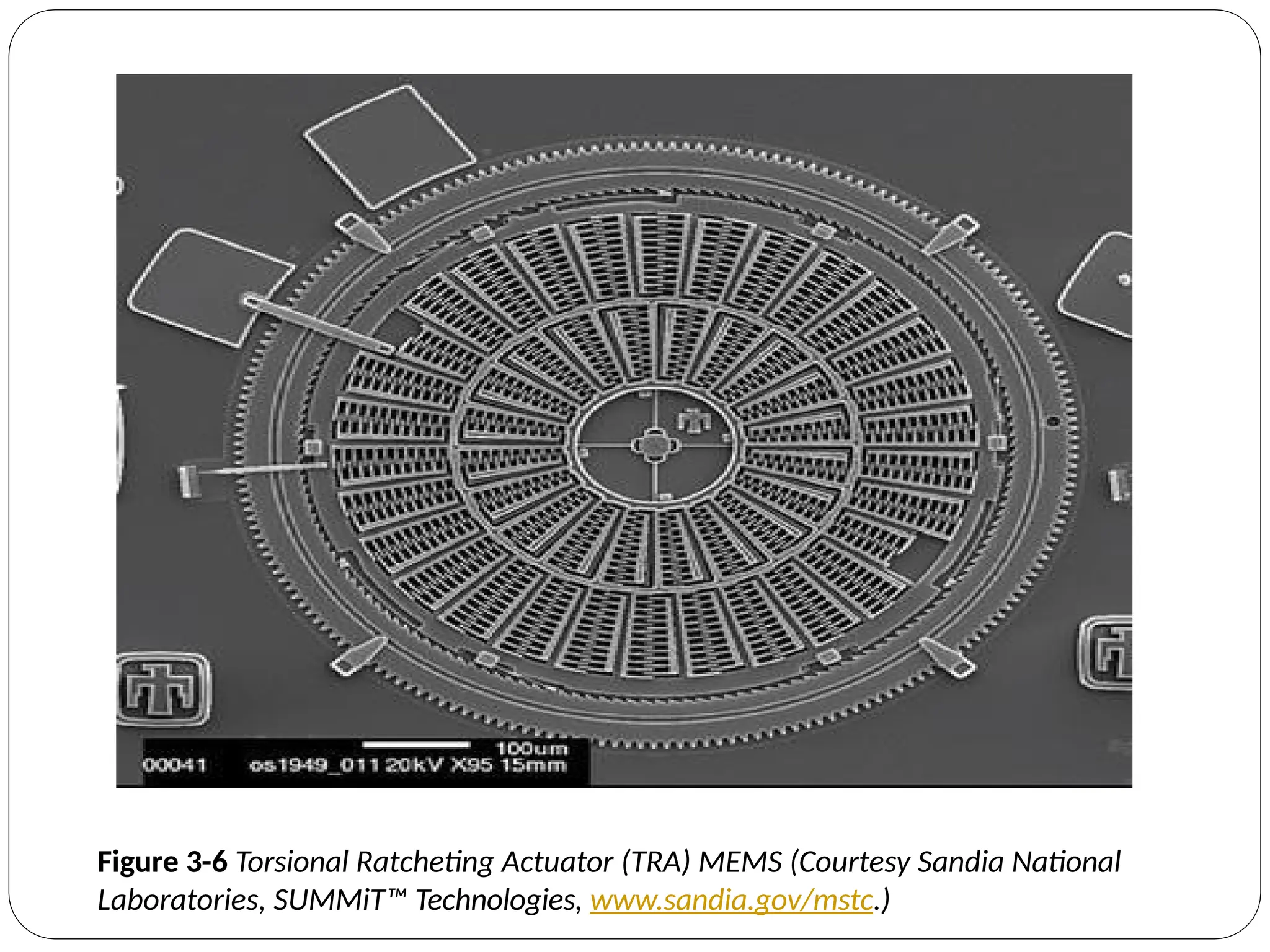
Figure 3-6 Torsional Ratcheting Actuator (TRA) MEMS (Courtesy Sandia National
Laboratories, SUMMiT™ Technologies, www.sandia.gov/mstc.)
Smart Objects
⚫Smart objects are, quite simply, the building blocks of IoT.
⚫They are what transform everyday objects into a
network of intelligent objects that are able to
learn from and interact with their
environment in a meaningful way
⚫The real power of smart objects in IoT comes from
being networked together rather than being isolated as
standalone objects
⚫ If a sensor is a standalone device that simply measures
the humidity of the soil, it is interesting and useful, but
it isn’t revolutionary
⚫ If that same sensor is connected as part of an
intelligent network that is able to coordinate
intelligently with actuators to trigger irrigation
systems as needed based on those sensor readings, we
have something far more powerful
⚫ Extending that even further, imagine that the coordinated
sensor/actuator set is intelligently interconnected with
other sensor/actuator sets to further coordinate
fertilization, pest control, and so on—and even
communicate with an intelligent backend to calculate crop
yield potential
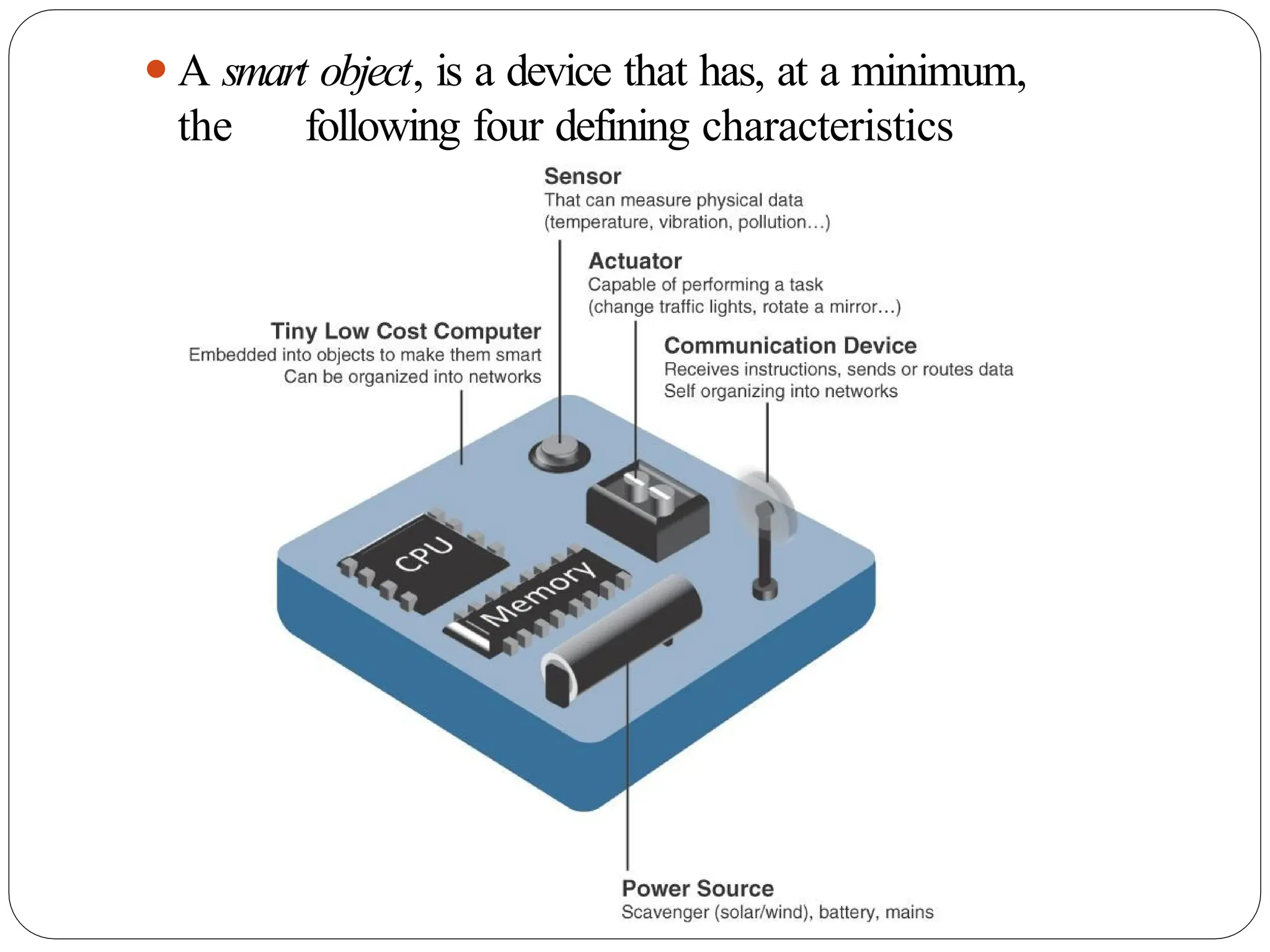
⚫A smart object, is a device that has, at a minimum,
the following four defining characteristics
⚫Processing unit:
⚫Some type of processing unit for
⚫Acquiring data,
⚫Processing and analyzing sensing
information received by the sensor(s),
⚫Coordinating control signals to any
actuators, and
⚫Controlling a variety of functions on the smart
object, including the communication and power
systems
⚫The most common is a microcontroller because of
its small form factor, flexibility, programming
simplicity, ubiquity, low power consumption, and
⚫Sensor(s) and/or actuator(s):
⚫A smart object is capable of interacting with the
physical world through sensors and actuators
⚫Communication device:
⚫The communication unit is responsible for connecting
a smart object with other smart objects and the
outside world (via the network).
⚫Communication devices for smart objects can be either
wired or wireless
⚫Power source:
⚫Smart objects have components that need to be powered.
⚫The most significant power consumption usually comes
from the communication unit of a smart object
Trends in Smart Objects
⚫Size is decreasing
⚫Power consumption is decreasing
⚫Processing power is increasing
⚫Communication capabilities are improving
⚫Communication is being increasingly standardized
SENSOR NETWORKS
⚫A sensor/actuator network (SANET), is a network of
sensors that sense and measure their environment
and/or actuators that act on their environment
⚫The sensors and/or actuators in a SANET are capable
of communicating and cooperating
⚫Effective and well-coordinated communication and
cooperation is a prominent challenge, primarily because the
sensors and actuators in SANETs are diverse, heterogeneous,
and resource-constrained
⚫SANETs offer highly coordinated sensing and actuation
capabilities.
⚫Smart homes are a type of SANET that display this
coordination between distributed sensors and actuators
⚫For example, smart homes can have temperature sensors
that are strategically networked with heating, ventilation,
and air-conditioning (HVAC) actuators.
⚫When a sensor detects a specified temperature, this can
trigger an actuator to take action and heat or cool the
home as needed.
⚫Advantages and disadvantages that a wireless-based
solution offers:
Advantages:
⚫ Greater deployment flexibility (especially in
extreme environments or hard-to-reach places)
⚫ Simpler scaling to a large number of nodes
⚫ Lower implementation costs
⚫ Easier long-term maintenance
⚫ Effortless introduction of new sensor/actuator
nodes
⚫ Better equipped to handle dynamic/rapid topology
changes
Disadvantages:
⚫ Potentially less secure (for example, hijacked access
points)
Wireless Sensor Networks
(WSNs)
⚫Wireless sensor networks are made up of wirelessly
connected smart objects, which are sometimes
referred to as motes.
⚫The fact that there is no infrastructure to consider
with WSNs is surely a powerful advantage for
flexible
deployments, but there are a variety of design
constraints to consider with these wirelessly connected
smart objects
⚫ The following are some of the most significant limitations
of the smart objects in WSNs:
⚫ Limited processing power
⚫ Limited memory
⚫ Lossy communication
⚫ Limited transmission speeds
⚫ Limited power
⚫Note
⚫Smart objects with limited processing, memory, power,
and so on are often referred to as constrained nodes.
⚫These limitations greatly influence how WSNs are
designed, deployed, and utilized.
⚫The fact that individual sensor nodes are typically so
limited is a reason that they are often deployed in
very large numbers.
⚫As the cost of sensor nodes continues to decline, the
ability to deploy highly redundant sensors becomes
increasingly feasible.
⚫Because many sensors are very inexpensive and
correspondingly inaccurate, the ability to deploy
smart objects redundantly allows for increased
accuracy
⚫Such large numbers of sensors permit the
introduction of hierarchies of smart objects.
⚫ Such a hierarchy provides, among other
organizational advantages, the ability to aggregate
similar sensor readings from sensor nodes
that are in close proximity to each other
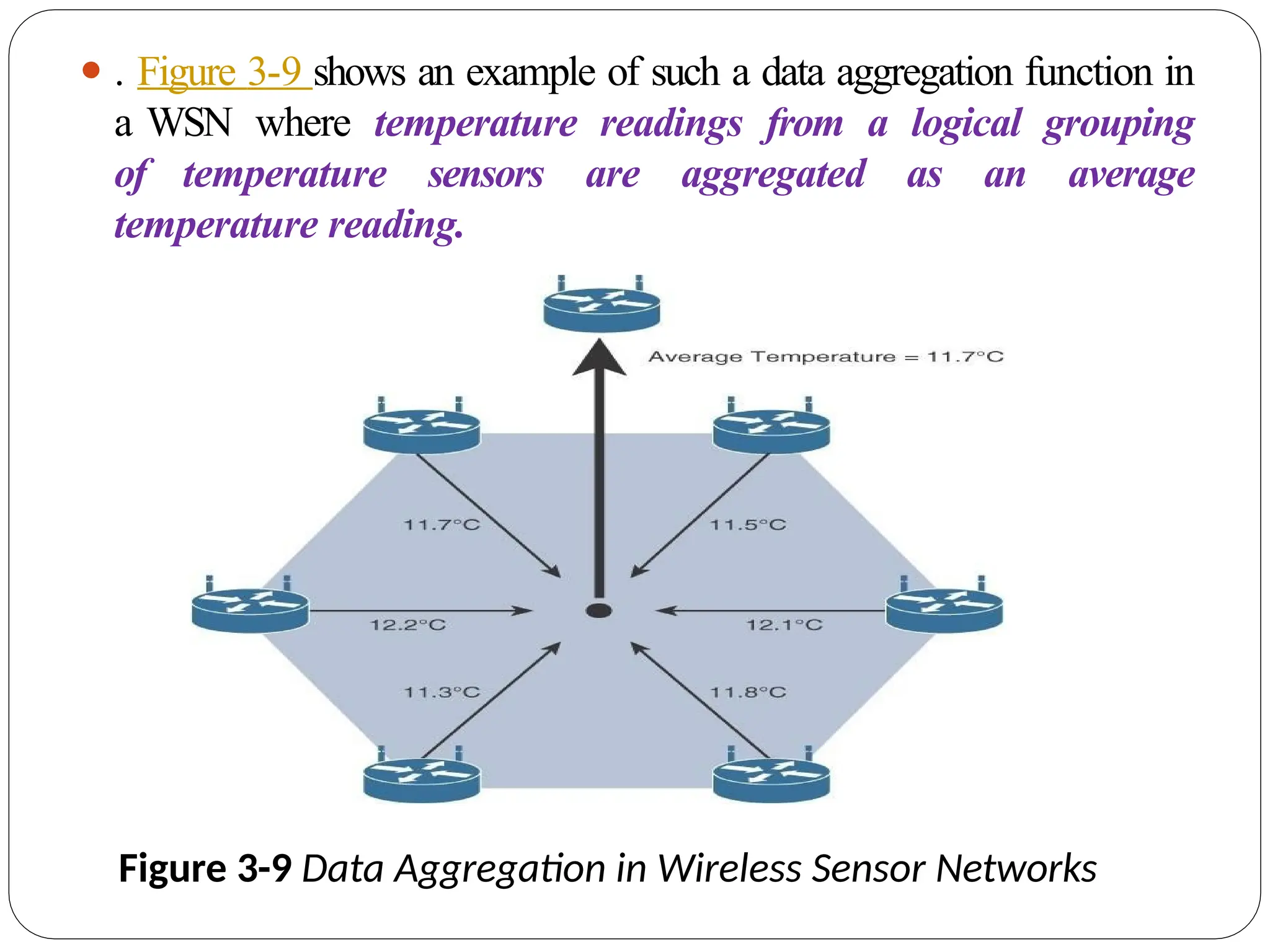
⚫ . Figure 3-9 shows an example of such a data aggregation function in
a WSN where temperature readings from a logical grouping
of temperature sensors are aggregated as an average
temperature reading.
Figure 3-9 Data Aggregation in Wireless Sensor Networks
⚫ These data aggregation techniques are helpful in reducing the
amount of overall traffic (and energy) inW/Ns with very
large numbers of deployed smart objects.
⚫ This data aggregation at the network edges is where fog and
mist computing are critical IoT architectural elements
needed to deliver the scale and performance required by so
many IoT use cases
⚫ Wirelessly connected smart objects generally have one of the
following two communication patterns:
⚫ Event-driven:
⚫ Transmission of sensory information is triggered only when a smart
object detects a particular event or predetermined threshold.
⚫ Periodic:
⚫ Transmission of sensory information occurs only at periodic
intervals.
⚫The decision of which of these communication schemes is used
depends greatly on the specific application
⚫For example: medical use cases
⚫For example, in some medical use cases, sensors
periodically send postoperative vitals, such
as temperature or blood pressure readings.
In other medical use cases, the same blood
pressure or temperature readings are
triggered to be sent only when certain critically
low or high readings are measured.
Communication Protocols for
Wireless Sensor Networks
⚫ There are literally thousands of different types of sensors and actuators.
⚫ WSNs are becoming increasingly heterogeneous, with more
sophisticated interactions.
⚫ Any communication protocol must be able to scale to a large
number of nodes.
⚫ Likewise, when selecting a communication protocol, you must
carefully take into account the requirements of the specific
application and consider any trade-offs the communication
protocol offers between power consumption,
maximum
transmission speed, range, tolerance for packet loss,
topology optimization, security, and so on
⚫ They must also enable, as needed, the overlay of autonomous
techniques (for example, self-organization, self-healing,
self- configuration)
⚫ Wireless sensor networks interact with their environment. Sensors
often produce large amounts of sensing and measurement data that
needs to be processed. This data can be processed locally by the
nodes of a WSN or across zero or more hierarchical levels in IoT
networks.
⚫ Communication protocols need to facilitate routing and
message handling for this data flow between sensor
nodes as well as from sensor nodes to optional gateways, edge
compute, or centralized cloud compute
⚫ standardization of communication protocols is a
complicated task.
⚫ While there isn’t a single protocol solution, there is
beginning to be some clear market convergence around
several key communication protocols.
Connecting Smart Objects
⚫IoT devices and sensors must be connected to the
network for their data to be utilized.
⚫In addition to the wide range of sensors, actuators, and
smart objects that make up IoT, there are also a number of
different protocols used to connect them
COMMUNICATIONS CRITERIA
⚫The characteristics and attributes you should
consider when selecting and dealing with
connecting smart objects
⚫Range
⚫Frequency Bands:
⚫Power Consumption:
⚫Topology
⚫Constrained Devices:
⚫Constrained-Node Networks:
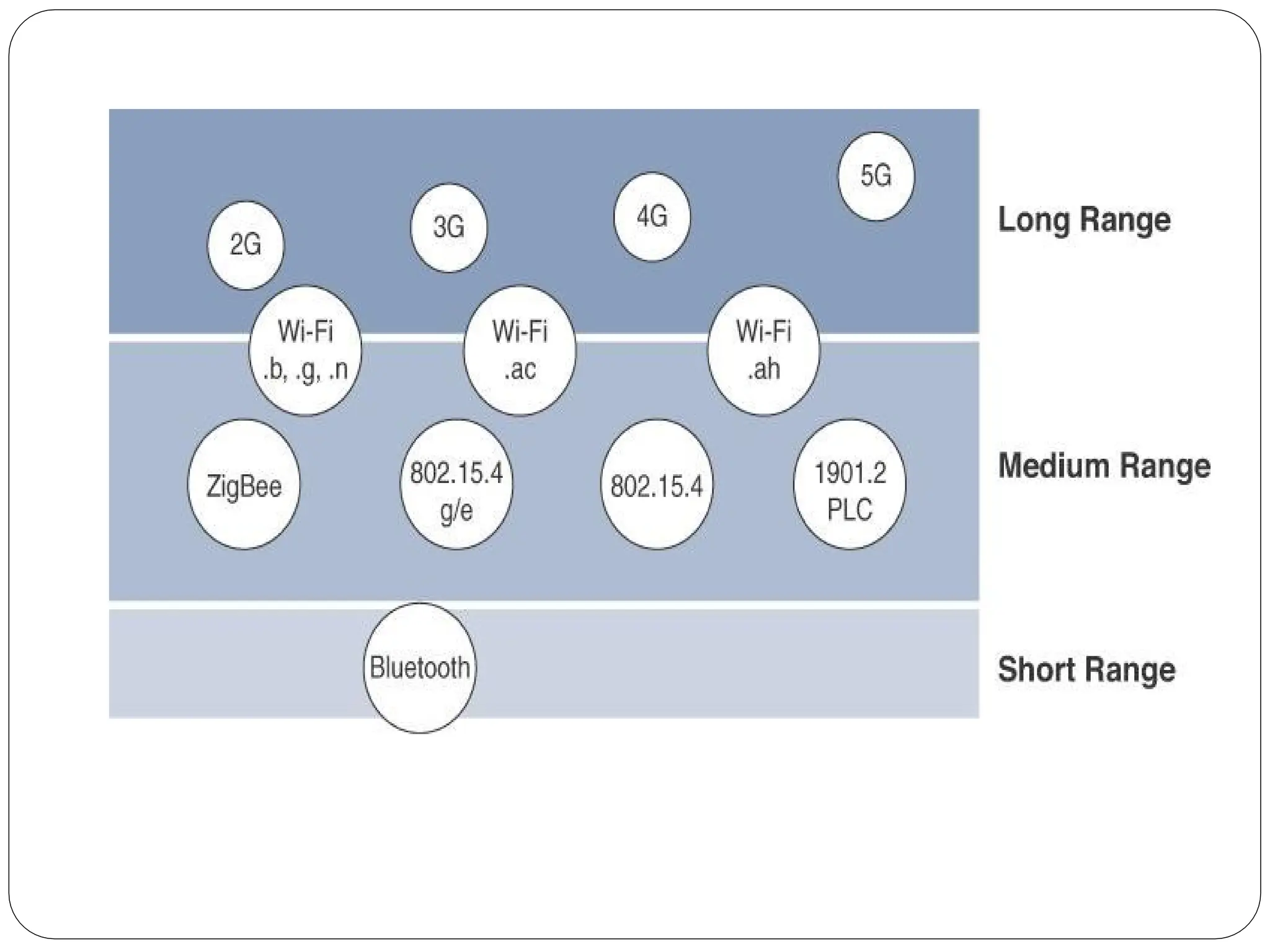
⚫Range
⚫How far does the signal need to be propagated?
⚫That is, what will be the area of coverage for a
selected wireless technology?
⚫Should indoor versus outdoor deployments be
differentiated?
⚫Short range:
⚫The classical wired example is a serial cable.
⚫Wireless short-range technologies are often considered as
an alternative to a serial cable, supporting tens of
meters of maximum distance between two devices.
⚫Examples of short-range wireless technologies are IEEE
802.15.1 Bluetooth and IEEE 802.15.7 Visible
Light Communications (VLC)
⚫Medium range:
⚫This range is the main category of IoT access
technologies.
⚫In the range of tens to hundreds of meters,
many specifications and implementations are
available.
⚫The maximum distance is generally less than 1
mile between two devices
⚫Examples of medium-range wireless technologies include
IEEE 802.11 Wi-Fi, IEEE 802.15.4, and 802.15.4g
WPAN.
⚫Wired technologies such as IEEE 802.3 Ethernet and
⚫Long range:
⚫Distances greater than 1 mile between two devices
require long-range technologies.
⚫Wireless examples are cellular (2G, 3G, 4G) and some
applications of outdoor IEEE 802.11 Wi-Fi and Low-
Power Wide-Area (LPWA) technologies.
⚫LPW
A communications have the ability to communicate over a
large area without consuming much power. These
technologies are therefore ideal for battery-powered
IoT sensors
⚫Frequency Bands
⚫Radio spectrum is regulated by countries and/or
organizations, such as the International
Telecommunication Union (ITU) and the Federal
Communications Commission (FCC).
⚫These groups define the regulations and
transmission requirements for various
frequency bands
⚫For example, portions of the spectrum are allocated to
types of telecommunications such as radio, television,
military, and so on.
⚫Focusing on IoT access technologies, the frequency
bands leveraged by wireless communications are
split between licensed and unlicensed bands.
⚫Licensed spectrum is generally applicable to IoT
long- range access technologies
⚫In order to utilize licensed spectrum, users must
subscribe to services when connecting their IoT
devices
⚫In exchange for the subscription fee, the network operator
can guarantee the exclusivity of the frequency usage over
the target area and can therefore sell a better guarantee
of service.
⚫ The ITU has also defined unlicensed spectrum for the
industrial, scientific, and medical (ISM) portions of the radio
bands.
⚫ These frequencies are used in many communications
technologies for short-range devices (SRDs).
⚫ Unlicensed means that no guarantees or protections
are offered in the ISM bands for device
communications
⚫ ISM bands for IoT access
⚫ 2.4 GHz band as used by IEEE 802.11b/g/n Wi-Fi
⚫ IEEE 802.15.1 Bluetooth
⚫ IEEE 802.15.4 WPAN
⚫Unlicensed spectrum is usually simpler to deploy
than licensed because it does not require a service
provider.
⚫However, it can suffer from more interference because
other devices may be competing for the same frequency
in a specific area
⚫The frequency of transmission directly impacts how a
signal propagates and its practical maximum range.
Power Consumption
⚫Powered nodes and battery-powered nodes
⚫A powered node has a direct connection to a
power source, and communications are
usually not limited by power consumption criteria.
⚫However, ease of deployment of powered nodes is
limited by the availability of a power source,
which makes mobility more complex
⚫Battery-powered nodes bring much more flexibility
to IoT devices.
⚫These nodes are often classified by the required
lifetimes of their batteries.
⚫For battery-
powered
nodes, IoT wireless
access
technologies must address the needs of low
power consumption and connectivity
⚫A new wireless environment known as Low-Power
Wide- Area (LPWA)
⚫Battery-powered nodes are often placed in a “sleep
mode”
to preserve battery life when not transmitting
⚫Wired IoT access technologies consisting of powered
nodes are not exempt from power optimization
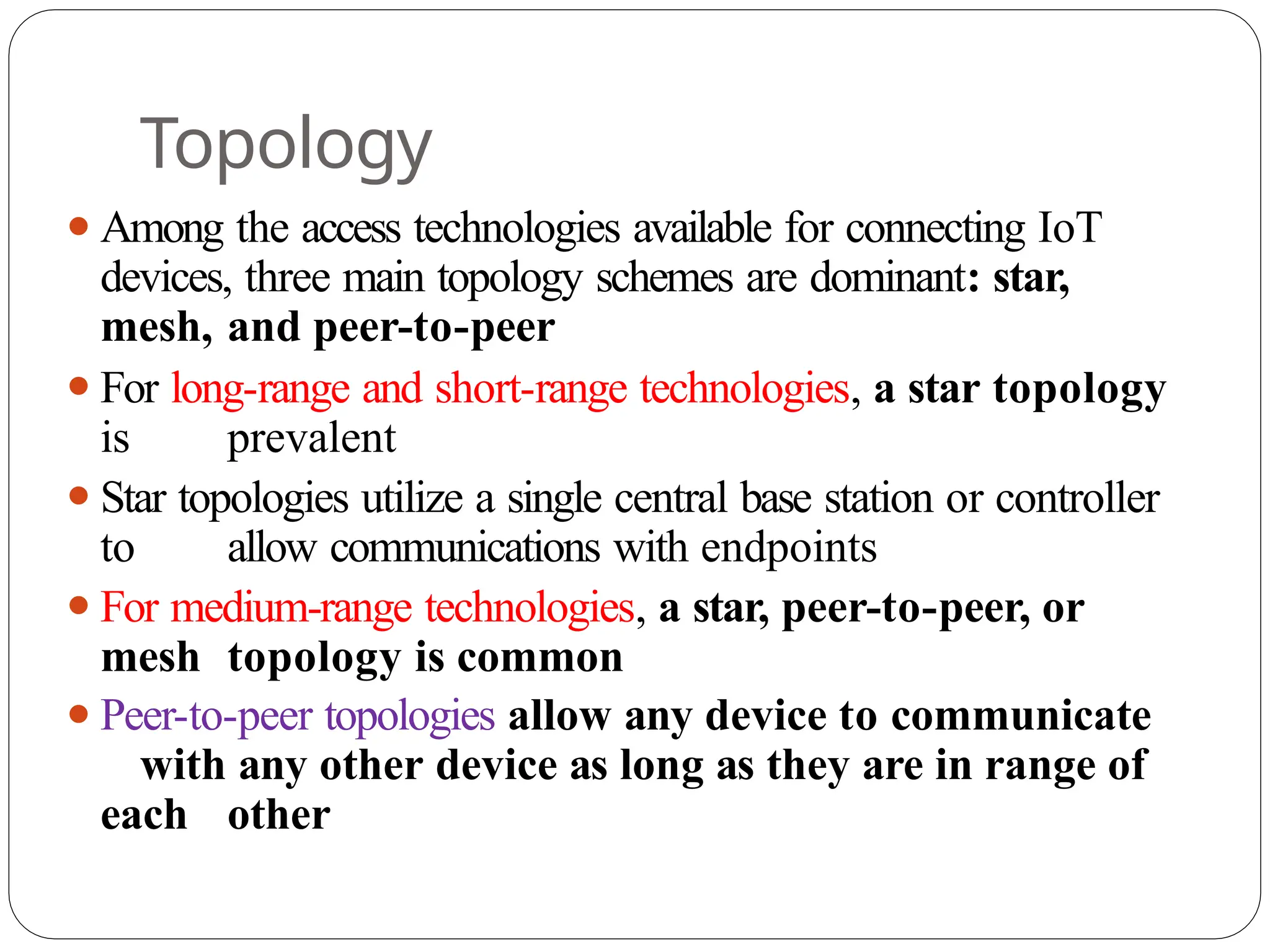
Topology
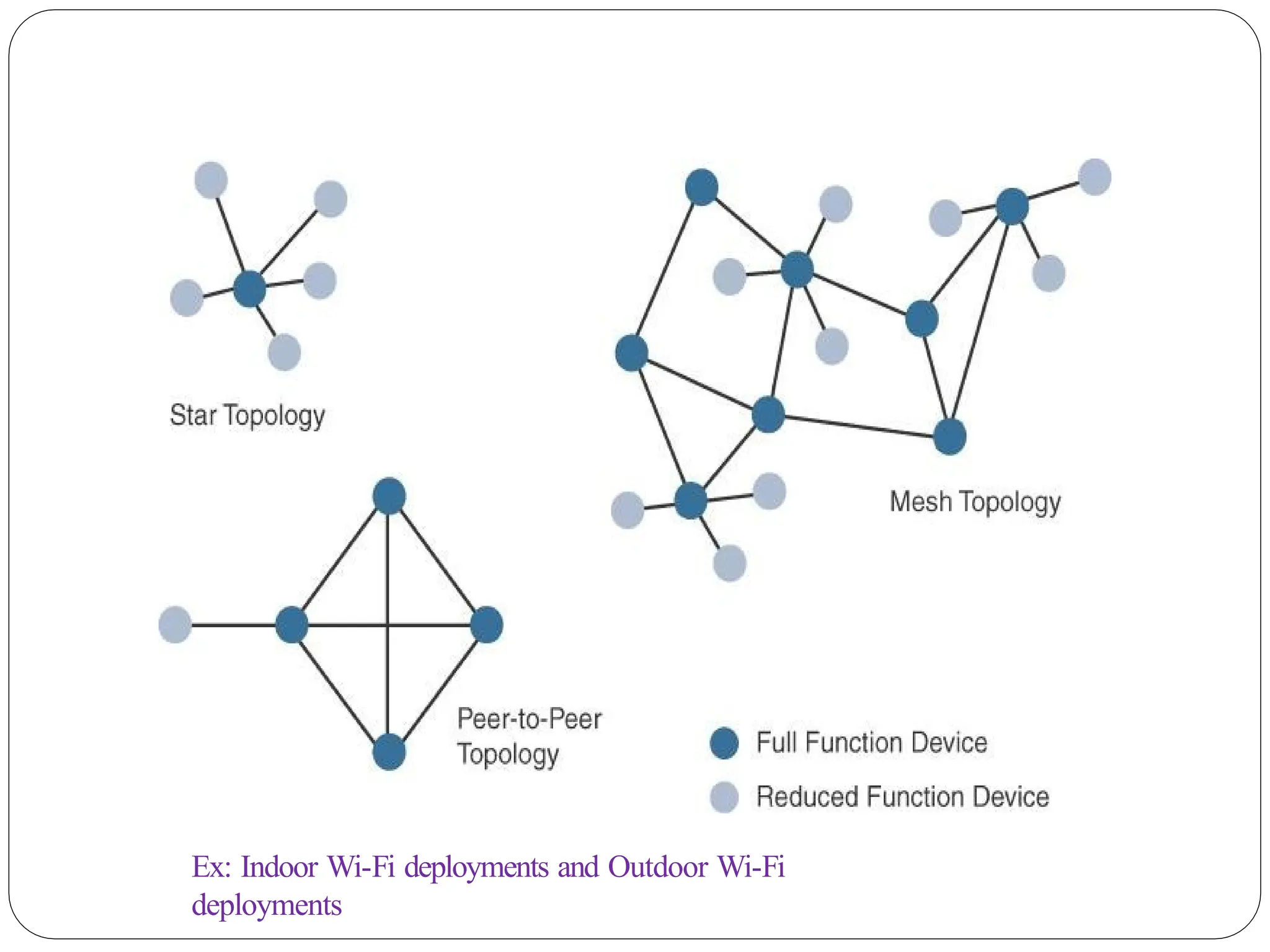
⚫Among the access technologies available for connecting IoT
devices, three main topology schemes are dominant: star,
mesh, and peer-to-peer
⚫For long-range and short-range technologies, a star topology
is prevalent
⚫Star topologies utilize a single central base station or controller
to allow communications with endpoints
⚫For medium-range technologies, a star, peer-to-peer, or
mesh topology is common
⚫Peer-to-peer topologies allow any device to communicate
with any other device as long as they are in range of
each other
Ex: Indoor Wi-Fi deployments and Outdoor Wi-Fi
deployments
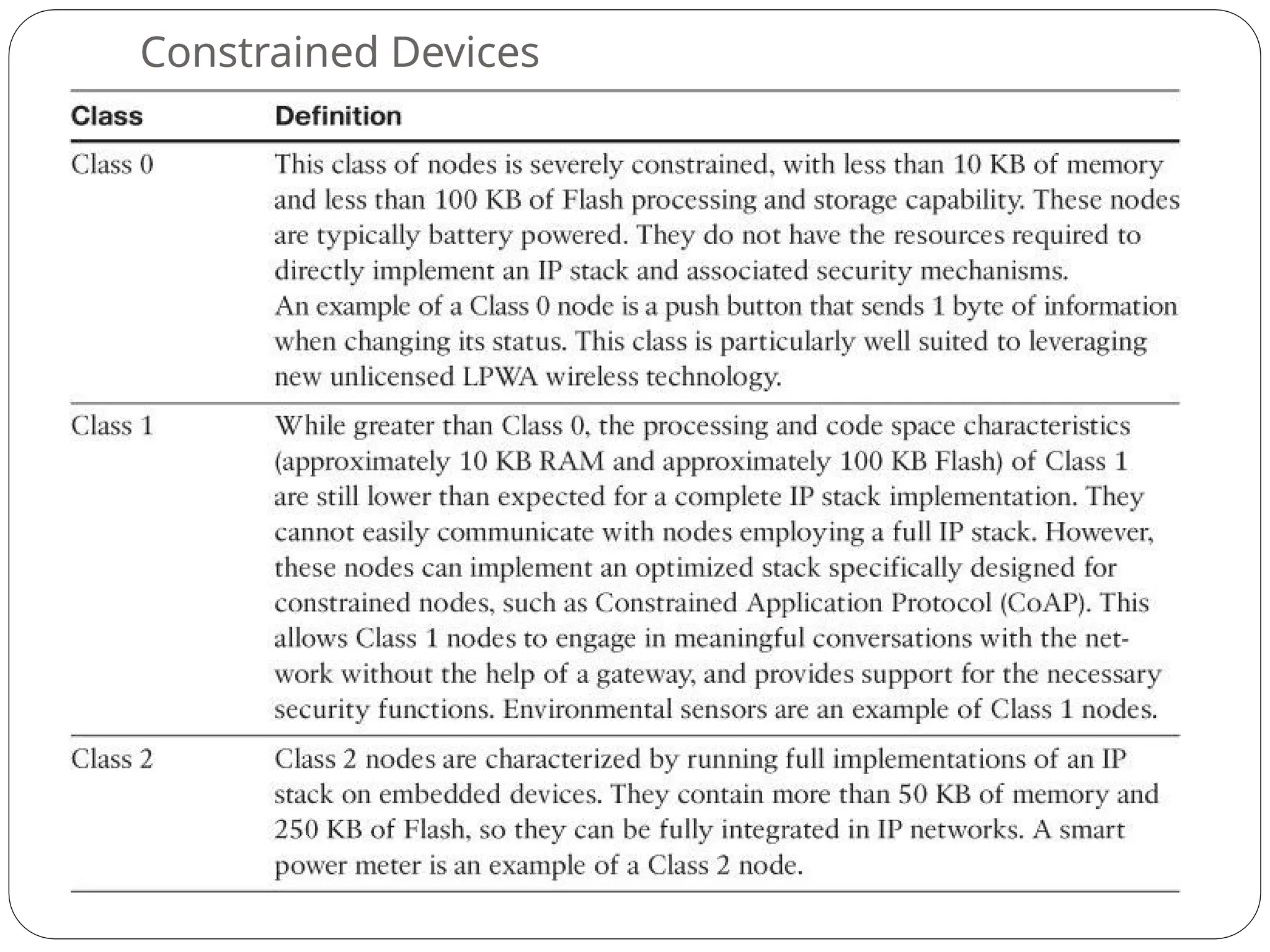
Constrained Devices
Constrained-Node
Networks
⚫IEEE 802.15.4 and 802.15.4g RF, IEEE 1901.2a
PLC,
LPWA, and IEEE 802.11ah access technologies
⚫Constrained-node networks are often referred to
as low-power and lossy networks (LLNs).
⚫Low power – battery powered constraints
⚫Lossy network -- network performance may suffer
from interference and variability due to harsh
radio environments
⚫Protocols that can be used for constrained-node
networks must be evaluated in the context of the
following characteristics: data rate and
throughput, latency and determinism, and
overhead and payload.
Data Rate and Throughput
⚫The data rates available from IoT access technologies range
from 100 bps with protocols such as Sigfox to tens
of megabits per second with technologies such
as L
TE and IEEE 802.11ac
⚫However, the actual throughput is less
⚫Therefore, understanding the bandwidth requirements of a
particular technology, its applicability to given use cases,
the capacity planning rules, and the expected real
throughput are important for proper network design
and successful production deployment
⚫Technologies not particularly designed for IoT, such as
cellular and Wi-Fi, match up well to IoT applications
with high bandwidth requirements
⚫For example, nodes involved with video analytics have a
need for high data rates, IoT endpoints are not
constrained in terms of computing or network bandwidth,
the design guidelines tend to focus on application
requirements, such as latency and determinism
⚫Short-range technologies can also provide medium to
high data rates that have enough throughput to
connect a few endpoints.
⚫For example, Bluetooth sensors that are now appearing
on connected wearables fall into this category.
⚫In this case, the solutions focus more on footprint and
battery lifetime than on data rate.
⚫The IoT access technologies developed for constrained
nodes are optimized for low power consumption, but they
are also limited in terms of data rate
⚫Another characteristic of IoT devices is that a majority
of them initiate the communication.
⚫Upstream traffic toward an application server is usually
more common than downstream traffic from the
application server.
⚫Understanding this behavior also helps when deploying
an IoT access technology, such as cellular, that is
asymmetrical because the upstream bandwidth must be
considered a key parameter for profiling the
network capacity
Latency and Determinism
⚫Latency expectations of IoT applications should be
known when selecting an access technology
⚫This is particularly true for wireless networks,
where packet loss and retransmissions due to
interference, collisions, and noise are normal
behaviors
⚫On constrained networks, latency may range from
a few milliseconds to seconds, and applications and
protocol stacks must cope with these wide-
ranging values
Overhead and Payload
⚫When considering constrained access network
technologies, it is important to review the MAC
payload size characteristics required by
applications
⚫Y
ou should be aware of any requirements for IP.
⚫ The minimum IPv6 MTU size is expected to be
1280 bytes.
⚫Therefore, the fragmentation of the IPv6 payload
has to be taken into account by link layer access
protocols with smaller MTUs
IoT Access
Technologies
⚫The following topics are addressed for each
IoT access technology:
Standardization and alliances:
⚫ The standards bodies that maintain the protocols for a technology
Physical layer:
⚫ The wired or wireless methods and relevant frequencies
MAC layer:
⚫ Considerations at the Media Access Control (MAC) layer, which bridges
the physical layer with data link control
Topology:
⚫ The topologies supported by the technology
Security:
⚫ Security aspects of the technology
Competitive technologies:
⚫ Other technologies that are similar and may be suitable alternatives to the
given technology
⚫IEEE 802.15.4
⚫IEEE 802.15.4g and 802.15.4e
⚫IEEE 1901.2a
⚫IEEE 802.11ah
⚫LoRaWAN
⚫NB-IoT and other LTE
Variations
IoT Access Technologies
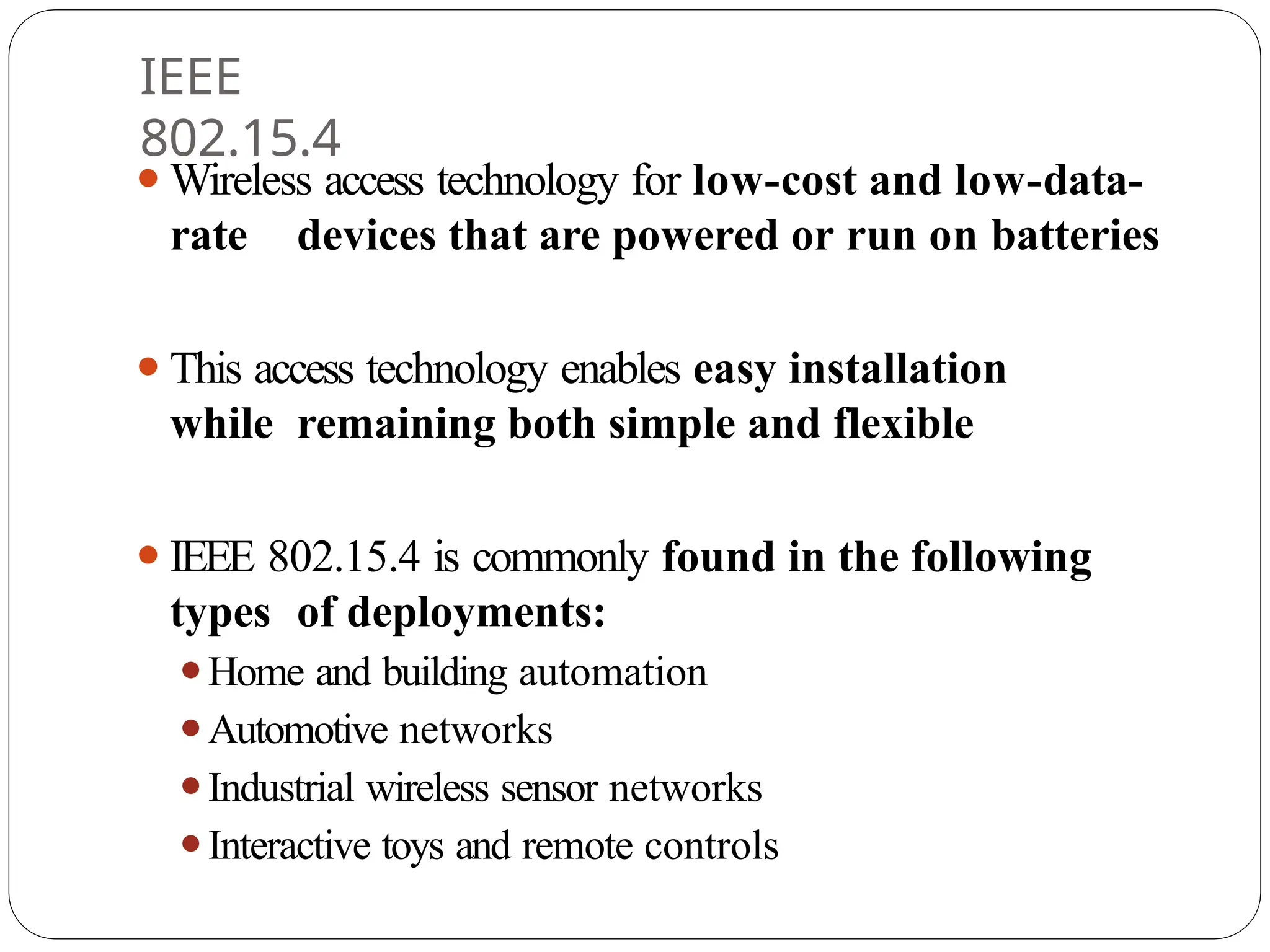
IEEE
802.15.4
⚫Wireless access technology for low-cost and low-data-
rate devices that are powered or run on batteries
⚫This access technology enables easy installation
while remaining both simple and flexible
⚫IEEE 802.15.4 is commonly found in the following
types of deployments:
⚫Home and building automation
⚫Automotive networks
⚫Industrial wireless sensor networks
⚫Interactive toys and remote controls
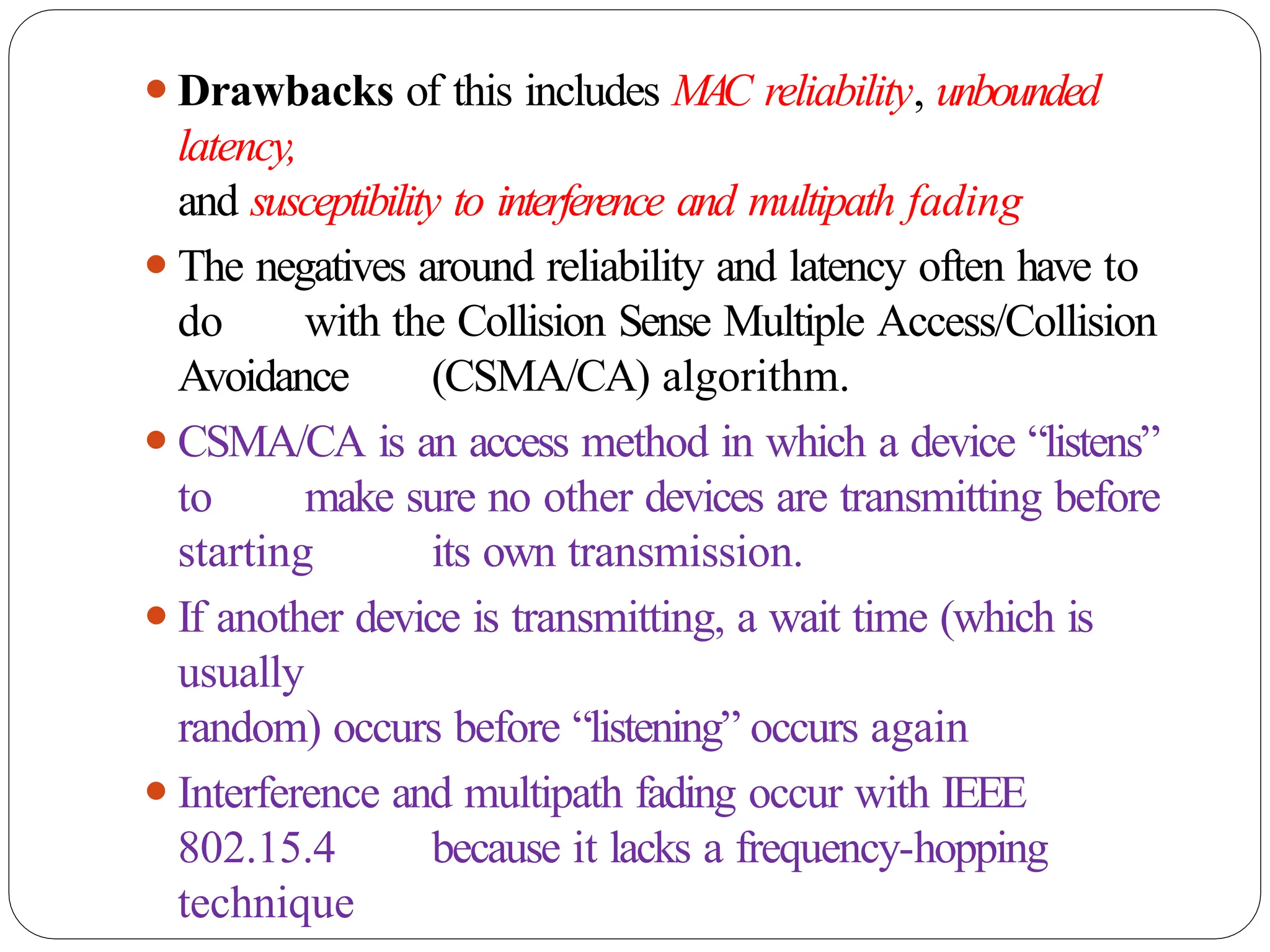
⚫Drawbacks of this includes MAC reliability, unbounded
latency,
and susceptibility to interference and multipath fading
⚫The negatives around reliability and latency often have to
do with the Collision Sense Multiple Access/Collision
Avoidance (CSMA/CA) algorithm.
⚫CSMA/CA is an access method in which a device “listens”
to make sure no other devices are transmitting before
starting its own transmission.
⚫If another device is transmitting, a wait time (which is
usually
random) occurs before “listening” occurs again
⚫Interference and multipath fading occur with IEEE
802.15.4 because it lacks a frequency-hopping
technique
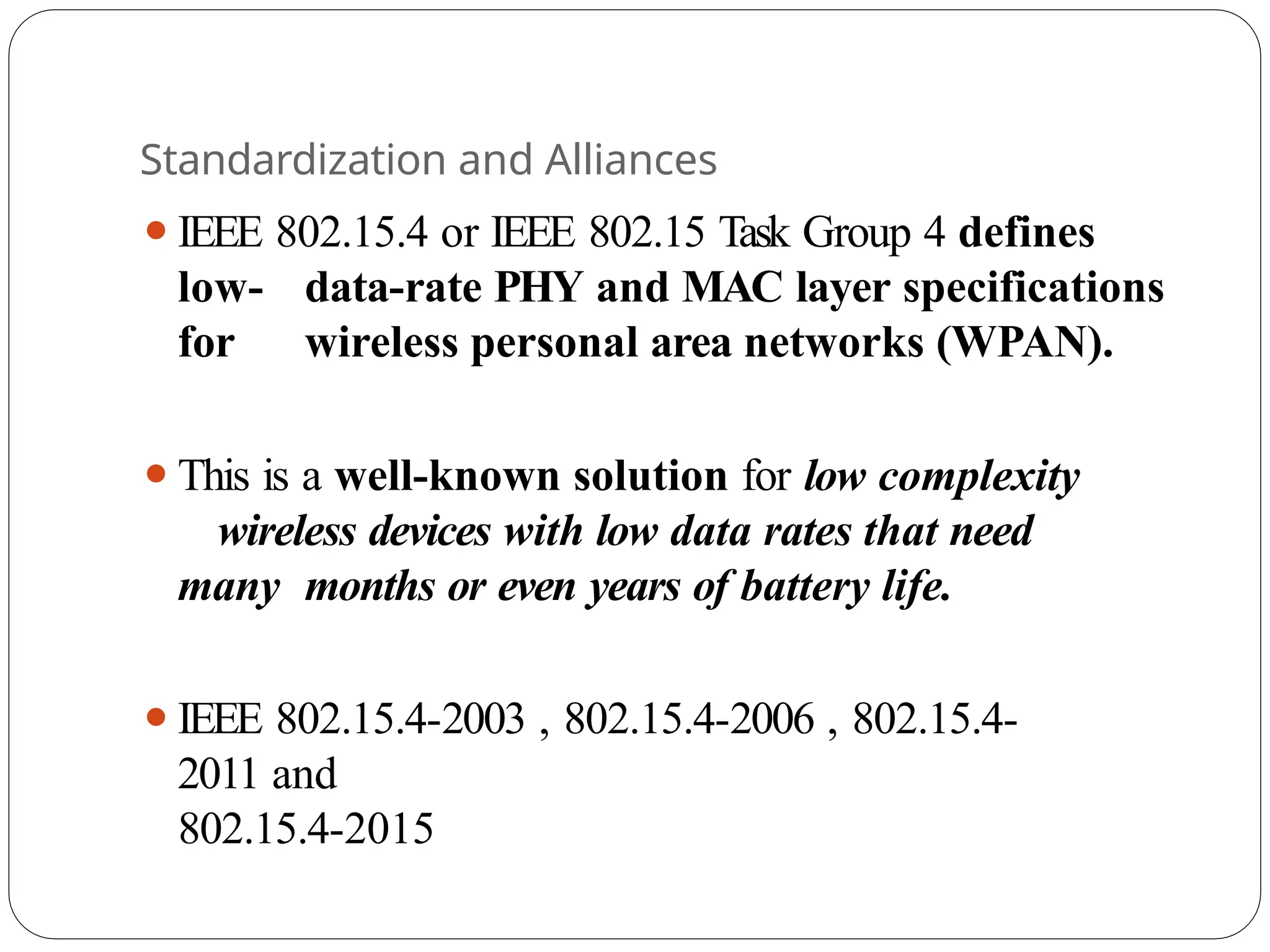
Standardization and Alliances
⚫IEEE 802.15.4 or IEEE 802.15 Task Group 4 defines
low- data-rate PHY and MAC layer specifications
for wireless personal area networks (WPAN).
⚫This is a well-known solution for low complexity
wireless devices with low data rates that need
many months or even years of battery life.
⚫IEEE 802.15.4-2003 , 802.15.4-2006 , 802.15.4-
2011 and
802.15.4-2015
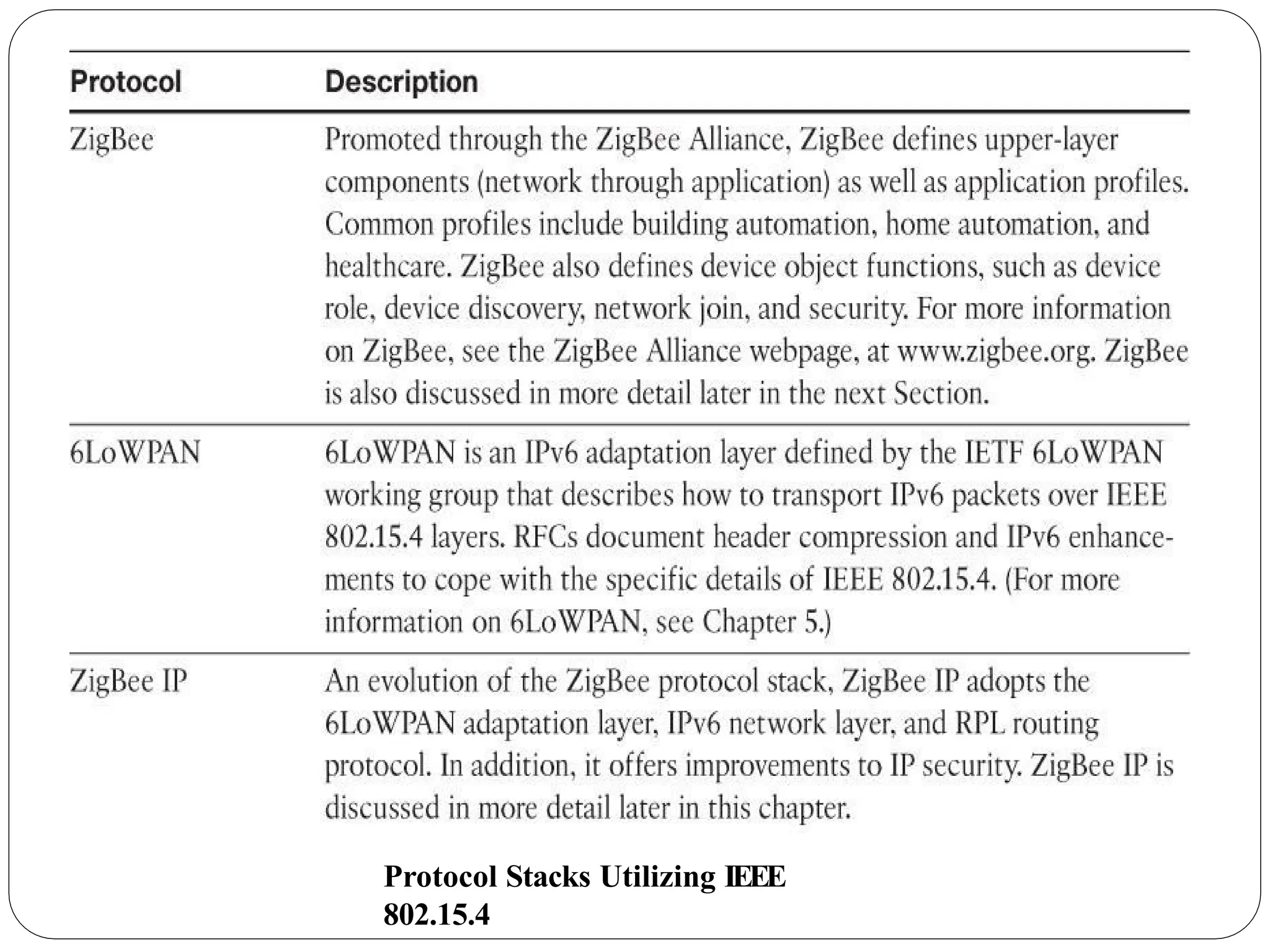
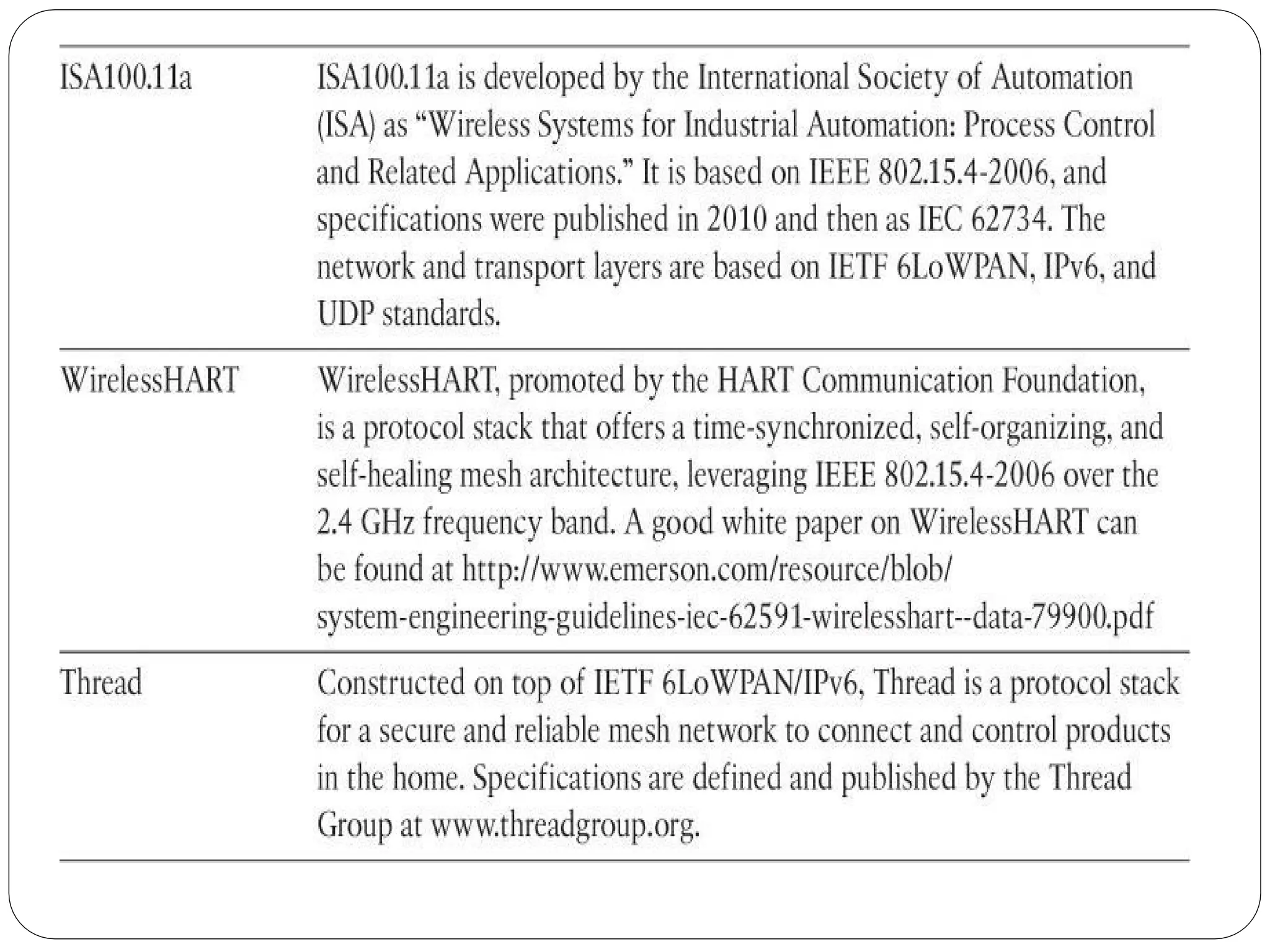
Protocol Stacks Utilizing IEEE
802.15.4
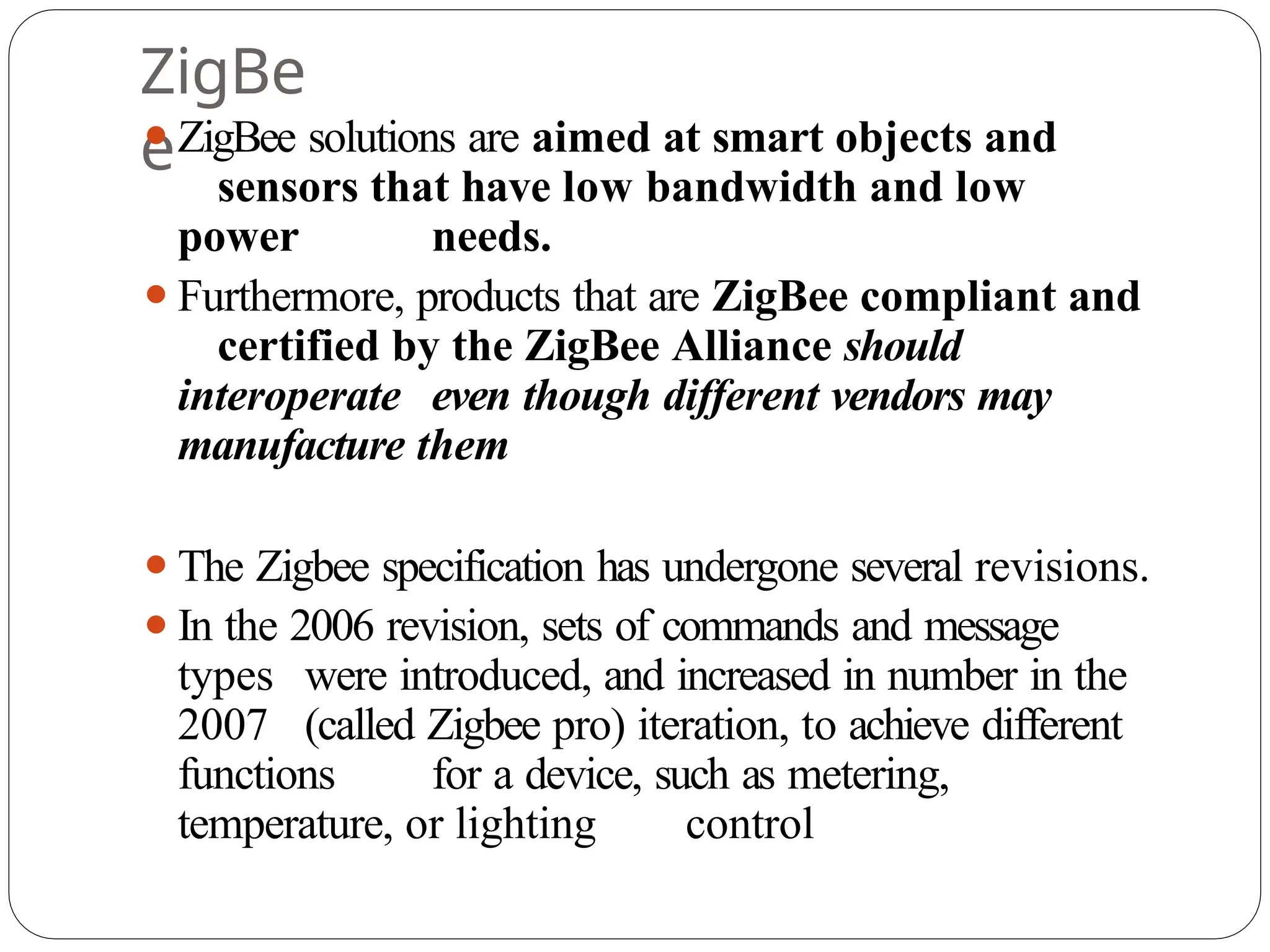
ZigBe
e
⚫ZigBee solutions are aimed at smart objects and
sensors that have low bandwidth and low
power needs.
⚫Furthermore, products that are ZigBee compliant and
certified by the ZigBee Alliance should
interoperate even though different vendors may
manufacture them
⚫The Zigbee specification has undergone several revisions.
⚫In the 2006 revision, sets of commands and message
types were introduced, and increased in number in the
2007 (called Zigbee pro) iteration, to achieve different
functions for a device, such as metering,
temperature, or lighting control
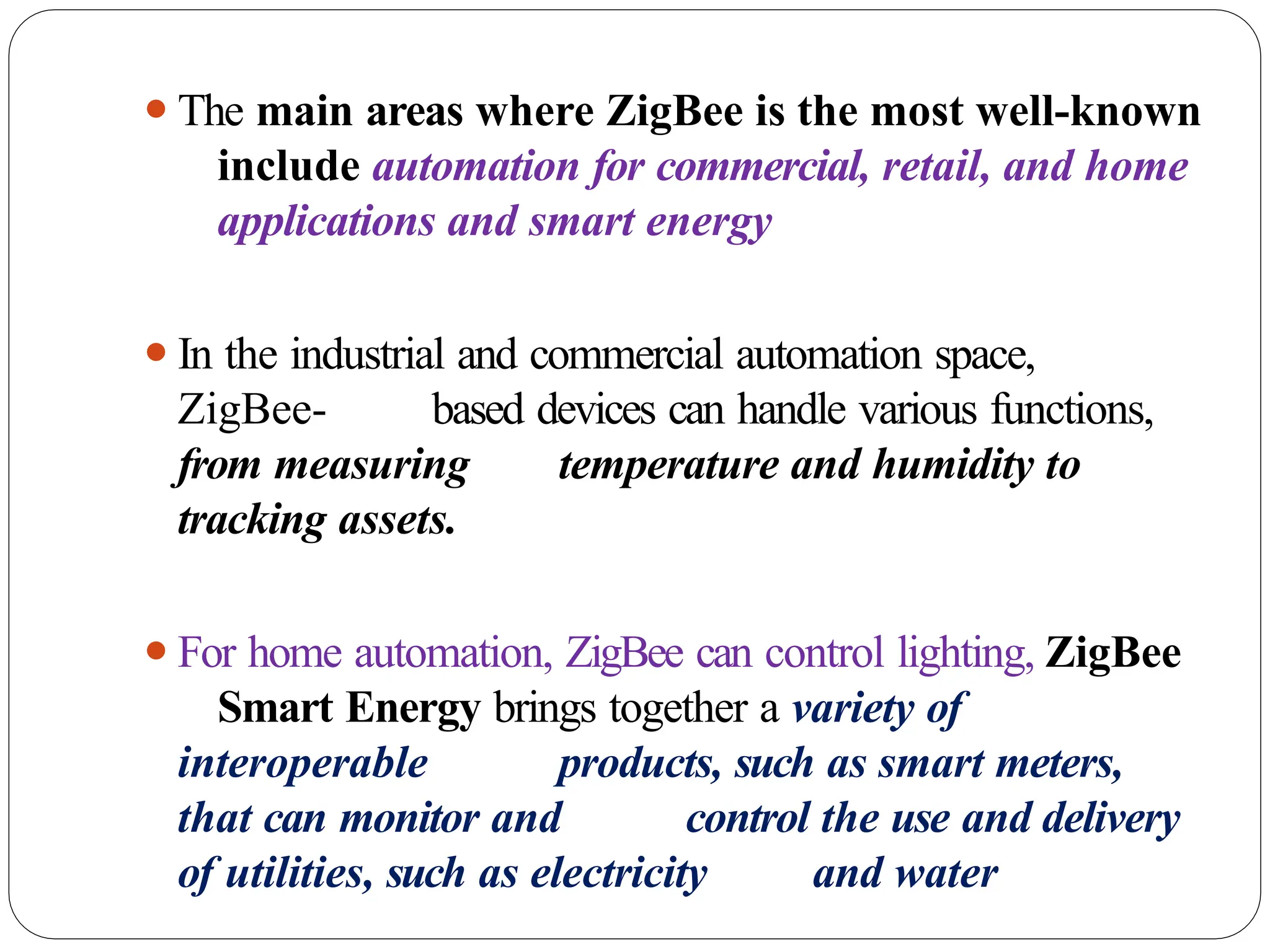
⚫The main areas where ZigBee is the most well-known
include automation for commercial, retail, and home
applications and smart energy
⚫In the industrial and commercial automation space,
ZigBee- based devices can handle various functions,
from measuring temperature and humidity to
tracking assets.
⚫For home automation, ZigBee can control lighting, ZigBee
Smart Energy brings together a variety of
interoperable products, such as smart meters,
that can monitor and control the use and delivery
of utilities, such as electricity and water
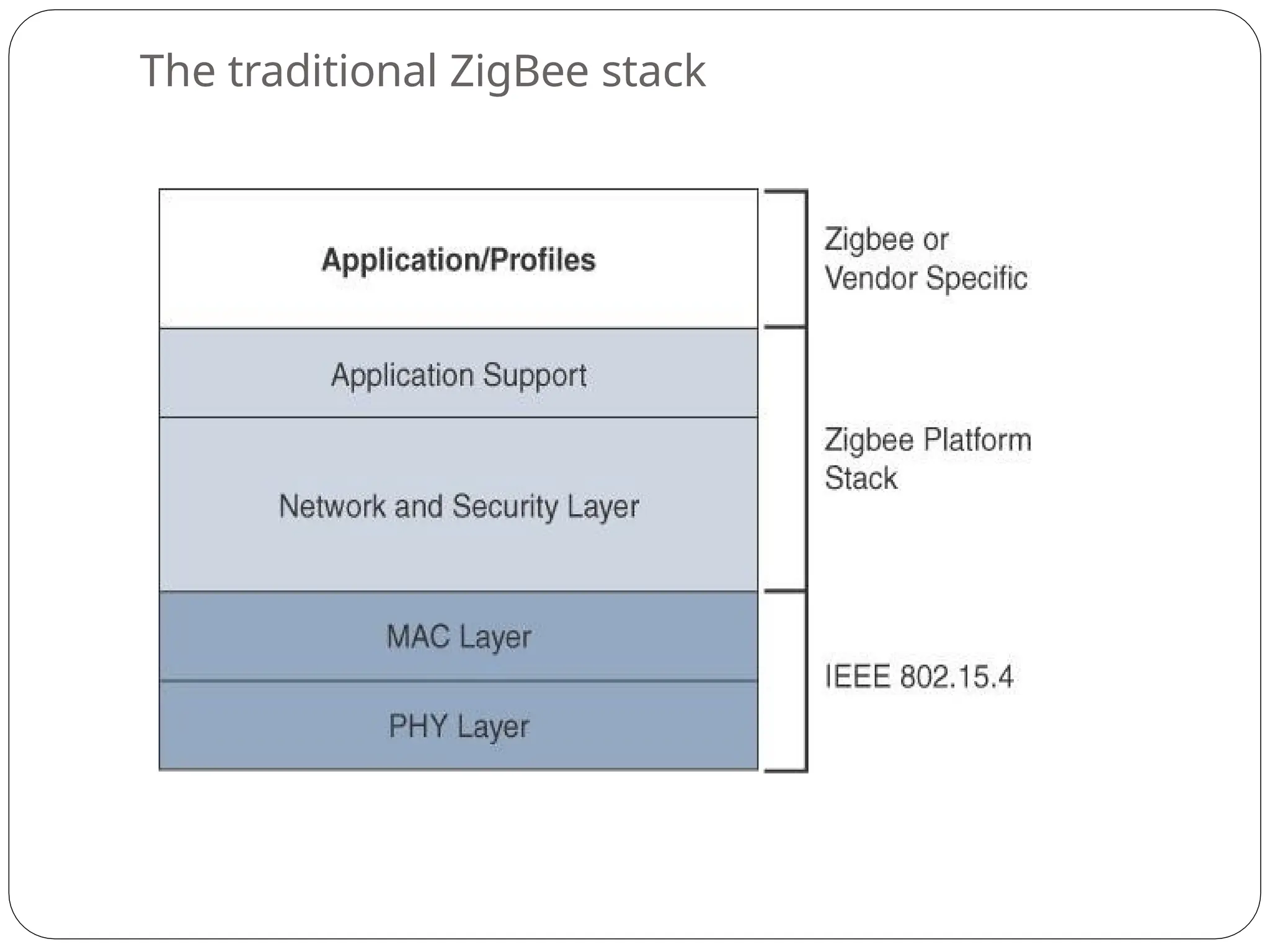
The traditional ZigBee stack
⚫The ZigBee network and security layer provides
mechanisms for network startup, configuration,
routing, and securing communications.
⚫This includes calculating routing paths in what is often a
changing topology, discovering neighbors, and managing
the routing tables as devices join for the first time.
⚫The network layer is also responsible for forming the
appropriate topology, which is often a mesh but could
be a star or tree as well.
⚫From a security perspective, ZigBee utilizes 802.15.4 for security
at the MAC layer
, using the Advanced Encryption
Standard (AES) with a 128-bit key and also
provides security at the network and
application layers.
⚫ZigBee uses Ad hoc On-Demand Distance
Vector (AODV) routing across a mesh
network.
⚫Interestingly, this routing algorithm does not send a
message until a route is needed.
⚫Assuming that the next hop for a route is not in its
routing table, a network node broadcasts a
request for a routing connection.
⚫This causes a burst of routing related traffic, but after a
comparison of various responses, the path with the
lowest number of hops is determined for the
connection.
⚫The application support layer interfaces the lower
portion of the stack dealing with the networking of ZigBee
devices with the higher-layer applications.
⚫ZigBee predefines many application profiles for
certain industries, and vendors can optionally create
their own custom ones at this layer.
⚫As mentioned previously, Home Automation and /mart
Energy are two examples of popular application
profiles.
ZigBee
IP
⚫With the introduction of ZigBee IP, the support of IEEE
802.15.4 continues, but the IP and TCP/UDP protocols
and various other open standards are now supported at the
network and transport layers.
⚫The ZigBee-specific layers are now found only at the top
of the protocol stack for the applications
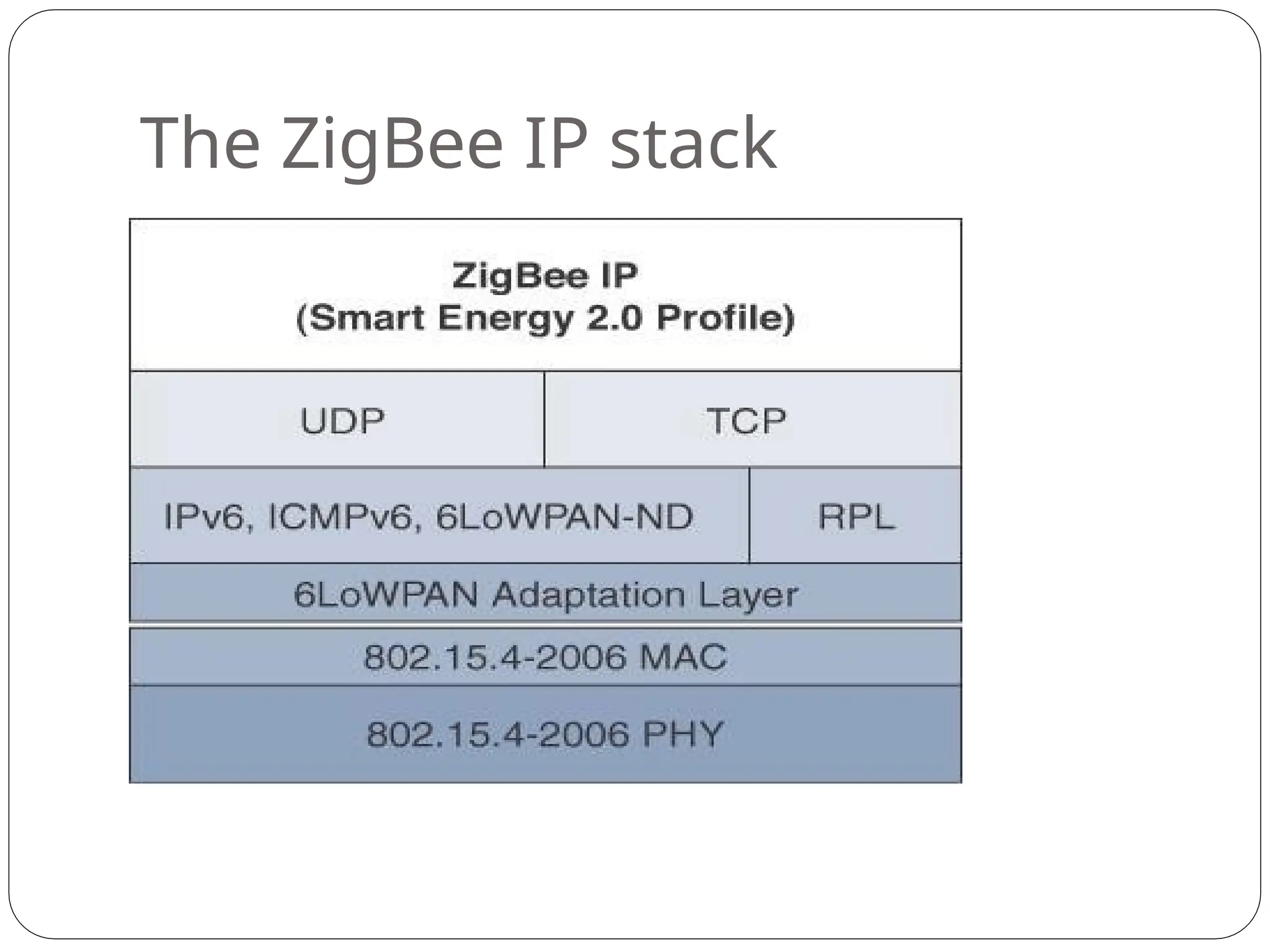
The ZigBee IP stack
⚫ ZigBee IP supports 6LoWPAN as an adaptation layer.
⚫ The 6LoWPAN mesh addressing header is not required as
ZigBee IP utilizes the mesh-over or route-over method for
forwarding packets.
⚫ ZigBee IP requires the support of 6LoWPAN’s fragmentation
and
header compression schemes.
⚫ At the network layer, all ZigBee IP nodes support IPv6,
ICMPv6, and 6LoWPAN Neighbor Discovery (ND), and utilize
RPL for the routing of packets across the mesh network.
⚫ Both TCP and UDP are also supported, to provide both
connection-oriented and connectionless service.
Physical
Layer
⚫The 802.15.4 standard supports an extensive number
of PHY options that range from 2.4 GHz to sub-
GHz frequencies in ISM bands
⚫The original IEEE 802.15.4-2003 standard specified only
three PHY options based on direct sequence spread
spectrum (DSSS) modulation.
⚫DSSS is a modulation technique in which a signal is
intentionally spread in the frequency domain, resulting
in greater bandwidth.
Modulation
⚫In the modulation process, some parameter of the
carrier wave (such as amplitude, frequency or
phase ) is varied in accordance with the modulating
signal .This modulated signal is then transmitted
by the transmitter
⚫In the modulation process, two signals are used namely
the modulating signal and the carrier
⚫The modulating signal is nothing but the baseband signal
or information signal while the carrier is a high
frequency sinusoidal signal
⚫Advantages of Modulation
⚫Reduction in the height of antenna
⚫Avoids mixing of signals
⚫Increases the range of
communication
⚫Multiplexing is possible
⚫Improves quality of reception
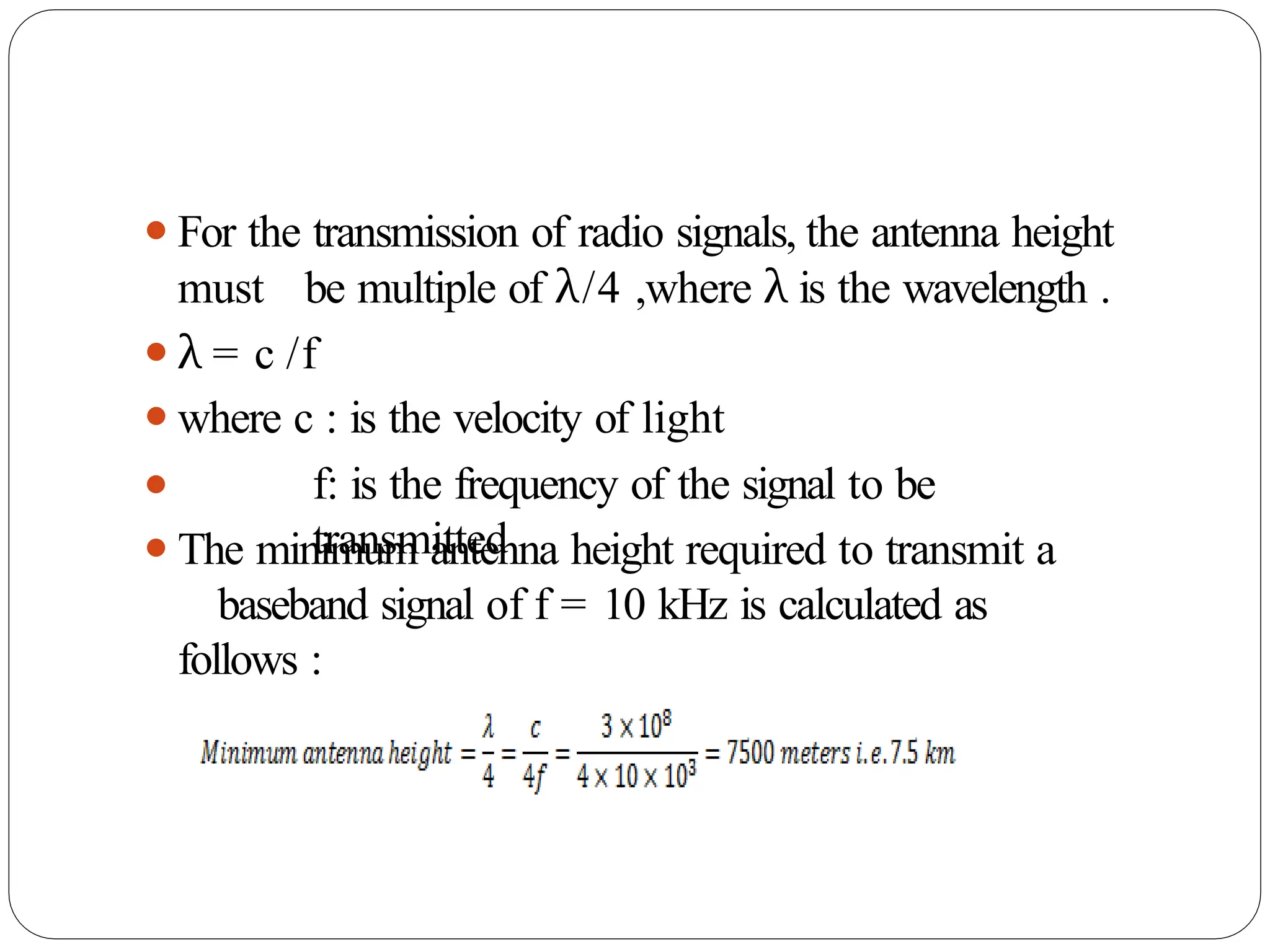
⚫For the transmission of radio signals, the antenna height
must be multiple of λ/4 ,where λ is the wavelength .
⚫λ = c /f
⚫where c : is the velocity of light
⚫ f: is the frequency of the signal to be
transmitted
⚫The minimum antenna height required to transmit a
baseband signal of f = 10 kHz is calculated as
follows :
⚫The original physical layer transmission options were
as follows:
⚫2.4 GHz, 16 channels, with a data rate of 250 kbps
⚫915 MHz, 10 channels, with a data rate of 40 kbps
⚫868 MHz, 1 channel, with a data rate of 20 kbps
⚫IEEE 802.15.4-2006, 802.15.4- 2011, and IEEE
802.15.4-
2015 introduced additional PHY communication
options, including the following:
⚫OQPSK PHY:
⚫This is DSSS PHY
, employing offset quadrature phase
shift keying (OQPSK) modulation. OQPSK
is a modulation technique that uses four unique bit
values that are signalled by phase changes.
⚫An offset function that is present during phase shifts
allows data to be transmitted more reliably.
⚫ BPSK PHY:
⚫ This is DSSS PHY
, employing binary phase-shift keying
(BPSK) modulation.
⚫ BPSK specifies two unique phase shifts as its data encoding
scheme.
⚫ ASK PHY:
⚫ This is parallel sequence spread spectrum (PSSS) PHY
,
employing amplitude shift keying (ASK) and BPSK
modulation.
⚫ PSSS is an advanced encoding scheme that offers increased
range, throughput, data rates, and signal integrity compared to
DSSS.
⚫ ASK uses amplitude shifts instead of phase shifts to signal
different bit values
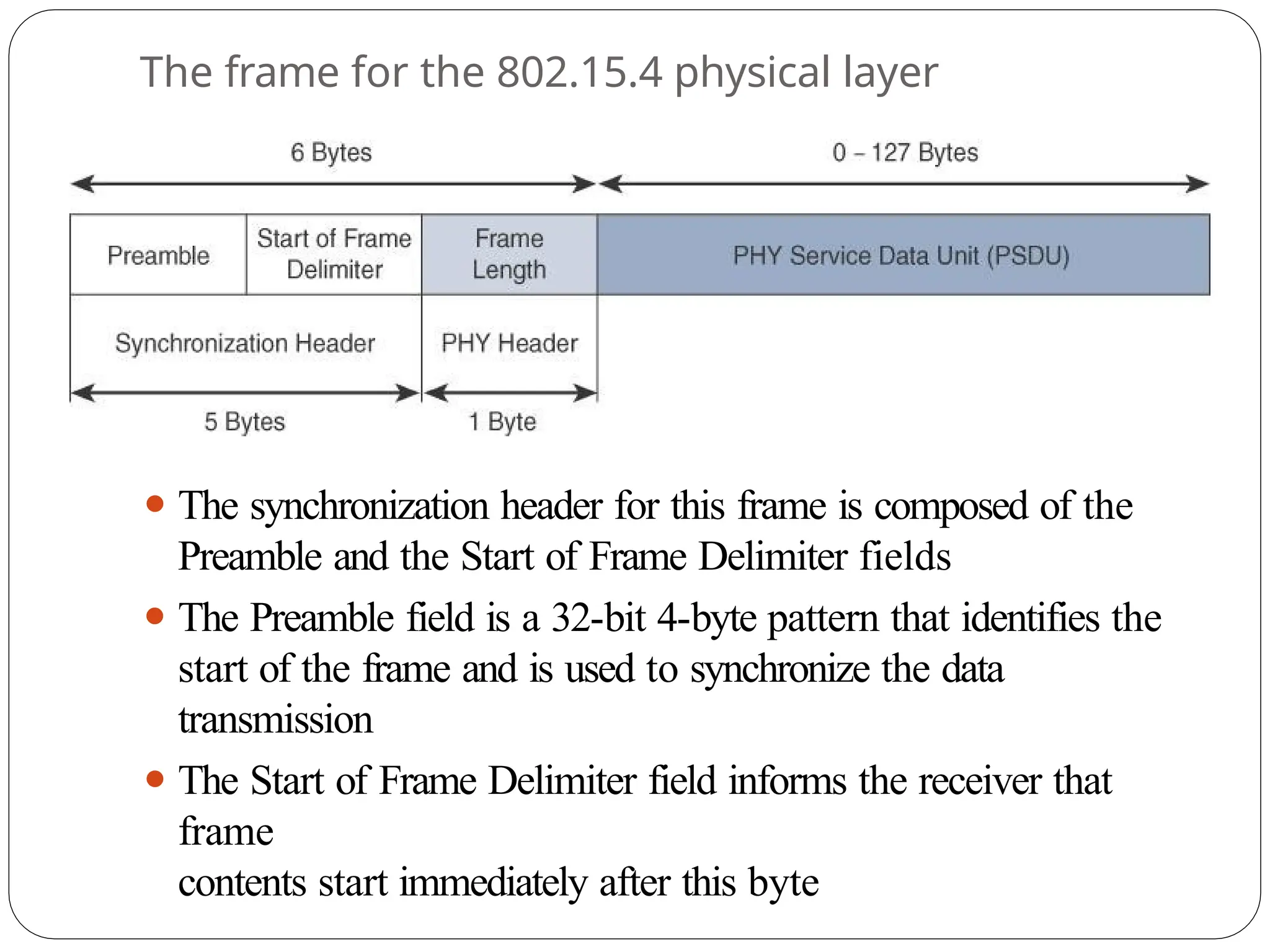
The frame for the 802.15.4 physical layer
⚫ The synchronization header for this frame is composed of the
Preamble and the Start of Frame Delimiter fields
⚫ The Preamble field is a 32-bit 4-byte pattern that identifies the
start of the frame and is used to synchronize the data
transmission
⚫ The Start of Frame Delimiter field informs the receiver that
frame
contents start immediately after this byte
⚫The PHY Header portion of the PHY frame is frame
length value. It lets the receiver know how much total
data to expect in the PHY service data unit (PSDU)
portion of the
802.4.15 PHY.
⚫The PSDU is the data field or payload
⚫ The maximum size of the IEEE 802.15.4 PSDU is 127 bytes.This size is
significantly smaller than the lowest MTU setting of other upper-layer
protocols, such as IPv6, which has a minimum MTU setting of 1280
bytes. Therefore, fragmentation of the IPv6 packet must occur at the data
link layer for larger IPv6 packets to be carried over IEEE 802.15.4
frames.
MAC
Layer
⚫At this layer, the scheduling and routing of data frames
are coordinated
⚫The 802.15.4 MAC layer performs the following tasks:
⚫Network beaconing for devices acting as coordinators
(New devices use beacons to join an 802.15.4 network)
⚫PAN association and disassociation by a device
⚫Device security
⚫Reliable link communications between two peer
MAC entities
⚫ The MAC layer achieves these tasks by using various
predefined frame types
⚫ Four types of MAC frames are specified in 802.15.4:
⚫ Data frame:
⚫ Handles all transfers of data
⚫ Beacon frame:
⚫ Used in the transmission of beacons from a P
AN coordinator
⚫ Acknowledgement frame:
⚫ Confirms the successful reception of a frame
⚫ MAC command frame:
⚫ Responsible for control communication between devices
IEEE 802.15.4 MAC Format
⚫The MAC Header field is composed of the Frame
Control, Sequence Number and the Addressing
fields.
⚫The Frame Control field defines attributes such as
frame type, addressing modes, and other control
flags.
⚫The Sequence Number field indicates the sequence
identifier for the frame.
⚫The Addressing field specifies the Source and
Destination PAN Identifier fields as well as the
Source and Destination Address fields
⚫The MAC Payload field varies by individual frame type.
⚫For example, beacon frames have specific fields and
payloads related to beacons, while MAC command
frames have different fields present.
⚫The MAC Footer field is nothing more than a frame
check sequence (FCS).
⚫An FCS is a calculation based on the data in the frame that
is used by the receiving side to confirm the integrity
of the data in the frame.
⚫IEEE 802.15.4 requires all devices to support a unique 64-
bit extended MAC address, based on EUI-64.
⚫However, because the maximum payload is 127 bytes,
802.15.4 also defines how a 16-bit “short address” is
assigned
to devices.
⚫This short address is local to the PAN and substantially
reduces the frame overhead compared to a 64-bit
extended MAC address
Topology
⚫IEEE 802.15.4–based networks can be built as star, peer-
to- peer, or mesh topologies.
⚫Mesh networks tie together many nodes.
⚫This allows nodes that would be out of range if trying
to communicate directly to leverage intermediary
nodes to transfer communications.
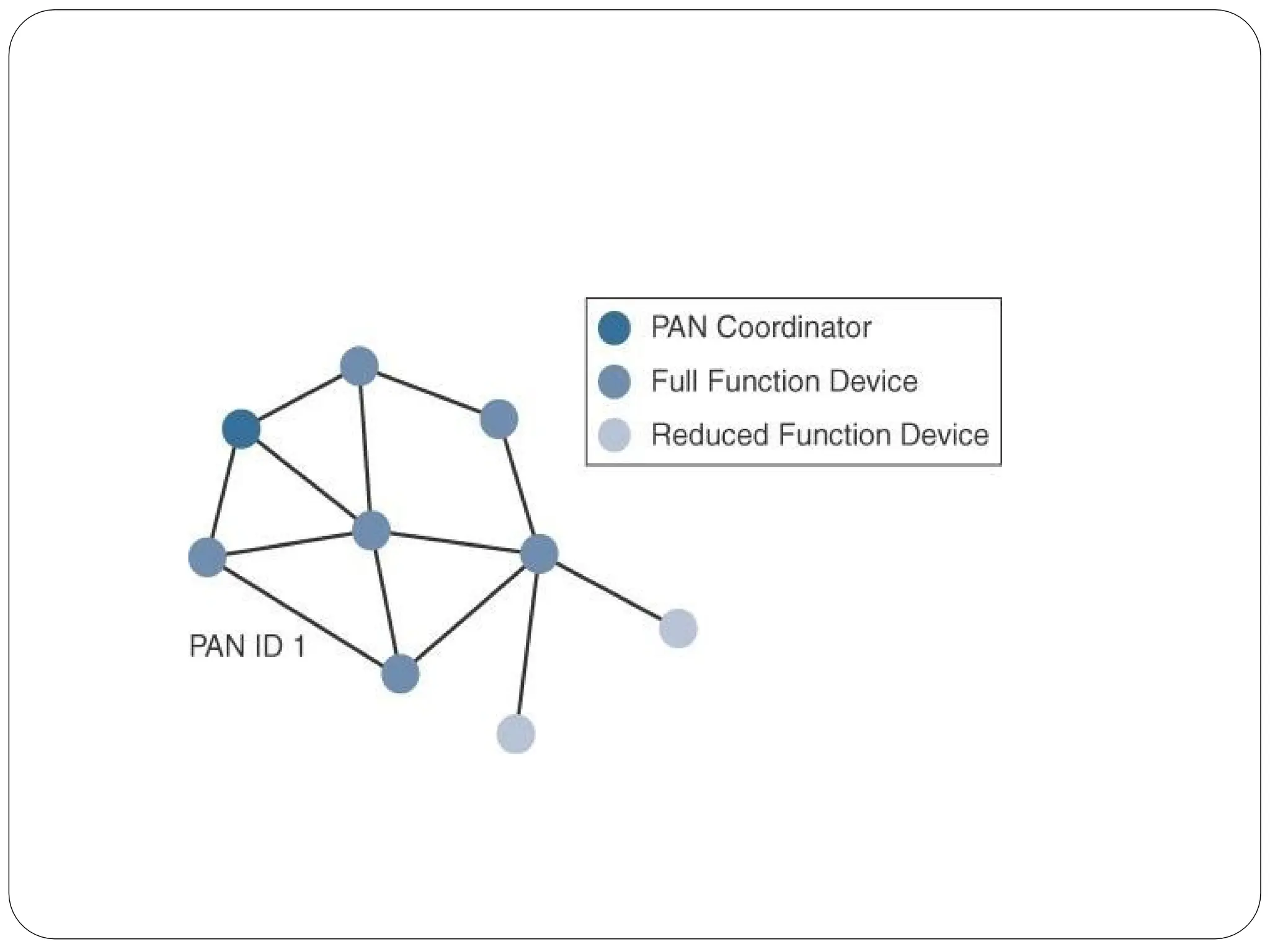
⚫Every 802.15.4 PAN should be set up with a unique
ID.
⚫All the nodes in the same 802.15.4 network should use
the same P
AN ID
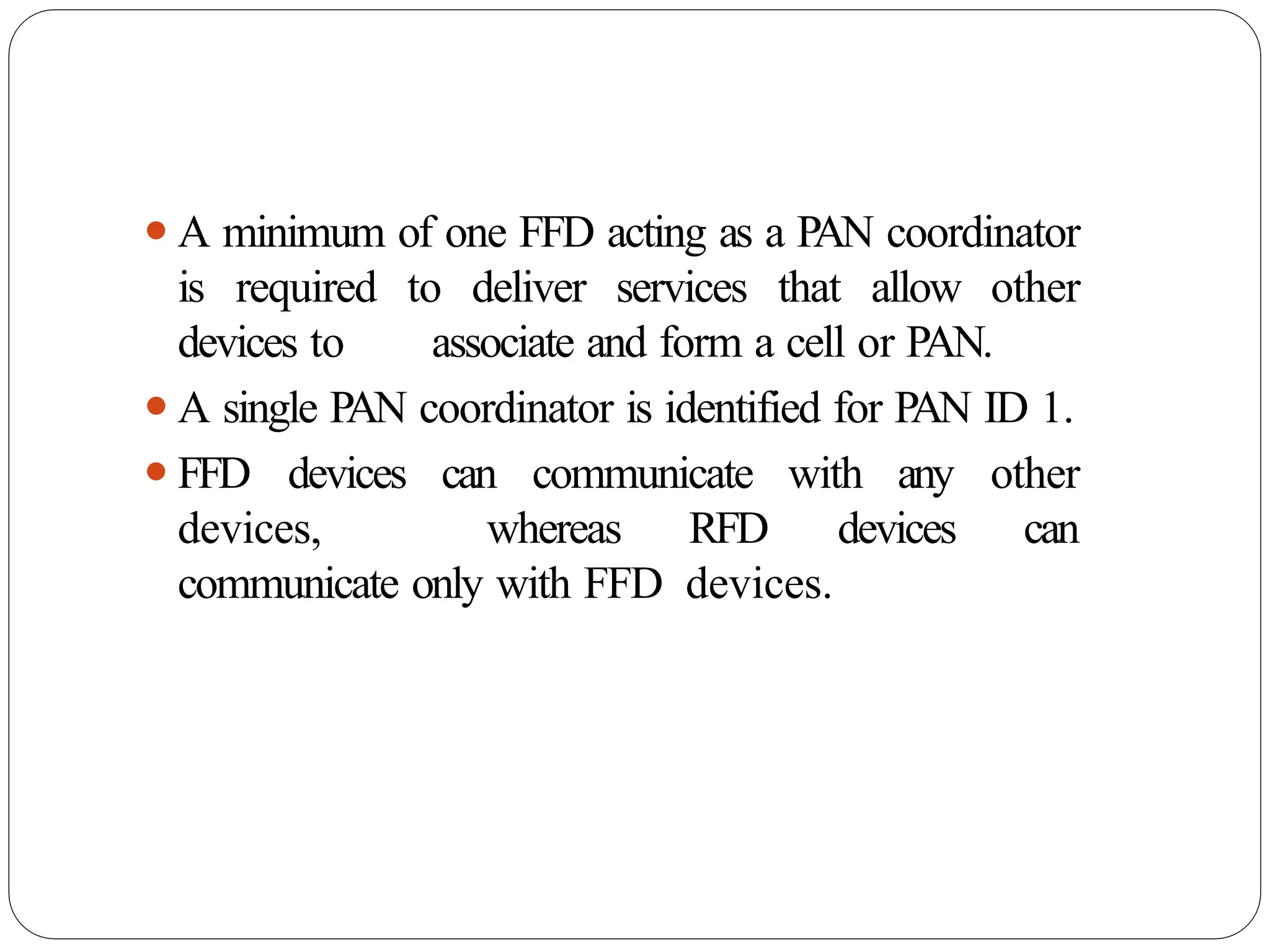
⚫A minimum of one FFD acting as a PAN coordinator
is required to deliver services that allow other
devices to associate and form a cell or PAN.
⚫A single PAN coordinator is identified for PAN ID 1.
⚫FFD devices can communicate with any other
devices, whereas RFD devices can
communicate only with FFD devices.
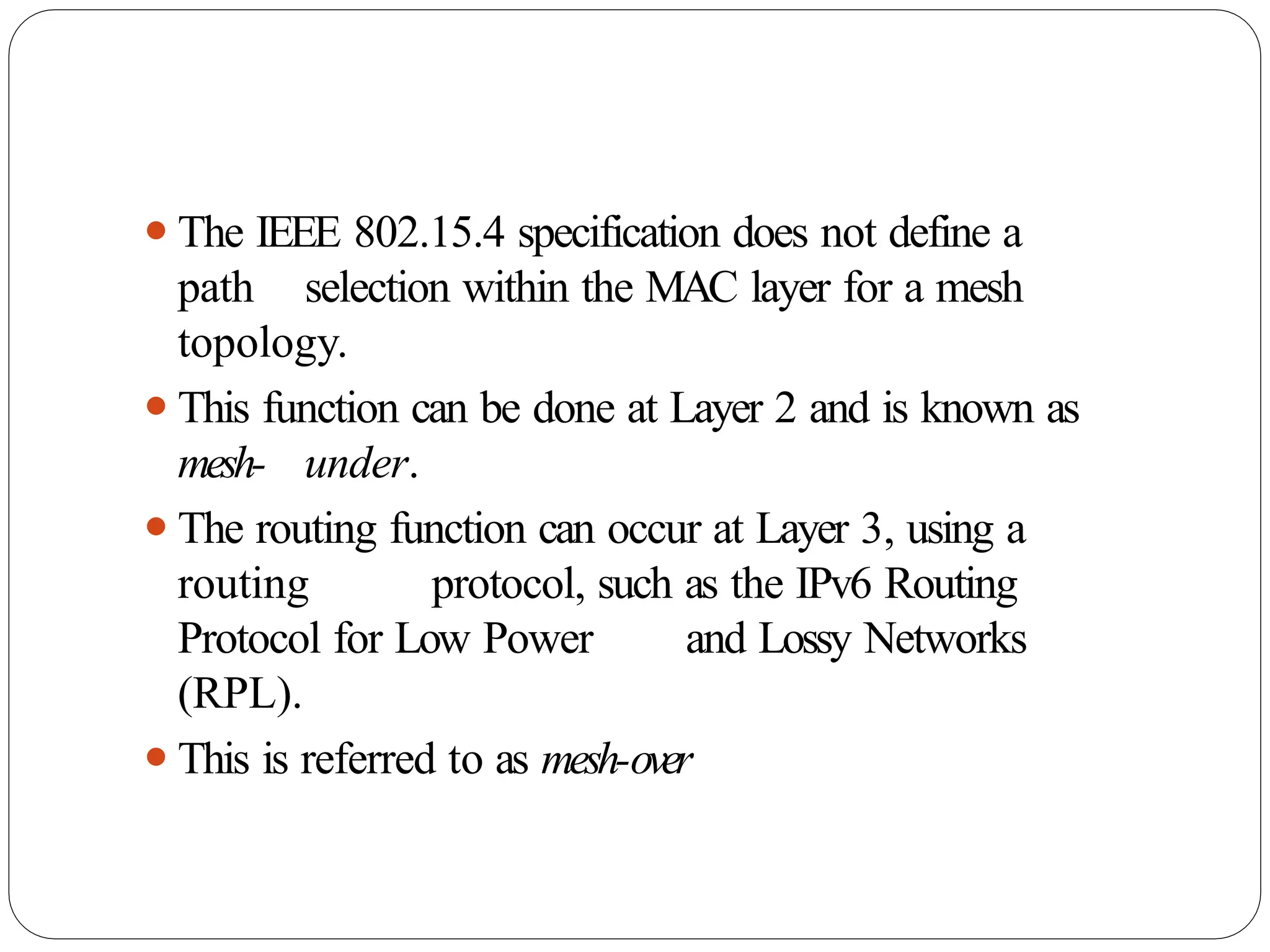
⚫The IEEE 802.15.4 specification does not define a
path selection within the MAC layer for a mesh
topology.
⚫This function can be done at Layer 2 and is known as
mesh- under.
⚫The routing function can occur at Layer 3, using a
routing protocol, such as the IPv6 Routing
Protocol for Low Power and Lossy Networks
(RPL).
⚫This is referred to as mesh-over
Security
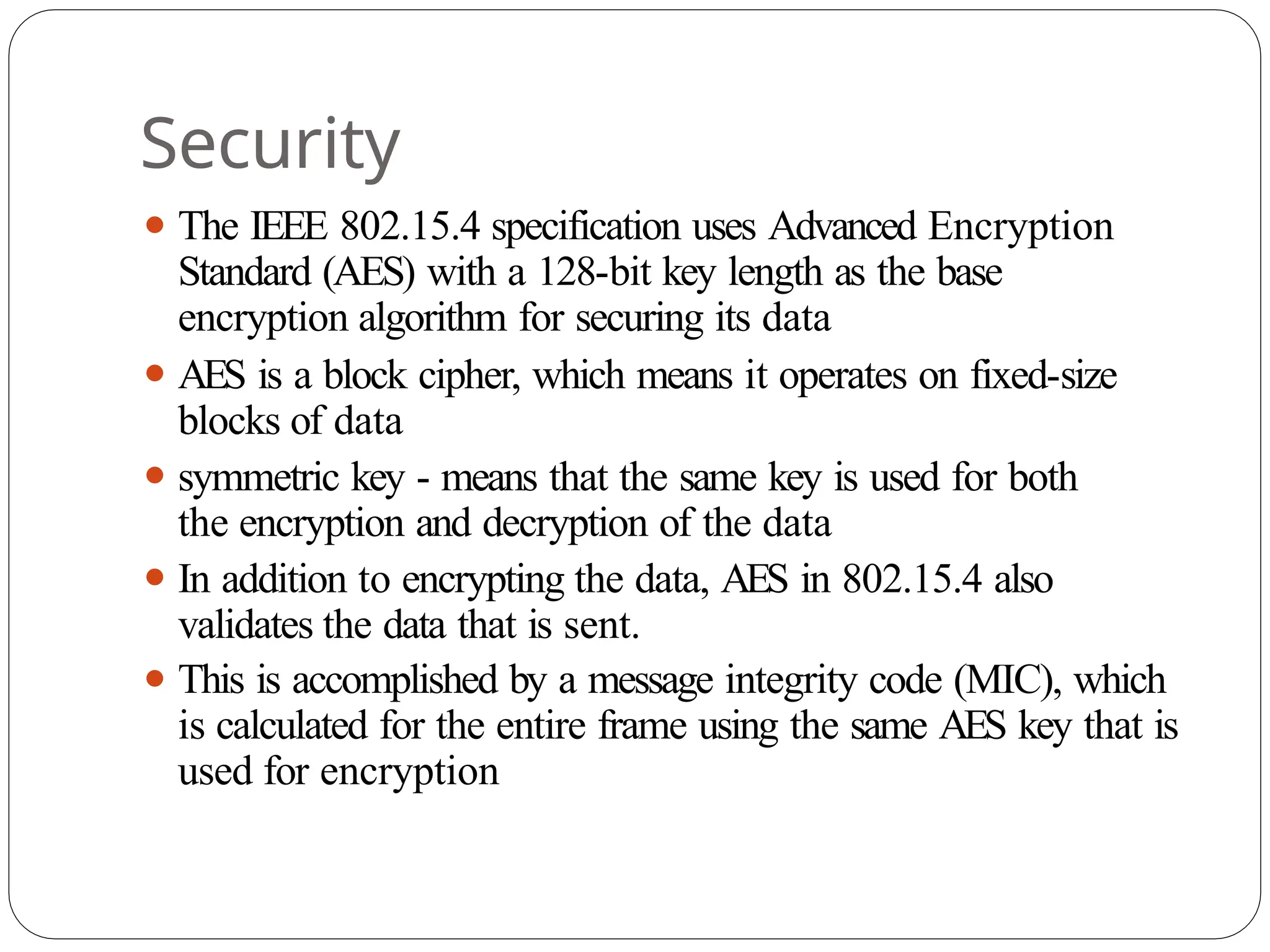
⚫ The IEEE 802.15.4 specification uses Advanced Encryption
Standard (AES) with a 128-bit key length as the base
encryption algorithm for securing its data
⚫ AES is a block cipher, which means it operates on fixed-size
blocks of data
⚫ symmetric key - means that the same key is used for both
the encryption and decryption of the data
⚫ In addition to encrypting the data, AES in 802.15.4 also
validates the data that is sent.
⚫ This is accomplished by a message integrity code (MIC), which
is calculated for the entire frame using the same AES key that is
used for encryption
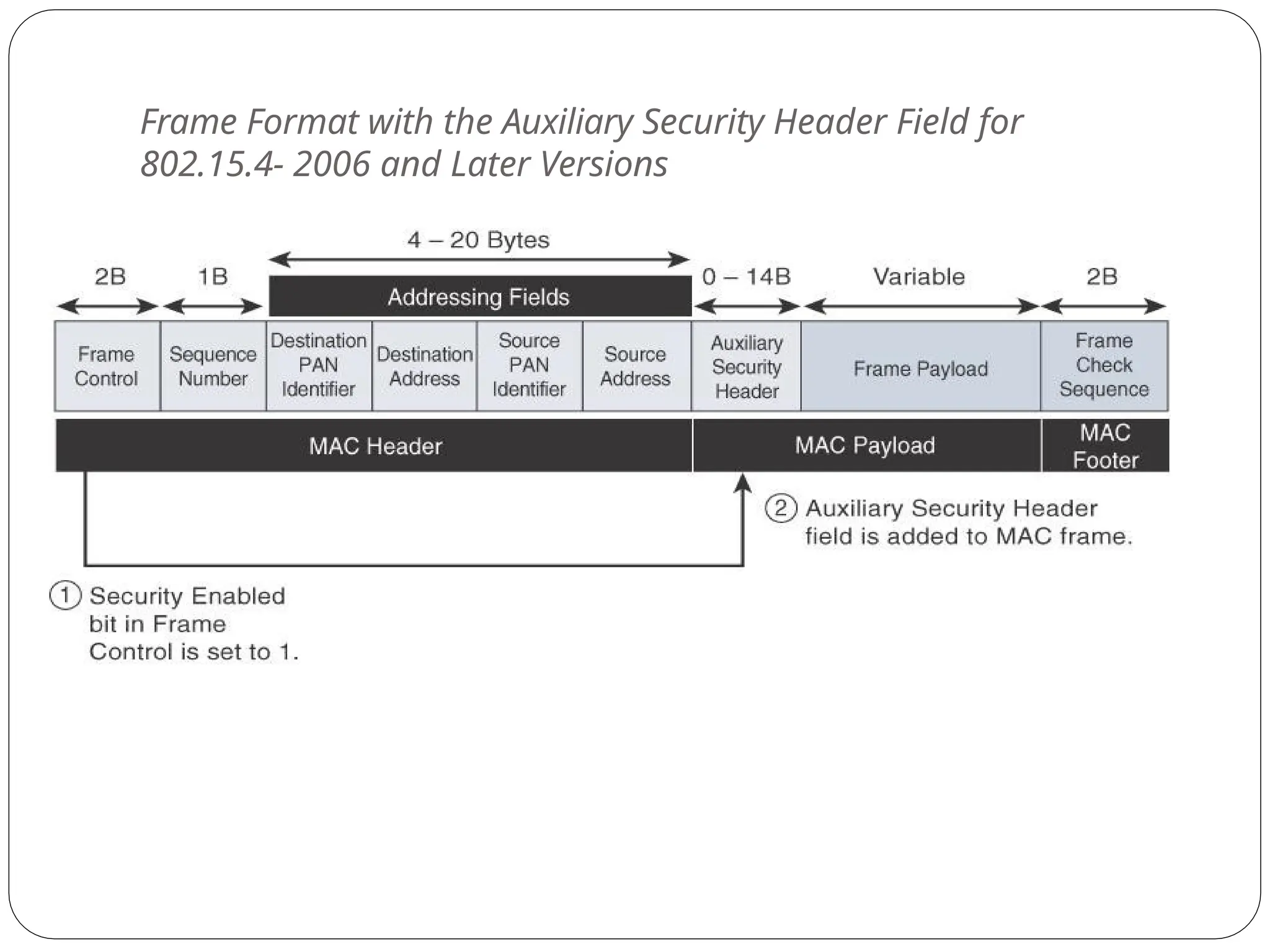
⚫Using the Security Enabled field in the Frame Control
portion of the 802.15.4 header is the first step to
enabling AES encryption.
⚫This field is a single bit that is set to 1 for security.
⚫Once this bit is set, a field called the Auxiliary Security
Header is created after the Source Address field, by
stealing some bytes from the Payload field.
Frame Format with the Auxiliary Security Header Field for
802.15.4- 2006 and Later Versions
IEEE 802.15.4g and 802.15.4e
⚫The IEEE 802.15.4e amendment of 802.15.4-2011
expands the MAC layer feature set to remedy the
disadvantages associated with 802.15.4, including MAC
reliability, unbounded latency, and multipath fading
⚫Also made improvements to better cope with certain
application domains, such as factory and process
automation and smart grid
⚫IEEE 802.15.4e-2012 enhanced the IEEE 802.15.4 MAC
layer capabilities in the areas of frame format,
security, determinism mechanism, and frequency
hopping
⚫IEEE 802.15.4g-2012 is also an amendment to the
IEEE 802.15.4-2011 standard
⚫The focus of this specification is the smart grid or,
more specifically, smart utility network
communication.
⚫802.15.4g seeks to optimize large outdoor wireless
mesh networks for field area networks (FANs)
⚫This technology applies to IoT use cases such as
the following:
⚫ Distribution automation and industrial supervisory
control and data acquisition (SCADA) environments for
remote monitoring and control
⚫ Public lighting
⚫ Environmental wireless sensors in smart cities
⚫ Electrical vehicle charging stations
⚫ Smart parking meters
⚫ Microgrids
⚫ Renewable energy
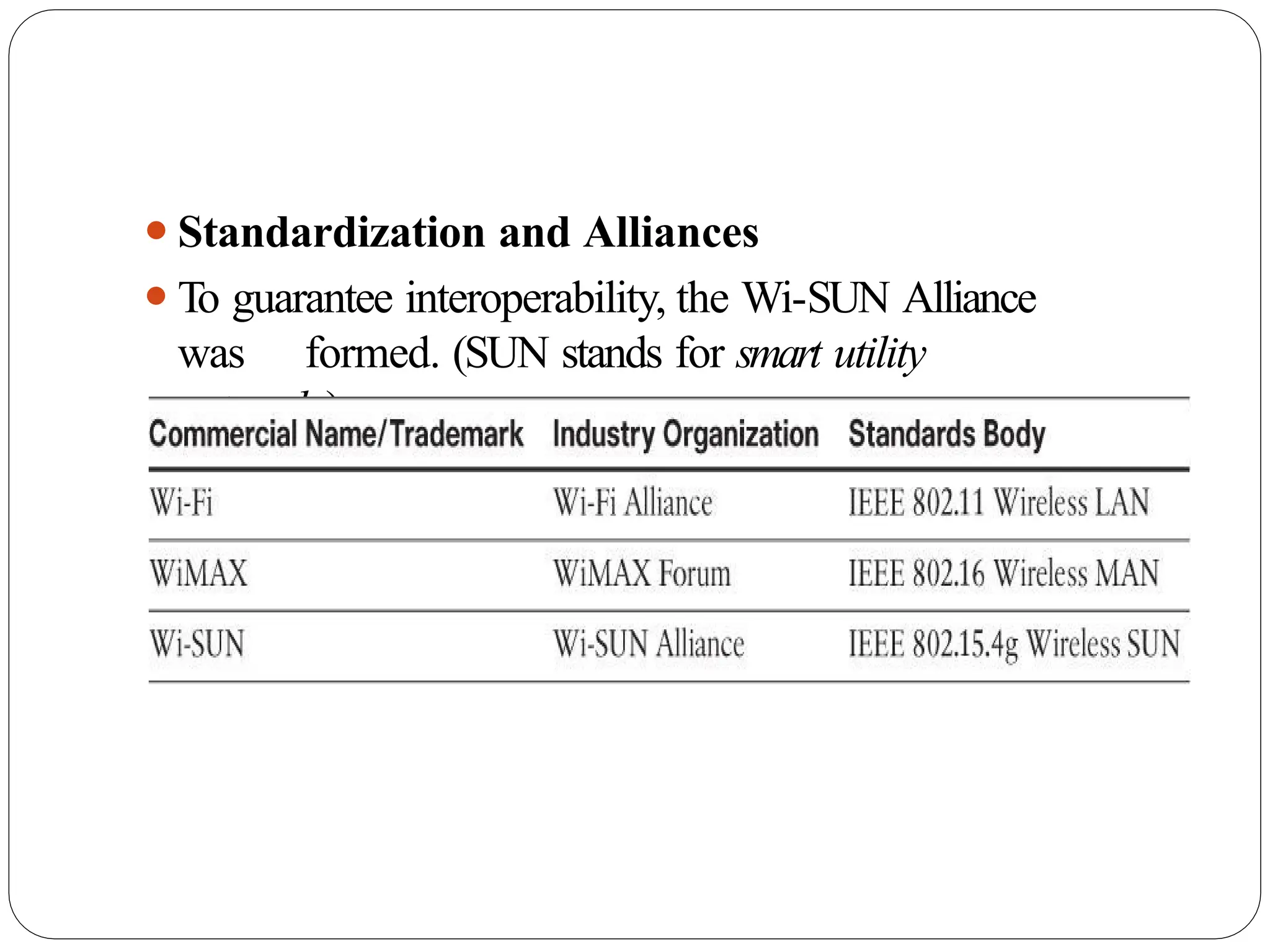
⚫Standardization and Alliances
⚫To guarantee interoperability, the Wi-SUN Alliance
was formed. (SUN stands for smart utility
network.)
Physical
Layer
⚫PSDU or payload size of 127 bytes was increased for
the SUN PHY to 2047 bytes
⚫This provides a better match for the greater packet
sizes found in many upper-layer protocols.
⚫For example, the default IPv6 MTU setting is 1280
bytes.
⚫Fragmentation is no longer necessary at Layer 2 when
IPv6 packets are transmitted over IEEE 802.15.4g
MAC frames.
⚫The error protection was improved in IEEE 802.15.4g
by evolving the CRC from 16 to 32 bits
⚫The SUN PHY
, as described in IEEE 802.15.4g-2012,
supports multiple data rates in bands ranging from 169
MHz to 2.4 GHz.
⚫These bands are covered in the unlicensed ISM
frequency spectrum
⚫Within these bands, data must be modulated onto
the frequency using at least one of the following
PHY mechanisms to be IEEE 802.15.4g
compliant:
⚫Multi-Rate and Multi-Regional Frequency
Shift Keying (MR-FSK)
⚫Offers good transmit power efficiency due to the
constant envelope of the transmit signal
⚫Multi-Rate and Multi-Regional Orthogonal
Frequency Division Multiplexing (MR-
OFDM)
⚫Provides higher data rates but may be too complex for
low- cost and low-power devices
⚫Multi-Rate and Multi-Regional Offset
Quadrature Phase-Shift Keying (MR-O-QPSK)
⚫Shares the same characteristics of the IEEE 802.15.4-
2006 O-QPSK PHY
, making multi-mode systems more
cost- effective and easier to design
⚫Enhanced data rates and a greater number of channels
for channel hopping are available, depending on the
frequency bands and modulation
MAC Layer
⚫Time-Slotted Channel Hopping (TSCH):
⚫It is an IEEE 802.15.4e-2012 MAC operation mode
that works to guarantee media access and channel
diversity.
⚫Channel hopping, also known as frequency hopping,
utilizes different channels for transmission at
different times.
⚫TSCH divides time into fixed time periods, or “time
slots,”
which offer guaranteed bandwidth and predictable
latency.
⚫In a time slot, one packet and its acknowledgement can be
transmitted, increasing network capacity because
multiple nodes can communicate in the same time
⚫A number of time slots are defined as a “slot frame,”
which is regularly repeated to provide “guaranteed
access.”
⚫The transmitter and receiver agree on the channels and
the timing for switching between channels through
the combination of a global time slot counter and a
global channel hopping sequence list
⚫Information elements:
⚫Information elements (IEs) allow for the exchange of
information at the MAC layer in an extensible manner,
either as header IEs (standardized) and/or payload IEs
(private).
⚫Specified in a tag, length, value (TLV) format, the IE
field allows frames to carry additional metadata to
support MAC layer services
⚫These services may include IEEE 802.15.9 key
management, Wi-SUN 1.0 IEs to broadcast and unicast
schedule timing information, and frequency hopping
synchronization information for the 6TiSCH
architecture.
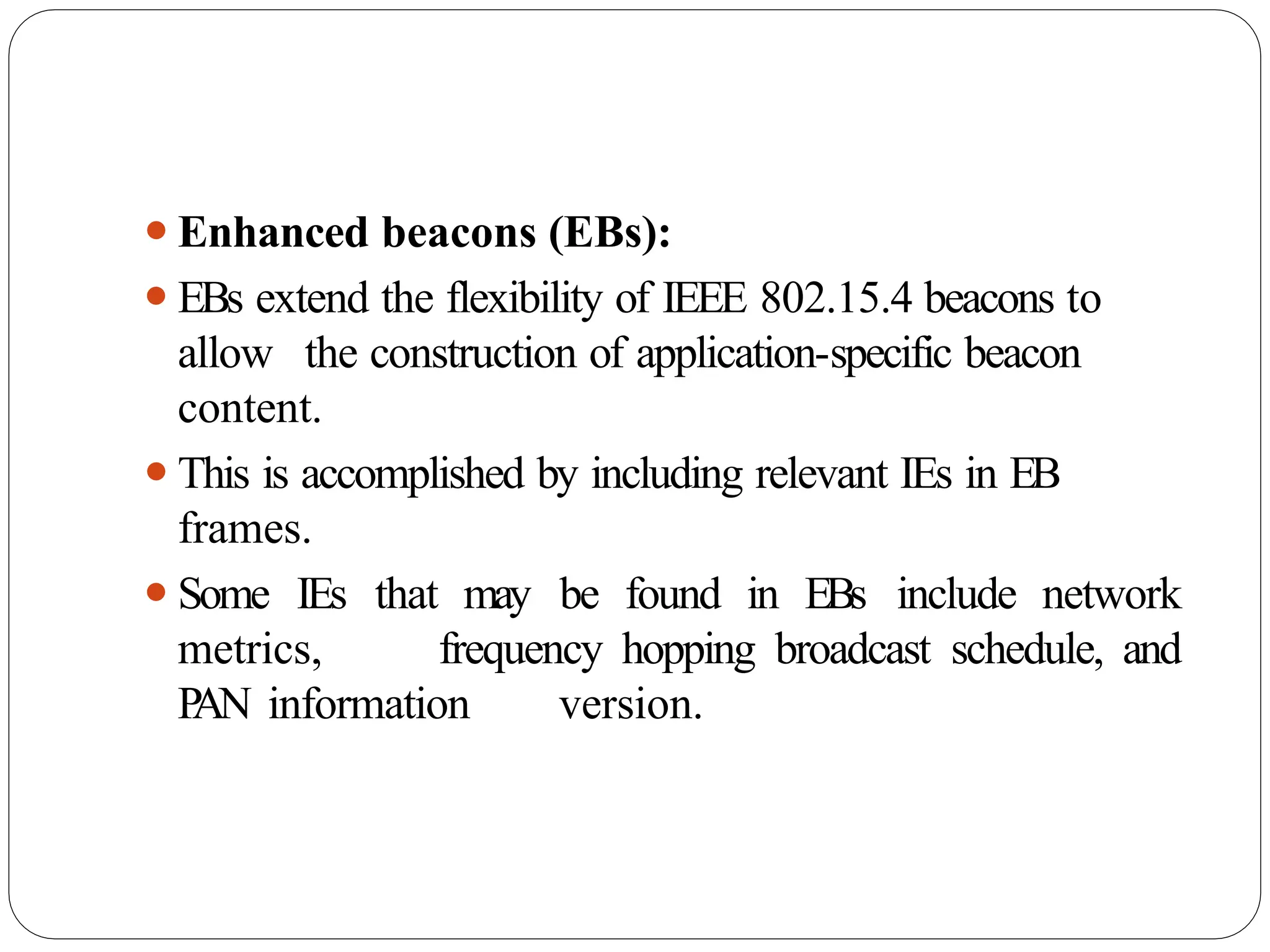
⚫Enhanced beacons (EBs):
⚫EBs extend the flexibility of IEEE 802.15.4 beacons to
allow the construction of application-specific beacon
content.
⚫This is accomplished by including relevant IEs in EB
frames.
⚫Some IEs that may be found in EBs include network
metrics, frequency hopping broadcast schedule, and
P
AN information version.
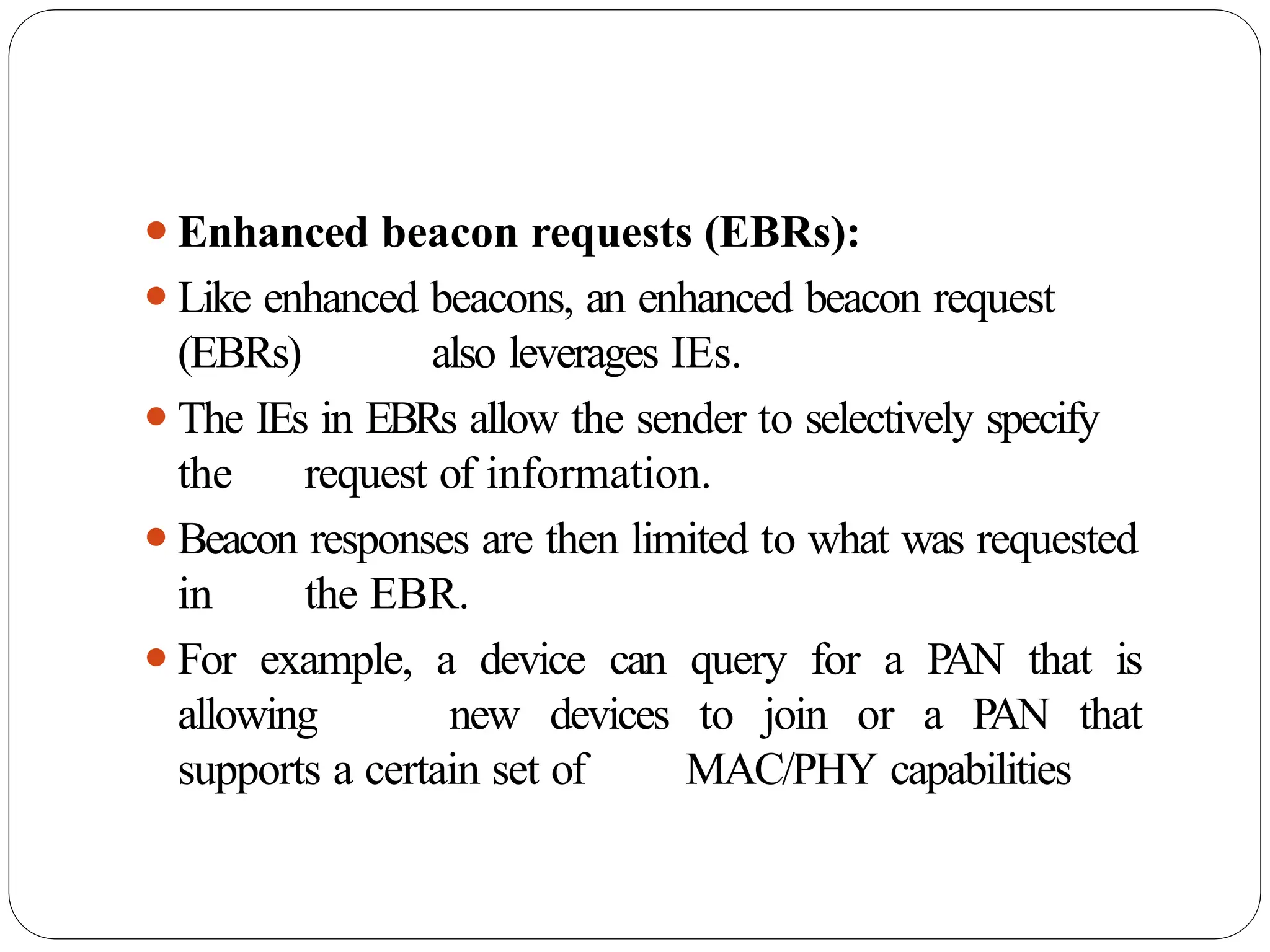
⚫Enhanced beacon requests (EBRs):
⚫Like enhanced beacons, an enhanced beacon request
(EBRs) also leverages IEs.
⚫The IEs in EBRs allow the sender to selectively specify
the request of information.
⚫Beacon responses are then limited to what was requested
in the EBR.
⚫For example, a device can query for a PAN that is
allowing new devices to join or a PAN that
supports a certain set of MAC/PHY capabilities
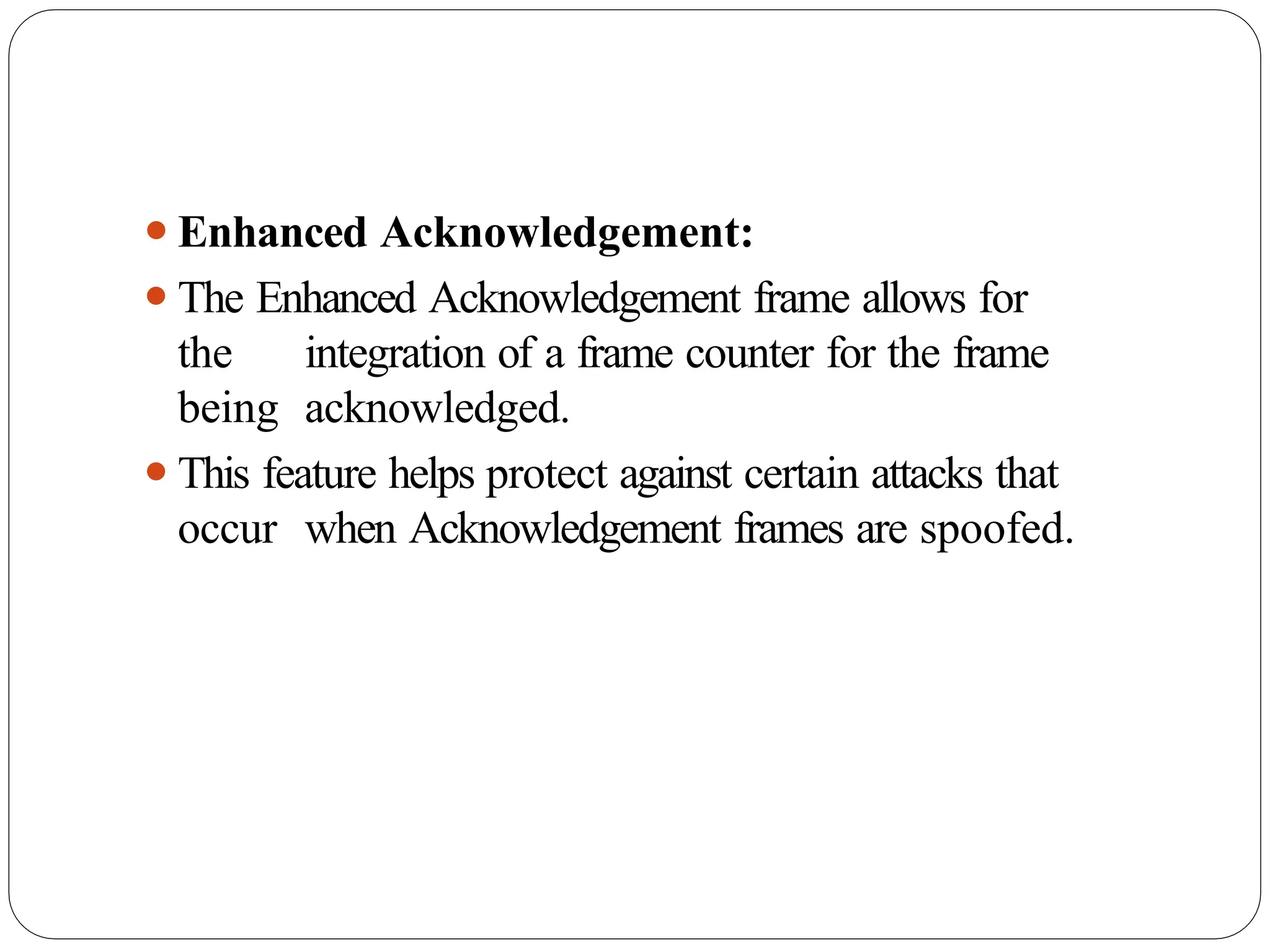
⚫Enhanced Acknowledgement:
⚫The Enhanced Acknowledgement frame allows for
the integration of a frame counter for the frame
being acknowledged.
⚫This feature helps protect against certain attacks that
occur when Acknowledgement frames are spoofed.
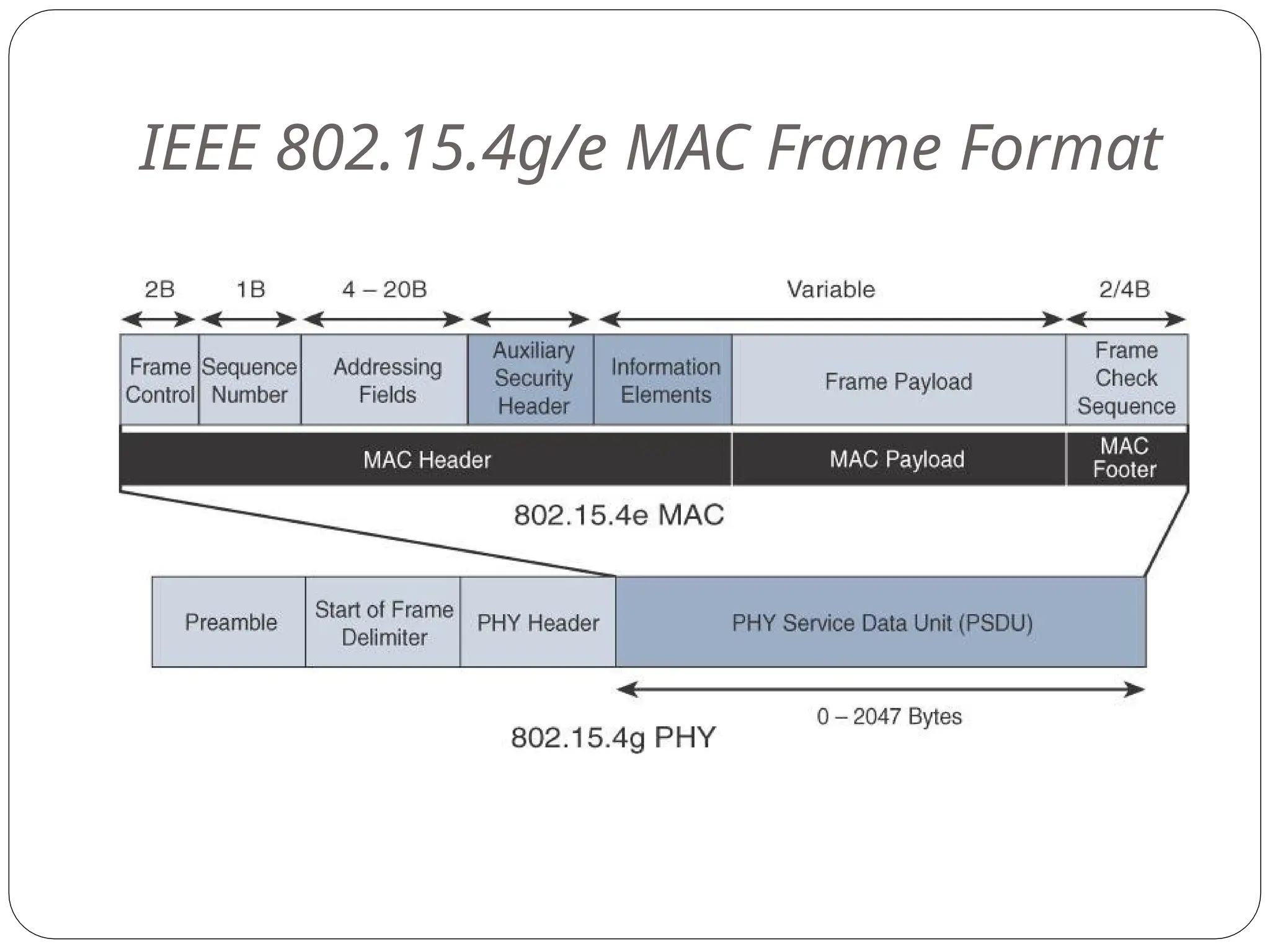
IEEE 802.15.4g/e MAC Frame Format
⚫The main changes shown in the IEEE 802.15.4e header
are the presence of the Auxiliary Security Header and
Information Elements field.
⚫The Auxiliary Security header provides for the encryption
of the data frame
⚫The IE field contains one or more information elements
that allow for additional information to be exchanged at
the MAC layer.
Topology
⚫Deployments of IEEE 802.15.4g-2012 are mostly based on
a mesh topology
⚫Mesh topology is typically the best choice for use cases in
the industrial and smart cities areas
⚫A mesh topology allows deployments to be done in urban
or rural areas, expanding the distance between nodes
that can relay the traffic of other nodes.
Security
⚫Both IEEE 802.15.4g and 802.15.4e inherit their
security attributes from the IEEE 802.15.4-2006
specification.
⚫Encryption is provided by AES, with a 128-bit key.
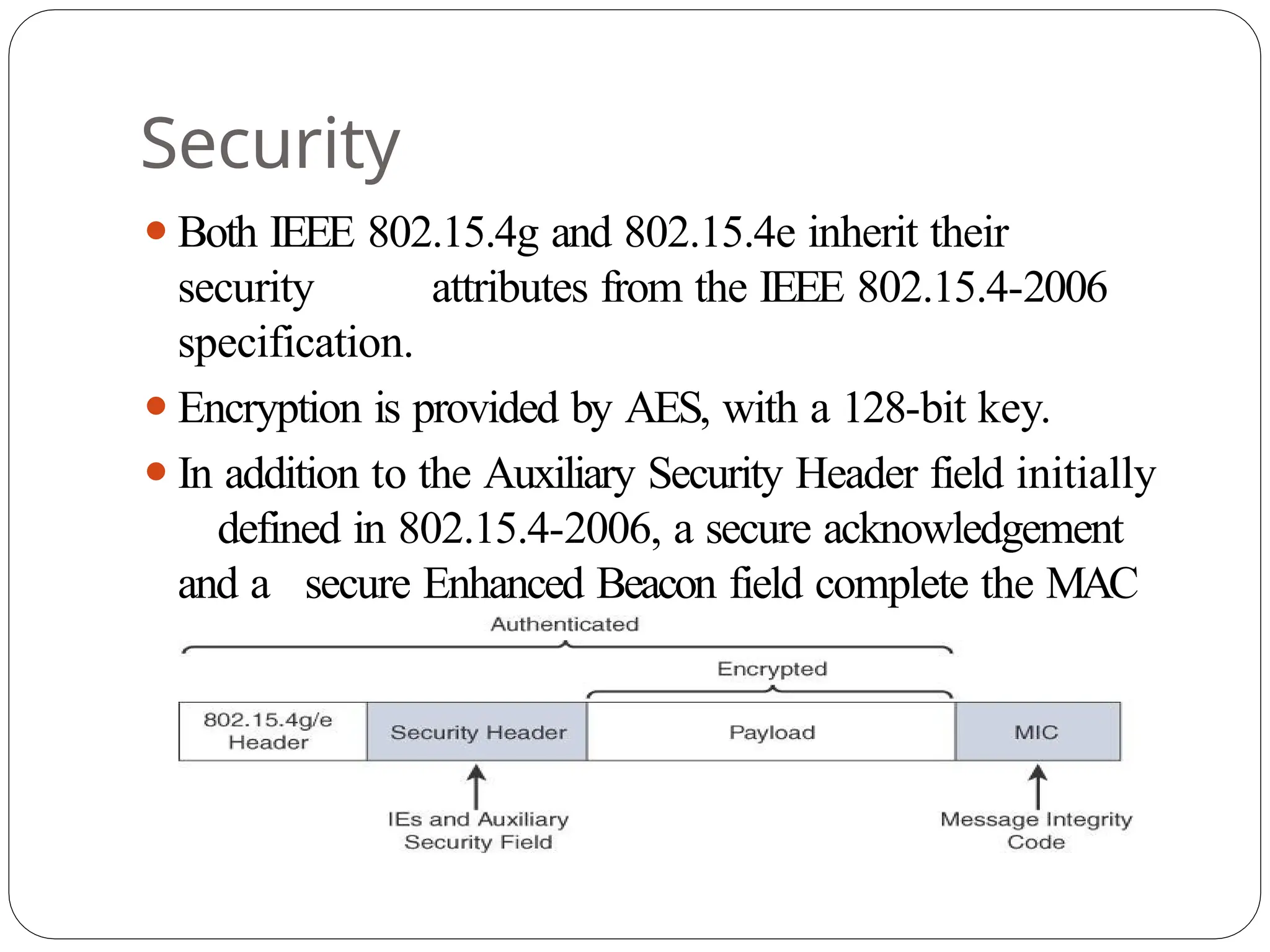
⚫In addition to the Auxiliary Security Header field initially
defined in 802.15.4-2006, a secure acknowledgement
and a secure Enhanced Beacon field complete the MAC
layer security
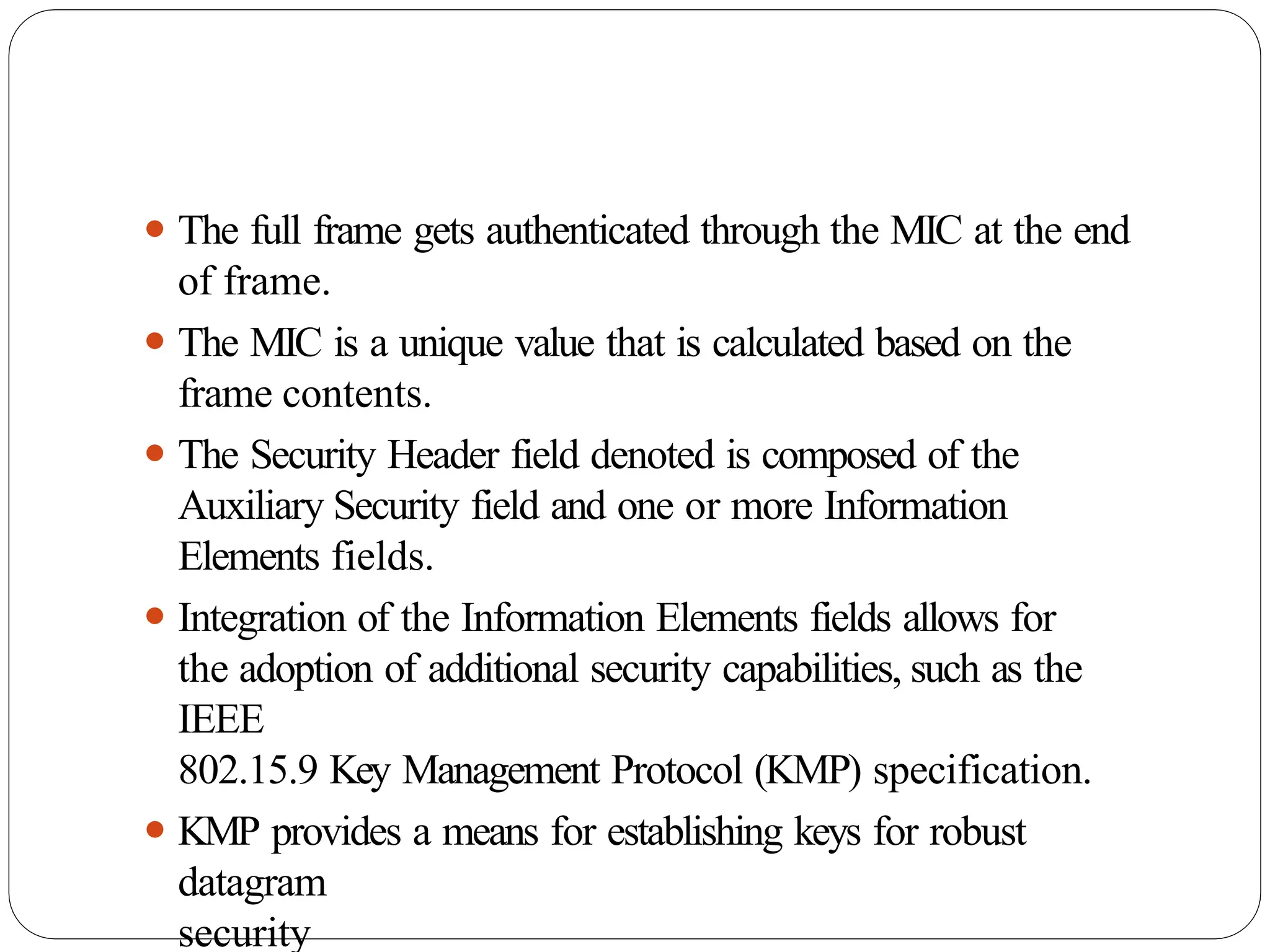
⚫ The full frame gets authenticated through the MIC at the end
of frame.
⚫ The MIC is a unique value that is calculated based on the
frame contents.
⚫ The Security Header field denoted is composed of the
Auxiliary Security field and one or more Information
Elements fields.
⚫ Integration of the Information Elements fields allows for
the adoption of additional security capabilities, such as the
IEEE
802.15.9 Key Management Protocol (KMP) specification.
⚫ KMP provides a means for establishing keys for robust
datagram
security
IEEE 1901.2a
⚫IEEE 1901.2a-2013 is a wired technology that is an update
to the original IEEE 1901.2 specification.
⚫This is a standard for Narrowband Power
Line Communication (NB-PLC).
⚫NB-PLC leverages a narrowband spectrum for low
power, long range, and resistance to interference
over the same wires that carry electric power.
⚫NB-PLC is often found in use cases such as the
following:
⚫Smart metering:
⚫NB-PLC can be used to automate the reading of
utility meters, such as electric, gas, and water
meters
⚫Distribution automation:
⚫NB-PLC can be used for distribution automation,
which involves monitoring and controlling all the
devices in the power grid.
⚫ Public lighting:
⚫ A common use for NB-PLC is with public lighting—the lights
found in cities and along streets, highways, and public areas such
as parks.
⚫ Electric vehicle charging stations:
⚫ NB-PLC can be used for electric vehicle charging stations,
where the batteries of electric vehicles can be recharged.
⚫ Microgrids:
⚫ NB-PLC can be used for microgrids, local energy grids that
can disconnect from the traditional grid and operate
independently.
⚫ Renewable energy:
⚫ NB-PLC can be used in renewable energy applications, such
as solar, wind power, hydroelectric, and geothermal heat.
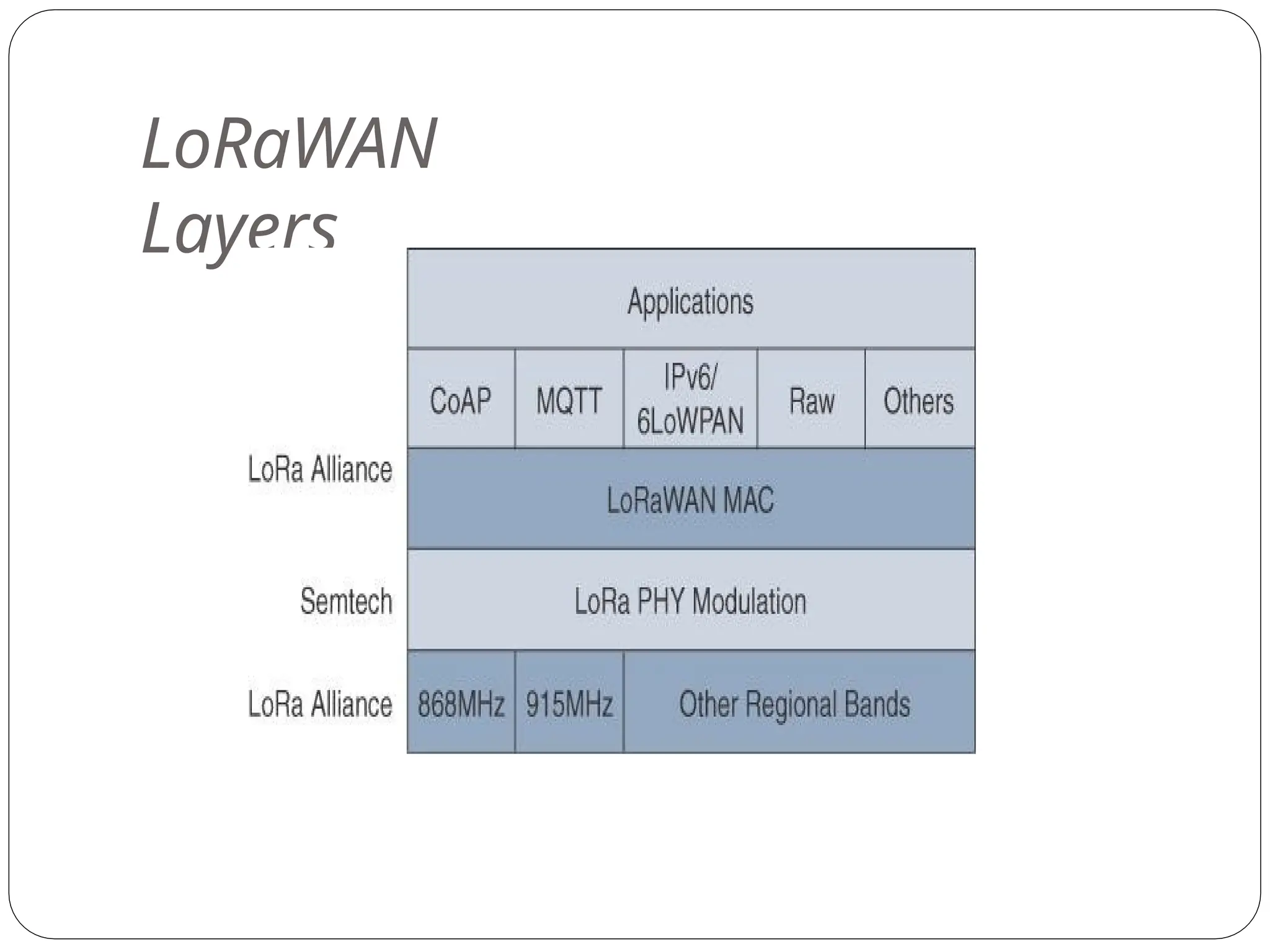
LoRaWAN
⚫Low-Power Wide-Area (LPWA) adapted for long-range
and battery powered endpoints
⚫LoRaWAN is unlicensed-band LPW
A technology
⚫LoRa was a physical layer, or Layer 1, modulation that
was developed by a French company named Cycleo
⚫Later, Cycleo was acquired by Semtech
⚫Optimized for long-range, two-way communications and
low power consumption
LoRaWAN
Layers
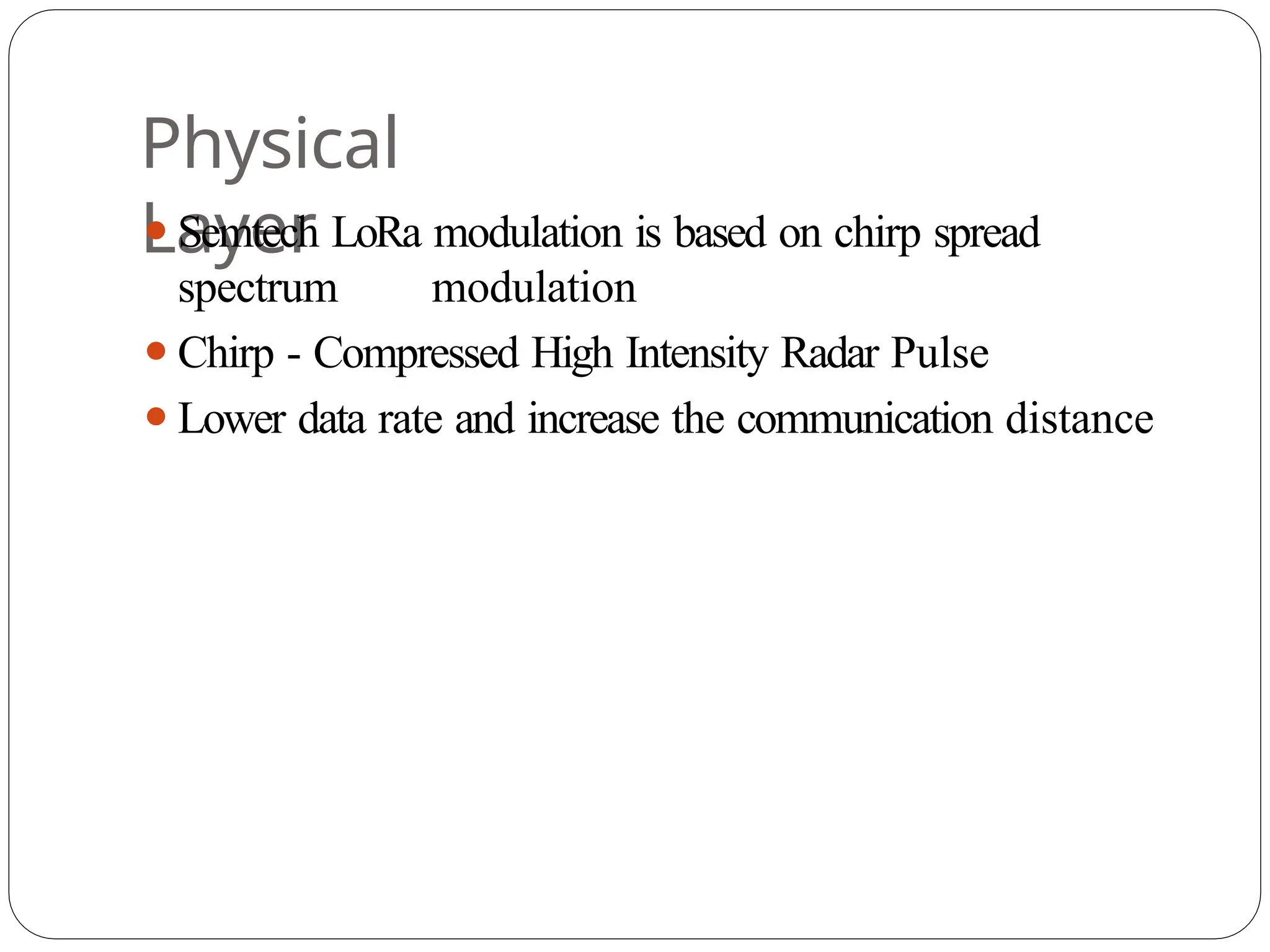
Physical
Layer
⚫Semtech LoRa modulation is based on chirp spread
spectrum modulation
⚫Chirp - Compressed High Intensity Radar Pulse
⚫Lower data rate and increase the communication distance
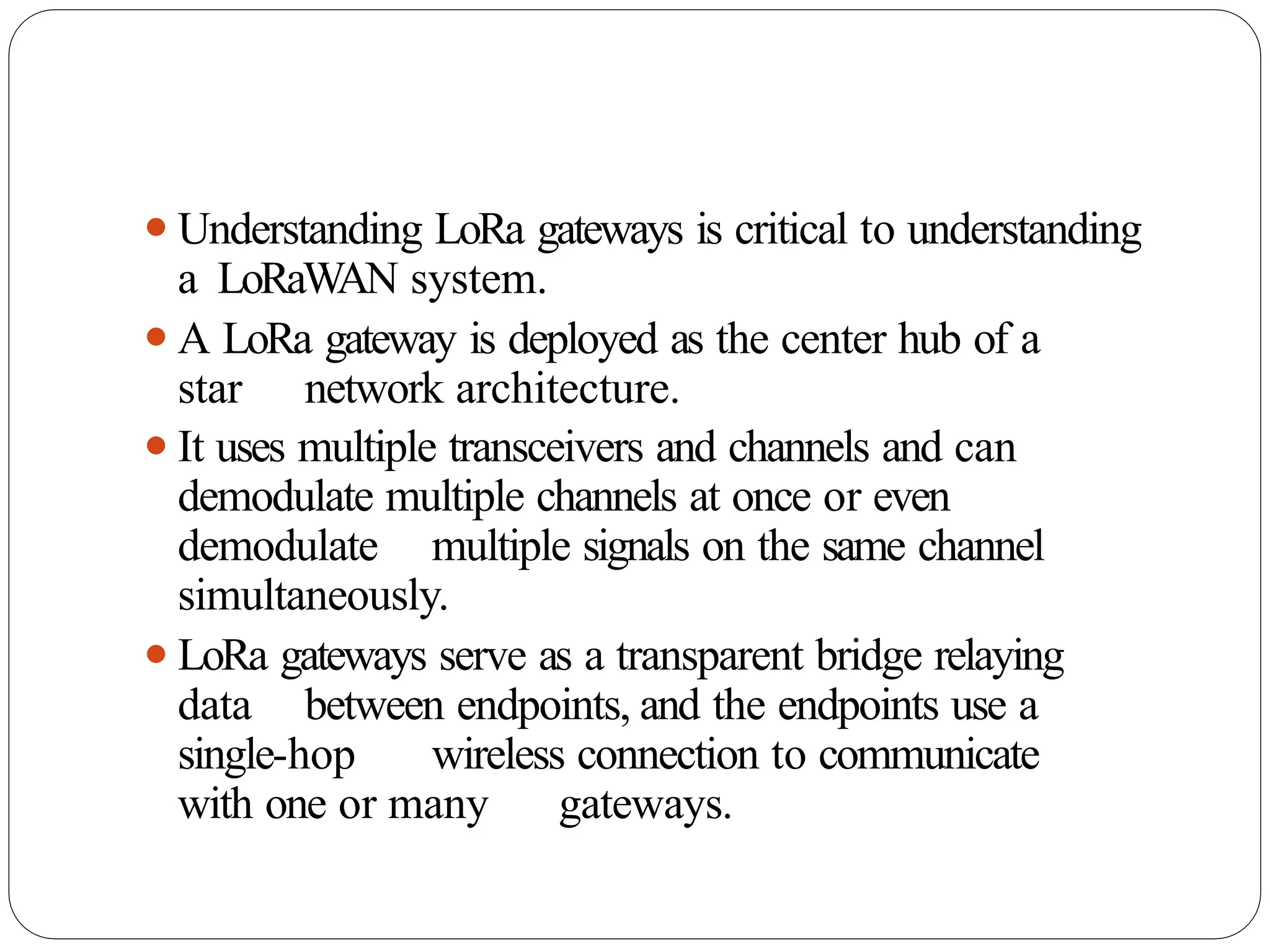
⚫Understanding LoRa gateways is critical to understanding
a LoRaWAN system.
⚫A LoRa gateway is deployed as the center hub of a
star network architecture.
⚫It uses multiple transceivers and channels and can
demodulate multiple channels at once or even
demodulate multiple signals on the same channel
simultaneously.
⚫LoRa gateways serve as a transparent bridge relaying
data between endpoints, and the endpoints use a
single-hop wireless connection to communicate
with one or many gateways.
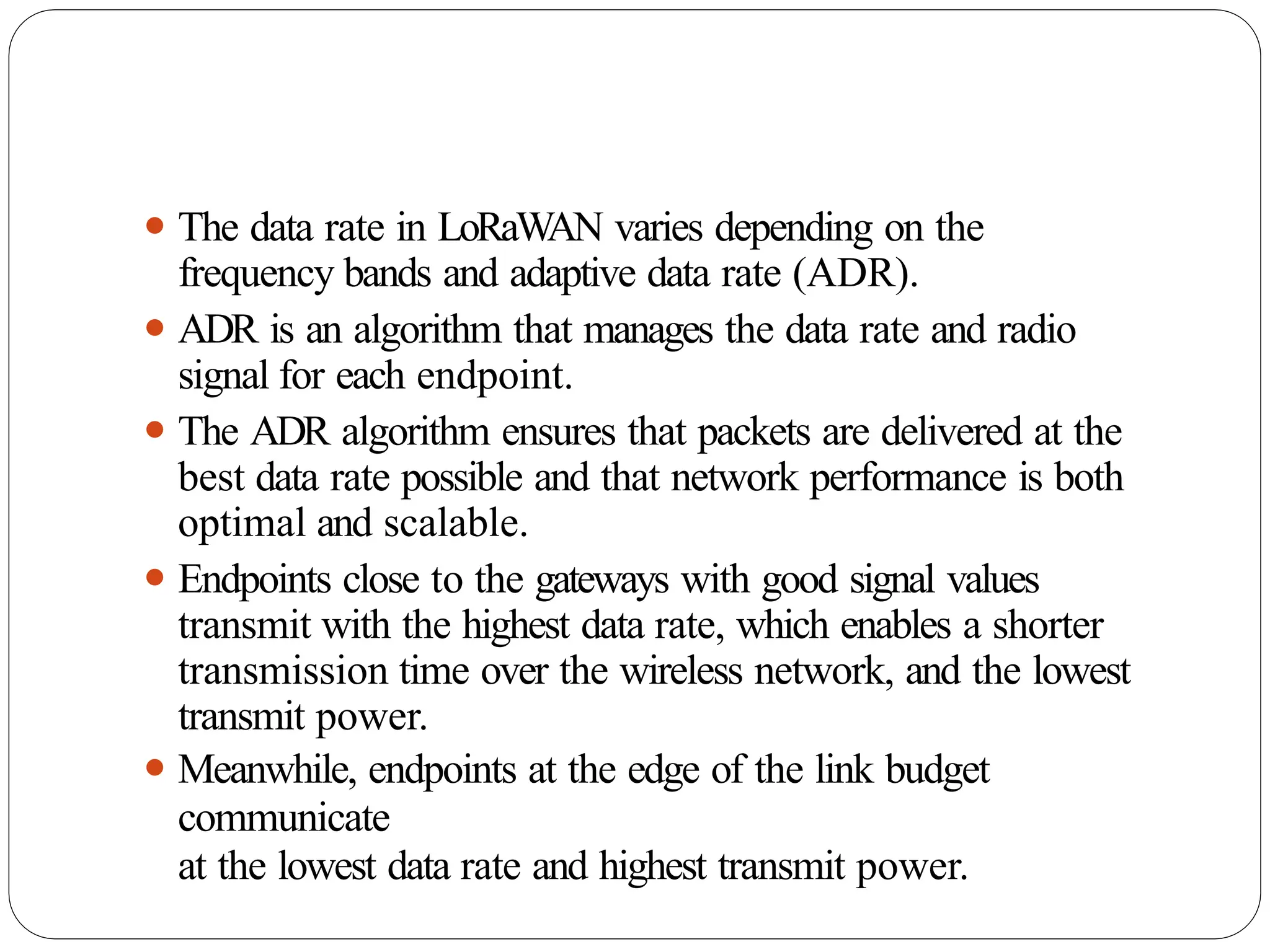
⚫ The data rate in LoRaW
AN varies depending on the
frequency bands and adaptive data rate (ADR).
⚫ ADR is an algorithm that manages the data rate and radio
signal for each endpoint.
⚫ The ADR algorithm ensures that packets are delivered at the
best data rate possible and that network performance is both
optimal and scalable.
⚫ Endpoints close to the gateways with good signal values
transmit with the highest data rate, which enables a shorter
transmission time over the wireless network, and the lowest
transmit power.
⚫ Meanwhile, endpoints at the edge of the link budget
communicate
at the lowest data rate and highest transmit power.
⚫An important feature of LoRa is its ability to handle
various data rates via the spreading factor.
⚫Devices with a low spreading factor (SF) achieve less
distance in their communications but transmit at
faster speeds, resulting in less airtime.
⚫A higher SF provides slower transmission rates but achieves
a higher reliability at longer distances.
MAC
Layer
⚫The MAC layer is defined in the LoRaW
AN
specification.
⚫This layer takes advantage of the LoRa physical layer and
classifies LoRaWAN endpoints to optimize their battery
life and ensure downstream communications to the
LoRaWAN endpoints.
⚫The LoRaW
AN specification documents three classes
of LoRaWAN devices:
⚫Class A:
⚫This class is the default implementation. Optimized
for battery powered nodes, it allows
bidirectional communications, where a given node
is able to receive downstream traffic after
transmitting.
⚫Two receive windows are available after each
⚫Class B:
⚫This class was designated“experimental” in LoRaW
AN
1.0.1 until it can be better defined.
⚫A Class B node or endpoint should get additional
receive windows compared to Class A, but
gateways must be synchronized through a
beaconing process
⚫Class C:
⚫This class is particularly adapted for powered nodes.
⚫This classification enables a node to be continuously
listening by keeping its receive window open when
not transmitting.
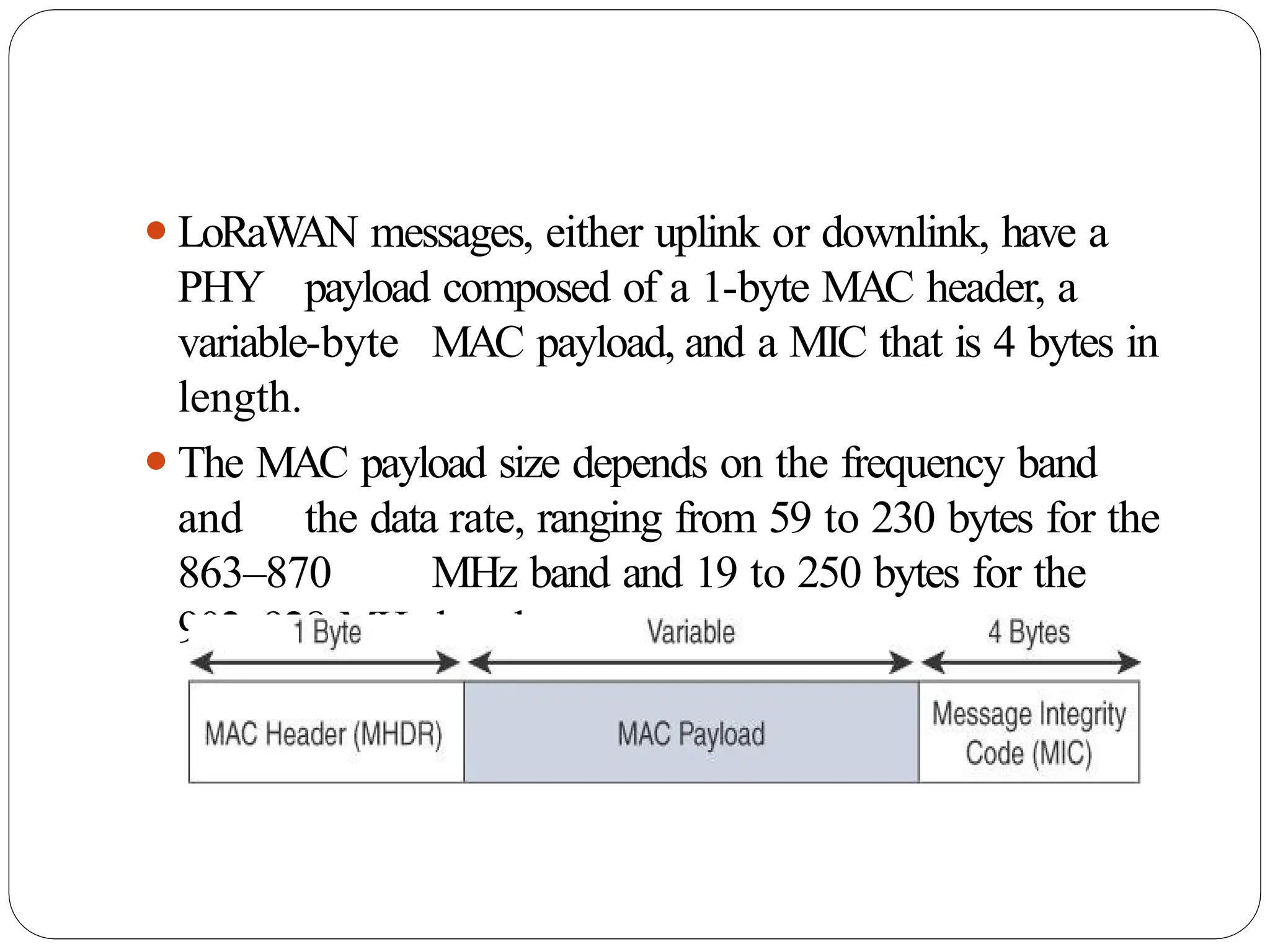
⚫LoRaW
AN messages, either uplink or downlink, have a
PHY payload composed of a 1-byte MAC header, a
variable-byte MAC payload, and a MIC that is 4 bytes in
length.
⚫The MAC payload size depends on the frequency band
and the data rate, ranging from 59 to 230 bytes for the
863–870 MHz band and 19 to 250 bytes for the
902–928 MHz band
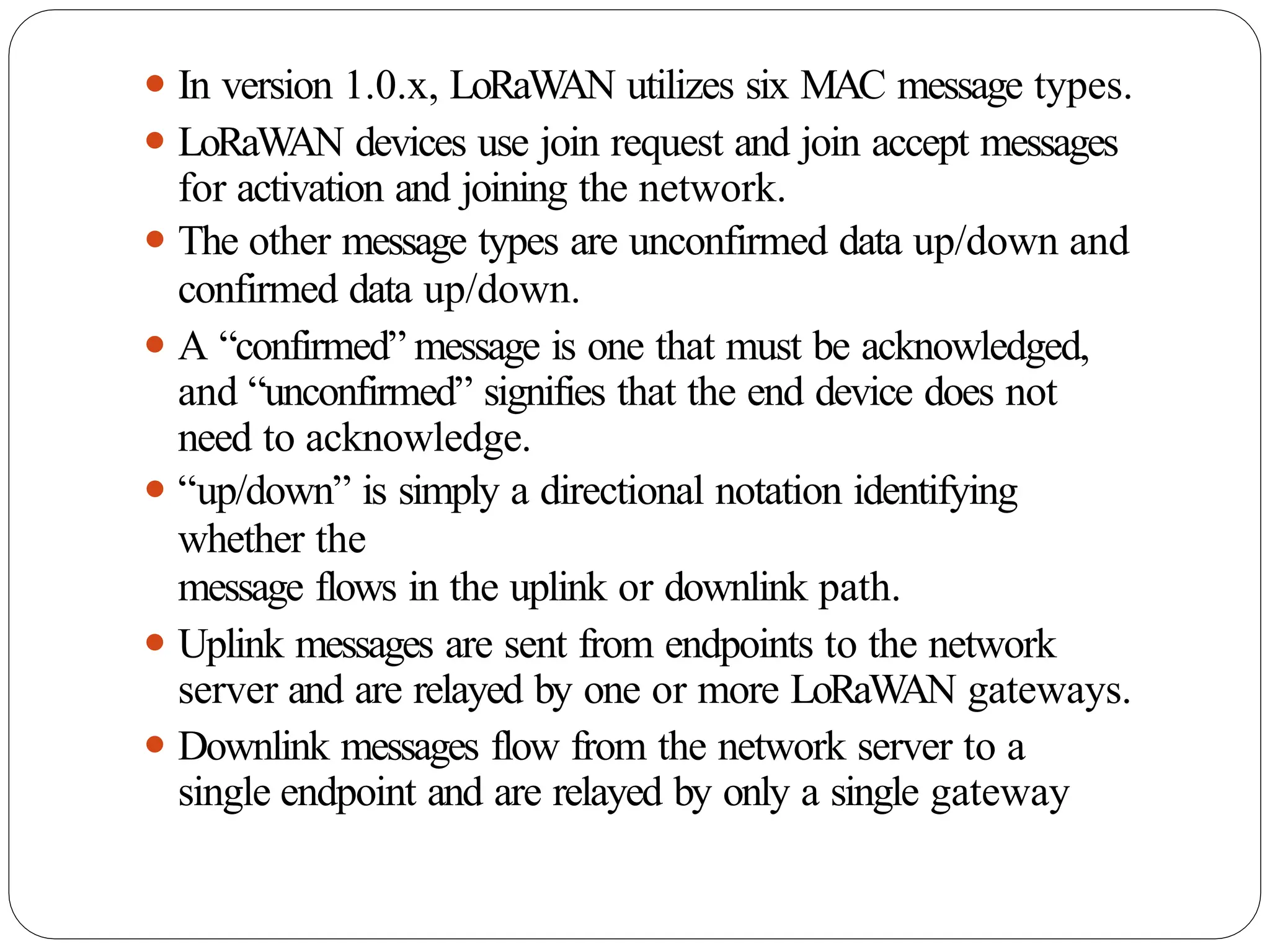
⚫ In version 1.0.x, LoRaW
AN utilizes six MAC message types.
⚫ LoRaW
AN devices use join request and join accept messages
for activation and joining the network.
⚫ The other message types are unconfirmed data up/down and
confirmed data up/down.
⚫ A “confirmed” message is one that must be acknowledged,
and “unconfirmed” signifies that the end device does not
need to acknowledge.
⚫ “up/down” is simply a directional notation identifying
whether the
message flows in the uplink or downlink path.
⚫ Uplink messages are sent from endpoints to the network
server and are relayed by one or more LoRaW
AN gateways.
⚫ Downlink messages flow from the network server to a
single endpoint and are relayed by only a single gateway
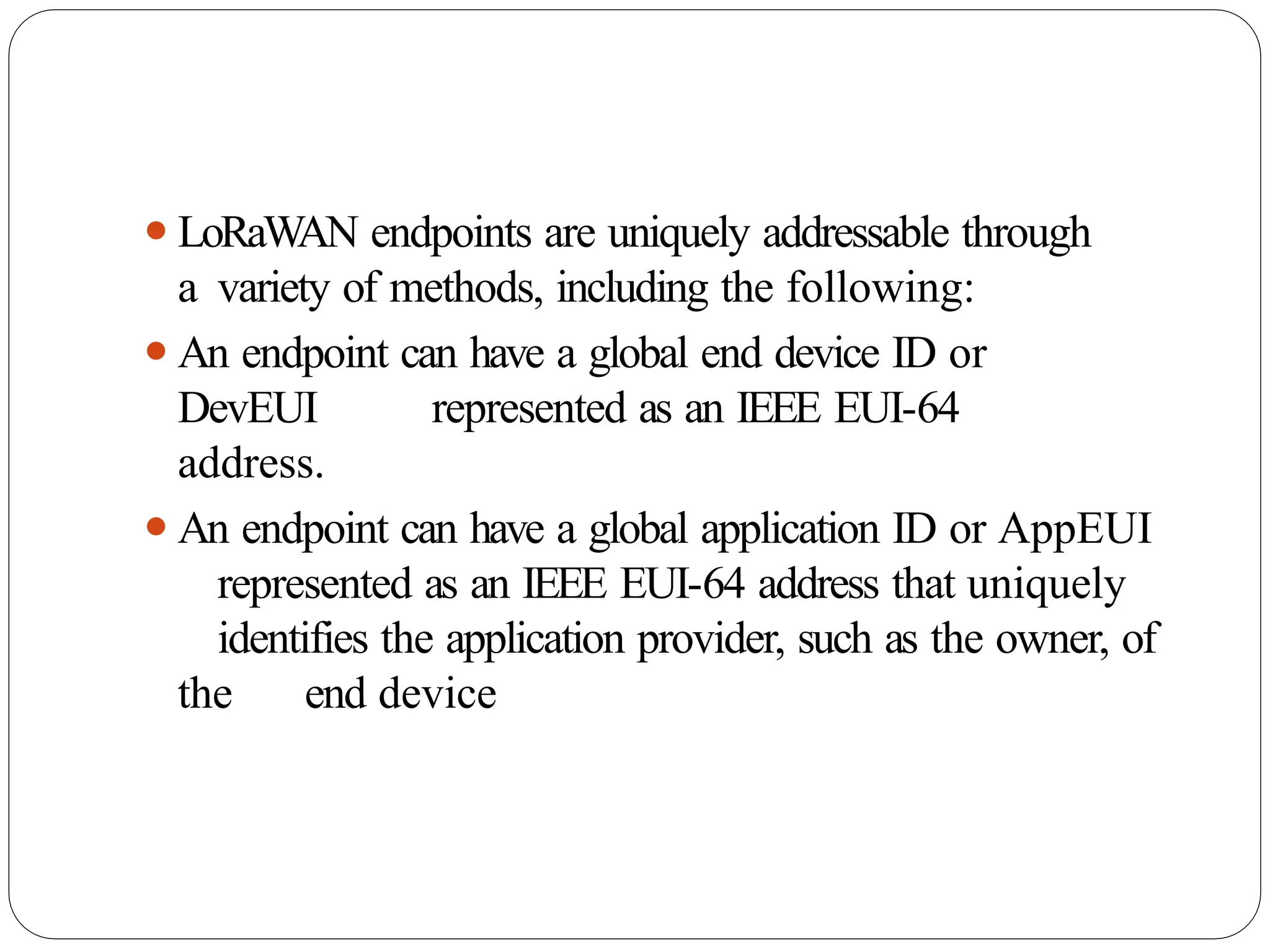
⚫LoRaWAN endpoints are uniquely addressable through
a variety of methods, including the following:
⚫An endpoint can have a global end device ID or
DevEUI represented as an IEEE EUI-64
address.
⚫An endpoint can have a global application ID or AppEUI
represented as an IEEE EUI-64 address that uniquely
identifies the application provider, such as the owner, of
the end device
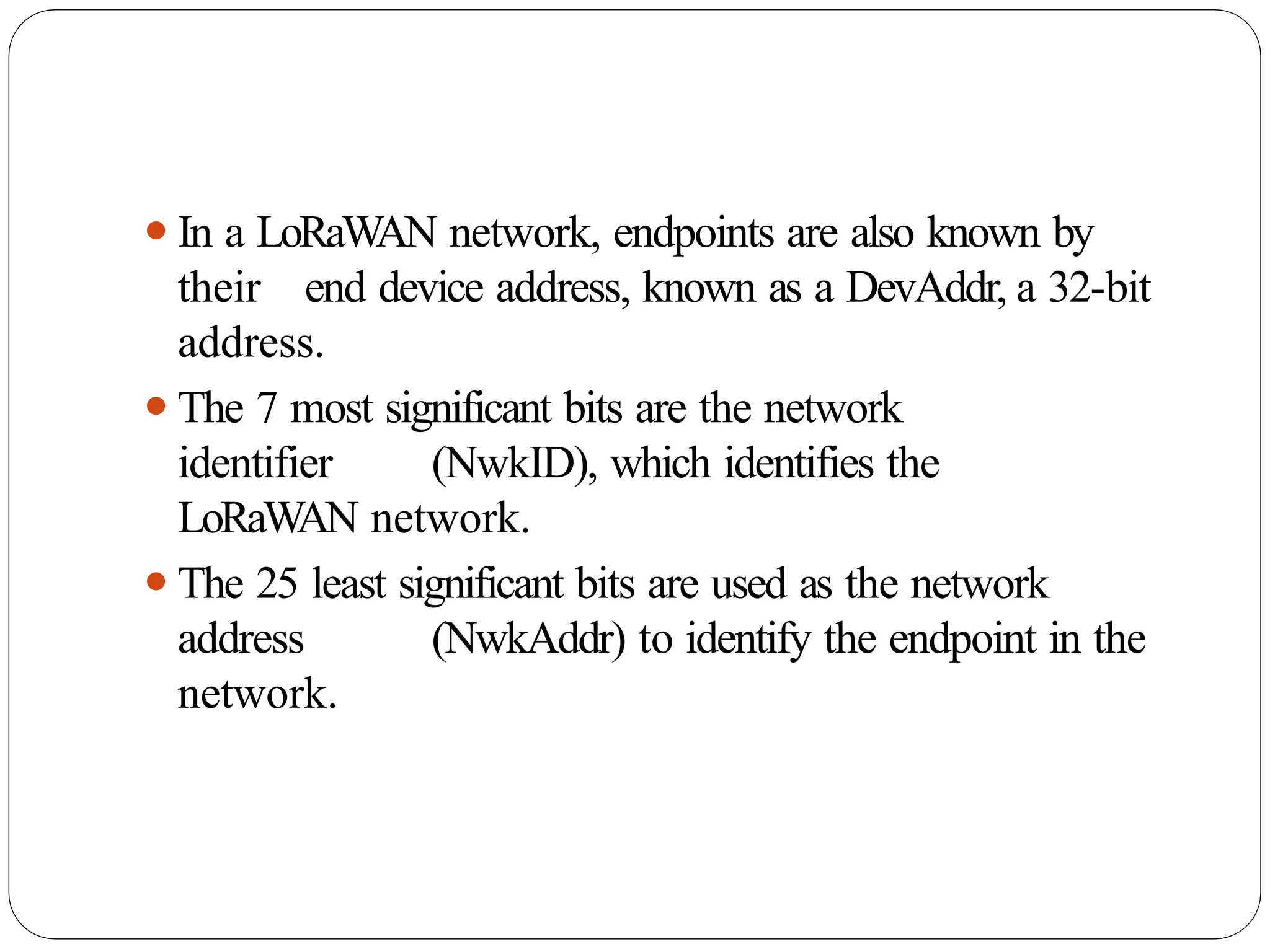
⚫In a LoRaWAN network, endpoints are also known by
their end device address, known as a DevAddr, a 32-bit
address.
⚫The 7 most significant bits are the network
identifier (NwkID), which identifies the
LoRaW
AN network.
⚫The 25 least significant bits are used as the network
address (NwkAddr) to identify the endpoint in the
network.
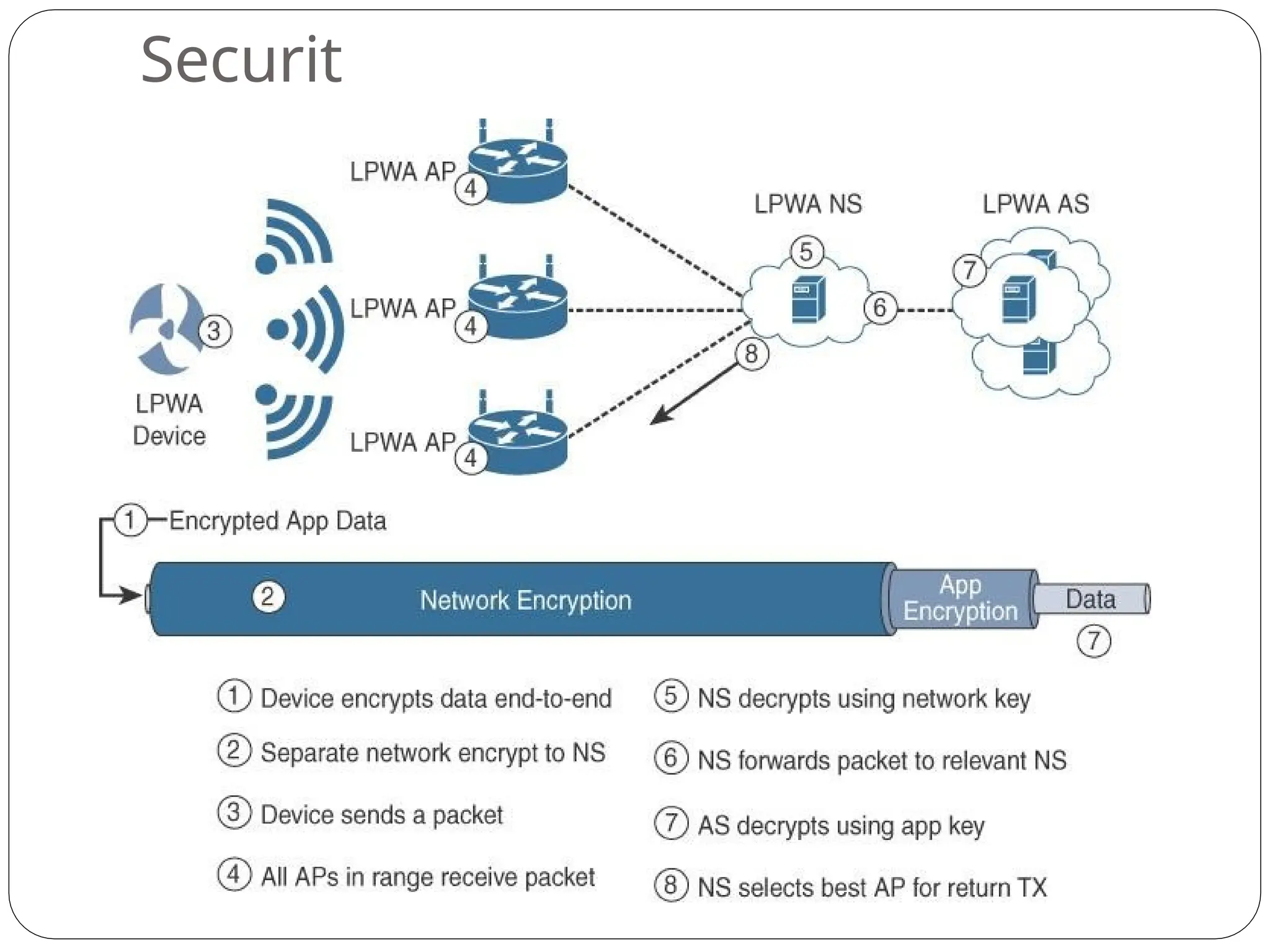
Securit
y
⚫LoRaWAN endpoints must implement two layers of
security, protecting communications and data privacy
across the network.
⚫The first layer, called “network security” but applied at the
MAC layer, guarantees the authentication of the
endpoints by the LoRaW
AN network server.
⚫Also, it protects LoRaW
AN packets by
performing encryption based on AES
⚫Each endpoint implements a network session key
(NwkSKey), used by both itself and the LoRaW
AN
network server.
⚫The NwkSKey ensures data integrity through computing
and checking the MIC of every data message as well as
encrypting and decrypting MAC-only data message
payloads
⚫The second layer is an application session key
(AppSKey), which performs encryption and
decryption functions between the endpoint and its
application server
⚫LoRaWAN endpoints attached to a LoRaWAN network
must get registered and authenticated.
⚫This can be achieved through one of the two
join mechanisms:
⚫Activation by personalization (ABP):
⚫Endpoints don’t need to run a join procedure as their
individual details, including DevAddr and the NwkSKey
and AppSKey session keys, are preconfigured and
stored in the end device.
⚫This same information is registered in the
LoRaWAN network server
⚫ Over-the-air activation (OTAA):
⚫ Endpoints are allowed to dynamically join a particular
LoRaWAN
network after successfully going through a join procedure.
⚫ The join procedure must be done every time a session context
is renewed.
⚫ During the join process, which involves the sending and
receiving of MAC layer join request and join accept messages,
the node establishes its credentials with a LoRaW
AN network
server, exchanging its globally unique DevEUI, AppEUI, and
AppKey.
⚫ The AppKey is then used to derive the session NwkSKey and
AppSKey keys
NB-IoT and Other LTE
Variations
⚫Existing cellular technologies, such as GPRS, Edge, 3G,
and 4G/LTE, are not particularly well adapted to
battery- powered devices and small objects
specifically developed for the Internet of Things
⚫L
TE -M
⚫The new LTE-M device category was not sufficiently close
to LPW
A capabilities
⚫A new narrowband radio access technology
called Narrowband IoT (NB-IoT)
⚫It addresses the requirements of a massive number of
low- throughput devices, low device power
consumption, improved indoor coverage, and
optimized network architecture
LTE Cat 0
⚫The first enhancements to better support IoT devices
in 3GPP occurred in L
TE Release 12.
⚫A new user equipment (UE) category, Category 0, was
added, with devices running at a maximum data rate
of 1 Mbps
⚫Category 0 includes important characteristics to
be supported by both the network and end
devices
⚫ Power saving mode (PSM)
⚫ This new device status minimizes energy consumption
⚫ PSM is defined as being similar to “powered off ” mode, but
the
device stays registered with the network.
⚫ By staying registered, the device avoids having to reattach or
re- establish its network connection
⚫ The device negotiates with the network the idle time after
which it will wake up.
⚫ When it wakes up, it initiates a tracking area update (TAU),
after which it stays available for a configured time and then
switches back to sleep mode or PSM.
⚫ A T
AU is a procedure that an L
TE device uses to let the
network know its current tracking area, or the group of
towers in the network from which it can be reached
⚫Half-duplex mode
⚫This mode reduces the cost and complexity of a
device’s
implementation because a duplex filter is not needed.
⚫Most IoT endpoints are sensors that send low amounts
of data that do not have a full duplex
communication requirement.
⚫L
TE-M
⚫L
TE Release 13
⚫Lower receiver bandwidth
⚫Bandwidth has been lowered to 1.4 MHz versus the usual
20 MHz.This further simplifies the LTE endpoint
⚫Lower data rate
⚫Data is around 200 kbps for LTE-M, compared to 1 Mbps
for Cat 0.
⚫Half-duplex mode
⚫Just as with Cat 0, LTE-M offers a half-duplex mode
that decreases node complexity and cost
⚫Enhanced discontinuous reception (eDRX)
⚫This capability increases from seconds to minutes the
amount
of time an endpoint can “sleep” between paging cycles
A Brief Introduction to IoT- Smart Objects: The "Things" in IoT

  • 1.
    Module 2 Smart Objects: The“Things” in IoT
  • 2.
    ⚫Sensors are fundamentalbuilding blocks of IoT networks ⚫Sensors are the foundational elements found in smart objects—the “things” in the Internet of Things ⚫Smart objects are any physical objects that contain embedded technology to sense and/or interact with their environment in a meaningful way by being interconnected and enabling communication among themselves or an external agent.
  • 3.
    SENSORS, ACTUATORS, ANDSMART OBJECTS ⚫A sensor: It senses ⚫More specifically, a sensor measures some physical quantity and converts that measurement reading into a digital representation. ⚫That digital representation is typically passed to another device for transformation into useful data that can be consumed by intelligent devices or humans ⚫Sensors are not limited to human-like sensory data. ⚫They are able to provide an extremely wide spectrum of rich and diverse measurement data with far greater precision than human senses
  • 4.
    Categorie s ⚫Active or passive: ⚫Sensorscan be categorized based on whether they produce an energy output and typically require an external power supply (active) or ⚫Whether they simply receive energy and typically require no external power supply (passive). ⚫Invasive or non-invasive: ⚫Sensors can be categorized based on whether a sensor is part of the environment it is measuring (invasive) or ⚫External to it (non-invasive).
  • 5.
    ⚫Contact or no-contact: ⚫Sensorscan be categorized based on whether they require physical contact with what they are measuring (contact) or not (no-contact). ⚫Absolute or relative: ⚫Sensors can be categorized based on whether they measure on an absolute scale (absolute) or based on a difference with a fixed or variable reference value (relative).
  • 6.
    ⚫Area of application: ⚫Sensorscan be categorized based on the specific industry or vertical where they are being used. ⚫How sensors measure: ⚫Sensors can be categorized based on the physical mechanism used to measure sensory input (for example, thermoelectric, electrochemical, piezoresistive, optic, electric, fluid mechanic, photoelastic).
  • 7.
    ⚫What sensors measure: ⚫Sensorscan be categorized based on their applications or what physical variables they measure. ⚫Note that this is by no means an exhaustive list, and there are many other classification and taxonomic schemes for sensors, including those based on material, cost, design, and other factors
  • 8.
    Categorization based onwhat physical phenomenon a sensor is measuring
  • 9.
  • 12.
    Precision agriculture (smart farming) ⚫which uses a variety of technical advances to improve the efficiency, sustainability, and profitability of traditional farming practices. ⚫ This includes the use of GPS and satellite aerial imagery for determining field viability; robots for high-precision planting, harvesting, irrigation, and so on; and real-time analytics and artificial intelligence to predict optimal crop yield, weather impacts,and soil quality. ⚫ Among the most significant impacts of precision agriculture are those dealing with sensor measurement of a variety of soil characteristics. These include real- time measurement of soil quality, pH levels, salinity, toxicity levels, moisture levels for irrigation planning, nutrient levels for fertilization planning, and so on. ⚫ All this detailed sensor data can be analyzed to provide highly valuable and actionable insight to boost productivity and crop yield.
  • 13.
    IoT Use Case:Area of precision agriculture (smart farming) ⚫ biodegradable, passive microsensors to measure soil and crop and conditions . ⚫ These sensors, developed at North Dakota State University (NDSU), can be planted directly in the soil and left in the ground to biodegrade without any harm to soil quality.
  • 14.
    Figure 3-1 BiodegradableSensors Developed by NDSU for Smart Farming
  • 15.
    Sensors in aSmart Phone
  • 16.
    Figure 3-3 Growthand Predictions in the Number of Sensors
  • 17.
    Actuator s ⚫Actuators are naturalcomplements to sensors ⚫Sensors are designed to sense and measure practically any measurable variable in the physical world. ⚫They convert their measurements (typically analog) into electric signals or digital representations that can be consumed by an intelligent agent (a device or a human). ⚫Actuators, on the others hand, receive some type of control signal (commonly an electric signal or digital command) that triggers a physical effect, usually some type of motion, force, and so on. ⚫/ensors provide the information, actuators provide the action
  • 20.
    ⚫ Actuators alsovary greatly in function, size, design, and so on. ⚫ Some common ways that they can be classified include the following: ⚫ Type of motion: Actuators can be classified based on the type of motion they produce (for example, linear, rotary, one/two/three- axes). ⚫ Power: Actuators can be classified based on their power output (for example, high power, low power, micro power) ⚫ Binary or continuous: Actuators can be classified based on the number of stable-state outputs. ⚫ Area of application: Actuators can be classified based on the specific industry or vertical where they are used. ⚫ Type of energy: Actuators can be classified based on their energy type.
  • 21.
  • 22.
    Micro-Electro-Mechanical Systems (MEMS) ⚫ Interestingadvances in sensor and actuator technologies is in how they are packaged and deployed. ⚫ Micro-electro-mechanical systems (MEMS), sometimes simply referred to as micro-machines, can integrate and combine electric and mechanical elements, such as sensors and actuators, on a very small (millimeter or less) scale. ⚫ One of the keys to this technology is a microfabrication technique that is similar to what is used for microelectronicintegrated circuits. ⚫ This approach allows mass production at very low costs
  • 23.
    ⚫ The combinationof tiny size, low cost, and the ability to mass produce makes MEMS an attractive option for a huge number of IoT applications. ⚫ MEMS devices have already been widely used in a variety of different applications and can be found in very familiar everyday devices. ⚫ For example, inkjet printers use micropump MEMS. ⚫ Smart phones also use MEMS technologies for things like accelerometers and gyroscopes. ⚫ In fact, automobiles were among the first to commercially introduce MEMS into the mass market, with airbag accelerometers.
  • 24.
    Figure 3-6 TorsionalRatcheting Actuator (TRA) MEMS (Courtesy Sandia National Laboratories, SUMMiT™ Technologies, www.sandia.gov/mstc.)
  • 25.
    Smart Objects ⚫Smart objectsare, quite simply, the building blocks of IoT. ⚫They are what transform everyday objects into a network of intelligent objects that are able to learn from and interact with their environment in a meaningful way ⚫The real power of smart objects in IoT comes from being networked together rather than being isolated as standalone objects
  • 26.
    ⚫ If asensor is a standalone device that simply measures the humidity of the soil, it is interesting and useful, but it isn’t revolutionary ⚫ If that same sensor is connected as part of an intelligent network that is able to coordinate intelligently with actuators to trigger irrigation systems as needed based on those sensor readings, we have something far more powerful ⚫ Extending that even further, imagine that the coordinated sensor/actuator set is intelligently interconnected with other sensor/actuator sets to further coordinate fertilization, pest control, and so on—and even communicate with an intelligent backend to calculate crop yield potential
  • 27.
    ⚫A smart object,is a device that has, at a minimum, the following four defining characteristics
  • 28.
    ⚫Processing unit: ⚫Some typeof processing unit for ⚫Acquiring data, ⚫Processing and analyzing sensing information received by the sensor(s), ⚫Coordinating control signals to any actuators, and ⚫Controlling a variety of functions on the smart object, including the communication and power systems ⚫The most common is a microcontroller because of its small form factor, flexibility, programming simplicity, ubiquity, low power consumption, and
  • 29.
    ⚫Sensor(s) and/or actuator(s): ⚫Asmart object is capable of interacting with the physical world through sensors and actuators ⚫Communication device: ⚫The communication unit is responsible for connecting a smart object with other smart objects and the outside world (via the network). ⚫Communication devices for smart objects can be either wired or wireless
  • 30.
    ⚫Power source: ⚫Smart objectshave components that need to be powered. ⚫The most significant power consumption usually comes from the communication unit of a smart object
  • 31.
    Trends in SmartObjects ⚫Size is decreasing ⚫Power consumption is decreasing ⚫Processing power is increasing ⚫Communication capabilities are improving ⚫Communication is being increasingly standardized
  • 32.
    SENSOR NETWORKS ⚫A sensor/actuatornetwork (SANET), is a network of sensors that sense and measure their environment and/or actuators that act on their environment ⚫The sensors and/or actuators in a SANET are capable of communicating and cooperating ⚫Effective and well-coordinated communication and cooperation is a prominent challenge, primarily because the sensors and actuators in SANETs are diverse, heterogeneous, and resource-constrained
  • 33.
    ⚫SANETs offer highlycoordinated sensing and actuation capabilities. ⚫Smart homes are a type of SANET that display this coordination between distributed sensors and actuators ⚫For example, smart homes can have temperature sensors that are strategically networked with heating, ventilation, and air-conditioning (HVAC) actuators. ⚫When a sensor detects a specified temperature, this can trigger an actuator to take action and heat or cool the home as needed.
  • 34.
    ⚫Advantages and disadvantagesthat a wireless-based solution offers: Advantages: ⚫ Greater deployment flexibility (especially in extreme environments or hard-to-reach places) ⚫ Simpler scaling to a large number of nodes ⚫ Lower implementation costs ⚫ Easier long-term maintenance ⚫ Effortless introduction of new sensor/actuator nodes ⚫ Better equipped to handle dynamic/rapid topology changes Disadvantages: ⚫ Potentially less secure (for example, hijacked access points)
  • 35.
    Wireless Sensor Networks (WSNs) ⚫Wirelesssensor networks are made up of wirelessly connected smart objects, which are sometimes referred to as motes. ⚫The fact that there is no infrastructure to consider with WSNs is surely a powerful advantage for flexible deployments, but there are a variety of design constraints to consider with these wirelessly connected smart objects
  • 37.
    ⚫ The followingare some of the most significant limitations of the smart objects in WSNs: ⚫ Limited processing power ⚫ Limited memory ⚫ Lossy communication ⚫ Limited transmission speeds ⚫ Limited power ⚫Note ⚫Smart objects with limited processing, memory, power, and so on are often referred to as constrained nodes.
  • 38.
    ⚫These limitations greatlyinfluence how WSNs are designed, deployed, and utilized. ⚫The fact that individual sensor nodes are typically so limited is a reason that they are often deployed in very large numbers. ⚫As the cost of sensor nodes continues to decline, the ability to deploy highly redundant sensors becomes increasingly feasible. ⚫Because many sensors are very inexpensive and correspondingly inaccurate, the ability to deploy smart objects redundantly allows for increased accuracy
  • 39.
    ⚫Such large numbersof sensors permit the introduction of hierarchies of smart objects. ⚫ Such a hierarchy provides, among other organizational advantages, the ability to aggregate similar sensor readings from sensor nodes that are in close proximity to each other
  • 40.
    ⚫ . Figure3-9 shows an example of such a data aggregation function in a WSN where temperature readings from a logical grouping of temperature sensors are aggregated as an average temperature reading. Figure 3-9 Data Aggregation in Wireless Sensor Networks
  • 41.
    ⚫ These dataaggregation techniques are helpful in reducing the amount of overall traffic (and energy) inW/Ns with very large numbers of deployed smart objects. ⚫ This data aggregation at the network edges is where fog and mist computing are critical IoT architectural elements needed to deliver the scale and performance required by so many IoT use cases
  • 42.
    ⚫ Wirelessly connectedsmart objects generally have one of the following two communication patterns: ⚫ Event-driven: ⚫ Transmission of sensory information is triggered only when a smart object detects a particular event or predetermined threshold. ⚫ Periodic: ⚫ Transmission of sensory information occurs only at periodic intervals. ⚫The decision of which of these communication schemes is used depends greatly on the specific application ⚫For example: medical use cases
  • 43.
    ⚫For example, insome medical use cases, sensors periodically send postoperative vitals, such as temperature or blood pressure readings. In other medical use cases, the same blood pressure or temperature readings are triggered to be sent only when certain critically low or high readings are measured.
  • 44.
    Communication Protocols for WirelessSensor Networks ⚫ There are literally thousands of different types of sensors and actuators. ⚫ WSNs are becoming increasingly heterogeneous, with more sophisticated interactions. ⚫ Any communication protocol must be able to scale to a large number of nodes. ⚫ Likewise, when selecting a communication protocol, you must carefully take into account the requirements of the specific application and consider any trade-offs the communication protocol offers between power consumption, maximum transmission speed, range, tolerance for packet loss, topology optimization, security, and so on
  • 45.
    ⚫ They mustalso enable, as needed, the overlay of autonomous techniques (for example, self-organization, self-healing, self- configuration) ⚫ Wireless sensor networks interact with their environment. Sensors often produce large amounts of sensing and measurement data that needs to be processed. This data can be processed locally by the nodes of a WSN or across zero or more hierarchical levels in IoT networks. ⚫ Communication protocols need to facilitate routing and message handling for this data flow between sensor nodes as well as from sensor nodes to optional gateways, edge compute, or centralized cloud compute
  • 46.
    ⚫ standardization ofcommunication protocols is a complicated task. ⚫ While there isn’t a single protocol solution, there is beginning to be some clear market convergence around several key communication protocols.
  • 47.
    Connecting Smart Objects ⚫IoTdevices and sensors must be connected to the network for their data to be utilized. ⚫In addition to the wide range of sensors, actuators, and smart objects that make up IoT, there are also a number of different protocols used to connect them
  • 48.
    COMMUNICATIONS CRITERIA ⚫The characteristicsand attributes you should consider when selecting and dealing with connecting smart objects ⚫Range ⚫Frequency Bands: ⚫Power Consumption: ⚫Topology ⚫Constrained Devices: ⚫Constrained-Node Networks:
  • 49.
    ⚫Range ⚫How far doesthe signal need to be propagated? ⚫That is, what will be the area of coverage for a selected wireless technology? ⚫Should indoor versus outdoor deployments be differentiated?
  • 51.
    ⚫Short range: ⚫The classicalwired example is a serial cable. ⚫Wireless short-range technologies are often considered as an alternative to a serial cable, supporting tens of meters of maximum distance between two devices. ⚫Examples of short-range wireless technologies are IEEE 802.15.1 Bluetooth and IEEE 802.15.7 Visible Light Communications (VLC)
  • 52.
    ⚫Medium range: ⚫This rangeis the main category of IoT access technologies. ⚫In the range of tens to hundreds of meters, many specifications and implementations are available. ⚫The maximum distance is generally less than 1 mile between two devices ⚫Examples of medium-range wireless technologies include IEEE 802.11 Wi-Fi, IEEE 802.15.4, and 802.15.4g WPAN. ⚫Wired technologies such as IEEE 802.3 Ethernet and
  • 53.
    ⚫Long range: ⚫Distances greaterthan 1 mile between two devices require long-range technologies. ⚫Wireless examples are cellular (2G, 3G, 4G) and some applications of outdoor IEEE 802.11 Wi-Fi and Low- Power Wide-Area (LPWA) technologies. ⚫LPW A communications have the ability to communicate over a large area without consuming much power. These technologies are therefore ideal for battery-powered IoT sensors
  • 54.
    ⚫Frequency Bands ⚫Radio spectrumis regulated by countries and/or organizations, such as the International Telecommunication Union (ITU) and the Federal Communications Commission (FCC). ⚫These groups define the regulations and transmission requirements for various frequency bands ⚫For example, portions of the spectrum are allocated to types of telecommunications such as radio, television, military, and so on.
  • 55.
    ⚫Focusing on IoTaccess technologies, the frequency bands leveraged by wireless communications are split between licensed and unlicensed bands. ⚫Licensed spectrum is generally applicable to IoT long- range access technologies ⚫In order to utilize licensed spectrum, users must subscribe to services when connecting their IoT devices ⚫In exchange for the subscription fee, the network operator can guarantee the exclusivity of the frequency usage over the target area and can therefore sell a better guarantee of service.
  • 56.
    ⚫ The ITUhas also defined unlicensed spectrum for the industrial, scientific, and medical (ISM) portions of the radio bands. ⚫ These frequencies are used in many communications technologies for short-range devices (SRDs). ⚫ Unlicensed means that no guarantees or protections are offered in the ISM bands for device communications ⚫ ISM bands for IoT access ⚫ 2.4 GHz band as used by IEEE 802.11b/g/n Wi-Fi ⚫ IEEE 802.15.1 Bluetooth ⚫ IEEE 802.15.4 WPAN
  • 57.
    ⚫Unlicensed spectrum isusually simpler to deploy than licensed because it does not require a service provider. ⚫However, it can suffer from more interference because other devices may be competing for the same frequency in a specific area ⚫The frequency of transmission directly impacts how a signal propagates and its practical maximum range.
  • 58.
    Power Consumption ⚫Powered nodesand battery-powered nodes ⚫A powered node has a direct connection to a power source, and communications are usually not limited by power consumption criteria. ⚫However, ease of deployment of powered nodes is limited by the availability of a power source, which makes mobility more complex ⚫Battery-powered nodes bring much more flexibility to IoT devices. ⚫These nodes are often classified by the required lifetimes of their batteries.
  • 59.
    ⚫For battery- powered nodes, IoTwireless access technologies must address the needs of low power consumption and connectivity ⚫A new wireless environment known as Low-Power Wide- Area (LPWA) ⚫Battery-powered nodes are often placed in a “sleep mode” to preserve battery life when not transmitting ⚫Wired IoT access technologies consisting of powered nodes are not exempt from power optimization
  • 60.
    Topology ⚫Among the accesstechnologies available for connecting IoT devices, three main topology schemes are dominant: star, mesh, and peer-to-peer ⚫For long-range and short-range technologies, a star topology is prevalent ⚫Star topologies utilize a single central base station or controller to allow communications with endpoints ⚫For medium-range technologies, a star, peer-to-peer, or mesh topology is common ⚫Peer-to-peer topologies allow any device to communicate with any other device as long as they are in range of each other
  • 61.
    Ex: Indoor Wi-Fideployments and Outdoor Wi-Fi deployments
  • 62.
  • 63.
    Constrained-Node Networks ⚫IEEE 802.15.4 and802.15.4g RF, IEEE 1901.2a PLC, LPWA, and IEEE 802.11ah access technologies ⚫Constrained-node networks are often referred to as low-power and lossy networks (LLNs). ⚫Low power – battery powered constraints ⚫Lossy network -- network performance may suffer from interference and variability due to harsh radio environments ⚫Protocols that can be used for constrained-node networks must be evaluated in the context of the following characteristics: data rate and throughput, latency and determinism, and overhead and payload.
  • 64.
    Data Rate andThroughput ⚫The data rates available from IoT access technologies range from 100 bps with protocols such as Sigfox to tens of megabits per second with technologies such as L TE and IEEE 802.11ac ⚫However, the actual throughput is less ⚫Therefore, understanding the bandwidth requirements of a particular technology, its applicability to given use cases, the capacity planning rules, and the expected real throughput are important for proper network design and successful production deployment
  • 65.
    ⚫Technologies not particularlydesigned for IoT, such as cellular and Wi-Fi, match up well to IoT applications with high bandwidth requirements ⚫For example, nodes involved with video analytics have a need for high data rates, IoT endpoints are not constrained in terms of computing or network bandwidth, the design guidelines tend to focus on application requirements, such as latency and determinism
  • 66.
    ⚫Short-range technologies canalso provide medium to high data rates that have enough throughput to connect a few endpoints. ⚫For example, Bluetooth sensors that are now appearing on connected wearables fall into this category. ⚫In this case, the solutions focus more on footprint and battery lifetime than on data rate. ⚫The IoT access technologies developed for constrained nodes are optimized for low power consumption, but they are also limited in terms of data rate
  • 67.
    ⚫Another characteristic ofIoT devices is that a majority of them initiate the communication. ⚫Upstream traffic toward an application server is usually more common than downstream traffic from the application server. ⚫Understanding this behavior also helps when deploying an IoT access technology, such as cellular, that is asymmetrical because the upstream bandwidth must be considered a key parameter for profiling the network capacity
  • 68.
    Latency and Determinism ⚫Latencyexpectations of IoT applications should be known when selecting an access technology ⚫This is particularly true for wireless networks, where packet loss and retransmissions due to interference, collisions, and noise are normal behaviors ⚫On constrained networks, latency may range from a few milliseconds to seconds, and applications and protocol stacks must cope with these wide- ranging values
  • 69.
    Overhead and Payload ⚫Whenconsidering constrained access network technologies, it is important to review the MAC payload size characteristics required by applications ⚫Y ou should be aware of any requirements for IP. ⚫ The minimum IPv6 MTU size is expected to be 1280 bytes. ⚫Therefore, the fragmentation of the IPv6 payload has to be taken into account by link layer access protocols with smaller MTUs
  • 70.
    IoT Access Technologies ⚫The followingtopics are addressed for each IoT access technology: Standardization and alliances: ⚫ The standards bodies that maintain the protocols for a technology Physical layer: ⚫ The wired or wireless methods and relevant frequencies MAC layer: ⚫ Considerations at the Media Access Control (MAC) layer, which bridges the physical layer with data link control Topology: ⚫ The topologies supported by the technology Security: ⚫ Security aspects of the technology Competitive technologies: ⚫ Other technologies that are similar and may be suitable alternatives to the given technology
  • 71.
    ⚫IEEE 802.15.4 ⚫IEEE 802.15.4gand 802.15.4e ⚫IEEE 1901.2a ⚫IEEE 802.11ah ⚫LoRaWAN ⚫NB-IoT and other LTE Variations IoT Access Technologies
  • 72.
    IEEE 802.15.4 ⚫Wireless access technologyfor low-cost and low-data- rate devices that are powered or run on batteries ⚫This access technology enables easy installation while remaining both simple and flexible ⚫IEEE 802.15.4 is commonly found in the following types of deployments: ⚫Home and building automation ⚫Automotive networks ⚫Industrial wireless sensor networks ⚫Interactive toys and remote controls
  • 73.
    ⚫Drawbacks of thisincludes MAC reliability, unbounded latency, and susceptibility to interference and multipath fading ⚫The negatives around reliability and latency often have to do with the Collision Sense Multiple Access/Collision Avoidance (CSMA/CA) algorithm. ⚫CSMA/CA is an access method in which a device “listens” to make sure no other devices are transmitting before starting its own transmission. ⚫If another device is transmitting, a wait time (which is usually random) occurs before “listening” occurs again ⚫Interference and multipath fading occur with IEEE 802.15.4 because it lacks a frequency-hopping technique
  • 74.
    Standardization and Alliances ⚫IEEE802.15.4 or IEEE 802.15 Task Group 4 defines low- data-rate PHY and MAC layer specifications for wireless personal area networks (WPAN). ⚫This is a well-known solution for low complexity wireless devices with low data rates that need many months or even years of battery life. ⚫IEEE 802.15.4-2003 , 802.15.4-2006 , 802.15.4- 2011 and 802.15.4-2015
  • 75.
  • 77.
    ZigBe e ⚫ZigBee solutions areaimed at smart objects and sensors that have low bandwidth and low power needs. ⚫Furthermore, products that are ZigBee compliant and certified by the ZigBee Alliance should interoperate even though different vendors may manufacture them ⚫The Zigbee specification has undergone several revisions. ⚫In the 2006 revision, sets of commands and message types were introduced, and increased in number in the 2007 (called Zigbee pro) iteration, to achieve different functions for a device, such as metering, temperature, or lighting control
  • 78.
    ⚫The main areaswhere ZigBee is the most well-known include automation for commercial, retail, and home applications and smart energy ⚫In the industrial and commercial automation space, ZigBee- based devices can handle various functions, from measuring temperature and humidity to tracking assets. ⚫For home automation, ZigBee can control lighting, ZigBee Smart Energy brings together a variety of interoperable products, such as smart meters, that can monitor and control the use and delivery of utilities, such as electricity and water
  • 79.
  • 80.
    ⚫The ZigBee networkand security layer provides mechanisms for network startup, configuration, routing, and securing communications. ⚫This includes calculating routing paths in what is often a changing topology, discovering neighbors, and managing the routing tables as devices join for the first time. ⚫The network layer is also responsible for forming the appropriate topology, which is often a mesh but could be a star or tree as well. ⚫From a security perspective, ZigBee utilizes 802.15.4 for security at the MAC layer , using the Advanced Encryption Standard (AES) with a 128-bit key and also provides security at the network and application layers.
  • 81.
    ⚫ZigBee uses Adhoc On-Demand Distance Vector (AODV) routing across a mesh network. ⚫Interestingly, this routing algorithm does not send a message until a route is needed. ⚫Assuming that the next hop for a route is not in its routing table, a network node broadcasts a request for a routing connection. ⚫This causes a burst of routing related traffic, but after a comparison of various responses, the path with the lowest number of hops is determined for the connection.
  • 82.
    ⚫The application supportlayer interfaces the lower portion of the stack dealing with the networking of ZigBee devices with the higher-layer applications. ⚫ZigBee predefines many application profiles for certain industries, and vendors can optionally create their own custom ones at this layer. ⚫As mentioned previously, Home Automation and /mart Energy are two examples of popular application profiles.
  • 83.
    ZigBee IP ⚫With the introductionof ZigBee IP, the support of IEEE 802.15.4 continues, but the IP and TCP/UDP protocols and various other open standards are now supported at the network and transport layers. ⚫The ZigBee-specific layers are now found only at the top of the protocol stack for the applications
  • 84.
  • 85.
    ⚫ ZigBee IPsupports 6LoWPAN as an adaptation layer. ⚫ The 6LoWPAN mesh addressing header is not required as ZigBee IP utilizes the mesh-over or route-over method for forwarding packets. ⚫ ZigBee IP requires the support of 6LoWPAN’s fragmentation and header compression schemes. ⚫ At the network layer, all ZigBee IP nodes support IPv6, ICMPv6, and 6LoWPAN Neighbor Discovery (ND), and utilize RPL for the routing of packets across the mesh network. ⚫ Both TCP and UDP are also supported, to provide both connection-oriented and connectionless service.
  • 86.
    Physical Layer ⚫The 802.15.4 standardsupports an extensive number of PHY options that range from 2.4 GHz to sub- GHz frequencies in ISM bands ⚫The original IEEE 802.15.4-2003 standard specified only three PHY options based on direct sequence spread spectrum (DSSS) modulation. ⚫DSSS is a modulation technique in which a signal is intentionally spread in the frequency domain, resulting in greater bandwidth.
  • 87.
    Modulation ⚫In the modulationprocess, some parameter of the carrier wave (such as amplitude, frequency or phase ) is varied in accordance with the modulating signal .This modulated signal is then transmitted by the transmitter ⚫In the modulation process, two signals are used namely the modulating signal and the carrier ⚫The modulating signal is nothing but the baseband signal or information signal while the carrier is a high frequency sinusoidal signal
  • 88.
    ⚫Advantages of Modulation ⚫Reductionin the height of antenna ⚫Avoids mixing of signals ⚫Increases the range of communication ⚫Multiplexing is possible ⚫Improves quality of reception
  • 89.
    ⚫For the transmissionof radio signals, the antenna height must be multiple of λ/4 ,where λ is the wavelength . ⚫λ = c /f ⚫where c : is the velocity of light ⚫ f: is the frequency of the signal to be transmitted ⚫The minimum antenna height required to transmit a baseband signal of f = 10 kHz is calculated as follows :
  • 90.
    ⚫The original physicallayer transmission options were as follows: ⚫2.4 GHz, 16 channels, with a data rate of 250 kbps ⚫915 MHz, 10 channels, with a data rate of 40 kbps ⚫868 MHz, 1 channel, with a data rate of 20 kbps ⚫IEEE 802.15.4-2006, 802.15.4- 2011, and IEEE 802.15.4- 2015 introduced additional PHY communication options, including the following:
  • 91.
    ⚫OQPSK PHY: ⚫This isDSSS PHY , employing offset quadrature phase shift keying (OQPSK) modulation. OQPSK is a modulation technique that uses four unique bit values that are signalled by phase changes. ⚫An offset function that is present during phase shifts allows data to be transmitted more reliably.
  • 92.
    ⚫ BPSK PHY: ⚫This is DSSS PHY , employing binary phase-shift keying (BPSK) modulation. ⚫ BPSK specifies two unique phase shifts as its data encoding scheme. ⚫ ASK PHY: ⚫ This is parallel sequence spread spectrum (PSSS) PHY , employing amplitude shift keying (ASK) and BPSK modulation. ⚫ PSSS is an advanced encoding scheme that offers increased range, throughput, data rates, and signal integrity compared to DSSS. ⚫ ASK uses amplitude shifts instead of phase shifts to signal different bit values
  • 93.
    The frame forthe 802.15.4 physical layer ⚫ The synchronization header for this frame is composed of the Preamble and the Start of Frame Delimiter fields ⚫ The Preamble field is a 32-bit 4-byte pattern that identifies the start of the frame and is used to synchronize the data transmission ⚫ The Start of Frame Delimiter field informs the receiver that frame contents start immediately after this byte
  • 94.
    ⚫The PHY Headerportion of the PHY frame is frame length value. It lets the receiver know how much total data to expect in the PHY service data unit (PSDU) portion of the 802.4.15 PHY. ⚫The PSDU is the data field or payload ⚫ The maximum size of the IEEE 802.15.4 PSDU is 127 bytes.This size is significantly smaller than the lowest MTU setting of other upper-layer protocols, such as IPv6, which has a minimum MTU setting of 1280 bytes. Therefore, fragmentation of the IPv6 packet must occur at the data link layer for larger IPv6 packets to be carried over IEEE 802.15.4 frames.
  • 95.
    MAC Layer ⚫At this layer,the scheduling and routing of data frames are coordinated ⚫The 802.15.4 MAC layer performs the following tasks: ⚫Network beaconing for devices acting as coordinators (New devices use beacons to join an 802.15.4 network) ⚫PAN association and disassociation by a device ⚫Device security ⚫Reliable link communications between two peer MAC entities
  • 96.
    ⚫ The MAClayer achieves these tasks by using various predefined frame types ⚫ Four types of MAC frames are specified in 802.15.4: ⚫ Data frame: ⚫ Handles all transfers of data ⚫ Beacon frame: ⚫ Used in the transmission of beacons from a P AN coordinator ⚫ Acknowledgement frame: ⚫ Confirms the successful reception of a frame ⚫ MAC command frame: ⚫ Responsible for control communication between devices
  • 97.
  • 98.
    ⚫The MAC Headerfield is composed of the Frame Control, Sequence Number and the Addressing fields. ⚫The Frame Control field defines attributes such as frame type, addressing modes, and other control flags. ⚫The Sequence Number field indicates the sequence identifier for the frame. ⚫The Addressing field specifies the Source and Destination PAN Identifier fields as well as the Source and Destination Address fields
  • 99.
    ⚫The MAC Payloadfield varies by individual frame type. ⚫For example, beacon frames have specific fields and payloads related to beacons, while MAC command frames have different fields present. ⚫The MAC Footer field is nothing more than a frame check sequence (FCS). ⚫An FCS is a calculation based on the data in the frame that is used by the receiving side to confirm the integrity of the data in the frame.
  • 100.
    ⚫IEEE 802.15.4 requiresall devices to support a unique 64- bit extended MAC address, based on EUI-64. ⚫However, because the maximum payload is 127 bytes, 802.15.4 also defines how a 16-bit “short address” is assigned to devices. ⚫This short address is local to the PAN and substantially reduces the frame overhead compared to a 64-bit extended MAC address
  • 101.
    Topology ⚫IEEE 802.15.4–based networkscan be built as star, peer- to- peer, or mesh topologies. ⚫Mesh networks tie together many nodes. ⚫This allows nodes that would be out of range if trying to communicate directly to leverage intermediary nodes to transfer communications. ⚫Every 802.15.4 PAN should be set up with a unique ID. ⚫All the nodes in the same 802.15.4 network should use the same P AN ID
  • 103.
    ⚫A minimum ofone FFD acting as a PAN coordinator is required to deliver services that allow other devices to associate and form a cell or PAN. ⚫A single PAN coordinator is identified for PAN ID 1. ⚫FFD devices can communicate with any other devices, whereas RFD devices can communicate only with FFD devices.
  • 104.
    ⚫The IEEE 802.15.4specification does not define a path selection within the MAC layer for a mesh topology. ⚫This function can be done at Layer 2 and is known as mesh- under. ⚫The routing function can occur at Layer 3, using a routing protocol, such as the IPv6 Routing Protocol for Low Power and Lossy Networks (RPL). ⚫This is referred to as mesh-over
  • 105.
    Security ⚫ The IEEE802.15.4 specification uses Advanced Encryption Standard (AES) with a 128-bit key length as the base encryption algorithm for securing its data ⚫ AES is a block cipher, which means it operates on fixed-size blocks of data ⚫ symmetric key - means that the same key is used for both the encryption and decryption of the data ⚫ In addition to encrypting the data, AES in 802.15.4 also validates the data that is sent. ⚫ This is accomplished by a message integrity code (MIC), which is calculated for the entire frame using the same AES key that is used for encryption
  • 106.
    ⚫Using the SecurityEnabled field in the Frame Control portion of the 802.15.4 header is the first step to enabling AES encryption. ⚫This field is a single bit that is set to 1 for security. ⚫Once this bit is set, a field called the Auxiliary Security Header is created after the Source Address field, by stealing some bytes from the Payload field.
  • 107.
    Frame Format withthe Auxiliary Security Header Field for 802.15.4- 2006 and Later Versions
  • 108.
    IEEE 802.15.4g and802.15.4e ⚫The IEEE 802.15.4e amendment of 802.15.4-2011 expands the MAC layer feature set to remedy the disadvantages associated with 802.15.4, including MAC reliability, unbounded latency, and multipath fading ⚫Also made improvements to better cope with certain application domains, such as factory and process automation and smart grid ⚫IEEE 802.15.4e-2012 enhanced the IEEE 802.15.4 MAC layer capabilities in the areas of frame format, security, determinism mechanism, and frequency hopping
  • 109.
    ⚫IEEE 802.15.4g-2012 isalso an amendment to the IEEE 802.15.4-2011 standard ⚫The focus of this specification is the smart grid or, more specifically, smart utility network communication. ⚫802.15.4g seeks to optimize large outdoor wireless mesh networks for field area networks (FANs)
  • 110.
    ⚫This technology appliesto IoT use cases such as the following: ⚫ Distribution automation and industrial supervisory control and data acquisition (SCADA) environments for remote monitoring and control ⚫ Public lighting ⚫ Environmental wireless sensors in smart cities ⚫ Electrical vehicle charging stations ⚫ Smart parking meters ⚫ Microgrids ⚫ Renewable energy
  • 111.
    ⚫Standardization and Alliances ⚫Toguarantee interoperability, the Wi-SUN Alliance was formed. (SUN stands for smart utility network.)
  • 112.
    Physical Layer ⚫PSDU or payloadsize of 127 bytes was increased for the SUN PHY to 2047 bytes ⚫This provides a better match for the greater packet sizes found in many upper-layer protocols. ⚫For example, the default IPv6 MTU setting is 1280 bytes. ⚫Fragmentation is no longer necessary at Layer 2 when IPv6 packets are transmitted over IEEE 802.15.4g MAC frames. ⚫The error protection was improved in IEEE 802.15.4g by evolving the CRC from 16 to 32 bits
  • 113.
    ⚫The SUN PHY ,as described in IEEE 802.15.4g-2012, supports multiple data rates in bands ranging from 169 MHz to 2.4 GHz. ⚫These bands are covered in the unlicensed ISM frequency spectrum ⚫Within these bands, data must be modulated onto the frequency using at least one of the following PHY mechanisms to be IEEE 802.15.4g compliant: ⚫Multi-Rate and Multi-Regional Frequency Shift Keying (MR-FSK) ⚫Offers good transmit power efficiency due to the constant envelope of the transmit signal
  • 114.
    ⚫Multi-Rate and Multi-RegionalOrthogonal Frequency Division Multiplexing (MR- OFDM) ⚫Provides higher data rates but may be too complex for low- cost and low-power devices ⚫Multi-Rate and Multi-Regional Offset Quadrature Phase-Shift Keying (MR-O-QPSK) ⚫Shares the same characteristics of the IEEE 802.15.4- 2006 O-QPSK PHY , making multi-mode systems more cost- effective and easier to design ⚫Enhanced data rates and a greater number of channels for channel hopping are available, depending on the frequency bands and modulation
  • 115.
    MAC Layer ⚫Time-Slotted ChannelHopping (TSCH): ⚫It is an IEEE 802.15.4e-2012 MAC operation mode that works to guarantee media access and channel diversity. ⚫Channel hopping, also known as frequency hopping, utilizes different channels for transmission at different times. ⚫TSCH divides time into fixed time periods, or “time slots,” which offer guaranteed bandwidth and predictable latency. ⚫In a time slot, one packet and its acknowledgement can be transmitted, increasing network capacity because multiple nodes can communicate in the same time
  • 116.
    ⚫A number oftime slots are defined as a “slot frame,” which is regularly repeated to provide “guaranteed access.” ⚫The transmitter and receiver agree on the channels and the timing for switching between channels through the combination of a global time slot counter and a global channel hopping sequence list
  • 117.
    ⚫Information elements: ⚫Information elements(IEs) allow for the exchange of information at the MAC layer in an extensible manner, either as header IEs (standardized) and/or payload IEs (private). ⚫Specified in a tag, length, value (TLV) format, the IE field allows frames to carry additional metadata to support MAC layer services ⚫These services may include IEEE 802.15.9 key management, Wi-SUN 1.0 IEs to broadcast and unicast schedule timing information, and frequency hopping synchronization information for the 6TiSCH architecture.
  • 118.
    ⚫Enhanced beacons (EBs): ⚫EBsextend the flexibility of IEEE 802.15.4 beacons to allow the construction of application-specific beacon content. ⚫This is accomplished by including relevant IEs in EB frames. ⚫Some IEs that may be found in EBs include network metrics, frequency hopping broadcast schedule, and P AN information version.
  • 119.
    ⚫Enhanced beacon requests(EBRs): ⚫Like enhanced beacons, an enhanced beacon request (EBRs) also leverages IEs. ⚫The IEs in EBRs allow the sender to selectively specify the request of information. ⚫Beacon responses are then limited to what was requested in the EBR. ⚫For example, a device can query for a PAN that is allowing new devices to join or a PAN that supports a certain set of MAC/PHY capabilities
  • 120.
    ⚫Enhanced Acknowledgement: ⚫The EnhancedAcknowledgement frame allows for the integration of a frame counter for the frame being acknowledged. ⚫This feature helps protect against certain attacks that occur when Acknowledgement frames are spoofed.
  • 121.
  • 122.
    ⚫The main changesshown in the IEEE 802.15.4e header are the presence of the Auxiliary Security Header and Information Elements field. ⚫The Auxiliary Security header provides for the encryption of the data frame ⚫The IE field contains one or more information elements that allow for additional information to be exchanged at the MAC layer.
  • 123.
    Topology ⚫Deployments of IEEE802.15.4g-2012 are mostly based on a mesh topology ⚫Mesh topology is typically the best choice for use cases in the industrial and smart cities areas ⚫A mesh topology allows deployments to be done in urban or rural areas, expanding the distance between nodes that can relay the traffic of other nodes.
  • 124.
    Security ⚫Both IEEE 802.15.4gand 802.15.4e inherit their security attributes from the IEEE 802.15.4-2006 specification. ⚫Encryption is provided by AES, with a 128-bit key. ⚫In addition to the Auxiliary Security Header field initially defined in 802.15.4-2006, a secure acknowledgement and a secure Enhanced Beacon field complete the MAC layer security
  • 125.
    ⚫ The fullframe gets authenticated through the MIC at the end of frame. ⚫ The MIC is a unique value that is calculated based on the frame contents. ⚫ The Security Header field denoted is composed of the Auxiliary Security field and one or more Information Elements fields. ⚫ Integration of the Information Elements fields allows for the adoption of additional security capabilities, such as the IEEE 802.15.9 Key Management Protocol (KMP) specification. ⚫ KMP provides a means for establishing keys for robust datagram security
  • 126.
    IEEE 1901.2a ⚫IEEE 1901.2a-2013is a wired technology that is an update to the original IEEE 1901.2 specification. ⚫This is a standard for Narrowband Power Line Communication (NB-PLC). ⚫NB-PLC leverages a narrowband spectrum for low power, long range, and resistance to interference over the same wires that carry electric power.
  • 127.
    ⚫NB-PLC is oftenfound in use cases such as the following: ⚫Smart metering: ⚫NB-PLC can be used to automate the reading of utility meters, such as electric, gas, and water meters ⚫Distribution automation: ⚫NB-PLC can be used for distribution automation, which involves monitoring and controlling all the devices in the power grid.
  • 128.
    ⚫ Public lighting: ⚫A common use for NB-PLC is with public lighting—the lights found in cities and along streets, highways, and public areas such as parks. ⚫ Electric vehicle charging stations: ⚫ NB-PLC can be used for electric vehicle charging stations, where the batteries of electric vehicles can be recharged. ⚫ Microgrids: ⚫ NB-PLC can be used for microgrids, local energy grids that can disconnect from the traditional grid and operate independently. ⚫ Renewable energy: ⚫ NB-PLC can be used in renewable energy applications, such as solar, wind power, hydroelectric, and geothermal heat.
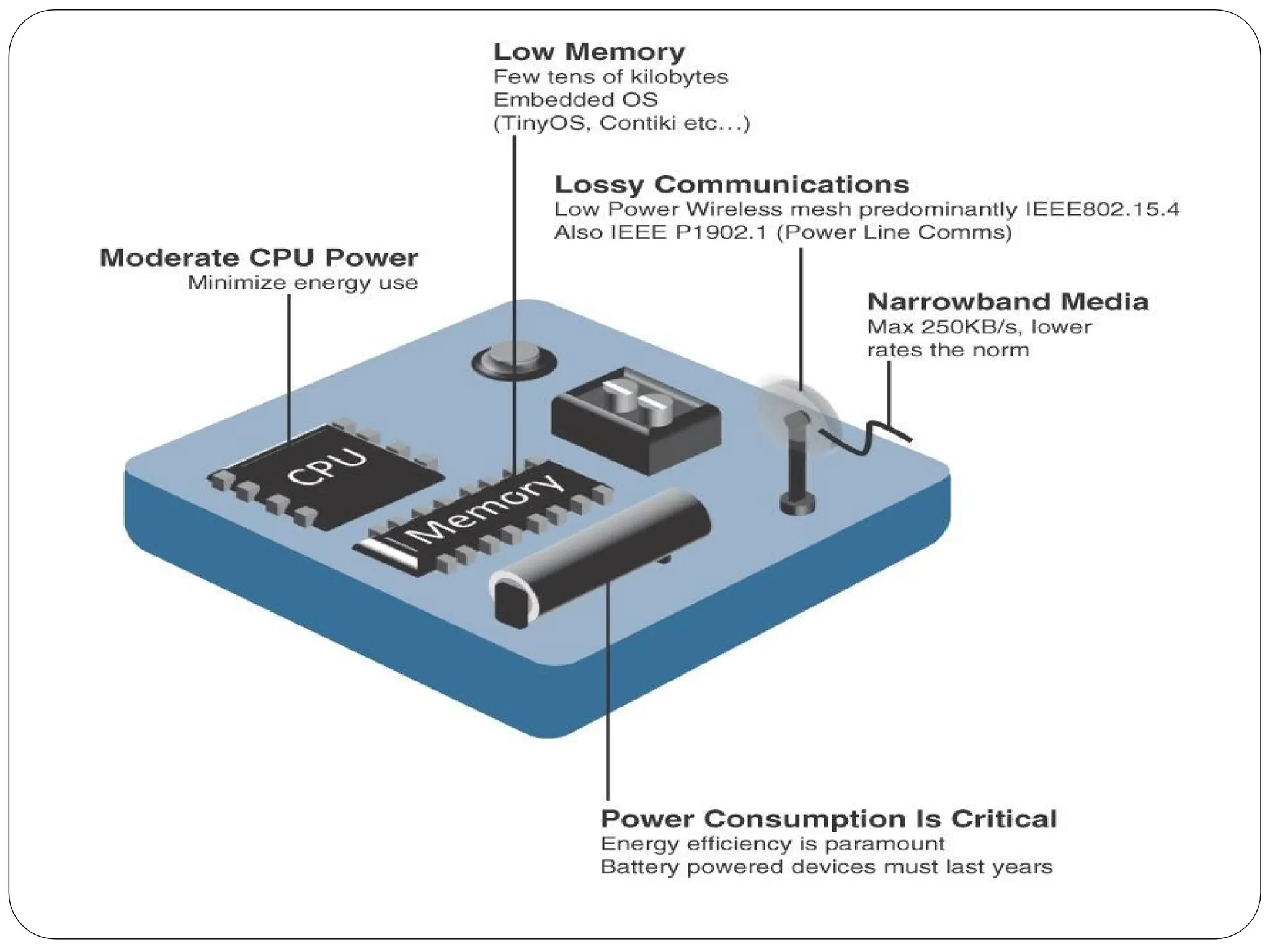
  • 129.
    LoRaWAN ⚫Low-Power Wide-Area (LPWA)adapted for long-range and battery powered endpoints ⚫LoRaWAN is unlicensed-band LPW A technology ⚫LoRa was a physical layer, or Layer 1, modulation that was developed by a French company named Cycleo ⚫Later, Cycleo was acquired by Semtech ⚫Optimized for long-range, two-way communications and low power consumption
  • 130.
  • 131.
    Physical Layer ⚫Semtech LoRa modulationis based on chirp spread spectrum modulation ⚫Chirp - Compressed High Intensity Radar Pulse ⚫Lower data rate and increase the communication distance
  • 132.
    ⚫Understanding LoRa gatewaysis critical to understanding a LoRaWAN system. ⚫A LoRa gateway is deployed as the center hub of a star network architecture. ⚫It uses multiple transceivers and channels and can demodulate multiple channels at once or even demodulate multiple signals on the same channel simultaneously. ⚫LoRa gateways serve as a transparent bridge relaying data between endpoints, and the endpoints use a single-hop wireless connection to communicate with one or many gateways.
  • 133.
    ⚫ The datarate in LoRaW AN varies depending on the frequency bands and adaptive data rate (ADR). ⚫ ADR is an algorithm that manages the data rate and radio signal for each endpoint. ⚫ The ADR algorithm ensures that packets are delivered at the best data rate possible and that network performance is both optimal and scalable. ⚫ Endpoints close to the gateways with good signal values transmit with the highest data rate, which enables a shorter transmission time over the wireless network, and the lowest transmit power. ⚫ Meanwhile, endpoints at the edge of the link budget communicate at the lowest data rate and highest transmit power.
  • 134.
    ⚫An important featureof LoRa is its ability to handle various data rates via the spreading factor. ⚫Devices with a low spreading factor (SF) achieve less distance in their communications but transmit at faster speeds, resulting in less airtime. ⚫A higher SF provides slower transmission rates but achieves a higher reliability at longer distances.
  • 135.
    MAC Layer ⚫The MAC layeris defined in the LoRaW AN specification. ⚫This layer takes advantage of the LoRa physical layer and classifies LoRaWAN endpoints to optimize their battery life and ensure downstream communications to the LoRaWAN endpoints. ⚫The LoRaW AN specification documents three classes of LoRaWAN devices: ⚫Class A: ⚫This class is the default implementation. Optimized for battery powered nodes, it allows bidirectional communications, where a given node is able to receive downstream traffic after transmitting. ⚫Two receive windows are available after each
  • 136.
    ⚫Class B: ⚫This classwas designated“experimental” in LoRaW AN 1.0.1 until it can be better defined. ⚫A Class B node or endpoint should get additional receive windows compared to Class A, but gateways must be synchronized through a beaconing process ⚫Class C: ⚫This class is particularly adapted for powered nodes. ⚫This classification enables a node to be continuously listening by keeping its receive window open when not transmitting.
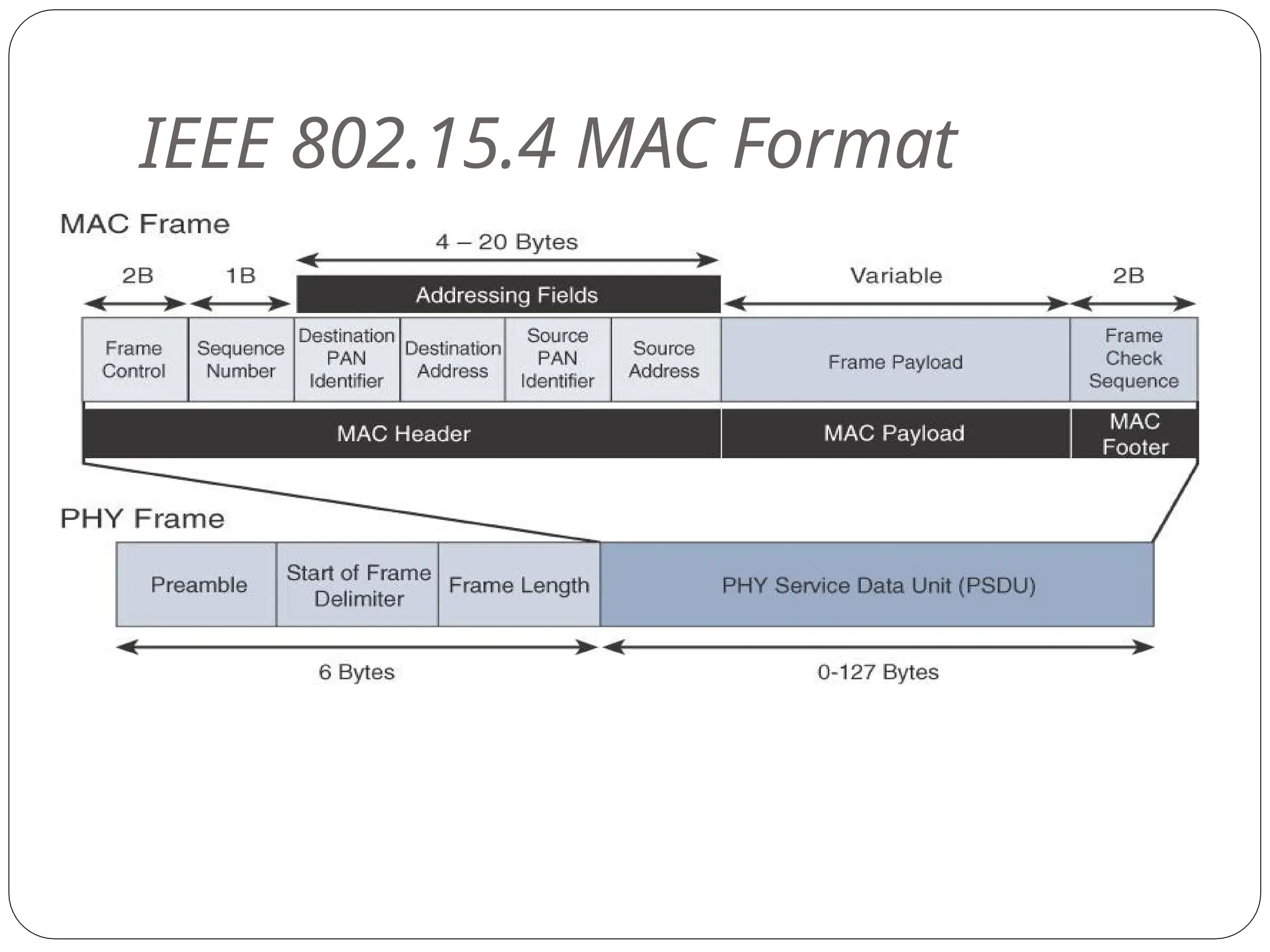
  • 137.
    ⚫LoRaW AN messages, eitheruplink or downlink, have a PHY payload composed of a 1-byte MAC header, a variable-byte MAC payload, and a MIC that is 4 bytes in length. ⚫The MAC payload size depends on the frequency band and the data rate, ranging from 59 to 230 bytes for the 863–870 MHz band and 19 to 250 bytes for the 902–928 MHz band
  • 138.
    ⚫ In version1.0.x, LoRaW AN utilizes six MAC message types. ⚫ LoRaW AN devices use join request and join accept messages for activation and joining the network. ⚫ The other message types are unconfirmed data up/down and confirmed data up/down. ⚫ A “confirmed” message is one that must be acknowledged, and “unconfirmed” signifies that the end device does not need to acknowledge. ⚫ “up/down” is simply a directional notation identifying whether the message flows in the uplink or downlink path. ⚫ Uplink messages are sent from endpoints to the network server and are relayed by one or more LoRaW AN gateways. ⚫ Downlink messages flow from the network server to a single endpoint and are relayed by only a single gateway
  • 139.
    ⚫LoRaWAN endpoints areuniquely addressable through a variety of methods, including the following: ⚫An endpoint can have a global end device ID or DevEUI represented as an IEEE EUI-64 address. ⚫An endpoint can have a global application ID or AppEUI represented as an IEEE EUI-64 address that uniquely identifies the application provider, such as the owner, of the end device
  • 140.
    ⚫In a LoRaWANnetwork, endpoints are also known by their end device address, known as a DevAddr, a 32-bit address. ⚫The 7 most significant bits are the network identifier (NwkID), which identifies the LoRaW AN network. ⚫The 25 least significant bits are used as the network address (NwkAddr) to identify the endpoint in the network.
  • 141.
  • 142.
    ⚫LoRaWAN endpoints mustimplement two layers of security, protecting communications and data privacy across the network. ⚫The first layer, called “network security” but applied at the MAC layer, guarantees the authentication of the endpoints by the LoRaW AN network server. ⚫Also, it protects LoRaW AN packets by performing encryption based on AES
  • 143.
    ⚫Each endpoint implementsa network session key (NwkSKey), used by both itself and the LoRaW AN network server. ⚫The NwkSKey ensures data integrity through computing and checking the MIC of every data message as well as encrypting and decrypting MAC-only data message payloads ⚫The second layer is an application session key (AppSKey), which performs encryption and decryption functions between the endpoint and its application server
  • 144.
    ⚫LoRaWAN endpoints attachedto a LoRaWAN network must get registered and authenticated. ⚫This can be achieved through one of the two join mechanisms: ⚫Activation by personalization (ABP): ⚫Endpoints don’t need to run a join procedure as their individual details, including DevAddr and the NwkSKey and AppSKey session keys, are preconfigured and stored in the end device. ⚫This same information is registered in the LoRaWAN network server
  • 145.
    ⚫ Over-the-air activation(OTAA): ⚫ Endpoints are allowed to dynamically join a particular LoRaWAN network after successfully going through a join procedure. ⚫ The join procedure must be done every time a session context is renewed. ⚫ During the join process, which involves the sending and receiving of MAC layer join request and join accept messages, the node establishes its credentials with a LoRaW AN network server, exchanging its globally unique DevEUI, AppEUI, and AppKey. ⚫ The AppKey is then used to derive the session NwkSKey and AppSKey keys
  • 146.
    NB-IoT and OtherLTE Variations ⚫Existing cellular technologies, such as GPRS, Edge, 3G, and 4G/LTE, are not particularly well adapted to battery- powered devices and small objects specifically developed for the Internet of Things ⚫L TE -M ⚫The new LTE-M device category was not sufficiently close to LPW A capabilities ⚫A new narrowband radio access technology called Narrowband IoT (NB-IoT)
  • 147.
    ⚫It addresses therequirements of a massive number of low- throughput devices, low device power consumption, improved indoor coverage, and optimized network architecture
  • 148.
    LTE Cat 0 ⚫Thefirst enhancements to better support IoT devices in 3GPP occurred in L TE Release 12. ⚫A new user equipment (UE) category, Category 0, was added, with devices running at a maximum data rate of 1 Mbps ⚫Category 0 includes important characteristics to be supported by both the network and end devices
  • 149.
    ⚫ Power savingmode (PSM) ⚫ This new device status minimizes energy consumption ⚫ PSM is defined as being similar to “powered off ” mode, but the device stays registered with the network. ⚫ By staying registered, the device avoids having to reattach or re- establish its network connection ⚫ The device negotiates with the network the idle time after which it will wake up. ⚫ When it wakes up, it initiates a tracking area update (TAU), after which it stays available for a configured time and then switches back to sleep mode or PSM. ⚫ A T AU is a procedure that an L TE device uses to let the network know its current tracking area, or the group of towers in the network from which it can be reached
  • 150.
    ⚫Half-duplex mode ⚫This modereduces the cost and complexity of a device’s implementation because a duplex filter is not needed. ⚫Most IoT endpoints are sensors that send low amounts of data that do not have a full duplex communication requirement.
  • 151.
    ⚫L TE-M ⚫L TE Release 13 ⚫Lowerreceiver bandwidth ⚫Bandwidth has been lowered to 1.4 MHz versus the usual 20 MHz.This further simplifies the LTE endpoint ⚫Lower data rate ⚫Data is around 200 kbps for LTE-M, compared to 1 Mbps for Cat 0.
  • 152.
    ⚫Half-duplex mode ⚫Just aswith Cat 0, LTE-M offers a half-duplex mode that decreases node complexity and cost ⚫Enhanced discontinuous reception (eDRX) ⚫This capability increases from seconds to minutes the amount of time an endpoint can “sleep” between paging cycles