
Agile Project Management
                                                     In
Harvard Business School’s Information Technology Group
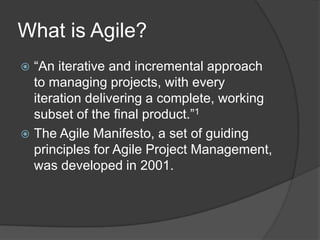
What is Agile?
 “An iterative and incremental approach
  to managing projects, with every
  iteration delivering a complete, working
  subset of the final product.”1
 The Agile Manifesto, a set of guiding
  principles for Agile Project Management,
  was developed in 2001.
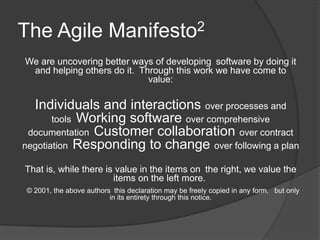
The Agile Manifesto2
We are uncovering better ways of developing
software by doing it
 and helping others do it.
Through this work we have come to
                             value:

  Individuals and interactions over processes and
       tools
Working software over comprehensive
 documentation
Customer collaboration over contract
negotiation
Responding to change over following a plan

 That is, while there is value in the items on
the right, we value the
                           items on the left more.

© 2001, the above authors
this declaration may be freely copied in any form, 
but only
                           in its entirety through this notice.
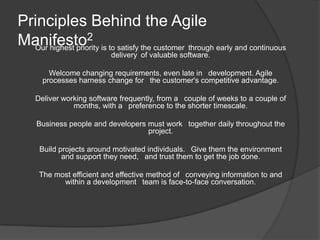
Principles Behind the Agile
Manifesto2 is to satisfy the customer
through early and continuous
  Our highest priority
                          delivery
of valuable software.

        Welcome changing requirements, even late in 
development. Agile
      processes harness change for 
the customer's competitive advantage.

    Deliver working software frequently, from a 
couple of weeks to a couple of
               months, with a 
preference to the shorter timescale.

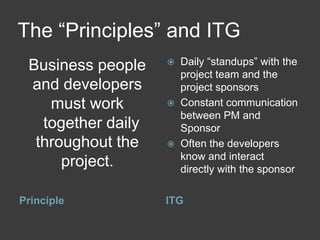
    Business people and developers must work 
together daily throughout the
                                   project.

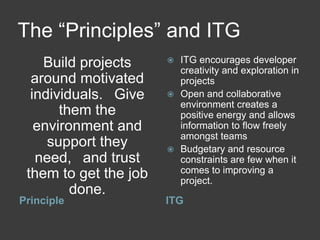
     Build projects around motivated individuals. 
Give them the environment
            and support they need, 
and trust them to get the job done.

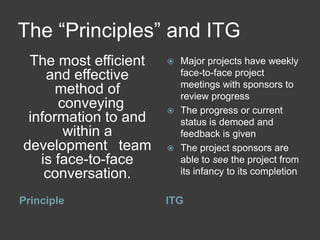
     The most efficient and effective method of 
conveying information to and
           within a development 
team is face-to-face conversation.
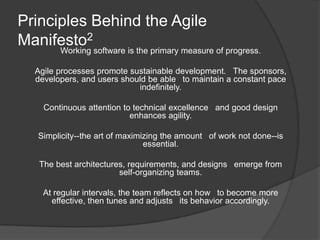
Principles Behind the Agile
Manifesto2
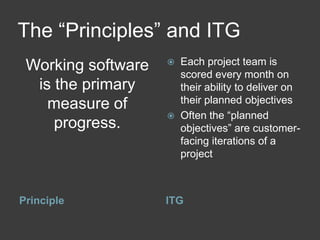
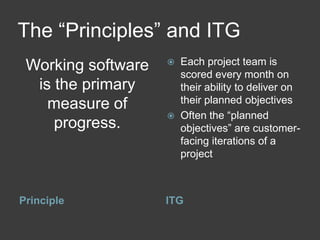
        Working software is the primary measure of progress.

  Agile processes promote sustainable development. 
The sponsors,
  developers, and users should be able 
to maintain a constant pace
                            indefinitely.

    Continuous attention to technical excellence 
and good design
                           enhances agility.

  Simplicity--the art of maximizing the amount 
of work not done--is
                               essential.

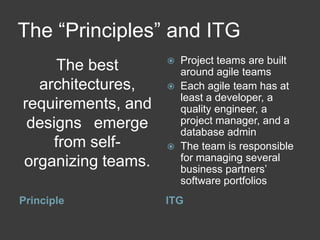
   The best architectures, requirements, and designs 
emerge from
                        self-organizing teams.

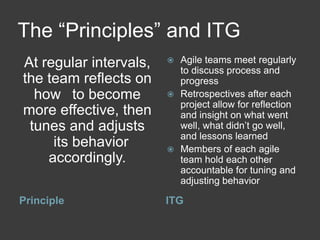
    At regular intervals, the team reflects on how 
to become more
      effective, then tunes and adjusts 
its behavior accordingly.
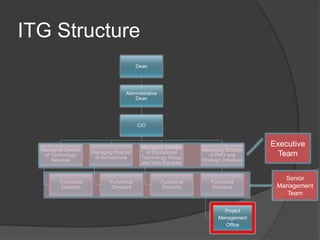
ITG Structure
                                            Dean


                                      Administrative
                                         Dean


                                            CIO


                                             Managing Director
                                                                                            Executive
  Managing Director                                                 Managing Director
   of Technology
                       Managing Director
                        of Architecture
                                               of Educational
                                             Technology Group
                                                                       of PMO and             Team
      Services                                                      Strategic Initiatives
                                             and Web Services


                                                                                               Senior
          Functional           Functional              Functional       Functional
          Directors            Directors               Directors        Directors            Management
                                                                                                Team

                                                                              Project
                                                                            Management
                                                                              Office
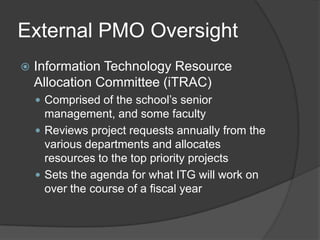
External PMO Oversight
   Information Technology Resource
    Allocation Committee (iTRAC)
     Comprised of the school’s senior
      management, and some faculty
     Reviews project requests annually from the
      various departments and allocates
      resources to the top priority projects
     Sets the agenda for what ITG will work on
      over the course of a fiscal year
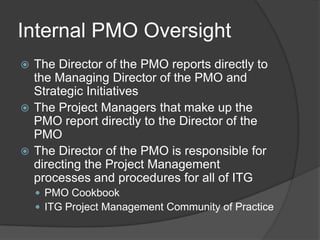
Internal PMO Oversight
 The Director of the PMO reports directly to
  the Managing Director of the PMO and
  Strategic Initiatives
 The Project Managers that make up the
  PMO report directly to the Director of the
  PMO
 The Director of the PMO is responsible for
  directing the Project Management
  processes and procedures for all of ITG
     PMO Cookbook
     ITG Project Management Community of Practice
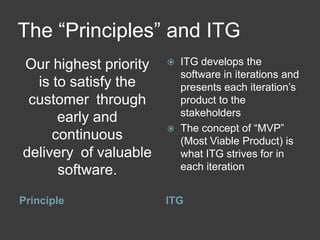
The “Principles” and ITG
Our highest priority      ITG develops the
                           software in iterations and
  is to satisfy the        presents each iteration’s
 customer
through          product to the
                           stakeholders
      early and
                          The concept of “MVP”
     continuous            (Most Viable Product) is
delivery
of valuable       what ITG strives for in
      software.            each iteration


Principle              ITG
The “Principles” and ITG
 Business people     Daily “standups” with the
                      project team and the
 and developers       project sponsors
    must work        Constant communication
                      between PM and
  
together daily     Sponsor
  throughout the     Often the developers
                      know and interact
      project.        directly with the sponsor

Principle           ITG
The “Principles” and ITG
    Build projects      ITG encourages developer
                         creativity and exploration in
  around motivated       projects
  individuals. 
Give    Open and collaborative
                         environment creates a
       them the          positive energy and allows
   environment and       information to flow freely
                         amongst teams
     support they       Budgetary and resource
   need, 
and trust      constraints are few when it
 them to get the job     comes to improving a
                         project.
         done.
Principle              ITG
The “Principles” and ITG
 The most efficient    Major projects have weekly
    and effective       face-to-face project
                        meetings with sponsors to
      method of         review progress
     
conveying        The progress or current
 information to and     status is demoed and
       within a         feedback is given
development 
team      The project sponsors are
   is face-to-face      able to see the project from
    conversation.       its infancy to its completion


Principle             ITG
The “Principles” and ITG
 Working software      Each project team is
                        scored every month on
  is the primary        their ability to deliver on
    measure of          their planned objectives
                       Often the “planned
     progress.          objectives” are customer-
                        facing iterations of a
                        project


Principle           ITG
The “Principles” and ITG
 Working software      Each project team is
                        scored every month on
  is the primary        their ability to deliver on
    measure of          their planned objectives
                       Often the “planned
     progress.          objectives” are customer-
                        facing iterations of a
                        project


Principle           ITG
The “Principles” and ITG
                       Project teams are built
      The best          around agile teams
  architectures,       Each agile team has at
                        least a developer, a
requirements, and       quality engineer, a
 designs 
emerge        project manager, and a
                        database admin
     from self-        The team is responsible
organizing teams.       for managing several
                        business partners’
                        software portfolios
Principle           ITG
The “Principles” and ITG
At regular intervals,    Agile teams meet regularly
                          to discuss process and
the team reflects on      progress
  how 
to become         Retrospectives after each
                          project allow for reflection
more effective, then      and insight on what went
 tunes and adjusts        well, what didn’t go well,
                          and lessons learned
    
its behavior        Members of each agile
    accordingly.          team hold each other
                          accountable for tuning and
                          adjusting behavior

Principle               ITG
References
1. Goncalves, Marcus. Fundamentals of
     Agile Project Management: An
     Overview. New York, NY: ASME,
     2010. Print.
2. http://agilemanifesto.org/

Project 5040- Agile Project Management

  • 1.
    Agile Project Management In Harvard Business School’s Information Technology Group
  • 2.
    What is Agile? “An iterative and incremental approach to managing projects, with every iteration delivering a complete, working subset of the final product.”1  The Agile Manifesto, a set of guiding principles for Agile Project Management, was developed in 2001.
  • 3.
    The Agile Manifesto2 Weare uncovering better ways of developing
software by doing it and helping others do it.
Through this work we have come to value: Individuals and interactions over processes and tools
Working software over comprehensive documentation
Customer collaboration over contract negotiation
Responding to change over following a plan That is, while there is value in the items on
the right, we value the items on the left more. 
© 2001, the above authors
this declaration may be freely copied in any form, 
but only in its entirety through this notice.
  • 4.
    Principles Behind theAgile Manifesto2 is to satisfy the customer
through early and continuous Our highest priority delivery
of valuable software. Welcome changing requirements, even late in 
development. Agile processes harness change for 
the customer's competitive advantage. Deliver working software frequently, from a 
couple of weeks to a couple of months, with a 
preference to the shorter timescale. Business people and developers must work 
together daily throughout the project. Build projects around motivated individuals. 
Give them the environment and support they need, 
and trust them to get the job done. The most efficient and effective method of 
conveying information to and within a development 
team is face-to-face conversation.
  • 5.
    Principles Behind theAgile Manifesto2 Working software is the primary measure of progress. Agile processes promote sustainable development. 
The sponsors, developers, and users should be able 
to maintain a constant pace indefinitely. Continuous attention to technical excellence 
and good design enhances agility. Simplicity--the art of maximizing the amount 
of work not done--is essential. The best architectures, requirements, and designs 
emerge from self-organizing teams. At regular intervals, the team reflects on how 
to become more effective, then tunes and adjusts 
its behavior accordingly.
  • 7.
    ITG Structure Dean Administrative Dean CIO Managing Director Executive Managing Director Managing Director of Technology Managing Director of Architecture of Educational Technology Group of PMO and Team Services Strategic Initiatives and Web Services Senior Functional Functional Functional Functional Directors Directors Directors Directors Management Team Project Management Office
  • 8.
    External PMO Oversight  Information Technology Resource Allocation Committee (iTRAC)  Comprised of the school’s senior management, and some faculty  Reviews project requests annually from the various departments and allocates resources to the top priority projects  Sets the agenda for what ITG will work on over the course of a fiscal year
  • 9.
    Internal PMO Oversight The Director of the PMO reports directly to the Managing Director of the PMO and Strategic Initiatives  The Project Managers that make up the PMO report directly to the Director of the PMO  The Director of the PMO is responsible for directing the Project Management processes and procedures for all of ITG  PMO Cookbook  ITG Project Management Community of Practice
  • 11.
    The “Principles” andITG Our highest priority  ITG develops the software in iterations and is to satisfy the presents each iteration’s customer
through product to the stakeholders early and  The concept of “MVP” continuous (Most Viable Product) is delivery
of valuable what ITG strives for in software. each iteration Principle ITG
  • 12.
    The “Principles” andITG Business people  Daily “standups” with the project team and the and developers project sponsors must work  Constant communication between PM and 
together daily Sponsor throughout the  Often the developers know and interact project. directly with the sponsor Principle ITG
  • 13.
    The “Principles” andITG Build projects  ITG encourages developer creativity and exploration in around motivated projects individuals. 
Give  Open and collaborative environment creates a them the positive energy and allows environment and information to flow freely amongst teams support they  Budgetary and resource need, 
and trust constraints are few when it them to get the job comes to improving a project. done. Principle ITG
  • 14.
    The “Principles” andITG The most efficient  Major projects have weekly and effective face-to-face project meetings with sponsors to method of review progress 
conveying  The progress or current information to and status is demoed and within a feedback is given development 
team  The project sponsors are is face-to-face able to see the project from conversation. its infancy to its completion Principle ITG
  • 15.
    The “Principles” andITG Working software  Each project team is scored every month on is the primary their ability to deliver on measure of their planned objectives  Often the “planned progress. objectives” are customer- facing iterations of a project Principle ITG
  • 16.
    The “Principles” andITG Working software  Each project team is scored every month on is the primary their ability to deliver on measure of their planned objectives  Often the “planned progress. objectives” are customer- facing iterations of a project Principle ITG
  • 17.
    The “Principles” andITG  Project teams are built The best around agile teams architectures,  Each agile team has at least a developer, a requirements, and quality engineer, a designs 
emerge project manager, and a database admin from self-  The team is responsible organizing teams. for managing several business partners’ software portfolios Principle ITG
  • 18.
    The “Principles” andITG At regular intervals,  Agile teams meet regularly to discuss process and the team reflects on progress how 
to become  Retrospectives after each project allow for reflection more effective, then and insight on what went tunes and adjusts well, what didn’t go well, and lessons learned 
its behavior  Members of each agile accordingly. team hold each other accountable for tuning and adjusting behavior Principle ITG
  • 20.
    References 1. Goncalves, Marcus.Fundamentals of Agile Project Management: An Overview. New York, NY: ASME, 2010. Print. 2. http://agilemanifesto.org/