Universitatea de Stiinte Agronomice si Medicina Veterinara,Bucuresti
Holiday destination abroad
Student:Matache Amalia-Georgiana
Dedu-Mircea Ionela
Grupa:8214
Profesor coordonator:
Frumuselu Mihai-Daniel
BUCURESTI 2015
Holidays in Tenerife
• Tenerife is the largest and most developed Canary Island. Attractive beaches, watersports and exciting
adventures to Loro Parque, Siam Park and the cliffs of Los Gigantes make holidays to Tenerife popular year
after year, offering activities for everyone to enjoy. It’s an island of two halves, with Spain’s highest
mountain dividing the lush tropical north from the rocky south.
Tenerife is the largest and most populous island of the seven Canary Islands it is also the most populated island of
Spain with a land area of 2 million square kilometres and 898,680 inhabitants 43 percent of the total
population of the Canary Islands. Tenerife is also the largest and most populous island of Macaronesia.
About five million tourists visit Tenerife each year It is also one of the most important tourist destinations in Spain.
Tenerife hosts one of the world's largestcarnivals and the Carnival of Santa Cruz de Tenerife is attempting to
become a World Heritage Site.
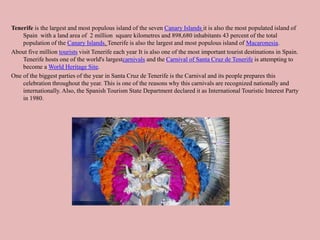
One of the biggest parties of the year in Santa Cruz de Tenerife is the Carnival and its people prepares this
celebration throughout the year. This is one of the reasons why this carnivals are recognized nationally and
internationally. Also, the Spanish Tourism State Department declared it as International Touristic Interest Party
in 1980.
Tenerife is served by two airports,Tenerife North
Airport and Tenerife South Airport, and is the tourism
and economic centre of the archipelago. Santa Cruz de
Tenerife is the capital of the island and the seat of the
island council .The city is capital of the autonomous
community of Canary Islands , sharing governmental
institutions such as Presidency and ministries.
Between the 1833 territorial division of Spain and
1927 Santa Cruz de Tenerife was the sole capital of the
Canary Islands, until a decree ordered that the capital
of the Canary Islands be shared, as it remains at
present.
The island is home to the University of La Laguna, which
was founded in 1792 and is the oldest university in the
Canaries. San Cristóbal de La Laguna (a World Heritage
Site) is the second city of the island and the third one of the
archipelago. The city of La Laguna was also capital of the
Canary Islands until Santa Cruz replaced it in 1833.
The island of Tenerife has a remarkable ecological
diversity in spite of its small surface area, which is a
consequence of the special environmental conditions on the
island, where its distinct orography modifies the general
climatic conditions at a local level, producing a significant
variety of microclimates. This diversity of natural
microclimates and, therefore, habitats, means that a rich and
diverse flora (1400 species of plants) exists on the island,
with well over a hundred entirely endemic to Tenerife.
The official symbols from nature associated with Tenerife are
the bird Blue Chaffinch and the Canary Islands dragon tree
Tourism is the most prominent industry in the Canaries,
which are one of the major tourist destinations in the world.
Tourism is more prevalent in the south of the island, which is
hotter and drier and has many well developed resorts such
as Playa de las Americas and Los Cristianos.
In the more lush and green north of the island the main
development for tourism has been in the town of Puerto de la
Cruz. The town itself has kept some of its old-harbour town
charm mixed with northern European influences. Still, the
tourist boom in the 1960s changed the outlook of the town,
making it cosy and cosmopolitan at the same time, and a
favourite for the more mature traveller
Bibliography
• www.ghiduri-turistice.info/ne-place-sa-citim
• ro.wikipedia.org/wiki/Tenerife
• https://www.christiantour.ro/vacante/tara_spania_st
atiune_tenerife-spania
www.tenerife-online.ro/

Proiect engleza

  • 1.
    Universitatea de StiinteAgronomice si Medicina Veterinara,Bucuresti Holiday destination abroad Student:Matache Amalia-Georgiana Dedu-Mircea Ionela Grupa:8214 Profesor coordonator: Frumuselu Mihai-Daniel BUCURESTI 2015
  • 2.
    Holidays in Tenerife •Tenerife is the largest and most developed Canary Island. Attractive beaches, watersports and exciting adventures to Loro Parque, Siam Park and the cliffs of Los Gigantes make holidays to Tenerife popular year after year, offering activities for everyone to enjoy. It’s an island of two halves, with Spain’s highest mountain dividing the lush tropical north from the rocky south.
  • 3.
    Tenerife is thelargest and most populous island of the seven Canary Islands it is also the most populated island of Spain with a land area of 2 million square kilometres and 898,680 inhabitants 43 percent of the total population of the Canary Islands. Tenerife is also the largest and most populous island of Macaronesia. About five million tourists visit Tenerife each year It is also one of the most important tourist destinations in Spain. Tenerife hosts one of the world's largestcarnivals and the Carnival of Santa Cruz de Tenerife is attempting to become a World Heritage Site. One of the biggest parties of the year in Santa Cruz de Tenerife is the Carnival and its people prepares this celebration throughout the year. This is one of the reasons why this carnivals are recognized nationally and internationally. Also, the Spanish Tourism State Department declared it as International Touristic Interest Party in 1980.
  • 4.
    Tenerife is servedby two airports,Tenerife North Airport and Tenerife South Airport, and is the tourism and economic centre of the archipelago. Santa Cruz de Tenerife is the capital of the island and the seat of the island council .The city is capital of the autonomous community of Canary Islands , sharing governmental institutions such as Presidency and ministries. Between the 1833 territorial division of Spain and 1927 Santa Cruz de Tenerife was the sole capital of the Canary Islands, until a decree ordered that the capital of the Canary Islands be shared, as it remains at present. The island is home to the University of La Laguna, which was founded in 1792 and is the oldest university in the Canaries. San Cristóbal de La Laguna (a World Heritage Site) is the second city of the island and the third one of the archipelago. The city of La Laguna was also capital of the Canary Islands until Santa Cruz replaced it in 1833.
  • 5.
    The island ofTenerife has a remarkable ecological diversity in spite of its small surface area, which is a consequence of the special environmental conditions on the island, where its distinct orography modifies the general climatic conditions at a local level, producing a significant variety of microclimates. This diversity of natural microclimates and, therefore, habitats, means that a rich and diverse flora (1400 species of plants) exists on the island, with well over a hundred entirely endemic to Tenerife.
  • 6.
    The official symbolsfrom nature associated with Tenerife are the bird Blue Chaffinch and the Canary Islands dragon tree Tourism is the most prominent industry in the Canaries, which are one of the major tourist destinations in the world. Tourism is more prevalent in the south of the island, which is hotter and drier and has many well developed resorts such as Playa de las Americas and Los Cristianos. In the more lush and green north of the island the main development for tourism has been in the town of Puerto de la Cruz. The town itself has kept some of its old-harbour town charm mixed with northern European influences. Still, the tourist boom in the 1960s changed the outlook of the town, making it cosy and cosmopolitan at the same time, and a favourite for the more mature traveller
  • 7.
    Bibliography • www.ghiduri-turistice.info/ne-place-sa-citim • ro.wikipedia.org/wiki/Tenerife •https://www.christiantour.ro/vacante/tara_spania_st atiune_tenerife-spania www.tenerife-online.ro/