Organized Labor à Changes
• 

Changes in workplace
• 

Machines
• 
replaced people for skilled jobs
• 
No longer “mom & pop” shop (negotiated) wages
• 
“family setting” à gone
• 
Rise of “sweatshops” where you monitored a machine
• 
lowered wages (no more skills)

• 

Children
• 
Two million children under age 15 in the workforce
• 
no schooling
• 
worked LONG x6days p/wk

• 

HAZARDS!
• 
Unhealthy air, extreme temps., dangerous situations
• 
Led to deaths
Organized Labor – cont’d
• 

Rise of organized labor
• 
• 

• 

Hazards led to pushback
Unions!
• 
Originally only skilled workers
• 
Non-union worker slow downs
• 
Strikes

Knights of Labor 1869
• 
• 
• 
• 
• 
• 

Opened unions to non-skilled and minorities
Terence Powderly – no strikes, just rallies
No children, shorter work day, equal wages by gender
Led to many strikes across the nation – not supported
Haymarket Square – explain!
AFL - ?
Women Workforce
—  Played a large role in the workforce
—  Mainly in textiles, tobacco, and garment industries

—  Many unions also formed
—  Also had strikes for better wages & hours

—  Hard times for organized labor
—  Triangle Shirtwaste Factory Fire – 1911
—  Overproduction and growth lead to layoffs
—  Rollercoaster of small recessions and depressions
—  More strikes and violence in cities
—  Railroads virtually shut down
Progressive Movements
—  Reforming City Governments

—  The rise of political bosses results from more need for city
services (sewer, road construction, garbage collection, etc)
—  Payoffs and bribes for contracts and loans for the needy
(William “Boss” Tweed)
—  “good government leagues – attacked corruption with some
success

—  Muckrackers

—  “dug up” stories on big business, corrupt politicians, factory
conditions, slum life, etc.
—  Inadequate police and fire protection
—  Upton Sinclair “The Jungle” – fiction?
—  Led to call for change
Progressive Movements
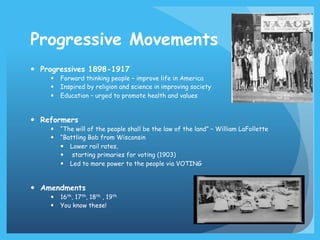
—  Progressives 1898-1917

—  Forward thinking people – improve life in America
—  Inspired by religion and science in improving society
—  Education – urged to promote health and values

—  Reformers

—  “The will of the people shall be the law of the land” – William LaFollette
—  “Battling Bob from Wisconsin
—  Lower rail rates,
—  starting primaries for voting (1903)
—  Led to more power to the people via VOTING

—  Amendments

—  16th, 17th, 18th , 19th
—  You know these!
Immigration
— 

Why America?
— 
— 
— 

Job security in industry, farming
A better life from homeland persecution

— 

— 

The “Promised Land” – FREEDOM!

Low fares on land/property, transportation

Journey
— 
— 

Close quarters in transit – led to disease
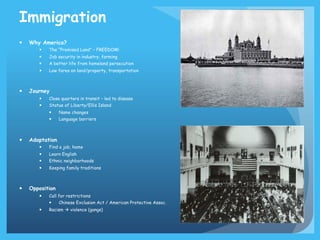
Statue of Liberty/Ellis Island
— 
— 

— 

Name changes
Language barriers

Adaptation
— 
— 
— 

Learn English
Ethnic neighborhoods

— 

— 

Find a job, home

Keeping family traditions

Opposition
— 

Call for restrictions
— 

— 

Chinese Exclusion Act / American Protective Assoc.

Racism à violence (gangs)

Progressive era pdf

  • 1.
    Organized Labor àChanges •  Changes in workplace •  Machines •  replaced people for skilled jobs •  No longer “mom & pop” shop (negotiated) wages •  “family setting” à gone •  Rise of “sweatshops” where you monitored a machine •  lowered wages (no more skills) •  Children •  Two million children under age 15 in the workforce •  no schooling •  worked LONG x6days p/wk •  HAZARDS! •  Unhealthy air, extreme temps., dangerous situations •  Led to deaths
  • 2.
    Organized Labor –cont’d •  Rise of organized labor •  •  •  Hazards led to pushback Unions! •  Originally only skilled workers •  Non-union worker slow downs •  Strikes Knights of Labor 1869 •  •  •  •  •  •  Opened unions to non-skilled and minorities Terence Powderly – no strikes, just rallies No children, shorter work day, equal wages by gender Led to many strikes across the nation – not supported Haymarket Square – explain! AFL - ?
  • 3.
    Women Workforce —  Playeda large role in the workforce —  Mainly in textiles, tobacco, and garment industries —  Many unions also formed —  Also had strikes for better wages & hours —  Hard times for organized labor —  Triangle Shirtwaste Factory Fire – 1911 —  Overproduction and growth lead to layoffs —  Rollercoaster of small recessions and depressions —  More strikes and violence in cities —  Railroads virtually shut down
  • 4.
    Progressive Movements —  ReformingCity Governments —  The rise of political bosses results from more need for city services (sewer, road construction, garbage collection, etc) —  Payoffs and bribes for contracts and loans for the needy (William “Boss” Tweed) —  “good government leagues – attacked corruption with some success —  Muckrackers —  “dug up” stories on big business, corrupt politicians, factory conditions, slum life, etc. —  Inadequate police and fire protection —  Upton Sinclair “The Jungle” – fiction? —  Led to call for change
  • 5.
    Progressive Movements —  Progressives1898-1917 —  Forward thinking people – improve life in America —  Inspired by religion and science in improving society —  Education – urged to promote health and values —  Reformers —  “The will of the people shall be the law of the land” – William LaFollette —  “Battling Bob from Wisconsin —  Lower rail rates, —  starting primaries for voting (1903) —  Led to more power to the people via VOTING —  Amendments —  16th, 17th, 18th , 19th —  You know these!
  • 6.
    Immigration —  Why America? —  —  —  Job securityin industry, farming A better life from homeland persecution —  —  The “Promised Land” – FREEDOM! Low fares on land/property, transportation Journey —  —  Close quarters in transit – led to disease Statue of Liberty/Ellis Island —  —  —  Name changes Language barriers Adaptation —  —  —  Learn English Ethnic neighborhoods —  —  Find a job, home Keeping family traditions Opposition —  Call for restrictions —  —  Chinese Exclusion Act / American Protective Assoc. Racism à violence (gangs)