Breakthroughs in AI
The concept that first emerged in 1947 has finally become a
more tangible idea
The confluence of three key
factors now contribute to massive
and rapid advancements in the
field of AI
 Moore’s Law
 Big Data
 Data Algorithms
v
b
First Big Step
in AI Progress
Image Recognition
1
Progress has been fast and furious.
Image recognition, for example, is
one of the most difficult fields in
AI. Over the past couple of years
image recognition has jumped rapidly
 2010 – 44% accuracy rate
 2011 – 77% accuracy rate
 2016 – 98% accuracy rate
v
b
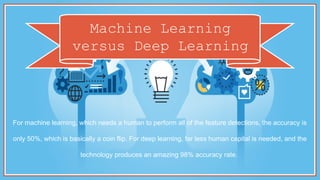
Machine Learning
versus Deep Learning
For machine learning, which needs a human to perform all of the feature detections, the accuracy is
only 50%, which is basically a coin flip. For deep learning, far less human capital is needed, and the
technology produces an amazing 98% accuracy rate.
Concerns with Choosing
Deep Learning over
Machine Learning
v
b
While paying six-figure salaries to
hundreds of data scientists is
costly, deep learning and neural
nets are extremely complex and
require advanced data teams to
implement them, which can seem
daunting.
The true power of AI has become its
ability to describe why something
happened, what will happen and what can be
done to affect the desired outcome that a
business has.
This fact that AI can explain the present
and predict the future is why AI has
become such a prominent innovation

Progress in AI

  • 1.
    Breakthroughs in AI Theconcept that first emerged in 1947 has finally become a more tangible idea
  • 2.
    The confluence ofthree key factors now contribute to massive and rapid advancements in the field of AI  Moore’s Law  Big Data  Data Algorithms v b
  • 3.
    First Big Step inAI Progress Image Recognition 1
  • 4.
    Progress has beenfast and furious. Image recognition, for example, is one of the most difficult fields in AI. Over the past couple of years image recognition has jumped rapidly  2010 – 44% accuracy rate  2011 – 77% accuracy rate  2016 – 98% accuracy rate v b
  • 5.
    Machine Learning versus DeepLearning For machine learning, which needs a human to perform all of the feature detections, the accuracy is only 50%, which is basically a coin flip. For deep learning, far less human capital is needed, and the technology produces an amazing 98% accuracy rate.
  • 6.
    Concerns with Choosing DeepLearning over Machine Learning v b While paying six-figure salaries to hundreds of data scientists is costly, deep learning and neural nets are extremely complex and require advanced data teams to implement them, which can seem daunting.
  • 7.
    The true powerof AI has become its ability to describe why something happened, what will happen and what can be done to affect the desired outcome that a business has.
  • 8.
    This fact thatAI can explain the present and predict the future is why AI has become such a prominent innovation