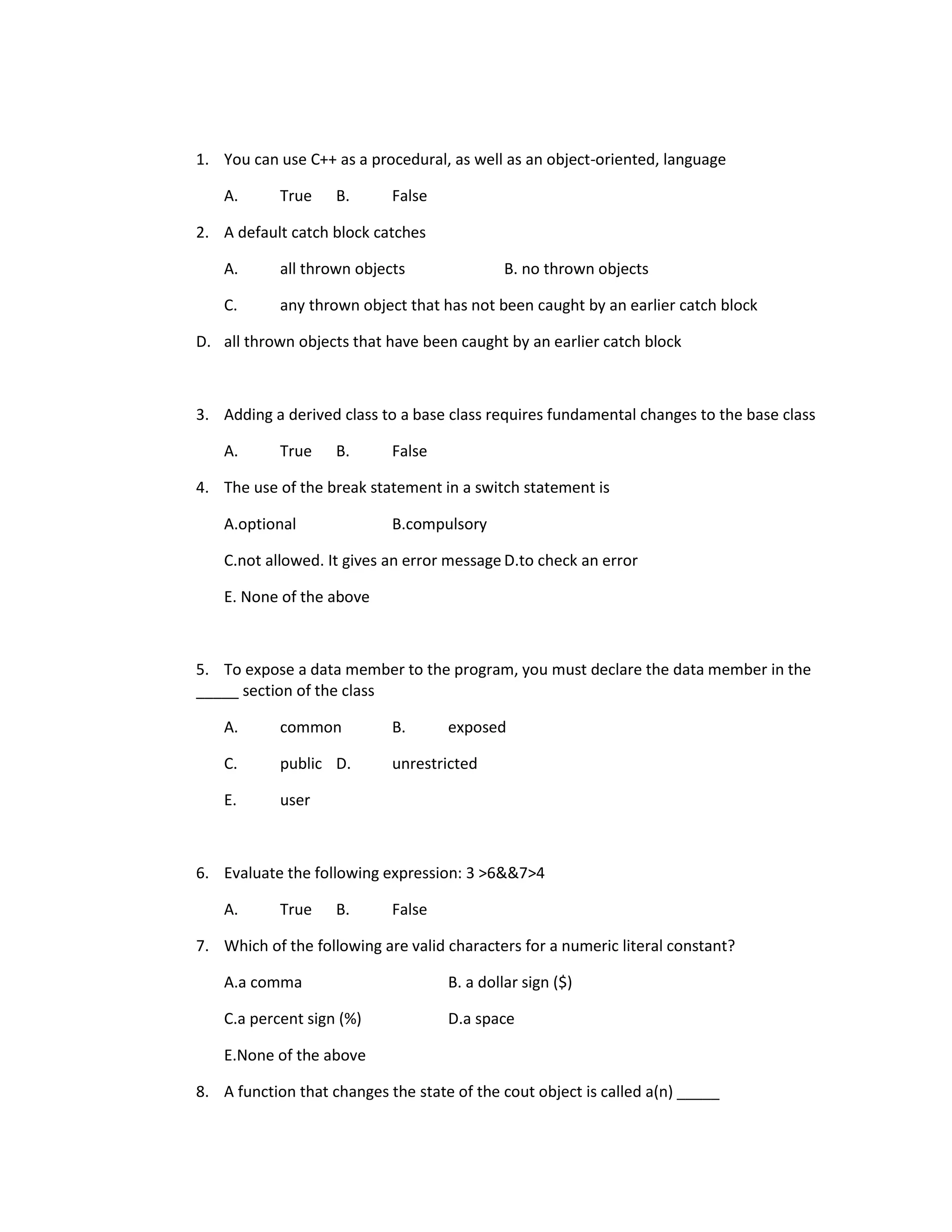
1. You can use C++ as a procedural, as well as an object-oriented, language

    A.      True    B.      False

2. A default catch block catches

    A.      all thrown objects               B. no thrown objects

    C.      any thrown object that has not been caught by an earlier catch block

D. all thrown objects that have been caught by an earlier catch block


3. Adding a derived class to a base class requires fundamental changes to the base class

    A.      True    B.      False

4. The use of the break statement in a switch statement is

    A.optional              B.compulsory

    C.not allowed. It gives an error message D.to check an error

    E. None of the above


5. To expose a data member to the program, you must declare the data member in the
_____ section of the class

    A.      common          B.      exposed

    C.      public D.       unrestricted

    E.      user


6. Evaluate the following expression: 3 >6&&7>4

    A.      True    B.      False

7. Which of the following are valid characters for a numeric literal constant?

    A.a comma                       B. a dollar sign ($)

    C.a percent sign (%)            D.a space

    E.None of the above

8. A function that changes the state of the cout object is called a(n) _____
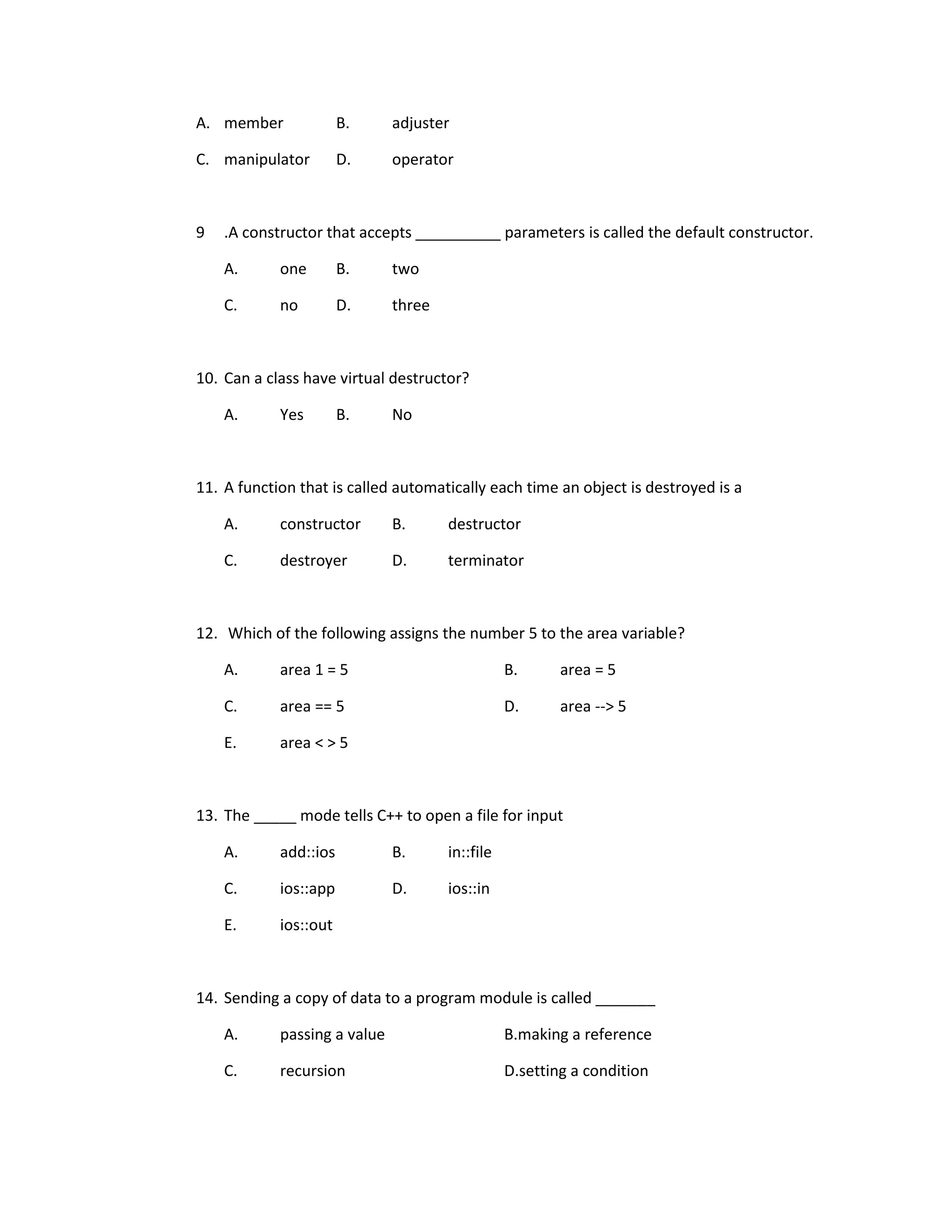
A. member              B.     adjuster

C. manipulator         D.     operator


9   .A constructor that accepts __________ parameters is called the default constructor.

    A.      one        B.     two

    C.      no         D.     three


10. Can a class have virtual destructor?

    A.      Yes        B.     No


11. A function that is called automatically each time an object is destroyed is a

    A.      constructor       B.      destructor

    C.      destroyer         D.      terminator


12. Which of the following assigns the number 5 to the area variable?

    A.      area 1 = 5                           B.      area = 5

    C.      area == 5                            D.      area --> 5

    E.      area < > 5


13. The _____ mode tells C++ to open a file for input

    A.      add::ios          B.      in::file

    C.      ios::app          D.      ios::in

    E.      ios::out


14. Sending a copy of data to a program module is called _______

    A.      passing a value                      B.making a reference

    C.      recursion                            D.setting a condition
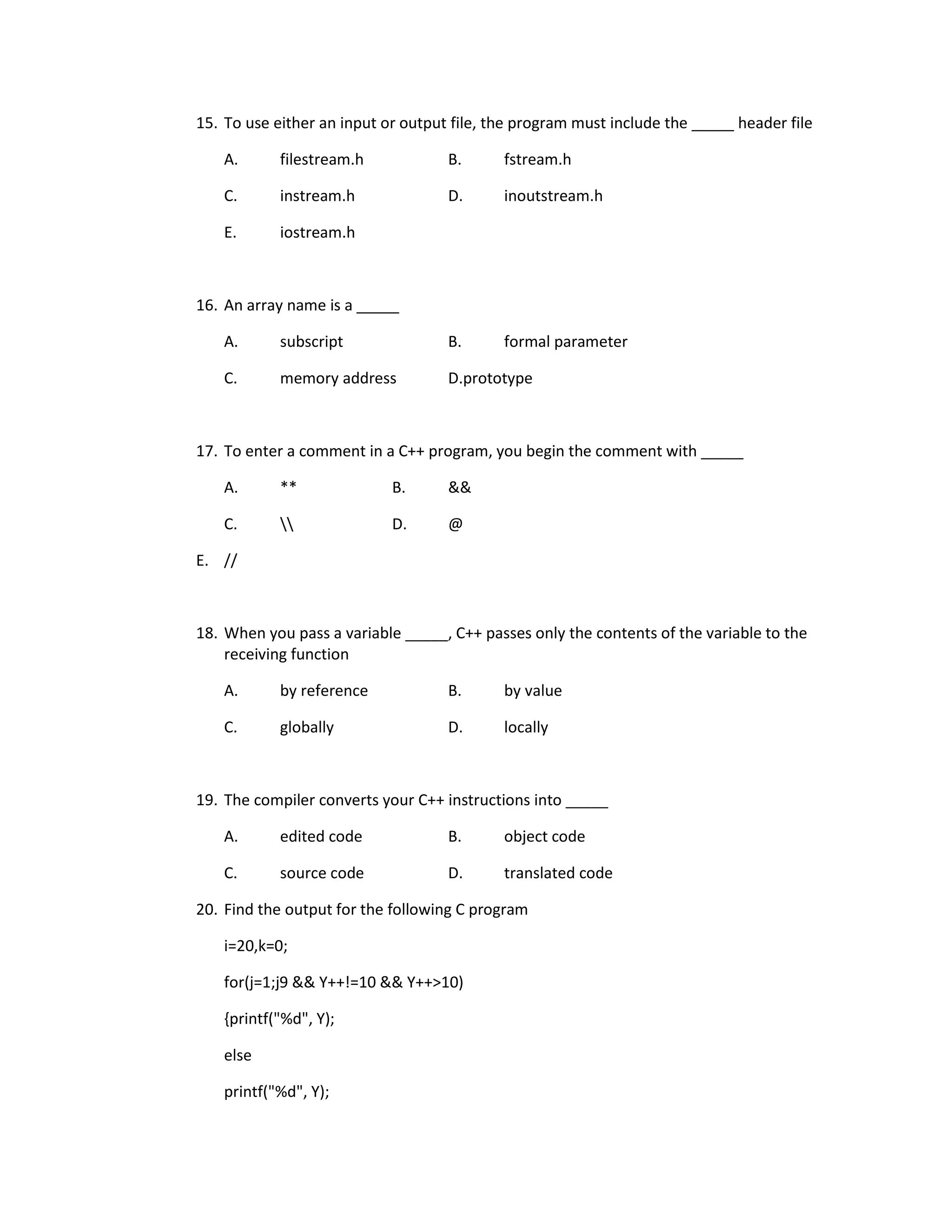
15. To use either an input or output file, the program must include the _____ header file

    A.      filestream.h            B.      fstream.h

    C.      instream.h              D.      inoutstream.h

    E.      iostream.h


16. An array name is a _____

    A.      subscript               B.      formal parameter

    C.      memory address          D.prototype


17. To enter a comment in a C++ program, you begin the comment with _____

    A.      **              B.      &&

    C.                    D.      @

E. //


18. When you pass a variable _____, C++ passes only the contents of the variable to the
    receiving function

    A.      by reference            B.      by value

    C.      globally                D.      locally


19. The compiler converts your C++ instructions into _____

    A.      edited code             B.      object code

    C.      source code             D.      translated code

20. Find the output for the following C program

    i=20,k=0;

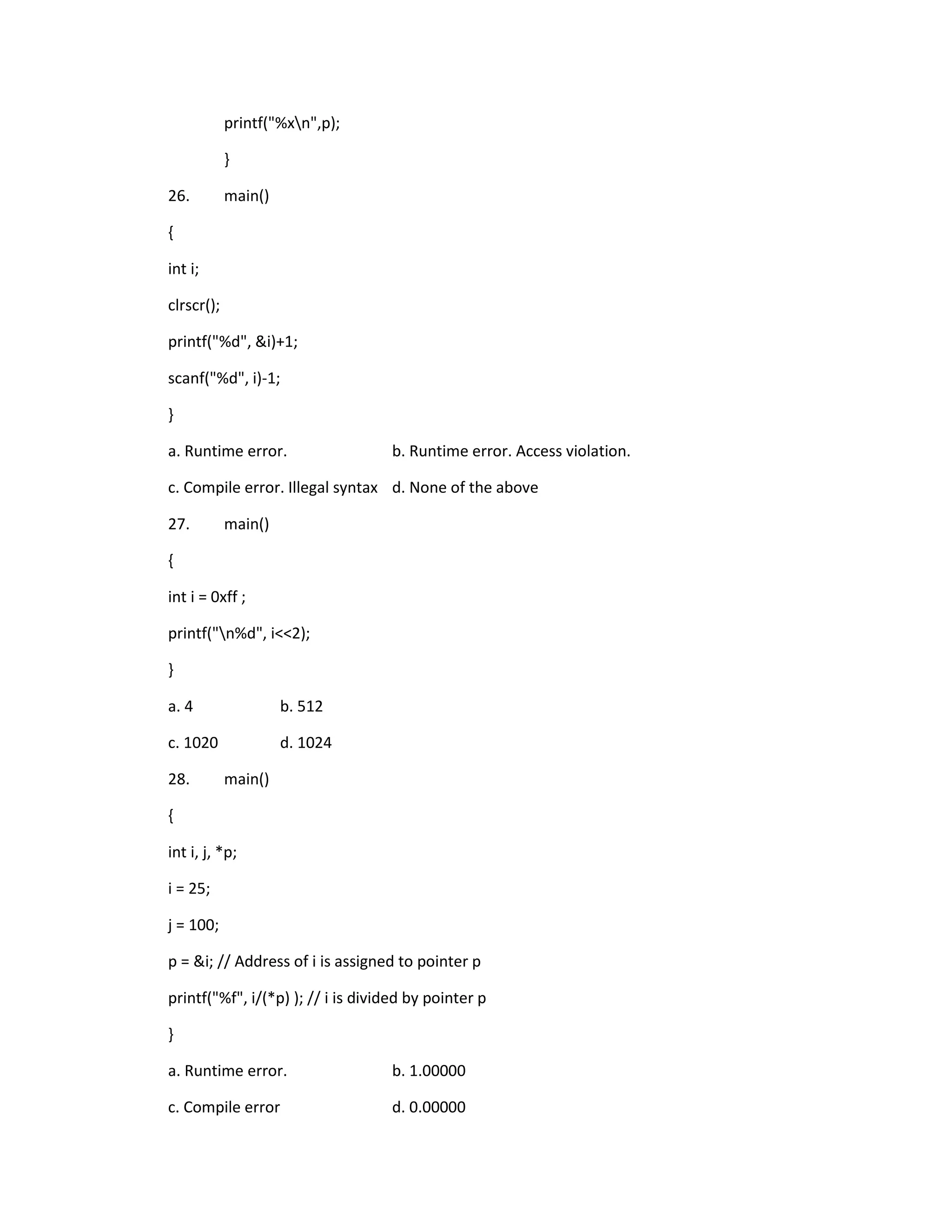
    for(j=1;j9 && Y++!=10 && Y++>10)

    {printf("%d", Y);

    else

    printf("%d", Y);
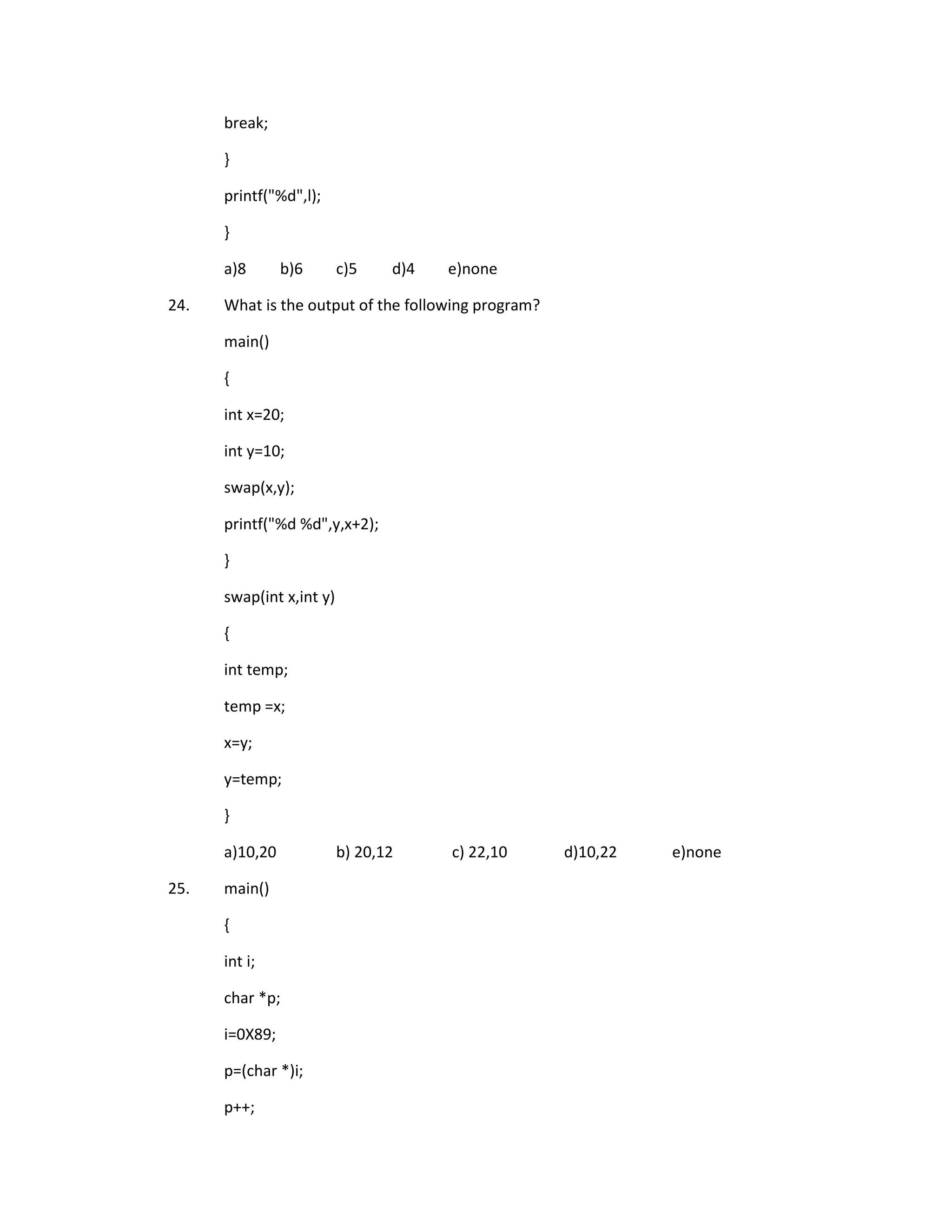
}

21.   What is the sizeof(long int)

      (a) 4 bytes

      (b) 2 bytes

      (c) compiler dependent

      (d) 8 bytes


22.   What is the output of the following program?

      main()

      {

      char *src = "Hello World";

      char dst[100];

      strcpy(src,dst);

      printf("%s",dst);

      }strcpy(char *dst,char *src)

      {while(*src) *dst++ = *src++;

      }

      A) "Hello World"                B)"Hello"

      C)"World"                       D) NULL

      E) unidentified

23.   What is the output of the following program?

      main()

      {

      int l=6;

      switch(l)

      { default : l+=2;

      case 4: l=4;

      case 5: l++;
break;

      }

      printf("%d",l);

      }

      a)8       b)6       c)5    d)4   e)none

24.   What is the output of the following program?

      main()

      {

      int x=20;

      int y=10;

      swap(x,y);

      printf("%d %d",y,x+2);

      }

      swap(int x,int y)

      {

      int temp;

      temp =x;

      x=y;

      y=temp;

      }

      a)10,20             b) 20,12     c) 22,10      d)10,22   e)none

25.   main()

      {

      int i;

      char *p;

      i=0X89;

      p=(char *)i;

      p++;
printf("%xn",p);

            }

26.         main()

{

int i;

clrscr();

printf("%d", &i)+1;

scanf("%d", i)-1;

}

a. Runtime error.                  b. Runtime error. Access violation.

c. Compile error. Illegal syntax d. None of the above

27.         main()

{

int i = 0xff ;

printf("n%d", i<<2);

}

a. 4                 b. 512

c. 1020              d. 1024

28.         main()

{

int i, j, *p;

i = 25;

j = 100;

p = &i; // Address of i is assigned to pointer p

printf("%f", i/(*p) ); // i is divided by pointer p

}

a. Runtime error.                  b. 1.00000

c. Compile error                   d. 0.00000
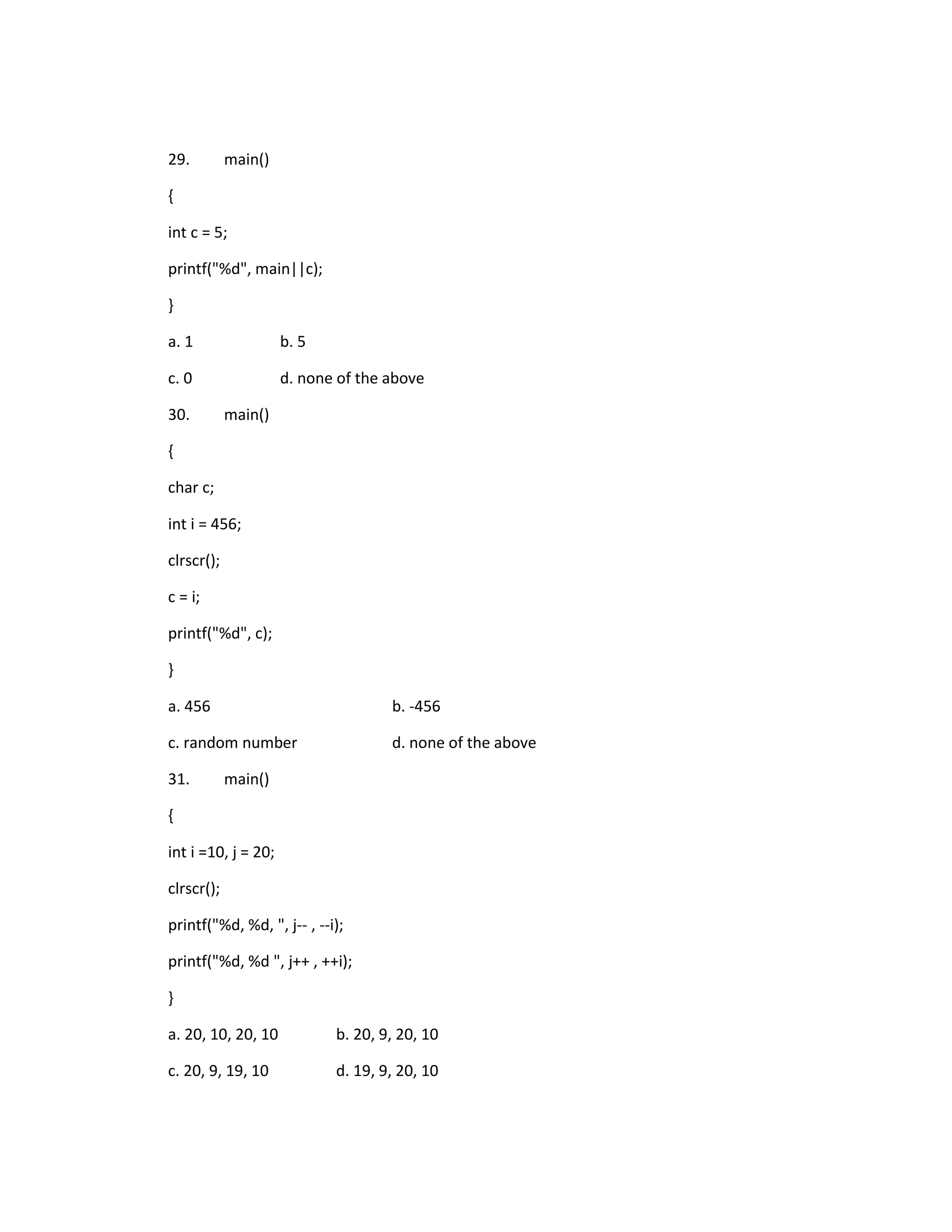
29.         main()

{

int c = 5;

printf("%d", main||c);

}

a. 1                 b. 5

c. 0                 d. none of the above

30.         main()

{

char c;

int i = 456;

clrscr();

c = i;

printf("%d", c);

}

a. 456                              b. -456

c. random number                    d. none of the above

31.         main()

{

int i =10, j = 20;

clrscr();

printf("%d, %d, ", j-- , --i);

printf("%d, %d ", j++ , ++i);

}

a. 20, 10, 20, 10           b. 20, 9, 20, 10

c. 20, 9, 19, 10            d. 19, 9, 20, 10
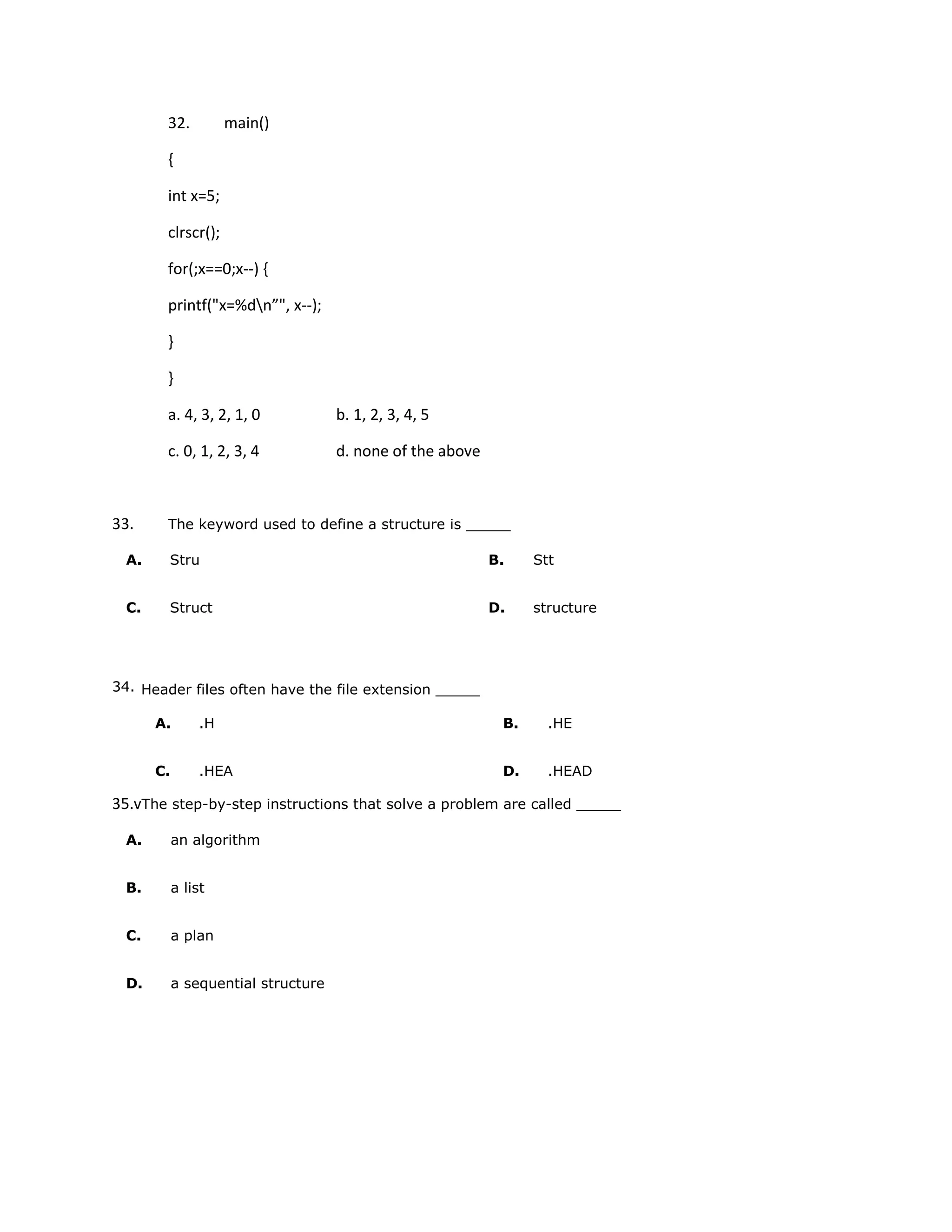
32.           main()

       {

       int x=5;

       clrscr();

       for(;x==0;x--) {

       printf("x=%dn”", x--);

       }

       }

       a. 4, 3, 2, 1, 0             b. 1, 2, 3, 4, 5

       c. 0, 1, 2, 3, 4             d. none of the above


33.    The keyword used to define a structure is _____

 A.     Stru                                               B.    Stt


 C.     Struct                                             D.    structure


34. Header files often have the file extension _____

      A.        .H                                          B.     .HE


      C.        .HEA                                        D.     .HEAD

35.vThe step-by-step instructions that solve a problem are called _____

 A.        an algorithm


 B.        a list


 C.        a plan


 D.        a sequential structure

Exam for c

  • 1.
    1. You canuse C++ as a procedural, as well as an object-oriented, language A. True B. False 2. A default catch block catches A. all thrown objects B. no thrown objects C. any thrown object that has not been caught by an earlier catch block D. all thrown objects that have been caught by an earlier catch block 3. Adding a derived class to a base class requires fundamental changes to the base class A. True B. False 4. The use of the break statement in a switch statement is A.optional B.compulsory C.not allowed. It gives an error message D.to check an error E. None of the above 5. To expose a data member to the program, you must declare the data member in the _____ section of the class A. common B. exposed C. public D. unrestricted E. user 6. Evaluate the following expression: 3 >6&&7>4 A. True B. False 7. Which of the following are valid characters for a numeric literal constant? A.a comma B. a dollar sign ($) C.a percent sign (%) D.a space E.None of the above 8. A function that changes the state of the cout object is called a(n) _____
  • 2.
    A. member B. adjuster C. manipulator D. operator 9 .A constructor that accepts __________ parameters is called the default constructor. A. one B. two C. no D. three 10. Can a class have virtual destructor? A. Yes B. No 11. A function that is called automatically each time an object is destroyed is a A. constructor B. destructor C. destroyer D. terminator 12. Which of the following assigns the number 5 to the area variable? A. area 1 = 5 B. area = 5 C. area == 5 D. area --> 5 E. area < > 5 13. The _____ mode tells C++ to open a file for input A. add::ios B. in::file C. ios::app D. ios::in E. ios::out 14. Sending a copy of data to a program module is called _______ A. passing a value B.making a reference C. recursion D.setting a condition
  • 3.
    15. To useeither an input or output file, the program must include the _____ header file A. filestream.h B. fstream.h C. instream.h D. inoutstream.h E. iostream.h 16. An array name is a _____ A. subscript B. formal parameter C. memory address D.prototype 17. To enter a comment in a C++ program, you begin the comment with _____ A. ** B. && C. D. @ E. // 18. When you pass a variable _____, C++ passes only the contents of the variable to the receiving function A. by reference B. by value C. globally D. locally 19. The compiler converts your C++ instructions into _____ A. edited code B. object code C. source code D. translated code 20. Find the output for the following C program i=20,k=0; for(j=1;j9 && Y++!=10 && Y++>10) {printf("%d", Y); else printf("%d", Y);
  • 4.
    } 21. What is the sizeof(long int) (a) 4 bytes (b) 2 bytes (c) compiler dependent (d) 8 bytes 22. What is the output of the following program? main() { char *src = "Hello World"; char dst[100]; strcpy(src,dst); printf("%s",dst); }strcpy(char *dst,char *src) {while(*src) *dst++ = *src++; } A) "Hello World" B)"Hello" C)"World" D) NULL E) unidentified 23. What is the output of the following program? main() { int l=6; switch(l) { default : l+=2; case 4: l=4; case 5: l++;
  • 5.
    break; } printf("%d",l); } a)8 b)6 c)5 d)4 e)none 24. What is the output of the following program? main() { int x=20; int y=10; swap(x,y); printf("%d %d",y,x+2); } swap(int x,int y) { int temp; temp =x; x=y; y=temp; } a)10,20 b) 20,12 c) 22,10 d)10,22 e)none 25. main() { int i; char *p; i=0X89; p=(char *)i; p++;
  • 6.
    printf("%xn",p); } 26. main() { int i; clrscr(); printf("%d", &i)+1; scanf("%d", i)-1; } a. Runtime error. b. Runtime error. Access violation. c. Compile error. Illegal syntax d. None of the above 27. main() { int i = 0xff ; printf("n%d", i<<2); } a. 4 b. 512 c. 1020 d. 1024 28. main() { int i, j, *p; i = 25; j = 100; p = &i; // Address of i is assigned to pointer p printf("%f", i/(*p) ); // i is divided by pointer p } a. Runtime error. b. 1.00000 c. Compile error d. 0.00000
  • 7.
    29. main() { int c = 5; printf("%d", main||c); } a. 1 b. 5 c. 0 d. none of the above 30. main() { char c; int i = 456; clrscr(); c = i; printf("%d", c); } a. 456 b. -456 c. random number d. none of the above 31. main() { int i =10, j = 20; clrscr(); printf("%d, %d, ", j-- , --i); printf("%d, %d ", j++ , ++i); } a. 20, 10, 20, 10 b. 20, 9, 20, 10 c. 20, 9, 19, 10 d. 19, 9, 20, 10
  • 8.
    32. main() { int x=5; clrscr(); for(;x==0;x--) { printf("x=%dn”", x--); } } a. 4, 3, 2, 1, 0 b. 1, 2, 3, 4, 5 c. 0, 1, 2, 3, 4 d. none of the above 33. The keyword used to define a structure is _____ A. Stru B. Stt C. Struct D. structure 34. Header files often have the file extension _____ A. .H B. .HE C. .HEA D. .HEAD 35.vThe step-by-step instructions that solve a problem are called _____ A. an algorithm B. a list C. a plan D. a sequential structure