programming
    basics
    basics

Ladislav Martincik
Content
   - Simple question
   - Complexity OF MODELING
     reality (Not-reality)
   - OOP
   - Coupling (Connascence)
   - big applouse ;)

ALL the time discussion please!
Why oop?
class Component
  attr_accessor :name, :price

  def initialize name, price
    @name = name
    @price = price
  end

  def to_s
    "#{name}: $#{price}"
  end
end
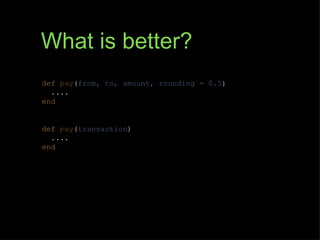
What is better?
def pay(from, to, amount, rounding = 0.5)
  ....
end


def pay(transaction)
  ....
end
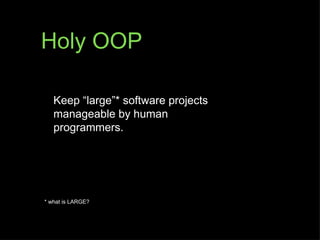
Holy OOP

   Keep “large”* software projects
   manageable by human
   programmers.


* what is LARGE?
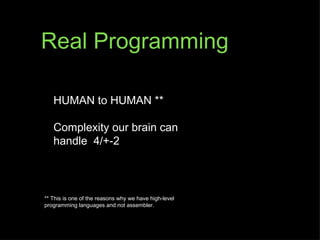
Real Programming

   HUMAN to HUMAN **

   Complexity our brain can
   handle 4/+-2


** This is one of the reasons why we have high-level
programming languages and not assembler.
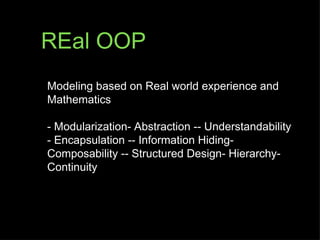
REal OOP
Modeling based on Real world experience and
Mathematics

- Modularization- Abstraction -- Understandability
- Encapsulation -- Information Hiding-
Composability -- Structured Design- Hierarchy-
Continuity
Modularization


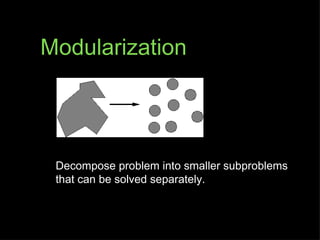
 Decompose problem into smaller subproblems
 that can be solved separately.
Modularization
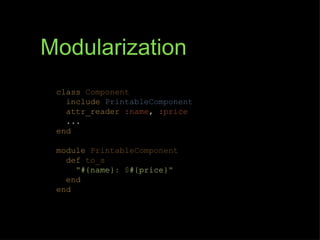
 class Component
   include PrintableComponent
   attr_reader :name, :price
   ...
 end

 module PrintableComponent
   def to_s
     "#{name}: $#{price}"
   end
 end
Abstraction --
Understandability


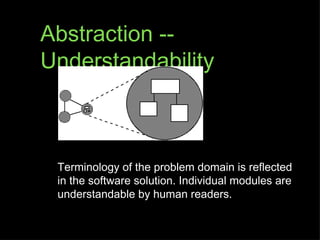
 Terminology of the problem domain is reflected
 in the software solution. Individual modules are
 understandable by human readers.
Abstraction --
Understandability
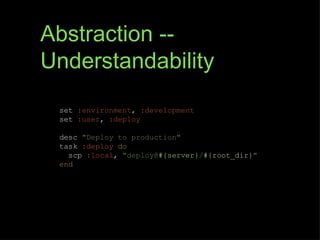
 set :environment, :development
 set :user, :deploy

 desc "Deploy to production"
 task :deploy do
   scp :local, "deploy@#{server}/#{root_dir}"
 end
Composability --
Structured Design


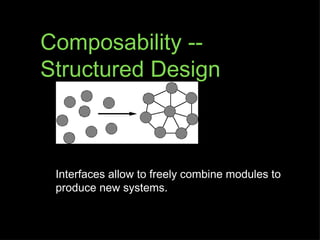
 Interfaces allow to freely combine modules to
 produce new systems.
Composability --
Structured Design
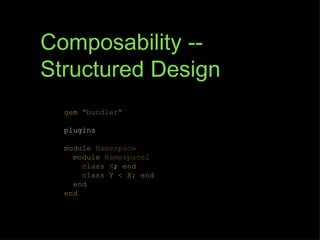
  gem "bundler"

  plugins

  module Namespace
    module Namespace2
      class X; end
      class Y < X; end
    end
  end
Hierarchy

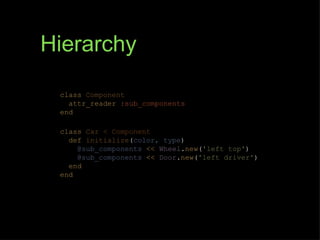
 class Component
   attr_reader :sub_components
 end

 class Car < Component
   def initialize(color, type)
     @sub_components << Wheel.new('left top')
     @sub_components << Door.new('left driver')
   end
 end
Continuity


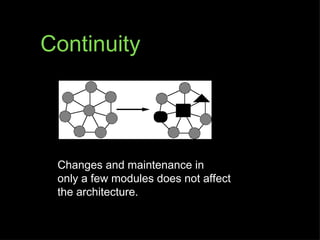
 Changes and maintenance in
 only a few modules does not affect
 the architecture.
Continuity
 DRY - Do not repeat yourself
 Coupling - ConNascence
ConNascence

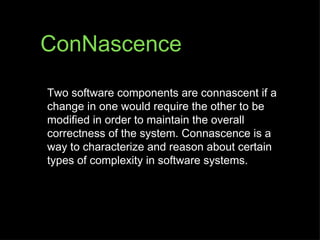
Two software components are connascent if a
change in one would require the other to be
modified in order to maintain the overall
correctness of the system. Connascence is a
way to characterize and reason about certain
types of complexity in software systems.
ConNascence
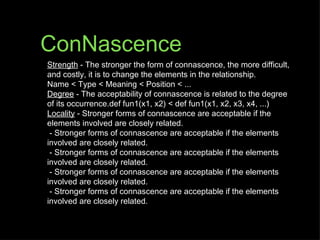
Strength - The stronger the form of connascence, the more difficult,
and costly, it is to change the elements in the relationship.
Name < Type < Meaning < Position < ...
Degree - The acceptability of connascence is related to the degree
of its occurrence.def fun1(x1, x2) < def fun1(x1, x2, x3, x4, ...)
Locality - Stronger forms of connascence are acceptable if the
elements involved are closely related.
 - Stronger forms of connascence are acceptable if the elements
involved are closely related.
 - Stronger forms of connascence are acceptable if the elements
involved are closely related.
 - Stronger forms of connascence are acceptable if the elements
involved are closely related.
 - Stronger forms of connascence are acceptable if the elements
involved are closely related.
C of Name
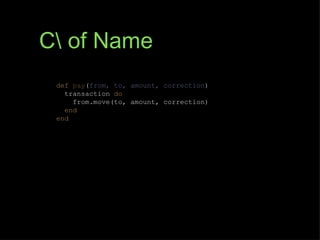
 def pay(from, to, amount, correction)
   transaction do
     from.move(to, amount, correction)
   end
 end
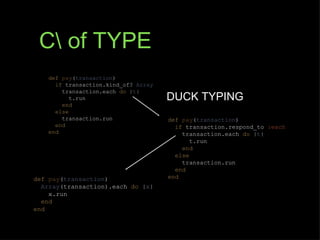
C of TYPE
    def pay(transaction)
      if transaction.kind_of? Array

                                      DUCK TYPING
        transaction.each do |t|
          t.run
        end
      else
        transaction.run               def pay(transaction)
      end                               if transaction.respond_to :each
    end                                   transaction.each do |t|
                                             t.run
                                          end
                                        else
                                          transaction.run
                                        end
def pay(transaction)                  end
  Array(transaction).each do |x|
    x.run
  end
end
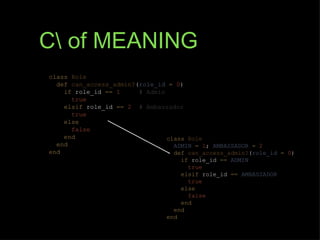
C of MEANING
class Role
  def can_access_admin?(role_id = 0)
    if role_id == 1     # Admin
      true
    elsif role_id == 2 # Ambassador
      true
    else
      false
    end                         class Role
  end                             ADMIN = 1; AMBASSADOR = 2
end                               def can_access_admin?(role_id = 0)
                                    if role_id == ADMIN
                                      true
                                    elsif role_id == AMBASSADOR
                                      true
                                    else
                                      false
                                    end
                                  end
                                end
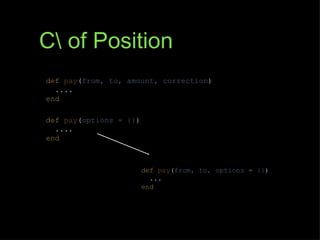
C of Position
def pay(from, to, amount, correction)
  ....
end

def pay(options = {})
  ....
end


                        def pay(from, to, options = {})
                          ...
                        end
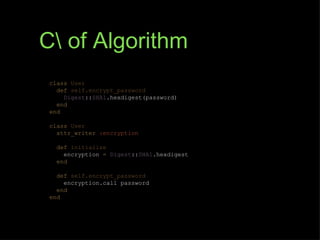
C of Algorithm
 class User
   def self.encrypt_password
     Digest::SHA1.hexdigest(password)
   end
 end

 class User
   attr_writer :encryption

   def initialize
     encryption = Digest::SHA1.hexdigest
   end

   def self.encrypt_password
     encryption.call password
   end
 end
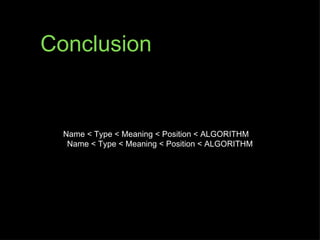
Conclusion


  Name < Type < Meaning < Position < ALGORITHM
   Name < Type < Meaning < Position < ALGORITHM
Thank you


 Questions? Opinions?

 ladislav.martincik@gmail.com
 martincik.com
            martincik.com
OOP - NEXT time
- Single responsibility principle
- Open/closed principle
- Liskov substitution principle
- Interface segregation principle
- Dependency inversion principle

Programming basics

  • 1.
    programming basics basics Ladislav Martincik
  • 2.
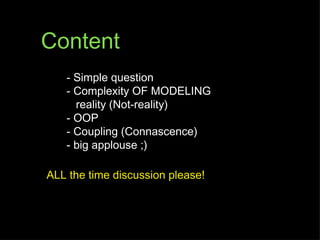
    Content - Simple question - Complexity OF MODELING reality (Not-reality) - OOP - Coupling (Connascence) - big applouse ;) ALL the time discussion please!
  • 3.
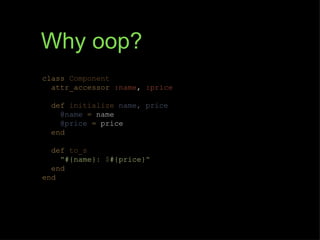
    Why oop? class Component attr_accessor :name, :price def initialize name, price @name = name @price = price end def to_s "#{name}: $#{price}" end end
  • 4.
    What is better? defpay(from, to, amount, rounding = 0.5) .... end def pay(transaction) .... end
  • 5.
    Holy OOP Keep “large”* software projects manageable by human programmers. * what is LARGE?
  • 6.
    Real Programming HUMAN to HUMAN ** Complexity our brain can handle 4/+-2 ** This is one of the reasons why we have high-level programming languages and not assembler.
  • 7.
    REal OOP Modeling basedon Real world experience and Mathematics - Modularization- Abstraction -- Understandability - Encapsulation -- Information Hiding- Composability -- Structured Design- Hierarchy- Continuity
  • 8.
    Modularization Decompose probleminto smaller subproblems that can be solved separately.
  • 9.
    Modularization class Component include PrintableComponent attr_reader :name, :price ... end module PrintableComponent def to_s "#{name}: $#{price}" end end
  • 10.
    Abstraction -- Understandability Terminologyof the problem domain is reflected in the software solution. Individual modules are understandable by human readers.
  • 11.
    Abstraction -- Understandability set:environment, :development set :user, :deploy desc "Deploy to production" task :deploy do scp :local, "deploy@#{server}/#{root_dir}" end
  • 12.
    Composability -- Structured Design Interfaces allow to freely combine modules to produce new systems.
  • 13.
    Composability -- Structured Design gem "bundler" plugins module Namespace module Namespace2 class X; end class Y < X; end end end
  • 14.
    Hierarchy class Component attr_reader :sub_components end class Car < Component def initialize(color, type) @sub_components << Wheel.new('left top') @sub_components << Door.new('left driver') end end
  • 15.
    Continuity Changes andmaintenance in only a few modules does not affect the architecture.
  • 16.
    Continuity DRY -Do not repeat yourself Coupling - ConNascence
  • 17.
    ConNascence Two software componentsare connascent if a change in one would require the other to be modified in order to maintain the overall correctness of the system. Connascence is a way to characterize and reason about certain types of complexity in software systems.
  • 18.
    ConNascence Strength - The strongerthe form of connascence, the more difficult, and costly, it is to change the elements in the relationship. Name < Type < Meaning < Position < ... Degree - The acceptability of connascence is related to the degree of its occurrence.def fun1(x1, x2) < def fun1(x1, x2, x3, x4, ...) Locality - Stronger forms of connascence are acceptable if the elements involved are closely related. - Stronger forms of connascence are acceptable if the elements involved are closely related. - Stronger forms of connascence are acceptable if the elements involved are closely related. - Stronger forms of connascence are acceptable if the elements involved are closely related. - Stronger forms of connascence are acceptable if the elements involved are closely related.
  • 19.
    C of Name def pay(from, to, amount, correction) transaction do from.move(to, amount, correction) end end
  • 20.
    C of TYPE def pay(transaction) if transaction.kind_of? Array DUCK TYPING transaction.each do |t| t.run end else transaction.run def pay(transaction) end if transaction.respond_to :each end transaction.each do |t| t.run end else transaction.run end def pay(transaction) end Array(transaction).each do |x| x.run end end
  • 21.
    C of MEANING classRole def can_access_admin?(role_id = 0) if role_id == 1 # Admin true elsif role_id == 2 # Ambassador true else false end class Role end ADMIN = 1; AMBASSADOR = 2 end def can_access_admin?(role_id = 0) if role_id == ADMIN true elsif role_id == AMBASSADOR true else false end end end
  • 22.
    C of Position defpay(from, to, amount, correction) .... end def pay(options = {}) .... end def pay(from, to, options = {}) ... end
  • 23.
    C of Algorithm class User def self.encrypt_password Digest::SHA1.hexdigest(password) end end class User attr_writer :encryption def initialize encryption = Digest::SHA1.hexdigest end def self.encrypt_password encryption.call password end end
  • 24.
    Conclusion Name< Type < Meaning < Position < ALGORITHM Name < Type < Meaning < Position < ALGORITHM
  • 25.
    Thank you Questions?Opinions? ladislav.martincik@gmail.com martincik.com martincik.com
  • 26.
    OOP - NEXTtime - Single responsibility principle - Open/closed principle - Liskov substitution principle - Interface segregation principle - Dependency inversion principle