Program Evaluation

                            Short self-completion
                            questionnaire


www.environmetrics.com.au
1. Use / participation


Is this the first time you have been to <program>.

   Useful to compare first time vs. repeats/regulars.


How often have you used/attended <program> in the past
  <time>?


                                                         2
2. Rating – 5-point scale

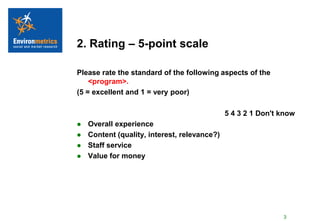
Please rate the standard of the following aspects of the
    <program>.
(5 = excellent and 1 = very poor)

                                              5 4 3 2 1 Don't know
   Overall experience
   Content (quality, interest, relevance?)
   Staff service
   Value for money


                                                              3
2. Net Promoter Score
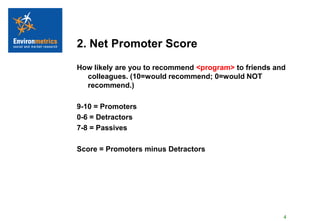
How likely are you to recommend <program> to friends and
  colleagues. (10=would recommend; 0=would NOT
  recommend.)

9-10 = Promoters
0-6 = Detractors
7-8 = Passives

Score = Promoters minus Detractors


                                                       4
3. KPIs / outcomes
Now, exploring your perceptions of <program> , please say TO
  WHAT EXTENT it does the following things.

High extent; Moderate extent; Little extent; Not at all; Don't know

   Gives access to information and ideas relevant to
    contemporary society
   Runs programs that encourage creative activities for adults
    and children
   Has made a positive difference to my life
   Makes everyone feel welcome
   Has a wide diversity of different programs and activities


                                                             5
4. Open comment


   Any comments?
   Any suggestions?


                       6
Demographics
   Age
   Gender
   Local/out of area
   Member


                        7
Prepared by Gillian Savage, Environmetrics.
Phone: 0412 928 302
Email: gillian@environmetrics.com.au
19 September 2012


                                              8

Program Evaluation

  • 1.
    Program Evaluation Short self-completion questionnaire www.environmetrics.com.au
  • 2.
    1. Use /participation Is this the first time you have been to <program>.  Useful to compare first time vs. repeats/regulars. How often have you used/attended <program> in the past <time>? 2
  • 3.
    2. Rating –5-point scale Please rate the standard of the following aspects of the <program>. (5 = excellent and 1 = very poor) 5 4 3 2 1 Don't know  Overall experience  Content (quality, interest, relevance?)  Staff service  Value for money 3
  • 4.
    2. Net PromoterScore How likely are you to recommend <program> to friends and colleagues. (10=would recommend; 0=would NOT recommend.) 9-10 = Promoters 0-6 = Detractors 7-8 = Passives Score = Promoters minus Detractors 4
  • 5.
    3. KPIs /outcomes Now, exploring your perceptions of <program> , please say TO WHAT EXTENT it does the following things. High extent; Moderate extent; Little extent; Not at all; Don't know  Gives access to information and ideas relevant to contemporary society  Runs programs that encourage creative activities for adults and children  Has made a positive difference to my life  Makes everyone feel welcome  Has a wide diversity of different programs and activities 5
  • 6.
    4. Open comment  Any comments?  Any suggestions? 6
  • 7.
    Demographics  Age  Gender  Local/out of area  Member 7
  • 8.
    Prepared by GillianSavage, Environmetrics. Phone: 0412 928 302 Email: gillian@environmetrics.com.au 19 September 2012 8

Editor's Notes

  • #2 This snapshot outlines a short questionnaire for evaluating any public program. The questionnaire has five parts.
  • #3 It is helpful to separate first time users from repeat users. The experience of first time users is very different from repeat users. It also give you an idea about customer loyalty and repeat ‘purchasers’. You can ask a second question about frequency of use if this is important to you.
  • #4 The rating scale should be near the front of the survey. The 5-point scale is the standard scale used in Australian museums and it will allow you to compare information with other institutions. Always use the same scale so you can compare results across the years. Ask the rating for “overall experience”. You can also add specific aspects that you want to track. Stick to a maximum of five items. Offer the ‘Don’t know’ option – not everyone will know about every item, e.g. they may not know the cost if they didn’t buy the ticket.
  • #5 The Net Promoter Score (NPS) is another way to measure the overall experience. There are published benchmarks that you can use to compare your performance. It’s a good top-level indicator.
  • #6 Use this question to get measures on how well your program achieved its stated goals. This is good discipline because it means that you are likely to clarify your desired outcomes at the beginning of the program and not get too distracted from them. The items shown here are examples from a recent program I evaluated, you will have different items. Keep it short and use a maximum of 5 items – you don’t need to comprehensively measure every single one.This 4-point scale means that people can’t sit on the fence and so clarifies positive/negative views. You could use the same 5-point scale as the overall rating, if you like.
  • #7 Every survey should have an area for open comments. You can phrase the invitation to comment in several ways. You can allow two boxes – one for positive comments and one for suggested improvements. It’s up to you.
  • #8 A few demographics will help you describe your audiences. These four are probably sufficient for most occasions.
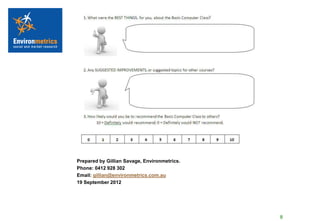
  • #9 This self-completion survey can be offered as a paper survey at the end of the program, or it can be put online and sent to participants by email. The paper survey should be no more than one double-sided A4 page. Clear layout and contemporary graphics will make the survey friendly and encourage quality responses.