Museum Research Methods MUSM7034 Semester 1 2009 Session 4.2 Observation methods www.arts.usyd.edu.au/departs/museum http://musm7034.ning.com/
How do people use the space?  What behaviours are encouraged? Are there congestion points? How are things used? Seating, introductory framing. Are there dead spots? How does the space work during busy periods? Do some features encourage social learning? What features/displays are used most? Questions
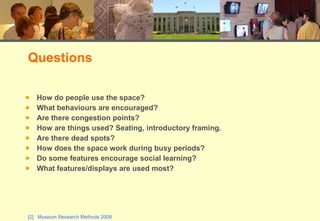
General Value Principle Desire Lines Hubs and cluster points Concepts
Attracting power – proportion who engage with the display Strongly influenced by location on main pathways Holding power – length of time spent at display Attracting & Holding Score  = average holding power x percent who looked Concepts
Tracking Counting / timing Behaviours Observation methods
Follow visitors and mark their path on a floor plan Record gender, age, visiting group, kids/no kids Record start time and finish time Mark path, stopping places and time spent Use a new map for each person Summarise data by showing main pathways Tracking
Choose displays/activities you want to focus on Select specific blocks of time (e.g. 1 hour) Count the number of people who attend to the display/activity and how long they spend doing it Counting and timing


Behaviours that suggest engagement Walking toward Looking, reading Behaviours that suggest learning (Janette Griffin) Looking, reading Pointing, talking (social learning) Returning (synthesise, reflect, question) Attend to distance (looking near and far) Noting behaviours
Specify the learning outcome  Nominate behaviours required to achieve this outcome Observe behaviours  Example: ‘Marvellous Molecules’ p17. Defined behaviours

Museum research methods

  • 1.
    Museum Research MethodsMUSM7034 Semester 1 2009 Session 4.2 Observation methods www.arts.usyd.edu.au/departs/museum http://musm7034.ning.com/
  • 2.
    How do peopleuse the space? What behaviours are encouraged? Are there congestion points? How are things used? Seating, introductory framing. Are there dead spots? How does the space work during busy periods? Do some features encourage social learning? What features/displays are used most? Questions
  • 3.
    General Value PrincipleDesire Lines Hubs and cluster points Concepts
  • 4.
    Attracting power –proportion who engage with the display Strongly influenced by location on main pathways Holding power – length of time spent at display Attracting & Holding Score = average holding power x percent who looked Concepts
  • 5.
    Tracking Counting /timing Behaviours Observation methods
  • 6.
    Follow visitors andmark their path on a floor plan Record gender, age, visiting group, kids/no kids Record start time and finish time Mark path, stopping places and time spent Use a new map for each person Summarise data by showing main pathways Tracking
  • 7.
    Choose displays/activities youwant to focus on Select specific blocks of time (e.g. 1 hour) Count the number of people who attend to the display/activity and how long they spend doing it Counting and timing
  • 8.
  • 9.
  • 10.
  • 11.
    Behaviours that suggestengagement Walking toward Looking, reading Behaviours that suggest learning (Janette Griffin) Looking, reading Pointing, talking (social learning) Returning (synthesise, reflect, question) Attend to distance (looking near and far) Noting behaviours
  • 12.
    Specify the learningoutcome Nominate behaviours required to achieve this outcome Observe behaviours Example: ‘Marvellous Molecules’ p17. Defined behaviours