HOW SMART,
CONNECTED
PRODUCTS
ARE
TRANSFORMI
NG
COMPETITION
PRESENTED BY –
• ABHISHEK ARORA
• BIPLAB BHATTACHARJEE
• ROHIT KULKARNI
• SOUMYA BANDYOPADHYAY
AGENDA
• INTRODUCTION TO SMART, CONNECTED PRODUCTS
• DRIVERS FOR THE ADVENT OF SMART DEVICES
• REDIFINING INDUSTRY BOUNDRIES AND COMPETITION
• IoT TO IOT
• STRATEGY FOR SUSTAINABLE COMPETITIVE ADVANTAGE
• Q&A
• REFERENCES
A PEEK INTO THE
FUTURE…
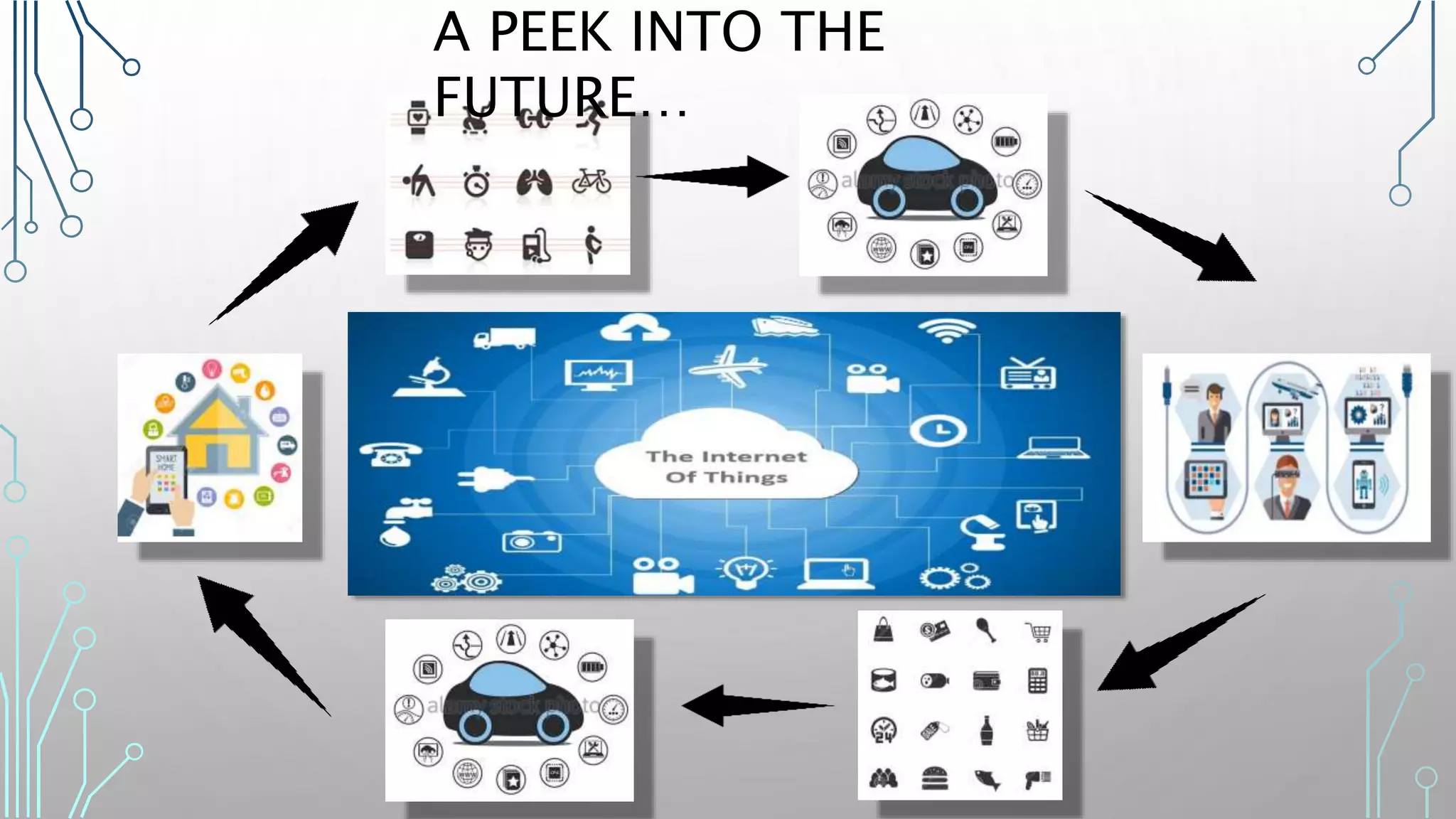
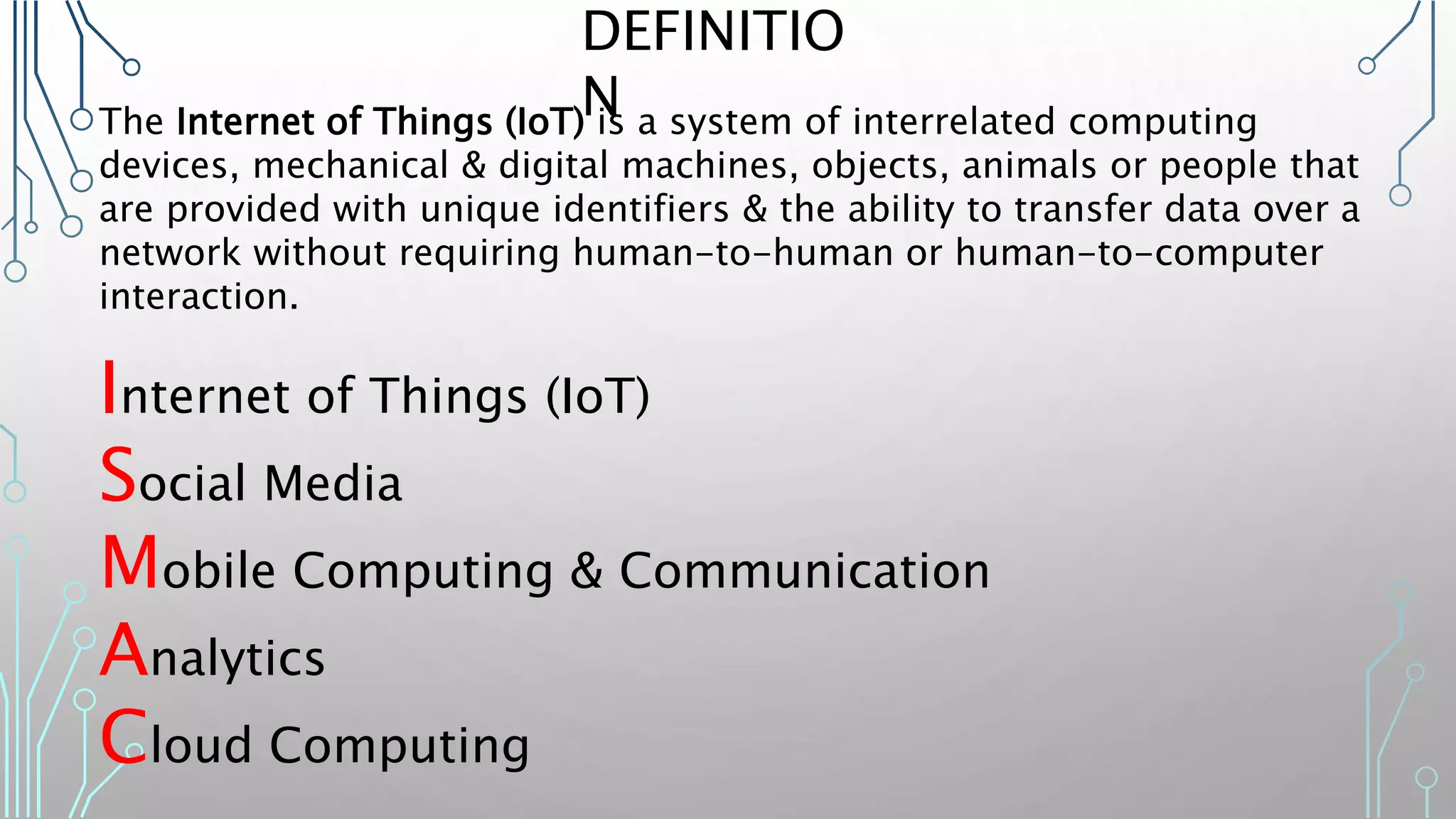
The Internet of Things (IoT) is a system of interrelated computing
devices, mechanical & digital machines, objects, animals or people that
are provided with unique identifiers & the ability to transfer data over a
network without requiring human-to-human or human-to-computer
interaction.
Internet of Things (IoT)
Social Media
Mobile Computing & Communication
Analytics
Cloud Computing
DEFINITIO
N
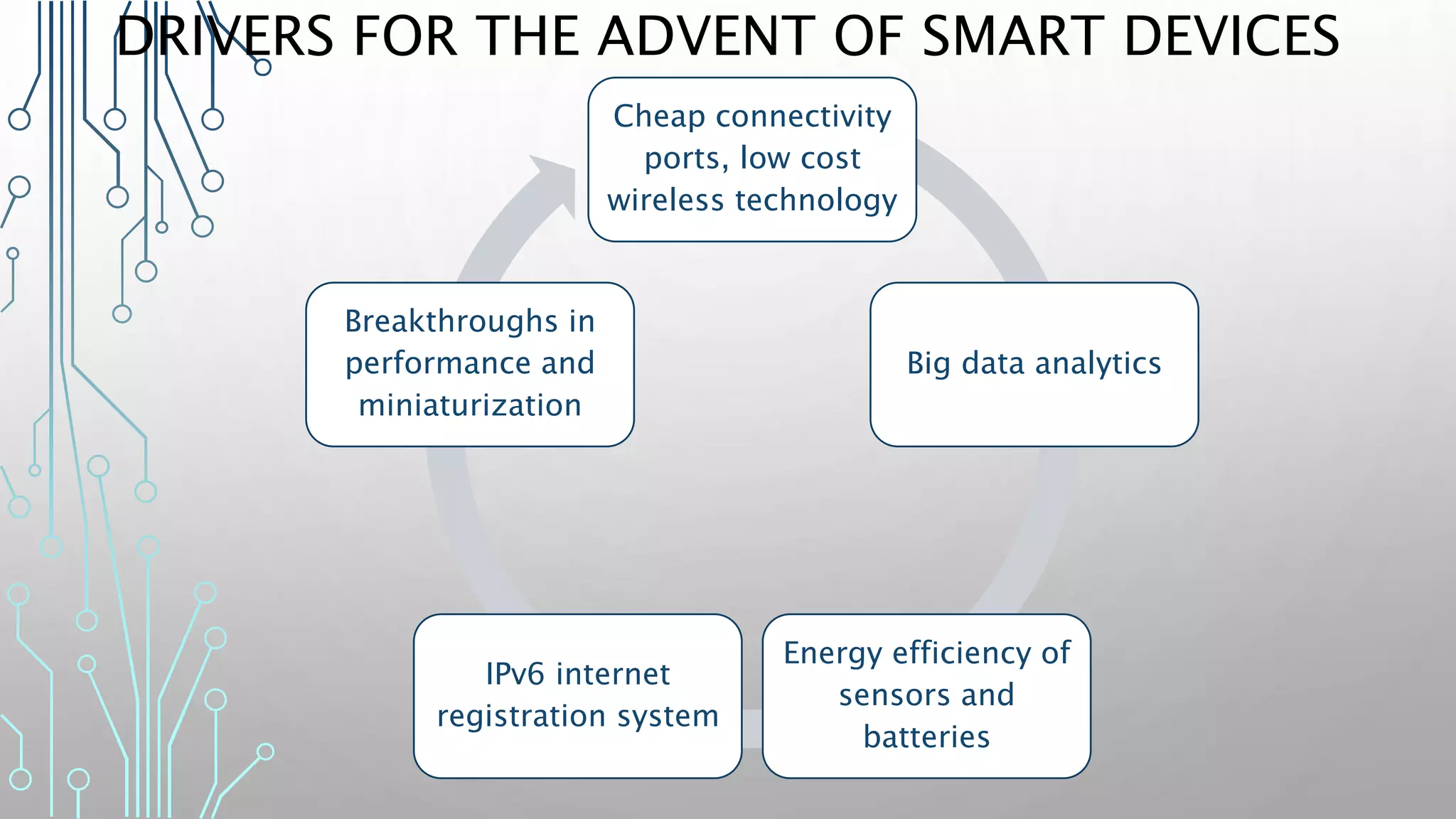
DRIVERS FOR THE ADVENT OF SMART DEVICES
Cheap connectivity
ports, low cost
wireless technology
Big data analytics
Energy efficiency of
sensors and
batteries
IPv6 internet
registration system
Breakthroughs in
performance and
miniaturization
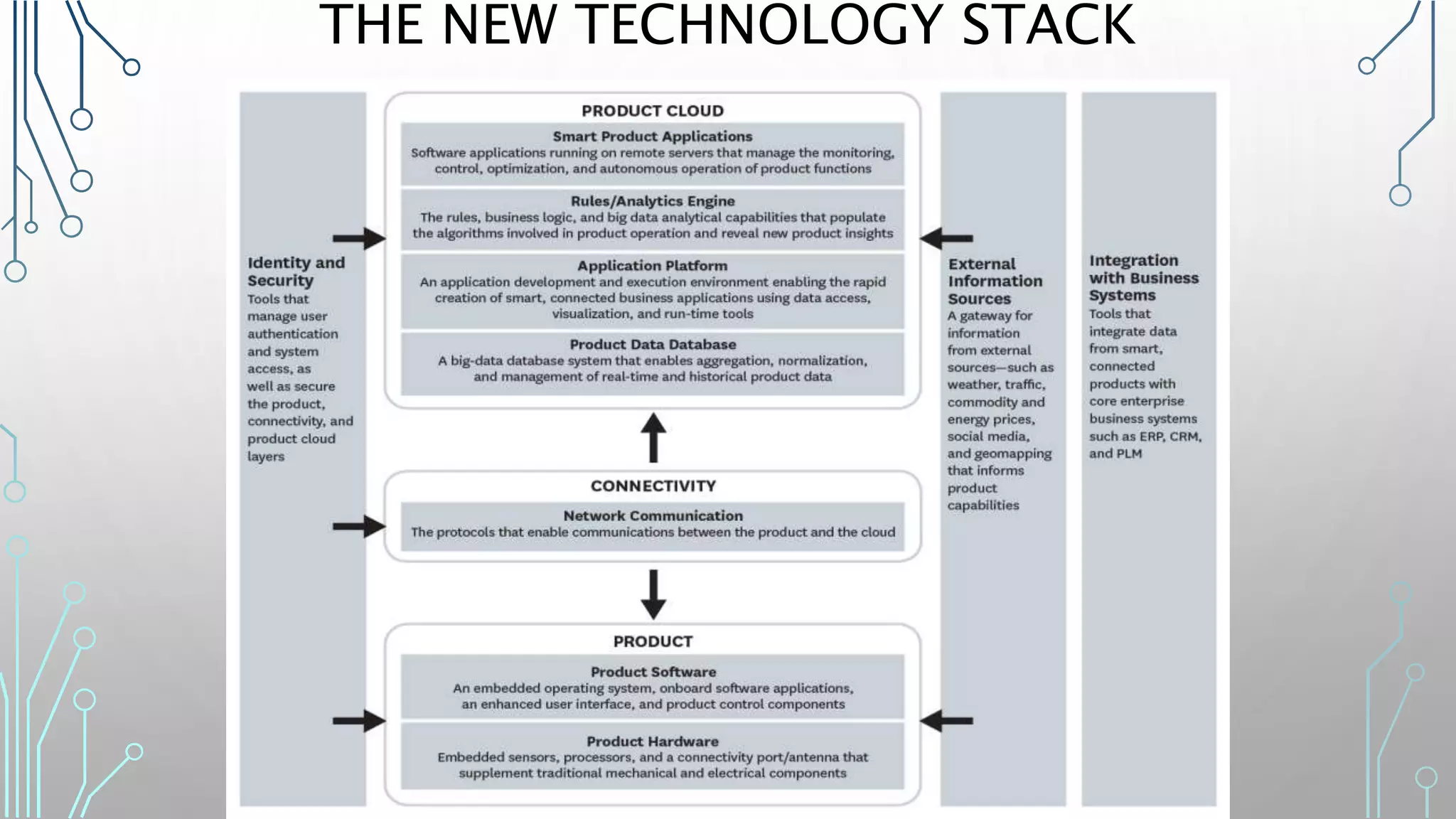
THE NEW TECHNOLOGY STACK
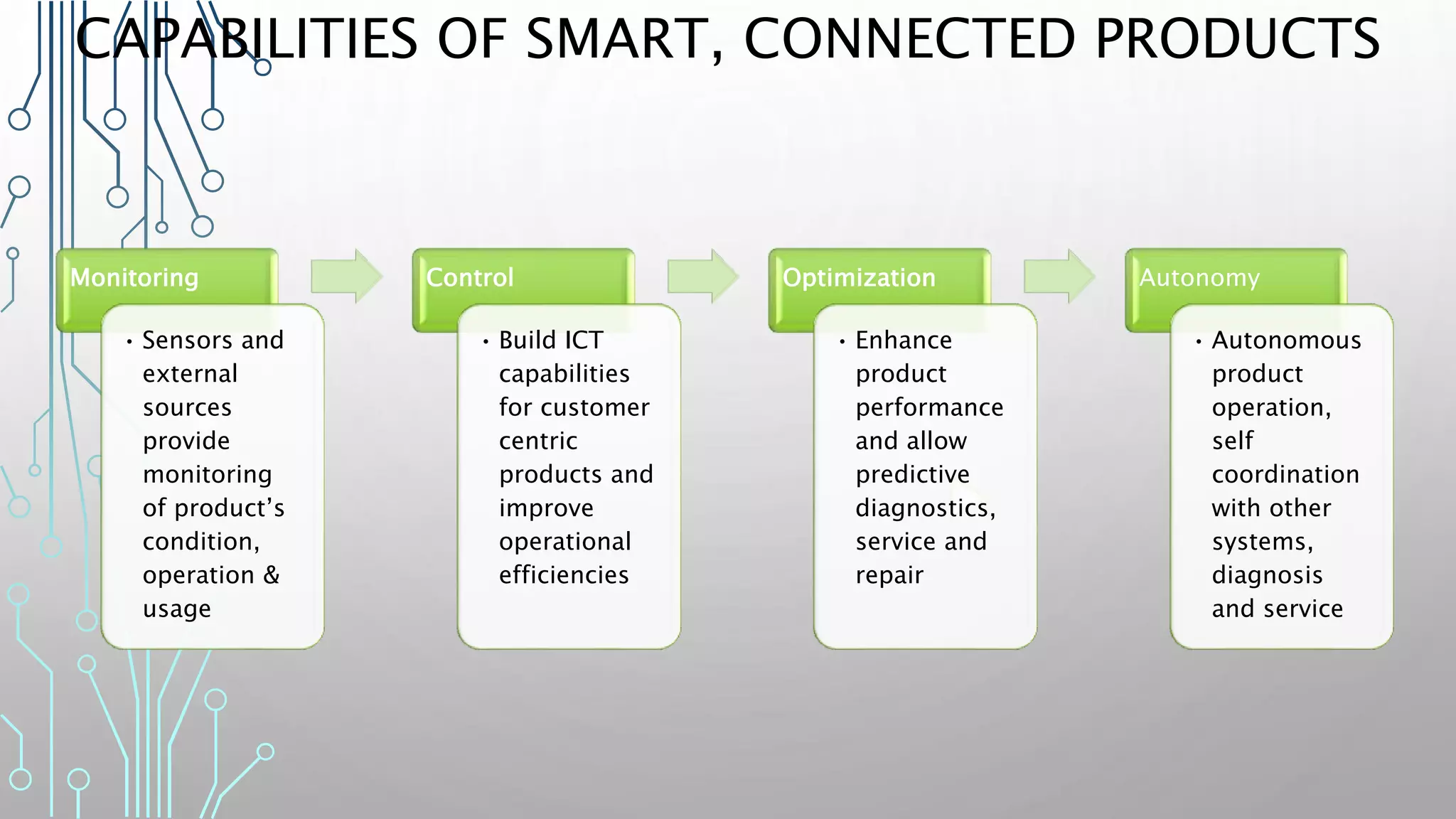
CAPABILITIES OF SMART, CONNECTED PRODUCTS
Monitoring
• Sensors and
external
sources
provide
monitoring
of product’s
condition,
operation &
usage
Control
• Build ICT
capabilities
for customer
centric
products and
improve
operational
efficiencies
Optimization
• Enhance
product
performance
and allow
predictive
diagnostics,
service and
repair
Autonomy
• Autonomous
product
operation,
self
coordination
with other
systems,
diagnosis
and service
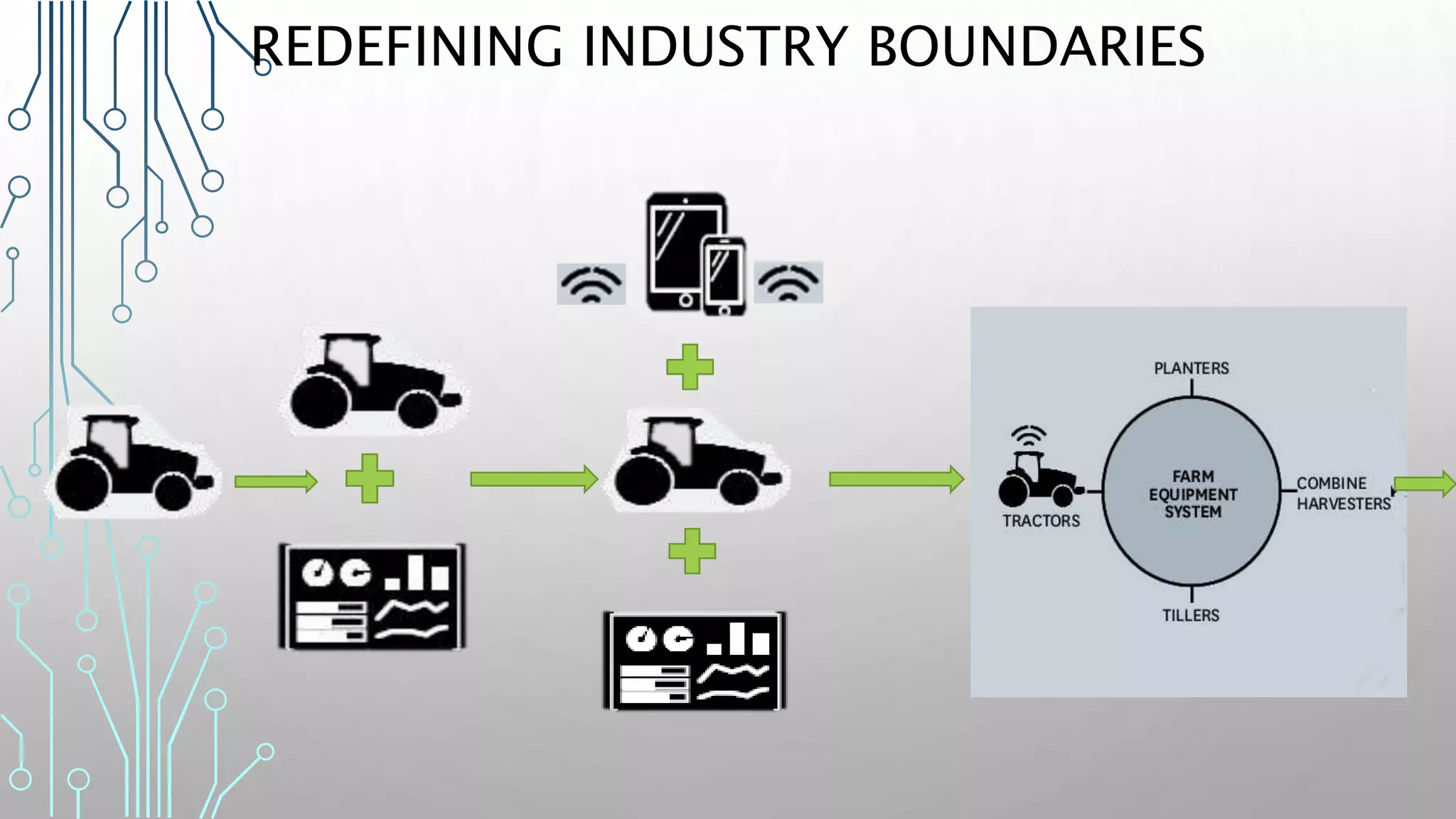
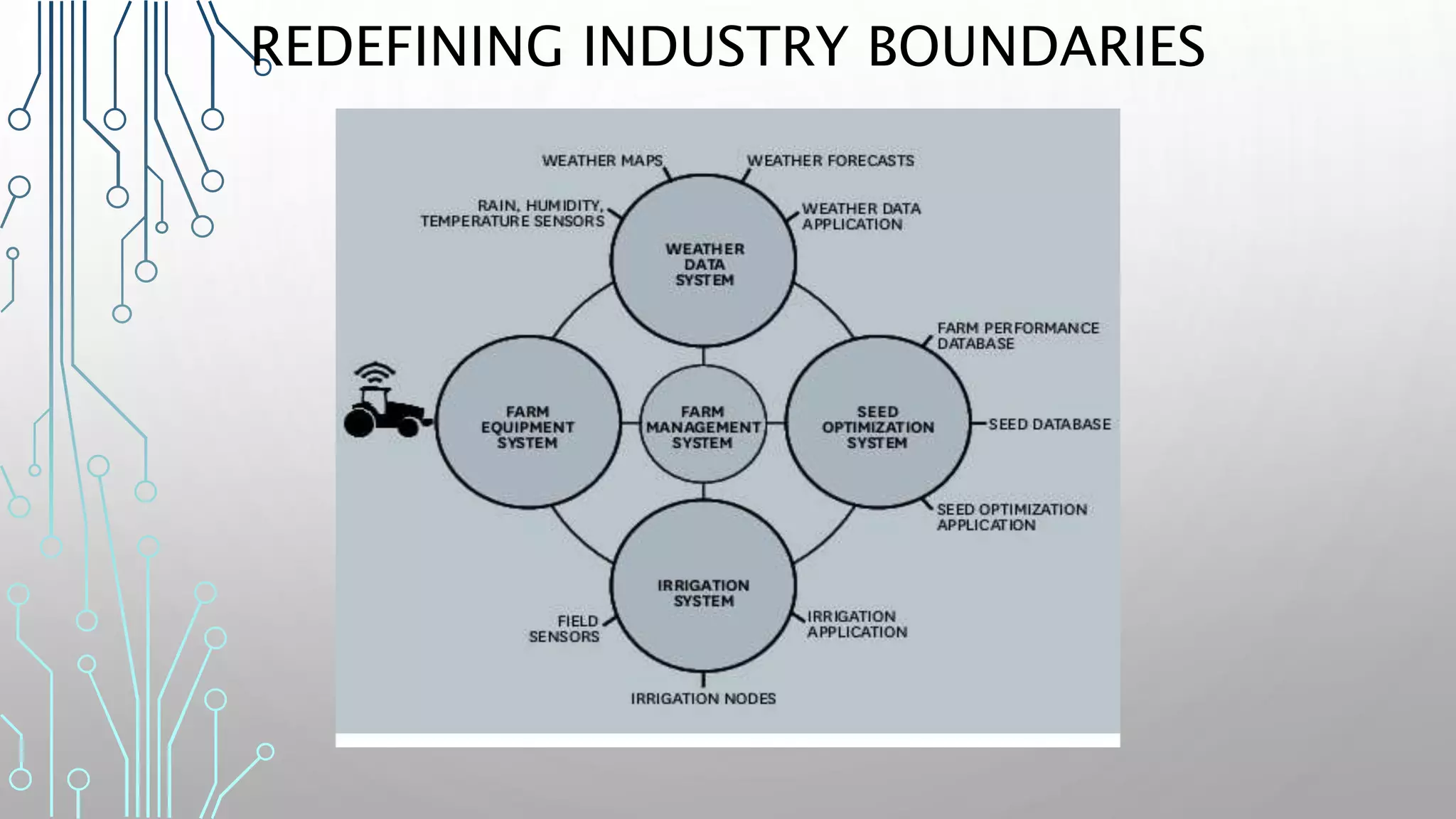
REDEFINING INDUSTRY BOUNDARIES
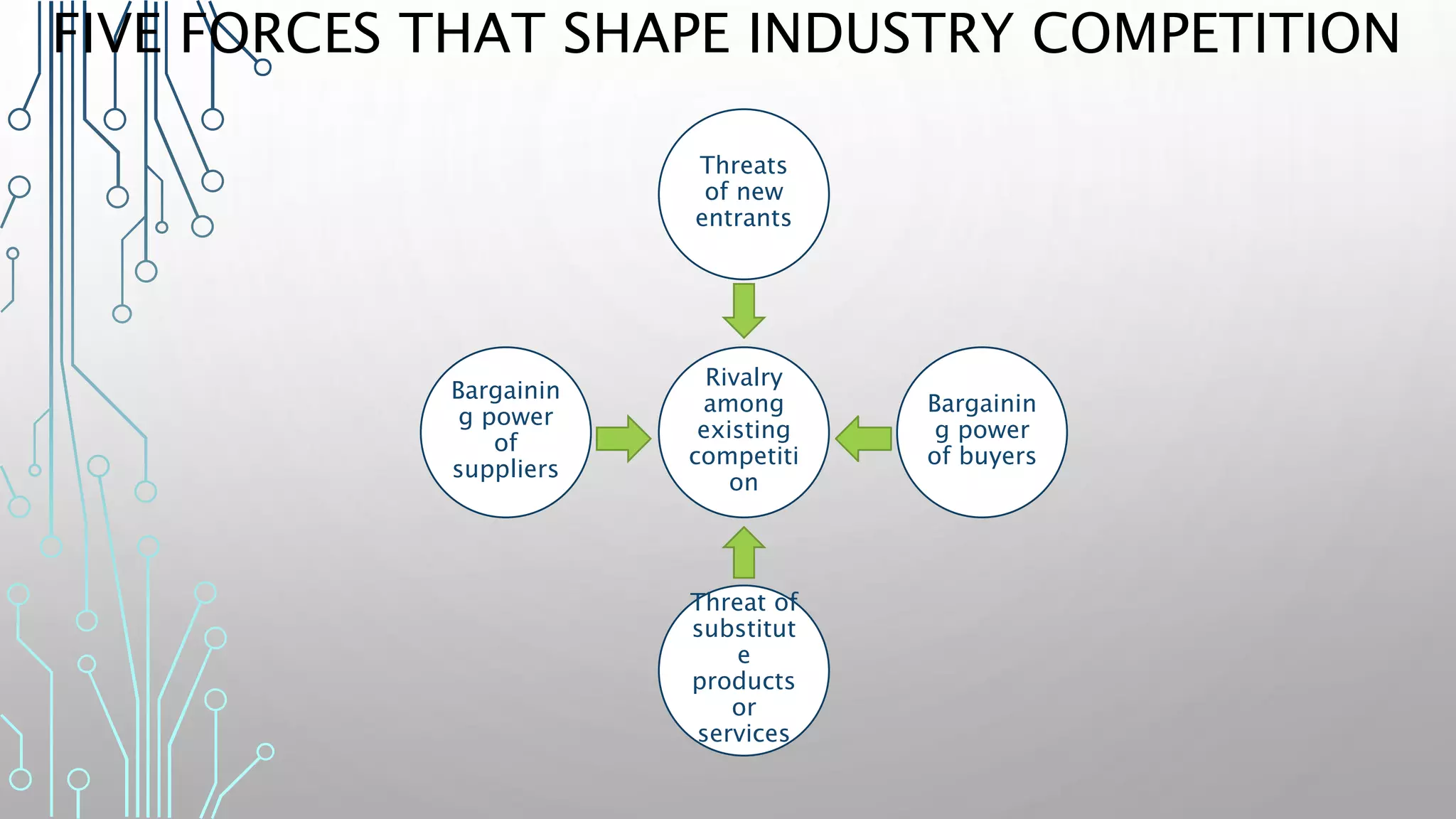
FIVE FORCES THAT SHAPE INDUSTRY COMPETITION
Rivalry
among
existing
competiti
on
Threats
of new
entrants
Bargainin
g power
of buyers
Threat of
substitut
e
products
or
services
Bargainin
g power
of
suppliers
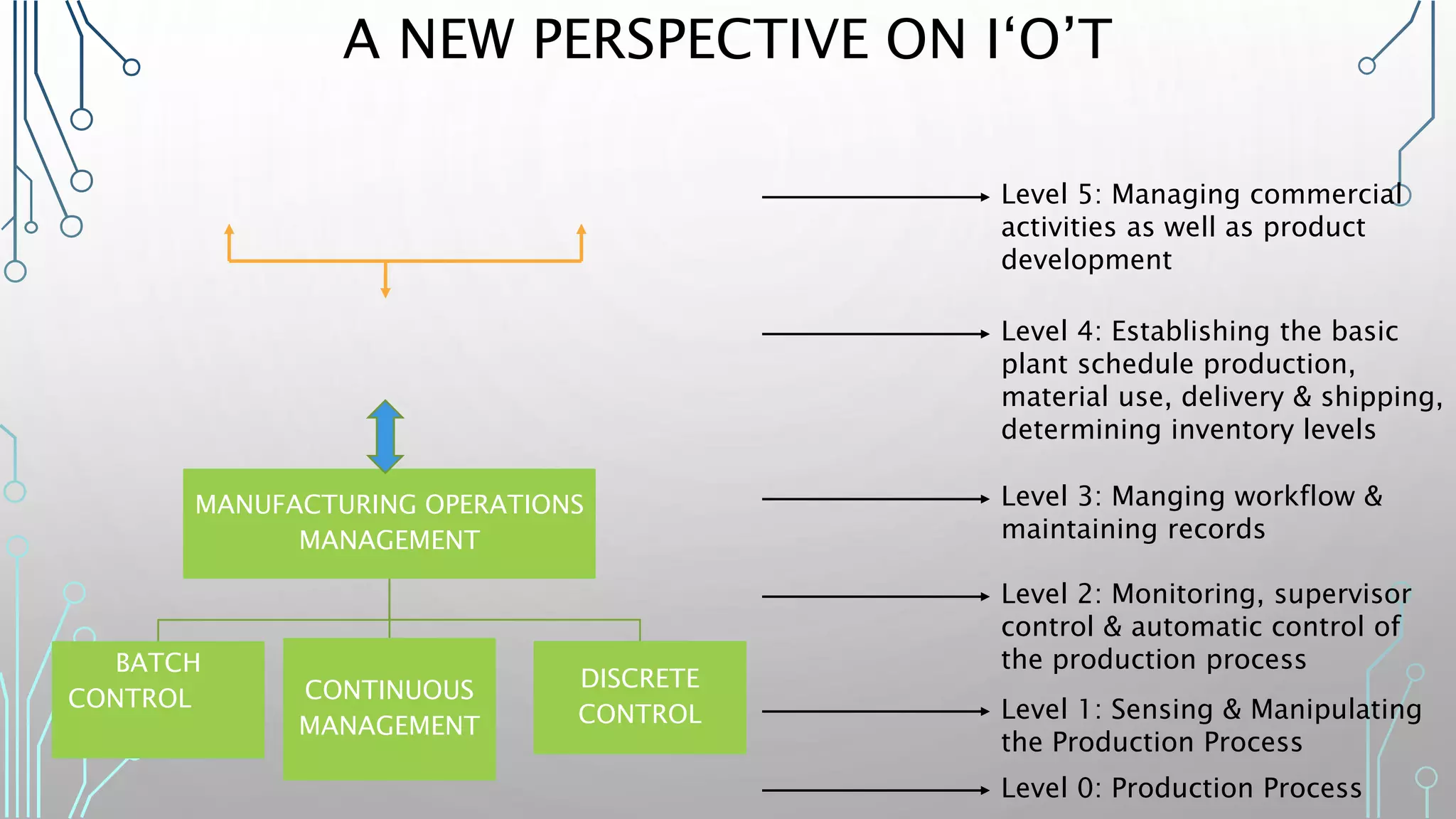
MANUFACTURING OPERATIONS
MANAGEMENT
BATCH
CONTROL CONTINUOUS
MANAGEMENT
DISCRETE
CONTROL
A NEW PERSPECTIVE ON I‘O’T
Level 0: Production Process
Level 1: Sensing & Manipulating
the Production Process
Level 2: Monitoring, supervisor
control & automatic control of
the production process
Level 3: Manging workflow &
maintaining records
Level 4: Establishing the basic
plant schedule production,
material use, delivery & shipping,
determining inventory levels
Level 5: Managing commercial
activities as well as product
development
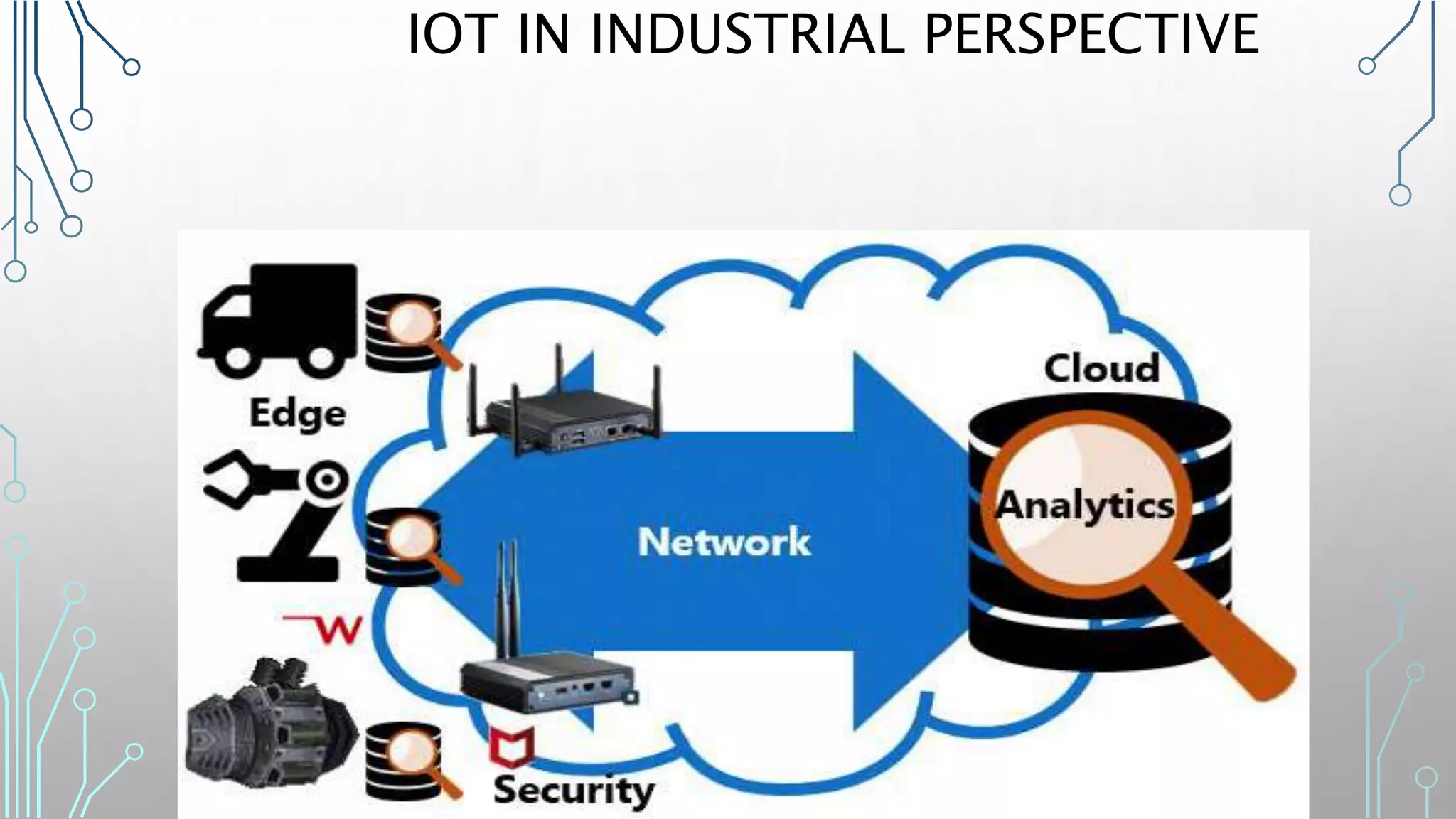
IOT IN INDUSTRIAL PERSPECTIVE
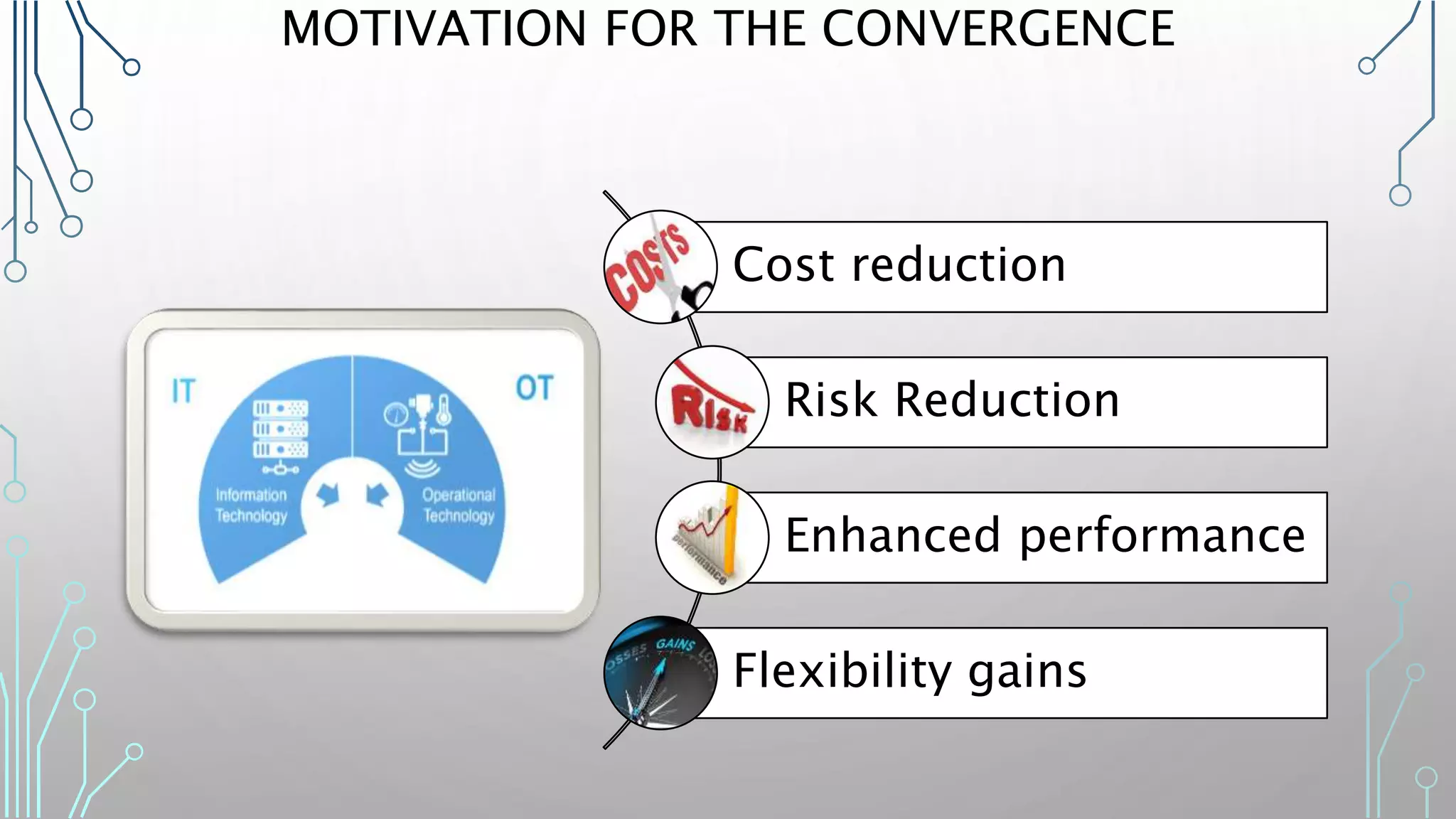
MOTIVATION FOR THE CONVERGENCE
Cost reduction
Risk Reduction
Enhanced performance
Flexibility gains
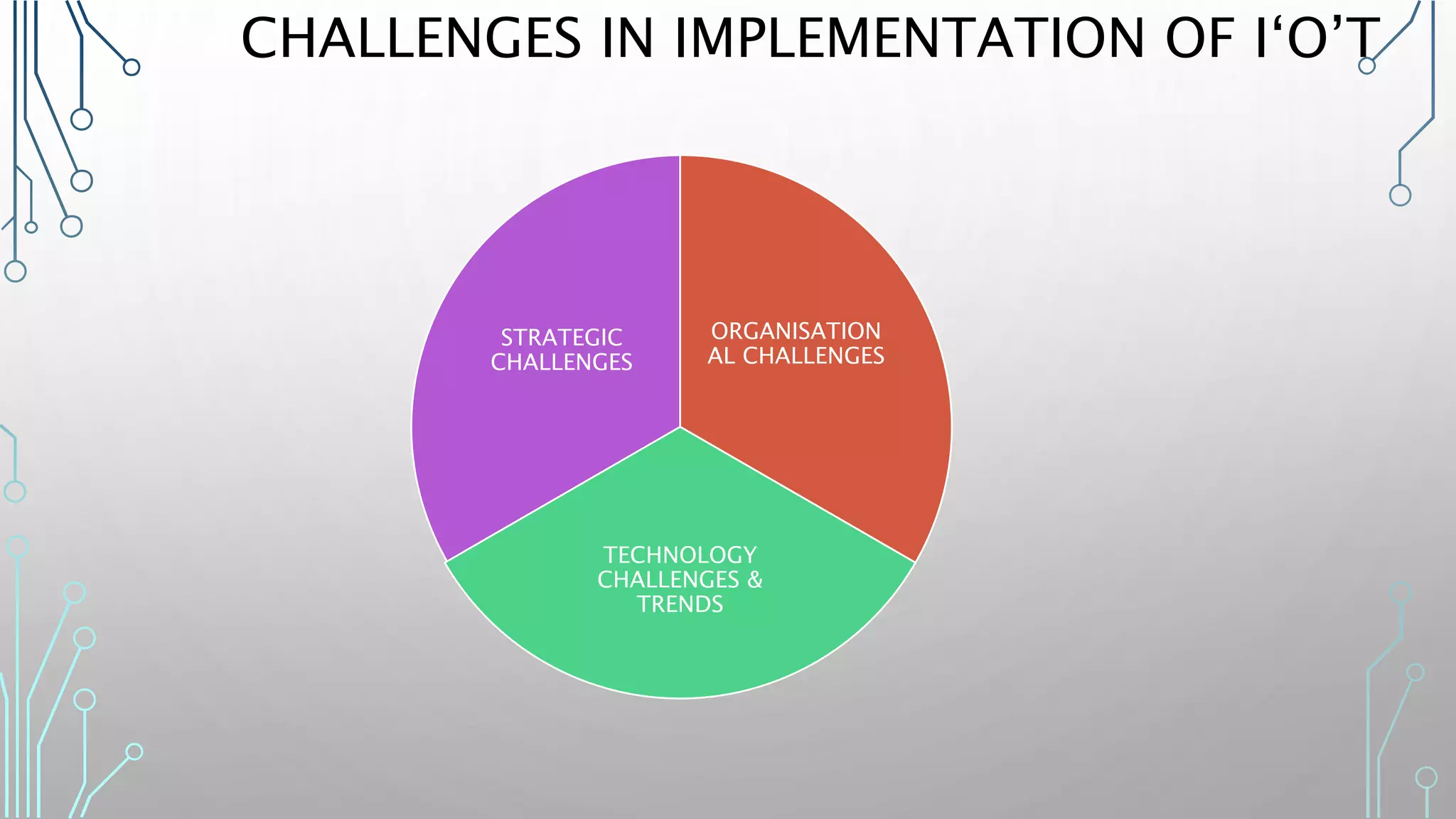
CHALLENGES IN IMPLEMENTATION OF I‘O’T
STRATEGIC
CHALLENGES
ORGANISATION
AL CHALLENGES
TECHNOLOGY
CHALLENGES &
TRENDS
CONVERGENCE
STRATEGIES
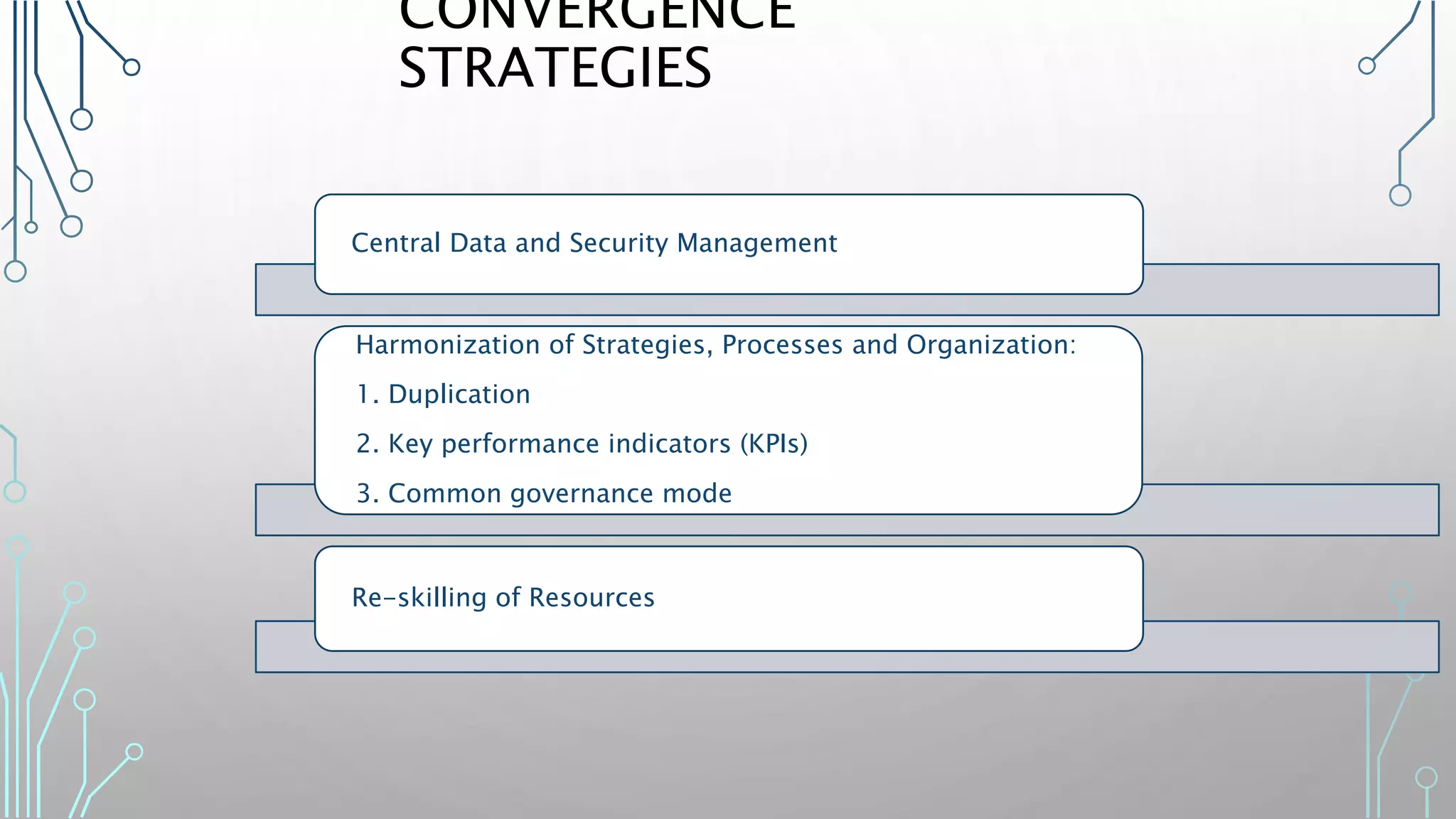
Central Data and Security Management
Harmonization of Strategies, Processes and Organization:
1. Duplication
2. Key performance indicators (KPIs)
3. Common governance mode
Re-skilling of Resources
IMPLEMENTATION
OPPORTUNITIES
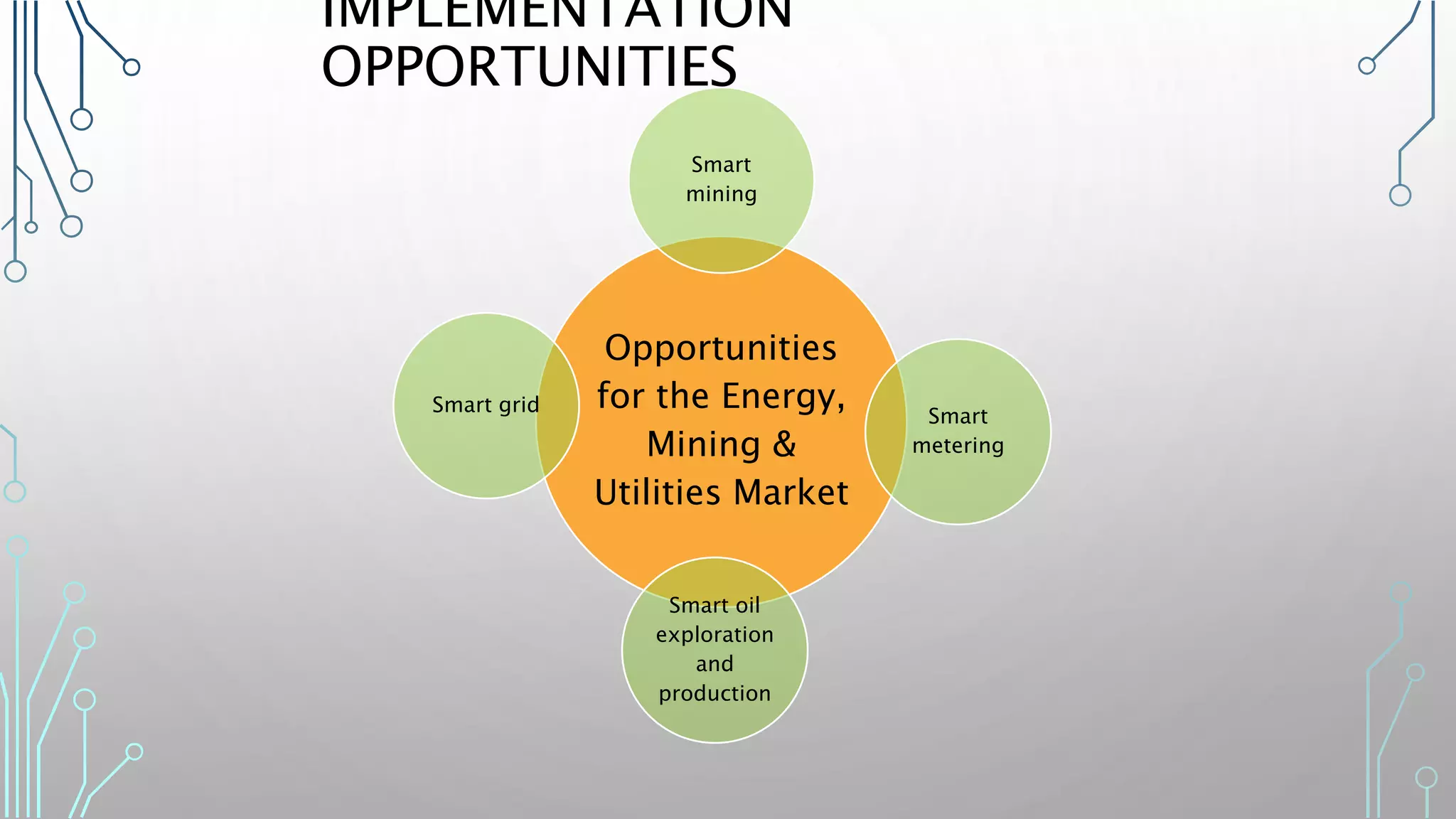
Opportunities
for the Energy,
Mining &
Utilities Market
Smart
mining
Smart
metering
Smart oil
exploration
and
production
Smart grid
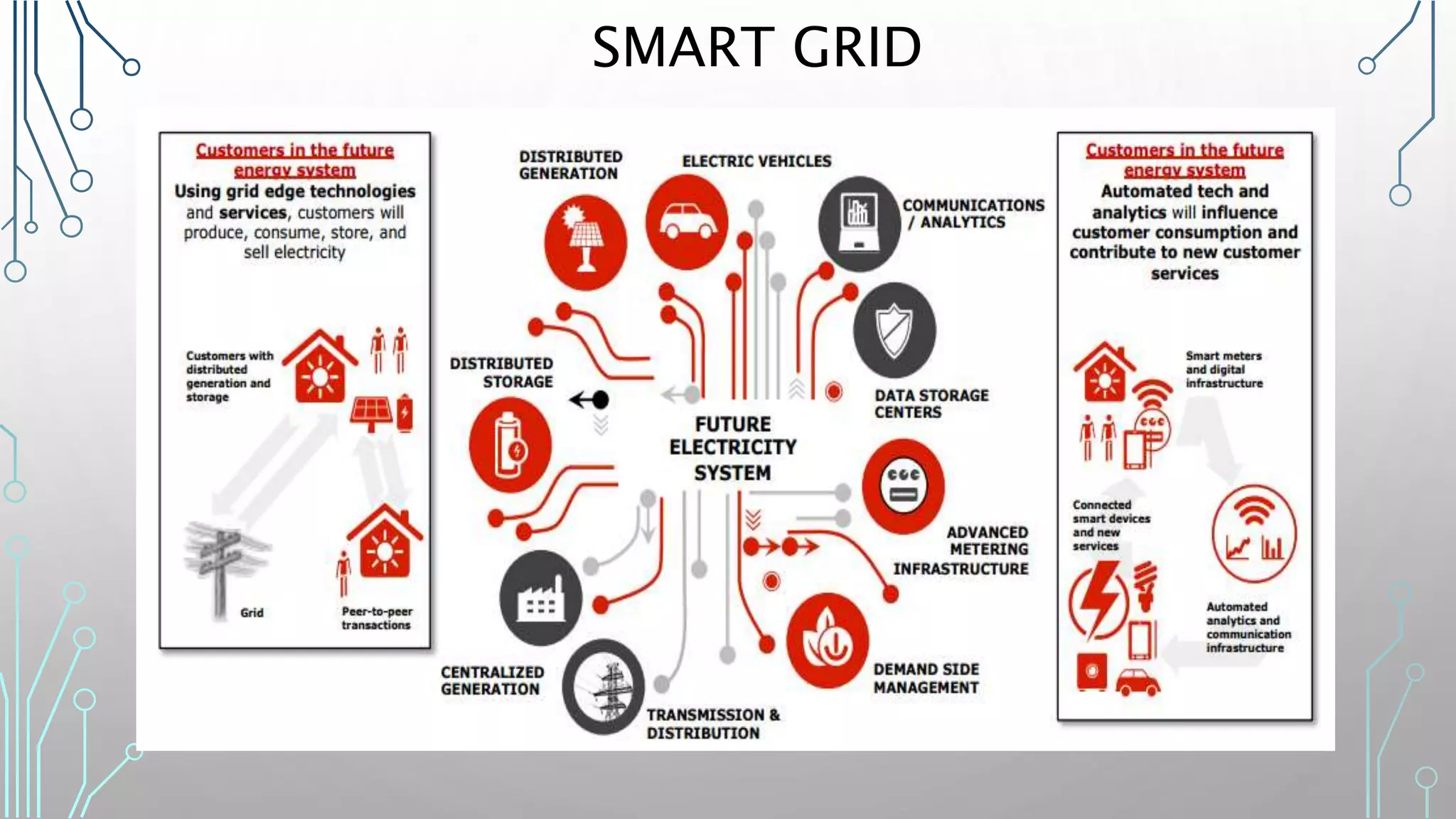
SMART GRID
• “The Internet will disappear… you won’t even sense it, it will be part of
your presence all the time.”— Eric Schmidt, Google chairman
• “If you think that internet has changed your life, think again. The IoT is
about to change it all over again!” — Brendan O’Brien, Co-Founder, Aria
Systems
• “The IoT will augment your brain” — Eric Schmidt, Google chairman
• “IoT is changing & transforming everything from business to life”— Mehul
Nayak, Tech.co
• “IoT is bringing more and more things into the digital fold every day,
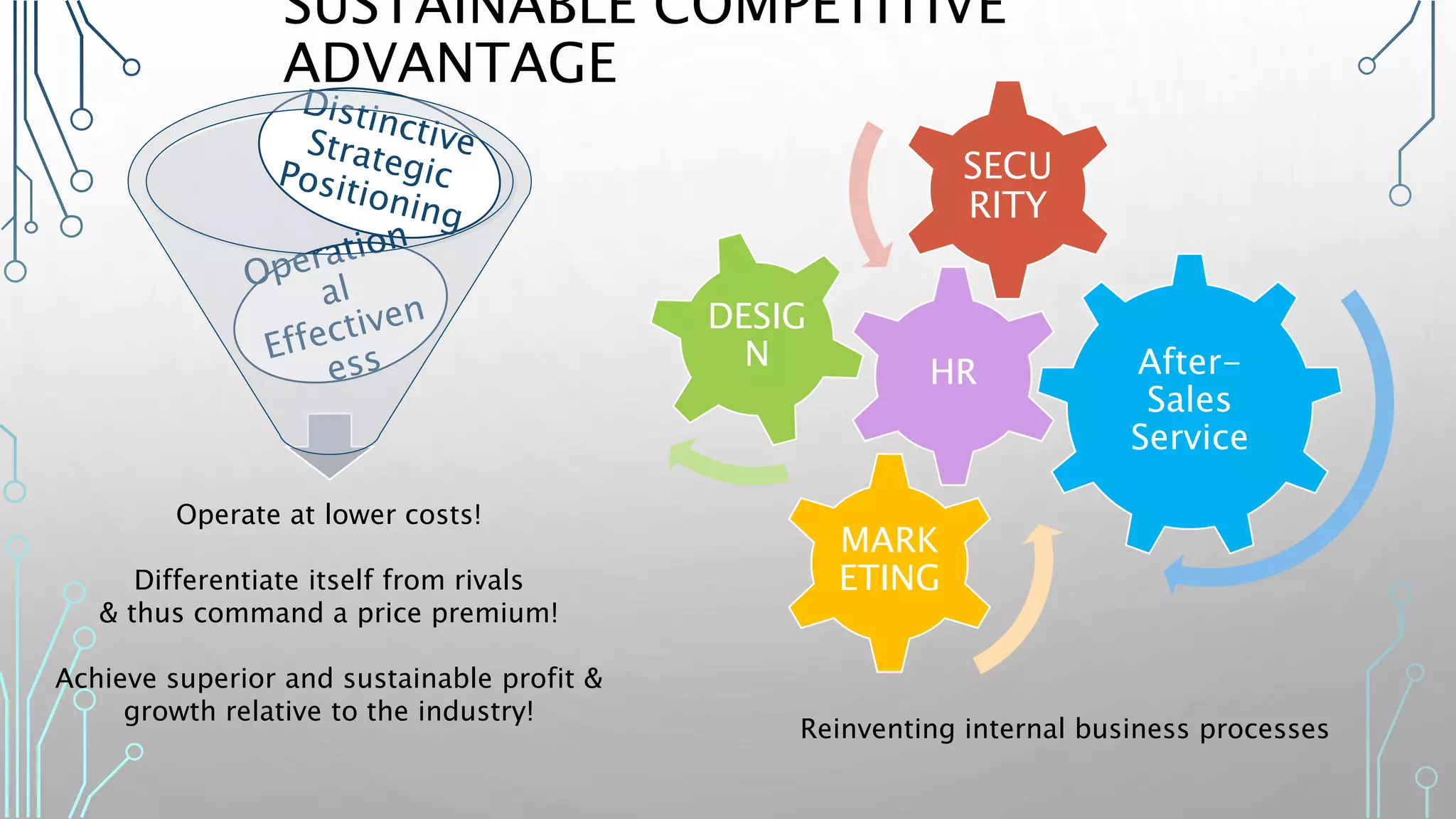
SUSTAINABLE COMPETITIVE
ADVANTAGE
After-
Sales
Service
MARK
ETING
DESIG
N
HR
SECU
RITY
Operate at lower costs!
Differentiate itself from rivals
& thus command a price premium!
Achieve superior and sustainable profit &
growth relative to the industry!
Reinventing internal business processes
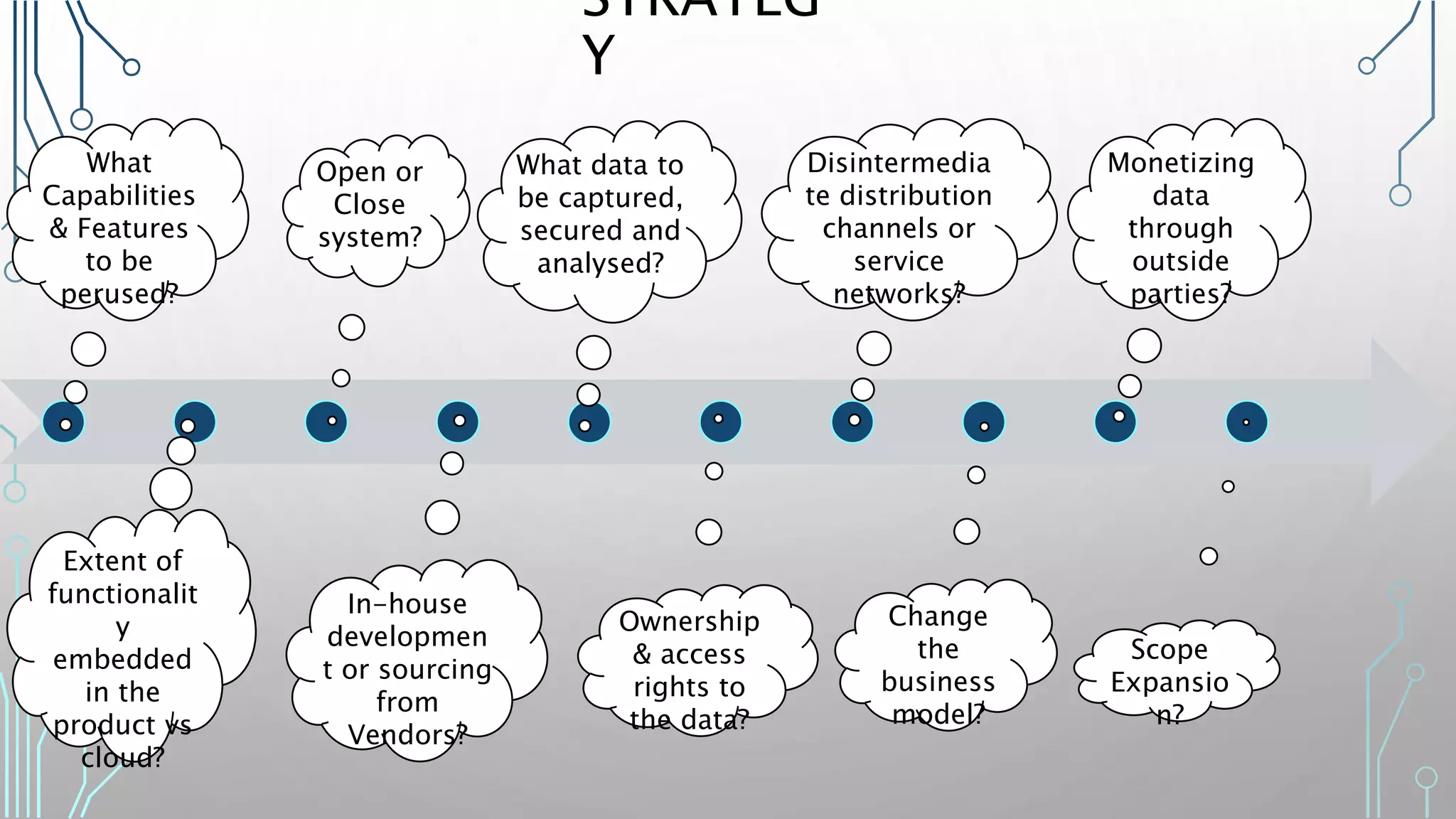
What
Capabilities
& Features
to be
perused?
Extent of
functionalit
y
embedded
in the
product vs
cloud?
Open or
Close
system?
In-house
developmen
t or sourcing
from
Vendors?
What data to
be captured,
secured and
analysed?
Ownership
& access
rights to
the data?
Disintermedia
te distribution
channels or
service
networks?
Change
the
business
model?
Monetizing
data
through
outside
parties?
Scope
Expansio
n?
STRATEG
Y
EXAMPL
ES
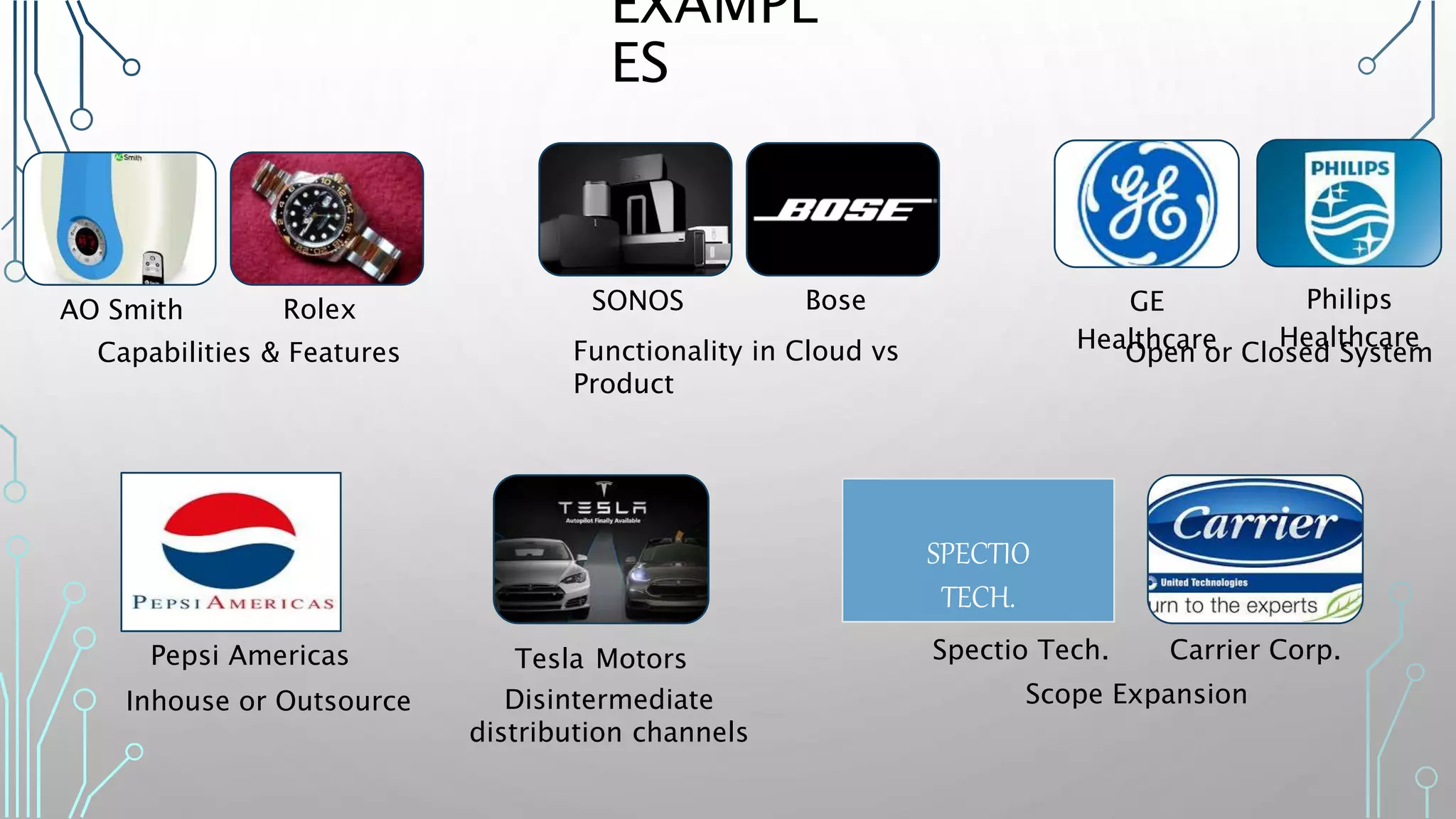
AO Smith Rolex GE
Healthcare
Philips
Healthcare
Tesla Motors
Capabilities & Features Open or Closed System
Disintermediate
distribution channels
SONOS Bose
Functionality in Cloud vs
Product
Carrier Corp.
Scope Expansion
SPECTIO
TECH.
Spectio Tech.
Inhouse or Outsource
Pepsi Americas
CHALLENGES…..
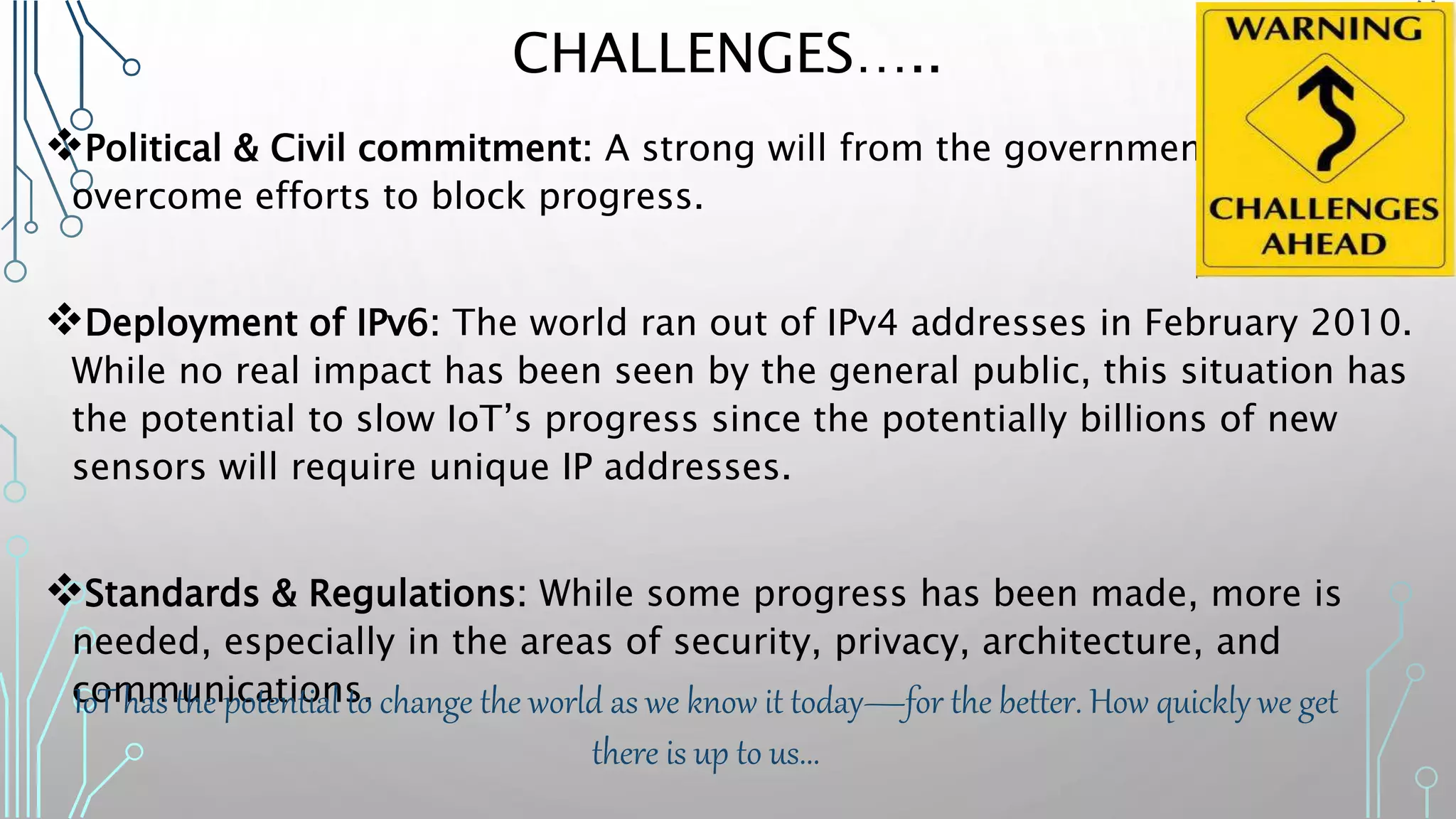
Political & Civil commitment: A strong will from the government & public to
overcome efforts to block progress.
Deployment of IPv6: The world ran out of IPv4 addresses in February 2010.
While no real impact has been seen by the general public, this situation has
the potential to slow IoT’s progress since the potentially billions of new
sensors will require unique IP addresses.
Standards & Regulations: While some progress has been made, more is
needed, especially in the areas of security, privacy, architecture, and
communications.IoT has the potential to change the world as we know it today—for the better. How quickly we get
there is up to us...
QUESTION
S?
THANKYO
U!!!
REFERENC
ES
How smart, connected products are transforming competition, Michael
E. Porter & James E. Heppelmann, HBR Article No. R1411C, Nov 2014.
“The Internet of Things (IoT): Applications, investments, and challenges
for enterprises”, I. Lee, K. Lee, Business Horizons (2015) 58, pp. 431-
440, Kelly School of Business.
“Spectio: A Digital Lighting Company”, Rajiv Lal & Sarah Mcara, HBS
Case No. 9-517-002, Sept 23, 2016.
“IT/OT Convergence – Bridging the Divide”, Derek R. Harp & Bengt
Gregory-Brown, NexDefense.
“The Internet of Things - How the Next Evolution of the Internet Is
Changing Everything”, Dave Evans, Cisco Internet Business Solutions
Group (IBSG), April 2011.
http://www.dyogram.com/2015/09/the-industrial-internet-the-next-

How smart connected products are transforming competition

  • 1.
    HOW SMART, CONNECTED PRODUCTS ARE TRANSFORMI NG COMPETITION PRESENTED BY– • ABHISHEK ARORA • BIPLAB BHATTACHARJEE • ROHIT KULKARNI • SOUMYA BANDYOPADHYAY
  • 2.
    AGENDA • INTRODUCTION TOSMART, CONNECTED PRODUCTS • DRIVERS FOR THE ADVENT OF SMART DEVICES • REDIFINING INDUSTRY BOUNDRIES AND COMPETITION • IoT TO IOT • STRATEGY FOR SUSTAINABLE COMPETITIVE ADVANTAGE • Q&A • REFERENCES
  • 3.
    A PEEK INTOTHE FUTURE…
  • 5.
    The Internet ofThings (IoT) is a system of interrelated computing devices, mechanical & digital machines, objects, animals or people that are provided with unique identifiers & the ability to transfer data over a network without requiring human-to-human or human-to-computer interaction. Internet of Things (IoT) Social Media Mobile Computing & Communication Analytics Cloud Computing DEFINITIO N
  • 7.
    DRIVERS FOR THEADVENT OF SMART DEVICES Cheap connectivity ports, low cost wireless technology Big data analytics Energy efficiency of sensors and batteries IPv6 internet registration system Breakthroughs in performance and miniaturization
  • 8.
  • 9.
    CAPABILITIES OF SMART,CONNECTED PRODUCTS Monitoring • Sensors and external sources provide monitoring of product’s condition, operation & usage Control • Build ICT capabilities for customer centric products and improve operational efficiencies Optimization • Enhance product performance and allow predictive diagnostics, service and repair Autonomy • Autonomous product operation, self coordination with other systems, diagnosis and service
  • 10.
  • 11.
  • 12.
    FIVE FORCES THATSHAPE INDUSTRY COMPETITION Rivalry among existing competiti on Threats of new entrants Bargainin g power of buyers Threat of substitut e products or services Bargainin g power of suppliers
  • 13.
    MANUFACTURING OPERATIONS MANAGEMENT BATCH CONTROL CONTINUOUS MANAGEMENT DISCRETE CONTROL ANEW PERSPECTIVE ON I‘O’T Level 0: Production Process Level 1: Sensing & Manipulating the Production Process Level 2: Monitoring, supervisor control & automatic control of the production process Level 3: Manging workflow & maintaining records Level 4: Establishing the basic plant schedule production, material use, delivery & shipping, determining inventory levels Level 5: Managing commercial activities as well as product development
  • 14.
    IOT IN INDUSTRIALPERSPECTIVE
  • 15.
    MOTIVATION FOR THECONVERGENCE Cost reduction Risk Reduction Enhanced performance Flexibility gains
  • 16.
    CHALLENGES IN IMPLEMENTATIONOF I‘O’T STRATEGIC CHALLENGES ORGANISATION AL CHALLENGES TECHNOLOGY CHALLENGES & TRENDS
  • 17.
    CONVERGENCE STRATEGIES Central Data andSecurity Management Harmonization of Strategies, Processes and Organization: 1. Duplication 2. Key performance indicators (KPIs) 3. Common governance mode Re-skilling of Resources
  • 18.
    IMPLEMENTATION OPPORTUNITIES Opportunities for the Energy, Mining& Utilities Market Smart mining Smart metering Smart oil exploration and production Smart grid
  • 19.
  • 20.
    • “The Internetwill disappear… you won’t even sense it, it will be part of your presence all the time.”— Eric Schmidt, Google chairman • “If you think that internet has changed your life, think again. The IoT is about to change it all over again!” — Brendan O’Brien, Co-Founder, Aria Systems • “The IoT will augment your brain” — Eric Schmidt, Google chairman • “IoT is changing & transforming everything from business to life”— Mehul Nayak, Tech.co • “IoT is bringing more and more things into the digital fold every day,
  • 21.
    SUSTAINABLE COMPETITIVE ADVANTAGE After- Sales Service MARK ETING DESIG N HR SECU RITY Operate atlower costs! Differentiate itself from rivals & thus command a price premium! Achieve superior and sustainable profit & growth relative to the industry! Reinventing internal business processes
  • 22.
    What Capabilities & Features to be perused? Extentof functionalit y embedded in the product vs cloud? Open or Close system? In-house developmen t or sourcing from Vendors? What data to be captured, secured and analysed? Ownership & access rights to the data? Disintermedia te distribution channels or service networks? Change the business model? Monetizing data through outside parties? Scope Expansio n? STRATEG Y
  • 23.
    EXAMPL ES AO Smith RolexGE Healthcare Philips Healthcare Tesla Motors Capabilities & Features Open or Closed System Disintermediate distribution channels SONOS Bose Functionality in Cloud vs Product Carrier Corp. Scope Expansion SPECTIO TECH. Spectio Tech. Inhouse or Outsource Pepsi Americas
  • 24.
    CHALLENGES….. Political & Civilcommitment: A strong will from the government & public to overcome efforts to block progress. Deployment of IPv6: The world ran out of IPv4 addresses in February 2010. While no real impact has been seen by the general public, this situation has the potential to slow IoT’s progress since the potentially billions of new sensors will require unique IP addresses. Standards & Regulations: While some progress has been made, more is needed, especially in the areas of security, privacy, architecture, and communications.IoT has the potential to change the world as we know it today—for the better. How quickly we get there is up to us...
  • 25.
  • 26.
    REFERENC ES How smart, connectedproducts are transforming competition, Michael E. Porter & James E. Heppelmann, HBR Article No. R1411C, Nov 2014. “The Internet of Things (IoT): Applications, investments, and challenges for enterprises”, I. Lee, K. Lee, Business Horizons (2015) 58, pp. 431- 440, Kelly School of Business. “Spectio: A Digital Lighting Company”, Rajiv Lal & Sarah Mcara, HBS Case No. 9-517-002, Sept 23, 2016. “IT/OT Convergence – Bridging the Divide”, Derek R. Harp & Bengt Gregory-Brown, NexDefense. “The Internet of Things - How the Next Evolution of the Internet Is Changing Everything”, Dave Evans, Cisco Internet Business Solutions Group (IBSG), April 2011. http://www.dyogram.com/2015/09/the-industrial-internet-the-next-

Editor's Notes

  • #14 Disconnection: Separate IT and OT Silos: Technology Misalignment ; Ownership and Governance; Cultural Aspects
  • #22 Foundation of competitive advantage is Operational Effectiveness & developing a distinctive strategic positioning! If a company is not continuously OE, it will fall behind rivals in cost & quality. Yet this alone is not sustainable as rivals will adopt best practices themselves & catch-up. To move beyond OE a company must define a dist. Strat. Positioning. Doing things well + doing them differently! To achieve success in implementation of IOT – Design – Achieve hardware standardization through software based customization. Harmonization of the hardware & software development/updation cycle. Marketing – Analyse data to understand how to create value for customers. Mare tailored marketing strategies. HR – Recruit new skill sets – Most manufacturing don’t have software developers, big data analytics, relationship managers. Security – Protecting data is now a serious issue. Data flowing from products to the cloud needs to be protected from hackers and unauthorized access. After Sales – Predictive maintenance. Early warning of impending failures.
  • #23 The path to competitive advantage ultimately rests on strategy. So most industries face 10 strategic choices. Each decision involves a trade-off & hence must reflect the company’s unique circumstances. Together they form a coherent strategy for the success of IOT. Capabilities & Features – what will add value to the customers? What market segment it wants to serve? Reinforce competitive positioning? Functionality in product vs cloud – Whether the enabling tech. for each feature should be embedded in the product (raising cost) vs delivered through cloud or use both? Closed o open? – Closed: Aims to have customers purchase the entire IOT products system from a single manufacturer. Open: enables the end users to assemble the parts of solution from different companies. In-house or outsource? Most successful is a combina tion of both. Which data? Collecting data requires sensors adding to cost. Also more sensitive data needs more securtity. Ownership – Maintain transparency in collection of data and establish a joint ownership. NDAs, right to share / sell etc. needs to be established. Middlemen – both pros & cons. Business Model: From product to product as a service. Instead of selling spare parts, companies like whirlpool can retain ownership of the product and charge only for usage. Middle path a better option. Selling data to 3rd party – Firm could hide individual data and sell combined or bundled data. Scope expansion: going from product to a whole set of solutions across the value chain. Carrier as intelligent HVAC systems. But is has not moved into smart building or home automation space. Why? Capabilities required a different and also the cost.