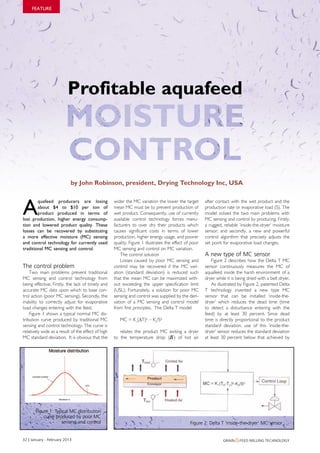
Digital Re-print -
               January | February 2013
       Profitable aquafeed moisture control

Grain & Feed Milling Technology is published six times a year by Perendale Publishers Ltd of the United Kingdom.
All data is published in good faith, based on information received, and while every care is taken to prevent inaccuracies,
the publishers accept no liability for any errors or omissions or for the consequences of action taken on the basis of
information published.
©Copyright 2013 Perendale Publishers Ltd. All rights reserved. No part of this publication may be reproduced in any form
or by any means without prior permission of the copyright owner. Printed by Perendale Publishers Ltd. ISSN: 1466-3872


                        www.gfmt.co.uk
FEATURE


                         Profitable aquafeed


                           by John Robinson, president, Drying Technology Inc, USA


A
        quafeed producers are losing                wider the MC variation the lower the target        after contact with the wet product and the
        about $4 to $10 per ton of                  mean MC must be to prevent production of           production rate or evaporative load (S). The
        product produced in terms of                wet product. Consequently, use of currently        model solved the two main problems with
lost production, higher energy consump-             available control technology forces manu-          MC sensing and control by producing. Firstly,
tion and lowered product quality. These             facturers to over dry their products which         a rugged, reliable ‘inside-the-dryer’ moisture
losses can be recovered by substituting             causes significant costs in terms of lower         sensor; and secondly, a new and powerful
a more effective moisture (MC) sensing              production, higher energy usage, and poorer        control algorithm that precisely adjusts the
and control technology for currently used           quality. Figure 1 illustrates the effect of poor   set point for evaporative load changes.
traditional MC sensing and control.                 MC sensing and control on MC variation.
                                                        The control solution                           A new type of MC sensor
                                                        Losses caused by poor MC sensing and               Figure 2 describes how the Delta T MC
The control problem                                 control may be recovered if the MC vari-           sensor continuously measures the MC of
    Two main problems prevent traditional           ation (standard deviation) is reduced such         aquafeed inside the harsh environment of a
MC sensing and control technology from              that the mean MC can be maximized with-            dryer while it is being dried with a belt dryer.
being effective. Firstly, the lack of timely and    out exceeding the upper specification limit            As illustrated by Figure 2, patented Delta
accurate MC data upon which to base con-            (USL). Fortunately, a solution for poor MC         T technology invented a new type MC
trol action (poor MC sensing). Secondly, the        sensing and control was supplied by the deri-      sensor that can be installed ‘inside-the-
inability to correctly adjust for evaporative       vation of a MC sensing and control model           dryer’ which reduces the dead time (time
load changes entering with the feed.                from first principles. The Delta T model:          to detect a disturbance entering with the
    Figure 1 shows a typical normal MC dis-                                                            feed) by at least 30 percent. Since dead
tribution curve produced by traditional MC             MC = K1(ΔT)p – K2/Sq                            time is directly proportional to the product
sensing and control technology. The curve is                                                           standard deviation, use of this ‘inside-the-
relatively wide as a result of the effect of high      relates the product MC exiting a dryer          dryer’ sensor reduces the standard deviation
MC standard deviation. It is obvious that the       to the temperature drop (ΔT) of hot air            at least 30 percent below that achieved by


       Figure 1: Typical MC distribution
           curve produced by poor MC
                    sensing and control                                                        Figure 2: Delta T ‘inside-the-dryer’ MC sensor


32 | January - february 2013                                                                                     Grain &feed millinG technoloGy
Success comes with the original product. Quality always pays off. Bühler is setting
standards in the grain processing industry for more than 150 years. Whether you
grind wheat, corn, rye, oat, buckwheat, soy, or malt grain – our processes and
equipment are finely tuned to get the most from your grain. And this kind of pro-
cess quality quickly pays off. The highest flour yields and best product quality
ensure fast return on investment. www.buhlergroup.com


                                                                                              Visit us at the IDMA 2013
Bühler AG, Grain Milling, 9240 Uzwil, Switzerland, T + 41 71 955 11 11, F + 41 71 955 66 11   in Istanbul (April 4 – 7, 2013),
milling@buhlergroup.com, www.buhlergroup.com                                                  Hall 10, booth no. B2


Innovations for a better world.
FEATURE
                                                                                                                                     FEATURE


                                                                                                      tive load entering the lower operating costs,
                                                                                                       means longer uptime, dryer with the feed.
                                                                                                       less expenses on maintenance and spares,
                                                                                                      Proprietary methods are used in adapting the
                                                                                                      model to the dryer and product. makes the
                                                                                                       and half the energy usage. This
                                                                                                       whole unloading process more economical
                                                                                                      Application of Delta T to especially
                                                                                                       and environmentally sustainable,
                                                                                                      aquafeed the added demurrage costs to
                                                                                                       considering manufacture
                                                                                                       vessels above-mentioned reduction in stand-
                                                                                                           The if a pneumatic system breaks down.
                                                                                                      ard deviation enablesoperates at lowerto be
                                                                                                       Lastly, the Bargolink the target MC noise
                                                                                                      increased by 0.5 not generate lower frequen-
                                                                                                       levels and does percent to as much as 1.25
                                                                                                      percent without fear of systems whoseprod-
                                                                                                       cies than pneumatic producing wet loud
                                                                                                      uct which might mold volumes maystorage.
                                                                                                       droning and changing in transit or consti-
                                                                                                      Figure health hazard.
                                                                                                       tute a 4 shows schematically how reducing
                                                                                                      the Already three customers the China,
                                                                                                             standard deviation enables in mean
                                                                                                      MC to and France have been convinced
                                                                                                       Croatia be increased by shifting the Delta T

                                           Figure 3: Delta T reduces dead time on belt dryer          curvethey can benefit the upper + 3Bargolink.
                                                                                                       that rightward until from Bühler’s standard
                                                                                                      deviation points (USL) ofBargolink offers an
                                                                                                       Altogether, Bühler’s both curves coincide.
                                                                                                      The difference in mean MCs represents effi-
                                                                                                       investment-friendly, highly flexible and the
   use of currently used MC sensing methods.         downstream of the dryer and analyzed by a        economic gain for unloading systems used for
                                                                                                       cient solution from using Delta T technology.
   It should be noted that use of raw Delta T        laboratory instrument.                            inland water transportation in the genuine
   data will not work—it must be processed              For the above conditions, the Delta T          Buhler manufacturing quality combined with
                                                                                                      Results and conclusions
   by the model before use. Figure 3 illustrates     accomplishes dead time reductions of 30 per-      best in class components. additional water
                                                                                                           From 10 to 25 lbs of
   the advantage of reducing dead time for           cent and 53 percent below that for the mois-     can be safely sold with the product per ton
   aquafeed drying.                                  ture meter method and the laboratory MC          of product produced without exceeding the
       Three possible locations are shown for        sample method respectively. The standard         upper specification limit using this new tech-
   installing the MC sensor. Dead time for each      deviation reductions would also be reduced       nology. ThenforMatIon: aquafeed manu-
                                                                                                          More I return to the
   installation point is the time it takes for the   30 percent and 53 percent respectively.              Bühler GmbH
                                                                                                      facturer is $4 to $10 per ton of product for
   individual MC method to detect a change in                                                         a wholesale productCH-9240, Uzwil, Switzerland
                                                                                                          Grain Logistics, price of $800 per ton.
   evaporative load entering with the feed. The      A new MC control algorithm                            Tel: +41 719 551111
                                                                                                      In addition, energy savings of approximately
   lowest dead time is 14 minutes for the Delta         As a result of its theoretical basis, the     four to seven 719 553949
                                                                                                           Fax: +41 percent possible. The Delta T
                                                                                                           Email: grain-logistics@buhlergroup.com
   T sensor inside the dryer; the next lowest        Delta T technology provides a new control        has been successfully applied in the US for
                                                                                                           Website: www.buhlergroup.com
   dead time is 20 minutes for a MC meter            algorithm that enables precise calculation of    MC sensing and control of many products,
   located at the dryer exit; the longest dead       the set point necessary to maintain the target   including aquafeed using a Beltomatic con-
   time is 30 minutes for MC samples taken           MC in spite of frequent changes in evapora-      veyor dryer.


                      ite
          ou r we b s
    Vi sit vigan.com
       www.

VIGAN manufactures dry agribulk materials handling systems:
• Portable pneumatic conveyors or grain pumps (100 - 250 tph);
                                                                             VIV Asia 2013                          Latest references
                                                                                                                    PYEONGTAEK PORT
                                                                                                                    South Korea
• Pneumatic Continuous barge & Ship Unloaders (160 - 800 tph);                                                      1 NIV 400 tph
• Mechanical Continuous Ship Unloaders (up to 1,500 tph);            March 13-15, 2013 | BITEC Bangkok, Thailand    On rails with cable reels
• Mechanical loaders (up to 1,200 tph).
as well as complete storage systems in ports and the agricultural industries.                                       LATTAKIA PORT
                                                                                                                    Syria
                                                                                                                    2 Mobile T200
       From project design to complete turnkey bulk handling solutions
            and port terminals with mechanical and/or pneumatic                                                         REGISTER NOW
                                                                                                                    2 x 250 tph

                    reliable and cost effective equipment.                                                             for FREE entrance at
                                                                                                                           www.viv.net
                                                                                                                    SWINOUJSCIE
      Special theme                                                                                                 Poland (BUNGE GROUP)
                               Join us at VIV Asia 2013 for the CropTech-FeedTech Conferences on March 13 & 14, 2013.
                                                                                                                    1 Loader 600 tph

                               Digital engineering in feed industry & Nutrition including presentations, debates and
            An affiliate company of VAN DE WIELE group.presentations.
                               international keynote
                                 VIGAN Engineering s.a. • Rue de l’Industrie, 16 • B-1400 Nivelles (Belgium)
                       Phone : +32 67 89 50 41 • Fax : +32 67 89 50 60 • Web : www.vigan.com • E-mail : info@vigan.com


    Grain&
         & feed millinG technoloGy
     Grain feed millinG technoloGy
Ann A5 victam 0212.indd 1
                                                                                                                          January - february 2013 | 17
                                                                                                                         January - february 2013 |15:37:04
                                                                                                                                          21/02/12 33
Milling Technology magazine. 	
 Content from the magazine is available to view free-of-charge, both as a full
                                                                                 LINKS
 This digital Re-print is part of the January | February 2013 edition of Grain & Feed


 online magazine on our website, and as an archive of individual features on
 the docstoc website.
 Please click here to view our other publications on www.docstoc.com.
                                                                                                                 January - February 2013


                    first published in 1891
                                                                                                                                           •	 See the full issue
                                         •    Controlling the
                                              explosion risks
                                              within hammer
                                              mills
                                                                                                                                           •	   Visit the GFMT website
                                         •
                                                                                                                                           •	   Contact the GFMT Team
                                              Recycling surplus
                                              factory food                            In this issue:
                                              into quality animal feeds
                                                                                       •     Efficient
                                                                                             barge
                                                                                             unloading
                                                                                             technology

                                     •       Use of computer                           •     Feed


                                                                                                                                           •	   Subscribe to GFMT
                                             programming                                     enzymes
                                             in animal diet                                  in animal
                                             formulation                                     nutrition


                 INCORPORATING PORTS, DISTRIBUTION AND FORMULATION
              A subscription magazine for the global flour & feed milling industries - first published in 1891


 To purchase a paper copy of the magazine, or to subscribe to the paper edi-
 tion please contact our Circulation and Subscriptions Manager on the link
 adove.  


INFORMATION FOR ADVERTISERS - CLICK HERE


 Article reprints
 All Grain & Feed Milling Tecchnology feature articles can be re-printed as a 4 or 8 page booklets (these
 have been used as point of sale materials, promotional materials for shows and exhibitions etc).
 If you are interested in getting this article re-printed please contact the GFMT team for more informa-
 tion on - Tel: +44 1242 267707 - Email: jamest@gfmt.co.uk or visit www.gfmt.co.uk/reprints


                                                      www.gfmt.co.uk

Profitable aquafeed moisture control

  • 1.
    Digital Re-print - January | February 2013 Profitable aquafeed moisture control Grain & Feed Milling Technology is published six times a year by Perendale Publishers Ltd of the United Kingdom. All data is published in good faith, based on information received, and while every care is taken to prevent inaccuracies, the publishers accept no liability for any errors or omissions or for the consequences of action taken on the basis of information published. ©Copyright 2013 Perendale Publishers Ltd. All rights reserved. No part of this publication may be reproduced in any form or by any means without prior permission of the copyright owner. Printed by Perendale Publishers Ltd. ISSN: 1466-3872 www.gfmt.co.uk
  • 2.
    FEATURE Profitable aquafeed by John Robinson, president, Drying Technology Inc, USA A quafeed producers are losing wider the MC variation the lower the target after contact with the wet product and the about $4 to $10 per ton of mean MC must be to prevent production of production rate or evaporative load (S). The product produced in terms of wet product. Consequently, use of currently model solved the two main problems with lost production, higher energy consump- available control technology forces manu- MC sensing and control by producing. Firstly, tion and lowered product quality. These facturers to over dry their products which a rugged, reliable ‘inside-the-dryer’ moisture losses can be recovered by substituting causes significant costs in terms of lower sensor; and secondly, a new and powerful a more effective moisture (MC) sensing production, higher energy usage, and poorer control algorithm that precisely adjusts the and control technology for currently used quality. Figure 1 illustrates the effect of poor set point for evaporative load changes. traditional MC sensing and control. MC sensing and control on MC variation. The control solution A new type of MC sensor Losses caused by poor MC sensing and Figure 2 describes how the Delta T MC The control problem control may be recovered if the MC vari- sensor continuously measures the MC of Two main problems prevent traditional ation (standard deviation) is reduced such aquafeed inside the harsh environment of a MC sensing and control technology from that the mean MC can be maximized with- dryer while it is being dried with a belt dryer. being effective. Firstly, the lack of timely and out exceeding the upper specification limit As illustrated by Figure 2, patented Delta accurate MC data upon which to base con- (USL). Fortunately, a solution for poor MC T technology invented a new type MC trol action (poor MC sensing). Secondly, the sensing and control was supplied by the deri- sensor that can be installed ‘inside-the- inability to correctly adjust for evaporative vation of a MC sensing and control model dryer’ which reduces the dead time (time load changes entering with the feed. from first principles. The Delta T model: to detect a disturbance entering with the Figure 1 shows a typical normal MC dis- feed) by at least 30 percent. Since dead tribution curve produced by traditional MC MC = K1(ΔT)p – K2/Sq time is directly proportional to the product sensing and control technology. The curve is standard deviation, use of this ‘inside-the- relatively wide as a result of the effect of high relates the product MC exiting a dryer dryer’ sensor reduces the standard deviation MC standard deviation. It is obvious that the to the temperature drop (ΔT) of hot air at least 30 percent below that achieved by Figure 1: Typical MC distribution curve produced by poor MC sensing and control Figure 2: Delta T ‘inside-the-dryer’ MC sensor 32 | January - february 2013 Grain &feed millinG technoloGy
  • 3.
    Success comes withthe original product. Quality always pays off. Bühler is setting standards in the grain processing industry for more than 150 years. Whether you grind wheat, corn, rye, oat, buckwheat, soy, or malt grain – our processes and equipment are finely tuned to get the most from your grain. And this kind of pro- cess quality quickly pays off. The highest flour yields and best product quality ensure fast return on investment. www.buhlergroup.com Visit us at the IDMA 2013 Bühler AG, Grain Milling, 9240 Uzwil, Switzerland, T + 41 71 955 11 11, F + 41 71 955 66 11 in Istanbul (April 4 – 7, 2013), milling@buhlergroup.com, www.buhlergroup.com Hall 10, booth no. B2 Innovations for a better world.
  • 4.
    FEATURE FEATURE tive load entering the lower operating costs, means longer uptime, dryer with the feed. less expenses on maintenance and spares, Proprietary methods are used in adapting the model to the dryer and product. makes the and half the energy usage. This whole unloading process more economical Application of Delta T to especially and environmentally sustainable, aquafeed the added demurrage costs to considering manufacture vessels above-mentioned reduction in stand- The if a pneumatic system breaks down. ard deviation enablesoperates at lowerto be Lastly, the Bargolink the target MC noise increased by 0.5 not generate lower frequen- levels and does percent to as much as 1.25 percent without fear of systems whoseprod- cies than pneumatic producing wet loud uct which might mold volumes maystorage. droning and changing in transit or consti- Figure health hazard. tute a 4 shows schematically how reducing the Already three customers the China, standard deviation enables in mean MC to and France have been convinced Croatia be increased by shifting the Delta T Figure 3: Delta T reduces dead time on belt dryer curvethey can benefit the upper + 3Bargolink. that rightward until from Bühler’s standard deviation points (USL) ofBargolink offers an Altogether, Bühler’s both curves coincide. The difference in mean MCs represents effi- investment-friendly, highly flexible and the use of currently used MC sensing methods. downstream of the dryer and analyzed by a economic gain for unloading systems used for cient solution from using Delta T technology. It should be noted that use of raw Delta T laboratory instrument. inland water transportation in the genuine data will not work—it must be processed For the above conditions, the Delta T Buhler manufacturing quality combined with Results and conclusions by the model before use. Figure 3 illustrates accomplishes dead time reductions of 30 per- best in class components. additional water From 10 to 25 lbs of the advantage of reducing dead time for cent and 53 percent below that for the mois- can be safely sold with the product per ton aquafeed drying. ture meter method and the laboratory MC of product produced without exceeding the Three possible locations are shown for sample method respectively. The standard upper specification limit using this new tech- installing the MC sensor. Dead time for each deviation reductions would also be reduced nology. ThenforMatIon: aquafeed manu- More I return to the installation point is the time it takes for the 30 percent and 53 percent respectively. Bühler GmbH facturer is $4 to $10 per ton of product for individual MC method to detect a change in a wholesale productCH-9240, Uzwil, Switzerland Grain Logistics, price of $800 per ton. evaporative load entering with the feed. The A new MC control algorithm Tel: +41 719 551111 In addition, energy savings of approximately lowest dead time is 14 minutes for the Delta As a result of its theoretical basis, the four to seven 719 553949 Fax: +41 percent possible. The Delta T Email: grain-logistics@buhlergroup.com T sensor inside the dryer; the next lowest Delta T technology provides a new control has been successfully applied in the US for Website: www.buhlergroup.com dead time is 20 minutes for a MC meter algorithm that enables precise calculation of MC sensing and control of many products, located at the dryer exit; the longest dead the set point necessary to maintain the target including aquafeed using a Beltomatic con- time is 30 minutes for MC samples taken MC in spite of frequent changes in evapora- veyor dryer. ite ou r we b s Vi sit vigan.com www. VIGAN manufactures dry agribulk materials handling systems: • Portable pneumatic conveyors or grain pumps (100 - 250 tph); VIV Asia 2013 Latest references PYEONGTAEK PORT South Korea • Pneumatic Continuous barge & Ship Unloaders (160 - 800 tph); 1 NIV 400 tph • Mechanical Continuous Ship Unloaders (up to 1,500 tph); March 13-15, 2013 | BITEC Bangkok, Thailand On rails with cable reels • Mechanical loaders (up to 1,200 tph). as well as complete storage systems in ports and the agricultural industries. LATTAKIA PORT Syria 2 Mobile T200 From project design to complete turnkey bulk handling solutions and port terminals with mechanical and/or pneumatic REGISTER NOW 2 x 250 tph reliable and cost effective equipment. for FREE entrance at www.viv.net SWINOUJSCIE Special theme Poland (BUNGE GROUP) Join us at VIV Asia 2013 for the CropTech-FeedTech Conferences on March 13 & 14, 2013. 1 Loader 600 tph Digital engineering in feed industry & Nutrition including presentations, debates and An affiliate company of VAN DE WIELE group.presentations. international keynote VIGAN Engineering s.a. • Rue de l’Industrie, 16 • B-1400 Nivelles (Belgium) Phone : +32 67 89 50 41 • Fax : +32 67 89 50 60 • Web : www.vigan.com • E-mail : info@vigan.com Grain& & feed millinG technoloGy Grain feed millinG technoloGy Ann A5 victam 0212.indd 1 January - february 2013 | 17 January - february 2013 |15:37:04 21/02/12 33
  • 6.
    Milling Technology magazine. Content from the magazine is available to view free-of-charge, both as a full LINKS This digital Re-print is part of the January | February 2013 edition of Grain & Feed online magazine on our website, and as an archive of individual features on the docstoc website. Please click here to view our other publications on www.docstoc.com. January - February 2013 first published in 1891 • See the full issue • Controlling the explosion risks within hammer mills • Visit the GFMT website • • Contact the GFMT Team Recycling surplus factory food In this issue: into quality animal feeds • Efficient barge unloading technology • Use of computer • Feed • Subscribe to GFMT programming enzymes in animal diet in animal formulation nutrition INCORPORATING PORTS, DISTRIBUTION AND FORMULATION A subscription magazine for the global flour & feed milling industries - first published in 1891 To purchase a paper copy of the magazine, or to subscribe to the paper edi- tion please contact our Circulation and Subscriptions Manager on the link adove. INFORMATION FOR ADVERTISERS - CLICK HERE Article reprints All Grain & Feed Milling Tecchnology feature articles can be re-printed as a 4 or 8 page booklets (these have been used as point of sale materials, promotional materials for shows and exhibitions etc). If you are interested in getting this article re-printed please contact the GFMT team for more informa- tion on - Tel: +44 1242 267707 - Email: jamest@gfmt.co.uk or visit www.gfmt.co.uk/reprints www.gfmt.co.uk