Production diary
Oscar Strokosz.
Pre-production
• Idea 1: (poorly done) Parkour video with “Sabotage” by the beastie boys
playing in then background.
• Montage of cops running towards something over obstacles.
• Didn’t follow through because no narrative development and I would have to
have substantial skill at animation.
• Idea 2: story about a pair of legs walking home from the club early in the
summer morning.
• Based on a memory of me doing the same thing before going to uni.
• Moodboards:
• Mood board 1
• Mood board 2
Story Idea.
• A drunk pair of legs walk home from club and desperate needs to go to the
toilet; the problem is that there isn’t one in sight.
• Being the early morning, and drunk, he decides to “go” in the middle of a
nearby field
• Drama: someone is coming down towards him but he can’t stop the flow.
Will he be able to stop in time?
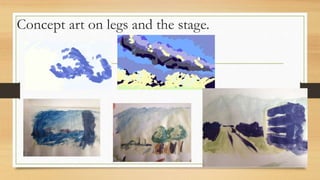
Concept art on legs and the stage.
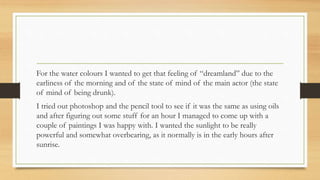
For the water colours I wanted to get that feeling of “dreamland” due to the
earliness of the morning and of the state of mind of the main actor (the state
of mind of being drunk).
I tried out photoshop and the pencil tool to see if it was the same as using oils
and after figuring out some stuff for an hour I managed to come up with a
couple of paintings I was happy with. I wanted the sunlight to be really
powerful and somewhat overbearing, as it normally is in the early hours after
sunrise.
Video resources
• Here are some videos I took for reference.
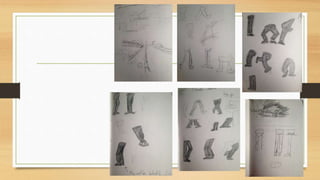
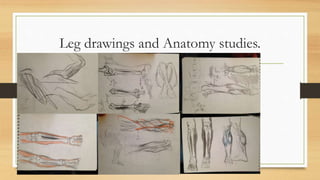
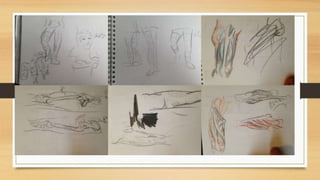
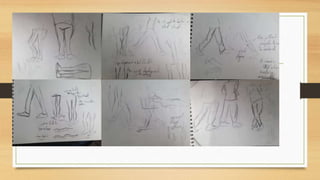
Leg drawings and Anatomy studies.
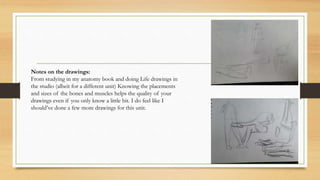
Notes on the drawings:
From studying in my anatomy book and doing Life drawings in
the studio (albeit for a different unit) Knowing the placements
and sizes of the bones and muscles helps the quality of your
drawings even if you only know a little bit. I do feel like I
should’ve done a few more drawings for this unit.
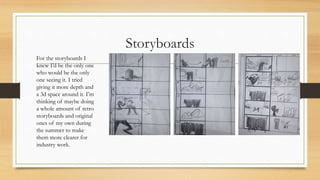
Storyboards
For the storyboards I
knew I’d be the only one
who would be the only
one seeing it. I tried
giving it more depth and
a 3d space around it. I’m
thinking of maybe doing
a whole amount of retro
storyboards and original
ones of my own during
the summer to make
them more clearer for
industry work.
Research from other animators
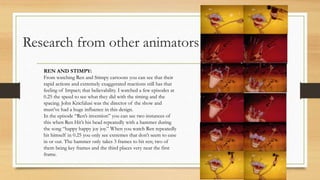
REN AND STIMPY:
From watching Ren and Stimpy cartoons you can see that their
rapid actions and extremely exaggerated reactions still has that
feeling of Impact; that believability. I watched a few episodes at
0.25 the speed to see what they did with the timing and the
spacing. John Kricfalusi was the director of the show and
must’ve had a huge influence in this design.
In the episode “Ren’s invention” you can see two instances of
this when Ren Hit’s his head repeatedly with a hammer during
the song “happy happy joy joy.” When you watch Ren repeatedly
hit himself in 0.25 you only see extremes that don’t seem to ease
in or out. The hammer only takes 3 frames to hit ren; two of
them being key frames and the third places very near the first
frame.
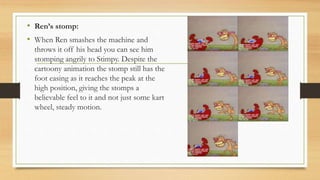
• Ren’s stomp:
• When Ren smashes the machine and
throws it off his head you can see him
stomping angrily to Stimpy. Despite the
cartoony animation the stomp still has the
foot easing as it reaches the peak at the
high position, giving the stomps a
believable feel to it and not just some kart
wheel, steady motion.
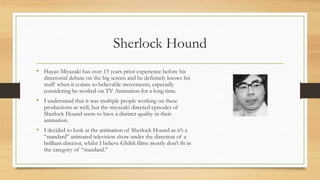
Sherlock Hound
• Hayao Miyazaki has over 15 years prior experience before his
directorial debute on the big screen and he definitely knows his
stuff when it comes to believable movements, especially
considering he worked on TV Animation for a long time.
• I understand that it was multiple people working on these
productions as well, but the miyazaki directed episodes of
Sherlock Hound seem to have a distinct quality in their
animation.
• I decided to look at the animation of Sherlock Hound as it’s a
“standard” animated television show under the direction of a
brilliant director, whilst I believe Ghibli films mostly don’t fit in
the category of “standard.”
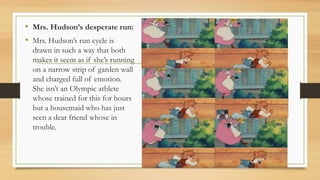
• Mrs. Hudson’s desperate run:
• Mrs. Hudson’s run cycle is
drawn in such a way that both
makes it seem as if she’s running
on a narrow strip of garden wall
and charged full of emotion.
She isn’t an Olympic athlete
whose trained for this for hours
but a housemaid who has just
seen a dear friend whose in
trouble.
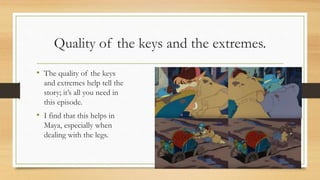
Quality of the keys and the extremes.
• The quality of the keys
and extremes help tell the
story; it’s all you need in
this episode.
• I find that this helps in
Maya, especially when
dealing with the legs.
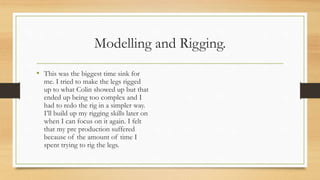
Modelling and Rigging.
• This was the biggest time sink for
me. I tried to make the legs rigged
up to what Colin showed up but that
ended up being too complex and I
had to redo the rig in a simpler way.
I’ll build up my rigging skills later on
when I can focus on it again. I felt
that my pre production suffered
because of the amount of time I
spent trying to rig the legs.
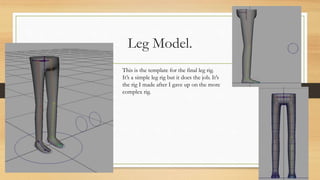
Leg Model.
This is the template for the final leg rig.
It’s a simple leg rig but it does the job. It’s
the rig I made after I gave up on the more
complex rig.
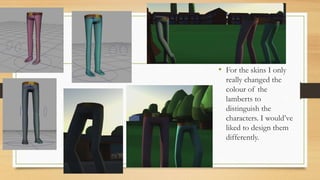
• For the skins I only
really changed the
colour of the
lamberts to
distinguish the
characters. I would’ve
liked to design them
differently.
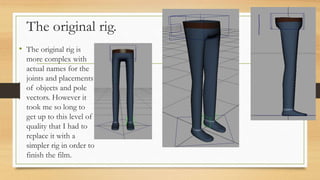
The original rig.
• The original rig is
more complex with
actual names for the
joints and placements
of objects and pole
vectors. However it
took me so long to
get up to this level of
quality that I had to
replace it with a
simpler rig in order to
finish the film.
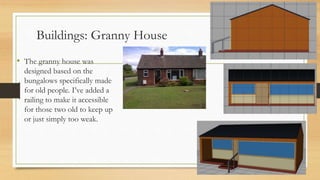
Buildings: Granny House
• The granny house was
designed based on the
bungalows specifically made
for old people. I’ve added a
railing to make it accessible
for those two old to keep up
or just simply too weak.
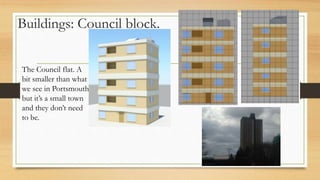
Buildings: Council block.
The Council flat. A
bit smaller than what
we see in Portsmouth
but it’s a small town
and they don’t need
to be.
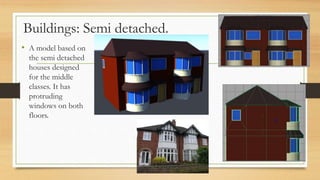
Buildings: Semi detached.
• A model based on
the semi detached
houses designed
for the middle
classes. It has
protruding
windows on both
floors.
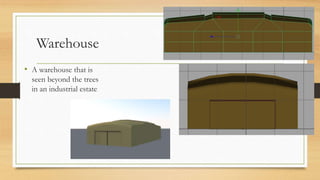
Warehouse
• A warehouse that is
seen beyond the trees
in an industrial estate
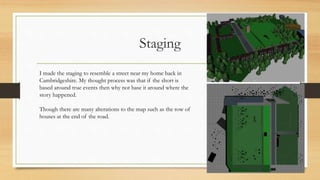
Staging
I made the staging to resemble a street near my home back in
Cambridgeshire. My thought process was that if the short is
based around true events then why not base it around where the
story happened.
Though there are many alterations to the map such as the row of
houses at the end of the road.
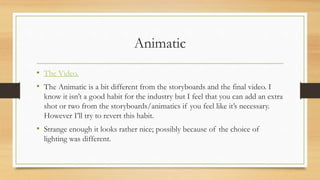
Animatic
• The Video.
• The Animatic is a bit different from the storyboards and the final video. I
know it isn’t a good habit for the industry but I feel that you can add an extra
shot or two from the storyboards/animatics if you feel like it’s necessary.
However I’ll try to revert this habit.
• Strange enough it looks rather nice; possibly because of the choice of
lighting was different.
Final product
Review on the course
• I think TB2 went better than TB1 for me. I believe that I have a better insight in the pre-
production stages of the work other than just storyboarding and concept art that you see on disc
2 of a DVD.
• It also helped me prioritise one element of the work over other aspects.
• I do have to say that the advance rigging was a bit forward for someone like me who was
essentially at cave man knowledge on Maya (meaning I knew nothing about it). It would be
amazing for second year 3D students but for someone in year one who has no prior experience
it’s a bit mind boggling.
• Despite the rigging I learnt a lot about 3D animation and the process so it was overly beneficial
and I think this shows up in the work I did.

Production diary

  • 1.
  • 2.
    Pre-production • Idea 1:(poorly done) Parkour video with “Sabotage” by the beastie boys playing in then background. • Montage of cops running towards something over obstacles. • Didn’t follow through because no narrative development and I would have to have substantial skill at animation.
  • 3.
    • Idea 2:story about a pair of legs walking home from the club early in the summer morning. • Based on a memory of me doing the same thing before going to uni. • Moodboards: • Mood board 1 • Mood board 2
  • 4.
    Story Idea. • Adrunk pair of legs walk home from club and desperate needs to go to the toilet; the problem is that there isn’t one in sight. • Being the early morning, and drunk, he decides to “go” in the middle of a nearby field • Drama: someone is coming down towards him but he can’t stop the flow. Will he be able to stop in time?
  • 5.
    Concept art onlegs and the stage.
  • 6.
    For the watercolours I wanted to get that feeling of “dreamland” due to the earliness of the morning and of the state of mind of the main actor (the state of mind of being drunk). I tried out photoshop and the pencil tool to see if it was the same as using oils and after figuring out some stuff for an hour I managed to come up with a couple of paintings I was happy with. I wanted the sunlight to be really powerful and somewhat overbearing, as it normally is in the early hours after sunrise.
  • 8.
    Video resources • Hereare some videos I took for reference.
  • 9.
    Leg drawings andAnatomy studies.
  • 12.
    Notes on thedrawings: From studying in my anatomy book and doing Life drawings in the studio (albeit for a different unit) Knowing the placements and sizes of the bones and muscles helps the quality of your drawings even if you only know a little bit. I do feel like I should’ve done a few more drawings for this unit.
  • 13.
    Storyboards For the storyboardsI knew I’d be the only one who would be the only one seeing it. I tried giving it more depth and a 3d space around it. I’m thinking of maybe doing a whole amount of retro storyboards and original ones of my own during the summer to make them more clearer for industry work.
  • 14.
    Research from otheranimators REN AND STIMPY: From watching Ren and Stimpy cartoons you can see that their rapid actions and extremely exaggerated reactions still has that feeling of Impact; that believability. I watched a few episodes at 0.25 the speed to see what they did with the timing and the spacing. John Kricfalusi was the director of the show and must’ve had a huge influence in this design. In the episode “Ren’s invention” you can see two instances of this when Ren Hit’s his head repeatedly with a hammer during the song “happy happy joy joy.” When you watch Ren repeatedly hit himself in 0.25 you only see extremes that don’t seem to ease in or out. The hammer only takes 3 frames to hit ren; two of them being key frames and the third places very near the first frame.
  • 15.
    • Ren’s stomp: •When Ren smashes the machine and throws it off his head you can see him stomping angrily to Stimpy. Despite the cartoony animation the stomp still has the foot easing as it reaches the peak at the high position, giving the stomps a believable feel to it and not just some kart wheel, steady motion.
  • 16.
    Sherlock Hound • HayaoMiyazaki has over 15 years prior experience before his directorial debute on the big screen and he definitely knows his stuff when it comes to believable movements, especially considering he worked on TV Animation for a long time. • I understand that it was multiple people working on these productions as well, but the miyazaki directed episodes of Sherlock Hound seem to have a distinct quality in their animation. • I decided to look at the animation of Sherlock Hound as it’s a “standard” animated television show under the direction of a brilliant director, whilst I believe Ghibli films mostly don’t fit in the category of “standard.”
  • 17.
    • Mrs. Hudson’sdesperate run: • Mrs. Hudson’s run cycle is drawn in such a way that both makes it seem as if she’s running on a narrow strip of garden wall and charged full of emotion. She isn’t an Olympic athlete whose trained for this for hours but a housemaid who has just seen a dear friend whose in trouble.
  • 18.
    Quality of thekeys and the extremes. • The quality of the keys and extremes help tell the story; it’s all you need in this episode. • I find that this helps in Maya, especially when dealing with the legs.
  • 19.
    Modelling and Rigging. •This was the biggest time sink for me. I tried to make the legs rigged up to what Colin showed up but that ended up being too complex and I had to redo the rig in a simpler way. I’ll build up my rigging skills later on when I can focus on it again. I felt that my pre production suffered because of the amount of time I spent trying to rig the legs.
  • 20.
    Leg Model. This isthe template for the final leg rig. It’s a simple leg rig but it does the job. It’s the rig I made after I gave up on the more complex rig.
  • 21.
    • For theskins I only really changed the colour of the lamberts to distinguish the characters. I would’ve liked to design them differently.
  • 22.
    The original rig. •The original rig is more complex with actual names for the joints and placements of objects and pole vectors. However it took me so long to get up to this level of quality that I had to replace it with a simpler rig in order to finish the film.
  • 23.
    Buildings: Granny House •The granny house was designed based on the bungalows specifically made for old people. I’ve added a railing to make it accessible for those two old to keep up or just simply too weak.
  • 24.
    Buildings: Council block. TheCouncil flat. A bit smaller than what we see in Portsmouth but it’s a small town and they don’t need to be.
  • 25.
    Buildings: Semi detached. •A model based on the semi detached houses designed for the middle classes. It has protruding windows on both floors.
  • 26.
    Warehouse • A warehousethat is seen beyond the trees in an industrial estate
  • 27.
    Staging I made thestaging to resemble a street near my home back in Cambridgeshire. My thought process was that if the short is based around true events then why not base it around where the story happened. Though there are many alterations to the map such as the row of houses at the end of the road.
  • 28.
    Animatic • The Video. •The Animatic is a bit different from the storyboards and the final video. I know it isn’t a good habit for the industry but I feel that you can add an extra shot or two from the storyboards/animatics if you feel like it’s necessary. However I’ll try to revert this habit. • Strange enough it looks rather nice; possibly because of the choice of lighting was different.
  • 29.
  • 30.
    Review on thecourse • I think TB2 went better than TB1 for me. I believe that I have a better insight in the pre- production stages of the work other than just storyboarding and concept art that you see on disc 2 of a DVD. • It also helped me prioritise one element of the work over other aspects. • I do have to say that the advance rigging was a bit forward for someone like me who was essentially at cave man knowledge on Maya (meaning I knew nothing about it). It would be amazing for second year 3D students but for someone in year one who has no prior experience it’s a bit mind boggling. • Despite the rigging I learnt a lot about 3D animation and the process so it was overly beneficial and I think this shows up in the work I did.