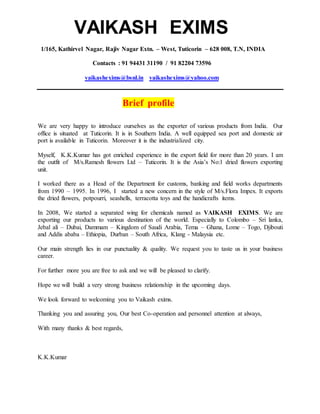
VAIKASH EXIMS
1/165, Kathirvel Nagar, Rajiv Nagar Extn. – West, Tuticorin – 628 008, T.N, INDIA
Contacts : 91 94431 31190 / 91 82204 73596
vaikashexims@bsnl.in vaikashexims@yahoo.com
Brief profile
We are very happy to introduce ourselves as the exporter of various products from India. Our
office is situated at Tuticorin. It is in Southern India. A well equipped sea port and domestic air
port is available in Tuticorin. Moreover it is the industrialized city.
Myself, K.K.Kumar has got enriched experience in the export field for more than 20 years. I am
the outfit of M/s.Ramesh flowers Ltd – Tuticorin. It is the Asia’s No:1 dried flowers exporting
unit.
I worked there as a Head of the Department for customs, banking and field works departments
from 1990 – 1995. In 1996, I started a new concern in the style of M/s.Flora Impex. It exports
the dried flowers, potpourri, seashells, terracotta toys and the handicrafts items.
In 2008, We started a separated wing for chemicals named as VAIKASH EXIMS. We are
exporting our products to various destination of the world. Especially to Colombo – Sri lanka,
Jebal ali – Dubai, Dammam – Kingdom of Saudi Arabia, Tema – Ghana, Lome – Togo, Djibouti
and Addis ababa – Ethiopia, Durban – South Africa, Klang - Malaysia etc.
Our main strength lies in our punctuality & quality. We request you to taste us in your business
career.
For further more you are free to ask and we will be pleased to clarify.
Hope we will build a very strong business relationship in the upcoming days.
We look forward to welcoming you to Vaikash exims.
Thanking you and assuring you, Our best Co-operation and personnel attention at always,
With many thanks & best regards,
K.K.Kumar
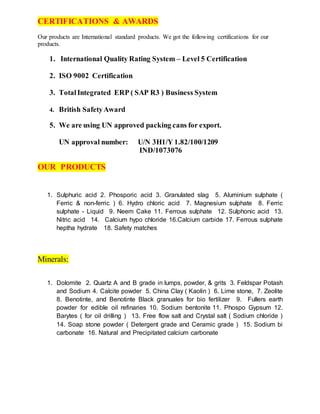
CERTIFICATIONS & AWARDS
Our products are International standard products. We got the following certifications for our
products.
1. International Quality Rating System – Level 5 Certification
2. ISO 9002 Certification
3. TotalIntegrated ERP ( SAP R3 ) Business System
4. British SafetyAward
5. We are using UN approved packing cans for export.
UN approval number: U/N 3H1/Y 1.82/100/1209
IND/1073076
OUR PRODUCTS
1. Sulphuric acid 2. Phosporic acid 3. Granulated slag 5. Aluminium sulphate (
Ferric & non-ferric ) 6. Hydro chloric acid 7. Magnesium sulphate 8. Ferric
sulphate - Liquid 9. Neem Cake 11. Ferrous sulphate 12. Sulphonic acid 13.
Nitric acid 14. Calcium hypo chloride 16.Calcium carbide 17. Ferrous sulphate
heptha hydrate 18. Safety matches
Minerals:
1. Dolomite 2. Quartz A and B grade in lumps, powder, & grits 3. Feldspar Potash
and Sodium 4. Calcite powder 5. China Clay ( Kaolin ) 6. Lime stone, 7. Zeolite
8. Benotinte, and Benotinte Black granuales for bio fertilizer 9. Fullers earth
powder for edible oil refinaries 10. Sodium bentonite 11. Phospo Gypsum 12.
Barytes ( for oil drilling ) 13. Free flow salt and Crystal salt ( Sodium chloride )
14. Soap stone powder ( Detergent grade and Ceramic grade ) 15. Sodium bi
carbonate 16. Natural and Precipitated calcium carbonate
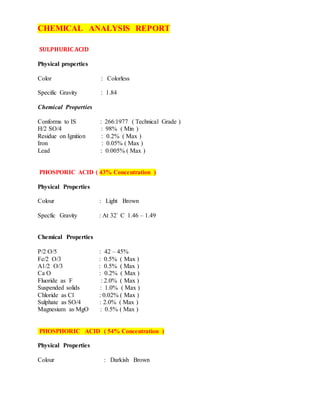
CHEMICAL ANALYSIS REPORT
SULPHURIC ACID
Physical properties
Color : Colorless
Specific Gravity : 1.84
Chemical Properties
Conforms to IS : 266:1977 ( Technical Grade )
H/2 SO/4 : 98% ( Min )
Residue on Ignition : 0.2% ( Max )
Iron : 0.05% ( Max )
Lead : 0.005% ( Max )
PHOSPORIC ACID ( 43% Concentration )
Physical Properties
Colour : Light Brown
Specfic Gravity : At 32` C 1.46 – 1.49
Chemical Properties
P/2 O/5 : 42 – 45%
Fe/2 O/3 : 0.5% ( Max )
A1/2 O/3 : 0.5% ( Max )
Ca O : 0.2% ( Max )
Fluoride as F : 2.0% ( Max )
Suspended solids : 1.0% ( Max )
Chloride as Cl : 0.02% ( Max )
Sulphate as SO/4 : 2.0% ( Max )
Magnesium as MgO : 0.5% ( Max )
PHOSPHORIC ACID ( 54% Concentration )
Physical Properties
Colour : Darkish Brown
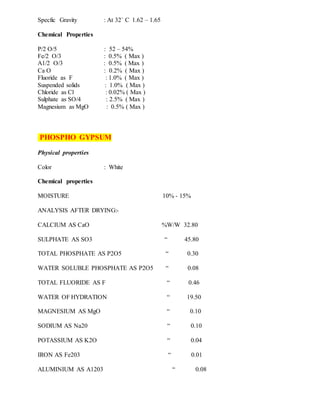
Specfic Gravity : At 32` C 1.62 – 1.65
Chemical Properties
P/2 O/5 : 52 – 54%
Fe/2 O/3 : 0.5% ( Max )
A1/2 O/3 : 0.5% ( Max )
Ca O : 0.2% ( Max )
Fluoride as F : 1.0% ( Max )
Suspended solids : 1.0% ( Max )
Chloride as Cl : 0.02% ( Max )
Sulphate as SO/4 : 2.5% ( Max )
Magnesium as MgO : 0.5% ( Max )
PHOSPHO GYPSUM
Physical properties
Color : White
Chemical properties
MOISTURE 10% - 15%
ANALYSIS AFTER DRYING:-
CALCIUM AS CaO %W/W 32.80
SULPHATE AS SO3 “ 45.80
TOTAL PHOSPHATE AS P2O5 “ 0.30
WATER SOLUBLE PHOSPHATE AS P2O5 “ 0.08
TOTAL FLUORIDE AS F “ 0.46
WATER OF HYDRATION “ 19.50
MAGNESIUM AS MgO “ 0.10
SODIUM AS Na20 “ 0.10
POTASSIUM AS K2O “ 0.04
IRON AS Fe203 “ 0.01
ALUMINIUM AS A1203 “ 0.08
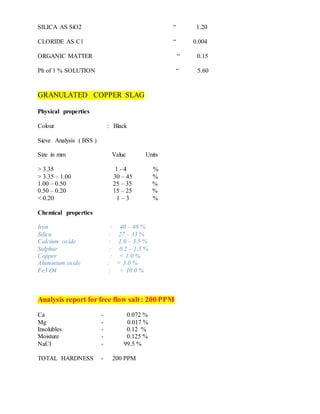
SILICA AS SiO2 “ 1.20
CLORIDE AS C1 “ 0.004
ORGANIC MATTER “ 0.15
Ph of 1 % SOLUTION “ 5.60
GRANULATED COPPER SLAG
Physical properties
Colour : Black
Sieve Analysis ( BSS )
Size in mm Value Units
> 3.35 1 - 4 %
> 3.35 – 1.00 30 – 45 %
1.00 – 0.50 25 – 35 %
0.50 – 0.20 15 – 25 %
< 0.20 1 – 3 %
Chemical properties
Iron : 40 – 48 %
Silica : 27 – 33 %
Calcium oxide : 1.0 – 3.5 %
Sulphur : 0.2 – 1.5 %
Copper : < 1.0 %
Aluminium oxide : < 3.0 %
Fe3 O4 : < 10.0 %
Analysis report for free flow salt: 200 PPM
Ca - 0.072 %
Mg - 0.017 %
Insolubles - 0.12 %
Moisture - 0.125 %
NaCl - 99.5 %
TOTAL HARDNESS - 200 PPM
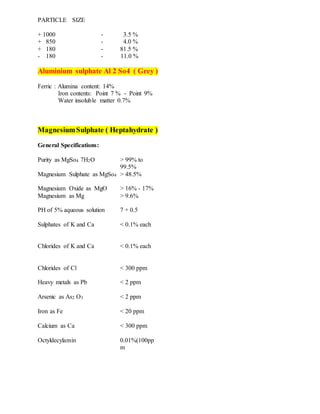
PARTICLE SIZE
+ 1000 - 3.5 %
+ 850 - 4.0 %
+ 180 - 81.5 %
- 180 - 11.0 %
Aluminium sulphate Al 2 So4 ( Grey )
Ferric : Alumina content: 14%
Iron contents: Point 7 % - Point 9%
Water insoluble matter 0.7%
MagnesiumSulphate ( Heptahydrate )
General Specifications:
Purity as MgSo4 7H2O > 99% to
99.5%
Magnesium Sulphate as MgSo4 > 48.5%
Magnesium Oxide as MgO > 16% - 17%
Magnesium as Mg > 9.6%
PH of 5% aqueous solution 7 + 0.5
Sulphates of K and Ca < 0.1% each
Chlorides of K and Ca < 0.1% each
Chlorides of Cl < 300 ppm
Heavy metals as Pb < 2 ppm
Arsenic as As2 O3 < 2 ppm
Iron as Fe < 20 ppm
Calcium as Ca < 300 ppm
Octyldecylamin 0.01%(100pp
m
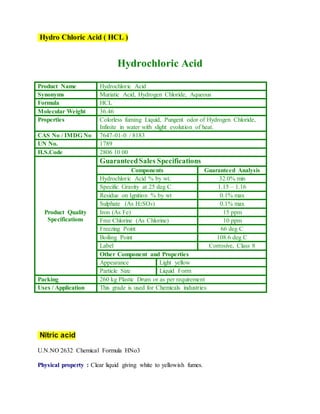
Hydro Chloric Acid ( HCL )
Hydrochloric Acid
Product Name Hydrochloric Acid
Synonyms Muriatic Acid, Hydrogen Chloride, Aqueous
Formula HCL
Molecular Weight 36.46
Properties Colorless fuming Liquid, Pungent odor of Hydrogen Chloride,
Infinite in water with slight evolution of heat.
CAS No / IMDG No 7647-01-0 / 8183
UN No. 1789
H.S.Code 2806 10 00
Product Quality
Specifications
GuaranteedSales Specifications
Components Guaranteed Analysis
Hydrochloric Acid % by wt. 32.0% min
Specific Gravity at 25 deg C 1.15 – 1.16
Residue on Ignition % by wt 0.1% max
Sulphate (As H2SO4) 0.1% max
Iron (As Fe) 15 ppm
Free Chlorine (As Chlorine) 10 ppm
Freezing Point 66 deg C
Boiling Point 108.6 deg C
Label Corrosive, Class 8
Other Component and Properties
Appearance Light yellow
Particle Size Liquid Form
Packing 260 kg Plastic Drum or as per requirement
Uses / Application This grade is used for Chemicals industries
Nitric acid
U.N.NO 2632 Chemical Formula HNo3
Physical property : Clear liquid giving white to yellowish fumes.
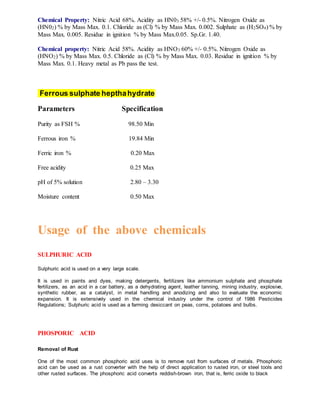
Chemical Property: Nitric Acid 68%. Acidity as HN03 58% +/- 0.5%. Nitrogen Oxide as
(HN02) % by Mass Max. 0.1. Chloride as (Cl) % by Mass Max. 0.002. Sulphate as (H2SO4) % by
Mass Max. 0.005. Residue in ignition % by Mass Max.0.05. Sp.Gr. 1.40.
Chemical property: Nitric Acid 58%. Acidity as HNO3 60% +/- 0.5%. Nitrogen Oxide as
(HNO2) % by Mass Max. 0.5. Chloride as (Cl) % by Mass Max. 0.03. Residue in ignition % by
Mass Max. 0.1. Heavy metal as Pb pass the test.
Ferrous sulphate hepthahydrate
Parameters Specification
Purity as FSH % 98.50 Min
Ferrous iron % 19.84 Min
Ferric iron % 0.20 Max
Free acidity 0.25 Max
pH of 5% solution 2.80 – 3.30
Moisture content 0.50 Max
Usage of the above chemicals
SULPHURIC ACID
Sulphuric acid is used on a very large scale.
It is used in paints and dyes, making detergents, fertilizers like ammonium sulphate and phosphate
fertilizers, as an acid in a car battery, as a dehydrating agent, leather tanning, mining industry, explosive,
synthetic rubber, as a catalyst, in metal handling and anodizing and also to evaluate the economic
expansion. It is extensively used in the chemical industry under the control of 1986 Pesticides
Regulations; Sulphuric acid is used as a farming desiccant on peas, corns, potatoes and bulbs.
PHOSPORIC ACID
Removal of Rust
One of the most common phosphoric acid uses is to remove rust from surfaces of metals. Phosphoric
acid can be used as a rust converter with the help of direct application to rusted iron, or steel tools and
other rusted surfaces. The phosphoric acid converts reddish-brown iron, that is, ferric oxide to black
colored ferric phosphate. After treatment with phosphoric acid, the black ferric phosphate coating can be
scrubbed off, thus, revealing fresh metal surface. However, there may be need for multiple applications of
phosphoric acid before all of the rust can be removed.
Other Phosphoric Acid Uses
Phosphoric acid is used as the electrolyte in phosphoric acid fuel cells. Phosphoric acid is also used as a
cleaner by construction trades so as to remove mineral deposits, cementinous smears and hard water
stains. Hot phosphoric acid is used in micro-fabrication to etch silicon nitride. Phosphoric acid is used as
a flux by hobbyists so as to aid in soldering. Phosphoric acid in also used in hydroponics pH solutions to
lower the pH of nutrient solutions. One of the phosphoric acid uses also includes it being used as an
electrolyte in copper electro-polishing for burr removal. In compound semiconductor processing,
phosphoric acid is a commonly used wet etching agent. Phosphoric acid is used as a pH adjuster in
cosmetics and other skin care products. It's also used as a chemical oxidizing agent for activated carbon
productions. It is used with distilled water as an electrolyte in oxyhydrogen generators.
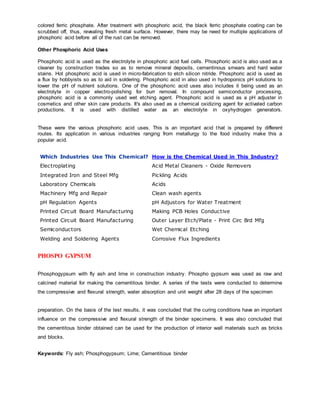
These were the various phosphoric acid uses. This is an important acid that is prepared by different
routes. Its application in various industries ranging from metallurgy to the food industry make this a
popular acid.
Which Industries Use This Chemical? How is the Chemical Used in This Industry?
Electroplating Acid Metal Cleaners - Oxide Removers
Integrated Iron and Steel Mfg Pickling Acids
Laboratory Chemicals Acids
Machinery Mfg and Repair Clean wash agents
pH Regulation Agents pH Adjustors for Water Treatment
Printed Circuit Board Manufacturing Making PCB Holes Conductive
Printed Circuit Board Manufacturing Outer Layer Etch/Plate - Print Circ Brd Mfg
Semiconductors Wet Chemical Etching
Welding and Soldering Agents Corrosive Flux Ingredients
PHOSPO GYPSUM
Phosphogypsum with fly ash and lime in construction industry. Phospho gypsum was used as raw and
calcined material for making the cementitous binder. A series of the tests were conducted to determine
the compressive and flexural strength, water absorption and unit weight after 28 days of the specimen
preparation. On the basis of the test results, it was concluded that the curing conditions have an important
influence on the compressive and flexural strength of the binder specimens. It was also concluded that
the cementitous binder obtained can be used for the production of interior wall materials such as bricks
and blocks.
Keywords: Fly ash; Phosphogypsum; Lime; Cementitious binder
As soil amendment in agriculture. This use was applied for a certain time period providing many
advantages to the fields ( excellent fertilizer source of calcium and sulphur ).
As refilling material in dead quarries of marbles. It was applied for a long time.
As road base construction material and as landfill cover after a preneutralization of the
acidity. These cases remained in the discussion phase.
As inert material (instead of the sea sand) in the N There are two ways for entering the gypsum into
fertilizer process:
Feeding it in the Preneutralizer where the fertilizer slurry is produced. This can be done also by feeding
the phosphoric slurry directly after the attack section.
Feeding it in the Granulator where normally the sand is fed.
The way, which will be chosen, depends on the process and the equipment arrangement of the
plant.PK fertilizers production.
Increasing the water content of the final fertilizer product (by about 0,2% H2O).
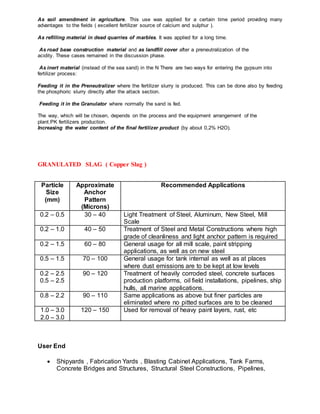
GRANULATED SLAG ( Copper Slag )
Particle
Size
(mm)
Approximate
Anchor
Pattern
(Microns)
Recommended Applications
0.2 – 0.5 30 – 40 Light Treatment of Steel, Aluminum, New Steel, Mill
Scale
0.2 – 1.0 40 – 50 Treatment of Steel and Metal Constructions where high
grade of cleanliness and light anchor pattern is required
0.2 – 1.5 60 – 80 General usage for all mill scale, paint stripping
applications, as well as on new steel
0.5 – 1.5 70 – 100 General usage for tank internal as well as at places
where dust emissions are to be kept at low levels
0.2 – 2.5
0.5 – 2.5
90 – 120 Treatment of heavily corroded steel, concrete surfaces
production platforms, oil field installations, pipelines, ship
hulls, all marine applications.
0.8 – 2.2 90 – 110 Same applications as above but finer particles are
eliminated where no pitted surfaces are to be cleaned
1.0 – 3.0
2.0 – 3.0
120 – 150 Used for removal of heavy paint layers, rust, etc
User End
 Shipyards , Fabrication Yards , Blasting Cabinet Applications, Tank Farms,
Concrete Bridges and Structures, Structural Steel Constructions, Pipelines,
Offshore and Onshore Applications, Chemical and Process Industries, Oil
Refineries and Platforms, Cement Industries, Power Plants, Marine Industry,
Foundries
ALUMINIUM SULPHATE ( Ferric & Non Ferric )
Aluminium sulfate is used in water purification and as a mordant in dyeing and printing textiles. In water
purification, it causes impurities to coagulate which are removed as the particulate settles to the bottom of
the container or more easily filtered. This process is called coagulation or flocculation.
When dissolved in a large amount of neutral or slightly-alkaline water, aluminium sulfate produces a
gelatinous precipitate of aluminium hydroxide, Al(OH)3. In dyeing and printing cloth, the gelatinous
precipitate helps the dye adhere to the clothing fibers by rendering the pigment insoluble.
Aluminium sulfate is sometimes used to reduce the pH of garden soil, as it hydrolyzes to form the
aluminium hydroxide precipitate and a dilute sulfuric acid solution. An example of what changing the pH
level of soil can do to plants is visible when looking at the Hydrangea macrophylla. The gardener can add
aluminium sulfate to the soil to reduce the pH level which in turn will result in the flowers of the Hydrangea
turning a different color.
Aluminium sulfate is the active ingredient of some antiperspirants; however, beginning in 2005 the US
Food and Drug Administration no longer recognized it as a wetness reducer.
Aluminium sulfate is usually found in baking powder, where there is controversy over its use due to
concern regarding the safety of adding aluminium to the diet.
In construction industry it is used as waterproofing agent and accelerator in concrete. Another use is a
foaming agent in fire fighting foam.
It is also used in styptic pencils, and pain relief from stings and bites.
It can also be very effective as a molluscicide, killing spanish slugs.
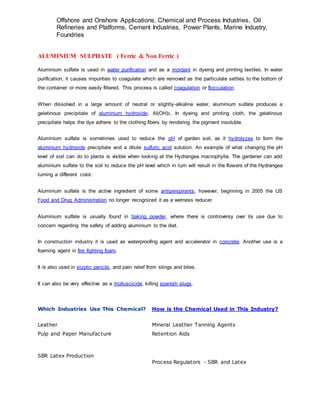
Which Industries Use This Chemical? How is the Chemical Used in This Industry?
Leather Mineral Leather Tanning Agents
Pulp and Paper Manufacture Retention Aids
SBR Latex Production
Process Regulators - SBR and Latex
HYDRO CHLORIC ACID ( HCL )
Hydrochloric acid is used for a large number of small-scale applications, such as leather
processing, household cleaning and building construction.
Oil production may be stimulated by injecting hydrochloric acid into the rock formation
of an oil well, dissolving a portion of the rock, and creating a large-pore structure. Oil
well acidizing is a common process in the North Sea oil production industry.
Many chemical reactions involving hydrochloric acid are applied in the production of
food, food ingredients, and food additives. Typical products include aspartame, fructose,
citric acid, lysine, hydrolyzed vegetable protein as food enhancer, and in gelatin
production. Food-grade (extra-pure) hydrochloric acid can be applied when needed for
the final product.
Hydrochloric acid is a strong inorganic acid that is used in many industrial processes. The
application often determines the required product quality.
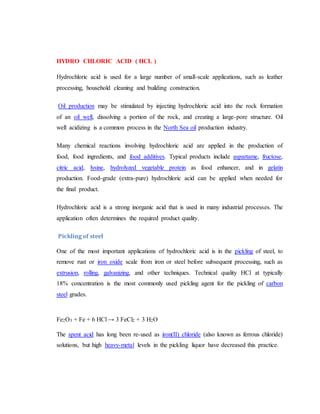
Pickling of steel
One of the most important applications of hydrochloric acid is in the pickling of steel, to
remove rust or iron oxide scale from iron or steel before subsequent processing, such as
extrusion, rolling, galvanizing, and other techniques. Technical quality HCl at typically
18% concentration is the most commonly used pickling agent for the pickling of carbon
steel grades.
Fe2O3 + Fe + 6 HCl → 3 FeCl2 + 3 H2O
The spent acid has long been re-used as iron(II) chloride (also known as ferrous chloride)
solutions, but high heavy-metal levels in the pickling liquor have decreased this practice.
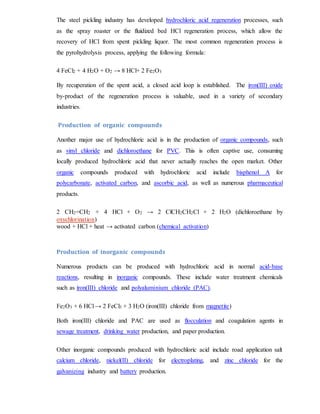
The steel pickling industry has developed hydrochloric acid regeneration processes, such
as the spray roaster or the fluidized bed HCl regeneration process, which allow the
recovery of HCl from spent pickling liquor. The most common regeneration process is
the pyrohydrolysis process, applying the following formula:
4 FeCl2 + 4 H2O + O2 → 8 HCl+ 2 Fe2O3
By recuperation of the spent acid, a closed acid loop is established. The iron(III) oxide
by-product of the regeneration process is valuable, used in a variety of secondary
industries.
Production of organic compounds
Another major use of hydrochloric acid is in the production of organic compounds, such
as vinyl chloride and dichloroethane for PVC. This is often captive use, consuming
locally produced hydrochloric acid that never actually reaches the open market. Other
organic compounds produced with hydrochloric acid include bisphenol A for
polycarbonate, activated carbon, and ascorbic acid, as well as numerous pharmaceutical
products.
2 CH2=CH2 + 4 HCl + O2 → 2 ClCH2CH2Cl + 2 H2O (dichloroethane by
oxychlorination)
wood + HCl + heat → activated carbon (chemical activation)
Production of inorganic compounds
Numerous products can be produced with hydrochloric acid in normal acid-base
reactions, resulting in inorganic compounds. These include water treatment chemicals
such as iron(III) chloride and polyaluminium chloride (PAC).
Fe2O3 + 6 HCl → 2 FeCl3 + 3 H2O (iron(III) chloride from magnetite)
Both iron(III) chloride and PAC are used as flocculation and coagulation agents in
sewage treatment, drinking water production, and paper production.
Other inorganic compounds produced with hydrochloric acid include road application salt
calcium chloride, nickel(II) chloride for electroplating, and zinc chloride for the
galvanizing industry and battery production.
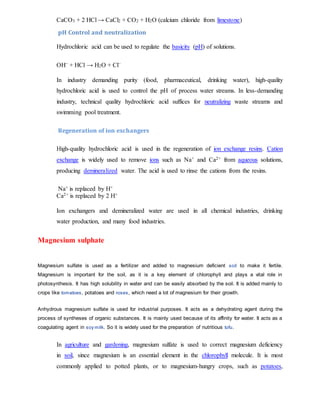
CaCO3 + 2 HCl → CaCl2 + CO2 + H2O (calcium chloride from limestone)
pH Control and neutralization
Hydrochloric acid can be used to regulate the basicity (pH) of solutions.
OH− + HCl → H2O + Cl−
In industry demanding purity (food, pharmaceutical, drinking water), high-quality
hydrochloric acid is used to control the pH of process water streams. In less-demanding
industry, technical quality hydrochloric acid suffices for neutralizing waste streams and
swimming pool treatment.
Regeneration of ion exchangers
High-quality hydrochloric acid is used in the regeneration of ion exchange resins. Cation
exchange is widely used to remove ions such as Na+ and Ca2+ from aqueous solutions,
producing demineralized water. The acid is used to rinse the cations from the resins.
Na+ is replaced by H+
Ca2+ is replaced by 2 H+
Ion exchangers and demineralized water are used in all chemical industries, drinking
water production, and many food industries.
Magnesium sulphate
Magnesium sulfate is used as a fertilizer and added to magnesium deficient soil to make it fertile.
Magnesium is important for the soil, as it is a key element of chlorophyll and plays a vital role in
photosynthesis. It has high solubility in water and can be easily absorbed by the soil. It is added mainly to
crops like tomatoes, potatoes and roses, which need a lot of magnesium for their growth.
Anhydrous magnesium sulfate is used for industrial purposes. It acts as a dehydrating agent during the
process of syntheses of organic substances. It is mainly used because of its affinity for water. It acts as a
coagulating agent in soy milk. So it is widely used for the preparation of nutritious tofu.
In agriculture and gardening, magnesium sulfate is used to correct magnesium deficiency
in soil, since magnesium is an essential element in the chlorophyll molecule. It is most
commonly applied to potted plants, or to magnesium-hungry crops, such as potatoes,
roses, tomatoes, peppers and cannabis. The advantage of magnesium sulfate over other
magnesium soil amendments (such as dolomitic lime) is its high solubility.
Anhydrous magnesium sulfate is commonly used as a desiccant in organic synthesis due
to its affinity for water. During work-up, an organic phase is saturated with magnesium
sulfate until it no longer forms clumps. The hydrated solid is then removed with filtration
or decantation. Other inorganic sulfate salts such as sodium sulfate and calcium sulfate
may also be used in the same way.
Magnesium sulfate is used in bath salts, particularly in flotation therapy where high
concentrations raise the bath water's specific gravity, effectively making the body more
buoyant. This property is also used to restore some Lava lamps damaged by being shaken
by exchanging the water and adding drops of a concentrated solution until sustainable
buoyancy is reached. Traditionally, it is also used to prepare foot baths, intended to
soothe sore feet. The reason for the inclusion of the salt is partially cosmetic: the increase
in ionic strength prevents some of the temporary skin wrinkling ("pruning" – partial
maceration) which is caused by prolonged immersion of extremities in pure water.
However, magnesium sulfate can also be absorbed into the skin, reducing inflammation.
It is also sometimes found in bottled mineral water, and accordingly is sometimes listed
in the contents thereof. It may also be used as a coagulant for making tofu.
Magnesium sulfate heptahydrate is also used to maintain the magnesium concentration in
marine aquaria which contain large amounts of stony corals as it is slowly depleted in
their calcification process. In a magnesium-deficient marine aquarium calcium and
alkalinity concentrations are very difficult to control because not enough magnesium is
present to stabilize these ions in the saltwater and prevent their spontaneous precipitation
into calcium carbonate.
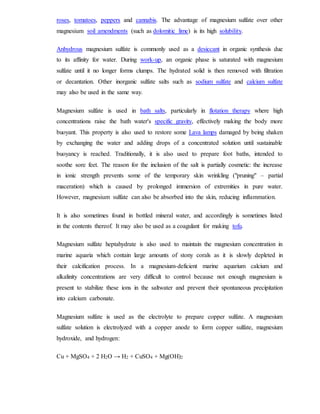
Magnesium sulfate is used as the electrolyte to prepare copper sulfate. A magnesium
sulfate solution is electrolyzed with a copper anode to form copper sulfate, magnesium
hydroxide, and hydrogen:
Cu + MgSO4 + 2 H2O → H2 + CuSO4 + Mg(OH)2
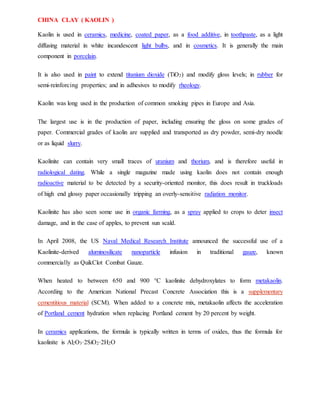
CHINA CLAY ( KAOLIN )
Kaolin is used in ceramics, medicine, coated paper, as a food additive, in toothpaste, as a light
diffusing material in white incandescent light bulbs, and in cosmetics. It is generally the main
component in porcelain.
It is also used in paint to extend titanium dioxide (TiO2) and modify gloss levels; in rubber for
semi-reinforcing properties; and in adhesives to modify rheology.
Kaolin was long used in the production of common smoking pipes in Europe and Asia.
The largest use is in the production of paper, including ensuring the gloss on some grades of
paper. Commercial grades of kaolin are supplied and transported as dry powder, semi-dry noodle
or as liquid slurry.
Kaolinite can contain very small traces of uranium and thorium, and is therefore useful in
radiological dating. While a single magazine made using kaolin does not contain enough
radioactive material to be detected by a security-oriented monitor, this does result in truckloads
of high end glossy paper occasionally tripping an overly-sensitive radiation monitor.
Kaolinite has also seen some use in organic farming, as a spray applied to crops to deter insect
damage, and in the case of apples, to prevent sun scald.
In April 2008, the US Naval Medical Research Institute announced the successful use of a
Kaolinite-derived aluminosilicate nanoparticle infusion in traditional gauze, known
commercially as QuikClot Combat Gauze.
When heated to between 650 and 900 °C kaolinite dehydroxylates to form metakaolin.
According to the American National Precast Concrete Association this is a supplementary
cementitious material (SCM). When added to a concrete mix, metakaolin affects the acceleration
of Portland cement hydration when replacing Portland cement by 20 percent by weight.
In ceramics applications, the formula is typically written in terms of oxides, thus the formula for
kaolinite is Al2O3·2SiO2·2H2O
This can be even written in a more compact way as AS2H2 using the cement chemist notation
(CCN) to represent the hereabove mentionned oxides respectively (A = Al2O3, S = SiO2, H =
H2O).
This format is also useful for describing the firing process of clay as the kaolinite loses the 2
water molecules, termed the chemical water, when fired to a high enough temperature. This is
different from clay's physical water which will be lost simply due to evaporation and is not a part
of the chemical formula.
Kaolin. (unknown scale)
A folk medicine use is to soothe an upset stomach, similar to the way parrots (and later, humans)
in South America originally used it.
Kaolin is, or has been, used as the active substance in liquid anti-diarrhea medicines such as
Kaomagma and Kaopectate. Such medicines were changed away from aluminium substances due
to a scare over Alzheimer's disease[citation needed], but have since changed back to compounds
containing aluminium as they are more effective.
Kaolin is known in traditional Chinese medicine by the name chìshízhī (赤石脂),[citation needed]
literally "crimson stone resin".
In Africa, kaolin is sometimes known as kalaba (in Gabon and Cameroon), calaba, and
calabachop (in Equatorial Guinea). It is used for facial masks or soap and is eaten for pleasure
or to suppress hunger, a practice known as geophagy. Consumption is greater among women,
especially during pregnancy.
This practice is also seen among African-American women in the Southern United States,
especially Georgia. There, the kaolin is called white dirt, chalk or white clay.
FERRIC SULPHATE - Liquid
It is used in dyeing as a mordant, and as a coagulant for industrial wastes. It is also used in
pigments, and in pickling baths for aluminum and steel. Medically it is used as an astringent and
styptic.
Some of the additional benefits for the use of ferric sulphate are:
* Precipitation of sulphur compounds.
* Increased efficiency in SS and BOD5 elimination.
* Reduction in energy consumption in the biological process.
* Lower corrosion and longer lifetime for the mechanical equipment in the plant compared to the
use of ferric chloride.
* Less maintenance work and expense at the plant.
BARYTES ( FOR OIL DRILLING )
Oil industry (84%)
Chemical - electronics, TV screen, glass, ceramics and medical applications (barium meals) (7%)
Fillers - car, rubber and paint industry, radiation shielding (9%)
Some 77% worldwide is used as a weighting agent for drilling fluids in oil and gas exploration.
Other uses are in added-value applications which include the car, electronics, TV screen, rubber,
and glass ceramics and paint industry, radiation shielding and medical applications (for example,
a barium meal before a contrast CAT scan). Baryte is supplied in a variety of forms and the price
depends on the amount of processing; filler applications commanding higher prices following
intense physical processing by grinding and micronising, and there are further premiums for
whiteness and brightness and color. Baryte is used in the manufacture of paints and paper.
Historically baryte was used for the production of barium hydroxide for sugar refining, and as a
white pigment for textiles, paper, and paint.
FREE FLOW SALT ( SODIUM CHLORIDE )
Apart from edible purpose, It would be difficult to list all of the thousands of industries that use salt
as a raw material or ingredient. The major industries include:
Textile and dyeing. Salt is used to fix dyes and to standardize dye batches
Metal processing, such as aluminum refining. Salt is used to remove impurities
Rubber manufacturing. Salt separates the rubber from latex
Oil and gas drilling. Salt is used to produce a drilling mud that prevents widening of bore holes in
rock salt strata, inhibits fermentation, and increases mud density
Pharmaceuticals. Salt is used for tablet and caplet polishing, the production of intraveneous saline
solutions and for manufacturing hemodialysis solutions used for kidney machines
Animal hide processing and leather tanning. Salt is used to cure, preserve, and tan hides
Pigment manufacture. Salt is a grinding agent
Ceramics manufacture. Salt acts to vitrify heated clays
Soap making. Salt separates glycerol from water
Detergent production. Salt is used as a filler.
Salting and tanning of skins – Chemical synthesis
USERS: Tanneries, Chemical industries, Steel works
Zootechnical feeding
USERS: Fodder factories,Agricultural factories, Farmers union – Retailers offertilizers and farming products.
Water softening
USERS: Dye, works, Laundry, Hospitals, Administration, Water softening plants
Domestic and industrial water softeners. It eliminates limestone from water increasing the
duration of domestic devices and water softening plants.
USERS: Restaurant, Hotels, Hospital, Communities, Swimming pools and industries.
Road deicing : Road maintenance societies, Local administration and municipalities.
Just a few of salt’s other industrial uses include.
 Windows, lenses and prisms and in high power laser systems (sodium chloride)
 In molten salt reactors to produce and separate transuranic elements (sodium chloride) - see
"further reading" to left
 In molten salt incineration of high explosives, propellants, and pyrotechnics (sodium chloride)
 In salt bath furnaces for a number of heat treatment applications such as: austenitizing,
martempering, neutral hardening, tempering nitriding, carburizing, and dip brazing (sodium
chloride)
 To generate electricity in salinity gradient solar ponds (sodium chloride)
 As an antifreeze agent in geothermal heating and cooling (sodium chloride)
 To combat greenhouse gases by sequestering industrial carbon/carbon dioxide underground
(sodium chloride)
CRYSTAL SALT ( Sodium chloride )
Same application which is mentioned for free flow salt
SOAP STONE POWDER
The soap stone powder is widely being used as basic material in Cosmetic and Paper industry
Application of Talc ( Soapstone powder ) in Plastic Industries
 Plastic Industry
Plastic industry consumes high quality ultra fine talc in polypropylene, polyamides, cable
PVC and other plastic compounds. Talc is being increasingly used in HDPE, PP, LDPE,
PVC, ABS & thermosetting compounds. It is excellent filler due to blending
characteristics and thermal and electrical resistant. It is chemically inert. It provides the
smooth feel to plastic surface. Due to its chemical inertness, superior electrical and
thermal resistance and other properties talc imparts stiffness, hardness, tensile strength of
plastic products, improves quality of their surfaces, gives them electrical, chemical and
thermal resistance.
 Application of Talc in Paint Industries
Talc is used in production of decorative paints, industrial coatings, pigment pastes,
primers, enamels, adhesives, putties and other products of the industry.
 Application of Soapstone powder (Talc) in Ceramics
In ceramics talc is used mostly as low cost filler in ceramic tiles, sanitary ware,
dinnerware, porcelain and electrical insulating.
 Application of Talc Powder in Pharmaceutical Industries
In pharmaceuticals talc is used as filler in tablets, ointments and dustings. Talc used in
this industry must be highly pure, bacteria free, must contain no iron oxide, dolomite,
carbon and other impurities.
 Paper industry
Talc is used in three stages of paper making -as a filler, to control pitch and stickiest and
in paper coating. During the paper making process, the micro impurities can clog the
paper machinery. Talc being hydrophobic absorbs these micro droplets thus controlling
their stickiness and avoiding clogging. High brightness of talc leads to reduction in usage
of expensive whitening agents and helps in controlling gloss of the coat. Talc gives
smoothness, yellow index, porosity, and opacity to paper, improves its yellow index and
reduces the deterioration of the machinery. Our grades of Talc powder are in wide range
for Paper industries.
 Other uses of talc
Besides all above uses Talc is also widely used in Toilet Soap manufacturing, Cosmetic
industries in baby talc powder, Detergent manufacturing, Dal mills (Pulses polishing),
Textile, Printing Ink, Rubber industry and as a filler raw material in many chemical
industries.
Ferrous sulfate hepta hydrate
It is used as a mordant in dyeing wool, in the manufacture of ink, in water purification as a
substitute for aluminum sulphate, as a fertilizer, and as a feed additive. It is also used to
produce magnetic ferric oxide.
. It is used as a lawn conditioner,and moss killer. See below for full details on application.
 Industrially, ferrous sulfate is mainly used as a precursor to other iron compounds.
 It is a reducing agent, mostly for the reduction of chromate in cement.
 Used in the manufacture of inks including iron gall ink.
 It is used a mordant for wool dyeing.
 Ferrous sulphate can also be used to stain concrete and some limestones and
sandstones a yellowish rust color.
 Woodworkers use ferrous sulfate solutions to color maple wood a silvery hue.
In horticulture it is used for treating iron chlorosis (yellowing of folliage caused by iron
deficiency). Although not as rapid-acting as iron chelate, its effects are longer-lasting. It
can be mixed with compost and dug into to the soil to create a store which can last for
years. Ferrous sulfate is sometimes added to the cooling water flowing through the brass
tubes of a turbine condenser. It forms a corrosion-resistant, protective coating on the
inside of the tube.
It has been applied for the purification of water by flocculation and for phosphate
removal in municipal and industrial sewage treatment plants to prevent eutrophication of
surface water bodies.
It is used as a traditional method of treating wood panel on houses, either alone
dissolved in water or as a component of water-based paint.
NEEM CAKE
Neem cake organic manure protects plant roots from nematodes, soil grubs and white ants
probably due to its content of the residual limonoids. It also acts as a natural fertilizer with
pesticidal properties. Neem cake is widely used in India to fertilize paddy, cotton and sugarcane.
Usage of neem cake have shown an increase in the dry matter in Tectona grandis (Teak), Acacia
nilotica (Gum Arabic), and other forest trees.
Neem seed cake also reduce alkalinity in soil, as it produces organic acids on decomposition.
Being totally natural, it is compatible with soil microbes, improves and rhizosphere microflora
and hence ensures fertility of the soil. Neem Cake improves the organic matter content of the
soil, helping improvement in soil texture, water holding capacity, soil aeration for better root
development.
Neem cake - Pest control application
Neem cake is effective in the management of insects and pests. The bitter principles of the soil
and cake have been reported to have seven types of activities (a) antifeedant (b) attractant
(c)repellent (d) insecticide (e) nematicide (f) growth disruptor and (g) antimicrobial.
The cake contains salannin, nimbin, azadirachtin and azadiradione as the major components. Of
these, azadirachtin and meliantriol are used as locust antifeedants while salannin is used as an
antifeedant for the housefly.
BANK DETAILS
Account name : VAIKASH EXIMS
Current A/c No : On request
Bankers : INDIAN BANK
Branch : Tuticorin ( Melur )
Bankers swift code : On request
RTGS / IFSC Code : On request
BSR Code : On request
MICR Code : On request
FEX Authorized dealer code : On request
Bankers address : Tuticorin ( Melur ) Branch,
92-N, Devarpuram Road,
Tuticorin – 628 001,
Tamil nadu, INDIA
IEC No: : On request
PAN No: : On request
TIN No: : On request
THANKING YOU

Product profile

  • 1.
    VAIKASH EXIMS 1/165, KathirvelNagar, Rajiv Nagar Extn. – West, Tuticorin – 628 008, T.N, INDIA Contacts : 91 94431 31190 / 91 82204 73596 vaikashexims@bsnl.in vaikashexims@yahoo.com Brief profile We are very happy to introduce ourselves as the exporter of various products from India. Our office is situated at Tuticorin. It is in Southern India. A well equipped sea port and domestic air port is available in Tuticorin. Moreover it is the industrialized city. Myself, K.K.Kumar has got enriched experience in the export field for more than 20 years. I am the outfit of M/s.Ramesh flowers Ltd – Tuticorin. It is the Asia’s No:1 dried flowers exporting unit. I worked there as a Head of the Department for customs, banking and field works departments from 1990 – 1995. In 1996, I started a new concern in the style of M/s.Flora Impex. It exports the dried flowers, potpourri, seashells, terracotta toys and the handicrafts items. In 2008, We started a separated wing for chemicals named as VAIKASH EXIMS. We are exporting our products to various destination of the world. Especially to Colombo – Sri lanka, Jebal ali – Dubai, Dammam – Kingdom of Saudi Arabia, Tema – Ghana, Lome – Togo, Djibouti and Addis ababa – Ethiopia, Durban – South Africa, Klang - Malaysia etc. Our main strength lies in our punctuality & quality. We request you to taste us in your business career. For further more you are free to ask and we will be pleased to clarify. Hope we will build a very strong business relationship in the upcoming days. We look forward to welcoming you to Vaikash exims. Thanking you and assuring you, Our best Co-operation and personnel attention at always, With many thanks & best regards, K.K.Kumar
  • 2.
    CERTIFICATIONS & AWARDS Ourproducts are International standard products. We got the following certifications for our products. 1. International Quality Rating System – Level 5 Certification 2. ISO 9002 Certification 3. TotalIntegrated ERP ( SAP R3 ) Business System 4. British SafetyAward 5. We are using UN approved packing cans for export. UN approval number: U/N 3H1/Y 1.82/100/1209 IND/1073076 OUR PRODUCTS 1. Sulphuric acid 2. Phosporic acid 3. Granulated slag 5. Aluminium sulphate ( Ferric & non-ferric ) 6. Hydro chloric acid 7. Magnesium sulphate 8. Ferric sulphate - Liquid 9. Neem Cake 11. Ferrous sulphate 12. Sulphonic acid 13. Nitric acid 14. Calcium hypo chloride 16.Calcium carbide 17. Ferrous sulphate heptha hydrate 18. Safety matches Minerals: 1. Dolomite 2. Quartz A and B grade in lumps, powder, & grits 3. Feldspar Potash and Sodium 4. Calcite powder 5. China Clay ( Kaolin ) 6. Lime stone, 7. Zeolite 8. Benotinte, and Benotinte Black granuales for bio fertilizer 9. Fullers earth powder for edible oil refinaries 10. Sodium bentonite 11. Phospo Gypsum 12. Barytes ( for oil drilling ) 13. Free flow salt and Crystal salt ( Sodium chloride ) 14. Soap stone powder ( Detergent grade and Ceramic grade ) 15. Sodium bi carbonate 16. Natural and Precipitated calcium carbonate
  • 3.
    CHEMICAL ANALYSIS REPORT SULPHURICACID Physical properties Color : Colorless Specific Gravity : 1.84 Chemical Properties Conforms to IS : 266:1977 ( Technical Grade ) H/2 SO/4 : 98% ( Min ) Residue on Ignition : 0.2% ( Max ) Iron : 0.05% ( Max ) Lead : 0.005% ( Max ) PHOSPORIC ACID ( 43% Concentration ) Physical Properties Colour : Light Brown Specfic Gravity : At 32` C 1.46 – 1.49 Chemical Properties P/2 O/5 : 42 – 45% Fe/2 O/3 : 0.5% ( Max ) A1/2 O/3 : 0.5% ( Max ) Ca O : 0.2% ( Max ) Fluoride as F : 2.0% ( Max ) Suspended solids : 1.0% ( Max ) Chloride as Cl : 0.02% ( Max ) Sulphate as SO/4 : 2.0% ( Max ) Magnesium as MgO : 0.5% ( Max ) PHOSPHORIC ACID ( 54% Concentration ) Physical Properties Colour : Darkish Brown
  • 4.
    Specfic Gravity :At 32` C 1.62 – 1.65 Chemical Properties P/2 O/5 : 52 – 54% Fe/2 O/3 : 0.5% ( Max ) A1/2 O/3 : 0.5% ( Max ) Ca O : 0.2% ( Max ) Fluoride as F : 1.0% ( Max ) Suspended solids : 1.0% ( Max ) Chloride as Cl : 0.02% ( Max ) Sulphate as SO/4 : 2.5% ( Max ) Magnesium as MgO : 0.5% ( Max ) PHOSPHO GYPSUM Physical properties Color : White Chemical properties MOISTURE 10% - 15% ANALYSIS AFTER DRYING:- CALCIUM AS CaO %W/W 32.80 SULPHATE AS SO3 “ 45.80 TOTAL PHOSPHATE AS P2O5 “ 0.30 WATER SOLUBLE PHOSPHATE AS P2O5 “ 0.08 TOTAL FLUORIDE AS F “ 0.46 WATER OF HYDRATION “ 19.50 MAGNESIUM AS MgO “ 0.10 SODIUM AS Na20 “ 0.10 POTASSIUM AS K2O “ 0.04 IRON AS Fe203 “ 0.01 ALUMINIUM AS A1203 “ 0.08
  • 5.
    SILICA AS SiO2“ 1.20 CLORIDE AS C1 “ 0.004 ORGANIC MATTER “ 0.15 Ph of 1 % SOLUTION “ 5.60 GRANULATED COPPER SLAG Physical properties Colour : Black Sieve Analysis ( BSS ) Size in mm Value Units > 3.35 1 - 4 % > 3.35 – 1.00 30 – 45 % 1.00 – 0.50 25 – 35 % 0.50 – 0.20 15 – 25 % < 0.20 1 – 3 % Chemical properties Iron : 40 – 48 % Silica : 27 – 33 % Calcium oxide : 1.0 – 3.5 % Sulphur : 0.2 – 1.5 % Copper : < 1.0 % Aluminium oxide : < 3.0 % Fe3 O4 : < 10.0 % Analysis report for free flow salt: 200 PPM Ca - 0.072 % Mg - 0.017 % Insolubles - 0.12 % Moisture - 0.125 % NaCl - 99.5 % TOTAL HARDNESS - 200 PPM
  • 6.
    PARTICLE SIZE + 1000- 3.5 % + 850 - 4.0 % + 180 - 81.5 % - 180 - 11.0 % Aluminium sulphate Al 2 So4 ( Grey ) Ferric : Alumina content: 14% Iron contents: Point 7 % - Point 9% Water insoluble matter 0.7% MagnesiumSulphate ( Heptahydrate ) General Specifications: Purity as MgSo4 7H2O > 99% to 99.5% Magnesium Sulphate as MgSo4 > 48.5% Magnesium Oxide as MgO > 16% - 17% Magnesium as Mg > 9.6% PH of 5% aqueous solution 7 + 0.5 Sulphates of K and Ca < 0.1% each Chlorides of K and Ca < 0.1% each Chlorides of Cl < 300 ppm Heavy metals as Pb < 2 ppm Arsenic as As2 O3 < 2 ppm Iron as Fe < 20 ppm Calcium as Ca < 300 ppm Octyldecylamin 0.01%(100pp m
  • 7.
    Hydro Chloric Acid( HCL ) Hydrochloric Acid Product Name Hydrochloric Acid Synonyms Muriatic Acid, Hydrogen Chloride, Aqueous Formula HCL Molecular Weight 36.46 Properties Colorless fuming Liquid, Pungent odor of Hydrogen Chloride, Infinite in water with slight evolution of heat. CAS No / IMDG No 7647-01-0 / 8183 UN No. 1789 H.S.Code 2806 10 00 Product Quality Specifications GuaranteedSales Specifications Components Guaranteed Analysis Hydrochloric Acid % by wt. 32.0% min Specific Gravity at 25 deg C 1.15 – 1.16 Residue on Ignition % by wt 0.1% max Sulphate (As H2SO4) 0.1% max Iron (As Fe) 15 ppm Free Chlorine (As Chlorine) 10 ppm Freezing Point 66 deg C Boiling Point 108.6 deg C Label Corrosive, Class 8 Other Component and Properties Appearance Light yellow Particle Size Liquid Form Packing 260 kg Plastic Drum or as per requirement Uses / Application This grade is used for Chemicals industries Nitric acid U.N.NO 2632 Chemical Formula HNo3 Physical property : Clear liquid giving white to yellowish fumes.
  • 8.
    Chemical Property: NitricAcid 68%. Acidity as HN03 58% +/- 0.5%. Nitrogen Oxide as (HN02) % by Mass Max. 0.1. Chloride as (Cl) % by Mass Max. 0.002. Sulphate as (H2SO4) % by Mass Max. 0.005. Residue in ignition % by Mass Max.0.05. Sp.Gr. 1.40. Chemical property: Nitric Acid 58%. Acidity as HNO3 60% +/- 0.5%. Nitrogen Oxide as (HNO2) % by Mass Max. 0.5. Chloride as (Cl) % by Mass Max. 0.03. Residue in ignition % by Mass Max. 0.1. Heavy metal as Pb pass the test. Ferrous sulphate hepthahydrate Parameters Specification Purity as FSH % 98.50 Min Ferrous iron % 19.84 Min Ferric iron % 0.20 Max Free acidity 0.25 Max pH of 5% solution 2.80 – 3.30 Moisture content 0.50 Max Usage of the above chemicals SULPHURIC ACID Sulphuric acid is used on a very large scale. It is used in paints and dyes, making detergents, fertilizers like ammonium sulphate and phosphate fertilizers, as an acid in a car battery, as a dehydrating agent, leather tanning, mining industry, explosive, synthetic rubber, as a catalyst, in metal handling and anodizing and also to evaluate the economic expansion. It is extensively used in the chemical industry under the control of 1986 Pesticides Regulations; Sulphuric acid is used as a farming desiccant on peas, corns, potatoes and bulbs. PHOSPORIC ACID Removal of Rust One of the most common phosphoric acid uses is to remove rust from surfaces of metals. Phosphoric acid can be used as a rust converter with the help of direct application to rusted iron, or steel tools and other rusted surfaces. The phosphoric acid converts reddish-brown iron, that is, ferric oxide to black
  • 9.
    colored ferric phosphate.After treatment with phosphoric acid, the black ferric phosphate coating can be scrubbed off, thus, revealing fresh metal surface. However, there may be need for multiple applications of phosphoric acid before all of the rust can be removed. Other Phosphoric Acid Uses Phosphoric acid is used as the electrolyte in phosphoric acid fuel cells. Phosphoric acid is also used as a cleaner by construction trades so as to remove mineral deposits, cementinous smears and hard water stains. Hot phosphoric acid is used in micro-fabrication to etch silicon nitride. Phosphoric acid is used as a flux by hobbyists so as to aid in soldering. Phosphoric acid in also used in hydroponics pH solutions to lower the pH of nutrient solutions. One of the phosphoric acid uses also includes it being used as an electrolyte in copper electro-polishing for burr removal. In compound semiconductor processing, phosphoric acid is a commonly used wet etching agent. Phosphoric acid is used as a pH adjuster in cosmetics and other skin care products. It's also used as a chemical oxidizing agent for activated carbon productions. It is used with distilled water as an electrolyte in oxyhydrogen generators. These were the various phosphoric acid uses. This is an important acid that is prepared by different routes. Its application in various industries ranging from metallurgy to the food industry make this a popular acid. Which Industries Use This Chemical? How is the Chemical Used in This Industry? Electroplating Acid Metal Cleaners - Oxide Removers Integrated Iron and Steel Mfg Pickling Acids Laboratory Chemicals Acids Machinery Mfg and Repair Clean wash agents pH Regulation Agents pH Adjustors for Water Treatment Printed Circuit Board Manufacturing Making PCB Holes Conductive Printed Circuit Board Manufacturing Outer Layer Etch/Plate - Print Circ Brd Mfg Semiconductors Wet Chemical Etching Welding and Soldering Agents Corrosive Flux Ingredients PHOSPO GYPSUM Phosphogypsum with fly ash and lime in construction industry. Phospho gypsum was used as raw and calcined material for making the cementitous binder. A series of the tests were conducted to determine the compressive and flexural strength, water absorption and unit weight after 28 days of the specimen preparation. On the basis of the test results, it was concluded that the curing conditions have an important influence on the compressive and flexural strength of the binder specimens. It was also concluded that the cementitous binder obtained can be used for the production of interior wall materials such as bricks and blocks. Keywords: Fly ash; Phosphogypsum; Lime; Cementitious binder
  • 10.
    As soil amendmentin agriculture. This use was applied for a certain time period providing many advantages to the fields ( excellent fertilizer source of calcium and sulphur ). As refilling material in dead quarries of marbles. It was applied for a long time. As road base construction material and as landfill cover after a preneutralization of the acidity. These cases remained in the discussion phase. As inert material (instead of the sea sand) in the N There are two ways for entering the gypsum into fertilizer process: Feeding it in the Preneutralizer where the fertilizer slurry is produced. This can be done also by feeding the phosphoric slurry directly after the attack section. Feeding it in the Granulator where normally the sand is fed. The way, which will be chosen, depends on the process and the equipment arrangement of the plant.PK fertilizers production. Increasing the water content of the final fertilizer product (by about 0,2% H2O). GRANULATED SLAG ( Copper Slag ) Particle Size (mm) Approximate Anchor Pattern (Microns) Recommended Applications 0.2 – 0.5 30 – 40 Light Treatment of Steel, Aluminum, New Steel, Mill Scale 0.2 – 1.0 40 – 50 Treatment of Steel and Metal Constructions where high grade of cleanliness and light anchor pattern is required 0.2 – 1.5 60 – 80 General usage for all mill scale, paint stripping applications, as well as on new steel 0.5 – 1.5 70 – 100 General usage for tank internal as well as at places where dust emissions are to be kept at low levels 0.2 – 2.5 0.5 – 2.5 90 – 120 Treatment of heavily corroded steel, concrete surfaces production platforms, oil field installations, pipelines, ship hulls, all marine applications. 0.8 – 2.2 90 – 110 Same applications as above but finer particles are eliminated where no pitted surfaces are to be cleaned 1.0 – 3.0 2.0 – 3.0 120 – 150 Used for removal of heavy paint layers, rust, etc User End  Shipyards , Fabrication Yards , Blasting Cabinet Applications, Tank Farms, Concrete Bridges and Structures, Structural Steel Constructions, Pipelines,
  • 11.
    Offshore and OnshoreApplications, Chemical and Process Industries, Oil Refineries and Platforms, Cement Industries, Power Plants, Marine Industry, Foundries ALUMINIUM SULPHATE ( Ferric & Non Ferric ) Aluminium sulfate is used in water purification and as a mordant in dyeing and printing textiles. In water purification, it causes impurities to coagulate which are removed as the particulate settles to the bottom of the container or more easily filtered. This process is called coagulation or flocculation. When dissolved in a large amount of neutral or slightly-alkaline water, aluminium sulfate produces a gelatinous precipitate of aluminium hydroxide, Al(OH)3. In dyeing and printing cloth, the gelatinous precipitate helps the dye adhere to the clothing fibers by rendering the pigment insoluble. Aluminium sulfate is sometimes used to reduce the pH of garden soil, as it hydrolyzes to form the aluminium hydroxide precipitate and a dilute sulfuric acid solution. An example of what changing the pH level of soil can do to plants is visible when looking at the Hydrangea macrophylla. The gardener can add aluminium sulfate to the soil to reduce the pH level which in turn will result in the flowers of the Hydrangea turning a different color. Aluminium sulfate is the active ingredient of some antiperspirants; however, beginning in 2005 the US Food and Drug Administration no longer recognized it as a wetness reducer. Aluminium sulfate is usually found in baking powder, where there is controversy over its use due to concern regarding the safety of adding aluminium to the diet. In construction industry it is used as waterproofing agent and accelerator in concrete. Another use is a foaming agent in fire fighting foam. It is also used in styptic pencils, and pain relief from stings and bites. It can also be very effective as a molluscicide, killing spanish slugs. Which Industries Use This Chemical? How is the Chemical Used in This Industry? Leather Mineral Leather Tanning Agents Pulp and Paper Manufacture Retention Aids SBR Latex Production Process Regulators - SBR and Latex
  • 12.
    HYDRO CHLORIC ACID( HCL ) Hydrochloric acid is used for a large number of small-scale applications, such as leather processing, household cleaning and building construction. Oil production may be stimulated by injecting hydrochloric acid into the rock formation of an oil well, dissolving a portion of the rock, and creating a large-pore structure. Oil well acidizing is a common process in the North Sea oil production industry. Many chemical reactions involving hydrochloric acid are applied in the production of food, food ingredients, and food additives. Typical products include aspartame, fructose, citric acid, lysine, hydrolyzed vegetable protein as food enhancer, and in gelatin production. Food-grade (extra-pure) hydrochloric acid can be applied when needed for the final product. Hydrochloric acid is a strong inorganic acid that is used in many industrial processes. The application often determines the required product quality. Pickling of steel One of the most important applications of hydrochloric acid is in the pickling of steel, to remove rust or iron oxide scale from iron or steel before subsequent processing, such as extrusion, rolling, galvanizing, and other techniques. Technical quality HCl at typically 18% concentration is the most commonly used pickling agent for the pickling of carbon steel grades. Fe2O3 + Fe + 6 HCl → 3 FeCl2 + 3 H2O The spent acid has long been re-used as iron(II) chloride (also known as ferrous chloride) solutions, but high heavy-metal levels in the pickling liquor have decreased this practice.
  • 13.
    The steel picklingindustry has developed hydrochloric acid regeneration processes, such as the spray roaster or the fluidized bed HCl regeneration process, which allow the recovery of HCl from spent pickling liquor. The most common regeneration process is the pyrohydrolysis process, applying the following formula: 4 FeCl2 + 4 H2O + O2 → 8 HCl+ 2 Fe2O3 By recuperation of the spent acid, a closed acid loop is established. The iron(III) oxide by-product of the regeneration process is valuable, used in a variety of secondary industries. Production of organic compounds Another major use of hydrochloric acid is in the production of organic compounds, such as vinyl chloride and dichloroethane for PVC. This is often captive use, consuming locally produced hydrochloric acid that never actually reaches the open market. Other organic compounds produced with hydrochloric acid include bisphenol A for polycarbonate, activated carbon, and ascorbic acid, as well as numerous pharmaceutical products. 2 CH2=CH2 + 4 HCl + O2 → 2 ClCH2CH2Cl + 2 H2O (dichloroethane by oxychlorination) wood + HCl + heat → activated carbon (chemical activation) Production of inorganic compounds Numerous products can be produced with hydrochloric acid in normal acid-base reactions, resulting in inorganic compounds. These include water treatment chemicals such as iron(III) chloride and polyaluminium chloride (PAC). Fe2O3 + 6 HCl → 2 FeCl3 + 3 H2O (iron(III) chloride from magnetite) Both iron(III) chloride and PAC are used as flocculation and coagulation agents in sewage treatment, drinking water production, and paper production. Other inorganic compounds produced with hydrochloric acid include road application salt calcium chloride, nickel(II) chloride for electroplating, and zinc chloride for the galvanizing industry and battery production.
  • 14.
    CaCO3 + 2HCl → CaCl2 + CO2 + H2O (calcium chloride from limestone) pH Control and neutralization Hydrochloric acid can be used to regulate the basicity (pH) of solutions. OH− + HCl → H2O + Cl− In industry demanding purity (food, pharmaceutical, drinking water), high-quality hydrochloric acid is used to control the pH of process water streams. In less-demanding industry, technical quality hydrochloric acid suffices for neutralizing waste streams and swimming pool treatment. Regeneration of ion exchangers High-quality hydrochloric acid is used in the regeneration of ion exchange resins. Cation exchange is widely used to remove ions such as Na+ and Ca2+ from aqueous solutions, producing demineralized water. The acid is used to rinse the cations from the resins. Na+ is replaced by H+ Ca2+ is replaced by 2 H+ Ion exchangers and demineralized water are used in all chemical industries, drinking water production, and many food industries. Magnesium sulphate Magnesium sulfate is used as a fertilizer and added to magnesium deficient soil to make it fertile. Magnesium is important for the soil, as it is a key element of chlorophyll and plays a vital role in photosynthesis. It has high solubility in water and can be easily absorbed by the soil. It is added mainly to crops like tomatoes, potatoes and roses, which need a lot of magnesium for their growth. Anhydrous magnesium sulfate is used for industrial purposes. It acts as a dehydrating agent during the process of syntheses of organic substances. It is mainly used because of its affinity for water. It acts as a coagulating agent in soy milk. So it is widely used for the preparation of nutritious tofu. In agriculture and gardening, magnesium sulfate is used to correct magnesium deficiency in soil, since magnesium is an essential element in the chlorophyll molecule. It is most commonly applied to potted plants, or to magnesium-hungry crops, such as potatoes,
  • 15.
    roses, tomatoes, peppersand cannabis. The advantage of magnesium sulfate over other magnesium soil amendments (such as dolomitic lime) is its high solubility. Anhydrous magnesium sulfate is commonly used as a desiccant in organic synthesis due to its affinity for water. During work-up, an organic phase is saturated with magnesium sulfate until it no longer forms clumps. The hydrated solid is then removed with filtration or decantation. Other inorganic sulfate salts such as sodium sulfate and calcium sulfate may also be used in the same way. Magnesium sulfate is used in bath salts, particularly in flotation therapy where high concentrations raise the bath water's specific gravity, effectively making the body more buoyant. This property is also used to restore some Lava lamps damaged by being shaken by exchanging the water and adding drops of a concentrated solution until sustainable buoyancy is reached. Traditionally, it is also used to prepare foot baths, intended to soothe sore feet. The reason for the inclusion of the salt is partially cosmetic: the increase in ionic strength prevents some of the temporary skin wrinkling ("pruning" – partial maceration) which is caused by prolonged immersion of extremities in pure water. However, magnesium sulfate can also be absorbed into the skin, reducing inflammation. It is also sometimes found in bottled mineral water, and accordingly is sometimes listed in the contents thereof. It may also be used as a coagulant for making tofu. Magnesium sulfate heptahydrate is also used to maintain the magnesium concentration in marine aquaria which contain large amounts of stony corals as it is slowly depleted in their calcification process. In a magnesium-deficient marine aquarium calcium and alkalinity concentrations are very difficult to control because not enough magnesium is present to stabilize these ions in the saltwater and prevent their spontaneous precipitation into calcium carbonate. Magnesium sulfate is used as the electrolyte to prepare copper sulfate. A magnesium sulfate solution is electrolyzed with a copper anode to form copper sulfate, magnesium hydroxide, and hydrogen: Cu + MgSO4 + 2 H2O → H2 + CuSO4 + Mg(OH)2
  • 16.
    CHINA CLAY (KAOLIN ) Kaolin is used in ceramics, medicine, coated paper, as a food additive, in toothpaste, as a light diffusing material in white incandescent light bulbs, and in cosmetics. It is generally the main component in porcelain. It is also used in paint to extend titanium dioxide (TiO2) and modify gloss levels; in rubber for semi-reinforcing properties; and in adhesives to modify rheology. Kaolin was long used in the production of common smoking pipes in Europe and Asia. The largest use is in the production of paper, including ensuring the gloss on some grades of paper. Commercial grades of kaolin are supplied and transported as dry powder, semi-dry noodle or as liquid slurry. Kaolinite can contain very small traces of uranium and thorium, and is therefore useful in radiological dating. While a single magazine made using kaolin does not contain enough radioactive material to be detected by a security-oriented monitor, this does result in truckloads of high end glossy paper occasionally tripping an overly-sensitive radiation monitor. Kaolinite has also seen some use in organic farming, as a spray applied to crops to deter insect damage, and in the case of apples, to prevent sun scald. In April 2008, the US Naval Medical Research Institute announced the successful use of a Kaolinite-derived aluminosilicate nanoparticle infusion in traditional gauze, known commercially as QuikClot Combat Gauze. When heated to between 650 and 900 °C kaolinite dehydroxylates to form metakaolin. According to the American National Precast Concrete Association this is a supplementary cementitious material (SCM). When added to a concrete mix, metakaolin affects the acceleration of Portland cement hydration when replacing Portland cement by 20 percent by weight. In ceramics applications, the formula is typically written in terms of oxides, thus the formula for kaolinite is Al2O3·2SiO2·2H2O
  • 17.
    This can beeven written in a more compact way as AS2H2 using the cement chemist notation (CCN) to represent the hereabove mentionned oxides respectively (A = Al2O3, S = SiO2, H = H2O). This format is also useful for describing the firing process of clay as the kaolinite loses the 2 water molecules, termed the chemical water, when fired to a high enough temperature. This is different from clay's physical water which will be lost simply due to evaporation and is not a part of the chemical formula. Kaolin. (unknown scale) A folk medicine use is to soothe an upset stomach, similar to the way parrots (and later, humans) in South America originally used it. Kaolin is, or has been, used as the active substance in liquid anti-diarrhea medicines such as Kaomagma and Kaopectate. Such medicines were changed away from aluminium substances due to a scare over Alzheimer's disease[citation needed], but have since changed back to compounds containing aluminium as they are more effective. Kaolin is known in traditional Chinese medicine by the name chìshízhī (赤石脂),[citation needed] literally "crimson stone resin". In Africa, kaolin is sometimes known as kalaba (in Gabon and Cameroon), calaba, and calabachop (in Equatorial Guinea). It is used for facial masks or soap and is eaten for pleasure or to suppress hunger, a practice known as geophagy. Consumption is greater among women, especially during pregnancy. This practice is also seen among African-American women in the Southern United States, especially Georgia. There, the kaolin is called white dirt, chalk or white clay. FERRIC SULPHATE - Liquid It is used in dyeing as a mordant, and as a coagulant for industrial wastes. It is also used in pigments, and in pickling baths for aluminum and steel. Medically it is used as an astringent and styptic.
  • 18.
    Some of theadditional benefits for the use of ferric sulphate are: * Precipitation of sulphur compounds. * Increased efficiency in SS and BOD5 elimination. * Reduction in energy consumption in the biological process. * Lower corrosion and longer lifetime for the mechanical equipment in the plant compared to the use of ferric chloride. * Less maintenance work and expense at the plant. BARYTES ( FOR OIL DRILLING ) Oil industry (84%) Chemical - electronics, TV screen, glass, ceramics and medical applications (barium meals) (7%) Fillers - car, rubber and paint industry, radiation shielding (9%) Some 77% worldwide is used as a weighting agent for drilling fluids in oil and gas exploration. Other uses are in added-value applications which include the car, electronics, TV screen, rubber, and glass ceramics and paint industry, radiation shielding and medical applications (for example, a barium meal before a contrast CAT scan). Baryte is supplied in a variety of forms and the price depends on the amount of processing; filler applications commanding higher prices following intense physical processing by grinding and micronising, and there are further premiums for whiteness and brightness and color. Baryte is used in the manufacture of paints and paper. Historically baryte was used for the production of barium hydroxide for sugar refining, and as a white pigment for textiles, paper, and paint. FREE FLOW SALT ( SODIUM CHLORIDE ) Apart from edible purpose, It would be difficult to list all of the thousands of industries that use salt as a raw material or ingredient. The major industries include: Textile and dyeing. Salt is used to fix dyes and to standardize dye batches Metal processing, such as aluminum refining. Salt is used to remove impurities
  • 19.
    Rubber manufacturing. Saltseparates the rubber from latex Oil and gas drilling. Salt is used to produce a drilling mud that prevents widening of bore holes in rock salt strata, inhibits fermentation, and increases mud density Pharmaceuticals. Salt is used for tablet and caplet polishing, the production of intraveneous saline solutions and for manufacturing hemodialysis solutions used for kidney machines Animal hide processing and leather tanning. Salt is used to cure, preserve, and tan hides Pigment manufacture. Salt is a grinding agent Ceramics manufacture. Salt acts to vitrify heated clays Soap making. Salt separates glycerol from water Detergent production. Salt is used as a filler. Salting and tanning of skins – Chemical synthesis USERS: Tanneries, Chemical industries, Steel works Zootechnical feeding USERS: Fodder factories,Agricultural factories, Farmers union – Retailers offertilizers and farming products. Water softening USERS: Dye, works, Laundry, Hospitals, Administration, Water softening plants Domestic and industrial water softeners. It eliminates limestone from water increasing the duration of domestic devices and water softening plants. USERS: Restaurant, Hotels, Hospital, Communities, Swimming pools and industries. Road deicing : Road maintenance societies, Local administration and municipalities. Just a few of salt’s other industrial uses include.  Windows, lenses and prisms and in high power laser systems (sodium chloride)  In molten salt reactors to produce and separate transuranic elements (sodium chloride) - see "further reading" to left
  • 20.
     In moltensalt incineration of high explosives, propellants, and pyrotechnics (sodium chloride)  In salt bath furnaces for a number of heat treatment applications such as: austenitizing, martempering, neutral hardening, tempering nitriding, carburizing, and dip brazing (sodium chloride)  To generate electricity in salinity gradient solar ponds (sodium chloride)  As an antifreeze agent in geothermal heating and cooling (sodium chloride)  To combat greenhouse gases by sequestering industrial carbon/carbon dioxide underground (sodium chloride) CRYSTAL SALT ( Sodium chloride ) Same application which is mentioned for free flow salt SOAP STONE POWDER The soap stone powder is widely being used as basic material in Cosmetic and Paper industry Application of Talc ( Soapstone powder ) in Plastic Industries  Plastic Industry Plastic industry consumes high quality ultra fine talc in polypropylene, polyamides, cable PVC and other plastic compounds. Talc is being increasingly used in HDPE, PP, LDPE, PVC, ABS & thermosetting compounds. It is excellent filler due to blending characteristics and thermal and electrical resistant. It is chemically inert. It provides the smooth feel to plastic surface. Due to its chemical inertness, superior electrical and thermal resistance and other properties talc imparts stiffness, hardness, tensile strength of plastic products, improves quality of their surfaces, gives them electrical, chemical and thermal resistance.  Application of Talc in Paint Industries Talc is used in production of decorative paints, industrial coatings, pigment pastes, primers, enamels, adhesives, putties and other products of the industry.  Application of Soapstone powder (Talc) in Ceramics In ceramics talc is used mostly as low cost filler in ceramic tiles, sanitary ware, dinnerware, porcelain and electrical insulating.  Application of Talc Powder in Pharmaceutical Industries
  • 21.
    In pharmaceuticals talcis used as filler in tablets, ointments and dustings. Talc used in this industry must be highly pure, bacteria free, must contain no iron oxide, dolomite, carbon and other impurities.  Paper industry Talc is used in three stages of paper making -as a filler, to control pitch and stickiest and in paper coating. During the paper making process, the micro impurities can clog the paper machinery. Talc being hydrophobic absorbs these micro droplets thus controlling their stickiness and avoiding clogging. High brightness of talc leads to reduction in usage of expensive whitening agents and helps in controlling gloss of the coat. Talc gives smoothness, yellow index, porosity, and opacity to paper, improves its yellow index and reduces the deterioration of the machinery. Our grades of Talc powder are in wide range for Paper industries.  Other uses of talc Besides all above uses Talc is also widely used in Toilet Soap manufacturing, Cosmetic industries in baby talc powder, Detergent manufacturing, Dal mills (Pulses polishing), Textile, Printing Ink, Rubber industry and as a filler raw material in many chemical industries. Ferrous sulfate hepta hydrate It is used as a mordant in dyeing wool, in the manufacture of ink, in water purification as a substitute for aluminum sulphate, as a fertilizer, and as a feed additive. It is also used to produce magnetic ferric oxide. . It is used as a lawn conditioner,and moss killer. See below for full details on application.  Industrially, ferrous sulfate is mainly used as a precursor to other iron compounds.  It is a reducing agent, mostly for the reduction of chromate in cement.  Used in the manufacture of inks including iron gall ink.  It is used a mordant for wool dyeing.  Ferrous sulphate can also be used to stain concrete and some limestones and sandstones a yellowish rust color.  Woodworkers use ferrous sulfate solutions to color maple wood a silvery hue. In horticulture it is used for treating iron chlorosis (yellowing of folliage caused by iron deficiency). Although not as rapid-acting as iron chelate, its effects are longer-lasting. It can be mixed with compost and dug into to the soil to create a store which can last for years. Ferrous sulfate is sometimes added to the cooling water flowing through the brass tubes of a turbine condenser. It forms a corrosion-resistant, protective coating on the inside of the tube. It has been applied for the purification of water by flocculation and for phosphate removal in municipal and industrial sewage treatment plants to prevent eutrophication of
  • 22.
    surface water bodies. Itis used as a traditional method of treating wood panel on houses, either alone dissolved in water or as a component of water-based paint. NEEM CAKE Neem cake organic manure protects plant roots from nematodes, soil grubs and white ants probably due to its content of the residual limonoids. It also acts as a natural fertilizer with pesticidal properties. Neem cake is widely used in India to fertilize paddy, cotton and sugarcane. Usage of neem cake have shown an increase in the dry matter in Tectona grandis (Teak), Acacia nilotica (Gum Arabic), and other forest trees. Neem seed cake also reduce alkalinity in soil, as it produces organic acids on decomposition. Being totally natural, it is compatible with soil microbes, improves and rhizosphere microflora and hence ensures fertility of the soil. Neem Cake improves the organic matter content of the soil, helping improvement in soil texture, water holding capacity, soil aeration for better root development. Neem cake - Pest control application Neem cake is effective in the management of insects and pests. The bitter principles of the soil and cake have been reported to have seven types of activities (a) antifeedant (b) attractant (c)repellent (d) insecticide (e) nematicide (f) growth disruptor and (g) antimicrobial. The cake contains salannin, nimbin, azadirachtin and azadiradione as the major components. Of these, azadirachtin and meliantriol are used as locust antifeedants while salannin is used as an antifeedant for the housefly. BANK DETAILS Account name : VAIKASH EXIMS Current A/c No : On request
  • 23.
    Bankers : INDIANBANK Branch : Tuticorin ( Melur ) Bankers swift code : On request RTGS / IFSC Code : On request BSR Code : On request MICR Code : On request FEX Authorized dealer code : On request Bankers address : Tuticorin ( Melur ) Branch, 92-N, Devarpuram Road, Tuticorin – 628 001, Tamil nadu, INDIA IEC No: : On request PAN No: : On request TIN No: : On request THANKING YOU