PRODUCT
HIERARCHY
Organizational chart that depicts the array of products
offered in a given market.
Product Classification
 Durability and Tangibility
 Non Durables
Durables
Services
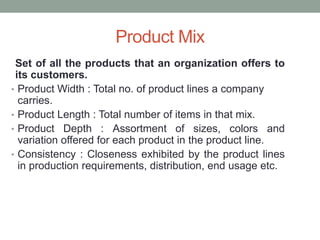
Product Mix
Set of all the products that an organization offers to
its customers.
• Product Width : Total no. of product lines a company
carries.
• Product Length : Total number of items in that mix.
• Product Depth : Assortment of sizes, colors and
variation offered for each product in the product line.
• Consistency : Closeness exhibited by the product lines
in production requirements, distribution, end usage etc.
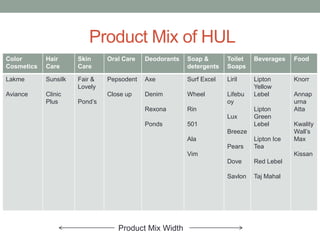
Product Mix of HUL
Color
Cosmetics
Hair
Care
Skin
Care
Oral Care Deodorants Soap &
detergents
Toilet
Soaps
Beverages Food
Lakme
Aviance
Sunsilk
Clinic
Plus
Fair &
Lovely
Pond’s
Pepsodent
Close up
Axe
Denim
Rexona
Ponds
Surf Excel
Wheel
Rin
501
Ala
Vim
Liril
Lifebu
oy
Lux
Breeze
Pears
Dove
Savlon
Lipton
Yellow
Lebel
Lipton
Green
Lebel
Lipton Ice
Tea
Red Lebel
Taj Mahal
Knorr
Annap
urna
Atta
Kwality
Wall’s
Max
Kissan
Product Mix Width
• Kotler defines differentiation as the process of adding
meaningful and valued differences to distinguish the
company’s offering from the competition.
• There are a number of differentiation dimensions and
strategies for their accomplishment.
Product Differentiation
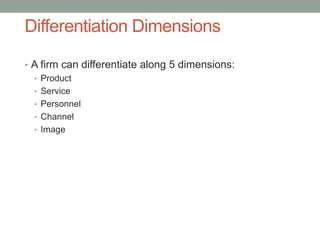
Differentiation Dimensions
• A firm can differentiate along 5 dimensions:
• Product
• Service
• Personnel
• Channel
• Image
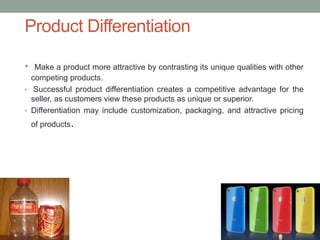
• Make a product more attractive by contrasting its unique qualities with other
competing products.
• Successful product differentiation creates a competitive advantage for the
seller, as customers view these products as unique or superior.
• Differentiation may include customization, packaging, and attractive pricing
of products.
Product Differentiation
Service Differentiation
• Customer service can be enhanced by 24-hour customer
feedback through e-mail and the ability to respond more
rapidly to customer concerns.
• Home delivery of groceries, online banking, and
securities trading are becoming increasingly popular.
• Today such services supplement traditional services, but
may someday replace them.
Personnel Differentiation
• Companies can gain a strong competitive advantage
through having better-trained people.
• Singapore Airlines enjoys an excellent reputation in large
part because of its fight attendants.
• The McDonald’s people are courteous
• The IBM people are professional
• The internet:
• Is a location-free, time-free distribution and communication
channel.
• Functions as a communication channel for companies that provide
product or service information online.
• Serves as a transaction and distribution channel for companies
that conduct online commercial transactions.
• Becomes the entire distribution channel for digital products.
Channel Differentiation
Image Differentiation
• A company can differentiate itself by creating a unique
experience called “experience branding.”
• Through experience branding firms can better retain
customers, target key segments, and enhance
profitability.
Image Differentiation
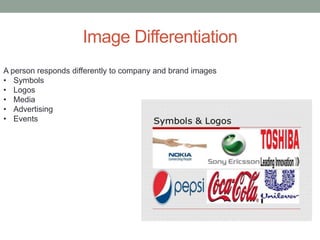
A person responds differently to company and brand images
• Symbols
• Logos
• Media
• Advertising
• Events
Differentiation Strategies
• Trout and Rivkin proposed specific differentiation
strategies common to offline and online
businesses:
• Being the first to enter the market.
• Owning a product attribute in the mind of the
consumer.
• Demonstrating product leadership.
• Utilizing an impressive company history or heritage.
• Supporting and demonstrating the differentiating
idea.
• Communicating the difference.
 There are 6 differentiation strategies unique to
online businesses.
 Site Environment/Atmospherics
 Easy downloads, accurate and clear
information, easy navigation.
 Build Trust
 Strong brand recognition.
 Privacy policy.
 Safe and encrypted payment process for
transactions.
Internet-Specific Differentiation Strategies
 Efficient and Timely Order Processing
 Pricing
 In the early days of the Web, companies
offered discounts as purchase incentives.
 Majority of firms today differentiate
themselves in other ways besides pricing.
 Customer Relationship Management
 Managing long-term relationships with
customers.
 Invite User-generated Content
 The key is to trust customers, listen, respond,
and learn.
Cont……………………………

Product Hierarchy.pptx

  • 1.
    PRODUCT HIERARCHY Organizational chart thatdepicts the array of products offered in a given market.
  • 2.
    Product Classification  Durabilityand Tangibility  Non Durables Durables Services
  • 3.
    Product Mix Set ofall the products that an organization offers to its customers. • Product Width : Total no. of product lines a company carries. • Product Length : Total number of items in that mix. • Product Depth : Assortment of sizes, colors and variation offered for each product in the product line. • Consistency : Closeness exhibited by the product lines in production requirements, distribution, end usage etc.
  • 4.
    Product Mix ofHUL Color Cosmetics Hair Care Skin Care Oral Care Deodorants Soap & detergents Toilet Soaps Beverages Food Lakme Aviance Sunsilk Clinic Plus Fair & Lovely Pond’s Pepsodent Close up Axe Denim Rexona Ponds Surf Excel Wheel Rin 501 Ala Vim Liril Lifebu oy Lux Breeze Pears Dove Savlon Lipton Yellow Lebel Lipton Green Lebel Lipton Ice Tea Red Lebel Taj Mahal Knorr Annap urna Atta Kwality Wall’s Max Kissan Product Mix Width
  • 5.
    • Kotler definesdifferentiation as the process of adding meaningful and valued differences to distinguish the company’s offering from the competition. • There are a number of differentiation dimensions and strategies for their accomplishment. Product Differentiation
  • 6.
    Differentiation Dimensions • Afirm can differentiate along 5 dimensions: • Product • Service • Personnel • Channel • Image
  • 7.
    • Make aproduct more attractive by contrasting its unique qualities with other competing products. • Successful product differentiation creates a competitive advantage for the seller, as customers view these products as unique or superior. • Differentiation may include customization, packaging, and attractive pricing of products. Product Differentiation
  • 8.
    Service Differentiation • Customerservice can be enhanced by 24-hour customer feedback through e-mail and the ability to respond more rapidly to customer concerns. • Home delivery of groceries, online banking, and securities trading are becoming increasingly popular. • Today such services supplement traditional services, but may someday replace them.
  • 9.
    Personnel Differentiation • Companiescan gain a strong competitive advantage through having better-trained people. • Singapore Airlines enjoys an excellent reputation in large part because of its fight attendants. • The McDonald’s people are courteous • The IBM people are professional
  • 10.
    • The internet: •Is a location-free, time-free distribution and communication channel. • Functions as a communication channel for companies that provide product or service information online. • Serves as a transaction and distribution channel for companies that conduct online commercial transactions. • Becomes the entire distribution channel for digital products. Channel Differentiation
  • 11.
    Image Differentiation • Acompany can differentiate itself by creating a unique experience called “experience branding.” • Through experience branding firms can better retain customers, target key segments, and enhance profitability.
  • 12.
    Image Differentiation A personresponds differently to company and brand images • Symbols • Logos • Media • Advertising • Events
  • 13.
    Differentiation Strategies • Troutand Rivkin proposed specific differentiation strategies common to offline and online businesses: • Being the first to enter the market. • Owning a product attribute in the mind of the consumer. • Demonstrating product leadership. • Utilizing an impressive company history or heritage. • Supporting and demonstrating the differentiating idea. • Communicating the difference.
  • 14.
     There are6 differentiation strategies unique to online businesses.  Site Environment/Atmospherics  Easy downloads, accurate and clear information, easy navigation.  Build Trust  Strong brand recognition.  Privacy policy.  Safe and encrypted payment process for transactions. Internet-Specific Differentiation Strategies
  • 15.
     Efficient andTimely Order Processing  Pricing  In the early days of the Web, companies offered discounts as purchase incentives.  Majority of firms today differentiate themselves in other ways besides pricing.  Customer Relationship Management  Managing long-term relationships with customers.  Invite User-generated Content  The key is to trust customers, listen, respond, and learn. Cont……………………………

Editor's Notes

  • #2 Level - Product class (Automobile sector _ Cars , Trucks, Bikes etc.) 2. level (Trucks – Heavy duty and semi heavy duty) (cars – SUV’s, Family cars) 3 Level (Brands – Fiat, Skoda , Toyota, )