Deployment Training
Procurement Procedures Manual
Procurement Advisory Office
Procurement Procedures Manual
The purpose of the Procurement Procedures Manual is to set out the
procedural requirements for conducting procurement activities in
accordance with the Company’s Procurement Policy.
All procurements must be conducted in accordance with the
Procurement Policy and the applicable protocols contained in the
Manual.
Defined terms used in the Manual have the meaning assigned to
them in the Procurement Policy.
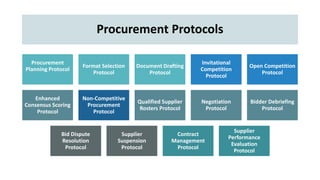
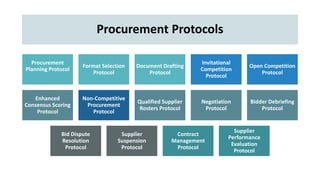
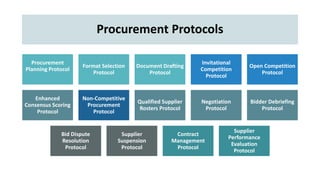
Procurement Protocols
Procurement
Planning Protocol
Format Selection
Protocol
Document Drafting
Protocol
Invitational
Competition
Protocol
Open Competition
Protocol
Enhanced
Consensus Scoring
Protocol
Non-Competitive
Procurement
Protocol
Qualified Supplier
Rosters Protocol
Negotiation
Protocol
Bidder Debriefing
Protocol
Bid Dispute
Resolution
Protocol
Supplier
Suspension
Protocol
Contract
Management
Protocol
Supplier
Performance
Evaluation
Protocol
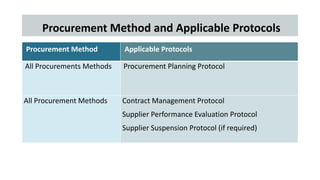
Procurement Method and Applicable Protocols
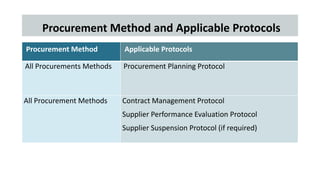
Procurement Method Applicable Protocols
All Procurements Methods Procurement Planning Protocol
All Procurement Methods Contract Management Protocol
Supplier Performance Evaluation Protocol
Supplier Suspension Protocol (if required)
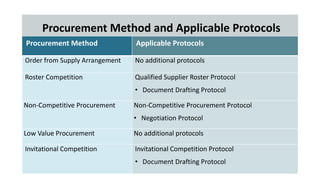
Procurement Method and Applicable Protocols
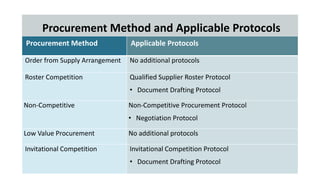
Procurement Method Applicable Protocols
Order from Supply Arrangement No additional protocols
Roster Competition Qualified Supplier Roster Protocol
• Document Drafting Protocol
Non-Competitive Procurement Non-Competitive Procurement Protocol
• Negotiation Protocol
Low Value Procurement No additional protocols
Invitational Competition Invitational Competition Protocol
• Document Drafting Protocol
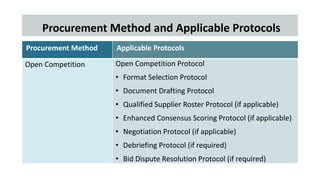
Procurement Method and Applicable Protocols
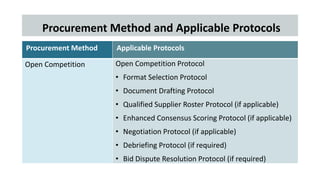
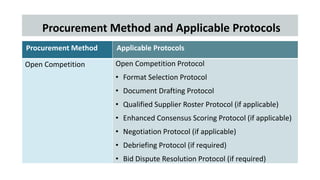
Procurement Method Applicable Protocols
Open Competition Open Competition Protocol
• Format Selection Protocol
• Document Drafting Protocol
• Qualified Supplier Roster Protocol (if applicable)
• Enhanced Consensus Scoring Protocol (if applicable)
• Negotiation Protocol (if applicable)
• Debriefing Protocol (if required)
• Bid Dispute Resolution Protocol (if required)
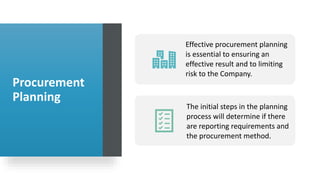
Procurement
Planning
Effective procurement planning
is essential to ensuring an
effective result and to limiting
risk to the Company.
The initial steps in the planning
process will determine if there
are reporting requirements and
the procurement method.
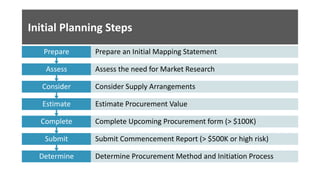
Initial Planning Steps
Determine Determine Procurement Method and Initiation Process
Submit Submit Commencement Report (> $500K or high risk)
Complete Complete Upcoming Procurement form (> $100K)
Estimate Estimate Procurement Value
Consider Consider Supply Arrangements
Assess Assess the need for Market Research
Prepare Prepare an Initial Mapping Statement
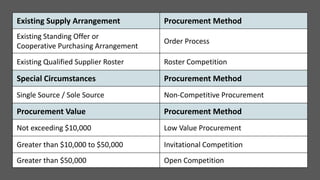
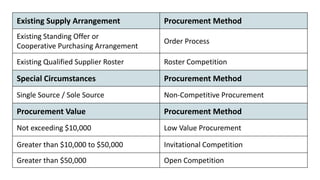
Existing Supply Arrangement Procurement Method
Existing Standing Offer or
Cooperative Purchasing Arrangement
Order Process
Existing Qualified Supplier Roster Roster Competition
Special Circumstances Procurement Method
Single Source / Sole Source Non-Competitive Procurement
Procurement Value Procurement Method
Not exceeding $10,000 Low Value Procurement
Greater than $10,000 to $50,000 Invitational Competition
Greater than $50,000 Open Competition
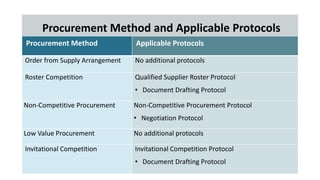
Procurement Method and Applicable Protocols
Procurement Method Applicable Protocols
Order from Supply Arrangement No additional protocols
Roster Competition Qualified Supplier Roster Protocol
• Document Drafting Protocol
Non-Competitive Procurement Non-Competitive Procurement Protocol
• Negotiation Protocol
Low Value Procurement No additional protocols
Invitational Competition Invitational Competition Protocol
• Document Drafting Protocol
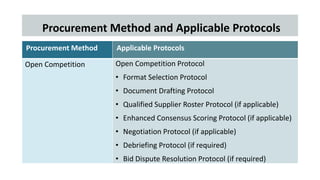
Procurement Method and Applicable Protocols
Procurement Method Applicable Protocols
Open Competition Open Competition Protocol
• Format Selection Protocol
• Document Drafting Protocol
• Qualified Supplier Roster Protocol (if applicable)
• Enhanced Consensus Scoring Protocol (if applicable)
• Negotiation Protocol (if applicable)
• Debriefing Protocol (if required)
• Bid Dispute Resolution Protocol (if required)
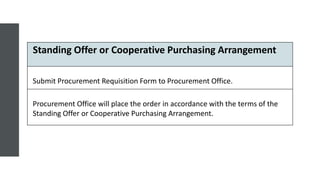
Standing Offer or Cooperative Purchasing Arrangement
Submit Procurement Requisition Form to Procurement Office.
Procurement Office will place the order in accordance with the terms of the
Standing Offer or Cooperative Purchasing Arrangement.
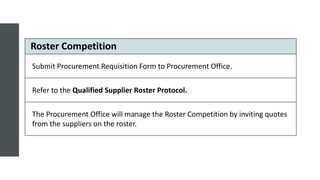
Roster Competition
Submit Procurement Requisition Form to Procurement Office.
Refer to the Qualified Supplier Roster Protocol.
The Procurement Office will manage the Roster Competition by inviting quotes
from the suppliers on the roster.
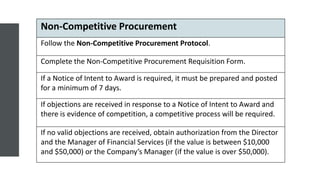
Non-Competitive Procurement
Follow the Non-Competitive Procurement Protocol.
Complete the Non-Competitive Procurement Requisition Form.
If a Notice of Intent to Award is required, it must be prepared and posted
for a minimum of 7 days.
If objections are received in response to a Notice of Intent to Award and
there is evidence of competition, a competitive process will be required.
If no valid objections are received, obtain authorization from the Director
and the Manager of Financial Services (if the value is between $10,000
and $50,000) or the Company’s Manager (if the value is over $50,000).
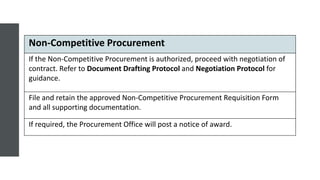
Non-Competitive Procurement
If the Non-Competitive Procurement is authorized, proceed with negotiation of
contract. Refer to Document Drafting Protocol and Negotiation Protocol for
guidance.
File and retain the approved Non-Competitive Procurement Requisition Form
and all supporting documentation.
If required, the Procurement Office will post a notice of award.
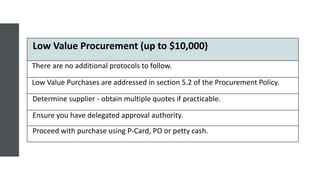
Low Value Procurement (up to $10,000)
There are no additional protocols to follow.
Low Value Purchases are addressed in section 5.2 of the Procurement Policy.
Determine supplier - obtain multiple quotes if practicable.
Ensure you have delegated approval authority.
Proceed with purchase using P-Card, PO or petty cash.
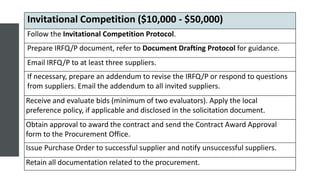
Invitational Competition ($10,000 - $50,000)
Follow the Invitational Competition Protocol.
Prepare IRFQ/P document, refer to Document Drafting Protocol for guidance.
Email IRFQ/P to at least three suppliers.
If necessary, prepare an addendum to revise the IRFQ/P or respond to questions
from suppliers. Email the addendum to all invited suppliers.
Receive and evaluate bids (minimum of two evaluators). Apply the local
preference policy, if applicable and disclosed in the solicitation document.
Obtain approval to award the contract and send the Contract Award Approval
form to the Procurement Office.
Issue Purchase Order to successful supplier and notify unsuccessful suppliers.
Retain all documentation related to the procurement.
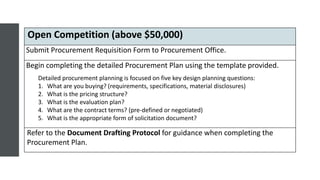
Open Competition (above $50,000)
Submit Procurement Requisition Form to Procurement Office.
Begin completing the detailed Procurement Plan using the template provided.
Detailed procurement planning is focused on five key design planning questions:
1. What are you buying? (requirements, specifications, material disclosures)
2. What is the pricing structure?
3. What is the evaluation plan?
4. What are the contract terms? (pre-defined or negotiated)
5. What is the appropriate form of solicitation document?
Refer to the Document Drafting Protocol for guidance when completing the
Procurement Plan.
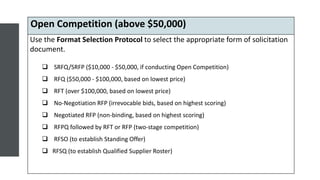
Open Competition (above $50,000)
Use the Format Selection Protocol to select the appropriate form of solicitation
document.
 SRFQ/SRFP ($10,000 - $50,000, if conducting Open Competition)
 RFQ ($50,000 - $100,000, based on lowest price)
 RFT (over $100,000, based on lowest price)
 No-Negotiation RFP (irrevocable bids, based on highest scoring)
 Negotiated RFP (non-binding, based on highest scoring)
 RFPQ followed by RFT or RFP (two-stage competition)
 RFSO (to establish Standing Offer)
 RFSQ (to establish Qualified Supplier Roster)
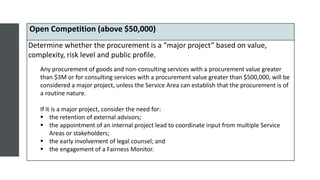
Open Competition (above $50,000)
Determine whether the procurement is a “major project” based on value,
complexity, risk level and public profile.
Any procurement of goods and non-consulting services with a procurement value greater
than $3M or for consulting services with a procurement value greater than $500,000, will be
considered a major project, unless the Service Area can establish that the procurement is of
a routine nature.
If it is a major project, consider the need for:
 the retention of external advisors;
 the appointment of an internal project lead to coordinate input from multiple Service
Areas or stakeholders;
 the early involvement of legal counsel; and
 the engagement of a Fairness Monitor.
Open Competition (above $50,000)
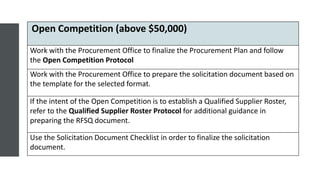
Work with the Procurement Office to finalize the Procurement Plan and follow
the Open Competition Protocol
Work with the Procurement Office to prepare the solicitation document based on
the template for the selected format.
If the intent of the Open Competition is to establish a Qualified Supplier Roster,
refer to the Qualified Supplier Roster Protocol for additional guidance in
preparing the RFSQ document.
Use the Solicitation Document Checklist in order to finalize the solicitation
document.
Open Competition (above $50,000)
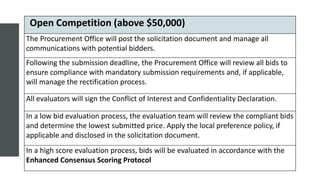
The Procurement Office will post the solicitation document and manage all
communications with potential bidders.
Following the submission deadline, the Procurement Office will review all bids to
ensure compliance with mandatory submission requirements and, if applicable,
will manage the rectification process.
All evaluators will sign the Conflict of Interest and Confidentiality Declaration.
In a low bid evaluation process, the evaluation team will review the compliant bids
and determine the lowest submitted price. Apply the local preference policy, if
applicable and disclosed in the solicitation document.
In a high score evaluation process, bids will be evaluated in accordance with the
Enhanced Consensus Scoring Protocol
Open Competition (above $50,000)
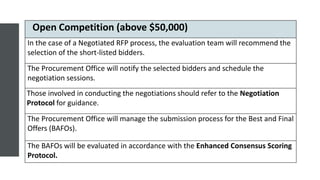
In the case of a Negotiated RFP process, the evaluation team will recommend the
selection of the short-listed bidders.
The Procurement Office will notify the selected bidders and schedule the
negotiation sessions.
Those involved in conducting the negotiations should refer to the Negotiation
Protocol for guidance.
The Procurement Office will manage the submission process for the Best and Final
Offers (BAFOs).
The BAFOs will be evaluated in accordance with the Enhanced Consensus Scoring
Protocol.
Open Competition (above $50,000)
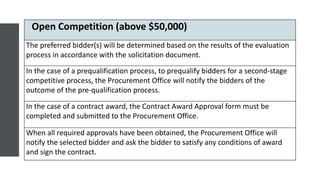
The preferred bidder(s) will be determined based on the results of the evaluation
process in accordance with the solicitation document.
In the case of a prequalification process, to prequalify bidders for a second-stage
competitive process, the Procurement Office will notify the bidders of the
outcome of the pre-qualification process.
In the case of a contract award, the Contract Award Approval form must be
completed and submitted to the Procurement Office.
When all required approvals have been obtained, the Procurement Office will
notify the selected bidder and ask the bidder to satisfy any conditions of award
and sign the contract.
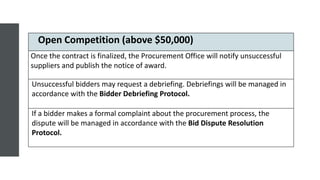
Open Competition (above $50,000)
Once the contract is finalized, the Procurement Office will notify unsuccessful
suppliers and publish the notice of award.
Unsuccessful bidders may request a debriefing. Debriefings will be managed in
accordance with the Bidder Debriefing Protocol.
If a bidder makes a formal complaint about the procurement process, the
dispute will be managed in accordance with the Bid Dispute Resolution
Protocol.
Procurement Method and Applicable Protocols
Procurement Method Applicable Protocols
Open Competition Open Competition Protocol
• Format Selection Protocol
• Document Drafting Protocol
• Qualified Supplier Roster Protocol (if applicable)
• Enhanced Consensus Scoring Protocol (if applicable)
• Negotiation Protocol (if applicable)
• Debriefing Protocol (if required)
• Bid Dispute Resolution Protocol (if required)
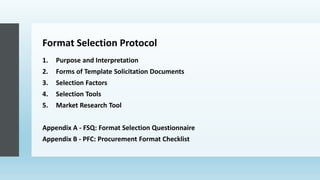
Format Selection Protocol
1. Purpose and Interpretation
2. Forms of Template Solicitation Documents
3. Selection Factors
4. Selection Tools
5. Market Research Tool
Appendix A - FSQ: Format Selection Questionnaire
Appendix B - PFC: Procurement Format Checklist
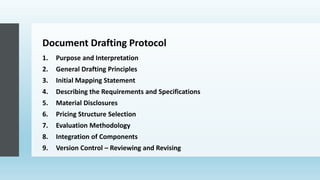
Document Drafting Protocol
1. Purpose and Interpretation
2. General Drafting Principles
3. Initial Mapping Statement
4. Describing the Requirements and Specifications
5. Material Disclosures
6. Pricing Structure Selection
7. Evaluation Methodology
8. Integration of Components
9. Version Control – Reviewing and Revising
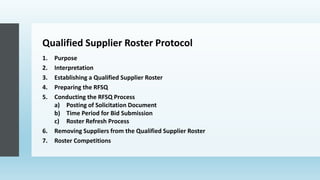
Qualified Supplier Roster Protocol
1. Purpose
2. Interpretation
3. Establishing a Qualified Supplier Roster
4. Preparing the RFSQ
5. Conducting the RFSQ Process
a) Posting of Solicitation Document
b) Time Period for Bid Submission
c) Roster Refresh Process
6. Removing Suppliers from the Qualified Supplier Roster
7. Roster Competitions
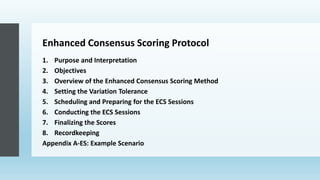
Enhanced Consensus Scoring Protocol
1. Purpose and Interpretation
2. Objectives
3. Overview of the Enhanced Consensus Scoring Method
4. Setting the Variation Tolerance
5. Scheduling and Preparing for the ECS Sessions
6. Conducting the ECS Sessions
7. Finalizing the Scores
8. Recordkeeping
Appendix A-ES: Example Scenario
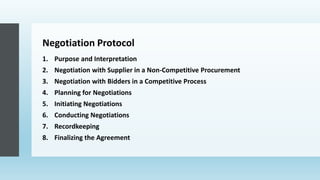
Negotiation Protocol
1. Purpose and Interpretation
2. Negotiation with Supplier in a Non-Competitive Procurement
3. Negotiation with Bidders in a Competitive Process
4. Planning for Negotiations
5. Initiating Negotiations
6. Conducting Negotiations
7. Recordkeeping
8. Finalizing the Agreement
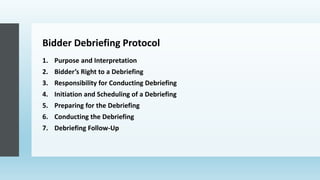
Bidder Debriefing Protocol
1. Purpose and Interpretation
2. Bidder’s Right to a Debriefing
3. Responsibility for Conducting Debriefing
4. Initiation and Scheduling of a Debriefing
5. Preparing for the Debriefing
6. Conducting the Debriefing
7. Debriefing Follow-Up
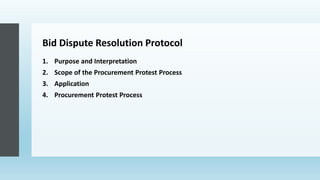
Bid Dispute Resolution Protocol
1. Purpose and Interpretation
2. Scope of the Procurement Protest Process
3. Application
4. Procurement Protest Process
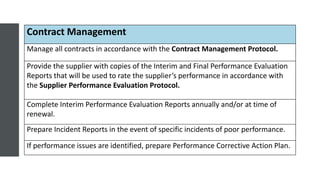
Contract Management
Manage all contracts in accordance with the Contract Management Protocol.
Provide the supplier with copies of the Interim and Final Performance Evaluation
Reports that will be used to rate the supplier’s performance in accordance with
the Supplier Performance Evaluation Protocol.
Complete Interim Performance Evaluation Reports annually and/or at time of
renewal.
Prepare Incident Reports in the event of specific incidents of poor performance.
If performance issues are identified, prepare Performance Corrective Action Plan.
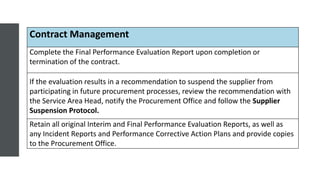
Contract Management
Complete the Final Performance Evaluation Report upon completion or
termination of the contract.
If the evaluation results in a recommendation to suspend the supplier from
participating in future procurement processes, review the recommendation with
the Service Area Head, notify the Procurement Office and follow the Supplier
Suspension Protocol.
Retain all original Interim and Final Performance Evaluation Reports, as well as
any Incident Reports and Performance Corrective Action Plans and provide copies
to the Procurement Office.
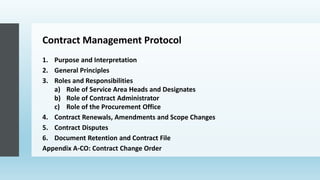
Contract Management Protocol
1. Purpose and Interpretation
2. General Principles
3. Roles and Responsibilities
a) Role of Service Area Heads and Designates
b) Role of Contract Administrator
c) Role of the Procurement Office
4. Contract Renewals, Amendments and Scope Changes
5. Contract Disputes
6. Document Retention and Contract File
Appendix A-CO: Contract Change Order
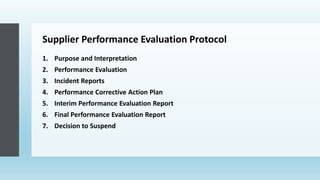
Supplier Performance Evaluation Protocol
1. Purpose and Interpretation
2. Performance Evaluation
3. Incident Reports
4. Performance Corrective Action Plan
5. Interim Performance Evaluation Report
6. Final Performance Evaluation Report
7. Decision to Suspend
Supplier Performance Evaluation Protocol
8. Retention of Evaluation Reports
9. Disclosure of Results to Others
10. Consideration of Performance in Evaluation of Bids
Appendix A - IPE: Interim Performance Evaluation Report
Appendix B - FPE: Final Performance Evaluation Report
Appendix C - IR: Incident Report
Appendix D - PCAP: Performance Corrective Action Plan
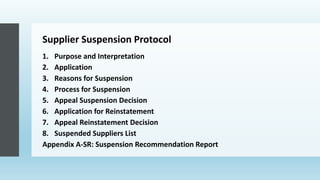
Supplier Suspension Protocol
1. Purpose and Interpretation
2. Application
3. Reasons for Suspension
4. Process for Suspension
5. Appeal Suspension Decision
6. Application for Reinstatement
7. Appeal Reinstatement Decision
8. Suspended Suppliers List
Appendix A-SR: Suspension Recommendation Report
Procurement Protocols
Procurement
Planning Protocol
Format Selection
Protocol
Document Drafting
Protocol
Invitational
Competition
Protocol
Open Competition
Protocol
Enhanced
Consensus Scoring
Protocol
Non-Competitive
Procurement
Protocol
Qualified Supplier
Rosters Protocol
Negotiation
Protocol
Bidder Debriefing
Protocol
Bid Dispute
Resolution
Protocol
Supplier
Suspension
Protocol
Contract
Management
Protocol
Supplier
Performance
Evaluation
Protocol
Existing Supply Arrangement Procurement Method
Existing Standing Offer or
Cooperative Purchasing Arrangement
Order Process
Existing Qualified Supplier Roster Roster Competition
Special Circumstances Procurement Method
Single Source / Sole Source Non-Competitive Procurement
Procurement Value Procurement Method
Not exceeding $10,000 Low Value Procurement
Greater than $10,000 to $50,000 Invitational Competition
Greater than $50,000 Open Competition
Procurement Method and Applicable Protocols
Procurement Method Applicable Protocols
All Procurements Methods Procurement Planning Protocol
All Procurement Methods Contract Management Protocol
Supplier Performance Evaluation Protocol
Supplier Suspension Protocol (if required)
Procurement Method and Applicable Protocols
Procurement Method Applicable Protocols
Order from Supply Arrangement No additional protocols
Roster Competition Qualified Supplier Roster Protocol
• Document Drafting Protocol
Non-Competitive Non-Competitive Procurement Protocol
• Negotiation Protocol
Low Value Procurement No additional protocols
Invitational Competition Invitational Competition Protocol
• Document Drafting Protocol
Procurement Method and Applicable Protocols
Procurement Method Applicable Protocols
Open Competition Open Competition Protocol
• Format Selection Protocol
• Document Drafting Protocol
• Qualified Supplier Roster Protocol (if applicable)
• Enhanced Consensus Scoring Protocol (if applicable)
• Negotiation Protocol (if applicable)
• Debriefing Protocol (if required)
• Bid Dispute Resolution Protocol (if required)
Procurement Protocols
Procurement
Planning Protocol
Format Selection
Protocol
Document Drafting
Protocol
Invitational
Competition
Protocol
Open Competition
Protocol
Enhanced
Consensus Scoring
Protocol
Non-Competitive
Procurement
Protocol
Qualified Supplier
Rosters Protocol
Negotiation
Protocol
Bidder Debriefing
Protocol
Bid Dispute
Resolution
Protocol
Supplier
Suspension
Protocol
Contract
Management
Protocol
Supplier
Performance
Evaluation
Protocol

Procurement Procedures Training for Open Competitions

  • 1.
    Deployment Training Procurement ProceduresManual Procurement Advisory Office
  • 2.
    Procurement Procedures Manual Thepurpose of the Procurement Procedures Manual is to set out the procedural requirements for conducting procurement activities in accordance with the Company’s Procurement Policy. All procurements must be conducted in accordance with the Procurement Policy and the applicable protocols contained in the Manual. Defined terms used in the Manual have the meaning assigned to them in the Procurement Policy.
  • 3.
    Procurement Protocols Procurement Planning Protocol FormatSelection Protocol Document Drafting Protocol Invitational Competition Protocol Open Competition Protocol Enhanced Consensus Scoring Protocol Non-Competitive Procurement Protocol Qualified Supplier Rosters Protocol Negotiation Protocol Bidder Debriefing Protocol Bid Dispute Resolution Protocol Supplier Suspension Protocol Contract Management Protocol Supplier Performance Evaluation Protocol
  • 4.
    Procurement Method andApplicable Protocols Procurement Method Applicable Protocols All Procurements Methods Procurement Planning Protocol All Procurement Methods Contract Management Protocol Supplier Performance Evaluation Protocol Supplier Suspension Protocol (if required)
  • 5.
    Procurement Method andApplicable Protocols Procurement Method Applicable Protocols Order from Supply Arrangement No additional protocols Roster Competition Qualified Supplier Roster Protocol • Document Drafting Protocol Non-Competitive Procurement Non-Competitive Procurement Protocol • Negotiation Protocol Low Value Procurement No additional protocols Invitational Competition Invitational Competition Protocol • Document Drafting Protocol
  • 6.
    Procurement Method andApplicable Protocols Procurement Method Applicable Protocols Open Competition Open Competition Protocol • Format Selection Protocol • Document Drafting Protocol • Qualified Supplier Roster Protocol (if applicable) • Enhanced Consensus Scoring Protocol (if applicable) • Negotiation Protocol (if applicable) • Debriefing Protocol (if required) • Bid Dispute Resolution Protocol (if required)
  • 7.
    Procurement Planning Effective procurement planning isessential to ensuring an effective result and to limiting risk to the Company. The initial steps in the planning process will determine if there are reporting requirements and the procurement method.
  • 8.
    Initial Planning Steps DetermineDetermine Procurement Method and Initiation Process Submit Submit Commencement Report (> $500K or high risk) Complete Complete Upcoming Procurement form (> $100K) Estimate Estimate Procurement Value Consider Consider Supply Arrangements Assess Assess the need for Market Research Prepare Prepare an Initial Mapping Statement
  • 9.
    Existing Supply ArrangementProcurement Method Existing Standing Offer or Cooperative Purchasing Arrangement Order Process Existing Qualified Supplier Roster Roster Competition Special Circumstances Procurement Method Single Source / Sole Source Non-Competitive Procurement Procurement Value Procurement Method Not exceeding $10,000 Low Value Procurement Greater than $10,000 to $50,000 Invitational Competition Greater than $50,000 Open Competition
  • 10.
    Procurement Method andApplicable Protocols Procurement Method Applicable Protocols Order from Supply Arrangement No additional protocols Roster Competition Qualified Supplier Roster Protocol • Document Drafting Protocol Non-Competitive Procurement Non-Competitive Procurement Protocol • Negotiation Protocol Low Value Procurement No additional protocols Invitational Competition Invitational Competition Protocol • Document Drafting Protocol
  • 11.
    Procurement Method andApplicable Protocols Procurement Method Applicable Protocols Open Competition Open Competition Protocol • Format Selection Protocol • Document Drafting Protocol • Qualified Supplier Roster Protocol (if applicable) • Enhanced Consensus Scoring Protocol (if applicable) • Negotiation Protocol (if applicable) • Debriefing Protocol (if required) • Bid Dispute Resolution Protocol (if required)
  • 12.
    Standing Offer orCooperative Purchasing Arrangement Submit Procurement Requisition Form to Procurement Office. Procurement Office will place the order in accordance with the terms of the Standing Offer or Cooperative Purchasing Arrangement.
  • 13.
    Roster Competition Submit ProcurementRequisition Form to Procurement Office. Refer to the Qualified Supplier Roster Protocol. The Procurement Office will manage the Roster Competition by inviting quotes from the suppliers on the roster.
  • 14.
    Non-Competitive Procurement Follow theNon-Competitive Procurement Protocol. Complete the Non-Competitive Procurement Requisition Form. If a Notice of Intent to Award is required, it must be prepared and posted for a minimum of 7 days. If objections are received in response to a Notice of Intent to Award and there is evidence of competition, a competitive process will be required. If no valid objections are received, obtain authorization from the Director and the Manager of Financial Services (if the value is between $10,000 and $50,000) or the Company’s Manager (if the value is over $50,000).
  • 15.
    Non-Competitive Procurement If theNon-Competitive Procurement is authorized, proceed with negotiation of contract. Refer to Document Drafting Protocol and Negotiation Protocol for guidance. File and retain the approved Non-Competitive Procurement Requisition Form and all supporting documentation. If required, the Procurement Office will post a notice of award.
  • 16.
    Low Value Procurement(up to $10,000) There are no additional protocols to follow. Low Value Purchases are addressed in section 5.2 of the Procurement Policy. Determine supplier - obtain multiple quotes if practicable. Ensure you have delegated approval authority. Proceed with purchase using P-Card, PO or petty cash.
  • 17.
    Invitational Competition ($10,000- $50,000) Follow the Invitational Competition Protocol. Prepare IRFQ/P document, refer to Document Drafting Protocol for guidance. Email IRFQ/P to at least three suppliers. If necessary, prepare an addendum to revise the IRFQ/P or respond to questions from suppliers. Email the addendum to all invited suppliers. Receive and evaluate bids (minimum of two evaluators). Apply the local preference policy, if applicable and disclosed in the solicitation document. Obtain approval to award the contract and send the Contract Award Approval form to the Procurement Office. Issue Purchase Order to successful supplier and notify unsuccessful suppliers. Retain all documentation related to the procurement.
  • 18.
    Open Competition (above$50,000) Submit Procurement Requisition Form to Procurement Office. Begin completing the detailed Procurement Plan using the template provided. Detailed procurement planning is focused on five key design planning questions: 1. What are you buying? (requirements, specifications, material disclosures) 2. What is the pricing structure? 3. What is the evaluation plan? 4. What are the contract terms? (pre-defined or negotiated) 5. What is the appropriate form of solicitation document? Refer to the Document Drafting Protocol for guidance when completing the Procurement Plan.
  • 19.
    Open Competition (above$50,000) Use the Format Selection Protocol to select the appropriate form of solicitation document.  SRFQ/SRFP ($10,000 - $50,000, if conducting Open Competition)  RFQ ($50,000 - $100,000, based on lowest price)  RFT (over $100,000, based on lowest price)  No-Negotiation RFP (irrevocable bids, based on highest scoring)  Negotiated RFP (non-binding, based on highest scoring)  RFPQ followed by RFT or RFP (two-stage competition)  RFSO (to establish Standing Offer)  RFSQ (to establish Qualified Supplier Roster)
  • 20.
    Open Competition (above$50,000) Determine whether the procurement is a “major project” based on value, complexity, risk level and public profile. Any procurement of goods and non-consulting services with a procurement value greater than $3M or for consulting services with a procurement value greater than $500,000, will be considered a major project, unless the Service Area can establish that the procurement is of a routine nature. If it is a major project, consider the need for:  the retention of external advisors;  the appointment of an internal project lead to coordinate input from multiple Service Areas or stakeholders;  the early involvement of legal counsel; and  the engagement of a Fairness Monitor.
  • 21.
    Open Competition (above$50,000) Work with the Procurement Office to finalize the Procurement Plan and follow the Open Competition Protocol Work with the Procurement Office to prepare the solicitation document based on the template for the selected format. If the intent of the Open Competition is to establish a Qualified Supplier Roster, refer to the Qualified Supplier Roster Protocol for additional guidance in preparing the RFSQ document. Use the Solicitation Document Checklist in order to finalize the solicitation document.
  • 22.
    Open Competition (above$50,000) The Procurement Office will post the solicitation document and manage all communications with potential bidders. Following the submission deadline, the Procurement Office will review all bids to ensure compliance with mandatory submission requirements and, if applicable, will manage the rectification process. All evaluators will sign the Conflict of Interest and Confidentiality Declaration. In a low bid evaluation process, the evaluation team will review the compliant bids and determine the lowest submitted price. Apply the local preference policy, if applicable and disclosed in the solicitation document. In a high score evaluation process, bids will be evaluated in accordance with the Enhanced Consensus Scoring Protocol
  • 23.
    Open Competition (above$50,000) In the case of a Negotiated RFP process, the evaluation team will recommend the selection of the short-listed bidders. The Procurement Office will notify the selected bidders and schedule the negotiation sessions. Those involved in conducting the negotiations should refer to the Negotiation Protocol for guidance. The Procurement Office will manage the submission process for the Best and Final Offers (BAFOs). The BAFOs will be evaluated in accordance with the Enhanced Consensus Scoring Protocol.
  • 24.
    Open Competition (above$50,000) The preferred bidder(s) will be determined based on the results of the evaluation process in accordance with the solicitation document. In the case of a prequalification process, to prequalify bidders for a second-stage competitive process, the Procurement Office will notify the bidders of the outcome of the pre-qualification process. In the case of a contract award, the Contract Award Approval form must be completed and submitted to the Procurement Office. When all required approvals have been obtained, the Procurement Office will notify the selected bidder and ask the bidder to satisfy any conditions of award and sign the contract.
  • 25.
    Open Competition (above$50,000) Once the contract is finalized, the Procurement Office will notify unsuccessful suppliers and publish the notice of award. Unsuccessful bidders may request a debriefing. Debriefings will be managed in accordance with the Bidder Debriefing Protocol. If a bidder makes a formal complaint about the procurement process, the dispute will be managed in accordance with the Bid Dispute Resolution Protocol.
  • 26.
    Procurement Method andApplicable Protocols Procurement Method Applicable Protocols Open Competition Open Competition Protocol • Format Selection Protocol • Document Drafting Protocol • Qualified Supplier Roster Protocol (if applicable) • Enhanced Consensus Scoring Protocol (if applicable) • Negotiation Protocol (if applicable) • Debriefing Protocol (if required) • Bid Dispute Resolution Protocol (if required)
  • 27.
    Format Selection Protocol 1.Purpose and Interpretation 2. Forms of Template Solicitation Documents 3. Selection Factors 4. Selection Tools 5. Market Research Tool Appendix A - FSQ: Format Selection Questionnaire Appendix B - PFC: Procurement Format Checklist
  • 28.
    Document Drafting Protocol 1.Purpose and Interpretation 2. General Drafting Principles 3. Initial Mapping Statement 4. Describing the Requirements and Specifications 5. Material Disclosures 6. Pricing Structure Selection 7. Evaluation Methodology 8. Integration of Components 9. Version Control – Reviewing and Revising
  • 29.
    Qualified Supplier RosterProtocol 1. Purpose 2. Interpretation 3. Establishing a Qualified Supplier Roster 4. Preparing the RFSQ 5. Conducting the RFSQ Process a) Posting of Solicitation Document b) Time Period for Bid Submission c) Roster Refresh Process 6. Removing Suppliers from the Qualified Supplier Roster 7. Roster Competitions
  • 30.
    Enhanced Consensus ScoringProtocol 1. Purpose and Interpretation 2. Objectives 3. Overview of the Enhanced Consensus Scoring Method 4. Setting the Variation Tolerance 5. Scheduling and Preparing for the ECS Sessions 6. Conducting the ECS Sessions 7. Finalizing the Scores 8. Recordkeeping Appendix A-ES: Example Scenario
  • 31.
    Negotiation Protocol 1. Purposeand Interpretation 2. Negotiation with Supplier in a Non-Competitive Procurement 3. Negotiation with Bidders in a Competitive Process 4. Planning for Negotiations 5. Initiating Negotiations 6. Conducting Negotiations 7. Recordkeeping 8. Finalizing the Agreement
  • 32.
    Bidder Debriefing Protocol 1.Purpose and Interpretation 2. Bidder’s Right to a Debriefing 3. Responsibility for Conducting Debriefing 4. Initiation and Scheduling of a Debriefing 5. Preparing for the Debriefing 6. Conducting the Debriefing 7. Debriefing Follow-Up
  • 33.
    Bid Dispute ResolutionProtocol 1. Purpose and Interpretation 2. Scope of the Procurement Protest Process 3. Application 4. Procurement Protest Process
  • 34.
    Contract Management Manage allcontracts in accordance with the Contract Management Protocol. Provide the supplier with copies of the Interim and Final Performance Evaluation Reports that will be used to rate the supplier’s performance in accordance with the Supplier Performance Evaluation Protocol. Complete Interim Performance Evaluation Reports annually and/or at time of renewal. Prepare Incident Reports in the event of specific incidents of poor performance. If performance issues are identified, prepare Performance Corrective Action Plan.
  • 35.
    Contract Management Complete theFinal Performance Evaluation Report upon completion or termination of the contract. If the evaluation results in a recommendation to suspend the supplier from participating in future procurement processes, review the recommendation with the Service Area Head, notify the Procurement Office and follow the Supplier Suspension Protocol. Retain all original Interim and Final Performance Evaluation Reports, as well as any Incident Reports and Performance Corrective Action Plans and provide copies to the Procurement Office.
  • 36.
    Contract Management Protocol 1.Purpose and Interpretation 2. General Principles 3. Roles and Responsibilities a) Role of Service Area Heads and Designates b) Role of Contract Administrator c) Role of the Procurement Office 4. Contract Renewals, Amendments and Scope Changes 5. Contract Disputes 6. Document Retention and Contract File Appendix A-CO: Contract Change Order
  • 37.
    Supplier Performance EvaluationProtocol 1. Purpose and Interpretation 2. Performance Evaluation 3. Incident Reports 4. Performance Corrective Action Plan 5. Interim Performance Evaluation Report 6. Final Performance Evaluation Report 7. Decision to Suspend
  • 38.
    Supplier Performance EvaluationProtocol 8. Retention of Evaluation Reports 9. Disclosure of Results to Others 10. Consideration of Performance in Evaluation of Bids Appendix A - IPE: Interim Performance Evaluation Report Appendix B - FPE: Final Performance Evaluation Report Appendix C - IR: Incident Report Appendix D - PCAP: Performance Corrective Action Plan
  • 39.
    Supplier Suspension Protocol 1.Purpose and Interpretation 2. Application 3. Reasons for Suspension 4. Process for Suspension 5. Appeal Suspension Decision 6. Application for Reinstatement 7. Appeal Reinstatement Decision 8. Suspended Suppliers List Appendix A-SR: Suspension Recommendation Report
  • 40.
    Procurement Protocols Procurement Planning Protocol FormatSelection Protocol Document Drafting Protocol Invitational Competition Protocol Open Competition Protocol Enhanced Consensus Scoring Protocol Non-Competitive Procurement Protocol Qualified Supplier Rosters Protocol Negotiation Protocol Bidder Debriefing Protocol Bid Dispute Resolution Protocol Supplier Suspension Protocol Contract Management Protocol Supplier Performance Evaluation Protocol
  • 41.
    Existing Supply ArrangementProcurement Method Existing Standing Offer or Cooperative Purchasing Arrangement Order Process Existing Qualified Supplier Roster Roster Competition Special Circumstances Procurement Method Single Source / Sole Source Non-Competitive Procurement Procurement Value Procurement Method Not exceeding $10,000 Low Value Procurement Greater than $10,000 to $50,000 Invitational Competition Greater than $50,000 Open Competition
  • 42.
    Procurement Method andApplicable Protocols Procurement Method Applicable Protocols All Procurements Methods Procurement Planning Protocol All Procurement Methods Contract Management Protocol Supplier Performance Evaluation Protocol Supplier Suspension Protocol (if required)
  • 43.
    Procurement Method andApplicable Protocols Procurement Method Applicable Protocols Order from Supply Arrangement No additional protocols Roster Competition Qualified Supplier Roster Protocol • Document Drafting Protocol Non-Competitive Non-Competitive Procurement Protocol • Negotiation Protocol Low Value Procurement No additional protocols Invitational Competition Invitational Competition Protocol • Document Drafting Protocol
  • 44.
    Procurement Method andApplicable Protocols Procurement Method Applicable Protocols Open Competition Open Competition Protocol • Format Selection Protocol • Document Drafting Protocol • Qualified Supplier Roster Protocol (if applicable) • Enhanced Consensus Scoring Protocol (if applicable) • Negotiation Protocol (if applicable) • Debriefing Protocol (if required) • Bid Dispute Resolution Protocol (if required)
  • 45.
    Procurement Protocols Procurement Planning Protocol FormatSelection Protocol Document Drafting Protocol Invitational Competition Protocol Open Competition Protocol Enhanced Consensus Scoring Protocol Non-Competitive Procurement Protocol Qualified Supplier Rosters Protocol Negotiation Protocol Bidder Debriefing Protocol Bid Dispute Resolution Protocol Supplier Suspension Protocol Contract Management Protocol Supplier Performance Evaluation Protocol