Process Safety Fundamentals
Safe Operational Principles
to avoid incidents with hazardous chemicals
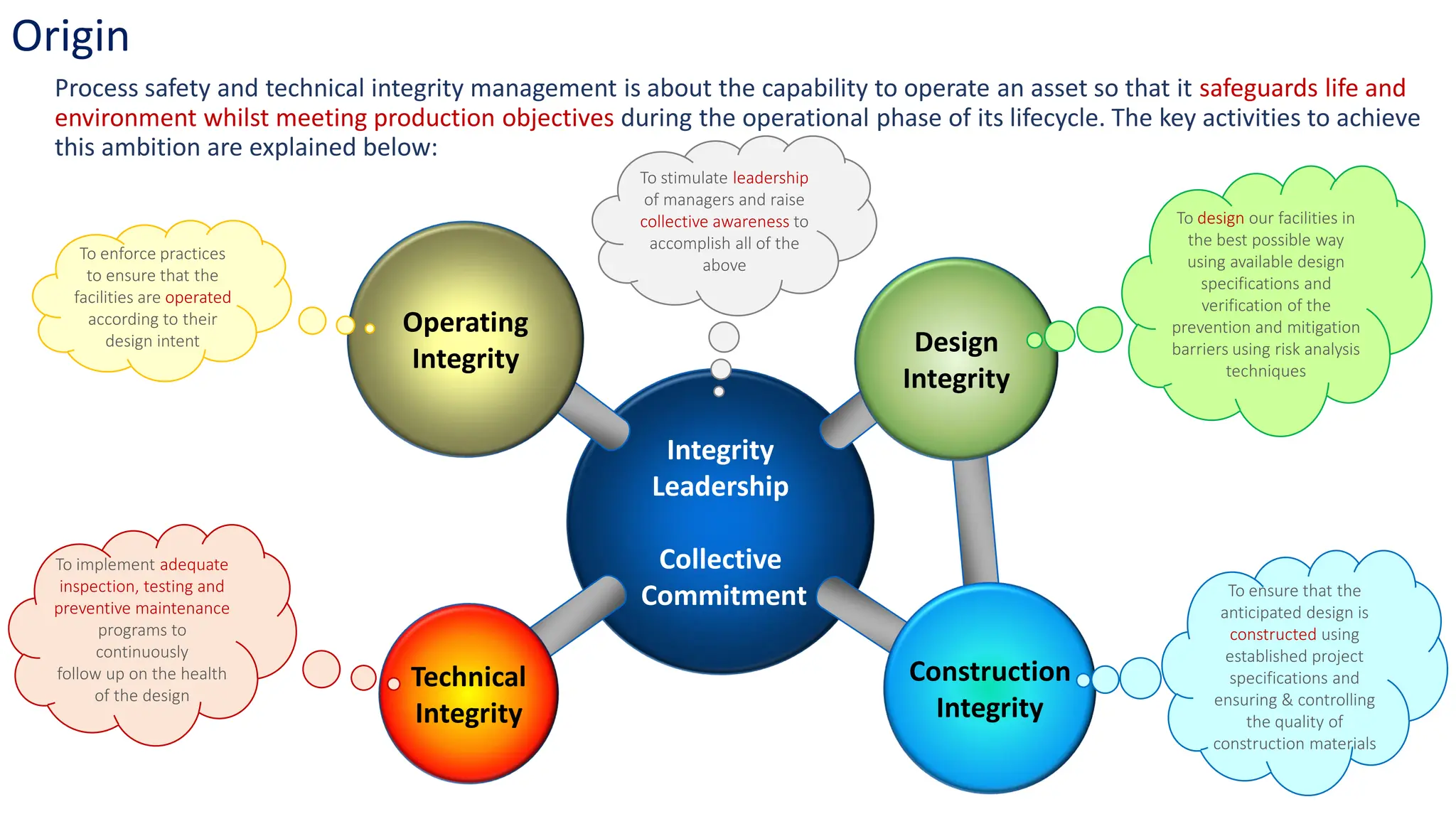
Origin
Integrity
Leadership
Collective
Commitment
Design
Integrity
Construction
Integrity
Operating
Integrity
Technical
Integrity
Process safety and technical integrity management is about the capability to operate an asset so that it safeguards life and
environment whilst meeting production objectives during the operational phase of its lifecycle. The key activities to achieve
this ambition are explained below:
To design our facilities in
the best possible way
using available design
specifications and
verification of the
prevention and mitigation
barriers using risk analysis
techniques
To ensure that the
anticipated design is
constructed using
established project
specifications and
ensuring & controlling
the quality of
construction materials
To stimulate leadership
of managers and raise
collective awareness to
accomplish all of the
above
To enforce practices
to ensure that the
facilities are operated
according to their
design intent
To implement adequate
inspection, testing and
preventive maintenance
programs to
continuously
follow up on the health
of the design
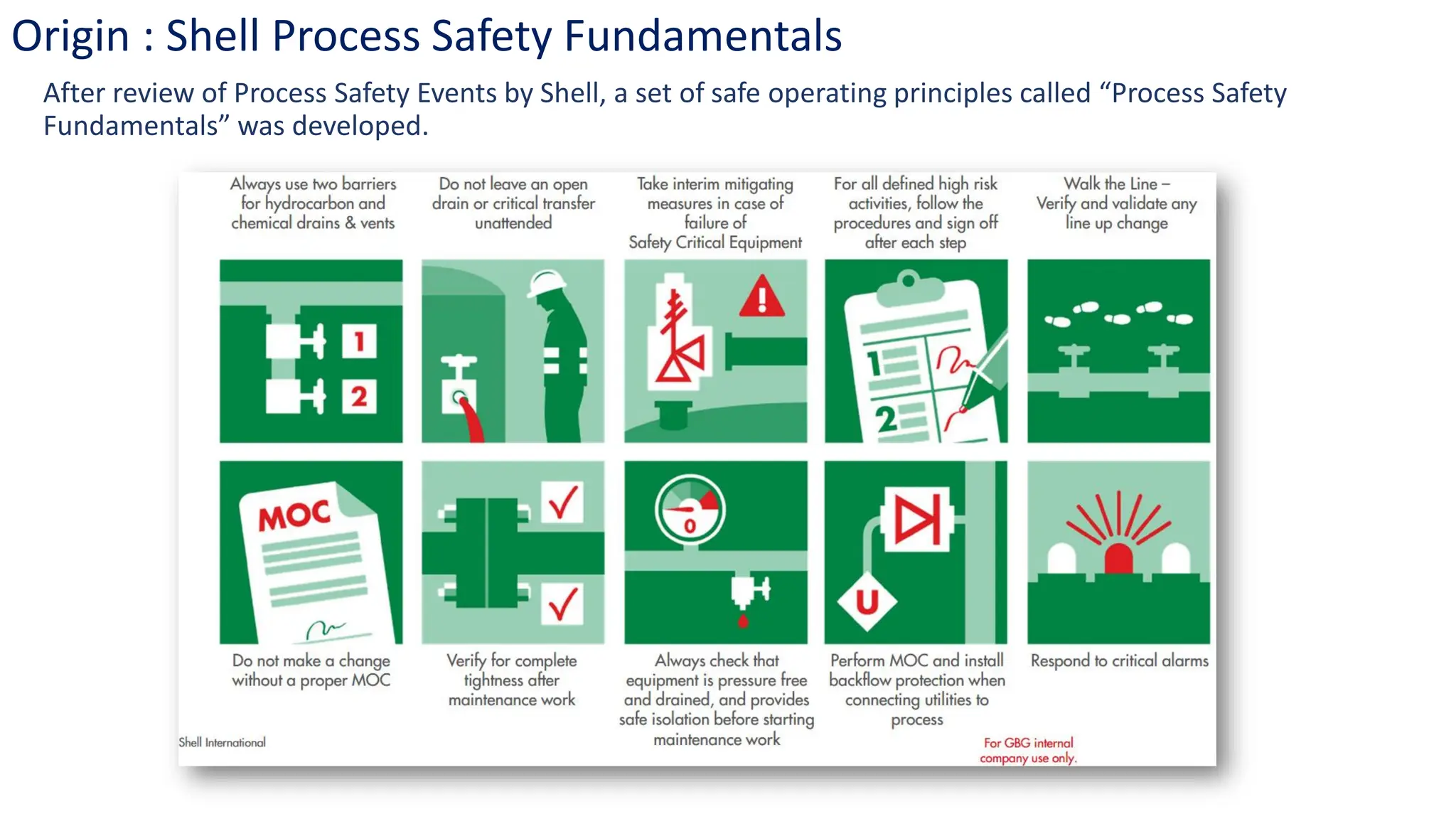
Origin : Shell Process Safety Fundamentals
After review of Process Safety Events by Shell, a set of safe operating principles called “Process Safety
Fundamentals” was developed.
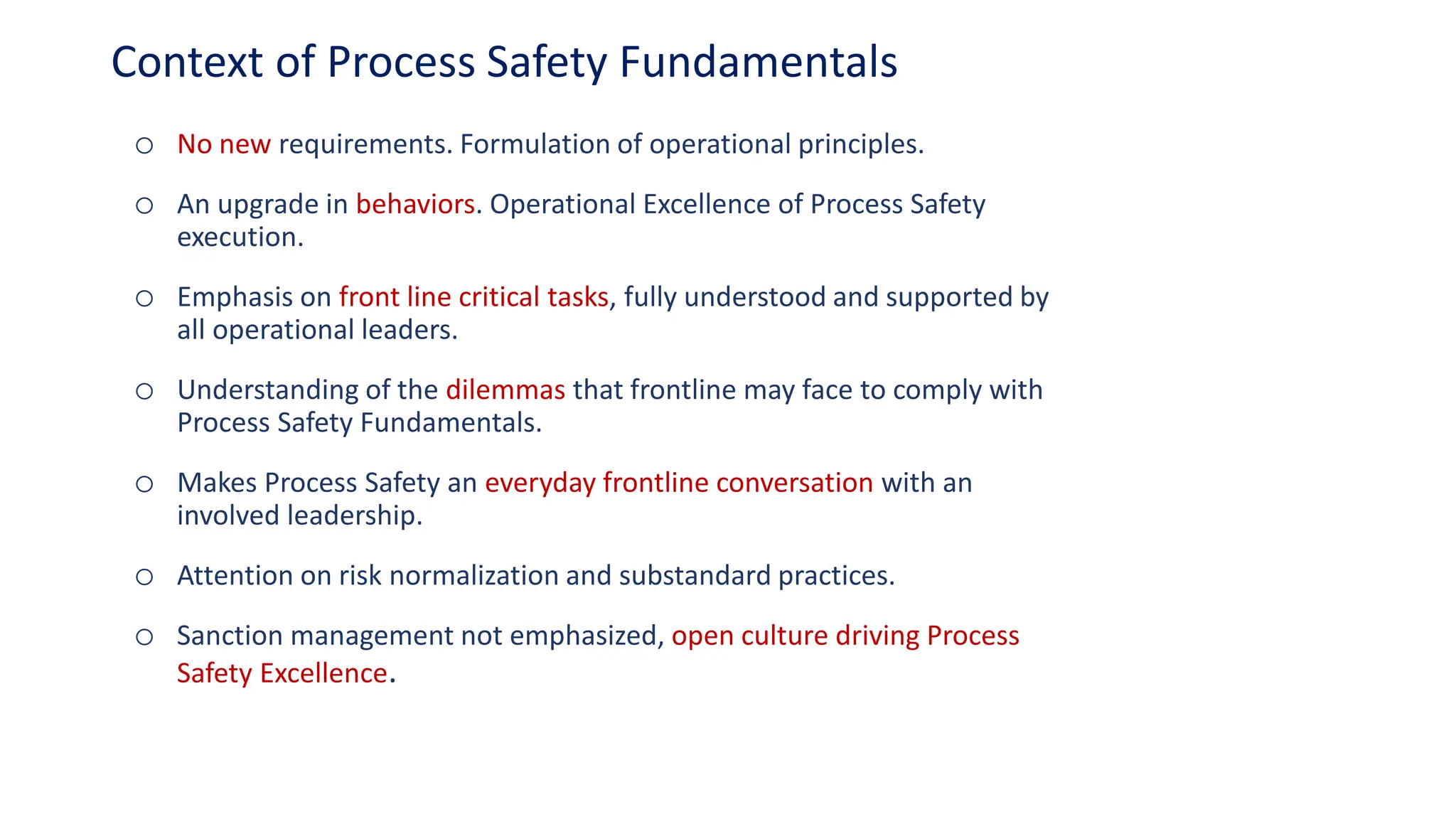
Context of Process Safety Fundamentals
o No new requirements. Formulation of operational principles.
o An upgrade in behaviors. Operational Excellence of Process Safety
execution.
o Emphasis on front line critical tasks, fully understood and supported by
all operational leaders.
o Understanding of the dilemmas that frontline may face to comply with
Process Safety Fundamentals.
o Makes Process Safety an everyday frontline conversation with an
involved leadership.
o Attention on risk normalization and substandard practices.
o Sanction management not emphasized, open culture driving Process
Safety Excellence.
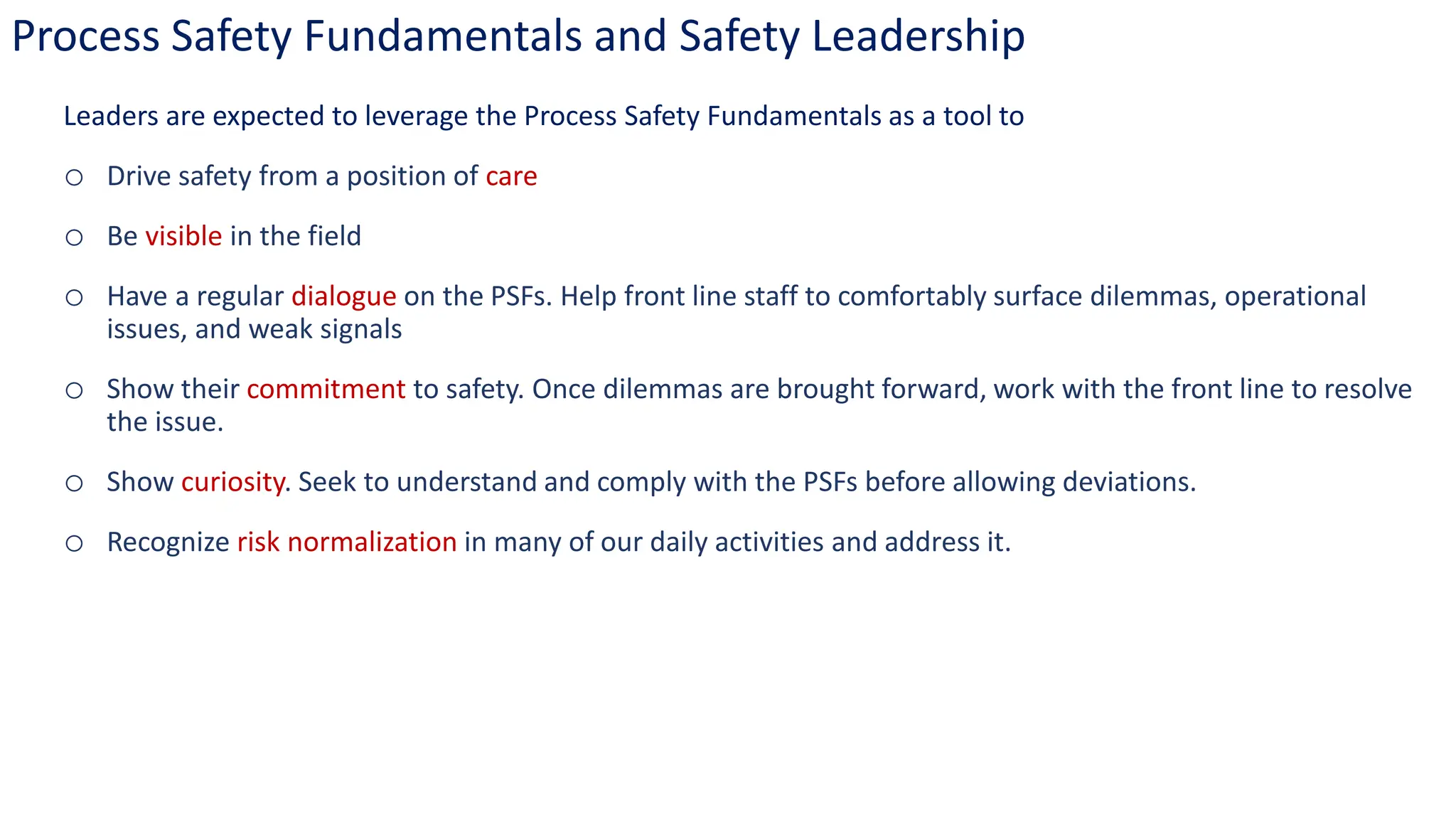
Process Safety Fundamentals and Safety Leadership
Leaders are expected to leverage the Process Safety Fundamentals as a tool to
o Drive safety from a position of care
o Be visible in the field
o Have a regular dialogue on the PSFs. Help front line staff to comfortably surface dilemmas, operational
issues, and weak signals
o Show their commitment to safety. Once dilemmas are brought forward, work with the front line to resolve
the issue.
o Show curiosity. Seek to understand and comply with the PSFs before allowing deviations.
o Recognize risk normalization in many of our daily activities and address it.
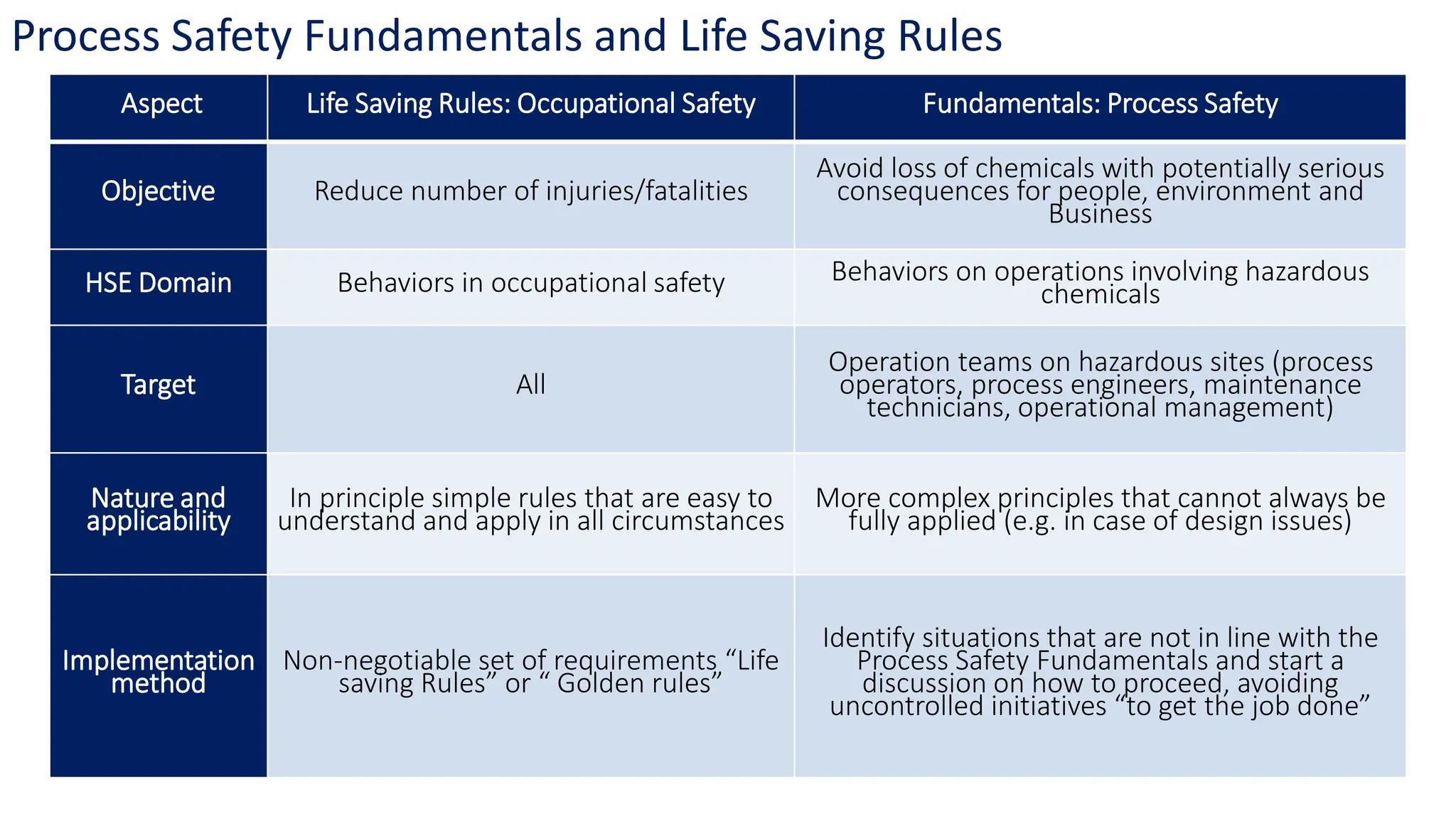
Aspect Life Saving Rules: Occupational Safety Fundamentals: Process Safety
Objective Reduce number of injuries/fatalities
Avoid loss of chemicals with potentially serious
consequences for people, environment and
Business
HSE Domain Behaviors in occupational safety Behaviors on operations involving hazardous
chemicals
Target All
Operation teams on hazardous sites (process
operators, process engineers, maintenance
technicians, operational management)
Nature and
applicability
In principle simple rules that are easy to
understand and apply in all circumstances
More complex principles that cannot always be
fully applied (e.g. in case of design issues)
Implementation
method
Non-negotiable set of requirements “Life
saving Rules” or “ Golden rules”
Identify situations that are not in line with the
Process Safety Fundamentals and start a
discussion on how to proceed, avoiding
uncontrolled initiatives “to get the job done”
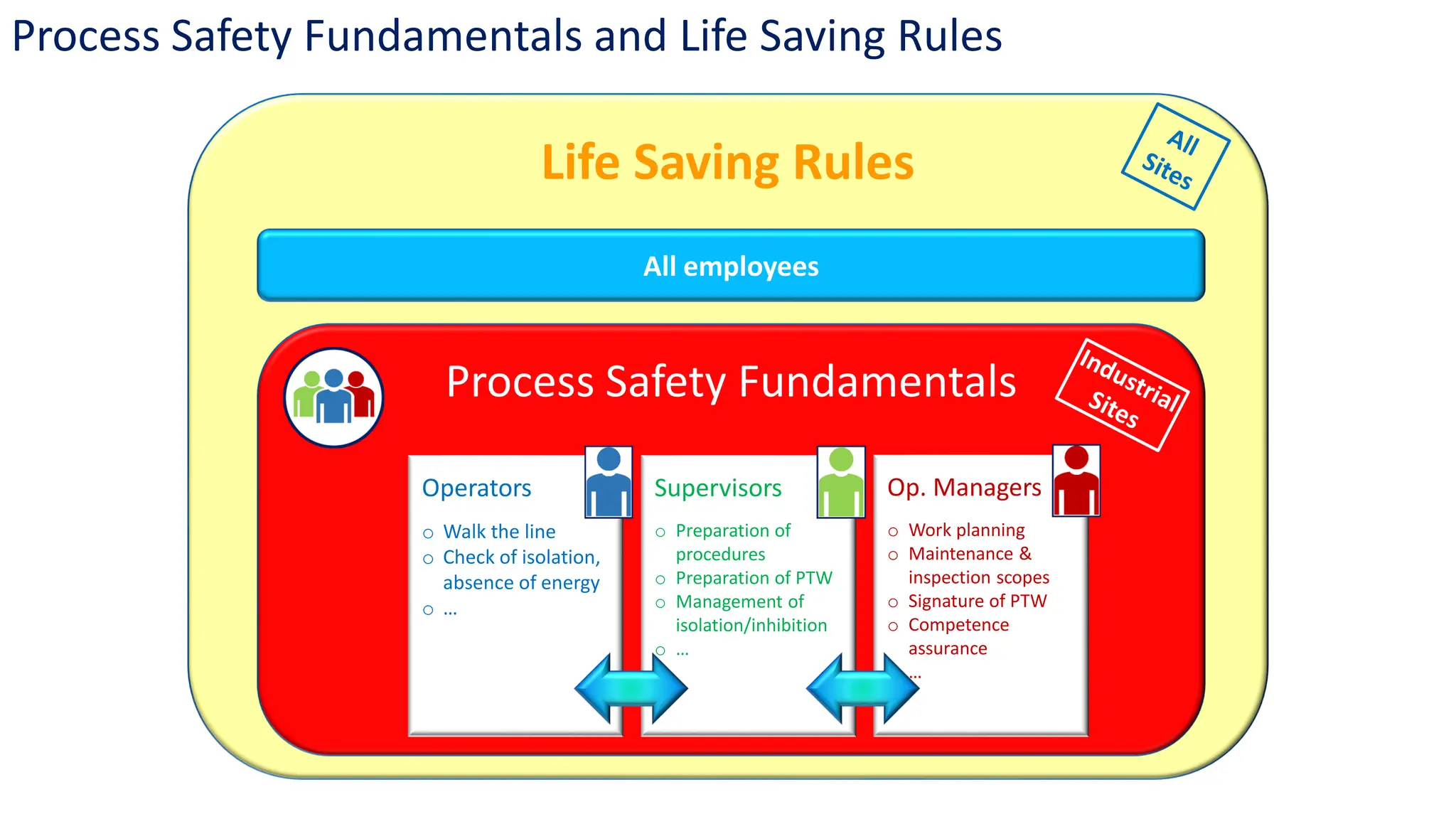
Process Safety Fundamentals and Life Saving Rules
Life Saving Rules
Process Safety Fundamentals
All employees
Op. Managers
o Work planning
o Maintenance &
inspection scopes
o Signature of PTW
o Competence
assurance
o …
Supervisors
o Preparation of
procedures
o Preparation of PTW
o Management of
isolation/inhibition
o …
Operators
o Walk the line
o Check of isolation,
absence of energy
o …
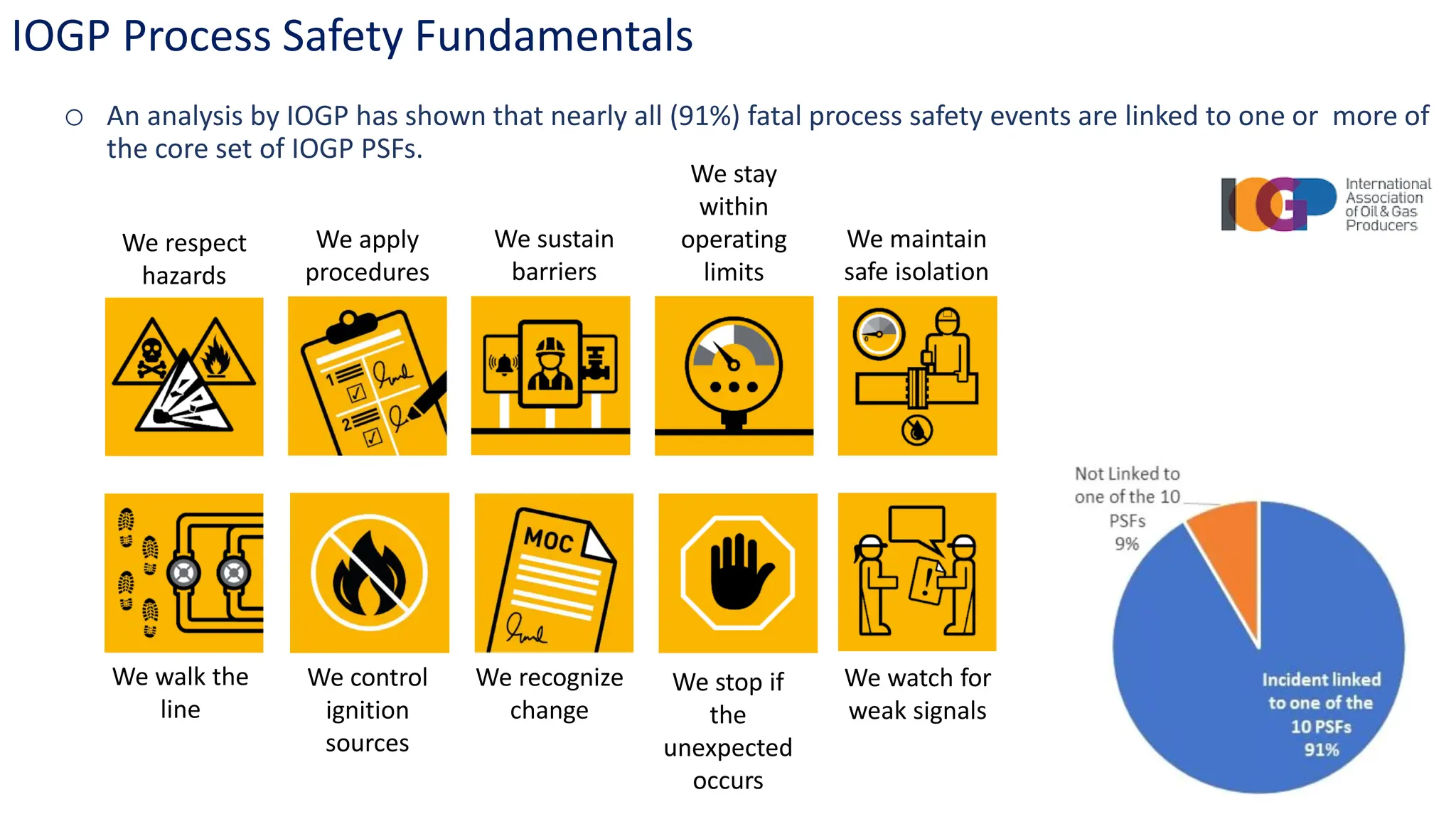
IOGP Process Safety Fundamentals
o An analysis by IOGP has shown that nearly all (91%) fatal process safety events are linked to one or more of
the core set of IOGP PSFs.
We respect
hazards
We apply
procedures
We sustain
barriers
We stay
within
operating
limits
We maintain
safe isolation
We walk the
line
We control
ignition
sources
We recognize
change
We stop if
the
unexpected
occurs
We watch for
weak signals
PSF
Logo
Title of PSF
Hazards: Options to get it right
When important:
Challenges in the field:
Description of specific hazards related to
this Process Safety Fundamental
Description of situations in which the
application of this Process Safety
Fundamental is important
Description of possible difficulties
encountered in the field when applying this
Process Safety Fundamental
Suggestions for efficient application of this Process Safety
Fundamental
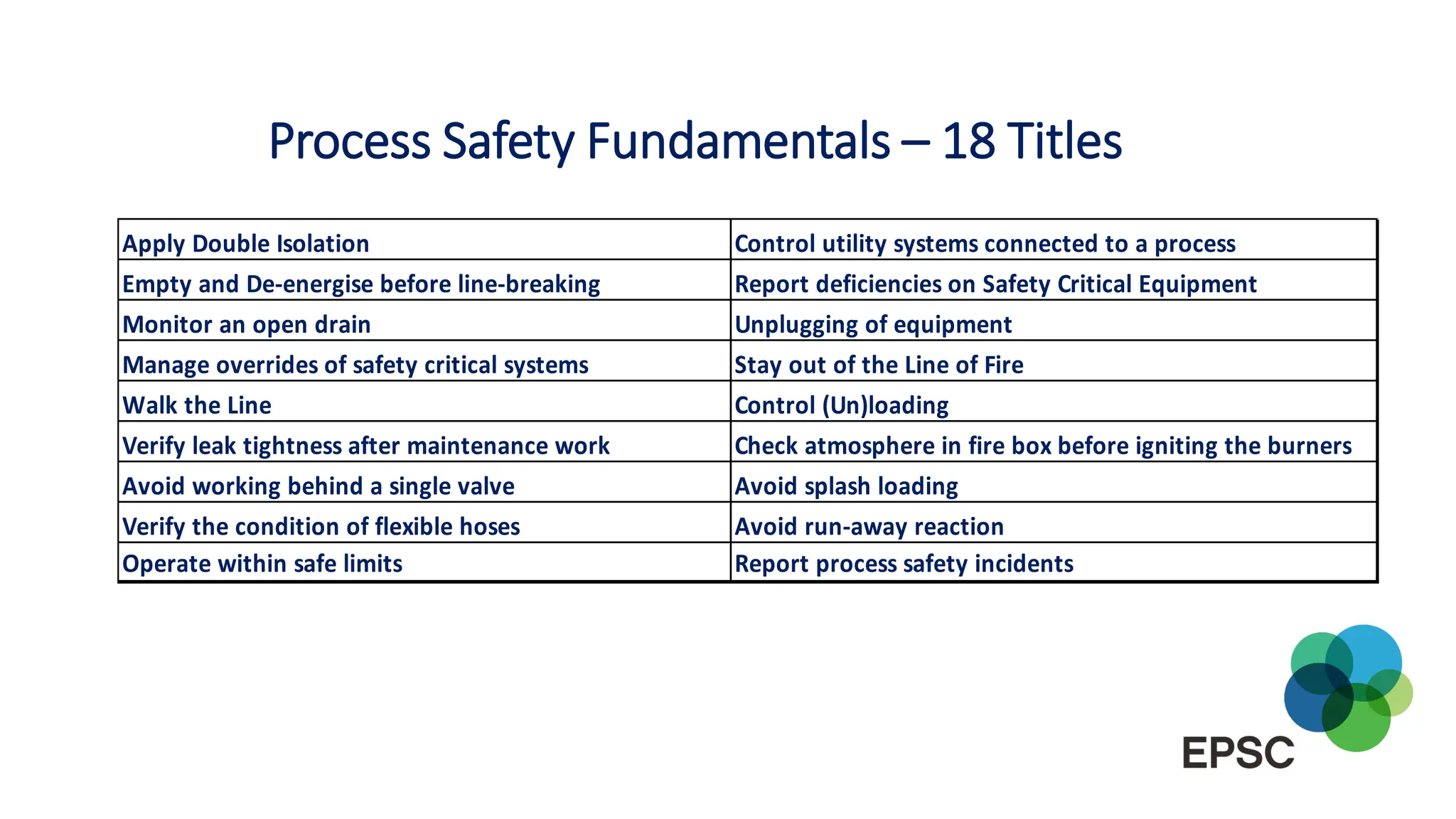
Apply Double Isolation Control utility systems connected to a process
Empty and De-energise before line-breaking Report deficiencies on Safety Critical Equipment
Monitor an open drain Unplugging of equipment
Manage overrides of safety critical systems Stay out of the Line of Fire
Walk the Line Control (Un)loading
Verify leak tightness after maintenance work Check atmosphere in fire box before igniting the burners
Avoid working behind a single valve Avoid splash loading
Verify the condition of flexible hoses Avoid run-away reaction
Operate within safe limits Report process safety incidents
Process Safety Fundamentals – 18 Titles
EPSC Pictograms
Double Isolation First Line Break Leak Tightness
Furnace Burners
Flexible Hoses Unloading
Open Drain
Run Away Reaction
Operating Limits Overrides Plugged Equipment Critical Equipment Reporting
Splash Loading Line of Fire Utility Connections Walk the Line Single valve
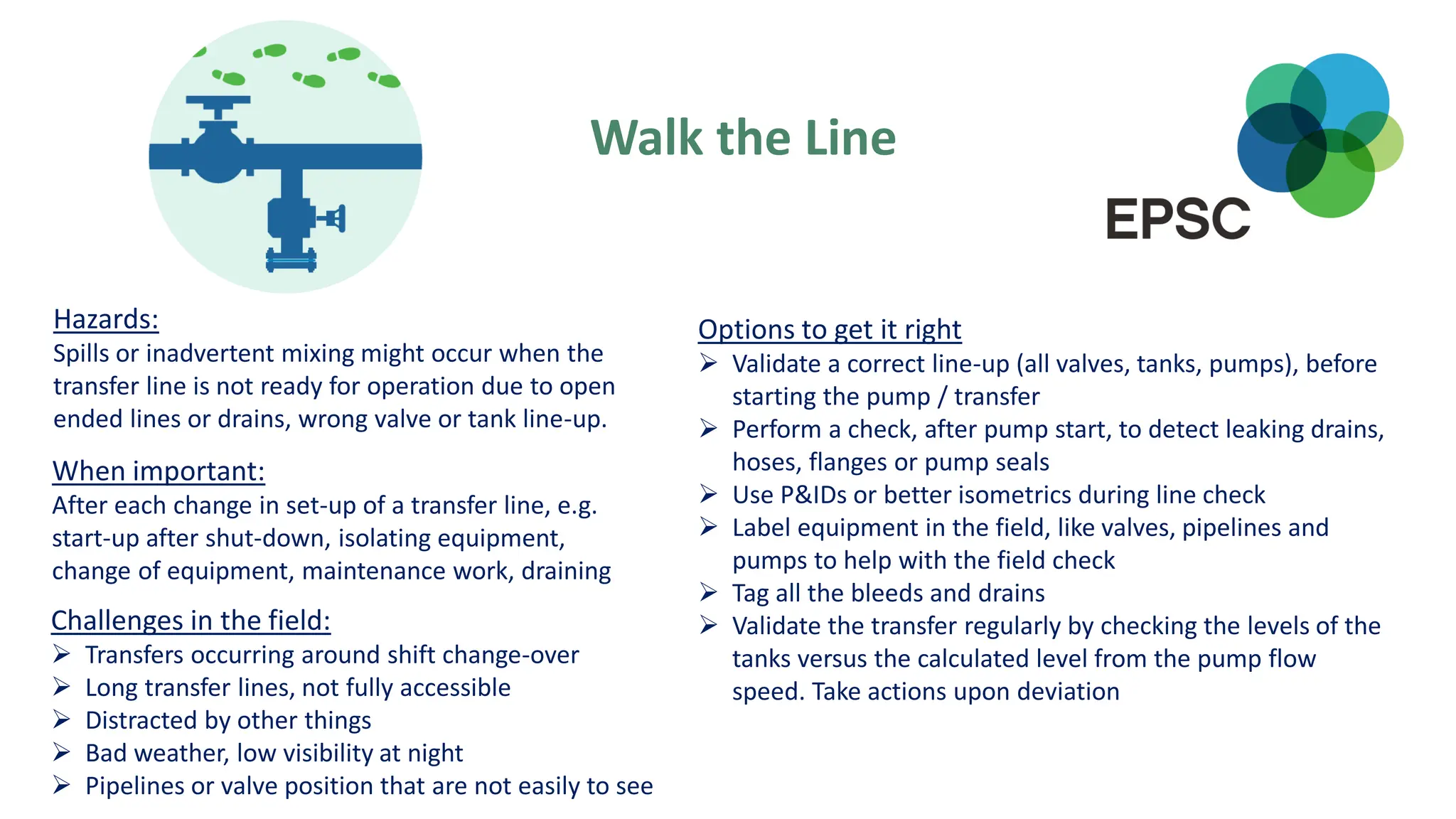
Walk the Line
Hazards:
Spills or inadvertent mixing might occur when the
transfer line is not ready for operation due to open
ended lines or drains, wrong valve or tank line-up.
Options to get it right
➢ Validate a correct line-up (all valves, tanks, pumps), before
starting the pump / transfer
➢ Perform a check, after pump start, to detect leaking drains,
hoses, flanges or pump seals
➢ Use P&IDs or better isometrics during line check
➢ Label equipment in the field, like valves, pipelines and
pumps to help with the field check
➢ Tag all the bleeds and drains
➢ Validate the transfer regularly by checking the levels of the
tanks versus the calculated level from the pump flow
speed. Take actions upon deviation
When important:
After each change in set-up of a transfer line, e.g.
start-up after shut-down, isolating equipment,
change of equipment, maintenance work, draining
Challenges in the field:
➢ Transfers occurring around shift change-over
➢ Long transfer lines, not fully accessible
➢ Distracted by other things
➢ Bad weather, low visibility at night
➢ Pipelines or valve position that are not easily to see
Video on “Walk the Line”
https://www.youtube.com/watch?v=l9Fu4ydckGg
To get in the positive process safety mood, feel free to use this video made by Shell:
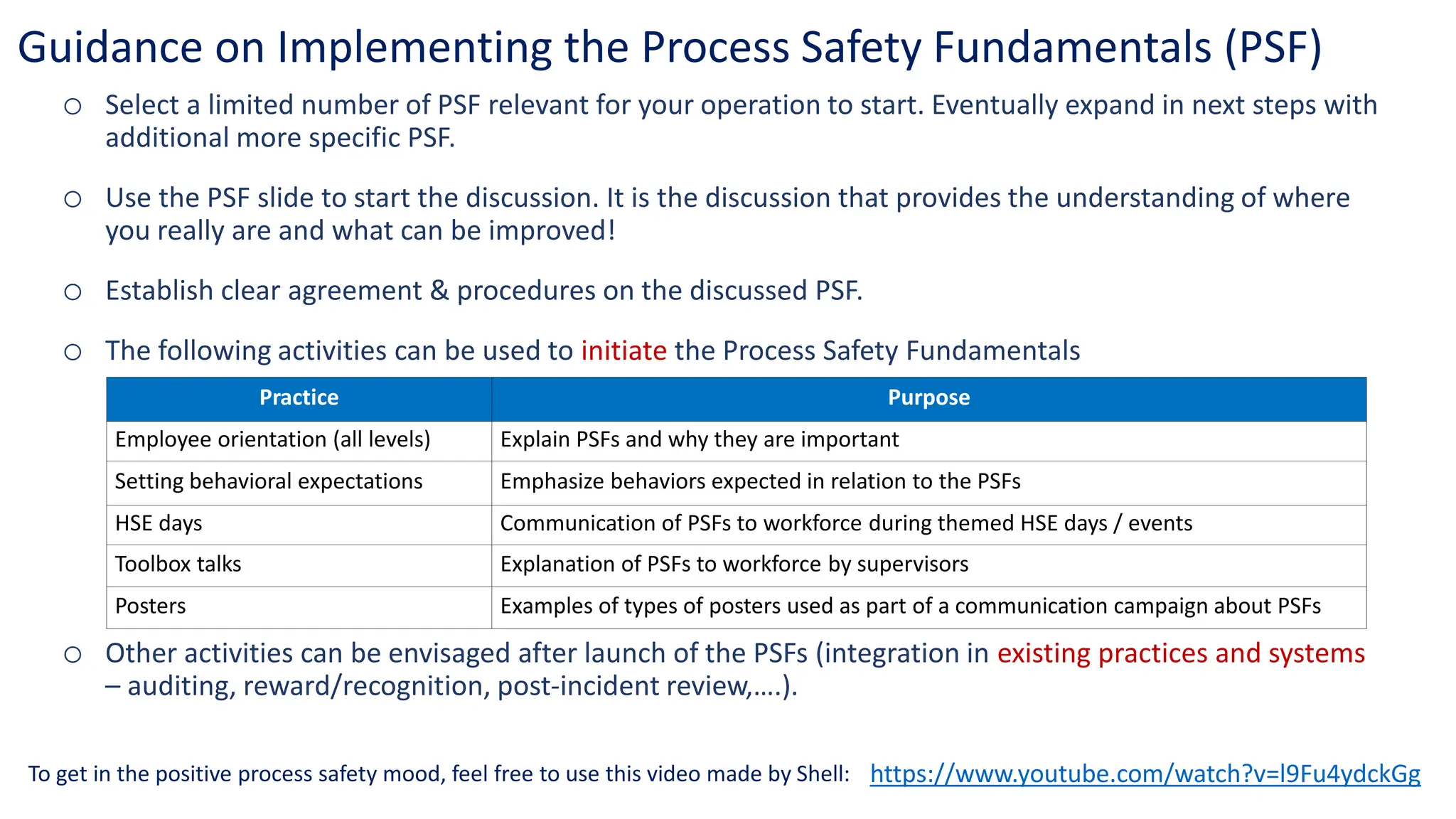
o Select a limited number of PSF relevant for your operation to start. Eventually expand in next steps with
additional more specific PSF.
o Use the PSF slide to start the discussion. It is the discussion that provides the understanding of where
you really are and what can be improved!
o Establish clear agreement & procedures on the discussed PSF.
o The following activities can be used to initiate the Process Safety Fundamentals
o Other activities can be envisaged after launch of the PSFs (integration in existing practices and systems
– auditing, reward/recognition, post-incident review,….).
Guidance on Implementing the Process Safety Fundamentals (PSF)
Practice Purpose
Employee orientation (all levels) Explain PSFs and why they are important
Setting behavioral expectations Emphasize behaviors expected in relation to the PSFs
HSE days Communication of PSFs to workforce during themed HSE days / events
Toolbox talks Explanation of PSFs to workforce by supervisors
Posters Examples of types of posters used as part of a communication campaign about PSFs
Apply Double Isolation
Hazards:
Spill of (hazardous) material can occur when a
barrier (like a valve) fails and no second barrier is in
place
Options to get it right:
➢ Do not rely on a single valve for positive isolation
➢ Execute regular audits to check that drains are having an
end-cap (blind flange or screw cap) conform pipe-spec
➢ Do not accept missing blind flanges or missing bolts on
blind flanges
➢ Report and investigate all incidents from leaking drains
➢ Valve handles can be locked to avoid accidentally opening
When important:
During routine and special operations: draining &
sampling, (un-)loading activities, utility connections
Challenges in the field:
➢ Older plant design often do not provide a double barrier
➢ Blind flanges not put back after maintenance work
➢ Blind flanges not installed with bolts & missing end-caps
➢ Importance of “primary containment” not understood
➢ Valve handles that can be opened accidentally
Empty and De-energize
before Line-breaking
Hazard:
Uncontrolled release of energy or a hazardous
material during the opening of piping or equipment
Options to get it right
➢ Have a validated isolation plan available, that indicates numbered
isolation points in the right sequence on a P&ID
➢ Apply LOTO to avoid that equipment can be re-energised: that is
providing locks and labels
➢ Empty and clean equipment properly
➢ Check the completion of the isolation plan by an independent
operator, before signing the permit to work
➢ Wear selected PPE for residual chemicals that might not be purged
or drained and provide absorbents for leaking fluids
➢ Perform a Last Minute Risk Assessment by the mechanic or
contractor, before opening, to validate that the pressure indicator is
zero, the drain is open, the system is at ambient temperature, there
is no flow and assure you are at the right equipment
➢ Use blinds according pipe spec, that is indicated on the isolation list
➢ Upon changes, validate that isolation remains intact
When important:
When unbolting, unscrewing, drilling or cutting of
process equipment
While working on live equipment
Challenges in the field:
➢ Working at the wrong location
➢ Complexity of piping or break points arrangements
➢ Double block and bleed not possible
➢ Plugging of vents or drains / leaking valves
➢ Installing blinds
➢ Drains at the wrong location
Monitor an Open Drain
Hazards:
Unintended product release can occur during
draining from a storage tank or other
equipment to atmosphere
Options to get it right
➢ Identify the critical draining operations on site
➢ Limit drain size (typical to 1 inch) to limit the release rate of
the hazardous chemical
➢ Spring Loaded valves can help to assure that an operator
remains present when drain time is short
➢ Understand the draining time necessary when starting the
draining process
➢ Ensure the drain-valve can be closed from a safe location
➢ Avoid doing something else while monitoring a draining task
➢ In a critical situation, first stop the draining process before
leaving the drain
➢ Stop draining during shift handover
When important:
When draining water from a tank that contains
hydrocarbons to a sewer.
When removing liquid from process equipment
Challenges in the field:
➢ Distracted by other things that need attention
➢ Long draining time
➢ Bad weather
➢ Under estimation of the potential consequence of the
product being released
➢ Drain valve does not fully close
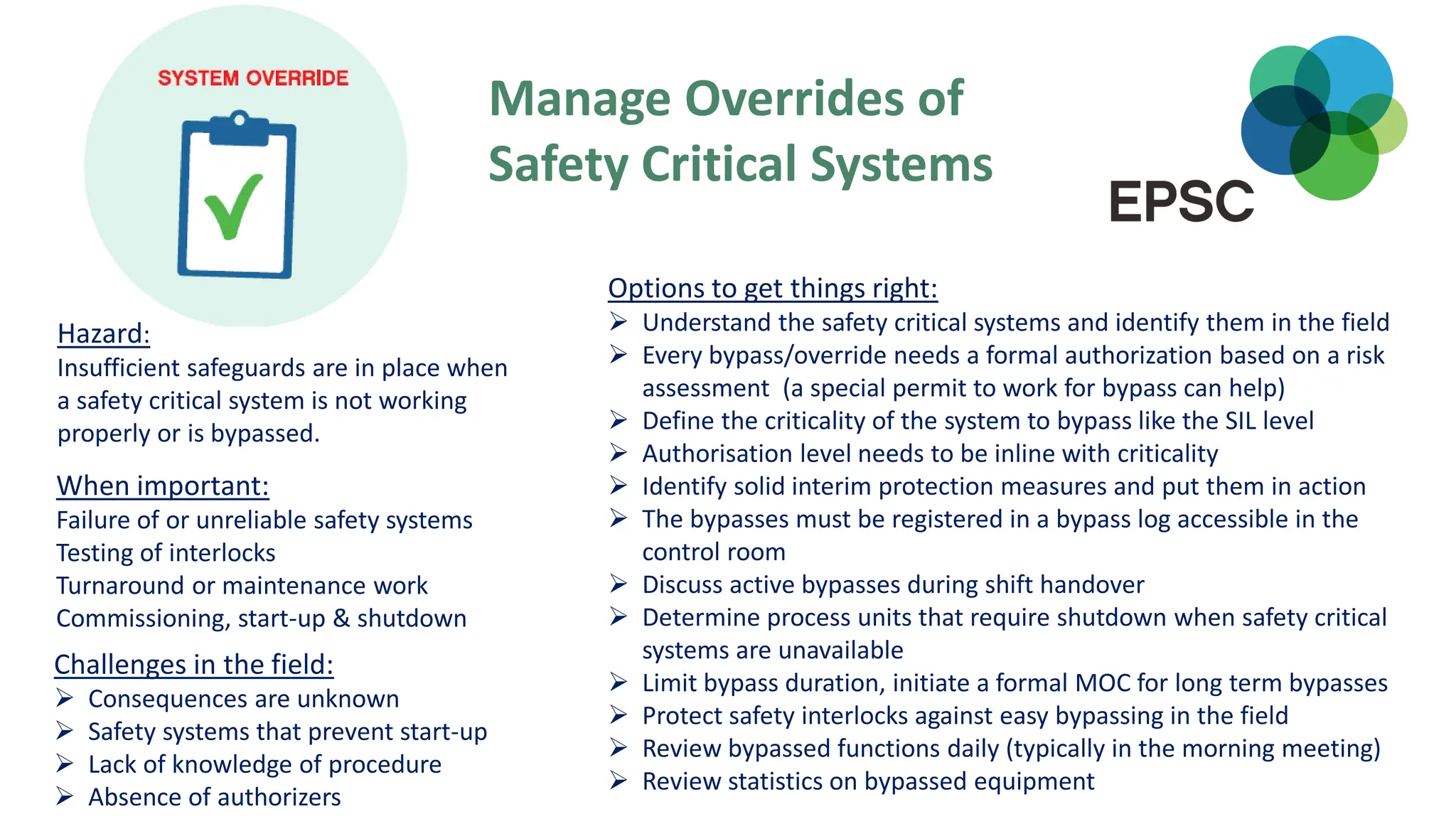
Manage Overrides of
Safety Critical Systems
Hazard:
Insufficient safeguards are in place when
a safety critical system is not working
properly or is bypassed.
Options to get things right:
➢ Understand the safety critical systems and identify them in the field
➢ Every bypass/override needs a formal authorization based on a risk
assessment (a special permit to work for bypass can help)
➢ Define the criticality of the system to bypass like the SIL level
➢ Authorisation level needs to be inline with criticality
➢ Identify solid interim protection measures and put them in action
➢ The bypasses must be registered in a bypass log accessible in the
control room
➢ Discuss active bypasses during shift handover
➢ Determine process units that require shutdown when safety critical
systems are unavailable
➢ Limit bypass duration, initiate a formal MOC for long term bypasses
➢ Protect safety interlocks against easy bypassing in the field
➢ Review bypassed functions daily (typically in the morning meeting)
➢ Review statistics on bypassed equipment
When important:
Failure of or unreliable safety systems
Testing of interlocks
Turnaround or maintenance work
Commissioning, start-up & shutdown
Challenges in the field:
➢ Consequences are unknown
➢ Safety systems that prevent start-up
➢ Lack of knowledge of procedure
➢ Absence of authorizers
Walk the Line
Hazards:
Spills or inadvertent mixing might occur when the
transfer line is not ready for operation due to open
ended lines or drains, wrong valve or tank line-up.
Options to get it right
➢ Validate a correct line-up (all valves, tanks, pumps), before
starting the pump / transfer
➢ Perform a check, after pump start, to detect leaking drains,
hoses, flanges or pump seals
➢ Use P&IDs or better isometrics during line check
➢ Label equipment in the field, like valves, pipelines and
pumps to help with the field check
➢ Tag all the bleeds and drains
➢ Validate the transfer regularly by checking the levels of the
tanks versus the calculated level from the pump flow
speed. Take actions upon deviation
When important:
After each change in set-up of a transfer line, e.g.
start-up after shut-down, isolating equipment,
change of equipment, maintenance work, draining
Challenges in the field:
➢ Transfers occurring around shift change-over
➢ Long transfer lines, not fully accessible
➢ Distracted by other things
➢ Bad weather, low visibility at night
➢ Pipelines or valve position that are not easily to see
Verify Leak Tightness after
Maintenance Work
Hazard:
When a flange or other equipment is
closed, it can still leak, when hazardous
chemicals are introduced
Options to get it right:
➢ Perform a leak test before introducing hazardous chemicals
➢ Leak test can be done
o by introducing a less hazardous gas and perform a pressure
hold test
o put soap bubbles on all flanges that have been opened
o Ultrasound measurements can detect leakages
➢ Develop criteria for acceptance of leak test results
➢ Develop a special procedure for the flange that was used in the
leak-tightness test (the flange to be closed after the leak test)
➢ Verify proper torqueing
➢ Validate and adjust bolt tension after heating-up the equipment
➢ Record Leak Test results
When important:
After work where equipment and flanges
have been opened
Temperature change can influence bolt
tension and create leakages
Challenges in the field:
➢ Competent people when bolting
➢ Verification competency or procedures
are missing
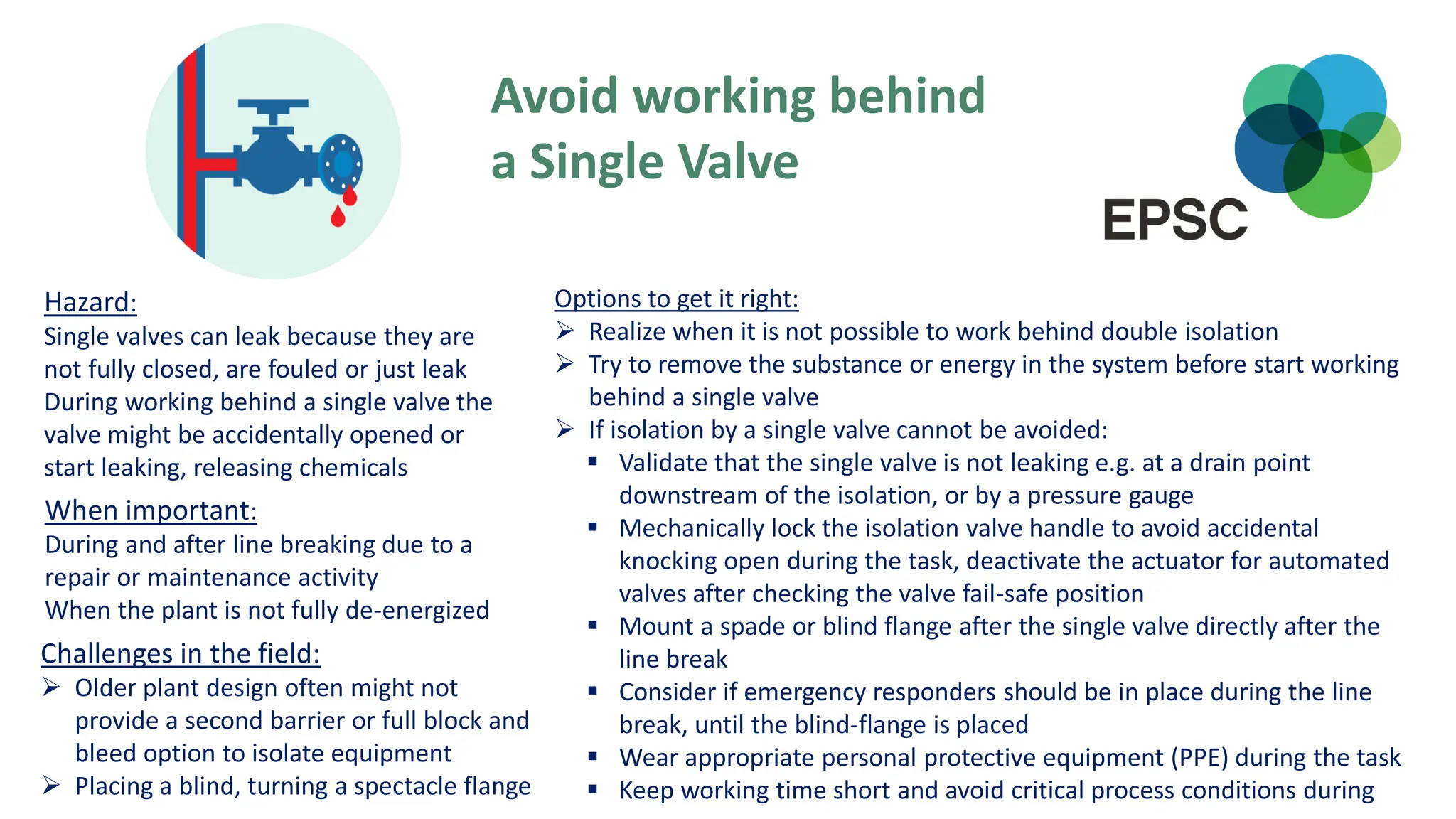
Avoid working behind
a Single Valve
Hazard:
Single valves can leak because they are
not fully closed, are fouled or just leak
During working behind a single valve the
valve might be accidentally opened or
start leaking, releasing chemicals
Options to get it right:
➢ Realize when it is not possible to work behind double isolation
➢ Try to remove the substance or energy in the system before start working
behind a single valve
➢ If isolation by a single valve cannot be avoided:
▪ Validate that the single valve is not leaking e.g. at a drain point
downstream of the isolation, or by a pressure gauge
▪ Mechanically lock the isolation valve handle to avoid accidental
knocking open during the task, deactivate the actuator for automated
valves after checking the valve fail-safe position
▪ Mount a spade or blind flange after the single valve directly after the
line break
▪ Consider if emergency responders should be in place during the line
break, until the blind-flange is placed
▪ Wear appropriate personal protective equipment (PPE) during the task
▪ Keep working time short and avoid critical process conditions during
When important:
During and after line breaking due to a
repair or maintenance activity
When the plant is not fully de-energized
Challenges in the field:
➢ Older plant design often might not
provide a second barrier or full block and
bleed option to isolate equipment
➢ Placing a blind, turning a spectacle flange
Verify the Condition of
Flexible Hoses
Hazard:
Hazardous fluid release due to hoses
failures
Wildly moving hoses at pressure release
when coupling gets loose
Options to get it right:
➢ Make sure you use the correct hose: correct material of construction and
temperature & pressure rating
➢ Visually inspect hoses before using them and check for defects like
corrosion, wear or mechanical damage
➢ Hoses (including the connections) with hazardous fluids should be
inspected periodically by an approved body and certified
➢ Avoid hoses for very toxic chemicals (like phosgene)
➢ Hoses should be tagged and included in the maintenance schedule
➢ When not in use, hoses must be properly stored, with the appropriate
bend radius, hanging straight down, or laying straight
➢ Hoses must not be twisted or forced when connected
➢ Connect hoses well, follow-up on possible vibrations
➢ If required replace hoses preventively and remove old hoses from the site
➢ Check correct depressurization of hoses before disconnecting
When important:
When using flexible hoses
When disconnecting hoses that still
contain pressure or toxic material
Challenges in the field:
➢ Connections are not properly made,
requiring bended or stretched hoses
➢ No good storage location available
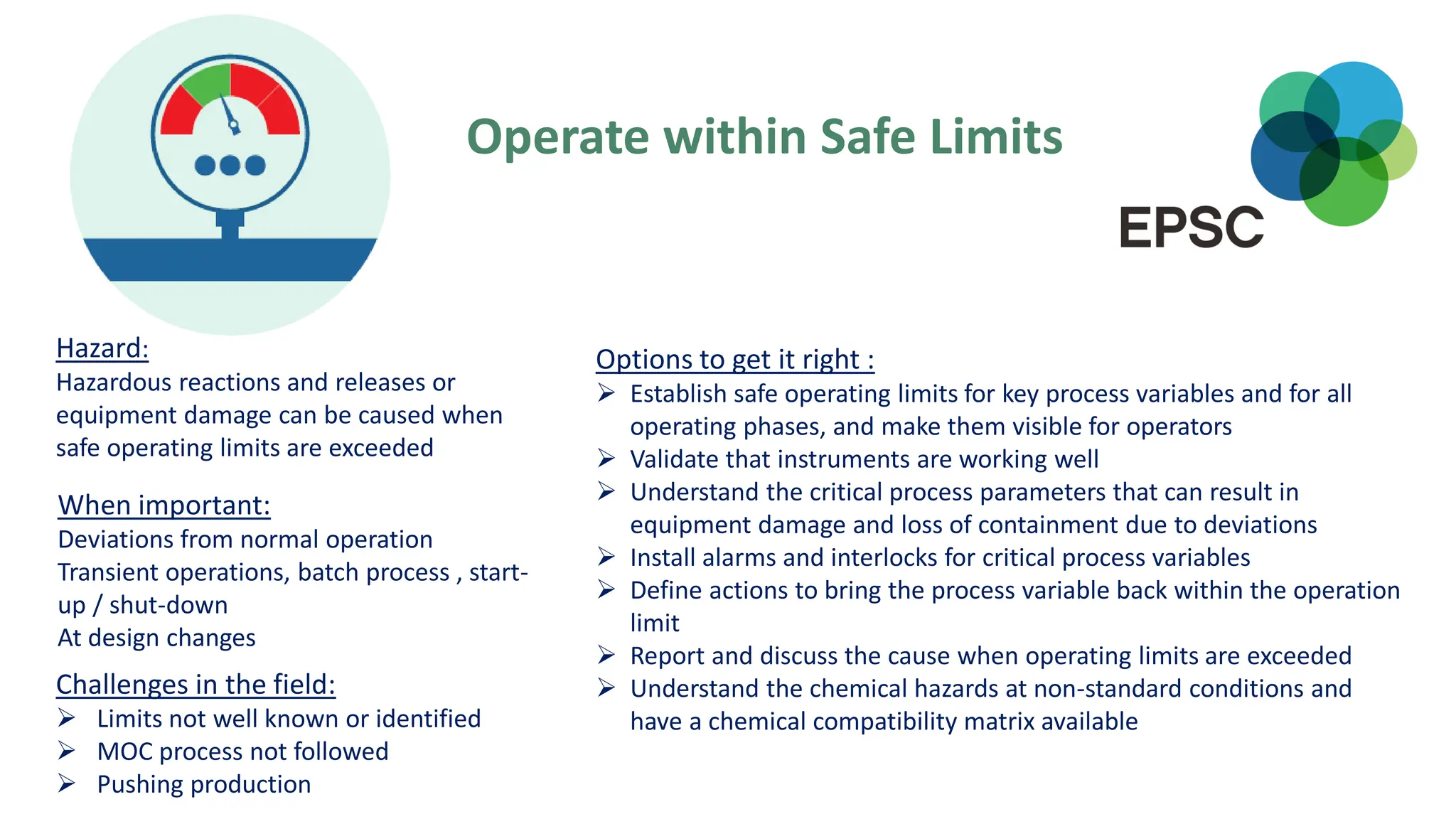
Operate within Safe Limits
Hazard:
Hazardous reactions and releases or
equipment damage can be caused when
safe operating limits are exceeded
Options to get it right :
➢ Establish safe operating limits for key process variables and for all
operating phases, and make them visible for operators
➢ Validate that instruments are working well
➢ Understand the critical process parameters that can result in
equipment damage and loss of containment due to deviations
➢ Install alarms and interlocks for critical process variables
➢ Define actions to bring the process variable back within the operation
limit
➢ Report and discuss the cause when operating limits are exceeded
➢ Understand the chemical hazards at non-standard conditions and
have a chemical compatibility matrix available
When important:
Deviations from normal operation
Transient operations, batch process , start-
up / shut-down
At design changes
Challenges in the field:
➢ Limits not well known or identified
➢ MOC process not followed
➢ Pushing production
Control Utility Systems
connected to a Process
Hazard:
When utility systems are temporarily
connected with a flexible hose to a process,
hazardous substances can flow back into the
utility system
Options to get it right
➢ Awareness of the hazard that utilities can be contaminated with
process gasses or liquids
➢ Understand the pressures in the systems and how they can
deviate during operation
➢ Define suitable safeguards against backflow, at least one non-
return valve must be present
➢ Remove the utility hoses from the process directly when the task
is completed
➢ Ensure that the hoses applied have the same pressure rating and
chemical compatibility as the process when used in normal
operation
➢ Evaluate backflow during MoC and HAZOP studies when fixed
connections exist between utilities and process units
When important:
During inerting, cleaning and unplugging
operational equipment using utilities
When taking a sample a utility is needed to
purge a system
Challenges in the field:
➢ Lack of knowledge
➢ Easy availability of utility stations & hoses
➢ Hazard studies did not identify the hazard
Report Deficiencies on
Safety Critical Equipment
Hazard:
Safety Critical Equipment provides a
barrier to prevent or limit the effect of a
major incident
Options to get it right:
➢ Determine which equipment is safety critical
➢ Ensure workers know what equipment is Safety Critical, and
understand the potential hazard
➢ Safety Critical Equipment must have a testing protocol and
frequency
➢ Report failures or deviations on safety critical systems (also from
testing)
➢ Decide what action is appropriate, if necessary stop the operation
➢ Implement interim mitigating measures that are approved, in case
of continuing operation
➢ Repair or replace safety critical equipment with highest priority
➢ Analyse why equipment failed
➢ Keeping a log on critical equipment out of service
When important:
When Safety Critical Equipment is not
working properly
Challenges in the field
➢ A shutdown might be needed to repair the
broken equipment
➢ Not aware of the criticality
➢ Unawareness of the failure – no testing
➢ Unreadable equipment, like a fouled side glass
Unplugging of Equipment
Hazard:
Unplugging might requires opening of
installations that can unexpectedly result in a
release of hazardous substances
Options to get it right :
➢ Consider to stop production before unplugging
➢ Do not start unplugging without an approved plan that includes a
hazard analysis
➢ Understand the source and reason of plugging
➢ Understand the hazards while unplugged and have a mitigation
plan for unexpected releases
➢ Understand that instrumentation might give misreading or that
safety valves do not operate properly
➢ Understand that opened equipment can still have pressurized
hazardous material inside behind the plug
➢ Apply isolation and First Line Break principles in the unplugging
procedure
➢ Do not use hazardous gas to blow out pipelines / equipment
When important:
When process equipment is blocked, eg by
fouling, polymer, corrosion, objects after
maintenance etc.
Challenges in the field:
➢ Unexpected severe flow restrictions
➢ No unplugging procedure or good options
➢ Not wanting to stop production
Stay Out of the Line of Fire
Hazard:
Exposure in case of unexpected release
of energy or chemicals or unexpected
movement of objects like a manhole,
also vacuum can form a hazard
Options to get it right :
➢ Identify hazardous location around release points or below
hoisted objects in the field, e.g. by lines or colours on the floor
➢ Understand release locations and remove yourself from the
potential energy discharge path from release points like PSV’s,
explosion panels and plugs under pressure
➢ Keep people out of the heat radiation zone around a flare
➢ Protect yourself (location of your body) when opening
installations
➢ Add physical barriers to prevent people from accidentally entering
the paths
➢ Verify that PSV’s are designed to always vent to a safe location
➢ At flange opening, first untighten the bolts that are far away from
you
When important:
When being in processing units that do
not work at ambient pressure
Challenges in the field:
➢ Release points not designed well: e.g. PSV
release points that end in a pathway
➢ Manholes (or manway) that are stuck
➢ Heat releases from flare
Control (Un)loading
Hazard:
Unexpected run away reaction
Formation of toxic chemicals
Overfilling or loss of containment
Options to get it right :
➢ Validate that the right chemical is loaded by a positive identification:
analysis of a sample, inline analysis (density), certificate, barcode,
clear label
➢ Have a good procedure in place with check points
➢ Provide unique coupling for hazardous chemicals (e.g. Chlorine,
Ammonium, Ethylene oxide) to avoid wrong line-up
➢ Use colour codes (or bar codes that can be scanned) on pipelines,
tubing and connection point
➢ Use professional firms for transporting the chemicals (that are ADR,
ADN & RID compliant)
➢ Guide contractors well that are involved in (un)loading
➢ Assure that receiving equipment has sufficient volume available
➢ Have a compatibility matrix available to understand the hazards
When important:
Receiving of chemicals at your site
Loading chemicals to a tank or reactor
Waste handling operation
Challenges in the field:
➢ Lack of knowledge & guidance of the
contractor or operator involved
➢ Line up
➢ Chemical identification
Check Atmosphere in Fire Box
before Igniting the Burners
Hazard:
When the firebox of a furnace or boiler
has an explosive mixture by accumulation
of large amounts of flammable gases, this
will explode when igniting the burners
Options to get it right :
➢ Furnaces/boilers need to be purged well with air to remove all gasses and to
avoid an explosive atmosphere, before igniting the burners
➢ Procedures for start of furnaces and boilers must be available, up-to-date.
Management shall undertake a periodic verification of the correct execution of
these procedures.
➢ Report problems with fully automated systems (burner management systems)
or deviation from start-up procedure immediately
➢ Limit the number of attempts to ignite a furnace/boiler (and keep sufficient
time between attempts)
➢ Perform a leak test on the gas supply before igniting a furnace/boiler
➢ Check atmosphere in the fire box before igniting the burners with a LEL meter
➢ Bypassing of safety instrumentation (flame eyes, gas detection,sensors) must
be managed carefully
➢ Limit the number of people in the vicinity when starting furnaces/boilers to
those necessary for the start-up operation
➢ Avoid time pressure when starting or restarting furnaces or boilers
When important:
Upon start and restart
Cold start
After a furnace trip
Challenges in the field:
➢ Reliability of instruments
➢ No good procedure / practices
➢ Fast restart required to avoid shut down
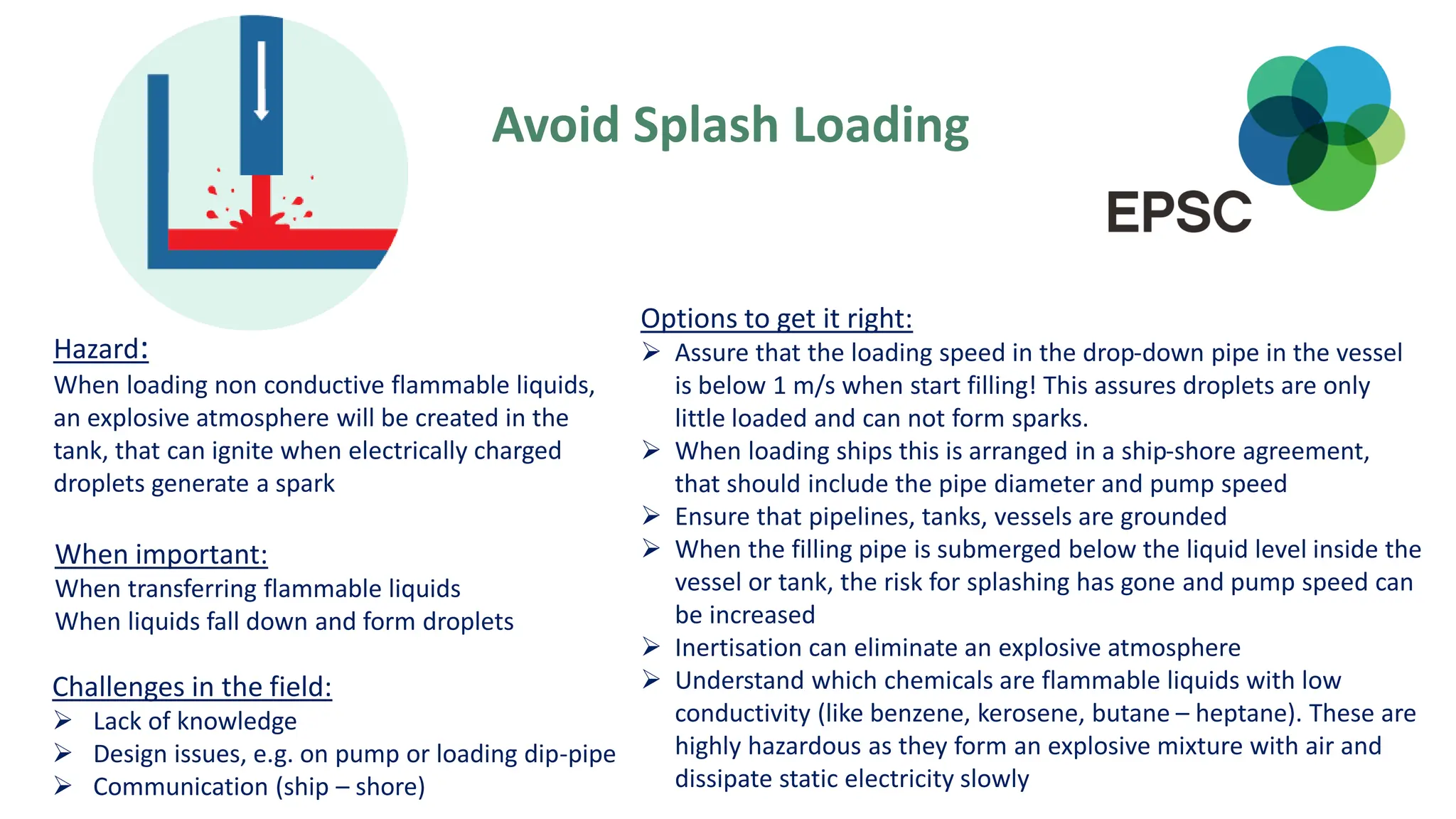
Avoid Splash Loading
Hazard:
When loading non conductive flammable liquids,
an explosive atmosphere will be created in the
tank, that can ignite when electrically charged
droplets generate a spark
Options to get it right:
➢ Assure that the loading speed in the drop-down pipe in the vessel
is below 1 m/s when start filling! This assures droplets are only
little loaded and can not form sparks.
➢ When loading ships this is arranged in a ship-shore agreement,
that should include the pipe diameter and pump speed
➢ Ensure that pipelines, tanks, vessels are grounded
➢ When the filling pipe is submerged below the liquid level inside the
vessel or tank, the risk for splashing has gone and pump speed can
be increased
➢ Inertisation can eliminate an explosive atmosphere
➢ Understand which chemicals are flammable liquids with low
conductivity (like benzene, kerosene, butane – heptane). These are
highly hazardous as they form an explosive mixture with air and
dissipate static electricity slowly
When important:
When transferring flammable liquids
When liquids fall down and form droplets
Challenges in the field:
➢ Lack of knowledge
➢ Design issues, e.g. on pump or loading dip-pipe
➢ Communication (ship – shore)
Avoid Run-Away Reaction
Hazard:
Bhopal & Seveso incidents occurred after
an exothermic exponential runaway
reaction started
Options to get it right :
➢ Understand the chemistry and side reactions at abnormal
conditions like elevated temperature
➢ Understand the point where cooling can not cope with the
exponential heat of the reaction (point of no return)
➢ Assure good design data is available on heat balance of all the
reactions involved (like DSC curves)
➢ Understand the effect of malfunctioning cooling
➢ Have a reactivity matrix available & make sure operators know
the critical combinations of chemicals to avoid
➢ Assure cooling is reliability and have back-up cooling available
➢ Validate inhibitors are present as applicable
➢ Have a last line of defence like Interlocks, Breaker plates, Bunkers
➢ Have an emergency procedure: Run away in a runaway reaction!
When important:
Exothermic batch reactions
Storage of reactive chemicals
Unexpected Polymerization or Decomposition
Challenges in the field:
➢ Chemistry at increased temperature can be
different or unknown to operators
➢ Cooling can malfunction or might not be able to
cope with the exponential increase of the
reaction rate
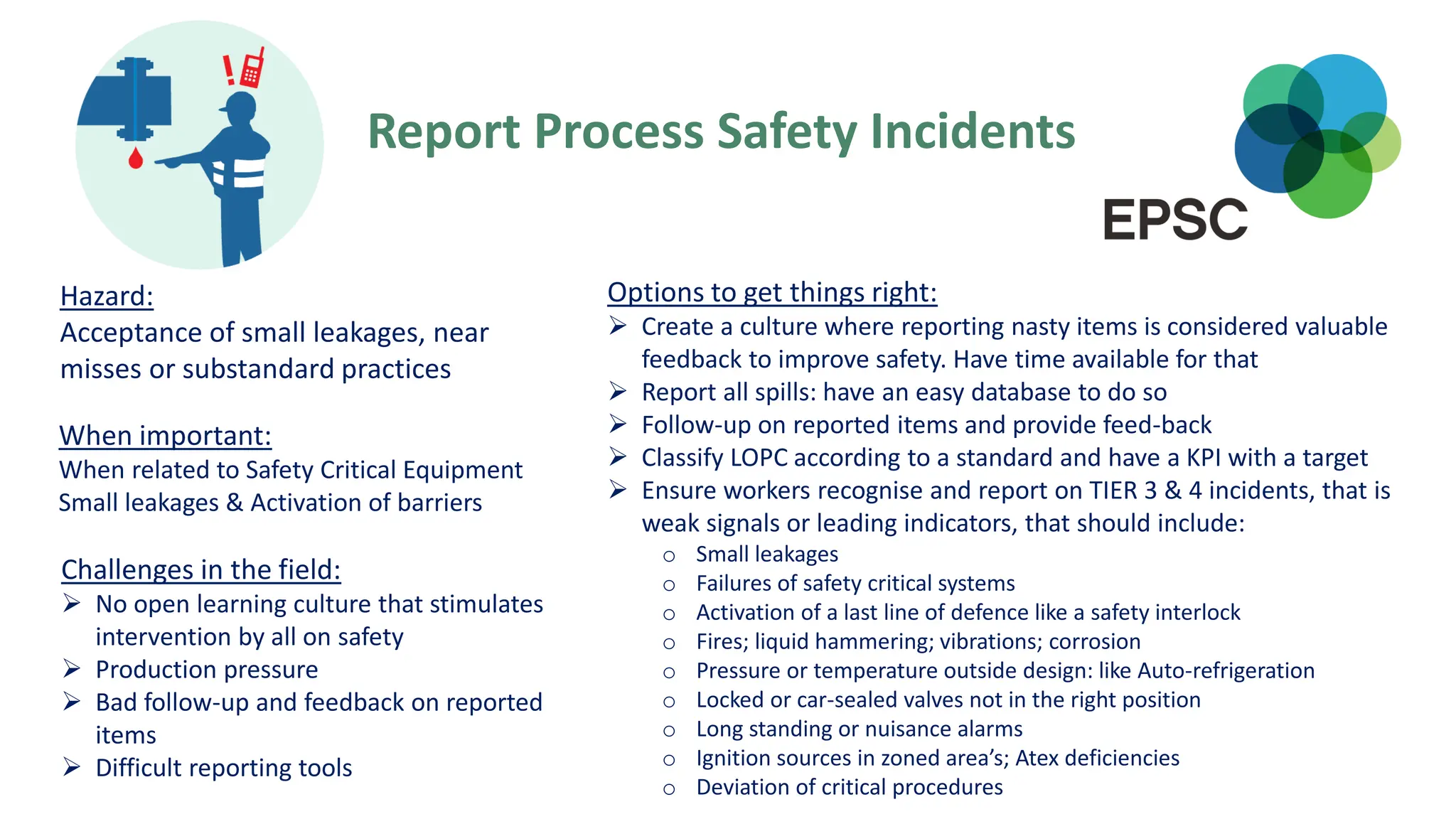
Report Process Safety Incidents
Hazard:
Acceptance of small leakages, near
misses or substandard practices
Options to get things right:
➢ Create a culture where reporting nasty items is considered valuable
feedback to improve safety. Have time available for that
➢ Report all spills: have an easy database to do so
➢ Follow-up on reported items and provide feed-back
➢ Classify LOPC according to a standard and have a KPI with a target
➢ Ensure workers recognise and report on TIER 3 & 4 incidents, that is
weak signals or leading indicators, that should include:
o Small leakages
o Failures of safety critical systems
o Activation of a last line of defence like a safety interlock
o Fires; liquid hammering; vibrations; corrosion
o Pressure or temperature outside design: like Auto-refrigeration
o Locked or car-sealed valves not in the right position
o Long standing or nuisance alarms
o Ignition sources in zoned area’s; Atex deficiencies
o Deviation of critical procedures
When important:
When related to Safety Critical Equipment
Small leakages & Activation of barriers
Challenges in the field:
➢ No open learning culture that stimulates
intervention by all on safety
➢ Production pressure
➢ Bad follow-up and feedback on reported
items
➢ Difficult reporting tools
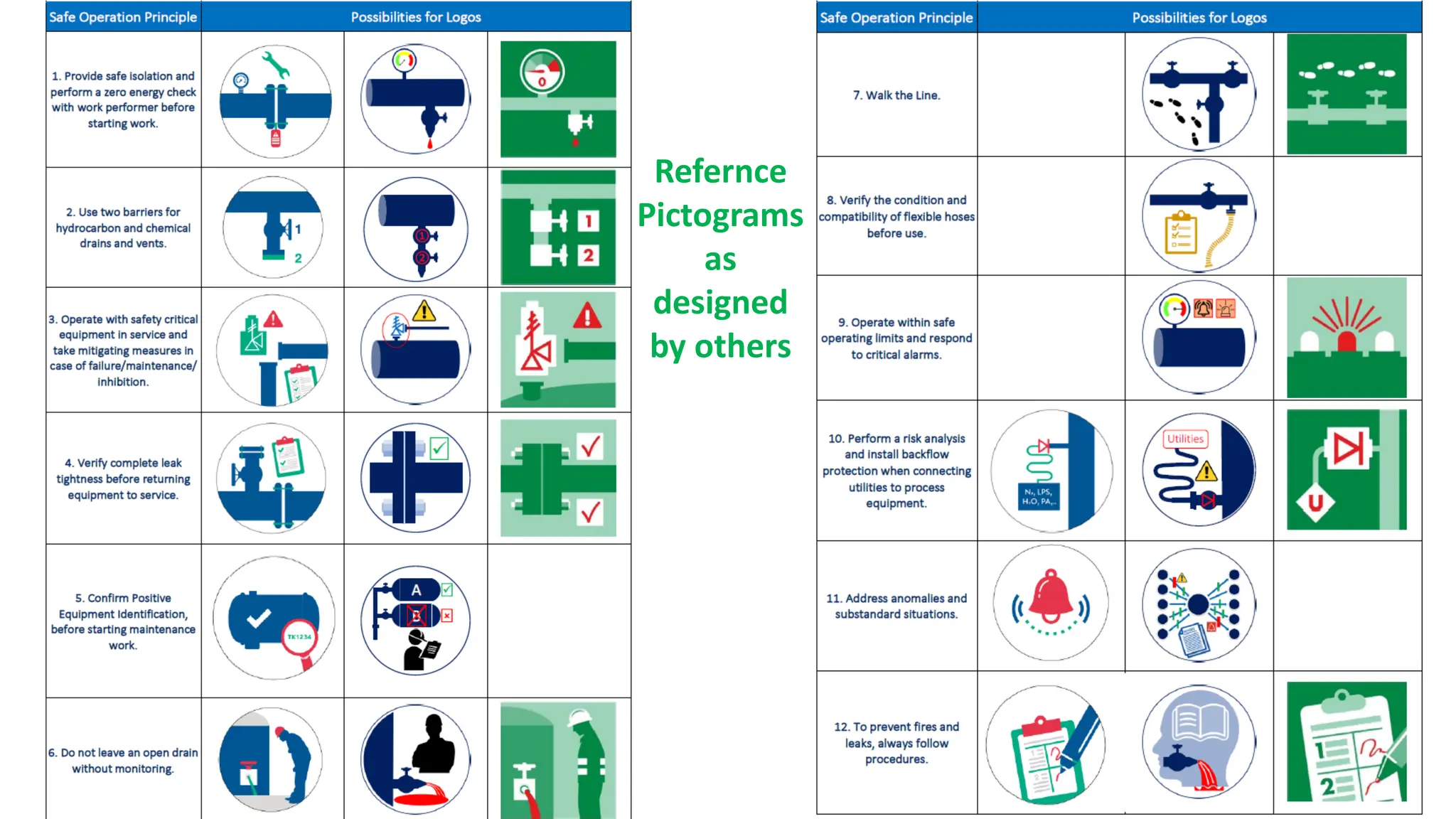
Refernce
Pictograms
as
designed
by others

Process Safety Fundamentals – European Process safety centre.pdf

  • 1.
    Process Safety Fundamentals SafeOperational Principles to avoid incidents with hazardous chemicals
  • 2.
    Origin Integrity Leadership Collective Commitment Design Integrity Construction Integrity Operating Integrity Technical Integrity Process safety andtechnical integrity management is about the capability to operate an asset so that it safeguards life and environment whilst meeting production objectives during the operational phase of its lifecycle. The key activities to achieve this ambition are explained below: To design our facilities in the best possible way using available design specifications and verification of the prevention and mitigation barriers using risk analysis techniques To ensure that the anticipated design is constructed using established project specifications and ensuring & controlling the quality of construction materials To stimulate leadership of managers and raise collective awareness to accomplish all of the above To enforce practices to ensure that the facilities are operated according to their design intent To implement adequate inspection, testing and preventive maintenance programs to continuously follow up on the health of the design
  • 3.
    Origin : ShellProcess Safety Fundamentals After review of Process Safety Events by Shell, a set of safe operating principles called “Process Safety Fundamentals” was developed.
  • 4.
    Context of ProcessSafety Fundamentals o No new requirements. Formulation of operational principles. o An upgrade in behaviors. Operational Excellence of Process Safety execution. o Emphasis on front line critical tasks, fully understood and supported by all operational leaders. o Understanding of the dilemmas that frontline may face to comply with Process Safety Fundamentals. o Makes Process Safety an everyday frontline conversation with an involved leadership. o Attention on risk normalization and substandard practices. o Sanction management not emphasized, open culture driving Process Safety Excellence.
  • 5.
    Process Safety Fundamentalsand Safety Leadership Leaders are expected to leverage the Process Safety Fundamentals as a tool to o Drive safety from a position of care o Be visible in the field o Have a regular dialogue on the PSFs. Help front line staff to comfortably surface dilemmas, operational issues, and weak signals o Show their commitment to safety. Once dilemmas are brought forward, work with the front line to resolve the issue. o Show curiosity. Seek to understand and comply with the PSFs before allowing deviations. o Recognize risk normalization in many of our daily activities and address it.
  • 6.
    Aspect Life SavingRules: Occupational Safety Fundamentals: Process Safety Objective Reduce number of injuries/fatalities Avoid loss of chemicals with potentially serious consequences for people, environment and Business HSE Domain Behaviors in occupational safety Behaviors on operations involving hazardous chemicals Target All Operation teams on hazardous sites (process operators, process engineers, maintenance technicians, operational management) Nature and applicability In principle simple rules that are easy to understand and apply in all circumstances More complex principles that cannot always be fully applied (e.g. in case of design issues) Implementation method Non-negotiable set of requirements “Life saving Rules” or “ Golden rules” Identify situations that are not in line with the Process Safety Fundamentals and start a discussion on how to proceed, avoiding uncontrolled initiatives “to get the job done” Process Safety Fundamentals and Life Saving Rules
  • 7.
    Process Safety Fundamentalsand Life Saving Rules Life Saving Rules Process Safety Fundamentals All employees Op. Managers o Work planning o Maintenance & inspection scopes o Signature of PTW o Competence assurance o … Supervisors o Preparation of procedures o Preparation of PTW o Management of isolation/inhibition o … Operators o Walk the line o Check of isolation, absence of energy o …
  • 8.
    IOGP Process SafetyFundamentals o An analysis by IOGP has shown that nearly all (91%) fatal process safety events are linked to one or more of the core set of IOGP PSFs. We respect hazards We apply procedures We sustain barriers We stay within operating limits We maintain safe isolation We walk the line We control ignition sources We recognize change We stop if the unexpected occurs We watch for weak signals
  • 9.
    PSF Logo Title of PSF Hazards:Options to get it right When important: Challenges in the field: Description of specific hazards related to this Process Safety Fundamental Description of situations in which the application of this Process Safety Fundamental is important Description of possible difficulties encountered in the field when applying this Process Safety Fundamental Suggestions for efficient application of this Process Safety Fundamental
  • 10.
    Apply Double IsolationControl utility systems connected to a process Empty and De-energise before line-breaking Report deficiencies on Safety Critical Equipment Monitor an open drain Unplugging of equipment Manage overrides of safety critical systems Stay out of the Line of Fire Walk the Line Control (Un)loading Verify leak tightness after maintenance work Check atmosphere in fire box before igniting the burners Avoid working behind a single valve Avoid splash loading Verify the condition of flexible hoses Avoid run-away reaction Operate within safe limits Report process safety incidents Process Safety Fundamentals – 18 Titles
  • 11.
    EPSC Pictograms Double IsolationFirst Line Break Leak Tightness Furnace Burners Flexible Hoses Unloading Open Drain Run Away Reaction Operating Limits Overrides Plugged Equipment Critical Equipment Reporting Splash Loading Line of Fire Utility Connections Walk the Line Single valve
  • 12.
    Walk the Line Hazards: Spillsor inadvertent mixing might occur when the transfer line is not ready for operation due to open ended lines or drains, wrong valve or tank line-up. Options to get it right ➢ Validate a correct line-up (all valves, tanks, pumps), before starting the pump / transfer ➢ Perform a check, after pump start, to detect leaking drains, hoses, flanges or pump seals ➢ Use P&IDs or better isometrics during line check ➢ Label equipment in the field, like valves, pipelines and pumps to help with the field check ➢ Tag all the bleeds and drains ➢ Validate the transfer regularly by checking the levels of the tanks versus the calculated level from the pump flow speed. Take actions upon deviation When important: After each change in set-up of a transfer line, e.g. start-up after shut-down, isolating equipment, change of equipment, maintenance work, draining Challenges in the field: ➢ Transfers occurring around shift change-over ➢ Long transfer lines, not fully accessible ➢ Distracted by other things ➢ Bad weather, low visibility at night ➢ Pipelines or valve position that are not easily to see
  • 13.
    Video on “Walkthe Line”
  • 14.
    https://www.youtube.com/watch?v=l9Fu4ydckGg To get inthe positive process safety mood, feel free to use this video made by Shell: o Select a limited number of PSF relevant for your operation to start. Eventually expand in next steps with additional more specific PSF. o Use the PSF slide to start the discussion. It is the discussion that provides the understanding of where you really are and what can be improved! o Establish clear agreement & procedures on the discussed PSF. o The following activities can be used to initiate the Process Safety Fundamentals o Other activities can be envisaged after launch of the PSFs (integration in existing practices and systems – auditing, reward/recognition, post-incident review,….). Guidance on Implementing the Process Safety Fundamentals (PSF) Practice Purpose Employee orientation (all levels) Explain PSFs and why they are important Setting behavioral expectations Emphasize behaviors expected in relation to the PSFs HSE days Communication of PSFs to workforce during themed HSE days / events Toolbox talks Explanation of PSFs to workforce by supervisors Posters Examples of types of posters used as part of a communication campaign about PSFs
  • 15.
    Apply Double Isolation Hazards: Spillof (hazardous) material can occur when a barrier (like a valve) fails and no second barrier is in place Options to get it right: ➢ Do not rely on a single valve for positive isolation ➢ Execute regular audits to check that drains are having an end-cap (blind flange or screw cap) conform pipe-spec ➢ Do not accept missing blind flanges or missing bolts on blind flanges ➢ Report and investigate all incidents from leaking drains ➢ Valve handles can be locked to avoid accidentally opening When important: During routine and special operations: draining & sampling, (un-)loading activities, utility connections Challenges in the field: ➢ Older plant design often do not provide a double barrier ➢ Blind flanges not put back after maintenance work ➢ Blind flanges not installed with bolts & missing end-caps ➢ Importance of “primary containment” not understood ➢ Valve handles that can be opened accidentally
  • 16.
    Empty and De-energize beforeLine-breaking Hazard: Uncontrolled release of energy or a hazardous material during the opening of piping or equipment Options to get it right ➢ Have a validated isolation plan available, that indicates numbered isolation points in the right sequence on a P&ID ➢ Apply LOTO to avoid that equipment can be re-energised: that is providing locks and labels ➢ Empty and clean equipment properly ➢ Check the completion of the isolation plan by an independent operator, before signing the permit to work ➢ Wear selected PPE for residual chemicals that might not be purged or drained and provide absorbents for leaking fluids ➢ Perform a Last Minute Risk Assessment by the mechanic or contractor, before opening, to validate that the pressure indicator is zero, the drain is open, the system is at ambient temperature, there is no flow and assure you are at the right equipment ➢ Use blinds according pipe spec, that is indicated on the isolation list ➢ Upon changes, validate that isolation remains intact When important: When unbolting, unscrewing, drilling or cutting of process equipment While working on live equipment Challenges in the field: ➢ Working at the wrong location ➢ Complexity of piping or break points arrangements ➢ Double block and bleed not possible ➢ Plugging of vents or drains / leaking valves ➢ Installing blinds ➢ Drains at the wrong location
  • 17.
    Monitor an OpenDrain Hazards: Unintended product release can occur during draining from a storage tank or other equipment to atmosphere Options to get it right ➢ Identify the critical draining operations on site ➢ Limit drain size (typical to 1 inch) to limit the release rate of the hazardous chemical ➢ Spring Loaded valves can help to assure that an operator remains present when drain time is short ➢ Understand the draining time necessary when starting the draining process ➢ Ensure the drain-valve can be closed from a safe location ➢ Avoid doing something else while monitoring a draining task ➢ In a critical situation, first stop the draining process before leaving the drain ➢ Stop draining during shift handover When important: When draining water from a tank that contains hydrocarbons to a sewer. When removing liquid from process equipment Challenges in the field: ➢ Distracted by other things that need attention ➢ Long draining time ➢ Bad weather ➢ Under estimation of the potential consequence of the product being released ➢ Drain valve does not fully close
  • 18.
    Manage Overrides of SafetyCritical Systems Hazard: Insufficient safeguards are in place when a safety critical system is not working properly or is bypassed. Options to get things right: ➢ Understand the safety critical systems and identify them in the field ➢ Every bypass/override needs a formal authorization based on a risk assessment (a special permit to work for bypass can help) ➢ Define the criticality of the system to bypass like the SIL level ➢ Authorisation level needs to be inline with criticality ➢ Identify solid interim protection measures and put them in action ➢ The bypasses must be registered in a bypass log accessible in the control room ➢ Discuss active bypasses during shift handover ➢ Determine process units that require shutdown when safety critical systems are unavailable ➢ Limit bypass duration, initiate a formal MOC for long term bypasses ➢ Protect safety interlocks against easy bypassing in the field ➢ Review bypassed functions daily (typically in the morning meeting) ➢ Review statistics on bypassed equipment When important: Failure of or unreliable safety systems Testing of interlocks Turnaround or maintenance work Commissioning, start-up & shutdown Challenges in the field: ➢ Consequences are unknown ➢ Safety systems that prevent start-up ➢ Lack of knowledge of procedure ➢ Absence of authorizers
  • 19.
    Walk the Line Hazards: Spillsor inadvertent mixing might occur when the transfer line is not ready for operation due to open ended lines or drains, wrong valve or tank line-up. Options to get it right ➢ Validate a correct line-up (all valves, tanks, pumps), before starting the pump / transfer ➢ Perform a check, after pump start, to detect leaking drains, hoses, flanges or pump seals ➢ Use P&IDs or better isometrics during line check ➢ Label equipment in the field, like valves, pipelines and pumps to help with the field check ➢ Tag all the bleeds and drains ➢ Validate the transfer regularly by checking the levels of the tanks versus the calculated level from the pump flow speed. Take actions upon deviation When important: After each change in set-up of a transfer line, e.g. start-up after shut-down, isolating equipment, change of equipment, maintenance work, draining Challenges in the field: ➢ Transfers occurring around shift change-over ➢ Long transfer lines, not fully accessible ➢ Distracted by other things ➢ Bad weather, low visibility at night ➢ Pipelines or valve position that are not easily to see
  • 20.
    Verify Leak Tightnessafter Maintenance Work Hazard: When a flange or other equipment is closed, it can still leak, when hazardous chemicals are introduced Options to get it right: ➢ Perform a leak test before introducing hazardous chemicals ➢ Leak test can be done o by introducing a less hazardous gas and perform a pressure hold test o put soap bubbles on all flanges that have been opened o Ultrasound measurements can detect leakages ➢ Develop criteria for acceptance of leak test results ➢ Develop a special procedure for the flange that was used in the leak-tightness test (the flange to be closed after the leak test) ➢ Verify proper torqueing ➢ Validate and adjust bolt tension after heating-up the equipment ➢ Record Leak Test results When important: After work where equipment and flanges have been opened Temperature change can influence bolt tension and create leakages Challenges in the field: ➢ Competent people when bolting ➢ Verification competency or procedures are missing
  • 21.
    Avoid working behind aSingle Valve Hazard: Single valves can leak because they are not fully closed, are fouled or just leak During working behind a single valve the valve might be accidentally opened or start leaking, releasing chemicals Options to get it right: ➢ Realize when it is not possible to work behind double isolation ➢ Try to remove the substance or energy in the system before start working behind a single valve ➢ If isolation by a single valve cannot be avoided: ▪ Validate that the single valve is not leaking e.g. at a drain point downstream of the isolation, or by a pressure gauge ▪ Mechanically lock the isolation valve handle to avoid accidental knocking open during the task, deactivate the actuator for automated valves after checking the valve fail-safe position ▪ Mount a spade or blind flange after the single valve directly after the line break ▪ Consider if emergency responders should be in place during the line break, until the blind-flange is placed ▪ Wear appropriate personal protective equipment (PPE) during the task ▪ Keep working time short and avoid critical process conditions during When important: During and after line breaking due to a repair or maintenance activity When the plant is not fully de-energized Challenges in the field: ➢ Older plant design often might not provide a second barrier or full block and bleed option to isolate equipment ➢ Placing a blind, turning a spectacle flange
  • 22.
    Verify the Conditionof Flexible Hoses Hazard: Hazardous fluid release due to hoses failures Wildly moving hoses at pressure release when coupling gets loose Options to get it right: ➢ Make sure you use the correct hose: correct material of construction and temperature & pressure rating ➢ Visually inspect hoses before using them and check for defects like corrosion, wear or mechanical damage ➢ Hoses (including the connections) with hazardous fluids should be inspected periodically by an approved body and certified ➢ Avoid hoses for very toxic chemicals (like phosgene) ➢ Hoses should be tagged and included in the maintenance schedule ➢ When not in use, hoses must be properly stored, with the appropriate bend radius, hanging straight down, or laying straight ➢ Hoses must not be twisted or forced when connected ➢ Connect hoses well, follow-up on possible vibrations ➢ If required replace hoses preventively and remove old hoses from the site ➢ Check correct depressurization of hoses before disconnecting When important: When using flexible hoses When disconnecting hoses that still contain pressure or toxic material Challenges in the field: ➢ Connections are not properly made, requiring bended or stretched hoses ➢ No good storage location available
  • 23.
    Operate within SafeLimits Hazard: Hazardous reactions and releases or equipment damage can be caused when safe operating limits are exceeded Options to get it right : ➢ Establish safe operating limits for key process variables and for all operating phases, and make them visible for operators ➢ Validate that instruments are working well ➢ Understand the critical process parameters that can result in equipment damage and loss of containment due to deviations ➢ Install alarms and interlocks for critical process variables ➢ Define actions to bring the process variable back within the operation limit ➢ Report and discuss the cause when operating limits are exceeded ➢ Understand the chemical hazards at non-standard conditions and have a chemical compatibility matrix available When important: Deviations from normal operation Transient operations, batch process , start- up / shut-down At design changes Challenges in the field: ➢ Limits not well known or identified ➢ MOC process not followed ➢ Pushing production
  • 24.
    Control Utility Systems connectedto a Process Hazard: When utility systems are temporarily connected with a flexible hose to a process, hazardous substances can flow back into the utility system Options to get it right ➢ Awareness of the hazard that utilities can be contaminated with process gasses or liquids ➢ Understand the pressures in the systems and how they can deviate during operation ➢ Define suitable safeguards against backflow, at least one non- return valve must be present ➢ Remove the utility hoses from the process directly when the task is completed ➢ Ensure that the hoses applied have the same pressure rating and chemical compatibility as the process when used in normal operation ➢ Evaluate backflow during MoC and HAZOP studies when fixed connections exist between utilities and process units When important: During inerting, cleaning and unplugging operational equipment using utilities When taking a sample a utility is needed to purge a system Challenges in the field: ➢ Lack of knowledge ➢ Easy availability of utility stations & hoses ➢ Hazard studies did not identify the hazard
  • 25.
    Report Deficiencies on SafetyCritical Equipment Hazard: Safety Critical Equipment provides a barrier to prevent or limit the effect of a major incident Options to get it right: ➢ Determine which equipment is safety critical ➢ Ensure workers know what equipment is Safety Critical, and understand the potential hazard ➢ Safety Critical Equipment must have a testing protocol and frequency ➢ Report failures or deviations on safety critical systems (also from testing) ➢ Decide what action is appropriate, if necessary stop the operation ➢ Implement interim mitigating measures that are approved, in case of continuing operation ➢ Repair or replace safety critical equipment with highest priority ➢ Analyse why equipment failed ➢ Keeping a log on critical equipment out of service When important: When Safety Critical Equipment is not working properly Challenges in the field ➢ A shutdown might be needed to repair the broken equipment ➢ Not aware of the criticality ➢ Unawareness of the failure – no testing ➢ Unreadable equipment, like a fouled side glass
  • 26.
    Unplugging of Equipment Hazard: Unpluggingmight requires opening of installations that can unexpectedly result in a release of hazardous substances Options to get it right : ➢ Consider to stop production before unplugging ➢ Do not start unplugging without an approved plan that includes a hazard analysis ➢ Understand the source and reason of plugging ➢ Understand the hazards while unplugged and have a mitigation plan for unexpected releases ➢ Understand that instrumentation might give misreading or that safety valves do not operate properly ➢ Understand that opened equipment can still have pressurized hazardous material inside behind the plug ➢ Apply isolation and First Line Break principles in the unplugging procedure ➢ Do not use hazardous gas to blow out pipelines / equipment When important: When process equipment is blocked, eg by fouling, polymer, corrosion, objects after maintenance etc. Challenges in the field: ➢ Unexpected severe flow restrictions ➢ No unplugging procedure or good options ➢ Not wanting to stop production
  • 27.
    Stay Out ofthe Line of Fire Hazard: Exposure in case of unexpected release of energy or chemicals or unexpected movement of objects like a manhole, also vacuum can form a hazard Options to get it right : ➢ Identify hazardous location around release points or below hoisted objects in the field, e.g. by lines or colours on the floor ➢ Understand release locations and remove yourself from the potential energy discharge path from release points like PSV’s, explosion panels and plugs under pressure ➢ Keep people out of the heat radiation zone around a flare ➢ Protect yourself (location of your body) when opening installations ➢ Add physical barriers to prevent people from accidentally entering the paths ➢ Verify that PSV’s are designed to always vent to a safe location ➢ At flange opening, first untighten the bolts that are far away from you When important: When being in processing units that do not work at ambient pressure Challenges in the field: ➢ Release points not designed well: e.g. PSV release points that end in a pathway ➢ Manholes (or manway) that are stuck ➢ Heat releases from flare
  • 28.
    Control (Un)loading Hazard: Unexpected runaway reaction Formation of toxic chemicals Overfilling or loss of containment Options to get it right : ➢ Validate that the right chemical is loaded by a positive identification: analysis of a sample, inline analysis (density), certificate, barcode, clear label ➢ Have a good procedure in place with check points ➢ Provide unique coupling for hazardous chemicals (e.g. Chlorine, Ammonium, Ethylene oxide) to avoid wrong line-up ➢ Use colour codes (or bar codes that can be scanned) on pipelines, tubing and connection point ➢ Use professional firms for transporting the chemicals (that are ADR, ADN & RID compliant) ➢ Guide contractors well that are involved in (un)loading ➢ Assure that receiving equipment has sufficient volume available ➢ Have a compatibility matrix available to understand the hazards When important: Receiving of chemicals at your site Loading chemicals to a tank or reactor Waste handling operation Challenges in the field: ➢ Lack of knowledge & guidance of the contractor or operator involved ➢ Line up ➢ Chemical identification
  • 29.
    Check Atmosphere inFire Box before Igniting the Burners Hazard: When the firebox of a furnace or boiler has an explosive mixture by accumulation of large amounts of flammable gases, this will explode when igniting the burners Options to get it right : ➢ Furnaces/boilers need to be purged well with air to remove all gasses and to avoid an explosive atmosphere, before igniting the burners ➢ Procedures for start of furnaces and boilers must be available, up-to-date. Management shall undertake a periodic verification of the correct execution of these procedures. ➢ Report problems with fully automated systems (burner management systems) or deviation from start-up procedure immediately ➢ Limit the number of attempts to ignite a furnace/boiler (and keep sufficient time between attempts) ➢ Perform a leak test on the gas supply before igniting a furnace/boiler ➢ Check atmosphere in the fire box before igniting the burners with a LEL meter ➢ Bypassing of safety instrumentation (flame eyes, gas detection,sensors) must be managed carefully ➢ Limit the number of people in the vicinity when starting furnaces/boilers to those necessary for the start-up operation ➢ Avoid time pressure when starting or restarting furnaces or boilers When important: Upon start and restart Cold start After a furnace trip Challenges in the field: ➢ Reliability of instruments ➢ No good procedure / practices ➢ Fast restart required to avoid shut down
  • 30.
    Avoid Splash Loading Hazard: Whenloading non conductive flammable liquids, an explosive atmosphere will be created in the tank, that can ignite when electrically charged droplets generate a spark Options to get it right: ➢ Assure that the loading speed in the drop-down pipe in the vessel is below 1 m/s when start filling! This assures droplets are only little loaded and can not form sparks. ➢ When loading ships this is arranged in a ship-shore agreement, that should include the pipe diameter and pump speed ➢ Ensure that pipelines, tanks, vessels are grounded ➢ When the filling pipe is submerged below the liquid level inside the vessel or tank, the risk for splashing has gone and pump speed can be increased ➢ Inertisation can eliminate an explosive atmosphere ➢ Understand which chemicals are flammable liquids with low conductivity (like benzene, kerosene, butane – heptane). These are highly hazardous as they form an explosive mixture with air and dissipate static electricity slowly When important: When transferring flammable liquids When liquids fall down and form droplets Challenges in the field: ➢ Lack of knowledge ➢ Design issues, e.g. on pump or loading dip-pipe ➢ Communication (ship – shore)
  • 31.
    Avoid Run-Away Reaction Hazard: Bhopal& Seveso incidents occurred after an exothermic exponential runaway reaction started Options to get it right : ➢ Understand the chemistry and side reactions at abnormal conditions like elevated temperature ➢ Understand the point where cooling can not cope with the exponential heat of the reaction (point of no return) ➢ Assure good design data is available on heat balance of all the reactions involved (like DSC curves) ➢ Understand the effect of malfunctioning cooling ➢ Have a reactivity matrix available & make sure operators know the critical combinations of chemicals to avoid ➢ Assure cooling is reliability and have back-up cooling available ➢ Validate inhibitors are present as applicable ➢ Have a last line of defence like Interlocks, Breaker plates, Bunkers ➢ Have an emergency procedure: Run away in a runaway reaction! When important: Exothermic batch reactions Storage of reactive chemicals Unexpected Polymerization or Decomposition Challenges in the field: ➢ Chemistry at increased temperature can be different or unknown to operators ➢ Cooling can malfunction or might not be able to cope with the exponential increase of the reaction rate
  • 32.
    Report Process SafetyIncidents Hazard: Acceptance of small leakages, near misses or substandard practices Options to get things right: ➢ Create a culture where reporting nasty items is considered valuable feedback to improve safety. Have time available for that ➢ Report all spills: have an easy database to do so ➢ Follow-up on reported items and provide feed-back ➢ Classify LOPC according to a standard and have a KPI with a target ➢ Ensure workers recognise and report on TIER 3 & 4 incidents, that is weak signals or leading indicators, that should include: o Small leakages o Failures of safety critical systems o Activation of a last line of defence like a safety interlock o Fires; liquid hammering; vibrations; corrosion o Pressure or temperature outside design: like Auto-refrigeration o Locked or car-sealed valves not in the right position o Long standing or nuisance alarms o Ignition sources in zoned area’s; Atex deficiencies o Deviation of critical procedures When important: When related to Safety Critical Equipment Small leakages & Activation of barriers Challenges in the field: ➢ No open learning culture that stimulates intervention by all on safety ➢ Production pressure ➢ Bad follow-up and feedback on reported items ➢ Difficult reporting tools
  • 33.