How Israel reimburses hospitals based on activity: the
Procedure-Related Group (PRG) incremental reform
Shuli Brammli-Greenberg1,2, Ruth Waitzberg1,
Vadim Perman3 and Ronni Gamzu4
1Smokler Center for Health Policy Research, Myers-JDC Brookdale Institute
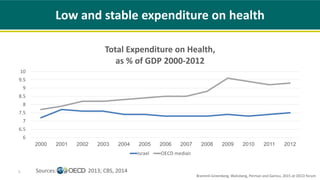
2School of Public Health at the University of Haifa
3Director of Pricing at the Department of Planning, Budgeting and Pricing, Ministry of Health
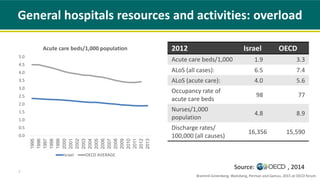
4Retired Director General, Ministry of Health. OECD health policy Analyst
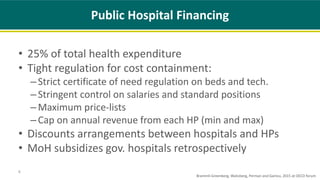
Brammli-Greenberg, S., Waitzberg, R., Perman V., and Gamzu,
R. (2015) "How Israel reimburses hospitals based on activity:
the Procedure-Related Group (PRG) incremental reform".
Presented at the 4th Meeting of the Joint Network on Fiscal
Sustainability of Health Systems for the OECD Working Party of
Senior Budget Officials (SBO) forum. In Paris, 16-17 February,
2015. Available at:
http://www.oecd.org/gov/budgeting/sbonetworkonhealthexpe
nditures.htm
2
How to cite this work:
Brammli-Greenberg, Waitzberg, Perman and Gamzu, 2015 at OECD forum
Part of the OECD project on "innovative payment schemes"
1. Overview of the Israeli healthcare system
2. The Israeli hospital market
3. The hospital payment reform: from per diem to PRG
4. Conclusions
5. Lessons for other countries
3
Outline
Brammli-Greenberg, Waitzberg, Perman and Gamzu, 2015 at OECD forum
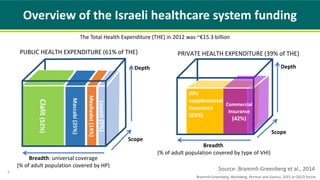
Source: Brammli-Greenberg et al., 2014
Overview of the Israeli healthcare system funding
4
The Total Health Expenditure (THE) in 2012 was ~€15.3 billion
HPs
supplemental
insurance
(83%)
Commercial
Insurance
(42%)
Breadth
(% of adult population covered by type of VHI)
Depth
Scope
PRIVATE HEALTH EXPENDITURE (39% of THE)
Maccabi(25%)
Meuhedet(14%)
Leumit(9%)
Breadth: universal coverage
(% of adult population covered by HP)
Depth
Scope
PUBLIC HEALTH EXPENDITURE (61% of THE)
Brammli-Greenberg, Waitzberg, Perman and Gamzu, 2015 at OECD forum
6
6.5
7
7.5
8
8.5
9
9.5
10
2000 2001 2002 2003 2004 2005 2006 2007 2008 2009 2010 2011 2012
Total Expenditure on Health,
as % of GDP 2000-2012
Israel OECD median
5 Sources: 2013; CBS, 2014
Low and stable expenditure on health
Brammli-Greenberg, Waitzberg, Perman and Gamzu, 2015 at OECD forum
THE ISRAELI HOSPITAL MARKET
6
Brammli-Greenberg, Waitzberg, Perman and Gamzu, 2015 at OECD forum
0.0
0.5
1.0
1.5
2.0
2.5
3.0
3.5
4.0
4.5
5.0
1995
1996
1997
1998
1999
2000
2001
2002
2003
2004
2005
2006
2007
2008
2009
2010
2011
2012
2013
Acute care beds/1,000 population
Israel OECD AVERAGE
OECDIsrael2012
3.31.9Acute care beds/1,000
7.46.5ALoS (all cases):
5.64.0ALoS (acute care):
7798
Occupancy rate of
acute care beds
8.94.8
Nurses/1,000
population
15,59016,356
Discharge rates/
100,000 (all causes)
General hospitals resources and activities: overload
Source: OECD , 2014
7
Brammli-Greenberg, Waitzberg, Perman and Gamzu, 2015 at OECD forum
• 25% of total health expenditure
• Tight regulation for cost containment:
–Strict certificate of need regulation on beds and tech.
–Stringent control on salaries and standard positions
–Maximum price-lists
–Cap on annual revenue from each HP (min and max)
• Discounts arrangements between hospitals and HPs
• MoH subsidizes gov. hospitals retrospectively
8
Public Hospital Financing
Brammli-Greenberg, Waitzberg, Perman and Gamzu, 2015 at OECD forum
9
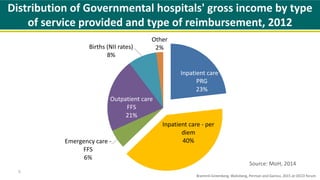
Distribution of Governmental hospitals' gross income by type
of service provided and type of reimbursement, 2012
Inpatient care –
PRG
23%
Inpatient care - per
diem
40%Emergency care -
FFS
6%
Outpatient care
FFS
21%
Births (NII rates)
8%
Other
2%
Source: MoH, 2014
Brammli-Greenberg, Waitzberg, Perman and Gamzu, 2015 at OECD forum
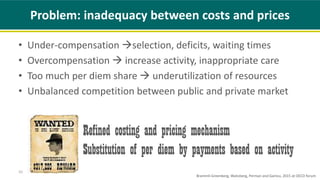
• Under-compensation selection, deficits, waiting times
• Overcompensation  increase activity, inappropriate care
• Too much per diem share  underutilization of resources
• Unbalanced competition between public and private market
10
Problem: inadequacy between costs and prices
Refined costing and pricing mechanism
Substitution of per diem by payments based on activity
Brammli-Greenberg, Waitzberg, Perman and Gamzu, 2015 at OECD forum
THE HOSPITAL PAYMENT REFORM:
FROM PER DIEM TO PRG
11
Brammli-Greenberg, Waitzberg, Perman and Gamzu, 2015 at OECD forum
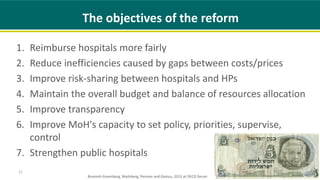
The objectives of the reform
1. Reimburse hospitals more fairly
2. Reduce inefficiencies caused by gaps between costs/prices
3. Improve risk-sharing between hospitals and HPs
4. Maintain the overall budget and balance of resources allocation
5. Improve transparency
6. Improve MoH's capacity to set policy, priorities, supervise,
control
7. Strengthen public hospitals
12
Brammli-Greenberg, Waitzberg, Perman and Gamzu, 2015 at OECD forum
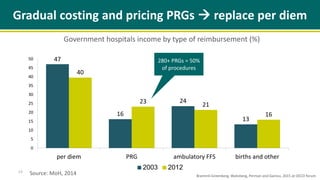
47
16
24
13
40
23 21
16
0
5
10
15
20
25
30
35
40
45
50
per diem PRG ambulatory FFS births and other
2003 2012
Gradual costing and pricing PRGs  replace per diem
Government hospitals income by type of reimbursement (%)
13
280+ PRGs = 50%
of procedures
Source: MoH, 2014 Brammli-Greenberg, Waitzberg, Perman and Gamzu, 2015 at OECD forum
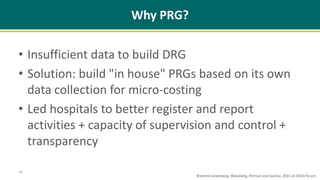
Why PRG?
• Insufficient data to build DRG
• Solution: build "in house" PRGs based on its own
data collection for micro-costing
• Led hospitals to better register and report
activities + capacity of supervision and control +
transparency
14
Brammli-Greenberg, Waitzberg, Perman and Gamzu, 2015 at OECD forum
Why incremental?
• The players involved are strong (MoF, HPs, hospitals)
• Gives the players time to adjust to changes during the
implementation process
• Keep players in the picture  avoid opposition
• Budget neutral: no winners or losers
• Zero-sum game within players
15
Brammli-Greenberg, Waitzberg, Perman and Gamzu, 2015 at OECD forum
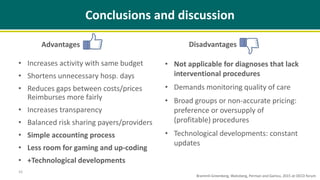
Advantages
• Increases activity with same budget
• Shortens unnecessary hosp. days
• Reduces gaps between costs/prices
Reimburses more fairly
• Increases transparency
• Balanced risk sharing payers/providers
• Simple accounting process
• Less room for gaming and up-coding
• +Technological developments
Disadvantages
• Not applicable for diagnoses that lack
interventional procedures
• Demands monitoring quality of care
• Broad groups or non-accurate pricing:
preference or oversupply of
(profitable) procedures
• Technological developments: constant
updates
16
Conclusions and discussion
Brammli-Greenberg, Waitzberg, Perman and Gamzu, 2015 at OECD forum
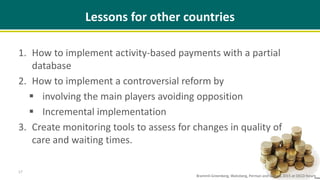
Lessons for other countries
1. How to implement activity-based payments with a partial
database
2. How to implement a controversial reform by
 involving the main players avoiding opposition
 Incremental implementation
3. Create monitoring tools to assess for changes in quality of
care and waiting times.
17
Brammli-Greenberg, Waitzberg, Perman and Gamzu, 2015 at OECD forum
Ruthw@jdc.org
Thank you
18
Acknowledgments:
Bruce Rosen, Tamar Medina-Artom and Ido Elmakias from the Smokler Center for Health Policy
Research, Myers-JDC Brookdale Institute for the constructive comments and advice.
Boaz Aricha, Economist in the pricing department, planning, budgeting and pricing division
at the MoH for the valuable inputs.
Brammli-Greenberg, Waitzberg, Perman and Gamzu, 2015 at OECD forum

Procedure-Related Group Incremental Reform

  • 1.
    How Israel reimburseshospitals based on activity: the Procedure-Related Group (PRG) incremental reform Shuli Brammli-Greenberg1,2, Ruth Waitzberg1, Vadim Perman3 and Ronni Gamzu4 1Smokler Center for Health Policy Research, Myers-JDC Brookdale Institute 2School of Public Health at the University of Haifa 3Director of Pricing at the Department of Planning, Budgeting and Pricing, Ministry of Health 4Retired Director General, Ministry of Health. OECD health policy Analyst
  • 2.
    Brammli-Greenberg, S., Waitzberg,R., Perman V., and Gamzu, R. (2015) "How Israel reimburses hospitals based on activity: the Procedure-Related Group (PRG) incremental reform". Presented at the 4th Meeting of the Joint Network on Fiscal Sustainability of Health Systems for the OECD Working Party of Senior Budget Officials (SBO) forum. In Paris, 16-17 February, 2015. Available at: http://www.oecd.org/gov/budgeting/sbonetworkonhealthexpe nditures.htm 2 How to cite this work: Brammli-Greenberg, Waitzberg, Perman and Gamzu, 2015 at OECD forum
  • 3.
    Part of theOECD project on "innovative payment schemes" 1. Overview of the Israeli healthcare system 2. The Israeli hospital market 3. The hospital payment reform: from per diem to PRG 4. Conclusions 5. Lessons for other countries 3 Outline Brammli-Greenberg, Waitzberg, Perman and Gamzu, 2015 at OECD forum
  • 4.
    Source: Brammli-Greenberg etal., 2014 Overview of the Israeli healthcare system funding 4 The Total Health Expenditure (THE) in 2012 was ~€15.3 billion HPs supplemental insurance (83%) Commercial Insurance (42%) Breadth (% of adult population covered by type of VHI) Depth Scope PRIVATE HEALTH EXPENDITURE (39% of THE) Maccabi(25%) Meuhedet(14%) Leumit(9%) Breadth: universal coverage (% of adult population covered by HP) Depth Scope PUBLIC HEALTH EXPENDITURE (61% of THE) Brammli-Greenberg, Waitzberg, Perman and Gamzu, 2015 at OECD forum
  • 5.
    6 6.5 7 7.5 8 8.5 9 9.5 10 2000 2001 20022003 2004 2005 2006 2007 2008 2009 2010 2011 2012 Total Expenditure on Health, as % of GDP 2000-2012 Israel OECD median 5 Sources: 2013; CBS, 2014 Low and stable expenditure on health Brammli-Greenberg, Waitzberg, Perman and Gamzu, 2015 at OECD forum
  • 6.
    THE ISRAELI HOSPITALMARKET 6 Brammli-Greenberg, Waitzberg, Perman and Gamzu, 2015 at OECD forum
  • 7.
    0.0 0.5 1.0 1.5 2.0 2.5 3.0 3.5 4.0 4.5 5.0 1995 1996 1997 1998 1999 2000 2001 2002 2003 2004 2005 2006 2007 2008 2009 2010 2011 2012 2013 Acute care beds/1,000population Israel OECD AVERAGE OECDIsrael2012 3.31.9Acute care beds/1,000 7.46.5ALoS (all cases): 5.64.0ALoS (acute care): 7798 Occupancy rate of acute care beds 8.94.8 Nurses/1,000 population 15,59016,356 Discharge rates/ 100,000 (all causes) General hospitals resources and activities: overload Source: OECD , 2014 7 Brammli-Greenberg, Waitzberg, Perman and Gamzu, 2015 at OECD forum
  • 8.
    • 25% oftotal health expenditure • Tight regulation for cost containment: –Strict certificate of need regulation on beds and tech. –Stringent control on salaries and standard positions –Maximum price-lists –Cap on annual revenue from each HP (min and max) • Discounts arrangements between hospitals and HPs • MoH subsidizes gov. hospitals retrospectively 8 Public Hospital Financing Brammli-Greenberg, Waitzberg, Perman and Gamzu, 2015 at OECD forum
  • 9.
    9 Distribution of Governmentalhospitals' gross income by type of service provided and type of reimbursement, 2012 Inpatient care – PRG 23% Inpatient care - per diem 40%Emergency care - FFS 6% Outpatient care FFS 21% Births (NII rates) 8% Other 2% Source: MoH, 2014 Brammli-Greenberg, Waitzberg, Perman and Gamzu, 2015 at OECD forum
  • 10.
    • Under-compensation selection,deficits, waiting times • Overcompensation  increase activity, inappropriate care • Too much per diem share  underutilization of resources • Unbalanced competition between public and private market 10 Problem: inadequacy between costs and prices Refined costing and pricing mechanism Substitution of per diem by payments based on activity Brammli-Greenberg, Waitzberg, Perman and Gamzu, 2015 at OECD forum
  • 11.
    THE HOSPITAL PAYMENTREFORM: FROM PER DIEM TO PRG 11 Brammli-Greenberg, Waitzberg, Perman and Gamzu, 2015 at OECD forum
  • 12.
    The objectives ofthe reform 1. Reimburse hospitals more fairly 2. Reduce inefficiencies caused by gaps between costs/prices 3. Improve risk-sharing between hospitals and HPs 4. Maintain the overall budget and balance of resources allocation 5. Improve transparency 6. Improve MoH's capacity to set policy, priorities, supervise, control 7. Strengthen public hospitals 12 Brammli-Greenberg, Waitzberg, Perman and Gamzu, 2015 at OECD forum
  • 13.
    47 16 24 13 40 23 21 16 0 5 10 15 20 25 30 35 40 45 50 per diemPRG ambulatory FFS births and other 2003 2012 Gradual costing and pricing PRGs  replace per diem Government hospitals income by type of reimbursement (%) 13 280+ PRGs = 50% of procedures Source: MoH, 2014 Brammli-Greenberg, Waitzberg, Perman and Gamzu, 2015 at OECD forum
  • 14.
    Why PRG? • Insufficientdata to build DRG • Solution: build "in house" PRGs based on its own data collection for micro-costing • Led hospitals to better register and report activities + capacity of supervision and control + transparency 14 Brammli-Greenberg, Waitzberg, Perman and Gamzu, 2015 at OECD forum
  • 15.
    Why incremental? • Theplayers involved are strong (MoF, HPs, hospitals) • Gives the players time to adjust to changes during the implementation process • Keep players in the picture  avoid opposition • Budget neutral: no winners or losers • Zero-sum game within players 15 Brammli-Greenberg, Waitzberg, Perman and Gamzu, 2015 at OECD forum
  • 16.
    Advantages • Increases activitywith same budget • Shortens unnecessary hosp. days • Reduces gaps between costs/prices Reimburses more fairly • Increases transparency • Balanced risk sharing payers/providers • Simple accounting process • Less room for gaming and up-coding • +Technological developments Disadvantages • Not applicable for diagnoses that lack interventional procedures • Demands monitoring quality of care • Broad groups or non-accurate pricing: preference or oversupply of (profitable) procedures • Technological developments: constant updates 16 Conclusions and discussion Brammli-Greenberg, Waitzberg, Perman and Gamzu, 2015 at OECD forum
  • 17.
    Lessons for othercountries 1. How to implement activity-based payments with a partial database 2. How to implement a controversial reform by  involving the main players avoiding opposition  Incremental implementation 3. Create monitoring tools to assess for changes in quality of care and waiting times. 17 Brammli-Greenberg, Waitzberg, Perman and Gamzu, 2015 at OECD forum
  • 18.
    Ruthw@jdc.org Thank you 18 Acknowledgments: Bruce Rosen,Tamar Medina-Artom and Ido Elmakias from the Smokler Center for Health Policy Research, Myers-JDC Brookdale Institute for the constructive comments and advice. Boaz Aricha, Economist in the pricing department, planning, budgeting and pricing division at the MoH for the valuable inputs. Brammli-Greenberg, Waitzberg, Perman and Gamzu, 2015 at OECD forum