MODULE 2-Problem Solving
based on Searching
Introduction to Problem Solving by searching Methods-State Space
search, Uninformed Search Methods – Uniform Cost Search, Breadth
First Search- Depth First Search-Depth limited search, Iterative
deepening depth-first, Informed Search Methods- Best First Search, A*
Search
Artificial intelligence
• Intelligence : “Ability to learn, understand,
and think”.
• The study of the capacity of machines to
simulate intelligent human behavior.
• AI is the study of how to make computers
make things which at the moment people
do better.
ARTIFICIAL
INTELLIGENCE
2
Formal description for
defining a problem
•Representation :
• State Space
• Initial State
• Goal State
• Transformation Rules
ARTIFICIAL
INTELLIGENCE
3
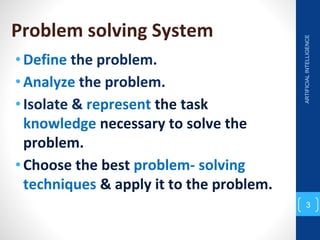
Problem solving System
•Define the problem.
•Analyze the problem.
•Isolate & represent the task
knowledge necessary to solve the
problem.
•Choose the best problem- solving
techniques & apply it to the problem.
ARTIFICIAL
INTELLIGENCE
3
Production Systems
• Production System Consists of
• A set of rules :
(Pattern) 🡺Operation to be performed
• One / more Knowledge/ databases
• Control strategy –specifies order in which
rules will be compared
• Rule applier
ARTIFICIAL
INTELLIGENCE
5
Example 1: 8-Puzzle problem
ARTIFICIAL
INTELLIGENCE
6
URL:http://www.cs.mun.ca/~oram/cs3754/AI6.pdf
State spaces
ARTIFICIAL
INTELLIGENCE
7
http://www.cs.mun.ca/~oram/cs3754/AI6.pdf
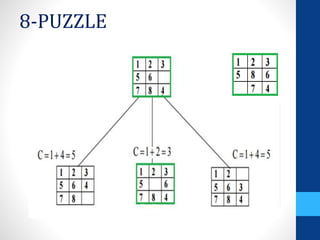
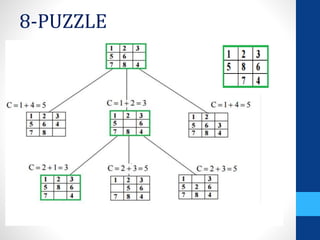
8-PUZZLE
• Initial State Goal State
• Apply 2 heuristic functions;
• Misplaced Tile & Manhattan Distance
8-PUZZLE
8-PUZZLE
8-PUZZLE
Example 2: Game Playing
ARTIFICIAL
INTELLIGENCE
12
Game Playing
ARTIFICIAL
INTELLIGENCE
13
Chess game
ARTIFICIAL
INTELLIGENCE
14
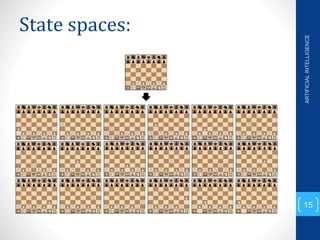
Transformation Rules:
white pawn at
square(file e, rank 2)
AND
square(file e, rank 3) is empty
AND
square(file e, rank 4) is empty
Initial state: Current board position Goal state: opponent does not have a
legal move and his /her king is under
attack.
Move pawn from
square(file e, rank 2)
to
square(file e, rank 4)
State spaces:
ARTIFICIAL
INTELLIGENCE
15
ARTIFICIAL
INTELLIGENCE
16
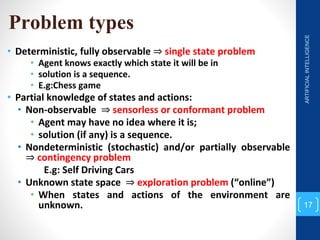
Problem types
• Deterministic, fully observable ⇒ single state problem
• Agent knows exactly which state it will be in
• solution is a sequence.
• E.g:Chess game
• Partial knowledge of states and actions:
• Non-observable ⇒ sensorless or conformant problem
• Agent may have no idea where it is;
• solution (if any) is a sequence.
• Nondeterministic (stochastic) and/or partially observable
⇒ contingency problem
E.g: Self Driving Cars
• Unknown state space ⇒ exploration problem (“online”)
• When states and actions of the environment are
unknown.
ARTIFICIAL
INTELLIGENCE
17
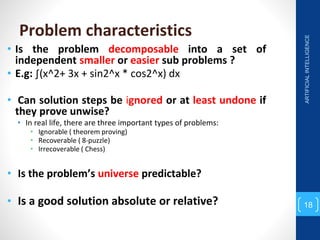
Problem characteristics
• Is the problem decomposable into a set of
independent smaller or easier sub problems ?
• E.g: ∫(x^2+ 3x + sin2^x * cos2^x) dx
• Can solution steps be ignored or at least undone if
they prove unwise?
• In real life, there are three important types of problems:
• Ignorable ( theorem proving)
• Recoverable ( 8-puzzle)
• Irrecoverable ( Chess)
• Is the problem’s universe predictable?
• Is a good solution absolute or relative?
ARTIFICIAL
INTELLIGENCE
18
Problem characteristics..
• Is the solution a state or path?
• Is a large amount of knowledge absolutely
required to solve the problem , or is
knowledge important only to constrain the
search?
• Can a computer that is simply given the
problem return the solution , or will the
solution of the problem require interaction
between the computer and a person?
ARTIFICIAL
INTELLIGENCE
19
Production System characteristics
• Monotonic :
application of rule never prevents later application of another rule
when both are used at the same time (that could have been
applied at the time first rule was selected)
• Non Monotonic :
this is not true
• Partially commutative :
If the application of a particular sequence of rules transform x🡺y,
then any permutation of those rules ie allowable also transform x🡺
y
• Commutative :
both Monotonic & Partially commutative
ARTIFICIAL
INTELLIGENCE
20
Examples of Problems
•“Toy” Problems :
• Water jug
• 8 – Queens
• 8 Puzzle
ARTIFICIAL
INTELLIGENCE
21
• “Real” Problems :
• Schedules
• Traveling Salesman.
• Robot navigation.
• Language Analysis (Parsers,
Grammars).
• VLSI design.
• Speech Recognition
Issues in the design of Search
programs
• Direction in which to conduct the search (forward Vs
Backward reasoning)
• How to select applicable rules (matching)
• How to represent each node of the search process
ARTIFICIAL
INTELLIGENCE
22
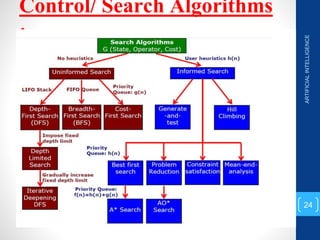
Control /Search Strategies
• Control Strategy decides which rule to apply
next during the process of searching for a
solution to a problem
• Requirements for a good Control Strategy
• It should cause motion.
• It should explore the solution space in a systematic
manner
• Types
• Uninformed
• Heuristic
•
ARTIFICIAL
INTELLIGENCE
23
Control/ Search Algorithms
:
ARTIFICIAL
INTELLIGENCE
24
Search strategies-performance measure
• A strategy is defined by picking the order of node
expansion.
• Problem-solving performance is measured in four ways:
• Completeness; Does it always find a solution if one
exists?
• Optimality; Does it always find the least-cost solution?
• Time Complexity; Number of nodes
generated/expanded?
• Space Complexity; Number of nodes stored in memory
during search?
ARTIFICIAL
INTELLIGENCE
25
Search strategies-
performance measure
• Time and space complexity are measured in terms of
problem difficulty defined by:
• b - maximum branching factor of the search tree(the
number of children at each node, the outdegree)
• d - depth of the least-cost solution ( the depth of its
deepest leaf-longest path from node to leaf)
• m - maximum depth of the state space (may be ∞)
ARTIFICIAL
INTELLIGENCE
26
ARTIFICIAL
INTELLIGENCE
27
Uninformed search strategies
•Blind search
• uses only the information
available in problem definition.
•Types
• Breadth-first search (BFS)
• Depth-first search (DFS)
• Depth-limited search
• Iterative deepening search.
ARTIFICIAL
INTELLIGENCE
28
BF-search :Breadth-First Search
• At each level we expand all nodes(possible solutions)
• Expand shallowest unexpanded node
ARTIFICIAL
INTELLIGENCE
29
A
BF-search
ARTIFICIAL
INTELLIGENCE
30
A
B C
BF-search, an example
ARTIFICIAL
INTELLIGENCE
31
A
B C
D E
BF-search, an example
ARTIFICIAL
INTELLIGENCE
32
A
B C
D E F G
ARTIFICIAL
INTELLIGENCE
33
BF-search: Evaluation
• Completeness:
• YES (if b is finite)
• Time complexity:
• Total number of nodes generated
• T (b) = 1+b2+b3+.......+ bd= O (bd)
• Where the d= depth of shallowest solution
and b is a node at every state
• Space complexity:
• Memory requirements are a bigger
problem than its execution time.
• O (bd)
• Optimality:
• Does it always find the least-cost solution?
• In general YES unless actions have different
cost.
ARTIFICIAL
INTELLIGENCE
34
Example :Water Jug problem
ARTIFICIAL
INTELLIGENCE
35
.Example: Water Jug Problem
• You are given two jugs, a 4-gallon
one and a 3-litre one. Neither have
any measuring markers on it. There is
a pump that can be used to fill the
jugs with water. How can you get
exactly 2 gallons of water into 4-
gallon jug.
• Let x and y be the amounts of water
in 4-gallon and 3-gallon Jugs
respectively.
• (x,y) refers to water available at any
time in 4-gallon, 3-gallon jugs.
• (x,y) 🡪 (x-d,y+dd) means drop some
unknown amount d of water from 4-
gallon jug and add dd onto 3-gallon
jug.
Example :Water Jug problem
ARTIFICIAL
INTELLIGENCE
36
Elements of Production
Systems
• State Space:(x,y)
• Where
• x=0,1,2,3,4
• y=0,1,2,3
• Initial State: (0,0)
• Goal State: (2,n)
• Production Rules
ARTIFICIAL
INTELLIGENCE
37
ARTIFICIAL
INTELLIGENCE
38
Solution :using BFS
ARTIFICIAL
INTELLIGENCE
39
BF-search: Evaluation
• Completeness:
• YES
• Time complexity:
• Total number of nodes generated
• O (bd)
• Space complexity:
• Memory requirements are a bigger
problem than its execution time.
• O (bd)
• Optimality:
• YES
ARTIFICIAL
INTELLIGENCE
40
DF-search: Depth-First Search
• Expands one of the nodes at the deepest
level
ARTIFICIAL
INTELLIGENCE
41
A
DF-search, an example
• Expand deepest unexpanded node
ARTIFICIAL
INTELLIGENCE
42
A
B C
S-A-B-D-E-C-G
Solution :using DFS
ARTIFICIAL
INTELLIGENCE
43
DF-search: evaluation
• Completeness:
• NO unless search space is finite.
• Time complexity :
• T(n)= 1+ n2+ n3 +.........+ nm=O(nm)
• Where, m= maximum depth of any node and this can be much larger
than d (Shallowest solution depth)
• Space complexity:
• Backtracking search uses even less
memory.
• O(bm).
• Optimality :No
• Same issues as completeness
ARTIFICIAL
INTELLIGENCE
44
Uniform-cost Search
Algorithm
• Uniform-cost search is a searching algorithm used for
traversing a weighted tree or graph.
• This algorithm comes into play when a different cost is
available for each edge.
• The primary goal of the uniform-cost search is to find a
path to the goal node which has the lowest cumulative
cost.
• A uniform-cost search algorithm is implemented by the
priority queue.
• It gives maximum priority to the lowest cumulative cost.
• Uniform cost search is equivalent to BFS algorithm if the
path cost of all edges is the same.
ARTIFICIAL
INTELLIGENCE
45
Uniform cost search
ARTIFICIAL
INTELLIGENCE
46
Depth-Limited Search Algorithm
• A depth-limited search algorithm is similar to depth-first
search with a predetermined limit. Depth-limited search can
solve the drawback of the infinite path in the Depth-first
search.
• In this algorithm, the node at the depth limit will treat as it
has no successor nodes further.
• Depth-limited search can be terminated with two Conditions
of failure:
• Standard failure value: It indicates that problem does not have
any solution.
• Cutoff failure value: It defines no solution for the problem within
a given depth limit.
ARTIFICIAL
INTELLIGENCE
47
EXAMPLE:DLS
ARTIFICIAL
INTELLIGENCE
48
Iterative deepening depth-first Search
• The iterative deepening algorithm is a combination of DFS and
BFS algorithms.
• This search algorithm finds out the best depth limit and does
it by gradually increasing the limit until a goal is found.
• This algorithm performs depth-first search up to a certain
"depth limit", and it keeps increasing the depth limit after
each iteration until the goal node is found.
• This Search algorithm combines the benefits of Breadth-first
search's fast search and depth-first search's memory
efficiency.
• The iterative search algorithm is useful uninformed search
when search space is large, and depth of goal node is
unknown.
ARTIFICIAL
INTELLIGENCE
49
ARTIFICIAL
INTELLIGENCE
50
1'st Iteration-----> A
2'nd Iteration----> A, B, C
3'rd Iteration------>A, B, D, E, C, F, G
4'th Iteration------>A, B, D, H, I, E, C, F, K, G
In the fourth iteration, the algorithm will find the goal node.
Informed search strategies
• Uses problem specific knowledge beyond the
definition of the problem.
• Types of Heuristic search algorithms
• Local search algorithms
• Generate and test
• Hill Climbing
• Global search algorithms
• A* search (Best First Search)
• AO* search (Problem reduction)
• Constraint Satisfaction Problem(CSP)
• Means-ends Analysis(MEA)
ARTIFICIAL
INTELLIGENCE
51
Local search algorithm:
Generate and Test
Steps:
1. Generate a possible solution
2. Test to see if this is a solution by
comparing the chosen point / end point
to the set of acceptable goal states
3. If a solution has been found, quit.
Otherwise return to step 1
ARTIFICIAL
INTELLIGENCE
52
• Not an Effective Technique
• Use Combination- Plan _Generate _ Test
• Combination = G&T+ CSP
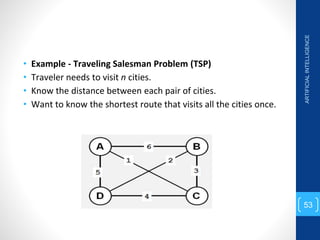
• Example - Traveling Salesman Problem (TSP)
• Traveler needs to visit n cities.
• Know the distance between each pair of cities.
• Want to know the shortest route that visits all the cities once.
ARTIFICIAL
INTELLIGENCE
53
• TSP - generation of possible solutions is done in
lexicographical order of cities:
• 1. A - B - C - D
• 2. A - B - D - C
• 3. A - C - B - D
• 4. A - C - D - B
• 5. A - D - C - B
• 6. A - D - B - C
• n=80 will take millions of years to solve exhaustively!
ARTIFICIAL
INTELLIGENCE
54
Hill Climbing (HC)
• Variant of G&T based on Feedback
• In G& T, Test Procedure 🡪 Yes (or) No
• Here, “Test Function is Augmented with
heuristic“
• HC often used when a good heuristic
Function is available & when no useful
knowledge available
• Example : To reach a place in
Unfamiliar city without a map
ARTIFICIAL
INTELLIGENCE
55
Hill Climbing
• Consider all possible successors as “one step” from
the current state on the landscape.
• At each iteration, go to
• The best successor (steepest ascent)
• Any uphill move (first choice)
• Any uphill move but steeper is more probable
(stochastic)
• All variations get stuck at local maxima
• Types:
ARTIFICIAL
INTELLIGENCE
56
•Simple Hill climbing
•Steepest –Ascent Hill climbing
•Simulated Annealing
Simple Hill climbing
• Algorithm
Evaluate the initial state.
Loop until a solution is found or there are no new operators left
to be applied:
- Select and apply a new operator
- Evaluate the new state:
goal → quit
better than current state → new current state
• Example: 8 puzzle problem
• Here, h(n) = the number of misplaced tiles (not including the
blank), the Manhattan Distance heuristic helps us quickly find
a solution to the 8-puzzle.
ARTIFICIAL
INTELLIGENCE
57
Click to add text
• Advantages of Hill Climbing
• Estimates how far away the goal is.
• Is neither optimal nor complete.
• Can be very fast.
•
ARTIFICIAL
INTELLIGENCE
58
Global Search Strategies
• Best-First Search – an algorithm in which a
node is selected for expansion based on an
evaluation function f(n)
-node with the lowest evaluation function is
selected
• Choose the node that appears to be the
best
ARTIFICIAL
INTELLIGENCE
59
A Quick Review
• g(n) = cost from the initial state to the
current state n
• h(n) = estimated cost of the cheapest path
from node n to a goal node
• f(n) = evaluation function to select a node for
expansion (usually the lowest cost node)
• Example: in route planning the estimate of
the cost of the cheapest path might be the
straight line distance between two cities
ARTIFICIAL
INTELLIGENCE
60
Greedy Best-First Search
• Expand the node that is closest to the goal
assuming it will lead to a solution quickly -
aka “Greedy Search”
• f(n) = h(n)
• Implementation
• expand the “most desirable” node into the fringe queue
• sort the queue in decreasing order of desirability
• Example:
• consider the straight-line distance heuristic hSLD
• Expand the node that appears to be closest to the goal
ARTIFICIAL
INTELLIGENCE
61
Greedy Best-First Search
ARTIFICIAL
INTELLIGENCE
62
176
Greedy Best-First Search
ARTIFICIAL
INTELLIGENCE
63
hSLD(In(Arad)) = 366
Greedy Best-First Search
ARTIFICIAL
INTELLIGENCE
64
Greedy Best-First Search
ARTIFICIAL
INTELLIGENCE
65
Shortest path cost is 450
A* Search
• A* (A star) is the most widely known form of
Best-First search
• It evaluates nodes by combining g(n) and h(n)
• f(n) = g(n) + h(n)
• Where
• g(n) = cost so far to reach n
• h(n) = estimated cost to goal from n
• f(n) = estimated total cost of path through
n
ARTIFICIAL
INTELLIGENCE
66
Example
ARTIFICIAL
INTELLIGENCE
67
A* Search
ARTIFICIAL
INTELLIGENCE
68
A* Search
ARTIFICIAL
INTELLIGENCE
69
A* Search
ARTIFICIAL
INTELLIGENCE
70
415=317+98
A* Search
ARTIFICIAL
INTELLIGENCE
71
Shortest path cost
A->S->R->P->B=418
415=317+98
A* Search
• Complete
• Yes
• Time
• Exponential
• The better the heuristic, the better the time
• Space
• Keeps all nodes in memory and save in case of
repetition
• A* usually runs out of space before it runs out of
time
• Optimal
• Yes, cannot expand fi+1 unless fi is finished
ARTIFICIAL
INTELLIGENCE
72
References
• http://www.cs.mun.ca/~oram/cs3754/AI6.pdf
• https://www.codingninjas.com/blog/2021/03/24/solving-
water-jug-problem-using-bfs/
• Kevin Night and Elaine Rich, Nair B., “Artificial Intelligence
(SIE)”, Mc Graw Hill-2008.

Problem Solving Based on Searching Module 2

  • 1.
    MODULE 2-Problem Solving basedon Searching Introduction to Problem Solving by searching Methods-State Space search, Uninformed Search Methods – Uniform Cost Search, Breadth First Search- Depth First Search-Depth limited search, Iterative deepening depth-first, Informed Search Methods- Best First Search, A* Search
  • 2.
    Artificial intelligence • Intelligence: “Ability to learn, understand, and think”. • The study of the capacity of machines to simulate intelligent human behavior. • AI is the study of how to make computers make things which at the moment people do better. ARTIFICIAL INTELLIGENCE 2
  • 3.
    Formal description for defininga problem •Representation : • State Space • Initial State • Goal State • Transformation Rules ARTIFICIAL INTELLIGENCE 3
  • 4.
    Problem solving System •Definethe problem. •Analyze the problem. •Isolate & represent the task knowledge necessary to solve the problem. •Choose the best problem- solving techniques & apply it to the problem. ARTIFICIAL INTELLIGENCE 3
  • 5.
    Production Systems • ProductionSystem Consists of • A set of rules : (Pattern) 🡺Operation to be performed • One / more Knowledge/ databases • Control strategy –specifies order in which rules will be compared • Rule applier ARTIFICIAL INTELLIGENCE 5
  • 6.
    Example 1: 8-Puzzleproblem ARTIFICIAL INTELLIGENCE 6 URL:http://www.cs.mun.ca/~oram/cs3754/AI6.pdf
  • 7.
  • 8.
    8-PUZZLE • Initial StateGoal State • Apply 2 heuristic functions; • Misplaced Tile & Manhattan Distance
  • 9.
  • 10.
  • 11.
  • 12.
    Example 2: GamePlaying ARTIFICIAL INTELLIGENCE 12
  • 13.
  • 14.
    Chess game ARTIFICIAL INTELLIGENCE 14 Transformation Rules: whitepawn at square(file e, rank 2) AND square(file e, rank 3) is empty AND square(file e, rank 4) is empty Initial state: Current board position Goal state: opponent does not have a legal move and his /her king is under attack. Move pawn from square(file e, rank 2) to square(file e, rank 4)
  • 15.
  • 16.
  • 17.
    Problem types • Deterministic,fully observable ⇒ single state problem • Agent knows exactly which state it will be in • solution is a sequence. • E.g:Chess game • Partial knowledge of states and actions: • Non-observable ⇒ sensorless or conformant problem • Agent may have no idea where it is; • solution (if any) is a sequence. • Nondeterministic (stochastic) and/or partially observable ⇒ contingency problem E.g: Self Driving Cars • Unknown state space ⇒ exploration problem (“online”) • When states and actions of the environment are unknown. ARTIFICIAL INTELLIGENCE 17
  • 18.
    Problem characteristics • Isthe problem decomposable into a set of independent smaller or easier sub problems ? • E.g: ∫(x^2+ 3x + sin2^x * cos2^x) dx • Can solution steps be ignored or at least undone if they prove unwise? • In real life, there are three important types of problems: • Ignorable ( theorem proving) • Recoverable ( 8-puzzle) • Irrecoverable ( Chess) • Is the problem’s universe predictable? • Is a good solution absolute or relative? ARTIFICIAL INTELLIGENCE 18
  • 19.
    Problem characteristics.. • Isthe solution a state or path? • Is a large amount of knowledge absolutely required to solve the problem , or is knowledge important only to constrain the search? • Can a computer that is simply given the problem return the solution , or will the solution of the problem require interaction between the computer and a person? ARTIFICIAL INTELLIGENCE 19
  • 20.
    Production System characteristics •Monotonic : application of rule never prevents later application of another rule when both are used at the same time (that could have been applied at the time first rule was selected) • Non Monotonic : this is not true • Partially commutative : If the application of a particular sequence of rules transform x🡺y, then any permutation of those rules ie allowable also transform x🡺 y • Commutative : both Monotonic & Partially commutative ARTIFICIAL INTELLIGENCE 20
  • 21.
    Examples of Problems •“Toy”Problems : • Water jug • 8 – Queens • 8 Puzzle ARTIFICIAL INTELLIGENCE 21 • “Real” Problems : • Schedules • Traveling Salesman. • Robot navigation. • Language Analysis (Parsers, Grammars). • VLSI design. • Speech Recognition
  • 22.
    Issues in thedesign of Search programs • Direction in which to conduct the search (forward Vs Backward reasoning) • How to select applicable rules (matching) • How to represent each node of the search process ARTIFICIAL INTELLIGENCE 22
  • 23.
    Control /Search Strategies •Control Strategy decides which rule to apply next during the process of searching for a solution to a problem • Requirements for a good Control Strategy • It should cause motion. • It should explore the solution space in a systematic manner • Types • Uninformed • Heuristic • ARTIFICIAL INTELLIGENCE 23
  • 24.
  • 25.
    Search strategies-performance measure •A strategy is defined by picking the order of node expansion. • Problem-solving performance is measured in four ways: • Completeness; Does it always find a solution if one exists? • Optimality; Does it always find the least-cost solution? • Time Complexity; Number of nodes generated/expanded? • Space Complexity; Number of nodes stored in memory during search? ARTIFICIAL INTELLIGENCE 25
  • 26.
    Search strategies- performance measure •Time and space complexity are measured in terms of problem difficulty defined by: • b - maximum branching factor of the search tree(the number of children at each node, the outdegree) • d - depth of the least-cost solution ( the depth of its deepest leaf-longest path from node to leaf) • m - maximum depth of the state space (may be ∞) ARTIFICIAL INTELLIGENCE 26
  • 27.
  • 28.
    Uninformed search strategies •Blindsearch • uses only the information available in problem definition. •Types • Breadth-first search (BFS) • Depth-first search (DFS) • Depth-limited search • Iterative deepening search. ARTIFICIAL INTELLIGENCE 28
  • 29.
    BF-search :Breadth-First Search •At each level we expand all nodes(possible solutions) • Expand shallowest unexpanded node ARTIFICIAL INTELLIGENCE 29 A
  • 30.
  • 31.
  • 32.
  • 33.
  • 34.
    BF-search: Evaluation • Completeness: •YES (if b is finite) • Time complexity: • Total number of nodes generated • T (b) = 1+b2+b3+.......+ bd= O (bd) • Where the d= depth of shallowest solution and b is a node at every state • Space complexity: • Memory requirements are a bigger problem than its execution time. • O (bd) • Optimality: • Does it always find the least-cost solution? • In general YES unless actions have different cost. ARTIFICIAL INTELLIGENCE 34
  • 35.
    Example :Water Jugproblem ARTIFICIAL INTELLIGENCE 35 .Example: Water Jug Problem • You are given two jugs, a 4-gallon one and a 3-litre one. Neither have any measuring markers on it. There is a pump that can be used to fill the jugs with water. How can you get exactly 2 gallons of water into 4- gallon jug. • Let x and y be the amounts of water in 4-gallon and 3-gallon Jugs respectively. • (x,y) refers to water available at any time in 4-gallon, 3-gallon jugs. • (x,y) 🡪 (x-d,y+dd) means drop some unknown amount d of water from 4- gallon jug and add dd onto 3-gallon jug.
  • 36.
    Example :Water Jugproblem ARTIFICIAL INTELLIGENCE 36
  • 37.
    Elements of Production Systems •State Space:(x,y) • Where • x=0,1,2,3,4 • y=0,1,2,3 • Initial State: (0,0) • Goal State: (2,n) • Production Rules ARTIFICIAL INTELLIGENCE 37
  • 38.
  • 39.
  • 40.
    BF-search: Evaluation • Completeness: •YES • Time complexity: • Total number of nodes generated • O (bd) • Space complexity: • Memory requirements are a bigger problem than its execution time. • O (bd) • Optimality: • YES ARTIFICIAL INTELLIGENCE 40
  • 41.
    DF-search: Depth-First Search •Expands one of the nodes at the deepest level ARTIFICIAL INTELLIGENCE 41 A
  • 42.
    DF-search, an example •Expand deepest unexpanded node ARTIFICIAL INTELLIGENCE 42 A B C S-A-B-D-E-C-G
  • 43.
  • 44.
    DF-search: evaluation • Completeness: •NO unless search space is finite. • Time complexity : • T(n)= 1+ n2+ n3 +.........+ nm=O(nm) • Where, m= maximum depth of any node and this can be much larger than d (Shallowest solution depth) • Space complexity: • Backtracking search uses even less memory. • O(bm). • Optimality :No • Same issues as completeness ARTIFICIAL INTELLIGENCE 44
  • 45.
    Uniform-cost Search Algorithm • Uniform-costsearch is a searching algorithm used for traversing a weighted tree or graph. • This algorithm comes into play when a different cost is available for each edge. • The primary goal of the uniform-cost search is to find a path to the goal node which has the lowest cumulative cost. • A uniform-cost search algorithm is implemented by the priority queue. • It gives maximum priority to the lowest cumulative cost. • Uniform cost search is equivalent to BFS algorithm if the path cost of all edges is the same. ARTIFICIAL INTELLIGENCE 45
  • 46.
  • 47.
    Depth-Limited Search Algorithm •A depth-limited search algorithm is similar to depth-first search with a predetermined limit. Depth-limited search can solve the drawback of the infinite path in the Depth-first search. • In this algorithm, the node at the depth limit will treat as it has no successor nodes further. • Depth-limited search can be terminated with two Conditions of failure: • Standard failure value: It indicates that problem does not have any solution. • Cutoff failure value: It defines no solution for the problem within a given depth limit. ARTIFICIAL INTELLIGENCE 47
  • 48.
  • 49.
    Iterative deepening depth-firstSearch • The iterative deepening algorithm is a combination of DFS and BFS algorithms. • This search algorithm finds out the best depth limit and does it by gradually increasing the limit until a goal is found. • This algorithm performs depth-first search up to a certain "depth limit", and it keeps increasing the depth limit after each iteration until the goal node is found. • This Search algorithm combines the benefits of Breadth-first search's fast search and depth-first search's memory efficiency. • The iterative search algorithm is useful uninformed search when search space is large, and depth of goal node is unknown. ARTIFICIAL INTELLIGENCE 49
  • 50.
    ARTIFICIAL INTELLIGENCE 50 1'st Iteration-----> A 2'ndIteration----> A, B, C 3'rd Iteration------>A, B, D, E, C, F, G 4'th Iteration------>A, B, D, H, I, E, C, F, K, G In the fourth iteration, the algorithm will find the goal node.
  • 51.
    Informed search strategies •Uses problem specific knowledge beyond the definition of the problem. • Types of Heuristic search algorithms • Local search algorithms • Generate and test • Hill Climbing • Global search algorithms • A* search (Best First Search) • AO* search (Problem reduction) • Constraint Satisfaction Problem(CSP) • Means-ends Analysis(MEA) ARTIFICIAL INTELLIGENCE 51
  • 52.
    Local search algorithm: Generateand Test Steps: 1. Generate a possible solution 2. Test to see if this is a solution by comparing the chosen point / end point to the set of acceptable goal states 3. If a solution has been found, quit. Otherwise return to step 1 ARTIFICIAL INTELLIGENCE 52 • Not an Effective Technique • Use Combination- Plan _Generate _ Test • Combination = G&T+ CSP
  • 53.
    • Example -Traveling Salesman Problem (TSP) • Traveler needs to visit n cities. • Know the distance between each pair of cities. • Want to know the shortest route that visits all the cities once. ARTIFICIAL INTELLIGENCE 53
  • 54.
    • TSP -generation of possible solutions is done in lexicographical order of cities: • 1. A - B - C - D • 2. A - B - D - C • 3. A - C - B - D • 4. A - C - D - B • 5. A - D - C - B • 6. A - D - B - C • n=80 will take millions of years to solve exhaustively! ARTIFICIAL INTELLIGENCE 54
  • 55.
    Hill Climbing (HC) •Variant of G&T based on Feedback • In G& T, Test Procedure 🡪 Yes (or) No • Here, “Test Function is Augmented with heuristic“ • HC often used when a good heuristic Function is available & when no useful knowledge available • Example : To reach a place in Unfamiliar city without a map ARTIFICIAL INTELLIGENCE 55
  • 56.
    Hill Climbing • Considerall possible successors as “one step” from the current state on the landscape. • At each iteration, go to • The best successor (steepest ascent) • Any uphill move (first choice) • Any uphill move but steeper is more probable (stochastic) • All variations get stuck at local maxima • Types: ARTIFICIAL INTELLIGENCE 56 •Simple Hill climbing •Steepest –Ascent Hill climbing •Simulated Annealing
  • 57.
    Simple Hill climbing •Algorithm Evaluate the initial state. Loop until a solution is found or there are no new operators left to be applied: - Select and apply a new operator - Evaluate the new state: goal → quit better than current state → new current state • Example: 8 puzzle problem • Here, h(n) = the number of misplaced tiles (not including the blank), the Manhattan Distance heuristic helps us quickly find a solution to the 8-puzzle. ARTIFICIAL INTELLIGENCE 57 Click to add text
  • 58.
    • Advantages ofHill Climbing • Estimates how far away the goal is. • Is neither optimal nor complete. • Can be very fast. • ARTIFICIAL INTELLIGENCE 58
  • 59.
    Global Search Strategies •Best-First Search – an algorithm in which a node is selected for expansion based on an evaluation function f(n) -node with the lowest evaluation function is selected • Choose the node that appears to be the best ARTIFICIAL INTELLIGENCE 59
  • 60.
    A Quick Review •g(n) = cost from the initial state to the current state n • h(n) = estimated cost of the cheapest path from node n to a goal node • f(n) = evaluation function to select a node for expansion (usually the lowest cost node) • Example: in route planning the estimate of the cost of the cheapest path might be the straight line distance between two cities ARTIFICIAL INTELLIGENCE 60
  • 61.
    Greedy Best-First Search •Expand the node that is closest to the goal assuming it will lead to a solution quickly - aka “Greedy Search” • f(n) = h(n) • Implementation • expand the “most desirable” node into the fringe queue • sort the queue in decreasing order of desirability • Example: • consider the straight-line distance heuristic hSLD • Expand the node that appears to be closest to the goal ARTIFICIAL INTELLIGENCE 61
  • 62.
  • 63.
  • 64.
  • 65.
  • 66.
    A* Search • A*(A star) is the most widely known form of Best-First search • It evaluates nodes by combining g(n) and h(n) • f(n) = g(n) + h(n) • Where • g(n) = cost so far to reach n • h(n) = estimated cost to goal from n • f(n) = estimated total cost of path through n ARTIFICIAL INTELLIGENCE 66
  • 67.
  • 68.
  • 69.
  • 70.
  • 71.
    A* Search ARTIFICIAL INTELLIGENCE 71 Shortest pathcost A->S->R->P->B=418 415=317+98
  • 72.
    A* Search • Complete •Yes • Time • Exponential • The better the heuristic, the better the time • Space • Keeps all nodes in memory and save in case of repetition • A* usually runs out of space before it runs out of time • Optimal • Yes, cannot expand fi+1 unless fi is finished ARTIFICIAL INTELLIGENCE 72
  • 73.