MALLA REDDY UNIVERSITY
MR22-1CS0105: ARTIFICIAL INTELLIGENCE
III YEAR B.TECH. CSE I - SEM
(MR22-1CS0105)
UNIT-I
INTRODUCTION: ARTIFICIAL INTELLIGENCE, AI PROBLEMS,
AI TECHNIQUES, THE LEVEL OF THE MODEL, CRITERIA FOR
SUCCESS.
DEFINING THE PROBLEM AS A STATE SPACE SEARCH,
PROBLEM CHARACTERISTICS, PRODUCTION SYSTEMS,
SEARCH: ISSUES IN THE DESIGN OF SEARCH PROGRAMS,
UN-INFORMED SEARCH, BFS, AND DFS.
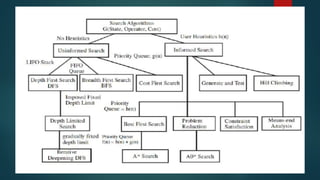
HEURISTIC SEARCH TECHNIQUES: GENERATE-AND-TEST, HILL
CLIMBING, BEST-FIRST SEARCH, A* ALGORITHM, PROBLEM
REDUCTION, AO* ALGORITHM.
INTRODUCTION TO ARTIFICIAL INTELLIGENCE
 Artificial Intelligence is composed of two words Artificial and
Intelligence, where Artificial defines "man-made," and intelligence
defines "thinking power", hence AI means "a man-made thinking
power.“
"It is a branch of computer science by which we can create intelligent
machines which can behave like a human, think like humans, and
able to make decisions."
INTRODUCTION TO ARTIFICIAL INTELLIGENCE
Goals of Artificial Intelligence
 Replicate human intelligence
 Building a machine which can perform tasks that requires human
intelligence such as:
 Proving a theorem
 Playing chess
 Plan some surgical operation
 Driving a car in traffic
 Creating some system which can exhibit intelligent behavior, learn
new things by itself, demonstrate, explain, and can advise to its user.
INTRODUCTION TO ARTIFICIAL INTELLIGENCE
Advantages of Artificial Intelligence
 High Accuracy with less errors
 High-Speed
 High reliability
 Useful for risky areas
 Digital Assistant
 Useful as a public utility
Disadvantages of Artificial Intelligence
 High Cost
 Can't think out of the box
 Increase dependency on machines
 No Original Creativity
INTRODUCTION TO ARTIFICIAL INTELLIGENCE
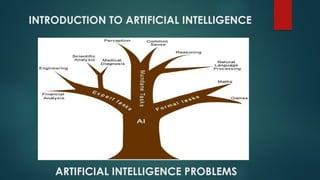
ARTIFICIAL INTELLIGENCE PROBLEMS
INTRODUCTION TO ARTIFICIAL INTELLIGENCE
 AI TECHNIQUES
These techniques fuel various applications of AI and can be broadly
categorized into several areas:
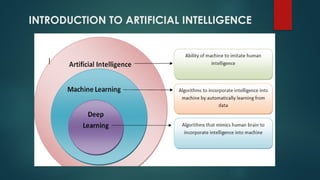
 Machine Learning: This is a core AI technique where machines learn
from data without being explicitly programmed. It allows them to
identify patterns, make predictions, and improve their performance
over time. Here are some subcategories of machine learning:
 Supervised Learning: Trains models using labeled data (data with known
outcomes) for tasks like classification (e.g., spam filtering) and regression
(e.g., predicting stock prices).
 Unsupervised Learning: Discovers hidden patterns in unlabeled data for
tasks like clustering (e.g., grouping customers) and dimensionality
reduction (e.g., compressing data for analysis).
 Reinforcement Learning: Machines learn through trial and error by
interacting with an environment and receiving rewards or penalties. This
is useful for training AI agents to play games or control robots.
INTRODUCTION TO ARTIFICIAL INTELLIGENCE
 Deep Learning: This is a subfield of machine learning inspired by the
structure and function of the human brain. It utilizes artificial neural
networks with multiple layers to process complex data like images,
text, and speech. Deep learning is a powerful technique for tasks
like image recognition, natural language processing, and machine
translation.
 Natural Language Processing (NLP): This technique equips machines
with the ability to understand and process human language. It
involves tasks like sentiment analysis (identifying emotions in text),
machine translation (converting text from one language to
another), and chatbots (conversational AI agents).
 Computer Vision: This technique allows computers to interpret and
understand visual information from the world. It involves tasks like
object detection (identifying objects in images), image recognition
(classifying images), and facial recognition (identifying people from
their faces).
INTRODUCTION TO ARTIFICIAL INTELLIGENCE
 Robotics: This combines AI with mechanical engineering to design
and build intelligent robots. AI techniques are used for robot control,
navigation, and decision-making, enabling robots to perform tasks
autonomously in various environments.
CRITERIA OF SUCCESS
 There are several key criteria to consider when evaluating the
success of an AI system:
 Performance: This is the most fundamental criterion. It measures how
well the AI achieves its intended goals.
 Accuracy: For tasks like classification (spam filtering) or prediction
(stock prices), it refers to how often the AI makes correct decisions.
 Efficiency: This measures how quickly the AI can complete a task.
This is important for real-time applications where speed is crucial.
 Robustness: This refers to how well the AI performs under varying
conditions or with unexpected inputs. A robust AI can handle noise,
errors, and unforeseen situations.
INTRODUCTION TO ARTIFICIAL INTELLIGENCE
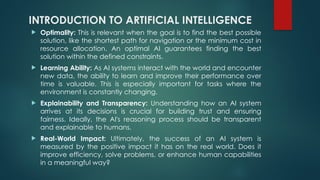
 Optimality: This is relevant when the goal is to find the best possible
solution, like the shortest path for navigation or the minimum cost in
resource allocation. An optimal AI guarantees finding the best
solution within the defined constraints.
 Learning Ability: As AI systems interact with the world and encounter
new data, the ability to learn and improve their performance over
time is valuable. This is especially important for tasks where the
environment is constantly changing.
 Explainability and Transparency: Understanding how an AI system
arrives at its decisions is crucial for building trust and ensuring
fairness. Ideally, the AI's reasoning process should be transparent
and explainable to humans.
 Real-World Impact: Ultimately, the success of an AI system is
measured by the positive impact it has on the real world. Does it
improve efficiency, solve problems, or enhance human capabilities
in a meaningful way?
INTRODUCTION TO ARTIFICIAL INTELLIGENCE
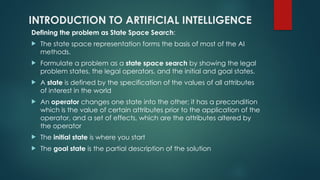
Defining the problem as State Space Search:
 The state space representation forms the basis of most of the AI
methods.
 Formulate a problem as a state space search by showing the legal
problem states, the legal operators, and the initial and goal states.
 A state is defined by the specification of the values of all attributes
of interest in the world
 An operator changes one state into the other; it has a precondition
which is the value of certain attributes prior to the application of the
operator, and a set of effects, which are the attributes altered by
the operator
 The initial state is where you start
 The goal state is the partial description of the solution
INTRODUCTION TO ARTIFICIAL INTELLIGENCE
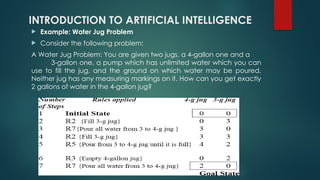
 Example: Water Jug Problem
 Consider the following problem:
A Water Jug Problem: You are given two jugs, a 4-gallon one and a
3-gallon one, a pump which has unlimited water which you can
use to fill the jug, and the ground on which water may be poured.
Neither jug has any measuring markings on it. How can you get exactly
2 gallons of water in the 4-gallon jug?
INTRODUCTION TO ARTIFICIAL INTELLIGENCE
 Since artificial intelligence (AI) is mainly related to the search process, it is important to
have some methodology to choose the best possible solution.
 To choose an appropriate method for a particular problem first we need to categorize
the problem based on the following characteristics.
1. Is the problem decomposable into small sub-problems which are easy to solve?
2. Can solution steps be ignored or undone?
3. Is the universe of the problem is predictable?
Problem Characteristics in Artificial Intelligence
4. Is a good solution to the problem is absolute or relative?
5. Is the solution to the problem a state or a path?
6. What is the role of knowledge in solving a problem using artificial intelligence?
7. Does the task of solving a problem require human interaction?
1. Is the problem decomposable into small sub-problems which are easy to solve?
 Can the problem be broken down into smaller problems to be solved
independently?
 The decomposable problem can be solved easily.
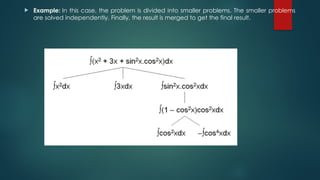
 Example: In this case, the problem is divided into smaller problems. The smaller problems
are solved independently. Finally, the result is merged to get the final result.
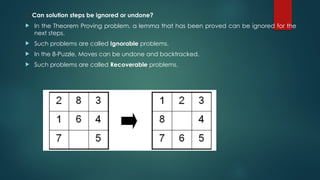
2. Can solution steps be ignored or undone?
 In the Theorem Proving problem, a lemma that has been proved can be ignored for the
next steps.
 Such problems are called Ignorable problems.
 In the 8-Puzzle, Moves can be undone and backtracked.
 Such problems are called Recoverable problems.
 In Playing Chess, moves can be retracted.
 Such problems are called Irrecoverable problems.
 Ignorable problems can be solved using a simple control structure that never backtracks.
 Recoverable problems can be solved using backtracking.
 Irrecoverable problems can be solved by recoverable style methods via planning.
3. Is the universe of the problem is predictable?
 In Playing Bridge, We cannot know exactly where all the cards are or what the other
players will do on their turns.
Uncertain outcome!
 For certain-outcome problems, planning can be used to generate a sequence of operators
that is guaranteed to lead to a solution.
 For uncertain-outcome problems, a sequence of generated operators can only have a
good probability of leading to a solution. Plan revision is made as the plan is carried out and
the necessary feedback is provided.
4. Is a good solution to the problem is absolute or relative?
 The Travelling Salesman Problem, we have to try all paths to find the shortest one.
 Any path problem can be solved using heuristics that suggest good paths to explore.
 For best-path problems, a much more exhaustive search will be performed.
5. Is the solution to the problem a state or a path
 The Water Jug Problem, the path that leads to the goal must be reported.
 A path-solution problem can be reformulated as a state-solution problem by
describing a state as a partial path to a solution. The question is whether that is
natural or not.
6. What is the role of knowledge in solving a problem using artificial intelligence?
Playing Chess
 Consider again the problem of playing chess. Suppose you had unlimited computing
power available.
 How much knowledge would be required by a perfect program?
 Additional knowledge about such things as good strategy and tactics could of course
help considerably to constrain the search and speed up the execution of the program.
Knowledge is important only to constrain the search for a solution.
7. Does the task of solving a problem require human interaction?
 we are building programs that require intermediate interaction with people, both to
provide additional input to the program and to provide additional reassurance to the
user.
 The solitary problem, in which there is no intermediate communication and no demand
for an explanation of the reasoning process.
 The conversational problem, in which intermediate communication is to provide either
additional assistance to the computer or additional information to the user.
INTRODUCTION TO ARTIFICIAL INTELLIGENCE
 Production System in AI
 In artificial intelligence (AI), a production system refers to a type of rule-based system
that is designed to provide a structured approach to problem solving and decision-
making. This framework is particularly influential in the realm of expert systems, where it
simulates human decision-making processes using a set of predefined rules and facts.
 Let’s consider an example of Expert System for Medical Diagnosis.
 Scenario: A patient comes to a healthcare facility with the following symptoms:
fever, severe headache, sensitivity to light, and stiff neck.
 Medical diagnosis operates in the following manner:
 Input: A healthcare professional inputs the symptoms into MediDiagnose.
 Processing:
 MediDiagnose reviews its knowledge base for rules that match the given symptoms.
 It identifies several potential conditions but recognizes a strong match for meningitis based
on the combination of symptoms.
 Output:
 The system suggests that meningitis could be a possible diagnosis and recommends further
tests to confirm, such as a lumbar puncture.
 It also provides a list of other less likely conditions based on the symptoms for comprehensive
differential diagnosis.
INTRODUCTION TO ARTIFICIAL INTELLIGENCE
 Applications of Production Systems
Expert Systems:
 Used in domains such as medical diagnosis, financial analysis, and
troubleshooting.
 Example: MYCIN, an early expert system for medical diagnosis.
Decision Support Systems:
 Help make business decisions by evaluating rules against large datasets.
 Example: Rule-based systems for credit scoring in financial institutions.
Automated Planning and Scheduling:
 Used in robotics, logistics, and operations management to plan and
schedule tasks.
 Example: STRIPS (Stanford Research Institute Problem Solver), a planning
system.
INTRODUCTION TO ARTIFICIAL INTELLIGENCE
Issues in the Design of Search Programs
 Designing effective search programs in AI involves addressing
several key issues to ensure that they are efficient, scalable, and
applicable to a variety of problems. Here are some of the primary
challenges:
1. Problem Definition and State Space Representation
 Defining the Problem:
 A precise definition of the problem, including the initial state, goal
state, and the set of possible actions, is crucial for the search
program. Ambiguities in problem definition can lead to inefficient
searches or incorrect solutions.
 State Space Representation:
 The way the state space is represented impacts the efficiency of
the search. A well-defined state space helps in systematically
exploring possible solutions. Complex problems require sophisticated
representations to manage the vast number of potential states​.
INTRODUCTION TO ARTIFICIAL INTELLIGENCE
2. Algorithm Selection and Performance
 Choice of Search Algorithm:
Selecting the appropriate search algorithm (e.g., Breadth-First Search,
Depth-First Search, A*, Dijkstra's algorithm) is critical. Each algorithm has
its own trade-offs in terms of time complexity, space complexity,
completeness, and optimality.​
 Heuristics:
Informed search algorithms like A* rely on heuristics to guide the search
process. Designing effective heuristics that are both admissible and
consistent is a significant challenge as they impact the efficiency and
accuracy of the search​
INTRODUCTION TO ARTIFICIAL INTELLIGENCE
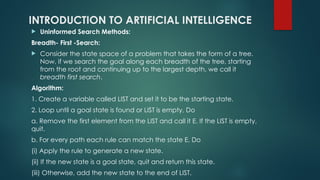
 Uninformed Search Methods:
Breadth- First -Search:
 Consider the state space of a problem that takes the form of a tree.
Now, if we search the goal along each breadth of the tree, starting
from the root and continuing up to the largest depth, we call it
breadth first search.
Algorithm:
1. Create a variable called LIST and set it to be the starting state.
2. Loop until a goal state is found or LIST is empty, Do
a. Remove the first element from the LIST and call it E. If the LIST is empty,
quit.
b. For every path each rule can match the state E, Do
(i) Apply the rule to generate a new state.
(ii) If the new state is a goal state, quit and return this state.
(iii) Otherwise, add the new state to the end of LIST.
INTRODUCTION TO ARTIFICIAL INTELLIGENCE
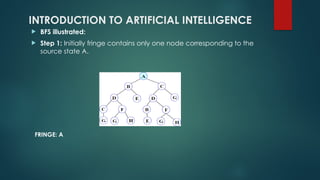
 BFS illustrated:
 Step 1: Initially fringe contains only one node corresponding to the
source state A.
FRINGE: A
INTRODUCTION TO ARTIFICIAL INTELLIGENCE
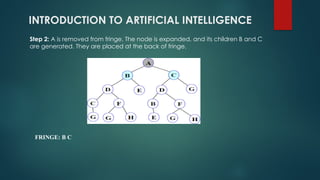
Step 2: A is removed from fringe. The node is expanded, and its children B and C
are generated. They are placed at the back of fringe.
FRINGE: B C
INTRODUCTION TO ARTIFICIAL INTELLIGENCE
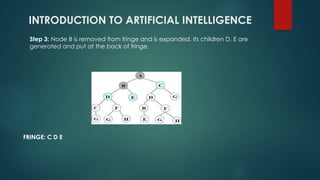
Step 3: Node B is removed from fringe and is expanded. Its children D, E are
generated and put at the back of fringe.
FRINGE: C D E
INTRODUCTION TO ARTIFICIAL INTELLIGENCE
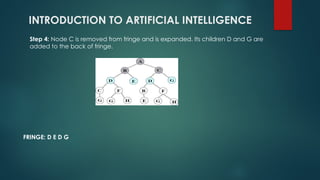
Step 4: Node C is removed from fringe and is expanded. Its children D and G are
added to the back of fringe.
FRINGE: D E D G
INTRODUCTION TO ARTIFICIAL INTELLIGENCE
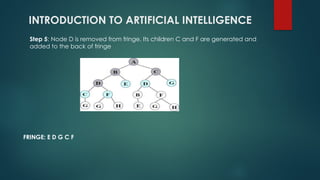
Step 5: Node D is removed from fringe. Its children C and F are generated and
added to the back of fringe
FRINGE: E D G C F
INTRODUCTION TO ARTIFICIAL INTELLIGENCE
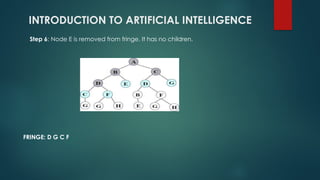
Step 6: Node E is removed from fringe. It has no children.
FRINGE: D G C F
INTRODUCTION TO ARTIFICIAL INTELLIGENCE
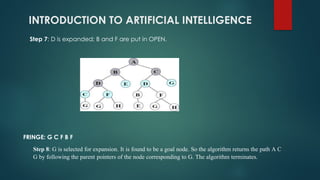
Step 7: D is expanded; B and F are put in OPEN.
FRINGE: G C F B F
Step 8: G is selected for expansion. It is found to be a goal node. So the algorithm returns the path A C
G by following the parent pointers of the node corresponding to G. The algorithm terminates.
INTRODUCTION TO ARTIFICIAL INTELLIGENCE
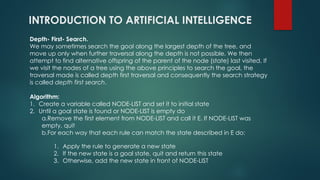
Depth- First- Search.
We may sometimes search the goal along the largest depth of the tree, and
move up only when further traversal along the depth is not possible. We then
attempt to find alternative offspring of the parent of the node (state) last visited. If
we visit the nodes of a tree using the above principles to search the goal, the
traversal made is called depth first traversal and consequently the search strategy
is called depth first search.
Algorithm:
1. Create a variable called NODE-LIST and set it to initial state
2. Until a goal state is found or NODE-LIST is empty do
a.Remove the first element from NODE-LIST and call it E. If NODE-LIST was
empty, quit
b.For each way that each rule can match the state described in E do:
1. Apply the rule to generate a new state
2. If the new state is a goal state, quit and return this state
3. Otherwise, add the new state in front of NODE-LIST
INTRODUCTION TO ARTIFICIAL INTELLIGENCE
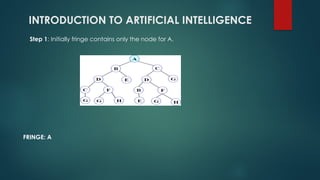
Step 1: Initially fringe contains only the node for A.
FRINGE: A
INTRODUCTION TO ARTIFICIAL INTELLIGENCE
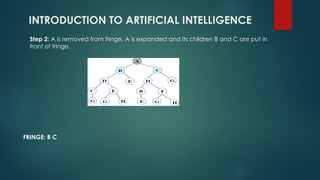
Step 2: A is removed from fringe. A is expanded and its children B and C are put in
front of fringe.
FRINGE: B C
INTRODUCTION TO ARTIFICIAL INTELLIGENCE
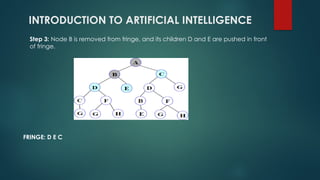
Step 3: Node B is removed from fringe, and its children D and E are pushed in front
of fringe.
FRINGE: D E C
INTRODUCTION TO ARTIFICIAL INTELLIGENCE
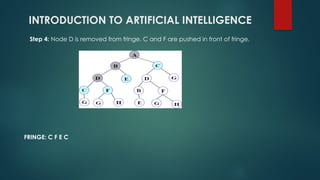
Step 4: Node D is removed from fringe. C and F are pushed in front of fringe.
FRINGE: C F E C
INTRODUCTION TO ARTIFICIAL INTELLIGENCE
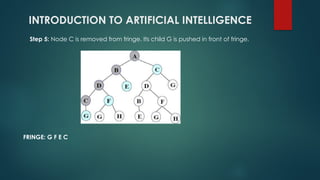
Step 5: Node C is removed from fringe. Its child G is pushed in front of fringe.
FRINGE: G F E C
INTRODUCTION TO ARTIFICIAL INTELLIGENCE
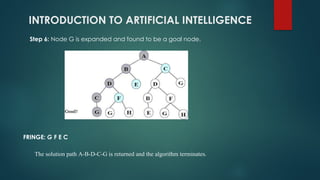
Step 6: Node G is expanded and found to be a goal node.
FRINGE: G F E C
The solution path A-B-D-C-G is returned and the algorithm terminates.
A * Algorithm
 Search algorithms are algorithms designed to search for or retrieve elements from a data
structure, where they are stored.
 A vital aspect of search algorithms is Path Finding, which is used to find paths that can be taken
to traverse from one point to another, by finding the most optimum route.
 We will be dealing with the A* algorithm, which is a search algorithm that finds the shortest path
between two points.
What is an A* Algorithm?
 It is a searching algorithm that is used to find the shortest path between an initial
and a final point.
 It is a handy algorithm that is often used for map traversal to find the shortest
path to be taken.
 A* was initially designed as a graph traversal problem, to help build a robot that
can find its own course.
 It searches for shorter paths first, thus making it an optimal and complete
algorithm.
 An optimal algorithm will find the least cost outcome for a problem, while a
complete algorithm finds all the possible outcomes of a problem.
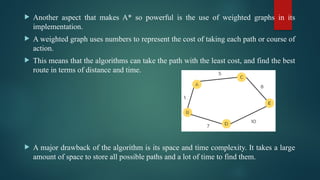
 Another aspect that makes A* so powerful is the use of weighted graphs in its
implementation.
 A weighted graph uses numbers to represent the cost of taking each path or course of
action.
 This means that the algorithms can take the path with the least cost, and find the best
route in terms of distance and time.
 A major drawback of the algorithm is its space and time complexity. It takes a large
amount of space to store all possible paths and a lot of time to find them.
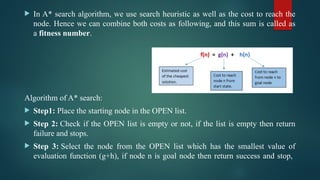
 In A* search algorithm, we use search heuristic as well as the cost to reach the
node. Hence we can combine both costs as following, and this sum is called as
a fitness number.
Algorithm of A* search:
 Step1: Place the starting node in the OPEN list.
 Step 2: Check if the OPEN list is empty or not, if the list is empty then return
failure and stops.
 Step 3: Select the node from the OPEN list which has the smallest value of
evaluation function (g+h), if node n is goal node then return success and stop,
 Step 4: Expand node n and generate all of its successors, and put n into the
closed list. For each successor n', check whether n' is already in the OPEN
or CLOSED list, if not then compute evaluation function for n' and place
into Open list.
 Step 5: Else if node n' is already in OPEN and CLOSED, then it should be
attached to the back pointer which reflects the lowest g(n') value.
 Step 6: Return to Step 2.
Example:
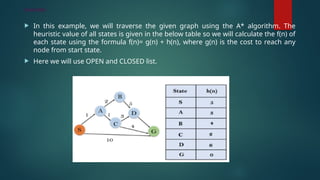
 In this example, we will traverse the given graph using the A* algorithm. The
heuristic value of all states is given in the below table so we will calculate the f(n) of
each state using the formula f(n)= g(n) + h(n), where g(n) is the cost to reach any
node from start state.
 Here we will use OPEN and CLOSED list.
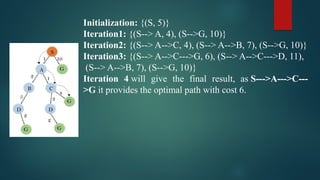
Initialization: {(S, 5)}
Iteration1: {(S--> A, 4), (S-->G, 10)}
Iteration2: {(S--> A-->C, 4), (S--> A-->B, 7), (S-->G, 10)}
Iteration3: {(S--> A-->C--->G, 6), (S--> A-->C--->D, 11),
(S--> A-->B, 7), (S-->G, 10)}
Iteration 4 will give the final result, as S--->A--->C---
>G it provides the optimal path with cost 6.
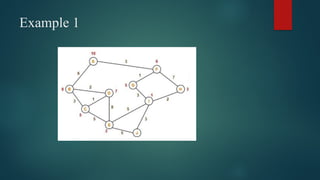
Example 1
Example: 2
Path found: ['A', 'E', 'D', 'G']
AO * Algorithm
 AO* algorithm is a best first search algorithm.
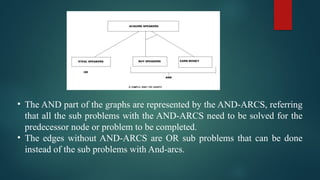
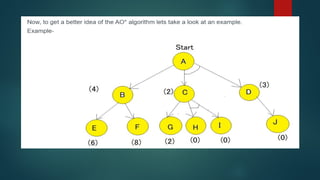
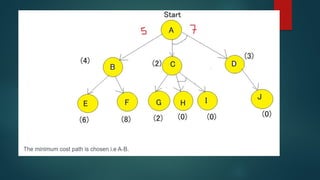
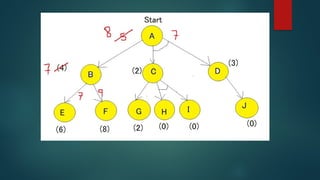
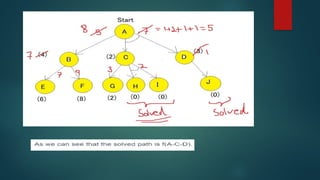
 AO* algorithm uses the concept of AND-OR graphs to decompose any complex
problem given into smaller set of problems which are further solved.
 AND-OR graphs are specialized graphs that are used in problems that can be
broken down into sub problems where AND side of the graph represent a set of
task that need to be done to achieve the main goal.
 whereas the or side of the graph represent the different ways of performing task
to achieve the same main goal.
• The AND part of the graphs are represented by the AND-ARCS, referring
that all the sub problems with the AND-ARCS need to be solved for the
predecessor node or problem to be completed.
• The edges without AND-ARCS are OR sub problems that can be done
instead of the sub problems with And-arcs.
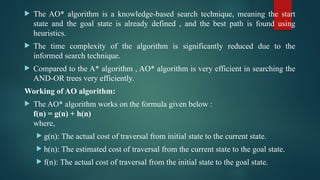
 The AO* algorithm is a knowledge-based search technique, meaning the start
state and the goal state is already defined , and the best path is found using
heuristics.
 The time complexity of the algorithm is significantly reduced due to the
informed search technique.
 Compared to the A* algorithm , AO* algorithm is very efficient in searching the
AND-OR trees very efficiently.
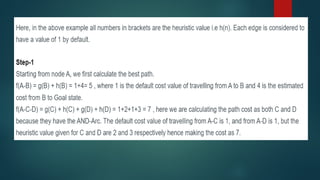
Working of AO algorithm:
 The AO* algorithm works on the formula given below :
f(n) = g(n) + h(n)
where,
 g(n): The actual cost of traversal from initial state to the current state.
 h(n): The estimated cost of traversal from the current state to the goal state.
 f(n): The actual cost of traversal from the initial state to the goal state.
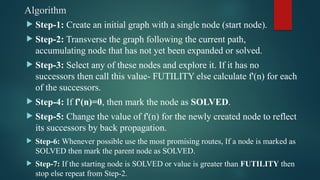
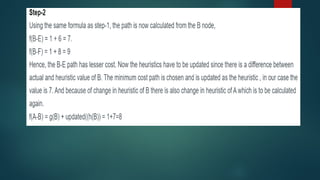
Algorithm
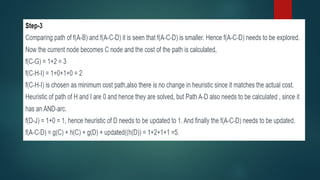
 Step-1: Create an initial graph with a single node (start node).
 Step-2: Transverse the graph following the current path,
accumulating node that has not yet been expanded or solved.
 Step-3: Select any of these nodes and explore it. If it has no
successors then call this value- FUTILITY else calculate f'(n) for each
of the successors.
 Step-4: If f'(n)=0, then mark the node as SOLVED.
 Step-5: Change the value of f'(n) for the newly created node to reflect
its successors by back propagation.
 Step-6: Whenever possible use the most promising routes, If a node is marked as
SOLVED then mark the parent node as SOLVED.
 Step-7: If the starting node is SOLVED or value is greater than FUTILITY then
stop else repeat from Step-2.
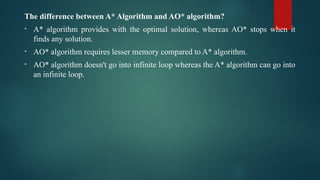
The difference between A* Algorithm and AO* algorithm?
• A* algorithm provides with the optimal solution, whereas AO* stops when it
finds any solution.
• AO* algorithm requires lesser memory compared to A* algorithm.
• AO* algorithm doesn't go into infinite loop whereas the A* algorithm can go into
an infinite loop.
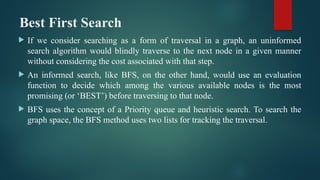
Best First Search
 If we consider searching as a form of traversal in a graph, an uninformed
search algorithm would blindly traverse to the next node in a given manner
without considering the cost associated with that step.
 An informed search, like BFS, on the other hand, would use an evaluation
function to decide which among the various available nodes is the most
promising (or ‘BEST’) before traversing to that node.
 BFS uses the concept of a Priority queue and heuristic search. To search the
graph space, the BFS method uses two lists for tracking the traversal.
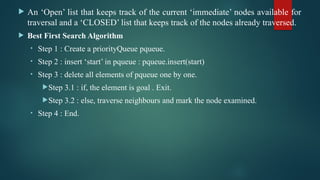
 An ‘Open’ list that keeps track of the current ‘immediate’ nodes available for
traversal and a ‘CLOSED’ list that keeps track of the nodes already traversed.
 Best First Search Algorithm
• Step 1 : Create a priorityQueue pqueue.
• Step 2 : insert ‘start’ in pqueue : pqueue.insert(start)
• Step 3 : delete all elements of pqueue one by one.
Step 3.1 : if, the element is goal . Exit.
Step 3.2 : else, traverse neighbours and mark the node examined.
• Step 4 : End.
 This algorithm will traverse the shortest path first in the queue. The time complexity
of the algorithm is given by O(n*logn).
 The idea of Best First Search is to use an evaluation function to decide which
adjacent is most promising and then explore.
 We use a priority queue or heap to store the costs of nodes that have the lowest
evaluation function value. So the implementation is a variation of BFS, we just need
to change Queue to PriorityQueue.
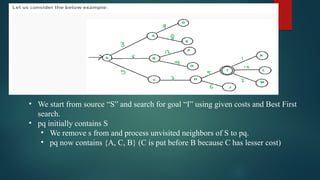
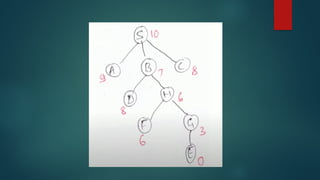
• We start from source “S” and search for goal “I” using given costs and Best First
search.
• pq initially contains S
• We remove s from and process unvisited neighbors of S to pq.
• pq now contains {A, C, B} (C is put before B because C has lesser cost)
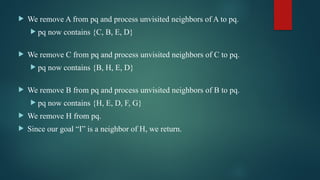
 We remove A from pq and process unvisited neighbors of A to pq.
 pq now contains {C, B, E, D}
 We remove C from pq and process unvisited neighbors of C to pq.
 pq now contains {B, H, E, D}
 We remove B from pq and process unvisited neighbors of B to pq.
 pq now contains {H, E, D, F, G}
 We remove H from pq.
 Since our goal “I” is a neighbor of H, we return.
Introduction to Hill Climbing
 Hill Climbing is a heuristic search used for mathematical optimization problems in
the field of Artificial Intelligence.
 Given a large set of inputs and a good heuristic function, it tries to find a sufficiently
good solution to the problem.
 This solution may not be the global optimal maximum
 In the above definition, mathematical optimization problems imply that hill-
climbing solves the problems where we need to maximize or minimize a given real
function by choosing values from the given inputs.
 Example-Travelling salesman problem where we need to minimize the distance
traveled by the salesman.
 ‘Heuristic search’ means that this search algorithm may not find the optimal solution
to the problem. However, it will give a good solution in a reasonable time.
 A heuristic function is a function that will rank all the possible alternatives at any
branching step in the search algorithm based on the available information.
 It helps the algorithm to select the best route out of possible routes.
Hill Climbing Algorithm
 Hill climbing algorithm is a local search algorithm which continuously moves in the
direction of increasing elevation/value to find the peak of the mountain or best
solution to the problem.
 Hill climbing algorithm is a technique which is used for optimizing the mathematical
problems.
 It is also called greedy local search as it only looks to its good immediate neighbor
state and not beyond that.
 A node of hill climbing algorithm has two components which are state and value.
 Hill Climbing is mostly used when a good heuristic is available.
 In this algorithm, we don't need to maintain and handle the search tree or graph as it
only keeps a single current state
Features of Hill Climbing:
Following are some main features of Hill Climbing Algorithm:
 Generate and Test variant: Hill Climbing is the variant of Generate and Test
method. The Generate and Test method produce feedback which helps to decide
which direction to move in the search space.
 Greedy approach: Hill-climbing algorithm search moves in the direction which
optimizes the cost.
 No backtracking: It does not backtrack the search space, as it does not remember
the previous states.
State-space Diagram for Hill Climbing:
 The state-space landscape is a graphical representation of the hill-climbing
algorithm.
 On Y-axis we have taken the function which can be an objective function or cost
function, and state-space on the x-axis.
 If the function on Y-axis is cost then, the goal of search is to find the global
minimum and local minimum.
 If the function of Y-axis is Objective function, then the goal of the search is to find
the global maximum and local maximum.
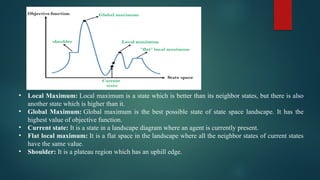
• Local Maximum: Local maximum is a state which is better than its neighbor states, but there is also
another state which is higher than it.
• Global Maximum: Global maximum is the best possible state of state space landscape. It has the
highest value of objective function.
• Current state: It is a state in a landscape diagram where an agent is currently present.
• Flat local maximum: It is a flat space in the landscape where all the neighbor states of current states
have the same value.
• Shoulder: It is a plateau region which has an uphill edge.
Types of Hill Climbing Algorithm:
 Simple hill Climbing:
 Steepest-Ascent hill-climbing:
 Stochastic hill Climbing:
1. Simple Hill Climbing:
 Simple hill climbing is the simplest way to implement a hill climbing algorithm.
 It only evaluates the neighbor node state at a time and selects the first one which
optimizes current cost and set it as a current state.
 It only checks it's one successor state, and if it finds better than the current state,
then move else be in the same state. This algorithm has the following features:
 Less time consuming
 Less optimal solution and the solution is not guaranteed
 Algorithm for Simple Hill Climbing:
Step 1: Evaluate the initial state, if it is goal state then return success and Stop.
Step 2: Loop Until a solution is found or there is no new operator left to apply.
Step 3: Select and apply an operator to the current state.
Step 4: Check new state:
If it is goal state, then return success and quit.
Else if it is better than the current state then assign new state as a current state.
Else if not better than the current state, then return to step2.
Step 5: Exit.
2. Steepest-Ascent hill climbing:
 The steepest-Ascent algorithm is a variation of simple hill climbing
algorithm.
 This algorithm examines all the neighboring nodes of the current state and
selects one neighbor node which is closest to the goal state.
 This algorithm consumes more time as it searches for multiple neighbors
Algorithm for Steepest-Ascent hill climbing:
 Step 1: Evaluate the initial state, if it is goal state then return success and
stop, else make current state as initial state.
 Step 2: Loop until a solution is found or the current state does not change.
 Let SUCC be a state such that any successor of the current state will be better
than it.
 For each operator that applies to the current state:
 Apply the new operator and generate a new state.
 Evaluate the new state.
 If it is goal state, then return it and quit, else compare it to the SUCC.
 If it is better than SUCC, then set new state as SUCC.
 If the SUCC is better than the current state, then set current state to SUCC.
 Step 5: Exit.
3. Stochastic hill climbing:
 Stochastic hill climbing does not examine for all its neighbor before moving. Rather,
this search algorithm selects one neighbor node at random and decides whether to
choose it as a current state or examine another state.
Problems in Hill Climbing Algorithm:
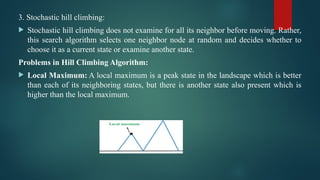
 Local Maximum: A local maximum is a peak state in the landscape which is better
than each of its neighboring states, but there is another state also present which is
higher than the local maximum.
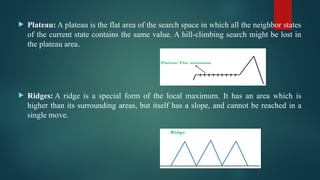
 Plateau: A plateau is the flat area of the search space in which all the neighbor states
of the current state contains the same value. A hill-climbing search might be lost in
the plateau area.
 Ridges: A ridge is a special form of the local maximum. It has an area which is
higher than its surrounding areas, but itself has a slope, and cannot be reached in a
single move.
AI Unit-1 PPT.pptx https https plans to go

AI Unit-1 PPT.pptx https https plans to go

  • 1.
    MALLA REDDY UNIVERSITY MR22-1CS0105:ARTIFICIAL INTELLIGENCE III YEAR B.TECH. CSE I - SEM (MR22-1CS0105) UNIT-I
  • 2.
    INTRODUCTION: ARTIFICIAL INTELLIGENCE,AI PROBLEMS, AI TECHNIQUES, THE LEVEL OF THE MODEL, CRITERIA FOR SUCCESS. DEFINING THE PROBLEM AS A STATE SPACE SEARCH, PROBLEM CHARACTERISTICS, PRODUCTION SYSTEMS, SEARCH: ISSUES IN THE DESIGN OF SEARCH PROGRAMS, UN-INFORMED SEARCH, BFS, AND DFS. HEURISTIC SEARCH TECHNIQUES: GENERATE-AND-TEST, HILL CLIMBING, BEST-FIRST SEARCH, A* ALGORITHM, PROBLEM REDUCTION, AO* ALGORITHM.
  • 3.
    INTRODUCTION TO ARTIFICIALINTELLIGENCE  Artificial Intelligence is composed of two words Artificial and Intelligence, where Artificial defines "man-made," and intelligence defines "thinking power", hence AI means "a man-made thinking power.“ "It is a branch of computer science by which we can create intelligent machines which can behave like a human, think like humans, and able to make decisions."
  • 4.
    INTRODUCTION TO ARTIFICIALINTELLIGENCE Goals of Artificial Intelligence  Replicate human intelligence  Building a machine which can perform tasks that requires human intelligence such as:  Proving a theorem  Playing chess  Plan some surgical operation  Driving a car in traffic  Creating some system which can exhibit intelligent behavior, learn new things by itself, demonstrate, explain, and can advise to its user.
  • 5.
    INTRODUCTION TO ARTIFICIALINTELLIGENCE Advantages of Artificial Intelligence  High Accuracy with less errors  High-Speed  High reliability  Useful for risky areas  Digital Assistant  Useful as a public utility Disadvantages of Artificial Intelligence  High Cost  Can't think out of the box  Increase dependency on machines  No Original Creativity
  • 6.
    INTRODUCTION TO ARTIFICIALINTELLIGENCE ARTIFICIAL INTELLIGENCE PROBLEMS
  • 7.
    INTRODUCTION TO ARTIFICIALINTELLIGENCE  AI TECHNIQUES These techniques fuel various applications of AI and can be broadly categorized into several areas:  Machine Learning: This is a core AI technique where machines learn from data without being explicitly programmed. It allows them to identify patterns, make predictions, and improve their performance over time. Here are some subcategories of machine learning:  Supervised Learning: Trains models using labeled data (data with known outcomes) for tasks like classification (e.g., spam filtering) and regression (e.g., predicting stock prices).  Unsupervised Learning: Discovers hidden patterns in unlabeled data for tasks like clustering (e.g., grouping customers) and dimensionality reduction (e.g., compressing data for analysis).  Reinforcement Learning: Machines learn through trial and error by interacting with an environment and receiving rewards or penalties. This is useful for training AI agents to play games or control robots.
  • 8.
    INTRODUCTION TO ARTIFICIALINTELLIGENCE  Deep Learning: This is a subfield of machine learning inspired by the structure and function of the human brain. It utilizes artificial neural networks with multiple layers to process complex data like images, text, and speech. Deep learning is a powerful technique for tasks like image recognition, natural language processing, and machine translation.  Natural Language Processing (NLP): This technique equips machines with the ability to understand and process human language. It involves tasks like sentiment analysis (identifying emotions in text), machine translation (converting text from one language to another), and chatbots (conversational AI agents).  Computer Vision: This technique allows computers to interpret and understand visual information from the world. It involves tasks like object detection (identifying objects in images), image recognition (classifying images), and facial recognition (identifying people from their faces).
  • 9.
    INTRODUCTION TO ARTIFICIALINTELLIGENCE  Robotics: This combines AI with mechanical engineering to design and build intelligent robots. AI techniques are used for robot control, navigation, and decision-making, enabling robots to perform tasks autonomously in various environments. CRITERIA OF SUCCESS  There are several key criteria to consider when evaluating the success of an AI system:  Performance: This is the most fundamental criterion. It measures how well the AI achieves its intended goals.  Accuracy: For tasks like classification (spam filtering) or prediction (stock prices), it refers to how often the AI makes correct decisions.  Efficiency: This measures how quickly the AI can complete a task. This is important for real-time applications where speed is crucial.  Robustness: This refers to how well the AI performs under varying conditions or with unexpected inputs. A robust AI can handle noise, errors, and unforeseen situations.
  • 10.
    INTRODUCTION TO ARTIFICIALINTELLIGENCE  Optimality: This is relevant when the goal is to find the best possible solution, like the shortest path for navigation or the minimum cost in resource allocation. An optimal AI guarantees finding the best solution within the defined constraints.  Learning Ability: As AI systems interact with the world and encounter new data, the ability to learn and improve their performance over time is valuable. This is especially important for tasks where the environment is constantly changing.  Explainability and Transparency: Understanding how an AI system arrives at its decisions is crucial for building trust and ensuring fairness. Ideally, the AI's reasoning process should be transparent and explainable to humans.  Real-World Impact: Ultimately, the success of an AI system is measured by the positive impact it has on the real world. Does it improve efficiency, solve problems, or enhance human capabilities in a meaningful way?
  • 11.
  • 12.
    INTRODUCTION TO ARTIFICIALINTELLIGENCE Defining the problem as State Space Search:  The state space representation forms the basis of most of the AI methods.  Formulate a problem as a state space search by showing the legal problem states, the legal operators, and the initial and goal states.  A state is defined by the specification of the values of all attributes of interest in the world  An operator changes one state into the other; it has a precondition which is the value of certain attributes prior to the application of the operator, and a set of effects, which are the attributes altered by the operator  The initial state is where you start  The goal state is the partial description of the solution
  • 13.
    INTRODUCTION TO ARTIFICIALINTELLIGENCE  Example: Water Jug Problem  Consider the following problem: A Water Jug Problem: You are given two jugs, a 4-gallon one and a 3-gallon one, a pump which has unlimited water which you can use to fill the jug, and the ground on which water may be poured. Neither jug has any measuring markings on it. How can you get exactly 2 gallons of water in the 4-gallon jug?
  • 14.
    INTRODUCTION TO ARTIFICIALINTELLIGENCE  Since artificial intelligence (AI) is mainly related to the search process, it is important to have some methodology to choose the best possible solution.  To choose an appropriate method for a particular problem first we need to categorize the problem based on the following characteristics. 1. Is the problem decomposable into small sub-problems which are easy to solve? 2. Can solution steps be ignored or undone? 3. Is the universe of the problem is predictable? Problem Characteristics in Artificial Intelligence
  • 15.
    4. Is agood solution to the problem is absolute or relative? 5. Is the solution to the problem a state or a path? 6. What is the role of knowledge in solving a problem using artificial intelligence? 7. Does the task of solving a problem require human interaction? 1. Is the problem decomposable into small sub-problems which are easy to solve?  Can the problem be broken down into smaller problems to be solved independently?  The decomposable problem can be solved easily.
  • 16.
     Example: Inthis case, the problem is divided into smaller problems. The smaller problems are solved independently. Finally, the result is merged to get the final result.
  • 17.
    2. Can solutionsteps be ignored or undone?  In the Theorem Proving problem, a lemma that has been proved can be ignored for the next steps.  Such problems are called Ignorable problems.  In the 8-Puzzle, Moves can be undone and backtracked.  Such problems are called Recoverable problems.
  • 18.
     In PlayingChess, moves can be retracted.  Such problems are called Irrecoverable problems.  Ignorable problems can be solved using a simple control structure that never backtracks.  Recoverable problems can be solved using backtracking.  Irrecoverable problems can be solved by recoverable style methods via planning. 3. Is the universe of the problem is predictable?  In Playing Bridge, We cannot know exactly where all the cards are or what the other players will do on their turns.
  • 19.
    Uncertain outcome!  Forcertain-outcome problems, planning can be used to generate a sequence of operators that is guaranteed to lead to a solution.  For uncertain-outcome problems, a sequence of generated operators can only have a good probability of leading to a solution. Plan revision is made as the plan is carried out and the necessary feedback is provided. 4. Is a good solution to the problem is absolute or relative?  The Travelling Salesman Problem, we have to try all paths to find the shortest one.  Any path problem can be solved using heuristics that suggest good paths to explore.  For best-path problems, a much more exhaustive search will be performed.
  • 20.
    5. Is thesolution to the problem a state or a path  The Water Jug Problem, the path that leads to the goal must be reported.  A path-solution problem can be reformulated as a state-solution problem by describing a state as a partial path to a solution. The question is whether that is natural or not. 6. What is the role of knowledge in solving a problem using artificial intelligence? Playing Chess  Consider again the problem of playing chess. Suppose you had unlimited computing power available.  How much knowledge would be required by a perfect program?
  • 21.
     Additional knowledgeabout such things as good strategy and tactics could of course help considerably to constrain the search and speed up the execution of the program. Knowledge is important only to constrain the search for a solution. 7. Does the task of solving a problem require human interaction?  we are building programs that require intermediate interaction with people, both to provide additional input to the program and to provide additional reassurance to the user.  The solitary problem, in which there is no intermediate communication and no demand for an explanation of the reasoning process.  The conversational problem, in which intermediate communication is to provide either additional assistance to the computer or additional information to the user.
  • 22.
    INTRODUCTION TO ARTIFICIALINTELLIGENCE  Production System in AI  In artificial intelligence (AI), a production system refers to a type of rule-based system that is designed to provide a structured approach to problem solving and decision- making. This framework is particularly influential in the realm of expert systems, where it simulates human decision-making processes using a set of predefined rules and facts.  Let’s consider an example of Expert System for Medical Diagnosis.  Scenario: A patient comes to a healthcare facility with the following symptoms: fever, severe headache, sensitivity to light, and stiff neck.  Medical diagnosis operates in the following manner:  Input: A healthcare professional inputs the symptoms into MediDiagnose.  Processing:  MediDiagnose reviews its knowledge base for rules that match the given symptoms.  It identifies several potential conditions but recognizes a strong match for meningitis based on the combination of symptoms.  Output:  The system suggests that meningitis could be a possible diagnosis and recommends further tests to confirm, such as a lumbar puncture.  It also provides a list of other less likely conditions based on the symptoms for comprehensive differential diagnosis.
  • 23.
    INTRODUCTION TO ARTIFICIALINTELLIGENCE  Applications of Production Systems Expert Systems:  Used in domains such as medical diagnosis, financial analysis, and troubleshooting.  Example: MYCIN, an early expert system for medical diagnosis. Decision Support Systems:  Help make business decisions by evaluating rules against large datasets.  Example: Rule-based systems for credit scoring in financial institutions. Automated Planning and Scheduling:  Used in robotics, logistics, and operations management to plan and schedule tasks.  Example: STRIPS (Stanford Research Institute Problem Solver), a planning system.
  • 24.
    INTRODUCTION TO ARTIFICIALINTELLIGENCE Issues in the Design of Search Programs  Designing effective search programs in AI involves addressing several key issues to ensure that they are efficient, scalable, and applicable to a variety of problems. Here are some of the primary challenges: 1. Problem Definition and State Space Representation  Defining the Problem:  A precise definition of the problem, including the initial state, goal state, and the set of possible actions, is crucial for the search program. Ambiguities in problem definition can lead to inefficient searches or incorrect solutions.  State Space Representation:  The way the state space is represented impacts the efficiency of the search. A well-defined state space helps in systematically exploring possible solutions. Complex problems require sophisticated representations to manage the vast number of potential states​.
  • 25.
    INTRODUCTION TO ARTIFICIALINTELLIGENCE 2. Algorithm Selection and Performance  Choice of Search Algorithm: Selecting the appropriate search algorithm (e.g., Breadth-First Search, Depth-First Search, A*, Dijkstra's algorithm) is critical. Each algorithm has its own trade-offs in terms of time complexity, space complexity, completeness, and optimality.​  Heuristics: Informed search algorithms like A* rely on heuristics to guide the search process. Designing effective heuristics that are both admissible and consistent is a significant challenge as they impact the efficiency and accuracy of the search​
  • 26.
    INTRODUCTION TO ARTIFICIALINTELLIGENCE  Uninformed Search Methods: Breadth- First -Search:  Consider the state space of a problem that takes the form of a tree. Now, if we search the goal along each breadth of the tree, starting from the root and continuing up to the largest depth, we call it breadth first search. Algorithm: 1. Create a variable called LIST and set it to be the starting state. 2. Loop until a goal state is found or LIST is empty, Do a. Remove the first element from the LIST and call it E. If the LIST is empty, quit. b. For every path each rule can match the state E, Do (i) Apply the rule to generate a new state. (ii) If the new state is a goal state, quit and return this state. (iii) Otherwise, add the new state to the end of LIST.
  • 27.
    INTRODUCTION TO ARTIFICIALINTELLIGENCE  BFS illustrated:  Step 1: Initially fringe contains only one node corresponding to the source state A. FRINGE: A
  • 28.
    INTRODUCTION TO ARTIFICIALINTELLIGENCE Step 2: A is removed from fringe. The node is expanded, and its children B and C are generated. They are placed at the back of fringe. FRINGE: B C
  • 29.
    INTRODUCTION TO ARTIFICIALINTELLIGENCE Step 3: Node B is removed from fringe and is expanded. Its children D, E are generated and put at the back of fringe. FRINGE: C D E
  • 30.
    INTRODUCTION TO ARTIFICIALINTELLIGENCE Step 4: Node C is removed from fringe and is expanded. Its children D and G are added to the back of fringe. FRINGE: D E D G
  • 31.
    INTRODUCTION TO ARTIFICIALINTELLIGENCE Step 5: Node D is removed from fringe. Its children C and F are generated and added to the back of fringe FRINGE: E D G C F
  • 32.
    INTRODUCTION TO ARTIFICIALINTELLIGENCE Step 6: Node E is removed from fringe. It has no children. FRINGE: D G C F
  • 33.
    INTRODUCTION TO ARTIFICIALINTELLIGENCE Step 7: D is expanded; B and F are put in OPEN. FRINGE: G C F B F Step 8: G is selected for expansion. It is found to be a goal node. So the algorithm returns the path A C G by following the parent pointers of the node corresponding to G. The algorithm terminates.
  • 34.
    INTRODUCTION TO ARTIFICIALINTELLIGENCE Depth- First- Search. We may sometimes search the goal along the largest depth of the tree, and move up only when further traversal along the depth is not possible. We then attempt to find alternative offspring of the parent of the node (state) last visited. If we visit the nodes of a tree using the above principles to search the goal, the traversal made is called depth first traversal and consequently the search strategy is called depth first search. Algorithm: 1. Create a variable called NODE-LIST and set it to initial state 2. Until a goal state is found or NODE-LIST is empty do a.Remove the first element from NODE-LIST and call it E. If NODE-LIST was empty, quit b.For each way that each rule can match the state described in E do: 1. Apply the rule to generate a new state 2. If the new state is a goal state, quit and return this state 3. Otherwise, add the new state in front of NODE-LIST
  • 35.
    INTRODUCTION TO ARTIFICIALINTELLIGENCE Step 1: Initially fringe contains only the node for A. FRINGE: A
  • 36.
    INTRODUCTION TO ARTIFICIALINTELLIGENCE Step 2: A is removed from fringe. A is expanded and its children B and C are put in front of fringe. FRINGE: B C
  • 37.
    INTRODUCTION TO ARTIFICIALINTELLIGENCE Step 3: Node B is removed from fringe, and its children D and E are pushed in front of fringe. FRINGE: D E C
  • 38.
    INTRODUCTION TO ARTIFICIALINTELLIGENCE Step 4: Node D is removed from fringe. C and F are pushed in front of fringe. FRINGE: C F E C
  • 39.
    INTRODUCTION TO ARTIFICIALINTELLIGENCE Step 5: Node C is removed from fringe. Its child G is pushed in front of fringe. FRINGE: G F E C
  • 40.
    INTRODUCTION TO ARTIFICIALINTELLIGENCE Step 6: Node G is expanded and found to be a goal node. FRINGE: G F E C The solution path A-B-D-C-G is returned and the algorithm terminates.
  • 41.
    A * Algorithm Search algorithms are algorithms designed to search for or retrieve elements from a data structure, where they are stored.  A vital aspect of search algorithms is Path Finding, which is used to find paths that can be taken to traverse from one point to another, by finding the most optimum route.  We will be dealing with the A* algorithm, which is a search algorithm that finds the shortest path between two points.
  • 42.
    What is anA* Algorithm?  It is a searching algorithm that is used to find the shortest path between an initial and a final point.  It is a handy algorithm that is often used for map traversal to find the shortest path to be taken.  A* was initially designed as a graph traversal problem, to help build a robot that can find its own course.  It searches for shorter paths first, thus making it an optimal and complete algorithm.  An optimal algorithm will find the least cost outcome for a problem, while a complete algorithm finds all the possible outcomes of a problem.
  • 43.
     Another aspectthat makes A* so powerful is the use of weighted graphs in its implementation.  A weighted graph uses numbers to represent the cost of taking each path or course of action.  This means that the algorithms can take the path with the least cost, and find the best route in terms of distance and time.  A major drawback of the algorithm is its space and time complexity. It takes a large amount of space to store all possible paths and a lot of time to find them.
  • 44.
     In A*search algorithm, we use search heuristic as well as the cost to reach the node. Hence we can combine both costs as following, and this sum is called as a fitness number. Algorithm of A* search:  Step1: Place the starting node in the OPEN list.  Step 2: Check if the OPEN list is empty or not, if the list is empty then return failure and stops.  Step 3: Select the node from the OPEN list which has the smallest value of evaluation function (g+h), if node n is goal node then return success and stop,
  • 45.
     Step 4:Expand node n and generate all of its successors, and put n into the closed list. For each successor n', check whether n' is already in the OPEN or CLOSED list, if not then compute evaluation function for n' and place into Open list.  Step 5: Else if node n' is already in OPEN and CLOSED, then it should be attached to the back pointer which reflects the lowest g(n') value.  Step 6: Return to Step 2.
  • 46.
    Example:  In thisexample, we will traverse the given graph using the A* algorithm. The heuristic value of all states is given in the below table so we will calculate the f(n) of each state using the formula f(n)= g(n) + h(n), where g(n) is the cost to reach any node from start state.  Here we will use OPEN and CLOSED list.
  • 47.
    Initialization: {(S, 5)} Iteration1:{(S--> A, 4), (S-->G, 10)} Iteration2: {(S--> A-->C, 4), (S--> A-->B, 7), (S-->G, 10)} Iteration3: {(S--> A-->C--->G, 6), (S--> A-->C--->D, 11), (S--> A-->B, 7), (S-->G, 10)} Iteration 4 will give the final result, as S--->A--->C--- >G it provides the optimal path with cost 6.
  • 48.
  • 49.
    Example: 2 Path found:['A', 'E', 'D', 'G']
  • 50.
    AO * Algorithm AO* algorithm is a best first search algorithm.  AO* algorithm uses the concept of AND-OR graphs to decompose any complex problem given into smaller set of problems which are further solved.  AND-OR graphs are specialized graphs that are used in problems that can be broken down into sub problems where AND side of the graph represent a set of task that need to be done to achieve the main goal.  whereas the or side of the graph represent the different ways of performing task to achieve the same main goal.
  • 51.
    • The ANDpart of the graphs are represented by the AND-ARCS, referring that all the sub problems with the AND-ARCS need to be solved for the predecessor node or problem to be completed. • The edges without AND-ARCS are OR sub problems that can be done instead of the sub problems with And-arcs.
  • 52.
     The AO*algorithm is a knowledge-based search technique, meaning the start state and the goal state is already defined , and the best path is found using heuristics.  The time complexity of the algorithm is significantly reduced due to the informed search technique.  Compared to the A* algorithm , AO* algorithm is very efficient in searching the AND-OR trees very efficiently. Working of AO algorithm:  The AO* algorithm works on the formula given below : f(n) = g(n) + h(n) where,  g(n): The actual cost of traversal from initial state to the current state.  h(n): The estimated cost of traversal from the current state to the goal state.  f(n): The actual cost of traversal from the initial state to the goal state.
  • 53.
    Algorithm  Step-1: Createan initial graph with a single node (start node).  Step-2: Transverse the graph following the current path, accumulating node that has not yet been expanded or solved.  Step-3: Select any of these nodes and explore it. If it has no successors then call this value- FUTILITY else calculate f'(n) for each of the successors.  Step-4: If f'(n)=0, then mark the node as SOLVED.  Step-5: Change the value of f'(n) for the newly created node to reflect its successors by back propagation.  Step-6: Whenever possible use the most promising routes, If a node is marked as SOLVED then mark the parent node as SOLVED.  Step-7: If the starting node is SOLVED or value is greater than FUTILITY then stop else repeat from Step-2.
  • 61.
    The difference betweenA* Algorithm and AO* algorithm? • A* algorithm provides with the optimal solution, whereas AO* stops when it finds any solution. • AO* algorithm requires lesser memory compared to A* algorithm. • AO* algorithm doesn't go into infinite loop whereas the A* algorithm can go into an infinite loop.
  • 62.
    Best First Search If we consider searching as a form of traversal in a graph, an uninformed search algorithm would blindly traverse to the next node in a given manner without considering the cost associated with that step.  An informed search, like BFS, on the other hand, would use an evaluation function to decide which among the various available nodes is the most promising (or ‘BEST’) before traversing to that node.  BFS uses the concept of a Priority queue and heuristic search. To search the graph space, the BFS method uses two lists for tracking the traversal.
  • 63.
     An ‘Open’list that keeps track of the current ‘immediate’ nodes available for traversal and a ‘CLOSED’ list that keeps track of the nodes already traversed.  Best First Search Algorithm • Step 1 : Create a priorityQueue pqueue. • Step 2 : insert ‘start’ in pqueue : pqueue.insert(start) • Step 3 : delete all elements of pqueue one by one. Step 3.1 : if, the element is goal . Exit. Step 3.2 : else, traverse neighbours and mark the node examined. • Step 4 : End.
  • 64.
     This algorithmwill traverse the shortest path first in the queue. The time complexity of the algorithm is given by O(n*logn).  The idea of Best First Search is to use an evaluation function to decide which adjacent is most promising and then explore.  We use a priority queue or heap to store the costs of nodes that have the lowest evaluation function value. So the implementation is a variation of BFS, we just need to change Queue to PriorityQueue.
  • 66.
    • We startfrom source “S” and search for goal “I” using given costs and Best First search. • pq initially contains S • We remove s from and process unvisited neighbors of S to pq. • pq now contains {A, C, B} (C is put before B because C has lesser cost)
  • 67.
     We removeA from pq and process unvisited neighbors of A to pq.  pq now contains {C, B, E, D}  We remove C from pq and process unvisited neighbors of C to pq.  pq now contains {B, H, E, D}  We remove B from pq and process unvisited neighbors of B to pq.  pq now contains {H, E, D, F, G}  We remove H from pq.  Since our goal “I” is a neighbor of H, we return.
  • 70.
    Introduction to HillClimbing  Hill Climbing is a heuristic search used for mathematical optimization problems in the field of Artificial Intelligence.  Given a large set of inputs and a good heuristic function, it tries to find a sufficiently good solution to the problem.  This solution may not be the global optimal maximum  In the above definition, mathematical optimization problems imply that hill- climbing solves the problems where we need to maximize or minimize a given real function by choosing values from the given inputs.  Example-Travelling salesman problem where we need to minimize the distance traveled by the salesman.
  • 71.
     ‘Heuristic search’means that this search algorithm may not find the optimal solution to the problem. However, it will give a good solution in a reasonable time.  A heuristic function is a function that will rank all the possible alternatives at any branching step in the search algorithm based on the available information.  It helps the algorithm to select the best route out of possible routes.
  • 72.
    Hill Climbing Algorithm Hill climbing algorithm is a local search algorithm which continuously moves in the direction of increasing elevation/value to find the peak of the mountain or best solution to the problem.  Hill climbing algorithm is a technique which is used for optimizing the mathematical problems.  It is also called greedy local search as it only looks to its good immediate neighbor state and not beyond that.  A node of hill climbing algorithm has two components which are state and value.  Hill Climbing is mostly used when a good heuristic is available.  In this algorithm, we don't need to maintain and handle the search tree or graph as it only keeps a single current state
  • 73.
    Features of HillClimbing: Following are some main features of Hill Climbing Algorithm:  Generate and Test variant: Hill Climbing is the variant of Generate and Test method. The Generate and Test method produce feedback which helps to decide which direction to move in the search space.  Greedy approach: Hill-climbing algorithm search moves in the direction which optimizes the cost.  No backtracking: It does not backtrack the search space, as it does not remember the previous states.
  • 74.
    State-space Diagram forHill Climbing:  The state-space landscape is a graphical representation of the hill-climbing algorithm.  On Y-axis we have taken the function which can be an objective function or cost function, and state-space on the x-axis.  If the function on Y-axis is cost then, the goal of search is to find the global minimum and local minimum.  If the function of Y-axis is Objective function, then the goal of the search is to find the global maximum and local maximum.
  • 75.
    • Local Maximum:Local maximum is a state which is better than its neighbor states, but there is also another state which is higher than it. • Global Maximum: Global maximum is the best possible state of state space landscape. It has the highest value of objective function. • Current state: It is a state in a landscape diagram where an agent is currently present. • Flat local maximum: It is a flat space in the landscape where all the neighbor states of current states have the same value. • Shoulder: It is a plateau region which has an uphill edge.
  • 76.
    Types of HillClimbing Algorithm:  Simple hill Climbing:  Steepest-Ascent hill-climbing:  Stochastic hill Climbing: 1. Simple Hill Climbing:  Simple hill climbing is the simplest way to implement a hill climbing algorithm.  It only evaluates the neighbor node state at a time and selects the first one which optimizes current cost and set it as a current state.  It only checks it's one successor state, and if it finds better than the current state, then move else be in the same state. This algorithm has the following features:  Less time consuming  Less optimal solution and the solution is not guaranteed
  • 77.
     Algorithm forSimple Hill Climbing: Step 1: Evaluate the initial state, if it is goal state then return success and Stop. Step 2: Loop Until a solution is found or there is no new operator left to apply. Step 3: Select and apply an operator to the current state. Step 4: Check new state: If it is goal state, then return success and quit. Else if it is better than the current state then assign new state as a current state. Else if not better than the current state, then return to step2. Step 5: Exit.
  • 78.
    2. Steepest-Ascent hillclimbing:  The steepest-Ascent algorithm is a variation of simple hill climbing algorithm.  This algorithm examines all the neighboring nodes of the current state and selects one neighbor node which is closest to the goal state.  This algorithm consumes more time as it searches for multiple neighbors Algorithm for Steepest-Ascent hill climbing:  Step 1: Evaluate the initial state, if it is goal state then return success and stop, else make current state as initial state.  Step 2: Loop until a solution is found or the current state does not change.
  • 79.
     Let SUCCbe a state such that any successor of the current state will be better than it.  For each operator that applies to the current state:  Apply the new operator and generate a new state.  Evaluate the new state.  If it is goal state, then return it and quit, else compare it to the SUCC.  If it is better than SUCC, then set new state as SUCC.  If the SUCC is better than the current state, then set current state to SUCC.  Step 5: Exit.
  • 80.
    3. Stochastic hillclimbing:  Stochastic hill climbing does not examine for all its neighbor before moving. Rather, this search algorithm selects one neighbor node at random and decides whether to choose it as a current state or examine another state. Problems in Hill Climbing Algorithm:  Local Maximum: A local maximum is a peak state in the landscape which is better than each of its neighboring states, but there is another state also present which is higher than the local maximum.
  • 81.
     Plateau: Aplateau is the flat area of the search space in which all the neighbor states of the current state contains the same value. A hill-climbing search might be lost in the plateau area.  Ridges: A ridge is a special form of the local maximum. It has an area which is higher than its surrounding areas, but itself has a slope, and cannot be reached in a single move.