Scrooge
      Project
         Based on
Vygotsky & Keller Theory
  No.1 – 김예진, 김지수, 김효진, 원라인
                              1
PRESENTATION
    TABLE
Vygots
       Keller
    ky


                Scrooge
                Project
                          2
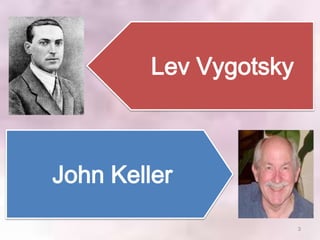
Lev Vygotsky


John Keller

                        3
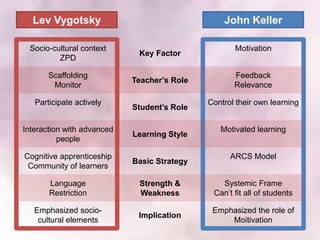
Lev Vygotsky                                   John Keller

 Socio-cultural context                             Motivation
                             Key Factor
         ZPD

       Scaffolding                                  Feedback
                            Teacher’s Role
        Monitor                                     Relevance

   Participate actively                      Control their own learning
                            Student’s Role

Interaction with advanced                       Motivated learning
                            Learning Style
          people

Cognitive apprenticeship                           ARCS Model
                            Basic Strategy
 Community of learners

       Language              Strength &         Systemic Frame
       Restriction           Weakness         Can’t fit all of students

   Emphasized socio-                          Emphasized the role of
                             Implication
    cultural elements                             Moitivation
                                                                          4
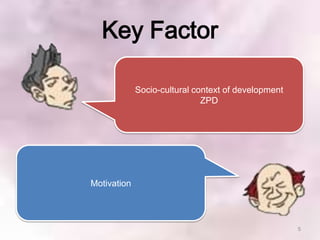
Key Factor

             Socio-cultural context of development
                              ZPD


Motivation


                                                     5
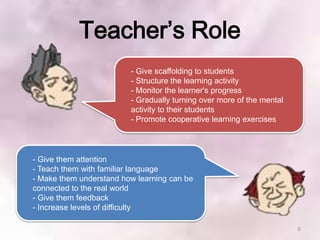
Teacher’s Role
                         - Give scaffolding to students
                         - Structure the learning activity
                         - Monitor the learner's progress
                         - Gradually turning over more of the mental
                         activity to their students
                         - Promote cooperative learning exercises


- Give them attention
- Teach them with familiar language
- Make them understand how learning can be
connected to the real world
- Give them feedback
- Increase levels of difficulty

                                                                       6
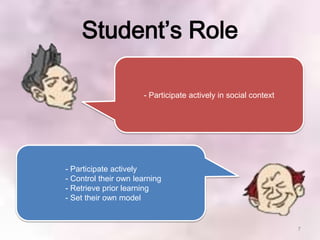
Student’s Role

                      - Participate actively in social context


- Participate actively
- Control their own learning
- Retrieve prior learning
- Set their own model


                                                                 7
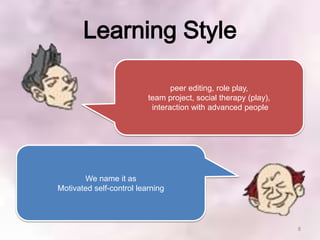
Learning Style

                                 peer editing, role play,
                          team project, social therapy (play),
                           interaction with advanced people


       We name it as
Motivated self-control learning


                                                                 8
Basic Strategy
               cognitive apprenticeship model
               -Modeling (interact with experts)
               -Scaffolding and fading
               -Authentic activity
               (real world, complex, meaningful, social)
               community of learners
               -Joint problem solving
               -Student directed inquiry
               -Dialogue


ARCS Model
 A : Attention
R : Relevance
C : Confidence
S : Satisfaction


                                                           9
Strength & Weakness
                                Strength
                                -It connected language with learning

                                Weakness
                                -It ignored heredity or development of brain
                                -There are limits and restriction on this theory


Strength
-It provides systemic frame
-Motivated students continuously study even
though they are out of class

Weakness
-It can't fit all of students

                                                                                   10
Implication
                     It emphasized the importance of socio-cultural
                     elements

                     It emphasized that knowledge can be
                     constructed with the culture or history, not
                     absolute itself


It emphasized the role of motivation


                                                                      11
Scrooge
Project


          12
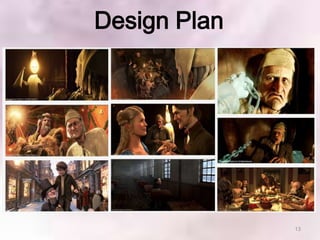
Design Plan


              13
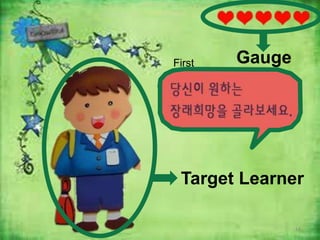
First   Gauge


 Target Learner

                14
15
16
17
18
19
20
21
22
23
24
25
26
27
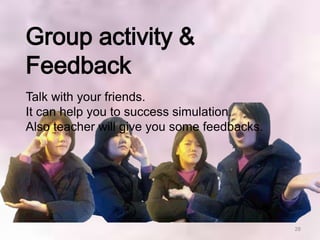
Group activity &
Feedback
Talk with your friends.
It can help you to success simulation.
Also teacher will give you some feedbacks.


                                             28
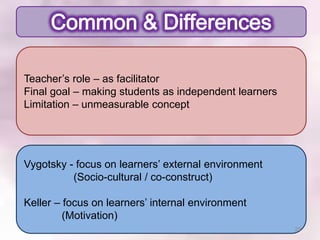
Common & Differences

Teacher’s role – as facilitator
Final goal – making students as independent learners
Limitation – unmeasurable concept


Vygotsky - focus on learners’ external environment
          (Socio-cultural / co-construct)

Keller – focus on learners’ internal environment
         (Motivation)
                                                       29
30
References 1
http://www.google.co.kr/imgres?q=vygotsky&hl=ko&newwindow=1&biw=1366&bih=560&tbm=isch&tbnid=eXAgZ2cRge--
     6M%3A&imgrefurl=http%3A%2F%2Fesl.fis.edu%2Fteachers%2Ffis%2Fscaffold%2Fpage1.htm&docid=ftUhzTziCVBr
     qM&imgurl=http%3A%2F%2Fesl.fis.edu%2Fteachers%2Ffis%2Fscaffold%2Fzpd.jpg&w=350&h=279&ei=rsnQToeFK
     6PUmAW-
     xJXCDQ&zoom=1&iact=rc&dur=312&sig=108461278417431789531&page=1&tbnh=118&tbnw=148&start=0&ndsp=29
     &ved=1t%3A429%2Cr%3A7%2Cs%3A0&tx=35&ty=87

    http://www.learningandteaching.info/learning/constructivism.htm

    http://www.projetospedagogicosdinamicos.com/vygotsky.htm


    http://www.google.co.kr/imgres?q=keller+arcs&hl=ko&newwindow=1&biw=1366&bih=560&tbm=isch&tbnid=tLCvuW
    lwwmKxGM%3A&imgrefurl=http%3A%2F%2Ffaculty.weber.edu%2Fpstewart%2F6030%2F6030.html&docid=6P7GPa
    z29UV2cM&imgurl=http%3A%2F%2Ffaculty.weber.edu%2Fpstewart%2Fimages%2Fjmkeller.gif&w=133&h=140&ei=D
    sLQTrvSOcuJmQWGt-
    naDQ&zoom=1&iact=rc&dur=109&sig=108461278417431789531&page=1&tbnh=107&tbnw=93&start=0&ndsp=29&ve
    d=1t%3A429%2Cr%3A22%2Cs%3A0&tx=81&ty=50

    http://www.google.co.kr/imgres?q=keller+arcs&hl=ko&newwindow=1&biw=1366&bih=560&tbm=isch&tbnid=fvVIBX
    KNjiTLWM%3A&imgrefurl=http%3A%2F%2Farcmit01.uncw.edu%2Ferg1602%2FGlossary.html&docid=NRZe0wzsMU
    RXbM&imgurl=http%3A%2F%2Farcmit01.uncw.edu%2Ferg1602%2FARCS.jpg&w=1005&h=844&ei=DsLQTrvSOcuJ
    mQWGt-
    naDQ&zoom=1&iact=rc&dur=93&sig=108461278417431789531&page=1&tbnh=113&tbnw=135&start=0&ndsp=29&ve
    d=1t%3A429%2Cr%3A15%2Cs%3A0&tx=105&ty=39


    http://idtheory.pbworks.com/w/page/25380791/John%20Keller's%20ARCS%20Model%20of%20Motivational%20Desi
    gn


                                                                                                            31
References 2
교수-학습 이론의 이해(2011, 변영계, 학지사)

교육공학-정의와 논평(2009, Alen Januszewski, 교육과학사)

http://blog.naver.com/18miles?Redirect=Log&logNo=9003
7430795

http://blog.daum.net/_blog/BlogTypeView.do?blogid=0O
Qri&articleno=14&categoryId=4&regdt=2009022312284
0
                                                  32
No.1


Only.1
                33

Ppt

  • 1.
    Scrooge Project Based on Vygotsky & Keller Theory No.1 – 김예진, 김지수, 김효진, 원라인 1
  • 2.
    PRESENTATION TABLE Vygots Keller ky Scrooge Project 2
  • 3.
  • 4.
    Lev Vygotsky John Keller Socio-cultural context Motivation Key Factor ZPD Scaffolding Feedback Teacher’s Role Monitor Relevance Participate actively Control their own learning Student’s Role Interaction with advanced Motivated learning Learning Style people Cognitive apprenticeship ARCS Model Basic Strategy Community of learners Language Strength & Systemic Frame Restriction Weakness Can’t fit all of students Emphasized socio- Emphasized the role of Implication cultural elements Moitivation 4
  • 5.
    Key Factor Socio-cultural context of development ZPD Motivation 5
  • 6.
    Teacher’s Role - Give scaffolding to students - Structure the learning activity - Monitor the learner's progress - Gradually turning over more of the mental activity to their students - Promote cooperative learning exercises - Give them attention - Teach them with familiar language - Make them understand how learning can be connected to the real world - Give them feedback - Increase levels of difficulty 6
  • 7.
    Student’s Role - Participate actively in social context - Participate actively - Control their own learning - Retrieve prior learning - Set their own model 7
  • 8.
    Learning Style peer editing, role play, team project, social therapy (play), interaction with advanced people We name it as Motivated self-control learning 8
  • 9.
    Basic Strategy cognitive apprenticeship model -Modeling (interact with experts) -Scaffolding and fading -Authentic activity (real world, complex, meaningful, social) community of learners -Joint problem solving -Student directed inquiry -Dialogue ARCS Model A : Attention R : Relevance C : Confidence S : Satisfaction 9
  • 10.
    Strength & Weakness Strength -It connected language with learning Weakness -It ignored heredity or development of brain -There are limits and restriction on this theory Strength -It provides systemic frame -Motivated students continuously study even though they are out of class Weakness -It can't fit all of students 10
  • 11.
    Implication It emphasized the importance of socio-cultural elements It emphasized that knowledge can be constructed with the culture or history, not absolute itself It emphasized the role of motivation 11
  • 12.
  • 13.
  • 14.
    First Gauge Target Learner 14
  • 15.
  • 16.
  • 17.
  • 18.
  • 19.
  • 20.
  • 21.
  • 22.
  • 23.
  • 24.
  • 25.
  • 26.
  • 27.
  • 28.
    Group activity & Feedback Talkwith your friends. It can help you to success simulation. Also teacher will give you some feedbacks. 28
  • 29.
    Common & Differences Teacher’srole – as facilitator Final goal – making students as independent learners Limitation – unmeasurable concept Vygotsky - focus on learners’ external environment (Socio-cultural / co-construct) Keller – focus on learners’ internal environment (Motivation) 29
  • 30.
  • 31.
    References 1 http://www.google.co.kr/imgres?q=vygotsky&hl=ko&newwindow=1&biw=1366&bih=560&tbm=isch&tbnid=eXAgZ2cRge-- 6M%3A&imgrefurl=http%3A%2F%2Fesl.fis.edu%2Fteachers%2Ffis%2Fscaffold%2Fpage1.htm&docid=ftUhzTziCVBr qM&imgurl=http%3A%2F%2Fesl.fis.edu%2Fteachers%2Ffis%2Fscaffold%2Fzpd.jpg&w=350&h=279&ei=rsnQToeFK 6PUmAW- xJXCDQ&zoom=1&iact=rc&dur=312&sig=108461278417431789531&page=1&tbnh=118&tbnw=148&start=0&ndsp=29 &ved=1t%3A429%2Cr%3A7%2Cs%3A0&tx=35&ty=87 http://www.learningandteaching.info/learning/constructivism.htm http://www.projetospedagogicosdinamicos.com/vygotsky.htm http://www.google.co.kr/imgres?q=keller+arcs&hl=ko&newwindow=1&biw=1366&bih=560&tbm=isch&tbnid=tLCvuW lwwmKxGM%3A&imgrefurl=http%3A%2F%2Ffaculty.weber.edu%2Fpstewart%2F6030%2F6030.html&docid=6P7GPa z29UV2cM&imgurl=http%3A%2F%2Ffaculty.weber.edu%2Fpstewart%2Fimages%2Fjmkeller.gif&w=133&h=140&ei=D sLQTrvSOcuJmQWGt- naDQ&zoom=1&iact=rc&dur=109&sig=108461278417431789531&page=1&tbnh=107&tbnw=93&start=0&ndsp=29&ve d=1t%3A429%2Cr%3A22%2Cs%3A0&tx=81&ty=50 http://www.google.co.kr/imgres?q=keller+arcs&hl=ko&newwindow=1&biw=1366&bih=560&tbm=isch&tbnid=fvVIBX KNjiTLWM%3A&imgrefurl=http%3A%2F%2Farcmit01.uncw.edu%2Ferg1602%2FGlossary.html&docid=NRZe0wzsMU RXbM&imgurl=http%3A%2F%2Farcmit01.uncw.edu%2Ferg1602%2FARCS.jpg&w=1005&h=844&ei=DsLQTrvSOcuJ mQWGt- naDQ&zoom=1&iact=rc&dur=93&sig=108461278417431789531&page=1&tbnh=113&tbnw=135&start=0&ndsp=29&ve d=1t%3A429%2Cr%3A15%2Cs%3A0&tx=105&ty=39 http://idtheory.pbworks.com/w/page/25380791/John%20Keller's%20ARCS%20Model%20of%20Motivational%20Desi gn 31
  • 32.
    References 2 교수-학습 이론의이해(2011, 변영계, 학지사) 교육공학-정의와 논평(2009, Alen Januszewski, 교육과학사) http://blog.naver.com/18miles?Redirect=Log&logNo=9003 7430795 http://blog.daum.net/_blog/BlogTypeView.do?blogid=0O Qri&articleno=14&categoryId=4&regdt=2009022312284 0 32
  • 33.