Basic Biostat 5: Probability Concepts 1
Chapter 5:
Probability Concepts
Basic Biostat 5: Probability Concepts 2
In Chapter 5:
5.1 What is Probability?
5.2 Types of Random Variables
5.3 Discrete Random Variables
5.4 Continuous Random Variables
5.5 More Rules and Properties of Probability
Basic Biostat 5: Probability Concepts 3
Definitions
• Random variable ≡ a numerical quantity that
takes on different values depending on chance
• Population ≡ the set of all possible values for a
random variable
• Event ≡ an outcome or set of outcomes
• Probability ≡ the relative frequency of an
event in the population … alternatively…
the proportion of times an event is
expected to occur in the long run
Basic Biostat 5: Probability Concepts 4
Example
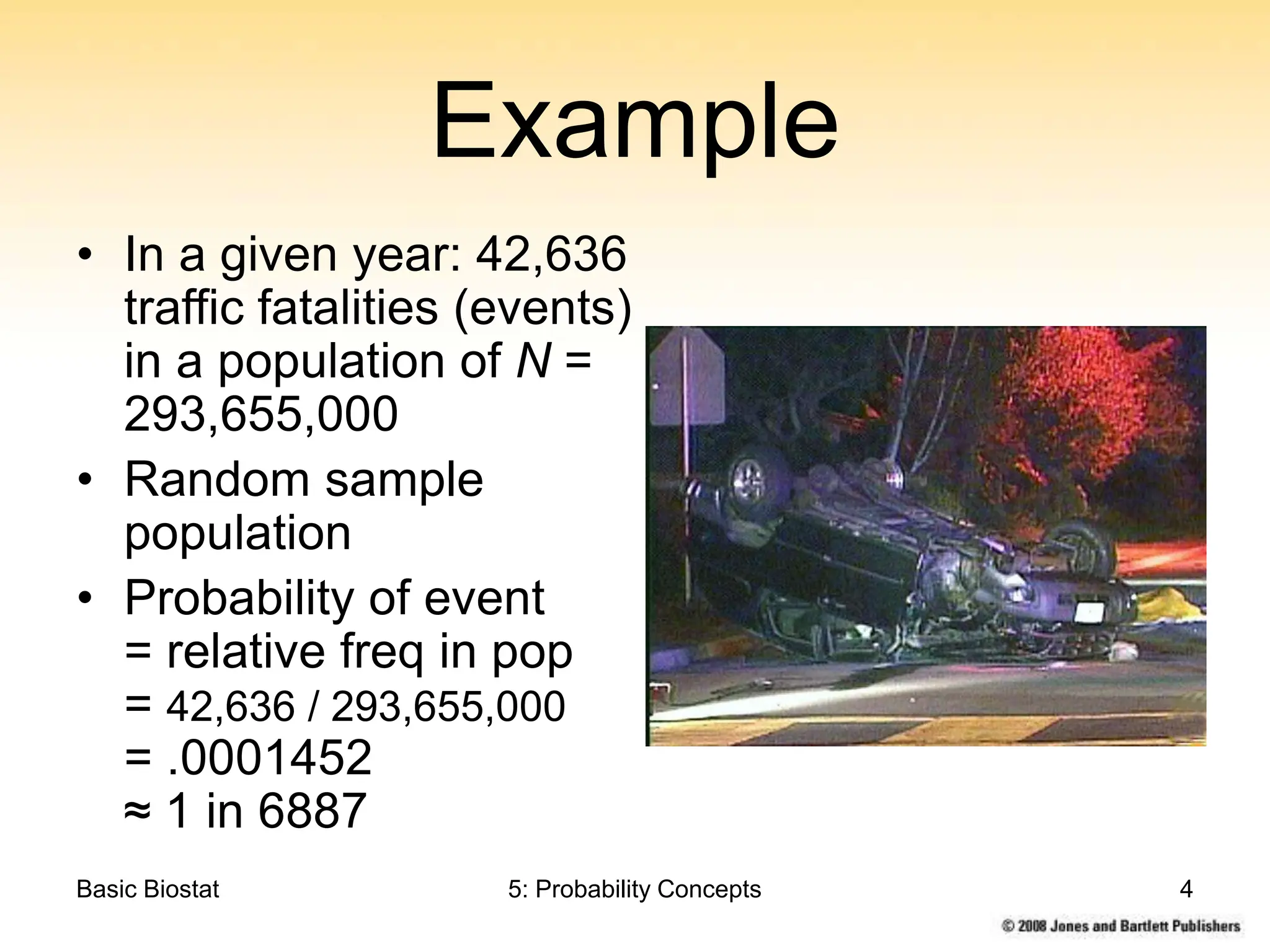
• In a given year: 42,636
traffic fatalities (events)
in a population of N =
293,655,000
• Random sample
population
• Probability of event
= relative freq in pop
= 42,636 / 293,655,000
= .0001452
≈ 1 in 6887
Basic Biostat 5: Probability Concepts 5
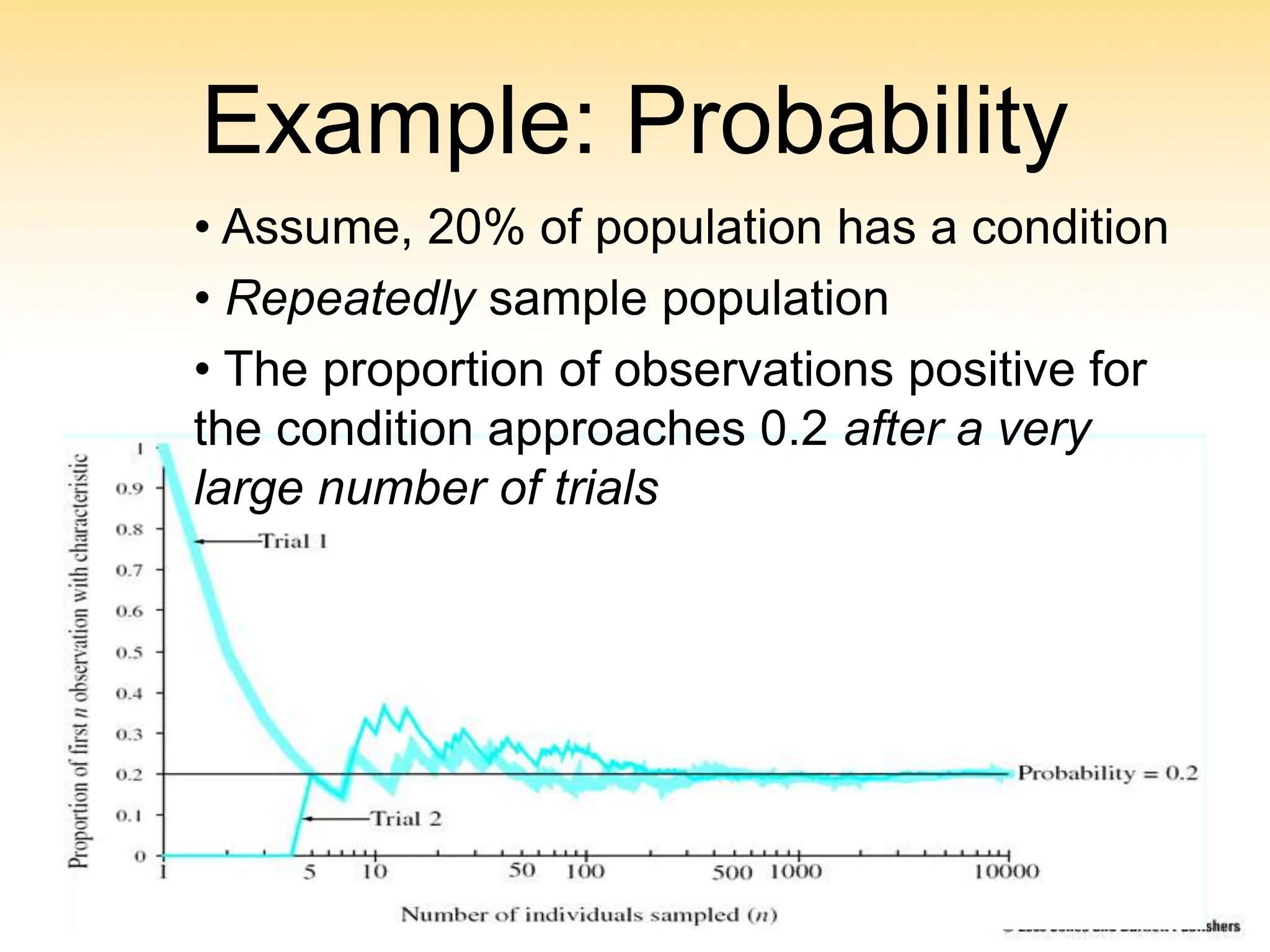
Example: Probability
• Assume, 20% of population has a condition
• Repeatedly sample population
• The proportion of observations positive for
the condition approaches 0.2 after a very
large number of trials
Basic Biostat 5: Probability Concepts 7
Random Variables
• Random variable ≡ a numerical quantity
that takes on different values depending
on chance
• Two types of random variables
– Discrete random variables (countable set of
possible outcomes)
– Continuous random variable (unbroken
chain of possible outcomes)
Basic Biostat 5: Probability Concepts 8
Example:
Discrete Random Variable
• Treat 4 patients with a
drug that is 75% effective
• Let X ≡ the [variable]
number of patients that
respond to treatment
• X is a discrete random
variable can be either 0,
1, 2, 3, or 4 (a countable
set of possible outcomes)
Basic Biostat 5: Probability Concepts 9
Example:
Discrete Random Variable
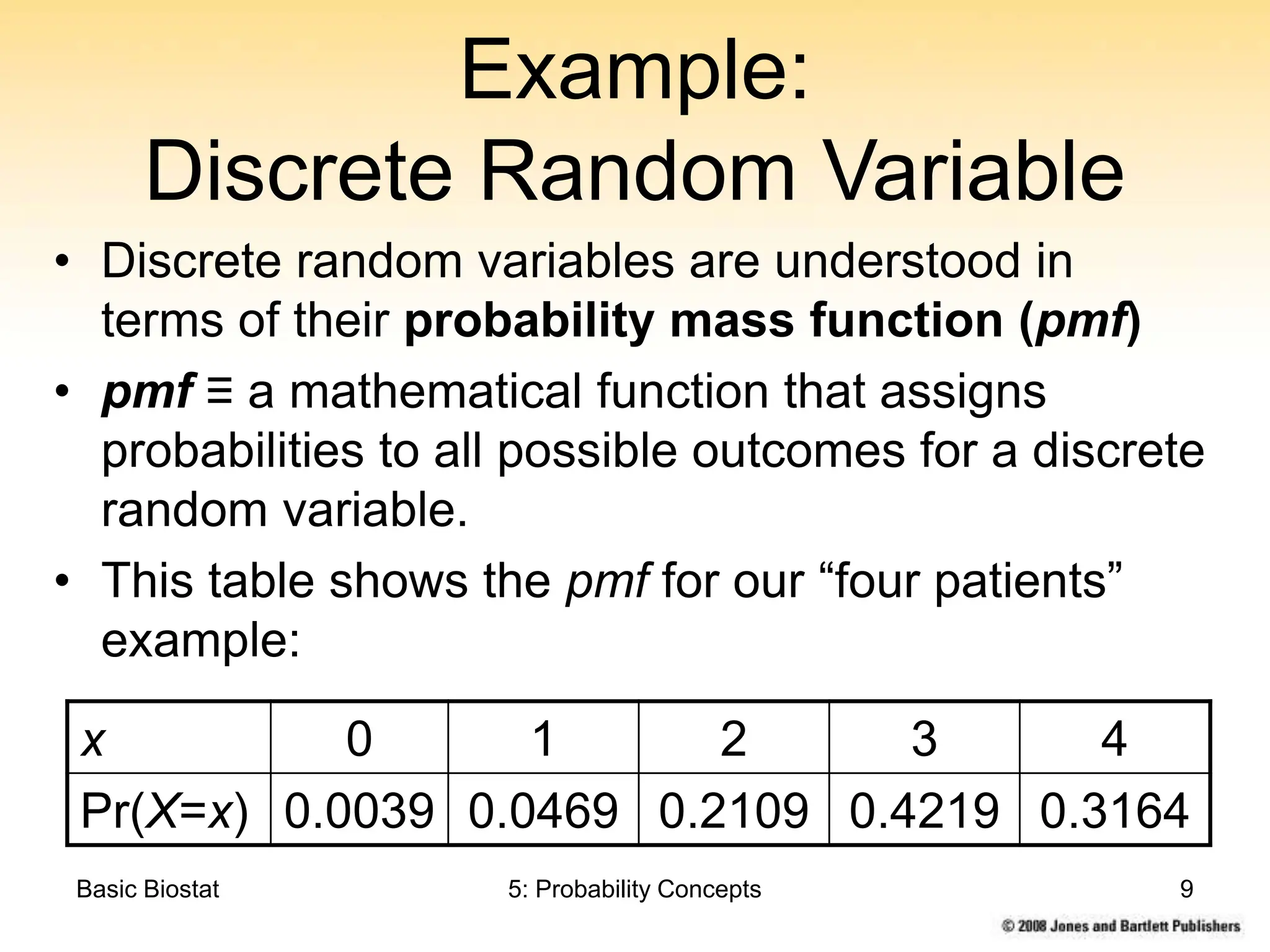
• Discrete random variables are understood in
terms of their probability mass function (pmf)
• pmf ≡ a mathematical function that assigns
probabilities to all possible outcomes for a discrete
random variable.
• This table shows the pmf for our “four patients”
example:
x 0 1 2 3 4
Pr(X=x) 0.0039 0.0469 0.2109 0.4219 0.3164
Basic Biostat 5: Probability Concepts 10
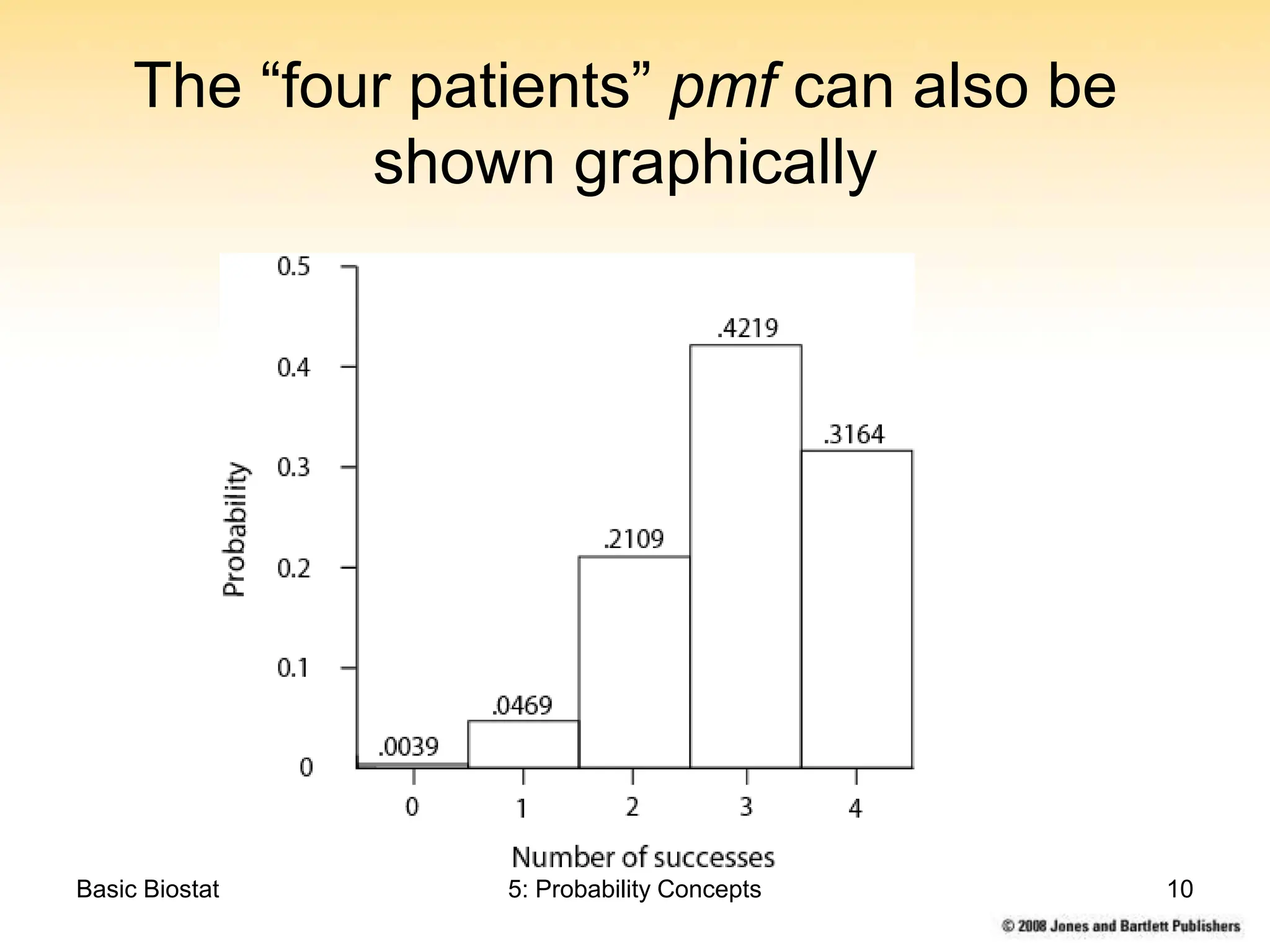
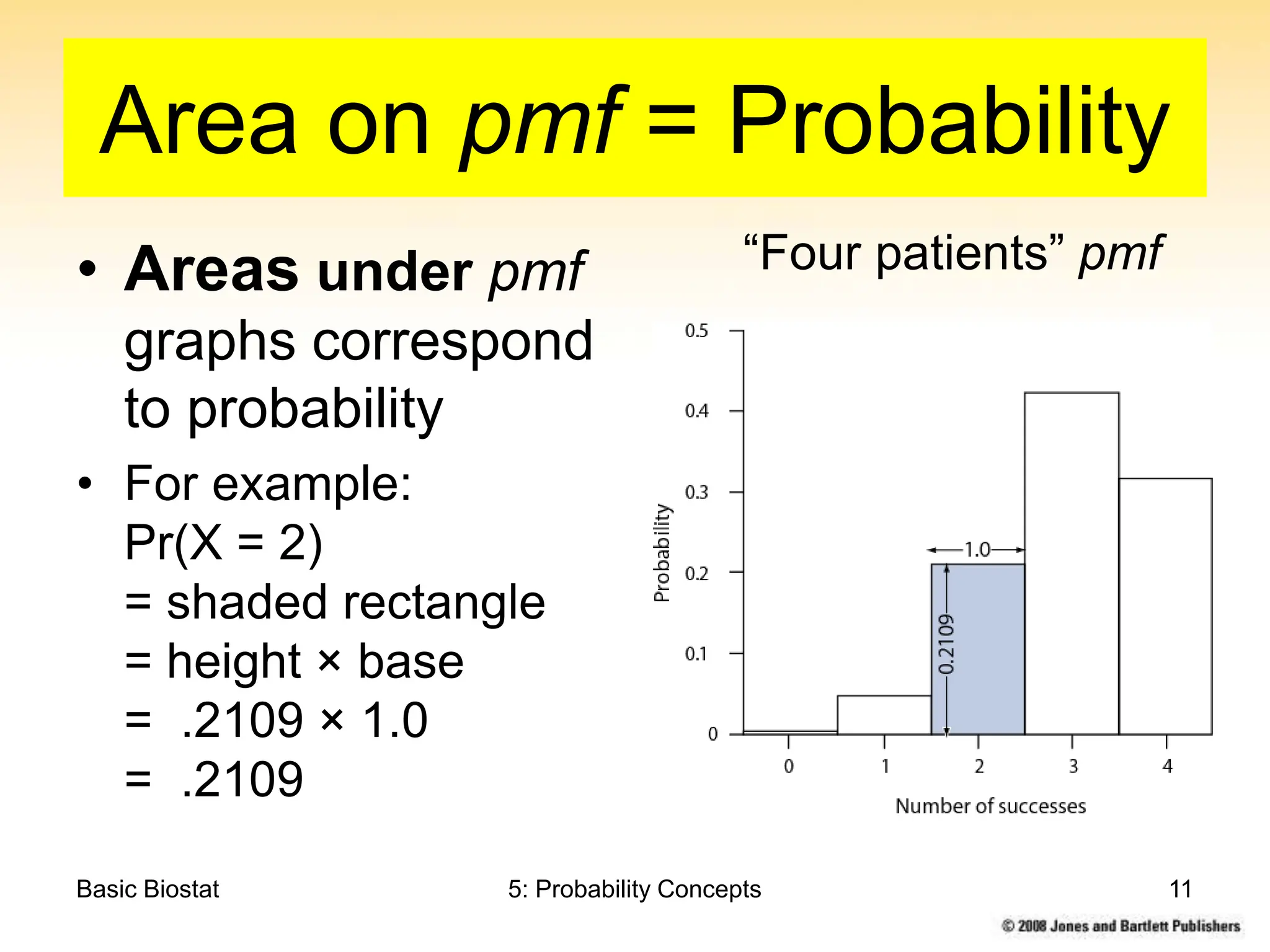
The “four patients” pmf can also be
shown graphically
Basic Biostat 5: Probability Concepts 11
Area on pmf = Probability
• Areas under pmf
graphs correspond
to probability
• For example:
Pr(X = 2)
= shaded rectangle
= height × base
= .2109 × 1.0
= .2109
“Four patients” pmf
Basic Biostat 5: Probability Concepts 12
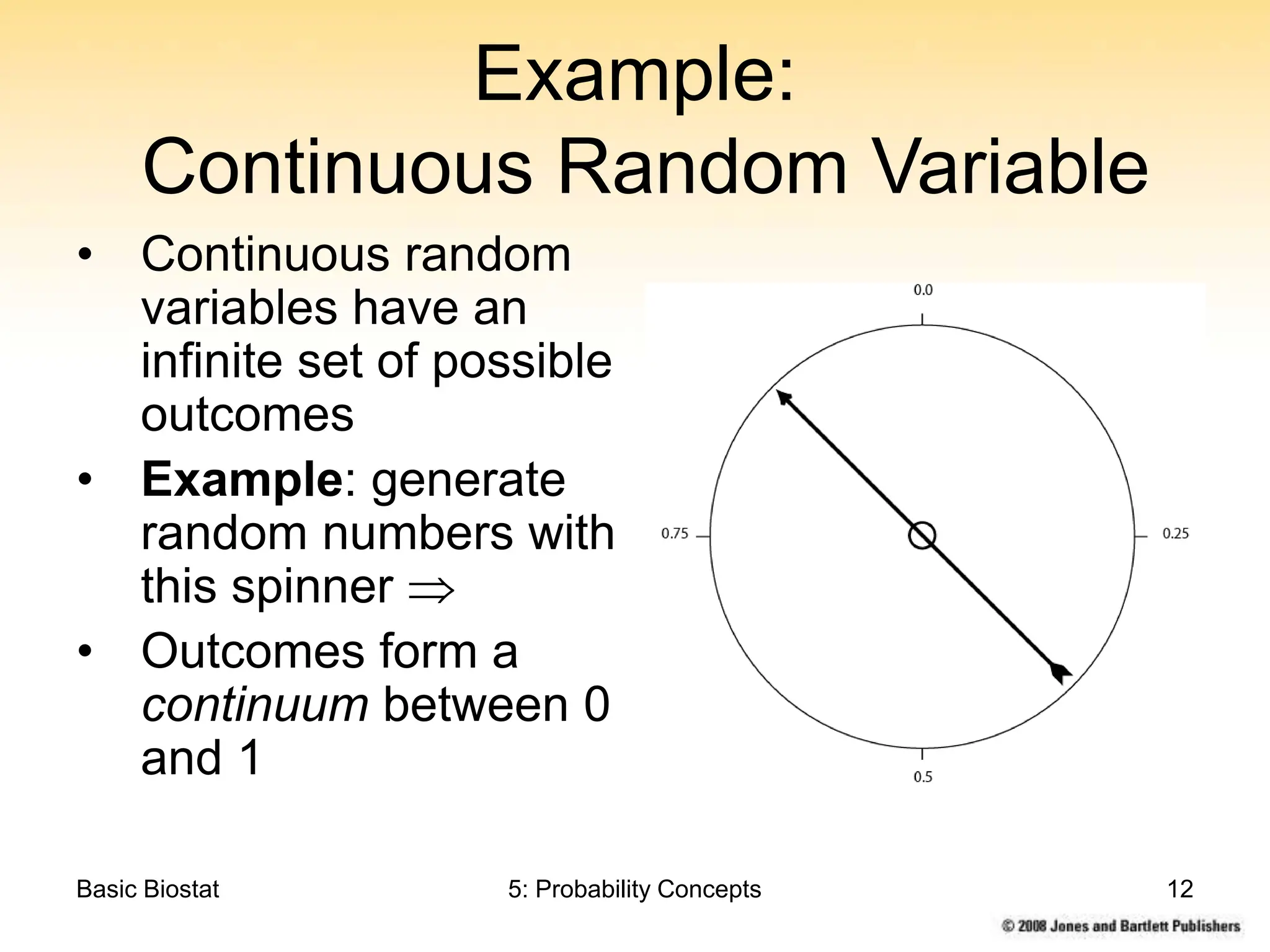
Example:
Continuous Random Variable
• Continuous random
variables have an
infinite set of possible
outcomes
• Example: generate
random numbers with
this spinner 
• Outcomes form a
continuum between 0
and 1
Basic Biostat 5: Probability Concepts 13
Example
Continuous Random Variable
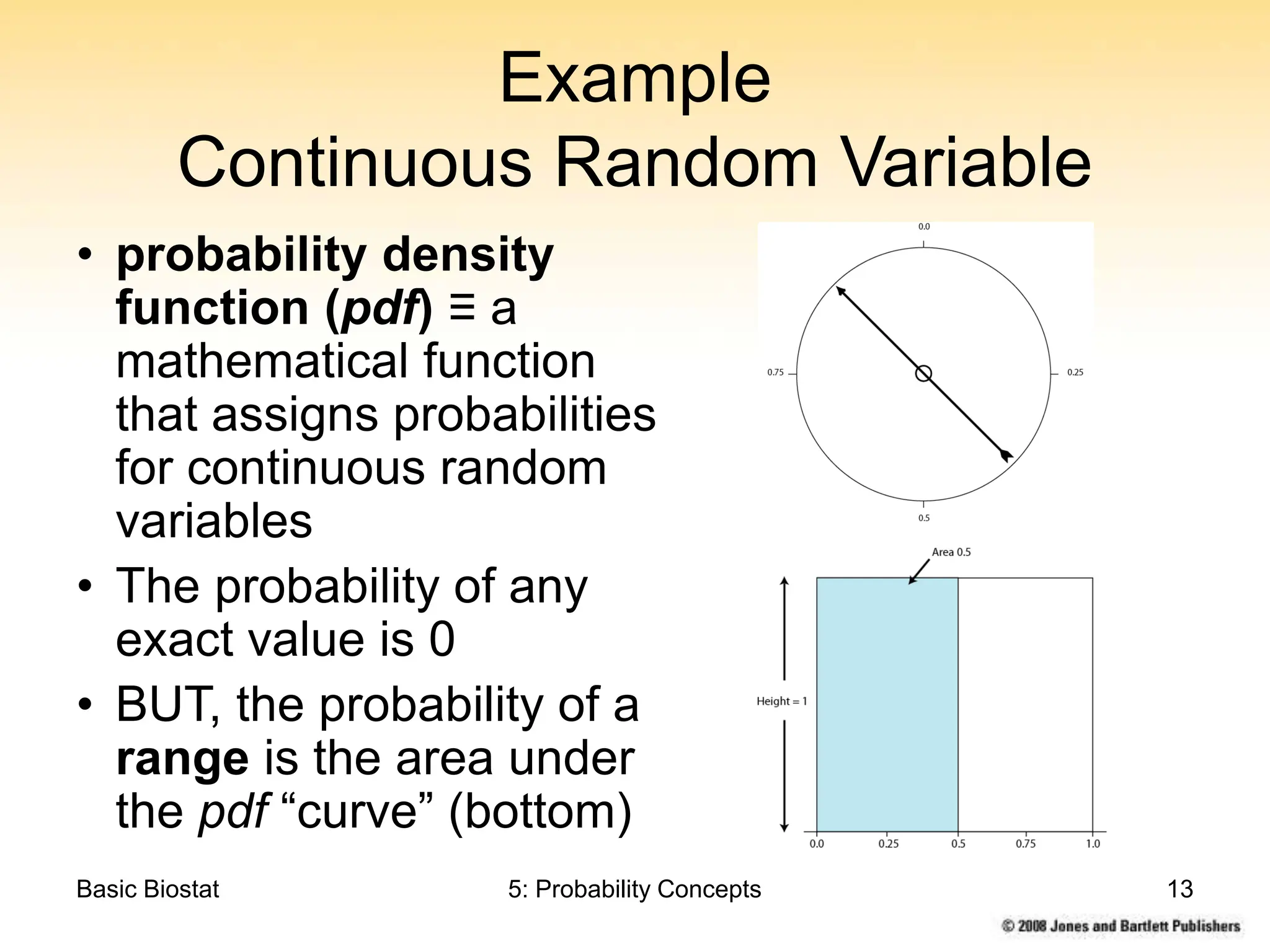
• probability density
function (pdf) ≡ a
mathematical function
that assigns probabilities
for continuous random
variables
• The probability of any
exact value is 0
• BUT, the probability of a
range is the area under
the pdf “curve” (bottom)
Basic Biostat 5: Probability Concepts 14
Example
Continuous Random Variable
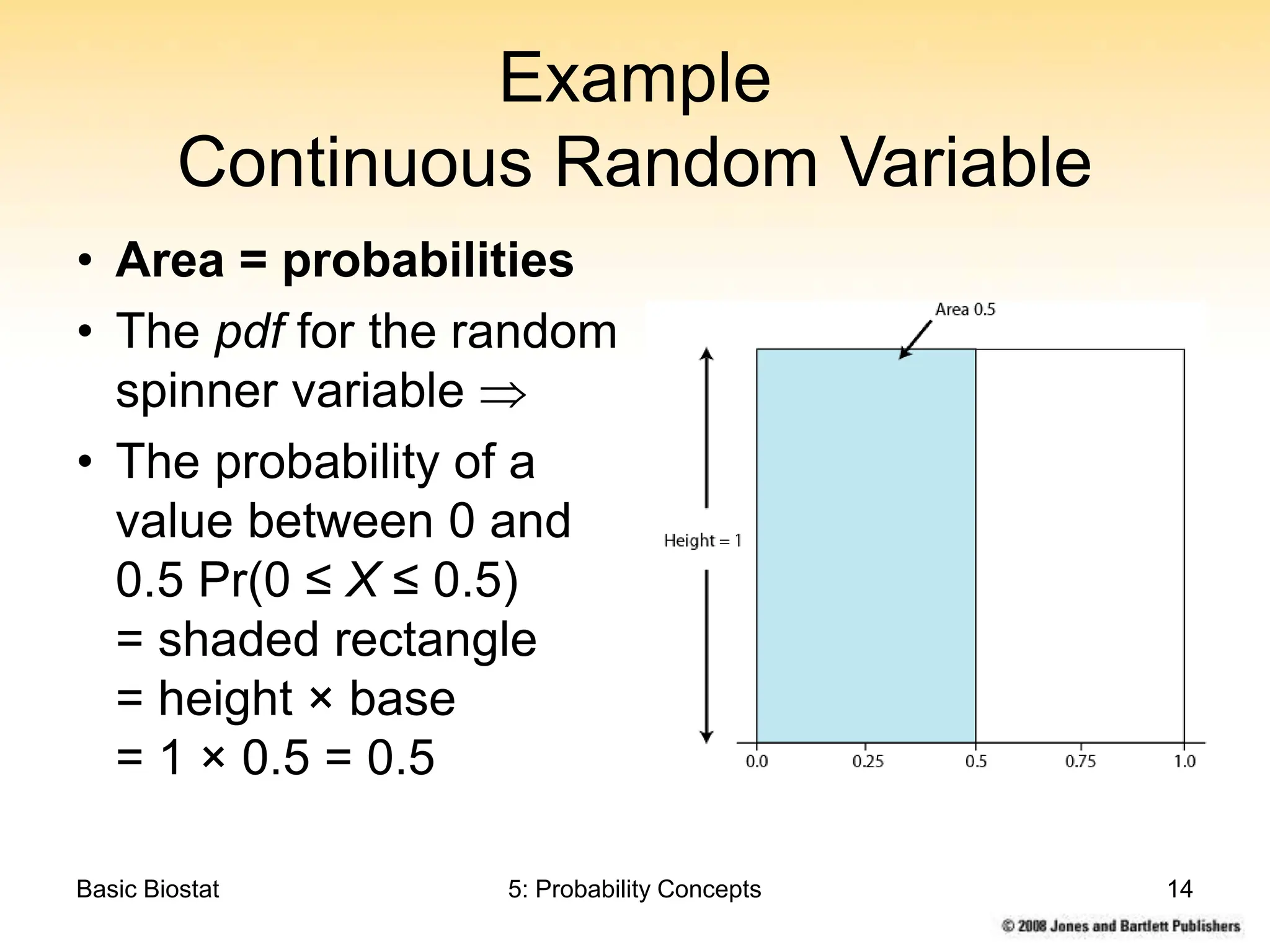
• Area = probabilities
• The pdf for the random
spinner variable 
• The probability of a
value between 0 and
0.5 Pr(0 ≤ X ≤ 0.5)
= shaded rectangle
= height × base
= 1 × 0.5 = 0.5
Basic Biostat 5: Probability Concepts 15
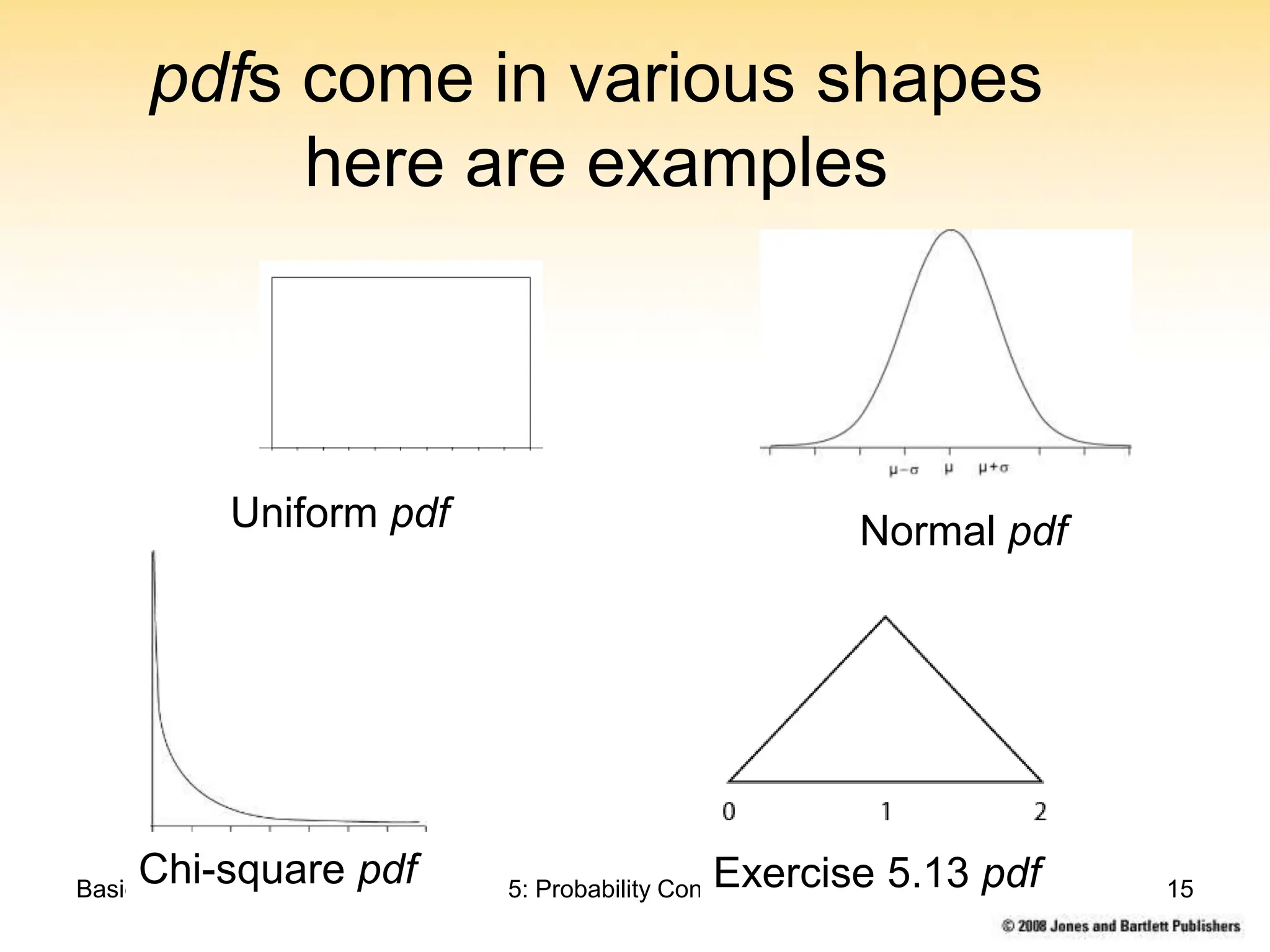
pdfs come in various shapes
here are examples
Chi-square pdf Exercise 5.13 pdf
Normal pdf
Uniform pdf
Basic Biostat 5: Probability Concepts 16
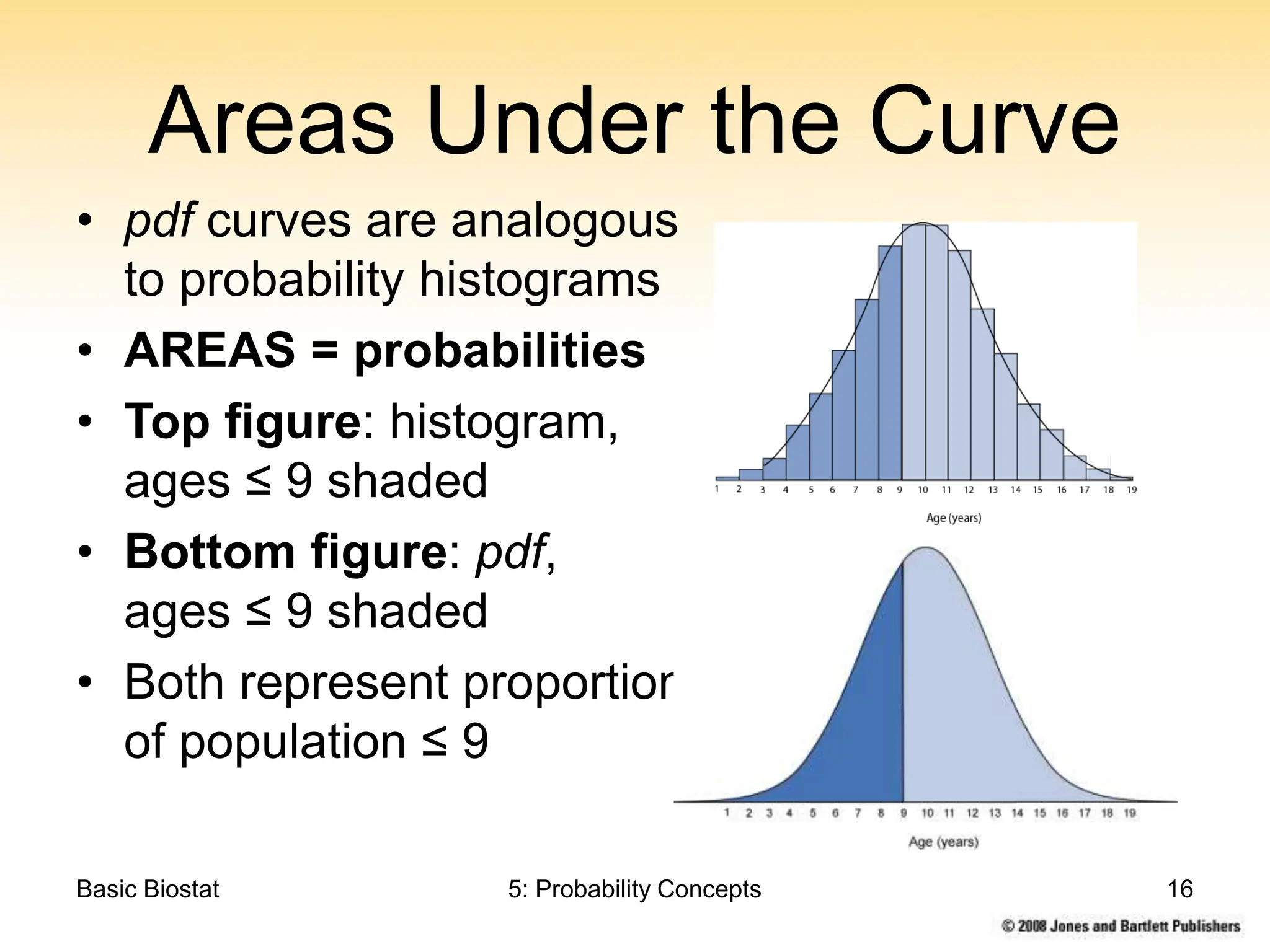
Areas Under the Curve
• pdf curves are analogous
to probability histograms
• AREAS = probabilities
• Top figure: histogram,
ages ≤ 9 shaded
• Bottom figure: pdf,
ages ≤ 9 shaded
• Both represent proportion
of population ≤ 9
Basic Biostat 5: Probability Concepts 17
Properties of Probabilities
• Property 1. Probabilities are always between 0
and 1
• Property 2. The sample space (S) for a random
variable represents all possible outcomes and
must sum to 1 exactly.
• Property 3. The probability of the complement
of an event (“NOT the event”)= 1 MINUS the
probability of the event.
• Property 4. Probabilities of disjoint events can
be added.
Basic Biostat 5: Probability Concepts 18
Properties of Probabilities
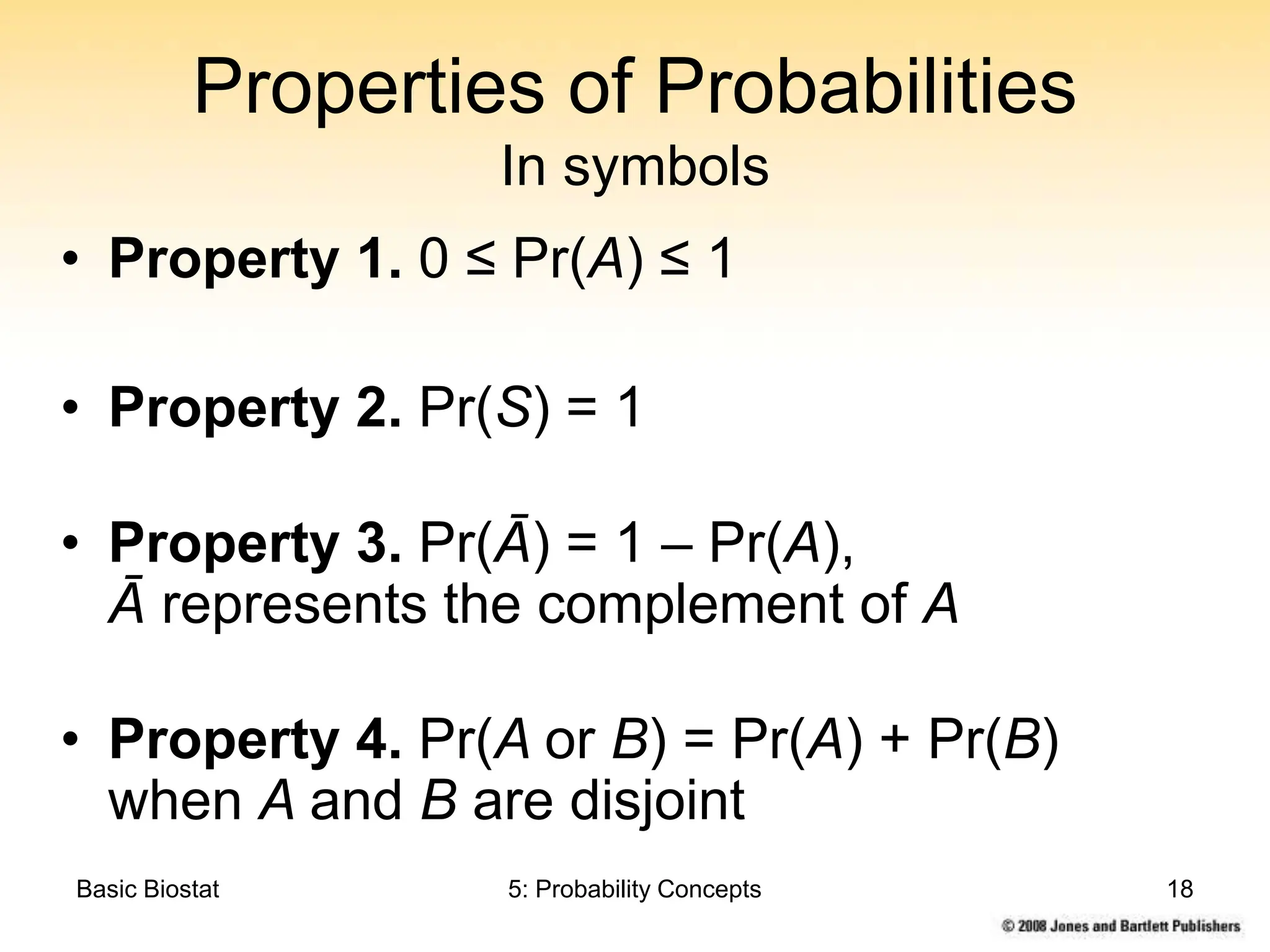
In symbols
• Property 1. 0 ≤ Pr(A) ≤ 1
• Property 2. Pr(S) = 1
• Property 3. Pr(Ā) = 1 – Pr(A),
Ā represents the complement of A
• Property 4. Pr(A or B) = Pr(A) + Pr(B)
when A and B are disjoint
Basic Biostat 5: Probability Concepts 19
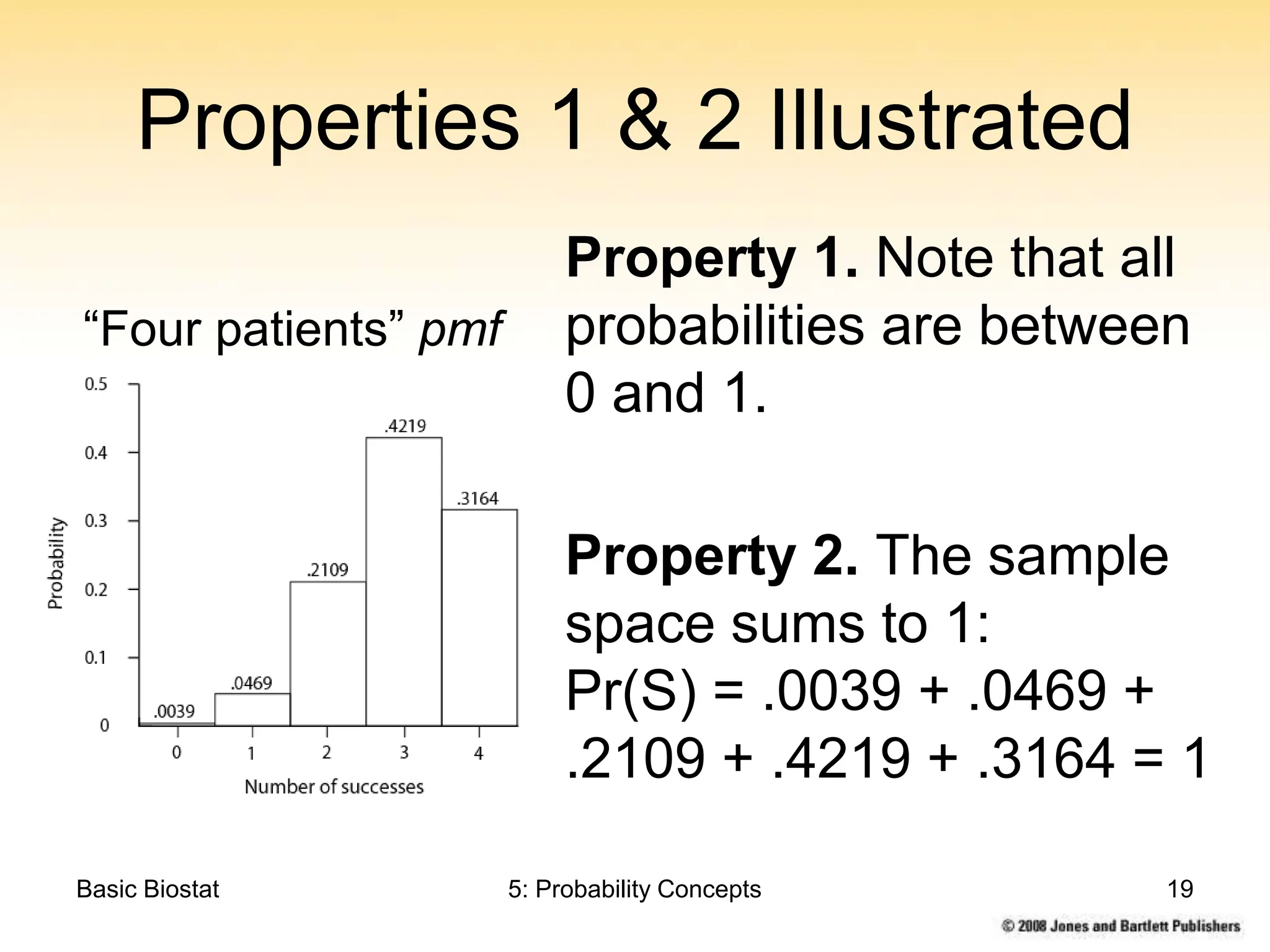
Properties 1 & 2 Illustrated
Property 1. Note that all
probabilities are between
0 and 1.
Property 2. The sample
space sums to 1:
Pr(S) = .0039 + .0469 +
.2109 + .4219 + .3164 = 1
“Four patients” pmf
Basic Biostat 5: Probability Concepts 20
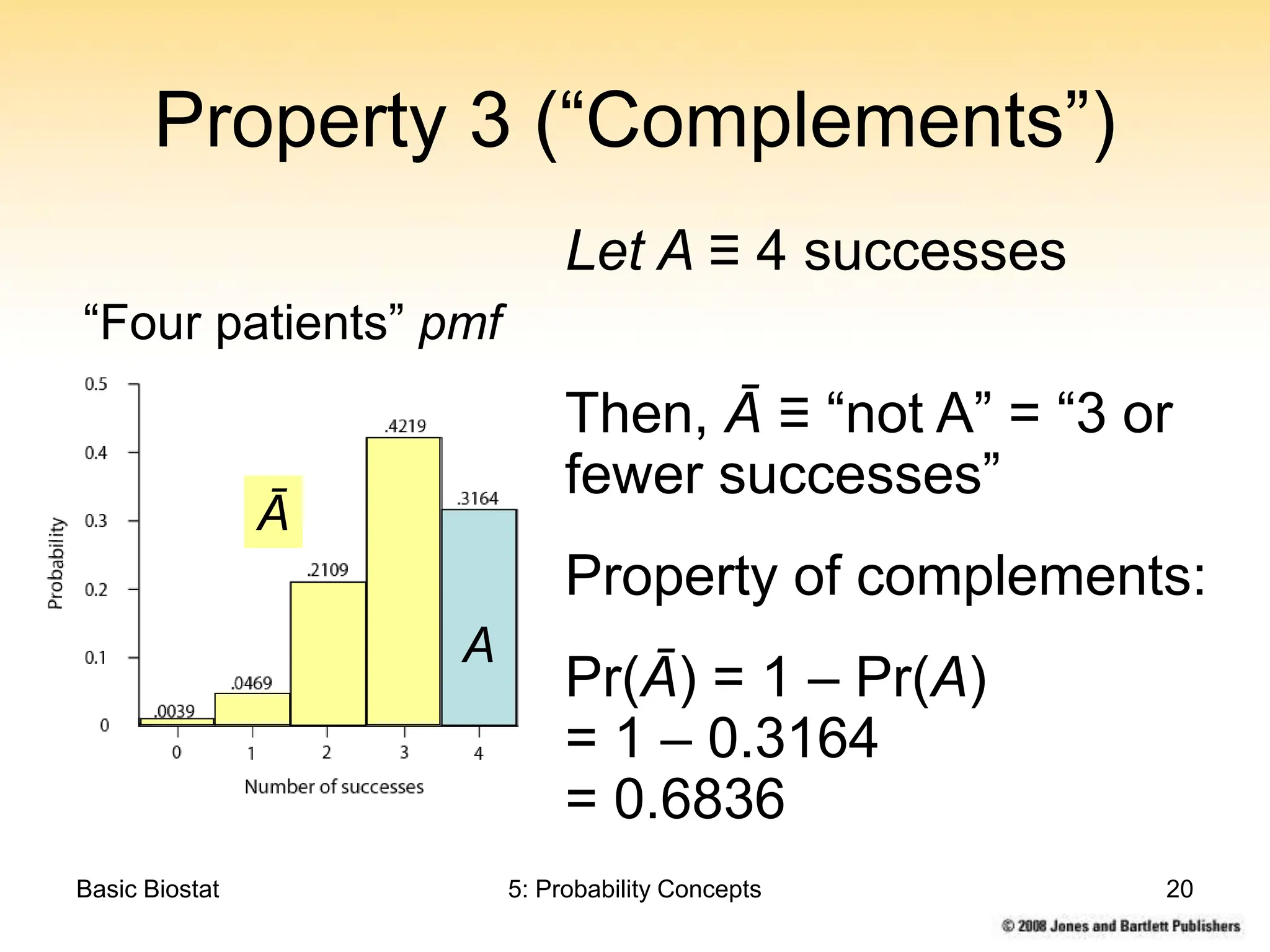
Property 3 (“Complements”)
Let A ≡ 4 successes
Then, Ā ≡ “not A” = “3 or
fewer successes”
Property of complements:
Pr(Ā) = 1 – Pr(A)
= 1 – 0.3164
= 0.6836
“Four patients” pmf
Ā
A
Basic Biostat 5: Probability Concepts 21
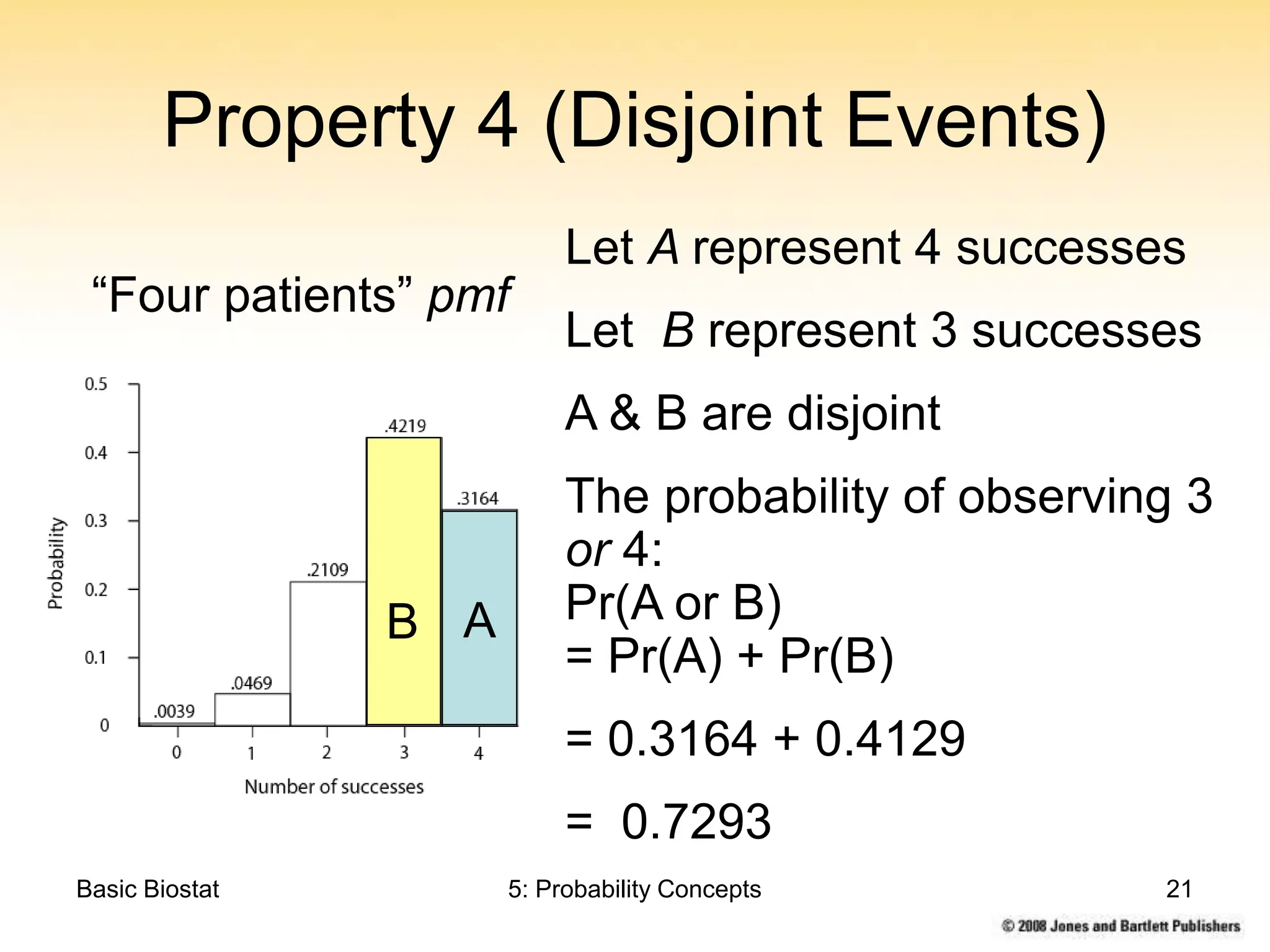
Property 4 (Disjoint Events)
Let A represent 4 successes
Let B represent 3 successes
A & B are disjoint
The probability of observing 3
or 4:
Pr(A or B)
= Pr(A) + Pr(B)
= 0.3164 + 0.4129
= 0.7293
“Four patients” pmf
B A
Basic Biostat 5: Probability Concepts 22
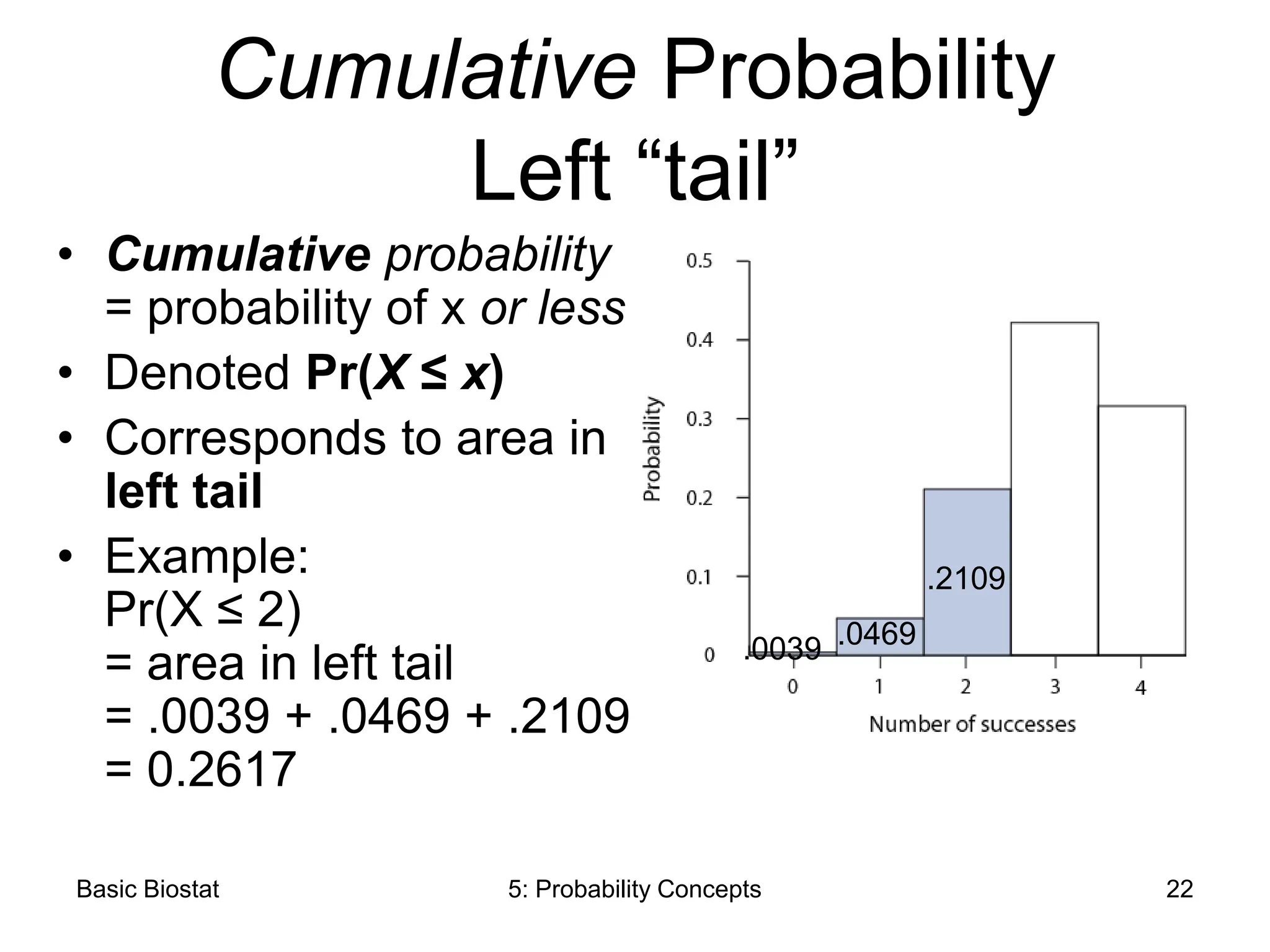
Cumulative Probability
Left “tail”
• Cumulative probability
= probability of x or less
• Denoted Pr(X ≤ x)
• Corresponds to area in
left tail
• Example:
Pr(X ≤ 2)
= area in left tail
= .0039 + .0469 + .2109
= 0.2617
.0469
.2109
.0039
Basic Biostat 5: Probability Concepts 23
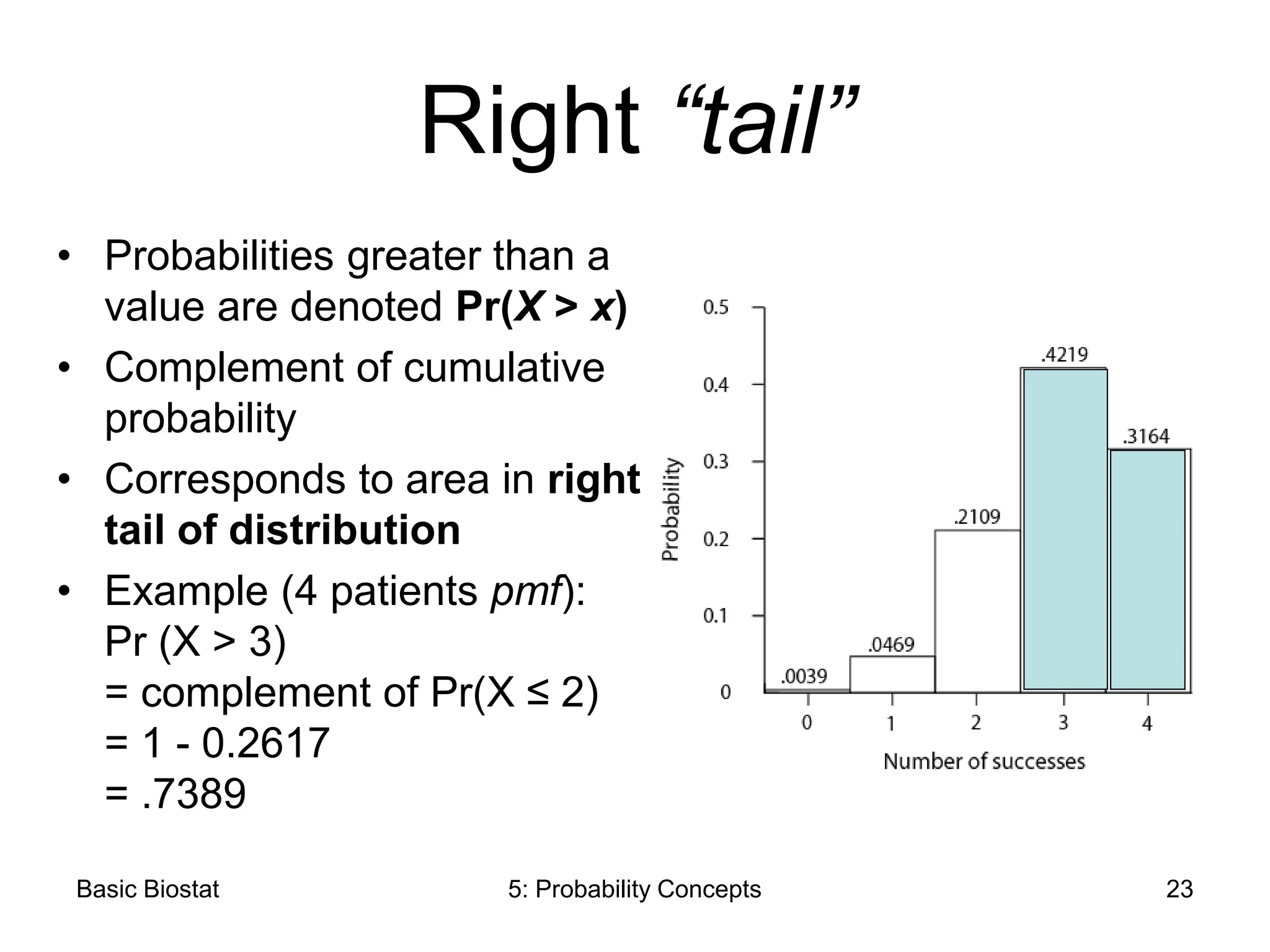
Right “tail”
• Probabilities greater than a
value are denoted Pr(X > x)
• Complement of cumulative
probability
• Corresponds to area in right
tail of distribution
• Example (4 patients pmf):
Pr (X > 3)
= complement of Pr(X ≤ 2)
= 1 - 0.2617
= .7389
.0469
.2109
.0039

Probability and statistics- Understanding

  • 1.
    Basic Biostat 5:Probability Concepts 1 Chapter 5: Probability Concepts
  • 2.
    Basic Biostat 5:Probability Concepts 2 In Chapter 5: 5.1 What is Probability? 5.2 Types of Random Variables 5.3 Discrete Random Variables 5.4 Continuous Random Variables 5.5 More Rules and Properties of Probability
  • 3.
    Basic Biostat 5:Probability Concepts 3 Definitions • Random variable ≡ a numerical quantity that takes on different values depending on chance • Population ≡ the set of all possible values for a random variable • Event ≡ an outcome or set of outcomes • Probability ≡ the relative frequency of an event in the population … alternatively… the proportion of times an event is expected to occur in the long run
  • 4.
    Basic Biostat 5:Probability Concepts 4 Example • In a given year: 42,636 traffic fatalities (events) in a population of N = 293,655,000 • Random sample population • Probability of event = relative freq in pop = 42,636 / 293,655,000 = .0001452 ≈ 1 in 6887
  • 5.
    Basic Biostat 5:Probability Concepts 5 Example: Probability • Assume, 20% of population has a condition • Repeatedly sample population • The proportion of observations positive for the condition approaches 0.2 after a very large number of trials
  • 6.
    Basic Biostat 5:Probability Concepts 7 Random Variables • Random variable ≡ a numerical quantity that takes on different values depending on chance • Two types of random variables – Discrete random variables (countable set of possible outcomes) – Continuous random variable (unbroken chain of possible outcomes)
  • 7.
    Basic Biostat 5:Probability Concepts 8 Example: Discrete Random Variable • Treat 4 patients with a drug that is 75% effective • Let X ≡ the [variable] number of patients that respond to treatment • X is a discrete random variable can be either 0, 1, 2, 3, or 4 (a countable set of possible outcomes)
  • 8.
    Basic Biostat 5:Probability Concepts 9 Example: Discrete Random Variable • Discrete random variables are understood in terms of their probability mass function (pmf) • pmf ≡ a mathematical function that assigns probabilities to all possible outcomes for a discrete random variable. • This table shows the pmf for our “four patients” example: x 0 1 2 3 4 Pr(X=x) 0.0039 0.0469 0.2109 0.4219 0.3164
  • 9.
    Basic Biostat 5:Probability Concepts 10 The “four patients” pmf can also be shown graphically
  • 10.
    Basic Biostat 5:Probability Concepts 11 Area on pmf = Probability • Areas under pmf graphs correspond to probability • For example: Pr(X = 2) = shaded rectangle = height × base = .2109 × 1.0 = .2109 “Four patients” pmf
  • 11.
    Basic Biostat 5:Probability Concepts 12 Example: Continuous Random Variable • Continuous random variables have an infinite set of possible outcomes • Example: generate random numbers with this spinner  • Outcomes form a continuum between 0 and 1
  • 12.
    Basic Biostat 5:Probability Concepts 13 Example Continuous Random Variable • probability density function (pdf) ≡ a mathematical function that assigns probabilities for continuous random variables • The probability of any exact value is 0 • BUT, the probability of a range is the area under the pdf “curve” (bottom)
  • 13.
    Basic Biostat 5:Probability Concepts 14 Example Continuous Random Variable • Area = probabilities • The pdf for the random spinner variable  • The probability of a value between 0 and 0.5 Pr(0 ≤ X ≤ 0.5) = shaded rectangle = height × base = 1 × 0.5 = 0.5
  • 14.
    Basic Biostat 5:Probability Concepts 15 pdfs come in various shapes here are examples Chi-square pdf Exercise 5.13 pdf Normal pdf Uniform pdf
  • 15.
    Basic Biostat 5:Probability Concepts 16 Areas Under the Curve • pdf curves are analogous to probability histograms • AREAS = probabilities • Top figure: histogram, ages ≤ 9 shaded • Bottom figure: pdf, ages ≤ 9 shaded • Both represent proportion of population ≤ 9
  • 16.
    Basic Biostat 5:Probability Concepts 17 Properties of Probabilities • Property 1. Probabilities are always between 0 and 1 • Property 2. The sample space (S) for a random variable represents all possible outcomes and must sum to 1 exactly. • Property 3. The probability of the complement of an event (“NOT the event”)= 1 MINUS the probability of the event. • Property 4. Probabilities of disjoint events can be added.
  • 17.
    Basic Biostat 5:Probability Concepts 18 Properties of Probabilities In symbols • Property 1. 0 ≤ Pr(A) ≤ 1 • Property 2. Pr(S) = 1 • Property 3. Pr(Ā) = 1 – Pr(A), Ā represents the complement of A • Property 4. Pr(A or B) = Pr(A) + Pr(B) when A and B are disjoint
  • 18.
    Basic Biostat 5:Probability Concepts 19 Properties 1 & 2 Illustrated Property 1. Note that all probabilities are between 0 and 1. Property 2. The sample space sums to 1: Pr(S) = .0039 + .0469 + .2109 + .4219 + .3164 = 1 “Four patients” pmf
  • 19.
    Basic Biostat 5:Probability Concepts 20 Property 3 (“Complements”) Let A ≡ 4 successes Then, Ā ≡ “not A” = “3 or fewer successes” Property of complements: Pr(Ā) = 1 – Pr(A) = 1 – 0.3164 = 0.6836 “Four patients” pmf Ā A
  • 20.
    Basic Biostat 5:Probability Concepts 21 Property 4 (Disjoint Events) Let A represent 4 successes Let B represent 3 successes A & B are disjoint The probability of observing 3 or 4: Pr(A or B) = Pr(A) + Pr(B) = 0.3164 + 0.4129 = 0.7293 “Four patients” pmf B A
  • 21.
    Basic Biostat 5:Probability Concepts 22 Cumulative Probability Left “tail” • Cumulative probability = probability of x or less • Denoted Pr(X ≤ x) • Corresponds to area in left tail • Example: Pr(X ≤ 2) = area in left tail = .0039 + .0469 + .2109 = 0.2617 .0469 .2109 .0039
  • 22.
    Basic Biostat 5:Probability Concepts 23 Right “tail” • Probabilities greater than a value are denoted Pr(X > x) • Complement of cumulative probability • Corresponds to area in right tail of distribution • Example (4 patients pmf): Pr (X > 3) = complement of Pr(X ≤ 2) = 1 - 0.2617 = .7389 .0469 .2109 .0039

Editor's Notes