Introduction to
Artificial Intelligence
Uncertainty
Probability
ω
Possible Worlds
P(ω)
0 ≤ P(ω) ≤ 1
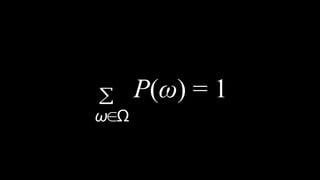
∑ P(ω) = 1
ω∈Ω
1 1 1 1 1 1
6 6 6 6 6 6
P( ) =
1
6
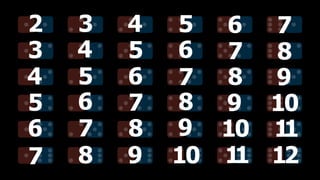
2 3 4 5
3 4 5 6
4 5 6 7
5 6 7 8
6 7 8 9
7 8 9 10
6
7
8
9
10
1
1
7
8
9
10
1
1
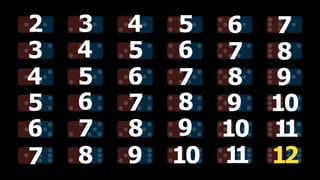
12
2 3 4 5
3 4 5 6
4 5 6 7
5 6 7 8
6 7 8 9
7 8 9 10
6
7
8
9
10
1
1
7
8
9
10
1
1
12
2 3 4 5
3 4 5 6
4 5 6 7
5 6 7 8
6 7 8 9
7 8 9 10
6
7
8
9
10
1
1
7
8
9
10
1
1
12
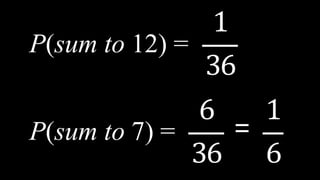
P(sum to 7) =
P(sum to 12) =
1
36
6
=
1
36 6
unconditional probability
degree of belief in a proposition
in the absence of any other evidence
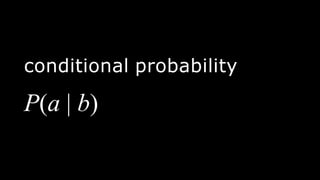
conditional probability
degree of belief in a proposition
given some evidence that has already
been revealed
conditional probability
P(a | b)
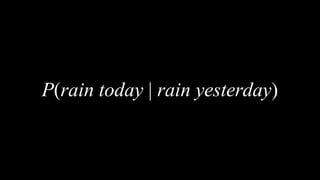
P(rain today | rain yesterday)
P(route change | traffic conditions)
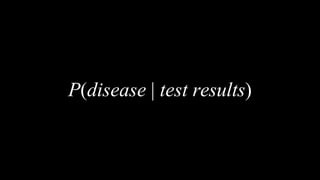
P(disease | test results)
P(a|b) =
P(a ∧b)
P(b)
P(sum 12 | )
6
P( ) =
1
1
P( ) =
6
36
P(sum 12) =
1
6
P(sum 12 | )=
1
P(a|b) =
P(a ∧b)
P(b)
P(a ∧b) = P(b)P(a|b)
P(a ∧b) = P(a)P(b|a)
random variable
a variable in probability theory with a
domain of possible values it can take on
random variable
Roll
{1, 2, 3, 4, 5, 6}
random variable
Weather
{sun, cloud, rain, wind, snow}
random variable
Traffic
{none, light, heavy}
random variable
Flight
{on time, delayed, cancelled}
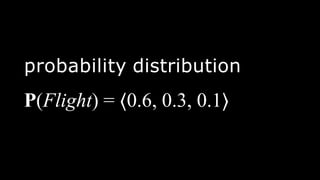
probability distribution
P(Flight = on time) = 0.6
P(Flight = delayed) = 0.3
P(Flight = cancelled) = 0.1
probability distribution
P(Flight) = ⟨0.6, 0.3, 0.1⟩
independence
the knowledge that one event occurs does
not affect the probability of the other event
independence
P(a ∧b) = P(a)P(b|a)
independence
P(a ∧b) = P(a)P(b)
independence
P( ) = P( )P( )
=
1
⋅
1
=
1
6 6 36
independence
P( ) ≠ P( )P( )
=
1
⋅
1
=
1
6 6 36
independence
P( ) ≠ P( )P( | )
6
=
1
⋅0 = 0
Bayes' Rule
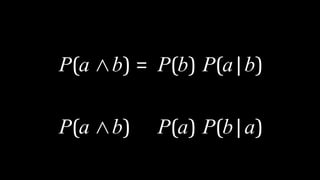
P(a ∧b) = P(b) P(a|b)
P(a ∧b) P(a) P(b|a)
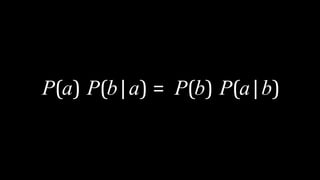
P(a) P(b|a) = P(b) P(a|b)
P(b|a) =
P(b) P(a|b)
P(a)
Bayes' Rule
P(b|a) =
P(a|b) P(b)
P(a)
Bayes' Rule
PM
AM
Given clouds in the morning,
what's the probability of rain in the afternoon?
• 80% of rainy afternoons start with cloudy
mornings.
• 40% of days have cloudy mornings.
• 10% of days have rainy afternoons.
P(rain|clouds) =
P(clouds|rain)P(rain)
P(clouds)
=
(.8)(.1)
.4
= 0.2
Knowing
P(cloudy morning | rainy afternoon)
we can calculate
P(rainy afternoon | cloudy morning)
Knowing
P(visible effect | unknown cause)

we can calculate
P(unknown cause | visible effect)
Knowing
P(medical test result | disease)
we can calculate
P(disease | medical test result)
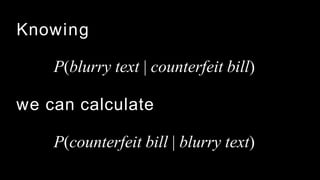
Knowing
P(blurry text | counterfeit bill)
we can calculate
P(counterfeit bill | blurry text)
Joint Probability
C = cloud C = ¬cloud
0.4 0.6
AM
R = rain R = ¬rain
C = cloud 0.08 0.32
C = ¬cloud 0.02 0.58
PM
R = rain R = ¬rain
0.1 0.9
PM
AM
P(C | rain)
R = rain R = ¬rain
C = cloud 0.08 0.32
C = ¬cloud 0.02 0.58
P(C | rain) =
P(C, rain)
P(rain)
= αP(C, rain)
= α⟨0.08, 0.02⟩ = ⟨0.8, 0.2⟩
Probability Rules
P(¬a) = 1 −P(a)
Negation
P(a ∨b) = P(a) + P(b) −P(a ∧b)
Inclusion-Exclusion
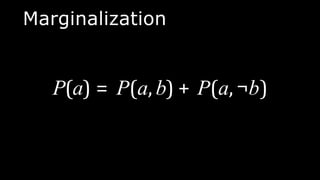
P(a) = P(a, b) + P(a, ¬b)
Marginalization
P(X = xi) = ∑ P(X = xi, Y = yj)
j
Marginalization
Marginalization
R = rain R = ¬rain
C = cloud 0.08 0.32
C = ¬cloud 0.02 0.58
P(C = cloud)
= P(C = cloud, R = rain) + P(C = cloud, R = ¬rain)
= 0.08 + 0.32
= 0.40
P(a) = P(a|b)P(b) + P(a|¬b)P(¬b)
Conditioning
P(X = xi) = ∑ P(X = xi |Y = yj)P(Y = yj)
j
Conditioning
Bayesian Networks
Bayesian network
data structure that represents the
dependencies among random variables
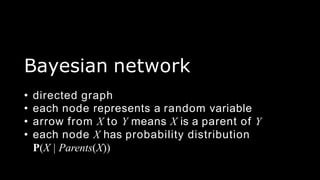
Bayesian network
• directed graph
• each node represents a random variable
• arrow from X to Y means X is a parent of Y
• each node X has probability distribution
P(X | Parents(X))
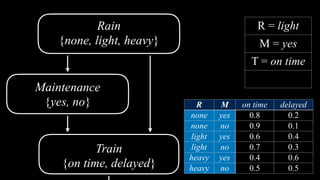
Rain
{none, light, heavy}
Maintenance
{yes, no}
Train
{on time, delayed}
Appointment
{attend, miss}
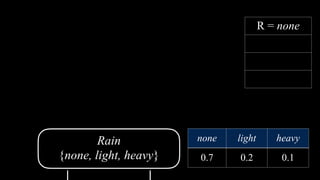
Rain
{none, light, heavy}
none light heavy
0.7 0.2 0.1
Rain
{none, light, heavy}
Maintenance
{yes, no}
R yes no
none 0.4 0.6
light 0.2 0.8
heavy 0.1 0.9
Rain
{none, light, heavy}
Maintenance
{yes, no}
Train
{on time, delayed}
R M on time delayed
none yes 0.8 0.2
none no 0.9 0.1
light yes 0.6 0.4
light no 0.7 0.3
heavy yes 0.4 0.6
heavy no 0.5 0.5
Maintenance
{yes, no}
Train
{on time, delayed}
Appointment
{attend, miss}
T attend miss
on time 0.9 0.1
delayed 0.6 0.4
Rain
{none, light, heavy}
Maintenance
{yes, no}
Train
{on time, delayed}
Appointment
{attend, miss}
Appointment
{attend, miss}
Maintenance
{yes, no}
Train
{on time, delayed}
Rain
{none, light, heavy}
P(light)
P(light)
Computing Joint Probabilities
Appointment
{attend, miss}
Maintenance
{yes, no}
Train
{on time, delayed}
Rain
{none, light, heavy}
P(light, no)
P(light) P(no | light)
Computing Joint Probabilities
Appointment
{attend, miss}
Maintenance
{yes, no}
Train
{on time, delayed}
Rain
{none, light, heavy}
P(light, no, delayed)
P(light) P(no | light) P(delayed | light, no)
Computing Joint Probabilities
Appointment
{attend, miss}
Maintenance
{yes, no}
Train
{on time, delayed}
Rain
{none, light, heavy}
P(light, no, delayed, miss)
P(light) P(no | light) P(delayed | light, no) P(miss | delayed)
Computing Joint Probabilities
Inference
Inference
• Query X: variable for which to compute distribution
• Evidence variables E: observed variables for event e
• Hidden variables Y: non-evidence, non-query variable.
• Goal: Calculate P(X | e)
Appointment
{attend, miss}
Train
{on time, delayed}
Maintenance
{yes, no}
Rain
{none, light, heavy}
P(Appointment | light, no)
= α P(Appointment, light, no)
= α [P(Appointment, light, no, on time)
+ P(Appointment, light, no, delayed)]
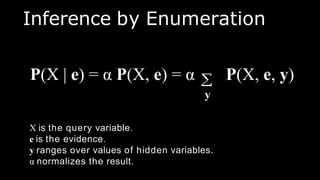
Inference by Enumeration
P(X | e) = α P(X, e) = α ∑ P(X, e, y)
y
X is the query variable.
e is the evidence.
y ranges over values of hidden variables.
α normalizes the result.
Approximate Inference
Sampling
Rain
{none, light, heavy}
Maintenance
{yes, no}
Train
{on time, delayed}
Appointment
{attend, miss}
Rain
{none, light, heavy}
none light heavy
0.7 0.2 0.1
R = none
Rain
{none, light, heavy}
Maintenance
{yes, no}
R yes no
none 0.4 0.6
light 0.2 0.8
heavy 0.1 0.9
R = none
M = yes
Rain
{none, light, heavy}
Maintenance
{yes, no}
Train
{on time, delayed}
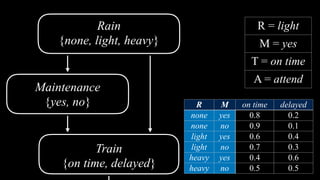
R M on time delayed
none yes 0.8 0.2
none no 0.9 0.1
light yes 0.6 0.4
light no 0.7 0.3
heavy yes 0.4 0.6
heavy no 0.5 0.5
R = none
M = yes
T = on time
Maintenance
{yes, no}
Train
{on time, delayed}
Appointment
{attend, miss}
T attend miss
on time 0.9 0.1
delayed 0.6 0.4
R = none
M = yes
T = on time
A = attend
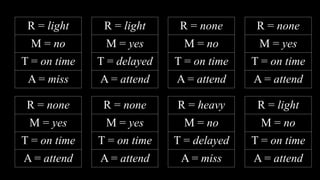
R = none
M = yes
T = on time
A = attend
R = none
M = yes
T = on time
A = attend
R = none
M = no
T = on time
A = attend
R = light
M = yes
T = delayed
A = attend
R = light
M = no
T = on time
A = miss
R = none
M = yes
T = on time
A = attend
R = none
M = yes
T = on time
A = attend
R = heavy
M = no
T = delayed
A = miss
R = light
M = no
T = on time
A = attend
P(Train = on time) ?
R = none
M = yes
T = on time
A = attend
R = none
M = no
T = on time
A = attend
R = light
M = yes
T = delayed
A = attend
R = light
M = no
T = on time
A = miss
R = none
M = yes
T = on time
A = attend
R = none
M = yes
T = on time
A = attend
R = heavy
M = no
T = delayed
A = miss
R = light
M = no
T = on time
A = attend
R = none
M = yes
T = on time
A = attend
R = none
M = no
T = on time
A = attend
R = light
M = yes
T = delayed
A = attend
R = light
M = no
T = on time
A = miss
R = none
M = yes
T = on time
A = attend
R = none
M = yes
T = on time
A = attend
R = heavy
M = no
T = delayed
A = miss
R = light
M = no
T = on time
A = attend
P(Rain = light | Train = on time) ?
R = none
M = yes
T = on time
A = attend
R = none
M = no
T = on time
A = attend
R = light
M = yes
T = delayed
A = attend
R = light
M = no
T = on time
A = miss
R = none
M = yes
T = on time
A = attend
R = none
M = yes
T = on time
A = attend
R = heavy
M = no
T = delayed
A = miss
R = light
M = no
T = on time
A = attend
R = none
M = yes
T = on time
A = attend
R = none
M = no
T = on time
A = attend
R = light
M = yes
T = delayed
A = attend
R = light
M = no
T = on time
A = miss
R = none
M = yes
T = on time
A = attend
R = none
M = yes
T = on time
A = attend
R = heavy
M = no
T = delayed
A = miss
R = light
M = no
T = on time
A = attend
R = none
M = yes
T = on time
A = attend
R = none
M = no
T = on time
A = attend
R = light
M = yes
T = delayed
A = attend
R = light
M = no
T = on time
A = miss
R = none
M = yes
T = on time
A = attend
R = none
M = yes
T = on time
A = attend
R = heavy
M = no
T = delayed
A = miss
R = light
M = no
T = on time
A = attend
Rejection Sampling
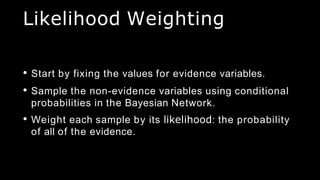
Likelihood Weighting
• Start by fixing the values for evidence variables.
• Sample the non-evidence variables using conditional
probabilities in the Bayesian Network.
• Weight each sample by its likelihood: the probability
of all of the evidence.
P(Rain = light | Train = on time) ?
Rain
{none, light, heavy}
Maintenance
{yes, no}
Train
{on time, delayed}
Appointment
{attend, miss}
Rain
{none, light, heavy}
none light heavy
0.7 0.2 0.1
R = light
T = on time
Rain
{none, light, heavy}
Maintenance
{yes, no}
R yes no
none 0.4 0.6
light 0.2 0.8
heavy 0.1 0.9
R = light
M = yes
T = on time
Rain
{none, light, heavy}
Maintenance
{yes, no}
Train
{on time, delayed}
R M on time delayed
none yes 0.8 0.2
none no 0.9 0.1
light yes 0.6 0.4
light no 0.7 0.3
heavy yes 0.4 0.6
heavy no 0.5 0.5
R = light
M = yes
T = on time
Maintenance
{yes, no}
Train
{on time, delayed}
Appointment
{attend, miss}
T attend miss
on time 0.9 0.1
delayed 0.6 0.4
R = light
M = yes
T = on time
A = attend
Rain
{none, light, heavy}
Maintenance
{yes, no}
Train
{on time, delayed}
R M on time delayed
none yes 0.8 0.2
none no 0.9 0.1
light yes 0.6 0.4
light no 0.7 0.3
heavy yes 0.4 0.6
heavy no 0.5 0.5
R = light
M = yes
T = on time
A = attend
Rain
{none, light, heavy}
Maintenance
{yes, no}
Train
{on time, delayed}
R M on time delayed
none yes 0.8 0.2
none no 0.9 0.1
light yes 0.6 0.4
light no 0.7 0.3
heavy yes 0.4 0.6
heavy no 0.5 0.5
R = light
M = yes
T = on time
A = attend
Uncertainty over Time
Xt: Weather at time t
Markov assumption
the assumption that the current state
depends on only a finite fixed number of
previous states
Markov Chain
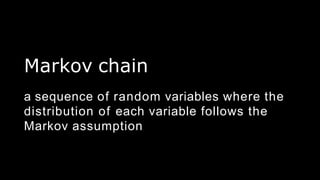
Markov chain
a sequence of random variables where the
distribution of each variable follows the
Markov assumption
0.8 0.2
0.3 0.7
Today (Xt)
Tomorrow (Xt+1)
Transition Model
X0 X1 X2 X3 X4
Sensor Models
Hidden State Observation
robot's position robot's sensor data
words spoken audio waveforms
user engagement website or app analytics
weather umbrella
Hidden Markov Models
Hidden Markov Model
a Markov model for a system with hidden
states that generate some observed event
0.2 0.8
0.9 0.1
State (Xt)
Observation (Et)
Sensor Model
sensor Markov assumption
the assumption that the evidence variable
depends only the corresponding state
X0 X1 X2 X3 X4
E0 E1 E2 E3 E4
Task Definition
filtering
given observations from start until now,
calculate distribution for current state
prediction
given observations from start until now,
calculate distribution for a future state
smoothing
given observations from start until now,
calculate distribution for past state
most likely
explanation
given observations from start until now,
calculate most likely sequence of states
Uncertainty
Introduction to
Artificial Intelligence
with Python

PROBABILISTIC REASONING AI.pptx