PRISMOID: a comprehensive 3D structure
database for post-translational modifications
and mutations with functional impact
Subash Chandra Pakhrin
PhD Student
Wichita State University
Wichita, Kansas
7/30/2020
Introduction
• PRISMOID is freely available web-based resource
• It provides 3D structure information of a wide range of protein PTM
sites.
• It has 17,145 PTM sites of 3919 protein
• 37 different types of PTMs
• Annotates the disease mutation affecting the PTM sites
• Protein secondary structure properties, solvent accessibility area
features, protein disorder region, and protein domain context, etc.,
were also collected and annotated in PRISMOID.
Sequence Databases
• Glycosylation, plays a crucial role in protein folding, trafficking,
subcellular localization and degradation
• PhosphoSitePlus
• SysPTM
• PLMD
• Phospho.ELM
• UniProt
• protein sequences, functions
Structural Databases
• PTM-SD
• protein structure database focused on PTMs, which contains 11,677 entries
• PTM-SD only focuses on the protein structure information of PTMs
• information such as disorder information associated with the PTM site and
PTM-associated disease mutations is not provided.
• The interactive visualization of protein 3D structures is not provided.
• The latest version of dbPTM provides the related Protein Data Bank
(PDB) ID of PTM proteins, but the corresponding positions of PTM
sites position on PDB structures are not available.
PTM prediction through PDB structures
• Few PTM prediction tools based on PDB structures
• This is mainly because the process of mapping from protein
sequences to protein structures is time-consuming and complex.
• Researcher extracted experimentally validated PTMs information
from several available protein sequence-based databases and
subsequently mapped the PTM sites to the corresponding 3D
structures
• Experimentally validated PTM sites are kept at PRISMOID
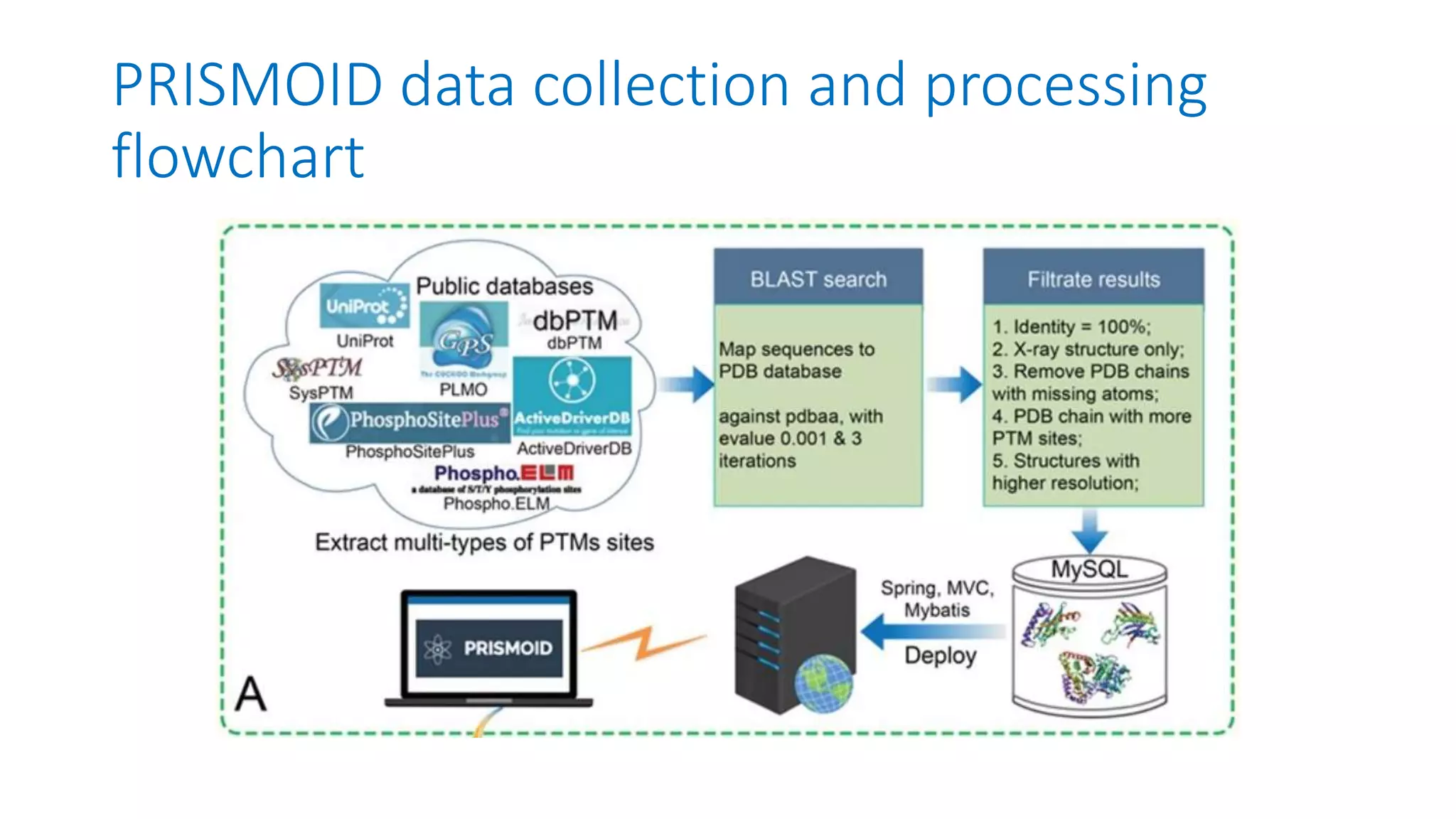
PRISMOID data collection and processing
flowchart
PTM-associated mutation collection
• Single amino acid variants (SAVs) will influence human disease.
• A potential effect of SAVs on protein function is the disruption of
PTMs
• Studies have shown that 3D structure-based features play an
important role in improving the predictive performance of PTM sites
• Researcher calculated two commonly used protein 3D structure
features, secondary structure features and solvent accessible area
(ASA) using DSSP and NACCESS, respectively
Structure-Based features
• Secondary Structure features:
• DSSP
• Secondary structure, bond angles, torsion angles, atom coordinates, number of water
molecules (ACC) features
• There are eight features for each PTM site
• ASA features:
• ASA is used for hot spots identification, catalytic sites prediction and
glycosylation sites prediction etc.
• NACCESS program is used to calculate ASA features. Each type includes five
different features: all-atoms, total-side, main-chain, non-polar and all-polar
ASA features. Thus, there are 10 ASA features for each PTM site in total.
Statistics of PTM
Number of PTM sites associated with
mutations
References
[1] Li, F, Fan, C, Marquez-Lago, TT, Leier, A, Revote, J, Jia, C, Zhu, Y, Smith, AI, Webb, GI, Liu, Q, Wei, L,
Li, J & Song, J 2020, 'PRISMOID: a comprehensive 3D structure database for post-translational
modifications and mutations with functional impact', Briefings in Bioinformatics, vol. 21, no. 3, pp.
1069-1079. https://doi.org/10.1093/bib/bbz050
[2] Pierrick Craveur, Joseph Rebehmed, and Alexandre G. de Brevern PTM-SD: a database of
structurally resolved and annotated posttranslational modifications in proteins Database 2014:
bau041 doi:10.1093/database/bau041 published online May 24, 2014

Prismoid

  • 1.
    PRISMOID: a comprehensive3D structure database for post-translational modifications and mutations with functional impact Subash Chandra Pakhrin PhD Student Wichita State University Wichita, Kansas 7/30/2020
  • 2.
    Introduction • PRISMOID isfreely available web-based resource • It provides 3D structure information of a wide range of protein PTM sites. • It has 17,145 PTM sites of 3919 protein • 37 different types of PTMs • Annotates the disease mutation affecting the PTM sites • Protein secondary structure properties, solvent accessibility area features, protein disorder region, and protein domain context, etc., were also collected and annotated in PRISMOID.
  • 3.
    Sequence Databases • Glycosylation,plays a crucial role in protein folding, trafficking, subcellular localization and degradation • PhosphoSitePlus • SysPTM • PLMD • Phospho.ELM • UniProt • protein sequences, functions
  • 4.
    Structural Databases • PTM-SD •protein structure database focused on PTMs, which contains 11,677 entries • PTM-SD only focuses on the protein structure information of PTMs • information such as disorder information associated with the PTM site and PTM-associated disease mutations is not provided. • The interactive visualization of protein 3D structures is not provided. • The latest version of dbPTM provides the related Protein Data Bank (PDB) ID of PTM proteins, but the corresponding positions of PTM sites position on PDB structures are not available.
  • 5.
    PTM prediction throughPDB structures • Few PTM prediction tools based on PDB structures • This is mainly because the process of mapping from protein sequences to protein structures is time-consuming and complex. • Researcher extracted experimentally validated PTMs information from several available protein sequence-based databases and subsequently mapped the PTM sites to the corresponding 3D structures • Experimentally validated PTM sites are kept at PRISMOID
  • 6.
    PRISMOID data collectionand processing flowchart
  • 7.
    PTM-associated mutation collection •Single amino acid variants (SAVs) will influence human disease. • A potential effect of SAVs on protein function is the disruption of PTMs • Studies have shown that 3D structure-based features play an important role in improving the predictive performance of PTM sites • Researcher calculated two commonly used protein 3D structure features, secondary structure features and solvent accessible area (ASA) using DSSP and NACCESS, respectively
  • 8.
    Structure-Based features • SecondaryStructure features: • DSSP • Secondary structure, bond angles, torsion angles, atom coordinates, number of water molecules (ACC) features • There are eight features for each PTM site • ASA features: • ASA is used for hot spots identification, catalytic sites prediction and glycosylation sites prediction etc. • NACCESS program is used to calculate ASA features. Each type includes five different features: all-atoms, total-side, main-chain, non-polar and all-polar ASA features. Thus, there are 10 ASA features for each PTM site in total.
  • 9.
  • 10.
    Number of PTMsites associated with mutations
  • 11.
    References [1] Li, F,Fan, C, Marquez-Lago, TT, Leier, A, Revote, J, Jia, C, Zhu, Y, Smith, AI, Webb, GI, Liu, Q, Wei, L, Li, J & Song, J 2020, 'PRISMOID: a comprehensive 3D structure database for post-translational modifications and mutations with functional impact', Briefings in Bioinformatics, vol. 21, no. 3, pp. 1069-1079. https://doi.org/10.1093/bib/bbz050 [2] Pierrick Craveur, Joseph Rebehmed, and Alexandre G. de Brevern PTM-SD: a database of structurally resolved and annotated posttranslational modifications in proteins Database 2014: bau041 doi:10.1093/database/bau041 published online May 24, 2014

Editor's Notes

  • #6 Many PTM prediction tools based on protein sequence data