Principles of
Management
By Sapna Suri
Define Management
“ Management is the process of designing &
maintaining an environment in which
individuals, working together in groups,
efficiently accomplish selected aims.”
Contd>>>>>>>
 As managers, people carry out the managerial
functions of planning, organizing, staffing,
leading, & controlling.
 Management applies to any kind of organization.
 It applies to managers at all organizational levels.
 The aim of all managers is the same: to create a
surplus.
 Managing is concerned with productivity, this
implies effectiveness & efficiency.
Define Organizations :
“Organizations which can be defined as group of
people working together to create a surplus.”
 In business organizations, this surplus is profit.
 In nonprofit organizations, such as charitable
organizations, it may be the satisfaction of needs.
Features of Management :
 Organized activities
 Existence of objectives
 Relationship among resources
 Working with & Through people
 Decision- Making
Management & Administration :
 Administration is above management
 Administration is part of management
 Management & administration are same
Administration is above management :
 “administration is that phase of business
enterprise that concerns itself with the overall
determination of institutional objectives & the
policies necessary to be followed in achieving those
objectives.”
 “Management on the other hand, is an executive
function which is primarily concerned with
carrying out broad policies laid down by the
administration.”
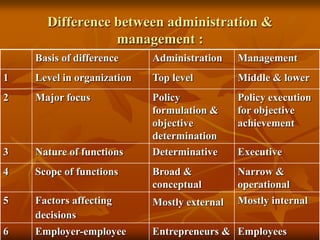
Difference between administration &
management :
Basis of difference Administration Management
1 Level in organization Top level Middle & lower
2 Major focus Policy
formulation &
objective
determination
Policy execution
for objective
achievement
3 Nature of functions Determinative Executive
4 Scope of functions Broad &
conceptual
Narrow &
operational
5 Factors affecting
decisions
Mostly external Mostly internal
6 Employer-employee Entrepreneurs & Employees
Administration is a part of management :
 Management is a generic name for the total process of
executive control in industry or commerce.
 It is a social process entailing responsibility for the
executive & economic planning & regulation of the
operation of an enterprise, in the fulfillment of a given
purpose or task.
 Administration is that part of management which is
concerned with the installation & carrying out the
procedures by which it is laid down & communicated, &
the process of activities regulated & checked against plans.
Management & Administration are same
 Management & administration are synonymous; the
difference between the two terms lies mostly in their usage
in different countries or different fields of human
organizations.
 The distinction between the two terms may be drawn by
analyzing the origin of the word “administration”.
 The government often uses the word administrator,
instead of manager, to handle & manage its affairs
The functions of management :
 Management can be break down into 5
managerial functions : planning, organizing,
staffing, leading & controlling
 Management as an essential for any
organization
Managerial functions as at different
organizational levels .
Top
level
Managers
Middle-level
Managers
First-level
Supervisors
Functions of Top Management :
 To analyze, evaluate & deal with the external
environmental forces
 To establish overall long-term goals strategy & policies of
the company including the master budget to allocate
resources.
 To create an organizational framework consisting of
authority responsibility relationships.
 To appoint departmental & other key executives.
 To provide overall leadership to the company.
Contd >>>>>>>
 To represent the company to the outside world, e.g. ; trade
associations, government, trade unions, etc.
 To exercise overall review & control on the company’s
operations &
 To coordinate the activities & efforts of different
departments.
Functions of Middle Management :
 To interpret & explain the policies framed by top
management .
 To compile & issue detailed instructions regarding
operations.
 To maintain close contacts with operating results so as to
evaluate performance.
 To participate in operating decisions
 To cooperate among themselves so as to integrate or
coordinate various parts of a division or a department
Functions of Supervisory Management :
 To plan day-to-day production within the goals laid down
by higher authorities.
 To assign jobs to workers to make arrangements for their
training & development.
 To supervise & control workers & maintain personal
contact with charge hands.
 To arrange materials & tools & to maintain machinery.
 To advise & assist workers by explaining work procedures,
solving their problems, etc
Importance of Management :
 Effective Utilization of Resources
 Development of Resources
 To Incorporate Innovations
 Integrating Various Interest Groups
 Stability in the Society
Skills of Management :
 Technical skills
 Human skills
 Conceptual skills
 Design skills
Nature of Management :
 Management as an activity (or a process )
I. Planning
II. Organizing
III. Staffing
IV. Directing &
V. Controlling
Contd >>>>>>>
 Management as a discipline
I. Management education is gaining popularity in the
present –day-times.
II. Scholars are interested in study of management
discipline, for purposes of conducting research studies
& making new & valuable contributions to this
discipline
III. Practitioners of management are much interested in a
study of management discipline
IV. Management discipline is growing into specialized
branches of management like
production, marketing, personnel, finance & several
others
Contd >>>>>..
 Management as a group ( class or team or society)
I. Micro-level : the economic results, in terms of the
attainment of common objectives, of the group-
endeavor
II. Macro-level : the survival, growth & prosperity of the
economy would be determined by the integrity,
competence & efforts of the total management class
 Management as an economic resource (or a factor of
production) . The economist has been all the time been
speaking of 4 factors viz , land, labour, capital &
enterprise.
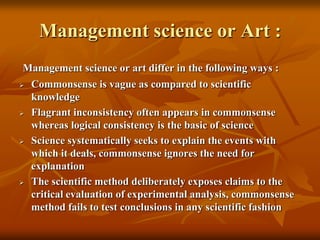
Management science or Art :
Management science or art differ in the following ways :
 Commonsense is vague as compared to scientific
knowledge
 Flagrant inconsistency often appears in commonsense
whereas logical consistency is the basic of science
 Science systematically seeks to explain the events with
which it deals, commonsense ignores the need for
explanation
 The scientific method deliberately exposes claims to the
critical evaluation of experimental analysis, commonsense
method fails to test conclusions in any scientific fashion
Management as profession :
“Profession is an occupation for which specialized
knowledge, skills & training are required & the use of
these skills is not meant for self-satisfaction but these are
used for larger interests of the society & the success of the
use of these skills is measured not in terms of money
alone.”
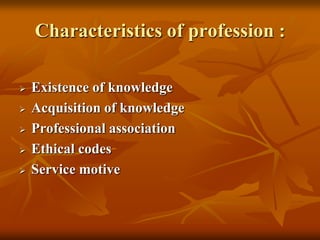
Characteristics of profession :
 Existence of knowledge
 Acquisition of knowledge
 Professional association
 Ethical codes
 Service motive
Objectives/ Advantages OR Significance
of Management :
 Micro level
 Macro level
Micro level
Enterprise level
 Maximum results with minimum inputs
I. Securing results in terms of production, sales, employee
satisfaction
II. Maintaining a balance between the internal
environment of the enterprise & the external
environment
Contd >>>>>>>
 Ensuring maximum prosperity for both employers &
employees
I. Stability of employement
II. Satisfactory working conditions
III. Fair remuneration
IV. Job-satisfaction
V. Justice & human treatment
 Ensuring survival, growth & prestige of the enterprise
Macro level
 To further the process of economic growth
 To ensure social welfare
 Generation of employment opportunities
 Helping maintain healthy industrial relations
 Conversion of challenges into opportunities
Role of Management Principles :
 To increase efficiency
 To crystallize the nature of Management
 To carry on Researches
 To attain social objectives
Evolution of Management Thought :
 Many different contributors of writers &
practitioners have resulted in different
approaches to management, & these make
up a “management theory jungle”
Taylor & scientific management :
 The concept of scientific management was introduced by
Frederick Taylor in USA in the beginning of 20th century.
 Scientific management was concerned essentially with
improving the operational efficiency at the shop floor level
Contd >>>>>>>>
 “scientific management is concerned with
knowing exactly what you want men to do
& then see in that they do in the best &
cheapest way”
Elements & Tools of scientific Management :
 Separation of planning & doing
 Functional Foremanship
 Job analysis
1. Time study involves the determination of time a
movement takes to complete
2. Motion study involves the study of movements in parts
which are involved in doing a job & thereby eliminating
the wasteful movements & performing only necessary
movements
Contd >>>>>>>
3. Fatigue study shows the amount & frequency of rest
required in completing the work.
 Standardization
 Scientific selection & training of workers
 Financial Incentives
 Economy
 Mental Revolution
Principles of scientific management :
 Replacing rule of Thumb with science
 Harmony in Group Action
 Co-operation
 Maximum output
 Development of workers
 A more equal division of responsibility between
management & workers
Contd >>>>>>>>>>>.
 Mental revolution on the part of management & workers
Merits of scientific Management :
 More production & higher profits
 Job-satisfaction
 Personality development
 Higher standard of living
Fayol’s Administrative management :
 Henry Fayol was a french mining engineer who turned a
leading industrialist & a successful manager
 Perhaps the real father of modern operational
management theory is the French industrialist Henry
Fayol.
Contd >>>>>>>
Fayol found that activities of an industrial organization
could be divided into 6 groups such as :
1. Technical (relating to production)
2. Commercial (buying, selling & exchange)
3. Financial (search for capital & its optimum use )
4. Security (protection of property & person)
5. Accounting (including statistics ) &
6. Managerial (planning, organization, command,
coordination, & control )
Managerial qualities & training :
 Physical (health, vigour , & address )
 Mental (ability to understand & learn, judgment, mental
vigour, & capability)
 Moral (energy, firmness, initiative, loyalty, tact, & dignity)
 Educational (general acquaintance with matters not
belonging exclusively to the function performed)
 Technical (peculiar to the function being performed) &
 Experience (arising from the work )
General Principles of Management :
 Division of work
 Authority & Responsibility
 Discipline
 Unity of Command
 Unity of Direction
 Subordination of Individual to General Interest
 Remuneration of Personnel
Contd >>>>>.
 Centralization
 Scalar chain
 Order
 Equity
 Stability of Tenure
 Initiative
 Esprit de corps
Role & Functions of a
manager & activities of
management
Functions of Manager :
 Planning
 Organizing
 Staffing
 Directing
 Controlling
Nature Management Functions :
 Management functions are universal
 Management functions have interactive quality
 Although management process suggests a sequential
arrangement of functions its not always possible in the
performance of managerial functions strictly in a sequence
 Since there are many managerial functions often a
question arises which management function is more
important so that managers devote more time to that
Diagram
Planning
Staffing
directing organizing
Controlling
Roles Of Manager :
 Interpersonal Role
 Informational Role
 Decisional Role
Management Role :
Formal authority &status
+
Personal skills & characteristics
Interpersonal roles
Figurehead
Leader
Liaison
International roles
Monitor
Disseminator
spokesperson
Decision roles
Entrepreneur
Disturbance
Handler
Resource allocator
Negotiator
Functions at Various Levels of
Management :
Management
Top Management Supervisory Management
Middle Management
Board of Directors Departmental heads Senior supervisors
chairman Divisional heads Intermediate supervisors
Chief executive Sectional heads Front-line supervisors
Top Management :
 Top management of an organization consists of board of
directors, chairman & chief executive officer
Functions of Board of Directors :
 A board is elected by the owners (shareholders) & is
responsible to them as their agent for managing the affairs
of the organization.
 Board has authority to manage subject to the limitations
imposed by the Memorandum of Association & Articles of
Association of the company as well as the provisions of the
Companies Act
Board of Directors
Divided into 6 categories :
 trusteeship, function implying that board
must use the property of the company
 Determination of basic objectives & policies
of the organization
 Selection of top executives & determination
of overall organization structure
 Approval of financial matters like

management.pdf

  • 1.
  • 2.
    Define Management “ Managementis the process of designing & maintaining an environment in which individuals, working together in groups, efficiently accomplish selected aims.”
  • 3.
    Contd>>>>>>>  As managers,people carry out the managerial functions of planning, organizing, staffing, leading, & controlling.  Management applies to any kind of organization.  It applies to managers at all organizational levels.  The aim of all managers is the same: to create a surplus.  Managing is concerned with productivity, this implies effectiveness & efficiency.
  • 4.
    Define Organizations : “Organizationswhich can be defined as group of people working together to create a surplus.”  In business organizations, this surplus is profit.  In nonprofit organizations, such as charitable organizations, it may be the satisfaction of needs.
  • 5.
    Features of Management:  Organized activities  Existence of objectives  Relationship among resources  Working with & Through people  Decision- Making
  • 6.
    Management & Administration:  Administration is above management  Administration is part of management  Management & administration are same
  • 7.
    Administration is abovemanagement :  “administration is that phase of business enterprise that concerns itself with the overall determination of institutional objectives & the policies necessary to be followed in achieving those objectives.”  “Management on the other hand, is an executive function which is primarily concerned with carrying out broad policies laid down by the administration.”
  • 8.
    Difference between administration& management : Basis of difference Administration Management 1 Level in organization Top level Middle & lower 2 Major focus Policy formulation & objective determination Policy execution for objective achievement 3 Nature of functions Determinative Executive 4 Scope of functions Broad & conceptual Narrow & operational 5 Factors affecting decisions Mostly external Mostly internal 6 Employer-employee Entrepreneurs & Employees
  • 9.
    Administration is apart of management :  Management is a generic name for the total process of executive control in industry or commerce.  It is a social process entailing responsibility for the executive & economic planning & regulation of the operation of an enterprise, in the fulfillment of a given purpose or task.  Administration is that part of management which is concerned with the installation & carrying out the procedures by which it is laid down & communicated, & the process of activities regulated & checked against plans.
  • 10.
    Management & Administrationare same  Management & administration are synonymous; the difference between the two terms lies mostly in their usage in different countries or different fields of human organizations.  The distinction between the two terms may be drawn by analyzing the origin of the word “administration”.  The government often uses the word administrator, instead of manager, to handle & manage its affairs
  • 11.
    The functions ofmanagement :  Management can be break down into 5 managerial functions : planning, organizing, staffing, leading & controlling  Management as an essential for any organization
  • 12.
    Managerial functions asat different organizational levels . Top level Managers Middle-level Managers First-level Supervisors
  • 13.
    Functions of TopManagement :  To analyze, evaluate & deal with the external environmental forces  To establish overall long-term goals strategy & policies of the company including the master budget to allocate resources.  To create an organizational framework consisting of authority responsibility relationships.  To appoint departmental & other key executives.  To provide overall leadership to the company.
  • 14.
    Contd >>>>>>>  Torepresent the company to the outside world, e.g. ; trade associations, government, trade unions, etc.  To exercise overall review & control on the company’s operations &  To coordinate the activities & efforts of different departments.
  • 15.
    Functions of MiddleManagement :  To interpret & explain the policies framed by top management .  To compile & issue detailed instructions regarding operations.  To maintain close contacts with operating results so as to evaluate performance.  To participate in operating decisions  To cooperate among themselves so as to integrate or coordinate various parts of a division or a department
  • 16.
    Functions of SupervisoryManagement :  To plan day-to-day production within the goals laid down by higher authorities.  To assign jobs to workers to make arrangements for their training & development.  To supervise & control workers & maintain personal contact with charge hands.  To arrange materials & tools & to maintain machinery.  To advise & assist workers by explaining work procedures, solving their problems, etc
  • 17.
    Importance of Management:  Effective Utilization of Resources  Development of Resources  To Incorporate Innovations  Integrating Various Interest Groups  Stability in the Society
  • 18.
    Skills of Management:  Technical skills  Human skills  Conceptual skills  Design skills
  • 19.
    Nature of Management:  Management as an activity (or a process ) I. Planning II. Organizing III. Staffing IV. Directing & V. Controlling
  • 20.
    Contd >>>>>>>  Managementas a discipline I. Management education is gaining popularity in the present –day-times. II. Scholars are interested in study of management discipline, for purposes of conducting research studies & making new & valuable contributions to this discipline III. Practitioners of management are much interested in a study of management discipline IV. Management discipline is growing into specialized branches of management like production, marketing, personnel, finance & several others
  • 21.
    Contd >>>>>..  Managementas a group ( class or team or society) I. Micro-level : the economic results, in terms of the attainment of common objectives, of the group- endeavor II. Macro-level : the survival, growth & prosperity of the economy would be determined by the integrity, competence & efforts of the total management class  Management as an economic resource (or a factor of production) . The economist has been all the time been speaking of 4 factors viz , land, labour, capital & enterprise.
  • 22.
    Management science orArt : Management science or art differ in the following ways :  Commonsense is vague as compared to scientific knowledge  Flagrant inconsistency often appears in commonsense whereas logical consistency is the basic of science  Science systematically seeks to explain the events with which it deals, commonsense ignores the need for explanation  The scientific method deliberately exposes claims to the critical evaluation of experimental analysis, commonsense method fails to test conclusions in any scientific fashion
  • 23.
    Management as profession: “Profession is an occupation for which specialized knowledge, skills & training are required & the use of these skills is not meant for self-satisfaction but these are used for larger interests of the society & the success of the use of these skills is measured not in terms of money alone.”
  • 24.
    Characteristics of profession:  Existence of knowledge  Acquisition of knowledge  Professional association  Ethical codes  Service motive
  • 25.
    Objectives/ Advantages ORSignificance of Management :  Micro level  Macro level
  • 26.
    Micro level Enterprise level Maximum results with minimum inputs I. Securing results in terms of production, sales, employee satisfaction II. Maintaining a balance between the internal environment of the enterprise & the external environment
  • 27.
    Contd >>>>>>>  Ensuringmaximum prosperity for both employers & employees I. Stability of employement II. Satisfactory working conditions III. Fair remuneration IV. Job-satisfaction V. Justice & human treatment  Ensuring survival, growth & prestige of the enterprise
  • 28.
    Macro level  Tofurther the process of economic growth  To ensure social welfare  Generation of employment opportunities  Helping maintain healthy industrial relations  Conversion of challenges into opportunities
  • 29.
    Role of ManagementPrinciples :  To increase efficiency  To crystallize the nature of Management  To carry on Researches  To attain social objectives
  • 30.
    Evolution of ManagementThought :  Many different contributors of writers & practitioners have resulted in different approaches to management, & these make up a “management theory jungle”
  • 31.
    Taylor & scientificmanagement :  The concept of scientific management was introduced by Frederick Taylor in USA in the beginning of 20th century.  Scientific management was concerned essentially with improving the operational efficiency at the shop floor level
  • 32.
    Contd >>>>>>>>  “scientificmanagement is concerned with knowing exactly what you want men to do & then see in that they do in the best & cheapest way”
  • 33.
    Elements & Toolsof scientific Management :  Separation of planning & doing  Functional Foremanship  Job analysis 1. Time study involves the determination of time a movement takes to complete 2. Motion study involves the study of movements in parts which are involved in doing a job & thereby eliminating the wasteful movements & performing only necessary movements
  • 34.
    Contd >>>>>>> 3. Fatiguestudy shows the amount & frequency of rest required in completing the work.  Standardization  Scientific selection & training of workers  Financial Incentives  Economy  Mental Revolution
  • 35.
    Principles of scientificmanagement :  Replacing rule of Thumb with science  Harmony in Group Action  Co-operation  Maximum output  Development of workers  A more equal division of responsibility between management & workers
  • 36.
    Contd >>>>>>>>>>>.  Mentalrevolution on the part of management & workers
  • 37.
    Merits of scientificManagement :  More production & higher profits  Job-satisfaction  Personality development  Higher standard of living
  • 38.
    Fayol’s Administrative management:  Henry Fayol was a french mining engineer who turned a leading industrialist & a successful manager  Perhaps the real father of modern operational management theory is the French industrialist Henry Fayol.
  • 39.
    Contd >>>>>>> Fayol foundthat activities of an industrial organization could be divided into 6 groups such as : 1. Technical (relating to production) 2. Commercial (buying, selling & exchange) 3. Financial (search for capital & its optimum use ) 4. Security (protection of property & person) 5. Accounting (including statistics ) & 6. Managerial (planning, organization, command, coordination, & control )
  • 40.
    Managerial qualities &training :  Physical (health, vigour , & address )  Mental (ability to understand & learn, judgment, mental vigour, & capability)  Moral (energy, firmness, initiative, loyalty, tact, & dignity)  Educational (general acquaintance with matters not belonging exclusively to the function performed)  Technical (peculiar to the function being performed) &  Experience (arising from the work )
  • 41.
    General Principles ofManagement :  Division of work  Authority & Responsibility  Discipline  Unity of Command  Unity of Direction  Subordination of Individual to General Interest  Remuneration of Personnel
  • 42.
    Contd >>>>>.  Centralization Scalar chain  Order  Equity  Stability of Tenure  Initiative  Esprit de corps
  • 43.
    Role & Functionsof a manager & activities of management
  • 44.
    Functions of Manager:  Planning  Organizing  Staffing  Directing  Controlling
  • 45.
    Nature Management Functions:  Management functions are universal  Management functions have interactive quality  Although management process suggests a sequential arrangement of functions its not always possible in the performance of managerial functions strictly in a sequence  Since there are many managerial functions often a question arises which management function is more important so that managers devote more time to that
  • 46.
  • 47.
    Roles Of Manager:  Interpersonal Role  Informational Role  Decisional Role
  • 48.
    Management Role : Formalauthority &status + Personal skills & characteristics Interpersonal roles Figurehead Leader Liaison International roles Monitor Disseminator spokesperson Decision roles Entrepreneur Disturbance Handler Resource allocator Negotiator
  • 49.
    Functions at VariousLevels of Management : Management Top Management Supervisory Management Middle Management Board of Directors Departmental heads Senior supervisors chairman Divisional heads Intermediate supervisors Chief executive Sectional heads Front-line supervisors
  • 50.
    Top Management : Top management of an organization consists of board of directors, chairman & chief executive officer
  • 51.
    Functions of Boardof Directors :  A board is elected by the owners (shareholders) & is responsible to them as their agent for managing the affairs of the organization.  Board has authority to manage subject to the limitations imposed by the Memorandum of Association & Articles of Association of the company as well as the provisions of the Companies Act
  • 52.
    Board of Directors Dividedinto 6 categories :  trusteeship, function implying that board must use the property of the company  Determination of basic objectives & policies of the organization  Selection of top executives & determination of overall organization structure  Approval of financial matters like