PRINCIPLES
OF
EFFECTIVE
COMMUNICATION
•The ability to communicate effectively is
essential to conducting business.
Communicating is much more than
speaking; it involves your entire
presence. How you communicate has
often more impact, than the content of
your message.
1.Principle of Objective
2.Principle of Clarity
3.Principle of Understanding
4.Principle of Completeness
5.Principle of Feedback
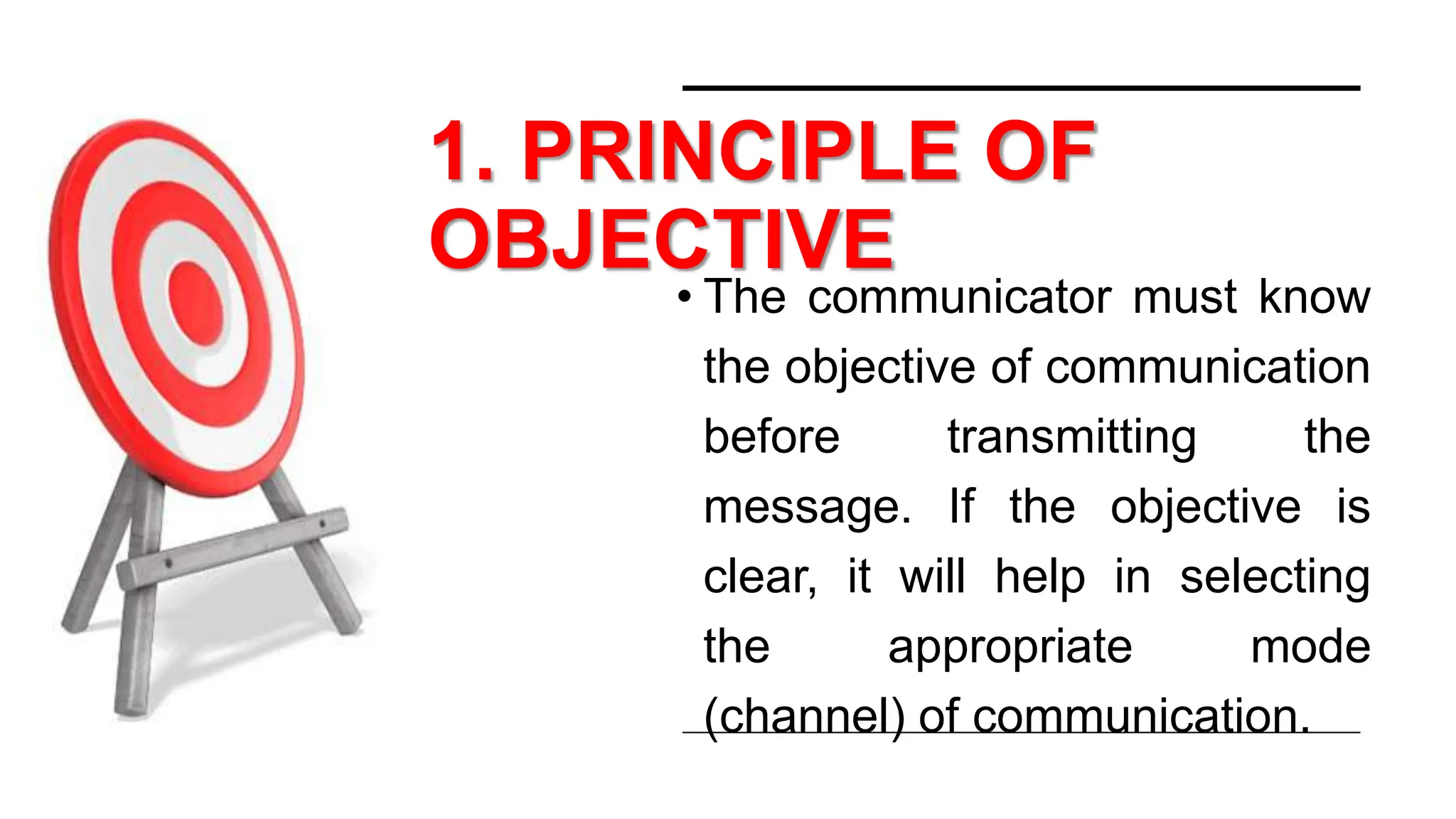
1. PRINCIPLE OF
OBJECTIVE
• The communicator must know
the objective of communication
before transmitting the
message. If the objective is
clear, it will help in selecting
the appropriate mode
(channel) of communication.
2. PRINCIPLE OF
CLARITY
• The message should
be as clear as possible
and should be free
from any ambiguity. It
helps in conveying the
message effectively.
The message should
not create confusion
and chaos.
3. PRINCIPLE OF
UNDERSTANDING
•The communication should create proper
understanding in the mind of the
receiver. The communicator must
consider the receptivity and
understanding level of the receiver.
4. PRINCIPLE OF
COMPLETENESS
•Inadequate communication leads to
misunderstanding, which delays the work
and affects the efficiency of the people.
Therefore, the message to be
communicated must be adequate and
complete.
5.
PRINCIPLE
OF
• Receiving and considering the feedback is key
to successful communication process. Any
communication should be a two-way process
and should provide opportunity for suggestions
and criticism.
REFERENCE:
•https://www.ifioque.com/miscellaneous/effecti
ve_communication_principles

Principles of Effective Communication.pptx