Principles of Distributed Database Systems
M. Tamer Özsu • Patrick Valduriez
Principles of Distributed
Database Systems
Third Edition
All rights reserved. This work may not be translated or copied
in whole or in part without the written
permission of the publisher (Springer Science+Business Media,
LLC, 233 Spring Street, New York,
NY 10013, USA), except for brief excerpts in connection with
reviews or scholarly analysis. Use in
connection with any form of information storage and retrieval,
electronic adaptation, computer, software,
or by similar or dissimilar methodology now known or hereafter
developed is forbidden.
The use in this publication of trade names, trademarks, service
marks, and similar terms, even if they
are not identified as such, is not to be taken as an expression of
opinion as to whether or not they are
subject to proprietary rights.
Printed on acid-free paper
Springer is part of Springer Science+Business Media
(www.springer.com)
Springer New York Dordrecht Heidelberg London
M. Tamer Özsu
David R. Cheriton School of
Computer Science
University of Waterloo
Waterloo Ontario
Canada N2L 3G1
ISBN 978-1-4419-8833-1 e-ISBN 978-1-4419-8834-8
DOI 10.1007/978-1-4419-8834-8
This book was previously published by: Pearson Education, Inc.
[email protected]
Library of Congress Control Number: 2011922491
© Springer Science+Business Media, LLC 2011
Patrick Valduriez
LIRMM
34392 Montpellier Cedex
France
[email protected]
INRIA
161 rue Ada
To my family
and my parents
M.T.Ö.
To Esther, my daughters Anna, Juliette and
Sarah, and my parents
P.V.
Preface
It has been almost twenty years since the first edition of this
book appeared, and ten
years since we released the second edition. As one can imagine,
in a fast changing
area such as this, there have been significant changes in the
intervening period.
Distributed data management went from a potentially significant
technology to one
that is common place. The advent of the Internet and the World
Wide Web have
certainly changed the way we typically look at distribution. The
emergence in recent
years of different forms of distributed computing, exemplified
by data streams and
cloud computing, has regenerated interest in distributed data
management. Thus, it
was time for a major revision of the material.
We started to work on this edition five years ago, and it has
taken quite a while to
complete the work. The end result, however, is a book that has
been heavily revised –
while we maintained and updated the core chapters, we have
also added new ones.
The major changes are the following:
1. Database integration and querying is now treated in much
more detail, re-
flecting the attention these topics have received in the
community in the
past decade. Chapter 4 focuses on the integration process, while
Chapter 9
discusses querying over multidatabase systems.
2. The previous editions had only brief discussion of data
replication protocols.
This topic is now covered in a separate chapter (Chapter 13)
where we provide
an in-depth discussion of the protocols and how they can be
integrated with
transaction management.
3. Peer-to-peer data management is discussed in depth in
Chapter 16. These
systems have become an important and interesting architectural
alternative to
classical distributed database systems. Although the early
distributed database
systems architectures followed the peer-to-peer paradigm, the
modern incar-
nation of these systems have fundamentally different
characteristics, so they
deserve in-depth discussion in a chapter of their own.
4. Web data management is discussed in Chapter 17. This is a
difficult topic
to cover since there is no unifying framework. We discuss
various aspects
vii
viii Preface
of the topic ranging from web models to search engines to
distributed XML
processing.
5. Earlier editions contained a chapter where we discussed
“recent issues” at the
time. In this edition, we again have a similar chapter (Chapter
18) where we
cover stream data management and cloud computing. These
topics are still
in a flux and are subjects of considerable ongoing research. We
highlight the
issues and the potential research directions.
The resulting manuscript strikes a balance between our two
objectives, namely to
address new and emerging issues, and maintain the main
characteristics of the book
in addressing the principles of distributed data management.
The organization of the book can be divided into two major
parts. The first part
covers the fundamental principles of distributed data
management and consist of
Chapters 1 to 14. Chapter 2 in this part covers the background
and can be skipped if
the students already have sufficient knowledge of the relational
database concepts
and the computer network technology. The only part of this
chapter that is essential
is Example 2.3, which introduces the running example that we
use throughout much
of the book. The second part covers more advanced topics and
includes Chapters 15 –
18. What one covers in a course depends very much on the
duration and the course
objectives. If the course aims to discuss the fundamental
techniques, then it might
cover Chapters 1, 3, 5, 6–8, 10–12. An extended coverage
would include, in addition
to the above, Chapters 4, 9, and 13. Courses that have time to
cover more material
can selectively pick one or more of Chapters 15 – 18 from the
second part.
Many colleagues have assisted with this edition of the book. S.
Keshav (Univer-
sity of Waterloo) has read and provided many suggestions to
update the sections
on computer networks. Renée Miller (University of Toronto)
and Erhard Rahm
(University of Leipzig) read an early draft of Chapter 4 and
provided many com-
ments, Alon Halevy (Google) answered a number of questions
about this chapter
and provided a draft copy of his upcoming book on this topic as
well as reading
and providing feedback on Chapter 9, Avigdor Gal (Technion)
also reviewed and
critiqued this chapter very thoroughly. Matthias Jarke and
Xiang Li (University of
Aachen), Gottfried Vossen (University of Muenster), Erhard
Rahm and Andreas
Thor (University of Leipzig) contributed exercises to this
chapter. Hubert Naacke
(University of Paris 6) contributed to the section on
heterogeneous cost modeling
and Fabio Porto (LNCC, Petropolis) to the section on adaptive
query processing of
Chapter 9. Data replication (Chapter 13) could not have been
written without the
assistance of Gustavo Alonso (ETH Zürich) and Bettina Kemme
(McGill University).
Tamer spent four months in Spring 2006 visiting Gustavo where
work on this chapter
began and involved many long discussions. Bettina read
multiple iterations of this
chapter over the next one year criticizing everything and
pointing out better ways of
explaining the material. Esther Pacitti (University of
Montpellier) also contributed to
this chapter, both by reviewing it and by providing background
material; she also
contributed to the section on replication in database clusters in
Chapter 14. Ricardo
Jimenez-Peris also contributed to that chapter in the section on
fault-tolerance in
database clusters. Khuzaima Daudjee (University of Waterloo)
read and provided
Preface ix
comments on this chapter as well. Chapter 15 on Distributed
Object Database Man-
agement was reviewed by Serge Abiteboul (INRIA), who
provided important critique
of the material and suggestions for its improvement. Peer-to-
peer data management
(Chapter 16) owes a lot to discussions with Beng Chin Ooi
(National University
of Singapore) during the four months Tamer was visiting NUS
in the fall of 2006.
The section of Chapter 16 on query processing in P2P systems
uses material from
the PhD work of Reza Akbarinia (INRIA) and Wenceslao Palma
(PUC-Valparaiso,
Chile) while the section on replication uses material from the
PhD work of Vidal
Martins (PUCPR, Curitiba). The distributed XML processing
section of Chapter 17
uses material from the PhD work of Ning Zhang (Facebook) and
Patrick Kling at
the University of Waterloo, and Ying Zhang at CWI. All three
of them also read
the material and provided significant feedback. Victor Muntés i
Mulero (Universitat
Politècnica de Catalunya) contributed to the exercises in that
chapter. Özgür Ulusoy
(Bilkent University) provided comments and corrections on
Chapters 16 and 17.
Data stream management section of Chapter 18 draws from the
PhD work of Lukasz
Golab (AT&T Labs-Research), and Yingying Tao at the
University of Waterloo.
Walid Aref (Purdue University) and Avigdor Gal (Technion)
used the draft of the
book in their courses, which was very helpful in debugging
certain parts. We thank
them, as well as many colleagues who had helped out with the
first two editions,
for all their assistance. We have not always followed their
advice, and, needless
to say, the resulting problems and errors are ours. Students in
two courses at the
University of Waterloo (Web Data Management in Winter 2005,
and Internet-Scale
Data Distribution in Fall 2005) wrote surveys as part of their
coursework that were
very helpful in structuring some chapters. Tamer taught courses
at ETH Zürich
(PDDBS – Parallel and Distributed Databases in Spring 2006)
and at NUS (CS5225 –
Parallel and Distributed Database Systems in Fall 2010) using
parts of this edition.
We thank students in all these courses for their contributions
and their patience as
they had to deal with chapters that were works-in-progress – the
material got cleaned
considerably as a result of these teaching experiences.
You will note that the publisher of the third edition of the book
is different than
the first two editions. Pearson, our previous publisher, decided
not to be involved
with the third edition. Springer subsequently showed
considerable interest in the
book. We would like to thank Susan Lagerstrom-Fife and
Jennifer Evans of Springer
for their lightning-fast decision to publish the book, and
Jennifer Mauer for a ton
of hand-holding during the conversion process. We would also
like to thank Tracy
Dunkelberger of Pearson who shepherded the reversal of the
copyright to us without
delay.
As in earlier editions, we will have presentation slides that can
be used to teach
from the book as well as solutions to most of the exercises.
These will be available
from Springer to instructors who adopt the book and there will
be a link to them
from the book’s site at springer.com.
Finally, we would be very interested to hear your comments and
suggestions
regarding the material. We welcome any feedback, but we
would particularly like to
receive feedback on the following aspects:
x Preface
1. any errors that may have remained despite our best efforts
(although we hope
there are not many);
2. any topics that should no longer be included and any topics
that should be
added or expanded; and
3. any exercises that you may have designed that you would like
to be included
in the book.
M. Tamer Özsu ([email protected])
Patrick Valduriez ([email protected])
November 2010
Contents
1 Introduction . . . . . . . . . . . . . . . . . . . . . . . . . . . . . . . . . . . . .
. . . . . . . . . . . . . . 1
1.1 Distributed Data Processing . . . . . . . . . . . . . . . . . . . . . . . .
. . . . . . . . . . 2
1.2 What is a Distributed Database System? . . . . . . . . . . . . . . .
. . . . . . . . 3
1.3 Data Delivery Alternatives . . . . . . . . . . . . . . . . . . . . . . . .
. . . . . . . . . . . 5
1.4 Promises of DDBSs . . . . . . . . . . . . . . . . . . . . . . . . . . . . . .
. . . . . . . . . . 7
1.4.1 Transparent Management of Distributed and Replicated
Data 7
1.4.2 Reliability Through Distributed Transactions . . . . . . . . . .
. . . 12
1.4.3 Improved Performance . . . . . . . . . . . . . . . . . . . . . . . . . .
. . . . . . 14
1.4.4 Easier System Expansion . . . . . . . . . . . . . . . . . . . . . . . .
. . . . . . 15
1.5 Complications Introduced by Distribution . . . . . . . . . . . . . .
. . . . . . . . 16
1.6 Design Issues . . . . . . . . . . . . . . . . . . . . . . . . . . . . . . . . . .
. . . . . . . . . . . . 16
1.6.1 Distributed Database Design . . . . . . . . . . . . . . . . . . . . . .
. . . . . 17
1.6.2 Distributed Directory Management . . . . . . . . . . . . . . . . .
. . . . 17
1.6.3 Distributed Query Processing . . . . . . . . . . . . . . . . . . . . .
. . . . . 17
1.6.4 Distributed Concurrency Control . . . . . . . . . . . . . . . . . . .
. . . . 18
1.6.5 Distributed Deadlock Management . . . . . . . . . . . . . . . . .
. . . . 18
1.6.6 Reliability of Distributed DBMS . . . . . . . . . . . . . . . . . . .
. . . . 18
1.6.7 Replication . . . . . . . . . . . . . . . . . . . . . . . . . . . . . . . . . .
. . . . . . . 19
1.6.8 Relationship among Problems . . . . . . . . . . . . . . . . . . . . .
. . . . . 19
1.6.9 Additional Issues . . . . . . . . . . . . . . . . . . . . . . . . . . . . . .
. . . . . . 20
1.7 Distributed DBMS Architecture . . . . . . . . . . . . . . . . . . . . .
. . . . . . . . . 21
1.7.1 ANSI/SPARC Architecture . . . . . . . . . . . . . . . . . . . . . . .
. . . . . 21
1.7.2 A Generic Centralized DBMS Architecture . . . . . . . . . . .
. . . 23
1.7.3 Architectural Models for Distributed DBMSs . . . . . . . . . .
. . . 25
1.7.4 Autonomy . . . . . . . . . . . . . . . . . . . . . . . . . . . . . . . . . . .
. . . . . . . 25
1.7.5 Distribution . . . . . . . . . . . . . . . . . . . . . . . . . . . . . . . . . .
. . . . . . . 27
1.7.6 Heterogeneity . . . . . . . . . . . . . . . . . . . . . . . . . . . . . . . . .
. . . . . . 27
1.7.7 Architectural Alternatives . . . . . . . . . . . . . . . . . . . . . . . .
. . . . . 28
1.7.8 Client/Server Systems . . . . . . . . . . . . . . . . . . . . . . . . . . .
. . . . . 28
1.7.9 Peer-to-Peer Systems . . . . . . . . . . . . . . . . . . . . . . . . . . .
. . . . . . 32
1.7.10 Multidatabase System Architecture . . . . . . . . . . . . . . . .
. . . . . 35
xi
xii Contents
1.8 Bibliographic Notes . . . . . . . . . . . . . . . . . . . . . . . . . . . . .
. . . . . . . . . . . 38
2 Background . . . . . . . . . . . . . . . . . . . . . . . . . . . . . . . . . . . . .
. . . . . . . . . . . . . . 41
2.1 Overview of Relational DBMS . . . . . . . . . . . . . . . . . . . . . .
. . . . . . . . . 41
2.1.1 Relational Database Concepts . . . . . . . . . . . . . . . . . . . . .
. . . . . 41
2.1.2 Normalization . . . . . . . . . . . . . . . . . . . . . . . . . . . . . . . .
. . . . . . . 43
2.1.3 Relational Data Languages . . . . . . . . . . . . . . . . . . . . . . .
. . . . . 45
2.2 Review of Computer Networks . . . . . . . . . . . . . . . . . . . . . .
. . . . . . . . . 58
2.2.1 Types of Networks . . . . . . . . . . . . . . . . . . . . . . . . . . . . .
. . . . . . 60
2.2.2 Communication Schemes . . . . . . . . . . . . . . . . . . . . . . . .
. . . . . 63
2.2.3 Data Communication Concepts . . . . . . . . . . . . . . . . . . . .
. . . . 65
2.2.4 Communication Protocols . . . . . . . . . . . . . . . . . . . . . . . .
. . . . . 67
2.3 Bibliographic Notes . . . . . . . . . . . . . . . . . . . . . . . . . . . . .
. . . . . . . . . . . 70
3 Distributed Database Design . . . . . . . . . . . . . . . . . . . . . . . . .
. . . . . . . . . . . 71
3.1 Top-Down Design Process . . . . . . . . . . . . . . . . . . . . . . . . .
. . . . . . . . . . 73
3.2 Distribution Design Issues . . . . . . . . . . . . . . . . . . . . . . . . .
. . . . . . . . . . 75
3.2.1 Reasons for Fragmentation . . . . . . . . . . . . . . . . . . . . . . .
. . . . . 75
3.2.2 Fragmentation Alternatives . . . . . . . . . . . . . . . . . . . . . . .
. . . . . 76
3.2.3 Degree of Fragmentation . . . . . . . . . . . . . . . . . . . . . . . . .
. . . . . 77
3.2.4 Correctness Rules of Fragmentation . . . . . . . . . . . . . . . .
. . . . . 79
3.2.5 Allocation Alternatives . . . . . . . . . . . . . . . . . . . . . . . . . .
. . . . . 79
3.2.6 Information Requirements . . . . . . . . . . . . . . . . . . . . . . . .
. . . . . 80
3.3 Fragmentation . . . . . . . . . . . . . . . . . . . . . . . . . . . . . . . . . .
. . . . . . . . . . . 81
3.3.1 Horizontal Fragmentation . . . . . . . . . . . . . . . . . . . . . . . .
. . . . . 81
3.3.2 Vertical Fragmentation . . . . . . . . . . . . . . . . . . . . . . . . . .
. . . . . . 98
3.3.3 Hybrid Fragmentation . . . . . . . . . . . . . . . . . . . . . . . . . . .
. . . . . 112
3.4 Allocation . . . . . . . . . . . . . . . . . . . . . . . . . . . . . . . . . . . .
. . . . . . . . . . . . . 113
3.4.1 Allocation Problem . . . . . . . . . . . . . . . . . . . . . . . . . . . . .
. . . . . 114
3.4.2 Information Requirements . . . . . . . . . . . . . . . . . . . . . . . .
. . . . . 116
3.4.3 Allocation Model . . . . . . . . . . . . . . . . . . . . . . . . . . . . . .
. . . . . . 118
3.4.4
Solution
Methods . . . . . . . . . . . . . . . . . . . . . . . . . . . . . . . . . . . . 121
3.5 Data Directory . . . . . . . . . . . . . . . . . . . . . . . . . . . . . . . . .
. . . . . . . . . . . . 122
3.6 Conclusion . . . . . . . . . . . . . . . . . . . . . . . . . . . . . . . . . . . .
. . . . . . . . . . . . 123
3.7 Bibliographic Notes . . . . . . . . . . . . . . . . . . . . . . . . . . . . .
. . . . . . . . . . . 125
4 Database Integration . . . . . . . . . . . . . . . . . . . . . . . . . . . . . .
. . . . . . . . . . . . . 131
4.1 Bottom-Up Design Methodology . . . . . . . . . . . . . . . . . . . .
. . . . . . . . . 133
4.2 Schema Matching . . . . . . . . . . . . . . . . . . . . . . . . . . . . . . .
. . . . . . . . . . . 137
4.2.1 Schema Heterogeneity . . . . . . . . . . . . . . . . . . . . . . . . . .
. . . . . . 140
4.2.2 Linguistic Matching Approaches . . . . . . . . . . . . . . . . . . .
. . . . 141
4.2.3 Constraint-based Matching Approaches . . . . . . . . . . . . . .
. . . 143
4.2.4 Learning-based Matching . . . . . . . . . . . . . . . . . . . . . . . .
. . . . . 145
4.2.5 Combined Matching Approaches . . . . . . . . . . . . . . . . . . .
. . . . 146
4.3 Schema Integration . . . . . . . . . . . . . . . . . . . . . . . . . . . . . .
. . . . . . . . . . . 147
Contents xiii
4.4 Schema Mapping . . . . . . . . . . . . . . . . . . . . . . . . . . . . . . . .
. . . . . . . . . . . 149
4.4.1 Mapping Creation . . . . . . . . . . . . . . . . . . . . . . . . . . . . . .
. . . . . . 150
4.4.2 Mapping Maintenance . . . . . . . . . . . . . . . . . . . . . . . . . . .
. . . . . 155
4.5 Data Cleaning . . . . . . . . . . . . . . . . . . . . . . . . . . . . . . . . . .
. . . . . . . . . . . 157
4.6 Conclusion . . . . . . . . . . . . . . . . . . . . . . . . . . . . . . . . . . . .
. . . . . . . . . . . . 159
4.7 Bibliographic Notes . . . . . . . . . . . . . . . . . . . . . . . . . . . . .
. . . . . . . . . . . 160
5 Data and Access Control . . . . . . . . . . . . . . . . . . . . . . . . . . .
. . . . . . . . . . . . . 171
5.1 View Management . . . . . . . . . . . . . . . . . . . . . . . . . . . . . . .
. . . . . . . . . . . 172
5.1.1 Views in Centralized DBMSs . . . . . . . . . . . . . . . . . . . . .
. . . . . 172
5.1.2 Views in Distributed DBMSs . . . . . . . . . . . . . . . . . . . . .
. . . . . 175
5.1.3 Maintenance of Materialized Views . . . . . . . . . . . . . . . . .
. . . . 177
5.2 Data Security . . . . . . . . . . . . . . . . . . . . . . . . . . . . . . . . . .
. . . . . . . . . . . . 180
5.2.1 Discretionary Access Control . . . . . . . . . . . . . . . . . . . . .
. . . . . 181
5.2.2 Multilevel Access Control . . . . . . . . . . . . . . . . . . . . . . . .
. . . . . 183
5.2.3 Distributed Access Control . . . . . . . . . . . . . . . . . . . . . . .
. . . . . 185
5.3 Semantic Integrity Control . . . . . . . . . . . . . . . . . . . . . . . . .
. . . . . . . . . . 187
5.3.1 Centralized Semantic Integrity Control . . . . . . . . . . . . . .
. . . . 189
5.3.2 Distributed Semantic Integrity Control . . . . . . . . . . . . . .
. . . . 194
5.4 Conclusion . . . . . . . . . . . . . . . . . . . . . . . . . . . . . . . . . . . .
. . . . . . . . . . . . 200
5.5 Bibliographic Notes . . . . . . . . . . . . . . . . . . . . . . . . . . . . .
. . . . . . . . . . . 201
6 Overview of Query Processing . . . . . . . . . . . . . . . . . . . . . . .
. . . . . . . . . . . . 205
6.1 Query Processing Problem . . . . . . . . . . . . . . . . . . . . . . . . .
. . . . . . . . . . 206
6.2 Objectives of Query Processing . . . . . . . . . . . . . . . . . . . . .
. . . . . . . . . . 209
6.3 Complexity of Relational Algebra Operations . . . . . . . . . . .
. . . . . . . . 210
6.4 Characterization of Query Processors . . . . . . . . . . . . . . . . .
. . . . . . . . . 211
6.4.1 Languages . . . . . . . . . . . . . . . . . . . . . . . . . . . . . . . . . . .
. . . . . . . 212
6.4.2 Types of Optimization . . . . . . . . . . . . . . . . . . . . . . . . . .
. . . . . . 212
6.4.3 Optimization Timing . . . . . . . . . . . . . . . . . . . . . . . . . . .
. . . . . . 213
6.4.4 Statistics . . . . . . . . . . . . . . . . . . . . . . . . . . . . . . . . . . . .
. . . . . . . 213
6.4.5 Decision Sites . . . . . . . . . . . . . . . . . . . . . . . . . . . . . . . .
. . . . . . . 214
6.4.6 Exploitation of the Network Topology . . . . . . . . . . . . . . .
. . . . 214
6.4.7 Exploitation of Replicated Fragments . . . . . . . . . . . . . . .
. . . . 215
6.4.8 Use of Semijoins . . . . . . . . . . . . . . . . . . . . . . . . . . . . . .
. . . . . . 215
6.5 Layers of Query Processing . . . . . . . . . . . . . . . . . . . . . . . .
. . . . . . . . . . 215
6.5.1 Query Decomposition . . . . . . . . . . . . . . . . . . . . . . . . . . .
. . . . . 216
6.5.2 Data Localization . . . . . . . . . . . . . . . . . . . . . . . . . . . . . .
. . . . . . 217
6.5.3 Global Query Optimization . . . . . . . . . . . . . . . . . . . . . . .
. . . . . 218
6.5.4 Distributed Query Execution . . . . . . . . . . . . . . . . . . . . . .
. . . . . 219
6.6 Conclusion . . . . . . . . . . . . . . . . . . . . . . . . . . . . . . . . . . . .
. . . . . . . . . . . . 219
6.7 Bibliographic Notes . . . . . . . . . . . . . . . . . . . . . . . . . . . . .
. . . . . . . . . . . 220
xiv Contents
7 Query Decomposition and Data Localization . . . . . . . . . . . . .
. . . . . . . . . 221
7.1 Query Decomposition . . . . . . . . . . . . . . . . . . . . . . . . . . . .
. . . . . . . . . . . 222
7.1.1 Normalization . . . . . . . . . . . . . . . . . . . . . . . . . . . . . . . .
. . . . . . . 222
7.1.2 Analysis . . . . . . . . . . . . . . . . . . . . . . . . . . . . . . . . . . . .
. . . . . . . . 223
7.1.3 Elimination of Redundancy . . . . . . . . . . . . . . . . . . . . . . .
. . . . . 226
7.1.4 Rewriting . . . . . . . . . . . . . . . . . . . . . . . . . . . . . . . . . . . .
. . . . . . . 227
7.2 Localization of Distributed Data . . . . . . . . . . . . . . . . . . . .
. . . . . . . . . . 231
7.2.1 Reduction for Primary Horizontal Fragmentation . . . . . . .
. . . 232
7.2.2 Reduction for Vertical Fragmentation . . . . . . . . . . . . . . .
. . . . 235
7.2.3 Reduction for Derived Fragmentation . . . . . . . . . . . . . . .
. . . . 237
7.2.4 Reduction for Hybrid Fragmentation . . . . . . . . . . . . . . . .
. . . . 238
7.3 Conclusion . . . . . . . . . . . . . . . . . . . . . . . . . . . . . . . . . . . .
. . . . . . . . . . . . 241
7.4 Bibliographic NOTES . . . . . . . . . . . . . . . . . . . . . . . . . . . .
. . . . . . . . . . . 241
8 Optimization of Distributed Queries . . . . . . . . . . . . . . . . . . .
. . . . . . . . . . . 245
8.1 Query Optimization . . . . . . . . . . . . . . . . . . . . . . . . . . . . . .
. . . . . . . . . . . 246
8.1.1 Search Space . . . . . . . . . . . . . . . . . . . . . . . . . . . . . . . . .
. . . . . . . 246
8.1.2 Search Strategy . . . . . . . . . . . . . . . . . . . . . . . . . . . . . . .
. . . . . . . 248
8.1.3 Distributed Cost Model . . . . . . . . . . . . . . . . . . . . . . . . . .
. . . . . 249
8.2 Centralized Query Optimization . . . . . . . . . . . . . . . . . . . . .
. . . . . . . . . 257
8.2.1 Dynamic Query Optimization . . . . . . . . . . . . . . . . . . . . .
. . . . . 257
8.2.2 Static Query Optimization . . . . . . . . . . . . . . . . . . . . . . . .
. . . . . 261
8.2.3 Hybrid Query Optimization . . . . . . . . . . . . . . . . . . . . . . .
. . . . . 265
8.3 Join Ordering in Distributed Queries . . . . . . . . . . . . . . . . .
. . . . . . . . . 267
8.3.1 Join Ordering . . . . . . . . . . . . . . . . . . . . . . . . . . . . . . . . .
. . . . . . 267
8.3.2 Semijoin Based Algorithms . . . . . . . . . . . . . . . . . . . . . . .
. . . . . 269
8.3.3 Join versus Semijoin . . . . . . . . . . . . . . . . . . . . . . . . . . . .
. . . . . 272
8.4 Distributed Query Optimization . . . . . . . . . . . . . . . . . . . . .
. . . . . . . . . 273
8.4.1 Dynamic Approach . . . . . . . . . . . . . . . . . . . . . . . . . . . . .
. . . . . 274
8.4.2 Static Approach . . . . . . . . . . . . . . . . . . . . . . . . . . . . . . .
. . . . . . 277
8.4.3 Semijoin-based Approach . . . . . . . . . . . . . . . . . . . . . . . .
. . . . . 281
8.4.4 Hybrid Approach . . . . . . . . . . . . . . . . . . . . . . . . . . . . . .
. . . . . . 286
8.5 Conclusion . . . . . . . . . . . . . . . . . . . . . . . . . . . . . . . . . . . .
. . . . . . . . . . . . 290
8.6 Bibliographic Notes . . . . . . . . . . . . . . . . . . . . . . . . . . . . .
. . . . . . . . . . . 292
9 Multidatabase Query Processing . . . . . . . . . . . . . . . . . . . . . .
. . . . . . . . . . . 297
9.1 Issues in Multidatabase Query Processing . . . . . . . . . . . . . .
. . . . . . . . 298
9.2 Multidatabase Query Processing Architecture . . . . . . . . . . .
. . . . . . . . 299
9.3 Query Rewriting Using Views . . . . . . . . . . . . . . . . . . . . . .
. . . . . . . . . . 301
9.3.1 Datalog Terminology . . . . . . . . . . . . . . . . . . . . . . . . . . .
. . . . . . 301
9.3.2 Rewriting in GAV . . . . . . . . . . . . . . . . . . . . . . . . . . . . .
. . . . . . . 302
9.3.3 Rewriting in LAV . . . . . . . . . . . . . . . . . . . . . . . . . . . . . .
. . . . . . 304
9.4 Query Optimization and Execution . . . . . . . . . . . . . . . . . . .
. . . . . . . . . 307
9.4.1 Heterogeneous Cost Modeling . . . . . . . . . . . . . . . . . . . . .
. . . . 307
9.4.2 Heterogeneous Query Optimization . . . . . . . . . . . . . . . . .
. . . . 314
Contents xv
9.4.3 Adaptive Query Processing . . . . . . . . . . . . . . . . . . . . . . .
. . . . . 320
9.5 Query Translation and Execution . . . . . . . . . . . . . . . . . . . .
. . . . . . . . . 327
9.6 Conclusion . . . . . . . . . . . . . . . . . . . . . . . . . . . . . . . . . . . .
. . . . . . . . . . . . 330
9.7 Bibliographic Notes . . . . . . . . . . . . . . . . . . . . . . . . . . . . .
. . . . . . . . . . . 331
10 Introduction to Transaction Management . . . . . . . . . . . . . . .
. . . . . . . . . . 335
10.1 Definition of a Transaction . . . . . . . . . . . . . . . . . . . . . . .
. . . . . . . . . . . . 337
10.1.1 Termination Conditions of Transactions . . . . . . . . . . . . .
. . . . 339
10.1.2 Characterization of Transactions . . . . . . . . . . . . . . . . . .
. . . . . 340
10.1.3 Formalization of the Transaction Concept . . . . . . . . . . .
. . . . . 341
10.2 Properties of Transactions . . . . . . . . . . . . . . . . . . . . . . . .
. . . . . . . . . . . 344
10.2.1 Atomicity . . . . . . . . . . . . . . . . . . . . . . . . . . . . . . . . . . .
. . . . . . . 344
10.2.2 Consistency . . . . . . . . . . . . . . . . . . . . . . . . . . . . . . . . .
. . . . . . . . 345
10.2.3 Isolation . . . . . . . . . . . . . . . . . . . . . . . . . . . . . . . . . . .
. . . . . . . . . 346
10.2.4 Durability . . . . . . . . . . . . . . . . . . . . . . . . . . . . . . . . . .
. . . . . . . . 349
10.3 Types of Transactions . . . . . . . . . . . . . . . . . . . . . . . . . . .
. . . . . . . . . . . . 349
10.3.1 Flat Transactions . . . . . . . . . . . . . . . . . . . . . . . . . . . . .
. . . . . . . 351
10.3.2 Nested Transactions . . . . . . . . . . . . . . . . . . . . . . . . . . .
. . . . . . . 352
10.3.3 Workflows . . . . . . . . . . . . . . . . . . . . . . . . . . . . . . . . . .
. . . . . . . . 353
10.4 Architecture Revisited . . . . . . . . . . . . . . . . . . . . . . . . . . .
. . . . . . . . . . . 356
10.5 Conclusion . . . . . . . . . . . . . . . . . . . . . . . . . . . . . . . . . . .
. . . . . . . . . . . . . 357
10.6 Bibliographic Notes . . . . . . . . . . . . . . . . . . . . . . . . . . . . .
. . . . . . . . . . . 358
11 Distributed Concurrency Control . . . . . . . . . . . . . . . . . . . . .
. . . . . . . . . . . 361
11.1 Serializability Theory . . . . . . . . . . . . . . . . . . . . . . . . . . .
. . . . . . . . . . . . 362
11.2 Taxonomy of Concurrency Control Mechanisms . . . . . . . .
. . . . . . . . . 367
11.3 Locking-Based Concurrency Control Algorithms . . . . . . . .
. . . . . . . . 369
11.3.1 Centralized 2PL . . . . . . . . . . . . . . . . . . . . . . . . . . . . . .
. . . . . . . 373
11.3.2 Distributed 2PL . . . . . . . . . . . . . . . . . . . . . . . . . . . . . .
. . . . . . . 374
11.4 Timestamp-Based Concurrency Control Algorithms . . . . . .
. . . . . . . . 377
11.4.1 Basic TO Algorithm . . . . . . . . . . . . . . . . . . . . . . . . . . .
. . . . . . . 378
11.4.2 Conservative TO Algorithm . . . . . . . . . . . . . . . . . . . . .
. . . . . . 381
11.4.3 Multiversion TO Algorithm. . . . . . . . . . . . . . . . . . . . . .
. . . . . . 383
11.5 Optimistic Concurrency Control Algorithms . . . . . . . . . . .
. . . . . . . . . 384
11.6 Deadlock Management . . . . . . . . . . . . . . . . . . . . . . . . . . .
. . . . . . . . . . . 387
11.6.1 Deadlock Prevention . . . . . . . . . . . . . . . . . . . . . . . . . . .
. . . . . . 389
11.6.2 Deadlock Avoidance . . . . . . . . . . . . . . . . . . . . . . . . . . .
. . . . . . 390
11.6.3 Deadlock Detection and Resolution . . . . . . . . . . . . . . . .
. . . . . 391
11.7 “Relaxed” Concurrency Control . . . . . . . . . . . . . . . . . . . .
. . . . . . . . . . 394
11.7.1 Non-Serializable Histories . . . . . . . . . . . . . . . . . . . . . .
. . . . . . . 395
11.7.2 Nested Distributed Transactions . . . . . . . . . . . . . . . . . .
. . . . . . 396
11.8 Conclusion . . . . . . . . . . . . . . . . . . . . . . . . . . . . . . . . . . .
. . . . . . . . . . . . . 398
11.9 Bibliographic Notes . . . . . . . . . . . . . . . . . . . . . . . . . . . . .
. . . . . . . . . . . 401
xvi Contents
12 Distributed DBMS Reliability . . . . . . . . . . . . . . . . . . . . . . .
. . . . . . . . . . . . 405
12.1 Reliability Concepts and Measures . . . . . . . . . . . . . . . . . .
. . . . . . . . . . 406
12.1.1 System, State, and Failure . . . . . . . . . . . . . . . . . . . . . . .
. . . . . . 406
12.1.2 Reliability and Availability . . . . . . . . . . . . . . . . . . . . . .
. . . . . . 408
12.1.3 Mean Time between Failures/Mean Time to Repair . . . . .
. . . 409
12.2 Failures in Distributed DBMS . . . . . . . . . . . . . . . . . . . . .
. . . . . . . . . . . 410
12.2.1 Transaction Failures . . . . . . . . . . . . . . . . . . . . . . . . . . .
. . . . . . . 411
12.2.2 Site (System) Failures . . . . . . . . . . . . . . . . . . . . . . . . . .
. . . . . . 411
12.2.3 Media Failures . . . . . . . . . . . . . . . . . . . . . . . . . . . . . . .
. . . . . . . 412
12.2.4 Communication Failures . . . . . . . . . . . . . . . . . . . . . . . .
. . . . . . 412
12.3 Local Reliability Protocols . . . . . . . . . . . . . . . . . . . . . . .
. . . . . . . . . . . . 413
12.3.1 Architectural Considerations . . . . . . . . . . . . . . . . . . . . .
. . . . . . 413
12.3.2 Recovery Information . . . . . . . . . . . . . . . . . . . . . . . . . .
. . . . . . 416
12.3.3 Execution of LRM Commands . . . . . . . . . . . . . . . . . . . .
. . . . . 420
12.3.4 Checkpointing . . . . . . . . . . . . . . . . . . . . . . . . . . . . . . .
. . . . . . . . 425
12.3.5 Handling Media Failures . . . . . . . . . . . . . . . . . . . . . . . .
. . . . . . 426
12.4 Distributed Reliability Protocols . . . . . . . . . . . . . . . . . . .
. . . . . . . . . . . 427
12.4.1 Components of Distributed Reliability Protocols . . . . . .
. . . . 428
12.4.2 Two-Phase Commit Protocol . . . . . . . . . . . . . . . . . . . . .
. . . . . . 428
12.4.3 Variations of 2PC . . . . . . . . . . . . . . . . . . . . . . . . . . . . .
. . . . . . . 434
12.5 Dealing with Site Failures . . . . . . . . . . . . . . . . . . . . . . . .
. . . . . . . . . . . 436
12.5.1 Termination and Recovery Protocols for 2PC . . . . . . . . .
. . . . 437
12.5.2 Three-Phase Commit Protocol . . . . . . . . . . . . . . . . . . . .
. . . . . 443
12.6 Network Partitioning . . . . . . . . . . . . . . . . . . . . . . . . . . . .
. . . . . . . . . . . . 448
12.6.1 Centralized Protocols . . . . . . . . . . . . . . . . . . . . . . . . . .
. . . . . . . 450
12.6.2 Voting-based Protocols . . . . . . . . . . . . . . . . . . . . . . . . .
. . . . . . 450
12.7 Architectural Considerations . . . . . . . . . . . . . . . . . . . . . .
. . . . . . . . . . . 453
12.8 Conclusion . . . . . . . . . . . . . . . . . . . . . . . . . . . . . . . . . . .
. . . . . . . . . . . . . 454
12.9 Bibliographic Notes . . . . . . . . . . . . . . . . . . . . . . . . . . . . .
. . . . . . . . . . . 455
13 Data Replication . . . . . . . . . . . . . . . . . . . . . . . . . . . . . . . .
. . . . . . . . . . . . . . . 459
13.1 Consistency of Replicated Databases . . . . . . . . . . . . . . . .
. . . . . . . . . . 461
13.1.1 Mutual Consistency . . . . . . . . . . . . . . . . . . . . . . . . . . .
. . . . . . . 461
13.1.2 Mutual Consistency versus Transaction Consistency . . . .
. . . 463
13.2 Update Management Strategies . . . . . . . . . . . . . . . . . . . . .
. . . . . . . . . . 465
13.2.1 Eager Update Propagation . . . . . . . . . . . . . . . . . . . . . . .
. . . . . . 465
13.2.2 Lazy Update Propagation . . . . . . . . . . . . . . . . . . . . . . .
. . . . . . 466
13.2.3 Centralized Techniques . . . . . . . . . . . . . . . . . . . . . . . . .
. . . . . . 466
13.2.4 Distributed Techniques . . . . . . . . . . . . . . . . . . . . . . . . .
. . . . . . 467
13.3 Replication Protocols . . . . . . . . . . . . . . . . . . . . . . . . . . .
. . . . . . . . . . . . 468
13.3.1 Eager Centralized Protocols . . . . . . . . . . . . . . . . . . . . .
. . . . . . 468
13.3.2 Eager Distributed Protocols . . . . . . . . . . . . . . . . . . . . . .
. . . . . . 474
13.3.3 Lazy Centralized Protocols . . . . . . . . . . . . . . . . . . . . . .
. . . . . . 475
13.3.4 Lazy Distributed Protocols . . . . . . . . . . . . . . . . . . . . . .
. . . . . . 480
13.4 Group Communication . . . . . . . . . . . . . . . . . . . . . . . . . . .
. . . . . . . . . . . 482
Contents xvii
13.5 Replication and Failures . . . . . . . . . . . . . . . . . . . . . . . . .
. . . . . . . . . . . . 485
13.5.1 Failures and Lazy Replication . . . . . . . . . . . . . . . . . . . .
. . . . . . 485
13.5.2 Failures and Eager Replication . . . . . . . . . . . . . . . . . . .
. . . . . . 486
13.6 Replication Mediator Service . . . . . . . . . . . . . . . . . . . . . .
. . . . . . . . . . . 489
13.7 Conclusion . . . . . . . . . . . . . . . . . . . . . . . . . . . . . . . . . . .
. . . . . . . . . . . . . 491
13.8 Bibliographic Notes . . . . . . . . . . . . . . . . . . . . . . . . . . . . .
. . . . . . . . . . . 493
14 Parallel Database Systems . . . . . . . . . . . . . . . . . . . . . . . . .
. . . . . . . . . . . . . . 497
14.1 Parallel Database System Architectures . . . . . . . . . . . . . .
. . . . . . . . . . 498
14.1.1 Objectives . . . . . . . . . . . . . . . . . . . . . . . . . . . . . . . . . .
. . . . . . . . 498
14.1.2 Functional Architecture . . . . . . . . . . . . . . . . . . . . . . . .
. . . . . . . 501
14.1.3 Parallel DBMS Architectures . . . . . . . . . . . . . . . . . . . .
. . . . . . 502
14.2 Parallel Data Placement . . . . . . . . . . . . . . . . . . . . . . . . . .
. . . . . . . . . . . 508
14.3 Parallel Query Processing . . . . . . . . . . . . . . . . . . . . . . . .
. . . . . . . . . . . . 512
14.3.1 Query Parallelism . . . . . . . . . . . . . . . . . . . . . . . . . . . . .
. . . . . . . 513
14.3.2 Parallel Algorithms for Data Processing . . . . . . . . . . . . .
. . . . 515
14.3.3 Parallel Query Optimization . . . . . . . . . . . . . . . . . . . . .
. . . . . . 521
14.4 Load Balancing . . . . . . . . . . . . . . . . . . . . . . . . . . . . . . . .
. . . . . . . . . . . . 525
14.4.1 Parallel Execution Problems . . . . . . . . . . . . . . . . . . . . .
. . . . . . 525
14.4.2 Intra-Operator Load Balancing . . . . . . . . . . . . . . . . . . .
. . . . . . 527
14.4.3 Inter-Operator Load Balancing . . . . . . . . . . . . . . . . . . .
. . . . . . 529
14.4.4 Intra-Query Load Balancing . . . . . . . . . . . . . . . . . . . . .
. . . . . . 530
14.5 Database Clusters . . . . . . . . . . . . . . . . . . . . . . . . . . . . . .
. . . . . . . . . . . . 534
14.5.1 Database Cluster Architecture . . . . . . . . . . . . . . . . . . . .
. . . . . . 535
14.5.2 Replication . . . . . . . . . . . . . . . . . . . . . . . . . . . . . . . . .
. . . . . . . . 537
14.5.3 Load Balancing . . . . . . . . . . . . . . . . . . . . . . . . . . . . . .
. . . . . . . . 540
14.5.4 Query Processing . . . . . . . . . . . . . . . . . . . . . . . . . . . . .
. . . . . . . 542
14.5.5 Fault-tolerance . . . . . . . . . . . . . . . . . . . . . . . . . . . . . . .
. . . . . . . 545
14.6 Conclusion . . . . . . . . . . . . . . . . . . . . . . . . . . . . . . . . . . .
. . . . . . . . . . . . . 546
14.7 Bibliographic Notes . . . . . . . . . . . . . . . . . . . . . . . . . . . . .
. . . . . . . . . . . 547
15 Distributed Object Database Management . . . . . . . . . . . . . .
. . . . . . . . . . 551
15.1 Fundamental Object Concepts and Object Models . . . . . . .
. . . . . . . . 553
15.1.1 Object . . . . . . . . . . . . . . . . . . . . . . . . . . . . . . . . . . . . .
. . . . . . . . 553
15.1.2 Types and Classes . . . . . . . . . . . . . . . . . . . . . . . . . . . .
. . . . . . . . 556
15.1.3 Composition (Aggregation) . . . . . . . . . . . . . . . . . . . . . .
. . . . . . 557
15.1.4 Subclassing and Inheritance . . . . . . . . . . . . . . . . . . . . .
. . . . . . 558
15.2 Object Distribution Design . . . . . . . . . . . . . . . . . . . . . . .
. . . . . . . . . . . . 560
15.2.1 Horizontal Class Partitioning . . . . . . . . . . . . . . . . . . . .
. . . . . . 561
15.2.2 Vertical Class Partitioning . . . . . . . . . . . . . . . . . . . . . .
. . . . . . . 563
15.2.3 Path Partitioning . . . . . . . . . . . . . . . . . . . . . . . . . . . . .
. . . . . . . . 563
15.2.4 Class Partitioning Algorithms . . . . . . . . . . . . . . . . . . . .
. . . . . . 564
15.2.5 Allocation . . . . . . . . . . . . . . . . . . . . . . . . . . . . . . . . . .
. . . . . . . . 565
15.2.6 Replication . . . . . . . . . . . . . . . . . . . . . . . . . . . . . . . . .
. . . . . . . . 565
15.3 Architectural Issues . . . . . . . . . . . . . . . . . . . . . . . . . . . . .
. . . . . . . . . . . . 566
xviii Contents
15.3.1 Alternative Client/Server Architectures . . . . . . . . . . . . .
. . . . . 567
15.3.2 Cache Consistency . . . . . . . . . . . . . . . . . . . . . . . . . . . .
. . . . . . . 572
15.4 Object Management . . . . . . . . . . . . . . . . . . . . . . . . . . . . .
. . . . . . . . . . . 574
15.4.1 Object Identifier Management . . . . . . . . . . . . . . . . . . . .
. . . . . . 574
15.4.2 Pointer Swizzling . . . . . . . . . . . . . . . . . . . . . . . . . . . . .
. . . . . . . 576
15.4.3 Object Migration . . . . . . . . . . . . . . . . . . . . . . . . . . . . .
. . . . . . . 577
15.5 Distributed Object Storage . . . . . . . . . . . . . . . . . . . . . . . .
. . . . . . . . . . . 578
15.6 Object Query Processing . . . . . . . . . . . . . . . . . . . . . . . . .
. . . . . . . . . . . 582
15.6.1 Object Query Processor Architectures . . . . . . . . . . . . . .
. . . . . 583
15.6.2 Query Processing Issues . . . . . . . . . . . . . . . . . . . . . . . .
. . . . . . 584
15.6.3 Query Execution . . . . . . . . . . . . . . . . . . . . . . . . . . . . . .
. . . . . . . 589
15.7 Transaction Management . . . . . . . . . . . . . . . . . . . . . . . . .
. . . . . . . . . . . 593
15.7.1 Correctness Criteria . . . . . . . . . . . . . . . . . . . . . . . . . . .
. . . . . . . 594
15.7.2 Transaction Models and Object Structures . . . . . . . . . . .
. . . . 596
15.7.3 Transactions Management in Object DBMSs . . . . . . . . .
. . . . 596
15.7.4 Transactions as Objects . . . . . . . . . . . . . . . . . . . . . . . . .
. . . . . . 605
15.8 Conclusion . . . . . . . . . . . . . . . . . . . . . . . . . . . . . . . . . . .
. . . . . . . . . . . . . 606
15.9 Bibliographic Notes . . . . . . . . . . . . . . . . . . . . . . . . . . . . .
. . . . . . . . . . . 607
16 Peer-to-Peer Data Management . . . . . . . . . . . . . . . . . . . . . .
. . . . . . . . . . . . 611
16.1 Infrastructure . . . . . . . . . . . . . . . . . . . . . . . . . . . . . . . . .
. . . . . . . . . . . . . 614
16.1.1 Unstructured P2P Networks . . . . . . . . . . . . . . . . . . . . . .
. . . . . 615
16.1.2 Structured P2P Networks . . . . . . . . . . . . . . . . . . . . . . .
. . . . . . . 618
16.1.3 Super-peer P2P Networks . . . . . . . . . . . . . . . . . . . . . . .
. . . . . . 622
16.1.4 Comparison of P2P Networks . . . . . . . . . . . . . . . . . . . .
. . . . . . 624
16.2 Schema Mapping in P2P Systems . . . . . . . . . . . . . . . . . . .
. . . . . . . . . . 624
16.2.1 Pairwise Schema Mapping . . . . . . . . . . . . . . . . . . . . . . .
. . . . . 625
16.2.2 Mapping based on Machine Learning Techniques . . . . . .
. . . 626
16.2.3 Common Agreement Mapping . . . . . . . . . . . . . . . . . . . .
. . . . . 626
16.2.4 Schema Mapping using IR Techniques . . . . . . . . . . . . . .
. . . . 627
16.3 Querying Over P2P Systems . . . . . . . . . . . . . . . . . . . . . . .
. . . . . . . . . . 628
16.3.1 Top-k Queries . . . . . . . . . . . . . . . . . . . . . . . . . . . . . . .
. . . . . . . . 628
16.3.2 Join Queries . . . . . . . . . . . . . . . . . . . . . . . . . . . . . . . . .
. . . . . . . 640
16.3.3 Range Queries . . . . . . . . . . . . . . . . . . . . . . . . . . . . . . .
. . . . . . . . 642
16.4 Replica Consistency . . . . . . . . . . . . . . . . . . . . . . . . . . . .
. . . . . . . . . . . . 645
16.4.1 Basic Support in DHTs . . . . . . . . . . . . . . . . . . . . . . . . .
. . . . . . 646
16.4.2 Data Currency in DHTs . . . . . . . . . . . . . . . . . . . . . . . . .
. . . . . . 648
16.4.3 Replica Reconciliation . . . . . . . . . . . . . . . . . . . . . . . . .
. . . . . . . 649
16.5 Conclusion . . . . . . . . . . . . . . . . . . . . . . . . . . . . . . . . . . .
. . . . . . . . . . . . . 653
16.6 Bibliographic Notes . . . . . . . . . . . . . . . . . . . . . . . . . . . . .
. . . . . . . . . . . 653
17 Web Data Management . . . . . . . . . . . . . . . . . . . . . . . . . . . .
. . . . . . . . . . . . . 657
17.1 Web Graph Management . . . . . . . . . . . . . . . . . . . . . . . . .
. . . . . . . . . . . 658
17.1.1 Compressing Web Graphs . . . . . . . . . . . . . . . . . . . . . . .
. . . . . . 660
17.1.2 Storing Web Graphs as S-Nodes . . . . . . . . . . . . . . . . . .
. . . . . . 661
Contents xix
17.2 Web Search . . . . . . . . . . . . . . . . . . . . . . . . . . . . . . . . . . .
. . . . . . . . . . . . 663
17.2.1 Web Crawling . . . . . . . . . . . . . . . . . . . . . . . . . . . . . . .
. . . . . . . . 664
17.2.2 Indexing . . . . . . . . . . . . . . . . . . . . . . . . . . . . . . . . . . .
. . . . . . . . . 667
17.2.3 Ranking and Link Analysis . . . . . . . . . . . . . . . . . . . . . .
. . . . . . 668
17.2.4 Evaluation of Keyword Search . . . . . . . . . . . . . . . . . . .
. . . . . . 669
17.3 Web Querying . . . . . . . . . . . . . . . . . . . . . . . . . . . . . . . . .
. . . . . . . . . . . . 670
17.3.1 Semistructured Data Approach . . . . . . . . . . . . . . . . . . .
. . . . . . 671
17.3.2 Web Query Language Approach . . . . . . . . . . . . . . . . . . .
. . . . . 676
17.3.3 Question Answering . . . . . . . . . . . . . . . . . . . . . . . . . . .
. . . . . . . 681
17.3.4 Searching and Querying the Hidden Web . . . . . . . . . . . .
. . . . 685
17.4 Distributed XML Processing . . . . . . . . . . . . . . . . . . . . . .
. . . . . . . . . . . 689
17.4.1 Overview of XML . . . . . . . . . . . . . . . . . . . . . . . . . . . . .
. . . . . . 691
17.4.2 XML Query Processing Techniques . . . . . . . . . . . . . . . .
. . . . . 699
17.4.3 Fragmenting XML Data . . . . . . . . . . . . . . . . . . . . . . . .
. . . . . . 703
17.4.4 Optimizing Distributed XML Processing . . . . . . . . . . . .
. . . . 710
17.5 Conclusion . . . . . . . . . . . . . . . . . . . . . . . . . . . . . . . . . . .
. . . . . . . . . . . . . 718
17.6 Bibliographic Notes . . . . . . . . . . . . . . . . . . . . . . . . . . . . .
. . . . . . . . . . . 719
18 . . . . . . . . . . . . 723
18.1 Data Stream Management . . . . . . . . . . . . . . . . . . . . . . . . .
. . . . . . . . . . 723
18.1.1 Stream Data Models . . . . . . . . . . . . . . . . . . . . . . . . . . .
. . . . . . . 725
18.1.2 Stream Query Languages . . . . . . . . . . . . . . . . . . . . . . . .
. . . . . . 727
18.1.3 Streaming Operators and their Implementation . . . . . . . .
. . . . 732
18.1.4 Query Processing . . . . . . . . . . . . . . . . . . . . . . . . . . . . .
. . . . . . . 734
18.1.5 DSMS Query Optimization . . . . . . . . . . . . . . . . . . . . . .
. . . . . . 738
18.1.6 Load Shedding and Approximation . . . . . . . . . . . . . . . .
. . . . . 739
18.1.7 Multi-Query Optimization . . . . . . . . . . . . . . . . . . . . . . .
. . . . . . 740
18.1.8 Stream Mining . . . . . . . . . . . . . . . . . . . . . . . . . . . . . . .
. . . . . . . 741
18.2 Cloud Data Management . . . . . . . . . . . . . . . . . . . . . . . . .
. . . . . . . . . . . 744
18.2.1 Taxonomy of Clouds . . . . . . . . . . . . . . . . . . . . . . . . . . .
. . . . . . 745
18.2.2 Grid Computing . . . . . . . . . . . . . . . . . . . . . . . . . . . . . .
. . . . . . . 748
18.2.3 Cloud architectures . . . . . . . . . . . . . . . . . . . . . . . . . . . .
. . . . . . . 751
18.2.4 Data management in the cloud . . . . . . . . . . . . . . . . . . . .
. . . . . 753
18.3 Conclusion . . . . . . . . . . . . . . . . . . . . . . . . . . . . . . . . . . .
. . . . . . . . . . . . . 760
18.4 Bibliographic Notes . . . . . . . . . . . . . . . . . . . . . . . . . . . . .
. . . . . . . . . . . 762
References . . . . . . . . . . . . . . . . . . . . . . . . . . . . . . . . . . . . . . .
. . . . . . . . . . . . . . . . . . 765
Index . . . . . . . . . . . . . . . . . . . . . . . . . . . . . . . . . . . . . . . . . . .
. . . . . . . . . . . . . . . . . . 833
Current Issues: Streaming Data and Cloud Computing
Chapter 1
Introduction
Distributed database system (DDBS) technology is the union of
what appear to
be two diametrically opposed approaches to data processing:
database system and
computer network technologies. Database systems have taken us
from a paradigm
of data processing in which each application defined and
maintained its own data
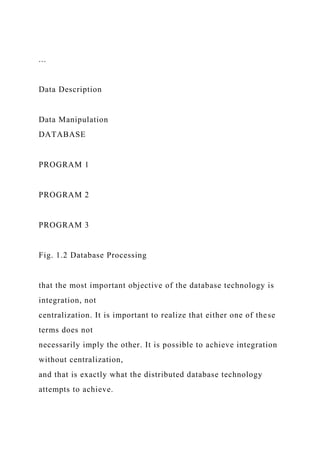
(Figure 1.1) to one in which the data are defined and
administered centrally (Figure
1.2). This new orientation results in data independence,
whereby the application
programs are immune to changes in the logical or physical
organization of the data,
and vice versa.
One of the major motivations behind the use of database
systems is the desire
to integrate the operational data of an enterprise and to provide
centralized, thus
controlled access to that data. The technology of computer
networks, on the other
hand, promotes a mode of work that goes against all
centralization efforts. At first
glance it might be difficult to understand how these two
contrasting approaches can
possibly be synthesized to produce a technology that is more
powerful and more
promising than either one alone. The key to this understanding
is the realization
PROGRAM 1
Data
Description
PROGRAM 2
FILE 1
FILE 2
FILE 3
PROGRAM 3
Data
Description
Data
Description
R
E
D
U
N
D
A
N
T
D
A
T
A
Fig. 1.1 Traditional File Processing
1
DOI 10.1007/978-1-4419-8834-8_1, © Springer
Science+Business Media, LLC 2011
M.T. Özsu and P. Valduriez, Principles of Distributed Database
Systems: Third Edition,
2 1 Introduction
...
Data Description
Data Manipulation
DATABASE
PROGRAM 1
PROGRAM 2
PROGRAM 3
Fig. 1.2 Database Processing
that the most important objective of the database technology is
integration, not
centralization. It is important to realize that either one of these
terms does not
necessarily imply the other. It is possible to achieve integration
without centralization,
and that is exactly what the distributed database technology
attempts to achieve.
In this chapter we define the fundamental concepts and set the
framework for
discussing distributed databases. We start by examining
distributed systems in general
in order to clarify the role of database technology within
distributed data processing,
and then move on to topics that are more directly related to
DDBS.
1.1 Distributed Data Processing
The term distributed processing (or distributed computing) is
hard to define precisely.
Obviously, some degree of distributed processing goes on in any
computer system,
even on single-processor computers where the central
processing unit (CPU) and in-
put/output (I/O) functions are separated and overlapped. This
separation and overlap
can be considered as one form of distributed processing. The
widespread emergence
of parallel computers has further complicated the picture, since
the distinction be-
tween distributed computing systems and some forms of parallel
computers is rather
vague.
In this book we define distributed processing in such a way that
it leads to a
definition of a distributed database system. The working
definition we use for a
distributed computing system states that it is a number of
autonomous processing
elements (not necessarily homogeneous) that are interconnected
by a computer
network and that cooperate in performing their assigned tasks.
The “processing
element” referred to in this definition is a computing device that
can execute a
program on its own. This definition is similar to those given in
distributed systems
textbooks (e.g., [Tanenbaum and van Steen, 2002] and [Colouris
et al., 2001]).
A fundamental question that needs to be asked is: What is being
distributed?
One of the things that might be distributed is the processing
logic. In fact, the
definition of a distributed computing system given above
implicitly assumes that the
1.2 What is a Distributed Database System? 3
processing logic or processing elements are distributed. Another
possible distribution
is according to function. Various functions of a computer
system could be delegated
to various pieces of hardware or software. A third possible
mode of distribution is
according to data. Data used by a number of applications may
be distributed to a
number of processing sites. Finally, control can be distributed.
The control of the
execution of various tasks might be distributed instead of being
performed by one
computer system. From the viewpoint of distributed database
systems, these modes
of distribution are all necessary and important. In the following
sections we talk
about these in more detail.
Another reasonable question to ask at this point is: Why do we
distribute at all?
The classical answers to this question indicate that distributed
processing better
corresponds to the organizational structure of today’s widely
distributed enterprises,
and that such a system is more reliable and more responsive.
More importantly,
many of the current applications of computer technology are
inherently distributed.
Web-based applications, electronic commerce business over the
Internet, multimedia
applications such as news-on-demand or medical imaging,
manufacturing control
systems are all examples of such applications.
From a more global perspective, however, it can be stated that
the fundamental
reason behind distributed processing is to be better able to cope
with the large-scale
data management problems that we face today, by using a
variation of the well-known
divide-and-conquer rule. If the necessary software support for
distributed processing
can be developed, it might be possible to solve these
complicated problems simply
by dividing them into smaller pieces and assigning them to
different software groups,
which work on different computers and produce a system that
runs on multiple
processing elements but can work efficiently toward the
execution of a common task.
Distributed database systems should also be viewed within this
framework and
treated as tools that could make distributed processing easier
and more efficient. It is
reasonable to draw an analogy between what distributed
databases might offer to the
data processing world and what the database technology has
already provided. There
is no doubt that the development of general-purpose, adaptable,
efficient distributed
database systems has aided greatly in the task of developing
distributed software.
1.2 What is a Distributed Database System?
We define a distributed database as a collection of multiple,
logically interrelated
databases distributed over a computer network. A distributed
database management
system (distributed DBMS) is then defined as the software
system that permits the
management of the distributed database and makes the
distribution transparent to the
users. Sometimes “distributed database system” (DDBS) is used
to refer jointly to
the distributed database and the distributed DBMS. The two
important terms in these
definitions are “logically interrelated” and “distributed over a
computer network.”
They help eliminate certain cases that have sometimes been
accepted to represent a
DDBS.
4 1 Introduction
A DDBS is not a “collection of files” that can be individually
stored at each
node of a computer network. To form a DDBS, files should not
only be logically
related, but there should be structured among the files, and
access should be via
a common interface. We should note that there has been much
recent activity in
providing DBMS functionality over semi-structured data that
are stored in files on
the Internet (such as Web pages). In light of this activity, the
above requirement
may seem unnecessarily strict. Nevertheless, it is important to
make a distinction
between a DDBS where this requirement is met, and more
general distributed data
management systems that provide a “DBMS-like” access to
data. In various chapters
of this book, we will expand our discussion to cover these more
general systems.
It has sometimes been assumed that the physical distribution of
data is not the
most significant issue. The proponents of this view would
therefore feel comfortable
in labeling as a distributed database a number of (related)
databases that reside in the
same computer system. However, the physical distribution of
data is important. It
creates problems that are not encountered when the databases
reside in the same com-
puter. These difficulties are discussed in Section 1.5. Note that
physical distribution
does not necessarily imply that the computer systems be
geographically far apart;
they could actually be in the same room. It simply implies that
the communication
between them is done over a network instead of through shared
memory or shared
disk (as would be the case with multiprocessor systems), with
the network as the only
shared resource.
This suggests that multiprocessor systems should not be
considered as DDBSs.
Although shared-nothing multiprocessors, where each processor
node has its own
primary and secondary memory, and may also have its own
peripherals, are quite
similar to the distributed environment that we focus on, there
are differences. The
fundamental difference is the mode of operation. A
multiprocessor system design
is rather symmetrical, consisting of a number of identical
processor and memory
components, and controlled by one or more copies of the same
operating system
that is responsible for a strict control of the task assignment to
each processor. This
is not true in distributed computing systems, where
heterogeneity of the operating
system as well as the hardware is quite common. Database
systems that run over
multiprocessor systems are called parallel database systems and
are discussed in
Chapter 14.
A DDBS is also not a system where, despite the existence of a
network, the
database resides at only one node of the network (Figure 1.3).
In this case, the
problems of database management are no different than the
problems encountered in
a centralized database environment (shortly, we will discuss
client/server DBMSs
which relax this requirement to a certain extent). The database
is centrally managed
by one computer system (site 2 in Figure 1.3) and all the
requests are routed to
that site. The only additional consideration has to do with
transmission delays. It
is obvious that the existence of a computer network or a
collection of “files” is not
sufficient to form a distributed database system. What we are
interested in is an
environment where data are distributed among a number of sites
(Figure 1.4).
1.3 Data Delivery Alternatives 5
Site 1
Site 2
Site 3Site 4
Site 5
Communication
Network
Fig. 1.3 Central Database on a Network
Site 1
Site 2
Site 3Site 4
Site 5
Communication
Network
Fig. 1.4 DDBS Environment
1.3 Data Delivery Alternatives
In distributed databases, data are “delivered” from the sites
where they are stored to
where the query is posed. We characterize the data delivery
alternatives along three
orthogonal dimensions: delivery modes, frequency and
communication methods. The
combinations of alternatives along each of these dimensions
(that we discuss next)
provide a rich design space.
The alternative delivery modes are pull-only, push-only and
hybrid. In the pull-
only mode of data delivery, the transfer of data from servers to
clients is initiated
by a client pull. When a client request is received at a server,
the server responds by
locating the requested information. The main characteristic of
pull-based delivery is
that the arrival of new data items or updates to existing data
items are carried out at a
6 1 Introduction
server without notification to clients unless clients explicitly
poll the server. Also, in
pull-based mode, servers must be interrupted continuously to
deal with requests from
clients. Furthermore, the information that clients can obtain
from a server is limited
to when and what clients know to ask for. Conventional DBMSs
offer primarily
pull-based data delivery.
In the push-only mode of data delivery, the transfer of data
from servers to clients
is initiated by a server push in the absence of any specific
request from clients.
The main difficulty of the push-based approach is in deciding
which data would be
of common interest, and when to send them to clients –
alternatives are periodic,
irregular, or conditional. Thus, the usefulness of server push
depends heavily upon
the accuracy of a server to predict the needs of clients. In push-
based mode, servers
disseminate information to either an unbounded set of clients
(random broadcast)
who can listen to a medium or selective set of clients
(multicast), who belong to some
categories of recipients that may receive the data.
The hybrid mode of data delivery combines the client-pull and
server-push mech-
anisms. The continuous (or continual) query approach (e.g.,
[Liu et al., 1996],[Terry
et al., 1992],[Chen et al., 2000],[Pandey et al., 2003]) presents
one possible way of
combining the pull and push modes: namely, the transfer of
information from servers
to clients is first initiated by a client pull (by posing the query),
and the subsequent
transfer of updated information to clients is initiated by a server
push.
There are three typical frequency measurements that can be
used to classify the
regularity of data delivery. They are periodic, conditional, and
ad-hoc or irregular.
In periodic delivery, data are sent from the server to clients at
regular intervals.
The intervals can be defined by system default or by clients
using their profiles. Both
pull and push can be performed in periodic fashion. Periodic
delivery is carried out
on a regular and pre-specified repeating schedule. A client
request for IBM’s stock
price every week is an example of a periodic pull. An example
of periodic push is
when an application can send out stock price listing on a regular
basis, say every
morning. Periodic push is particularly useful for situations in
which clients might not
be available at all times, or might be unable to react to what has
been sent, such as in
the mobile setting where clients can become disconnected.
In conditional delivery, data are sent from servers whenever
certain conditions
installed by clients in their profiles are satisfied. Such
conditions can be as simple
as a given time span or as complicated as event-condition-action
rules. Conditional
delivery is mostly used in the hybrid or push-only delivery
systems. Using condi-
tional push, data are sent out according to a pre-specified
condition, rather than
any particular repeating schedule. An application that sends out
stock prices only
when they change is an example of conditional push. An
application that sends out a
balance statement only when the total balance is 5% below the
pre-defined balance
threshold is an example of hybrid conditional push. Conditional
push assumes that
changes are critical to the clients, and that clients are always
listening and need to
respond to what is being sent. Hybrid conditional push further
assumes that missing
some update information is not crucial to the clients.
Ad-hoc delivery is irregular and is performed mostly in a pure
pull-based system.
Data are pulled from servers to clients in an ad-hoc fashion
whenever clients request
1.4 Promises of DDBSs 7
it. In contrast, periodic pull arises when a client uses polling to
obtain data from
servers based on a regular period (schedule).
The third component of the design space of information delivery
alternatives is the
communication method. These methods determine the various
ways in which servers
and clients communicate for delivering information to clients.
The alternatives are
unicast and one-to-many. In unicast, the communication from a
server to a client
is one-to-one: the server sends data to one client using a
particular delivery mode
with some frequency. In one-to-many, as the name implies, the
server sends data
to a number of clients. Note that we are not referring here to a
specific protocol;
one-to-many communication may use a multicast or broadcast
protocol.
We should note that this characterization is subject to
considerable debate. It is
not clear that every point in the design space is meaningful.
Furthermore, specifi-
cation of alternatives such as conditional and periodic (which
may make sense) is
difficult. However, it serves as a first-order characterization of
the complexity of
emerging distributed data management systems. For the most
part, in this book, we
are concerned with pull-only, ad hoc data delivery systems,
although examples of
other approaches are discussed in some chapters.
1.4 Promises of DDBSs
Many advantages of DDBSs have been cited in literature,
ranging from sociological
reasons for decentralization [D’Oliviera, 1977] to better
economics. All of these can
be distilled to four fundamentals which may also be viewed as
promises of DDBS
technology: transparent management of distributed and
replicated data, reliable
access to data through distributed transactions, improved
performance, and easier
system expansion. In this section we discuss these promises
and, in the process,
introduce many of the concepts that we will study in subsequent
chapters.
1.4.1 Transparent Management of Distributed and Replicated
Data
Transparency refers to separation of the higher-level semantics
of a system from
lower-level implementation issues. In other words, a transparent
system “hides” the
implementation details from users. The advantage of a fully
transparent DBMS is the
high level of support that it provides for the development of
complex applications. It
is obvious that we would like to make all DBMSs (centralized
or distributed) fully
transparent.
Let us start our discussion with an example. Consider an
engineering firm that
has offices in Boston, Waterloo, Paris and San Francisco. They
run projects at
each of these sites and would like to maintain a database of
their employees, the
projects and other related data. Assuming that the database is
relational, we can store
8 1 Introduction
this information in two relations: EMP(ENO, ENAME, TITLE)1
and PROJ(PNO,
PNAME, BUDGET). We also introduce a third relation to store
salary information:
SAL(TITLE, AMT) and a fourth relation ASG which indicates
which employees
have been assigned to which projects for what duration with
what responsibility:
ASG(ENO, PNO, RESP, DUR). If all of this data were stored in
a centralized DBMS,
and we wanted to find out the names and employees who
worked on a project for
more than 12 months, we would specify this using the following
SQL query:
SELECT ENAME, AMT
FROM EMP, ASG, SAL
WHERE ASG.DUR > 12
AND EMP.ENO = ASG.ENO
AND SAL.TITLE = EMP.TITLE
However, given the distributed nature of this firm’s business, it
is preferable, under
these circumstances, to localize data such that data about the
employees in Waterloo
office are stored in Waterloo, those in the Boston office are
stored in Boston, and
so forth. The same applies to the project and salary information.
Thus, what we
are engaged in is a process where we partition each of the
relations and store each
partition at a different site. This is known as fragmentation and
we discuss it further
below and in detail in Chapter 3.
Furthermore, it may be preferable to duplicate some of this data
at other sites
for performance and reliability reasons. The result is a
distributed database which
is fragmented and replicated (Figure 1.5). Fully transparent
access means that the
users can still pose the query as specified above, without paying
any attention to
the fragmentation, location, or replication of data, and let the
system worry about
resolving these issues.
For a system to adequately deal with this type of query over a
distributed, frag-
mented and replicated database, it needs to be able to deal with
a number of different
types of transparencies. We discuss these in this section.
1.4.1.1 Data Independence
Data independence is a fundamental form of transparency that
we look for within a
DBMS. It is also the only type that is important within the
context of a centralized
DBMS. It refers to the immunity of user applications to changes
in the definition and
organization of data, and vice versa.
As is well-known, data definition occurs at two levels. At one
level the logical
structure of the data are specified, and at the other level its
physical structure. The
former is commonly known as the schema definition, whereas
the latter is referred
to as the physical data description. We can therefore talk about
two types of data
1 We discuss relational systems in Chapter 2 (Section 2.1)
where we develop this example further.
For the time being, it is sufficient to note that this nomenclature
indicates that we have just defined
a relation with three attributes: ENO (which is the key,
identified by underlining), ENAME and
TITLE.
1.4 Promises of DDBSs 9
Paris
San
FranciscoWaterloo
Boston
Communication
Network
Boston employees, Paris employees,
Boston projects
Waterloo employees,
Waterloo projects, Paris projects
San Francisco employees,
San Francisco projects
Paris employees, Boston employees,
Paris projects, Boston projects
Fig. 1.5 A Distributed Application
independence: logical data independence and physical data
independence. Logical
data independence refers to the immunity of user applications to
changes in the
logical structure (i.e., schema) of the database. Physical data
independence, on the
other hand, deals with hiding the details of the storage structure
from user applications.
When a user application is written, it should not be concerned
with the details of
physical data organization. Therefore, the user application
should not need to be
modified when data organization changes occur due to
performance considerations.
1.4.1.2 Network Transparency
In centralized database systems, the only available resource that
needs to be shielded
from the user is the data (i.e., the storage system). In a
distributed database envi-
ronment, however, there is a second resource that needs to be
managed in much
the same manner: the network. Preferably, the user should be
protected from the
operational details of the network; possibly even hiding the
existence of the network.
Then there would be no difference between database
applications that would run on
a centralized database and those that would run on a distributed
database. This type
of transparency is referred to as network transparency or
distribution transparency.
One can consider network transparency from the viewpoint of
either the services
provided or the data. From the former perspective, it is
desirable to have a uniform
means by which services are accessed. From a DBMS
perspective, distribution
transparency requires that users do not have to specify where
data are located.
Sometimes two types of distribution transparency are identified:
location trans-
parency and naming transparency. Location transparency refers
to the fact that the
10 1 Introduction
command used to perform a task is independent of both the
location of the data and
the system on which an operation is carried out. Naming
transparency means that a
unique name is provided for each object in the database. In the
absence of naming
transparency, users are required to embed the location name (or
an identifier) as part
of the object name.
1.4.1.3 Replication Transparency
The issue of replicating data within a distributed database is
introduced in Chapter
3 and discussed in detail in Chapter 13. At this point, let us just
mention that for
performance, reliability, and availability reasons, it is usually
desirable to be able
to distribute data in a replicated fashion across the machines on
a network. Such
replication helps performance since diverse and conflicting user
requirements can be
more easily accommodated. For example, data that are
commonly accessed by one
user can be placed on that user’s local machine as well as on the
machine of another
user with the same access requirements. This increases the
locality of reference.
Furthermore, if one of the machines fails, a copy of the data are
still available on
another machine on the network. Of course, this is a very
simple-minded description
of the situation. In fact, the decision as to whether to replicate
or not, and how many
copies of any database object to have, depends to a considerable
degree on user
applications. We will discuss these in later chapters.
Assuming that data are replicated, the transparency issue is
whether the users
should be aware of the existence of copies or whether the
system should handle the
management of copies and the user should act as if there is a
single copy of the data
(note that we are not referring to the placement of copies, only
their existence). From
a user’s perspective the answer is obvious. It is preferable not
to be involved with
handling copies and having to specify the fact that a certain
action can and/or should
be taken on multiple copies. From a systems point of view,
however, the answer is not
that simple. As we will see in Chapter 11, when the
responsibility of specifying that
an action needs to be executed on multiple copies is delegated
to the user, it makes
transaction management simpler for distributed DBMSs. On the
other hand, doing
so inevitably results in the loss of some flexibility. It is not the
system that decides
whether or not to have copies and how many copies to have, but
the user application.
Any change in these decisions because of various considerations
definitely affects
the user application and, therefore, reduces data independence
considerably. Given
these considerations, it is desirable that replication transparency
be provided as a
standard feature of DBMSs. Remember that replication
transparency refers only
to the existence of replicas, not to their actual location. Note
also that distributing
these replicas across the network in a transparent manner is the
domain of network
transparency.
1.4 Promises of DDBSs 11
1.4.1.4 Fragmentation Transparency
The final form of transparency that needs to be addressed within
the context of a
distributed database system is that of fragmentation
transparency. In Chapter 3 we
discuss and justify the fact that it is commonly desirable to
divide each database
relation into smaller fragments and treat each fragment as a
separate database object
(i.e., another relation). This is commonly done for reasons of
performance, avail-
ability, and reliability. Furthermore, fragmentation can reduce
the negative effects of
replication. Each replica is not the full relation but only a
subset of it; thus less space
is required and fewer data items need be managed.
There are two general types of fragmentation alternatives. In
one case, called
horizontal fragmentation, a relation is partitioned into a set of
sub-relations each
of which have a subset of the tuples (rows) of the original
relation. The second
alternative is vertical fragmentation where each sub-relation is
defined on a subset of
the attributes (columns) of the original relation.
When database objects are fragmented, we have to deal with the
problem of
handling user queries that are specified on entire relations but
have to be executed on
subrelations. In other words, the issue is one of finding a query
processing strategy
based on the fragments rather than the relations, even though
the queries are specified
on the latter. Typically, this requires a translation from what is
called a global query to
several fragment queries. Since the fundamental issue of dealing
with fragmentation
transparency is one of query processing, we defer the discussion
of techniques by
which this translation can be performed until Chapter 7.
1.4.1.5 Who Should Provide Transparency?
In previous sections we discussed various possible forms of
transparency within a
distributed computing environment. Obviously, to provide easy
and efficient access
by novice users to the services of the DBMS, one would want to
have full trans-
parency, involving all the various types that we discussed.
Nevertheless, the level of
transparency is inevitably a compromise between ease of use
and the difficulty and
overhead cost of providing high levels of transparency. For
example, Gray argues
that full transparency makes the management of distributed data
very difficult and
claims that “applications coded with transparent access to
geographically distributed
databases have: poor manageability, poor modularity, and poor
message performance”
[Gray, 1989]. He proposes a remote procedure call mechanism
between the requestor
users and the server DBMSs whereby the users would direct
their queries to a specific
DBMS. This is indeed the approach commonly taken by
client/server systems that
we discuss shortly.
What has not yet been discussed is who is responsible for
providing these services.
It is possible to identify three distinct layers at which the
transparency services can be
provided. It is quite common to treat these as mutually
exclusive means of providing
the service, although it is more appropriate to view them as
complementary.
12 1 Introduction
We could leave the responsibility of providing transparent
access to data resources
to the access layer. The transparency features can be built into
the user language,
which then translates the requested services into required
operations. In other words,
the compiler or the interpreter takes over the task and no
transparent service is
provided to the implementer of the compiler or the interpreter.
The second layer at which transparency can be provided is the
operating system
level. State-of-the-art operating systems provide some level of
transparency to system
users. For example, the device drivers within the operating
system handle the details
of getting each piece of peripheral equipment to do what is
requested. The typical
computer user, or even an application programmer, does not
normally write device
drivers to interact with individual peripheral equipment; that
operation is transparent
to the user.
Providing transparent access to resources at the operating
system level can ob-
viously be extended to the distributed environment, where the
management of the
network resource is taken over by the distributed operating
system or the middleware
if the distributed DBMS is implemented over one. There are two
potential problems
with this approach. The first is that not all commercially
available distributed operat-
ing systems provide a reasonable level of transparency in
network management. The
second problem is that some applications do not wish to be
shielded from the details
of distribution and need to access them for specific performance
tuning.
The third layer at which transparency can be supported is within
the DBMS. The
transparency and support for database functions provided to the
DBMS designers
by an underlying operating system is generally minimal and
typically limited to
very fundamental operations for performing certain tasks. It is
the responsibility of
the DBMS to make all the necessary translations from the
operating system to the
higher-level user interface. This mode of operation is the most
common method today.
There are, however, various problems associated with leaving
the task of providing
full transparency to the DBMS. These have to do with the
interaction of the operating
system with the distributed DBMS and are discussed throughout
this book.
A hierarchy of these transparencies is shown in Figure 1.6. It is
not always easy
to delineate clearly the levels of transparency, but such a figure
serves an important
instructional purpose even if it is not fully correct. To complete
the picture we
have added a “language transparency” layer, although it is not
discussed in this
chapter. With this generic layer, users have high-level access to
the data (e.g., fourth-
generation languages, graphical user interfaces, natural
language access).
1.4.2 Reliability Through Distributed Transactions
Distributed DBMSs are intended to improve reliability since
they have replicated
components and, thereby eliminate single points of failure. The
failure of a single site,
or the failure of a communication link which makes one or more
sites unreachable,
is not sufficient to bring down the entire system. In the case of
a distributed database,
this means that some of the data may be unreachable, but with
proper care, users
1.4 Promises of DDBSs 13
Data
Da
ta
Independence
Ne
two
rk
Transparency
Re
pli
cat
ion
Transparency
Fr
ag
me
ntat
ion
Transparency
La
ng
ua
ge
Transparency
Fig. 1.6 Layers of Transparency
may be permitted to access other parts of the distributed
database. The “proper care”
comes in the form of support for distributed transactions and
application protocols.
We discuss transactions and transaction processing in detail in
Chapters 10–12.
A transaction is a basic unit of consistent and reliable
computing, consisting of a
sequence of database operations executed as an atomic action. It
transforms a consis-
tent database state to another consistent database state even
when a number of such
transactions are executed concurrently (sometimes called
concurrency transparency),
and even when failures occur (also called failure atomicity).
Therefore, a DBMS
that provides full transaction support guarantees that concurrent
execution of user
transactions will not violate database consistency in the face of
system failures as
long as each transaction is correct, i.e., obeys the integrity rules
specified on the
database.
Let us give an example of a transaction based on the
engineering firm example
that we introduced earlier. Assume that there is an application
that updates the
salaries of all the employees by 10%. It is desirable to
encapsulate the query (or
the program code) that accomplishes this task within transaction
boundaries. For
example, if a system failure occurs half-way through the
execution of this program,
we would like the DBMS to be able to determine, upon
recovery, where it left off
and continue with its operation (or start all over again). This is
the topic of failure
atomicity. Alternatively, if some other user runs a query
calculating the average
salaries of the employees in this firm while the original update
action is going on, the
calculated result will be in error. Therefore we would like the
system to be able to
synchronize the concurrent execution of these two programs. To
encapsulate a query
(or a program code) within transactional boundaries, it is
sufficient to declare the
begin of the transaction and its end:
Begin transaction SALARY UPDATE
begin
EXEC SQL UPDATE PAY
SET SAL = SAL*1.1
end.
14 1 Introduction
Distributed transactions execute at a number of sites at which
they access the
local database. The above transaction, for example, will execute
in Boston, Waterloo,
Paris and San Francisco since the data are distributed at these
sites. With full support
for distributed transactions, user applications can access a
single logical image of
the database and rely on the distributed DBMS to ensure that
their requests will be
executed correctly no matter what happens in the system.
“Correctly” means that
user applications do not need to be concerned with coordinating
their accesses to
individual local databases nor do they need to worry about the
possibility of site or
communication link failures during the execution of their
transactions. This illustrates
the link between distributed transactions and transparency,
since both involve issues
related to distributed naming and directory management, among
other things.
Providing transaction support requires the implementation of
distributed concur-
rency control (Chapter 11) and distributed reliability (Chapter
12) protocols — in
particular, two-phase commit (2PC) and distributed recovery
protocols — which are
significantly more complicated than their centralized
counterparts. Supporting repli-
cas requires the implementation of replica control protocols that
enforce a specified
semantics of accessing them (Chapter 13).
1.4.3 Improved Performance
The case for the improved performance of distributed DBMSs is
typically made
based on two points. First, a distributed DBMS fragments the
conceptual database,
enabling data to be stored in close proximity to its points of use
(also called data
localization). This has two potential advantages:
1. Since each site handles only a portion of the database,
contention for CPU
and I/O services is not as severe as for centralized databases.
2. Localization reduces remote access delays that are usually
involved in wide
area networks (for example, the minimum round-trip message
propagation
delay in satellite-based systems is about 1 second).
Most distributed DBMSs are structured to gain maximum
benefit from data localiza-
tion. Full benefits of reduced contention and reduced
communication overhead can
be obtained only by a proper fragmentation and distribution of
the database.
This point relates to the overhead of distributed computing if
the data have
to reside at remote sites and one has to access it by remote
communication. The
argument is that it is better, in these circumstances, to distribute
the data management
functionality to where the data are located rather than moving
large amounts of data.
This has lately become a topic of contention. Some argue that
with the widespread
use of high-speed, high-capacity networks, distributing data and
data management
functions no longer makes sense and that it may be much
simpler to store data
at a central site and access it (by downloading) over high-speed
networks. This
argument, while appealing, misses the point of distributed
databases. First of all, in
1.4 Promises of DDBSs 15
most of today’s applications, data are distributed; what may be
open for debate is
how and where we process it. Second, and more important,
point is that this argument
does not distinguish between bandwidth (the capacity of the
computer links) and
latency (how long it takes for data to be transmitted). Latency is
inherent in the
distributed environments and there are physical limits to how
fast we can send data
over computer networks. As indicated above, for example,
satellite links take about
half-a-second to transmit data between two ground stations.
This is a function of the
distance of the satellites from the earth and there is nothing that
we can do to improve
that performance. For some applications, this might constitute
an unacceptable delay.
The second case point is that the inherent parallelism of
distributed systems
may be exploited for inter-query and intra-query parallelism.
Inter-query parallelism
results from the ability to execute multiple queries at the same
time while intra-query
parallelism is achieved by breaking up a single query into a
number of subqueries each
of which is executed at a different site, accessing a different
part of the distributed
database.
If the user access to the distributed database consisted only of
querying (i.e.,
read-only access), then provision of inter-query and intra-query
parallelism would
imply that as much of the database as possible should be
replicated. However, since
most database accesses are not read-only, the mixing of read
and update operations
requires the implementation of elaborate concurrency control
and commit protocols.
1.4.4 Easier System Expansion
In a distributed environment, it is much easier to accommodate
increasing database
sizes. Major system overhauls are seldom necessary; expansion
can usually be
handled by adding processing and storage power to the network.
Obviously, it may
not be possible to obtain a linear increase in “power,” since this
also depends on the
overhead of distribution. However, significant improvements
are still possible.
One aspect of easier system expansion is economics. It normally
costs much less
to put together a system of “smaller” computers with the
equivalent power of a single
big machine. In earlier times, it was commonly believed that it
would be possible
to purchase a fourfold powerful computer if one spent twice as
much. This was
known as Grosh’s law. With the advent of microcomputers and
workstations, and
their price/performance characteristics, this law is considered
invalid.
This should not be interpreted to mean that mainframes are
dead; this is not the
point that we are making here. Indeed, in recent years, we have
observed a resurgence
in the world-wide sale of mainframes. The point is that for
many applications, it is
more economical to put together a distributed computer system
(whether composed
of mainframes or workstations) with sufficient power than it is
to establish a single,
centralized system to run these tasks. In fact, the latter may not
even be feasible these
days.
16 1 Introduction
1.5 Complications Introduced by Distribution
The problems encountered in database systems take on
additional complexity in a
distributed environment, even though the basic underlying
principles are the same.
Furthermore, this additional complexity gives rise to new
problems influenced mainly
by three factors.
First, data may be replicated in a distributed environment. A
distributed database
can be designed so that the entire database, or portions of it,
reside at different sites
of a computer network. It is not essential that every site on the
network contain the
database; it is only essential that there be more than one site
where the database
resides. The possible duplication of data items is mainly due to
reliability and effi-
ciency considerations. Consequently, the distributed database
system is responsible
for (1) choosing one of the stored copies of the requested data
for access in case of
retrievals, and (2) making sure that the effect of an update is
reflected on each and
every copy of that data item.
Second, if some sites fail (e.g., by either hardware or software
malfunction), or
if some communication links fail (making some of the sites
unreachable) while an
update is being executed, the system must make sure that the
effects will be reflected
on the data residing at the failing or unreachable sites as soon
as the system can
recover from the failure.
The third point is that since each site cannot have instantaneous
information
on the actions currently being carried out at the other sites, the
synchronization of
transactions on multiple sites is considerably harder than for a
centralized system.
These difficulties point to a number of potential problems with
distributed DBMSs.
These are the inherent complexity of building distributed
applications, increased
cost of replicating resources, and, more importantly, managing
distribution, the
devolution of control to many centers and the difficulty of
reaching agreements,
and the exacerbated security concerns (the secure
communication channel problem).
These are well-known problems in distributed systems in
general, and, in this book,
we discuss their manifestations within the context of distributed
DBMS and how they
can be addressed.
1.6 Design Issues
In Section 1.4, we discussed the promises of distributed DBMS
technology, highlight-
ing the challenges that need to be overcome in order to realize
them. In this section
we build on this discussion by presenting the design issues that
arise in building a
distributed DBMS. These issues will occupy much of the
remainder of this book.
1.6 Design Issues 17
1.6.1 Distributed Database Design
The question that is being addressed is how the database and the
applications that run
against it should be placed across the sites. There are two basic
alternatives to placing
data: partitioned (or non-replicated) and replicated. In the
partitioned scheme the
database is divided into a number of disjoint partitions each of
which is placed at
a different site. Replicated designs can be either fully replicated
(also called fully
duplicated) where the entire database is stored at each site, or
partially replicated (or
partially duplicated) where each partition of the database is
stored at more than one
site, but not at all the sites. The two fundamental design issues
are fragmentation,
the separation of the database into partitions called fragments,
and distribution, the
optimum distribution of fragments.
The research in this area mostly involves mathematical
programming in order
to minimize the combined cost of storing the database,
processing transactions
against it, and message communication among sites. The general
problem is NP-hard.
Therefore, the proposed solutions are based on heuristics.
Distributed database design
is the topic of Chapter 3.
1.6.2 Distributed Directory Management
A directory contains information (such as descriptions and
locations) about data
items in the database. Problems related to directory management
are similar in nature
to the database placement problem discussed in the preceding
section. A directory
may be global to the entire DDBS or local to each site; it can be
centralized at one
site or distributed over several sites; there can be a single copy
or multiple copies.
We briefly discuss these issues in Chapter 3.
1.6.3 Distributed Query Processing
Query processing deals with designing algorithms that analyze
queries and convert
them into a series of data manipulation operations. The problem
is how to decide
on a strategy for executing each query over the network in the
most cost-effective
way, however cost is defined. The factors to be considered are
the distribution of
data, communication costs, and lack of sufficient locally-
available information. The
objective is to optimize where the inherent parallelism is used
to improve the perfor-
mance of executing the transaction, subject to the above-
mentioned constraints. The
problem is NP-hard in nature, and the approaches are usually
heuristic. Distributed
query processing is discussed in detail in Chapter 6 - 8.
18 1 Introduction
1.6.4 Distributed Concurrency Control
Concurrency control involves the synchronization of accesses to
the distributed data-
base, such that the integrity of the database is maintained. It is,
without any doubt,
one of the most extensively studied problems in the DDBS field.
The concurrency
control problem in a distributed context is somewhat different
than in a centralized
framework. One not only has to worry about the integrity of a
single database, but
also about the consistency of multiple copies of the database.
The condition that
requires all the values of multiple copies of every data item to
converge to the same
value is called mutual consistency.
The alternative solutions are too numerous to discuss here, so
we examine them in
detail in Chapter 11. Let us only mention that the two general
classes are pessimistic ,
synchronizing the execution of user requests before the
execution starts, and opti-
mistic, executing the requests and then checking if the
execution has compromised
the consistency of the database. Two fundamental primitives
that can be used with
both approaches are locking, which is based on the mutual
exclusion of accesses to
data items, and timestamping, where the transaction executions
are ordered based on
timestamps. There are variations of these schemes as well as
hybrid algorithms that
attempt to combine the two basic mechanisms.
1.6.5 Distributed Deadlock Management
The deadlock problem in DDBSs is similar in nature to that
encountered in operating
systems. The competition among users for access to a set of
resources (data, in this
case) can result in a deadlock if the synchronization mechanism
is based on locking.
The well-known alternatives of prevention, avoidance, and
detection/recovery also
apply to DDBSs. Deadlock management is covered in Chapter
11.
1.6.6 Reliability of Distributed DBMS
We mentioned earlier that one of the potential advantages of
distributed systems
is improved reliability and availability. This, however, is not a
feature that comes
automatically. It is important that mechanisms be provided to
ensure the consistency
of the database as well as to detect failures and recover from
them. The implication
for DDBSs is that when a failure occurs and various sites
become either inoperable
or inaccessible, the databases at the operational sites remain
consistent and up to date.
Furthermore, when the computer system or network recovers
from the failure, the
DDBSs should be able to recover and bring the databases at the
failed sites up-to-date.
This may be especially difficult in the case of network
partitioning, where the sites
are divided into two or more groups with no communication
among them. Distributed
reliability protocols are the topic of Chapter 12.
1.6 Design Issues 19
Directory
Management
Query
Processing
Distributed
DB Design
Concurrency
Control
Deadlock
Management
Reliability
Replication
Fig. 1.7 Relationship Among Research Issues
1.6.7 Replication
If the distributed database is (partially or fully) replicated, it is
necessary to implement
protocols that ensure the consistency of the replicas,i.e., copies
of the same data item
have the same value. These protocols can be eager in that they
force the updates
to be applied to all the replicas before the transaction
completes, or they may be
lazy so that the transaction updates one copy (called the master)
from which updates
are propagated to the others after the transaction completes. We
discuss replication
protocols in Chapter 13.
1.6.8 Relationship among Problems
Naturally, these problems are not isolated from one another.
Each problem is affected
by the solutions found for the others, and in turn affects the set
of feasible solutions
for them. In this section we discuss how they are related.
The relationship among the components is shown in Figure 1.7.
The design of
distributed databases affects many areas. It affects directory
management, because the
definition of fragments and their placement determine the
contents of the directory
(or directories) as well as the strategies that may be employed
to manage them.
The same information (i.e., fragment structure and placement) is
used by the query
processor to determine the query evaluation strategy. On the
other hand, the access
and usage patterns that are determined by the query processor
are used as inputs to
the data distribution and fragmentation algorithms. Similarly,
directory placement
and contents influence the processing of queries.
20 1 Introduction
The replication of fragments when they are distributed affects
the concurrency
control strategies that might be employed. As we will study in
Chapter 11, some
concurrency control algorithms cannot be easily used with
replicated databases.
Similarly, usage and access patterns to the database will
influence the concurrency
control algorithms. If the environment is update intensive, the
necessary precautions
are quite different from those in a query-only environment.
There is a strong relationship among the concurrency control
problem, the dead-
lock management problem, and reliability issues. This is to be
expected, since to-
gether they are usually called the transaction management
problem. The concurrency
control algorithm that is employed will determine whether or
not a separate deadlock
management facility is required. If a locking-based algorithm is
used, deadlocks will
occur, whereas they will not if timestamping is the chosen
alternative.
Reliability mechanisms involve both local recovery techniques
and distributed
reliability protocols. In that sense, they both influence the
choice of the concurrency
control techniques and are built on top of them. Techniques to
provide reliability also
make use of data placement information since the existence of
duplicate copies of
the data serve as a safeguard to maintain reliable operation.
Finally, the need for replication protocols arise if data
distribution involves replicas.
As indicated above, there is a strong relationship between
replication protocols and
concurrency control techniques, since both deal with the
consistency of data, but from
different perspectives. Furthermore, the replication protocols
influence distributed
reliability techniques such as commit protocols. In fact, it is
sometimes suggested
(wrongly, in our view) that replication protocols can be used
instead of implementing
distributed commit protocols.
1.6.9 Additional Issues
The above design issues cover what may be called “traditional”
distributed database
systems. The environment has changed significantly since these
topics started to be
investigated, posing additional challenges and opportunities.
One of the important developments has been the move towards
“looser” federation
among data sources, which may also be heterogeneous. As we
discuss in the next
section, this has given rise to the development of multidatabase
systems (also called
federated databases and data integration systems) that require
re-investigation of
some of the fundamental database techniques. These systems
constitute an important
part of today’s distributed environment. We discuss database
design issues in multi-
database systems (i.e., database integration) in Chapter 4 and
the query processing
challenges in Chapter 9.
The growth of the Internet as a fundamental networking
platform has raised
important questions about the assumptions underlying
distributed database systems.
Two issues are of particular concern to us. One is the re-
emergence of peer-to-peer
computing, and the other is the development and growth of the
World Wide Web
(web for short). Both of these aim at improving data sharing,
but take different
1.7 Distributed DBMS Architecture 21
approaches and pose different data management challenges. We
discuss peer-to-peer
data management in Chapter 16 and web data management in
Chapter 17.
We should note that peer-to-peer is not a new concept in
distributed databases,
as we discuss in the next section. However, their new re-
incarnation has significant
differences from the earlier versions. In Chapter 16, it is these
new versions that we
focus on.
Finally, as earlier noted, there is a strong relationship between
distributed
databases and parallel databases. Although the former assumes
each site to be a
single logical computer, most of these installations are, in fact,
parallel clusters. Thus,
while most of the book focuses on issues that arise in managing
data distributed
across these sites, interesting data management issues exist
within a single logical
site that may be a parallel system. We discuss these issues in
Chapter 14.
1.7 Distributed DBMS Architecture
The architecture of a system defines its structure. This means
that the components of
the system are identified, the function of each component is
specified, and the interre-
lationships and interactions among these components are
defined. The specification
of the architecture of a system requires identification of the
various modules, with
their interfaces and interrelationships, in terms of the data and
control flow through
the system.
In this section we develop three “reference” architectures2 for a
distributed DBMS:
client/server systems, peer-to-peer distributed DBMS, and
multidatabase systems.
These are “idealized” views of a DBMS in that many of the
commercially available
systems may deviate from them; however, the architectures will
serve as a reasonable
framework within which the issues related to distributed DBMS
can be discussed.
We first start with a brief presentation of the “ANSI/SPARC
architecture”, which is
a datalogical approach to defining a DBMS architecture – it
focuses on the different
user classes and roles and their varying views on data. This
architecture is helpful in
putting certain concepts we have discussed so far in their proper
perspective. We then
have a short discussion of a generic architecture of a centralized
DBMSs, that we
subsequently extend to identify the set of alternative
architectures for a distributed
DBMS. Whithin this characterization, we focus on the three
alternatives that we
identified above.
1.7.1 ANSI/SPARC Architecture
In late 1972, the Computer and Information Processing
Committee (X3) of the Amer-
ican National Standards Institute (ANSI) established a Study
Group on Database
2 A reference architecture is commonly created by standards
developers to clearly define the
interfaces that need to be standardized.
22 1 Introduction
External
Schema
Conceptual
Schema
Internal
Schema
Internal
view
Conceptual
view
External
view
External
view
External
view
Users
Fig. 1.8 The ANSI/SPARC Architecture
Management Systems under the auspices of its Standards
Planning and Requirements
Committee (SPARC). The mission of the study group was to
study the feasibility
of setting up standards in this area, as well as determining
which aspects should be
standardized if it was feasible. The study group issued its
interim report in 1975
[ANSI/SPARC, 1975], and its final report in 1977 [Tsichritzis
and Klug, 1978].
The architectural framework proposed in these reports came to
be known as the
“ANSI/SPARC architecture,” its full title being
“ANSI/X3/SPARC DBMS Frame-
work.” The study group proposed that the interfaces be
standardized, and defined
an architectural framework that contained 43 interfaces, 14 of
which would deal
with the physical storage subsystem of the computer and
therefore not be considered
essential parts of the DBMS architecture.
A simplified version of the ANSI/SPARC architecture is
depicted in Figure 1.8.
There are three views of data: the external view, which is that
of the end user, who
might be a programmer; the internal view, that of the system or
machine; and
the conceptual view, that of the enterprise. For each of these
views, an appropriate
schema definition is required.
At the lowest level of the architecture is the internal view,
which deals with the
physical definition and organization of data. The location of
data on different storage
devices and the access mechanisms used to reach and
manipulate data are the issues
dealt with at this level. At the other extreme is the external
view, which is concerned
with how users view the database. An individual user’s view
represents the portion of
the database that will be accessed by that user as well as the
relationships that the user
would like to see among the data. A view can be shared among a
number of users,
with the collection of user views making up the external
schema. In between these
two ends is the conceptual schema, which is an abstract
definition of the database. It
is the “real world” view of the enterprise being modeled in the
database [Yormark,
1977]. As such, it is supposed to represent the data and the
relationships among data
without considering the requirements of individual applications
or the restrictions
of the physical storage media. In reality, however, it is not
possible to ignore these
1.7 Distributed DBMS Architecture 23
requirements completely, due to performance reasons. The
transformation between
these three levels is accomplished by mappings that specify how
a definition at one
level can be obtained from a definition at another level.
This perspective is important, because it provides the basis for
data independence
that we discussed earlier. The separation of the external
schemas from the conceptual
schema enables logical data independence, while the separation
of the conceptual
schema from the internal schema allows physical data
independence.
1.7.2 A Generic Centralized DBMS Architecture
A DBMS is a reentrant program shared by multiple processes
(transactions), that
run database programs. When running on a general purpose
computer, a DBMS is
interfaced with two other components: the communication
subsystem and the operat-
ing system. The communication subsystem permits interfacing
the DBMS with other
subsystems in order to communicate with applications. For
example, the terminal
monitor needs to communicate with the DBMS to run
interactive transactions. The
operating system provides the interface between the DBMS and
computer resources
(processor, memory, disk drives, etc.).
The functions performed by a DBMS can be layered as in Figure
1.9, where the
arrows indicate the direction of the data and the control flow.
Taking a top-down
approach, the layers are the interface, control, compilation,
execution, data access,
and consistency management.
The interface layer manages the interface to the applications.
There can be
several interfaces such as, in the case of relational DBMSs
discussed in Chapter
2, SQL embedded in a host language, such as C and QBE
(Query-by-Example).
Database application programs are executed against external
views of the database.
For an application, a view is useful in representing its particular
perception of the
database (shared by many applications). A view in relational
DBMSs is a virtual
relation derived from base relations by applying relational
algebra operations.3 These
concepts are defined more precisely in Chapter 2, but they are
usually covered in
undergraduate database courses, so we expect many readers to
be familiar with
them. View management consists of translating the user query
from external data to
conceptual data.
The control layer controls the query by adding semantic
integrity predicates and
authorization predicates. Semantic integrity constraints and
authorizations are usually
specified in a declarative language, as discussed in Chapter 5.
The output of this layer
is an enriched query in the high-level language accepted by the
interface.
The query processing (or compilation) layer maps the query into
an optimized
sequence of lower-level operations. This layer is concerned with
performance. It
3 Note that this does not mean that the real-world views are, or
should be, specified in relational
algebra. On the contrary, they are specified by some high-level
data language such as SQL. The
translation from one of these languages to relational algebra is
now well understood, and the effects
of the view definition can be specified in terms of relational
algebra operations.
24 1 Introduction
Applications
User Interfaces
View Management
Semantic Integrity Control
Authorization Checking
Query Decomposition and Optimization
Access Plan Management
Access Plan Execution Control
Algebra Operation Execution
Buffer Management
Access Methods
Concurrency Control
Logging
retrieval/update
retrieval/update
relational algebra
relational calculus
relational calculus
Interface
Control
Compilation
Execution
Data Access
Consistency
Results
Database
Fig. 1.9 Functional Layers of a Centralized DBMS
decomposes the query into a tree of algebra operations and tries
to find the “optimal”
ordering of the operations. The result is stored in an access
plan. The output of this
layer is a query expressed in lower-level code (algebra
operations).
The execution layer directs the execution of the access plans,
including transaction
management (commit, restart) and synchronization of algebra
operations. It interprets
the relational operations by calling the data access layer through
the retrieval and
update requests.
The data access layer manages the data structures that
implement the files, indices,
etc. It also manages the buffers by caching the most frequently
accessed data. Careful
use of this layer minimizes the access to disks to get or write
data.
Finally, the consistency layer manages concurrency control and
logging for update
requests. This layer allows transaction, system, and media
recovery after failure.
1.7 Distributed DBMS Architecture 25
1.7.3 Architectural Models for Distributed DBMSs
We now consider the possible ways in which a distributed
DBMS may be architected.
We use a classification (Figure 1.10) that organizes the systems
as characterized
with respect to (1) the autonomy of local systems, (2) their
distribution, and (3) their
heterogeneity.
Distribution
Heterogeneity
Autonomy
Client/Server
Systems
Multidatabase
Systems
Peer-to-Peer
DDBSs
Fig. 1.10 DBMS Implementation Alternatives
1.7.4 Autonomy
Autonomy, in this context, refers to the distribution of control,
not of data. It indi-
cates the degree to which individual DBMSs can operate
independently. Autonomy
is a function of a number of factors such as whether the
component systems (i.e.,
individual DBMSs) exchange information, whether they can
independently exe-
cute transactions, and whether one is allowed to modify them.
Requirements of an
autonomous system have been specified as follows [Gligor and
Popescu-Zeletin,
1986]:
1. The local operations of the individual DBMSs are not
affected by their partic-
ipation in the distributed system.
26 1 Introduction
2. The manner in which the individual DBMSs process queries
and optimize
them should not be affected by the execution of global queries
that access
multiple databases.
3. System consistency or operation should not be compromised
when individual
DBMSs join or leave the distributed system.
On the other hand, the dimensions of autonomy can be specified
as follows [Du
and Elmagarmid, 1989]:
1. Design autonomy: Individual DBMSs are free to use the data
models and
transaction management techniques that they prefer.
2. Communication autonomy: Each of the individual DBMSs is
free to make its
own decision as to what type of information it wants to provide
to the other
DBMSs or to the software that controls their global execution.
3. Execution autonomy: Each DBMS can execute the
transactions that are sub-
mitted to it in any way that it wants to.
We will use a classification that covers the important aspects of
these features.
One alternative is tight integration, where a single-image of the
entire database
is available to any user who wants to share the information,
which may reside in
multiple databases. From the users’ perspective, the data are
logically integrated in
one database. In these tightly-integrated systems, the data
managers are implemented
so that one of them is in control of the processing of each user
request even if
that request is serviced by more than one data manager. The
data managers do
not typically operate as independent DBMSs even though they
usually have the
functionality to do so.
Next we identify semiautonomous systems that consist of
DBMSs that can (and
usually do) operate independently, but have decided to
participate in a federation to
make their local data sharable. Each of these DBMSs determine
what parts of their
own database they will make accessible to users of other
DBMSs. They are not fully
autonomous systems because they need to be modified to enable
them to exchange
information with one another.
The last alternative that we consider is total isolation, where the
individual systems
are stand-alone DBMSs that know neither of the existence of
other DBMSs nor how
to communicate with them. In such systems, the processing of
user transactions that
access multiple databases is especially difficult since there is no
global control over
the execution of individual DBMSs.
It is important to note at this point that the three alternatives
that we consider for
autonomous systems are not the only possibilities. We simply
highlight the three
most popular ones.
1.7 Distributed DBMS Architecture 27
1.7.5 Distribution
Whereas autonomy refers to the distribution (or
decentralization) of control, the
distribution dimension of the taxonomy deals with data. Of
course, we are considering
the physical distribution of data over multiple sites; as we
discussed earlier, the user
sees the data as one logical pool. There are a number of ways
DBMSs have been
distributed. We abstract these alternatives into two classes:
client/server distribution
and peer-to-peer distribution (or full distribution). Together
with the non-distributed
option, the taxonomy identifies three alternative architectures.
The client/server distribution concentrates data management
duties at servers
while the clients focus on providing the application
environment including the
user interface. The communication duties are shared between
the client machines
and servers. Client/server DBMSs represent a practical
compromise to distributing
functionality. There are a variety of ways of structuring them,
each providing a
different level of distribution. With respect to the framework,
we abstract these
differences and leave that discussion to Section 1.7.8, which we
devote to client/server
DBMS architectures. What is important at this point is that the
sites on a network are
distinguished as “clients” and “servers” and their functionality
is different.
In peer-to-peer systems, there is no distinction of client
machines versus servers.
Each machine has full DBMS functionality and can
communicate with other ma-
chines to execute queries and transactions. Most of the very
early work on distributed
database systems have assumed peer-to-peer architecture.
Therefore, our main focus
in this book are on peer-to-peer systems (also called fully
distributed), even though
many of the techniques carry over to client/server systems as
well.
1.7.6 Heterogeneity
Heterogeneity may occur in various forms in distributed
systems, ranging from
hardware heterogeneity and differences in networking protocols
to variations in data
managers. The important ones from the perspective of this book
relate to data models,
query languages, and transaction management protocols.
Representing data with
different modeling tools creates heterogeneity because of the
inherent expressive
powers and limitations of individual data models. Heterogeneity
in query languages
not only involves the use of completely different data access
paradigms in different
data models (set-at-a-time access in relational systems versus
record-at-a-time access
in some object-oriented systems), but also covers differences in
languages even
when the individual systems use the same data model. Although
SQL is now the
standard relational query language, there are many different
implementations and
every vendor’s language has a slightly different flavor
(sometimes even different
semantics, producing different results).
28 1 Introduction
1.7.7 Architectural Alternatives
The distribution of databases, their possible heterogeneity, and
their autonomy are
orthogonal issues. Consequently, following the above
characterization, there are
18 different possible architectures. Not all of these architectural
alternatives that
form the design space are meaningful. Furthermore, not all are
relevant from the
perspective of this book.
In Figure 1.10, we have identified three alternative architectures
that are the focus
of this book and that we discuss in more detail in the next three
subsections: (A0,
D1, H0) that corresponds to client/server distributed DBMSs,
(A0, D2, H0) that
is a peer-to-peer distributed DBMS and (A2, D2, H1) which
represents a (peer-to-
peer) distributed, heterogeneous multidatabase system. Note
that we discuss the
heterogeneity issues within the context of one system
architecture, although the issue
arises in other models as well.
1.7.8 Client/Server Systems
Client/server DBMSs entered the computing scene at the
beginning of 1990’s and
have made a significant impact on both the DBMS technology
and the way we do
computing. The general idea is very simple and elegant:
distinguish the functionality
that needs to be provided and divide these functions into two
classes: server functions
and client functions. This provides a two-level architecture
which makes it easier to
manage the complexity of modern DBMSs and the complexity
of distribution.
As with any highly popular term, client/server has been much
abused and has
come to mean different things. If one takes a process-centric
view, then any process
that requests the services of another process is its client and
vice versa. However, it
is important to note that “client/server computing” and
“client/server DBMS,” as it is
used in our context, do not refer to processes, but to actual
machines. Thus, we focus
on what software should run on the client machines and what
software should run on
the server machine.
Put this way, the issue is clearer and we can begin to study the
differences in client
and server functionality. The functionality allocation between
clients and serves
differ in different types of distributed DBMSs (e.g., relational
versus object-oriented).
In relational systems, the server does most of the data
management work. This means
that all of query processing and optimization, transaction
management and storage
management is done at the server. The client, in addition to the
application and the
user interface, has a DBMS client module that is responsible for
managing the data
that is cached to the client and (sometimes) managing the
transaction locks that may
have been cached as well. It is also possible to place
consistency checking of user
queries at the client side, but this is not common since it
requires the replication
of the system catalog at the client machines. Of course, there is
operating system
and communication software that runs on both the client and the
server, but we only
focus on the DBMS related functionality. This architecture,
depicted in Figure 1.11,
1.7 Distributed DBMS Architecture 29
Database
SQL
queries
Semantic Data Controller
Query Optimizer
Transaction Manager
Recovery Manager
Runtime Support Processor
Communication SoftwareO
p
e
r
a
t
i
n
g
S y s t e m
Communication Software
Client DBMS
User
Interface
Application
Program
…
O
p
e
ra
ti
n
g
S
y
s
te
m
Result
relation
Fig. 1.11 Client/Server Reference Architecture
is quite common in relational systems where the communication
between the clients
and the server(s) is at the level of SQL statements. In other
words, the client passes
SQL queries to the server without trying to understand or
optimize them. The server
does most of the work and returns the result relation to the
client.
There are a number of different types of client/server
architecture. The simplest is
the case where there is only one server which is accessed by
multiple clients. We call
this multiple client/single server. From a data management
perspective, this is not
much different from centralized databases since the database is
stored on only one
machine (the server) that also hosts the software to manage it.
However, there are
some (important) differences from centralized systems in the
way transactions are
executed and caches are managed. We do not consider such
issues at this point. A
more sophisticated client/server architecture is one where there
are multiple servers in
the system (the so-called multiple client/multiple server
approach). In this case, two
alternative management strategies are possible: either each
client manages its own
connection to the appropriate server or each client knows of
only its “home server”
which then communicates with other servers as required. The
former approach
simplifies server code, but loads the client machines with
additional responsibilities.
This leads to what has been called “heavy client” systems. The
latter approach, on
30 1 Introduction
the other hand, concentrates the data management functionality
at the servers. Thus,
the transparency of data access is provided at the server
interface, leading to “light
clients.”
From a datalogical perspective, client/server DBMSs provide
the same view of
data as do peer-to-peer systems that we discuss next. That is,
they give the user the
appearance of a logically single database, while at the physical
level data may be
distributed. Thus the primary distinction between client/server
systems and peer-
to-peer ones is not in the level of transparency that is provided
to the users and
applications, but in the architectural paradigm that is used to
realize this level of
transparency.
Client/server can be naturally extended to provide for a more
efficient function
distribution on different kinds of servers: client servers run the
user interface (e.g.,
web servers), application servers run application programs, and
database servers
run database management functions. This leads to the present
trend in three-tier
distributed system architecture, where sites are organized as
specialized servers
rather than as general-purpose computers.
The original idea, which is to offload the database management
functions to a
special server, dates back to the early 1970s [Canaday et al.,
1974]. At the time, the
computer on which the database system was run was called the
database machine,
database computer, or backend computer, while the computer
that ran the applica-
tions was called the host computer. More recent terms for these
are the database
server and application server, respectively. Figure 1.12
illustrates a simple view of
the database server approach, with application servers
connected to one database
server via a communication network.
The database server approach, as an extension of the classical
client/server archi-
tecture, has several potential advantages. First, the single focus
on data management
makes possible the development of specific techniques for
increasing data reliability
and availability, e.g. using parallelism. Second, the overall
performance of database
management can be significantly enhanced by the tight
integration of the database
system and a dedicated database operating system. Finally, a
database server can
also exploit recent hardware architectures, such as
multiprocessors or clusters of PC
servers to enhance both performance and data availability.
Although these advantages are significant, they can be offset by
the overhead
introduced by the additional communication between the
application and the data
servers. This is an issue, of course, in classical client/server
systems as well, but
in this case there is an additional layer of communication to
worry about. The
communication cost can be amortized only if the server
interface is sufficiently high
level to allow the expression of complex queries involving
intensive data processing.
The application server approach (indeed, a n-tier distributed
approach) can be
extended by the introduction of multiple database servers and
multiple application
servers (Figure 1.13), as can be done in classical client/server
architectures. In this
case, it is typically the case that each application server is
dedicated to one or a few
applications, while database servers operate in the multiple
server fashion discussed
above.
1.7 Distributed DBMS Architecture 31
network
Application
server
Database
server
Client Client...
network
Fig. 1.12 Database Server Approach
network
Database
server
Client
Application
server
Client...
network
Database
server
Database
server
Application
server
...
Fig. 1.13 Distributed Database Servers
32 1 Introduction
1.7.9 Peer-to-Peer Systems
If the term “client/server” is loaded with different
interpretations, “peer-to-peer” is
even worse as its meaning has changed and evolved over the
years. As noted earlier,
the early works on distributed DBMSs all focused on peer-to-
peer architectures where
there was no differentiation between the functionality of each
site in the system4.
After a decade of popularity of client/server computing, peer-to-
peer have made
a comeback in the last few years (primarily spurred by file
sharing applications)
and some have even positioned peer-to-peer data management as
an alternative
to distributed DBMSs. While this may be a stretch, modern
peer-to-peer systems
have two important differences from their earlier relatives. The
first is the massive
distribution in current systems. While in the early days we
focused on a few (perhaps
at most tens of) sites, current systems consider thousands of
sites. The second is the
inherent heterogeneity of every aspect of the sites and their
autonomy. While this has
always been a concern of distributed databases, as discussed
earlier, coupled with
massive distribution, site heterogeneity and autonomy take on
an added significance,
disallowing some of the approaches from consideration.
Discussing peer-to-peer database systems within this backdrop
poses real chal-
lenges; the unique issues of database management over the
“modern” peer-to-peer
architectures are still being investigated. What we choose to do,
in this book, is to
initially focus on the classical meaning of peer-to-peer (the
same functionality of
each site), since the principles and fundamental techniques of
these systems are
very similar to those of client/server systems, and discuss the
modern peer-to-peer
database issues in a separate chapter (Chapter 16).
Let us start the description of the architecture by looking at the
data organizational
view. We first note that the physical data organization on each
machine may be, and
probably is, different. This means that there needs to be an
individual internal schema
definition at each site, which we call the local internal schema
(LIS). The enterprise
view of the data is described by the global conceptual schema
(GCS), which is global
because it describes the logical structure of the data at all the
sites.
To handle data fragmentation and replication, the logical
organization of data
at each site needs to be described. Therefore, there needs to be a
third layer in the
architecture, the local conceptual schema (LCS). In the
architectural model we have
chosen, then, the global conceptual schema is the union of the
local conceptual
schemas. Finally, user applications and user access to the
database is supported by
external schemas (ESs), defined as being above the global
conceptual schema.
This architecture model, depicted in Figure 1.14, provides the
levels of trans-
parency discussed earlier. Data independence is supported since
the model is an
extension of ANSI/SPARC, which provides such independence
naturally. Location
and replication transparencies are supported by the definition of
the local and global
conceptual schemas and the mapping in between. Network
transparency, on the
other hand, is supported by the definition of the global
conceptual schema. The user
4 In fact, in the first edition of this book which appeared in
early 1990 and whose writing was
completed in 1989, there wasn’t a single mention of the term
“client/server”.
1.7 Distributed DBMS Architecture 33
...
...
...
ES
1 2 n
GCS
LCS LCS LCS
1 2 n
LIS
1
LIS
2
LIS
n
ES ES
Fig. 1.14 Distributed Database Reference Architecture
queries data irrespective of its location or of which local
component of the distributed
database system will service it. As mentioned before, the
distributed DBMS translates
global queries into a group of local queries, which are executed
by distributed DBMS
components at different sites that communicate with one
another.
The detailed components of a distributed DBMS are shown in
Figure 1.15. One
component handles the interaction with users, and another deals
with the storage. The
first major component, which we call the user processor,
consists of four elements:
1. The user interface handler is responsible for interpreting user
commands as
they come in, and formatting the result data as it is sent to the
user.
2. The semantic data controller uses the integrity constraints
and authorizations
that are defined as part of the global conceptual schema to
check if the user
query can be processed. This component, which is studied in
detail in Chapter
5, is also responsible for authorization and other functions.
3. The global query optimizer and decomposer determines an
execution strategy
to minimize a cost function, and translates the global queries
into local ones
using the global and local conceptual schemas as well as the
global directory.
The global query optimizer is responsible, among other things,
for generating
the best strategy to execute distributed join operations. These
issues are
discussed in Chapters 6 through 8.
4. The distributed execution monitor coordinates the distributed
execution of the
user request. The execution monitor is also called the
distributed transaction
manager. In executing queries in a distributed fashion, the
execution monitors
at various sites may, and usually do, communicate with one
another.
The second major component of a distributed DBMS is the data
processor and
consists of three elements:
34 1 Introduction
USER
User
requests
System
responses
USER
PROCESSOR
DATA
PROCESSOR
User Interface
Handler
Semantic Data
Controller
Global Query
Optimizer
Global Execution
Monitor
Local
Recovery Manager
Local Internal
Schema
Runtime Support
Processor
External
Schema
Global
Conceptual
Schema
System
Log
Local
Query Processor
Local
Conceptual
Schema
Fig. 1.15 Components of a Distributed DBMS
1.7 Distributed DBMS Architecture 35
1. The local query optimizer, which actually acts as the access
path selector,
is responsible for choosing the best access path5 to access any
data item
(touched upon briefly in Chapter 8).
2. The local recovery manager is responsible for making sure
that the local
database remains consistent even when failures occur (Chapter
12).
3. The run-time support processor physically accesses the
database according
to the physical commands in the schedule generated by the
query optimizer.
The run-time support processor is the interface to the operating
system and
contains the database buffer (or cache) manager, which is
responsible for
maintaining the main memory buffers and managing the data
accesses.
It is important to note, at this point, that our use of the terms
“user processor”
and “data processor” does not imply a functional division
similar to client/server
systems. These divisions are merely organizational and there is
no suggestion that
they should be placed on different machines. In peer-to-peer
systems, one expects
to find both the user processor modules and the data processor
modules on each
machine. However, there have been suggestions to separate
“query-only sites” in a
system from full-functionality ones. In this case, the former
sites would only need to
have the user processor.
In client/server systems where there is a single server, the client
has the user
interface manager while the server has all of the data processor
functionality as
well as semantic data controller; there is no need for the global
query optimizer
or the global execution monitor. If there are multiple servers
and the home server
approach described in the previous section is employed, then
each server hosts all of
the modules except the user interface manager that resides on
the client. If, however,
each client is expected to contact individual servers on its own,
then, most likely,
the clients will host the full user processor functionality while
the data processor
functionality resides in the servers.
1.7.10 Multidatabase System Architecture
Multidatabase systems (MDBS) represent the case where
individual DBMSs (whether
distributed or not) are fully autonomous and have no concept of
cooperation; they may
not even “know” of each other’s existence or how to talk to
each other. Our focus is,
naturally, on distributed MDBSs, which is what the term will
refer to in the remainder.
In most current literature, one finds the term data integration
system used instead.
We avoid using that term since data integration systems
consider non-database data
sources as well. Our focus is strictly on databases. We discuss
these systems and
their relationship to database integration in Chapter 4. We note,
however, that there
is considerable variability of the use of the term
“multidatabase” in literature. In this
5 The term access path refers to the data structures and the
algorithms that are used to access the
data. A typical access path, for example, is an index on one or
more attributes of a relation.
36 1 Introduction
book, we use it consistently as defined above, which may
devitate from its use in
some of the existing literature.
The differences in the level of autonomy between the
distributed multi-DBMSs
and distributed DBMSs are also reflected in their architectural
models. The fun-
damental difference relates to the definition of the global
conceptual schema. In
the case of logically integrated distributed DBMSs, the global
conceptual schema
defines the conceptual view of the entire database, while in the
case of distributed
multi-DBMSs, it represents only the collection of some of the
local databases that
each local DBMS wants to share. The individual DBMSs may
choose to make some
of their data available for access by others (i.e., federated
database architectures) by
defining an export schema [Heimbigner and McLeod, 1985].
Thus the definition of a
global database is different in MDBSs than in distributed
DBMSs. In the latter, the
global database is equal to the union of local databases, whereas
in the former it is
only a (possibly proper) subset of the same union. In a MDBS,
the GCS (which is
also called a mediated schema) is defined by integrating either
the external schemas
of local autonomous databases or (possibly parts of their) local
conceptual schemas.
Furthermore, users of a local DBMS define their own views on
the local database
and do not need to change their applications if they do not want
to access data from
another database. This is again an issue of autonomy.
Designing the global conceptual schema in multidatabase
systems involves the
integration of either the local conceptual schemas or the local
external schemas
(Figure 1.16). A major difference between the design of the
GCS in multi-DBMSs
and in logically integrated distributed DBMSs is that in the
former the mapping is
from local conceptual schemas to a global schema. In the latter,
however, mapping
is in the reverse direction. As we discuss in Chapters 3 and 4,
this is because the
design in the former is usually a bottom-up process, whereas in
the latter it is usually
a top-down procedure. Furthermore, if heterogeneity exists in
the multidatabase
system, a canonical data model has to be found to define the
GCS.
...
...
GCS
LCS
1 LCSn
LIS
1
LIS
n
...GES2 GES3GES1
...LES11 ...LES12 LES13 LESn1 LESn2 LESnm
Fig. 1.16 MDBS Architecture with a GCS
1.7 Distributed DBMS Architecture 37
Once the GCS has been designed, views over the global schema
can be defined
for users who require global access. It is not necessary for the
GES and GCS to be
defined using the same data model and language; whether they
do or not determines
whether the system is homogeneous or heterogeneous.
If heterogeneity exists in the system, then two implementation
alternatives exist:
unilingual and multilingual. A unilingual multi-DBMS requires
the users to utilize
possibly different data models and languages when both a local
database and the
global database are accessed. The identifying characteristic of
unilingual systems is
that any application that accesses data from multiple databases
must do so by means
of an external view that is defined on the global conceptual
schema. This means that
the user of the global database is effectively a different user
than those who access
only a local database, utilizing a different data model and a
different data language.
An alternative is multilingual architecture, where the basic
philosophy is to permit
each user to access the global database (i.e., data from other
databases) by means
of an external schema, defined using the language of the user’s
local DBMS. The
GCS definition is quite similar in the multilingual architecture
and the unilingual
approach, the major difference being the definition of the
external schemas, which
are described in the language of the external schemas of the
local database. Assuming
that the definition is purely local, a query issued according to a
particular schema is
handled exactly as any query in the centralized DBMSs. Queries
against the global
database are made using the language of the local DBMS, but
they generally require
some processing to be mapped to the global conceptual schema.
The component-based architectural model of a multi-DBMS is
significantly dif-
ferent from a distributed DBMS. The fundamental difference is
the existence of
full-fledged DBMSs, each of which manages a different
database. The MDBS pro-
vides a layer of software that runs on top of these individual
DBMSs and provides
users with the facilities of accessing various databases (Figure
1.17). Note that in a
distributed MDBS, the multi-DBMS layer may run on multiple
sites or there may be
central site where those services are offered. Also note that as
far as the individual
DBMSs are concerned, the MDBS layer is simply another
application that submits
requests and receives answers.
A popular implementation architecture for MDBSs is the
mediator/wrapper ap-
proach (Figure 1.18) [Wiederhold, 1992]. A mediator “is a
software module that
exploits encoded knowledge about certain sets or subsets of data
to create information
for a higher layer of applications.” Thus, each mediator
performs a particular function
with clearly defined interfaces. Using this architecture to
implement a MDBS, each
module in the multi-DBMS layer of Figure 1.17 is realized as a
mediator. Since
mediators can be built on top of other mediators, it is possible
to construct a layered
implementation. In mapping this architecture to the datalogical
view of Figure 1.16,
the mediator level implements the GCS. It is this level that
handles user queries over
the GCS and performs the MDBS functionality.
The mediators typically operate using a common data model and
interface lan-
guage. To deal with potential heterogeneities of the source
DBMSs, wrappers are
implemented whose task is to provide a mapping between a
source DBMSs view and
the mediators’ view. For example, if the source DBMS is a
relational one, but the
38 1 Introduction
USER
User
requests
System
responses
Multi-DBMS
Layer
...
DBMS DBMS
Fig. 1.17 Components of an MDBS
mediator implementations are object-oriented, the required
mappings are established
by the wrappers. The exact role and function of mediators differ
from one imple-
mentation to another. In some cases, thin mediators have been
implemented who do
nothing more than translation. In other cases, wrappers take
over the execution of
some of the query functionality.
One can view the collection of mediators as a middleware layer
that provides
services above the source systems. Middleware is a topic that
has been the subject of
significant study in the past decade and very sophisticated
middleware systems have
been developed that provide advanced services for development
of distributed appli-
cations. The mediators that we discuss only represent a subset
of the functionality
provided by these systems.
1.8 Bibliographic Notes
There are not many books on distributed DBMSs. Ceri and
Pelagatti’s book [Ceri
and Pelagatti, 1983] was the first on this topic though it is now
dated. The book
by Bell and Grimson [Bell and Grimson, 1992] also provides an
overview of the
topics addressed here. In addition, almost every database book
now has a chapter on
distributed DBMSs. A brief overview of the technology is
provided in [Özsu and
Valduriez, 1997]. Our papers [Özsu and Valduriez, 1994, 1991]
provide discussions
of the state-of-the-art at the time they were written.
Database design is discussed in an introductory manner in
[Levin and Morgan,
1975] and more comprehensively in [Ceri et al., 1987]. A
survey of the file distribu-
tion algorithms is given in [Dowdy and Foster, 1982]. Directory
management has not
been considered in detail in the research community, but
general techniques can be
found in Chu and Nahouraii [1975] and [Chu, 1976]. A survey
of query processing
1.8 Bibliographic Notes 39
USER
User
requests
System
responses
...
Wrapper Wrapper Wrapper
Mediator Mediator
Mediator Mediator
DBMS DBMS DBMS DBMS
Fig. 1.18 Mediator/Wrapper Architecture
techniques can be found in [Sacco and Yao, 1982]. Concurrency
control algorithms
are reviewed in [Bernstein and Goodman, 1981] and [Bernstein
et al., 1987]. Dead-
lock management has also been the subject of extensive
research; an introductory
paper is [Isloor and Marsland, 1980] and a widely quoted paper
is [Obermarck,
1982]. For deadlock detection, good surveys are [Knapp, 1987]
and [Elmagarmid,
1986]. Reliability is one of the issues discussed in [Gray, 1979],
which is one of the
landmark papers in the field. Other important papers on this
topic are [Verhofstadt,
1978] and [Härder and Reuter, 1983]. [Gray, 1979] is also the
first paper discussing
the issues of operating system support for distributed databases;
the same topic is
addressed in [Stonebraker, 1981]. Unfortunately, both papers
emphasize centralized
database systems.
There have been a number of architectural framework proposals.
Some of the inter-
esting ones include Schreiber’s quite detailed extension of the
ANSI/SPARC frame-
work which attempts to accommodate heterogeneity of the data
models [Schreiber,
1977], and the proposal by Mohan and Yeh [Mohan and Yeh,
1978]. As expected,
these date back to the early days of the introduction of
distributed DBMS technology.
The detailed component-wise system architecture given in
Figure 1.15 derives from
40 1 Introduction
[Rahimi, 1987]. An alternative to the classification that we
provide in Figure 1.10
can be found in [Sheth and Larson, 1990].
Most of the discussion on architectural models for multi-
DBMSs is from [Özsu
and Barker, 1990]. Other architectural discussions on multi-
DBMSs are given in
[Gligor and Luckenbaugh, 1984], [Litwin, 1988], and [Sheth
and Larson, 1990]. All
of these papers provide overview discussions of various
prototype and commercial
systems. An excellent overview of heterogeneous and federated
database systems is
[Sheth and Larson, 1990].
Chapter 2
Background
As indicated in the previous chapter, there are two
technological bases for distributed
database technology: database management and computer
networks. In this chapter,
we provide an overview of the concepts in these two fields that
are more important
from the perspective of distributed database technology.
2.1 Overview of Relational DBMS
The aim of this section is to define the terminology and
framework used in subsequent
chapters, since most of the distributed database technology has
been developed using
the relational model. In later chapters, when appropriate, we
introduce other models.
Our focus here is on the language and operators.
2.1.1 Relational Database Concepts
A database is a structured collection of data related to some
real-life phenomena that
we are trying to model. A relational database is one where the
database structure is
in the form of tables. Formally, a relation R defined over n sets
D1,D2, . . . ,Dn (not
necessarily distinct) is a set of n-tuples (or simply tuples)
〈d1,d2, . . . ,dn〉 such that
d1 ∈ D1,d2 ∈ D2, . . . ,dn ∈ Dn.
Example 2.1. As an example we use a database that models an
engineering company.
The entities to be modeled are the employees (EMP) and
projects (PROJ). For
each employee, we would like to keep track of the employee
number (ENO), name
(ENAME), title in the company (TITLE), salary (SAL),
identification number of
the project(s) the employee is working on (PNO), responsibility
within the project
(RESP), and duration of the assignment to the project (DUR) in
months. Similarly,
for each project we would like to store the project number
(PNO), the project name
(PNAME), and the project budget (BUDGET).
41
DOI 10.1007/978-1-4419-8834-8_2, © Springer
Science+Business Media, LLC 2011
M.T. Özsu and P. Valduriez, Principles of Distributed Database
Systems: Third Edition,
42 2 Background
ENO
EMP
ENAME TITLE SAL PNO RESP DUR
PROJ
PNO PNAME BUDGET
Fig. 2.1 Sample Database Scheme
The relation schemas for this database can be defined as
follows:
EMP(ENO, ENAME, TITLE, SAL, PNO, RESP, DUR)
PROJ(PNO,PNAME, BUDGET)
In relation scheme EMP, there are seven attributes: ENO,
ENAME, TITLE, SAL,
PNO, RESP, DUR. The values of ENO come from the domain of
all valid employee
numbers, say D1, the values of ENAME come from the domain
of all valid names,
say D2, and so on. Note that each attribute of each relation does
not have to come
from a distinct domain. Various attributes within a relation or
from a number of
relations may be defined over the same domain. �
The key of a relation scheme is the minimum non-empty subset
of its attributes
such that the values of the attributes comprising the key
uniquely identify each tuple
of the relation. The attributes that make up key are called prime
attributes. The
superset of a key is usually called a superkey. Thus in our
example the key of PROJ
is PNO, and that of EMP is the set (ENO, PNO). Each relation
has at least one key.
Sometimes, there may be more than one possibility for the key.
In such cases, each
alternative is considered a candidate key, and one of the
candidate keys is chosen
as the primary key, which we denote by underlining. The
number of attributes of a
relation defines its degree, whereas the number of tuples of the
relation defines its
cardinality.
In tabular form, the example database consists of two tables, as
shown in Figure
2.1. The columns of the tables correspond to the attributes of
the relations; if there
were any information entered as the rows, they would
correspond to the tuples. The
empty table, showing the structure of the table, corresponds to
the relation schema;
when the table is filled with rows, it corresponds to a relation
instance. Since the
information within a table varies over time, many instances can
be generated from
one relation scheme. Note that from now on, the term relation
refers to a relation
instance. In Figure 2.2 we depict instances of the two relations
that are defined in
Figure 2.1.
An attribute value may be undefined. This lack of definition
may have various
interpretations, the most common being “unknown” or “not
applicable”. This special
value of the attribute is generally referred to as the null value.
The representation of
a null value must be different from any other domain value, and
special care should
be given to differentiate it from zero. For example, value “0”
for attribute DUR is
2.1 Overview of Relational DBMS 43
ENO
EMP
ENAME TITLE SAL
J. Doe Elect. Eng. 40000
M. Smith 34000
M. Smith
Analyst
Analyst 34000
A. Lee Mech. Eng. 27000
J. Miller Programmer 24000
B. Casey Syst. Anal. 34000
L. Chu Elect. Eng. 40000
R. Davis Mech. Eng. 27000
E1
E2
E2
E3
E3
E4
E5
E6
E7
E8 J. Jones Syst. Anal. 34000
24
PNO RESP DUR
P1 Manager 12
P1 Analyst
P2 Analyst 6
P3 Consultant 10
P4 Engineer 48
P2 Programmer 18
P2 Manager 24
P4 Manager 48
P3 Engineer 36
P3 Manager 40
PROJ
PNO PNAME BUDGET
P1 Instrumentation 150000
P2 Database Develop. 135000
P3 CAD/CAM 250000
P4 Maintenance 310000
Fig. 2.2 Sample Database Instance
known information (e.g., in the case of a newly hired
employee), while value “null”
for DUR means unknown. Supporting null values is an
important feature necessary
to deal with maybe queries [Codd, 1979].
2.1.2 Normalization
The aim of normalization is to eliminate various anomalies (or
undesirable aspects)
of a relation in order to obtain “better” relations. The following
four problems might
exist in a relation scheme:
1. Repetition anomaly. Certain information may be repeated
unnecessarily. Con-
sider, for example, the EMP relation in Figure 2.2. The name,
title, and salary
of an employee are repeated for each project on which this
person serves. This
is obviously a waste of storage and is contrary to the spirit of
databases.
44 2 Background
2. Update anomaly. As a consequence of the repetition of data,
performing
updates may be troublesome. For example, if the salary of an
employee
changes, multiple tuples have to be updated to reflect this
change.
3. Insertion anomaly. It may not be possible to add new
information to the
database. For example, when a new employee joins the
company, we cannot
add personal information (name, title, salary) to the EMP
relation unless an
appointment to a project is made. This is because the key of
EMP includes
the attribute PNO, and null values cannot be part of the key.
4. Deletion anomaly. This is the converse of the insertion
anomaly. If an em-
ployee works on only one project, and that project is
terminated, it is not
possible to delete the project information from the EMP
relation. To do so
would result in deleting the only tuple about the employee,
thereby resulting
in the loss of personal information we might want to retain.
Normalization transforms arbitrary relation schemes into ones
without these
problems. A relation with one or more of the above mentioned
anomalies is split into
two or more relations of a higher normal form. A relation is said
to be in a normal
form if it satisfies the conditions associated with that normal
form. Codd initially
defined the first, second, and third normal forms (1NF, 2NF,
and 3NF, respectively).
Boyce and Codd [Codd, 1974] later defined a modified version
of the third normal
form, commonly known as the Boyce-Codd normal form
(BCNF). This was followed
by the definition of the fourth (4NF) [Fagin, 1977] and fifth
normal forms (5NF)
[Fagin, 1979].
The normal forms are based on certain dependency structures.
BCNF and lower
normal forms are based on functional dependencies (FDs), 4NF
is based on multi-
valued dependencies, and 5NF is based on projection-join
dependencies. We only
introduce functional dependency, since that is the only relevant
one for the example
we are considering.
Let R be a relation defined over the set of attributes A =
{A1,A2, . . . ,An} and let
X ⊂ A, Y ⊂ A. If for each value of X in R, there is only one
associated Y value, we
say that “X functionally determines Y” or that “Y is
functionally dependent on X .”
Notationally, this is shown as X →Y . The key of a relation
functionally determines
the non-key attributes of the same relation.
Example 2.2. For example, in the PROJ relation of Example 2.1
(one can observe
these in Figure 2.2 as well), the valid FD is
PNO→ (PNAME, BUDGET)
In the EMP relation we have
(ENO, PNO)→ (ENAME,TITLE,SAL,RESP,DUR)
This last FD is not the only FD in EMP, however. If each
employee is given unique
employee numbers, we can write
2.1 Overview of Relational DBMS 45
ENO→ (ENAME, TITLE, SAL)
(ENO, PNO)→ (RESP, DUR)
It may also happen that the salary for a given position is fixed,
which gives rise to
the FD
TITLE→ SAL
�
We do not discuss the normal forms or the normalization
algorithms in detail;
these can be found in database textbooks. The following
example shows the result of
normalization on the sample database that we introduced in
Example 2.1.
Example 2.3. The following set of relation schemes are
normalized into BCNF with
respect to the functional dependencies defined over the
relations.
EMP(ENO, ENAME, TITLE)
PAY(TITLE, SAL)
PROJ(PNO, PNAME, BUDGET)
ASG(ENO, PNO, RESP, DUR)
The normalized instances of these relations are shown in Figure
2.3. �
2.1.3 Relational Data Languages
Data manipulation languages developed for the relational model
(commonly called
query languages) fall into two fundamental groups: relational
algebra languages and
relational calculus languages. The difference between them is
based on how the user
query is formulated. The relational algebra is procedural in that
the user is expected
to specify, using certain high-level operators, how the result is
to be obtained. The
relational calculus, on the other hand, is non-procedural; the
user only specifies the
relationships that should hold in the result. Both of these
languages were originally
proposed by Codd [1970], who also proved that they were
equivalent in terms of
expressive power [Codd, 1972].
2.1.3.1 Relational Algebra
Relational algebra consists of a set of operators that operate on
relations. Each
operator takes one or two relations as operands and produces a
result relation, which,
in turn, may be an operand to another operator. These
operations permit the querying
and updating of a relational database.
46 2 Background
ENO ENAME TITLE
E1 J. Doe Elect. Eng
E2 M. Smith Syst. Anal.
E3 A. Lee Mech. Eng.
E4 J. Miller Programmer
E5 B. Casey Syst. Anal.
E6 L. Chu Elect. Eng.
E7 R. Davis Mech. Eng.
E8 J. Jones Syst. Anal.
EMP
TITLE SAL
PAY
Elect. Eng. 40000
Syst. Anal. 34000
Mech. Eng. 27000
Programmer 24000
PROJ
PNO PNAME BUDGET
P1 Instrumentation 150000
P2 Database Develop. 135000
P3 CAD/CAM 250000
P4 Maintenance 310000
ENO PNO RESP
E1 P1 Manager 12
DUR
E2 P1 Analyst 24
E2 P2 Analyst 6
E3 P3 Consultant 10
E3 P4 Engineer 48
E4 P2 Programmer 18
E5 P2 Manager 24
E6 P4 Manager 48
E7 P3 Engineer 36
E8 P3 Manager 40
ASG
Fig. 2.3 Normalized Relations
There are five fundamental relational algebra operators and five
others that can be
defined in terms of these. The fundamental operators are
selection, projection, union,
set difference, and Cartesian product. The first two of these
operators are unary
operators, and the last three are binary operators. The additional
operators that can be
defined in terms of these fundamental operators are intersection,
θ − join, natural
join, semijoin and division. In practice, relational algebra is
extended with operators
for grouping or sorting the results, and for performing
arithmetic and aggregate
functions. Other operators, such as outer join and transitive
closure, are sometimes
used as well to provide additional functionality. We only
discuss the more common
operators.
The operands of some of the binary relations should be union
compatible. Two
relations R and S are union compatible if and only if they are of
the same degree
and the i-th attribute of each is defined over the same domain.
The second part of
the definition holds, obviously, only when the attributes of a
relation are identified
by their relative positions within the relation and not by their
names. If relative
ordering of attributes is not important, it is necessary to replace
the second part of the
definition by the phrase “the corresponding attributes of the two
relations should be
defined over the same domain.” The correspondence is defined
rather loosely here.
Many operator definitions refer to “formula”, which also
appears in relational
calculus expressions we discuss later. Thus, let us define
precisely, at this point, what
we mean by a formula. We define a formula within the context
of first-order predicate
2.1 Overview of Relational DBMS 47
calculus (since we use that formalism later), and follow the
notation of Gallaire et al.
[1984]. First-order predicate calculus is based on a symbol
alphabet that consists of
(1) variables, constants, functions, and predicate symbols; (2)
parentheses; (3) the
logical connectors ∧ (and), ∨ (or), ¬ (not),→ (implication),
and↔ (equivalence);
and (4) quantifiers ∀ (for all) and ∃ (there exists). A term is
either a constant or a
variable. Recursively, if f is an n-ary function and t1, . . . , tn
are terms, f (t1, . . . , tn)
is also a term. An atomic formula is of the form P(t1, . . . , tn),
where P is an n-ary
predicate symbol and the ti’s are terms. A well-formed formula
(wff ) can be defined
recursively as follows: If wi and w j are wffs, then (wi),
¬(wi),(wi)∧ (w j),(wi)∨
(w j),(wi)→ (w j), and (wi)↔ (w j) are all wffs. Variables in a
wff may be free or
they may be bound by one of the two quantifiers.
Selection.
Selection produces a horizontal subset of a given relation. The
subset consists of all
the tuples that satisfy a formula (condition). The selection from
a relation R is
σF(R)
where R is the relation and F is a formula.
The formula in the selection operation is called a selection
predicate and is an
atomic formula whose terms are of the form Aθc, where A is an
attribute of R and
θ is one of the arithmetic comparison operators <, >, =, 6=, ≤,
and ≥. The terms
can be connected by the logical connectors ∧ ,∨ , and ¬.
Furthermore, the selection
predicate does not contain any quantifiers.
Example 2.4. Consider the relation EMP shown in Figure 2.3.
The result of selecting
those tuples for electrical engineers is shown in Figure 2.4. �
ENO ENAME TITLE
E1 J. Doe Elect. Eng
E6 L. Chu Elect. Eng.
σ
TITLE="Elect. Eng."
(EMP)
Fig. 2.4 Result of Selection
48 2 Background
Projection.
Projection produces a vertical subset of a relation. The result
relation contains only
those attributes of the original relation over which projection is
performed. Thus the
degree of the result is less than or equal to the degree of the
original relation.
The projection of relation R over attributes A and B is denoted
as
ΠA,B(R)
Note that the result of a projection might contain tuples that are
identical. In that
case the duplicate tuples may be deleted from the result
relation. It is possible to
specify projection with or without duplicate elimination.
Example 2.5. The projection of relation PROJ shown in Figure
2.3 over attributes
PNO and BUDGET is depicted in Figure 2.5. �
PNO BUDGET
P1 150000
P2 135000
P3 250000
P4 310000
Π
PNO,BUDGET
(PROJ)
Fig. 2.5 Result of Projection
Union.
The union of two relations R and S (denoted as R ∪ S) is the set
of all tuples that are
in R, or in S, or in both. We should note that R and S should be
union compatible. As
in the case of projection, the duplicate tuples are normally
eliminated. Union may be
used to insert new tuples into an existing relation, where these
tuples form one of the
operand relations.
Set Difference.
The set difference of two relations R and S (R− S) is the set of
all tuples that are
in R but not in S. In this case, not only should R and S be union
compatible, but
the operation is also asymmetric (i.e., R− S 6= S−R). This
operation allows the
2.1 Overview of Relational DBMS 49
ENO ENAME EMP.TITLE PAY.TITLE SAL
E1 J. Doe Elect. Eng.
Elect. Eng. 40000
Syst. Anal. 34000
Mech. Eng. 27000
Programmer 24000
E2 M. Smith Syst. Anal.
Elect. Eng. 40000
Syst. Anal. 34000
Mech. Eng. 27000
Programmer 24000
Elect. Eng. 40000
Syst. Anal. 34000
Mech. Eng. 27000
Programmer 24000
Elect. Eng. 40000
Syst. Anal. 34000
Mech. Eng. 27000
Programmer 24000
E3 A. Lee Mech. Eng.
E8 J. Jones Syst. Anal.
EMP x PAY
≈≈≈≈≈≈
Fig. 2.6 Partial Result of Cartesian Product
deletion of tuples from a relation. Together with the union
operation, we can perform
modification of tuples by deletion followed by insertion.
Cartesian Product.
The Cartesian product of two relations R of degree k1 and S of
degree k2 is the set
of (k1 + k2)-tuples, where each result tuple is a concatenation
of one tuple of R with
one tuple of S, for all tuples of R and S. The Cartesian product
of R and S is denoted
as R×S.
It is possible that the two relations might have attributes with
the same name. In
this case the attribute names are prefixed with the relation name
so as to maintain the
uniqueness of the attribute names within a relation.
Example 2.6. Consider relations EMP and PAY in Figure 2.3.
EMP × PAY is shown
in Figure 2.6. Note that the attribute TITLE, which is common
to both relations,
appears twice, prefixed with the relation name. �
50 2 Background
Intersection.
Intersection of two relations R and S (R ∩ S) consists of the set
of all tuples that are
in both R and S. In terms of the basic operators, it can be
specified as follows:
R∩S = R− (R−S)
θ -Join.
Join is a derivative of Cartesian product. There are various
forms of join; the primary
classification is between inner join and outer join. We first
discuss inner join and its
variants and then describe outer join.
The most general type of inner join is the θ -join. The θ -join of
two relations R
and S is denoted as
R 1F S
where F is a formula specifying the join predicate. A join
predicate is specified
similar to a selection predicate, except that the terms are of the
form R.AθS.B, where
A and B are attributes of R and S, respectively.
The join of two relations is equivalent to performing a
selection, using the join
predicate as the selection formula, over the Cartesian product of
the two operand
relations. Thus
R 1F S = σF(R×S)
In the equivalence above, we should note that if F involves
attributes of the two
relations that are common to both of them, a projection is
necessary to make sure
that those attributes do not appear twice in the result.
Example 2.7. Let us consider that the EMP relation in Figure
2.3 and add two more
tuples as depicted in Figure 2.7(a). Then Figure 2.7(b) shows
the θ -join of relations
EMP and ASG over the join predicate EMP.ENO=ASG.ENO.
The same result could have been obtained as
EMP 1EMP.ENO=ASG.ENO ASG =
ΠENO, ENAME, TITLE, SAL(σEMP.ENO
=PAY.ENO(EMP×ASG))
Notice that the result does not have tuples E9 and E10 since
these employees
have not yet been assigned to a project. Furthermore, the
information about some
employees (e.g., E2 and E3) who have been assigned to multiple
projects appear
more than once in the result. �
This example demonstrates a special case of θ -join which is
called the equi-join.
This is a case where the formula F only contains equality (=) as
the arithmetic
operator. It should be noted, however, that an equi-join does not
have to be specified
over a common attribute as the example above might suggest.
2.1 Overview of Relational DBMS 51
ENO ENAME TITLE PNO
E1 J. Doe Elect. Eng.
M. SmithE2 Syst. Anal.
E3 A. Lee Mech. Eng.
E4 J. Miller Programmer
E6 L. Chu Elect. Eng.
E7 R. Davis Mech. Eng.
E8 J. Jones Syst. Anal.
EMP
EMP.ENO=ASG.ENO
ASG
ENO ENAME TITLE
E1 J. Doe Elect. Eng
E2 M. Smith Syst. Anal.
E3 A. Lee Mech. Eng.
E4 J. Miller Programmer
E5 B. Casey Syst. Anal.
E6 L. Chu Elect. Eng.
E7 R. Davis Mech. Eng.
E8 J. Jones Syst. Anal.
EMP
E9 A. Hsu Programmer
E10 T. Wong Syst. Anal.
(a)
RESP DUR
M. SmithE2 Syst. Anal.
E3 A. Lee Mech. Eng.
E5 J. Miller Syst. Anal.
P1 Manager 12
P1 Analyst 12
P2 Analyst 12
P3 Consultant 12
P4 Engineer 12
P2 Programmer 12
P2 Manager 12
P4 Manager 12
P3 Engineer 12
P3 Manager 12
(b)
Fig. 2.7 The Result of Join
A natural join is an equi-join of two relations over a specified
attribute, more
specifically, over attributes with the same domain. There is a
difference, however, in
that usually the attributes over which the natural join is
performed appear only once
in the result. A natural join is denoted as the join without the
formula
R 1A S
where A is the attribute common to both R and S. We should
note here that the natural
join attribute may have different names in the two relations;
what is required is that
they come from the same domain. In this case the join is
denoted as
RA 1B S
where B is the corresponding join attribute of S.
Example 2.8. The join of EMP and ASG in Example 2.7 is
actually a natural join.
Here is another example – Figure 2.8 shows the natural join of
relations EMP and
PAY in Figure 2.3 over the attribute TITLE.
�
Inner join requires the joined tuples from the two operand
relations to satisfy the
join predicate. In contrast, outer join does not have this
requirement – tuples exist in
the result relation regardless. Outer join can be of three types:
left outer join (1),
right outer join (2) and full outer join (3). In the left outer join,
the tuples from
the left operand relation are always in the result, in the case of
right outer join, the
tuples from the right operand are always in the result, and in the
case of full outer
relation, tuples from both relations are always in the result.
Outer join is useful in
those cases where we wish to include information from one or
both relations even if
the do not satisfy the join predicate.
52 2 Background
ENO ENAME TITLE SAL
E1 J. Doe Elect. Eng. 40000
M. Smith 34000E2 Analyst
E3 A. Lee Mech. Eng. 27000
E4 J. Miller Programmer 24000
E5 B. Casey Syst. Anal. 34000
E6 L. Chu Elect. Eng. 40000
E7 R. Davis Mech. Eng. 27000
E8 J. Jones Syst. Anal. 34000
EMP
TITLE
PAY
Fig. 2.8 The Result of Natural Join
Example 2.9. Consider the left outer join of EMP (as revised in
Example 2.7) and
ASG over attribute ENO (i.e., EMP1ENO ASG). The result is
given in Figure 2.9.
Notice that the information about two employees, E9 and E10
are included in the
result even thought they have not yet been assigned to a project
with “Null” values
for the attributes from the ASG relation. �
ENO ENAME TITLE PNO
E1 J. Doe Elect. Eng.
M. SmithE2 Syst. Anal.
E3 A. Lee Mech. Eng.
E4 J. Miller Programmer
E6 L. Chu Elect. Eng.
E7 R. Davis Mech. Eng.
E8 J. Jones Syst. Anal.
EMP
ENO
ASG
RESP DUR
M. SmithE2 Syst. Anal.
E3 A. Lee Mech. Eng.
E5 J. Miller Syst. Anal.
P1 Manager 12
P1 Analyst 12
P2 Analyst 12
P3 Consultant 12
P4 Engineer 12
P2 Programmer 12
P2 Manager 12
P4 Manager 12
P3 Engineer 12
P3 Manager 12
Null Null Null
Null Null Null
E9 A. Hsu Programmer
E10 T. Wong Syst. Anal.
Fig. 2.9 The Result of Left Outer Join
2.1 Overview of Relational DBMS 53
Semijoin.
The semijoin of relation R, defined over the set of attributes A,
by relation S, defined
over the set of attributes B, is the subset of the tuples of R that
participate in the join
of R with S. It is denoted as RnF S (where F is a predicate as
defined before) and
can be obtained as follows:
RnF S = ΠA(R 1F S) = ΠA(R) 1F ΠA∩B(S)
= R 1F ΠA∩B(S)
The advantage of semijoin is that it decreases the number of
tuples that need to be
handled to form the join. In centralized database systems, this is
important because
it usually results in a decreased number of secondary storage
accesses by making
better use of the memory. It is even more important in
distributed databases since
it usually reduces the amount of data that needs to be
transmitted between sites in
order to evaluate a query. We talk about this in more detail in
Chapters 3 and 8. At
this point note that the operation is asymmetric (i.e., RnF S 6=
SnF R).
Example 2.10. To demonstrate the difference between join and
semijoin, let us con-
sider the semijoin of EMP with PAY over the predicate
EMP.TITLE = PAY.TITLE,
that is,
EMP nEMP.TITLE = PAY.TITLE PAY
The result of the operation is shown in Figure 2.10. We
encourage readers to
compare Figures 2.7 and 2.10 to see the difference between the
join and the semijoin
operations. Note that the resultant relation does not have the
PAY attribute and is
therefore smaller. �
ENO ENAME TITLE
E1 J. Doe Elect. Eng.
M. SmithE2 Analyst
E3 A. Lee Mech. Eng.
E4 J. Miller Programmer
E5 B. Casey Syst. Anal.
E6 L. Chu Elect. Eng.
E7 R. Davis Mech. Eng.
E8 J. Jones Syst. Anal.
EMP
EMP.TITLE=PAY.TITLE
PAY
Fig. 2.10 The Result of Semijoin
54 2 Background
Division.
The division of relation R of degree r with relation S of degree
s (where r > s and
s 6= 0) is the set of (r− s)-tuples t such that for all s-tuples u in
S, the tuple tu is in
R. The division operation is denoted as R÷S and can be
specified in terms of the
fundamental operators as follows:
R÷S = ΠĀ(R)−ΠĀ((ΠĀ(R)×S)−R)
where Ā is the set of attributes of R that are not in S [i.e., the
(r− s)-tuples].
Example 2.11. Assume that we have a modified version of the
ASG relation (call it
ASG′) depicted in Figure 2.11a and defined as follows:
ASG′ = ΠENO,PNO (ASG) 1PNO PROJ
If one wants to find the employee numbers of those employees
who are assigned
to all the projects that have a budget greater than $200,000, it is
necessary to divide
ASG′ with a restricted version of PROJ, called PROJ′ (see
Figure 2.11b). The result
of division (ASG′÷ PROJ′) is shown in Figure 2.11c.
The keyword in the query above is “all.” This rules out the
possibility of doing
a selection on ASG′ to find the necessary tuples, since that
would only give those
which correspond to employees working on some project with a
budget greater than
$200,000, not those who work on all projects. Note that the
result contains only the
tuple 〈E3〉 since the tuples 〈E3, P3, CAD/CAM, 250000〉 and
〈E3, P4, Maintenance,
310000〉 both exist in ASG′. On the other hand, for example,
〈E7〉 is not in the result,
since even though the tuple 〈E7, P3, CAD/CAM, 250000〉 is in
ASG′, the tuple 〈E7,
P4, Maintenance, 310000〉 is not. �
Since all operations take relations as input and produce
relations as outputs, we
can nest operations using a parenthesized notation and represent
relational algebra
programs. The parentheses indicate the order of execution. The
following are a few
examples that demonstrate the issue.
Example 2.12. Consider the relations of Figure 2.3. The
retrieval query
“Find the names of employees working on the CAD/CAM
project”
can be answered by the relational algebra program
ΠENAME(((σPNAME = “CAD/CAM” PROJ) 1PNO ASG)
1ENO EMP)
The order of execution is: the selection on PROJ, followed by
the join with ASG,
followed by the join with EMP, and finally the project on
ENAME.
An equivalent program where the size of the intermediate
relations is smaller is
ΠENAME (EMP nENO(ΠENO(ASG nPNO(σPNAME=
“CAD/CAM” PROJ))))
�
2.1 Overview of Relational DBMS 55
(a)
(b)
PROJ'
PNO PNAME BUDGET
P3 CAD/CAM 250000
P4 Maintenance 310000
ENO
E3
(ASG' ÷ PROJ')
(c)
ASG'
ENO PNO PNAME
E1 P1 Instrumentation 150000
BUDGET
E2 P1 Instrumentation 150000
E2 P2 Database Develop. 135000
E3 P3 CAD/CAM
E3 P4 Maintenance
E4 P2
E5 P2
E6 P4
E7 P3 CAD/CAM
E8 P3 CAD/CAM
310000
135000
135000
310000
250000
250000
Maintenance
250000
Database Develop.
Database Develop.
Fig. 2.11 The Result of Division
Example 2.13. The update query
“Replace the salary of programmers by $25,000”
can be computed by
(PAY −(σTITLE = “Programmer” PAY)) ∪ (〈Programmer,
25000 〉)
�
2.1.3.2 Relational Calculus
In relational calculus-based languages, instead of specifying
how to obtain the result,
one specifies what the result is by stating the relationship that is
supposed to hold
for the result. Relational calculus languages fall into two
groups: tuple relational
calculus and domain relational calculus. The difference between
the two is in terms
56 2 Background
of the primitive variable used in specifying the queries. We
briefly review these two
types of languages.
Relational calculus languages have a solid theoretical
foundation since they are
based on first-order predicate logic as we discussed before.
Semantics is given to
formulas by interpreting them as assertions on the database. A
relational database
can be viewed as a collection of tuples or a collection of
domains. Tuple relational
calculus interprets a variable in a formula as a tuple of a
relation, whereas domain
relational calculus interprets a variable as the value of a
domain.
Tuple relational calculus.
The primitive variable used in tuple relational calculus is a
tuple variable which
specifies a tuple of a relation. In other words, it ranges over the
tuples of a relation.
Tuple calculus is the original relational calculus developed by
Codd [1970].
In tuple relational calculus queries are specified as {t|F(t)},
where t is a tuple
variable and F is a well-formed formula. The atomic formulas
are of two forms:
1. Tuple-variable membership expressions. If t is a tuple
variable ranging over
the tuples of relation R (predicate symbol), the expression
“tuple t belongs to
relation R” is an atomic formula, which is usually specified as
R.t or R(t).
2. Conditions. These can be defined as follows:
(a) s[A]θ t[B], where s and t are tuple variables and A and B are
compo-
nents of s and t, respectively. θ is one of the arithmetic
comparison
operators <, >, =, 6=, ≤, and ≥. This condition specifies that
component A of s stands in relation θ to the B component of t:
for
example, s[SAL] > t[SAL].
(b) s[A]θc, where s, A, and θ are as defined above and c is a
constant. For
example, s[ENAME] = “Smith”.
Note that A is defined as a component of the tuple variable s.
Since the range of
s is a relation instance, say S, it is obvious that component A of
s corresponds to
attribute A of relation S. The same thing is obviously true for B.
There are many languages that are based on relational tuple
calculus, the most
popular ones being SQL1 [Date, 1987] and QUEL [Stonebraker
et al., 1976]. SQL is
now an international standard (actually, the only one) with
various versions released:
SQL1 was released in 1986, modifications to SQL1 were
included in the 1989 version,
SQL2 was issued in 1992, and SQL3, with object-oriented
language extensions, was
released in 1999.
1 Sometimes SQL is cited as lying somewhere between
relational algebra and relational calculus. Its
originators called it a “mapping language.” However, it follows
the tuple calculus definition quite
closely; hence we classify it as such.
2.1 Overview of Relational DBMS 57
SQL provides a uniform approach to data manipulation
(retrieval, update), data
definition (schema manipulation), and control (authorization,
integrity, etc.). We limit
ourselves to the expression, in SQL, of the queries in Examples
2.14 and 2.15.
Example 2.14. The query from Example 2.12,
“Find the names of employees working on the CAD/CAM
project”
can be expressed as follows:
SELECT EMP.ENAME
FROM EMP,ASG,PROJ
WHERE EMP.ENO = ASG.ENO
AND ASG.PNO = PROJ.PNO
AND PROJ.PNAME = "CAD/CAM"
�
Note that a retrieval query generates a new relation similar to
the relational algebra
operations.
Example 2.15. The update query of Example 2.13,
“Replace the salary of programmers by $25,000”
is expressed as
UPDATE PAY
SET SAL = 25000
WHERE PAY.TITLE = "Programmer"
�
Domain relational calculus.
The domain relational calculus was first proposed by Lacroix
and Pirotte [1977]. The
fundamental difference between a tuple relational language and
a domain relational
language is the use of a domain variable in the latter. A domain
variable ranges over
the values in a domain and specifies a component of a tuple. In
other words, the range
of a domain variable consists of the domains over which the
relation is defined. The
wffs are formulated accordingly. The queries are specified in
the following form:
x1,x2, ...,xn|F(x1,x2, ...,xn)
where F is a wff in which x1, . . . ,xn are the free variables.
The success of domain relational calculus languages is due
mainly to QBE [Zloof,
1977], which is a visual application of domain calculus. QBE,
designed only for
interactive use from a visual terminal, is user friendly. The
basic concept is an
example: the user formulates queries by providing a possible
example of the answer.
Typing relation names triggers the printing, on screen, of their
schemes. Then, by
supplying keywords into the columns (domains), the user
specifies the query. For
instance, the attributes of the project relation are given by P,
which stands for “Print.”
58 2 Background
EMP ENO ENAME TITLE
E2 P.
ASG ENO PNO RESP DUR
E2 P3
P3
PROJ PNO PNAME BUDGET
CAD/CAM
Fig. 2.12 Retrieval Query in QBE
By default, all queries are retrieval. An update query requires
the specification
of U under the name of the updated relation or in the updated
column. The retrieval
query corresponding to Example 2.12 is given in Figure 2.12
and the update query
of Example 2.13 is given in Figure 2.13. To distinguish
examples from constants,
examples are underlined.
PAY TITLE SAL
Programmer U.25000
Fig. 2.13 Update Query in QBE
2.2 Review of Computer Networks
In this section we discuss computer networking concepts
relevant to distributed
database systems. We omit most of the details of the
technological and technical
issues in favor of discussing the main concepts.
We define a computer network as an interconnected collection
of autonomous
computers that are capable of exchanging information among
themselves (Figure
2.14). The keywords in this definition are interconnected and
autonomous. We want
the computers to be autonomous so that each computer can
execute programs on its
own. We also want the computers to be interconnected so that
they are capable of
exchanging information. Computers on a network are referred to
as nodes, hosts, end
systems, or sites. Note that sometimes the terms host and end
system are used to refer
2.2 Review of Computer Networks 59
Switches
Hosts
Network
Fig. 2.14 A Computer Network
simply to the equipment, whereas site is reserved for the
equipment as well as the
software that runs on it. Similarly, node is generally used as a
generic reference to
the computers or to the switches in a network. They form one of
the fundamental
hardware components of a network. The other fundamental
component is special
purpose devices and links that form the communication path
that interconnects the
nodes. As depicted in Figure 2.14, the hosts are connected to
the network through
switches (represented as circles with an X in them)2, which are
special-purpose
equipment that route messages through the network. Some of
the hosts may be
connected to the switches directly (using fiber optic, coaxial
cable or copper wire)
and some via wireless base stations. The switches are connected
to each other by
communication links that may be fiber optics, coaxial cable,
satellite links, microwave
connections, etc.
The most widely used computer network these days is the
Internet. It is hard
to define the Internet since the term is used to mean different
things, but perhaps
the best definition is that it is a network of networks (Figure
2.15). Each of these
2 Note that the terms “switch” and “router” are sometimes used
interchangeably (even within the
same text). However, other times they are used to mean slightly
different things: switch refers to the
devices inside a network whereas router refers to one that is at
the edge of a network connecting it
to the backbone. We use them interchangeably as in Figures
2.14 and 2.15.
60 2 Background
R
R
R
R
Server
Intranet
Intranet
ISP
Network
ISP
Network
Client
Intranet
R
Fig. 2.15 Internet
networks is referred to as an intranet to highlight the fact that
they are “internal” to
an organization. An intranet, then, consists of a set of links and
routers (shown as
“R” in Figure 2.15) administered by a single administrative
entity or by its delegates.
For instance, the routers and links at a university constitute a
single administrative
domain. Such domains may be located within a single
geographical area (such as the
university network mentioned above), or, as in the case of large
enterprises or Internet
Service Provider (ISP) networks, span multiple geographical
areas. Each intranet is
connected to some others by means of links provisioned from
ISPs. These links are
typically high-speed, long-distance duplex data transmission
media (we will define
these terms shortly), such as a fiber-optic cable, or a satellite
link. These links make up
what is called the Internet backbone. Each intranet has a router
interface that connects
it to the backbone, as shown in Figure 2.15. Thus, each link
connects an intranet
router to an ISP’s router. ISP’s routers are connected by similar
links to routers of
other ISPs. This allows servers and clients within an intranet to
communicate with
servers and clients in other intranets.
2.2.1 Types of Networks
There are various criteria by which computer networks can be
classified. One crite-
rion is the geographic distribution (also called scale
[Tanenbaum, 2003]), a second
2.2 Review of Computer Networks 61
criterion is the interconnection structure of nodes (also called
topology), and the
third is the mode of transmission.
2.2.1.1 Scale
In terms of geographic distribution, networks are classified as
wide area networks,
metropolitan area networks and local area networks. The
distinctions among these
are somewhat blurred, but in the following, we give some
general guidelines that
identify each of these networks. The primary distinction among
them are probably in
terms of propagation delay, administrative control, and the
protocols that are used in
managing them.
A wide area network (WAN) is one where the link distance
between any two nodes
is greater than approximately 20 kilometers (km) and can go as
large as thousands of
kilometers. Use of switches allow the aggregation of
communication over wider areas
such as this. Owing to the distances that need to be traveled,
long delays are involved
in wide area data transmission. For example, via satellite, there
is a minimum delay
of half a second for data to be transmitted from the source to the
destination and
acknowledged. This is because the speed with which signals can
be transmitted is
limited to the speed of light, and the distances that need to be
spanned are great
(about 31,000 km from an earth station to a satellite).
WANs are typically characterized by the heterogeneity of the
transmission media,
the computers, and the user community involved. Early WANs
had a limited capacity
of less than a few megabits-per-second (Mbps). However, most
of the current ones are
broadband WANs that provide capacities of 150 Mbps and
above. These individual
channels are aggregated into the backbone links; the current
backbone links are
commonly OC48 at 2.4 Gbps or OC192 at 10Gbps. These
networks can carry
multiple data streams with varying characteristics (e.g., data as
well as audio/video
streams), the possibility of negotiating for a level of quality of
service (QoS) and
reserving network resources sufficient to fulfill this level of
QoS.
Local area networks (LANs) are typically limited in geographic
scope (usually
less than 2 km). They provide higher capacity communication
over inexpensive
transmission media. The capacities are typically in the range of
10-1000 Mbps per
connection. Higher capacity and shorter distances between hosts
result in very short
delays. Furthermore, the better controlled environments in
which the communication
links are laid out (within buildings, for example) reduce the
noise and interference,
and the heterogeneity among the computers that are connected
is easier to manage,
and a common transmission medium is used.
Metropolitan area networks (MANs) are in between LANs and
WANs in scale
and cover a city or a portion of it. The distances between nodes
is typically on the
order of 10 km.
62 2 Background
2.2.1.2 Topology
As the name indicates, interconnection structure or topology
refers to the way nodes
on a network are interconnected. The network in Figure 2.14 is
what is called an
irregular network, where the interconnections between nodes do
not follow any
pattern. It is possible to find a node that is connected to only
one other node, as well
as nodes that have connections to a number of nodes. Internet is
a typical irregular
network.
B U S
Host
#1
Host
#3
Host
#2
Host
#4
Bus
Interface
Fig. 2.16 Bus Network
Another popular topology is the bus, where all the computers
are connected to a
common channel (Figure 2.16). This type of network is
primarily used in LANs. The
link control is typically performed using carrier sense medium
access with collision
detection (CSMA/CD) protocol. The CSMA/CD bus control
mechanism can best be
described as a “listen before and while you transmit” scheme.
The fundamental point
is that each host listens continuously to what occurs on the bus.
When a message
transmission is detected, the host checks if the message is
addressed to it, and takes
the appropriate action. If it wants to transmit, it waits until it
detects no more activity
on the bus and then places its message on the network and
continues to listen to bus
activity. If it detects another transmission while it is
transmitting a message itself,
then there has been a “collision.” In such a case, and when the
collision is detected,
the transmitting hosts abort the transmission, each waits a
random amount of time,
and then each retransmits the message. The basic CSMA/CD
scheme is used in the
Ethernet local area network3.
Other common alternatives are star, ring, bus, and mesh
networks.
3 In most current implementations of Ethernet, multiple busses
are linked via one or more switches
(called switched hubs) for expanded coverage and to better
control the load on each bus segment.
In these systems, individual computers can directly be
connected to the switch as well. These are
known as switched Ethernet.
2.2 Review of Computer Networks 63
• Star networks connect all the hosts to a central node that
coordinates the
transmission on the network. Thus if two hosts want to
communicate, they have
to go through the central node. Since there is a separate link
between the central
node and each of the others, there is a negotiation between the
hosts and the
central node when they wish to communicate.
• Ring networks interconnect the hosts in the form of a loop.
This type of network
was originally proposed for LANs, but their use in these
networks has nearly
stopped. They are now primarily used in MANs (e.g., SONET
rings). In their
current incarnation, data transmission around the ring is usually
bidirectional
(original rings were unidirectional), with each station (actually
the interface
to which each station is connected) serving as an active repeater
that receives
a message, checks the address, copies the message if it is
addressed to that
station, and retransmits it.
Control of communication in ring type networks is generally
controlled by
means of a control token. In the simplest type of token ring
networks, a token,
which has one bit pattern to indicate that the network is free and
a different
bit pattern to indicate that it is in use, is circulated around the
network. Any
site wanting to transmit a message waits for the token. When it
arrives, the site
checks the token’s bit pattern to see if the network is free or in
use. If it is free,
the site changes the bit pattern to indicate that the network is in
use and then
places the messages on the ring. The message circulates around
the ring and
returns to the sender which changes the bit pattern to free and
sends the token
to the next computer down the line.
• Complete (or mesh) interconnection is one where each node is
interconnected
to every other node. Such an interconnection structure
obviously provides more
reliability and the possibility of better performance than that of
the structures
noted previously. However, it is also the costliest. For example,
a complete
connection of 10,000 computers would require approximately
(10,000)2 links.4
2.2.2 Communication Schemes
In terms of the physical communication schemes employed,
networks can be either
point-to-point (also called unicast) networks, or broadcast
(sometimes also called
multi-point) networks.
In point-to-point networks, there are one or more (direct or
indirect) links between
each pair of nodes. The communication is always between two
nodes and the receiver
and sender are identified by their addresses that are included in
the message header.
Data transmission from the sender to the receiver follows one of
the possibly many
links between them, some of which may involve visiting other
intermediate nodes.
An intermediate node checks the destination address in the
message header and if
it is not addressed to it, passes it along to the next intermediate
node. This is the
4 The general form of the equation is n(n−1)/2, where n is the
number of nodes on the network.
64 2 Background
process of switching or routing. The selection of the links via
which messages are
sent is determined by usually elaborate routing algorithms that
are beyond our scope.
We discuss the details of switching in Section 2.2.3.
The fundamental transmission media for point-to-point networks
are twisted pair,
coaxial or fiber optic cables. Each of these media have different
capacities: twisted
pair 300 bps to 10 Mbps, coaxial up to 200 Mbps, and fiber
optic 10 Gbps and even
higher.
In broadcast networks, there is a common communication
channel that is utilized
by all the nodes in the network. Messages are transmitted over
this common channel
and received by all the nodes. Each node checks the receiver
address and if the
message is not addressed to it, ignores it.
A special case of broadcasting is multicasting where the
message is sent to a
subset of the nodes in the network. The receiver address is
somehow encoded to
indicate which nodes are the recipients.
Broadcast networks are generally radio or satellite-based. In
case of satellite
transmission, each site beams its transmission to a satellite
which then beams it back
at a different frequency. Every site on the network listens to the
receiving frequency
and has to disregard the message if it is not addressed to that
site. A network that
uses this technique is HughesNetTM.
Microwave transmission is another mode of data communication
and it can be
over satellite or terrestrial. Terrestrial microwave links used to
form a major portion
of most countries’ telephone networks although many of these
have since been
converted to fiber optic. In addition to the public carriers, some
companies make
use of private terrestrial microwave links. In fact, major
metropolitan cities face the
problem of microwave interference among privately owned and
public carrier links.
A very early example that is usually identified as having
pioneered the use of satellite
microwave transmission is ALOHA [Abramson, 1973].
Satellite and microwave networks are examples of wireless
networks. These types
of wireless networks are commonly referred to as wireless
broadband networks.
Another type of wireless network is one that is based on cellular
networks. A
cellular network control station is responsible for a geographic
area called a cell and
coordinates the communication from mobile hosts in their cell.
These control stations
may be linked to a “wireline” backbone network and thereby
provide access from/to
mobile hosts to other mobile hosts or stationary hosts on the
wireline network.
A third type of wireless network with which most of us may be
more familiar are
wireless LANs (commonly referred to as Wi-LAN or WiLan). In
this case a number
of “base stations” are connected to a wireline network and serve
as connection points
for mobile hosts (similar to control stations in cellular
networks). These networks
can provide bandwidth of up to 54 Mbps.
A final word on broadcasting topologies is that they have the
advantage that it is
easier to check for errors and to send messages to more than one
site than to do so in
point-to-point topologies. On the other hand, since everybody
listens in, broadcast
networks are not as secure as point-to-point networks.
2.2 Review of Computer Networks 65
2.2.3 Data Communication Concepts
What we refer to as data communication is the set of
technologies that enable two
hosts to communicate. We are not going to be too detailed in
this discussion, since,
at the distributed DBMS level, we can assume that the
technology exists to move
bits between hosts. We, instead, focus on a few important issues
that are relevant to
understanding delay and routing concepts.
As indicated earlier hosts are connected by links, each of which
can carry one or
more channels. Link is a physical entity whereas channel is a
logical one. Communi-
cation links can carry signals either in digital form or in analog
form. Telephone lines,
for example, can carry data in analog form between the home
and the central office –
the rest of the telephone network is now digital and even the
home-to-central office
link is becoming digital with voice-over-IP (VoIP) technology.
Each communication
channel has a capacity, which can be defined as the amount of
information that can
be transmitted over the channel in a given time unit. This
capacity is commonly
referred to as the bandwidth of the channel. In analog
transmission channels, the
bandwidth is defined as the difference (in hertz) between the
lowest and highest
frequencies that can be transmitted over the channel per second.
In digital links,
bandwidth refers (less formally and with abuse of terminology)
to the number of bits
that can be transmitted per second (bps).
With respect to delays in getting the user’s work done, the
bandwidth of a trans-
mission channel is a significant factor, but it is not necessarily
the only ones. The
other factor in the transmission time is the software employed.
There are usually
overhead costs involved in data transmission due to the
redundancies within the
message itself, necessary for error detection and correction.
Furthermore, the net-
work software adds headers and trailers to any message, for
example, to specify
the destination or to check for errors in the entire message. All
of these activities
contribute to delays in transmitting data. The actual rate at
which data are transmitted
across the network is known as the data transfer rate and this
rate is usually less than
the actual bandwidth of the transmission channel. The software
issues, that generally
are referred as network protocols, are discussed in the next
section.
In computer-to-computer communication, data are usually
transmitted in packets,
as we mentioned earlier. Usually, upper limits on frame sizes
are established for each
network and each contains data as well as some control
information, such as the
destination and source addresses, block error check codes, and
so on (Figure 2.17).
If a message that is to be sent from a source node to a
destination node cannot fit
one frame, it is split over a number of frames. This is be
discussed further in Section
2.2.4.
There are various possible forms of switching/routing that can
occur in point-to-
point networks. It is possible to establish a connection such that
a dedicated channel
exists between the sender and the receiver. This is called circuit
switching and is
commonly used in traditional telephone connections. When a
subscriber dials the
number of another subscriber, a circuit is established between
the two phones by
means of various switches. The circuit is maintained during the
period of conversation
and is broken when one side hangs up. Similar setup is possible
in computer networks.
66 2 Background
- Source address
- Destination address
- Message number
- Packet number
- Acknowledgment
- Control information
Header Text
Block Error
Check
Fig. 2.17 Typical Frame Format
Another form of switching used in computer communication is
packet switching,
where a message is broken up into packets and each packet
transmitted individually.
In our discussion of the TCP/IP protocol earlier, we referred to
messages being
transmitted; in fact the TCP protocol (or any other transport
layer protocol) takes
each application package and breaks it up into fixed sized
packets. Therefore, each
application message may be sent to the destination as multiple
packets.
Packets for the same message may travel independently of each
other and may,
in fact, take different routes. The result of routing packets along
possibly different
links in the network is that they may arrive at the destination
out-of-order. Thus
the transport layer software at the destination site should be
able to sort them into
their original order to reconstruct the message. Consequently, it
is the individual
packages that are routed through the network, which may result
in packets reaching
the destination at different times and even out of order. The
transport layer protocol
at the destination is responsible for collating and ordering the
packets and generating
the application message properly.
The advantages of packet switching are many. First, packet-
switching networks
provide higher link utilization since each link is not dedicated
to a pair of communi-
cating equipment and can be shared by many. This is especially
useful in computer
communication due to its bursty nature – there is a burst of
transmission and then
some break before another burst of transmission starts. The link
can be used for
other transmission when it is idle. Another reason is that
packetizing may permit the
parallel transmission of data. There is usually no requirement
that various packets
belonging to the same message travel the same route through the
network. In such
a case, they may be sent in parallel via different routes to
improve the total data
transmission time. As mentioned above, the result of routing
frames this way is that
their in-order delivery cannot be guaranteed.
On the other hand, circuit switching provides a dedicated
channel between the
receiver and the sender. If there is a sizable amount of data to
be transmitted between
the two or if the channel sharing in packet switched networks
introduces too much
delay or delay variance, or packet loss (which are important in
multimedia applica-
tions), then the dedicated channel facilitates this significantly.
Therefore, schemes
similar to circuit switching (i.e., reservation-based schemes)
have gained favor in
2.2 Review of Computer Networks 67
the broadband networks that support applications such as
multimedia with very high
data transmission loads.
2.2.4 Communication Protocols
Establishing a physical connection between two hosts is not
sufficient for them
to communicate. Error-free, reliable and efficient
communication between hosts
requires the implementation of elaborate software systems that
are generally called
protocols. Network protocols are “layered” in that network
functionality is divided
into layers, each layer performing a well-defined function
relying on the services
provided by the layer below it and providing a service to the
layer above. A protocol
defines the services that are performed at one layer. The
resulting layered protocol
set is referred to as a protocol stack or protocol suite.
There are different protocol stacks for different types of
networks; however, for
communication over the Internet, the standard one is what is
referred to as TCP/IP
that stands for “Transport Control Protocol/Internet Protocol”.
We focus primarily
on TCP/IP in this section as well as some of the common LAN
protocols.
Before we get into the specifics of the TCP/IP protocol stack,
let us first discuss
how a message from a process on host C in Figure 2.15 is
transmitted to a process
on server S, assuming both hosts implement the TCP/IP
protocol. The process is
depicted in Figure 2.18.
The appropriate application layer protocol takes the message
from the process on
host C and creates an application layer message by adding some
application layer
header information (oblique hatched part in Figure 2.18) details
of which are not
important for us. The application message is handed over to the
TCP protocol, which
repeats the process by adding its own header information. TCP
header includes the
necessary information to facilitate the provision of TCP
services we discuss shortly.
The Internet layer takes the TCP message that is generated and
forms an Internet
message as we also discuss below. This message is now
physically transmitted from
host C to its router using the protocol of its own network, then
through a series
of routers to the router of the network that contains server S,
where the process is
reversed until the original message is recovered and handed
over to the appropriate
process on S. The TCP protocols at hosts C and S communicate
to ensure the
end-to-end guarantees that we discussed.
2.2.4.1 TCP/IP Protocol Stack
What is referred to as TCP/IP is in fact a family of protocols,
commonly referred
to as the protocol stack. It consists of two sets of protocols, one
set at the transport
layer and the other at the network (Internet) layer (Figure 2.19).
The transport layer defines the types of services that the
network provides to
applications. The protocols at this layer address issues such as
data loss (can the
68 2 Background
Application Layer
Transport Layer
Internet Layer
Message
Local
Network
Application Layer
Transport Layer
Internet Layer
Message
Local
Network
Fig. 2.18 Message Transmission using TCP/IP
Ethernet Token Ring ATM FDDI ...
IP
TCP UDP
HTML, HTTP, FTP Telnet NFS SNMP ...
Individual
Networks
Network
Transport
Application HTML, HTTP, FTP Telnet NFS SNMP ...
Ethernet Token Ring ATM FDDI ...WiFi
Fig. 2.19 TCP/IP Protocol
2.2 Review of Computer Networks 69
application tolerate losing some of the data during
transmission?), bandwidth (some
applications have minimum bandwidth requirements while
others can be more elastic
in their requirements), and timing (what type of delay can the
applications tolerate?).
For example, a file transfer application can not tolerate any data
loss, can be flexible
in its bandwidth use (it will work whether the connection is
high capacity or low
capacity, although the performance may differ), and it does not
have strict timing
requirements (although we may not like a file transfer to take a
few days, it would
still work). In contrast, a real-time audio/video transmission
application can tolerate
a limited amount of data loss (this may cause some jitter and
other problems, but the
communication will still be “understandable”), has minimum
bandwidth requirement
(5-128 Kbps for audio and 5 Kbps-20 Mbps for video), and is
time sensitive (audio
and video data need to be synchronized).
To deal with these varying requirements (at least with some of
them), at the trans-
port layer, two protocols are provided: TCP and UDP. TCP is
connection-oriented,
meaning that prior setup is required between the sender and the
receiver before
actual message transmission can start; it provides reliable
transmission between the
sender and the receiver by ensuring that the messages are
received correctly at the
receiver (referred to as “end-to-end reliability”); ensures flow
control so that the
sender does not overwhelm the receiver if the receiver process
is not able to keep
up with the incoming messages, and ensures congestion control
so that the sender
is throttled when network is overloaded. Note that TCP does not
address the timing
and minimum bandwidth guarantees, leaving these to the
application layer.
UDP, on the other hand, is a connectionless service that does
not provide the
reliability, flow control and congestion control guarantees that
TCP provides. Nor
does it establish a connection between the sender and receiver
beforehand. Thus, each
message is transmitted hoping that it will get to the destination,
but no end-to-end
guarantees are provided. Thus, UDP has significantly lower
overhead than TCP,
and is preferred by applications that would prefer to deal with
these requirements
themselves, rather than having the network protocol handle
them.
The network layer implements the Internet Protocol (IP) that
provides the facility
to “package” a message in a standard Internet message format
for transmission across
the network. Each Internet message can be up to 64KB long and
consists of a header
that contains, among other things, the IP addresses of the sender
and the receiver
machines (the numbers such as 129.97.79.58 that you may have
seen attached to your
own machines), and the message body itself. The message
format of each network
that makes up the Internet can be different, but each of these
messages are encoded
into an Internet message by the Internet Protocol before they are
transmitted5.
The importance of TCP/IP is the following. Each of the
intranets that are part of
the Internet can use its own preferred protocol, so the computers
on that network
implement that particular protocol (e.g., the token ring
mechanism and the CSMA/CS
technique described above are examples of these types of
protocols). However, if
they are to connect to the Internet, they need to be able to
communicate using TCP/IP,
which are implemented on top of these specific network
protocols (Figure 2.19).
5 Today, many of the Intranets also use TCP/IP, in which case
IP encapsulation may not be necessary.
70 2 Background
2.2.4.2 Other Protocol Layers
Let us now briefly consider the other two layers depicted in
Figure 2.19. Although
these are not part of the TCP/IP protocol stack, they are
necessary to be able to build
distributed applications. These make up the top and the bottom
layers of the protocol
stack.
The Application Protocol layer provides the specifications that
distributed appli-
cations have to follow. For example, if one is building a Web
application, then the
documents that will be posted on the Web have to be written
according to the HTML
protocol (note that HTML is not a networking protocol, but a
document encoding
protocol) and the communication between the client browser
and the Web server has
to follow the HTTP protocol. Similar protocols are defined at
this layer for other
applications as indicated in the figure.
The bottom layer represents the specific network that may be
used. Each of
those networks have their own message formats and protocols
and they provide the
mechanisms for data transmission within those networks.
The standardization for LANs is spearheaded by the Institute of
Electrical and
Electronics Engineers (IEEE), specifically their Committee No.
802; hence the
standard that has been developed is known as the IEEE 802
Standard. The three
layers of the IEEE 802 local area network standard are the
physical layer, the medium
access control layer, and the logical link control layer.
The physical layer deals with physical data transmission issues
such as signaling.
Medium access control layer defines protocols that control who
can have access to the
transmission medium and when. Logical link control layer
implements protocols that
ensure reliable packet transmission between two adjacent
computers (not end-to-end).
In most LANs, the TCP and IP layer protocols are implemented
on top of these three
layers, enabling each computer to be able to directly
communicate on the Internet.
To enable it to cover a variety of LAN architectures, the 802
local area network
standard is actually a number of standards rather than a single
one. Originally, it
was specified to support three mechanisms at the medium access
control level: the
CSMA/CD mechanism, token ring, and token access mechanism
for bus networks.
2.3 Bibliographic Notes
This chapter covered the basic issues related to relational
database systems and
computer networks. These concepts are discussed in much
greater detail in a number
of excellent textbooks. Related to database technology, we can
name [Ramakrishnan
and Gehrke, 2003; Elmasri and Navathe, 2011; Silberschatz et
al., 2002; Garcia-
Molina et al., 2002; Kifer et al., 2006], and [Date, 2004]. For
computer networks one
can refer to [Tanenbaum, 2003; Kurose and Ross, 2010; Leon-
Garcia and Widjaja,
2004; Comer, 2009]. More focused discussion of data
communication issues can be
found in [Stallings, 2011].
Chapter 3
Distributed Database Design
The design of a distributed computer system involves making
decisions on the
placement of data and programs across the sites of a computer
network, as well
as possibly designing the network itself. In the case of
distributed DBMSs, the
distribution of applications involves two things: the distribution
of the distributed
DBMS software and the distribution of the application programs
that run on it.
Different architectural models discussed in Chapter 1 address
the issue of application
distribution. In this chapter we concentrate on distribution of
data.
It has been suggested that the organization of distributed
systems can be investi-
gated along three orthogonal dimensions [Levin and Morgan,
1975] (Figure 3.1):
1. Level of sharing
2. Behavior of access patterns
3. Level of knowledge on access pattern behavior
In terms of the level of sharing, there are three possibilities.
First, there is no shar-
ing: each application and its data execute at one site, and there
is no communication
with any other program or access to any data file at other sites.
This characterizes the
very early days of networking and is probably not very common
today. We then find
the level of data sharing; all the programs are replicated at all
the sites, but data files
are not. Accordingly, user requests are handled at the site where
they originate and
the necessary data files are moved around the network. Finally,
in data-plus-program
sharing, both data and programs may be shared, meaning that a
program at a given
site can request a service from another program at a second site,
which, in turn, may
have to access a data file located at a third site.
Levin and Morgan draw a distinction between data sharing and
data-plus-pro-
gram sharing to illustrate the differences between homogeneous
and heterogeneous
distributed computer systems. They indicate, correctly, that in a
heterogeneous
environment it is usually very difficult, and sometimes
impossible, to execute a given
program on different hardware under a different operating
system. It might, however,
be possible to move data around relatively easily.
71
DOI 10.1007/978-1-4419-8834-8_3, © Springer
Science+Business Media, LLC 2011
M.T. Özsu and P. Valduriez, Principles of Distributed Database
Systems: Third Edition,
72 3 Distributed Database Design
Dynamic
Static
Data
Partial
information
Complete
informationData +
program
Level of
knowledge
Sharing
Access
pattern
Fig. 3.1 Framework of Distribution
Along the second dimension of access pattern behavior, it is
possible to identify
two alternatives. The access patterns of user requests may be
static, so that they do
not change over time, or dynamic. It is obviously considerably
easier to plan for
and manage the static environments than would be the case for
dynamic distributed
systems. Unfortunately, it is difficult to find many real-life
distributed applications
that would be classified as static. The significant question, then,
is not whether a
system is static or dynamic, but how dynamic it is. Incidentally,
it is along this
dimension that the relationship between the distributed database
design and query
processing is established (refer to Figure 1.7).
The third dimension of classification is the level of knowledge
about the access
pattern behavior. One possibility, of course, is that the
designers do not have any
information about how users will access the database. This is a
theoretical possibility,
but it is very difficult, if not impossible, to design a distributed
DBMS that can
effectively cope with this situation. The more practical
alternatives are that the
designers have complete information, where the access patterns
can reasonably
be predicted and do not deviate significantly from these
predictions, or partial
information, where there are deviations from the predictions.
The distributed database design problem should be considered
within this general
framework. In all the cases discussed, except in the no-sharing
alternative, new
problems are introduced in the distributed environment which
are not relevant in
a centralized setting. In this chapter it is our objective to focus
on these unique
problems.
3.1 Top-Down Design Process 73
Two major strategies that have been identified for designing
distributed databases
are the top-down approach and the bottom-up approach [Ceri et
al., 1987]. As the
names indicate, they constitute very different approaches to the
design process. Top-
down approach is more suitable for tightly integrated,
homogeneous distributed
DBMSs, while bottom-up design is more suited to
multidatabases (see the classifica-
tion in Chapter 1). In this chapter, we focus on top-down design
and defer bottom-up
to the next chapter.
3.1 Top-Down Design Process
A framework for top-down design process is shown in Figure
3.2. The activity begins
with a requirements analysis that defines the environment of the
system and “elicits
both the data and processing needs of all potential database
users” [Yao et al., 1982a].
The requirements study also specifies where the final system is
expected to stand
with respect to the objectives of a distributed DBMS as
identified in Section 1.4.
These objectives are defined with respect to performance,
reliability and availability,
economics, and expandability (flexibility).
The requirements document is input to two parallel activities:
view design and
conceptual design. The view design activity deals with defining
the interfaces for end
users. The conceptual design, on the other hand, is the process
by which the enterprise
is examined to determine entity types and relationships among
these entities. One
can possibly divide this process into two related activity groups
[Davenport, 1981]:
entity analysis and functional analysis. Entity analysis is
concerned with determining
the entities, their attributes, and the relationships among them.
Functional analysis,
on the other hand, is concerned with determining the
fundamental functions with
which the modeled enterprise is involved. The results of these
two steps need to be
cross-referenced to get a better understanding of which
functions deal with which
entities.
There is a relationship between the conceptual design and the
view design. In one
sense, the conceptual design can be interpreted as being an
integration of user views.
Even though this view integration activity is very important, the
conceptual model
should support not only the existing applications, but also
future applications. View
integration should be used to ensure that entity and relationship
requirements for all
the views are covered in the conceptual schema.
In conceptual design and view design activities the user needs
to specify the data
entities and must determine the applications that will run on the
database as well as
statistical information about these applications. Statistical
information includes the
specification of the frequency of user applications, the volume
of various information,
and the like. Note that from the conceptual design step comes
the definition of
global conceptual schema discussed in Section 1.7. We have not
yet considered the
implications of the distributed environment; in fact, up to this
point, the process is
identical to that in a centralized database design.
74 3 Distributed Database Design
System Requirements
(Objectives)
User
Input
View Integration
Global Conceptual
Schema
Distribution
Design
Local Conceptual
Schemas
Physical
Design
Physical
Schemas
Observation and
Monitoring
User
input
Requirements
Analysis
FeedbackFeedback
View Design
Access Information
External
Schema Definitions
Conceptual Design
Fig. 3.2 Top-Down Design Process
The global conceptual schema (GCS) and access pattern
information collected
as a result of view design are inputs to the distribution design
step. The objective
at this stage, which is the focus of this chapter, is to design the
local conceptual
schemas (LCSs) by distributing the entities over the sites of the
distributed system. It
is possible, of course, to treat each entity as a unit of
distribution. Given that we use
3.2 Distribution Design Issues 75
the relational model as the basis of discussion in this book, the
entities correspond to
relations.
Rather than distributing relations, it is quite common to divide
them into subre-
lations, called fragments, which are then distributed. Thus, the
distribution design
activity consists of two steps: fragmentation and allocation. The
reason for separating
the distribution design into two steps is to better deal with the
complexity of the
problem. However, this raises other concerns as we discuss at
the end of the chapter.
The last step in the design process is the physical design, which
maps the local
conceptual schemas to the physical storage devices available at
the corresponding
sites. The inputs to this process are the local conceptual schema
and the access pattern
information about the fragments in them.
It is well known that design and development activity of any
kind is an ongoing
process requiring constant monitoring and periodic adjustment
and tuning. We have
therefore included observation and monitoring as a major
activity in this process.
Note that one does not monitor only the behavior of the
database implementation but
also the suitability of user views. The result is some form of
feedback, which may
result in backing up to one of the earlier steps in the design.
3.2 Distribution Design Issues
In the preceding section we indicated that the relations in a
database schema are
usually decomposed into smaller fragments, but we did not offer
any justification or
details for this process. The objective of this section is to fill in
these details.
The following set of interrelated questions covers the entire
issue. We will there-
fore seek to answer them in the remainder of this section.
1. Why fragment at all?
2. How should we fragment?
3. How much should we fragment?
4. Is there any way to test the correctness of decomposition?
5. How should we allocate?
6. What is the necessary information for fragmentation and
allocation?
3.2.1 Reasons for Fragmentation
From a data distribution viewpoint, there is really no reason to
fragment data. After
all, in distributed file systems, the distribution is performed on
the basis of entire files.
In fact, the very early work dealt specifically with the
allocation of files to nodes on
a computer network. We consider earlier models in Section 3.4.
76 3 Distributed Database Design
With respect to fragmentation, the important issue is the
appropriate unit of distri-
bution. A relation is not a suitable unit, for a number of
reasons. First, application
views are usually subsets of relations. Therefore, the locality of
accesses of applica-
tions is defined not on entire relations but on their subsets.
Hence it is only natural to
consider subsets of relations as distribution units.
Second, if the applications that have views defined on a given
relation reside at
different sites, two alternatives can be followed, with the entire
relation being the
unit of distribution. Either the relation is not replicated and is
stored at only one site,
or it is replicated at all or some of the sites where the
applications reside. The former
results in an unnecessarily high volume of remote data accesses.
The latter, on the
other hand, has unnecessary replication, which causes problems
in executing updates
(to be discussed later) and may not be desirable if storage is
limited.
Finally, the decomposition of a relation into fragments, each
being treated as
a unit, permits a number of transactions to execute concurrently.
In addition, the
fragmentation of relations typically results in the parallel
execution of a single query
by dividing it into a set of subqueries that operate on fragments.
Thus fragmentation
typically increases the level of concurrency and therefore the
system throughput.
This form of concurrency, which we refer to as intraquery
concurrency, is dealt with
mainly in Chapters 7 and 8, under query processing.
Fragmentation raises difficulties as well. If the applications
have conflicting
requirements that prevent decomposition of the relation into
mutually exclusive
fragments, those applications whose views are defined on more
than one fragment
may suffer performance degradation. It might, for example, be
necessary to retrieve
data from two fragments and then take their join, which is
costly. Minimizing
distributed joins is a fundamental fragmentation issue.
The second problem is related to semantic data control,
specifically to integrity
checking. As a result of fragmentation, attributes participating
in a dependency may
be decomposed into different fragments that might be allocated
to different sites. In
this case, even the simpler task of checking for dependencies
would result in chasing
after data in a number of sites. In Chapter 5 we return to the
issue of semantic data
control.
3.2.2 Fragmentation Alternatives
Relation instances are essentially tables, so the issue is one of
finding alternative
ways of dividing a table into smaller ones. There are clearly two
alternatives for this:
dividing it horizontally or dividing it vertically.
Example 3.1. In this chapter we use a modified version of the
relational database
scheme developed in Section 2.1. We have added to the PROJ
relation a new attribute
(LOC) that indicates the place of each project. Figure 3.3
depicts the database instance
we will use. Figure 3.4 shows the PROJ relation of Figure 3.3
divided horizontally
into two relations. Subrelation PROJ1 contains information
about projects whose
3.2 Distribution Design Issues 77
ENO ENAME TITLE
E1 J. Doe Elect. Eng
E2 M. Smith Syst. Anal.
E3 A. Lee Mech. Eng.
E4 J. Miller Programmer
E5 B. Casey Syst. Anal.
E6 L. Chu Elect. Eng.
E7 R. Davis Mech. Eng.
E8 J. Jones Syst. Anal.
EMP
TITLE SAL
PAY
Elect. Eng. 40000
Syst. Anal. 34000
Mech. Eng. 27000
Programmer 24000
PROJ
PNO PNAME BUDGET
P1 Instrumentation 150000
P2 Database Develop. 135000
P3 CAD/CAM 250000
P4 Maintenance 310000
ENO PNO RESP
E1 P1 Manager 12
DUR
E2 P1 Analyst 24
E2 P2 Analyst 6
E3 P3 Consultant 10
E3 P4 Engineer 48
E4 P2 Programmer 18
E5 P2 Manager 24
E6 P4 Manager 48
E7 P3 Engineer 36
E8 P3 Manager 40
ASG
LOC
Montreal
New York
New York
Paris
Fig. 3.3 Modified Example Database
budgets are less than $200,000, whereas PROJ2 stores
information about projects
with larger budgets. �
Example 3.2. Figure 3.5 shows the PROJ relation of Figure 3.3
partitioned vertically
into two subrelations, PROJ1 and PROJ2. PROJ1 contains only
the information about
project budgets, whereas PROJ2 contains project names and
locations. It is important
to notice that the primary key to the relation (PNO) is included
in both fragments. �
The fragmentation may, of course, be nested. If the nestings are
of different types,
one gets hybrid fragmentation. Even though we do not treat
hybrid fragmentation as
a primitive fragmentation strategy, many real-life partitionings
may be hybrid.
3.2.3 Degree of Fragmentation
The extent to which the database should be fragmented is an
important decision
that affects the performance of query execution. In fact, the
issues in Section 3.2.1
concerning the reasons for fragmentation constitute a subset of
the answers to the
question we are addressing here. The degree of fragmentation
goes from one extreme,
that is, not to fragment at all, to the other extreme, to fragment
to the level of
78 3 Distributed Database Design
PNO PNAME
P1
P2
Instrumentation
Database Develop.
BUDGET
150000
135000
PROJ
1
LOC
Montreal
New York
PNO PNAME BUDGET
P3 CAD/CAM 255000
P4 Maintenance 310000
PROJ
2
LOC
New York
Paris
Fig. 3.4 Example of Horizontal Partitioning
BUDGET
150000
135000
250000
310000
PNO
P1
P2
P3
P4
PROJ
1
PNO PNAME
P1
P2
P3
P4
Instrumentation
Database Develop.
CAD/CAM
Maintenance
PROJ
2
LOC
Montreal
New York
New York
Paris
Fig. 3.5 Example of Vertical Partitioning
individual tuples (in the case of horizontal fragmentation) or to
the level of individual
attributes (in the case of vertical fragmentation).
We have already addressed the adverse effects of very large and
very small units
of fragmentation. What we need, then, is to find a suitable level
of fragmentation that
is a compromise between the two extremes. Such a level can
only be defined with
respect to the applications that will run on the database. The
issue is, how? In general,
the applications need to be characterized with respect to a
number of parameters.
According to the values of these parameters, individual
fragments can be identified.
In Section 3.3 we describe how this characterization can be
carried out for alternative
fragmentations.
3.2 Distribution Design Issues 79
3.2.4 Correctness Rules of Fragmentation
We will enforce the following three rules during fragmentation,
which, together,
ensure that the database does not undergo semantic change
during fragmentation.
1. Completeness. If a relation instance R is decomposed into
fragments FR =
{R1,R2, . . . ,Rn}, each data item that can be found in R can
also be found
in one or more of Ri’s. This property, which is identical to the
lossless de-
composition property of normalization (Section 2.1), is also
important in
fragmentation since it ensures that the data in a global relation
are mapped
into fragments without any loss [Grant, 1984]. Note that in the
case of hori-
zontal fragmentation, the “item” typically refers to a tuple,
while in the case
of vertical fragmentation, it refers to an attribute.
2. Reconstruction. If a relation R is decomposed into fragments
FR = {R1,R2,
. . . ,Rn}, it should be possible to define a relational operator5
such that
R =5Ri, ∀ Ri ∈ FR
The operator 5 will be different for different forms of
fragmentation; it is
important, however, that it can be identified. The
reconstructability of the
relation from its fragments ensures that constraints defined on
the data in the
form of dependencies are preserved.
3. Disjointness. If a relation R is horizontally decomposed into
fragments FR =
{R1, R2, . . . , Rn} and data item di is in R j, it is not in any
other fragment
Rk (k 6= j). This criterion ensures that the horizontal fragments
are disjoint. If
relation R is vertically decomposed, its primary key attributes
are typically
repeated in all its fragments (for reconstruction). Therefore, in
case of vertical
partitioning, disjointness is defined only on the non-primary key
attributes of
a relation.
3.2.5 Allocation Alternatives
Assuming that the database is fragmented properly, one has to
decide on the allocation
of the fragments to various sites on the network. When data are
allocated, it may
either be replicated or maintained as a single copy. The reasons
for replication are
reliability and efficiency of read-only queries. If there are
multiple copies of a data
item, there is a good chance that some copy of the data will be
accessible somewhere
even when system failures occur. Furthermore, read-only
queries that access the same
data items can be executed in parallel since copies exist on
multiple sites. On the other
hand, the execution of update queries cause trouble since the
system has to ensure
that all the copies of the data are updated properly. Hence the
decision regarding
replication is a trade-off that depends on the ratio of the read-
only queries to the
80 3 Distributed Database Design
update queries. This decision affects almost all of the
distributed DBMS algorithms
and control functions.
A non-replicated database (commonly called a partitioned
database) contains
fragments that are allocated to sites, and there is only one copy
of any fragment on
the network. In case of replication, either the database exists in
its entirety at each
site (fully replicated database), or fragments are distributed to
the sites in such a way
that copies of a fragment may reside in multiple sites (partially
replicated database).
In the latter the number of copies of a fragment may be an input
to the allocation
algorithm or a decision variable whose value is determined by
the algorithm. Figure
3.6 compares these three replication alternatives with respect to
various distributed
DBMS functions. We will discuss replication at length in
Chapter 13.
Full replication Partial replication Partitioning
QUERY
PROCESSING Easy
Same difficulty
Same difficultyDIRECTORY
MANAGEMENT
Easy or
nonexistent
CONCURRENCY
CONTROL EasyDifficultModerate
RELIABILITY Very high High Low
REALITY Possible application Realistic Possible application
Fig. 3.6 Comparison of Replication Alternatives
3.2.6 Information Requirements
One aspect of distribution design is that too many factors
contribute to an optimal
design. The logical organization of the database, the location of
the applications, the
access characteristics of the applications to the database, and
the properties of the
computer systems at each site all have an influence on
distribution decisions. This
makes it very complicated to formulate the distribution
problem.
The information needed for distribution design can be divided
into four categories:
database information, application information, communication
network informa-
tion, and computer system information. The latter two
categories are completely
quantitative in nature and are used in allocation models rather
than in fragmentation
algorithms. We do not consider them in detail here. Instead, the
detailed information
3.3 Fragmentation 81
requirements of the fragmentation and allocation algorithms are
discussed in their
respective sections.
3.3 Fragmentation
In this section we present the various fragmentation strategies
and algorithms. As
mentioned previously, there are two fundamental fragmentation
strategies: horizontal
and vertical. Furthermore, there is a possibility of nesting
fragments in a hybrid
fashion.
3.3.1 Horizontal Fragmentation
As we explained earlier, horizontal fragmentation partitions a
relation along its tuples.
Thus each fragment has a subset of the tuples of the relation.
There are two versions
of horizontal partitioning: primary and derived. Primary
horizontal fragmentation
of a relation is performed using predicates that are defined on
that relation. Derived
horizontal fragmentation, on the other hand, is the partitioning
of a relation that
results from predicates being defined on another relation.
Later in this section we consider an algorithm for performing
both of these
fragmentations. However, first we investigate the information
needed to carry out
horizontal fragmentation activity.
3.3.1.1 Information Requirements of Horizontal Fragmentation
Database Information.
The database information concerns the global conceptual
schema. In this context it is
important to note how the database relations are connected to
one another, especially
with joins. In the relational model, these relationships are also
depicted as relations.
However, in other data models, such as the entity-relationship
(E–R) model [Chen,
1976], these relationships between database objects are depicted
explicitly. Ceri et al.
[1983] also model the relationship explicitly, within the
relational framework, for
purposes of the distribution design. In the latter notation,
directed links are drawn
between relations that are related to each other by an equijoin
operation.
Example 3.3. Figure 3.7 shows the expression of links among
the database relations
given in Figure 2.3. Note that the direction of the link shows a
one-to-many rela-
tionship. For example, for each title there are multiple
employees with that title;
thus there is a link between the PAY and EMP relations. Along
the same lines, the
many-to-many relationship between the EMP and PROJ
relations is expressed with
two links to the ASG relation. �
82 3 Distributed Database Design
TITLE, SAL
ENO, ENAME, TITLE PNO, PNAME, BUDGET, LOC
ENO, PNO, RESP, DUR
ASG
L
1
PROJ
PAY
EMP
L
2
L
3
Fig. 3.7 Expression of Relationships Among Relations Using
Links
The links between database objects (i.e., relations in our case)
should be quite
familiar to those who have dealt with network models of data.
In the relational model,
they are introduced as join graphs, which we discuss in detail in
subsequent chapters
on query processing. We introduce them here because they help
to simplify the
presentation of the distribution models we discuss later.
The relation at the tail of a link is called the owner of the link
and the relation
at the head is called the member [Ceri et al., 1983]. More
commonly used terms,
within the relational framework, are source relation for owner
and target relation
for member. Let us define two functions: owner and member,
both of which provide
mappings from the set of links to the set of relations. Therefore,
given a link, they
return the member or owner relations of the link, respectively.
Example 3.4. Given link L1 of Figure 3.7, the owner and
member functions have the
following values:
owner(L1) = PAY
member(L1) = EMP
�
The quantitative information required about the database is the
cardinality of each
relation R, denoted card(R).
Application Information.
As indicated previously in relation to Figure 3.2, both
qualitative and quantitative
information is required about applications. The qualitative
information guides the
fragmentation activity, whereas the quantitative information is
incorporated primarily
into the allocation models.
The fundamental qualitative information consists of the
predicates used in user
queries. If it is not possible to analyze all of the user
applications to determine these
3.3 Fragmentation 83
predicates, one should at least investigate the most “important”
ones. It has been
suggested that as a rule of thumb, the most active 20% of user
queries account for
80% of the total data accesses [Wiederhold, 1982]. This “80/20
rule” may be used as
a guideline in carrying out this analysis.
At this point we are interested in determining simple predicates.
Given a relation
R(A1, A2, . . . , An), where Ai is an attribute defined over
domain Di, a simple
predicate p j defined on R has the form
p j : Ai θ Value
where θ ∈ {=, <, 6=, ≤, >, ≥} and Value is chosen from the
domain of Ai (Value∈
Di). We use Pri to denote the set of all simple predicates
defined on a relation Ri.
The members of Pri are denoted by pi j.
Example 3.5. Given the relation instance PROJ of Figure 3.3,
PNAME = “Maintenance”
is a simple predicate, as well as
BUDGET ≤ 200000
�
Even though simple predicates are quite elegant to deal with,
user queries quite
often include more complicated predicates, which are Boolean
combinations of
simple predicates. One combination that we are particularly
interested in, called a
minterm predicate, is the conjunction of simple predicates.
Since it is always possible
to transform a Boolean expression into conjunctive normal
form, the use of minterm
predicates in the design algorithms does not cause any loss of
generality.
Given a set Pri = {pi1, pi2, . . . , pim} of simple predicates for
relation Ri, the set
of minterm predicates Mi = {mi1, mi2, . . . , miz} is defined as
Mi = {mi j|mi j =
∧
pik∈ Pri
p∗ ik}, 1≤ k ≤ m, 1≤ j ≤ z
where p∗ ik = pik or p
∗
ik = ¬pik. So each simple predicate can occur in a minterm
predicate either in its natural form or its negated form.
It is important to note that the negation of a predicate is
meaningful for equality
predicates of the form Attribute = Value. For inequality
predicates, the negation
should be treated as the complement. For example, the negation
of the simple predi-
cate Attribute≤Value is Attribute >Value. Besides theoretical
problems of comple-
mentation in infinite sets, there is also the practical problem
that the complement may
be difficult to define. For example, if two simple predicates are
defined of the form
Lower bound ≤ Attribute 1, and Attribute 1 ≤U pper bound,
their complements
are ¬(Lower bound ≤ Attribute 1) and ¬(Attribute 1≤U pper
bound). However,
the original two simple predicates can be written as Lower
bound ≤ Attribute 1≤
U pper bound with a complement ¬(Lower bound ≤ Attribute
1≤U pper bound)
84 3 Distributed Database Design
that may not be easy to define. Therefore, the research in this
area typically considers
only simple equality predicates [Ceri et al., 1982b; Ceri and
Pelagatti, 1984].
Example 3.6. Consider relation PAY of Figure 3.3. The
following are some of the
possible simple predicates that can be defined on PAY.
p1: TITLE = “Elect. Eng.”
p2: TITLE = “Syst. Anal.”
p3: TITLE = “Mech. Eng.”
p4: TITLE = “Programmer”
p5: SAL ≤ 30000
The following are some of the minterm predicates that can be
defined based on
these simple predicates.
m1: TITLE = “Elect. Eng.” ∧ SAL ≤ 30000
m2: TITLE = “Elect. Eng.” ∧ SAL > 30000
m3: ¬(TITLE = “Elect. Eng.”) ∧ SAL ≤ 30000
m4: ¬(TITLE = “Elect. Eng.”) ∧ SAL > 30000
m5: TITLE = “Programmer” ∧ SAL ≤ 30000
m6: TITLE = “Programmer” ∧ SAL > 30000
�
There are a few points to mention here. First, these are not all
the minterm
predicates that can be defined; we are presenting only a
representative sample.
Second, some of these may be meaningless given the semantics
of relation PAY;
we are not addressing that issue here. Third, these are
simplified versions of the
minterms. The minterm definition requires each predicate to be
in a minterm in either
its natural or its negated form. Thus, m1, for example, should be
written as
m1: TITLE = “Elect. Eng.” ∧ TITLE 6= “Syst. Anal.” ∧ TITLE
6= “Mech. Eng.”
∧ TITLE 6= “Programmer” ∧ SAL ≤ 30000
However, clearly this is not necessary, and we use the
simplified form. Finally,
note that there are logically equivalent expressions to these
minterms; for example,
m3 can also be rewritten as
m3: TITLE 6= “Elect. Eng.” ∧ SAL ≤ 30000
In terms of quantitative information about user applications, we
need to have two
sets of data.
1. Minterm selectivity: number of tuples of the relation that
would be accessed
by a user query specified according to a given minterm
predicate. For example,
the selectivity of m1 of Example 3.6 is 0 since there are no
tuples in PAY that
satisfy the minterm predicate. The selectivity of m2, on the
other hand, is 0.25
3.3 Fragmentation 85
since one of the four tuples in PAY satisfy m2. We denote the
selectivity of a
minterm mi as sel(mi).
2. Access frequency: frequency with which user applications
access data. If
Q = {q1, q2, . . . , qq} is a set of user queries, acc(qi) indicates
the access
frequency of query qi in a given period.
Note that minterm access frequencies can be determined from
the query frequen-
cies. We refer to the access frequency of a minterm mi as
acc(mi).
3.3.1.2 Primary Horizontal Fragmentation
Before we present a formal algorithm for horizontal
fragmentation, we intuitively
discuss the process for primary (and derived) horizontal
fragmentation. A primary
horizontal fragmentation is defined by a selection operation on
the owner relations of
a database schema. Therefore, given relation R, its horizontal
fragments are given by
Ri = σFi(R), 1≤ i≤ w
where Fi is the selection formula used to obtain fragment Ri
(also called the frag-
mentation predicate). Note that if Fi is in conjunctive normal
form, it is a minterm
predicate (mi). The algorithm we discuss will, in fact, insist that
Fi be a minterm
predicate.
Example 3.7. The decomposition of relation PROJ into
horizontal fragments PROJ1
and PROJ2 in Example 3.1 is defined as follows1:
PROJ1 = σBUDGET ≤ 200000 (PROJ)
PROJ2 = σBUDGET > 200000 (PROJ)
�
Example 3.7 demonstrates one of the problems of horizontal
partitioning. If
the domain of the attributes participating in the selection
formulas are continuous
and infinite, as in Example 3.7, it is quite difficult to define the
set of formulas
F = {F1, F2, . . . , Fn} that would fragment the relation
properly. One possible course
of action is to define ranges as we have done in Example 3.7.
However, there is
always the problem of handling the two endpoints. For example,
if a new tuple with
a BUDGET value of, say, $600,000 were to be inserted into
PROJ, one would have
had to review the fragmentation to decide if the new tuple is to
go into PROJ2 or if
the fragments need to be revised and a new fragment needs to be
defined as
1 We assume that the non-negativity of the BUDGET values is a
feature of the relation that is
enforced by an integrity constraint. Otherwise, a simple
predicate of the form 0≤ BUDGET also
needs to be included in Pr. We assume this to be true in all our
examples and discussions in this
chapter.
86 3 Distributed Database Design
PROJ2 = σ200000<BUDGET ≤ 400000 (PROJ)
PROJ3 = σBUDGET > 400000 (PROJ)
Example 3.8. Consider relation PROJ of Figure 3.3. We can
define the following
horizontal fragments based on the project location. The
resulting fragments are shown
in Figure 3.8.
PROJ1 = σLOC=“Montreal” (PROJ)
PROJ2 = σLOC=“New York” (PROJ)
PROJ3 = σLOC=“Paris” (PROJ)
�
PNO PNAME BUDGET LOC
P1 Instrumentation 150000 Montreal
PROJ1
PNO PNAME BUDGET LOC
P2 Database Develop. 135000 New York
P3 CAD/CAM 250000 New York
PNO PNAME BUDGET LOC
P4 Maintenance 310000 Paris
PROJ2
PROJ3
Fig. 3.8 Primary Horizontal Fragmentation of Relation PROJ
Now we can define a horizontal fragment more carefully. A
horizontal fragment
Ri of relation R consists of all the tuples of R that satisfy a
minterm predicate mi.
Hence, given a set of minterm predicates M, there are as many
horizontal fragments
of relation R as there are minterm predicates. This set of
horizontal fragments is also
commonly referred to as the set of minterm fragments.
From the foregoing discussion it is obvious that the definition
of the horizontal
fragments depends on minterm predicates. Therefore, the first
step of any fragmenta-
tion algorithm is to determine a set of simple predicates that
will form the minterm
predicates.
An important aspect of simple predicates is their completeness;
another is their
minimality. A set of simple predicates Pr is said to be complete
if and only if there
3.3 Fragmentation 87
is an equal probability of access by every application to any
tuple belonging to any
minterm fragment that is defined according to Pr2.
Example 3.9. Consider the fragmentation of relation PROJ given
in Example 3.8. If
the only application that accesses PROJ wants to access the
tuples according to the
location, the set is complete since each tuple of each fragment
PROJi (Example 3.8)
has the same probability of being accessed. If, however, there is
a second application
which accesses only those project tuples where the budget is
less than or equal to
$200,000, then Pr is not complete. Some of the tuples within
each PROJi have a
higher probability of being accessed due to this second
application. To make the set
of predicates complete, we need to add (BUDGET ≤ 200000,
BUDGET > 200000)
to Pr:
Pr = {LOC=“Montreal”, LOC=“New York”, LOC=“Paris”,
BUDGET ≤ 200000, BUDGET > 200000}
�
The reason completeness is a desirable property is because
fragments obtained ac-
cording to a complete set of predicates are logically uniform
since they all satisfy the
minterm predicate. They are also statistically homogeneous in
the way applications
access them. These characteristics ensure that the resulting
fragmentation results
in a balanced load (with respect to the given workload) across
all the fragments.
Therefore, we will use a complete set of predicates as the basis
of primary horizontal
fragmentation.
It is possible to define completeness more formally so that a
complete set of
predicates can be obtained automatically. However, this would
require the designer
to specify the access probabilities for each tuple of a relation
for each application
under consideration. This is considerably more work than
appealing to the common
sense and experience of the designer to come up with a
complete set. Shortly, we
will present an algorithmic way of obtaining this set.
The second desirable property of the set of predicates,
according to which min-
term predicates and, in turn, fragments are to be defined, is
minimality, which is
very intuitive. It simply states that if a predicate influences how
fragmentation is
performed (i.e., causes a fragment f to be further fragmented
into, say, fi and f j),
there should be at least one application that accesses fi and f j
differently. In other
words, the simple predicate should be relevant in determining a
fragmentation. If all
the predicates of a set Pr are relevant, Pr is minimal.
A formal definition of relevance can be given as follows [Ceri
et al., 1982b]. Let
mi and m j be two minterm predicates that are identical in their
definition, except that
mi contains the simple predicate pi in its natural form while m j
contains ¬pi. Also,
let fi and f j be two fragments defined according to mi and m j,
respectively. Then pi
is relevant if and only if
2 It is clear that the definition of completeness of a set of
simple predicates is different from the
completeness rule of fragmentation given in Section 3.2.4.
88 3 Distributed Database Design
acc(mi)
card( fi)
6=
acc(m j)
card( f j)
Example 3.10. The set Pr defined in Example 3.9 is complete
and minimal. If, how-
ever, we were to add the predicate
PNAME = “Instrumentation”
to Pr, the resulting set would not be minimal since the new
predicate is not
relevant with respect to Pr – there is no application that would
access the resulting
fragments any differently. �
We can now present an iterative algorithm that would generate a
complete and
minimal set of predicates Pr′ given a set of simple predicates Pr.
This algorithm,
called COM MIN, is given in Algorithm 3.1. To avoid lengthy
wording, we have
adopted the following notation:
Rule 1: each fragment is accessed differently by at least one
application.’
fi o f Pr′: fragment fi defined according to a minterm predicate
defined over the
predicates of Pr′.
Algorithm 3.1: COM MIN Algorithm
Input: R: relation; Pr: set of simple predicates
Output: Pr′: set of simple predicates
Declare: F : set of minterm fragments
begin
find pi ∈ Pr such that pi partitions R according to Rule 1 ;
Pr′← pi ;
Pr← Pr− pi ;
F ← fi { fi is the minterm fragment according to pi} ;
repeat
find a p j ∈ Pr such that p j partitions some fk of Pr′ according
to Rule 1
;
Pr′← Pr′∪ p j ;
Pr← Pr− p j ;
F ← F ∪ f j ;
if ∃ pk ∈ Pr′ which is not relevant then
Pr′← Pr′− pk ;
F ← F− fk ;
until Pr′ is complete ;
end
3.3 Fragmentation 89
The algorithm begins by finding a predicate that is relevant and
that partitions the
input relation. The repeat-until loop iteratively adds predicates
to this set, ensuring
minimality at each step. Therefore, at the end the set Pr′ is both
minimal and
complete.
The second step in the primary horizontal design process is to
derive the set of
minterm predicates that can be defined on the predicates in set
Pr′. These minterm
predicates determine the fragments that are used as candidates
in the allocation step.
Determination of individual minterm predicates is trivial; the
difficulty is that the
set of minterm predicates may be quite large (in fact,
exponential on the number of
simple predicates). We look at ways of reducing the number of
minterm predicates
that need to be considered in fragmentation.
This reduction can be achieved by eliminating some of the
minterm fragments that
may be meaningless. This elimination is performed by
identifying those minterms
that might be contradictory to a set of implications I. For
example, if Pr′ = {p1, p2},
where
p1 : att = value 1
p2 : att = value 2
and the domain of att is {value 1,value 2}, it is obvious that I
contains two implica-
tions:
i1 : (att = value 1)⇒¬(att = value 2)
i2 : ¬(att = value1)⇒ (att = value 2)
The following four minterm predicates are defined according to
Pr′:
m1 : (att = value 1)∧ (att = value 2)
m2 : (att = value 1)∧ ¬(att = value 2)
m3 : ¬(att = value 1)∧ (att = value 2)
m4 : ¬(att = value 1)∧ ¬(att = value 2)
In this case the minterm predicates m1 and m4 are contradictory
to the implications I
and can therefore be eliminated from M.
The algorithm for primary horizontal fragmentation is given in
Algorithm 3.2.
The input to the algorithm PHORIZONTAL is a relation R that
is subject to primary
horizontal fragmentation, and Pr, which is the set of simple
predicates that have been
determined according to applications defined on relation R.
Example 3.11. We now consider the design of the database
scheme given in Figure
3.7. The first thing to note is that there are two relations that
are the subject of primary
horizontal fragmentation: PAY and PROJ.
Suppose that there is only one application that accesses PAY,
which checks the
salary information and determines a raise accordingly. Assume
that employee records
are managed in two places, one handling the records of those
with salaries less than
90 3 Distributed Database Design
Algorithm 3.2: PHORIZONTAL Algorithm
Input: R: relation; Pr: set of simple predicates
Output: M: set of minterm fragments
begin
Pr′←COM MIN(R,Pr) ;
determine the set M of minterm predicates ;
determine the set I of implications among pi ∈ Pr′ ;
foreach mi ∈ M do
if mi is contradictory according to I then
M←M−mi
end
or equal to $30,000, and the other handling the records of those
who earn more than
$30,000. Therefore, the query is issued at two sites.
The simple predicates that would be used to partition relation
PAY are
p1: SAL ≤ 30000
p2: SAL > 30000
thus giving the initial set of simple predicates Pr = {p1, p2}.
Applying the
COM MIN algorithm with i = 1 as initial value results in Pr′ =
{p1}. This is com-
plete and minimal since p2 would not partition f1 (which is the
minterm fragment
formed with respect to p1) according to Rule 1. We can form
the following minterm
predicates as members of M:
m1: (SAL < 30000)
m2: ¬(SAL ≤ 30000) = SAL > 30000
Therefore, we define two fragments Fs = {S1,S2} according to
M (Figure 3.9).
TITLE
Mech. Eng.
Programmer
SAL
27000
24000
TITLE
Elect. Eng.
Syst. Anal.
SAL
40000
34000
1PAY 2PAY
Fig. 3.9 Horizontal Fragmentation of Relation PAY
Let us next consider relation PROJ. Assume that there are two
applications. The
first is issued at three sites and finds the names and budgets of
projects given their
location. In SQL notation, the query is
3.3 Fragmentation 91
SELECT PNAME, BUDGET
FROM PROJ
WHERE LOC=Value
For this application, the simple predicates that would be used
are the following:
p1: LOC = “Montreal”
p2: LOC = “New York”
p3: LOC = “Paris”
The second application is issued at two sites and has to do with
the management
of the projects. Those projects that have a budget of less than or
equal to $200,000
are managed at one site, whereas those with larger budgets are
managed at a second
site. Thus, the simple predicates that should be used to fragment
according to the
second application are
p4: BUDGET ≤ 200000
p5: BUDGET > 200000
If the COM MIN algorithm is followed, the set Pr′ = {p1, p2,
p4} is obviously
complete and minimal. Actually COM MIN would add any two
of p1, p2, p3 to Pr′;
in this example we have selected to include p1, p2.
Based on Pr′, the following six minterm predicates that form M
can be defined:
m1: (LOC = “Montreal”) ∧ (BUDGET ≤ 200000)
m2: (LOC = “Montreal”) ∧ (BUDGET > 200000)
m3: (LOC = “New York”) ∧ (BUDGET ≤ 200000)
m4: (LOC = “New York”) ∧ (BUDGET > 200000)
m5: (LOC = “Paris”) ∧ (BUDGET ≤ 200000)
m6: (LOC = “Paris”) ∧ (BUDGET > 200000)
As noted in Example 3.6, these are not the only minterm
predicates that can be
generated. It is, for example, possible to specify predicates of
the form
p1∧ p2∧ p3∧ p4∧ p5
However, the obvious implications
i1 :p1⇒¬p2∧ ¬p3
i2 :p2⇒¬p1∧ ¬p3
i3 :p3⇒¬p1∧ ¬p2
i4 :p4⇒¬p5
i5 :p5⇒¬p4
i6 :¬p4⇒ p5
i7 :¬p5⇒ p4
eliminate these minterm predicates and we are left with m1 to
m6.
92 3 Distributed Database Design
Looking at the database instance in Figure 3.3, one may be
tempted to claim that
the following implications hold:
i8: LOC = “Montreal”⇒¬ (BUDGET > 200000)
i9: LOC = “Paris”⇒¬ (BUDGET ≤ 200000)
i10: ¬ (LOC = “Montreal”)⇒ BUDGET ≤ 200000
i11: ¬ (LOC = “Paris”)⇒ BUDGET > 200000
However, remember that implications should be defined
according to the semantics
of the database, not according to the current values. There is
nothing in the database
semantics that suggest that the implications i8 through i11 hold.
Some of the fragments
defined according to M = {m1, . . . ,m6} may be empty, but they
are, nevertheless,
fragments.
The result of the primary horizontal fragmentation of PROJ is to
form six frag-
ments FPROJ = {PROJ1, PROJ2, PROJ3, PROJ4, PROJ5,
PROJ6} of relation PROJ
according to the minterm predicates M (Figure 3.10). Since
fragments PROJ2, and
PROJ5 are empty, they are not depicted in Figure 3.10. �
PNO PNAME BUDGET LOC
P1 Instrumentation 150000 Montreal
PROJ1 PROJ3
PROJ4
PNO PNAME BUDGET LOC
P3 CAD/CAM 250000 New York
PROJ6
PNO PNAME BUDGET LOC
P2 Database
Develop.
135000 New York
PNO PNAME BUDGET LOC
P4 Maintenance 310000 Paris
Fig. 3.10 Horizontal Partitioning of Relation PROJ
3.3.1.3 Derived Horizontal Fragmentation
A derived horizontal fragmentation is defined on a member
relation of a link accord-
ing to a selection operation specified on its owner. It is
important to remember two
points. First, the link between the owner and the member
relations is defined as an
equi-join. Second, an equi-join can be implemented by means of
semijoins. This
second point is especially important for our purposes, since we
want to partition a
3.3 Fragmentation 93
member relation according to the fragmentation of its owner,
but we also want the
resulting fragment to be defined only on the attributes of the
member relation.
Accordingly, given a link L where owner(L) = S and member(L)
= R, the derived
horizontal fragments of R are defined as
Ri = RnSi,1≤ i≤ w
where w is the maximum number of fragments that will be
defined on R, and Si = σFi
(S), where Fi is the formula according to which the primary
horizontal fragment Si is
defined.
Example 3.12. Consider link L1 in Figure 3.7, where owner(L1)
= PAY and
member(L1) = EMP. Then we can group engineers into two
groups according to
their salary: those making less than or equal to $30,000, and
those making more than
$30,000. The two fragments EMP1 and EMP2 are defined as
follows:
EMP1 = EMP n PAY1
EMP2 = EMP n PAY2
where
PAY1 = σSAL ≤ 30000(PAY)
PAY2 = σSAL > 30000(PAY)
The result of this fragmentation is depicted in Figure 3.11. �
EMP1
ENO ENAME TITLE
E3 A. Lee Mech. Eng.
E4 J. Miller Programmer
E7 R. Davis Mech. Eng.
EMP2
B. Casey
Elect. Eng.
E1 J. Doe Elect. Eng.
E2 M. Smith Syst. Anal.
E5 Syst. Anal.
E6 L. Chu
E8 J. Jones Syst. Anal.
ENO ENAME TITLE
Fig. 3.11 Derived Horizontal Fragmentation of Relation EMP
To carry out a derived horizontal fragmentation, three inputs are
needed: the set of
partitions of the owner relation (e.g., PAY1 and PAY2 in
Example 3.12), the member
relation, and the set of semijoin predicates between the owner
and the member (e.g.,
EMP.TITLE = PAY.TITLE in Example 3.12). The fragmentation
algorithm, then, is
quite trivial, so we will not present it in any detail.
There is one potential complication that deserves some
attention. In a database
schema, it is common that there are more than two links into a
relation R (e.g., in
Figure 3.7, ASG has two incoming links). In this case there is
more than one possible
94 3 Distributed Database Design
derived horizontal fragmentation of R. The choice of candidate
fragmentation is
based on two criteria:
1. The fragmentation with better join characteristics
2. The fragmentation used in more applications
Let us discuss the second criterion first. This is quite
straightforward if we take into
consideration the frequency with which applications access
some data. If possible,
one should try to facilitate the accesses of the “heavy” users so
that their total impact
on system performance is minimized.
Applying the first criterion, however, is not that
straightforward. Consider, for ex-
ample, the fragmentation we discussed in Example 3.1. The
effect (and the objective)
of this fragmentation is that the join of the EMP and PAY
relations to answer the
query is assisted (1) by performing it on smaller relations (i.e.,
fragments), and (2)
by potentially performing joins in parallel.
The first point is obvious. The fragments of EMP are smaller
than EMP itself.
Therefore, it will be faster to join any fragment of PAY with
any fragment of EMP
than to work with the relations themselves. The second point,
however, is more
important and is at the heart of distributed databases. If, besides
executing a number
of queries at different sites, we can parallelize execution of one
join query, the
response time or throughput of the system can be expected to
improve. In the case of
joins, this is possible under certain circumstances. Consider, for
example, the join
graph (i.e., the links) between the fragments of EMP and PAY
derived in Example
3.10 (Figure 3.12). There is only one link coming in or going
out of a fragment.
Such a join graph is called a simple graph. The advantage of a
design where the join
relationship between fragments is simple is that the member and
owner of a link
can be allocated to one site and the joins between different pairs
of fragments can
proceed independently and in parallel.
TITLE SAL TITLE SAL
ENO ENAME TITLE ENO ENAME TITLE
PAY
1 PAY2
EMP
1
EMP
2
Fig. 3.12 Join Graph Between Fragments
Unfortunately, obtaining simple join graphs may not always be
possible. In that
case, the next desirable alternative is to have a design that
results in a partitioned join
3.3 Fragmentation 95
graph. A partitioned graph consists of two or more subgraphs
with no links between
them. Fragments so obtained may not be distributed for parallel
execution as easily
as those obtained via simple join graphs, but the allocation is
still possible.
Example 3.13. Let us continue with the distribution design of
the database we started
in Example 3.11. We already decided on the fragmentation of
relation EMP according
to the fragmentation of PAY (Example 3.12). Let us now
consider ASG. Assume that
there are the following two applications:
1. The first application finds the names of engineers who work
at certain places.
It runs on all three sites and accesses the information about the
engineers who
work on local projects with higher probability than those of
projects at other
locations.
2. At each administrative site where employee records are
managed, users would
like to access the responsibilities on the projects that these
employees work
on and learn how long they will work on those projects.
The first application results in a fragmentation of ASG
according to the (non-
empty) fragments PROJ1, PROJ3, PROJ4 and PROJ6 of PROJ
obtained in Example
3.11. Remember that
PROJ1: σLOC=“Montreal”∧ BUDGET≤200000 (PROJ)
PROJ3: σLOC=“New York”∧ BUDGET≤200000 (PROJ)
PROJ4: σLOC=“New York”∧ BUDGET>200000 (PROJ)
PROJ6: σLOC=“Paris”∧ BUDGET>200000 (PROJ)
Therefore, the derived fragmentation of ASG according to
{PROJ1, PROJ2,
PROJ3} is defined as follows:
ASG1 = ASG n PROJ1
ASG2 = ASG n PROJ3
ASG3 = ASG n PROJ4
ASG4 = ASG n PROJ6
These fragment instances are shown in Figure 3.13.
The second query can be specified in SQL as
SELECT RESP, DUR
FROM ASG, EMPi
WHERE ASG.ENO = EMPi.ENO
where i = 1 or i = 2, depending on the site where the query is
issued. The derived
fragmentation of ASG according to the fragmentation of EMP is
defined below and
depicted in Figure 3.14.
ASG1 = ASG n EMP1
ASG2 = ASG n EMP2
�
96 3 Distributed Database Design
Fig. 3.13 Derived Fragmentation of ASG with respect to PROJ
Fig. 3.14 Derived Fragmentation of ASG with respect to EMP
This example demonstrates two things:
1. Derived fragmentation may follow a chain where one relation
is fragmented
as a result of another one’s design and it, in turn, causes the
fragmentation of
another relation (e.g., the chain PAY→EMP→ASG).
2. Typically, there will be more than one candidate
fragmentation for a relation
(e.g., relation ASG). The final choice of the fragmentation
scheme may be a
decision problem addressed during allocation.
ASG1 ASG2
PNO RESP DURENO
E3 P3 Consultant 10
E3 P4 Engineer 48
E4 P2 Programmer 18
E7 P3 Engineer 36
PNO RESP DURENO
ManagerE1 P1 12
AnalystE2 P1 24
Analyst 6P2E2
ManagerE5 P2 24
ManagerE6 P4 48
ManagerE8 P3 40
ASG1
PNO RESP DURENO
E1 P1 Manager 12
E2 P1 Analyst 24
PNO RESP DURENO
AnalystE2 P2 6
Programmer 18P2E4
Manager 24P2E5
ASG2
PNO RESP DURENO
E3
E6
P4
P4 Manager
48
48
Engineer
ASG4
PNO RESP DURENO
ASG3
Consultant 10P3E3
Engineer 36P3E7
Manager 40P3E8
3.3 Fragmentation 97
3.3.1.4 Checking for Correctness
We should now check the fragmentation algorithms discussed so
far with respect to
the three correctness criteria presented in Section 3.2.4.
Completeness.
The completeness of a primary horizontal fragmentation is
based on the selection
predicates used. As long as the selection predicates are
complete, the resulting
fragmentation is guaranteed to be complete as well. Since the
basis of the fragmen-
tation algorithm is a set of complete and minimal predicates,
Pr′, completeness is
guaranteed as long as no mistakes are made in defining Pr′.
The completeness of a derived horizontal fragmentation is
somewhat more difficult
to define. The difficulty is due to the fact that the predicate
determining the fragmen-
tation involves two relations. Let us first define the
completeness rule formally and
then look at an example.
Let R be the member relation of a link whose owner is relation
S, where R and
S are fragmented as FR = {R1,R2, . . . ,Rw} and FS = {S1,S2, .
. . ,Sw}, respectively.
Furthermore, let A be the join attribute between R and S. Then
for each tuple t of Ri,
there should be a tuple t ′ of Si such that t[A] = t ′[A].
For example, there should be no ASG tuple which has a project
number that is not
also contained in PROJ. Similarly, there should be no EMP
tuples with TITLE values
where the same TITLE value does not appear in PAY as well.
This rule is known
as referential integrity and ensures that the tuples of any
fragment of the member
relation are also in the owner relation.
Reconstruction.
Reconstruction of a global relation from its fragments is
performed by the union
operator in both the primary and the derived horizontal
fragmentation. Thus, for a
relation R with fragmentation FR = {R1,R2, . . . ,Rw},
R =
⋃
Ri, ∀ Ri ∈ FR
Disjointness.
It is easier to establish disjointness of fragmentation for
primary than for derived
horizontal fragmentation. In the former case, disjointness is
guaranteed as long as
the minterm predicates determining the fragmentation are
mutually exclusive.
In derived fragmentation, however, there is a semijoin involved
that adds con-
siderable complexity. Disjointness can be guaranteed if the join
graph is simple.
Otherwise, it is necessary to investigate actual tuple values. In
general, we do not
98 3 Distributed Database Design
want a tuple of a member relation to join with two or more
tuples of the owner
relation when these tuples are in different fragments of the
owner. This may not
be very easy to establish, and illustrates why derived
fragmentation schemes that
generate a simple join graph are always desirable.
Example 3.14. In fragmenting relation PAY (Example 3.11), the
minterm predicates
M = {m1,m2} were
m1: SAL ≤ 30000
m2: SAL > 30000
Since m1 and m2 are mutually exclusive, the fragmentation of
PAY is disjoint.
For relation EMP, however, we require that
1. Each engineer has a single title.
2. Each title have a single salary value associated with it.
Since these two rules follow from the semantics of the database,
the fragmentation
of EMP with respect to PAY is also disjoint. �
3.3.2 Vertical Fragmentation
Remember that a vertical fragmentation of a relation R produces
fragments R1,R2,
. . . ,Rr, each of which contains a subset of R’s attributes as
well as the primary key
of R. The objective of vertical fragmentation is to partition a
relation into a set of
smaller relations so that many of the user applications will run
on only one fragment.
In this context, an “optimal” fragmentation is one that produces
a fragmentation
scheme which minimizes the execution time of user applications
that run on these
fragments.
Vertical fragmentation has been investigated within the context
of centralized
database systems as well as distributed ones. Its motivation
within the centralized
context is as a design tool, which allows the user queries to deal
with smaller relations,
thus causing a smaller number of page accesses [Navathe et al.,
1984]. It has also
been suggested that the most “active” subrelations can be
identified and placed in a
faster memory subsystem in those cases where memory
hierarchies are supported
[Eisner and Severance, 1976].
Vertical partitioning is inherently more complicated than
horizontal partitioning.
This is due to the total number of alternatives that are available.
For example, in
horizontal partitioning, if the total number of simple predicates
in Pr is n, there are
2n possible minterm predicates that can be defined on it. In
addition, we know that
some of these will contradict the existing implications, further
reducing the candidate
fragments that need to be considered. In the case of vertical
partitioning, however,
if a relation has m non-primary key attributes, the number of
possible fragments is
equal to B(m), which is the mth Bell number [Niamir, 1978].
For large values of
3.3 Fragmentation 99
m,B(m)≈mm; for example, for m=10, B(m)≈ 115,000, for m=15,
B(m)≈ 109, for
m=30, B(m) = 1023 [Hammer and Niamir, 1979; Navathe et al.,
1984].
These values indicate that it is futile to attempt to obtain
optimal solutions to the
vertical partitioning problem; one has to resort to heuristics.
Two types of heuristic
approaches exist for the vertical fragmentation of global
relations:
1. Grouping: starts by assigning each attribute to one fragment,
and at each step,
joins some of the fragments until some criteria is satisfied.
Grouping was first
suggested for centralized databases [Hammer and Niamir,
1979], and was
used later for distributed databases [Sacca and Wiederhold,
1985].
2. Splitting: starts with a relation and decides on beneficial
partitionings based
on the access behavior of applications to the attributes. The
technique was
also first discussed for centralized database design [Hoffer and
Severance,
1975]. It was then extended to the distributed environment
[Navathe et al.,
1984].
In what follows we discuss only the splitting technique, since it
fits more naturally
within the top-down design methodology, since the “optimal”
solution is probably
closer to the full relation than to a set of fragments each of
which consists of a single
attribute [Navathe et al., 1984]. Furthermore, splitting generates
non-overlapping
fragments whereas grouping typically results in overlapping
fragments. We prefer
non-overlapping fragments for disjointness. Of course, non-
overlapping refers only
to non-primary key attributes.
Before we proceed, let us clarify an issue that we only
mentioned in Example 3.2,
namely, the replication of the global relation’s key in the
fragments. This is a charac-
teristic of vertical fragmentation that allows the reconstruction
of the global relation.
Therefore, splitting is considered only for those attributes that
do not participate in
the primary key.
There is a strong advantage to replicating the key attributes
despite the obvious
problems it causes. This advantage has to do with semantic
integrity enforcement, to
be discussed in Chapter 5. Note that the dependencies briefly
discussed in Section 2.1
is, in fact, a constraint that has to hold among the attribute
values of the respective
relations at all times. Remember also that most of these
dependencies involve the
key attributes of a relation. If we now design the database so
that the key attributes
are part of one fragment that is allocated to one site, and the
implied attributes are
part of another fragment that is allocated to a second site, every
update request that
causes an integrity check will necessitate communication among
sites. Replication of
the key attributes at each fragment reduces the chances of this
occurring but does not
eliminate it completely, since such communication may be
necessary due to integrity
constraints that do not involve the primary key, as well as due
to concurrency control.
One alternative to the replication of the key attributes is the use
of tuple identifiers
(TIDs), which are system-assigned unique values to the tuples
of a relation. Since
TIDs are maintained by the system, the fragments are disjoint at
a logical level.
100 3 Distributed Database Design
3.3.2.1 Information Requirements of Vertical Fragmentation
The major information required for vertical fragmentation is
related to applications.
The following discussion, therefore, is exclusively focused on
what needs to be
determined about applications that will run against the
distributed database. Since
vertical partitioning places in one fragment those attributes
usually accessed together,
there is a need for some measure that would define more
precisely the notion of
“togetherness.” This measure is the affinity of attributes, which
indicates how closely
related the attributes are. Unfortunately, it is not realistic to
expect the designer or
the users to be able to easily specify these values. We now
present one way by which
they can be obtained from more primitive data.
The major information requirement related to applications is
their access frequen-
cies. Let Q = {q1,q2, . . . ,qq} be the set of user queries
(applications) that access
relation R(A1,A2, . . . ,An). Then, for each query qi and each
attribute A j, we associate
an attribute usage value, denoted as use(qi,A j), and defined as
follows:
use(qi,A j) =
{
1 if attribute A j is referenced by query qi
0 otherwise
The use(qi,•) vectors for each application are easy to define if
the designer knows
the applications that will run on the database. Again, remember
that the 80-20 rule
discussed earlier should be helpful in this task.
Example 3.15. Consider relation PROJ of Figure 3.3. Assume
that the following
applications are defined to run on this relation. In each case we
also give the SQL
specification.
q1: Find the budget of a project, given its identification number.
SELECT BUDGET
FROM PROJ
WHERE PNO=Value
q2: Find the names and budgets of all projects.
SELECT PNAME, BUDGET
FROM PROJ
q3: Find the names of projects located at a given city.
SELECT PNAME
FROM PROJ
WHERE LOC=Value
q4: Find the total project budgets for each city.
SELECT SUM(BUDGET)
FROM PROJ
WHERE LOC=Value
3.3 Fragmentation 101
According to these four applications, the attribute usage values
can be defined. As
a notational convenience, we let A1 = PNO, A2 = PNAME, A3
= BUDGET, and A4
= LOC. The usage values are defined in matrix form (Figure
3.15), where entry (i, j)
denotes use(qi, A j). �
A
1
A
2
A
3
A
4
q
4
q
3
q
2
q
1
1 0 1 0
0 1 1 0
0 1 0 1
0 0 1 1
Fig. 3.15 Example Attribute Usage Matrix
Attribute usage values are not sufficiently general to form the
basis of attribute
splitting and fragmentation. This is because these values do not
represent the weight
of application frequencies. The frequency measure can be
included in the definition
of the attribute affinity measure a f f (Ai,A j), which measures
the bond between two
attributes of a relation according to how they are accessed by
applications.
The attribute affinity measure between two attributes Ai and A j
of a relation
R(A1,A2, . . . ,An) with respect to the set of applications Q =
{q1,q2, . . . ,qq} is de-
fined as
a f f (Ai,A j) = ∑
k|use(qk,Ai)=1∧ use(qk ,A j)=1
∑
∀ Sl
re fl(qk)accl(qk)
where re fl(qk) is the number of accesses to attributes (Ai,A j)
for each execution of
application qk at site Sl and accl(qk) is the application access
frequency measure
previously defined and modified to include frequencies at
different sites.
The result of this computation is an n×n matrix, each element of
which is one of
the measures defined above. We call this matrix the attribute
affinity matrix (AA).
Example 3.16. Let us continue with the case that we examined
in Example 3.15.
For simplicity, let us assume that re fl(qk) = 1 for all qk and Sl .
If the application
frequencies are
acc1(q1) = 15 acc2(q1) = 20 acc3(q1) = 10
acc1(q2) = 5 acc2(q2) = 0 acc3(q2) = 0
acc1(q3) = 25 acc2(q3) = 25 acc3(q3) = 25
acc1(q4) = 3 acc2(q4) = 0 acc3(q4) = 0
then the affinity measure between attributes A1 and A3 can be
measured as
102 3 Distributed Database Design
a f f (A1,A3) = ∑1k=1 ∑
3
l=1 accl(qk) = acc1(q1)+acc2(q1)+acc3(q1) = 45
since the only application that accesses both of the attributes is
q1. The complete
attribute affinity matrix is shown in Figure 3.16. Note that the
diagonal values are
not computed since they are meaningless. �
A
1
A
2
A
3
A
4
A
4
A
3
A
2
A
1
0 45 0
0 5 75
45 5 3
0 75 3 -
-
-
-
Fig. 3.16 Attribute Affinity Matrix
The attribute affinity matrix will be used in the rest of this
chapter to guide the
fragmentation effort. The process involves first clustering
together the attributes with
high affinity for each other, and then splitting the relation
accordingly.
3.3.2.2 Clustering Algorithm
The fundamental task in designing a vertical fragmentation
algorithm is to find some
means of grouping the attributes of a relation based on the
attribute affinity values in
AA. It has been suggested that the bond energy algorithm
(BEA) [McCormick et al.,
1972] should be used for this purpose ([Hoffer and Severance,
1975] and [Navathe
et al., 1984]). It is considered appropriate for the following
reasons [Hoffer and
Severance, 1975]:
1. It is designed specifically to determine groups of similar
items as opposed to,
say, a linear ordering of the items (i.e., it clusters the attributes
with larger
affinity values together, and the ones with smaller values
together).
2. The final groupings are insensitive to the order in which
items are presented
to the algorithm.
3. The computation time of the algorithm is reasonable: O(n2),
where n is the
number of attributes.
4. Secondary interrelationships between clustered attribute
groups are identifi-
able.
The bond energy algorithm takes as input the attribute affinity
matrix, permutes its
rows and columns, and generates a clustered affinity matrix
(CA). The permutation is
3.3 Fragmentation 103
done in such a way as to maximize the following global affinity
measure (AM):
AM =
n
∑
i=1
n
∑
j=1
a f f (Ai,A j)[a f f (Ai,A j−1)+a f f (Ai,A j+1)
+a f f (Ai−1,A j)+a f f (Ai+1,A j)]
where
a f f (A0,A j) = a f f (Ai,A0) = a f f (An+1,A j) = a f f
(Ai,An+1) = 0
The last set of conditions takes care of the cases where an
attribute is being placed
in CA to the left of the leftmost attribute or to the right of the
rightmost attribute
during column permutations, and prior to the topmost row and
following the last
row during row permutations. In these cases, we take 0 to be the
aff values between
the attribute being considered for placement and its left or right
(top or bottom)
neighbors, which do not exist in CA.
The maximization function considers the nearest neighbors
only, thereby resulting
in the grouping of large values with large ones, and small
values with small ones.
Also, the attribute affinity matrix (AA) is symmetric, which
reduces the objective
function of the formulation above to
AM =
n
∑
i=1
n
∑
j=1
a f f (Ai,A j)[a f f (Ai,A j−1)+a f f (Ai,A j+1)]
The details of the bond energy algorithm are given in Algorithm
3.3. Generation
of the clustered affinity matrix (CA) is done in three steps:
1. Initialization. Place and fix one of the columns of AA
arbitrarily into CA.
Column 1 was chosen in the algorithm.
2. Iteration. Pick each of the remaining n− i columns (where i is
the number of
columns already placed in CA) and try to place them in the
remaining i+1
positions in the CA matrix. Choose the placement that makes
the greatest
contribution to the global affinity measure described above.
Continue this step
until no more columns remain to be placed.
3. Row ordering. Once the column ordering is determined, the
placement of the
rows should also be changed so that their relative positions
match the relative
positions of the columns.3
3 From now on, we may refer to elements of the AA and CA
matrices as AA(i, j) and CA(i, j),
respectively. This is done for notational convenience only. The
mapping to the affinity measures
is AA(i, j) = a f f (Ai,A j) and CA(i, j) = a f f (attribute placed
at column i in CA, attribute placed at
column j in CA). Even though AA and CA matrices are identical
except for the ordering of attributes,
since the algorithm orders all the CA columns before it orders
the rows, the affinity measure of CA
is specified with respect to columns. Note that the endpoint
condition for the calculation of the
affinity measure (AM) can be specified, using this notation, as
CA(0, j) =CA(i,0) =CA(n+1, j) =
CA(i,n+1) = 0.
104 3 Distributed Database Design
Algorithm 3.3: BEA Algorithm
Input: AA: attribute affinity matrix
Output: CA: clustered affinity matrix
begin
{initialize; remember that AA is an n×n matrix}
CA(•,1)← AA(•,1) ;
CA(•,2)← AA(•,2) ;
index← 3 ;
while index≤ n do {choose the “best” location for attribute
AAindex}
for i from 1 to index−1 by 1 do calculate cont(Ai−1,Aindex,Ai)
;
calculate cont(Aindex−1,Aindex,Aindex+1) ; {boundary
condition}
loc← placement given by maximum cont value ;
for j from index to loc by −1 do
CA(•, j)←CA(•, j−1) {shuffle the two matrices}
CA(•, loc)← AA(•, index) ;
index← index+1
order the rows according to the relative ordering of columns
end
For the second step of the algorithm to work, we need to define
what is meant
by the contribution of an attribute to the affinity measure. This
contribution can be
derived as follows. Recall that the global affinity measure AM
was previously defined
as
AM =
n
∑
i=1
n
∑
j=1
a f f (Ai,A j)[a f f (Ai,A j−1)+a f f (Ai,A j+1)]
which can be rewritten as
AM =
n
∑
i=1
n
∑
j=1
[a f f (Ai,A j)a f f (Ai,A j−1)+a f f (Ai,A j)a f f (Ai,A j+1)]
=
n
∑
j=1
[
n
∑
i=1
a f f (Ai,A j)a f f (Ai,A j−1)+
n
∑
i=1
a f f (Ai,A j)a f f (Ai,A j+1)
]
Let us define the bond between two attributes Ax and Ay as
bond(Ax,Ay) =
n
∑
z=1
a f f (Az,Ax)a f f (Az,Ay)
Then AM can be written as
AM =
n
∑
j=1
[bond(A j,A j−1)+bond(A j,A j+1)]
3.3 Fragmentation 105
Now consider the following n attributes
A1 A2 . . . Ai−1︸ ︷︷ ︸
AM′
Ai A j A j+1 . . . An︸ ︷︷ ︸
AM′′
The global affinity measure for these attributes can be written
as
AMold = AM
′
+AM
′′
+bond(Ai−1,Ai)+bond(Ai,A j)+bond(A j,Ai)+bond(A j,A j+1)
=
i
∑
l=1
[bond(Al ,Al−1)+bond(Al ,Al+1)]
+
n
∑
l=i+2
[bond(Al ,Al−1)+bond(Al ,Al+1)]
+2bond(Ai,A j)
Now consider placing a new attribute Ak between attributes Ai
and A j in the clustered
affinity matrix. The new global affinity measure can be
similarly written as
AMnew = AM
′
+AM
′′
+bond(Ai,Ak)+bond(Ak,Ai)
+bond(Ak,A j)+bond(A j,Ak)
= AM
′
+AM
′′
+2bond(Ai,Ak)+2bond(Ak,A j)
Thus, the net contribution4 to the global affinity measure of
placing attribute Ak
between Ai and A j is
cont(Ai,Ak,A j) = AMnew−AMold
= 2bond(Ai,Ak)+2bond(Ak,A j)−2bond(Ai,A j)
Example 3.17. Let us consider the AA matrix given in Figure
3.16 and study the
contribution of moving attribute A4 between attributes A1 and
A2, given by the
formula
cont(A1,A4,A2) = 2bond(A1,A4)+2bond(A4,A2)−2bond(A1,A2)
Computing each term, we get
bond(A1,A4) = 45∗ 0+0∗ 75+45∗ 3+0∗ 78 = 135
bond(A4,A2) = 11865
bond(A1,A2) = 225
Therefore,
4 In literature [Hoffer and Severance, 1975] this measure is
specified as bond(Ai,Ak) +
bond(Ak,A j)−2bond(Ai,A j). However, this is a pessimistic
measure which does not follow from
the definition of AM.
106 3 Distributed Database Design
cont(A1,A4,A2) = 2∗ 135+2∗ 11865−2∗ 225 = 23550
�
Note that the calculation of the bond between two attributes
requires the multipli-
cation of the respective elements of the two columns
representing these attributes
and taking the row-wise sum.
The algorithm and our discussion so far have both concentrated
on the columns of
the attribute affinity matrix. We can also make the same
arguments and redesign the
algorithm to operate on the rows. Since the AA matrix is
symmetric, both of these
approaches will generate the same result.
Another point about Algorithm 3.3 is that to improve its
efficiency, the second
column is also fixed and placed next to the first one during the
initialization step.
This is acceptable since, according to the algorithm, A2 can be
placed either to the
left of A1 or to its right. The bond between the two, however, is
independent of their
positions relative to one another.
Finally, we should indicate the problem of computing cont at
the endpoints. If
an attribute Ai is being considered for placement to the left of
the leftmost attribute,
one of the bond equations to be calculated is between a non-
existent left element
and Ak [i.e., bond(A0,Ak)]. Thus we need to refer to the
conditions imposed on the
definition of the global affinity measure AM, where CA(0,k) =
0. The other extreme
is if A j is the rightmost attribute that is already placed in the
CA matrix and we are
checking for the contribution of placing attribute Ak to the right
of A j. In this case
the bond(k,k+1) needs to be calculated. However, since no
attribute is yet placed in
column k+1 of CA, the affinity measure is not defined.
Therefore, according to the
endpoint conditions, this bond value is also 0.
Example 3.18. We consider the clustering of the PROJ relation
attributes and use the
attribute affinity matrix AA of Figure 3.16.
According to the initialization step, we copy columns 1 and 2 of
the AA matrix
to the CA matrix (Figure 3.17a) and start with column 3 (i.e.,
attribute A3). There
are three alternative places where column 3 can be placed: to
the left of column
1, resulting in the ordering (3-1-2), in between columns 1 and 2,
giving (1-3-2),
and to the right of 2, resulting in (1-2-3). Note that to compute
the contribution of
the last ordering we have to compute cont(A2,A3,A4) rather
than cont(A1,A2,A3).
Furthermore, in this context A4 refers to the fourth index
position in the CA matrix,
which is empty (Figure 3.17b), not to the attribute column A4 of
the AA matrix. Let
us calculate the contribution to the global affinity measure of
each alternative.
Ordering (0-3-1):
cont(A0,A3,A1) = 2bond(A0,A3)+2bond(A3,A1)−2bond(A0,A1)
We know that
bond(A0,A1) = bond(A0,A3) = 0
bond(A3,A1) = 45∗ 45+5∗ 0+53∗ 45+3∗ 0 = 4410
3.3 Fragmentation 107
A
1
A
2
A
4
A
3
A
2
A
1
45 0
0 80
45 5
0 75
A
1
A
4
A
3
A
2
A
1
45
0
45
0
A
2
0
80
5
75
A
3
45
5
53
3
(a) (b)
(c) (d)
A
1
A
4
A
4
A
3
A
2
A
1
45 0
0 75
45 3
0 78
A
2
0
80
5
75
A
3
45
5
53
3
A
1
A
4
A
4
A
1
45 0
0 78
A
2
0
75
A
3
45
A
2
0 75805
A
3 45 3553
3
Fig. 3.17 Calculation of the Clustered Affinity (CA) Matrix
Thus
cont(A0,A3,A1) = 8820
Ordering (1-3-2):
cont(A1,A3,A2) = 2bond(A1,A3)+2bond(A3,A2)−2bond(A1,A2)
bond(A1,A3) = bond(A3,A1) = 4410
bond(A3,A2) = 890
bond(A1,A2) = 225
Thus
cont(A1,A3,A2) = 10150
Ordering (2-3-4):
cont(A2,A3,A4) = 2bond(A2,A3)+2bond(A3,A4)−2bond(A2,A4)
bond(A2,A3) = 890
bond(A3,A4) = 0
bond(A2,A4) = 0
108 3 Distributed Database Design
Thus
cont(A2,A3,A4) = 1780
Since the contribution of the ordering (1-3-2) is the largest, we
select to place A3
to the right of A1 (Figure 3.17b). Similar calculations for A4
indicate that it should
be placed to the right of A2 (Figure 3.17c).
Finally, the rows are organized in the same order as the columns
and the result is
shown in Figure 3.17d. �
In Figure 3.17d we see the creation of two clusters: one is in the
upper left corner
and contains the smaller affinity values and the other is in the
lower right corner
and contains the larger affinity values. This clustering indicates
how the attributes
of relation PROJ should be split. However, in general the border
for this split may
not be this clear-cut. When the CA matrix is big, usually more
than two clusters are
formed and there are more than one candidate partitionings.
Thus, there is a need to
approach this problem more systematically.
3.3.2.3 Partitioning Algorithm
The objective of the splitting activity is to find sets of attributes
that are accessed
solely, or for the most part, by distinct sets of applications. For
example, if it is
possible to identify two attributes, A1 and A2, which are
accessed only by application
q1, and attributes A3 and A4, which are accessed by, say, two
applications q2 and q3,
it would be quite straightforward to decide on the fragments.
The task lies in finding
an algorithmic method of identifying these groups.
Consider the clustered attribute matrix of Figure 3.18. If a point
along the diagonal
is fixed, two sets of attributes are identified. One set {A1,A2, . .
. ,Ai} is at the upper
left-hand corner and the second set {Ai+1, . . . ,An} is to the
right and to the bottom of
this point. We call the former set top and the latter set bottom
and denote the attribute
sets as TA and BA, respectively.
We now turn to the set of applications Q = {q1,q2, . . . ,qq} and
define the set of
applications that access only TA, only BA, or both. These sets
are defined as follows:
AQ(qi) = {A j|use(qi,A j) = 1}
T Q = {qi|AQ(qi)⊆ TA}
BQ = {qi|AQ(qi)⊆ BA}
OQ = Q−{T Q∪ BQ}
The first of these equations defines the set of attributes
accessed by application
qi; T Q and BQ are the sets of applications that only access TA
or BA, respectively,
and OQ is the set of applications that access both.
There is an optimization problem here. If there are n attributes
of a relation, there
are n−1 possible positions where the dividing point can be
placed along the diagonal
3.3 Fragmentation 109
A
1
A
2
A
3
A
i
A
i+1
A
n
…
A
1
A
2
…
…
A
i+1
…
A
n
A
i
BA
TA
Fig. 3.18 Locating a Splitting Point
of the clustered attribute matrix for that relation. The best
position for division is
one which produces the sets T Q and BQ such that the total
accesses to only one
fragment are maximized while the total accesses to both
fragments are minimized.
We therefore define the following cost equations:
CQ = ∑
qi∈ Q
∑
∀ S j
re f j(qi)acc j(qi)
CT Q = ∑
qi∈ T Q
∑
∀ S j
re f j(qi)acc j(qi)
CBQ = ∑
qi∈ BQ
∑
∀ S j
re f j(qi)acc j(qi)
COQ = ∑
qi∈ OQ
∑
∀ S j
re f j(qi)acc j(qi)
Each of the equations above counts the total number of accesses
to attributes by
applications in their respective classes. Based on these
measures, the optimization
problem is defined as finding the point x (1≤ x≤ n) such that the
expression
z =CT Q∗ CBQ−COQ2
is maximized [Navathe et al., 1984]. The important feature of
this expression is
that it defines two fragments such that the values of CT Q and
CBQ are as nearly
equal as possible. This enables the balancing of processing
loads when the fragments
are distributed to various sites. It is clear that the partitioning
algorithm has linear
complexity in terms of the number of attributes of the relation,
that is, O(n).
There are two complications that need to be addressed. The first
is with respect
to the splitting. The procedure splits the set of attributes two-
way. For larger sets of
attributes, it is quite likely that m-way partitioning may be
necessary.
110 3 Distributed Database Design
Designing an m-way partitioning is possible but
computationally expensive. Along
the diagonal of the CA matrix, it is necessary to try 1, 2, . . .
,m−1 split points, and for
each of these, it is necessary to check which place maximizes z.
Thus, the complexity
of such an algorithm is O(2m). Of course, the definition of z has
to be modified
for those cases where there are multiple split points. The
alternative solution is to
recursively apply the binary partitioning algorithm to each of
the fragments obtained
during the previous iteration. One would compute T Q, BQ, and
OQ, as well as the
associated access measures for each of the fragments, and
partition them further.
The second complication relates to the location of the block of
attributes that
should form one fragment. Our discussion so far assumed that
the split point is
unique and single and divides the CA matrix into an upper left-
hand partition and a
second partition formed by the rest of the attributes. The
partition, however, may also
be formed in the middle of the matrix. In this case, we need to
modify the algorithm
slightly. The leftmost column of the CA matrix is shifted to
become the rightmost
column and the topmost row is shifted to the bottom. The shift
operation is followed
by checking the n−1 diagonal positions to find the maximum z.
The idea behind
shifting is to move the block of attributes that should form a
cluster to the topmost
left corner of the matrix, where it can easily be identified. With
the addition of the
shift operation, the complexity of the partitioning algorithm
increases by a factor of
n and becomes O(n2).
Assuming that a shift procedure, called SHIFT, has already been
implemented, the
partitioning algorithm is given in Algorithm 3.4. The input of
the PARTITION is the
clustered affinity matrix CA, the relation R to be fragmented,
and the attribute usage
and access frequency matrices. The output is a set of fragments
FR = {R1,R2}, where
Ri ⊆ {A1,A2 . . . ,An} and R1 ∩R2 = the key attributes of
relation R. Note that for
n-way partitioning, this routine should either be invoked
iteratively, or implemented
as a recursive procedure.
Example 3.19. When the PARTITION algorithm is applied to
the CA matrix obtained
for relation PROJ (Example 3.18), the result is the definition of
fragments FPROJ =
{PROJ1,PROJ2}, where PROJ1 = {A1,A3} and PROJ2 =
{A1,A2,A4}. Thus
PROJ1 = {PNO, BUDGET}
PROJ2 = {PNO, PNAME, LOC}
Note that in this exercise we performed the fragmentation over
the entire set of
attributes rather than only on the non-key ones. The reason for
this is the simplicity
of the example. For that reason, we included PNO, which is the
key of PROJ in
PROJ2 as well as in PROJ1. �
3.3.2.4 Checking for Correctness
We follow arguments similar to those of horizontal partitioning
to prove that the
PARTITION algorithm yields a correct vertical fragmentation.
3.3 Fragmentation 111
Algorithm 3.4: PARTITION Algorithm
Input: CA: clustered affinity matrix; R: relation; re f : attribute
usage matrix;
acc: access frequency matrix
Output: F: set of fragments
begin
{determine the z value for the first column}
{the subscripts in the cost equations indicate the split point}
calculate CT Qn−1 ;
calculate CBQn−1 ;
calculate COQn−1 ;
best←CT Qn−1 ∗ CBQn−1− (COQn−1)2 ;
repeat
{determine the best partitioning}
for i from n−2 to 1 by −1 do
calculate CT Qi ;
calculate CBQi ;
calculate COQi ;
z←CT Q∗ CBQi−COQ2i ;
if z > best then best← z {record the split point within shift}
call SHIFT(CA)
until no more SHIFT is possible ;
reconstruct the matrix according to the shift position ;
R1←ΠTA(R)∪ K ; {K is the set of primary key attributes of R}
R2←ΠBA(R)∪ K ;
F ←{R1,R2}
end
Completeness.
Completeness is guaranteed by the PARTITION algorithm since
each attribute of the
global relation is assigned to one of the fragments. As long as
the set of attributes A
over which the relation R is defined consists of
A =
⋃
Ri
completeness of vertical fragmentation is ensured.
Reconstruction.
We have already mentioned that the reconstruction of the
original global relation is
made possible by the join operation. Thus, for a relation R with
vertical fragmentation
FR = {R1,R2, . . . ,Rr} and key attribute(s) K,
112 3 Distributed Database Design
R =1K Ri,∀ Ri ∈ FR
Therefore, as long as each Ri is complete, the join operation
will properly reconstruct
R. Another important point is that either each Ri should contain
the key attribute(s)
of R, or it should contain the system assigned tuple IDs (TIDs).
Disjointness.
As we indicated before, the disjointness of fragments is not as
important in vertical
fragmentation as it is in horizontal fragmentation. There are two
cases here:
1. TIDs are used, in which case the fragments are disjoint since
the TIDs that are
replicated in each fragment are system assigned and managed
entities, totally
invisible to the users.
2. The key attributes are replicated in each fragment, in which
case one cannot
claim that they are disjoint in the strict sense of the term.
However, it is
important to realize that this duplication of the key attributes is
known and
managed by the system and does not have the same implications
as tuple
duplication in horizontally partitioned fragments. In other
words, as long as
the fragments are disjoint except for the key attributes, we can
be satisfied
and call them disjoint.
3.3.3 Hybrid Fragmentation
In most cases a simple horizontal or vertical fragmentation of a
database schema will
not be sufficient to satisfy the requirements of user
applications. In this case a vertical
fragmentation may be followed by a horizontal one, or vice
versa, producing a tree-
structured partitioning (Figure 3.19). Since the two types of
partitioning strategies
are applied one after the other, this alternative is called hybrid
fragmentation. It has
also been named mixed fragmentation or nested fragmentation.
R
R1 R2
R11 R12 R21 R22 R23
H H
V V V V V
Fig. 3.19 Hybrid Fragmentation
3.4 Allocation 113
A good example for the necessity of hybrid fragmentation is
relation PROJ, which
we have been working with. In Example 3.11 we partitioned it
into six horizontal
fragments based on two applications. In Example 3.19 we
partitioned the same
relation vertically into two. What we have, therefore, is a set of
horizontal fragments,
each of which is further partitioned into two vertical fragments.
The number of levels of nesting can be large, but it is certainly
finite. In the case
of horizontal fragmentation, one has to stop when each fragment
consists of only one
tuple, whereas the termination point for vertical fragmentation
is one attribute per
fragment. These limits are quite academic, however, since the
levels of nesting in
most practical applications do not exceed 2. This is due to the
fact that normalized
global relations already have small degrees and one cannot
perform too many vertical
fragmentations before the cost of joins becomes very high.
We will not discuss in detail the correctness rules and
conditions for hybrid
fragmentation, since they follow naturally from those for
vertical and horizontal frag-
mentations. For example, to reconstruct the original global
relation in case of hybrid
fragmentation, one starts at the leaves of the partitioning tree
and moves upward
by performing joins and unions (Figure 3.20). The
fragmentation is complete if the
intermediate and leaf fragments are complete. Similarly,
disjointness is guaranteed if
intermediate and leaf fragments are disjoint.
R11 R12 R21 R22 R23
∪
Fig. 3.20 Reconstruction of Hybrid Fragmentation
3.4 Allocation
The allocation of resources across the nodes of a computer
network is an old problem
that has been studied extensively. Most of this work, however,
does not address the
problem of distributed database design, but rather that of
placing individual files on
a computer network. We will examine the differences between
the two shortly. We
first need to define the allocation problem more precisely.
114 3 Distributed Database Design
3.4.1 Allocation Problem
Assume that there are a set of fragments F = {F1,F2, . . . ,Fn}
and a distributed
system consisting of sites S = {S1,S2, . . . ,Sm} on which a set
of applications Q =
{q1,q2, . . . ,qq} is running. The allocation problem involves
finding the “optimal”
distribution of F to S.
The optimality can be defined with respect to two measures
[Dowdy and Foster,
1982]:
1. Minimal cost. The cost function consists of the cost of
storing each Fi at a
site S j, the cost of querying Fi at site S j, the cost of updating
Fi at all sites
where it is stored, and the cost of data communication. The
allocation problem,
then, attempts to find an allocation scheme that minimizes a
combined cost
function.
2. Performance. The allocation strategy is designed to maintain
a performance
metric. Two well-known ones are to minimize the response time
and to
maximize the system throughput at each site.
Most of the models that have been proposed to date make this
distinction of
optimality. However, if one really examines the problem in
depth, it is apparent that
the “optimality” measure should include both the performance
and the cost factors.
In other words, one should be looking for an allocation scheme
that, for example,
answers user queries in minimal time while keeping the cost of
processing minimal.
A similar statement can be made for throughput maximization.
One can then ask
why such models have not been developed. The answer is quite
simple: complexity.
Let us consider a very simple formulation of the problem. Let F
and S be defined
as before. For the time being, we consider only a single
fragment, Fk. We make a
number of assumptions and definitions that will enable us to
model the allocation
problem.
1. Assume that Q can be modified so that it is possible to
identify the update and
the retrieval-only queries, and to define the following for a
single fragment Fk:
T = {t1, t2, . . . , tm}
where ti is the read-only traffic generated at site Si for Fk, and
U = {u1,u2, . . . ,um}
where ui is the update traffic generated at site Si for Fk.
2. Assume that the communication cost between any two pair of
sites Si and S j
is fixed for a unit of transmission. Furthermore, assume that it
is different for
updates and retrievals in order that the following can be
defined:
3.4 Allocation 115
C(T ) = {c12,c13, . . . ,c1m, . . . ,cm−1,m}
C′(U) = {c′12,c′13, . . . ,c′1m, . . . ,c′m−1,m}
where ci j is the unit communication cost for retrieval requests
between sites
Si and S j, and c′i j is the unit communication cost for update
requests between
sites Si and S j .
3. Let the cost of storing the fragment at site Si be di. Thus we
can define
D = {d1,d2, . . . ,dm} for the storage cost of fragment Fk at all
the sites.
4. Assume that there are no capacity constraints for either the
sites or the com-
munication links.
Then the allocation problem can be specified as a cost-
minimization problem
where we are trying to find the set I ⊆ S that specifies where
the copies of the
fragment will be stored. In the following, x j denotes the
decision variable for the
placement such that
x j =
{
1 if fragment Fk is assigned to site S j
0 otherwise
The precise specification is as follows:
min
i=1
j|S j∈ I
x ju jc
′
i j + t j min
j|S j∈ I
ci j
j|S j∈ I
x jd j
subject to
x j = 0 or 1
The second term of the objective function calculates the total
cost of storing all
the duplicate copies of the fragment. The first term, on the other
hand, corresponds
to the cost of transmitting the updates to all the sites that hold
the replicas of the
fragment, and to the cost of executing the retrieval-only
requests at the site, which
will result in minimal data transmission cost.
This is a very simplistic formulation that is not suitable for
distributed database
design. But even if it were, there is another problem. This
formulation, which comes
from Casey [1972], has been proven to be NP-complete
[Eswaran, 1974]. Various
different formulations of the problem have been proven to be
just as hard over the
years (e.g., [Sacca and Wiederhold, 1985] and [Lam and Yu,
1980]). The implication
is, of course, that for large problems (i.e., large number of
fragments and sites),
obtaining optimal solutions is probably not computationally
feasible. Considerable
research has therefore been devoted to finding good heuristics
that may provide
suboptimal solutions.
116 3 Distributed Database Design
There are a number of reasons why simplistic formulations such
as the one we
have discussed are not suitable for distributed database design.
These are inherent in
all the early file allocation models for computer networks.
1. One cannot treat fragments as individual files that can be
allocated one at a
time, in isolation. The placement of one fragment usually has an
impact on the
placement decisions about the other fragments which are
accessed together
since the access costs to the remaining fragments may change
(e.g., due to
distributed join). Therefore, the relationship between fragments
should be
taken into account.
2. The access to data by applications is modeled very simply. A
user request
is issued at one site and all the data to answer it is transferred
to that site.
In distributed database systems, access to data is more
complicated than
this simple “remote file access” model suggests. Therefore, the
relationship
between the allocation and query processing should be properly
modeled.
3. These models do not take into consideration the cost of
integrity enforcement,
yet locating two fragments involved in the same integrity
constraint at two
different sites can be costly.
4. Similarly, the cost of enforcing concurrency control
mechanisms should be
considered [Rothnie and Goodman, 1977].
In summary, let us remember the interrelationship between the
distributed database
problems as depicted in Figure 1.7. Since the allocation is so
central, its relationship
with algorithms that are implemented for other problem areas
needs to be represented
in the allocation model. However, this is exactly what makes it
quite difficult to solve
these models. To separate the traditional problem of file
allocation from the fragment
allocation in distributed database design, we refer to the former
as the file allocation
problem (FAP) and to the latter as the database allocation
problem (DAP).
There are no general heuristic models that take as input a set of
fragments and
produce a near-optimal allocation subject to the types of
constraints discussed here.
The models developed to date make a number of simplifying
assumptions and are
applicable to certain specific formulations. Therefore, instead of
presenting one or
more of these allocation algorithms, we present a relatively
general model and then
discuss a number of possible heuristics that might be employed
to solve it.
3.4.2 Information Requirements
It is at the allocation stage that we need the quantitative data
about the database, the
applications that run on it, the communication network, the
processing capabilities,
and storage limitations of each site on the network. We will
discuss each of these in
detail.
3.4 Allocation 117
3.4.2.1 Database Information
To perform horizontal fragmentation, we defined the selectivity
of minterms. We now
need to extend that definition to fragments, and define the
selectivity of a fragment Fj
with respect to query qi. This is the number of tuples of Fj that
need to be accessed
in order to process qi. This value will be denoted as seli(Fj).
Another piece of necessary information on the database
fragments is their size.
The size of a fragment Fj is given by
size(Fj) = card(Fj)∗ length(Fj)
where length(Fj) is the length (in bytes) of a tuple of fragment
Fj.
3.4.2.2 Application Information
Most of the application-related information is already compiled
during the fragmenta-
tion activity, but a few more are required by the allocation
model. The two important
measures are the number of read accesses that a query qi makes
to a fragment Fj
during its execution (denoted as RRi j), and its counterpart for
the update accesses
(URi j). These may, for example, count the number of block
accesses required by the
query.
We also need to define two matrices UM and RM, with elements
ui j and ri j,
respectively, which are specified as follows:
ui j =
{
1 if query qi updates fragment Fj
0 otherwise
ri j =
{
1 if query qi retrieves from fragment Fj
0 otherwise
A vector O of values o(i) is also defined, where o(i) specifies
the originating site
of query qi. Finally, to define the response-time constraint, the
maximum allowable
response time of each application should be specified.
3.4.2.3 Site Information
For each computer site, we need to know its storage and
processing capacity. Obvi-
ously, these values can be computed by means of elaborate
functions or by simple
estimates. The unit cost of storing data at site Sk will be
denoted as USCk. There is
also a need to specify a cost measure LPCk as the cost of
processing one unit of work
at site Sk. The work unit should be identical to that of the RR
and UR measures.
118 3 Distributed Database Design
3.4.2.4 Network Information
In our model we assume the existence of a simple network
where the cost of commu-
nication is defined in terms of one frame of data. Thus gi j
denotes the communication
cost per frame between sites Si and S j. To enable the
calculation of the number of
messages, we use f size as the size (in bytes) of one frame.
There is no question
that there are more elaborate network models which take into
consideration the
channel capacities, distances between sites, protocol overhead,
and so on. However,
the derivation of those equations is beyond the scope of this
chapter.
3.4.3 Allocation Model
We discuss an allocation model that attempts to minimize the
total cost of processing
and storage while trying to meet certain response time
restrictions. The model we
use has the following form:
min(Total Cost)
subject to
response-time constraint
storage constraint
processing constraint
In the remainder of this section we expand the components of
this model based
on the information requirements discussed in Section 3.4.2. The
decision variable is
xi j, which is defined as
xi j =
{
1 if the fragment Fi is stored at site S j
0 otherwise
3.4.3.1 Total Cost
The total cost function has two components: query processing
and storage. Thus it
can be expressed as
TOC = ∑
∀ qi∈ Q
QPCi + ∑
∀ Sk∈ S
∑
∀ Fj∈ F
STC jk
where QPCi is the query processing cost of application qi, and
STC jk is the cost of
storing fragment Fj at site Sk.
Let us consider the storage cost first. It is simply given by
STC jk =USCk ∗ size(Fj)∗ x jk
3.4 Allocation 119
and the two summations find the total storage costs at all the
sites for all the fragments.
The query processing cost is more difficult to specify. Most
models of the file allo-
cation problem (FAP) separate it into two components: the
retrieval-only processing
cost, and the update processing cost. We choose a different
approach in our model of
the database allocation problem (DAP) and specify it as
consisting of the processing
cost (PC) and the transmission cost (TC). Thus the query
processing cost (QPC) for
application qi is
QPCi = PCi +TCi
According to the guidelines presented in Section 3.4.1, the
processing component,
PC, consists of three cost factors, the access cost (AC), the
integrity enforcement cost
(IE), and the concurrency control cost (CC):
PCi = ACi + IEi +CCi
The detailed specification of each of these cost factors depends
on the algorithms
used to accomplish these tasks. However, to demonstrate the
point, we specify AC in
some detail:
ACi = ∑
∀ Sk∈ S
∑
∀ Fj∈ F
(ui j ∗ URi j + ri j ∗ RRi j)∗ x jk ∗ LPCk
The first two terms in the above formula calculate the number
of accesses of user
query qi to fragment Fj. Note that (URi j +RRi j) gives the total
number of update and
retrieval accesses. We assume that the local costs of processing
them are identical.
The summation gives the total number of accesses for all the
fragments referenced
by qi. Multiplication by LPCk gives the cost of this access at
site Sk. We again use
x jk to select only those cost values for the sites where
fragments are stored.
A very important issue needs to be pointed out here. The access
cost function
assumes that processing a query involves decomposing it into a
set of subqueries,
each of which works on a fragment stored at the site, followed
by transmitting the
results back to the site where the query has originated. As we
discussed earlier, this
is a very simplistic view which does not take into consideration
the complexities of
database processing. For example, the cost function does not
take into account the
cost of performing joins (if necessary), which may be executed
in a number of ways,
studied in Chapter 8. In a model that is more realistic than the
generic model we are
considering, these issues should not be omitted.
The integrity enforcement cost factor can be specified much like
the processing
component, except that the unit local processing cost would
probably change to reflect
the true cost of integrity enforcement. Since the integrity
checking and concurrency
control methods are discussed later in the book, we do not need
to study these cost
components further here. The reader should refer back to this
section after reading
Chapters 5 and 11 to be convinced that the cost functions can
indeed be derived.
The transmission cost function can be formulated along the
lines of the access cost
function. However, the data transmission overhead for update
and that for retrieval
120 3 Distributed Database Design
requests are quite different. In update queries it is necessary to
inform all the sites
where replicas exist, while in retrieval queries, it is sufficient to
access only one of the
copies. In addition, at the end of an update request, there is no
data transmission back
to the originating site other than a confirmation message,
whereas the retrieval-only
queries may result in significant data transmission.
The update component of the transmission function is
TCUi = ∑
∀ Sk∈ S
∑
∀ Fj∈ F
ui j ∗ x jk ∗ go(i),k + ∑
∀ Sk∈ S
∑
∀ Fj∈ F
ui j ∗ x jk ∗ gk,o(i)
The first term is for sending the update message from the
originating site o(i) of
qi to all the fragment replicas that need to be updated. The
second term is for the
confirmation.
The retrieval cost can be specified as
TCRi = ∑
∀ Fj∈ F
min
Sk∈ S
(ri j ∗ x jk ∗ go(i),k + ri j ∗ x jk ∗
seli(Fj)∗ length(Fj)
f size
∗ gk,o(i))
The first term in TCR represents the cost of transmitting the
retrieval request to
those sites which have copies of fragments that need to be
accessed. The second term
accounts for the transmission of the results from these sites to
the originating site.
The equation states that among all the sites with copies of the
same fragment, only
the site that yields the minimum total transmission cost should
be selected for the
execution of the operation.
Now the transmission cost function for query qi can be
specified as
TCi = TCUi +TCRi
which fully specifies the total cost function.
3.4.3.2 Constraints
The constraint functions can be specified in similar detail.
However, instead of
describing these functions in depth, we will simply indicate
what they should look
like. The response-time constraint should be specified as
execution time of qi ≤ maximum response time of qi,∀ qi ∈ Q
Preferably, the cost measure in the objective function should be
specified in terms
of time, as it makes the specification of the execution-time
constraint relatively
straightforward.
The storage constraint is
∑
∀ Fj∈ F
STC jk ≤ storage capacity at site Sk,∀ Sk ∈ S
3.4 Allocation 121
whereas the processing constraint is
∑
∀ qi∈ Q
processing load of qi at site Sk ≤ processing capacity of Sk,∀ Sk
∈ S
This completes our development of the allocation model. Even
though we have
not developed it entirely, the precision in some of the terms
indicates how one goes
about formulating such a problem. In addition to this aspect, we
have indicated the
important issues that need to be addressed in allocation models.
3.4.4

Principles of Distributed Database Systems.docx

  • 1.
    Principles of DistributedDatabase Systems M. Tamer Özsu • Patrick Valduriez Principles of Distributed Database Systems Third Edition All rights reserved. This work may not be translated or copied in whole or in part without the written permission of the publisher (Springer Science+Business Media, LLC, 233 Spring Street, New York, NY 10013, USA), except for brief excerpts in connection with reviews or scholarly analysis. Use in
  • 2.
    connection with anyform of information storage and retrieval, electronic adaptation, computer, software, or by similar or dissimilar methodology now known or hereafter developed is forbidden. The use in this publication of trade names, trademarks, service marks, and similar terms, even if they are not identified as such, is not to be taken as an expression of opinion as to whether or not they are subject to proprietary rights. Printed on acid-free paper Springer is part of Springer Science+Business Media (www.springer.com) Springer New York Dordrecht Heidelberg London M. Tamer Özsu David R. Cheriton School of Computer Science University of Waterloo Waterloo Ontario Canada N2L 3G1 ISBN 978-1-4419-8833-1 e-ISBN 978-1-4419-8834-8 DOI 10.1007/978-1-4419-8834-8 This book was previously published by: Pearson Education, Inc. [email protected] Library of Congress Control Number: 2011922491 © Springer Science+Business Media, LLC 2011 Patrick Valduriez
  • 3.
    LIRMM 34392 Montpellier Cedex France [emailprotected] INRIA 161 rue Ada To my family and my parents M.T.Ö. To Esther, my daughters Anna, Juliette and Sarah, and my parents P.V. Preface It has been almost twenty years since the first edition of this book appeared, and ten years since we released the second edition. As one can imagine, in a fast changing area such as this, there have been significant changes in the intervening period. Distributed data management went from a potentially significant technology to one that is common place. The advent of the Internet and the World Wide Web have
  • 4.
    certainly changed theway we typically look at distribution. The emergence in recent years of different forms of distributed computing, exemplified by data streams and cloud computing, has regenerated interest in distributed data management. Thus, it was time for a major revision of the material. We started to work on this edition five years ago, and it has taken quite a while to complete the work. The end result, however, is a book that has been heavily revised – while we maintained and updated the core chapters, we have also added new ones. The major changes are the following: 1. Database integration and querying is now treated in much more detail, re- flecting the attention these topics have received in the community in the past decade. Chapter 4 focuses on the integration process, while Chapter 9 discusses querying over multidatabase systems. 2. The previous editions had only brief discussion of data replication protocols. This topic is now covered in a separate chapter (Chapter 13) where we provide an in-depth discussion of the protocols and how they can be integrated with transaction management. 3. Peer-to-peer data management is discussed in depth in Chapter 16. These systems have become an important and interesting architectural alternative to
  • 5.
    classical distributed databasesystems. Although the early distributed database systems architectures followed the peer-to-peer paradigm, the modern incar- nation of these systems have fundamentally different characteristics, so they deserve in-depth discussion in a chapter of their own. 4. Web data management is discussed in Chapter 17. This is a difficult topic to cover since there is no unifying framework. We discuss various aspects vii viii Preface of the topic ranging from web models to search engines to distributed XML processing. 5. Earlier editions contained a chapter where we discussed “recent issues” at the time. In this edition, we again have a similar chapter (Chapter 18) where we cover stream data management and cloud computing. These topics are still in a flux and are subjects of considerable ongoing research. We highlight the issues and the potential research directions. The resulting manuscript strikes a balance between our two objectives, namely to address new and emerging issues, and maintain the main
  • 6.
    characteristics of thebook in addressing the principles of distributed data management. The organization of the book can be divided into two major parts. The first part covers the fundamental principles of distributed data management and consist of Chapters 1 to 14. Chapter 2 in this part covers the background and can be skipped if the students already have sufficient knowledge of the relational database concepts and the computer network technology. The only part of this chapter that is essential is Example 2.3, which introduces the running example that we use throughout much of the book. The second part covers more advanced topics and includes Chapters 15 – 18. What one covers in a course depends very much on the duration and the course objectives. If the course aims to discuss the fundamental techniques, then it might cover Chapters 1, 3, 5, 6–8, 10–12. An extended coverage would include, in addition to the above, Chapters 4, 9, and 13. Courses that have time to cover more material can selectively pick one or more of Chapters 15 – 18 from the second part. Many colleagues have assisted with this edition of the book. S. Keshav (Univer- sity of Waterloo) has read and provided many suggestions to update the sections on computer networks. Renée Miller (University of Toronto) and Erhard Rahm (University of Leipzig) read an early draft of Chapter 4 and provided many com-
  • 7.
    ments, Alon Halevy(Google) answered a number of questions about this chapter and provided a draft copy of his upcoming book on this topic as well as reading and providing feedback on Chapter 9, Avigdor Gal (Technion) also reviewed and critiqued this chapter very thoroughly. Matthias Jarke and Xiang Li (University of Aachen), Gottfried Vossen (University of Muenster), Erhard Rahm and Andreas Thor (University of Leipzig) contributed exercises to this chapter. Hubert Naacke (University of Paris 6) contributed to the section on heterogeneous cost modeling and Fabio Porto (LNCC, Petropolis) to the section on adaptive query processing of Chapter 9. Data replication (Chapter 13) could not have been written without the assistance of Gustavo Alonso (ETH Zürich) and Bettina Kemme (McGill University). Tamer spent four months in Spring 2006 visiting Gustavo where work on this chapter began and involved many long discussions. Bettina read multiple iterations of this chapter over the next one year criticizing everything and pointing out better ways of explaining the material. Esther Pacitti (University of Montpellier) also contributed to this chapter, both by reviewing it and by providing background material; she also contributed to the section on replication in database clusters in Chapter 14. Ricardo Jimenez-Peris also contributed to that chapter in the section on fault-tolerance in database clusters. Khuzaima Daudjee (University of Waterloo) read and provided
  • 8.
    Preface ix comments onthis chapter as well. Chapter 15 on Distributed Object Database Man- agement was reviewed by Serge Abiteboul (INRIA), who provided important critique of the material and suggestions for its improvement. Peer-to- peer data management (Chapter 16) owes a lot to discussions with Beng Chin Ooi (National University of Singapore) during the four months Tamer was visiting NUS in the fall of 2006. The section of Chapter 16 on query processing in P2P systems uses material from the PhD work of Reza Akbarinia (INRIA) and Wenceslao Palma (PUC-Valparaiso, Chile) while the section on replication uses material from the PhD work of Vidal Martins (PUCPR, Curitiba). The distributed XML processing section of Chapter 17 uses material from the PhD work of Ning Zhang (Facebook) and Patrick Kling at the University of Waterloo, and Ying Zhang at CWI. All three of them also read the material and provided significant feedback. Victor Muntés i Mulero (Universitat Politècnica de Catalunya) contributed to the exercises in that chapter. Özgür Ulusoy (Bilkent University) provided comments and corrections on Chapters 16 and 17. Data stream management section of Chapter 18 draws from the PhD work of Lukasz Golab (AT&T Labs-Research), and Yingying Tao at the
  • 9.
    University of Waterloo. WalidAref (Purdue University) and Avigdor Gal (Technion) used the draft of the book in their courses, which was very helpful in debugging certain parts. We thank them, as well as many colleagues who had helped out with the first two editions, for all their assistance. We have not always followed their advice, and, needless to say, the resulting problems and errors are ours. Students in two courses at the University of Waterloo (Web Data Management in Winter 2005, and Internet-Scale Data Distribution in Fall 2005) wrote surveys as part of their coursework that were very helpful in structuring some chapters. Tamer taught courses at ETH Zürich (PDDBS – Parallel and Distributed Databases in Spring 2006) and at NUS (CS5225 – Parallel and Distributed Database Systems in Fall 2010) using parts of this edition. We thank students in all these courses for their contributions and their patience as they had to deal with chapters that were works-in-progress – the material got cleaned considerably as a result of these teaching experiences. You will note that the publisher of the third edition of the book is different than the first two editions. Pearson, our previous publisher, decided not to be involved with the third edition. Springer subsequently showed considerable interest in the book. We would like to thank Susan Lagerstrom-Fife and Jennifer Evans of Springer for their lightning-fast decision to publish the book, and
  • 10.
    Jennifer Mauer fora ton of hand-holding during the conversion process. We would also like to thank Tracy Dunkelberger of Pearson who shepherded the reversal of the copyright to us without delay. As in earlier editions, we will have presentation slides that can be used to teach from the book as well as solutions to most of the exercises. These will be available from Springer to instructors who adopt the book and there will be a link to them from the book’s site at springer.com. Finally, we would be very interested to hear your comments and suggestions regarding the material. We welcome any feedback, but we would particularly like to receive feedback on the following aspects: x Preface 1. any errors that may have remained despite our best efforts (although we hope there are not many); 2. any topics that should no longer be included and any topics that should be added or expanded; and 3. any exercises that you may have designed that you would like to be included in the book.
  • 11.
    M. Tamer Özsu([email protected]) Patrick Valduriez ([email protected]) November 2010 Contents 1 Introduction . . . . . . . . . . . . . . . . . . . . . . . . . . . . . . . . . . . . . . . . . . . . . . . . . . . 1 1.1 Distributed Data Processing . . . . . . . . . . . . . . . . . . . . . . . . . . . . . . . . . . 2 1.2 What is a Distributed Database System? . . . . . . . . . . . . . . . . . . . . . . . 3 1.3 Data Delivery Alternatives . . . . . . . . . . . . . . . . . . . . . . . . . . . . . . . . . . . 5 1.4 Promises of DDBSs . . . . . . . . . . . . . . . . . . . . . . . . . . . . . . . . . . . . . . . . 7 1.4.1 Transparent Management of Distributed and Replicated Data 7 1.4.2 Reliability Through Distributed Transactions . . . . . . . . . . . . . 12 1.4.3 Improved Performance . . . . . . . . . . . . . . . . . . . . . . . . . . . . . . . . 14 1.4.4 Easier System Expansion . . . . . . . . . . . . . . . . . . . . . . . . . . . . . . 15 1.5 Complications Introduced by Distribution . . . . . . . . . . . . . . . . . . . . . . 16 1.6 Design Issues . . . . . . . . . . . . . . . . . . . . . . . . . . . . . . . . . . . . . . . . . . . . . . 16 1.6.1 Distributed Database Design . . . . . . . . . . . . . . . . . . . . . .
  • 12.
    . . .. . 17 1.6.2 Distributed Directory Management . . . . . . . . . . . . . . . . . . . . . 17 1.6.3 Distributed Query Processing . . . . . . . . . . . . . . . . . . . . . . . . . . 17 1.6.4 Distributed Concurrency Control . . . . . . . . . . . . . . . . . . . . . . . 18 1.6.5 Distributed Deadlock Management . . . . . . . . . . . . . . . . . . . . . 18 1.6.6 Reliability of Distributed DBMS . . . . . . . . . . . . . . . . . . . . . . . 18 1.6.7 Replication . . . . . . . . . . . . . . . . . . . . . . . . . . . . . . . . . . . . . . . . . 19 1.6.8 Relationship among Problems . . . . . . . . . . . . . . . . . . . . . . . . . . 19 1.6.9 Additional Issues . . . . . . . . . . . . . . . . . . . . . . . . . . . . . . . . . . . . 20 1.7 Distributed DBMS Architecture . . . . . . . . . . . . . . . . . . . . . . . . . . . . . . 21 1.7.1 ANSI/SPARC Architecture . . . . . . . . . . . . . . . . . . . . . . . . . . . . 21 1.7.2 A Generic Centralized DBMS Architecture . . . . . . . . . . . . . . 23 1.7.3 Architectural Models for Distributed DBMSs . . . . . . . . . . . . . 25 1.7.4 Autonomy . . . . . . . . . . . . . . . . . . . . . . . . . . . . . . . . . . . . . . . . . . 25 1.7.5 Distribution . . . . . . . . . . . . . . . . . . . . . . . . . . . . . . . . . . . . . . . . . 27 1.7.6 Heterogeneity . . . . . . . . . . . . . . . . . . . . . . . . . . . . . . . . . . . . . . . 27 1.7.7 Architectural Alternatives . . . . . . . . . . . . . . . . . . . . . . . . . . . . . 28 1.7.8 Client/Server Systems . . . . . . . . . . . . . . . . . . . . . . . . . . . . . . . . 28
  • 13.
    1.7.9 Peer-to-Peer Systems. . . . . . . . . . . . . . . . . . . . . . . . . . . . . . . . . 32 1.7.10 Multidatabase System Architecture . . . . . . . . . . . . . . . . . . . . . 35 xi xii Contents 1.8 Bibliographic Notes . . . . . . . . . . . . . . . . . . . . . . . . . . . . . . . . . . . . . . . . 38 2 Background . . . . . . . . . . . . . . . . . . . . . . . . . . . . . . . . . . . . . . . . . . . . . . . . . . . 41 2.1 Overview of Relational DBMS . . . . . . . . . . . . . . . . . . . . . . . . . . . . . . . 41 2.1.1 Relational Database Concepts . . . . . . . . . . . . . . . . . . . . . . . . . . 41 2.1.2 Normalization . . . . . . . . . . . . . . . . . . . . . . . . . . . . . . . . . . . . . . . 43 2.1.3 Relational Data Languages . . . . . . . . . . . . . . . . . . . . . . . . . . . . 45 2.2 Review of Computer Networks . . . . . . . . . . . . . . . . . . . . . . . . . . . . . . . 58 2.2.1 Types of Networks . . . . . . . . . . . . . . . . . . . . . . . . . . . . . . . . . . . 60 2.2.2 Communication Schemes . . . . . . . . . . . . . . . . . . . . . . . . . . . . . 63 2.2.3 Data Communication Concepts . . . . . . . . . . . . . . . . . . . . . . . . 65 2.2.4 Communication Protocols . . . . . . . . . . . . . . . . . . . . . . . . . . . . . 67
  • 14.
    2.3 Bibliographic Notes. . . . . . . . . . . . . . . . . . . . . . . . . . . . . . . . . . . . . . . . 70 3 Distributed Database Design . . . . . . . . . . . . . . . . . . . . . . . . . . . . . . . . . . . . 71 3.1 Top-Down Design Process . . . . . . . . . . . . . . . . . . . . . . . . . . . . . . . . . . . 73 3.2 Distribution Design Issues . . . . . . . . . . . . . . . . . . . . . . . . . . . . . . . . . . . 75 3.2.1 Reasons for Fragmentation . . . . . . . . . . . . . . . . . . . . . . . . . . . . 75 3.2.2 Fragmentation Alternatives . . . . . . . . . . . . . . . . . . . . . . . . . . . . 76 3.2.3 Degree of Fragmentation . . . . . . . . . . . . . . . . . . . . . . . . . . . . . . 77 3.2.4 Correctness Rules of Fragmentation . . . . . . . . . . . . . . . . . . . . . 79 3.2.5 Allocation Alternatives . . . . . . . . . . . . . . . . . . . . . . . . . . . . . . . 79 3.2.6 Information Requirements . . . . . . . . . . . . . . . . . . . . . . . . . . . . . 80 3.3 Fragmentation . . . . . . . . . . . . . . . . . . . . . . . . . . . . . . . . . . . . . . . . . . . . . 81 3.3.1 Horizontal Fragmentation . . . . . . . . . . . . . . . . . . . . . . . . . . . . . 81 3.3.2 Vertical Fragmentation . . . . . . . . . . . . . . . . . . . . . . . . . . . . . . . . 98 3.3.3 Hybrid Fragmentation . . . . . . . . . . . . . . . . . . . . . . . . . . . . . . . . 112 3.4 Allocation . . . . . . . . . . . . . . . . . . . . . . . . . . . . . . . . . . . . . . . . . . . . . . . . . 113 3.4.1 Allocation Problem . . . . . . . . . . . . . . . . . . . . . . . . . . . . .
  • 15.
    . . .. . 114 3.4.2 Information Requirements . . . . . . . . . . . . . . . . . . . . . . . . . . . . . 116 3.4.3 Allocation Model . . . . . . . . . . . . . . . . . . . . . . . . . . . . . . . . . . . . 118 3.4.4 Solution Methods . . . . . . . . . . . . . . . . . . . . . . . . . . . . . . . . . . . . 121 3.5 Data Directory . . . . . . . . . . . . . . . . . . . . . . . . . . . . . . . . . . . . . . . . . . . . . 122 3.6 Conclusion . . . . . . . . . . . . . . . . . . . . . . . . . . . . . . . . . . . . . . . . . . . . . . . . 123 3.7 Bibliographic Notes . . . . . . . . . . . . . . . . . . . . . . . . . . . . . . . . . . . . . . . . 125 4 Database Integration . . . . . . . . . . . . . . . . . . . . . . . . . . . . . . . . . . . . . . . . . . . 131 4.1 Bottom-Up Design Methodology . . . . . . . . . . . . . . . . . . . . . . . . . . . . . 133 4.2 Schema Matching . . . . . . . . . . . . . . . . . . . . . . . . . . . . . . . . . . . . . . . . . . 137 4.2.1 Schema Heterogeneity . . . . . . . . . . . . . . . . . . . . . . . . . .
  • 16.
    . . .. . . 140 4.2.2 Linguistic Matching Approaches . . . . . . . . . . . . . . . . . . . . . . . 141 4.2.3 Constraint-based Matching Approaches . . . . . . . . . . . . . . . . . 143 4.2.4 Learning-based Matching . . . . . . . . . . . . . . . . . . . . . . . . . . . . . 145 4.2.5 Combined Matching Approaches . . . . . . . . . . . . . . . . . . . . . . . 146 4.3 Schema Integration . . . . . . . . . . . . . . . . . . . . . . . . . . . . . . . . . . . . . . . . . 147 Contents xiii 4.4 Schema Mapping . . . . . . . . . . . . . . . . . . . . . . . . . . . . . . . . . . . . . . . . . . . 149 4.4.1 Mapping Creation . . . . . . . . . . . . . . . . . . . . . . . . . . . . . . . . . . . . 150 4.4.2 Mapping Maintenance . . . . . . . . . . . . . . . . . . . . . . . . . . . . . . . . 155 4.5 Data Cleaning . . . . . . . . . . . . . . . . . . . . . . . . . . . . . . . . . .
  • 17.
    . . .. . . . . . . . 157 4.6 Conclusion . . . . . . . . . . . . . . . . . . . . . . . . . . . . . . . . . . . . . . . . . . . . . . . . 159 4.7 Bibliographic Notes . . . . . . . . . . . . . . . . . . . . . . . . . . . . . . . . . . . . . . . . 160 5 Data and Access Control . . . . . . . . . . . . . . . . . . . . . . . . . . . . . . . . . . . . . . . . 171 5.1 View Management . . . . . . . . . . . . . . . . . . . . . . . . . . . . . . . . . . . . . . . . . . 172 5.1.1 Views in Centralized DBMSs . . . . . . . . . . . . . . . . . . . . . . . . . . 172 5.1.2 Views in Distributed DBMSs . . . . . . . . . . . . . . . . . . . . . . . . . . 175 5.1.3 Maintenance of Materialized Views . . . . . . . . . . . . . . . . . . . . . 177 5.2 Data Security . . . . . . . . . . . . . . . . . . . . . . . . . . . . . . . . . . . . . . . . . . . . . . 180 5.2.1 Discretionary Access Control . . . . . . . . . . . . . . . . . . . . . . . . . . 181 5.2.2 Multilevel Access Control . . . . . . . . . . . . . . . . . . . . . . . . . . . . . 183 5.2.3 Distributed Access Control . . . . . . . . . . . . . . . . . . . . . . .
  • 18.
    . . .. . 185 5.3 Semantic Integrity Control . . . . . . . . . . . . . . . . . . . . . . . . . . . . . . . . . . . 187 5.3.1 Centralized Semantic Integrity Control . . . . . . . . . . . . . . . . . . 189 5.3.2 Distributed Semantic Integrity Control . . . . . . . . . . . . . . . . . . 194 5.4 Conclusion . . . . . . . . . . . . . . . . . . . . . . . . . . . . . . . . . . . . . . . . . . . . . . . . 200 5.5 Bibliographic Notes . . . . . . . . . . . . . . . . . . . . . . . . . . . . . . . . . . . . . . . . 201 6 Overview of Query Processing . . . . . . . . . . . . . . . . . . . . . . . . . . . . . . . . . . . 205 6.1 Query Processing Problem . . . . . . . . . . . . . . . . . . . . . . . . . . . . . . . . . . . 206 6.2 Objectives of Query Processing . . . . . . . . . . . . . . . . . . . . . . . . . . . . . . . 209 6.3 Complexity of Relational Algebra Operations . . . . . . . . . . . . . . . . . . . 210 6.4 Characterization of Query Processors . . . . . . . . . . . . . . . . . . . . . . . . . . 211
  • 19.
    6.4.1 Languages .. . . . . . . . . . . . . . . . . . . . . . . . . . . . . . . . . . . . . . . . . 212 6.4.2 Types of Optimization . . . . . . . . . . . . . . . . . . . . . . . . . . . . . . . . 212 6.4.3 Optimization Timing . . . . . . . . . . . . . . . . . . . . . . . . . . . . . . . . . 213 6.4.4 Statistics . . . . . . . . . . . . . . . . . . . . . . . . . . . . . . . . . . . . . . . . . . . 213 6.4.5 Decision Sites . . . . . . . . . . . . . . . . . . . . . . . . . . . . . . . . . . . . . . . 214 6.4.6 Exploitation of the Network Topology . . . . . . . . . . . . . . . . . . . 214 6.4.7 Exploitation of Replicated Fragments . . . . . . . . . . . . . . . . . . . 215 6.4.8 Use of Semijoins . . . . . . . . . . . . . . . . . . . . . . . . . . . . . . . . . . . . 215 6.5 Layers of Query Processing . . . . . . . . . . . . . . . . . . . . . . . . . . . . . . . . . . 215 6.5.1 Query Decomposition . . . . . . . . . . . . . . . . . . . . . . . . . . . . . . . . 216 6.5.2 Data Localization . . . . . . . . . . . . . . . . . . . . . . . . . . . . . . . . . . . . 217 6.5.3 Global Query Optimization . . . . . . . . . . . . . . . . . . . . . . . . . . . . 218
  • 20.
    6.5.4 Distributed QueryExecution . . . . . . . . . . . . . . . . . . . . . . . . . . . 219 6.6 Conclusion . . . . . . . . . . . . . . . . . . . . . . . . . . . . . . . . . . . . . . . . . . . . . . . . 219 6.7 Bibliographic Notes . . . . . . . . . . . . . . . . . . . . . . . . . . . . . . . . . . . . . . . . 220 xiv Contents 7 Query Decomposition and Data Localization . . . . . . . . . . . . . . . . . . . . . . 221 7.1 Query Decomposition . . . . . . . . . . . . . . . . . . . . . . . . . . . . . . . . . . . . . . . 222 7.1.1 Normalization . . . . . . . . . . . . . . . . . . . . . . . . . . . . . . . . . . . . . . . 222 7.1.2 Analysis . . . . . . . . . . . . . . . . . . . . . . . . . . . . . . . . . . . . . . . . . . . . 223 7.1.3 Elimination of Redundancy . . . . . . . . . . . . . . . . . . . . . . . . . . . . 226 7.1.4 Rewriting . . . . . . . . . . . . . . . . . . . . . . . . . . . . . . . . . . . . . . . . . . . 227
  • 21.
    7.2 Localization ofDistributed Data . . . . . . . . . . . . . . . . . . . . . . . . . . . . . . 231 7.2.1 Reduction for Primary Horizontal Fragmentation . . . . . . . . . . 232 7.2.2 Reduction for Vertical Fragmentation . . . . . . . . . . . . . . . . . . . 235 7.2.3 Reduction for Derived Fragmentation . . . . . . . . . . . . . . . . . . . 237 7.2.4 Reduction for Hybrid Fragmentation . . . . . . . . . . . . . . . . . . . . 238 7.3 Conclusion . . . . . . . . . . . . . . . . . . . . . . . . . . . . . . . . . . . . . . . . . . . . . . . . 241 7.4 Bibliographic NOTES . . . . . . . . . . . . . . . . . . . . . . . . . . . . . . . . . . . . . . . 241 8 Optimization of Distributed Queries . . . . . . . . . . . . . . . . . . . . . . . . . . . . . . 245 8.1 Query Optimization . . . . . . . . . . . . . . . . . . . . . . . . . . . . . . . . . . . . . . . . . 246 8.1.1 Search Space . . . . . . . . . . . . . . . . . . . . . . . . . . . . . . . . . . . . . . . . 246 8.1.2 Search Strategy . . . . . . . . . . . . . . . . . . . . . . . . . . . . . . .
  • 22.
    . . .. . . . 248 8.1.3 Distributed Cost Model . . . . . . . . . . . . . . . . . . . . . . . . . . . . . . . 249 8.2 Centralized Query Optimization . . . . . . . . . . . . . . . . . . . . . . . . . . . . . . 257 8.2.1 Dynamic Query Optimization . . . . . . . . . . . . . . . . . . . . . . . . . . 257 8.2.2 Static Query Optimization . . . . . . . . . . . . . . . . . . . . . . . . . . . . . 261 8.2.3 Hybrid Query Optimization . . . . . . . . . . . . . . . . . . . . . . . . . . . . 265 8.3 Join Ordering in Distributed Queries . . . . . . . . . . . . . . . . . . . . . . . . . . 267 8.3.1 Join Ordering . . . . . . . . . . . . . . . . . . . . . . . . . . . . . . . . . . . . . . . 267 8.3.2 Semijoin Based Algorithms . . . . . . . . . . . . . . . . . . . . . . . . . . . . 269 8.3.3 Join versus Semijoin . . . . . . . . . . . . . . . . . . . . . . . . . . . . . . . . . 272 8.4 Distributed Query Optimization . . . . . . . . . . . . . . . . . . . . . . . . . . . . . . 273 8.4.1 Dynamic Approach . . . . . . . . . . . . . . . . . . . . . . . . . . . . .
  • 23.
    . . .. . 274 8.4.2 Static Approach . . . . . . . . . . . . . . . . . . . . . . . . . . . . . . . . . . . . . 277 8.4.3 Semijoin-based Approach . . . . . . . . . . . . . . . . . . . . . . . . . . . . . 281 8.4.4 Hybrid Approach . . . . . . . . . . . . . . . . . . . . . . . . . . . . . . . . . . . . 286 8.5 Conclusion . . . . . . . . . . . . . . . . . . . . . . . . . . . . . . . . . . . . . . . . . . . . . . . . 290 8.6 Bibliographic Notes . . . . . . . . . . . . . . . . . . . . . . . . . . . . . . . . . . . . . . . . 292 9 Multidatabase Query Processing . . . . . . . . . . . . . . . . . . . . . . . . . . . . . . . . . 297 9.1 Issues in Multidatabase Query Processing . . . . . . . . . . . . . . . . . . . . . . 298 9.2 Multidatabase Query Processing Architecture . . . . . . . . . . . . . . . . . . . 299 9.3 Query Rewriting Using Views . . . . . . . . . . . . . . . . . . . . . . . . . . . . . . . . 301 9.3.1 Datalog Terminology . . . . . . . . . . . . . . . . . . . . . . . . . . . . . . . . . 301 9.3.2 Rewriting in GAV . . . . . . . . . . . . . . . . . . . . . . . . . . . . .
  • 24.
    . . .. . . . 302 9.3.3 Rewriting in LAV . . . . . . . . . . . . . . . . . . . . . . . . . . . . . . . . . . . . 304 9.4 Query Optimization and Execution . . . . . . . . . . . . . . . . . . . . . . . . . . . . 307 9.4.1 Heterogeneous Cost Modeling . . . . . . . . . . . . . . . . . . . . . . . . . 307 9.4.2 Heterogeneous Query Optimization . . . . . . . . . . . . . . . . . . . . . 314 Contents xv 9.4.3 Adaptive Query Processing . . . . . . . . . . . . . . . . . . . . . . . . . . . . 320 9.5 Query Translation and Execution . . . . . . . . . . . . . . . . . . . . . . . . . . . . . 327 9.6 Conclusion . . . . . . . . . . . . . . . . . . . . . . . . . . . . . . . . . . . . . . . . . . . . . . . . 330 9.7 Bibliographic Notes . . . . . . . . . . . . . . . . . . . . . . . . . . . . . . . . . . . . . . . . 331 10 Introduction to Transaction Management . . . . . . . . . . . . . . .
  • 25.
    . . .. . . . . . . 335 10.1 Definition of a Transaction . . . . . . . . . . . . . . . . . . . . . . . . . . . . . . . . . . . 337 10.1.1 Termination Conditions of Transactions . . . . . . . . . . . . . . . . . 339 10.1.2 Characterization of Transactions . . . . . . . . . . . . . . . . . . . . . . . 340 10.1.3 Formalization of the Transaction Concept . . . . . . . . . . . . . . . . 341 10.2 Properties of Transactions . . . . . . . . . . . . . . . . . . . . . . . . . . . . . . . . . . . 344 10.2.1 Atomicity . . . . . . . . . . . . . . . . . . . . . . . . . . . . . . . . . . . . . . . . . . 344 10.2.2 Consistency . . . . . . . . . . . . . . . . . . . . . . . . . . . . . . . . . . . . . . . . . 345 10.2.3 Isolation . . . . . . . . . . . . . . . . . . . . . . . . . . . . . . . . . . . . . . . . . . . . 346 10.2.4 Durability . . . . . . . . . . . . . . . . . . . . . . . . . . . . . . . . . . . . . . . . . . 349 10.3 Types of Transactions . . . . . . . . . . . . . . . . . . . . . . . . . . . . . . . . . . . . . . . 349 10.3.1 Flat Transactions . . . . . . . . . . . . . . . . . . . . . . . . . . . . .
  • 26.
    . . .. . . . 351 10.3.2 Nested Transactions . . . . . . . . . . . . . . . . . . . . . . . . . . . . . . . . . . 352 10.3.3 Workflows . . . . . . . . . . . . . . . . . . . . . . . . . . . . . . . . . . . . . . . . . . 353 10.4 Architecture Revisited . . . . . . . . . . . . . . . . . . . . . . . . . . . . . . . . . . . . . . 356 10.5 Conclusion . . . . . . . . . . . . . . . . . . . . . . . . . . . . . . . . . . . . . . . . . . . . . . . . 357 10.6 Bibliographic Notes . . . . . . . . . . . . . . . . . . . . . . . . . . . . . . . . . . . . . . . . 358 11 Distributed Concurrency Control . . . . . . . . . . . . . . . . . . . . . . . . . . . . . . . . 361 11.1 Serializability Theory . . . . . . . . . . . . . . . . . . . . . . . . . . . . . . . . . . . . . . . 362 11.2 Taxonomy of Concurrency Control Mechanisms . . . . . . . . . . . . . . . . . 367 11.3 Locking-Based Concurrency Control Algorithms . . . . . . . . . . . . . . . . 369 11.3.1 Centralized 2PL . . . . . . . . . . . . . . . . . . . . . . . . . . . . . . . . . . . . . 373 11.3.2 Distributed 2PL . . . . . . . . . . . . . . . . . . . . . . . . . . . . . .
  • 27.
    . . .. . . . 374 11.4 Timestamp-Based Concurrency Control Algorithms . . . . . . . . . . . . . . 377 11.4.1 Basic TO Algorithm . . . . . . . . . . . . . . . . . . . . . . . . . . . . . . . . . . 378 11.4.2 Conservative TO Algorithm . . . . . . . . . . . . . . . . . . . . . . . . . . . 381 11.4.3 Multiversion TO Algorithm. . . . . . . . . . . . . . . . . . . . . . . . . . . . 383 11.5 Optimistic Concurrency Control Algorithms . . . . . . . . . . . . . . . . . . . . 384 11.6 Deadlock Management . . . . . . . . . . . . . . . . . . . . . . . . . . . . . . . . . . . . . . 387 11.6.1 Deadlock Prevention . . . . . . . . . . . . . . . . . . . . . . . . . . . . . . . . . 389 11.6.2 Deadlock Avoidance . . . . . . . . . . . . . . . . . . . . . . . . . . . . . . . . . 390 11.6.3 Deadlock Detection and Resolution . . . . . . . . . . . . . . . . . . . . . 391 11.7 “Relaxed” Concurrency Control . . . . . . . . . . . . . . . . . . . . . . . . . . . . . . 394
  • 28.
    11.7.1 Non-Serializable Histories. . . . . . . . . . . . . . . . . . . . . . . . . . . . . 395 11.7.2 Nested Distributed Transactions . . . . . . . . . . . . . . . . . . . . . . . . 396 11.8 Conclusion . . . . . . . . . . . . . . . . . . . . . . . . . . . . . . . . . . . . . . . . . . . . . . . . 398 11.9 Bibliographic Notes . . . . . . . . . . . . . . . . . . . . . . . . . . . . . . . . . . . . . . . . 401 xvi Contents 12 Distributed DBMS Reliability . . . . . . . . . . . . . . . . . . . . . . . . . . . . . . . . . . . 405 12.1 Reliability Concepts and Measures . . . . . . . . . . . . . . . . . . . . . . . . . . . . 406 12.1.1 System, State, and Failure . . . . . . . . . . . . . . . . . . . . . . . . . . . . . 406 12.1.2 Reliability and Availability . . . . . . . . . . . . . . . . . . . . . . . . . . . . 408 12.1.3 Mean Time between Failures/Mean Time to Repair . . . . . . . . 409
  • 29.
    12.2 Failures inDistributed DBMS . . . . . . . . . . . . . . . . . . . . . . . . . . . . . . . . 410 12.2.1 Transaction Failures . . . . . . . . . . . . . . . . . . . . . . . . . . . . . . . . . . 411 12.2.2 Site (System) Failures . . . . . . . . . . . . . . . . . . . . . . . . . . . . . . . . 411 12.2.3 Media Failures . . . . . . . . . . . . . . . . . . . . . . . . . . . . . . . . . . . . . . 412 12.2.4 Communication Failures . . . . . . . . . . . . . . . . . . . . . . . . . . . . . . 412 12.3 Local Reliability Protocols . . . . . . . . . . . . . . . . . . . . . . . . . . . . . . . . . . . 413 12.3.1 Architectural Considerations . . . . . . . . . . . . . . . . . . . . . . . . . . . 413 12.3.2 Recovery Information . . . . . . . . . . . . . . . . . . . . . . . . . . . . . . . . 416 12.3.3 Execution of LRM Commands . . . . . . . . . . . . . . . . . . . . . . . . . 420 12.3.4 Checkpointing . . . . . . . . . . . . . . . . . . . . . . . . . . . . . . . . . . . . . . . 425 12.3.5 Handling Media Failures . . . . . . . . . . . . . . . . . . . . . . . . . . . . . . 426
  • 30.
    12.4 Distributed ReliabilityProtocols . . . . . . . . . . . . . . . . . . . . . . . . . . . . . . 427 12.4.1 Components of Distributed Reliability Protocols . . . . . . . . . . 428 12.4.2 Two-Phase Commit Protocol . . . . . . . . . . . . . . . . . . . . . . . . . . . 428 12.4.3 Variations of 2PC . . . . . . . . . . . . . . . . . . . . . . . . . . . . . . . . . . . . 434 12.5 Dealing with Site Failures . . . . . . . . . . . . . . . . . . . . . . . . . . . . . . . . . . . 436 12.5.1 Termination and Recovery Protocols for 2PC . . . . . . . . . . . . . 437 12.5.2 Three-Phase Commit Protocol . . . . . . . . . . . . . . . . . . . . . . . . . 443 12.6 Network Partitioning . . . . . . . . . . . . . . . . . . . . . . . . . . . . . . . . . . . . . . . . 448 12.6.1 Centralized Protocols . . . . . . . . . . . . . . . . . . . . . . . . . . . . . . . . . 450 12.6.2 Voting-based Protocols . . . . . . . . . . . . . . . . . . . . . . . . . . . . . . . 450 12.7 Architectural Considerations . . . . . . . . . . . . . . . . . . . . . . . . . . . . . . . . . 453
  • 31.
    12.8 Conclusion .. . . . . . . . . . . . . . . . . . . . . . . . . . . . . . . . . . . . . . . . . . . . . . . 454 12.9 Bibliographic Notes . . . . . . . . . . . . . . . . . . . . . . . . . . . . . . . . . . . . . . . . 455 13 Data Replication . . . . . . . . . . . . . . . . . . . . . . . . . . . . . . . . . . . . . . . . . . . . . . . 459 13.1 Consistency of Replicated Databases . . . . . . . . . . . . . . . . . . . . . . . . . . 461 13.1.1 Mutual Consistency . . . . . . . . . . . . . . . . . . . . . . . . . . . . . . . . . . 461 13.1.2 Mutual Consistency versus Transaction Consistency . . . . . . . 463 13.2 Update Management Strategies . . . . . . . . . . . . . . . . . . . . . . . . . . . . . . . 465 13.2.1 Eager Update Propagation . . . . . . . . . . . . . . . . . . . . . . . . . . . . . 465 13.2.2 Lazy Update Propagation . . . . . . . . . . . . . . . . . . . . . . . . . . . . . 466 13.2.3 Centralized Techniques . . . . . . . . . . . . . . . . . . . . . . . . . . . . . . . 466 13.2.4 Distributed Techniques . . . . . . . . . . . . . . . . . . . . . . . . . . . . . . . 467
  • 32.
    13.3 Replication Protocols. . . . . . . . . . . . . . . . . . . . . . . . . . . . . . . . . . . . . . . 468 13.3.1 Eager Centralized Protocols . . . . . . . . . . . . . . . . . . . . . . . . . . . 468 13.3.2 Eager Distributed Protocols . . . . . . . . . . . . . . . . . . . . . . . . . . . . 474 13.3.3 Lazy Centralized Protocols . . . . . . . . . . . . . . . . . . . . . . . . . . . . 475 13.3.4 Lazy Distributed Protocols . . . . . . . . . . . . . . . . . . . . . . . . . . . . 480 13.4 Group Communication . . . . . . . . . . . . . . . . . . . . . . . . . . . . . . . . . . . . . . 482 Contents xvii 13.5 Replication and Failures . . . . . . . . . . . . . . . . . . . . . . . . . . . . . . . . . . . . . 485 13.5.1 Failures and Lazy Replication . . . . . . . . . . . . . . . . . . . . . . . . . . 485 13.5.2 Failures and Eager Replication . . . . . . . . . . . . . . . . . . . . . . . . . 486
  • 33.
    13.6 Replication MediatorService . . . . . . . . . . . . . . . . . . . . . . . . . . . . . . . . . 489 13.7 Conclusion . . . . . . . . . . . . . . . . . . . . . . . . . . . . . . . . . . . . . . . . . . . . . . . . 491 13.8 Bibliographic Notes . . . . . . . . . . . . . . . . . . . . . . . . . . . . . . . . . . . . . . . . 493 14 Parallel Database Systems . . . . . . . . . . . . . . . . . . . . . . . . . . . . . . . . . . . . . . . 497 14.1 Parallel Database System Architectures . . . . . . . . . . . . . . . . . . . . . . . . 498 14.1.1 Objectives . . . . . . . . . . . . . . . . . . . . . . . . . . . . . . . . . . . . . . . . . . 498 14.1.2 Functional Architecture . . . . . . . . . . . . . . . . . . . . . . . . . . . . . . . 501 14.1.3 Parallel DBMS Architectures . . . . . . . . . . . . . . . . . . . . . . . . . . 502 14.2 Parallel Data Placement . . . . . . . . . . . . . . . . . . . . . . . . . . . . . . . . . . . . . 508 14.3 Parallel Query Processing . . . . . . . . . . . . . . . . . . . . . . . . . . . . . . . . . . . . 512
  • 34.
    14.3.1 Query Parallelism. . . . . . . . . . . . . . . . . . . . . . . . . . . . . . . . . . . . 513 14.3.2 Parallel Algorithms for Data Processing . . . . . . . . . . . . . . . . . 515 14.3.3 Parallel Query Optimization . . . . . . . . . . . . . . . . . . . . . . . . . . . 521 14.4 Load Balancing . . . . . . . . . . . . . . . . . . . . . . . . . . . . . . . . . . . . . . . . . . . . 525 14.4.1 Parallel Execution Problems . . . . . . . . . . . . . . . . . . . . . . . . . . . 525 14.4.2 Intra-Operator Load Balancing . . . . . . . . . . . . . . . . . . . . . . . . . 527 14.4.3 Inter-Operator Load Balancing . . . . . . . . . . . . . . . . . . . . . . . . . 529 14.4.4 Intra-Query Load Balancing . . . . . . . . . . . . . . . . . . . . . . . . . . . 530 14.5 Database Clusters . . . . . . . . . . . . . . . . . . . . . . . . . . . . . . . . . . . . . . . . . . 534 14.5.1 Database Cluster Architecture . . . . . . . . . . . . . . . . . . . . . . . . . . 535 14.5.2 Replication . . . . . . . . . . . . . . . . . . . . . . . . . . . . . . . . . . . . . . . . . 537 14.5.3 Load Balancing . . . . . . . . . . . . . . . . . . . . . . . . . . . . . .
  • 35.
    . . .. . . . . 540 14.5.4 Query Processing . . . . . . . . . . . . . . . . . . . . . . . . . . . . . . . . . . . . 542 14.5.5 Fault-tolerance . . . . . . . . . . . . . . . . . . . . . . . . . . . . . . . . . . . . . . 545 14.6 Conclusion . . . . . . . . . . . . . . . . . . . . . . . . . . . . . . . . . . . . . . . . . . . . . . . . 546 14.7 Bibliographic Notes . . . . . . . . . . . . . . . . . . . . . . . . . . . . . . . . . . . . . . . . 547 15 Distributed Object Database Management . . . . . . . . . . . . . . . . . . . . . . . . 551 15.1 Fundamental Object Concepts and Object Models . . . . . . . . . . . . . . . 553 15.1.1 Object . . . . . . . . . . . . . . . . . . . . . . . . . . . . . . . . . . . . . . . . . . . . . 553 15.1.2 Types and Classes . . . . . . . . . . . . . . . . . . . . . . . . . . . . . . . . . . . . 556 15.1.3 Composition (Aggregation) . . . . . . . . . . . . . . . . . . . . . . . . . . . . 557 15.1.4 Subclassing and Inheritance . . . . . . . . . . . . . . . . . . . . . . . . . . . 558
  • 36.
    15.2 Object DistributionDesign . . . . . . . . . . . . . . . . . . . . . . . . . . . . . . . . . . . 560 15.2.1 Horizontal Class Partitioning . . . . . . . . . . . . . . . . . . . . . . . . . . 561 15.2.2 Vertical Class Partitioning . . . . . . . . . . . . . . . . . . . . . . . . . . . . . 563 15.2.3 Path Partitioning . . . . . . . . . . . . . . . . . . . . . . . . . . . . . . . . . . . . . 563 15.2.4 Class Partitioning Algorithms . . . . . . . . . . . . . . . . . . . . . . . . . . 564 15.2.5 Allocation . . . . . . . . . . . . . . . . . . . . . . . . . . . . . . . . . . . . . . . . . . 565 15.2.6 Replication . . . . . . . . . . . . . . . . . . . . . . . . . . . . . . . . . . . . . . . . . 565 15.3 Architectural Issues . . . . . . . . . . . . . . . . . . . . . . . . . . . . . . . . . . . . . . . . . 566 xviii Contents 15.3.1 Alternative Client/Server Architectures . . . . . . . . . . . . . . . . . . 567 15.3.2 Cache Consistency . . . . . . . . . . . . . . . . . . . . . . . . . . . .
  • 37.
    . . .. . . . 572 15.4 Object Management . . . . . . . . . . . . . . . . . . . . . . . . . . . . . . . . . . . . . . . . 574 15.4.1 Object Identifier Management . . . . . . . . . . . . . . . . . . . . . . . . . . 574 15.4.2 Pointer Swizzling . . . . . . . . . . . . . . . . . . . . . . . . . . . . . . . . . . . . 576 15.4.3 Object Migration . . . . . . . . . . . . . . . . . . . . . . . . . . . . . . . . . . . . 577 15.5 Distributed Object Storage . . . . . . . . . . . . . . . . . . . . . . . . . . . . . . . . . . . 578 15.6 Object Query Processing . . . . . . . . . . . . . . . . . . . . . . . . . . . . . . . . . . . . 582 15.6.1 Object Query Processor Architectures . . . . . . . . . . . . . . . . . . . 583 15.6.2 Query Processing Issues . . . . . . . . . . . . . . . . . . . . . . . . . . . . . . 584 15.6.3 Query Execution . . . . . . . . . . . . . . . . . . . . . . . . . . . . . . . . . . . . . 589 15.7 Transaction Management . . . . . . . . . . . . . . . . . . . . . . . . . . . . . . . . . . . . 593
  • 38.
    15.7.1 Correctness Criteria. . . . . . . . . . . . . . . . . . . . . . . . . . . . . . . . . . 594 15.7.2 Transaction Models and Object Structures . . . . . . . . . . . . . . . 596 15.7.3 Transactions Management in Object DBMSs . . . . . . . . . . . . . 596 15.7.4 Transactions as Objects . . . . . . . . . . . . . . . . . . . . . . . . . . . . . . . 605 15.8 Conclusion . . . . . . . . . . . . . . . . . . . . . . . . . . . . . . . . . . . . . . . . . . . . . . . . 606 15.9 Bibliographic Notes . . . . . . . . . . . . . . . . . . . . . . . . . . . . . . . . . . . . . . . . 607 16 Peer-to-Peer Data Management . . . . . . . . . . . . . . . . . . . . . . . . . . . . . . . . . . 611 16.1 Infrastructure . . . . . . . . . . . . . . . . . . . . . . . . . . . . . . . . . . . . . . . . . . . . . . 614 16.1.1 Unstructured P2P Networks . . . . . . . . . . . . . . . . . . . . . . . . . . . 615 16.1.2 Structured P2P Networks . . . . . . . . . . . . . . . . . . . . . . . . . . . . . . 618 16.1.3 Super-peer P2P Networks . . . . . . . . . . . . . . . . . . . . . . . . . . . . . 622
  • 39.
    16.1.4 Comparison ofP2P Networks . . . . . . . . . . . . . . . . . . . . . . . . . . 624 16.2 Schema Mapping in P2P Systems . . . . . . . . . . . . . . . . . . . . . . . . . . . . . 624 16.2.1 Pairwise Schema Mapping . . . . . . . . . . . . . . . . . . . . . . . . . . . . 625 16.2.2 Mapping based on Machine Learning Techniques . . . . . . . . . 626 16.2.3 Common Agreement Mapping . . . . . . . . . . . . . . . . . . . . . . . . . 626 16.2.4 Schema Mapping using IR Techniques . . . . . . . . . . . . . . . . . . 627 16.3 Querying Over P2P Systems . . . . . . . . . . . . . . . . . . . . . . . . . . . . . . . . . 628 16.3.1 Top-k Queries . . . . . . . . . . . . . . . . . . . . . . . . . . . . . . . . . . . . . . . 628 16.3.2 Join Queries . . . . . . . . . . . . . . . . . . . . . . . . . . . . . . . . . . . . . . . . 640 16.3.3 Range Queries . . . . . . . . . . . . . . . . . . . . . . . . . . . . . . . . . . . . . . . 642 16.4 Replica Consistency . . . . . . . . . . . . . . . . . . . . . . . . . . . . . . . . . . . . . . . . 645
  • 40.
    16.4.1 Basic Supportin DHTs . . . . . . . . . . . . . . . . . . . . . . . . . . . . . . . 646 16.4.2 Data Currency in DHTs . . . . . . . . . . . . . . . . . . . . . . . . . . . . . . . 648 16.4.3 Replica Reconciliation . . . . . . . . . . . . . . . . . . . . . . . . . . . . . . . . 649 16.5 Conclusion . . . . . . . . . . . . . . . . . . . . . . . . . . . . . . . . . . . . . . . . . . . . . . . . 653 16.6 Bibliographic Notes . . . . . . . . . . . . . . . . . . . . . . . . . . . . . . . . . . . . . . . . 653 17 Web Data Management . . . . . . . . . . . . . . . . . . . . . . . . . . . . . . . . . . . . . . . . . 657 17.1 Web Graph Management . . . . . . . . . . . . . . . . . . . . . . . . . . . . . . . . . . . . 658 17.1.1 Compressing Web Graphs . . . . . . . . . . . . . . . . . . . . . . . . . . . . . 660 17.1.2 Storing Web Graphs as S-Nodes . . . . . . . . . . . . . . . . . . . . . . . . 661 Contents xix
  • 41.
    17.2 Web Search. . . . . . . . . . . . . . . . . . . . . . . . . . . . . . . . . . . . . . . . . . . . . . . 663 17.2.1 Web Crawling . . . . . . . . . . . . . . . . . . . . . . . . . . . . . . . . . . . . . . . 664 17.2.2 Indexing . . . . . . . . . . . . . . . . . . . . . . . . . . . . . . . . . . . . . . . . . . . . 667 17.2.3 Ranking and Link Analysis . . . . . . . . . . . . . . . . . . . . . . . . . . . . 668 17.2.4 Evaluation of Keyword Search . . . . . . . . . . . . . . . . . . . . . . . . . 669 17.3 Web Querying . . . . . . . . . . . . . . . . . . . . . . . . . . . . . . . . . . . . . . . . . . . . . 670 17.3.1 Semistructured Data Approach . . . . . . . . . . . . . . . . . . . . . . . . . 671 17.3.2 Web Query Language Approach . . . . . . . . . . . . . . . . . . . . . . . . 676 17.3.3 Question Answering . . . . . . . . . . . . . . . . . . . . . . . . . . . . . . . . . . 681 17.3.4 Searching and Querying the Hidden Web . . . . . . . . . . . . . . . . 685 17.4 Distributed XML Processing . . . . . . . . . . . . . . . . . . . . . . . . . . . . . . . . . 689
  • 42.
    17.4.1 Overview ofXML . . . . . . . . . . . . . . . . . . . . . . . . . . . . . . . . . . . 691 17.4.2 XML Query Processing Techniques . . . . . . . . . . . . . . . . . . . . . 699 17.4.3 Fragmenting XML Data . . . . . . . . . . . . . . . . . . . . . . . . . . . . . . 703 17.4.4 Optimizing Distributed XML Processing . . . . . . . . . . . . . . . . 710 17.5 Conclusion . . . . . . . . . . . . . . . . . . . . . . . . . . . . . . . . . . . . . . . . . . . . . . . . 718 17.6 Bibliographic Notes . . . . . . . . . . . . . . . . . . . . . . . . . . . . . . . . . . . . . . . . 719 18 . . . . . . . . . . . . 723 18.1 Data Stream Management . . . . . . . . . . . . . . . . . . . . . . . . . . . . . . . . . . . 723 18.1.1 Stream Data Models . . . . . . . . . . . . . . . . . . . . . . . . . . . . . . . . . . 725 18.1.2 Stream Query Languages . . . . . . . . . . . . . . . . . . . . . . . . . . . . . . 727 18.1.3 Streaming Operators and their Implementation . . . . . . . . . . . . 732 18.1.4 Query Processing . . . . . . . . . . . . . . . . . . . . . . . . . . . . .
  • 43.
    . . .. . . . 734 18.1.5 DSMS Query Optimization . . . . . . . . . . . . . . . . . . . . . . . . . . . . 738 18.1.6 Load Shedding and Approximation . . . . . . . . . . . . . . . . . . . . . 739 18.1.7 Multi-Query Optimization . . . . . . . . . . . . . . . . . . . . . . . . . . . . . 740 18.1.8 Stream Mining . . . . . . . . . . . . . . . . . . . . . . . . . . . . . . . . . . . . . . 741 18.2 Cloud Data Management . . . . . . . . . . . . . . . . . . . . . . . . . . . . . . . . . . . . 744 18.2.1 Taxonomy of Clouds . . . . . . . . . . . . . . . . . . . . . . . . . . . . . . . . . 745 18.2.2 Grid Computing . . . . . . . . . . . . . . . . . . . . . . . . . . . . . . . . . . . . . 748 18.2.3 Cloud architectures . . . . . . . . . . . . . . . . . . . . . . . . . . . . . . . . . . . 751 18.2.4 Data management in the cloud . . . . . . . . . . . . . . . . . . . . . . . . . 753 18.3 Conclusion . . . . . . . . . . . . . . . . . . . . . . . . . . . . . . . . . . . . . . . . . . . . . . . . 760 18.4 Bibliographic Notes . . . . . . . . . . . . . . . . . . . . . . . . . . . . . . . . . . . . . . . . 762
  • 44.
    References . .. . . . . . . . . . . . . . . . . . . . . . . . . . . . . . . . . . . . . . . . . . . . . . . . . . . . . . . 765 Index . . . . . . . . . . . . . . . . . . . . . . . . . . . . . . . . . . . . . . . . . . . . . . . . . . . . . . . . . . . . . 833 Current Issues: Streaming Data and Cloud Computing Chapter 1 Introduction Distributed database system (DDBS) technology is the union of what appear to be two diametrically opposed approaches to data processing: database system and computer network technologies. Database systems have taken us from a paradigm of data processing in which each application defined and maintained its own data (Figure 1.1) to one in which the data are defined and
  • 45.
    administered centrally (Figure 1.2).This new orientation results in data independence, whereby the application programs are immune to changes in the logical or physical organization of the data, and vice versa. One of the major motivations behind the use of database systems is the desire to integrate the operational data of an enterprise and to provide centralized, thus controlled access to that data. The technology of computer networks, on the other hand, promotes a mode of work that goes against all centralization efforts. At first glance it might be difficult to understand how these two contrasting approaches can possibly be synthesized to produce a technology that is more powerful and more promising than either one alone. The key to this understanding is the realization PROGRAM 1 Data
  • 46.
    Description PROGRAM 2 FILE 1 FILE2 FILE 3 PROGRAM 3 Data Description Data Description R E D U
  • 47.
    N D A N T D A T A Fig. 1.1 TraditionalFile Processing 1 DOI 10.1007/978-1-4419-8834-8_1, © Springer Science+Business Media, LLC 2011 M.T. Özsu and P. Valduriez, Principles of Distributed Database Systems: Third Edition, 2 1 Introduction
  • 48.
    ... Data Description Data Manipulation DATABASE PROGRAM1 PROGRAM 2 PROGRAM 3 Fig. 1.2 Database Processing that the most important objective of the database technology is integration, not centralization. It is important to realize that either one of these terms does not necessarily imply the other. It is possible to achieve integration without centralization, and that is exactly what the distributed database technology attempts to achieve.
  • 49.
    In this chapterwe define the fundamental concepts and set the framework for discussing distributed databases. We start by examining distributed systems in general in order to clarify the role of database technology within distributed data processing, and then move on to topics that are more directly related to DDBS. 1.1 Distributed Data Processing The term distributed processing (or distributed computing) is hard to define precisely. Obviously, some degree of distributed processing goes on in any computer system, even on single-processor computers where the central processing unit (CPU) and in- put/output (I/O) functions are separated and overlapped. This separation and overlap can be considered as one form of distributed processing. The widespread emergence of parallel computers has further complicated the picture, since the distinction be- tween distributed computing systems and some forms of parallel computers is rather
  • 50.
    vague. In this bookwe define distributed processing in such a way that it leads to a definition of a distributed database system. The working definition we use for a distributed computing system states that it is a number of autonomous processing elements (not necessarily homogeneous) that are interconnected by a computer network and that cooperate in performing their assigned tasks. The “processing element” referred to in this definition is a computing device that can execute a program on its own. This definition is similar to those given in distributed systems textbooks (e.g., [Tanenbaum and van Steen, 2002] and [Colouris et al., 2001]). A fundamental question that needs to be asked is: What is being distributed? One of the things that might be distributed is the processing logic. In fact, the definition of a distributed computing system given above implicitly assumes that the
  • 51.
    1.2 What isa Distributed Database System? 3 processing logic or processing elements are distributed. Another possible distribution is according to function. Various functions of a computer system could be delegated to various pieces of hardware or software. A third possible mode of distribution is according to data. Data used by a number of applications may be distributed to a number of processing sites. Finally, control can be distributed. The control of the execution of various tasks might be distributed instead of being performed by one computer system. From the viewpoint of distributed database systems, these modes of distribution are all necessary and important. In the following sections we talk about these in more detail. Another reasonable question to ask at this point is: Why do we distribute at all?
  • 52.
    The classical answersto this question indicate that distributed processing better corresponds to the organizational structure of today’s widely distributed enterprises, and that such a system is more reliable and more responsive. More importantly, many of the current applications of computer technology are inherently distributed. Web-based applications, electronic commerce business over the Internet, multimedia applications such as news-on-demand or medical imaging, manufacturing control systems are all examples of such applications. From a more global perspective, however, it can be stated that the fundamental reason behind distributed processing is to be better able to cope with the large-scale data management problems that we face today, by using a variation of the well-known divide-and-conquer rule. If the necessary software support for distributed processing can be developed, it might be possible to solve these complicated problems simply by dividing them into smaller pieces and assigning them to
  • 53.
    different software groups, whichwork on different computers and produce a system that runs on multiple processing elements but can work efficiently toward the execution of a common task. Distributed database systems should also be viewed within this framework and treated as tools that could make distributed processing easier and more efficient. It is reasonable to draw an analogy between what distributed databases might offer to the data processing world and what the database technology has already provided. There is no doubt that the development of general-purpose, adaptable, efficient distributed database systems has aided greatly in the task of developing distributed software. 1.2 What is a Distributed Database System? We define a distributed database as a collection of multiple, logically interrelated databases distributed over a computer network. A distributed database management
  • 54.
    system (distributed DBMS)is then defined as the software system that permits the management of the distributed database and makes the distribution transparent to the users. Sometimes “distributed database system” (DDBS) is used to refer jointly to the distributed database and the distributed DBMS. The two important terms in these definitions are “logically interrelated” and “distributed over a computer network.” They help eliminate certain cases that have sometimes been accepted to represent a DDBS. 4 1 Introduction A DDBS is not a “collection of files” that can be individually stored at each node of a computer network. To form a DDBS, files should not only be logically related, but there should be structured among the files, and access should be via a common interface. We should note that there has been much
  • 55.
    recent activity in providingDBMS functionality over semi-structured data that are stored in files on the Internet (such as Web pages). In light of this activity, the above requirement may seem unnecessarily strict. Nevertheless, it is important to make a distinction between a DDBS where this requirement is met, and more general distributed data management systems that provide a “DBMS-like” access to data. In various chapters of this book, we will expand our discussion to cover these more general systems. It has sometimes been assumed that the physical distribution of data is not the most significant issue. The proponents of this view would therefore feel comfortable in labeling as a distributed database a number of (related) databases that reside in the same computer system. However, the physical distribution of data is important. It creates problems that are not encountered when the databases reside in the same com- puter. These difficulties are discussed in Section 1.5. Note that
  • 56.
    physical distribution does notnecessarily imply that the computer systems be geographically far apart; they could actually be in the same room. It simply implies that the communication between them is done over a network instead of through shared memory or shared disk (as would be the case with multiprocessor systems), with the network as the only shared resource. This suggests that multiprocessor systems should not be considered as DDBSs. Although shared-nothing multiprocessors, where each processor node has its own primary and secondary memory, and may also have its own peripherals, are quite similar to the distributed environment that we focus on, there are differences. The fundamental difference is the mode of operation. A multiprocessor system design is rather symmetrical, consisting of a number of identical processor and memory components, and controlled by one or more copies of the same operating system
  • 57.
    that is responsiblefor a strict control of the task assignment to each processor. This is not true in distributed computing systems, where heterogeneity of the operating system as well as the hardware is quite common. Database systems that run over multiprocessor systems are called parallel database systems and are discussed in Chapter 14. A DDBS is also not a system where, despite the existence of a network, the database resides at only one node of the network (Figure 1.3). In this case, the problems of database management are no different than the problems encountered in a centralized database environment (shortly, we will discuss client/server DBMSs which relax this requirement to a certain extent). The database is centrally managed by one computer system (site 2 in Figure 1.3) and all the requests are routed to that site. The only additional consideration has to do with transmission delays. It is obvious that the existence of a computer network or a
  • 58.
    collection of “files”is not sufficient to form a distributed database system. What we are interested in is an environment where data are distributed among a number of sites (Figure 1.4). 1.3 Data Delivery Alternatives 5 Site 1 Site 2 Site 3Site 4 Site 5 Communication Network Fig. 1.3 Central Database on a Network Site 1
  • 59.
    Site 2 Site 3Site4 Site 5 Communication Network Fig. 1.4 DDBS Environment 1.3 Data Delivery Alternatives In distributed databases, data are “delivered” from the sites where they are stored to where the query is posed. We characterize the data delivery alternatives along three orthogonal dimensions: delivery modes, frequency and communication methods. The combinations of alternatives along each of these dimensions (that we discuss next) provide a rich design space. The alternative delivery modes are pull-only, push-only and hybrid. In the pull-
  • 60.
    only mode ofdata delivery, the transfer of data from servers to clients is initiated by a client pull. When a client request is received at a server, the server responds by locating the requested information. The main characteristic of pull-based delivery is that the arrival of new data items or updates to existing data items are carried out at a 6 1 Introduction server without notification to clients unless clients explicitly poll the server. Also, in pull-based mode, servers must be interrupted continuously to deal with requests from clients. Furthermore, the information that clients can obtain from a server is limited to when and what clients know to ask for. Conventional DBMSs offer primarily pull-based data delivery. In the push-only mode of data delivery, the transfer of data from servers to clients
  • 61.
    is initiated bya server push in the absence of any specific request from clients. The main difficulty of the push-based approach is in deciding which data would be of common interest, and when to send them to clients – alternatives are periodic, irregular, or conditional. Thus, the usefulness of server push depends heavily upon the accuracy of a server to predict the needs of clients. In push- based mode, servers disseminate information to either an unbounded set of clients (random broadcast) who can listen to a medium or selective set of clients (multicast), who belong to some categories of recipients that may receive the data. The hybrid mode of data delivery combines the client-pull and server-push mech- anisms. The continuous (or continual) query approach (e.g., [Liu et al., 1996],[Terry et al., 1992],[Chen et al., 2000],[Pandey et al., 2003]) presents one possible way of combining the pull and push modes: namely, the transfer of information from servers to clients is first initiated by a client pull (by posing the query),
  • 62.
    and the subsequent transferof updated information to clients is initiated by a server push. There are three typical frequency measurements that can be used to classify the regularity of data delivery. They are periodic, conditional, and ad-hoc or irregular. In periodic delivery, data are sent from the server to clients at regular intervals. The intervals can be defined by system default or by clients using their profiles. Both pull and push can be performed in periodic fashion. Periodic delivery is carried out on a regular and pre-specified repeating schedule. A client request for IBM’s stock price every week is an example of a periodic pull. An example of periodic push is when an application can send out stock price listing on a regular basis, say every morning. Periodic push is particularly useful for situations in which clients might not be available at all times, or might be unable to react to what has been sent, such as in
  • 63.
    the mobile settingwhere clients can become disconnected. In conditional delivery, data are sent from servers whenever certain conditions installed by clients in their profiles are satisfied. Such conditions can be as simple as a given time span or as complicated as event-condition-action rules. Conditional delivery is mostly used in the hybrid or push-only delivery systems. Using condi- tional push, data are sent out according to a pre-specified condition, rather than any particular repeating schedule. An application that sends out stock prices only when they change is an example of conditional push. An application that sends out a balance statement only when the total balance is 5% below the pre-defined balance threshold is an example of hybrid conditional push. Conditional push assumes that changes are critical to the clients, and that clients are always listening and need to respond to what is being sent. Hybrid conditional push further assumes that missing some update information is not crucial to the clients.
  • 64.
    Ad-hoc delivery isirregular and is performed mostly in a pure pull-based system. Data are pulled from servers to clients in an ad-hoc fashion whenever clients request 1.4 Promises of DDBSs 7 it. In contrast, periodic pull arises when a client uses polling to obtain data from servers based on a regular period (schedule). The third component of the design space of information delivery alternatives is the communication method. These methods determine the various ways in which servers and clients communicate for delivering information to clients. The alternatives are unicast and one-to-many. In unicast, the communication from a server to a client is one-to-one: the server sends data to one client using a particular delivery mode with some frequency. In one-to-many, as the name implies, the
  • 65.
    server sends data toa number of clients. Note that we are not referring here to a specific protocol; one-to-many communication may use a multicast or broadcast protocol. We should note that this characterization is subject to considerable debate. It is not clear that every point in the design space is meaningful. Furthermore, specifi- cation of alternatives such as conditional and periodic (which may make sense) is difficult. However, it serves as a first-order characterization of the complexity of emerging distributed data management systems. For the most part, in this book, we are concerned with pull-only, ad hoc data delivery systems, although examples of other approaches are discussed in some chapters. 1.4 Promises of DDBSs Many advantages of DDBSs have been cited in literature, ranging from sociological reasons for decentralization [D’Oliviera, 1977] to better
  • 66.
    economics. All ofthese can be distilled to four fundamentals which may also be viewed as promises of DDBS technology: transparent management of distributed and replicated data, reliable access to data through distributed transactions, improved performance, and easier system expansion. In this section we discuss these promises and, in the process, introduce many of the concepts that we will study in subsequent chapters. 1.4.1 Transparent Management of Distributed and Replicated Data Transparency refers to separation of the higher-level semantics of a system from lower-level implementation issues. In other words, a transparent system “hides” the implementation details from users. The advantage of a fully transparent DBMS is the high level of support that it provides for the development of complex applications. It is obvious that we would like to make all DBMSs (centralized or distributed) fully
  • 67.
    transparent. Let us startour discussion with an example. Consider an engineering firm that has offices in Boston, Waterloo, Paris and San Francisco. They run projects at each of these sites and would like to maintain a database of their employees, the projects and other related data. Assuming that the database is relational, we can store 8 1 Introduction this information in two relations: EMP(ENO, ENAME, TITLE)1 and PROJ(PNO, PNAME, BUDGET). We also introduce a third relation to store salary information: SAL(TITLE, AMT) and a fourth relation ASG which indicates which employees have been assigned to which projects for what duration with what responsibility: ASG(ENO, PNO, RESP, DUR). If all of this data were stored in a centralized DBMS,
  • 68.
    and we wantedto find out the names and employees who worked on a project for more than 12 months, we would specify this using the following SQL query: SELECT ENAME, AMT FROM EMP, ASG, SAL WHERE ASG.DUR > 12 AND EMP.ENO = ASG.ENO AND SAL.TITLE = EMP.TITLE However, given the distributed nature of this firm’s business, it is preferable, under these circumstances, to localize data such that data about the employees in Waterloo office are stored in Waterloo, those in the Boston office are stored in Boston, and so forth. The same applies to the project and salary information. Thus, what we are engaged in is a process where we partition each of the relations and store each partition at a different site. This is known as fragmentation and we discuss it further below and in detail in Chapter 3.
  • 69.
    Furthermore, it maybe preferable to duplicate some of this data at other sites for performance and reliability reasons. The result is a distributed database which is fragmented and replicated (Figure 1.5). Fully transparent access means that the users can still pose the query as specified above, without paying any attention to the fragmentation, location, or replication of data, and let the system worry about resolving these issues. For a system to adequately deal with this type of query over a distributed, frag- mented and replicated database, it needs to be able to deal with a number of different types of transparencies. We discuss these in this section. 1.4.1.1 Data Independence Data independence is a fundamental form of transparency that we look for within a DBMS. It is also the only type that is important within the context of a centralized DBMS. It refers to the immunity of user applications to changes
  • 70.
    in the definitionand organization of data, and vice versa. As is well-known, data definition occurs at two levels. At one level the logical structure of the data are specified, and at the other level its physical structure. The former is commonly known as the schema definition, whereas the latter is referred to as the physical data description. We can therefore talk about two types of data 1 We discuss relational systems in Chapter 2 (Section 2.1) where we develop this example further. For the time being, it is sufficient to note that this nomenclature indicates that we have just defined a relation with three attributes: ENO (which is the key, identified by underlining), ENAME and TITLE. 1.4 Promises of DDBSs 9 Paris
  • 71.
    San FranciscoWaterloo Boston Communication Network Boston employees, Parisemployees, Boston projects Waterloo employees, Waterloo projects, Paris projects San Francisco employees, San Francisco projects Paris employees, Boston employees,
  • 72.
    Paris projects, Bostonprojects Fig. 1.5 A Distributed Application independence: logical data independence and physical data independence. Logical data independence refers to the immunity of user applications to changes in the logical structure (i.e., schema) of the database. Physical data independence, on the other hand, deals with hiding the details of the storage structure from user applications. When a user application is written, it should not be concerned with the details of physical data organization. Therefore, the user application should not need to be modified when data organization changes occur due to performance considerations. 1.4.1.2 Network Transparency In centralized database systems, the only available resource that needs to be shielded from the user is the data (i.e., the storage system). In a distributed database envi-
  • 73.
    ronment, however, thereis a second resource that needs to be managed in much the same manner: the network. Preferably, the user should be protected from the operational details of the network; possibly even hiding the existence of the network. Then there would be no difference between database applications that would run on a centralized database and those that would run on a distributed database. This type of transparency is referred to as network transparency or distribution transparency. One can consider network transparency from the viewpoint of either the services provided or the data. From the former perspective, it is desirable to have a uniform means by which services are accessed. From a DBMS perspective, distribution transparency requires that users do not have to specify where data are located. Sometimes two types of distribution transparency are identified: location trans- parency and naming transparency. Location transparency refers
  • 74.
    to the factthat the 10 1 Introduction command used to perform a task is independent of both the location of the data and the system on which an operation is carried out. Naming transparency means that a unique name is provided for each object in the database. In the absence of naming transparency, users are required to embed the location name (or an identifier) as part of the object name. 1.4.1.3 Replication Transparency The issue of replicating data within a distributed database is introduced in Chapter 3 and discussed in detail in Chapter 13. At this point, let us just mention that for performance, reliability, and availability reasons, it is usually desirable to be able to distribute data in a replicated fashion across the machines on
  • 75.
    a network. Such replicationhelps performance since diverse and conflicting user requirements can be more easily accommodated. For example, data that are commonly accessed by one user can be placed on that user’s local machine as well as on the machine of another user with the same access requirements. This increases the locality of reference. Furthermore, if one of the machines fails, a copy of the data are still available on another machine on the network. Of course, this is a very simple-minded description of the situation. In fact, the decision as to whether to replicate or not, and how many copies of any database object to have, depends to a considerable degree on user applications. We will discuss these in later chapters. Assuming that data are replicated, the transparency issue is whether the users should be aware of the existence of copies or whether the system should handle the management of copies and the user should act as if there is a single copy of the data
  • 76.
    (note that weare not referring to the placement of copies, only their existence). From a user’s perspective the answer is obvious. It is preferable not to be involved with handling copies and having to specify the fact that a certain action can and/or should be taken on multiple copies. From a systems point of view, however, the answer is not that simple. As we will see in Chapter 11, when the responsibility of specifying that an action needs to be executed on multiple copies is delegated to the user, it makes transaction management simpler for distributed DBMSs. On the other hand, doing so inevitably results in the loss of some flexibility. It is not the system that decides whether or not to have copies and how many copies to have, but the user application. Any change in these decisions because of various considerations definitely affects the user application and, therefore, reduces data independence considerably. Given these considerations, it is desirable that replication transparency be provided as a standard feature of DBMSs. Remember that replication
  • 77.
    transparency refers only tothe existence of replicas, not to their actual location. Note also that distributing these replicas across the network in a transparent manner is the domain of network transparency. 1.4 Promises of DDBSs 11 1.4.1.4 Fragmentation Transparency The final form of transparency that needs to be addressed within the context of a distributed database system is that of fragmentation transparency. In Chapter 3 we discuss and justify the fact that it is commonly desirable to divide each database relation into smaller fragments and treat each fragment as a separate database object (i.e., another relation). This is commonly done for reasons of performance, avail- ability, and reliability. Furthermore, fragmentation can reduce the negative effects of
  • 78.
    replication. Each replicais not the full relation but only a subset of it; thus less space is required and fewer data items need be managed. There are two general types of fragmentation alternatives. In one case, called horizontal fragmentation, a relation is partitioned into a set of sub-relations each of which have a subset of the tuples (rows) of the original relation. The second alternative is vertical fragmentation where each sub-relation is defined on a subset of the attributes (columns) of the original relation. When database objects are fragmented, we have to deal with the problem of handling user queries that are specified on entire relations but have to be executed on subrelations. In other words, the issue is one of finding a query processing strategy based on the fragments rather than the relations, even though the queries are specified on the latter. Typically, this requires a translation from what is called a global query to several fragment queries. Since the fundamental issue of dealing
  • 79.
    with fragmentation transparency isone of query processing, we defer the discussion of techniques by which this translation can be performed until Chapter 7. 1.4.1.5 Who Should Provide Transparency? In previous sections we discussed various possible forms of transparency within a distributed computing environment. Obviously, to provide easy and efficient access by novice users to the services of the DBMS, one would want to have full trans- parency, involving all the various types that we discussed. Nevertheless, the level of transparency is inevitably a compromise between ease of use and the difficulty and overhead cost of providing high levels of transparency. For example, Gray argues that full transparency makes the management of distributed data very difficult and claims that “applications coded with transparent access to geographically distributed databases have: poor manageability, poor modularity, and poor message performance”
  • 80.
    [Gray, 1989]. Heproposes a remote procedure call mechanism between the requestor users and the server DBMSs whereby the users would direct their queries to a specific DBMS. This is indeed the approach commonly taken by client/server systems that we discuss shortly. What has not yet been discussed is who is responsible for providing these services. It is possible to identify three distinct layers at which the transparency services can be provided. It is quite common to treat these as mutually exclusive means of providing the service, although it is more appropriate to view them as complementary. 12 1 Introduction We could leave the responsibility of providing transparent access to data resources to the access layer. The transparency features can be built into the user language,
  • 81.
    which then translatesthe requested services into required operations. In other words, the compiler or the interpreter takes over the task and no transparent service is provided to the implementer of the compiler or the interpreter. The second layer at which transparency can be provided is the operating system level. State-of-the-art operating systems provide some level of transparency to system users. For example, the device drivers within the operating system handle the details of getting each piece of peripheral equipment to do what is requested. The typical computer user, or even an application programmer, does not normally write device drivers to interact with individual peripheral equipment; that operation is transparent to the user. Providing transparent access to resources at the operating system level can ob- viously be extended to the distributed environment, where the management of the network resource is taken over by the distributed operating
  • 82.
    system or themiddleware if the distributed DBMS is implemented over one. There are two potential problems with this approach. The first is that not all commercially available distributed operat- ing systems provide a reasonable level of transparency in network management. The second problem is that some applications do not wish to be shielded from the details of distribution and need to access them for specific performance tuning. The third layer at which transparency can be supported is within the DBMS. The transparency and support for database functions provided to the DBMS designers by an underlying operating system is generally minimal and typically limited to very fundamental operations for performing certain tasks. It is the responsibility of the DBMS to make all the necessary translations from the operating system to the higher-level user interface. This mode of operation is the most common method today. There are, however, various problems associated with leaving
  • 83.
    the task ofproviding full transparency to the DBMS. These have to do with the interaction of the operating system with the distributed DBMS and are discussed throughout this book. A hierarchy of these transparencies is shown in Figure 1.6. It is not always easy to delineate clearly the levels of transparency, but such a figure serves an important instructional purpose even if it is not fully correct. To complete the picture we have added a “language transparency” layer, although it is not discussed in this chapter. With this generic layer, users have high-level access to the data (e.g., fourth- generation languages, graphical user interfaces, natural language access). 1.4.2 Reliability Through Distributed Transactions Distributed DBMSs are intended to improve reliability since they have replicated components and, thereby eliminate single points of failure. The failure of a single site,
  • 84.
    or the failureof a communication link which makes one or more sites unreachable, is not sufficient to bring down the entire system. In the case of a distributed database, this means that some of the data may be unreachable, but with proper care, users 1.4 Promises of DDBSs 13 Data Da ta Independence Ne two rk Transparency Re pli
  • 85.
  • 86.
    may be permittedto access other parts of the distributed database. The “proper care” comes in the form of support for distributed transactions and application protocols. We discuss transactions and transaction processing in detail in Chapters 10–12. A transaction is a basic unit of consistent and reliable computing, consisting of a sequence of database operations executed as an atomic action. It transforms a consis- tent database state to another consistent database state even when a number of such transactions are executed concurrently (sometimes called concurrency transparency), and even when failures occur (also called failure atomicity). Therefore, a DBMS that provides full transaction support guarantees that concurrent execution of user transactions will not violate database consistency in the face of system failures as long as each transaction is correct, i.e., obeys the integrity rules specified on the database.
  • 87.
    Let us givean example of a transaction based on the engineering firm example that we introduced earlier. Assume that there is an application that updates the salaries of all the employees by 10%. It is desirable to encapsulate the query (or the program code) that accomplishes this task within transaction boundaries. For example, if a system failure occurs half-way through the execution of this program, we would like the DBMS to be able to determine, upon recovery, where it left off and continue with its operation (or start all over again). This is the topic of failure atomicity. Alternatively, if some other user runs a query calculating the average salaries of the employees in this firm while the original update action is going on, the calculated result will be in error. Therefore we would like the system to be able to synchronize the concurrent execution of these two programs. To encapsulate a query (or a program code) within transactional boundaries, it is sufficient to declare the
  • 88.
    begin of thetransaction and its end: Begin transaction SALARY UPDATE begin EXEC SQL UPDATE PAY SET SAL = SAL*1.1 end. 14 1 Introduction Distributed transactions execute at a number of sites at which they access the local database. The above transaction, for example, will execute in Boston, Waterloo, Paris and San Francisco since the data are distributed at these sites. With full support for distributed transactions, user applications can access a single logical image of the database and rely on the distributed DBMS to ensure that their requests will be executed correctly no matter what happens in the system. “Correctly” means that
  • 89.
    user applications donot need to be concerned with coordinating their accesses to individual local databases nor do they need to worry about the possibility of site or communication link failures during the execution of their transactions. This illustrates the link between distributed transactions and transparency, since both involve issues related to distributed naming and directory management, among other things. Providing transaction support requires the implementation of distributed concur- rency control (Chapter 11) and distributed reliability (Chapter 12) protocols — in particular, two-phase commit (2PC) and distributed recovery protocols — which are significantly more complicated than their centralized counterparts. Supporting repli- cas requires the implementation of replica control protocols that enforce a specified semantics of accessing them (Chapter 13). 1.4.3 Improved Performance
  • 90.
    The case forthe improved performance of distributed DBMSs is typically made based on two points. First, a distributed DBMS fragments the conceptual database, enabling data to be stored in close proximity to its points of use (also called data localization). This has two potential advantages: 1. Since each site handles only a portion of the database, contention for CPU and I/O services is not as severe as for centralized databases. 2. Localization reduces remote access delays that are usually involved in wide area networks (for example, the minimum round-trip message propagation delay in satellite-based systems is about 1 second). Most distributed DBMSs are structured to gain maximum benefit from data localiza- tion. Full benefits of reduced contention and reduced communication overhead can be obtained only by a proper fragmentation and distribution of the database.
  • 91.
    This point relatesto the overhead of distributed computing if the data have to reside at remote sites and one has to access it by remote communication. The argument is that it is better, in these circumstances, to distribute the data management functionality to where the data are located rather than moving large amounts of data. This has lately become a topic of contention. Some argue that with the widespread use of high-speed, high-capacity networks, distributing data and data management functions no longer makes sense and that it may be much simpler to store data at a central site and access it (by downloading) over high-speed networks. This argument, while appealing, misses the point of distributed databases. First of all, in 1.4 Promises of DDBSs 15 most of today’s applications, data are distributed; what may be open for debate is
  • 92.
    how and wherewe process it. Second, and more important, point is that this argument does not distinguish between bandwidth (the capacity of the computer links) and latency (how long it takes for data to be transmitted). Latency is inherent in the distributed environments and there are physical limits to how fast we can send data over computer networks. As indicated above, for example, satellite links take about half-a-second to transmit data between two ground stations. This is a function of the distance of the satellites from the earth and there is nothing that we can do to improve that performance. For some applications, this might constitute an unacceptable delay. The second case point is that the inherent parallelism of distributed systems may be exploited for inter-query and intra-query parallelism. Inter-query parallelism results from the ability to execute multiple queries at the same time while intra-query parallelism is achieved by breaking up a single query into a number of subqueries each
  • 93.
    of which isexecuted at a different site, accessing a different part of the distributed database. If the user access to the distributed database consisted only of querying (i.e., read-only access), then provision of inter-query and intra-query parallelism would imply that as much of the database as possible should be replicated. However, since most database accesses are not read-only, the mixing of read and update operations requires the implementation of elaborate concurrency control and commit protocols. 1.4.4 Easier System Expansion In a distributed environment, it is much easier to accommodate increasing database sizes. Major system overhauls are seldom necessary; expansion can usually be handled by adding processing and storage power to the network. Obviously, it may not be possible to obtain a linear increase in “power,” since this also depends on the
  • 94.
    overhead of distribution.However, significant improvements are still possible. One aspect of easier system expansion is economics. It normally costs much less to put together a system of “smaller” computers with the equivalent power of a single big machine. In earlier times, it was commonly believed that it would be possible to purchase a fourfold powerful computer if one spent twice as much. This was known as Grosh’s law. With the advent of microcomputers and workstations, and their price/performance characteristics, this law is considered invalid. This should not be interpreted to mean that mainframes are dead; this is not the point that we are making here. Indeed, in recent years, we have observed a resurgence in the world-wide sale of mainframes. The point is that for many applications, it is more economical to put together a distributed computer system (whether composed of mainframes or workstations) with sufficient power than it is
  • 95.
    to establish asingle, centralized system to run these tasks. In fact, the latter may not even be feasible these days. 16 1 Introduction 1.5 Complications Introduced by Distribution The problems encountered in database systems take on additional complexity in a distributed environment, even though the basic underlying principles are the same. Furthermore, this additional complexity gives rise to new problems influenced mainly by three factors. First, data may be replicated in a distributed environment. A distributed database can be designed so that the entire database, or portions of it, reside at different sites of a computer network. It is not essential that every site on the network contain the
  • 96.
    database; it isonly essential that there be more than one site where the database resides. The possible duplication of data items is mainly due to reliability and effi- ciency considerations. Consequently, the distributed database system is responsible for (1) choosing one of the stored copies of the requested data for access in case of retrievals, and (2) making sure that the effect of an update is reflected on each and every copy of that data item. Second, if some sites fail (e.g., by either hardware or software malfunction), or if some communication links fail (making some of the sites unreachable) while an update is being executed, the system must make sure that the effects will be reflected on the data residing at the failing or unreachable sites as soon as the system can recover from the failure. The third point is that since each site cannot have instantaneous information on the actions currently being carried out at the other sites, the
  • 97.
    synchronization of transactions onmultiple sites is considerably harder than for a centralized system. These difficulties point to a number of potential problems with distributed DBMSs. These are the inherent complexity of building distributed applications, increased cost of replicating resources, and, more importantly, managing distribution, the devolution of control to many centers and the difficulty of reaching agreements, and the exacerbated security concerns (the secure communication channel problem). These are well-known problems in distributed systems in general, and, in this book, we discuss their manifestations within the context of distributed DBMS and how they can be addressed. 1.6 Design Issues In Section 1.4, we discussed the promises of distributed DBMS technology, highlight- ing the challenges that need to be overcome in order to realize
  • 98.
    them. In thissection we build on this discussion by presenting the design issues that arise in building a distributed DBMS. These issues will occupy much of the remainder of this book. 1.6 Design Issues 17 1.6.1 Distributed Database Design The question that is being addressed is how the database and the applications that run against it should be placed across the sites. There are two basic alternatives to placing data: partitioned (or non-replicated) and replicated. In the partitioned scheme the database is divided into a number of disjoint partitions each of which is placed at a different site. Replicated designs can be either fully replicated (also called fully duplicated) where the entire database is stored at each site, or partially replicated (or partially duplicated) where each partition of the database is
  • 99.
    stored at morethan one site, but not at all the sites. The two fundamental design issues are fragmentation, the separation of the database into partitions called fragments, and distribution, the optimum distribution of fragments. The research in this area mostly involves mathematical programming in order to minimize the combined cost of storing the database, processing transactions against it, and message communication among sites. The general problem is NP-hard. Therefore, the proposed solutions are based on heuristics. Distributed database design is the topic of Chapter 3. 1.6.2 Distributed Directory Management A directory contains information (such as descriptions and locations) about data items in the database. Problems related to directory management are similar in nature to the database placement problem discussed in the preceding section. A directory
  • 100.
    may be globalto the entire DDBS or local to each site; it can be centralized at one site or distributed over several sites; there can be a single copy or multiple copies. We briefly discuss these issues in Chapter 3. 1.6.3 Distributed Query Processing Query processing deals with designing algorithms that analyze queries and convert them into a series of data manipulation operations. The problem is how to decide on a strategy for executing each query over the network in the most cost-effective way, however cost is defined. The factors to be considered are the distribution of data, communication costs, and lack of sufficient locally- available information. The objective is to optimize where the inherent parallelism is used to improve the perfor- mance of executing the transaction, subject to the above- mentioned constraints. The problem is NP-hard in nature, and the approaches are usually heuristic. Distributed query processing is discussed in detail in Chapter 6 - 8.
  • 101.
    18 1 Introduction 1.6.4Distributed Concurrency Control Concurrency control involves the synchronization of accesses to the distributed data- base, such that the integrity of the database is maintained. It is, without any doubt, one of the most extensively studied problems in the DDBS field. The concurrency control problem in a distributed context is somewhat different than in a centralized framework. One not only has to worry about the integrity of a single database, but also about the consistency of multiple copies of the database. The condition that requires all the values of multiple copies of every data item to converge to the same value is called mutual consistency. The alternative solutions are too numerous to discuss here, so we examine them in
  • 102.
    detail in Chapter11. Let us only mention that the two general classes are pessimistic , synchronizing the execution of user requests before the execution starts, and opti- mistic, executing the requests and then checking if the execution has compromised the consistency of the database. Two fundamental primitives that can be used with both approaches are locking, which is based on the mutual exclusion of accesses to data items, and timestamping, where the transaction executions are ordered based on timestamps. There are variations of these schemes as well as hybrid algorithms that attempt to combine the two basic mechanisms. 1.6.5 Distributed Deadlock Management The deadlock problem in DDBSs is similar in nature to that encountered in operating systems. The competition among users for access to a set of resources (data, in this case) can result in a deadlock if the synchronization mechanism is based on locking. The well-known alternatives of prevention, avoidance, and
  • 103.
    detection/recovery also apply toDDBSs. Deadlock management is covered in Chapter 11. 1.6.6 Reliability of Distributed DBMS We mentioned earlier that one of the potential advantages of distributed systems is improved reliability and availability. This, however, is not a feature that comes automatically. It is important that mechanisms be provided to ensure the consistency of the database as well as to detect failures and recover from them. The implication for DDBSs is that when a failure occurs and various sites become either inoperable or inaccessible, the databases at the operational sites remain consistent and up to date. Furthermore, when the computer system or network recovers from the failure, the DDBSs should be able to recover and bring the databases at the failed sites up-to-date. This may be especially difficult in the case of network partitioning, where the sites are divided into two or more groups with no communication
  • 104.
    among them. Distributed reliabilityprotocols are the topic of Chapter 12. 1.6 Design Issues 19 Directory Management Query Processing Distributed DB Design Concurrency Control Deadlock Management Reliability
  • 105.
    Replication Fig. 1.7 RelationshipAmong Research Issues 1.6.7 Replication If the distributed database is (partially or fully) replicated, it is necessary to implement protocols that ensure the consistency of the replicas,i.e., copies of the same data item have the same value. These protocols can be eager in that they force the updates to be applied to all the replicas before the transaction completes, or they may be lazy so that the transaction updates one copy (called the master) from which updates are propagated to the others after the transaction completes. We discuss replication protocols in Chapter 13. 1.6.8 Relationship among Problems Naturally, these problems are not isolated from one another. Each problem is affected by the solutions found for the others, and in turn affects the set
  • 106.
    of feasible solutions forthem. In this section we discuss how they are related. The relationship among the components is shown in Figure 1.7. The design of distributed databases affects many areas. It affects directory management, because the definition of fragments and their placement determine the contents of the directory (or directories) as well as the strategies that may be employed to manage them. The same information (i.e., fragment structure and placement) is used by the query processor to determine the query evaluation strategy. On the other hand, the access and usage patterns that are determined by the query processor are used as inputs to the data distribution and fragmentation algorithms. Similarly, directory placement and contents influence the processing of queries. 20 1 Introduction
  • 107.
    The replication offragments when they are distributed affects the concurrency control strategies that might be employed. As we will study in Chapter 11, some concurrency control algorithms cannot be easily used with replicated databases. Similarly, usage and access patterns to the database will influence the concurrency control algorithms. If the environment is update intensive, the necessary precautions are quite different from those in a query-only environment. There is a strong relationship among the concurrency control problem, the dead- lock management problem, and reliability issues. This is to be expected, since to- gether they are usually called the transaction management problem. The concurrency control algorithm that is employed will determine whether or not a separate deadlock management facility is required. If a locking-based algorithm is used, deadlocks will occur, whereas they will not if timestamping is the chosen alternative.
  • 108.
    Reliability mechanisms involveboth local recovery techniques and distributed reliability protocols. In that sense, they both influence the choice of the concurrency control techniques and are built on top of them. Techniques to provide reliability also make use of data placement information since the existence of duplicate copies of the data serve as a safeguard to maintain reliable operation. Finally, the need for replication protocols arise if data distribution involves replicas. As indicated above, there is a strong relationship between replication protocols and concurrency control techniques, since both deal with the consistency of data, but from different perspectives. Furthermore, the replication protocols influence distributed reliability techniques such as commit protocols. In fact, it is sometimes suggested (wrongly, in our view) that replication protocols can be used instead of implementing distributed commit protocols. 1.6.9 Additional Issues
  • 109.
    The above designissues cover what may be called “traditional” distributed database systems. The environment has changed significantly since these topics started to be investigated, posing additional challenges and opportunities. One of the important developments has been the move towards “looser” federation among data sources, which may also be heterogeneous. As we discuss in the next section, this has given rise to the development of multidatabase systems (also called federated databases and data integration systems) that require re-investigation of some of the fundamental database techniques. These systems constitute an important part of today’s distributed environment. We discuss database design issues in multi- database systems (i.e., database integration) in Chapter 4 and the query processing challenges in Chapter 9. The growth of the Internet as a fundamental networking platform has raised
  • 110.
    important questions aboutthe assumptions underlying distributed database systems. Two issues are of particular concern to us. One is the re- emergence of peer-to-peer computing, and the other is the development and growth of the World Wide Web (web for short). Both of these aim at improving data sharing, but take different 1.7 Distributed DBMS Architecture 21 approaches and pose different data management challenges. We discuss peer-to-peer data management in Chapter 16 and web data management in Chapter 17. We should note that peer-to-peer is not a new concept in distributed databases, as we discuss in the next section. However, their new re- incarnation has significant differences from the earlier versions. In Chapter 16, it is these new versions that we focus on.
  • 111.
    Finally, as earliernoted, there is a strong relationship between distributed databases and parallel databases. Although the former assumes each site to be a single logical computer, most of these installations are, in fact, parallel clusters. Thus, while most of the book focuses on issues that arise in managing data distributed across these sites, interesting data management issues exist within a single logical site that may be a parallel system. We discuss these issues in Chapter 14. 1.7 Distributed DBMS Architecture The architecture of a system defines its structure. This means that the components of the system are identified, the function of each component is specified, and the interre- lationships and interactions among these components are defined. The specification of the architecture of a system requires identification of the various modules, with their interfaces and interrelationships, in terms of the data and
  • 112.
    control flow through thesystem. In this section we develop three “reference” architectures2 for a distributed DBMS: client/server systems, peer-to-peer distributed DBMS, and multidatabase systems. These are “idealized” views of a DBMS in that many of the commercially available systems may deviate from them; however, the architectures will serve as a reasonable framework within which the issues related to distributed DBMS can be discussed. We first start with a brief presentation of the “ANSI/SPARC architecture”, which is a datalogical approach to defining a DBMS architecture – it focuses on the different user classes and roles and their varying views on data. This architecture is helpful in putting certain concepts we have discussed so far in their proper perspective. We then have a short discussion of a generic architecture of a centralized DBMSs, that we subsequently extend to identify the set of alternative
  • 113.
    architectures for adistributed DBMS. Whithin this characterization, we focus on the three alternatives that we identified above. 1.7.1 ANSI/SPARC Architecture In late 1972, the Computer and Information Processing Committee (X3) of the Amer- ican National Standards Institute (ANSI) established a Study Group on Database 2 A reference architecture is commonly created by standards developers to clearly define the interfaces that need to be standardized. 22 1 Introduction External Schema Conceptual Schema
  • 114.
    Internal Schema Internal view Conceptual view External view External view External view Users Fig. 1.8 TheANSI/SPARC Architecture Management Systems under the auspices of its Standards Planning and Requirements
  • 115.
    Committee (SPARC). Themission of the study group was to study the feasibility of setting up standards in this area, as well as determining which aspects should be standardized if it was feasible. The study group issued its interim report in 1975 [ANSI/SPARC, 1975], and its final report in 1977 [Tsichritzis and Klug, 1978]. The architectural framework proposed in these reports came to be known as the “ANSI/SPARC architecture,” its full title being “ANSI/X3/SPARC DBMS Frame- work.” The study group proposed that the interfaces be standardized, and defined an architectural framework that contained 43 interfaces, 14 of which would deal with the physical storage subsystem of the computer and therefore not be considered essential parts of the DBMS architecture. A simplified version of the ANSI/SPARC architecture is depicted in Figure 1.8. There are three views of data: the external view, which is that of the end user, who might be a programmer; the internal view, that of the system or
  • 116.
    machine; and the conceptualview, that of the enterprise. For each of these views, an appropriate schema definition is required. At the lowest level of the architecture is the internal view, which deals with the physical definition and organization of data. The location of data on different storage devices and the access mechanisms used to reach and manipulate data are the issues dealt with at this level. At the other extreme is the external view, which is concerned with how users view the database. An individual user’s view represents the portion of the database that will be accessed by that user as well as the relationships that the user would like to see among the data. A view can be shared among a number of users, with the collection of user views making up the external schema. In between these two ends is the conceptual schema, which is an abstract definition of the database. It is the “real world” view of the enterprise being modeled in the database [Yormark,
  • 117.
    1977]. As such,it is supposed to represent the data and the relationships among data without considering the requirements of individual applications or the restrictions of the physical storage media. In reality, however, it is not possible to ignore these 1.7 Distributed DBMS Architecture 23 requirements completely, due to performance reasons. The transformation between these three levels is accomplished by mappings that specify how a definition at one level can be obtained from a definition at another level. This perspective is important, because it provides the basis for data independence that we discussed earlier. The separation of the external schemas from the conceptual schema enables logical data independence, while the separation of the conceptual schema from the internal schema allows physical data independence.
  • 118.
    1.7.2 A GenericCentralized DBMS Architecture A DBMS is a reentrant program shared by multiple processes (transactions), that run database programs. When running on a general purpose computer, a DBMS is interfaced with two other components: the communication subsystem and the operat- ing system. The communication subsystem permits interfacing the DBMS with other subsystems in order to communicate with applications. For example, the terminal monitor needs to communicate with the DBMS to run interactive transactions. The operating system provides the interface between the DBMS and computer resources (processor, memory, disk drives, etc.). The functions performed by a DBMS can be layered as in Figure 1.9, where the arrows indicate the direction of the data and the control flow. Taking a top-down approach, the layers are the interface, control, compilation, execution, data access,
  • 119.
    and consistency management. Theinterface layer manages the interface to the applications. There can be several interfaces such as, in the case of relational DBMSs discussed in Chapter 2, SQL embedded in a host language, such as C and QBE (Query-by-Example). Database application programs are executed against external views of the database. For an application, a view is useful in representing its particular perception of the database (shared by many applications). A view in relational DBMSs is a virtual relation derived from base relations by applying relational algebra operations.3 These concepts are defined more precisely in Chapter 2, but they are usually covered in undergraduate database courses, so we expect many readers to be familiar with them. View management consists of translating the user query from external data to conceptual data. The control layer controls the query by adding semantic
  • 120.
    integrity predicates and authorizationpredicates. Semantic integrity constraints and authorizations are usually specified in a declarative language, as discussed in Chapter 5. The output of this layer is an enriched query in the high-level language accepted by the interface. The query processing (or compilation) layer maps the query into an optimized sequence of lower-level operations. This layer is concerned with performance. It 3 Note that this does not mean that the real-world views are, or should be, specified in relational algebra. On the contrary, they are specified by some high-level data language such as SQL. The translation from one of these languages to relational algebra is now well understood, and the effects of the view definition can be specified in terms of relational algebra operations. 24 1 Introduction
  • 121.
    Applications User Interfaces View Management SemanticIntegrity Control Authorization Checking Query Decomposition and Optimization Access Plan Management Access Plan Execution Control Algebra Operation Execution Buffer Management Access Methods Concurrency Control
  • 122.
    Logging retrieval/update retrieval/update relational algebra relational calculus relationalcalculus Interface Control Compilation Execution Data Access Consistency Results
  • 123.
    Database Fig. 1.9 FunctionalLayers of a Centralized DBMS decomposes the query into a tree of algebra operations and tries to find the “optimal” ordering of the operations. The result is stored in an access plan. The output of this layer is a query expressed in lower-level code (algebra operations). The execution layer directs the execution of the access plans, including transaction management (commit, restart) and synchronization of algebra operations. It interprets the relational operations by calling the data access layer through the retrieval and update requests. The data access layer manages the data structures that implement the files, indices, etc. It also manages the buffers by caching the most frequently accessed data. Careful use of this layer minimizes the access to disks to get or write
  • 124.
    data. Finally, the consistencylayer manages concurrency control and logging for update requests. This layer allows transaction, system, and media recovery after failure. 1.7 Distributed DBMS Architecture 25 1.7.3 Architectural Models for Distributed DBMSs We now consider the possible ways in which a distributed DBMS may be architected. We use a classification (Figure 1.10) that organizes the systems as characterized with respect to (1) the autonomy of local systems, (2) their distribution, and (3) their heterogeneity. Distribution Heterogeneity
  • 125.
    Autonomy Client/Server Systems Multidatabase Systems Peer-to-Peer DDBSs Fig. 1.10 DBMSImplementation Alternatives 1.7.4 Autonomy Autonomy, in this context, refers to the distribution of control, not of data. It indi- cates the degree to which individual DBMSs can operate independently. Autonomy is a function of a number of factors such as whether the component systems (i.e., individual DBMSs) exchange information, whether they can
  • 126.
    independently exe- cute transactions,and whether one is allowed to modify them. Requirements of an autonomous system have been specified as follows [Gligor and Popescu-Zeletin, 1986]: 1. The local operations of the individual DBMSs are not affected by their partic- ipation in the distributed system. 26 1 Introduction 2. The manner in which the individual DBMSs process queries and optimize them should not be affected by the execution of global queries that access multiple databases. 3. System consistency or operation should not be compromised when individual DBMSs join or leave the distributed system.
  • 127.
    On the otherhand, the dimensions of autonomy can be specified as follows [Du and Elmagarmid, 1989]: 1. Design autonomy: Individual DBMSs are free to use the data models and transaction management techniques that they prefer. 2. Communication autonomy: Each of the individual DBMSs is free to make its own decision as to what type of information it wants to provide to the other DBMSs or to the software that controls their global execution. 3. Execution autonomy: Each DBMS can execute the transactions that are sub- mitted to it in any way that it wants to. We will use a classification that covers the important aspects of these features. One alternative is tight integration, where a single-image of the entire database is available to any user who wants to share the information, which may reside in multiple databases. From the users’ perspective, the data are
  • 128.
    logically integrated in onedatabase. In these tightly-integrated systems, the data managers are implemented so that one of them is in control of the processing of each user request even if that request is serviced by more than one data manager. The data managers do not typically operate as independent DBMSs even though they usually have the functionality to do so. Next we identify semiautonomous systems that consist of DBMSs that can (and usually do) operate independently, but have decided to participate in a federation to make their local data sharable. Each of these DBMSs determine what parts of their own database they will make accessible to users of other DBMSs. They are not fully autonomous systems because they need to be modified to enable them to exchange information with one another. The last alternative that we consider is total isolation, where the individual systems
  • 129.
    are stand-alone DBMSsthat know neither of the existence of other DBMSs nor how to communicate with them. In such systems, the processing of user transactions that access multiple databases is especially difficult since there is no global control over the execution of individual DBMSs. It is important to note at this point that the three alternatives that we consider for autonomous systems are not the only possibilities. We simply highlight the three most popular ones. 1.7 Distributed DBMS Architecture 27 1.7.5 Distribution Whereas autonomy refers to the distribution (or decentralization) of control, the distribution dimension of the taxonomy deals with data. Of course, we are considering the physical distribution of data over multiple sites; as we
  • 130.
    discussed earlier, theuser sees the data as one logical pool. There are a number of ways DBMSs have been distributed. We abstract these alternatives into two classes: client/server distribution and peer-to-peer distribution (or full distribution). Together with the non-distributed option, the taxonomy identifies three alternative architectures. The client/server distribution concentrates data management duties at servers while the clients focus on providing the application environment including the user interface. The communication duties are shared between the client machines and servers. Client/server DBMSs represent a practical compromise to distributing functionality. There are a variety of ways of structuring them, each providing a different level of distribution. With respect to the framework, we abstract these differences and leave that discussion to Section 1.7.8, which we devote to client/server DBMS architectures. What is important at this point is that the sites on a network are
  • 131.
    distinguished as “clients”and “servers” and their functionality is different. In peer-to-peer systems, there is no distinction of client machines versus servers. Each machine has full DBMS functionality and can communicate with other ma- chines to execute queries and transactions. Most of the very early work on distributed database systems have assumed peer-to-peer architecture. Therefore, our main focus in this book are on peer-to-peer systems (also called fully distributed), even though many of the techniques carry over to client/server systems as well. 1.7.6 Heterogeneity Heterogeneity may occur in various forms in distributed systems, ranging from hardware heterogeneity and differences in networking protocols to variations in data managers. The important ones from the perspective of this book relate to data models, query languages, and transaction management protocols.
  • 132.
    Representing data with differentmodeling tools creates heterogeneity because of the inherent expressive powers and limitations of individual data models. Heterogeneity in query languages not only involves the use of completely different data access paradigms in different data models (set-at-a-time access in relational systems versus record-at-a-time access in some object-oriented systems), but also covers differences in languages even when the individual systems use the same data model. Although SQL is now the standard relational query language, there are many different implementations and every vendor’s language has a slightly different flavor (sometimes even different semantics, producing different results). 28 1 Introduction 1.7.7 Architectural Alternatives
  • 133.
    The distribution ofdatabases, their possible heterogeneity, and their autonomy are orthogonal issues. Consequently, following the above characterization, there are 18 different possible architectures. Not all of these architectural alternatives that form the design space are meaningful. Furthermore, not all are relevant from the perspective of this book. In Figure 1.10, we have identified three alternative architectures that are the focus of this book and that we discuss in more detail in the next three subsections: (A0, D1, H0) that corresponds to client/server distributed DBMSs, (A0, D2, H0) that is a peer-to-peer distributed DBMS and (A2, D2, H1) which represents a (peer-to- peer) distributed, heterogeneous multidatabase system. Note that we discuss the heterogeneity issues within the context of one system architecture, although the issue arises in other models as well. 1.7.8 Client/Server Systems
  • 134.
    Client/server DBMSs enteredthe computing scene at the beginning of 1990’s and have made a significant impact on both the DBMS technology and the way we do computing. The general idea is very simple and elegant: distinguish the functionality that needs to be provided and divide these functions into two classes: server functions and client functions. This provides a two-level architecture which makes it easier to manage the complexity of modern DBMSs and the complexity of distribution. As with any highly popular term, client/server has been much abused and has come to mean different things. If one takes a process-centric view, then any process that requests the services of another process is its client and vice versa. However, it is important to note that “client/server computing” and “client/server DBMS,” as it is used in our context, do not refer to processes, but to actual machines. Thus, we focus on what software should run on the client machines and what
  • 135.
    software should runon the server machine. Put this way, the issue is clearer and we can begin to study the differences in client and server functionality. The functionality allocation between clients and serves differ in different types of distributed DBMSs (e.g., relational versus object-oriented). In relational systems, the server does most of the data management work. This means that all of query processing and optimization, transaction management and storage management is done at the server. The client, in addition to the application and the user interface, has a DBMS client module that is responsible for managing the data that is cached to the client and (sometimes) managing the transaction locks that may have been cached as well. It is also possible to place consistency checking of user queries at the client side, but this is not common since it requires the replication of the system catalog at the client machines. Of course, there is operating system
  • 136.
    and communication softwarethat runs on both the client and the server, but we only focus on the DBMS related functionality. This architecture, depicted in Figure 1.11, 1.7 Distributed DBMS Architecture 29 Database SQL queries Semantic Data Controller Query Optimizer Transaction Manager Recovery Manager Runtime Support Processor
  • 137.
    Communication SoftwareO p e r a t i n g S ys t e m Communication Software Client DBMS User
  • 138.
  • 139.
    relation Fig. 1.11 Client/ServerReference Architecture is quite common in relational systems where the communication between the clients and the server(s) is at the level of SQL statements. In other words, the client passes SQL queries to the server without trying to understand or optimize them. The server does most of the work and returns the result relation to the client. There are a number of different types of client/server architecture. The simplest is the case where there is only one server which is accessed by multiple clients. We call this multiple client/single server. From a data management perspective, this is not much different from centralized databases since the database is stored on only one machine (the server) that also hosts the software to manage it. However, there are some (important) differences from centralized systems in the
  • 140.
    way transactions are executedand caches are managed. We do not consider such issues at this point. A more sophisticated client/server architecture is one where there are multiple servers in the system (the so-called multiple client/multiple server approach). In this case, two alternative management strategies are possible: either each client manages its own connection to the appropriate server or each client knows of only its “home server” which then communicates with other servers as required. The former approach simplifies server code, but loads the client machines with additional responsibilities. This leads to what has been called “heavy client” systems. The latter approach, on 30 1 Introduction the other hand, concentrates the data management functionality at the servers. Thus, the transparency of data access is provided at the server
  • 141.
    interface, leading to“light clients.” From a datalogical perspective, client/server DBMSs provide the same view of data as do peer-to-peer systems that we discuss next. That is, they give the user the appearance of a logically single database, while at the physical level data may be distributed. Thus the primary distinction between client/server systems and peer- to-peer ones is not in the level of transparency that is provided to the users and applications, but in the architectural paradigm that is used to realize this level of transparency. Client/server can be naturally extended to provide for a more efficient function distribution on different kinds of servers: client servers run the user interface (e.g., web servers), application servers run application programs, and database servers run database management functions. This leads to the present trend in three-tier
  • 142.
    distributed system architecture,where sites are organized as specialized servers rather than as general-purpose computers. The original idea, which is to offload the database management functions to a special server, dates back to the early 1970s [Canaday et al., 1974]. At the time, the computer on which the database system was run was called the database machine, database computer, or backend computer, while the computer that ran the applica- tions was called the host computer. More recent terms for these are the database server and application server, respectively. Figure 1.12 illustrates a simple view of the database server approach, with application servers connected to one database server via a communication network. The database server approach, as an extension of the classical client/server archi- tecture, has several potential advantages. First, the single focus on data management makes possible the development of specific techniques for
  • 143.
    increasing data reliability andavailability, e.g. using parallelism. Second, the overall performance of database management can be significantly enhanced by the tight integration of the database system and a dedicated database operating system. Finally, a database server can also exploit recent hardware architectures, such as multiprocessors or clusters of PC servers to enhance both performance and data availability. Although these advantages are significant, they can be offset by the overhead introduced by the additional communication between the application and the data servers. This is an issue, of course, in classical client/server systems as well, but in this case there is an additional layer of communication to worry about. The communication cost can be amortized only if the server interface is sufficiently high level to allow the expression of complex queries involving intensive data processing. The application server approach (indeed, a n-tier distributed
  • 144.
    approach) can be extendedby the introduction of multiple database servers and multiple application servers (Figure 1.13), as can be done in classical client/server architectures. In this case, it is typically the case that each application server is dedicated to one or a few applications, while database servers operate in the multiple server fashion discussed above. 1.7 Distributed DBMS Architecture 31 network Application server Database server
  • 145.
    Client Client... network Fig. 1.12Database Server Approach network Database server Client Application server Client... network Database server
  • 146.
    Database server Application server ... Fig. 1.13 DistributedDatabase Servers 32 1 Introduction 1.7.9 Peer-to-Peer Systems If the term “client/server” is loaded with different interpretations, “peer-to-peer” is even worse as its meaning has changed and evolved over the years. As noted earlier, the early works on distributed DBMSs all focused on peer-to- peer architectures where there was no differentiation between the functionality of each
  • 147.
    site in thesystem4. After a decade of popularity of client/server computing, peer-to- peer have made a comeback in the last few years (primarily spurred by file sharing applications) and some have even positioned peer-to-peer data management as an alternative to distributed DBMSs. While this may be a stretch, modern peer-to-peer systems have two important differences from their earlier relatives. The first is the massive distribution in current systems. While in the early days we focused on a few (perhaps at most tens of) sites, current systems consider thousands of sites. The second is the inherent heterogeneity of every aspect of the sites and their autonomy. While this has always been a concern of distributed databases, as discussed earlier, coupled with massive distribution, site heterogeneity and autonomy take on an added significance, disallowing some of the approaches from consideration. Discussing peer-to-peer database systems within this backdrop poses real chal-
  • 148.
    lenges; the uniqueissues of database management over the “modern” peer-to-peer architectures are still being investigated. What we choose to do, in this book, is to initially focus on the classical meaning of peer-to-peer (the same functionality of each site), since the principles and fundamental techniques of these systems are very similar to those of client/server systems, and discuss the modern peer-to-peer database issues in a separate chapter (Chapter 16). Let us start the description of the architecture by looking at the data organizational view. We first note that the physical data organization on each machine may be, and probably is, different. This means that there needs to be an individual internal schema definition at each site, which we call the local internal schema (LIS). The enterprise view of the data is described by the global conceptual schema (GCS), which is global because it describes the logical structure of the data at all the sites.
  • 149.
    To handle datafragmentation and replication, the logical organization of data at each site needs to be described. Therefore, there needs to be a third layer in the architecture, the local conceptual schema (LCS). In the architectural model we have chosen, then, the global conceptual schema is the union of the local conceptual schemas. Finally, user applications and user access to the database is supported by external schemas (ESs), defined as being above the global conceptual schema. This architecture model, depicted in Figure 1.14, provides the levels of trans- parency discussed earlier. Data independence is supported since the model is an extension of ANSI/SPARC, which provides such independence naturally. Location and replication transparencies are supported by the definition of the local and global conceptual schemas and the mapping in between. Network transparency, on the other hand, is supported by the definition of the global conceptual schema. The user
  • 150.
    4 In fact,in the first edition of this book which appeared in early 1990 and whose writing was completed in 1989, there wasn’t a single mention of the term “client/server”. 1.7 Distributed DBMS Architecture 33 ... ... ... ES 1 2 n GCS LCS LCS LCS 1 2 n LIS
  • 151.
    1 LIS 2 LIS n ES ES Fig. 1.14Distributed Database Reference Architecture queries data irrespective of its location or of which local component of the distributed database system will service it. As mentioned before, the distributed DBMS translates global queries into a group of local queries, which are executed by distributed DBMS components at different sites that communicate with one another. The detailed components of a distributed DBMS are shown in Figure 1.15. One component handles the interaction with users, and another deals with the storage. The
  • 152.
    first major component,which we call the user processor, consists of four elements: 1. The user interface handler is responsible for interpreting user commands as they come in, and formatting the result data as it is sent to the user. 2. The semantic data controller uses the integrity constraints and authorizations that are defined as part of the global conceptual schema to check if the user query can be processed. This component, which is studied in detail in Chapter 5, is also responsible for authorization and other functions. 3. The global query optimizer and decomposer determines an execution strategy to minimize a cost function, and translates the global queries into local ones using the global and local conceptual schemas as well as the global directory. The global query optimizer is responsible, among other things, for generating the best strategy to execute distributed join operations. These
  • 153.
    issues are discussed inChapters 6 through 8. 4. The distributed execution monitor coordinates the distributed execution of the user request. The execution monitor is also called the distributed transaction manager. In executing queries in a distributed fashion, the execution monitors at various sites may, and usually do, communicate with one another. The second major component of a distributed DBMS is the data processor and consists of three elements: 34 1 Introduction USER User requests
  • 154.
    System responses USER PROCESSOR DATA PROCESSOR User Interface Handler Semantic Data Controller GlobalQuery Optimizer Global Execution Monitor Local Recovery Manager Local Internal
  • 155.
  • 156.
    1.7 Distributed DBMSArchitecture 35 1. The local query optimizer, which actually acts as the access path selector, is responsible for choosing the best access path5 to access any data item (touched upon briefly in Chapter 8). 2. The local recovery manager is responsible for making sure that the local database remains consistent even when failures occur (Chapter 12). 3. The run-time support processor physically accesses the database according to the physical commands in the schedule generated by the query optimizer. The run-time support processor is the interface to the operating system and contains the database buffer (or cache) manager, which is responsible for maintaining the main memory buffers and managing the data
  • 157.
    accesses. It is importantto note, at this point, that our use of the terms “user processor” and “data processor” does not imply a functional division similar to client/server systems. These divisions are merely organizational and there is no suggestion that they should be placed on different machines. In peer-to-peer systems, one expects to find both the user processor modules and the data processor modules on each machine. However, there have been suggestions to separate “query-only sites” in a system from full-functionality ones. In this case, the former sites would only need to have the user processor. In client/server systems where there is a single server, the client has the user interface manager while the server has all of the data processor functionality as well as semantic data controller; there is no need for the global query optimizer or the global execution monitor. If there are multiple servers
  • 158.
    and the homeserver approach described in the previous section is employed, then each server hosts all of the modules except the user interface manager that resides on the client. If, however, each client is expected to contact individual servers on its own, then, most likely, the clients will host the full user processor functionality while the data processor functionality resides in the servers. 1.7.10 Multidatabase System Architecture Multidatabase systems (MDBS) represent the case where individual DBMSs (whether distributed or not) are fully autonomous and have no concept of cooperation; they may not even “know” of each other’s existence or how to talk to each other. Our focus is, naturally, on distributed MDBSs, which is what the term will refer to in the remainder. In most current literature, one finds the term data integration system used instead. We avoid using that term since data integration systems consider non-database data
  • 159.
    sources as well.Our focus is strictly on databases. We discuss these systems and their relationship to database integration in Chapter 4. We note, however, that there is considerable variability of the use of the term “multidatabase” in literature. In this 5 The term access path refers to the data structures and the algorithms that are used to access the data. A typical access path, for example, is an index on one or more attributes of a relation. 36 1 Introduction book, we use it consistently as defined above, which may devitate from its use in some of the existing literature. The differences in the level of autonomy between the distributed multi-DBMSs and distributed DBMSs are also reflected in their architectural models. The fun- damental difference relates to the definition of the global
  • 160.
    conceptual schema. In thecase of logically integrated distributed DBMSs, the global conceptual schema defines the conceptual view of the entire database, while in the case of distributed multi-DBMSs, it represents only the collection of some of the local databases that each local DBMS wants to share. The individual DBMSs may choose to make some of their data available for access by others (i.e., federated database architectures) by defining an export schema [Heimbigner and McLeod, 1985]. Thus the definition of a global database is different in MDBSs than in distributed DBMSs. In the latter, the global database is equal to the union of local databases, whereas in the former it is only a (possibly proper) subset of the same union. In a MDBS, the GCS (which is also called a mediated schema) is defined by integrating either the external schemas of local autonomous databases or (possibly parts of their) local conceptual schemas. Furthermore, users of a local DBMS define their own views on
  • 161.
    the local database anddo not need to change their applications if they do not want to access data from another database. This is again an issue of autonomy. Designing the global conceptual schema in multidatabase systems involves the integration of either the local conceptual schemas or the local external schemas (Figure 1.16). A major difference between the design of the GCS in multi-DBMSs and in logically integrated distributed DBMSs is that in the former the mapping is from local conceptual schemas to a global schema. In the latter, however, mapping is in the reverse direction. As we discuss in Chapters 3 and 4, this is because the design in the former is usually a bottom-up process, whereas in the latter it is usually a top-down procedure. Furthermore, if heterogeneity exists in the multidatabase system, a canonical data model has to be found to define the GCS. ...
  • 162.
    ... GCS LCS 1 LCSn LIS 1 LIS n ...GES2 GES3GES1 ...LES11...LES12 LES13 LESn1 LESn2 LESnm Fig. 1.16 MDBS Architecture with a GCS 1.7 Distributed DBMS Architecture 37 Once the GCS has been designed, views over the global schema
  • 163.
    can be defined forusers who require global access. It is not necessary for the GES and GCS to be defined using the same data model and language; whether they do or not determines whether the system is homogeneous or heterogeneous. If heterogeneity exists in the system, then two implementation alternatives exist: unilingual and multilingual. A unilingual multi-DBMS requires the users to utilize possibly different data models and languages when both a local database and the global database are accessed. The identifying characteristic of unilingual systems is that any application that accesses data from multiple databases must do so by means of an external view that is defined on the global conceptual schema. This means that the user of the global database is effectively a different user than those who access only a local database, utilizing a different data model and a different data language. An alternative is multilingual architecture, where the basic
  • 164.
    philosophy is topermit each user to access the global database (i.e., data from other databases) by means of an external schema, defined using the language of the user’s local DBMS. The GCS definition is quite similar in the multilingual architecture and the unilingual approach, the major difference being the definition of the external schemas, which are described in the language of the external schemas of the local database. Assuming that the definition is purely local, a query issued according to a particular schema is handled exactly as any query in the centralized DBMSs. Queries against the global database are made using the language of the local DBMS, but they generally require some processing to be mapped to the global conceptual schema. The component-based architectural model of a multi-DBMS is significantly dif- ferent from a distributed DBMS. The fundamental difference is the existence of full-fledged DBMSs, each of which manages a different database. The MDBS pro-
  • 165.
    vides a layerof software that runs on top of these individual DBMSs and provides users with the facilities of accessing various databases (Figure 1.17). Note that in a distributed MDBS, the multi-DBMS layer may run on multiple sites or there may be central site where those services are offered. Also note that as far as the individual DBMSs are concerned, the MDBS layer is simply another application that submits requests and receives answers. A popular implementation architecture for MDBSs is the mediator/wrapper ap- proach (Figure 1.18) [Wiederhold, 1992]. A mediator “is a software module that exploits encoded knowledge about certain sets or subsets of data to create information for a higher layer of applications.” Thus, each mediator performs a particular function with clearly defined interfaces. Using this architecture to implement a MDBS, each module in the multi-DBMS layer of Figure 1.17 is realized as a mediator. Since mediators can be built on top of other mediators, it is possible
  • 166.
    to construct alayered implementation. In mapping this architecture to the datalogical view of Figure 1.16, the mediator level implements the GCS. It is this level that handles user queries over the GCS and performs the MDBS functionality. The mediators typically operate using a common data model and interface lan- guage. To deal with potential heterogeneities of the source DBMSs, wrappers are implemented whose task is to provide a mapping between a source DBMSs view and the mediators’ view. For example, if the source DBMS is a relational one, but the 38 1 Introduction USER User requests
  • 167.
    System responses Multi-DBMS Layer ... DBMS DBMS Fig. 1.17Components of an MDBS mediator implementations are object-oriented, the required mappings are established by the wrappers. The exact role and function of mediators differ from one imple- mentation to another. In some cases, thin mediators have been implemented who do nothing more than translation. In other cases, wrappers take over the execution of some of the query functionality. One can view the collection of mediators as a middleware layer that provides services above the source systems. Middleware is a topic that has been the subject of
  • 168.
    significant study inthe past decade and very sophisticated middleware systems have been developed that provide advanced services for development of distributed appli- cations. The mediators that we discuss only represent a subset of the functionality provided by these systems. 1.8 Bibliographic Notes There are not many books on distributed DBMSs. Ceri and Pelagatti’s book [Ceri and Pelagatti, 1983] was the first on this topic though it is now dated. The book by Bell and Grimson [Bell and Grimson, 1992] also provides an overview of the topics addressed here. In addition, almost every database book now has a chapter on distributed DBMSs. A brief overview of the technology is provided in [Özsu and Valduriez, 1997]. Our papers [Özsu and Valduriez, 1994, 1991] provide discussions of the state-of-the-art at the time they were written. Database design is discussed in an introductory manner in
  • 169.
    [Levin and Morgan, 1975]and more comprehensively in [Ceri et al., 1987]. A survey of the file distribu- tion algorithms is given in [Dowdy and Foster, 1982]. Directory management has not been considered in detail in the research community, but general techniques can be found in Chu and Nahouraii [1975] and [Chu, 1976]. A survey of query processing 1.8 Bibliographic Notes 39 USER User requests System responses ...
  • 170.
    Wrapper Wrapper Wrapper MediatorMediator Mediator Mediator DBMS DBMS DBMS DBMS Fig. 1.18 Mediator/Wrapper Architecture techniques can be found in [Sacco and Yao, 1982]. Concurrency control algorithms are reviewed in [Bernstein and Goodman, 1981] and [Bernstein et al., 1987]. Dead- lock management has also been the subject of extensive research; an introductory paper is [Isloor and Marsland, 1980] and a widely quoted paper is [Obermarck, 1982]. For deadlock detection, good surveys are [Knapp, 1987] and [Elmagarmid, 1986]. Reliability is one of the issues discussed in [Gray, 1979], which is one of the landmark papers in the field. Other important papers on this topic are [Verhofstadt, 1978] and [Härder and Reuter, 1983]. [Gray, 1979] is also the
  • 171.
    first paper discussing theissues of operating system support for distributed databases; the same topic is addressed in [Stonebraker, 1981]. Unfortunately, both papers emphasize centralized database systems. There have been a number of architectural framework proposals. Some of the inter- esting ones include Schreiber’s quite detailed extension of the ANSI/SPARC frame- work which attempts to accommodate heterogeneity of the data models [Schreiber, 1977], and the proposal by Mohan and Yeh [Mohan and Yeh, 1978]. As expected, these date back to the early days of the introduction of distributed DBMS technology. The detailed component-wise system architecture given in Figure 1.15 derives from 40 1 Introduction [Rahimi, 1987]. An alternative to the classification that we
  • 172.
    provide in Figure1.10 can be found in [Sheth and Larson, 1990]. Most of the discussion on architectural models for multi- DBMSs is from [Özsu and Barker, 1990]. Other architectural discussions on multi- DBMSs are given in [Gligor and Luckenbaugh, 1984], [Litwin, 1988], and [Sheth and Larson, 1990]. All of these papers provide overview discussions of various prototype and commercial systems. An excellent overview of heterogeneous and federated database systems is [Sheth and Larson, 1990]. Chapter 2 Background As indicated in the previous chapter, there are two technological bases for distributed database technology: database management and computer networks. In this chapter, we provide an overview of the concepts in these two fields that
  • 173.
    are more important fromthe perspective of distributed database technology. 2.1 Overview of Relational DBMS The aim of this section is to define the terminology and framework used in subsequent chapters, since most of the distributed database technology has been developed using the relational model. In later chapters, when appropriate, we introduce other models. Our focus here is on the language and operators. 2.1.1 Relational Database Concepts A database is a structured collection of data related to some real-life phenomena that we are trying to model. A relational database is one where the database structure is in the form of tables. Formally, a relation R defined over n sets D1,D2, . . . ,Dn (not necessarily distinct) is a set of n-tuples (or simply tuples) 〈d1,d2, . . . ,dn〉 such that d1 ∈ D1,d2 ∈ D2, . . . ,dn ∈ Dn. Example 2.1. As an example we use a database that models an
  • 174.
    engineering company. The entitiesto be modeled are the employees (EMP) and projects (PROJ). For each employee, we would like to keep track of the employee number (ENO), name (ENAME), title in the company (TITLE), salary (SAL), identification number of the project(s) the employee is working on (PNO), responsibility within the project (RESP), and duration of the assignment to the project (DUR) in months. Similarly, for each project we would like to store the project number (PNO), the project name (PNAME), and the project budget (BUDGET). 41 DOI 10.1007/978-1-4419-8834-8_2, © Springer Science+Business Media, LLC 2011 M.T. Özsu and P. Valduriez, Principles of Distributed Database Systems: Third Edition, 42 2 Background
  • 175.
    ENO EMP ENAME TITLE SALPNO RESP DUR PROJ PNO PNAME BUDGET Fig. 2.1 Sample Database Scheme The relation schemas for this database can be defined as follows: EMP(ENO, ENAME, TITLE, SAL, PNO, RESP, DUR) PROJ(PNO,PNAME, BUDGET) In relation scheme EMP, there are seven attributes: ENO, ENAME, TITLE, SAL, PNO, RESP, DUR. The values of ENO come from the domain of all valid employee numbers, say D1, the values of ENAME come from the domain of all valid names,
  • 176.
    say D2, andso on. Note that each attribute of each relation does not have to come from a distinct domain. Various attributes within a relation or from a number of relations may be defined over the same domain. � The key of a relation scheme is the minimum non-empty subset of its attributes such that the values of the attributes comprising the key uniquely identify each tuple of the relation. The attributes that make up key are called prime attributes. The superset of a key is usually called a superkey. Thus in our example the key of PROJ is PNO, and that of EMP is the set (ENO, PNO). Each relation has at least one key. Sometimes, there may be more than one possibility for the key. In such cases, each alternative is considered a candidate key, and one of the candidate keys is chosen as the primary key, which we denote by underlining. The number of attributes of a relation defines its degree, whereas the number of tuples of the relation defines its cardinality.
  • 177.
    In tabular form,the example database consists of two tables, as shown in Figure 2.1. The columns of the tables correspond to the attributes of the relations; if there were any information entered as the rows, they would correspond to the tuples. The empty table, showing the structure of the table, corresponds to the relation schema; when the table is filled with rows, it corresponds to a relation instance. Since the information within a table varies over time, many instances can be generated from one relation scheme. Note that from now on, the term relation refers to a relation instance. In Figure 2.2 we depict instances of the two relations that are defined in Figure 2.1. An attribute value may be undefined. This lack of definition may have various interpretations, the most common being “unknown” or “not applicable”. This special value of the attribute is generally referred to as the null value. The representation of
  • 178.
    a null valuemust be different from any other domain value, and special care should be given to differentiate it from zero. For example, value “0” for attribute DUR is 2.1 Overview of Relational DBMS 43 ENO EMP ENAME TITLE SAL J. Doe Elect. Eng. 40000 M. Smith 34000 M. Smith Analyst Analyst 34000
  • 179.
    A. Lee Mech.Eng. 27000 A. Lee Mech. Eng. 27000 J. Miller Programmer 24000 B. Casey Syst. Anal. 34000 L. Chu Elect. Eng. 40000 R. Davis Mech. Eng. 27000 E1 E2 E2 E3 E3 E4 E5
  • 180.
    E6 E7 E8 J. JonesSyst. Anal. 34000 24 PNO RESP DUR P1 Manager 12 P1 Analyst P2 Analyst 6 P3 Consultant 10 P4 Engineer 48 P2 Programmer 18 P2 Manager 24
  • 181.
    P4 Manager 48 P3Engineer 36 P3 Manager 40 PROJ PNO PNAME BUDGET P1 Instrumentation 150000 P2 Database Develop. 135000 P3 CAD/CAM 250000 P4 Maintenance 310000 Fig. 2.2 Sample Database Instance known information (e.g., in the case of a newly hired employee), while value “null” for DUR means unknown. Supporting null values is an important feature necessary to deal with maybe queries [Codd, 1979].
  • 182.
    2.1.2 Normalization The aimof normalization is to eliminate various anomalies (or undesirable aspects) of a relation in order to obtain “better” relations. The following four problems might exist in a relation scheme: 1. Repetition anomaly. Certain information may be repeated unnecessarily. Con- sider, for example, the EMP relation in Figure 2.2. The name, title, and salary of an employee are repeated for each project on which this person serves. This is obviously a waste of storage and is contrary to the spirit of databases. 44 2 Background 2. Update anomaly. As a consequence of the repetition of data, performing updates may be troublesome. For example, if the salary of an
  • 183.
    employee changes, multiple tupleshave to be updated to reflect this change. 3. Insertion anomaly. It may not be possible to add new information to the database. For example, when a new employee joins the company, we cannot add personal information (name, title, salary) to the EMP relation unless an appointment to a project is made. This is because the key of EMP includes the attribute PNO, and null values cannot be part of the key. 4. Deletion anomaly. This is the converse of the insertion anomaly. If an em- ployee works on only one project, and that project is terminated, it is not possible to delete the project information from the EMP relation. To do so would result in deleting the only tuple about the employee, thereby resulting in the loss of personal information we might want to retain. Normalization transforms arbitrary relation schemes into ones
  • 184.
    without these problems. Arelation with one or more of the above mentioned anomalies is split into two or more relations of a higher normal form. A relation is said to be in a normal form if it satisfies the conditions associated with that normal form. Codd initially defined the first, second, and third normal forms (1NF, 2NF, and 3NF, respectively). Boyce and Codd [Codd, 1974] later defined a modified version of the third normal form, commonly known as the Boyce-Codd normal form (BCNF). This was followed by the definition of the fourth (4NF) [Fagin, 1977] and fifth normal forms (5NF) [Fagin, 1979]. The normal forms are based on certain dependency structures. BCNF and lower normal forms are based on functional dependencies (FDs), 4NF is based on multi- valued dependencies, and 5NF is based on projection-join dependencies. We only introduce functional dependency, since that is the only relevant one for the example
  • 185.
    we are considering. LetR be a relation defined over the set of attributes A = {A1,A2, . . . ,An} and let X ⊂ A, Y ⊂ A. If for each value of X in R, there is only one associated Y value, we say that “X functionally determines Y” or that “Y is functionally dependent on X .” Notationally, this is shown as X →Y . The key of a relation functionally determines the non-key attributes of the same relation. Example 2.2. For example, in the PROJ relation of Example 2.1 (one can observe these in Figure 2.2 as well), the valid FD is PNO→ (PNAME, BUDGET) In the EMP relation we have (ENO, PNO)→ (ENAME,TITLE,SAL,RESP,DUR) This last FD is not the only FD in EMP, however. If each employee is given unique employee numbers, we can write
  • 186.
    2.1 Overview ofRelational DBMS 45 ENO→ (ENAME, TITLE, SAL) (ENO, PNO)→ (RESP, DUR) It may also happen that the salary for a given position is fixed, which gives rise to the FD TITLE→ SAL � We do not discuss the normal forms or the normalization algorithms in detail; these can be found in database textbooks. The following example shows the result of normalization on the sample database that we introduced in Example 2.1. Example 2.3. The following set of relation schemes are normalized into BCNF with respect to the functional dependencies defined over the
  • 187.
    relations. EMP(ENO, ENAME, TITLE) PAY(TITLE,SAL) PROJ(PNO, PNAME, BUDGET) ASG(ENO, PNO, RESP, DUR) The normalized instances of these relations are shown in Figure 2.3. � 2.1.3 Relational Data Languages Data manipulation languages developed for the relational model (commonly called query languages) fall into two fundamental groups: relational algebra languages and relational calculus languages. The difference between them is based on how the user query is formulated. The relational algebra is procedural in that the user is expected to specify, using certain high-level operators, how the result is to be obtained. The
  • 188.
    relational calculus, onthe other hand, is non-procedural; the user only specifies the relationships that should hold in the result. Both of these languages were originally proposed by Codd [1970], who also proved that they were equivalent in terms of expressive power [Codd, 1972]. 2.1.3.1 Relational Algebra Relational algebra consists of a set of operators that operate on relations. Each operator takes one or two relations as operands and produces a result relation, which, in turn, may be an operand to another operator. These operations permit the querying and updating of a relational database. 46 2 Background ENO ENAME TITLE E1 J. Doe Elect. Eng
  • 189.
    E2 M. SmithSyst. Anal. E3 A. Lee Mech. Eng. E4 J. Miller Programmer E5 B. Casey Syst. Anal. E6 L. Chu Elect. Eng. E7 R. Davis Mech. Eng. E8 J. Jones Syst. Anal. EMP TITLE SAL PAY Elect. Eng. 40000 Syst. Anal. 34000
  • 190.
    Mech. Eng. 27000 Programmer24000 PROJ PNO PNAME BUDGET P1 Instrumentation 150000 P2 Database Develop. 135000 P3 CAD/CAM 250000 P4 Maintenance 310000 ENO PNO RESP E1 P1 Manager 12 DUR E2 P1 Analyst 24 E2 P2 Analyst 6
  • 191.
    E3 P3 Consultant10 E3 P4 Engineer 48 E4 P2 Programmer 18 E5 P2 Manager 24 E6 P4 Manager 48 E7 P3 Engineer 36 E8 P3 Manager 40 ASG Fig. 2.3 Normalized Relations There are five fundamental relational algebra operators and five others that can be defined in terms of these. The fundamental operators are selection, projection, union, set difference, and Cartesian product. The first two of these operators are unary
  • 192.
    operators, and thelast three are binary operators. The additional operators that can be defined in terms of these fundamental operators are intersection, θ − join, natural join, semijoin and division. In practice, relational algebra is extended with operators for grouping or sorting the results, and for performing arithmetic and aggregate functions. Other operators, such as outer join and transitive closure, are sometimes used as well to provide additional functionality. We only discuss the more common operators. The operands of some of the binary relations should be union compatible. Two relations R and S are union compatible if and only if they are of the same degree and the i-th attribute of each is defined over the same domain. The second part of the definition holds, obviously, only when the attributes of a relation are identified by their relative positions within the relation and not by their names. If relative ordering of attributes is not important, it is necessary to replace
  • 193.
    the second partof the definition by the phrase “the corresponding attributes of the two relations should be defined over the same domain.” The correspondence is defined rather loosely here. Many operator definitions refer to “formula”, which also appears in relational calculus expressions we discuss later. Thus, let us define precisely, at this point, what we mean by a formula. We define a formula within the context of first-order predicate 2.1 Overview of Relational DBMS 47 calculus (since we use that formalism later), and follow the notation of Gallaire et al. [1984]. First-order predicate calculus is based on a symbol alphabet that consists of (1) variables, constants, functions, and predicate symbols; (2) parentheses; (3) the logical connectors ∧ (and), ∨ (or), ¬ (not),→ (implication), and↔ (equivalence);
  • 194.
    and (4) quantifiers∀ (for all) and ∃ (there exists). A term is either a constant or a variable. Recursively, if f is an n-ary function and t1, . . . , tn are terms, f (t1, . . . , tn) is also a term. An atomic formula is of the form P(t1, . . . , tn), where P is an n-ary predicate symbol and the ti’s are terms. A well-formed formula (wff ) can be defined recursively as follows: If wi and w j are wffs, then (wi), ¬(wi),(wi)∧ (w j),(wi)∨ (w j),(wi)→ (w j), and (wi)↔ (w j) are all wffs. Variables in a wff may be free or they may be bound by one of the two quantifiers. Selection. Selection produces a horizontal subset of a given relation. The subset consists of all the tuples that satisfy a formula (condition). The selection from a relation R is σF(R) where R is the relation and F is a formula. The formula in the selection operation is called a selection
  • 195.
    predicate and isan atomic formula whose terms are of the form Aθc, where A is an attribute of R and θ is one of the arithmetic comparison operators <, >, =, 6=, ≤, and ≥. The terms can be connected by the logical connectors ∧ ,∨ , and ¬. Furthermore, the selection predicate does not contain any quantifiers. Example 2.4. Consider the relation EMP shown in Figure 2.3. The result of selecting those tuples for electrical engineers is shown in Figure 2.4. � ENO ENAME TITLE E1 J. Doe Elect. Eng E6 L. Chu Elect. Eng. σ TITLE="Elect. Eng." (EMP)
  • 196.
    Fig. 2.4 Resultof Selection 48 2 Background Projection. Projection produces a vertical subset of a relation. The result relation contains only those attributes of the original relation over which projection is performed. Thus the degree of the result is less than or equal to the degree of the original relation. The projection of relation R over attributes A and B is denoted as ΠA,B(R) Note that the result of a projection might contain tuples that are identical. In that case the duplicate tuples may be deleted from the result relation. It is possible to specify projection with or without duplicate elimination.
  • 197.
    Example 2.5. Theprojection of relation PROJ shown in Figure 2.3 over attributes PNO and BUDGET is depicted in Figure 2.5. � PNO BUDGET P1 150000 P2 135000 P3 250000 P4 310000 Π PNO,BUDGET (PROJ) Fig. 2.5 Result of Projection Union. The union of two relations R and S (denoted as R ∪ S) is the set
  • 198.
    of all tuplesthat are in R, or in S, or in both. We should note that R and S should be union compatible. As in the case of projection, the duplicate tuples are normally eliminated. Union may be used to insert new tuples into an existing relation, where these tuples form one of the operand relations. Set Difference. The set difference of two relations R and S (R− S) is the set of all tuples that are in R but not in S. In this case, not only should R and S be union compatible, but the operation is also asymmetric (i.e., R− S 6= S−R). This operation allows the 2.1 Overview of Relational DBMS 49 ENO ENAME EMP.TITLE PAY.TITLE SAL E1 J. Doe Elect. Eng.
  • 199.
    E1 J. DoeElect. Eng. E1 J. Doe Elect. Eng. E1 J. Doe Elect. Eng. Elect. Eng. 40000 Syst. Anal. 34000 Mech. Eng. 27000 Programmer 24000 E2 M. Smith Syst. Anal. E2 M. Smith Syst. Anal. E2 M. Smith Syst. Anal. E2 M. Smith Syst. Anal. Elect. Eng. 40000
  • 200.
    Syst. Anal. 34000 Mech.Eng. 27000 Programmer 24000 Elect. Eng. 40000 Syst. Anal. 34000 Mech. Eng. 27000 Programmer 24000 Elect. Eng. 40000 Syst. Anal. 34000 Mech. Eng. 27000 Programmer 24000 E3 A. Lee Mech. Eng. E3 A. Lee Mech. Eng.
  • 201.
    E3 A. LeeMech. Eng. E3 A. Lee Mech. Eng. E8 J. Jones Syst. Anal. E8 J. Jones Syst. Anal. E8 J. Jones Syst. Anal. E8 J. Jones Syst. Anal. EMP x PAY ≈≈≈≈≈≈ Fig. 2.6 Partial Result of Cartesian Product deletion of tuples from a relation. Together with the union operation, we can perform modification of tuples by deletion followed by insertion. Cartesian Product.
  • 202.
    The Cartesian productof two relations R of degree k1 and S of degree k2 is the set of (k1 + k2)-tuples, where each result tuple is a concatenation of one tuple of R with one tuple of S, for all tuples of R and S. The Cartesian product of R and S is denoted as R×S. It is possible that the two relations might have attributes with the same name. In this case the attribute names are prefixed with the relation name so as to maintain the uniqueness of the attribute names within a relation. Example 2.6. Consider relations EMP and PAY in Figure 2.3. EMP × PAY is shown in Figure 2.6. Note that the attribute TITLE, which is common to both relations, appears twice, prefixed with the relation name. � 50 2 Background Intersection.
  • 203.
    Intersection of tworelations R and S (R ∩ S) consists of the set of all tuples that are in both R and S. In terms of the basic operators, it can be specified as follows: R∩S = R− (R−S) θ -Join. Join is a derivative of Cartesian product. There are various forms of join; the primary classification is between inner join and outer join. We first discuss inner join and its variants and then describe outer join. The most general type of inner join is the θ -join. The θ -join of two relations R and S is denoted as R 1F S where F is a formula specifying the join predicate. A join predicate is specified similar to a selection predicate, except that the terms are of the
  • 204.
    form R.AθS.B, where Aand B are attributes of R and S, respectively. The join of two relations is equivalent to performing a selection, using the join predicate as the selection formula, over the Cartesian product of the two operand relations. Thus R 1F S = σF(R×S) In the equivalence above, we should note that if F involves attributes of the two relations that are common to both of them, a projection is necessary to make sure that those attributes do not appear twice in the result. Example 2.7. Let us consider that the EMP relation in Figure 2.3 and add two more tuples as depicted in Figure 2.7(a). Then Figure 2.7(b) shows the θ -join of relations EMP and ASG over the join predicate EMP.ENO=ASG.ENO. The same result could have been obtained as
  • 205.
    EMP 1EMP.ENO=ASG.ENO ASG= ΠENO, ENAME, TITLE, SAL(σEMP.ENO =PAY.ENO(EMP×ASG)) Notice that the result does not have tuples E9 and E10 since these employees have not yet been assigned to a project. Furthermore, the information about some employees (e.g., E2 and E3) who have been assigned to multiple projects appear more than once in the result. � This example demonstrates a special case of θ -join which is called the equi-join. This is a case where the formula F only contains equality (=) as the arithmetic operator. It should be noted, however, that an equi-join does not have to be specified over a common attribute as the example above might suggest. 2.1 Overview of Relational DBMS 51 ENO ENAME TITLE PNO
  • 206.
    E1 J. DoeElect. Eng. M. SmithE2 Syst. Anal. E3 A. Lee Mech. Eng. E4 J. Miller Programmer E6 L. Chu Elect. Eng. E7 R. Davis Mech. Eng. E8 J. Jones Syst. Anal. EMP EMP.ENO=ASG.ENO ASG ENO ENAME TITLE E1 J. Doe Elect. Eng E2 M. Smith Syst. Anal.
  • 207.
    E3 A. LeeMech. Eng. E4 J. Miller Programmer E5 B. Casey Syst. Anal. E6 L. Chu Elect. Eng. E7 R. Davis Mech. Eng. E8 J. Jones Syst. Anal. EMP E9 A. Hsu Programmer E10 T. Wong Syst. Anal. (a) RESP DUR M. SmithE2 Syst. Anal.
  • 208.
    E3 A. LeeMech. Eng. E5 J. Miller Syst. Anal. P1 Manager 12 P1 Analyst 12 P2 Analyst 12 P3 Consultant 12 P4 Engineer 12 P2 Programmer 12 P2 Manager 12 P4 Manager 12 P3 Engineer 12 P3 Manager 12 (b)
  • 209.
    Fig. 2.7 TheResult of Join A natural join is an equi-join of two relations over a specified attribute, more specifically, over attributes with the same domain. There is a difference, however, in that usually the attributes over which the natural join is performed appear only once in the result. A natural join is denoted as the join without the formula R 1A S where A is the attribute common to both R and S. We should note here that the natural join attribute may have different names in the two relations; what is required is that they come from the same domain. In this case the join is denoted as RA 1B S where B is the corresponding join attribute of S.
  • 210.
    Example 2.8. Thejoin of EMP and ASG in Example 2.7 is actually a natural join. Here is another example – Figure 2.8 shows the natural join of relations EMP and PAY in Figure 2.3 over the attribute TITLE. � Inner join requires the joined tuples from the two operand relations to satisfy the join predicate. In contrast, outer join does not have this requirement – tuples exist in the result relation regardless. Outer join can be of three types: left outer join (1), right outer join (2) and full outer join (3). In the left outer join, the tuples from the left operand relation are always in the result, in the case of right outer join, the tuples from the right operand are always in the result, and in the case of full outer relation, tuples from both relations are always in the result. Outer join is useful in those cases where we wish to include information from one or both relations even if the do not satisfy the join predicate.
  • 211.
    52 2 Background ENOENAME TITLE SAL E1 J. Doe Elect. Eng. 40000 M. Smith 34000E2 Analyst E3 A. Lee Mech. Eng. 27000 E4 J. Miller Programmer 24000 E5 B. Casey Syst. Anal. 34000 E6 L. Chu Elect. Eng. 40000 E7 R. Davis Mech. Eng. 27000 E8 J. Jones Syst. Anal. 34000 EMP TITLE
  • 212.
    PAY Fig. 2.8 TheResult of Natural Join Example 2.9. Consider the left outer join of EMP (as revised in Example 2.7) and ASG over attribute ENO (i.e., EMP1ENO ASG). The result is given in Figure 2.9. Notice that the information about two employees, E9 and E10 are included in the result even thought they have not yet been assigned to a project with “Null” values for the attributes from the ASG relation. � ENO ENAME TITLE PNO E1 J. Doe Elect. Eng. M. SmithE2 Syst. Anal. E3 A. Lee Mech. Eng. E4 J. Miller Programmer
  • 213.
    E6 L. ChuElect. Eng. E7 R. Davis Mech. Eng. E8 J. Jones Syst. Anal. EMP ENO ASG RESP DUR M. SmithE2 Syst. Anal. E3 A. Lee Mech. Eng. E5 J. Miller Syst. Anal. P1 Manager 12 P1 Analyst 12 P2 Analyst 12
  • 214.
    P3 Consultant 12 P4Engineer 12 P2 Programmer 12 P2 Manager 12 P4 Manager 12 P3 Engineer 12 P3 Manager 12 Null Null Null Null Null Null E9 A. Hsu Programmer E10 T. Wong Syst. Anal. Fig. 2.9 The Result of Left Outer Join
  • 215.
    2.1 Overview ofRelational DBMS 53 Semijoin. The semijoin of relation R, defined over the set of attributes A, by relation S, defined over the set of attributes B, is the subset of the tuples of R that participate in the join of R with S. It is denoted as RnF S (where F is a predicate as defined before) and can be obtained as follows: RnF S = ΠA(R 1F S) = ΠA(R) 1F ΠA∩B(S) = R 1F ΠA∩B(S) The advantage of semijoin is that it decreases the number of tuples that need to be handled to form the join. In centralized database systems, this is important because it usually results in a decreased number of secondary storage accesses by making better use of the memory. It is even more important in distributed databases since it usually reduces the amount of data that needs to be
  • 216.
    transmitted between sitesin order to evaluate a query. We talk about this in more detail in Chapters 3 and 8. At this point note that the operation is asymmetric (i.e., RnF S 6= SnF R). Example 2.10. To demonstrate the difference between join and semijoin, let us con- sider the semijoin of EMP with PAY over the predicate EMP.TITLE = PAY.TITLE, that is, EMP nEMP.TITLE = PAY.TITLE PAY The result of the operation is shown in Figure 2.10. We encourage readers to compare Figures 2.7 and 2.10 to see the difference between the join and the semijoin operations. Note that the resultant relation does not have the PAY attribute and is therefore smaller. � ENO ENAME TITLE E1 J. Doe Elect. Eng.
  • 217.
    M. SmithE2 Analyst E3A. Lee Mech. Eng. E4 J. Miller Programmer E5 B. Casey Syst. Anal. E6 L. Chu Elect. Eng. E7 R. Davis Mech. Eng. E8 J. Jones Syst. Anal. EMP EMP.TITLE=PAY.TITLE PAY Fig. 2.10 The Result of Semijoin 54 2 Background
  • 218.
    Division. The division ofrelation R of degree r with relation S of degree s (where r > s and s 6= 0) is the set of (r− s)-tuples t such that for all s-tuples u in S, the tuple tu is in R. The division operation is denoted as R÷S and can be specified in terms of the fundamental operators as follows: R÷S = ΠĀ(R)−ΠĀ((ΠĀ(R)×S)−R) where Ā is the set of attributes of R that are not in S [i.e., the (r− s)-tuples]. Example 2.11. Assume that we have a modified version of the ASG relation (call it ASG′) depicted in Figure 2.11a and defined as follows: ASG′ = ΠENO,PNO (ASG) 1PNO PROJ If one wants to find the employee numbers of those employees who are assigned to all the projects that have a budget greater than $200,000, it is
  • 219.
    necessary to divide ASG′with a restricted version of PROJ, called PROJ′ (see Figure 2.11b). The result of division (ASG′÷ PROJ′) is shown in Figure 2.11c. The keyword in the query above is “all.” This rules out the possibility of doing a selection on ASG′ to find the necessary tuples, since that would only give those which correspond to employees working on some project with a budget greater than $200,000, not those who work on all projects. Note that the result contains only the tuple 〈E3〉 since the tuples 〈E3, P3, CAD/CAM, 250000〉 and 〈E3, P4, Maintenance, 310000〉 both exist in ASG′. On the other hand, for example, 〈E7〉 is not in the result, since even though the tuple 〈E7, P3, CAD/CAM, 250000〉 is in ASG′, the tuple 〈E7, P4, Maintenance, 310000〉 is not. � Since all operations take relations as input and produce relations as outputs, we can nest operations using a parenthesized notation and represent relational algebra
  • 220.
    programs. The parenthesesindicate the order of execution. The following are a few examples that demonstrate the issue. Example 2.12. Consider the relations of Figure 2.3. The retrieval query “Find the names of employees working on the CAD/CAM project” can be answered by the relational algebra program ΠENAME(((σPNAME = “CAD/CAM” PROJ) 1PNO ASG) 1ENO EMP) The order of execution is: the selection on PROJ, followed by the join with ASG, followed by the join with EMP, and finally the project on ENAME. An equivalent program where the size of the intermediate relations is smaller is ΠENAME (EMP nENO(ΠENO(ASG nPNO(σPNAME= “CAD/CAM” PROJ))))
  • 221.
    � 2.1 Overview ofRelational DBMS 55 (a) (b) PROJ' PNO PNAME BUDGET P3 CAD/CAM 250000 P4 Maintenance 310000 ENO E3 (ASG' ÷ PROJ') (c)
  • 222.
    ASG' ENO PNO PNAME E1P1 Instrumentation 150000 BUDGET E2 P1 Instrumentation 150000 E2 P2 Database Develop. 135000 E3 P3 CAD/CAM E3 P4 Maintenance E4 P2 E5 P2 E6 P4 E7 P3 CAD/CAM
  • 223.
    E8 P3 CAD/CAM 310000 135000 135000 310000 250000 250000 Maintenance 250000 DatabaseDevelop. Database Develop. Fig. 2.11 The Result of Division Example 2.13. The update query
  • 224.
    “Replace the salaryof programmers by $25,000” can be computed by (PAY −(σTITLE = “Programmer” PAY)) ∪ (〈Programmer, 25000 〉) � 2.1.3.2 Relational Calculus In relational calculus-based languages, instead of specifying how to obtain the result, one specifies what the result is by stating the relationship that is supposed to hold for the result. Relational calculus languages fall into two groups: tuple relational calculus and domain relational calculus. The difference between the two is in terms 56 2 Background of the primitive variable used in specifying the queries. We
  • 225.
    briefly review thesetwo types of languages. Relational calculus languages have a solid theoretical foundation since they are based on first-order predicate logic as we discussed before. Semantics is given to formulas by interpreting them as assertions on the database. A relational database can be viewed as a collection of tuples or a collection of domains. Tuple relational calculus interprets a variable in a formula as a tuple of a relation, whereas domain relational calculus interprets a variable as the value of a domain. Tuple relational calculus. The primitive variable used in tuple relational calculus is a tuple variable which specifies a tuple of a relation. In other words, it ranges over the tuples of a relation. Tuple calculus is the original relational calculus developed by Codd [1970].
  • 226.
    In tuple relationalcalculus queries are specified as {t|F(t)}, where t is a tuple variable and F is a well-formed formula. The atomic formulas are of two forms: 1. Tuple-variable membership expressions. If t is a tuple variable ranging over the tuples of relation R (predicate symbol), the expression “tuple t belongs to relation R” is an atomic formula, which is usually specified as R.t or R(t). 2. Conditions. These can be defined as follows: (a) s[A]θ t[B], where s and t are tuple variables and A and B are compo- nents of s and t, respectively. θ is one of the arithmetic comparison operators <, >, =, 6=, ≤, and ≥. This condition specifies that component A of s stands in relation θ to the B component of t: for example, s[SAL] > t[SAL]. (b) s[A]θc, where s, A, and θ are as defined above and c is a constant. For
  • 227.
    example, s[ENAME] =“Smith”. Note that A is defined as a component of the tuple variable s. Since the range of s is a relation instance, say S, it is obvious that component A of s corresponds to attribute A of relation S. The same thing is obviously true for B. There are many languages that are based on relational tuple calculus, the most popular ones being SQL1 [Date, 1987] and QUEL [Stonebraker et al., 1976]. SQL is now an international standard (actually, the only one) with various versions released: SQL1 was released in 1986, modifications to SQL1 were included in the 1989 version, SQL2 was issued in 1992, and SQL3, with object-oriented language extensions, was released in 1999. 1 Sometimes SQL is cited as lying somewhere between relational algebra and relational calculus. Its originators called it a “mapping language.” However, it follows the tuple calculus definition quite closely; hence we classify it as such.
  • 228.
    2.1 Overview ofRelational DBMS 57 SQL provides a uniform approach to data manipulation (retrieval, update), data definition (schema manipulation), and control (authorization, integrity, etc.). We limit ourselves to the expression, in SQL, of the queries in Examples 2.14 and 2.15. Example 2.14. The query from Example 2.12, “Find the names of employees working on the CAD/CAM project” can be expressed as follows: SELECT EMP.ENAME FROM EMP,ASG,PROJ WHERE EMP.ENO = ASG.ENO AND ASG.PNO = PROJ.PNO AND PROJ.PNAME = "CAD/CAM"
  • 229.
    � Note that aretrieval query generates a new relation similar to the relational algebra operations. Example 2.15. The update query of Example 2.13, “Replace the salary of programmers by $25,000” is expressed as UPDATE PAY SET SAL = 25000 WHERE PAY.TITLE = "Programmer" � Domain relational calculus. The domain relational calculus was first proposed by Lacroix and Pirotte [1977]. The fundamental difference between a tuple relational language and a domain relational language is the use of a domain variable in the latter. A domain
  • 230.
    variable ranges over thevalues in a domain and specifies a component of a tuple. In other words, the range of a domain variable consists of the domains over which the relation is defined. The wffs are formulated accordingly. The queries are specified in the following form: x1,x2, ...,xn|F(x1,x2, ...,xn) where F is a wff in which x1, . . . ,xn are the free variables. The success of domain relational calculus languages is due mainly to QBE [Zloof, 1977], which is a visual application of domain calculus. QBE, designed only for interactive use from a visual terminal, is user friendly. The basic concept is an example: the user formulates queries by providing a possible example of the answer. Typing relation names triggers the printing, on screen, of their schemes. Then, by supplying keywords into the columns (domains), the user specifies the query. For instance, the attributes of the project relation are given by P,
  • 231.
    which stands for“Print.” 58 2 Background EMP ENO ENAME TITLE E2 P. ASG ENO PNO RESP DUR E2 P3 P3 PROJ PNO PNAME BUDGET CAD/CAM Fig. 2.12 Retrieval Query in QBE By default, all queries are retrieval. An update query requires the specification of U under the name of the updated relation or in the updated
  • 232.
    column. The retrieval querycorresponding to Example 2.12 is given in Figure 2.12 and the update query of Example 2.13 is given in Figure 2.13. To distinguish examples from constants, examples are underlined. PAY TITLE SAL Programmer U.25000 Fig. 2.13 Update Query in QBE 2.2 Review of Computer Networks In this section we discuss computer networking concepts relevant to distributed database systems. We omit most of the details of the technological and technical issues in favor of discussing the main concepts. We define a computer network as an interconnected collection of autonomous computers that are capable of exchanging information among themselves (Figure
  • 233.
    2.14). The keywordsin this definition are interconnected and autonomous. We want the computers to be autonomous so that each computer can execute programs on its own. We also want the computers to be interconnected so that they are capable of exchanging information. Computers on a network are referred to as nodes, hosts, end systems, or sites. Note that sometimes the terms host and end system are used to refer 2.2 Review of Computer Networks 59 Switches Hosts Network Fig. 2.14 A Computer Network simply to the equipment, whereas site is reserved for the equipment as well as the
  • 234.
    software that runson it. Similarly, node is generally used as a generic reference to the computers or to the switches in a network. They form one of the fundamental hardware components of a network. The other fundamental component is special purpose devices and links that form the communication path that interconnects the nodes. As depicted in Figure 2.14, the hosts are connected to the network through switches (represented as circles with an X in them)2, which are special-purpose equipment that route messages through the network. Some of the hosts may be connected to the switches directly (using fiber optic, coaxial cable or copper wire) and some via wireless base stations. The switches are connected to each other by communication links that may be fiber optics, coaxial cable, satellite links, microwave connections, etc. The most widely used computer network these days is the Internet. It is hard to define the Internet since the term is used to mean different
  • 235.
    things, but perhaps thebest definition is that it is a network of networks (Figure 2.15). Each of these 2 Note that the terms “switch” and “router” are sometimes used interchangeably (even within the same text). However, other times they are used to mean slightly different things: switch refers to the devices inside a network whereas router refers to one that is at the edge of a network connecting it to the backbone. We use them interchangeably as in Figures 2.14 and 2.15. 60 2 Background R R R R
  • 236.
    Server Intranet Intranet ISP Network ISP Network Client Intranet R Fig. 2.15 Internet networksis referred to as an intranet to highlight the fact that they are “internal” to an organization. An intranet, then, consists of a set of links and
  • 237.
    routers (shown as “R”in Figure 2.15) administered by a single administrative entity or by its delegates. For instance, the routers and links at a university constitute a single administrative domain. Such domains may be located within a single geographical area (such as the university network mentioned above), or, as in the case of large enterprises or Internet Service Provider (ISP) networks, span multiple geographical areas. Each intranet is connected to some others by means of links provisioned from ISPs. These links are typically high-speed, long-distance duplex data transmission media (we will define these terms shortly), such as a fiber-optic cable, or a satellite link. These links make up what is called the Internet backbone. Each intranet has a router interface that connects it to the backbone, as shown in Figure 2.15. Thus, each link connects an intranet router to an ISP’s router. ISP’s routers are connected by similar links to routers of other ISPs. This allows servers and clients within an intranet to communicate with
  • 238.
    servers and clientsin other intranets. 2.2.1 Types of Networks There are various criteria by which computer networks can be classified. One crite- rion is the geographic distribution (also called scale [Tanenbaum, 2003]), a second 2.2 Review of Computer Networks 61 criterion is the interconnection structure of nodes (also called topology), and the third is the mode of transmission. 2.2.1.1 Scale In terms of geographic distribution, networks are classified as wide area networks, metropolitan area networks and local area networks. The distinctions among these are somewhat blurred, but in the following, we give some general guidelines that
  • 239.
    identify each ofthese networks. The primary distinction among them are probably in terms of propagation delay, administrative control, and the protocols that are used in managing them. A wide area network (WAN) is one where the link distance between any two nodes is greater than approximately 20 kilometers (km) and can go as large as thousands of kilometers. Use of switches allow the aggregation of communication over wider areas such as this. Owing to the distances that need to be traveled, long delays are involved in wide area data transmission. For example, via satellite, there is a minimum delay of half a second for data to be transmitted from the source to the destination and acknowledged. This is because the speed with which signals can be transmitted is limited to the speed of light, and the distances that need to be spanned are great (about 31,000 km from an earth station to a satellite). WANs are typically characterized by the heterogeneity of the
  • 240.
    transmission media, the computers,and the user community involved. Early WANs had a limited capacity of less than a few megabits-per-second (Mbps). However, most of the current ones are broadband WANs that provide capacities of 150 Mbps and above. These individual channels are aggregated into the backbone links; the current backbone links are commonly OC48 at 2.4 Gbps or OC192 at 10Gbps. These networks can carry multiple data streams with varying characteristics (e.g., data as well as audio/video streams), the possibility of negotiating for a level of quality of service (QoS) and reserving network resources sufficient to fulfill this level of QoS. Local area networks (LANs) are typically limited in geographic scope (usually less than 2 km). They provide higher capacity communication over inexpensive transmission media. The capacities are typically in the range of 10-1000 Mbps per connection. Higher capacity and shorter distances between hosts
  • 241.
    result in veryshort delays. Furthermore, the better controlled environments in which the communication links are laid out (within buildings, for example) reduce the noise and interference, and the heterogeneity among the computers that are connected is easier to manage, and a common transmission medium is used. Metropolitan area networks (MANs) are in between LANs and WANs in scale and cover a city or a portion of it. The distances between nodes is typically on the order of 10 km. 62 2 Background 2.2.1.2 Topology As the name indicates, interconnection structure or topology refers to the way nodes on a network are interconnected. The network in Figure 2.14 is what is called an
  • 242.
    irregular network, wherethe interconnections between nodes do not follow any pattern. It is possible to find a node that is connected to only one other node, as well as nodes that have connections to a number of nodes. Internet is a typical irregular network. B U S Host #1 Host #3 Host #2 Host #4 Bus Interface
  • 243.
    Fig. 2.16 BusNetwork Another popular topology is the bus, where all the computers are connected to a common channel (Figure 2.16). This type of network is primarily used in LANs. The link control is typically performed using carrier sense medium access with collision detection (CSMA/CD) protocol. The CSMA/CD bus control mechanism can best be described as a “listen before and while you transmit” scheme. The fundamental point is that each host listens continuously to what occurs on the bus. When a message transmission is detected, the host checks if the message is addressed to it, and takes the appropriate action. If it wants to transmit, it waits until it detects no more activity on the bus and then places its message on the network and continues to listen to bus activity. If it detects another transmission while it is transmitting a message itself, then there has been a “collision.” In such a case, and when the collision is detected,
  • 244.
    the transmitting hostsabort the transmission, each waits a random amount of time, and then each retransmits the message. The basic CSMA/CD scheme is used in the Ethernet local area network3. Other common alternatives are star, ring, bus, and mesh networks. 3 In most current implementations of Ethernet, multiple busses are linked via one or more switches (called switched hubs) for expanded coverage and to better control the load on each bus segment. In these systems, individual computers can directly be connected to the switch as well. These are known as switched Ethernet. 2.2 Review of Computer Networks 63 • Star networks connect all the hosts to a central node that coordinates the transmission on the network. Thus if two hosts want to communicate, they have
  • 245.
    to go throughthe central node. Since there is a separate link between the central node and each of the others, there is a negotiation between the hosts and the central node when they wish to communicate. • Ring networks interconnect the hosts in the form of a loop. This type of network was originally proposed for LANs, but their use in these networks has nearly stopped. They are now primarily used in MANs (e.g., SONET rings). In their current incarnation, data transmission around the ring is usually bidirectional (original rings were unidirectional), with each station (actually the interface to which each station is connected) serving as an active repeater that receives a message, checks the address, copies the message if it is addressed to that station, and retransmits it. Control of communication in ring type networks is generally controlled by means of a control token. In the simplest type of token ring networks, a token,
  • 246.
    which has onebit pattern to indicate that the network is free and a different bit pattern to indicate that it is in use, is circulated around the network. Any site wanting to transmit a message waits for the token. When it arrives, the site checks the token’s bit pattern to see if the network is free or in use. If it is free, the site changes the bit pattern to indicate that the network is in use and then places the messages on the ring. The message circulates around the ring and returns to the sender which changes the bit pattern to free and sends the token to the next computer down the line. • Complete (or mesh) interconnection is one where each node is interconnected to every other node. Such an interconnection structure obviously provides more reliability and the possibility of better performance than that of the structures noted previously. However, it is also the costliest. For example, a complete connection of 10,000 computers would require approximately
  • 247.
    (10,000)2 links.4 2.2.2 CommunicationSchemes In terms of the physical communication schemes employed, networks can be either point-to-point (also called unicast) networks, or broadcast (sometimes also called multi-point) networks. In point-to-point networks, there are one or more (direct or indirect) links between each pair of nodes. The communication is always between two nodes and the receiver and sender are identified by their addresses that are included in the message header. Data transmission from the sender to the receiver follows one of the possibly many links between them, some of which may involve visiting other intermediate nodes. An intermediate node checks the destination address in the message header and if it is not addressed to it, passes it along to the next intermediate node. This is the
  • 248.
    4 The generalform of the equation is n(n−1)/2, where n is the number of nodes on the network. 64 2 Background process of switching or routing. The selection of the links via which messages are sent is determined by usually elaborate routing algorithms that are beyond our scope. We discuss the details of switching in Section 2.2.3. The fundamental transmission media for point-to-point networks are twisted pair, coaxial or fiber optic cables. Each of these media have different capacities: twisted pair 300 bps to 10 Mbps, coaxial up to 200 Mbps, and fiber optic 10 Gbps and even higher. In broadcast networks, there is a common communication channel that is utilized by all the nodes in the network. Messages are transmitted over this common channel
  • 249.
    and received byall the nodes. Each node checks the receiver address and if the message is not addressed to it, ignores it. A special case of broadcasting is multicasting where the message is sent to a subset of the nodes in the network. The receiver address is somehow encoded to indicate which nodes are the recipients. Broadcast networks are generally radio or satellite-based. In case of satellite transmission, each site beams its transmission to a satellite which then beams it back at a different frequency. Every site on the network listens to the receiving frequency and has to disregard the message if it is not addressed to that site. A network that uses this technique is HughesNetTM. Microwave transmission is another mode of data communication and it can be over satellite or terrestrial. Terrestrial microwave links used to form a major portion of most countries’ telephone networks although many of these
  • 250.
    have since been convertedto fiber optic. In addition to the public carriers, some companies make use of private terrestrial microwave links. In fact, major metropolitan cities face the problem of microwave interference among privately owned and public carrier links. A very early example that is usually identified as having pioneered the use of satellite microwave transmission is ALOHA [Abramson, 1973]. Satellite and microwave networks are examples of wireless networks. These types of wireless networks are commonly referred to as wireless broadband networks. Another type of wireless network is one that is based on cellular networks. A cellular network control station is responsible for a geographic area called a cell and coordinates the communication from mobile hosts in their cell. These control stations may be linked to a “wireline” backbone network and thereby provide access from/to mobile hosts to other mobile hosts or stationary hosts on the wireline network.
  • 251.
    A third typeof wireless network with which most of us may be more familiar are wireless LANs (commonly referred to as Wi-LAN or WiLan). In this case a number of “base stations” are connected to a wireline network and serve as connection points for mobile hosts (similar to control stations in cellular networks). These networks can provide bandwidth of up to 54 Mbps. A final word on broadcasting topologies is that they have the advantage that it is easier to check for errors and to send messages to more than one site than to do so in point-to-point topologies. On the other hand, since everybody listens in, broadcast networks are not as secure as point-to-point networks. 2.2 Review of Computer Networks 65 2.2.3 Data Communication Concepts
  • 252.
    What we referto as data communication is the set of technologies that enable two hosts to communicate. We are not going to be too detailed in this discussion, since, at the distributed DBMS level, we can assume that the technology exists to move bits between hosts. We, instead, focus on a few important issues that are relevant to understanding delay and routing concepts. As indicated earlier hosts are connected by links, each of which can carry one or more channels. Link is a physical entity whereas channel is a logical one. Communi- cation links can carry signals either in digital form or in analog form. Telephone lines, for example, can carry data in analog form between the home and the central office – the rest of the telephone network is now digital and even the home-to-central office link is becoming digital with voice-over-IP (VoIP) technology. Each communication channel has a capacity, which can be defined as the amount of information that can be transmitted over the channel in a given time unit. This
  • 253.
    capacity is commonly referredto as the bandwidth of the channel. In analog transmission channels, the bandwidth is defined as the difference (in hertz) between the lowest and highest frequencies that can be transmitted over the channel per second. In digital links, bandwidth refers (less formally and with abuse of terminology) to the number of bits that can be transmitted per second (bps). With respect to delays in getting the user’s work done, the bandwidth of a trans- mission channel is a significant factor, but it is not necessarily the only ones. The other factor in the transmission time is the software employed. There are usually overhead costs involved in data transmission due to the redundancies within the message itself, necessary for error detection and correction. Furthermore, the net- work software adds headers and trailers to any message, for example, to specify the destination or to check for errors in the entire message. All of these activities
  • 254.
    contribute to delaysin transmitting data. The actual rate at which data are transmitted across the network is known as the data transfer rate and this rate is usually less than the actual bandwidth of the transmission channel. The software issues, that generally are referred as network protocols, are discussed in the next section. In computer-to-computer communication, data are usually transmitted in packets, as we mentioned earlier. Usually, upper limits on frame sizes are established for each network and each contains data as well as some control information, such as the destination and source addresses, block error check codes, and so on (Figure 2.17). If a message that is to be sent from a source node to a destination node cannot fit one frame, it is split over a number of frames. This is be discussed further in Section 2.2.4. There are various possible forms of switching/routing that can occur in point-to-
  • 255.
    point networks. Itis possible to establish a connection such that a dedicated channel exists between the sender and the receiver. This is called circuit switching and is commonly used in traditional telephone connections. When a subscriber dials the number of another subscriber, a circuit is established between the two phones by means of various switches. The circuit is maintained during the period of conversation and is broken when one side hangs up. Similar setup is possible in computer networks. 66 2 Background - Source address - Destination address - Message number - Packet number
  • 256.
    - Acknowledgment - Controlinformation Header Text Block Error Check Fig. 2.17 Typical Frame Format Another form of switching used in computer communication is packet switching, where a message is broken up into packets and each packet transmitted individually. In our discussion of the TCP/IP protocol earlier, we referred to messages being transmitted; in fact the TCP protocol (or any other transport layer protocol) takes each application package and breaks it up into fixed sized packets. Therefore, each application message may be sent to the destination as multiple packets. Packets for the same message may travel independently of each
  • 257.
    other and may, infact, take different routes. The result of routing packets along possibly different links in the network is that they may arrive at the destination out-of-order. Thus the transport layer software at the destination site should be able to sort them into their original order to reconstruct the message. Consequently, it is the individual packages that are routed through the network, which may result in packets reaching the destination at different times and even out of order. The transport layer protocol at the destination is responsible for collating and ordering the packets and generating the application message properly. The advantages of packet switching are many. First, packet- switching networks provide higher link utilization since each link is not dedicated to a pair of communi- cating equipment and can be shared by many. This is especially useful in computer communication due to its bursty nature – there is a burst of transmission and then
  • 258.
    some break beforeanother burst of transmission starts. The link can be used for other transmission when it is idle. Another reason is that packetizing may permit the parallel transmission of data. There is usually no requirement that various packets belonging to the same message travel the same route through the network. In such a case, they may be sent in parallel via different routes to improve the total data transmission time. As mentioned above, the result of routing frames this way is that their in-order delivery cannot be guaranteed. On the other hand, circuit switching provides a dedicated channel between the receiver and the sender. If there is a sizable amount of data to be transmitted between the two or if the channel sharing in packet switched networks introduces too much delay or delay variance, or packet loss (which are important in multimedia applica- tions), then the dedicated channel facilitates this significantly. Therefore, schemes similar to circuit switching (i.e., reservation-based schemes)
  • 259.
    have gained favorin 2.2 Review of Computer Networks 67 the broadband networks that support applications such as multimedia with very high data transmission loads. 2.2.4 Communication Protocols Establishing a physical connection between two hosts is not sufficient for them to communicate. Error-free, reliable and efficient communication between hosts requires the implementation of elaborate software systems that are generally called protocols. Network protocols are “layered” in that network functionality is divided into layers, each layer performing a well-defined function relying on the services provided by the layer below it and providing a service to the layer above. A protocol defines the services that are performed at one layer. The
  • 260.
    resulting layered protocol setis referred to as a protocol stack or protocol suite. There are different protocol stacks for different types of networks; however, for communication over the Internet, the standard one is what is referred to as TCP/IP that stands for “Transport Control Protocol/Internet Protocol”. We focus primarily on TCP/IP in this section as well as some of the common LAN protocols. Before we get into the specifics of the TCP/IP protocol stack, let us first discuss how a message from a process on host C in Figure 2.15 is transmitted to a process on server S, assuming both hosts implement the TCP/IP protocol. The process is depicted in Figure 2.18. The appropriate application layer protocol takes the message from the process on host C and creates an application layer message by adding some application layer header information (oblique hatched part in Figure 2.18) details
  • 261.
    of which arenot important for us. The application message is handed over to the TCP protocol, which repeats the process by adding its own header information. TCP header includes the necessary information to facilitate the provision of TCP services we discuss shortly. The Internet layer takes the TCP message that is generated and forms an Internet message as we also discuss below. This message is now physically transmitted from host C to its router using the protocol of its own network, then through a series of routers to the router of the network that contains server S, where the process is reversed until the original message is recovered and handed over to the appropriate process on S. The TCP protocols at hosts C and S communicate to ensure the end-to-end guarantees that we discussed. 2.2.4.1 TCP/IP Protocol Stack What is referred to as TCP/IP is in fact a family of protocols, commonly referred
  • 262.
    to as theprotocol stack. It consists of two sets of protocols, one set at the transport layer and the other at the network (Internet) layer (Figure 2.19). The transport layer defines the types of services that the network provides to applications. The protocols at this layer address issues such as data loss (can the 68 2 Background Application Layer Transport Layer Internet Layer Message Local Network
  • 263.
    Application Layer Transport Layer InternetLayer Message Local Network Fig. 2.18 Message Transmission using TCP/IP Ethernet Token Ring ATM FDDI ... IP TCP UDP HTML, HTTP, FTP Telnet NFS SNMP ... Individual Networks
  • 264.
    Network Transport Application HTML, HTTP,FTP Telnet NFS SNMP ... Ethernet Token Ring ATM FDDI ...WiFi Fig. 2.19 TCP/IP Protocol 2.2 Review of Computer Networks 69 application tolerate losing some of the data during transmission?), bandwidth (some applications have minimum bandwidth requirements while others can be more elastic in their requirements), and timing (what type of delay can the applications tolerate?). For example, a file transfer application can not tolerate any data loss, can be flexible in its bandwidth use (it will work whether the connection is high capacity or low
  • 265.
    capacity, although theperformance may differ), and it does not have strict timing requirements (although we may not like a file transfer to take a few days, it would still work). In contrast, a real-time audio/video transmission application can tolerate a limited amount of data loss (this may cause some jitter and other problems, but the communication will still be “understandable”), has minimum bandwidth requirement (5-128 Kbps for audio and 5 Kbps-20 Mbps for video), and is time sensitive (audio and video data need to be synchronized). To deal with these varying requirements (at least with some of them), at the trans- port layer, two protocols are provided: TCP and UDP. TCP is connection-oriented, meaning that prior setup is required between the sender and the receiver before actual message transmission can start; it provides reliable transmission between the sender and the receiver by ensuring that the messages are received correctly at the receiver (referred to as “end-to-end reliability”); ensures flow
  • 266.
    control so thatthe sender does not overwhelm the receiver if the receiver process is not able to keep up with the incoming messages, and ensures congestion control so that the sender is throttled when network is overloaded. Note that TCP does not address the timing and minimum bandwidth guarantees, leaving these to the application layer. UDP, on the other hand, is a connectionless service that does not provide the reliability, flow control and congestion control guarantees that TCP provides. Nor does it establish a connection between the sender and receiver beforehand. Thus, each message is transmitted hoping that it will get to the destination, but no end-to-end guarantees are provided. Thus, UDP has significantly lower overhead than TCP, and is preferred by applications that would prefer to deal with these requirements themselves, rather than having the network protocol handle them.
  • 267.
    The network layerimplements the Internet Protocol (IP) that provides the facility to “package” a message in a standard Internet message format for transmission across the network. Each Internet message can be up to 64KB long and consists of a header that contains, among other things, the IP addresses of the sender and the receiver machines (the numbers such as 129.97.79.58 that you may have seen attached to your own machines), and the message body itself. The message format of each network that makes up the Internet can be different, but each of these messages are encoded into an Internet message by the Internet Protocol before they are transmitted5. The importance of TCP/IP is the following. Each of the intranets that are part of the Internet can use its own preferred protocol, so the computers on that network implement that particular protocol (e.g., the token ring mechanism and the CSMA/CS technique described above are examples of these types of protocols). However, if
  • 268.
    they are toconnect to the Internet, they need to be able to communicate using TCP/IP, which are implemented on top of these specific network protocols (Figure 2.19). 5 Today, many of the Intranets also use TCP/IP, in which case IP encapsulation may not be necessary. 70 2 Background 2.2.4.2 Other Protocol Layers Let us now briefly consider the other two layers depicted in Figure 2.19. Although these are not part of the TCP/IP protocol stack, they are necessary to be able to build distributed applications. These make up the top and the bottom layers of the protocol stack. The Application Protocol layer provides the specifications that distributed appli- cations have to follow. For example, if one is building a Web
  • 269.
    application, then the documentsthat will be posted on the Web have to be written according to the HTML protocol (note that HTML is not a networking protocol, but a document encoding protocol) and the communication between the client browser and the Web server has to follow the HTTP protocol. Similar protocols are defined at this layer for other applications as indicated in the figure. The bottom layer represents the specific network that may be used. Each of those networks have their own message formats and protocols and they provide the mechanisms for data transmission within those networks. The standardization for LANs is spearheaded by the Institute of Electrical and Electronics Engineers (IEEE), specifically their Committee No. 802; hence the standard that has been developed is known as the IEEE 802 Standard. The three layers of the IEEE 802 local area network standard are the physical layer, the medium
  • 270.
    access control layer,and the logical link control layer. The physical layer deals with physical data transmission issues such as signaling. Medium access control layer defines protocols that control who can have access to the transmission medium and when. Logical link control layer implements protocols that ensure reliable packet transmission between two adjacent computers (not end-to-end). In most LANs, the TCP and IP layer protocols are implemented on top of these three layers, enabling each computer to be able to directly communicate on the Internet. To enable it to cover a variety of LAN architectures, the 802 local area network standard is actually a number of standards rather than a single one. Originally, it was specified to support three mechanisms at the medium access control level: the CSMA/CD mechanism, token ring, and token access mechanism for bus networks. 2.3 Bibliographic Notes
  • 271.
    This chapter coveredthe basic issues related to relational database systems and computer networks. These concepts are discussed in much greater detail in a number of excellent textbooks. Related to database technology, we can name [Ramakrishnan and Gehrke, 2003; Elmasri and Navathe, 2011; Silberschatz et al., 2002; Garcia- Molina et al., 2002; Kifer et al., 2006], and [Date, 2004]. For computer networks one can refer to [Tanenbaum, 2003; Kurose and Ross, 2010; Leon- Garcia and Widjaja, 2004; Comer, 2009]. More focused discussion of data communication issues can be found in [Stallings, 2011]. Chapter 3 Distributed Database Design The design of a distributed computer system involves making decisions on the placement of data and programs across the sites of a computer
  • 272.
    network, as well aspossibly designing the network itself. In the case of distributed DBMSs, the distribution of applications involves two things: the distribution of the distributed DBMS software and the distribution of the application programs that run on it. Different architectural models discussed in Chapter 1 address the issue of application distribution. In this chapter we concentrate on distribution of data. It has been suggested that the organization of distributed systems can be investi- gated along three orthogonal dimensions [Levin and Morgan, 1975] (Figure 3.1): 1. Level of sharing 2. Behavior of access patterns 3. Level of knowledge on access pattern behavior In terms of the level of sharing, there are three possibilities. First, there is no shar- ing: each application and its data execute at one site, and there is no communication
  • 273.
    with any otherprogram or access to any data file at other sites. This characterizes the very early days of networking and is probably not very common today. We then find the level of data sharing; all the programs are replicated at all the sites, but data files are not. Accordingly, user requests are handled at the site where they originate and the necessary data files are moved around the network. Finally, in data-plus-program sharing, both data and programs may be shared, meaning that a program at a given site can request a service from another program at a second site, which, in turn, may have to access a data file located at a third site. Levin and Morgan draw a distinction between data sharing and data-plus-pro- gram sharing to illustrate the differences between homogeneous and heterogeneous distributed computer systems. They indicate, correctly, that in a heterogeneous environment it is usually very difficult, and sometimes impossible, to execute a given program on different hardware under a different operating
  • 274.
    system. It might,however, be possible to move data around relatively easily. 71 DOI 10.1007/978-1-4419-8834-8_3, © Springer Science+Business Media, LLC 2011 M.T. Özsu and P. Valduriez, Principles of Distributed Database Systems: Third Edition, 72 3 Distributed Database Design Dynamic Static Data Partial information Complete
  • 275.
    informationData + program Level of knowledge Sharing Access pattern Fig.3.1 Framework of Distribution Along the second dimension of access pattern behavior, it is possible to identify two alternatives. The access patterns of user requests may be static, so that they do not change over time, or dynamic. It is obviously considerably easier to plan for and manage the static environments than would be the case for dynamic distributed systems. Unfortunately, it is difficult to find many real-life
  • 276.
    distributed applications that wouldbe classified as static. The significant question, then, is not whether a system is static or dynamic, but how dynamic it is. Incidentally, it is along this dimension that the relationship between the distributed database design and query processing is established (refer to Figure 1.7). The third dimension of classification is the level of knowledge about the access pattern behavior. One possibility, of course, is that the designers do not have any information about how users will access the database. This is a theoretical possibility, but it is very difficult, if not impossible, to design a distributed DBMS that can effectively cope with this situation. The more practical alternatives are that the designers have complete information, where the access patterns can reasonably be predicted and do not deviate significantly from these predictions, or partial information, where there are deviations from the predictions.
  • 277.
    The distributed databasedesign problem should be considered within this general framework. In all the cases discussed, except in the no-sharing alternative, new problems are introduced in the distributed environment which are not relevant in a centralized setting. In this chapter it is our objective to focus on these unique problems. 3.1 Top-Down Design Process 73 Two major strategies that have been identified for designing distributed databases are the top-down approach and the bottom-up approach [Ceri et al., 1987]. As the names indicate, they constitute very different approaches to the design process. Top- down approach is more suitable for tightly integrated, homogeneous distributed DBMSs, while bottom-up design is more suited to multidatabases (see the classifica- tion in Chapter 1). In this chapter, we focus on top-down design
  • 278.
    and defer bottom-up tothe next chapter. 3.1 Top-Down Design Process A framework for top-down design process is shown in Figure 3.2. The activity begins with a requirements analysis that defines the environment of the system and “elicits both the data and processing needs of all potential database users” [Yao et al., 1982a]. The requirements study also specifies where the final system is expected to stand with respect to the objectives of a distributed DBMS as identified in Section 1.4. These objectives are defined with respect to performance, reliability and availability, economics, and expandability (flexibility). The requirements document is input to two parallel activities: view design and conceptual design. The view design activity deals with defining the interfaces for end users. The conceptual design, on the other hand, is the process by which the enterprise
  • 279.
    is examined todetermine entity types and relationships among these entities. One can possibly divide this process into two related activity groups [Davenport, 1981]: entity analysis and functional analysis. Entity analysis is concerned with determining the entities, their attributes, and the relationships among them. Functional analysis, on the other hand, is concerned with determining the fundamental functions with which the modeled enterprise is involved. The results of these two steps need to be cross-referenced to get a better understanding of which functions deal with which entities. There is a relationship between the conceptual design and the view design. In one sense, the conceptual design can be interpreted as being an integration of user views. Even though this view integration activity is very important, the conceptual model should support not only the existing applications, but also future applications. View integration should be used to ensure that entity and relationship
  • 280.
    requirements for all theviews are covered in the conceptual schema. In conceptual design and view design activities the user needs to specify the data entities and must determine the applications that will run on the database as well as statistical information about these applications. Statistical information includes the specification of the frequency of user applications, the volume of various information, and the like. Note that from the conceptual design step comes the definition of global conceptual schema discussed in Section 1.7. We have not yet considered the implications of the distributed environment; in fact, up to this point, the process is identical to that in a centralized database design. 74 3 Distributed Database Design System Requirements
  • 281.
  • 282.
  • 283.
    Fig. 3.2 Top-DownDesign Process The global conceptual schema (GCS) and access pattern information collected as a result of view design are inputs to the distribution design step. The objective at this stage, which is the focus of this chapter, is to design the local conceptual schemas (LCSs) by distributing the entities over the sites of the distributed system. It is possible, of course, to treat each entity as a unit of distribution. Given that we use 3.2 Distribution Design Issues 75 the relational model as the basis of discussion in this book, the entities correspond to relations. Rather than distributing relations, it is quite common to divide them into subre- lations, called fragments, which are then distributed. Thus, the
  • 284.
    distribution design activity consistsof two steps: fragmentation and allocation. The reason for separating the distribution design into two steps is to better deal with the complexity of the problem. However, this raises other concerns as we discuss at the end of the chapter. The last step in the design process is the physical design, which maps the local conceptual schemas to the physical storage devices available at the corresponding sites. The inputs to this process are the local conceptual schema and the access pattern information about the fragments in them. It is well known that design and development activity of any kind is an ongoing process requiring constant monitoring and periodic adjustment and tuning. We have therefore included observation and monitoring as a major activity in this process. Note that one does not monitor only the behavior of the database implementation but also the suitability of user views. The result is some form of
  • 285.
    feedback, which may resultin backing up to one of the earlier steps in the design. 3.2 Distribution Design Issues In the preceding section we indicated that the relations in a database schema are usually decomposed into smaller fragments, but we did not offer any justification or details for this process. The objective of this section is to fill in these details. The following set of interrelated questions covers the entire issue. We will there- fore seek to answer them in the remainder of this section. 1. Why fragment at all? 2. How should we fragment? 3. How much should we fragment? 4. Is there any way to test the correctness of decomposition? 5. How should we allocate? 6. What is the necessary information for fragmentation and allocation? 3.2.1 Reasons for Fragmentation
  • 286.
    From a datadistribution viewpoint, there is really no reason to fragment data. After all, in distributed file systems, the distribution is performed on the basis of entire files. In fact, the very early work dealt specifically with the allocation of files to nodes on a computer network. We consider earlier models in Section 3.4. 76 3 Distributed Database Design With respect to fragmentation, the important issue is the appropriate unit of distri- bution. A relation is not a suitable unit, for a number of reasons. First, application views are usually subsets of relations. Therefore, the locality of accesses of applica- tions is defined not on entire relations but on their subsets. Hence it is only natural to consider subsets of relations as distribution units. Second, if the applications that have views defined on a given relation reside at
  • 287.
    different sites, twoalternatives can be followed, with the entire relation being the unit of distribution. Either the relation is not replicated and is stored at only one site, or it is replicated at all or some of the sites where the applications reside. The former results in an unnecessarily high volume of remote data accesses. The latter, on the other hand, has unnecessary replication, which causes problems in executing updates (to be discussed later) and may not be desirable if storage is limited. Finally, the decomposition of a relation into fragments, each being treated as a unit, permits a number of transactions to execute concurrently. In addition, the fragmentation of relations typically results in the parallel execution of a single query by dividing it into a set of subqueries that operate on fragments. Thus fragmentation typically increases the level of concurrency and therefore the system throughput. This form of concurrency, which we refer to as intraquery concurrency, is dealt with
  • 288.
    mainly in Chapters7 and 8, under query processing. Fragmentation raises difficulties as well. If the applications have conflicting requirements that prevent decomposition of the relation into mutually exclusive fragments, those applications whose views are defined on more than one fragment may suffer performance degradation. It might, for example, be necessary to retrieve data from two fragments and then take their join, which is costly. Minimizing distributed joins is a fundamental fragmentation issue. The second problem is related to semantic data control, specifically to integrity checking. As a result of fragmentation, attributes participating in a dependency may be decomposed into different fragments that might be allocated to different sites. In this case, even the simpler task of checking for dependencies would result in chasing after data in a number of sites. In Chapter 5 we return to the issue of semantic data control.
  • 289.
    3.2.2 Fragmentation Alternatives Relationinstances are essentially tables, so the issue is one of finding alternative ways of dividing a table into smaller ones. There are clearly two alternatives for this: dividing it horizontally or dividing it vertically. Example 3.1. In this chapter we use a modified version of the relational database scheme developed in Section 2.1. We have added to the PROJ relation a new attribute (LOC) that indicates the place of each project. Figure 3.3 depicts the database instance we will use. Figure 3.4 shows the PROJ relation of Figure 3.3 divided horizontally into two relations. Subrelation PROJ1 contains information about projects whose 3.2 Distribution Design Issues 77 ENO ENAME TITLE
  • 290.
    E1 J. DoeElect. Eng E2 M. Smith Syst. Anal. E3 A. Lee Mech. Eng. E4 J. Miller Programmer E5 B. Casey Syst. Anal. E6 L. Chu Elect. Eng. E7 R. Davis Mech. Eng. E8 J. Jones Syst. Anal. EMP TITLE SAL PAY Elect. Eng. 40000
  • 291.
    Syst. Anal. 34000 Mech.Eng. 27000 Programmer 24000 PROJ PNO PNAME BUDGET P1 Instrumentation 150000 P2 Database Develop. 135000 P3 CAD/CAM 250000 P4 Maintenance 310000 ENO PNO RESP E1 P1 Manager 12 DUR E2 P1 Analyst 24
  • 292.
    E2 P2 Analyst6 E3 P3 Consultant 10 E3 P4 Engineer 48 E4 P2 Programmer 18 E5 P2 Manager 24 E6 P4 Manager 48 E7 P3 Engineer 36 E8 P3 Manager 40 ASG LOC Montreal New York
  • 293.
    New York Paris Fig. 3.3Modified Example Database budgets are less than $200,000, whereas PROJ2 stores information about projects with larger budgets. � Example 3.2. Figure 3.5 shows the PROJ relation of Figure 3.3 partitioned vertically into two subrelations, PROJ1 and PROJ2. PROJ1 contains only the information about project budgets, whereas PROJ2 contains project names and locations. It is important to notice that the primary key to the relation (PNO) is included in both fragments. � The fragmentation may, of course, be nested. If the nestings are of different types, one gets hybrid fragmentation. Even though we do not treat hybrid fragmentation as a primitive fragmentation strategy, many real-life partitionings may be hybrid.
  • 294.
    3.2.3 Degree ofFragmentation The extent to which the database should be fragmented is an important decision that affects the performance of query execution. In fact, the issues in Section 3.2.1 concerning the reasons for fragmentation constitute a subset of the answers to the question we are addressing here. The degree of fragmentation goes from one extreme, that is, not to fragment at all, to the other extreme, to fragment to the level of 78 3 Distributed Database Design PNO PNAME P1 P2 Instrumentation
  • 295.
    Database Develop. BUDGET 150000 135000 PROJ 1 LOC Montreal New York PNOPNAME BUDGET P3 CAD/CAM 255000 P4 Maintenance 310000 PROJ
  • 296.
    2 LOC New York Paris Fig. 3.4Example of Horizontal Partitioning BUDGET 150000 135000 250000 310000 PNO P1 P2
  • 297.
  • 298.
    PROJ 2 LOC Montreal New York New York Paris Fig.3.5 Example of Vertical Partitioning individual tuples (in the case of horizontal fragmentation) or to the level of individual attributes (in the case of vertical fragmentation). We have already addressed the adverse effects of very large and very small units of fragmentation. What we need, then, is to find a suitable level of fragmentation that is a compromise between the two extremes. Such a level can
  • 299.
    only be definedwith respect to the applications that will run on the database. The issue is, how? In general, the applications need to be characterized with respect to a number of parameters. According to the values of these parameters, individual fragments can be identified. In Section 3.3 we describe how this characterization can be carried out for alternative fragmentations. 3.2 Distribution Design Issues 79 3.2.4 Correctness Rules of Fragmentation We will enforce the following three rules during fragmentation, which, together, ensure that the database does not undergo semantic change during fragmentation. 1. Completeness. If a relation instance R is decomposed into fragments FR = {R1,R2, . . . ,Rn}, each data item that can be found in R can
  • 300.
    also be found inone or more of Ri’s. This property, which is identical to the lossless de- composition property of normalization (Section 2.1), is also important in fragmentation since it ensures that the data in a global relation are mapped into fragments without any loss [Grant, 1984]. Note that in the case of hori- zontal fragmentation, the “item” typically refers to a tuple, while in the case of vertical fragmentation, it refers to an attribute. 2. Reconstruction. If a relation R is decomposed into fragments FR = {R1,R2, . . . ,Rn}, it should be possible to define a relational operator5 such that R =5Ri, ∀ Ri ∈ FR The operator 5 will be different for different forms of fragmentation; it is important, however, that it can be identified. The reconstructability of the relation from its fragments ensures that constraints defined on
  • 301.
    the data inthe form of dependencies are preserved. 3. Disjointness. If a relation R is horizontally decomposed into fragments FR = {R1, R2, . . . , Rn} and data item di is in R j, it is not in any other fragment Rk (k 6= j). This criterion ensures that the horizontal fragments are disjoint. If relation R is vertically decomposed, its primary key attributes are typically repeated in all its fragments (for reconstruction). Therefore, in case of vertical partitioning, disjointness is defined only on the non-primary key attributes of a relation. 3.2.5 Allocation Alternatives Assuming that the database is fragmented properly, one has to decide on the allocation of the fragments to various sites on the network. When data are allocated, it may either be replicated or maintained as a single copy. The reasons for replication are
  • 302.
    reliability and efficiencyof read-only queries. If there are multiple copies of a data item, there is a good chance that some copy of the data will be accessible somewhere even when system failures occur. Furthermore, read-only queries that access the same data items can be executed in parallel since copies exist on multiple sites. On the other hand, the execution of update queries cause trouble since the system has to ensure that all the copies of the data are updated properly. Hence the decision regarding replication is a trade-off that depends on the ratio of the read- only queries to the 80 3 Distributed Database Design update queries. This decision affects almost all of the distributed DBMS algorithms and control functions. A non-replicated database (commonly called a partitioned database) contains
  • 303.
    fragments that areallocated to sites, and there is only one copy of any fragment on the network. In case of replication, either the database exists in its entirety at each site (fully replicated database), or fragments are distributed to the sites in such a way that copies of a fragment may reside in multiple sites (partially replicated database). In the latter the number of copies of a fragment may be an input to the allocation algorithm or a decision variable whose value is determined by the algorithm. Figure 3.6 compares these three replication alternatives with respect to various distributed DBMS functions. We will discuss replication at length in Chapter 13. Full replication Partial replication Partitioning QUERY PROCESSING Easy Same difficulty Same difficultyDIRECTORY
  • 304.
    MANAGEMENT Easy or nonexistent CONCURRENCY CONTROL EasyDifficultModerate RELIABILITYVery high High Low REALITY Possible application Realistic Possible application Fig. 3.6 Comparison of Replication Alternatives 3.2.6 Information Requirements One aspect of distribution design is that too many factors contribute to an optimal design. The logical organization of the database, the location of the applications, the access characteristics of the applications to the database, and the properties of the computer systems at each site all have an influence on distribution decisions. This
  • 305.
    makes it verycomplicated to formulate the distribution problem. The information needed for distribution design can be divided into four categories: database information, application information, communication network informa- tion, and computer system information. The latter two categories are completely quantitative in nature and are used in allocation models rather than in fragmentation algorithms. We do not consider them in detail here. Instead, the detailed information 3.3 Fragmentation 81 requirements of the fragmentation and allocation algorithms are discussed in their respective sections. 3.3 Fragmentation In this section we present the various fragmentation strategies
  • 306.
    and algorithms. As mentionedpreviously, there are two fundamental fragmentation strategies: horizontal and vertical. Furthermore, there is a possibility of nesting fragments in a hybrid fashion. 3.3.1 Horizontal Fragmentation As we explained earlier, horizontal fragmentation partitions a relation along its tuples. Thus each fragment has a subset of the tuples of the relation. There are two versions of horizontal partitioning: primary and derived. Primary horizontal fragmentation of a relation is performed using predicates that are defined on that relation. Derived horizontal fragmentation, on the other hand, is the partitioning of a relation that results from predicates being defined on another relation. Later in this section we consider an algorithm for performing both of these fragmentations. However, first we investigate the information needed to carry out
  • 307.
    horizontal fragmentation activity. 3.3.1.1Information Requirements of Horizontal Fragmentation Database Information. The database information concerns the global conceptual schema. In this context it is important to note how the database relations are connected to one another, especially with joins. In the relational model, these relationships are also depicted as relations. However, in other data models, such as the entity-relationship (E–R) model [Chen, 1976], these relationships between database objects are depicted explicitly. Ceri et al. [1983] also model the relationship explicitly, within the relational framework, for purposes of the distribution design. In the latter notation, directed links are drawn between relations that are related to each other by an equijoin operation. Example 3.3. Figure 3.7 shows the expression of links among the database relations
  • 308.
    given in Figure2.3. Note that the direction of the link shows a one-to-many rela- tionship. For example, for each title there are multiple employees with that title; thus there is a link between the PAY and EMP relations. Along the same lines, the many-to-many relationship between the EMP and PROJ relations is expressed with two links to the ASG relation. � 82 3 Distributed Database Design TITLE, SAL ENO, ENAME, TITLE PNO, PNAME, BUDGET, LOC ENO, PNO, RESP, DUR ASG L 1
  • 309.
    PROJ PAY EMP L 2 L 3 Fig. 3.7 Expressionof Relationships Among Relations Using Links The links between database objects (i.e., relations in our case) should be quite familiar to those who have dealt with network models of data. In the relational model, they are introduced as join graphs, which we discuss in detail in subsequent chapters on query processing. We introduce them here because they help to simplify the presentation of the distribution models we discuss later.
  • 310.
    The relation atthe tail of a link is called the owner of the link and the relation at the head is called the member [Ceri et al., 1983]. More commonly used terms, within the relational framework, are source relation for owner and target relation for member. Let us define two functions: owner and member, both of which provide mappings from the set of links to the set of relations. Therefore, given a link, they return the member or owner relations of the link, respectively. Example 3.4. Given link L1 of Figure 3.7, the owner and member functions have the following values: owner(L1) = PAY member(L1) = EMP � The quantitative information required about the database is the cardinality of each relation R, denoted card(R).
  • 311.
    Application Information. As indicatedpreviously in relation to Figure 3.2, both qualitative and quantitative information is required about applications. The qualitative information guides the fragmentation activity, whereas the quantitative information is incorporated primarily into the allocation models. The fundamental qualitative information consists of the predicates used in user queries. If it is not possible to analyze all of the user applications to determine these 3.3 Fragmentation 83 predicates, one should at least investigate the most “important” ones. It has been suggested that as a rule of thumb, the most active 20% of user queries account for 80% of the total data accesses [Wiederhold, 1982]. This “80/20 rule” may be used as
  • 312.
    a guideline incarrying out this analysis. At this point we are interested in determining simple predicates. Given a relation R(A1, A2, . . . , An), where Ai is an attribute defined over domain Di, a simple predicate p j defined on R has the form p j : Ai θ Value where θ ∈ {=, <, 6=, ≤, >, ≥} and Value is chosen from the domain of Ai (Value∈ Di). We use Pri to denote the set of all simple predicates defined on a relation Ri. The members of Pri are denoted by pi j. Example 3.5. Given the relation instance PROJ of Figure 3.3, PNAME = “Maintenance” is a simple predicate, as well as BUDGET ≤ 200000 �
  • 313.
    Even though simplepredicates are quite elegant to deal with, user queries quite often include more complicated predicates, which are Boolean combinations of simple predicates. One combination that we are particularly interested in, called a minterm predicate, is the conjunction of simple predicates. Since it is always possible to transform a Boolean expression into conjunctive normal form, the use of minterm predicates in the design algorithms does not cause any loss of generality. Given a set Pri = {pi1, pi2, . . . , pim} of simple predicates for relation Ri, the set of minterm predicates Mi = {mi1, mi2, . . . , miz} is defined as Mi = {mi j|mi j = ∧ pik∈ Pri p∗ ik}, 1≤ k ≤ m, 1≤ j ≤ z where p∗ ik = pik or p ∗
  • 314.
    ik = ¬pik.So each simple predicate can occur in a minterm predicate either in its natural form or its negated form. It is important to note that the negation of a predicate is meaningful for equality predicates of the form Attribute = Value. For inequality predicates, the negation should be treated as the complement. For example, the negation of the simple predi- cate Attribute≤Value is Attribute >Value. Besides theoretical problems of comple- mentation in infinite sets, there is also the practical problem that the complement may be difficult to define. For example, if two simple predicates are defined of the form Lower bound ≤ Attribute 1, and Attribute 1 ≤U pper bound, their complements are ¬(Lower bound ≤ Attribute 1) and ¬(Attribute 1≤U pper bound). However, the original two simple predicates can be written as Lower bound ≤ Attribute 1≤ U pper bound with a complement ¬(Lower bound ≤ Attribute 1≤U pper bound)
  • 315.
    84 3 DistributedDatabase Design that may not be easy to define. Therefore, the research in this area typically considers only simple equality predicates [Ceri et al., 1982b; Ceri and Pelagatti, 1984]. Example 3.6. Consider relation PAY of Figure 3.3. The following are some of the possible simple predicates that can be defined on PAY. p1: TITLE = “Elect. Eng.” p2: TITLE = “Syst. Anal.” p3: TITLE = “Mech. Eng.” p4: TITLE = “Programmer” p5: SAL ≤ 30000 The following are some of the minterm predicates that can be defined based on these simple predicates. m1: TITLE = “Elect. Eng.” ∧ SAL ≤ 30000 m2: TITLE = “Elect. Eng.” ∧ SAL > 30000
  • 316.
    m3: ¬(TITLE =“Elect. Eng.”) ∧ SAL ≤ 30000 m4: ¬(TITLE = “Elect. Eng.”) ∧ SAL > 30000 m5: TITLE = “Programmer” ∧ SAL ≤ 30000 m6: TITLE = “Programmer” ∧ SAL > 30000 � There are a few points to mention here. First, these are not all the minterm predicates that can be defined; we are presenting only a representative sample. Second, some of these may be meaningless given the semantics of relation PAY; we are not addressing that issue here. Third, these are simplified versions of the minterms. The minterm definition requires each predicate to be in a minterm in either its natural or its negated form. Thus, m1, for example, should be written as m1: TITLE = “Elect. Eng.” ∧ TITLE 6= “Syst. Anal.” ∧ TITLE 6= “Mech. Eng.” ∧ TITLE 6= “Programmer” ∧ SAL ≤ 30000 However, clearly this is not necessary, and we use the
  • 317.
    simplified form. Finally, notethat there are logically equivalent expressions to these minterms; for example, m3 can also be rewritten as m3: TITLE 6= “Elect. Eng.” ∧ SAL ≤ 30000 In terms of quantitative information about user applications, we need to have two sets of data. 1. Minterm selectivity: number of tuples of the relation that would be accessed by a user query specified according to a given minterm predicate. For example, the selectivity of m1 of Example 3.6 is 0 since there are no tuples in PAY that satisfy the minterm predicate. The selectivity of m2, on the other hand, is 0.25 3.3 Fragmentation 85 since one of the four tuples in PAY satisfy m2. We denote the
  • 318.
    selectivity of a mintermmi as sel(mi). 2. Access frequency: frequency with which user applications access data. If Q = {q1, q2, . . . , qq} is a set of user queries, acc(qi) indicates the access frequency of query qi in a given period. Note that minterm access frequencies can be determined from the query frequen- cies. We refer to the access frequency of a minterm mi as acc(mi). 3.3.1.2 Primary Horizontal Fragmentation Before we present a formal algorithm for horizontal fragmentation, we intuitively discuss the process for primary (and derived) horizontal fragmentation. A primary horizontal fragmentation is defined by a selection operation on the owner relations of a database schema. Therefore, given relation R, its horizontal fragments are given by
  • 319.
    Ri = σFi(R),1≤ i≤ w where Fi is the selection formula used to obtain fragment Ri (also called the frag- mentation predicate). Note that if Fi is in conjunctive normal form, it is a minterm predicate (mi). The algorithm we discuss will, in fact, insist that Fi be a minterm predicate. Example 3.7. The decomposition of relation PROJ into horizontal fragments PROJ1 and PROJ2 in Example 3.1 is defined as follows1: PROJ1 = σBUDGET ≤ 200000 (PROJ) PROJ2 = σBUDGET > 200000 (PROJ) � Example 3.7 demonstrates one of the problems of horizontal partitioning. If the domain of the attributes participating in the selection formulas are continuous and infinite, as in Example 3.7, it is quite difficult to define the set of formulas
  • 320.
    F = {F1,F2, . . . , Fn} that would fragment the relation properly. One possible course of action is to define ranges as we have done in Example 3.7. However, there is always the problem of handling the two endpoints. For example, if a new tuple with a BUDGET value of, say, $600,000 were to be inserted into PROJ, one would have had to review the fragmentation to decide if the new tuple is to go into PROJ2 or if the fragments need to be revised and a new fragment needs to be defined as 1 We assume that the non-negativity of the BUDGET values is a feature of the relation that is enforced by an integrity constraint. Otherwise, a simple predicate of the form 0≤ BUDGET also needs to be included in Pr. We assume this to be true in all our examples and discussions in this chapter. 86 3 Distributed Database Design
  • 321.
    PROJ2 = σ200000<BUDGET≤ 400000 (PROJ) PROJ3 = σBUDGET > 400000 (PROJ) Example 3.8. Consider relation PROJ of Figure 3.3. We can define the following horizontal fragments based on the project location. The resulting fragments are shown in Figure 3.8. PROJ1 = σLOC=“Montreal” (PROJ) PROJ2 = σLOC=“New York” (PROJ) PROJ3 = σLOC=“Paris” (PROJ) � PNO PNAME BUDGET LOC P1 Instrumentation 150000 Montreal PROJ1 PNO PNAME BUDGET LOC P2 Database Develop. 135000 New York
  • 322.
    P3 CAD/CAM 250000New York PNO PNAME BUDGET LOC P4 Maintenance 310000 Paris PROJ2 PROJ3 Fig. 3.8 Primary Horizontal Fragmentation of Relation PROJ Now we can define a horizontal fragment more carefully. A horizontal fragment Ri of relation R consists of all the tuples of R that satisfy a minterm predicate mi. Hence, given a set of minterm predicates M, there are as many horizontal fragments of relation R as there are minterm predicates. This set of horizontal fragments is also commonly referred to as the set of minterm fragments. From the foregoing discussion it is obvious that the definition of the horizontal fragments depends on minterm predicates. Therefore, the first
  • 323.
    step of anyfragmenta- tion algorithm is to determine a set of simple predicates that will form the minterm predicates. An important aspect of simple predicates is their completeness; another is their minimality. A set of simple predicates Pr is said to be complete if and only if there 3.3 Fragmentation 87 is an equal probability of access by every application to any tuple belonging to any minterm fragment that is defined according to Pr2. Example 3.9. Consider the fragmentation of relation PROJ given in Example 3.8. If the only application that accesses PROJ wants to access the tuples according to the location, the set is complete since each tuple of each fragment PROJi (Example 3.8) has the same probability of being accessed. If, however, there is
  • 324.
    a second application whichaccesses only those project tuples where the budget is less than or equal to $200,000, then Pr is not complete. Some of the tuples within each PROJi have a higher probability of being accessed due to this second application. To make the set of predicates complete, we need to add (BUDGET ≤ 200000, BUDGET > 200000) to Pr: Pr = {LOC=“Montreal”, LOC=“New York”, LOC=“Paris”, BUDGET ≤ 200000, BUDGET > 200000} � The reason completeness is a desirable property is because fragments obtained ac- cording to a complete set of predicates are logically uniform since they all satisfy the minterm predicate. They are also statistically homogeneous in the way applications access them. These characteristics ensure that the resulting fragmentation results in a balanced load (with respect to the given workload) across
  • 325.
    all the fragments. Therefore,we will use a complete set of predicates as the basis of primary horizontal fragmentation. It is possible to define completeness more formally so that a complete set of predicates can be obtained automatically. However, this would require the designer to specify the access probabilities for each tuple of a relation for each application under consideration. This is considerably more work than appealing to the common sense and experience of the designer to come up with a complete set. Shortly, we will present an algorithmic way of obtaining this set. The second desirable property of the set of predicates, according to which min- term predicates and, in turn, fragments are to be defined, is minimality, which is very intuitive. It simply states that if a predicate influences how fragmentation is performed (i.e., causes a fragment f to be further fragmented into, say, fi and f j),
  • 326.
    there should beat least one application that accesses fi and f j differently. In other words, the simple predicate should be relevant in determining a fragmentation. If all the predicates of a set Pr are relevant, Pr is minimal. A formal definition of relevance can be given as follows [Ceri et al., 1982b]. Let mi and m j be two minterm predicates that are identical in their definition, except that mi contains the simple predicate pi in its natural form while m j contains ¬pi. Also, let fi and f j be two fragments defined according to mi and m j, respectively. Then pi is relevant if and only if 2 It is clear that the definition of completeness of a set of simple predicates is different from the completeness rule of fragmentation given in Section 3.2.4. 88 3 Distributed Database Design acc(mi)
  • 327.
    card( fi) 6= acc(m j) card(f j) Example 3.10. The set Pr defined in Example 3.9 is complete and minimal. If, how- ever, we were to add the predicate PNAME = “Instrumentation” to Pr, the resulting set would not be minimal since the new predicate is not relevant with respect to Pr – there is no application that would access the resulting fragments any differently. � We can now present an iterative algorithm that would generate a complete and minimal set of predicates Pr′ given a set of simple predicates Pr. This algorithm, called COM MIN, is given in Algorithm 3.1. To avoid lengthy wording, we have adopted the following notation:
  • 328.
    Rule 1: eachfragment is accessed differently by at least one application.’ fi o f Pr′: fragment fi defined according to a minterm predicate defined over the predicates of Pr′. Algorithm 3.1: COM MIN Algorithm Input: R: relation; Pr: set of simple predicates Output: Pr′: set of simple predicates Declare: F : set of minterm fragments begin find pi ∈ Pr such that pi partitions R according to Rule 1 ; Pr′← pi ; Pr← Pr− pi ; F ← fi { fi is the minterm fragment according to pi} ; repeat find a p j ∈ Pr such that p j partitions some fk of Pr′ according to Rule 1 ; Pr′← Pr′∪ p j ; Pr← Pr− p j ;
  • 329.
    F ← F∪ f j ; if ∃ pk ∈ Pr′ which is not relevant then Pr′← Pr′− pk ; F ← F− fk ; until Pr′ is complete ; end 3.3 Fragmentation 89 The algorithm begins by finding a predicate that is relevant and that partitions the input relation. The repeat-until loop iteratively adds predicates to this set, ensuring minimality at each step. Therefore, at the end the set Pr′ is both minimal and complete. The second step in the primary horizontal design process is to derive the set of minterm predicates that can be defined on the predicates in set Pr′. These minterm
  • 330.
    predicates determine thefragments that are used as candidates in the allocation step. Determination of individual minterm predicates is trivial; the difficulty is that the set of minterm predicates may be quite large (in fact, exponential on the number of simple predicates). We look at ways of reducing the number of minterm predicates that need to be considered in fragmentation. This reduction can be achieved by eliminating some of the minterm fragments that may be meaningless. This elimination is performed by identifying those minterms that might be contradictory to a set of implications I. For example, if Pr′ = {p1, p2}, where p1 : att = value 1 p2 : att = value 2 and the domain of att is {value 1,value 2}, it is obvious that I contains two implica- tions:
  • 331.
    i1 : (att= value 1)⇒¬(att = value 2) i2 : ¬(att = value1)⇒ (att = value 2) The following four minterm predicates are defined according to Pr′: m1 : (att = value 1)∧ (att = value 2) m2 : (att = value 1)∧ ¬(att = value 2) m3 : ¬(att = value 1)∧ (att = value 2) m4 : ¬(att = value 1)∧ ¬(att = value 2) In this case the minterm predicates m1 and m4 are contradictory to the implications I and can therefore be eliminated from M. The algorithm for primary horizontal fragmentation is given in Algorithm 3.2. The input to the algorithm PHORIZONTAL is a relation R that is subject to primary horizontal fragmentation, and Pr, which is the set of simple predicates that have been determined according to applications defined on relation R. Example 3.11. We now consider the design of the database scheme given in Figure
  • 332.
    3.7. The firstthing to note is that there are two relations that are the subject of primary horizontal fragmentation: PAY and PROJ. Suppose that there is only one application that accesses PAY, which checks the salary information and determines a raise accordingly. Assume that employee records are managed in two places, one handling the records of those with salaries less than 90 3 Distributed Database Design Algorithm 3.2: PHORIZONTAL Algorithm Input: R: relation; Pr: set of simple predicates Output: M: set of minterm fragments begin Pr′←COM MIN(R,Pr) ; determine the set M of minterm predicates ; determine the set I of implications among pi ∈ Pr′ ; foreach mi ∈ M do
  • 333.
    if mi iscontradictory according to I then M←M−mi end or equal to $30,000, and the other handling the records of those who earn more than $30,000. Therefore, the query is issued at two sites. The simple predicates that would be used to partition relation PAY are p1: SAL ≤ 30000 p2: SAL > 30000 thus giving the initial set of simple predicates Pr = {p1, p2}. Applying the COM MIN algorithm with i = 1 as initial value results in Pr′ = {p1}. This is com- plete and minimal since p2 would not partition f1 (which is the minterm fragment formed with respect to p1) according to Rule 1. We can form the following minterm predicates as members of M:
  • 334.
    m1: (SAL <30000) m2: ¬(SAL ≤ 30000) = SAL > 30000 Therefore, we define two fragments Fs = {S1,S2} according to M (Figure 3.9). TITLE Mech. Eng. Programmer SAL 27000 24000 TITLE Elect. Eng. Syst. Anal. SAL
  • 335.
    40000 34000 1PAY 2PAY Fig. 3.9Horizontal Fragmentation of Relation PAY Let us next consider relation PROJ. Assume that there are two applications. The first is issued at three sites and finds the names and budgets of projects given their location. In SQL notation, the query is 3.3 Fragmentation 91 SELECT PNAME, BUDGET FROM PROJ WHERE LOC=Value For this application, the simple predicates that would be used are the following:
  • 336.
    p1: LOC =“Montreal” p2: LOC = “New York” p3: LOC = “Paris” The second application is issued at two sites and has to do with the management of the projects. Those projects that have a budget of less than or equal to $200,000 are managed at one site, whereas those with larger budgets are managed at a second site. Thus, the simple predicates that should be used to fragment according to the second application are p4: BUDGET ≤ 200000 p5: BUDGET > 200000 If the COM MIN algorithm is followed, the set Pr′ = {p1, p2, p4} is obviously complete and minimal. Actually COM MIN would add any two of p1, p2, p3 to Pr′; in this example we have selected to include p1, p2. Based on Pr′, the following six minterm predicates that form M
  • 337.
    can be defined: m1:(LOC = “Montreal”) ∧ (BUDGET ≤ 200000) m2: (LOC = “Montreal”) ∧ (BUDGET > 200000) m3: (LOC = “New York”) ∧ (BUDGET ≤ 200000) m4: (LOC = “New York”) ∧ (BUDGET > 200000) m5: (LOC = “Paris”) ∧ (BUDGET ≤ 200000) m6: (LOC = “Paris”) ∧ (BUDGET > 200000) As noted in Example 3.6, these are not the only minterm predicates that can be generated. It is, for example, possible to specify predicates of the form p1∧ p2∧ p3∧ p4∧ p5 However, the obvious implications i1 :p1⇒¬p2∧ ¬p3 i2 :p2⇒¬p1∧ ¬p3 i3 :p3⇒¬p1∧ ¬p2 i4 :p4⇒¬p5 i5 :p5⇒¬p4 i6 :¬p4⇒ p5 i7 :¬p5⇒ p4
  • 338.
    eliminate these mintermpredicates and we are left with m1 to m6. 92 3 Distributed Database Design Looking at the database instance in Figure 3.3, one may be tempted to claim that the following implications hold: i8: LOC = “Montreal”⇒¬ (BUDGET > 200000) i9: LOC = “Paris”⇒¬ (BUDGET ≤ 200000) i10: ¬ (LOC = “Montreal”)⇒ BUDGET ≤ 200000 i11: ¬ (LOC = “Paris”)⇒ BUDGET > 200000 However, remember that implications should be defined according to the semantics of the database, not according to the current values. There is nothing in the database semantics that suggest that the implications i8 through i11 hold. Some of the fragments defined according to M = {m1, . . . ,m6} may be empty, but they are, nevertheless,
  • 339.
    fragments. The result ofthe primary horizontal fragmentation of PROJ is to form six frag- ments FPROJ = {PROJ1, PROJ2, PROJ3, PROJ4, PROJ5, PROJ6} of relation PROJ according to the minterm predicates M (Figure 3.10). Since fragments PROJ2, and PROJ5 are empty, they are not depicted in Figure 3.10. � PNO PNAME BUDGET LOC P1 Instrumentation 150000 Montreal PROJ1 PROJ3 PROJ4 PNO PNAME BUDGET LOC P3 CAD/CAM 250000 New York PROJ6 PNO PNAME BUDGET LOC
  • 340.
    P2 Database Develop. 135000 NewYork PNO PNAME BUDGET LOC P4 Maintenance 310000 Paris Fig. 3.10 Horizontal Partitioning of Relation PROJ 3.3.1.3 Derived Horizontal Fragmentation A derived horizontal fragmentation is defined on a member relation of a link accord- ing to a selection operation specified on its owner. It is important to remember two points. First, the link between the owner and the member relations is defined as an equi-join. Second, an equi-join can be implemented by means of semijoins. This second point is especially important for our purposes, since we want to partition a
  • 341.
    3.3 Fragmentation 93 memberrelation according to the fragmentation of its owner, but we also want the resulting fragment to be defined only on the attributes of the member relation. Accordingly, given a link L where owner(L) = S and member(L) = R, the derived horizontal fragments of R are defined as Ri = RnSi,1≤ i≤ w where w is the maximum number of fragments that will be defined on R, and Si = σFi (S), where Fi is the formula according to which the primary horizontal fragment Si is defined. Example 3.12. Consider link L1 in Figure 3.7, where owner(L1) = PAY and member(L1) = EMP. Then we can group engineers into two groups according to
  • 342.
    their salary: thosemaking less than or equal to $30,000, and those making more than $30,000. The two fragments EMP1 and EMP2 are defined as follows: EMP1 = EMP n PAY1 EMP2 = EMP n PAY2 where PAY1 = σSAL ≤ 30000(PAY) PAY2 = σSAL > 30000(PAY) The result of this fragmentation is depicted in Figure 3.11. � EMP1 ENO ENAME TITLE E3 A. Lee Mech. Eng. E4 J. Miller Programmer E7 R. Davis Mech. Eng.
  • 343.
    EMP2 B. Casey Elect. Eng. E1J. Doe Elect. Eng. E2 M. Smith Syst. Anal. E5 Syst. Anal. E6 L. Chu E8 J. Jones Syst. Anal. ENO ENAME TITLE Fig. 3.11 Derived Horizontal Fragmentation of Relation EMP To carry out a derived horizontal fragmentation, three inputs are needed: the set of partitions of the owner relation (e.g., PAY1 and PAY2 in Example 3.12), the member relation, and the set of semijoin predicates between the owner and the member (e.g., EMP.TITLE = PAY.TITLE in Example 3.12). The fragmentation
  • 344.
    algorithm, then, is quitetrivial, so we will not present it in any detail. There is one potential complication that deserves some attention. In a database schema, it is common that there are more than two links into a relation R (e.g., in Figure 3.7, ASG has two incoming links). In this case there is more than one possible 94 3 Distributed Database Design derived horizontal fragmentation of R. The choice of candidate fragmentation is based on two criteria: 1. The fragmentation with better join characteristics 2. The fragmentation used in more applications Let us discuss the second criterion first. This is quite straightforward if we take into consideration the frequency with which applications access some data. If possible,
  • 345.
    one should tryto facilitate the accesses of the “heavy” users so that their total impact on system performance is minimized. Applying the first criterion, however, is not that straightforward. Consider, for ex- ample, the fragmentation we discussed in Example 3.1. The effect (and the objective) of this fragmentation is that the join of the EMP and PAY relations to answer the query is assisted (1) by performing it on smaller relations (i.e., fragments), and (2) by potentially performing joins in parallel. The first point is obvious. The fragments of EMP are smaller than EMP itself. Therefore, it will be faster to join any fragment of PAY with any fragment of EMP than to work with the relations themselves. The second point, however, is more important and is at the heart of distributed databases. If, besides executing a number of queries at different sites, we can parallelize execution of one join query, the response time or throughput of the system can be expected to
  • 346.
    improve. In thecase of joins, this is possible under certain circumstances. Consider, for example, the join graph (i.e., the links) between the fragments of EMP and PAY derived in Example 3.10 (Figure 3.12). There is only one link coming in or going out of a fragment. Such a join graph is called a simple graph. The advantage of a design where the join relationship between fragments is simple is that the member and owner of a link can be allocated to one site and the joins between different pairs of fragments can proceed independently and in parallel. TITLE SAL TITLE SAL ENO ENAME TITLE ENO ENAME TITLE PAY 1 PAY2 EMP 1
  • 347.
    EMP 2 Fig. 3.12 JoinGraph Between Fragments Unfortunately, obtaining simple join graphs may not always be possible. In that case, the next desirable alternative is to have a design that results in a partitioned join 3.3 Fragmentation 95 graph. A partitioned graph consists of two or more subgraphs with no links between them. Fragments so obtained may not be distributed for parallel execution as easily as those obtained via simple join graphs, but the allocation is still possible. Example 3.13. Let us continue with the distribution design of the database we started in Example 3.11. We already decided on the fragmentation of relation EMP according
  • 348.
    to the fragmentationof PAY (Example 3.12). Let us now consider ASG. Assume that there are the following two applications: 1. The first application finds the names of engineers who work at certain places. It runs on all three sites and accesses the information about the engineers who work on local projects with higher probability than those of projects at other locations. 2. At each administrative site where employee records are managed, users would like to access the responsibilities on the projects that these employees work on and learn how long they will work on those projects. The first application results in a fragmentation of ASG according to the (non- empty) fragments PROJ1, PROJ3, PROJ4 and PROJ6 of PROJ obtained in Example 3.11. Remember that PROJ1: σLOC=“Montreal”∧ BUDGET≤200000 (PROJ)
  • 349.
    PROJ3: σLOC=“New York”∧BUDGET≤200000 (PROJ) PROJ4: σLOC=“New York”∧ BUDGET>200000 (PROJ) PROJ6: σLOC=“Paris”∧ BUDGET>200000 (PROJ) Therefore, the derived fragmentation of ASG according to {PROJ1, PROJ2, PROJ3} is defined as follows: ASG1 = ASG n PROJ1 ASG2 = ASG n PROJ3 ASG3 = ASG n PROJ4 ASG4 = ASG n PROJ6 These fragment instances are shown in Figure 3.13. The second query can be specified in SQL as SELECT RESP, DUR FROM ASG, EMPi WHERE ASG.ENO = EMPi.ENO where i = 1 or i = 2, depending on the site where the query is issued. The derived fragmentation of ASG according to the fragmentation of EMP is defined below and depicted in Figure 3.14.
  • 350.
    ASG1 = ASGn EMP1 ASG2 = ASG n EMP2 � 96 3 Distributed Database Design Fig. 3.13 Derived Fragmentation of ASG with respect to PROJ Fig. 3.14 Derived Fragmentation of ASG with respect to EMP This example demonstrates two things: 1. Derived fragmentation may follow a chain where one relation is fragmented as a result of another one’s design and it, in turn, causes the fragmentation of another relation (e.g., the chain PAY→EMP→ASG). 2. Typically, there will be more than one candidate fragmentation for a relation (e.g., relation ASG). The final choice of the fragmentation
  • 351.
    scheme may bea decision problem addressed during allocation. ASG1 ASG2 PNO RESP DURENO E3 P3 Consultant 10 E3 P4 Engineer 48 E4 P2 Programmer 18 E7 P3 Engineer 36 PNO RESP DURENO ManagerE1 P1 12 AnalystE2 P1 24 Analyst 6P2E2 ManagerE5 P2 24
  • 352.
    ManagerE6 P4 48 ManagerE8P3 40 ASG1 PNO RESP DURENO E1 P1 Manager 12 E2 P1 Analyst 24 PNO RESP DURENO AnalystE2 P2 6 Programmer 18P2E4 Manager 24P2E5 ASG2 PNO RESP DURENO E3
  • 353.
    E6 P4 P4 Manager 48 48 Engineer ASG4 PNO RESPDURENO ASG3 Consultant 10P3E3 Engineer 36P3E7 Manager 40P3E8
  • 354.
    3.3 Fragmentation 97 3.3.1.4Checking for Correctness We should now check the fragmentation algorithms discussed so far with respect to the three correctness criteria presented in Section 3.2.4. Completeness. The completeness of a primary horizontal fragmentation is based on the selection predicates used. As long as the selection predicates are complete, the resulting fragmentation is guaranteed to be complete as well. Since the basis of the fragmen- tation algorithm is a set of complete and minimal predicates, Pr′, completeness is guaranteed as long as no mistakes are made in defining Pr′. The completeness of a derived horizontal fragmentation is somewhat more difficult to define. The difficulty is due to the fact that the predicate
  • 355.
    determining the fragmen- tationinvolves two relations. Let us first define the completeness rule formally and then look at an example. Let R be the member relation of a link whose owner is relation S, where R and S are fragmented as FR = {R1,R2, . . . ,Rw} and FS = {S1,S2, . . . ,Sw}, respectively. Furthermore, let A be the join attribute between R and S. Then for each tuple t of Ri, there should be a tuple t ′ of Si such that t[A] = t ′[A]. For example, there should be no ASG tuple which has a project number that is not also contained in PROJ. Similarly, there should be no EMP tuples with TITLE values where the same TITLE value does not appear in PAY as well. This rule is known as referential integrity and ensures that the tuples of any fragment of the member relation are also in the owner relation. Reconstruction.
  • 356.
    Reconstruction of aglobal relation from its fragments is performed by the union operator in both the primary and the derived horizontal fragmentation. Thus, for a relation R with fragmentation FR = {R1,R2, . . . ,Rw}, R = ⋃ Ri, ∀ Ri ∈ FR Disjointness. It is easier to establish disjointness of fragmentation for primary than for derived horizontal fragmentation. In the former case, disjointness is guaranteed as long as the minterm predicates determining the fragmentation are mutually exclusive. In derived fragmentation, however, there is a semijoin involved that adds con- siderable complexity. Disjointness can be guaranteed if the join graph is simple. Otherwise, it is necessary to investigate actual tuple values. In
  • 357.
    general, we donot 98 3 Distributed Database Design want a tuple of a member relation to join with two or more tuples of the owner relation when these tuples are in different fragments of the owner. This may not be very easy to establish, and illustrates why derived fragmentation schemes that generate a simple join graph are always desirable. Example 3.14. In fragmenting relation PAY (Example 3.11), the minterm predicates M = {m1,m2} were m1: SAL ≤ 30000 m2: SAL > 30000 Since m1 and m2 are mutually exclusive, the fragmentation of PAY is disjoint. For relation EMP, however, we require that
  • 358.
    1. Each engineerhas a single title. 2. Each title have a single salary value associated with it. Since these two rules follow from the semantics of the database, the fragmentation of EMP with respect to PAY is also disjoint. � 3.3.2 Vertical Fragmentation Remember that a vertical fragmentation of a relation R produces fragments R1,R2, . . . ,Rr, each of which contains a subset of R’s attributes as well as the primary key of R. The objective of vertical fragmentation is to partition a relation into a set of smaller relations so that many of the user applications will run on only one fragment. In this context, an “optimal” fragmentation is one that produces a fragmentation scheme which minimizes the execution time of user applications that run on these fragments. Vertical fragmentation has been investigated within the context of centralized
  • 359.
    database systems aswell as distributed ones. Its motivation within the centralized context is as a design tool, which allows the user queries to deal with smaller relations, thus causing a smaller number of page accesses [Navathe et al., 1984]. It has also been suggested that the most “active” subrelations can be identified and placed in a faster memory subsystem in those cases where memory hierarchies are supported [Eisner and Severance, 1976]. Vertical partitioning is inherently more complicated than horizontal partitioning. This is due to the total number of alternatives that are available. For example, in horizontal partitioning, if the total number of simple predicates in Pr is n, there are 2n possible minterm predicates that can be defined on it. In addition, we know that some of these will contradict the existing implications, further reducing the candidate fragments that need to be considered. In the case of vertical partitioning, however, if a relation has m non-primary key attributes, the number of
  • 360.
    possible fragments is equalto B(m), which is the mth Bell number [Niamir, 1978]. For large values of 3.3 Fragmentation 99 m,B(m)≈mm; for example, for m=10, B(m)≈ 115,000, for m=15, B(m)≈ 109, for m=30, B(m) = 1023 [Hammer and Niamir, 1979; Navathe et al., 1984]. These values indicate that it is futile to attempt to obtain optimal solutions to the vertical partitioning problem; one has to resort to heuristics. Two types of heuristic approaches exist for the vertical fragmentation of global relations: 1. Grouping: starts by assigning each attribute to one fragment, and at each step, joins some of the fragments until some criteria is satisfied. Grouping was first suggested for centralized databases [Hammer and Niamir,
  • 361.
    1979], and was usedlater for distributed databases [Sacca and Wiederhold, 1985]. 2. Splitting: starts with a relation and decides on beneficial partitionings based on the access behavior of applications to the attributes. The technique was also first discussed for centralized database design [Hoffer and Severance, 1975]. It was then extended to the distributed environment [Navathe et al., 1984]. In what follows we discuss only the splitting technique, since it fits more naturally within the top-down design methodology, since the “optimal” solution is probably closer to the full relation than to a set of fragments each of which consists of a single attribute [Navathe et al., 1984]. Furthermore, splitting generates non-overlapping fragments whereas grouping typically results in overlapping fragments. We prefer non-overlapping fragments for disjointness. Of course, non-
  • 362.
    overlapping refers only tonon-primary key attributes. Before we proceed, let us clarify an issue that we only mentioned in Example 3.2, namely, the replication of the global relation’s key in the fragments. This is a charac- teristic of vertical fragmentation that allows the reconstruction of the global relation. Therefore, splitting is considered only for those attributes that do not participate in the primary key. There is a strong advantage to replicating the key attributes despite the obvious problems it causes. This advantage has to do with semantic integrity enforcement, to be discussed in Chapter 5. Note that the dependencies briefly discussed in Section 2.1 is, in fact, a constraint that has to hold among the attribute values of the respective relations at all times. Remember also that most of these dependencies involve the key attributes of a relation. If we now design the database so that the key attributes
  • 363.
    are part ofone fragment that is allocated to one site, and the implied attributes are part of another fragment that is allocated to a second site, every update request that causes an integrity check will necessitate communication among sites. Replication of the key attributes at each fragment reduces the chances of this occurring but does not eliminate it completely, since such communication may be necessary due to integrity constraints that do not involve the primary key, as well as due to concurrency control. One alternative to the replication of the key attributes is the use of tuple identifiers (TIDs), which are system-assigned unique values to the tuples of a relation. Since TIDs are maintained by the system, the fragments are disjoint at a logical level. 100 3 Distributed Database Design 3.3.2.1 Information Requirements of Vertical Fragmentation
  • 364.
    The major informationrequired for vertical fragmentation is related to applications. The following discussion, therefore, is exclusively focused on what needs to be determined about applications that will run against the distributed database. Since vertical partitioning places in one fragment those attributes usually accessed together, there is a need for some measure that would define more precisely the notion of “togetherness.” This measure is the affinity of attributes, which indicates how closely related the attributes are. Unfortunately, it is not realistic to expect the designer or the users to be able to easily specify these values. We now present one way by which they can be obtained from more primitive data. The major information requirement related to applications is their access frequen- cies. Let Q = {q1,q2, . . . ,qq} be the set of user queries (applications) that access relation R(A1,A2, . . . ,An). Then, for each query qi and each attribute A j, we associate
  • 365.
    an attribute usagevalue, denoted as use(qi,A j), and defined as follows: use(qi,A j) = { 1 if attribute A j is referenced by query qi 0 otherwise The use(qi,•) vectors for each application are easy to define if the designer knows the applications that will run on the database. Again, remember that the 80-20 rule discussed earlier should be helpful in this task. Example 3.15. Consider relation PROJ of Figure 3.3. Assume that the following applications are defined to run on this relation. In each case we also give the SQL specification. q1: Find the budget of a project, given its identification number. SELECT BUDGET FROM PROJ
  • 366.
    WHERE PNO=Value q2: Findthe names and budgets of all projects. SELECT PNAME, BUDGET FROM PROJ q3: Find the names of projects located at a given city. SELECT PNAME FROM PROJ WHERE LOC=Value q4: Find the total project budgets for each city. SELECT SUM(BUDGET) FROM PROJ WHERE LOC=Value 3.3 Fragmentation 101 According to these four applications, the attribute usage values can be defined. As
  • 367.
    a notational convenience,we let A1 = PNO, A2 = PNAME, A3 = BUDGET, and A4 = LOC. The usage values are defined in matrix form (Figure 3.15), where entry (i, j) denotes use(qi, A j). � A 1 A 2 A 3 A 4 q 4 q 3 q
  • 368.
    2 q 1 1 0 10 0 1 1 0 0 1 0 1 0 0 1 1 Fig. 3.15 Example Attribute Usage Matrix Attribute usage values are not sufficiently general to form the basis of attribute splitting and fragmentation. This is because these values do not represent the weight of application frequencies. The frequency measure can be included in the definition of the attribute affinity measure a f f (Ai,A j), which measures the bond between two attributes of a relation according to how they are accessed by applications.
  • 369.
    The attribute affinitymeasure between two attributes Ai and A j of a relation R(A1,A2, . . . ,An) with respect to the set of applications Q = {q1,q2, . . . ,qq} is de- fined as a f f (Ai,A j) = ∑ k|use(qk,Ai)=1∧ use(qk ,A j)=1 ∑ ∀ Sl re fl(qk)accl(qk) where re fl(qk) is the number of accesses to attributes (Ai,A j) for each execution of application qk at site Sl and accl(qk) is the application access frequency measure previously defined and modified to include frequencies at different sites. The result of this computation is an n×n matrix, each element of which is one of the measures defined above. We call this matrix the attribute
  • 370.
    affinity matrix (AA). Example3.16. Let us continue with the case that we examined in Example 3.15. For simplicity, let us assume that re fl(qk) = 1 for all qk and Sl . If the application frequencies are acc1(q1) = 15 acc2(q1) = 20 acc3(q1) = 10 acc1(q2) = 5 acc2(q2) = 0 acc3(q2) = 0 acc1(q3) = 25 acc2(q3) = 25 acc3(q3) = 25 acc1(q4) = 3 acc2(q4) = 0 acc3(q4) = 0 then the affinity measure between attributes A1 and A3 can be measured as 102 3 Distributed Database Design a f f (A1,A3) = ∑1k=1 ∑ 3 l=1 accl(qk) = acc1(q1)+acc2(q1)+acc3(q1) = 45 since the only application that accesses both of the attributes is
  • 371.
    q1. The complete attributeaffinity matrix is shown in Figure 3.16. Note that the diagonal values are not computed since they are meaningless. � A 1 A 2 A 3 A 4 A 4 A 3 A 2
  • 372.
    A 1 0 45 0 05 75 45 5 3 0 75 3 - - - - Fig. 3.16 Attribute Affinity Matrix The attribute affinity matrix will be used in the rest of this chapter to guide the fragmentation effort. The process involves first clustering together the attributes with high affinity for each other, and then splitting the relation
  • 373.
    accordingly. 3.3.2.2 Clustering Algorithm Thefundamental task in designing a vertical fragmentation algorithm is to find some means of grouping the attributes of a relation based on the attribute affinity values in AA. It has been suggested that the bond energy algorithm (BEA) [McCormick et al., 1972] should be used for this purpose ([Hoffer and Severance, 1975] and [Navathe et al., 1984]). It is considered appropriate for the following reasons [Hoffer and Severance, 1975]: 1. It is designed specifically to determine groups of similar items as opposed to, say, a linear ordering of the items (i.e., it clusters the attributes with larger affinity values together, and the ones with smaller values together). 2. The final groupings are insensitive to the order in which items are presented
  • 374.
    to the algorithm. 3.The computation time of the algorithm is reasonable: O(n2), where n is the number of attributes. 4. Secondary interrelationships between clustered attribute groups are identifi- able. The bond energy algorithm takes as input the attribute affinity matrix, permutes its rows and columns, and generates a clustered affinity matrix (CA). The permutation is 3.3 Fragmentation 103 done in such a way as to maximize the following global affinity measure (AM): AM = n
  • 375.
    ∑ i=1 n ∑ j=1 a f f(Ai,A j)[a f f (Ai,A j−1)+a f f (Ai,A j+1) +a f f (Ai−1,A j)+a f f (Ai+1,A j)] where a f f (A0,A j) = a f f (Ai,A0) = a f f (An+1,A j) = a f f (Ai,An+1) = 0 The last set of conditions takes care of the cases where an attribute is being placed in CA to the left of the leftmost attribute or to the right of the rightmost attribute during column permutations, and prior to the topmost row and following the last row during row permutations. In these cases, we take 0 to be the aff values between
  • 376.
    the attribute beingconsidered for placement and its left or right (top or bottom) neighbors, which do not exist in CA. The maximization function considers the nearest neighbors only, thereby resulting in the grouping of large values with large ones, and small values with small ones. Also, the attribute affinity matrix (AA) is symmetric, which reduces the objective function of the formulation above to AM = n ∑ i=1 n ∑ j=1 a f f (Ai,A j)[a f f (Ai,A j−1)+a f f (Ai,A j+1)]
  • 377.
    The details ofthe bond energy algorithm are given in Algorithm 3.3. Generation of the clustered affinity matrix (CA) is done in three steps: 1. Initialization. Place and fix one of the columns of AA arbitrarily into CA. Column 1 was chosen in the algorithm. 2. Iteration. Pick each of the remaining n− i columns (where i is the number of columns already placed in CA) and try to place them in the remaining i+1 positions in the CA matrix. Choose the placement that makes the greatest contribution to the global affinity measure described above. Continue this step until no more columns remain to be placed. 3. Row ordering. Once the column ordering is determined, the placement of the rows should also be changed so that their relative positions match the relative positions of the columns.3 3 From now on, we may refer to elements of the AA and CA
  • 378.
    matrices as AA(i,j) and CA(i, j), respectively. This is done for notational convenience only. The mapping to the affinity measures is AA(i, j) = a f f (Ai,A j) and CA(i, j) = a f f (attribute placed at column i in CA, attribute placed at column j in CA). Even though AA and CA matrices are identical except for the ordering of attributes, since the algorithm orders all the CA columns before it orders the rows, the affinity measure of CA is specified with respect to columns. Note that the endpoint condition for the calculation of the affinity measure (AM) can be specified, using this notation, as CA(0, j) =CA(i,0) =CA(n+1, j) = CA(i,n+1) = 0. 104 3 Distributed Database Design Algorithm 3.3: BEA Algorithm Input: AA: attribute affinity matrix Output: CA: clustered affinity matrix begin {initialize; remember that AA is an n×n matrix} CA(•,1)← AA(•,1) ;
  • 379.
    CA(•,2)← AA(•,2) ; index←3 ; while index≤ n do {choose the “best” location for attribute AAindex} for i from 1 to index−1 by 1 do calculate cont(Ai−1,Aindex,Ai) ; calculate cont(Aindex−1,Aindex,Aindex+1) ; {boundary condition} loc← placement given by maximum cont value ; for j from index to loc by −1 do CA(•, j)←CA(•, j−1) {shuffle the two matrices} CA(•, loc)← AA(•, index) ; index← index+1 order the rows according to the relative ordering of columns end For the second step of the algorithm to work, we need to define what is meant by the contribution of an attribute to the affinity measure. This contribution can be derived as follows. Recall that the global affinity measure AM was previously defined
  • 380.
    as AM = n ∑ i=1 n ∑ j=1 a ff (Ai,A j)[a f f (Ai,A j−1)+a f f (Ai,A j+1)] which can be rewritten as AM = n ∑ i=1 n
  • 381.
    ∑ j=1 [a f f(Ai,A j)a f f (Ai,A j−1)+a f f (Ai,A j)a f f (Ai,A j+1)] = n ∑ j=1 [ n ∑ i=1 a f f (Ai,A j)a f f (Ai,A j−1)+ n ∑ i=1 a f f (Ai,A j)a f f (Ai,A j+1)
  • 382.
    ] Let us definethe bond between two attributes Ax and Ay as bond(Ax,Ay) = n ∑ z=1 a f f (Az,Ax)a f f (Az,Ay) Then AM can be written as AM = n ∑ j=1 [bond(A j,A j−1)+bond(A j,A j+1)] 3.3 Fragmentation 105
  • 383.
    Now consider thefollowing n attributes A1 A2 . . . Ai−1︸ ︷︷ ︸ AM′ Ai A j A j+1 . . . An︸ ︷︷ ︸ AM′′ The global affinity measure for these attributes can be written as AMold = AM ′ +AM ′′ +bond(Ai−1,Ai)+bond(Ai,A j)+bond(A j,Ai)+bond(A j,A j+1) = i ∑ l=1
  • 384.
    [bond(Al ,Al−1)+bond(Al ,Al+1)] + n ∑ l=i+2 [bond(Al,Al−1)+bond(Al ,Al+1)] +2bond(Ai,A j) Now consider placing a new attribute Ak between attributes Ai and A j in the clustered affinity matrix. The new global affinity measure can be similarly written as AMnew = AM ′ +AM ′′ +bond(Ai,Ak)+bond(Ak,Ai)
  • 385.
    +bond(Ak,A j)+bond(A j,Ak) =AM ′ +AM ′′ +2bond(Ai,Ak)+2bond(Ak,A j) Thus, the net contribution4 to the global affinity measure of placing attribute Ak between Ai and A j is cont(Ai,Ak,A j) = AMnew−AMold = 2bond(Ai,Ak)+2bond(Ak,A j)−2bond(Ai,A j) Example 3.17. Let us consider the AA matrix given in Figure 3.16 and study the contribution of moving attribute A4 between attributes A1 and A2, given by the formula cont(A1,A4,A2) = 2bond(A1,A4)+2bond(A4,A2)−2bond(A1,A2) Computing each term, we get
  • 386.
    bond(A1,A4) = 45∗0+0∗ 75+45∗ 3+0∗ 78 = 135 bond(A4,A2) = 11865 bond(A1,A2) = 225 Therefore, 4 In literature [Hoffer and Severance, 1975] this measure is specified as bond(Ai,Ak) + bond(Ak,A j)−2bond(Ai,A j). However, this is a pessimistic measure which does not follow from the definition of AM. 106 3 Distributed Database Design cont(A1,A4,A2) = 2∗ 135+2∗ 11865−2∗ 225 = 23550 � Note that the calculation of the bond between two attributes requires the multipli- cation of the respective elements of the two columns representing these attributes and taking the row-wise sum.
  • 387.
    The algorithm andour discussion so far have both concentrated on the columns of the attribute affinity matrix. We can also make the same arguments and redesign the algorithm to operate on the rows. Since the AA matrix is symmetric, both of these approaches will generate the same result. Another point about Algorithm 3.3 is that to improve its efficiency, the second column is also fixed and placed next to the first one during the initialization step. This is acceptable since, according to the algorithm, A2 can be placed either to the left of A1 or to its right. The bond between the two, however, is independent of their positions relative to one another. Finally, we should indicate the problem of computing cont at the endpoints. If an attribute Ai is being considered for placement to the left of the leftmost attribute, one of the bond equations to be calculated is between a non- existent left element
  • 388.
    and Ak [i.e.,bond(A0,Ak)]. Thus we need to refer to the conditions imposed on the definition of the global affinity measure AM, where CA(0,k) = 0. The other extreme is if A j is the rightmost attribute that is already placed in the CA matrix and we are checking for the contribution of placing attribute Ak to the right of A j. In this case the bond(k,k+1) needs to be calculated. However, since no attribute is yet placed in column k+1 of CA, the affinity measure is not defined. Therefore, according to the endpoint conditions, this bond value is also 0. Example 3.18. We consider the clustering of the PROJ relation attributes and use the attribute affinity matrix AA of Figure 3.16. According to the initialization step, we copy columns 1 and 2 of the AA matrix to the CA matrix (Figure 3.17a) and start with column 3 (i.e., attribute A3). There are three alternative places where column 3 can be placed: to the left of column 1, resulting in the ordering (3-1-2), in between columns 1 and 2,
  • 389.
    giving (1-3-2), and tothe right of 2, resulting in (1-2-3). Note that to compute the contribution of the last ordering we have to compute cont(A2,A3,A4) rather than cont(A1,A2,A3). Furthermore, in this context A4 refers to the fourth index position in the CA matrix, which is empty (Figure 3.17b), not to the attribute column A4 of the AA matrix. Let us calculate the contribution to the global affinity measure of each alternative. Ordering (0-3-1): cont(A0,A3,A1) = 2bond(A0,A3)+2bond(A3,A1)−2bond(A0,A1) We know that bond(A0,A1) = bond(A0,A3) = 0 bond(A3,A1) = 45∗ 45+5∗ 0+53∗ 45+3∗ 0 = 4410 3.3 Fragmentation 107
  • 390.
  • 391.
  • 392.
  • 393.
  • 394.
  • 395.
  • 396.
    A 2 0 75805 A 3 453553 3 Fig. 3.17 Calculation of the Clustered Affinity (CA) Matrix Thus cont(A0,A3,A1) = 8820 Ordering (1-3-2): cont(A1,A3,A2) = 2bond(A1,A3)+2bond(A3,A2)−2bond(A1,A2) bond(A1,A3) = bond(A3,A1) = 4410 bond(A3,A2) = 890 bond(A1,A2) = 225 Thus
  • 397.
    cont(A1,A3,A2) = 10150 Ordering(2-3-4): cont(A2,A3,A4) = 2bond(A2,A3)+2bond(A3,A4)−2bond(A2,A4) bond(A2,A3) = 890 bond(A3,A4) = 0 bond(A2,A4) = 0 108 3 Distributed Database Design Thus cont(A2,A3,A4) = 1780 Since the contribution of the ordering (1-3-2) is the largest, we select to place A3 to the right of A1 (Figure 3.17b). Similar calculations for A4 indicate that it should be placed to the right of A2 (Figure 3.17c). Finally, the rows are organized in the same order as the columns
  • 398.
    and the resultis shown in Figure 3.17d. � In Figure 3.17d we see the creation of two clusters: one is in the upper left corner and contains the smaller affinity values and the other is in the lower right corner and contains the larger affinity values. This clustering indicates how the attributes of relation PROJ should be split. However, in general the border for this split may not be this clear-cut. When the CA matrix is big, usually more than two clusters are formed and there are more than one candidate partitionings. Thus, there is a need to approach this problem more systematically. 3.3.2.3 Partitioning Algorithm The objective of the splitting activity is to find sets of attributes that are accessed solely, or for the most part, by distinct sets of applications. For example, if it is possible to identify two attributes, A1 and A2, which are accessed only by application
  • 399.
    q1, and attributesA3 and A4, which are accessed by, say, two applications q2 and q3, it would be quite straightforward to decide on the fragments. The task lies in finding an algorithmic method of identifying these groups. Consider the clustered attribute matrix of Figure 3.18. If a point along the diagonal is fixed, two sets of attributes are identified. One set {A1,A2, . . . ,Ai} is at the upper left-hand corner and the second set {Ai+1, . . . ,An} is to the right and to the bottom of this point. We call the former set top and the latter set bottom and denote the attribute sets as TA and BA, respectively. We now turn to the set of applications Q = {q1,q2, . . . ,qq} and define the set of applications that access only TA, only BA, or both. These sets are defined as follows: AQ(qi) = {A j|use(qi,A j) = 1} T Q = {qi|AQ(qi)⊆ TA} BQ = {qi|AQ(qi)⊆ BA} OQ = Q−{T Q∪ BQ}
  • 400.
    The first ofthese equations defines the set of attributes accessed by application qi; T Q and BQ are the sets of applications that only access TA or BA, respectively, and OQ is the set of applications that access both. There is an optimization problem here. If there are n attributes of a relation, there are n−1 possible positions where the dividing point can be placed along the diagonal 3.3 Fragmentation 109 A 1 A 2 A 3 A i
  • 401.
  • 402.
    n A i BA TA Fig. 3.18 Locatinga Splitting Point of the clustered attribute matrix for that relation. The best position for division is one which produces the sets T Q and BQ such that the total accesses to only one fragment are maximized while the total accesses to both fragments are minimized. We therefore define the following cost equations: CQ = ∑ qi∈ Q ∑ ∀ S j
  • 403.
    re f j(qi)accj(qi) CT Q = ∑ qi∈ T Q ∑ ∀ S j re f j(qi)acc j(qi) CBQ = ∑ qi∈ BQ ∑ ∀ S j re f j(qi)acc j(qi) COQ = ∑ qi∈ OQ ∑ ∀ S j re f j(qi)acc j(qi)
  • 404.
    Each of theequations above counts the total number of accesses to attributes by applications in their respective classes. Based on these measures, the optimization problem is defined as finding the point x (1≤ x≤ n) such that the expression z =CT Q∗ CBQ−COQ2 is maximized [Navathe et al., 1984]. The important feature of this expression is that it defines two fragments such that the values of CT Q and CBQ are as nearly equal as possible. This enables the balancing of processing loads when the fragments are distributed to various sites. It is clear that the partitioning algorithm has linear complexity in terms of the number of attributes of the relation, that is, O(n). There are two complications that need to be addressed. The first is with respect to the splitting. The procedure splits the set of attributes two- way. For larger sets of
  • 405.
    attributes, it isquite likely that m-way partitioning may be necessary. 110 3 Distributed Database Design Designing an m-way partitioning is possible but computationally expensive. Along the diagonal of the CA matrix, it is necessary to try 1, 2, . . . ,m−1 split points, and for each of these, it is necessary to check which place maximizes z. Thus, the complexity of such an algorithm is O(2m). Of course, the definition of z has to be modified for those cases where there are multiple split points. The alternative solution is to recursively apply the binary partitioning algorithm to each of the fragments obtained during the previous iteration. One would compute T Q, BQ, and OQ, as well as the associated access measures for each of the fragments, and partition them further. The second complication relates to the location of the block of
  • 406.
    attributes that should formone fragment. Our discussion so far assumed that the split point is unique and single and divides the CA matrix into an upper left- hand partition and a second partition formed by the rest of the attributes. The partition, however, may also be formed in the middle of the matrix. In this case, we need to modify the algorithm slightly. The leftmost column of the CA matrix is shifted to become the rightmost column and the topmost row is shifted to the bottom. The shift operation is followed by checking the n−1 diagonal positions to find the maximum z. The idea behind shifting is to move the block of attributes that should form a cluster to the topmost left corner of the matrix, where it can easily be identified. With the addition of the shift operation, the complexity of the partitioning algorithm increases by a factor of n and becomes O(n2). Assuming that a shift procedure, called SHIFT, has already been implemented, the
  • 407.
    partitioning algorithm isgiven in Algorithm 3.4. The input of the PARTITION is the clustered affinity matrix CA, the relation R to be fragmented, and the attribute usage and access frequency matrices. The output is a set of fragments FR = {R1,R2}, where Ri ⊆ {A1,A2 . . . ,An} and R1 ∩R2 = the key attributes of relation R. Note that for n-way partitioning, this routine should either be invoked iteratively, or implemented as a recursive procedure. Example 3.19. When the PARTITION algorithm is applied to the CA matrix obtained for relation PROJ (Example 3.18), the result is the definition of fragments FPROJ = {PROJ1,PROJ2}, where PROJ1 = {A1,A3} and PROJ2 = {A1,A2,A4}. Thus PROJ1 = {PNO, BUDGET} PROJ2 = {PNO, PNAME, LOC} Note that in this exercise we performed the fragmentation over the entire set of attributes rather than only on the non-key ones. The reason for
  • 408.
    this is thesimplicity of the example. For that reason, we included PNO, which is the key of PROJ in PROJ2 as well as in PROJ1. � 3.3.2.4 Checking for Correctness We follow arguments similar to those of horizontal partitioning to prove that the PARTITION algorithm yields a correct vertical fragmentation. 3.3 Fragmentation 111 Algorithm 3.4: PARTITION Algorithm Input: CA: clustered affinity matrix; R: relation; re f : attribute usage matrix; acc: access frequency matrix Output: F: set of fragments begin {determine the z value for the first column} {the subscripts in the cost equations indicate the split point} calculate CT Qn−1 ;
  • 409.
    calculate CBQn−1 ; calculateCOQn−1 ; best←CT Qn−1 ∗ CBQn−1− (COQn−1)2 ; repeat {determine the best partitioning} for i from n−2 to 1 by −1 do calculate CT Qi ; calculate CBQi ; calculate COQi ; z←CT Q∗ CBQi−COQ2i ; if z > best then best← z {record the split point within shift} call SHIFT(CA) until no more SHIFT is possible ; reconstruct the matrix according to the shift position ; R1←ΠTA(R)∪ K ; {K is the set of primary key attributes of R} R2←ΠBA(R)∪ K ; F ←{R1,R2} end Completeness. Completeness is guaranteed by the PARTITION algorithm since
  • 410.
    each attribute ofthe global relation is assigned to one of the fragments. As long as the set of attributes A over which the relation R is defined consists of A = ⋃ Ri completeness of vertical fragmentation is ensured. Reconstruction. We have already mentioned that the reconstruction of the original global relation is made possible by the join operation. Thus, for a relation R with vertical fragmentation FR = {R1,R2, . . . ,Rr} and key attribute(s) K, 112 3 Distributed Database Design R =1K Ri,∀ Ri ∈ FR
  • 411.
    Therefore, as longas each Ri is complete, the join operation will properly reconstruct R. Another important point is that either each Ri should contain the key attribute(s) of R, or it should contain the system assigned tuple IDs (TIDs). Disjointness. As we indicated before, the disjointness of fragments is not as important in vertical fragmentation as it is in horizontal fragmentation. There are two cases here: 1. TIDs are used, in which case the fragments are disjoint since the TIDs that are replicated in each fragment are system assigned and managed entities, totally invisible to the users. 2. The key attributes are replicated in each fragment, in which case one cannot claim that they are disjoint in the strict sense of the term. However, it is important to realize that this duplication of the key attributes is
  • 412.
    known and managed bythe system and does not have the same implications as tuple duplication in horizontally partitioned fragments. In other words, as long as the fragments are disjoint except for the key attributes, we can be satisfied and call them disjoint. 3.3.3 Hybrid Fragmentation In most cases a simple horizontal or vertical fragmentation of a database schema will not be sufficient to satisfy the requirements of user applications. In this case a vertical fragmentation may be followed by a horizontal one, or vice versa, producing a tree- structured partitioning (Figure 3.19). Since the two types of partitioning strategies are applied one after the other, this alternative is called hybrid fragmentation. It has also been named mixed fragmentation or nested fragmentation. R
  • 413.
    R1 R2 R11 R12R21 R22 R23 H H V V V V V Fig. 3.19 Hybrid Fragmentation 3.4 Allocation 113 A good example for the necessity of hybrid fragmentation is relation PROJ, which we have been working with. In Example 3.11 we partitioned it into six horizontal fragments based on two applications. In Example 3.19 we partitioned the same relation vertically into two. What we have, therefore, is a set of horizontal fragments, each of which is further partitioned into two vertical fragments. The number of levels of nesting can be large, but it is certainly
  • 414.
    finite. In thecase of horizontal fragmentation, one has to stop when each fragment consists of only one tuple, whereas the termination point for vertical fragmentation is one attribute per fragment. These limits are quite academic, however, since the levels of nesting in most practical applications do not exceed 2. This is due to the fact that normalized global relations already have small degrees and one cannot perform too many vertical fragmentations before the cost of joins becomes very high. We will not discuss in detail the correctness rules and conditions for hybrid fragmentation, since they follow naturally from those for vertical and horizontal frag- mentations. For example, to reconstruct the original global relation in case of hybrid fragmentation, one starts at the leaves of the partitioning tree and moves upward by performing joins and unions (Figure 3.20). The fragmentation is complete if the intermediate and leaf fragments are complete. Similarly, disjointness is guaranteed if
  • 415.
    intermediate and leaffragments are disjoint. R11 R12 R21 R22 R23 ∪ Fig. 3.20 Reconstruction of Hybrid Fragmentation 3.4 Allocation The allocation of resources across the nodes of a computer network is an old problem that has been studied extensively. Most of this work, however, does not address the problem of distributed database design, but rather that of placing individual files on a computer network. We will examine the differences between the two shortly. We first need to define the allocation problem more precisely. 114 3 Distributed Database Design 3.4.1 Allocation Problem
  • 416.
    Assume that thereare a set of fragments F = {F1,F2, . . . ,Fn} and a distributed system consisting of sites S = {S1,S2, . . . ,Sm} on which a set of applications Q = {q1,q2, . . . ,qq} is running. The allocation problem involves finding the “optimal” distribution of F to S. The optimality can be defined with respect to two measures [Dowdy and Foster, 1982]: 1. Minimal cost. The cost function consists of the cost of storing each Fi at a site S j, the cost of querying Fi at site S j, the cost of updating Fi at all sites where it is stored, and the cost of data communication. The allocation problem, then, attempts to find an allocation scheme that minimizes a combined cost function. 2. Performance. The allocation strategy is designed to maintain a performance
  • 417.
    metric. Two well-knownones are to minimize the response time and to maximize the system throughput at each site. Most of the models that have been proposed to date make this distinction of optimality. However, if one really examines the problem in depth, it is apparent that the “optimality” measure should include both the performance and the cost factors. In other words, one should be looking for an allocation scheme that, for example, answers user queries in minimal time while keeping the cost of processing minimal. A similar statement can be made for throughput maximization. One can then ask why such models have not been developed. The answer is quite simple: complexity. Let us consider a very simple formulation of the problem. Let F and S be defined as before. For the time being, we consider only a single fragment, Fk. We make a number of assumptions and definitions that will enable us to model the allocation
  • 418.
    problem. 1. Assume thatQ can be modified so that it is possible to identify the update and the retrieval-only queries, and to define the following for a single fragment Fk: T = {t1, t2, . . . , tm} where ti is the read-only traffic generated at site Si for Fk, and U = {u1,u2, . . . ,um} where ui is the update traffic generated at site Si for Fk. 2. Assume that the communication cost between any two pair of sites Si and S j is fixed for a unit of transmission. Furthermore, assume that it is different for updates and retrievals in order that the following can be defined: 3.4 Allocation 115
  • 419.
    C(T ) ={c12,c13, . . . ,c1m, . . . ,cm−1,m} C′(U) = {c′12,c′13, . . . ,c′1m, . . . ,c′m−1,m} where ci j is the unit communication cost for retrieval requests between sites Si and S j, and c′i j is the unit communication cost for update requests between sites Si and S j . 3. Let the cost of storing the fragment at site Si be di. Thus we can define D = {d1,d2, . . . ,dm} for the storage cost of fragment Fk at all the sites. 4. Assume that there are no capacity constraints for either the sites or the com- munication links. Then the allocation problem can be specified as a cost- minimization problem where we are trying to find the set I ⊆ S that specifies where the copies of the fragment will be stored. In the following, x j denotes the decision variable for the
  • 420.
    placement such that xj = { 1 if fragment Fk is assigned to site S j 0 otherwise The precise specification is as follows: min i=1 j|S j∈ I x ju jc ′ i j + t j min j|S j∈ I ci j
  • 421.
    j|S j∈ I xjd j subject to x j = 0 or 1 The second term of the objective function calculates the total cost of storing all the duplicate copies of the fragment. The first term, on the other hand, corresponds to the cost of transmitting the updates to all the sites that hold the replicas of the fragment, and to the cost of executing the retrieval-only requests at the site, which will result in minimal data transmission cost. This is a very simplistic formulation that is not suitable for distributed database design. But even if it were, there is another problem. This formulation, which comes from Casey [1972], has been proven to be NP-complete
  • 422.
    [Eswaran, 1974]. Various differentformulations of the problem have been proven to be just as hard over the years (e.g., [Sacca and Wiederhold, 1985] and [Lam and Yu, 1980]). The implication is, of course, that for large problems (i.e., large number of fragments and sites), obtaining optimal solutions is probably not computationally feasible. Considerable research has therefore been devoted to finding good heuristics that may provide suboptimal solutions. 116 3 Distributed Database Design There are a number of reasons why simplistic formulations such as the one we have discussed are not suitable for distributed database design. These are inherent in all the early file allocation models for computer networks. 1. One cannot treat fragments as individual files that can be allocated one at a
  • 423.
    time, in isolation.The placement of one fragment usually has an impact on the placement decisions about the other fragments which are accessed together since the access costs to the remaining fragments may change (e.g., due to distributed join). Therefore, the relationship between fragments should be taken into account. 2. The access to data by applications is modeled very simply. A user request is issued at one site and all the data to answer it is transferred to that site. In distributed database systems, access to data is more complicated than this simple “remote file access” model suggests. Therefore, the relationship between the allocation and query processing should be properly modeled. 3. These models do not take into consideration the cost of integrity enforcement, yet locating two fragments involved in the same integrity constraint at two
  • 424.
    different sites canbe costly. 4. Similarly, the cost of enforcing concurrency control mechanisms should be considered [Rothnie and Goodman, 1977]. In summary, let us remember the interrelationship between the distributed database problems as depicted in Figure 1.7. Since the allocation is so central, its relationship with algorithms that are implemented for other problem areas needs to be represented in the allocation model. However, this is exactly what makes it quite difficult to solve these models. To separate the traditional problem of file allocation from the fragment allocation in distributed database design, we refer to the former as the file allocation problem (FAP) and to the latter as the database allocation problem (DAP). There are no general heuristic models that take as input a set of fragments and produce a near-optimal allocation subject to the types of constraints discussed here.
  • 425.
    The models developedto date make a number of simplifying assumptions and are applicable to certain specific formulations. Therefore, instead of presenting one or more of these allocation algorithms, we present a relatively general model and then discuss a number of possible heuristics that might be employed to solve it. 3.4.2 Information Requirements It is at the allocation stage that we need the quantitative data about the database, the applications that run on it, the communication network, the processing capabilities, and storage limitations of each site on the network. We will discuss each of these in detail. 3.4 Allocation 117 3.4.2.1 Database Information
  • 426.
    To perform horizontalfragmentation, we defined the selectivity of minterms. We now need to extend that definition to fragments, and define the selectivity of a fragment Fj with respect to query qi. This is the number of tuples of Fj that need to be accessed in order to process qi. This value will be denoted as seli(Fj). Another piece of necessary information on the database fragments is their size. The size of a fragment Fj is given by size(Fj) = card(Fj)∗ length(Fj) where length(Fj) is the length (in bytes) of a tuple of fragment Fj. 3.4.2.2 Application Information Most of the application-related information is already compiled during the fragmenta- tion activity, but a few more are required by the allocation model. The two important measures are the number of read accesses that a query qi makes to a fragment Fj
  • 427.
    during its execution(denoted as RRi j), and its counterpart for the update accesses (URi j). These may, for example, count the number of block accesses required by the query. We also need to define two matrices UM and RM, with elements ui j and ri j, respectively, which are specified as follows: ui j = { 1 if query qi updates fragment Fj 0 otherwise ri j = { 1 if query qi retrieves from fragment Fj 0 otherwise A vector O of values o(i) is also defined, where o(i) specifies the originating site of query qi. Finally, to define the response-time constraint, the
  • 428.
    maximum allowable response timeof each application should be specified. 3.4.2.3 Site Information For each computer site, we need to know its storage and processing capacity. Obvi- ously, these values can be computed by means of elaborate functions or by simple estimates. The unit cost of storing data at site Sk will be denoted as USCk. There is also a need to specify a cost measure LPCk as the cost of processing one unit of work at site Sk. The work unit should be identical to that of the RR and UR measures. 118 3 Distributed Database Design 3.4.2.4 Network Information In our model we assume the existence of a simple network where the cost of commu- nication is defined in terms of one frame of data. Thus gi j
  • 429.
    denotes the communication costper frame between sites Si and S j. To enable the calculation of the number of messages, we use f size as the size (in bytes) of one frame. There is no question that there are more elaborate network models which take into consideration the channel capacities, distances between sites, protocol overhead, and so on. However, the derivation of those equations is beyond the scope of this chapter. 3.4.3 Allocation Model We discuss an allocation model that attempts to minimize the total cost of processing and storage while trying to meet certain response time restrictions. The model we use has the following form: min(Total Cost) subject to response-time constraint
  • 430.
    storage constraint processing constraint Inthe remainder of this section we expand the components of this model based on the information requirements discussed in Section 3.4.2. The decision variable is xi j, which is defined as xi j = { 1 if the fragment Fi is stored at site S j 0 otherwise 3.4.3.1 Total Cost The total cost function has two components: query processing and storage. Thus it can be expressed as TOC = ∑ ∀ qi∈ Q QPCi + ∑
  • 431.
    ∀ Sk∈ S ∑ ∀Fj∈ F STC jk where QPCi is the query processing cost of application qi, and STC jk is the cost of storing fragment Fj at site Sk. Let us consider the storage cost first. It is simply given by STC jk =USCk ∗ size(Fj)∗ x jk 3.4 Allocation 119 and the two summations find the total storage costs at all the sites for all the fragments. The query processing cost is more difficult to specify. Most models of the file allo- cation problem (FAP) separate it into two components: the
  • 432.
    retrieval-only processing cost, andthe update processing cost. We choose a different approach in our model of the database allocation problem (DAP) and specify it as consisting of the processing cost (PC) and the transmission cost (TC). Thus the query processing cost (QPC) for application qi is QPCi = PCi +TCi According to the guidelines presented in Section 3.4.1, the processing component, PC, consists of three cost factors, the access cost (AC), the integrity enforcement cost (IE), and the concurrency control cost (CC): PCi = ACi + IEi +CCi The detailed specification of each of these cost factors depends on the algorithms used to accomplish these tasks. However, to demonstrate the point, we specify AC in some detail:
  • 433.
    ACi = ∑ ∀Sk∈ S ∑ ∀ Fj∈ F (ui j ∗ URi j + ri j ∗ RRi j)∗ x jk ∗ LPCk The first two terms in the above formula calculate the number of accesses of user query qi to fragment Fj. Note that (URi j +RRi j) gives the total number of update and retrieval accesses. We assume that the local costs of processing them are identical. The summation gives the total number of accesses for all the fragments referenced by qi. Multiplication by LPCk gives the cost of this access at site Sk. We again use x jk to select only those cost values for the sites where fragments are stored. A very important issue needs to be pointed out here. The access cost function assumes that processing a query involves decomposing it into a set of subqueries,
  • 434.
    each of whichworks on a fragment stored at the site, followed by transmitting the results back to the site where the query has originated. As we discussed earlier, this is a very simplistic view which does not take into consideration the complexities of database processing. For example, the cost function does not take into account the cost of performing joins (if necessary), which may be executed in a number of ways, studied in Chapter 8. In a model that is more realistic than the generic model we are considering, these issues should not be omitted. The integrity enforcement cost factor can be specified much like the processing component, except that the unit local processing cost would probably change to reflect the true cost of integrity enforcement. Since the integrity checking and concurrency control methods are discussed later in the book, we do not need to study these cost components further here. The reader should refer back to this section after reading Chapters 5 and 11 to be convinced that the cost functions can
  • 435.
    indeed be derived. Thetransmission cost function can be formulated along the lines of the access cost function. However, the data transmission overhead for update and that for retrieval 120 3 Distributed Database Design requests are quite different. In update queries it is necessary to inform all the sites where replicas exist, while in retrieval queries, it is sufficient to access only one of the copies. In addition, at the end of an update request, there is no data transmission back to the originating site other than a confirmation message, whereas the retrieval-only queries may result in significant data transmission. The update component of the transmission function is TCUi = ∑ ∀ Sk∈ S
  • 436.
    ∑ ∀ Fj∈ F uij ∗ x jk ∗ go(i),k + ∑ ∀ Sk∈ S ∑ ∀ Fj∈ F ui j ∗ x jk ∗ gk,o(i) The first term is for sending the update message from the originating site o(i) of qi to all the fragment replicas that need to be updated. The second term is for the confirmation. The retrieval cost can be specified as TCRi = ∑ ∀ Fj∈ F min Sk∈ S
  • 437.
    (ri j ∗x jk ∗ go(i),k + ri j ∗ x jk ∗ seli(Fj)∗ length(Fj) f size ∗ gk,o(i)) The first term in TCR represents the cost of transmitting the retrieval request to those sites which have copies of fragments that need to be accessed. The second term accounts for the transmission of the results from these sites to the originating site. The equation states that among all the sites with copies of the same fragment, only the site that yields the minimum total transmission cost should be selected for the execution of the operation. Now the transmission cost function for query qi can be specified as TCi = TCUi +TCRi which fully specifies the total cost function.
  • 438.
    3.4.3.2 Constraints The constraintfunctions can be specified in similar detail. However, instead of describing these functions in depth, we will simply indicate what they should look like. The response-time constraint should be specified as execution time of qi ≤ maximum response time of qi,∀ qi ∈ Q Preferably, the cost measure in the objective function should be specified in terms of time, as it makes the specification of the execution-time constraint relatively straightforward. The storage constraint is ∑ ∀ Fj∈ F STC jk ≤ storage capacity at site Sk,∀ Sk ∈ S
  • 439.
    3.4 Allocation 121 whereasthe processing constraint is ∑ ∀ qi∈ Q processing load of qi at site Sk ≤ processing capacity of Sk,∀ Sk ∈ S This completes our development of the allocation model. Even though we have not developed it entirely, the precision in some of the terms indicates how one goes about formulating such a problem. In addition to this aspect, we have indicated the important issues that need to be addressed in allocation models. 3.4.4