Read Anytime AnywhereEasy Ebook Downloads at ebookluna.com
(eBook PDF) Database System Concepts 6th Edition
https://ebookluna.com/product/ebook-pdf-database-system-
concepts-6th-edition/
OR CLICK HERE
DOWLOAD EBOOK
Visit and Get More Ebook Downloads Instantly at https://ebookluna.com
2.
Instant digital products(PDF, ePub, MOBI) available
Download now and explore formats that suit you...
Database System Concepts 7th Edition Abraham Silberschatz
- eBook PDF
https://ebookluna.com/download/database-system-concepts-ebook-pdf/
ebookluna.com
(eBook PDF) Database System Concepts 7th Edition by
Abraham Silberschatz
https://ebookluna.com/product/ebook-pdf-database-system-concepts-7th-
edition-by-abraham-silberschatz/
ebookluna.com
Database Concepts 8th Edition (eBook PDF)
https://ebookluna.com/product/database-concepts-8th-edition-ebook-pdf/
ebookluna.com
(eBook PDF) Concepts of Database Management 10th Edition
https://ebookluna.com/product/ebook-pdf-concepts-of-database-
management-10th-edition/
ebookluna.com
3.
(eBook PDF) OperatingSystem Concepts, 10th Edition
https://ebookluna.com/product/ebook-pdf-operating-system-
concepts-10th-edition/
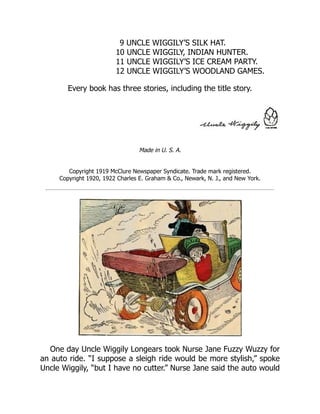
ebookluna.com
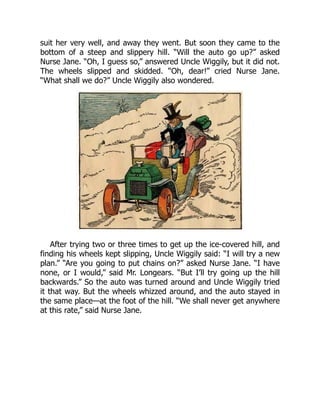
(Original PDF) Database Concepts 8th Edition by David M.
Kroenke
https://ebookluna.com/product/original-pdf-database-concepts-8th-
edition-by-david-m-kroenke/
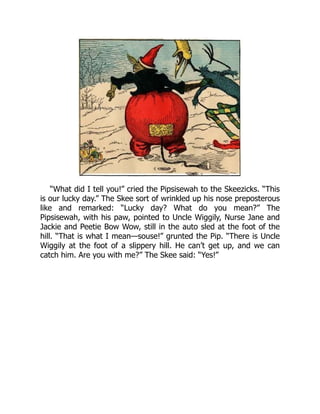
ebookluna.com
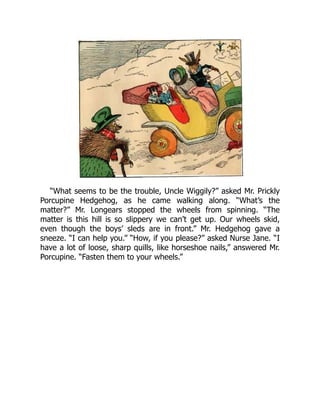
Concepts of database management 10th Edition Lisa
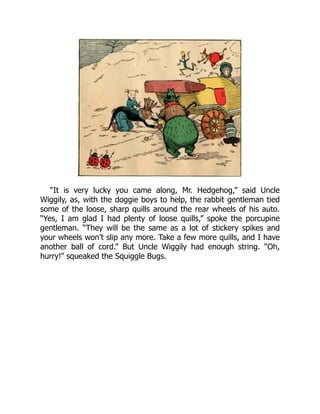
Friedrichsen - eBook PDF
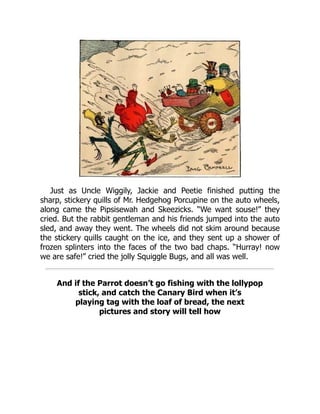
https://ebookluna.com/download/concepts-of-database-management-ebook-
pdf/
ebookluna.com
(eBook PDF) Concepts of Database Management , 9th Edition
Joy L. Starks
https://ebookluna.com/product/ebook-pdf-concepts-of-database-
management-9th-edition-joy-l-starks/
ebookluna.com
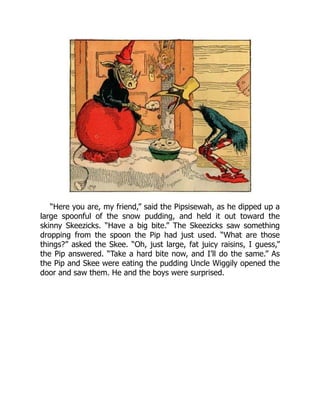
(eBook PDF) Instructor's Manual to accompany Operating
System Concepts
https://ebookluna.com/product/ebook-pdf-instructors-manual-to-
accompany-operating-system-concepts/
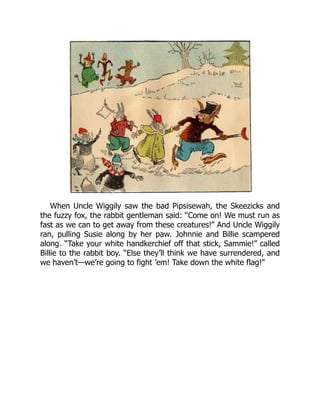
ebookluna.com
6.
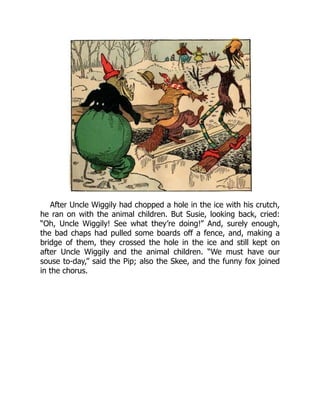
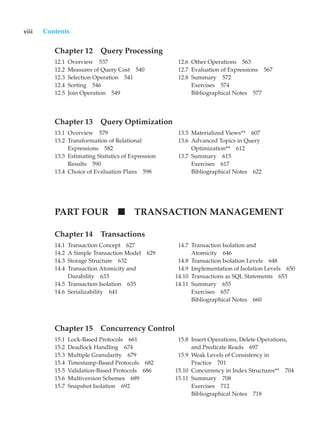
Contents vii
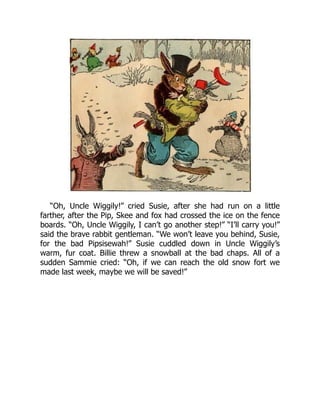
Chapter 8Relational Database Design
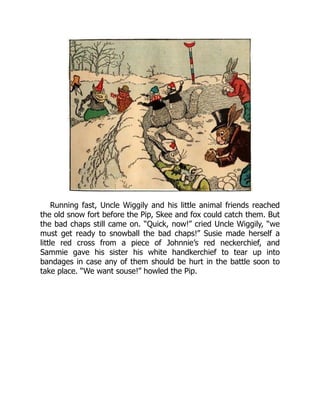
8.1 Features of Good Relational
Designs 323
8.2 Atomic Domains and First Normal
Form 327
8.3 Decomposition Using Functional
Dependencies 329
8.4 Functional-Dependency Theory 338
8.5 Algorithms for Decomposition 348
8.6 Decomposition Using Multivalued
Dependencies 355
8.7 More Normal Forms 360
8.8 Database-Design Process 361
8.9 Modeling Temporal Data 364
8.10 Summary 367
Exercises 368
Bibliographical Notes 374
Chapter 9 Application Design and Development
9.1 Application Programs and User
Interfaces 375
9.2 Web Fundamentals 377
9.3 Servlets and JSP 383
9.4 Application Architectures 391
9.5 Rapid Application Development 396
9.6 Application Performance 400
9.7 Application Security 402
9.8 Encryption and Its Applications 411
9.9 Summary 417
Exercises 419
Bibliographical Notes 426
PART THREE DATA STORAGE AND QUERYING
Chapter 10 Storage and File Structure
10.1 Overview of Physical Storage
Media 429
10.2 Magnetic Disk and Flash Storage 432
10.3 RAID 441
10.4 Tertiary Storage 449
10.5 File Organization 451
10.6 Organization of Records in Files 457
10.7 Data-Dictionary Storage 462
10.8 Database Buffer 464
10.9 Summary 468
Exercises 470
Bibliographical Notes 473
Chapter 11 Indexing and Hashing
11.1 Basic Concepts 475
11.2 Ordered Indices 476
11.3 B+
-Tree Index Files 485
11.4 B+
-Tree Extensions 500
11.5 Multiple-Key Access 506
11.6 Static Hashing 509
11.7 Dynamic Hashing 515
11.8 Comparison of Ordered Indexing and
Hashing 523
11.9 Bitmap Indices 524
11.10 Index Definition in SQL 528
11.11 Summary 529
Exercises 532
Bibliographical Notes 536
7.
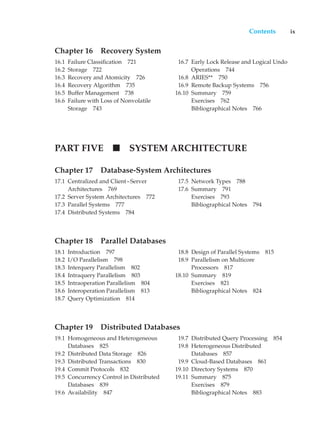
viii Contents
Chapter 12Query Processing
12.1 Overview 537
12.2 Measures of Query Cost 540
12.3 Selection Operation 541
12.4 Sorting 546
12.5 Join Operation 549
12.6 Other Operations 563
12.7 Evaluation of Expressions 567
12.8 Summary 572
Exercises 574
Bibliographical Notes 577
Chapter 13 Query Optimization
13.1 Overview 579
13.2 Transformation of Relational
Expressions 582
13.3 Estimating Statistics of Expression
Results 590
13.4 Choice of Evaluation Plans 598
13.5 Materialized Views** 607
13.6 Advanced Topics in Query
Optimization** 612
13.7 Summary 615
Exercises 617
Bibliographical Notes 622
PART FOUR TRANSACTION MANAGEMENT
Chapter 14 Transactions
14.1 Transaction Concept 627
14.2 A Simple Transaction Model 629
14.3 Storage Structure 632
14.4 Transaction Atomicity and
Durability 633
14.5 Transaction Isolation 635
14.6 Serializability 641
14.7 Transaction Isolation and
Atomicity 646
14.8 Transaction Isolation Levels 648
14.9 Implementation of Isolation Levels 650
14.10 Transactions as SQL Statements 653
14.11 Summary 655
Exercises 657
Bibliographical Notes 660
Chapter 15 Concurrency Control
15.1 Lock-Based Protocols 661
15.2 Deadlock Handling 674
15.3 Multiple Granularity 679
15.4 Timestamp-Based Protocols 682
15.5 Validation-Based Protocols 686
15.6 Multiversion Schemes 689
15.7 Snapshot Isolation 692
15.8 Insert Operations, Delete Operations,
and Predicate Reads 697
15.9 Weak Levels of Consistency in
Practice 701
15.10 Concurrency in Index Structures** 704
15.11 Summary 708
Exercises 712
Bibliographical Notes 718
8.
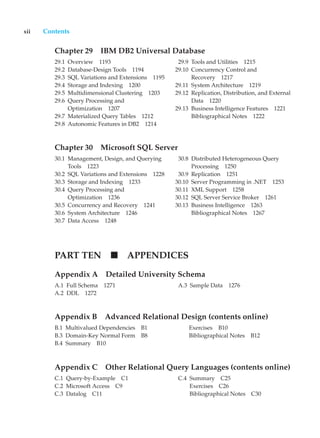
Contents ix
Chapter 16Recovery System
16.1 Failure Classification 721
16.2 Storage 722
16.3 Recovery and Atomicity 726
16.4 Recovery Algorithm 735
16.5 Buffer Management 738
16.6 Failure with Loss of Nonvolatile
Storage 743
16.7 Early Lock Release and Logical Undo
Operations 744
16.8 ARIES** 750
16.9 Remote Backup Systems 756
16.10 Summary 759
Exercises 762
Bibliographical Notes 766
PART FIVE SYSTEM ARCHITECTURE
Chapter 17 Database-System Architectures
17.1 Centralized and Client–Server
Architectures 769
17.2 Server System Architectures 772
17.3 Parallel Systems 777
17.4 Distributed Systems 784
17.5 Network Types 788
17.6 Summary 791
Exercises 793
Bibliographical Notes 794
Chapter 18 Parallel Databases
18.1 Introduction 797
18.2 I/O Parallelism 798
18.3 Interquery Parallelism 802
18.4 Intraquery Parallelism 803
18.5 Intraoperation Parallelism 804
18.6 Interoperation Parallelism 813
18.7 Query Optimization 814
18.8 Design of Parallel Systems 815
18.9 Parallelism on Multicore
Processors 817
18.10 Summary 819
Exercises 821
Bibliographical Notes 824
Chapter 19 Distributed Databases
19.1 Homogeneous and Heterogeneous
Databases 825
19.2 Distributed Data Storage 826
19.3 Distributed Transactions 830
19.4 Commit Protocols 832
19.5 Concurrency Control in Distributed
Databases 839
19.6 Availability 847
19.7 Distributed Query Processing 854
19.8 Heterogeneous Distributed
Databases 857
19.9 Cloud-Based Databases 861
19.10 Directory Systems 870
19.11 Summary 875
Exercises 879
Bibliographical Notes 883
9.
x Contents
PART SIXDATA WAREHOUSING, DATA
MINING, AND INFORMATION RETRIEVAL
Chapter 20 Data Warehousing and Mining
20.1 Decision-Support Systems 887
20.2 Data Warehousing 889
20.3 Data Mining 893
20.4 Classification 894
20.5 Association Rules 904
20.6 Other Types of Associations 906
20.7 Clustering 907
20.8 Other Forms of Data Mining 908
20.9 Summary 909
Exercises 911
Bibliographical Notes 914
Chapter 21 Information Retrieval
21.1 Overview 915
21.2 Relevance Ranking Using Terms 917
21.3 Relevance Using Hyperlinks 920
21.4 Synonyms, Homonyms, and
Ontologies 925
21.5 Indexing of Documents 927
21.6 Measuring Retrieval Effectiveness 929
21.7 Crawling and Indexing the Web 930
21.8 Information Retrieval: Beyond Ranking
of Pages 931
21.9 Directories and Categories 935
21.10 Summary 937
Exercises 939
Bibliographical Notes 941
PART SEVEN SPECIALTY DATABASES
Chapter 22 Object-Based Databases
22.1 Overview 945
22.2 Complex Data Types 946
22.3 Structured Types and Inheritance in
SQL 949
22.4 Table Inheritance 954
22.5 Array and Multiset Types in SQL 956
22.6 Object-Identity and Reference Types in
SQL 961
22.7 Implementing O-R Features 963
22.8 Persistent Programming
Languages 964
22.9 Object-Relational Mapping 973
22.10 Object-Oriented versus
Object-Relational 973
22.11 Summary 975
Exercises 976
Bibliographical Notes 980
Chapter 23 XML
23.1 Motivation 981
23.2 Structure of XML Data 986
23.3 XML Document Schema 990
23.4 Querying and Transformation 998
23.5 Application Program Interfaces to
XML 1008
23.6 Storage of XML Data 1009
23.7 XML Applications 1016
23.8 Summary 1019
Exercises 1021
Bibliographical Notes 1024
10.
Contents xi
PART EIGHTADVANCED TOPICS
Chapter 24 Advanced Application Development
24.1 Performance Tuning 1029
24.2 Performance Benchmarks 1045
24.3 Other Issues in Application
Development 1048
24.4 Standardization 1051
24.5 Summary 1056
Exercises 1057
Bibliographical Notes 1059
Chapter 25 Spatial and Temporal Data and Mobility
25.1 Motivation 1061
25.2 Time in Databases 1062
25.3 Spatial and Geographic Data 1064
25.4 Multimedia Databases 1076
25.5 Mobility and Personal Databases 1079
25.6 Summary 1085
Exercises 1087
Bibliographical Notes 1089
Chapter 26 Advanced Transaction Processing
26.1 Transaction-Processing Monitors 1091
26.2 Transactional Workflows 1096
26.3 E-Commerce 1102
26.4 Main-Memory Databases 1105
26.5 Real-Time Transaction Systems 1108
26.6 Long-Duration Transactions 1109
26.7 Summary 1115
Exercises 1117
Bibliographical Notes 1119
PART NINE CASE STUDIES
Chapter 27 PostgreSQL
27.1 Introduction 1123
27.2 User Interfaces 1124
27.3 SQL Variations and Extensions 1126
27.4 Transaction Management in
PostgreSQL 1137
27.5 Storage and Indexing 1146
27.6 Query Processing and
Optimization 1151
27.7 System Architecture 1154
Bibliographical Notes 1155
Chapter 28 Oracle
28.1 Database Design and Querying
Tools 1157
28.2 SQL Variations and Extensions 1158
28.3 Storage and Indexing 1162
28.4 Query Processing and
Optimization 1172
28.5 Concurrency Control and
Recovery 1180
28.6 System Architecture 1183
28.7 Replication, Distribution, and External
Data 1188
28.8 Database Administration Tools 1189
28.9 Data Mining 1191
Bibliographical Notes 1191
11.
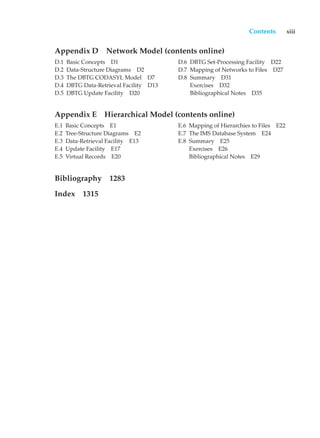
xii Contents
Chapter 29IBM DB2 Universal Database
29.1 Overview 1193
29.2 Database-Design Tools 1194
29.3 SQL Variations and Extensions 1195
29.4 Storage and Indexing 1200
29.5 Multidimensional Clustering 1203
29.6 Query Processing and
Optimization 1207
29.7 Materialized Query Tables 1212
29.8 Autonomic Features in DB2 1214
29.9 Tools and Utilities 1215
29.10 Concurrency Control and
Recovery 1217
29.11 System Architecture 1219
29.12 Replication, Distribution, and External
Data 1220
29.13 Business Intelligence Features 1221
Bibliographical Notes 1222
Chapter 30 Microsoft SQL Server
30.1 Management, Design, and Querying
Tools 1223
30.2 SQL Variations and Extensions 1228
30.3 Storage and Indexing 1233
30.4 Query Processing and
Optimization 1236
30.5 Concurrency and Recovery 1241
30.6 System Architecture 1246
30.7 Data Access 1248
30.8 Distributed Heterogeneous Query
Processing 1250
30.9 Replication 1251
30.10 Server Programming in .NET 1253
30.11 XML Support 1258
30.12 SQL Server Service Broker 1261
30.13 Business Intelligence 1263
Bibliographical Notes 1267
PART TEN APPENDICES
Appendix A Detailed University Schema
A.1 Full Schema 1271
A.2 DDL 1272
A.3 Sample Data 1276
Appendix B Advanced Relational Design (contents online)
B.1 Multivalued Dependencies B1
B.3 Domain-Key Normal Form B8
B.4 Summary B10
Exercises B10
Bibliographical Notes B12
Appendix C Other Relational Query Languages (contents online)
C.1 Query-by-Example C1
C.2 Microsoft Access C9
C.3 Datalog C11
C.4 Summary C25
Exercises C26
Bibliographical Notes C30
12.
Contents xiii
Appendix DNetwork Model (contents online)
D.1 Basic Concepts D1
D.2 Data-Structure Diagrams D2
D.3 The DBTG CODASYL Model D7
D.4 DBTG Data-Retrieval Facility D13
D.5 DBTG Update Facility D20
D.6 DBTG Set-Processing Facility D22
D.7 Mapping of Networks to Files D27
D.8 Summary D31
Exercises D32
Bibliographical Notes D35
Appendix E Hierarchical Model (contents online)
E.1 Basic Concepts E1
E.2 Tree-Structure Diagrams E2
E.3 Data-Retrieval Facility E13
E.4 Update Facility E17
E.5 Virtual Records E20
E.6 Mapping of Hierarchies to Files E22
E.7 The IMS Database System E24
E.8 Summary E25
Exercises E26
Bibliographical Notes E29
Bibliography 1283
Index 1315
Preface
Database management hasevolved from a specialized computer application to a
central component of a modern computing environment, and, as a result, knowl-
edge about database systems has become an essential part of an education in
computer science. In this text, we present the fundamental concepts of database
management. These concepts include aspects of database design, database lan-
guages, and database-system implementation.
This text is intended for a first course in databases at the junior or senior
undergraduate, or first-year graduate, level. In addition to basic material for
a first course, the text contains advanced material that can be used for course
supplements, or as introductory material for an advanced course.
We assume only a familiarity with basic data structures, computer organi-
zation, and a high-level programming language such as Java, C, or Pascal. We
present concepts as intuitive descriptions, many of which are based on our run-
ning example of a university. Important theoretical results are covered, but formal
proofs are omitted. In place of proofs, figures and examples are used to suggest
why a result is true. Formal descriptions and proofs of theoretical results may
be found in research papers and advanced texts that are referenced in the biblio-
graphical notes.
The fundamental concepts and algorithms covered in the book are often
based on those used in existing commercial or experimental database systems.
Our aim is to present these concepts and algorithms in a general setting that is
not tied to one particular database system. Details of particular database systems
are discussed in Part 9, “Case Studies.”
In this, the sixth edition of Database System Concepts, we have retained the
overall style of the prior editions while evolving the content and organization to
reflect the changes that are occurring in the way databases are designed, managed,
and used. We have also taken into account trends in the teaching of database
concepts and made adaptations to facilitate these trends where appropriate.
xv
xvi Preface
Organization
The textis organized in nine major parts, plus five appendices.
• Overview (Chapter 1). Chapter 1 provides a general overview of the nature
and purpose of database systems. We explain how the concept of a database
system has developed, what the common features of database systems are,
what a database system does for the user, and how a database system in-
terfaces with operating systems. We also introduce an example database
application: a university organization consisting of multiple departments,
instructors, students, and courses. This application is used as a running ex-
ample throughout the book. This chapter is motivational, historical, and ex-
planatory in nature.
• Part 1: Relational Databases (Chapters 2 through 6). Chapter 2 introduces
the relational model of data, covering basic concepts such as the structure
of relational databases, database schemas, keys, schema diagrams, relational
query languages, and relational operations. Chapters 3, 4, and 5 focus on the
most influential of the user-oriented relational languages: SQL. Chapter 6 cov-
ers the formal relational query languages: relational algebra, tuple relational
calculus, and domain relational calculus.
The chapters in this part describe data manipulation: queries, updates, in-
sertions, and deletions, assuming a schema design has been provided. Schema
design issues are deferred to Part 2.
• Part 2: Database Design (Chapters 7 through 9). Chapter 7 provides an
overview of the database-design process, with major emphasis on database
design using the entity-relationship data model. The entity-relationship data
model provides a high-level view of the issues in database design, and of the
problems that we encounter in capturing the semantics of realistic applica-
tions within the constraints of a data model. UML class-diagram notation is
also covered in this chapter.
Chapter 8 introduces the theory of relational database design. The the-
ory of functional dependencies and normalization is covered, with emphasis
on the motivation and intuitive understanding of each normal form. This
chapter begins with an overview of relational design and relies on an intu-
itive understanding of logical implication of functional dependencies. This
allows the concept of normalization to be introduced prior to full coverage
of functional-dependency theory, which is presented later in the chapter. In-
structors may choose to use only this initial coverage in Sections 8.1 through
8.3 without loss of continuity. Instructors covering the entire chapter will ben-
efit from students having a good understanding of normalization concepts to
motivate some of the challenging concepts of functional-dependency theory.
Chapter 9 covers application design and development. This chapter empha-
sizes the construction of database applications with Web-based interfaces. In
addition, the chapter covers application security.
17.
Preface xvii
• Part3: Data Storage and Querying (Chapters 10 through 13). Chapter 10
deals with storage devices, files, and data-storage structures. A variety of
data-access techniques are presented in Chapter 11, including B+
-tree indices
and hashing. Chapters 12 and 13 address query-evaluation algorithms and
query optimization. These chapters provide an understanding of the internals
of the storage and retrieval components of a database.
• Part 4: Transaction Management (Chapters 14 through 16). Chapter 14 fo-
cuses on the fundamentals of a transaction-processing system: atomicity,
consistency, isolation, and durability. It provides an overview of the methods
used to ensure these properties, including locking and snapshot isolation.
Chapter 15 focuses on concurrency control and presents several techniques
for ensuring serializability, including locking, timestamping, and optimistic
(validation) techniques. The chapter also covers deadlock issues. Alterna-
tives to serializability are covered, most notably the widely-used snapshot
isolation, which is discussed in detail.
Chapter 16 covers the primary techniques for ensuring correct transac-
tion execution despite system crashes and storage failures. These techniques
include logs, checkpoints, and database dumps. The widely-used ARIES al-
gorithm is presented.
• Part 5: System Architecture (Chapters 17 through 19). Chapter 17 covers
computer-system architecture, and describes the influence of the underly-
ing computer system on the database system. We discuss centralized sys-
tems, client–server systems, and parallel and distributed architectures in this
chapter.
Chapter 18, on parallel databases, explores a variety of parallelization
techniques, including I/O parallelism, interquery and intraquery parallelism,
and interoperation and intraoperation parallelism. The chapter also describes
parallel-system design.
Chapter 19 covers distributed database systems, revisiting the issues
of database design, transaction management, and query evaluation and op-
timization, in the context of distributed databases. The chapter also cov-
ers issues of system availability during failures, heterogeneous distributed
databases, cloud-based databases, and distributed directory systems.
• Part 6: Data Warehousing, Data Mining, and Information Retrieval (Chap-
ters 20 and 21). Chapter 20 introduces the concepts of data warehousing
and data mining. Chapter 21 describes information-retrieval techniques for
querying textual data, including hyperlink-based techniques used in Web
search engines.
Part 6 uses the modeling and language concepts from Parts 1 and 2, but
does not depend on Parts 3, 4, or 5. It can therefore be incorporated easily
into a course that focuses on SQL and on database design.
18.
xviii Preface
• Part7: Specialty Databases (Chapters 22 and 23). Chapter 22 covers object-
based databases. The chapter describes the object-relational data model,
which extends the relational data model to support complex data types, type
inheritance, and object identity. The chapter also describes database access
from object-oriented programming languages.
Chapter 23 covers the XML standard for data representation, which is seeing
increasing use in the exchange and storage of complex data. The chapter also
describes query languages for XML.
• Part 8: Advanced Topics (Chapters 24 through 26). Chapter 24 covers ad-
vanced issues in application development, including performance tuning,
performance benchmarks, database-application testing, and standardization.
Chapter 25 covers spatial and geographic data, temporal data, multimedia
data, and issues in the management of mobile and personal databases.
Finally, Chapter 26 deals with advanced transaction processing. Top-
ics covered in the chapter include transaction-processing monitors, transac-
tional workflows, electronic commerce, high-performance transaction sys-
tems, real-time transaction systems, and long-duration transactions.
• Part 9: Case Studies (Chapters 27 through 30). In this part, we present case
studies of four of the leading database systems, PostgreSQL, Oracle, IBM DB2,
and Microsoft SQL Server. These chapters outline unique features of each of
these systems, and describe their internal structure. They provide a wealth of
interesting information about the respective products, and help you see how
the various implementation techniques described in earlier parts are used
in real systems. They also cover several interesting practical aspects in the
design of real systems.
• Appendices. We provide five appendices that cover material that is of histor-
ical nature or is advanced; these appendices are available only online on the
Web site of the book (http://www.db-book.com). An exception is Appendix A,
which presents details of our university schema including the full schema,
DDL, and all the tables. This appendix appears in the actual text.
Appendix B describes other relational query languages, including QBE
Microsoft Access, and Datalog.
Appendix C describes advanced relational database design, including the
theory of multivalued dependencies, join dependencies, and the project-join
and domain-key normal forms. This appendix is for the benefit of individuals
who wish to study the theory of relational database design in more detail,
and instructors who wish to do so in their courses. This appendix, too, is
available only online, on the Web site of the book.
Although most new database applications use either the relational model
or the object-relational model, the network and hierarchical data models are
still in use in some legacy applications. For the benefit of readers who wish to
learn about these data models, we provide appendices describing the network
and hierarchical data models, in Appendices D and E respectively.
19.
Preface xix
The SixthEdition
The production of this sixth edition has been guided by the many comments and
suggestions we received concerning the earlier editions, by our own observations
while teaching at Yale University, Lehigh University, and IIT Bombay, and by our
analysis of the directions in which database technology is evolving.
We have replaced the earlier running example of bank enterprise with a uni-
versity example. This example has an immediate intuitive connection to students
that assists not only in remembering the example, but, more importantly, in gain-
ing deeper insight into the various design decisions that need to be made.
We have reorganized the book so as to collect all of our SQL coverage together
and place it early in the book. Chapters 3, 4, and 5 present complete SQL coverage.
Chapter 3 presents the basics of the language, with more advanced features in
Chapter 4. In Chapter 5, we present JDBC along with other means of accessing
SQL from a general-purpose programming language. We present triggers and re-
cursion, and then conclude with coverage of online analytic processing (OLAP).
Introductory courses may choose to cover only certain sections of Chapter 5 or
defer sections until after the coverage of database design without loss of continu-
ity.
Beyond these two major changes, we revised the material in each chapter,
bringing the older material up-to-date, adding discussions on recent develop-
ments in database technology, and improving descriptions of topics that students
found difficult to understand. We have also added new exercises and updated
references. The list of specific changes includes the following:
• Earlier coverage of SQL. Many instructors use SQL as a key component of term
projects (see our Web site, www.db-book.com, for sample projects). In order to
give students ample time for the projects, particularly for universities and
colleges on the quarter system, it is essential to teach SQL as early as possible.
With this in mind, we have undertaken several changes in organization:
◦ A new chapter on the relational model (Chapter 2) precedes SQL, laying
the conceptual foundation, without getting lost in details of relational
algebra.
◦ Chapters 3, 4, and 5 provide detailed coverage of SQL. These chapters also
discuss variants supported by different database systems, to minimize
problems that students face when they execute queries on actual database
systems. These chapters cover all aspects of SQL, including queries, data
definition, constraint specification, OLAP, and the use of SQL from within
a variety of languages, including Java/JDBC.
◦ Formal languages (Chapter 6) have been postponed to after SQL, and can
be omitted without affecting the sequencing of other chapters. Only our
discussion of query optimization in Chapter 13 depends on the relational
algebra coverage of Chapter 6.
20.
xx Preface
• Newdatabase schema. We adopted a new schema, which is based on uni-
versity data, as a running example throughout the book. This schema is
more intuitive and motivating for students than the earlier bank schema, and
illustrates more complex design trade-offs in the database-design chapters.
• More support for a hands-on student experience. To facilitate following
our running example, we list the database schema and the sample relation
instances for our university database together in Appendix A as well as
where they are used in the various regular chapters. In addition, we provide,
on our Web site http://www.db-book.com, SQL data-definition statements for the
entire example, along with SQL statements to create our example relation
instances. This encourages students to run example queries directly on a
database system and to experiment with modifying those queries.
• Revised coverage of E-R model. The E-R diagram notation in Chapter 7 has
been modified to make it more compatible with UML. The chapter also makes
good use of the new university database schema to illustrate more complex
design trade-offs.
• Revised coverage of relational design. Chapter 8 now has a more readable
style, providing an intuitive understanding of functional dependencies and
normalization, before covering functional dependency theory; the theory is
motivated much better as a result.
• Expanded material on application development and security. Chapter 9 has
new material on application development, mirroring rapid changes in the
field. In particular, coverage of security has been expanded, considering its
criticality in today’s interconnected world, with an emphasis on practical
issues over abstract concepts.
• Revised and updated coverage of data storage, indexing and query op-
timization. Chapter 10 has been updated with new technology, including
expanded coverage of flash memory.
Coverage of B+
-trees in Chapter 11 has been revised to reflect practical
implementations, including coverage of bulk loading, and the presentation
has been improved. The B+
-tree examples in Chapter 11 have now been
revised with n = 4, to avoid the special case of empty nodes that arises with
the (unrealistic) value of n = 3.
Chapter 13 has new material on advanced query-optimization techniques.
• Revised coverage of transaction management. Chapter 14 provides full cov-
erage of the basics for an introductory course, with advanced details follow-
ing in Chapters 15 and 16. Chapter 14 has been expanded to cover the practical
issues in transaction management faced by database users and database-
application developers. The chapter also includes an expanded overview of
topics covered in Chapters 15 and 16, ensuring that even if Chapters 15 and 16
are omitted, students have a basic knowledge of the concepts of concurrency
control and recovery.
This ebook isfor the use of anyone anywhere in the United States
and most other parts of the world at no cost and with almost no
restrictions whatsoever. You may copy it, give it away or re-use it
under the terms of the Project Gutenberg License included with this
ebook or online at www.gutenberg.org. If you are not located in the
United States, you will have to check the laws of the country where
you are located before using this eBook.
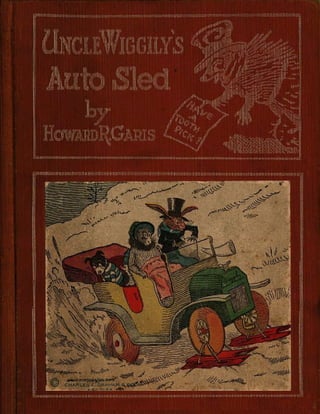
Title: Uncle Wiggily's Auto Sled
Author: Howard Roger Garis
Illustrator: Lang Campbell
Release date: November 7, 2015 [eBook #50405]
Most recently updated: October 22, 2024
Language: English
Credits: E-text prepared by David Edwards, Emmy, and the Online
Distributed Proofreading Team (http://www.pgdp.net) from
page images generously made available by the Google
Books Library Project (http://books.google.com)
*** START OF THE PROJECT GUTENBERG EBOOK UNCLE
WIGGILY'S AUTO SLED ***
27.
The Project GutenbergeBook, Uncle Wiggily's Auto Sled, by
Howard Roger Garis, Illustrated by Lansing Campbell
Note: Images of the original pages are available through the
Google Books Library Project. See
https://books.google.com/books?id=STJCAQAAMAAJ&hl=en
28.
Uncle Wiggily’s AutoSled
Or
How Mr. Hedgehog Helped Him Get Up the Slippery
Hill and How Uncle Wiggily Made a Snow
Pudding. Also What Happened in
the Snow Fort.
29.
Text By
HOWARD R.GARIS
Author of Three Little Trippertrots and Bed Time Stories
Pictured By
LANG CAMPBELL
CHARLES E. GRAHAM & CO.
NEWARK, N.J. —— NEW YORK
IF YOU LIKE THIS FUNNY LITTLE PICTURE BOOK ABOUT THE
BUNNY RABBIT GENTLEMAN YOU MAY BE GLAD
TO KNOW THERE ARE OTHERS.
So if the spoon holder doesn’t go down cellar and take
the coal shovel away from the gas stove, you may read
1 UNCLE WIGGILY’S AUTO SLED.
2 UNCLE WIGGILY’S SNOW MAN.
3 UNCLE WIGGILY’S HOLIDAYS.
4 UNCLE WIGGILY’S APPLE ROAST.
5 UNCLE WIGGILY’S PICNIC.
6 UNCLE WIGGILY GOES FISHING.
7 UNCLE WIGGILY’S JUNE BUG FRIENDS.
8 UNCLE WIGGILY’S VISIT TO THE FARM.
30.
9 UNCLE WIGGILY’SSILK HAT.
10 UNCLE WIGGILY, INDIAN HUNTER.
11 UNCLE WIGGILY’S ICE CREAM PARTY.
12 UNCLE WIGGILY’S WOODLAND GAMES.
Every book has three stories, including the title story.
Made in U. S. A.
Copyright 1919 McClure Newspaper Syndicate. Trade mark registered.
Copyright 1920, 1922 Charles E. Graham & Co., Newark, N. J., and New York.
One day Uncle Wiggily Longears took Nurse Jane Fuzzy Wuzzy for
an auto ride. “I suppose a sleigh ride would be more stylish,” spoke
Uncle Wiggily, “but I have no cutter.” Nurse Jane said the auto would
31.
suit her verywell, and away they went. But soon they came to the
bottom of a steep and slippery hill. “Will the auto go up?” asked
Nurse Jane. “Oh, I guess so,” answered Uncle Wiggily, but it did not.
The wheels slipped and skidded. “Oh, dear!” cried Nurse Jane.
“What shall we do?” Uncle Wiggily also wondered.
After trying two or three times to get up the ice-covered hill, and
finding his wheels kept slipping, Uncle Wiggily said: “I will try a new
plan.” “Are you going to put chains on?” asked Nurse Jane. “I have
none, or I would,” said Mr. Longears. “But I’ll try going up the hill
backwards.” So the auto was turned around and Uncle Wiggily tried
it that way. But the wheels whizzed around, and the auto stayed in
the same place—at the foot of the hill. “We shall never get anywhere
at this rate,” said Nurse Jane.
32.
“Are you pushing,Nurse Jane?” cried Uncle Wiggily, as he turned
on more gasolene. “Are you pushing?” The muskrat lady, who had
gotten out and was in back of the auto, answered: “Am I pushing?
Well, I should say I was! Aren’t we going up the hill?” Uncle Wiggily
gave a look. “We aren’t going up a bit,” he answered. With all Nurse
Jane’s pushing, the auto seemed to be slipping back instead of going
ahead. “What shall we do?” asked the muskrat lady. “I don’t know,”
sadly answered Uncle Wiggily.
33.
“What’s the matter,Uncle Wiggily?” asked Jackie. “Won’t your
auto go up the hill?” The rabbit gentleman shook his head. “We can’t
get up,” he said. “Maybe we could help,” offered Peetie. The two
Bow Wow doggie boys had come along with their sleds to coast on
the hill. “Thank you for offering, but how could you help get Uncle
Wiggily’s auto up?” asked Nurse Jane. “He could put our sleds under
the front wheels,” said Jackie, “and then he would have an auto sled.
Maybe it would go up easier then.”
34.
“It was verykind of you to offer me your sleds,” said Uncle
Wiggily to Jackie and Peetie. The sleds of the doggie boys were tied
to the two front wheels of the auto with ropes. “Now we will surely
go up the hill!” said Nurse Jane. So they all got in the machine
again, and Uncle Wiggily started off. But alas! Once more the back
wheels spun around like an alarm clock. “Oh, we shall never get up,”
said Nurse Jane. “And I am afraid something is going to happen!
Suppose the Pipsisewah and Skeezicks come along now?”
35.
“What did Itell you!” cried the Pipsisewah to the Skeezicks. “This
is our lucky day.” The Skee sort of wrinkled up his nose preposterous
like and remarked: “Lucky day? What do you mean?” The
Pipsisewah, with his paw, pointed to Uncle Wiggily, Nurse Jane and
Jackie and Peetie Bow Wow, still in the auto sled at the foot of the
hill. “That is what I mean—souse!” grunted the Pip. “There is Uncle
Wiggily at the foot of a slippery hill. He can’t get up, and we can
catch him. Are you with me?” The Skee said: “Yes!”
36.
“What seems tobe the trouble, Uncle Wiggily?” asked Mr. Prickly
Porcupine Hedgehog, as he came walking along. “What’s the
matter?” Mr. Longears stopped the wheels from spinning. “The
matter is this hill is so slippery we can’t get up. Our wheels skid,
even though the boys’ sleds are in front.” Mr. Hedgehog gave a
sneeze. “I can help you.” “How, if you please?” asked Nurse Jane. “I
have a lot of loose, sharp quills, like horseshoe nails,” answered Mr.
Porcupine. “Fasten them to your wheels.”
37.
“It is verylucky you came along, Mr. Hedgehog,” said Uncle
Wiggily, as, with the doggie boys to help, the rabbit gentleman tied
some of the loose, sharp quills around the rear wheels of his auto.
“Yes, I am glad I had plenty of loose quills,” spoke the porcupine
gentleman. “They will be the same as a lot of stickery spikes and
your wheels won’t slip any more. Take a few more quills, and I have
another ball of cord.” But Uncle Wiggily had enough string. “Oh,
hurry!” squeaked the Squiggle Bugs.
38.
Just as UncleWiggily, Jackie and Peetie finished putting the
sharp, stickery quills of Mr. Hedgehog Porcupine on the auto wheels,
along came the Pipsisewah and Skeezicks. “We want souse!” they
cried. But the rabbit gentleman and his friends jumped into the auto
sled, and away they went. The wheels did not skim around because
the stickery quills caught on the ice, and they sent up a shower of
frozen splinters into the faces of the two bad chaps. “Hurray! now
we are safe!” cried the jolly Squiggle Bugs, and all was well.
And if the Parrot doesn’t go fishing with the lollypop
stick, and catch the Canary Bird when it’s
playing tag with the loaf of bread, the next
pictures and story will tell how
39.
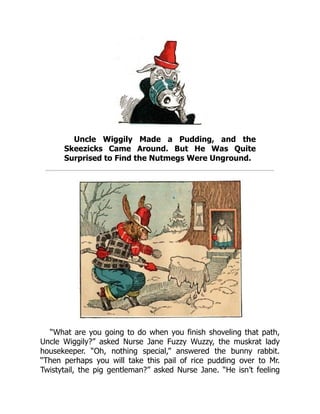
Uncle Wiggily Madea Pudding, and the
Skeezicks Came Around. But He Was Quite
Surprised to Find the Nutmegs Were Unground.
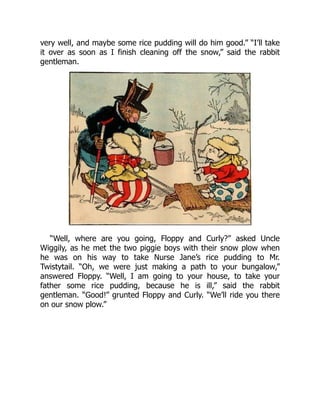
“What are you going to do when you finish shoveling that path,
Uncle Wiggily?” asked Nurse Jane Fuzzy Wuzzy, the muskrat lady
housekeeper. “Oh, nothing special,” answered the bunny rabbit.
“Then perhaps you will take this pail of rice pudding over to Mr.
Twistytail, the pig gentleman?” asked Nurse Jane. “He isn’t feeling
40.
very well, andmaybe some rice pudding will do him good.” “I’ll take
it over as soon as I finish cleaning off the snow,” said the rabbit
gentleman.
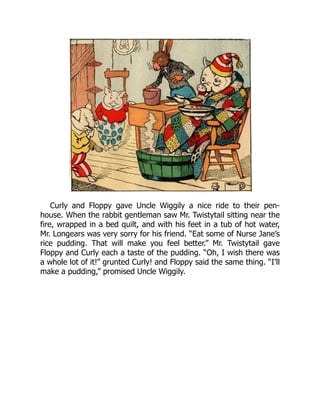
“Well, where are you going, Floppy and Curly?” asked Uncle
Wiggily, as he met the two piggie boys with their snow plow when
he was on his way to take Nurse Jane’s rice pudding to Mr.
Twistytail. “Oh, we were just making a path to your bungalow,”
answered Floppy. “Well, I am going to your house, to take your
father some rice pudding, because he is ill,” said the rabbit
gentleman. “Good!” grunted Floppy and Curly. “We’ll ride you there
on our snow plow.”
41.
Curly and Floppygave Uncle Wiggily a nice ride to their pen-
house. When the rabbit gentleman saw Mr. Twistytail sitting near the
fire, wrapped in a bed quilt, and with his feet in a tub of hot water,
Mr. Longears was very sorry for his friend. “Eat some of Nurse Jane’s
rice pudding. That will make you feel better.” Mr. Twistytail gave
Floppy and Curly each a taste of the pudding. “Oh, I wish there was
a whole lot of it!” grunted Curly! and Floppy said the same thing. “I’ll
make a pudding,” promised Uncle Wiggily.
42.
“Oh, will youreally make us a pudding?” asked Floppy. “I’ll make
you a snow pudding. Just ask your mother to let me take some
eggs, sugar, molasses, nutmeg and a few things like that. Then I’ll
easily make a snow pudding.” Curly and Floppy clapped their feet in
delight. “But our mother isn’t home,” said Floppy. She went to the
store for some medicine for Daddy’s cold. Mr. Longears said Mrs.
Twistytail didn’t really need to be home. “We’ll go to the kitchen and
make the pudding ourselves,” he added.
43.
“Let me seenow,” said Uncle Wiggily, as the pudding was almost
finished. “I have put in the sugar, milk, eggs and cocoanut. And you
put in the snow, to make it like ice cream, didn’t you, Curly, my
boy?” The little piggie chap said he had put in plenty of snow. “And
now I have forgotten how to put in the nutmegs to make the
pudding spicy. I forget whether you put them in whole like
hickorynuts, or grate them up fine, like powder. I really have
forgotten. I guess I’ll put them in whole.”
44.
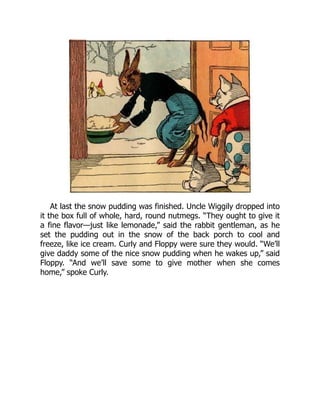
At last thesnow pudding was finished. Uncle Wiggily dropped into
it the box full of whole, hard, round nutmegs. “They ought to give it
a fine flavor—just like lemonade,” said the rabbit gentleman, as he
set the pudding out in the snow of the back porch to cool and
freeze, like ice cream. Curly and Floppy were sure they would. “We’ll
give daddy some of the nice snow pudding when he wakes up,” said
Floppy. “And we’ll save some to give mother when she comes
home,” spoke Curly.
45.
“Hello! What havewe here?” asked the Pipsisewah, as he and the
Skeezicks jumped over the snow drift and sneaked up to the piggie
boys’ house. The Skeezicks gave a grunt: “I was just wondering that
myself. I saw Uncle Wiggily set it out. It must be something good.”
They took a sniff and the Pip cried: “It’s a pudding! Hurray! Lucky I
have this long-handled spoon! I’ll dip it in and we’ll take turns eating
this pudding. If we can’t get Uncle Wiggily’s souse we’ll have his
pudding. Come on!”
46.
“Here you are,my friend,” said the Pipsisewah, as he dipped up a
large spoonful of the snow pudding, and held it out toward the
skinny Skeezicks. “Have a big bite.” The Skeezicks saw something
dropping from the spoon the Pip had just used. “What are those
things?” asked the Skee. “Oh, just large, fat juicy raisins, I guess,”
the Pip answered. “Take a hard bite now, and I’ll do the same.” As
the Pip and Skee were eating the pudding Uncle Wiggily opened the
door and saw them. He and the boys were surprised.
47.
“Ha! Ha!” laughedUncle Wiggily as he saw the Pip and Skee run
away. “Ho! Ho! That’s the time I fooled them!” They saw the bad
chaps running away, holding their jaws. “They bit too hard on the
nutmegs in our pudding,” said the bunny rabbit. “I remember, now, I
should have grated the nutmeg. It’s just as well I didn’t, or else the
Pip and the Skee would have eaten it all. I can pick out the whole
nutmegs, grate one, and our pudding will be as good as ever.” And it
was.
Now if the lemonade doesn’t slip on the butter knife, and
fall downstairs when the teacup is trying to dance
in the sugar bowl, the next pictures and
story will tell how
48.
The Bad Pip,Skee and Fox Chased Uncle
Wiggily and the Bunny Thought Surely He
Would Be Caught. But the Snow Fort Saved Him.
Uncle Wiggily Longears, the bunny rabbit gentleman, was out
walking in the snow-covered fields one day, when he met Sammie
and Susie Littletail, the two rabbit children, and Johnnie and Billie
Bushytail, the two squirrel brothers. “Where are you going, Uncle
49.
Wiggily?” asked Susie.“Oh, just to look for an adventure,” replied
Mr. Longears. “Don’t you want to come?” They started, Uncle Wiggily
holding Susie’s paw, the boys throwing snowballs. “I’d like to see the
bad Pipsisewah or Skeezicks now!” said Billie.
“Why do you want to see the Pipsisewah or Skeezicks, Billie?”
asked Johnnie, the other squirrel boy. “Oh, so I could throw
snowballs at ’em!” answered Billie, “and pay them back for trying to
get Uncle Wiggily’s souse.” The bunny rabbit made some holes in the
snow with his red, white and blue-striped rheumatism crutch, and
then, all of a sudden, Susie cried: “Well, you have you wish, Billie
Bushytail! Look, there’s the Skeezicks now, and the Pipsisewah and
bad fox are with him! Oh! Oh! What shall we do?”
50.
When Uncle Wiggilysaw the bad Pipsisewah, the Skeezicks and
the fuzzy fox, the rabbit gentleman said: “Come on! We must run as
fast as we can to get away from these creatures!” And Uncle Wiggily
ran, pulling Susie along by her paw. Johnnie and Billie scampered
along. “Take your white handkerchief off that stick, Sammie!” called
Billie to the rabbit boy. “Else they’ll think we have surrendered, and
we haven’t—we’re going to fight ’em! Take down the white flag!”
51.
“Run along, children,run along!” cried Uncle Wiggily. Sammie and
Susie and Johnnie and Billie ran over the hard, cold water of a frozen
brook. “What are you going to do, Uncle Wiggily?” asked Susie,
when the little rabbit girl was safe on the other side of the brook.
“I’m going to make a hole in the ice so the Pip, the Skee and the fox
can’t cross and get us, I hope.” With his crutch he made a hole in
the ice. But the Pip, Skee and fox had not given up the chase. On
they came, faster and faster.
52.
After Uncle Wiggilyhad chopped a hole in the ice with his crutch,
he ran on with the animal children. But Susie, looking back, cried:
“Oh, Uncle Wiggily! See what they’re doing!” And, surely enough,
the bad chaps had pulled some boards off a fence, and, making a
bridge of them, they crossed the hole in the ice and still kept on
after Uncle Wiggily and the animal children. “We must have our
souse to-day,” said the Pip; also the Skee, and the funny fox joined
in the chorus.
53.
“Oh, Uncle Wiggily!”cried Susie, after she had run on a little
farther, after the Pip, Skee and fox had crossed the ice on the fence
boards. “Oh, Uncle Wiggily, I can’t go another step!” “I’ll carry you!”
said the brave rabbit gentleman. “We won’t leave you behind, Susie,
for the bad Pipsisewah!” Susie cuddled down in Uncle Wiggily’s
warm, fur coat. Billie threw a snowball at the bad chaps. All of a
sudden Sammie cried: “Oh, if we can reach the old snow fort we
made last week, maybe we will be saved!”
54.
Running fast, UncleWiggily and his little animal friends reached
the old snow fort before the Pip, Skee and fox could catch them. But
the bad chaps still came on. “Quick, now!” cried Uncle Wiggily, “we
must get ready to snowball the bad chaps!” Susie made herself a
little red cross from a piece of Johnnie’s red neckerchief, and
Sammie gave his sister his white handkerchief to tear up into
bandages in case any of them should be hurt in the battle soon to
take place. “We want souse!” howled the Pip.
55.
“Come on now!”cried the Pip to the Skee and fox. “We must
charge on them in the fort! We must capture Uncle Wiggily!” The
Skee and fox ran up the hill with the Pip. “Ouch! Wouch!” cried the
Skee. “Some one hit me in the eye with a snowball!” Uncle Wiggily
had made a lot of snowballs for the animal boys to throw at the
enemy. “Bang away! Bang away!” cried brave Uncle Wiggily. “Hurray!
Hurray! Hurray!” shouted the boys, while Red Cross Nurse Susie was
all ready with rolls of bandages.
56.
The boys throwso many hard snowballs over the wall of the fort
at the Pip, Skee and fox, that the bad animals were glad enough to
run away. “Oh, wow! Come on out of this!” howled the Pip to the
Skee, and down the hill they ran. “Hoist the flag! We’ve won the
fight!” cried Sammie. He made a banner from red and blue pieces of
Billie’s and Johnnie’s neckerchiefs and pieces of white from his own
handkerchief. A hole was in Uncle Wiggily’s hat, but Susie bandaged
it up. The snow fort saved Uncle Wiggily.
57.
Welcome to ourwebsite – the ideal destination for book lovers and
knowledge seekers. With a mission to inspire endlessly, we offer a
vast collection of books, ranging from classic literary works to
specialized publications, self-development books, and children's
literature. Each book is a new journey of discovery, expanding
knowledge and enriching the soul of the reade
Our website is not just a platform for buying books, but a bridge
connecting readers to the timeless values of culture and wisdom. With
an elegant, user-friendly interface and an intelligent search system,
we are committed to providing a quick and convenient shopping
experience. Additionally, our special promotions and home delivery
services ensure that you save time and fully enjoy the joy of reading.
Let us accompany you on the journey of exploring knowledge and
personal growth!
ebookluna.com













![This ebook is for the use of anyone anywhere in the United States
and most other parts of the world at no cost and with almost no
restrictions whatsoever. You may copy it, give it away or re-use it
under the terms of the Project Gutenberg License included with this
ebook or online at www.gutenberg.org. If you are not located in the
United States, you will have to check the laws of the country where
you are located before using this eBook.
Title: Uncle Wiggily's Auto Sled
Author: Howard Roger Garis
Illustrator: Lang Campbell
Release date: November 7, 2015 [eBook #50405]
Most recently updated: October 22, 2024
Language: English
Credits: E-text prepared by David Edwards, Emmy, and the Online
Distributed Proofreading Team (http://www.pgdp.net) from
page images generously made available by the Google
Books Library Project (http://books.google.com)
*** START OF THE PROJECT GUTENBERG EBOOK UNCLE
WIGGILY'S AUTO SLED ***](https://image.slidesharecdn.com/12902-250302062727-f03afc8e/85/eBook-PDF-Database-System-Concepts-6th-Edition-26-320.jpg)