IDRE Statistical Consulting
1
https://stats.idre.ucla.edu/spss/seminars/efa-spss/
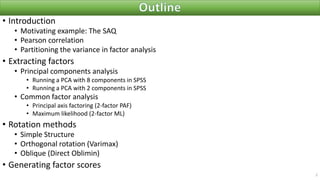
• Introduction
• Motivating example: The SAQ
• Pearson correlation
• Partitioning the variance in factor analysis
• Extracting factors
• Principal components analysis
• Running a PCA with 8 components in SPSS
• Running a PCA with 2 components in SPSS
• Common factor analysis
• Principal axis factoring (2-factor PAF)
• Maximum likelihood (2-factor ML)
• Rotation methods
• Simple Structure
• Orthogonal rotation (Varimax)
• Oblique (Direct Oblimin)
• Generating factor scores
2
• Motivating example: The SAQ
• Pearson correlation
• Partitioning the variance in
factor analysis
3
4
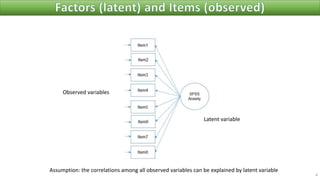
Latent variable
Observed variables
Assumption: the correlations among all observed variables can be explained by latent variable
1. I dream that Pearson is attacking me with correlation coefficients
2. I don’t understand statistics
3. I have little experience with computers
4. All computers hate me
5. I have never been good at mathematics
6. My friends are better at statistics than me
7. Computers are useful only for playing games
8. I did badly at mathematics at school
5
6
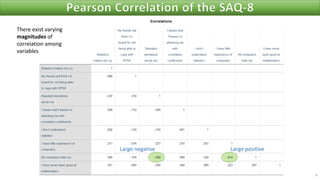
Large negative Large positive
There exist varying
magnitudes of
correlation among
variables
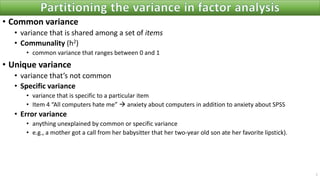
• Common variance
• variance that is shared among a set of items
• Communality (h2)
• common variance that ranges between 0 and 1
• Unique variance
• variance that’s not common
• Specific variance
• variance that is specific to a particular item
• Item 4 “All computers hate me” → anxiety about computers in addition to anxiety about SPSS
• Error variance
• anything unexplained by common or specific variance
• e.g., a mother got a call from her babysitter that her two-year old son ate her favorite lipstick).
7
8
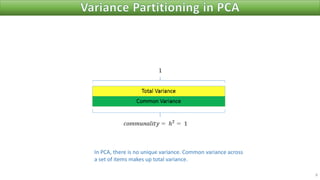
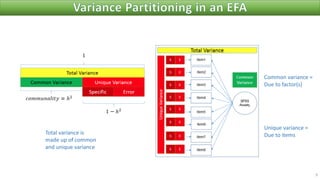
In PCA, there is no unique variance. Common variance across
a set of items makes up total variance.
9
Total variance is
made up of common
and unique variance
Common variance =
Due to factor(s)
Unique variance =
Due to items
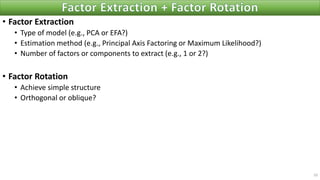
• Factor Extraction
• Type of model (e.g., PCA or EFA?)
• Estimation method (e.g., Principal Axis Factoring or Maximum Likelihood?)
• Number of factors or components to extract (e.g., 1 or 2?)
• Factor Rotation
• Achieve simple structure
• Orthogonal or oblique?
10
• Principal components analysis
• PCA with 8 / 2 components
• Common factor analysis
• Principal axis factoring (2-factor PAF)
• Maximum likelihood (2-factor ML)
11
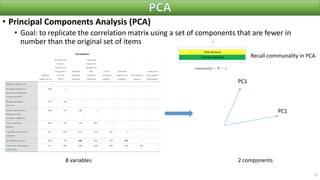
• Principal Components Analysis (PCA)
• Goal: to replicate the correlation matrix using a set of components that are fewer in
number than the original set of items
12
8 variables 2 components
PC1
PC1
Recall communality in PCA
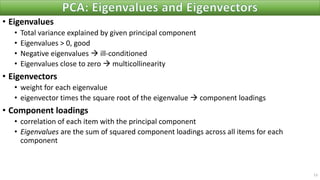
• Eigenvalues
• Total variance explained by given principal component
• Eigenvalues > 0, good
• Negative eigenvalues → ill-conditioned
• Eigenvalues close to zero → multicollinearity
• Eigenvectors
• weight for each eigenvalue
• eigenvector times the square root of the eigenvalue → component loadings
• Component loadings
• correlation of each item with the principal component
• Eigenvalues are the sum of squared component loadings across all items for each
component
13
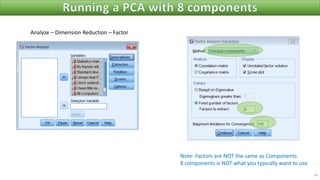
Analyze – Dimension Reduction – Factor
14
Note: Factors are NOT the same as Components
8 components is NOT what you typically want to use
15
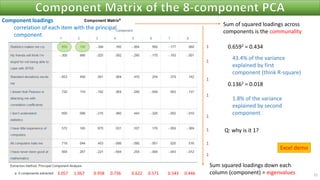
0.6592 = 0.434
0.1362 = 0.018
43.4% of the variance
explained by first
component (think R-square)
1.8% of the variance
explained by second
component
Sum squared loadings down each
column (component) = eigenvalues
Sum of squared loadings across
components is the communality
3.057 1.067 0.958 0.736 0.622 0.571 0.543 0.446
Q: why is it 1?
Component loadings
correlation of each item with the principal
component
Excel demo
1
1
1
1
1
1
1
1
16
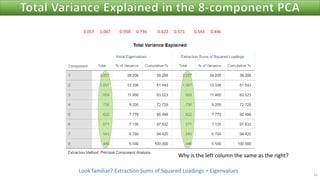
Look familiar? Extraction Sums of Squared Loadings = Eigenvalues
3.057 1.067 0.958 0.736 0.622 0.571 0.543 0.446
Why is the left column the same as the right?
17
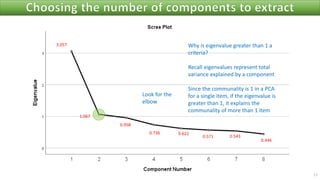
3.057
1.067
0.958
0.736 0.622
0.571 0.543
0.446
Look for the
elbow
Why is eigenvalue greater than 1 a
criteria?
Recall eigenvalues represent total
variance explained by a component
Since the communality is 1 in a PCA
for a single item, if the eigenvalue is
greater than 1, it explains the
communality of more than 1 item
18
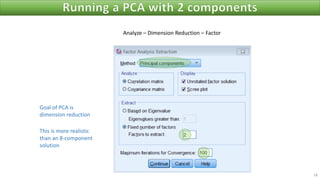
Analyze – Dimension Reduction – Factor
This is more realistic
than an 8-component
solution
Goal of PCA is
dimension reduction
19
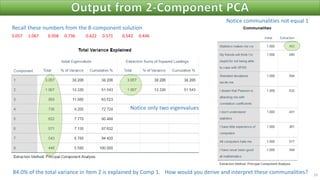
Notice only two eigenvalues
Notice communalities not equal 1
How would you derive and interpret these communalities?
3.057 1.067 0.958 0.736 0.622 0.571 0.543 0.446
Recall these numbers from the 8-component solution
84.0% of the total variance in Item 2 is explained by Comp 1.
20
• Principal components analysis
• PCA with 8 / 2 components
• Common factor analysis
• Principal axis factoring (2-factor PAF)
• Maximum likelihood (2-factor ML)
21
• Factor Analysis (EFA)
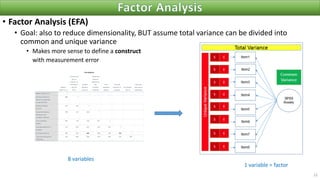
• Goal: also to reduce dimensionality, BUT assume total variance can be divided into
common and unique variance
• Makes more sense to define a construct
with measurement error
22
8 variables
1 variable = factor
23
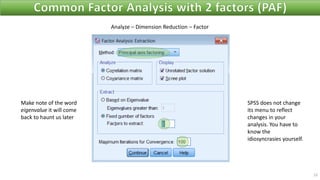
Analyze – Dimension Reduction – Factor
Make note of the word
eigenvalue it will come
back to haunt us later
SPSS does not change
its menu to reflect
changes in your
analysis. You have to

know the
idiosyncrasies yourself.
24
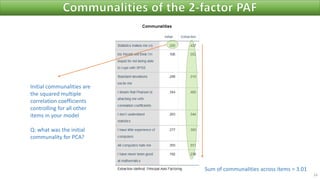
Initial communalities are
the squared multiple
correlation coefficients
controlling for all other
items in your model
Q: what was the initial
communality for PCA?
Sum of communalities across items = 3.01
25
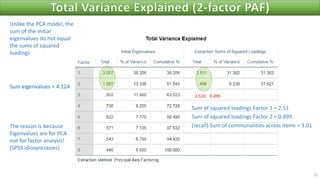
Unlike the PCA model, the
sum of the initial
eigenvalues do not equal
the sums of squared
loadings
2.510 0.499
Sum eigenvalues = 4.124
The reason is because
Eigenvalues are for PCA
not for factor analysis!
(SPSS idiosyncrasies)
(recall) Sum of communalities across items = 3.01
Sum of squared loadings Factor 1 = 2.51
Sum of squared loadings Factor 2 = 0.499
26
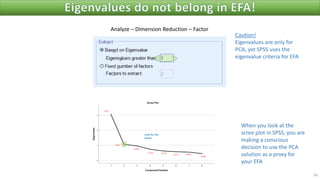
Caution!
Eigenvalues are only for
PCA, yet SPSS uses the
eigenvalue criteria for EFA
When you look at the
scree plot in SPSS, you are
making a conscious
decision to use the PCA
solution as a proxy for
your EFA
Analyze – Dimension Reduction – Factor
27
28
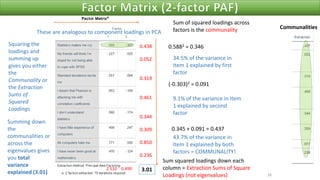
Squaring the
loadings and
summing up
gives you either
the
Communality or
the Extraction
Sums of
Squared
Loadings
Sum of squared loadings across
factors is the communality
Sum squared loadings down each
column = Extraction Sums of Square
Loadings (not eigenvalues)
0.5882 = 0.346
(-0.303)2 = 0.091
34.5% of the variance in
Item 1 explained by first
factor
9.1% of the variance in Item
1 explained by second
factor
0.345 + 0.091 = 0.437
2.510 0.499
0.438
0.052
0.319
0.461
0.344
0.309
0.850
0.236
These are analogous to component loadings in PCA
43.7% of the variance in
Item 1 explained by both
factors = COMMUNALITY!
3.01
Summing down
the
communalities or
across the
eigenvalues gives
you total
variance
explained (3.01)
Communalities
29
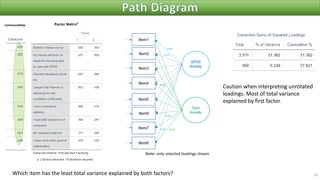
Caution when interpreting unrotated
loadings. Most of total variance
explained by first factor.
Communalities
Which item has the least total variance explained by both factors?
30
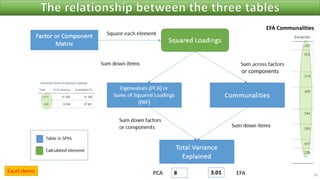
or components
3.01
EFA Communalities
Excel demo 8
PCA EFA
31
32
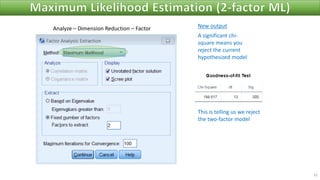
New output
A significant chi-
square means you
reject the current
hypothesized model
This is telling us we reject
the two-factor model
Analyze – Dimension Reduction – Factor
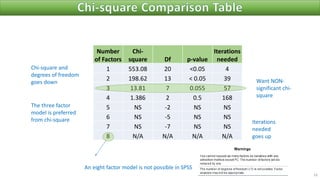
Number
of Factors
Chi-
square Df p-value
Iterations
needed
1 553.08 20 <0.05 4
2 198.62 13 < 0.05 39
3 13.81 7 0.055 57
4 1.386 2 0.5 168
5 NS -2 NS NS
6 NS -5 NS NS
7 NS -7 NS NS
8 N/A N/A N/A N/A
33
Iterations
needed
goes up
Chi-square and
degrees of freedom
goes down
An eight factor model is not possible in SPSS
The three factor
model is preferred
from chi-square
Want NON-
significant chi-
square
34
35
EFA: Total Variance
Explained = Total
Communality
Explained NOT
Total Variance
PCA: Total Variance
Explained = Total
Variance
For both models,
communality is the
total proportion of
variance due to all
factors or
components in the
model
Communalities are
item specific
36
37
(across all items)
• Simple Structure
• Orthogonal rotation (Varimax)
• Oblique (Direct Oblimin)
38
Item Factor 1 Factor 2 Factor 3
1 0.8 0 0
2 0.8 0 0
3 0.8 0 0
4 0 0.8 0
5 0 0.8 0
6 0 0.8 0
7 0 0 0.8
8 0 0 0.8
1. Each item has high loadings on one factor only
2. Each factor has high loadings for only some of the items.
39
The goal of rotation
is to achieve simple
structure
Pedhazur and Schemlkin (1991)
Item Factor 1 Factor 2 Factor 3
1 0.8 0 0.8
2 0.8 0 0.8
3 0.8 0 0
4 0.8 0 0
5 0 0.8 0.8
6 0 0.8 0.8
7 0 0.8 0.8
8 0 0.8 0
40
1. Most items have high loadings on more than one factor
2. Factor 3 has high loadings on 5/8 items
41
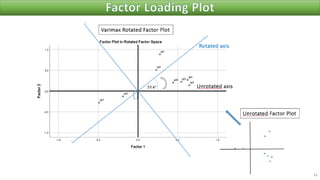
Varimax:
orthogonal rotation
maximizes
variances of the
loadings within the
factors while
maximizing
differences
between high and
low loadings on a
particular factor
Orthogonal means the
factors are uncorrelated
Without rotation, first factor is the most general factor onto which most items load and explains the largest amount of variance
42
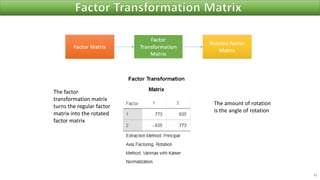
The factor
transformation matrix
turns the regular factor
matrix into the rotated
factor matrix
The amount of rotation
is the angle of rotation
43
44
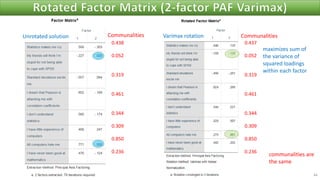
Unrotated solution
maximizes sum of
the variance of
squared loadings
within each factor
0.438
0.052
0.319
0.461
0.344
0.309
0.850
0.236
Varimax rotation
0.437
0.052
0.319
0.461
0.344
0.309
0.850
0.236
communalities are
the same
Communalities Communalities
45
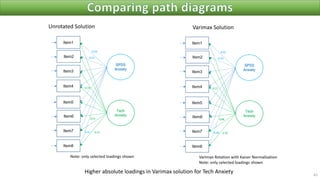
Higher absolute loadings in Varimax solution for Tech Anxiety
Unrotated Solution Varimax Solution
46
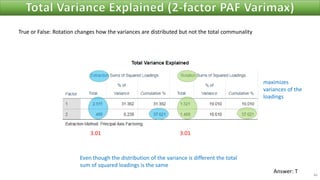
3.01 3.01
Even though the distribution of the variance is different the total
sum of squared loadings is the same
maximizes
variances of the
loadings
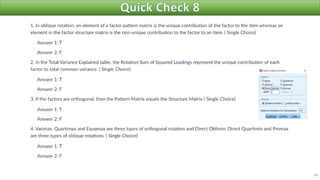
True or False: Rotation changes how the variances are distributed but not the total communality
Answer: T
47
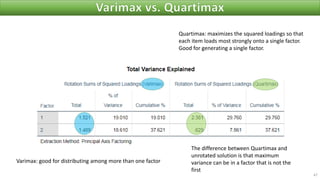
Varimax: good for distributing among more than one factor
Quartimax: maximizes the squared loadings so that
each item loads most strongly onto a single factor.
Good for generating a single factor.
The difference between Quartimax and
unrotated solution is that maximum
variance can be in a factor that is not the
first
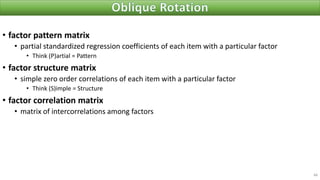
• factor pattern matrix
• partial standardized regression coefficients of each item with a particular factor
• Think (P)artial = Pattern
• factor structure matrix
• simple zero order correlations of each item with a particular factor
• Think (S)imple = Structure
• factor correlation matrix
• matrix of intercorrelations among factors
48
49
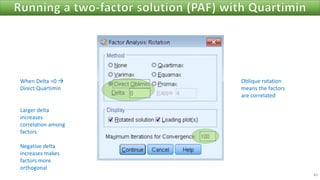
When Delta =0 →
Direct Quartimin
Oblique rotation
means the factors
are correlated
Larger delta
increases
correlation among
factors
Negative delta
increases makes
factors more
orthogonal
50
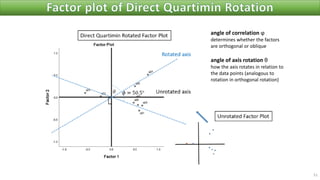
angle of correlation ϕ
determines whether the factors
are orthogonal or oblique
angle of axis rotation θ
how the axis rotates in relation to
the data points (analogous to
rotation in orthogonal rotation)
51
52
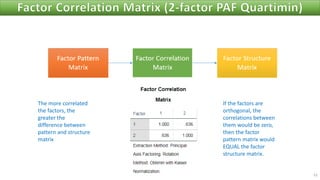
If the factors are
orthogonal, the
correlations between
them would be zero,
then the factor
pattern matrix would
EQUAL the factor
structure matrix.
The more correlated
the factors, the
greater the
difference between
pattern and structure
matrix
53
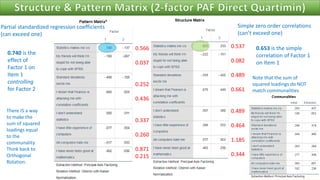
Simple zero order correlations
(can’t exceed one)
Partial standardized regression coefficients
(can exceed one)
0.653 is the simple
correlation of Factor 1
on Item 1
0.740 is the
effect of
Factor 1 on
Item 1
controlling
for Factor 2
0.566
0.037
0.252
0.436
0.337
0.260
0.871
0.215
0.537
0.082
0.489
0.661
0.489
0.464
1.185
0.344
Note that the sum of
squared loadings do NOT
match communalities
There IS a way
to make the
sum of squared
loadings equal
to the
communality.
Think back to
Orthogonal
Rotation.
54
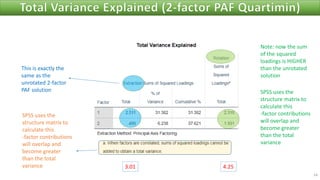
This is exactly the
same as the
unrotated 2-factor
PAF solution
3.01 4.25
Note: now the sum
of the squared
loadings is HIGHER
than the unrotated
solution
SPSS uses the
structure matrix to
calculate this
-factor contributions
will overlap and
become greater
than the total
variance
SPSS uses the
structure matrix to
calculate this
-factor contributions
will overlap and
become greater
than the total
variance
55
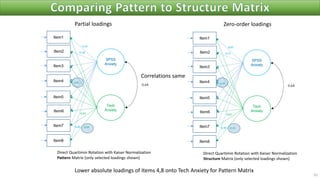
Lower absolute loadings of Items 4,8 onto Tech Anxiety for Pattern Matrix
Partial loadings Zero-order loadings
Correlations same
56
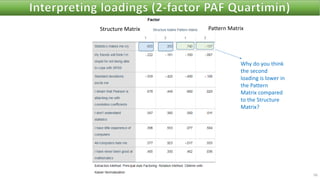
Structure Matrix Pattern Matrix
Why do you think
the second
loading is lower in
the Pattern
Matrix compared
to the Structure
Matrix?
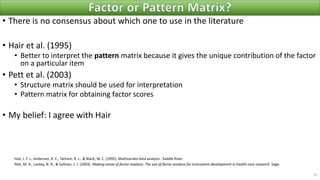
• There is no consensus about which one to use in the literature
• Hair et al. (1995)
• Better to interpret the pattern matrix because it gives the unique contribution of the factor
on a particular item
• Pett et al. (2003)
• Structure matrix should be used for interpretation
• Pattern matrix for obtaining factor scores
• My belief: I agree with Hair
Hair, J. F. J., Anderson, R. E., Tatham, R. L., & Black, W. C. (1995). Multivariate data analysis . Saddle River.
Pett, M. A., Lackey, N. R., & Sullivan, J. J. (2003). Making sense of factor analysis: The use of factor analysis for instrument development in health care research. Sage.
57
58
• Regression
• Bartlett
• Anderson-Rubin
59
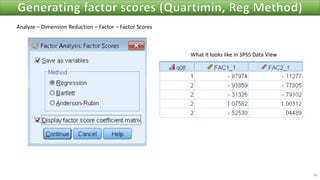
60
Analyze – Dimension Reduction – Factor – Factor Scores
What it looks like in SPSS Data View
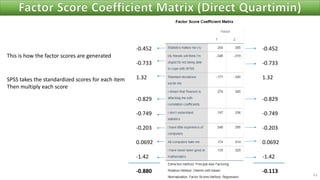
61
This is how the factor scores are generated
SPSS takes the standardized scores for each item
Then multiply each score
-0.452
-0.733
1.32
-0.829
-0.749
-0.203
0.0692
-1.42
-0.880
-0.452
-0.733
1.32
-0.829
-0.749
-0.203
0.0692
-1.42
-0.113
62
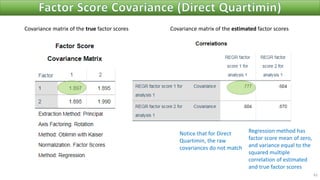
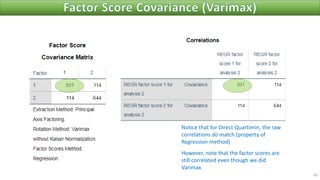
Covariance matrix of the true factor scores Covariance matrix of the estimated factor scores
Notice that for Direct
Quartimin, the raw
covariances do not match
Regression method has
factor score mean of zero,
and variance equal to the
squared multiple
correlation of estimated
and true factor scores
63
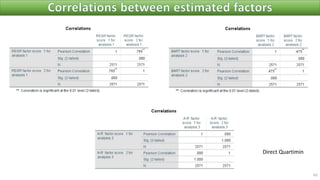
Notice that for Direct Quartimin, the raw
correlations do match (property of
Regression method)
However, note that the factor scores are
still correlated even though we did
Varimax
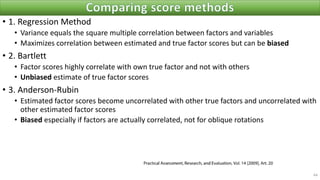
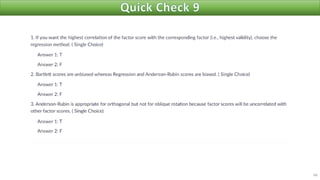
• 1. Regression Method
• Variance equals the square multiple correlation between factors and variables
• Maximizes correlation between estimated and true factor scores but can be biased
• 2. Bartlett
• Factor scores highly correlate with own true factor and not with others
• Unbiased estimate of true factor scores
• 3. Anderson-Rubin
• Estimated factor scores become uncorrelated with other true factors and uncorrelated with
other estimated factor scores
• Biased especially if factors are actually correlated, not for oblique rotations
64
65
Direct Quartimin
66

PRINCIPAL COMPONENTS (PCA) AND EXPLORATORY FACTOR ANALYSIS (EFA) WITH SPSS.pdf

  • 1.
  • 2.
    • Introduction • Motivatingexample: The SAQ • Pearson correlation • Partitioning the variance in factor analysis • Extracting factors • Principal components analysis • Running a PCA with 8 components in SPSS • Running a PCA with 2 components in SPSS • Common factor analysis • Principal axis factoring (2-factor PAF) • Maximum likelihood (2-factor ML) • Rotation methods • Simple Structure • Orthogonal rotation (Varimax) • Oblique (Direct Oblimin) • Generating factor scores 2
  • 3.
    • Motivating example:The SAQ • Pearson correlation • Partitioning the variance in factor analysis 3
  • 4.
    4 Latent variable Observed variables Assumption:the correlations among all observed variables can be explained by latent variable
  • 5.
    1. I dreamthat Pearson is attacking me with correlation coefficients 2. I don’t understand statistics 3. I have little experience with computers 4. All computers hate me 5. I have never been good at mathematics 6. My friends are better at statistics than me 7. Computers are useful only for playing games 8. I did badly at mathematics at school 5
  • 6.
    6 Large negative Largepositive There exist varying magnitudes of correlation among variables
  • 7.
    • Common variance •variance that is shared among a set of items • Communality (h2) • common variance that ranges between 0 and 1 • Unique variance • variance that’s not common • Specific variance • variance that is specific to a particular item • Item 4 “All computers hate me” → anxiety about computers in addition to anxiety about SPSS • Error variance • anything unexplained by common or specific variance • e.g., a mother got a call from her babysitter that her two-year old son ate her favorite lipstick). 7
  • 8.
    8 In PCA, thereis no unique variance. Common variance across a set of items makes up total variance.
  • 9.
    9 Total variance is madeup of common and unique variance Common variance = Due to factor(s) Unique variance = Due to items
  • 10.
    • Factor Extraction •Type of model (e.g., PCA or EFA?) • Estimation method (e.g., Principal Axis Factoring or Maximum Likelihood?) • Number of factors or components to extract (e.g., 1 or 2?) • Factor Rotation • Achieve simple structure • Orthogonal or oblique? 10
  • 11.
    • Principal componentsanalysis • PCA with 8 / 2 components • Common factor analysis • Principal axis factoring (2-factor PAF) • Maximum likelihood (2-factor ML) 11
  • 12.
    • Principal ComponentsAnalysis (PCA) • Goal: to replicate the correlation matrix using a set of components that are fewer in number than the original set of items 12 8 variables 2 components PC1 PC1 Recall communality in PCA
  • 13.
    • Eigenvalues • Totalvariance explained by given principal component • Eigenvalues > 0, good • Negative eigenvalues → ill-conditioned • Eigenvalues close to zero → multicollinearity • Eigenvectors • weight for each eigenvalue • eigenvector times the square root of the eigenvalue → component loadings • Component loadings • correlation of each item with the principal component • Eigenvalues are the sum of squared component loadings across all items for each component 13
  • 14.
    Analyze – DimensionReduction – Factor 14 Note: Factors are NOT the same as Components 8 components is NOT what you typically want to use
  • 15.
    15 0.6592 = 0.434 0.1362= 0.018 43.4% of the variance explained by first component (think R-square) 1.8% of the variance explained by second component Sum squared loadings down each column (component) = eigenvalues Sum of squared loadings across components is the communality 3.057 1.067 0.958 0.736 0.622 0.571 0.543 0.446 Q: why is it 1? Component loadings correlation of each item with the principal component Excel demo 1 1 1 1 1 1 1 1
  • 16.
    16 Look familiar? ExtractionSums of Squared Loadings = Eigenvalues 3.057 1.067 0.958 0.736 0.622 0.571 0.543 0.446 Why is the left column the same as the right?
  • 17.
    17 3.057 1.067 0.958 0.736 0.622 0.571 0.543 0.446 Lookfor the elbow Why is eigenvalue greater than 1 a criteria? Recall eigenvalues represent total variance explained by a component Since the communality is 1 in a PCA for a single item, if the eigenvalue is greater than 1, it explains the communality of more than 1 item
  • 18.
    18 Analyze – DimensionReduction – Factor This is more realistic than an 8-component solution Goal of PCA is dimension reduction
  • 19.
    19 Notice only twoeigenvalues Notice communalities not equal 1 How would you derive and interpret these communalities? 3.057 1.067 0.958 0.736 0.622 0.571 0.543 0.446 Recall these numbers from the 8-component solution 84.0% of the total variance in Item 2 is explained by Comp 1.
  • 20.
  • 21.
    • Principal componentsanalysis • PCA with 8 / 2 components • Common factor analysis • Principal axis factoring (2-factor PAF) • Maximum likelihood (2-factor ML) 21
  • 22.
    • Factor Analysis(EFA) • Goal: also to reduce dimensionality, BUT assume total variance can be divided into common and unique variance • Makes more sense to define a construct with measurement error 22 8 variables 1 variable = factor
  • 23.
    23 Analyze – DimensionReduction – Factor Make note of the word eigenvalue it will come back to haunt us later SPSS does not change its menu to reflect changes in your analysis. You have to know the idiosyncrasies yourself.
  • 24.
    24 Initial communalities are thesquared multiple correlation coefficients controlling for all other items in your model Q: what was the initial communality for PCA? Sum of communalities across items = 3.01
  • 25.
    25 Unlike the PCAmodel, the sum of the initial eigenvalues do not equal the sums of squared loadings 2.510 0.499 Sum eigenvalues = 4.124 The reason is because Eigenvalues are for PCA not for factor analysis! (SPSS idiosyncrasies) (recall) Sum of communalities across items = 3.01 Sum of squared loadings Factor 1 = 2.51 Sum of squared loadings Factor 2 = 0.499
  • 26.
    26 Caution! Eigenvalues are onlyfor PCA, yet SPSS uses the eigenvalue criteria for EFA When you look at the scree plot in SPSS, you are making a conscious decision to use the PCA solution as a proxy for your EFA Analyze – Dimension Reduction – Factor
  • 27.
  • 28.
    28 Squaring the loadings and summingup gives you either the Communality or the Extraction Sums of Squared Loadings Sum of squared loadings across factors is the communality Sum squared loadings down each column = Extraction Sums of Square Loadings (not eigenvalues) 0.5882 = 0.346 (-0.303)2 = 0.091 34.5% of the variance in Item 1 explained by first factor 9.1% of the variance in Item 1 explained by second factor 0.345 + 0.091 = 0.437 2.510 0.499 0.438 0.052 0.319 0.461 0.344 0.309 0.850 0.236 These are analogous to component loadings in PCA 43.7% of the variance in Item 1 explained by both factors = COMMUNALITY! 3.01 Summing down the communalities or across the eigenvalues gives you total variance explained (3.01) Communalities
  • 29.
    29 Caution when interpretingunrotated loadings. Most of total variance explained by first factor. Communalities Which item has the least total variance explained by both factors?
  • 30.
  • 31.
  • 32.
    32 New output A significantchi- square means you reject the current hypothesized model This is telling us we reject the two-factor model Analyze – Dimension Reduction – Factor
  • 33.
    Number of Factors Chi- square Dfp-value Iterations needed 1 553.08 20 <0.05 4 2 198.62 13 < 0.05 39 3 13.81 7 0.055 57 4 1.386 2 0.5 168 5 NS -2 NS NS 6 NS -5 NS NS 7 NS -7 NS NS 8 N/A N/A N/A N/A 33 Iterations needed goes up Chi-square and degrees of freedom goes down An eight factor model is not possible in SPSS The three factor model is preferred from chi-square Want NON- significant chi- square
  • 34.
  • 35.
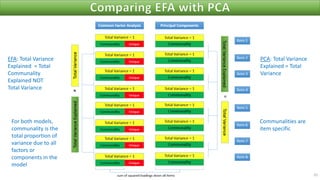
    35 EFA: Total Variance Explained= Total Communality Explained NOT Total Variance PCA: Total Variance Explained = Total Variance For both models, communality is the total proportion of variance due to all factors or components in the model Communalities are item specific
  • 36.
  • 37.
  • 38.
    • Simple Structure •Orthogonal rotation (Varimax) • Oblique (Direct Oblimin) 38
  • 39.
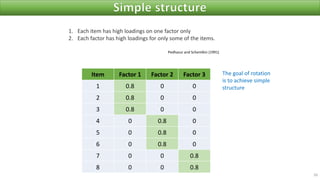
    Item Factor 1Factor 2 Factor 3 1 0.8 0 0 2 0.8 0 0 3 0.8 0 0 4 0 0.8 0 5 0 0.8 0 6 0 0.8 0 7 0 0 0.8 8 0 0 0.8 1. Each item has high loadings on one factor only 2. Each factor has high loadings for only some of the items. 39 The goal of rotation is to achieve simple structure Pedhazur and Schemlkin (1991)
  • 40.
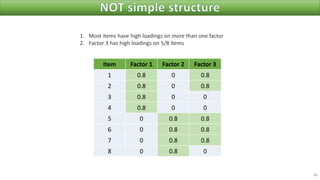
    Item Factor 1Factor 2 Factor 3 1 0.8 0 0.8 2 0.8 0 0.8 3 0.8 0 0 4 0.8 0 0 5 0 0.8 0.8 6 0 0.8 0.8 7 0 0.8 0.8 8 0 0.8 0 40 1. Most items have high loadings on more than one factor 2. Factor 3 has high loadings on 5/8 items
  • 41.
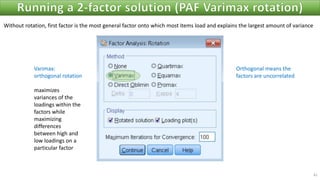
    41 Varimax: orthogonal rotation maximizes variances ofthe loadings within the factors while maximizing differences between high and low loadings on a particular factor Orthogonal means the factors are uncorrelated Without rotation, first factor is the most general factor onto which most items load and explains the largest amount of variance
  • 42.
    42 The factor transformation matrix turnsthe regular factor matrix into the rotated factor matrix The amount of rotation is the angle of rotation
  • 43.
  • 44.
    44 Unrotated solution maximizes sumof the variance of squared loadings within each factor 0.438 0.052 0.319 0.461 0.344 0.309 0.850 0.236 Varimax rotation 0.437 0.052 0.319 0.461 0.344 0.309 0.850 0.236 communalities are the same Communalities Communalities
  • 45.
    45 Higher absolute loadingsin Varimax solution for Tech Anxiety Unrotated Solution Varimax Solution
  • 46.
    46 3.01 3.01 Even thoughthe distribution of the variance is different the total sum of squared loadings is the same maximizes variances of the loadings True or False: Rotation changes how the variances are distributed but not the total communality Answer: T
  • 47.
    47 Varimax: good fordistributing among more than one factor Quartimax: maximizes the squared loadings so that each item loads most strongly onto a single factor. Good for generating a single factor. The difference between Quartimax and unrotated solution is that maximum variance can be in a factor that is not the first
  • 48.
    • factor patternmatrix • partial standardized regression coefficients of each item with a particular factor • Think (P)artial = Pattern • factor structure matrix • simple zero order correlations of each item with a particular factor • Think (S)imple = Structure • factor correlation matrix • matrix of intercorrelations among factors 48
  • 49.
    49 When Delta =0→ Direct Quartimin Oblique rotation means the factors are correlated Larger delta increases correlation among factors Negative delta increases makes factors more orthogonal
  • 50.
  • 51.
    angle of correlationϕ determines whether the factors are orthogonal or oblique angle of axis rotation θ how the axis rotates in relation to the data points (analogous to rotation in orthogonal rotation) 51
  • 52.
    52 If the factorsare orthogonal, the correlations between them would be zero, then the factor pattern matrix would EQUAL the factor structure matrix. The more correlated the factors, the greater the difference between pattern and structure matrix
  • 53.
    53 Simple zero ordercorrelations (can’t exceed one) Partial standardized regression coefficients (can exceed one) 0.653 is the simple correlation of Factor 1 on Item 1 0.740 is the effect of Factor 1 on Item 1 controlling for Factor 2 0.566 0.037 0.252 0.436 0.337 0.260 0.871 0.215 0.537 0.082 0.489 0.661 0.489 0.464 1.185 0.344 Note that the sum of squared loadings do NOT match communalities There IS a way to make the sum of squared loadings equal to the communality. Think back to Orthogonal Rotation.
  • 54.
    54 This is exactlythe same as the unrotated 2-factor PAF solution 3.01 4.25 Note: now the sum of the squared loadings is HIGHER than the unrotated solution SPSS uses the structure matrix to calculate this -factor contributions will overlap and become greater than the total variance SPSS uses the structure matrix to calculate this -factor contributions will overlap and become greater than the total variance
  • 55.
    55 Lower absolute loadingsof Items 4,8 onto Tech Anxiety for Pattern Matrix Partial loadings Zero-order loadings Correlations same
  • 56.
    56 Structure Matrix PatternMatrix Why do you think the second loading is lower in the Pattern Matrix compared to the Structure Matrix?
  • 57.
    • There isno consensus about which one to use in the literature • Hair et al. (1995) • Better to interpret the pattern matrix because it gives the unique contribution of the factor on a particular item • Pett et al. (2003) • Structure matrix should be used for interpretation • Pattern matrix for obtaining factor scores • My belief: I agree with Hair Hair, J. F. J., Anderson, R. E., Tatham, R. L., & Black, W. C. (1995). Multivariate data analysis . Saddle River. Pett, M. A., Lackey, N. R., & Sullivan, J. J. (2003). Making sense of factor analysis: The use of factor analysis for instrument development in health care research. Sage. 57
  • 58.
  • 59.
  • 60.
    60 Analyze – DimensionReduction – Factor – Factor Scores What it looks like in SPSS Data View
  • 61.
    61 This is howthe factor scores are generated SPSS takes the standardized scores for each item Then multiply each score -0.452 -0.733 1.32 -0.829 -0.749 -0.203 0.0692 -1.42 -0.880 -0.452 -0.733 1.32 -0.829 -0.749 -0.203 0.0692 -1.42 -0.113
  • 62.
    62 Covariance matrix ofthe true factor scores Covariance matrix of the estimated factor scores Notice that for Direct Quartimin, the raw covariances do not match Regression method has factor score mean of zero, and variance equal to the squared multiple correlation of estimated and true factor scores
  • 63.
    63 Notice that forDirect Quartimin, the raw correlations do match (property of Regression method) However, note that the factor scores are still correlated even though we did Varimax
  • 64.
    • 1. RegressionMethod • Variance equals the square multiple correlation between factors and variables • Maximizes correlation between estimated and true factor scores but can be biased • 2. Bartlett • Factor scores highly correlate with own true factor and not with others • Unbiased estimate of true factor scores • 3. Anderson-Rubin • Estimated factor scores become uncorrelated with other true factors and uncorrelated with other estimated factor scores • Biased especially if factors are actually correlated, not for oblique rotations 64
  • 65.
  • 66.