PRIMES, HIGHEST
COMMON FACTOR AND
LEAST COMMON
FACTOR
PRIMES
BRAINSTORMING
 I am a number between 1 and 10. I can only be divided by 1 and myself. What am
I?
 I am a number between 10 and 20. I can only be divided by 1 and myself. What
am I?
 I am the smallest number in number series, can only be divided by 1 and myself.
What am I?
PRIME NUMBERS
PRIME NUMBERS
Objective: You will learn to identify prime numbers using “Sieve of
Eratosthenes”.
Prime Numbers
 Prime numbers are
numbers that have only 2
factors: 1 and themselves.
 For Example: 2, 3, 5, 7, 11,
19
Composite Number
 A composite number is a
natural number or a
positive integer which has
more than two factors.
 For Example: 4, 6, 8, 10, 34
36
PRIME NUMBERS
Objective: You will learn to identify prime numbers using “Sieve of
Eratosthenes”.
Explain why 0 and 1 are neither prime nor composite?
Yasir says that if a whole number is not prime then it
must be composite. Do you agree? Explain your answer.
PRIME NUMBERS
Objective: You will learn to identify prime numbers using “Sieve of
Eratosthenes”.
Eratosthenes was the librarian at Alexandria, Egypt in
200 B.C.
Sieve of Eratosthenes
PRIME NUMBERS
Objective: You will learn to identify prime numbers using “Sieve of
Eratosthenes”.
 Eratosthenes was a Greek mathematician, astronomer, and
geographer.
 He invented a method for finding prime numbers that is still used
today.
 This method is called Eratosthenes’ Sieve.
 A sieve has holes in it and is used to filter out liquids from solids.
 Similarly, Eratosthenes’s sieve filters out numbers to find the prime
numbers.
Sieve of Eratosthenes
PRIME NUMBERS
Objective: You will learn to identify prime numbers using “Sieve of
Eratosthenes”.
ACTIVITY
1. Start at number 2. Put a Circle or highlight it. It is a Prime
Number. 2.
2. Cross out ALL the multiples of 2. (Yes all)
3. Go to the next number 3. Circle or highlight it. It is a Prime
Number.
4. Cross out all the multiples of 3.
5. Move to the next number NOT crossed out (5). It is a Prime
Number.. Repeat the process..
6. Complete this correct for each team member.
7. Show your teacher to WIN THE FIRST 5 POINTS.
8. Then have your first scribe read to you all the Team Rules for the
DE crypto Racer.
Sieve of Eratosthenes
PRIME NUMBERS
Objective: You will learn to identify prime numbers using “Sieve of
Eratosthenes”.
Sieve of Eratosthenes
PRIME NUMBERS
Objective: You will learn to identify prime numbers using “Sieve of
Eratosthenes”.
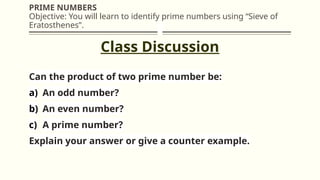
Can the product of two prime number be:
a) An odd number?
b) An even number?
c) A prime number?
Explain your answer or give a counter example.
Class Discussion

Primes, Highest Common Factor and Least common CHAPTER 1.pptx

  • 1.
    PRIMES, HIGHEST COMMON FACTORAND LEAST COMMON FACTOR PRIMES
  • 2.
    BRAINSTORMING  I ama number between 1 and 10. I can only be divided by 1 and myself. What am I?  I am a number between 10 and 20. I can only be divided by 1 and myself. What am I?  I am the smallest number in number series, can only be divided by 1 and myself. What am I? PRIME NUMBERS
  • 3.
    PRIME NUMBERS Objective: Youwill learn to identify prime numbers using “Sieve of Eratosthenes”. Prime Numbers  Prime numbers are numbers that have only 2 factors: 1 and themselves.  For Example: 2, 3, 5, 7, 11, 19 Composite Number  A composite number is a natural number or a positive integer which has more than two factors.  For Example: 4, 6, 8, 10, 34 36
  • 4.
    PRIME NUMBERS Objective: Youwill learn to identify prime numbers using “Sieve of Eratosthenes”. Explain why 0 and 1 are neither prime nor composite? Yasir says that if a whole number is not prime then it must be composite. Do you agree? Explain your answer.
  • 5.
    PRIME NUMBERS Objective: Youwill learn to identify prime numbers using “Sieve of Eratosthenes”. Eratosthenes was the librarian at Alexandria, Egypt in 200 B.C. Sieve of Eratosthenes
  • 6.
    PRIME NUMBERS Objective: Youwill learn to identify prime numbers using “Sieve of Eratosthenes”.  Eratosthenes was a Greek mathematician, astronomer, and geographer.  He invented a method for finding prime numbers that is still used today.  This method is called Eratosthenes’ Sieve.  A sieve has holes in it and is used to filter out liquids from solids.  Similarly, Eratosthenes’s sieve filters out numbers to find the prime numbers. Sieve of Eratosthenes
  • 7.
    PRIME NUMBERS Objective: Youwill learn to identify prime numbers using “Sieve of Eratosthenes”. ACTIVITY 1. Start at number 2. Put a Circle or highlight it. It is a Prime Number. 2. 2. Cross out ALL the multiples of 2. (Yes all) 3. Go to the next number 3. Circle or highlight it. It is a Prime Number. 4. Cross out all the multiples of 3. 5. Move to the next number NOT crossed out (5). It is a Prime Number.. Repeat the process.. 6. Complete this correct for each team member. 7. Show your teacher to WIN THE FIRST 5 POINTS. 8. Then have your first scribe read to you all the Team Rules for the DE crypto Racer. Sieve of Eratosthenes
  • 8.
    PRIME NUMBERS Objective: Youwill learn to identify prime numbers using “Sieve of Eratosthenes”. Sieve of Eratosthenes
  • 9.
    PRIME NUMBERS Objective: Youwill learn to identify prime numbers using “Sieve of Eratosthenes”. Can the product of two prime number be: a) An odd number? b) An even number? c) A prime number? Explain your answer or give a counter example. Class Discussion

Editor's Notes

  • #1 NOTE: To change the image on this slide, select the picture and delete it. Then click the Pictures icon in the placeholder to insert your own image.
  • #3 https://chatgpt.com/c/38bb6040-94ba-4c74-a6fa-85f238254e2a
  • #4 https://chatgpt.com/c/38bb6040-94ba-4c74-a6fa-85f238254e2a Certainly! Here’s a simplified explanation: 0 and 1 are neither prime nor composite. 0 has too many divisors (any number can divide 0). 1 only has one divisor (itself), so it doesn’t fit the definition of prime or composite. Regarding Yasir's statement: Not every non-prime number is composite. 0 and 1 are examples of numbers that are neither prime nor composite. 4o mini