MARKETING MIX
PRODUCT
Submitted by: Vanea Smith
Visit us: sanguinemurk.com
MARKETING MIX
Marketing mix is one of the major concepts in modern marketing. It
is the combination of various elements which constitutes the
company’s marketing system. It is set of controllable marketing
variables that the firm blends to produce the response it wants in
the target market. Though there are many basic marketing variables.
Visit: sanguinemurk.com
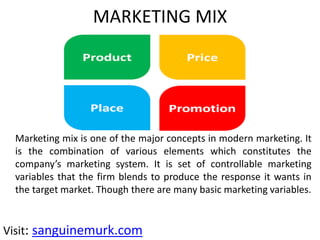
• McCarthy, popularized a four-factor classification called the four Ps:
Product, Price, Place and Promotion. Each P consists of a list of
particular marketing variables.
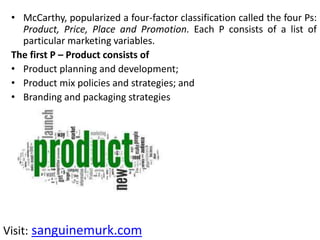
The first P – Product consists of
• Product planning and development;
• Product mix policies and strategies; and
• Branding and packaging strategies
Visit: sanguinemurk.com
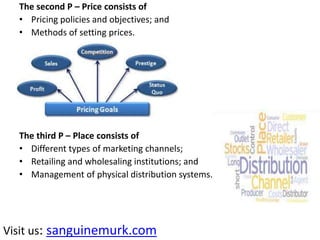
The second P – Price consists of
• Pricing policies and objectives; and
• Methods of setting prices.
The third P – Place consists of
• Different types of marketing channels;
• Retailing and wholesaling institutions; and
• Management of physical distribution systems.
Visit us: sanguinemurk.com
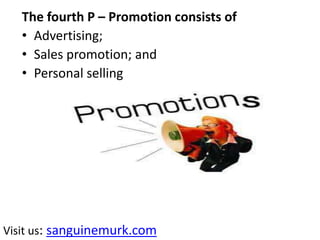
The fourth P – Promotion consists of
• Advertising;
• Sales promotion; and
• Personal selling
Visit us: sanguinemurk.com
What is a product ?
A product is something that must be capable of satisfying a need
or want, it includes physical objects, services, personalities
places, organisation and ideas. Thus, a transport service, as it
satisfies human need is a product. Similarly, places like Kashmir
and Kodaikanal, as they satisfy need to enjoy the cool climate are
also products
Visit us: sanguinemurk.com
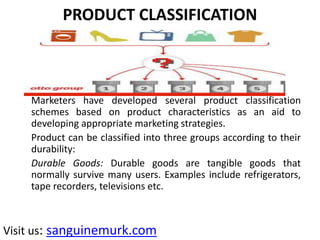
PRODUCT CLASSIFICATION
Marketers have developed several product classification
schemes based on product characteristics as an aid to
developing appropriate marketing strategies.
Product can be classified into three groups according to their
durability:
Durable Goods: Durable goods are tangible goods that
normally survive many users. Examples include refrigerators,
tape recorders, televisions etc.
Visit us: sanguinemurk.com
Non-Durable Goods: These are tangible goods
that normally are consumed for short period.
Example include soap, match box etc.
Services: Services are activities, benefits or
satisfactions that are offered for sale.
Examples include banking, transport,
insurance service etc
Visit us: sanguinemurk.com
Another method of classifying products is on the basis of
consumer shopping habits because they have implications
for marketing strategy. Based on this, goods may be
classified into three:
Convenience Goods: Goods that the customer usually
purchases frequently, immediately and with the minimum
effort. The price per unit is low, Example: soaps, match box
etc
Visit us: sanguinemurk.com
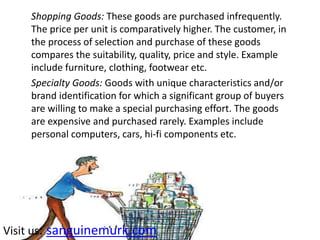
Shopping Goods: These goods are purchased infrequently.
The price per unit is comparatively higher. The customer, in
the process of selection and purchase of these goods
compares the suitability, quality, price and style. Example
include furniture, clothing, footwear etc.
Specialty Goods: Goods with unique characteristics and/or
brand identification for which a significant group of buyers
are willing to make a special purchasing effort. The goods
are expensive and purchased rarely. Examples include
personal computers, cars, hi-fi components etc.
Visit us: sanguinemurk.com
One of the ways of classification of industrial
products involves two broad categories viz.,
(1) products that are used in the production of
other goods and become a physical part of another
product, and
(2) products necessary to conduct business that do
not become part of another product. The products
that become part of another product are raw
materials, semi-manufactured goods, components
and subcontracted production services. The
products that are needed to conduct the business
include: Capital goods, operating supplies,
contracted industrial services, contracted
professional services and utilities.
Visit us: sanguinemurk.com
• The second aspect of product is product planning
and development.
• Product planning embraces all activities that
determine a company’s list of products. It include-
• Planning and developing a new product;
• Modification of existing product lines; and
• Elimination of unprofitable items.
• Product development encompasses the technical
activities of product research, engineering and
decision.
Visit us: sanguinemurk.com
• The third aspect of product is product mix
policies and strategies.
• Product mix refers to the composite of
products offered for sale by a company. For
example Godrej company offers cosmetics,
steel furnitures, office equipments, locks etc.
with many items in each category
Visit us: sanguinemurk.com
Product Mix
A product mix (also called product assortment) is the set of all
product lines and items that a particular seller offers to sale.
A company’s product mix can be described as having a certain width,
length, depth, and consistency.
The width of the product mix refers to how many product lines the
company carries.
The length of product mix refers to the total number of items in its
product mix.
The depth of product mix refers to how many product variants are
offered of each product item in the line.
The consistency of the product mix refers to how closely related the
various product lines are in end use, product requirements,
• Let us take an example of P&G as a company and
understand product mix. This will be not be a precise
example and all products of P&G might not be taken
into consideration. But the example will help you
understand product mix within an organization.
• Detergents – Arial, Arial oxyblue, Ariel bar, Tide, Tide
naturals, Tide bleach, Tide plus.
Shampoos – Head and shoulders, Head and shoulders
anti dandruff, Pantene, Pantene damage repair, Pantene
pro-v
• In the above example the following can be learned
about the product mix of P&G
Product mix Length – 12
Product mix Width – 2
Product mix Depth – 7 in detergents and 5 in shampoos
Product mix consistency – High as both are bathroom
products.
Visit us: sanguinemurk.com
PRODUCT DEVELOPMENT
• The products and services are the most visible assets of
the organizations and the new products are, hence
considered to be the corner stone of the long term
survival and prosperity of many organizations. The
rapid technological changes, shifting patterns of world
market opportunities and the intense competition
compel the business firms to continuously develop
new products and services for their survival. But failure
too in new product development is not uncommon.
Apparently, new product development is an unstable
activity, inherent in most organizations. But when
market conditions pressurize there is no other go
except to take the risk of introducing new products.
Visit us: sanguinemurk.com
• For Kotler, new product mean original products,
improved products, modified products and new
brands which are developed by the firm through
its own research and development efforts and
includes those products which the consumers see
as new.
• A new product is thus perceived differently by
different people. It is a need satisfying concept
with benefit for buyers bundle of need satisfying
features; for marketers, a way to add value; for
intermediaries, an opportunity to design; for R&D
and to assemble and process for production
department
Visit us: sanguinemurk.com
NEED FOR PRODUCT DEVELOPMENT
• New products meet the changes in consumer
demands.
• New products are the source of competitive advantage.
• They provide long-term financial return on investment.
• They utilize the existing production and operation
resources to an optimum level.
• They capitalize on research and development.
• They provide opportunities for reinforcing or changing
strategic direction.
Visit us: sanguinemurk.com
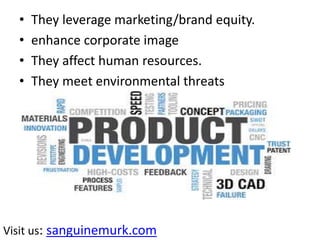
• They leverage marketing/brand equity.
• enhance corporate image
• They affect human resources.
• They meet environmental threats
Visit us: sanguinemurk.com
PROCESS OF PRODUCT DEVELOPMENT
• Idea Generation
• Screening of Ideas
• Concept Development and Testing
• Marketing Strategy Development
• Business Analysis
• Product Development
• Market Testing
• Market Introduction ( COMMERCIALIZATION)
IDEA GENERATION
a) Ideas for new products
Internal Sources: Customers: Competitors:
Distributors, Suppliers and Others
(b) New attribute for the existing products
(c) New uses of the existing products
Visit us: sanguinemurk.com
SCREENING OF IDEAS
• Compatibility with the promoter
• Consistency with governmental priorities
• Availability of inputs
• Adequacy of markets
• Reasonableness of cost
• Acceptability of risk level
Visit us: sanguinemurk.com
CONCEPT DEVELOPMENT AND
TESTING
• To get the reaction of consumer’s views of the
new product idea.
• To give direction regarding the development
of the project.
• To choose the most promising concepts for
development and
• To ascertain whether the product in question
has adequate potential for its
commercialization.
Visit us: sanguinemurk.com
MARKET STRATEGY & DEVELOPMENT
• The first part describes the size, structure and
behaviour of the target market, the planned
product positioning and the sales, market share
and profit goals sought in the first three years.
• The second part outlines the product’s planned
price, distribution strategy and marketing budget
for the first year.
• The third part describes the planned long-run
sales and profit goals and marketing-mix strategy
over time.
Visit us: sanguinemurk.com
BUSINESS ANALYSIS
• Business analysis is a stage where a new product
idea is subjected to more sophisticated and
detailed analysis. It involves a review of the sales,
costs and profit projections for a new product to
find out whether they satisfy the company’s
objectives. If they do, the product can move to
the product-development stage
Visit us: sanguinemurk.com
• The estimate size and growth rate of the
market segment, that is, the market
opportunity for the new product concept.
• The estimate sales and market share for the
new product concept in the selected market
or market segment.
• The values of the new product program in
terms of its expected financial performance
Visit us: sanguinemurk.com
PRODUCT DEVELOPMENT
• Product development is done after forecasted
sales and budgeted costs promise a
satisfactory return on investment and after
the company is satisfied that it can gain access
to the target market. At this juncture, the
objective is to establish if it is physically
possible to produce an object with the desired
performance characteristics within the cost
constraints indicated by the forecast demand
schedule
Visit us: sanguinemurk.com
• Usually this phase is the longest in the
whole process, and it is vitally important
that, throughout development, the
innovator should continue critically to
observe events and changes in the
proposed target markets. In addition to
updating the product concept to reflect
changes in the market. the development
phase should also provide for testing the
product under real usage condition to
ensure that it will deliver the promise
satisfactions.
Visit us: sanguinemurk.com
PROTOTYPE
• A prototype is a working model or preliminary
version of the final product, achieved through an
implementation of the product concept. For
many products the prototype is the first full-scale
likeness of the product; for other, it is a scaled-
down model. For some products a prototype is
not possible without at least a small-scale
product launch. In such cases, prototyping and
product development proceed simultaneously in
market.
Visit us: sanguinemurk.com
MARKET TESTING
• After developing a prototype, they must be put through vigorous
functional and consumer tests.
• The functional tests are conducted in order to make sure that the
product performs safely and effectively and they are conducted
under laboratory and field conditions.
• Consumer testing is done in a variety of ways. They may be done
by bringing consumers into laboratory or they may be given
samples to use in their homes. In-home product placement tests
are common in products like new home appliances, Consumer
preference testing draws on variety of techniques, like simple
ranking, paired comparisons, and rating scales, each with its own
advantages and disadvantages
Visit us: sanguinemurk.com
• Although test marketing can take a variety of
forms, the three popular types used in
practice in consumer goods markets are
simulated, controlled and conventional test
marketing. Kotler classifies them according to
the cost testing, from the least to the most
costly, are
(1) Sales-wave research
(2) Simulated test marketing
(3) Controlled test marketing,
(4) conventional test marketing.
Visit us: sanguinemurk.com
Sales Wave Research
• In this method the consumers are initially
offered to try the product at no cost and
subsequently they are reoffered the product, or
a competitor’s product, at slightly reduced
prices. These reoffering, referred to as sales
waves, may be restored to for as many as three
to five times in order to find out how many
customer selected the product again and their
reported level of satisfaction. This method may
also include exposing customers to one or more
advertising concept in rough form to ascertain
its effects on repeat purchase. The sales wave
research can be implemented quickly.
Visit us: sanguinemurk.com
Simulated Test Marketing (STM)
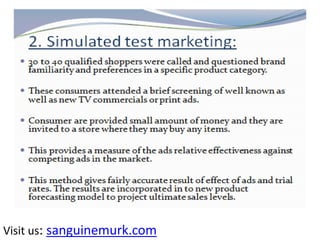
• It is a research method that facilitates the
measurement of market response to a new product
and its marketing program among potential buyers in a
pseudo market environment. It can be implemented in
a laboratory setting, in the homes or places of business
of potential buyers or in other places that will simulate
the buying process as closely as possible.
• The value of STMs is relatively low cost, quick
execution, and secrecy from competitors. In many
cases they are used to decide whether or not it is
feasible to conduct a test market, and in other cases
they are used to bypass test markets altogether and
move directly to launch.
Visit us: sanguinemurk.com
Controlled Test Marketing
These are commercial services that are conducted in
selected cities for test marketing. Selected retail outlets in
these cities are equipped with electronic checkout
scanners to record sales. A recruited panel of customers
agrees to shop in these stores, and the individual order
and a special identification care are scanned every time, a
panel member makes a purchase. Each card code is
associated with a profile of a customer kept in a data
base (containing demo-graphics, psychographics, and
preferences and so on). The impact of local advertising
and promotions during the test are also evaluated.
Bringing these data sources together on a weekly or even
daily basis can provide a powerful and highly controlled
testing environment.
Visit us: sanguinemurk.com
Conventional Test Marketing
• It is especially useful for measuring response to
the product from a broader set of stakeholders,
including competitors, the trade, media,
regulator and others. It is also very helpful for
discovering organizational and other market
problems in implementing the new product
program. The real benefits to conventional test
marketing are the learning and subsequent
adjustments that help ensure a successful launch,
especially for new product situations with high
stakes and high environment and market
uncertainty.
Visit us: sanguinemurk.com
COMMERCIALIZATION
• Commercialization can be considered as a final
phase in the new product development when the
product is launched into the market place, thus
initiating its life cycle. Supplies can be made
available to the distribution channel, intensive
selling must take place to ensure widespread
availability at the point of sale or to canvass order
from prospective buyers. Maintenance and
servicing facilities will be necessary and a large
promotional investment will be needed to create
awareness of the new product’s existence
Visit us: sanguinemurk.com

Marketing mix product

  • 1.
    MARKETING MIX PRODUCT Submitted by:Vanea Smith Visit us: sanguinemurk.com
  • 2.
    MARKETING MIX Marketing mixis one of the major concepts in modern marketing. It is the combination of various elements which constitutes the company’s marketing system. It is set of controllable marketing variables that the firm blends to produce the response it wants in the target market. Though there are many basic marketing variables. Visit: sanguinemurk.com
  • 3.
    • McCarthy, popularizeda four-factor classification called the four Ps: Product, Price, Place and Promotion. Each P consists of a list of particular marketing variables. The first P – Product consists of • Product planning and development; • Product mix policies and strategies; and • Branding and packaging strategies Visit: sanguinemurk.com
  • 4.
    The second P– Price consists of • Pricing policies and objectives; and • Methods of setting prices. The third P – Place consists of • Different types of marketing channels; • Retailing and wholesaling institutions; and • Management of physical distribution systems. Visit us: sanguinemurk.com
  • 5.
    The fourth P– Promotion consists of • Advertising; • Sales promotion; and • Personal selling Visit us: sanguinemurk.com
  • 6.
    What is aproduct ? A product is something that must be capable of satisfying a need or want, it includes physical objects, services, personalities places, organisation and ideas. Thus, a transport service, as it satisfies human need is a product. Similarly, places like Kashmir and Kodaikanal, as they satisfy need to enjoy the cool climate are also products Visit us: sanguinemurk.com
  • 7.
    PRODUCT CLASSIFICATION Marketers havedeveloped several product classification schemes based on product characteristics as an aid to developing appropriate marketing strategies. Product can be classified into three groups according to their durability: Durable Goods: Durable goods are tangible goods that normally survive many users. Examples include refrigerators, tape recorders, televisions etc. Visit us: sanguinemurk.com
  • 8.
    Non-Durable Goods: Theseare tangible goods that normally are consumed for short period. Example include soap, match box etc. Services: Services are activities, benefits or satisfactions that are offered for sale. Examples include banking, transport, insurance service etc Visit us: sanguinemurk.com
  • 9.
    Another method ofclassifying products is on the basis of consumer shopping habits because they have implications for marketing strategy. Based on this, goods may be classified into three: Convenience Goods: Goods that the customer usually purchases frequently, immediately and with the minimum effort. The price per unit is low, Example: soaps, match box etc Visit us: sanguinemurk.com
  • 10.
    Shopping Goods: Thesegoods are purchased infrequently. The price per unit is comparatively higher. The customer, in the process of selection and purchase of these goods compares the suitability, quality, price and style. Example include furniture, clothing, footwear etc. Specialty Goods: Goods with unique characteristics and/or brand identification for which a significant group of buyers are willing to make a special purchasing effort. The goods are expensive and purchased rarely. Examples include personal computers, cars, hi-fi components etc. Visit us: sanguinemurk.com
  • 11.
    One of theways of classification of industrial products involves two broad categories viz., (1) products that are used in the production of other goods and become a physical part of another product, and (2) products necessary to conduct business that do not become part of another product. The products that become part of another product are raw materials, semi-manufactured goods, components and subcontracted production services. The products that are needed to conduct the business include: Capital goods, operating supplies, contracted industrial services, contracted professional services and utilities. Visit us: sanguinemurk.com
  • 12.
    • The secondaspect of product is product planning and development. • Product planning embraces all activities that determine a company’s list of products. It include- • Planning and developing a new product; • Modification of existing product lines; and • Elimination of unprofitable items. • Product development encompasses the technical activities of product research, engineering and decision. Visit us: sanguinemurk.com
  • 13.
    • The thirdaspect of product is product mix policies and strategies. • Product mix refers to the composite of products offered for sale by a company. For example Godrej company offers cosmetics, steel furnitures, office equipments, locks etc. with many items in each category Visit us: sanguinemurk.com
  • 14.
    Product Mix A productmix (also called product assortment) is the set of all product lines and items that a particular seller offers to sale. A company’s product mix can be described as having a certain width, length, depth, and consistency. The width of the product mix refers to how many product lines the company carries. The length of product mix refers to the total number of items in its product mix. The depth of product mix refers to how many product variants are offered of each product item in the line. The consistency of the product mix refers to how closely related the various product lines are in end use, product requirements,
  • 15.
    • Let ustake an example of P&G as a company and understand product mix. This will be not be a precise example and all products of P&G might not be taken into consideration. But the example will help you understand product mix within an organization. • Detergents – Arial, Arial oxyblue, Ariel bar, Tide, Tide naturals, Tide bleach, Tide plus. Shampoos – Head and shoulders, Head and shoulders anti dandruff, Pantene, Pantene damage repair, Pantene pro-v • In the above example the following can be learned about the product mix of P&G Product mix Length – 12 Product mix Width – 2 Product mix Depth – 7 in detergents and 5 in shampoos Product mix consistency – High as both are bathroom products. Visit us: sanguinemurk.com
  • 16.
    PRODUCT DEVELOPMENT • Theproducts and services are the most visible assets of the organizations and the new products are, hence considered to be the corner stone of the long term survival and prosperity of many organizations. The rapid technological changes, shifting patterns of world market opportunities and the intense competition compel the business firms to continuously develop new products and services for their survival. But failure too in new product development is not uncommon. Apparently, new product development is an unstable activity, inherent in most organizations. But when market conditions pressurize there is no other go except to take the risk of introducing new products. Visit us: sanguinemurk.com
  • 17.
    • For Kotler,new product mean original products, improved products, modified products and new brands which are developed by the firm through its own research and development efforts and includes those products which the consumers see as new. • A new product is thus perceived differently by different people. It is a need satisfying concept with benefit for buyers bundle of need satisfying features; for marketers, a way to add value; for intermediaries, an opportunity to design; for R&D and to assemble and process for production department Visit us: sanguinemurk.com
  • 18.
    NEED FOR PRODUCTDEVELOPMENT • New products meet the changes in consumer demands. • New products are the source of competitive advantage. • They provide long-term financial return on investment. • They utilize the existing production and operation resources to an optimum level. • They capitalize on research and development. • They provide opportunities for reinforcing or changing strategic direction. Visit us: sanguinemurk.com
  • 19.
    • They leveragemarketing/brand equity. • enhance corporate image • They affect human resources. • They meet environmental threats Visit us: sanguinemurk.com
  • 20.
    PROCESS OF PRODUCTDEVELOPMENT • Idea Generation • Screening of Ideas • Concept Development and Testing • Marketing Strategy Development • Business Analysis • Product Development • Market Testing • Market Introduction ( COMMERCIALIZATION)
  • 21.
    IDEA GENERATION a) Ideasfor new products Internal Sources: Customers: Competitors: Distributors, Suppliers and Others (b) New attribute for the existing products (c) New uses of the existing products Visit us: sanguinemurk.com
  • 22.
    SCREENING OF IDEAS •Compatibility with the promoter • Consistency with governmental priorities • Availability of inputs • Adequacy of markets • Reasonableness of cost • Acceptability of risk level Visit us: sanguinemurk.com
  • 23.
    CONCEPT DEVELOPMENT AND TESTING •To get the reaction of consumer’s views of the new product idea. • To give direction regarding the development of the project. • To choose the most promising concepts for development and • To ascertain whether the product in question has adequate potential for its commercialization. Visit us: sanguinemurk.com
  • 24.
    MARKET STRATEGY &DEVELOPMENT • The first part describes the size, structure and behaviour of the target market, the planned product positioning and the sales, market share and profit goals sought in the first three years. • The second part outlines the product’s planned price, distribution strategy and marketing budget for the first year. • The third part describes the planned long-run sales and profit goals and marketing-mix strategy over time. Visit us: sanguinemurk.com
  • 25.
    BUSINESS ANALYSIS • Businessanalysis is a stage where a new product idea is subjected to more sophisticated and detailed analysis. It involves a review of the sales, costs and profit projections for a new product to find out whether they satisfy the company’s objectives. If they do, the product can move to the product-development stage Visit us: sanguinemurk.com
  • 26.
    • The estimatesize and growth rate of the market segment, that is, the market opportunity for the new product concept. • The estimate sales and market share for the new product concept in the selected market or market segment. • The values of the new product program in terms of its expected financial performance Visit us: sanguinemurk.com
  • 27.
    PRODUCT DEVELOPMENT • Productdevelopment is done after forecasted sales and budgeted costs promise a satisfactory return on investment and after the company is satisfied that it can gain access to the target market. At this juncture, the objective is to establish if it is physically possible to produce an object with the desired performance characteristics within the cost constraints indicated by the forecast demand schedule Visit us: sanguinemurk.com
  • 28.
    • Usually thisphase is the longest in the whole process, and it is vitally important that, throughout development, the innovator should continue critically to observe events and changes in the proposed target markets. In addition to updating the product concept to reflect changes in the market. the development phase should also provide for testing the product under real usage condition to ensure that it will deliver the promise satisfactions. Visit us: sanguinemurk.com
  • 29.
    PROTOTYPE • A prototypeis a working model or preliminary version of the final product, achieved through an implementation of the product concept. For many products the prototype is the first full-scale likeness of the product; for other, it is a scaled- down model. For some products a prototype is not possible without at least a small-scale product launch. In such cases, prototyping and product development proceed simultaneously in market. Visit us: sanguinemurk.com
  • 30.
    MARKET TESTING • Afterdeveloping a prototype, they must be put through vigorous functional and consumer tests. • The functional tests are conducted in order to make sure that the product performs safely and effectively and they are conducted under laboratory and field conditions. • Consumer testing is done in a variety of ways. They may be done by bringing consumers into laboratory or they may be given samples to use in their homes. In-home product placement tests are common in products like new home appliances, Consumer preference testing draws on variety of techniques, like simple ranking, paired comparisons, and rating scales, each with its own advantages and disadvantages Visit us: sanguinemurk.com
  • 31.
    • Although testmarketing can take a variety of forms, the three popular types used in practice in consumer goods markets are simulated, controlled and conventional test marketing. Kotler classifies them according to the cost testing, from the least to the most costly, are (1) Sales-wave research (2) Simulated test marketing (3) Controlled test marketing, (4) conventional test marketing. Visit us: sanguinemurk.com
  • 32.
    Sales Wave Research •In this method the consumers are initially offered to try the product at no cost and subsequently they are reoffered the product, or a competitor’s product, at slightly reduced prices. These reoffering, referred to as sales waves, may be restored to for as many as three to five times in order to find out how many customer selected the product again and their reported level of satisfaction. This method may also include exposing customers to one or more advertising concept in rough form to ascertain its effects on repeat purchase. The sales wave research can be implemented quickly. Visit us: sanguinemurk.com
  • 33.
    Simulated Test Marketing(STM) • It is a research method that facilitates the measurement of market response to a new product and its marketing program among potential buyers in a pseudo market environment. It can be implemented in a laboratory setting, in the homes or places of business of potential buyers or in other places that will simulate the buying process as closely as possible. • The value of STMs is relatively low cost, quick execution, and secrecy from competitors. In many cases they are used to decide whether or not it is feasible to conduct a test market, and in other cases they are used to bypass test markets altogether and move directly to launch. Visit us: sanguinemurk.com
  • 34.
  • 35.
    Controlled Test Marketing Theseare commercial services that are conducted in selected cities for test marketing. Selected retail outlets in these cities are equipped with electronic checkout scanners to record sales. A recruited panel of customers agrees to shop in these stores, and the individual order and a special identification care are scanned every time, a panel member makes a purchase. Each card code is associated with a profile of a customer kept in a data base (containing demo-graphics, psychographics, and preferences and so on). The impact of local advertising and promotions during the test are also evaluated. Bringing these data sources together on a weekly or even daily basis can provide a powerful and highly controlled testing environment. Visit us: sanguinemurk.com
  • 36.
    Conventional Test Marketing •It is especially useful for measuring response to the product from a broader set of stakeholders, including competitors, the trade, media, regulator and others. It is also very helpful for discovering organizational and other market problems in implementing the new product program. The real benefits to conventional test marketing are the learning and subsequent adjustments that help ensure a successful launch, especially for new product situations with high stakes and high environment and market uncertainty. Visit us: sanguinemurk.com
  • 37.
    COMMERCIALIZATION • Commercialization canbe considered as a final phase in the new product development when the product is launched into the market place, thus initiating its life cycle. Supplies can be made available to the distribution channel, intensive selling must take place to ensure widespread availability at the point of sale or to canvass order from prospective buyers. Maintenance and servicing facilities will be necessary and a large promotional investment will be needed to create awareness of the new product’s existence Visit us: sanguinemurk.com
  • 38.