
PreventionWorks!
Harm Reduction in the Nation's
Capital
PreventionWorks!
GUSOM Team
 Site: PreventionWorks!
 Project: Addressing Harm Reduction Issues in the
Nation’s Capital
 GUSOM Students: Daniel Vitantonio, Mudit Kaushal,
Helena Kuhn, Billy Richter, Brent Yeung, Sarah Sidhu,
Gabe Gaviola
 Faculty Team Leader: Mary Beth Levin
 Community Partners: PreventionWorks!
Background Information
 What is Harm Reduction?
 Harm reduction is a set of practical strategies that reduce
negative consequences of drug use and other activities
 The extent of a person’s drug use is of secondary importance to
the harms resulting from them
 HIV/AIDS in DC
 Approximately 1 out of 20 adults in DC is living with
HIV/AIDS
 Thirty percent of new AIDS cases in the District can be traced
to reused needle
PreventionWorks!
Project Overview
 Promoting harm reduction
 Safe Sex Kits (Condoms, Lubricant)
 Wound Care Kits
 Needle Exchange
 HIV Testing
 Treatment Referrals (Detox, Mental Health, Wound Care)
 Food and Water
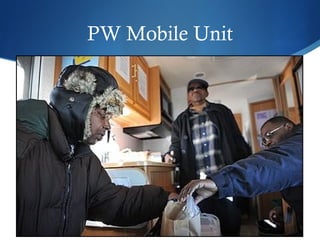
 A Typical Day on the Mobile Unit
PW Mobile Unit
Neighborhood: NE
Washington, DC
 Division Street and Nanny
Hills Burroughs, NE
 9th
and H Street, NE
 North Capitol and Hanover
Street, NW
Community Audience
 Neighborhood: Northeast DC
 Injection Drug Users (IDU)
 Majority African American
 Few Latinos and Caucasians
 Ages 18 – 68
 Average Contacts/day: 30 people
Reflections
 Does needle exchange promote and/or
facilitate drug use?
 Does needle exchange help people access
treatment?
 The Mobile Unit as a Medical Home
Recommendations
 Scheduling
 Staffing and Organization
 Supplies
Don’t give up the fight!

PreventionWorks2009-10[1]

  • 1.
  • 2.
    PreventionWorks! GUSOM Team  Site:PreventionWorks!  Project: Addressing Harm Reduction Issues in the Nation’s Capital  GUSOM Students: Daniel Vitantonio, Mudit Kaushal, Helena Kuhn, Billy Richter, Brent Yeung, Sarah Sidhu, Gabe Gaviola  Faculty Team Leader: Mary Beth Levin  Community Partners: PreventionWorks!
  • 3.
    Background Information  Whatis Harm Reduction?  Harm reduction is a set of practical strategies that reduce negative consequences of drug use and other activities  The extent of a person’s drug use is of secondary importance to the harms resulting from them  HIV/AIDS in DC  Approximately 1 out of 20 adults in DC is living with HIV/AIDS  Thirty percent of new AIDS cases in the District can be traced to reused needle
  • 4.
  • 5.
    Project Overview  Promotingharm reduction  Safe Sex Kits (Condoms, Lubricant)  Wound Care Kits  Needle Exchange  HIV Testing  Treatment Referrals (Detox, Mental Health, Wound Care)  Food and Water  A Typical Day on the Mobile Unit
  • 6.
  • 7.
    Neighborhood: NE Washington, DC Division Street and Nanny Hills Burroughs, NE  9th and H Street, NE  North Capitol and Hanover Street, NW
  • 8.
    Community Audience  Neighborhood:Northeast DC  Injection Drug Users (IDU)  Majority African American  Few Latinos and Caucasians  Ages 18 – 68  Average Contacts/day: 30 people
  • 9.
    Reflections  Does needleexchange promote and/or facilitate drug use?  Does needle exchange help people access treatment?  The Mobile Unit as a Medical Home
  • 10.
    Recommendations  Scheduling  Staffingand Organization  Supplies Don’t give up the fight!

Editor's Notes

  • #4 - Given that our project is entitled: Harm Reduction Issues in the District of Columbia, we will start by defining Harm Reduction So how does harm reduction apply to DC? It’s no secret that the District of Columbia has the highest rate of new AIDS cases in the country Nearly one out of every twenty adults in DC is living with HIV/AIDS. At least one in seven African-American men in DC are infected with HIV. Thirty percent of new AIDS cases in the District can be traced to a reused needle.
  • #5 Prevention Works is the largest and oldest needle exchange program in the district of Columbia. Currently, there still exists a nation-wide ban on federal funding for harm reduction However, in DC, In 2007, the law was changed to allow publicly funded organizations to use private funds, as well as local DC government funds, to provide syringe exchange PreventionWorks was founded in 1996 as part of the WhitmanWalker Clinic, and until 2007, relied solely on private funding
  • #6 We had both a “behind the scenes” role as well as a front and center role on the Mobile Unit In office building, prepared safe sex kits and wound care kits, some of us worked on preparing and updating client client literature BUT, the real meat of the experience was traveling through DC on the Mobile Unit The van provides a variety of services, all of which we helped to facilitate: read above MUDIT
  • #9 Oftentimes, if you went to the same sites, you would begin to recognize people, and realize that they were very dependent on the van
  • #10 1 + 2 = Mudit The Mobile Unit as a Medical Home: No access to care in these parts of the city, people come to rely on the van for a variety of services, People would come for food, water, HIV tests, condoms. These are very basic services! It is clear that these communities have come to rely heavily on the mobile unit. Story about man shot in the wrist. People in these areas will utilize the services if they can access them!