Public injecting drug use and the local harm reduction services József Rácz
Public injecting Blue Point Drug Counselling and Outpatient Centre: Contact Cafe 8th district of Budapest Injecting and sexual risk behaviours Local harm reduction services Risks of injecting: HIV, HCV Data on needle exchange Characteristics of the clientele Harm reduction methods Summary of a large scale study on needle exchange (Australia, 2009)
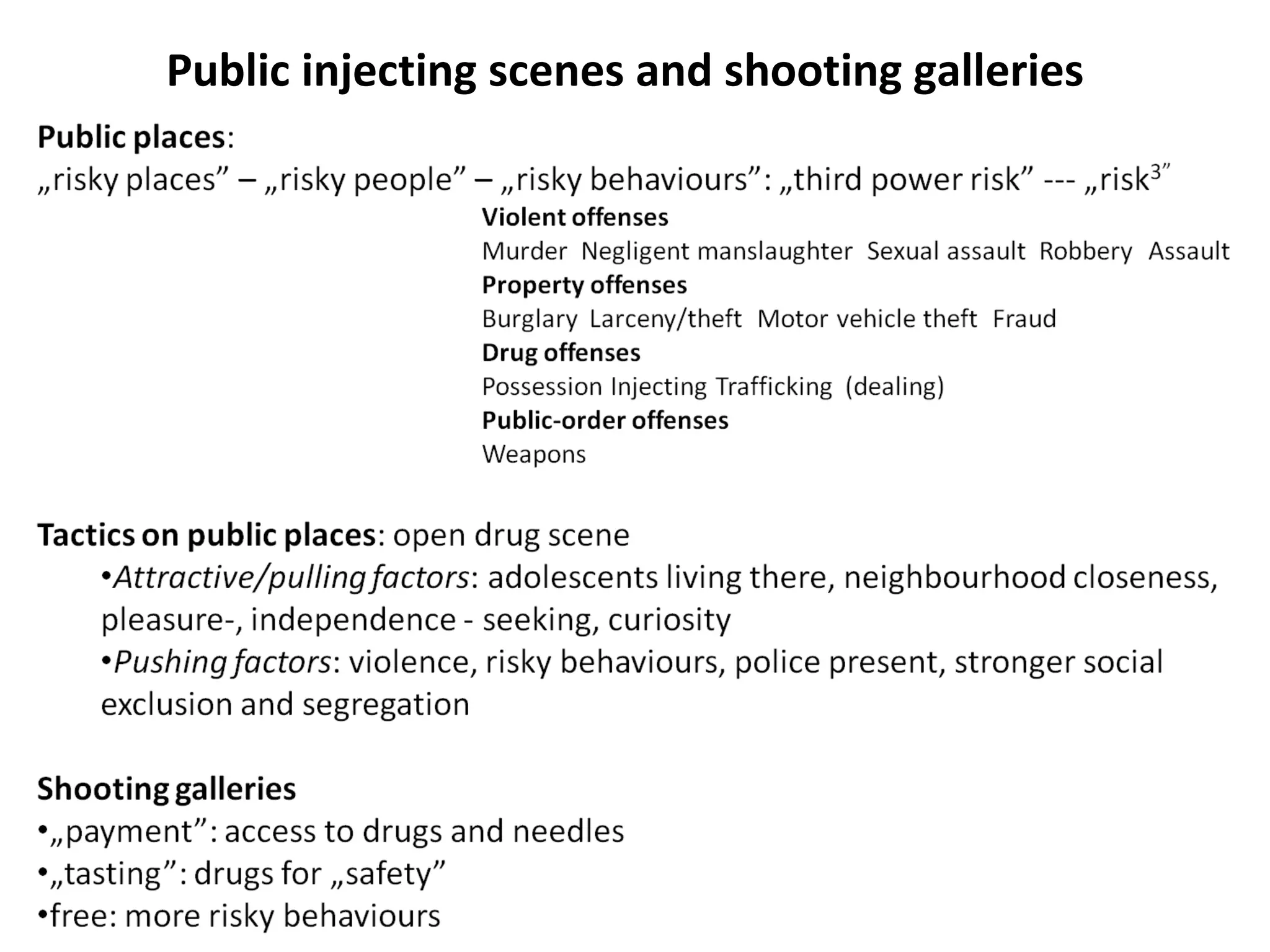
Public injecting scenes and shooting galleries
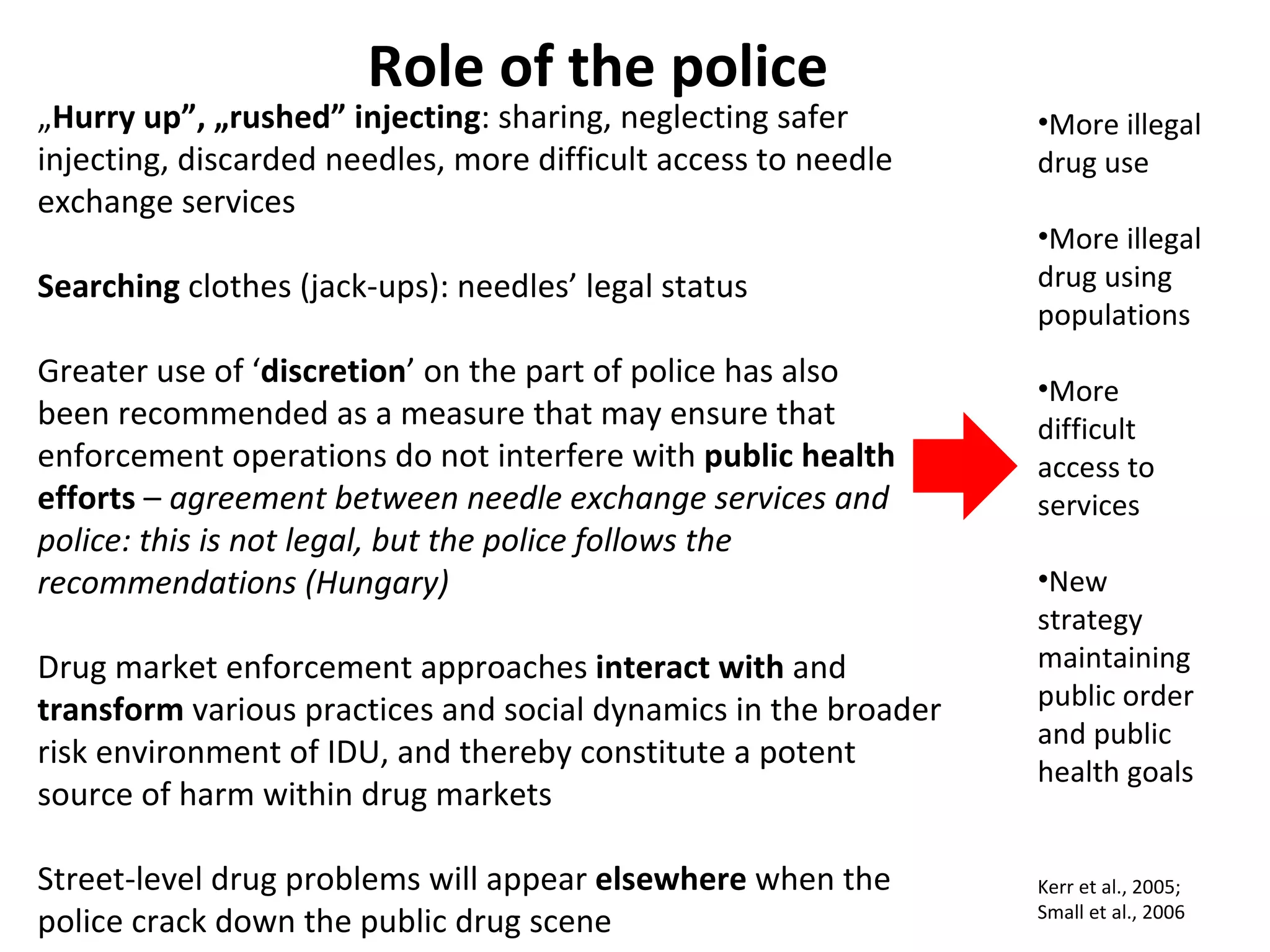
„ Hurry up”, „rushed” injecting : sharing, neglecting safer injecting, discarded needles, more difficult access to needle exchange services Searching  clothes (jack-ups): needles’ legal status Greater use of ‘ discretion ’ on the part of police has also been recommended as a measure that may ensure that enforcement operations do not interfere with  public health efforts  –  agreement between needle exchange services and police: this is not legal, but the police follows the recommendations (Hungary) Drug market enforcement approaches  interact   with  and  transform  various practices and social dynamics in the broader risk environment of IDU, and thereby constitute a potent source of harm within drug markets Street-level drug problems will appear  elsewhere  when the police crack down the public drug scene Role of the police Kerr et al., 2005; Small et al., 2006 More illegal drug use More illegal drug using populations More difficult access to services New strategy maintaining public order and public health  goals
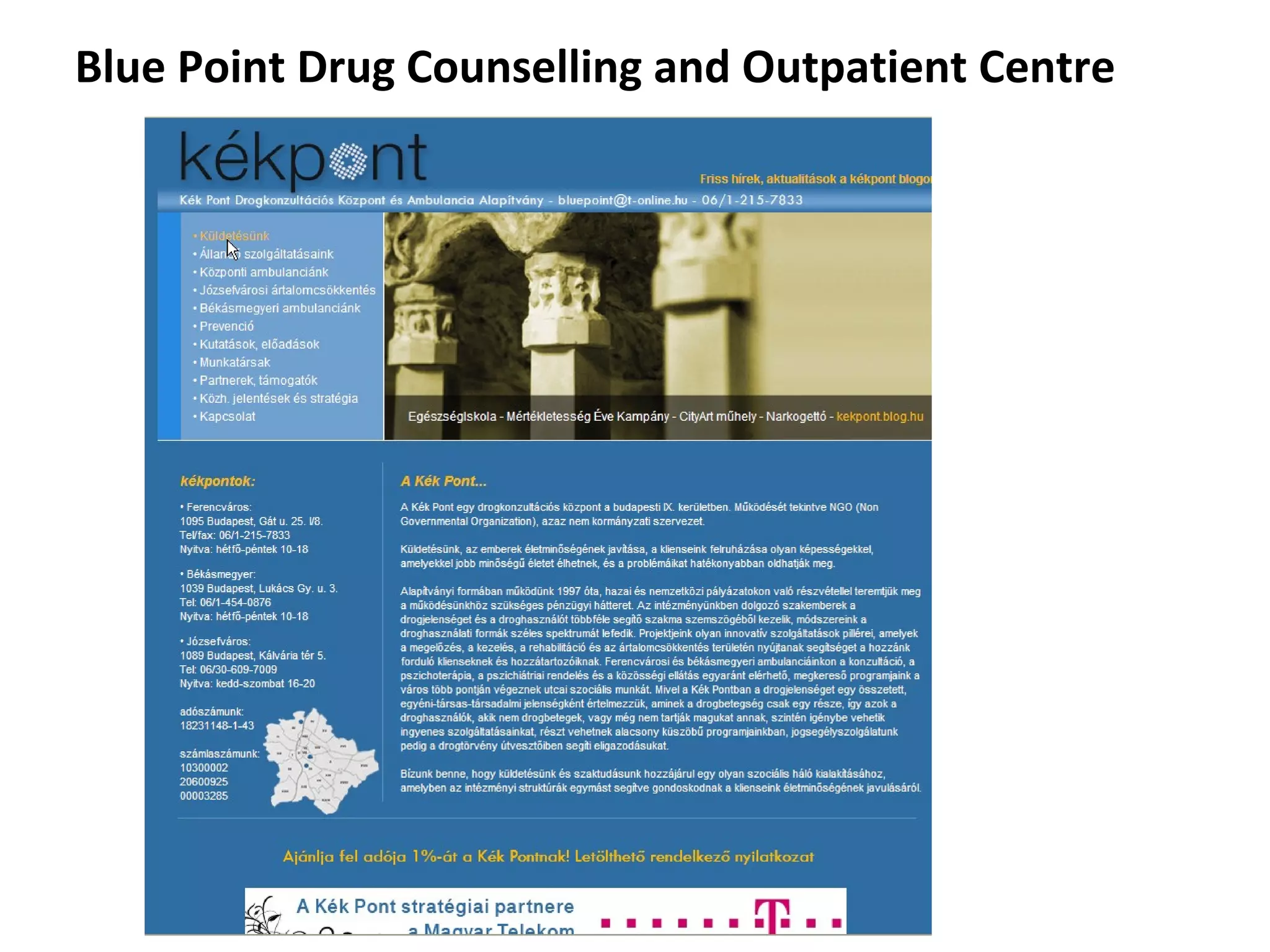
Blue Point Drug Counselling and Outpatient Centre
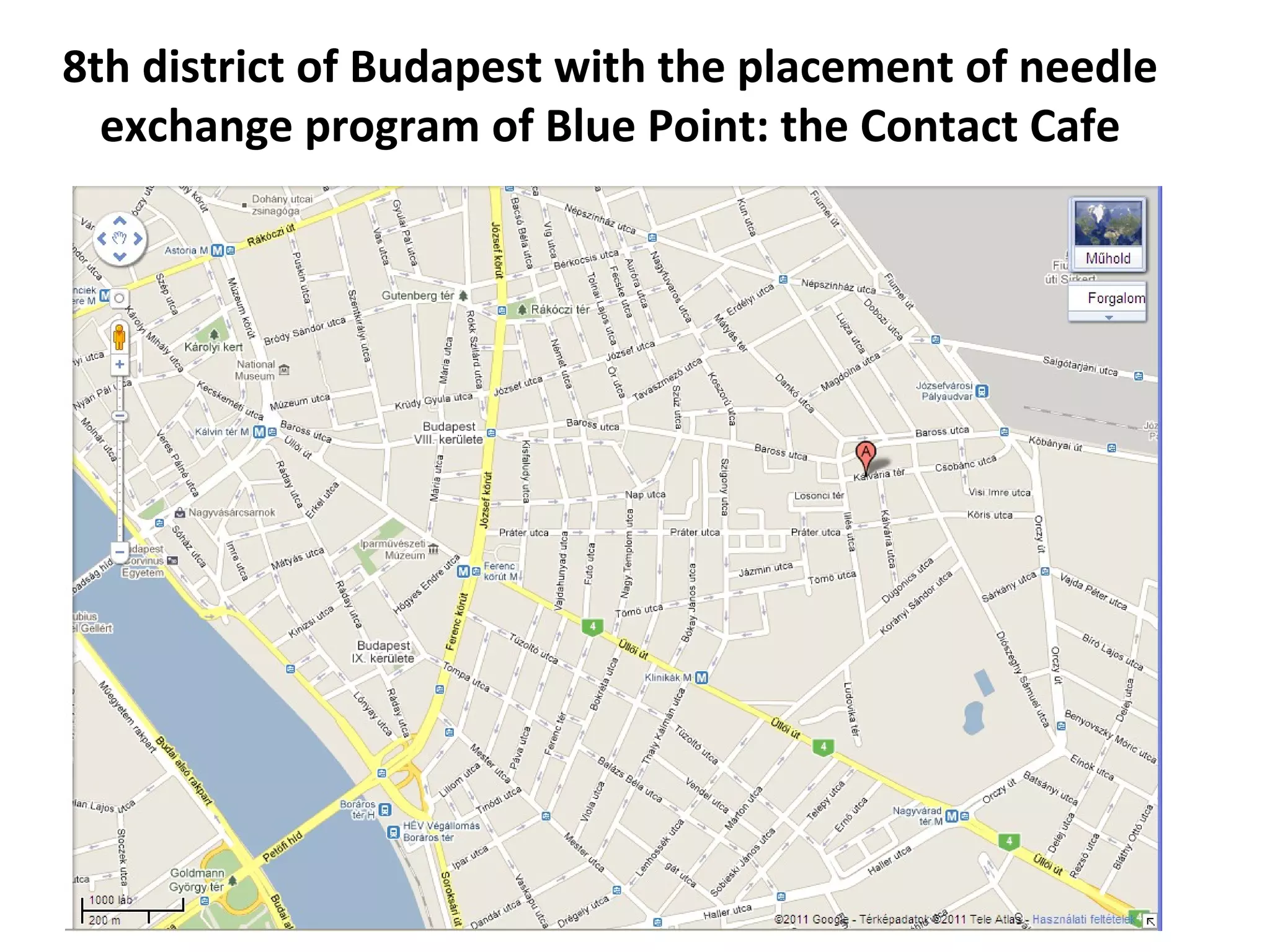
8th district of Budapest with the placement of needle exchange program of Blue Point: the Contact Cafe
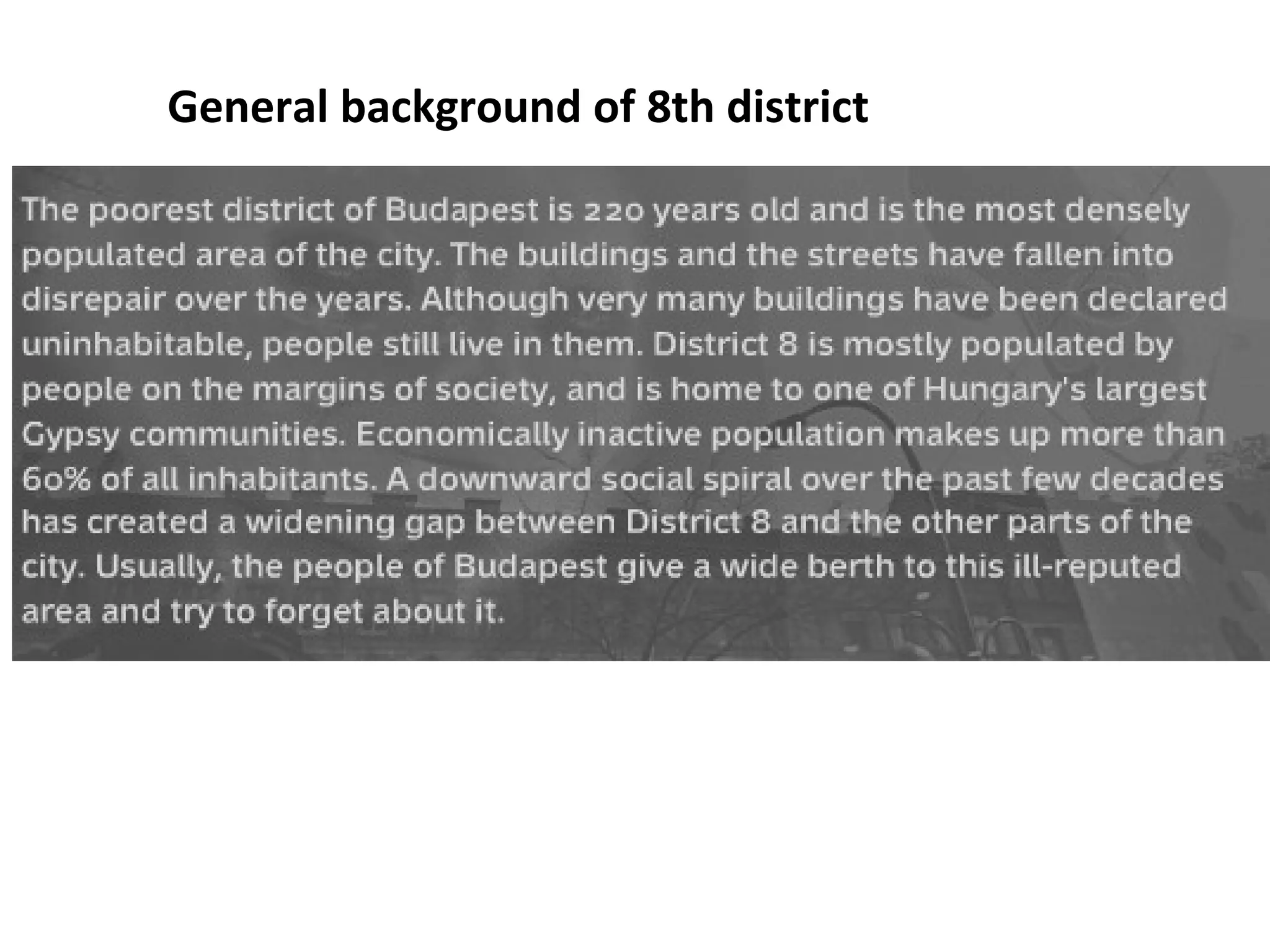
General background of 8th district
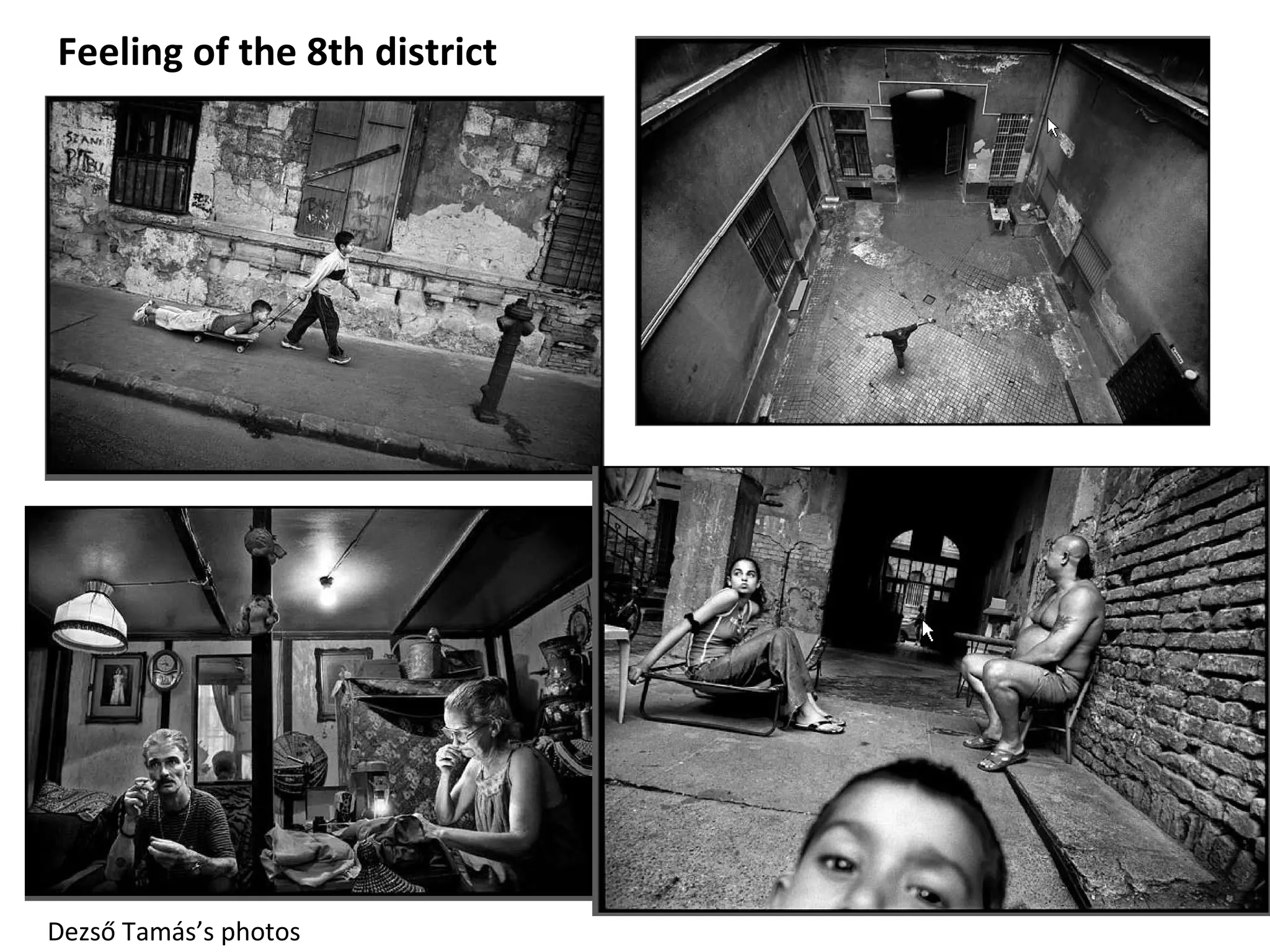
The VIII. district of Budapest faces a number of difficulties.  This is an area where there are  multiple  social, health, livelihood, community, etc..  problems. The drug and social problems are much higher compared to other districts.  The  legal and illegal drugs  and the presence of a large number of consumers in a very open drugscene requires various and several care providers at different levels to be present.  In particular, there are many addicts living in the district who are  suspicious of institutional care , which is a high-threshold care service.  The legal and illegal drug use associated with  poor living conditions and low social status  seriously increases the risk of spreading diseases. The clients with health problems often do not turn to a doctor or do not ask for care and treatment.  Cultrual diversity – including Roma culture  - is one of the characteristics of the disctrict. There are large differences of inhabitants concerning ethnicity, nationality, education and housing, and social status and health. (The „Integrated Rehabilitation Strategy for Urban Development” of the capital places an emphasis on refurbishing the district, but this is impossible without dealing with social problems.) The  well-defined part of the disctict’s inhabitants  are living in poor conditions, bad housing, has poor health culture, poor mental status and is low skilled and unemployed. The socio-cultural background
Dezső Tamás’s photos Feeling of the 8th district
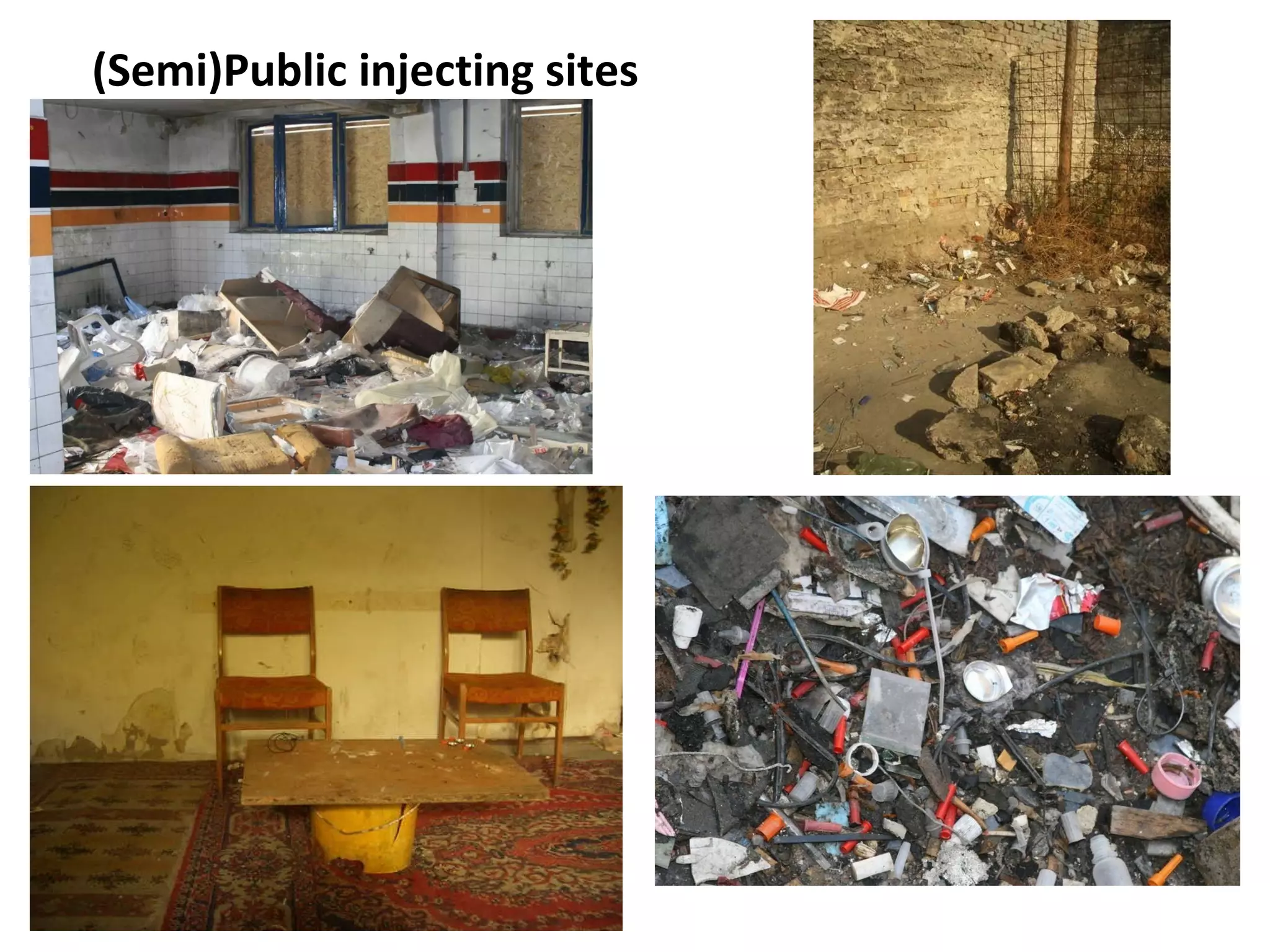
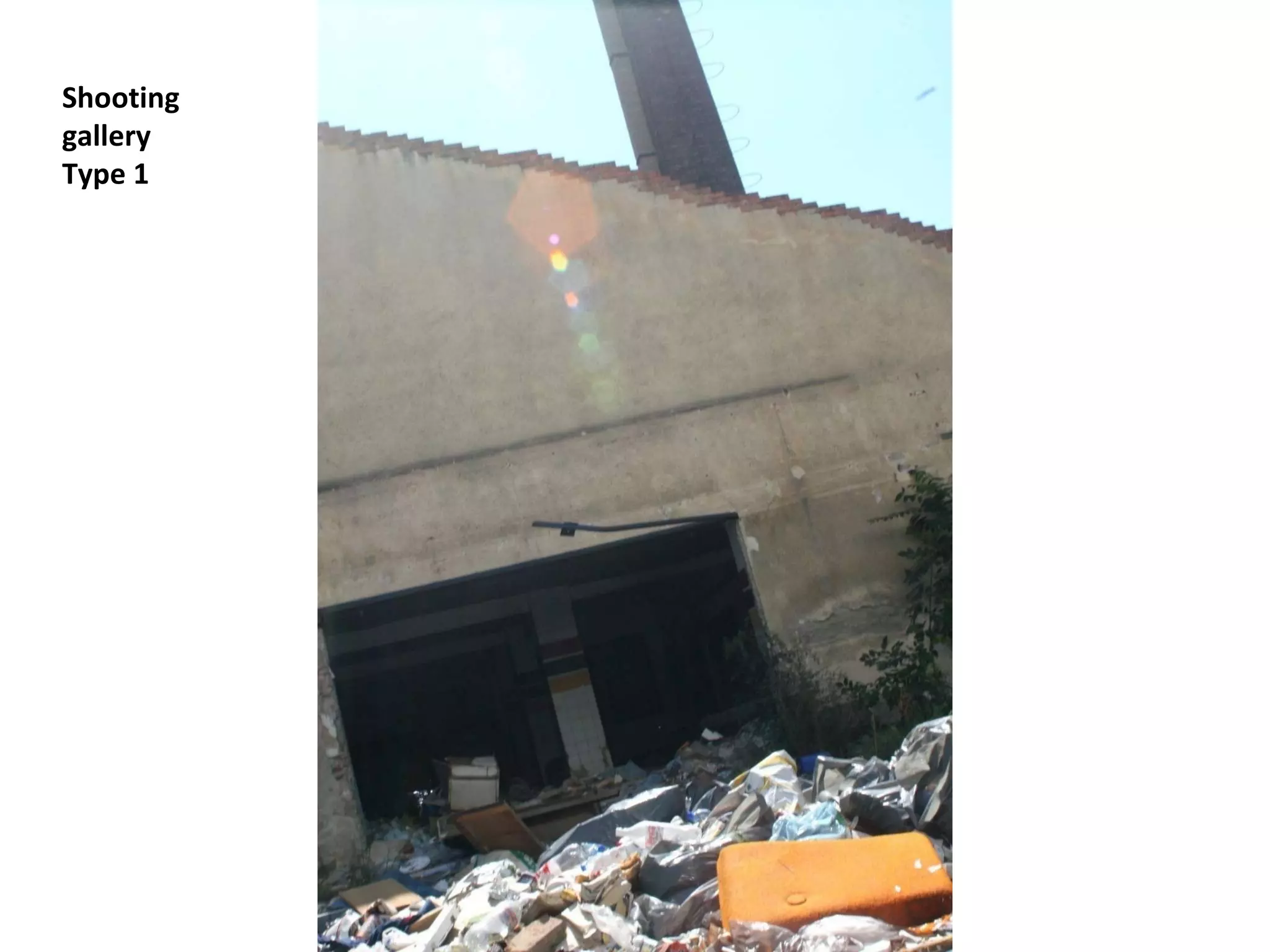
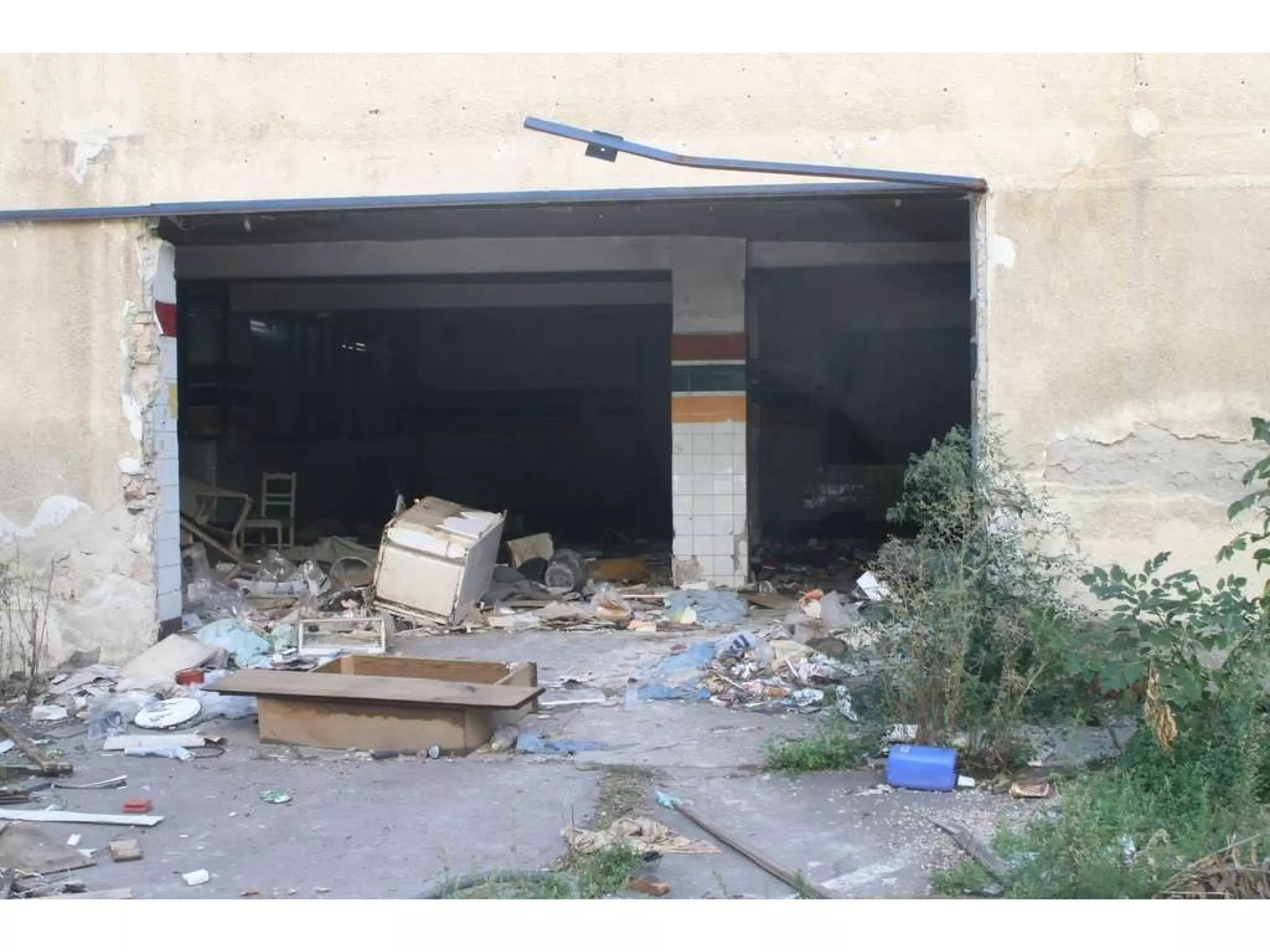
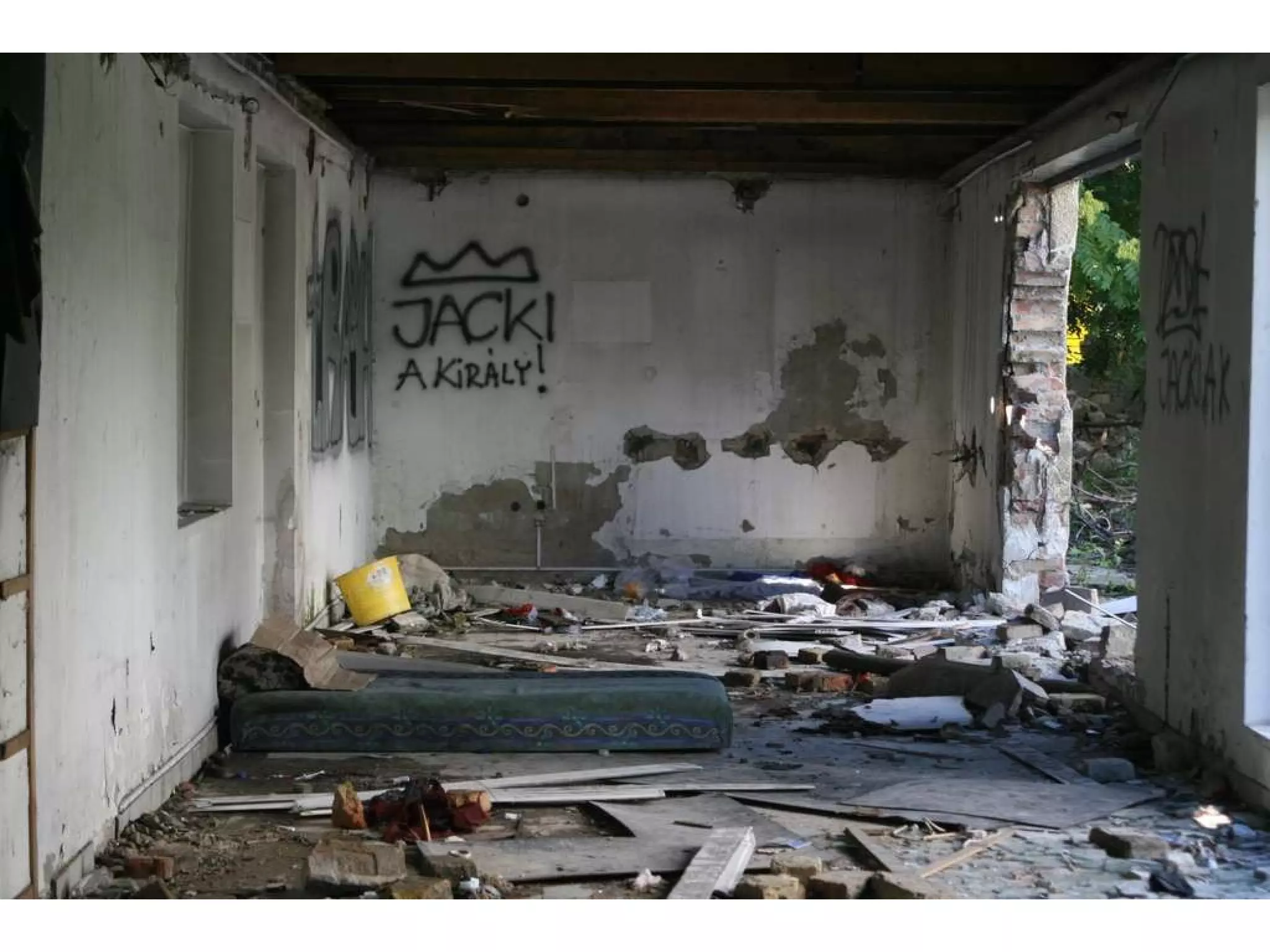
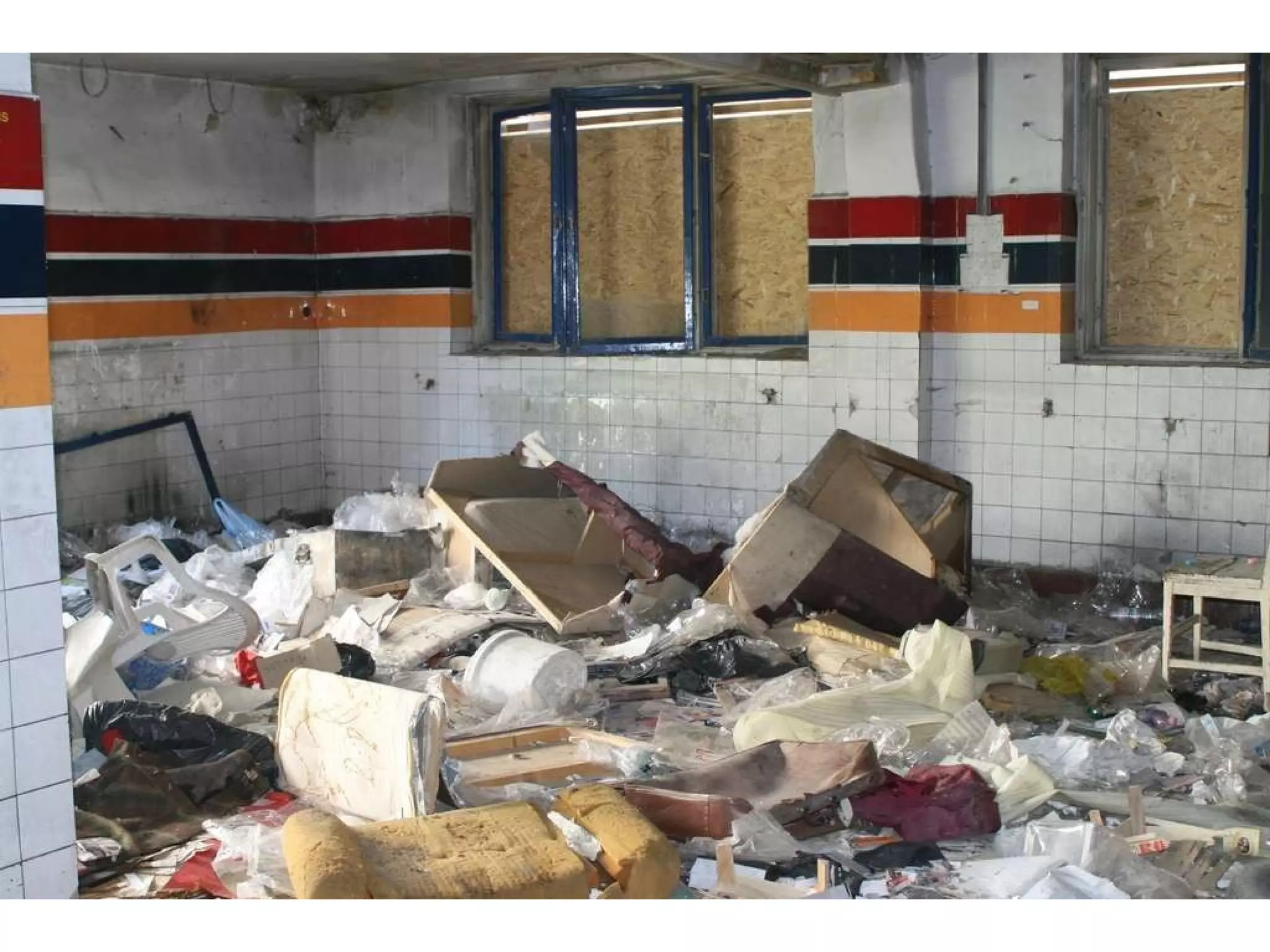
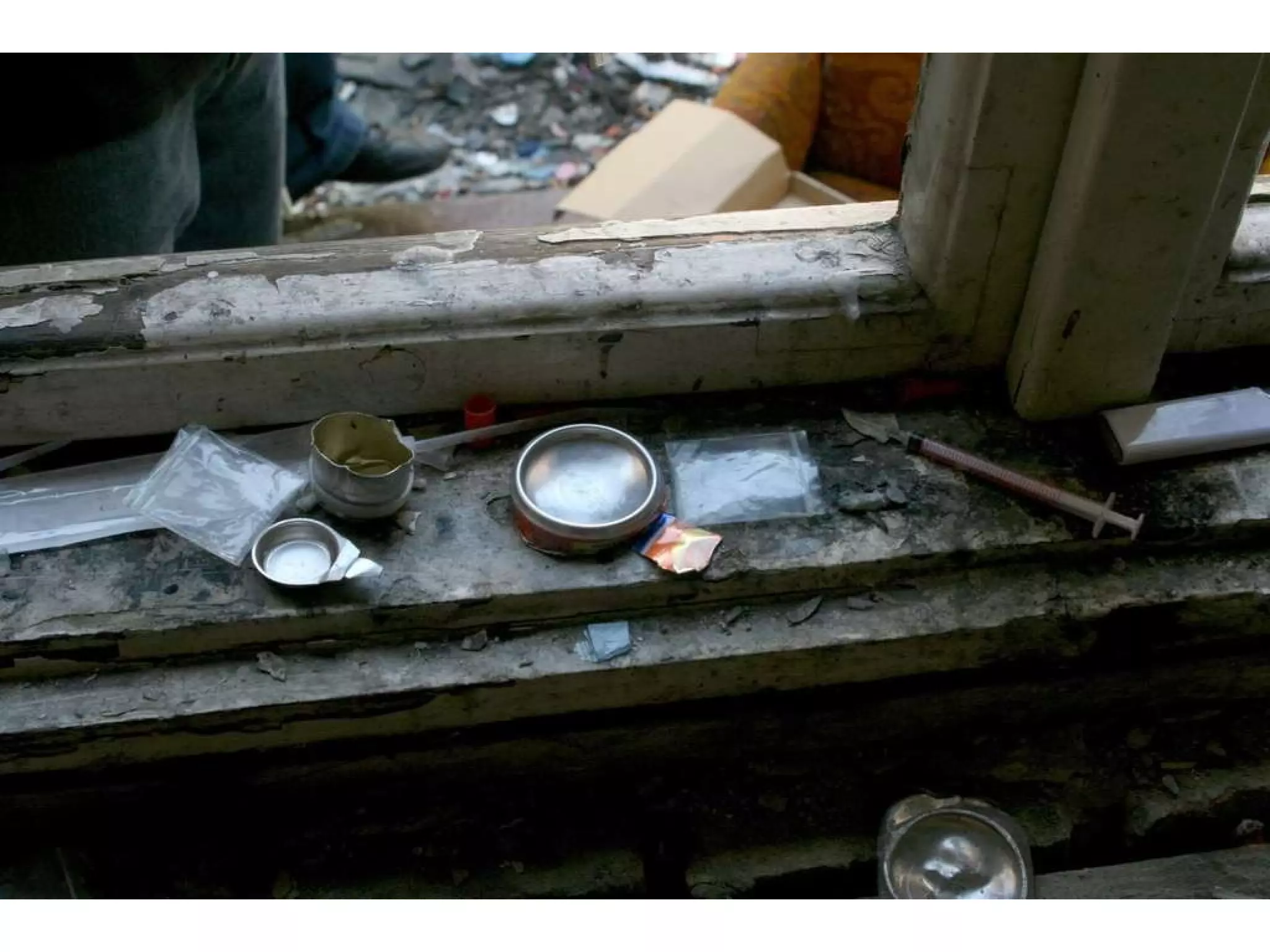
(Semi)Public injecting sites
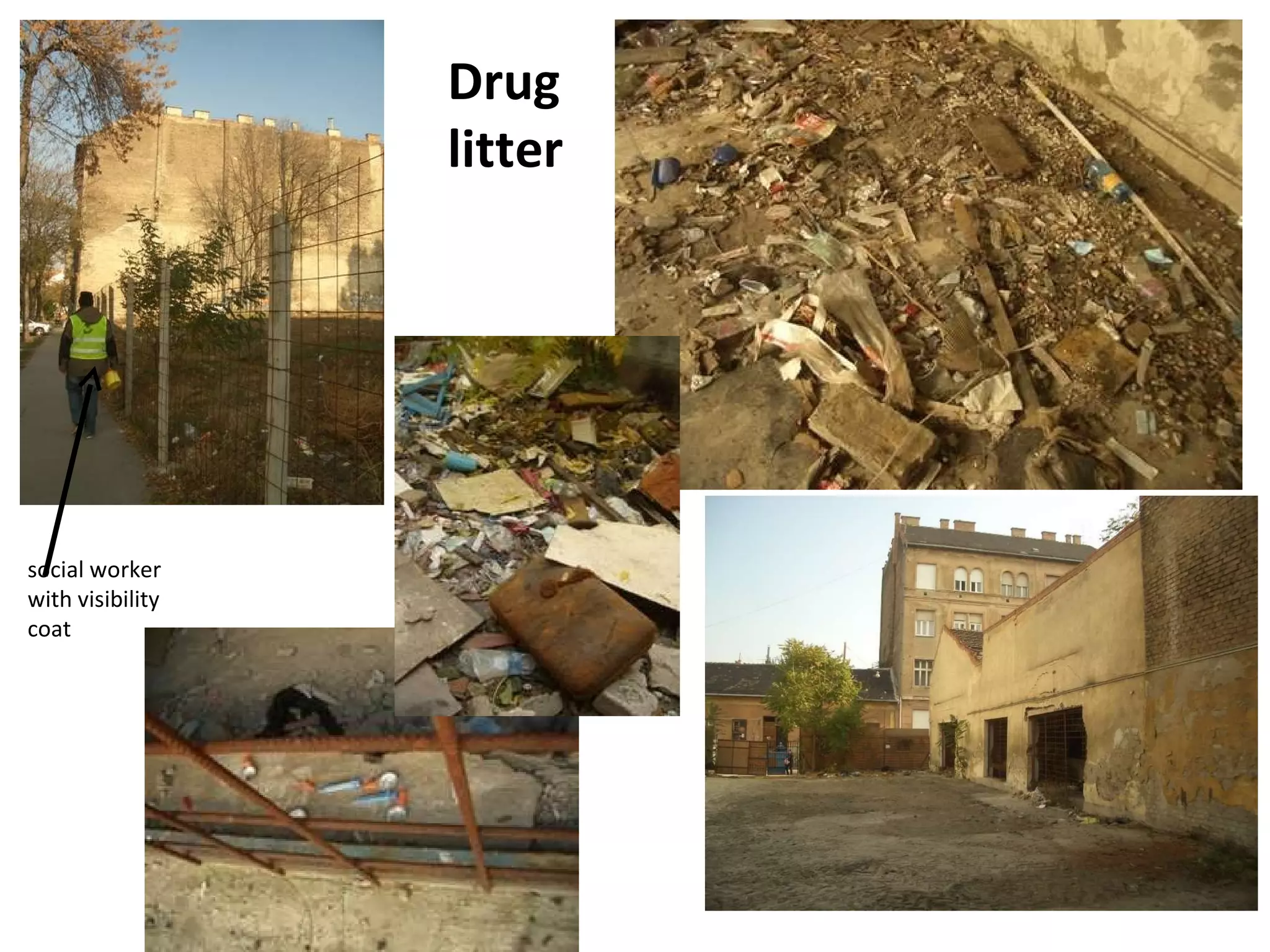
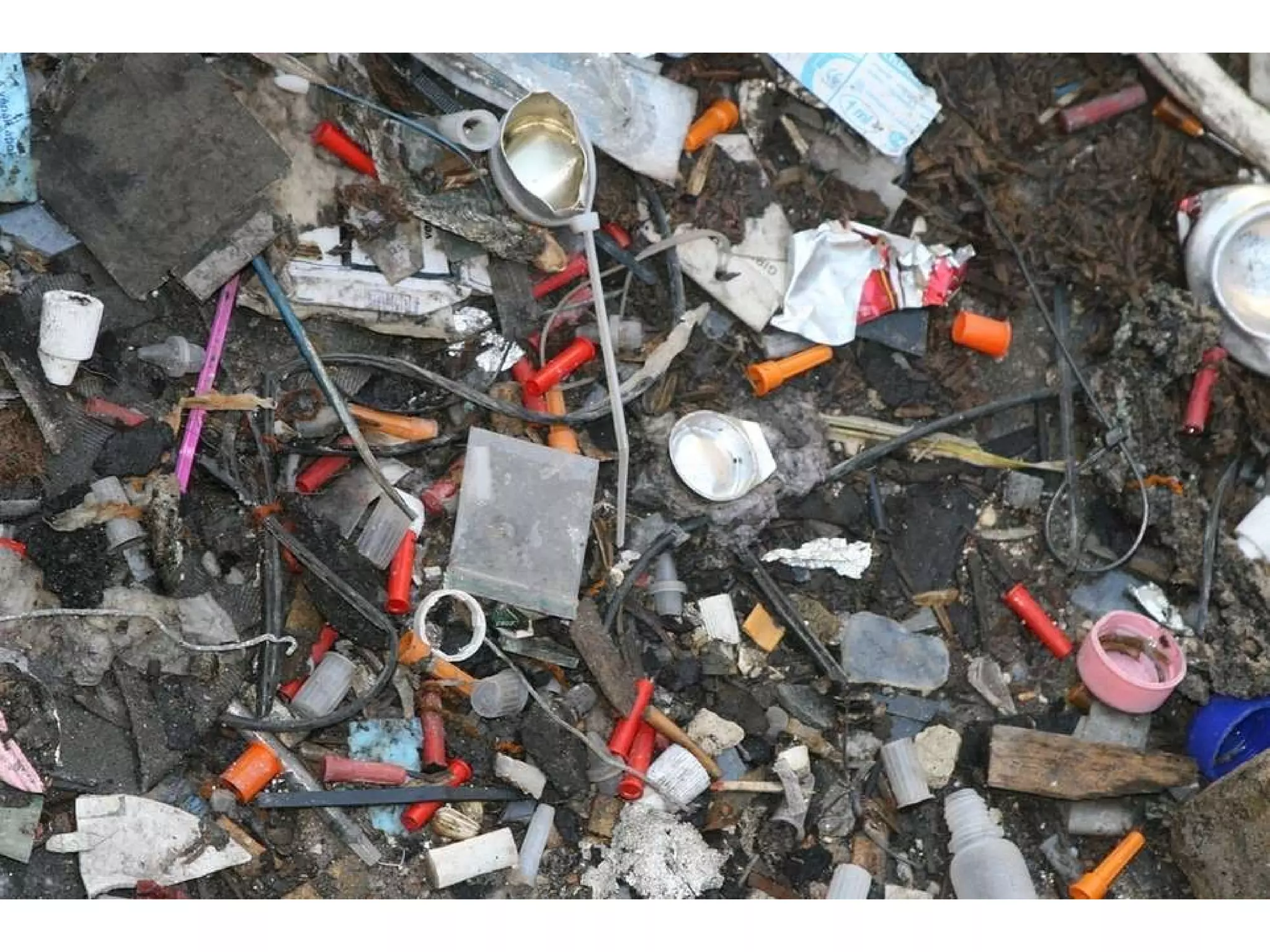
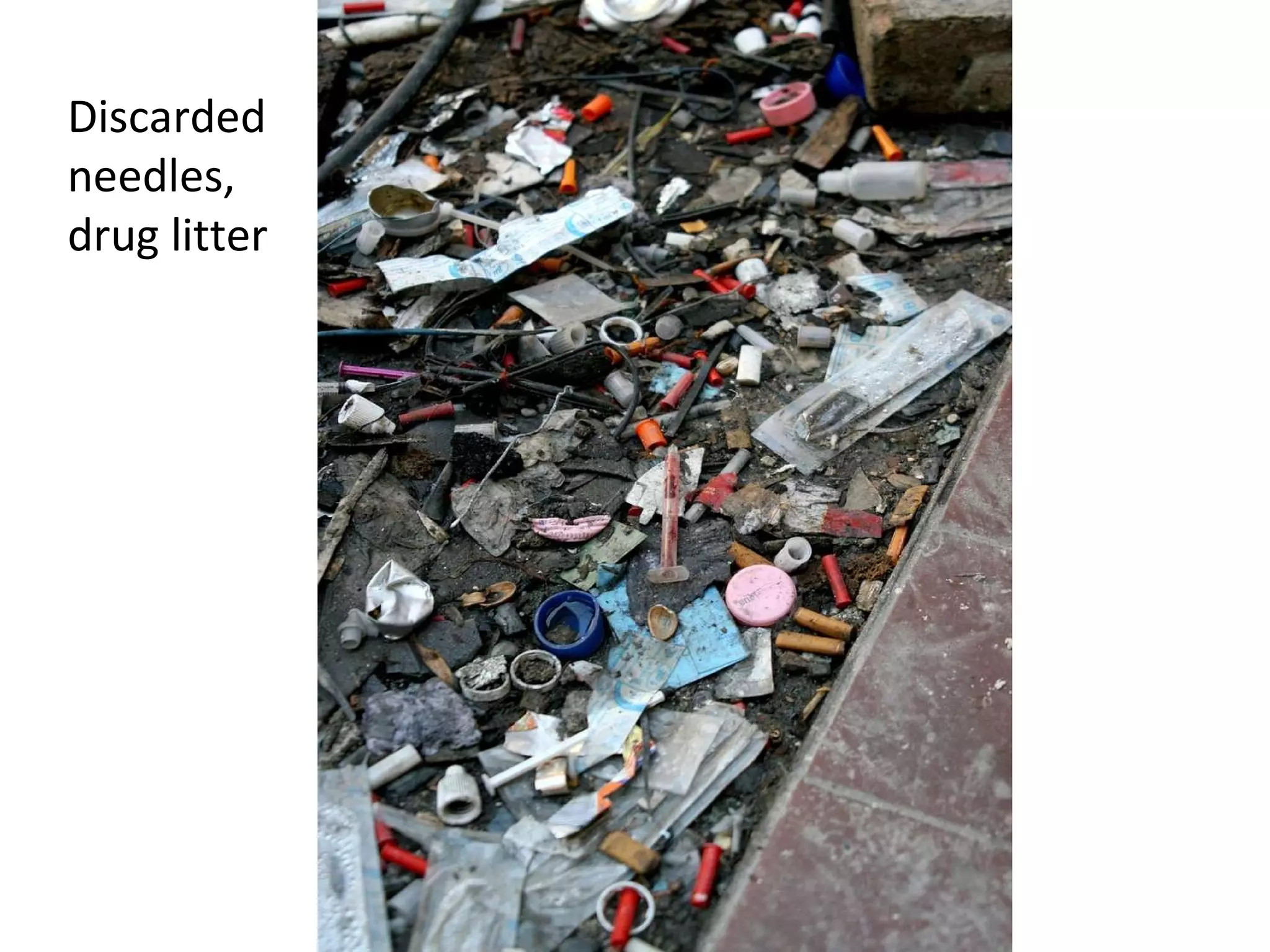
social worker with visibility coat Drug litter
 
Shooting gallery Type 1


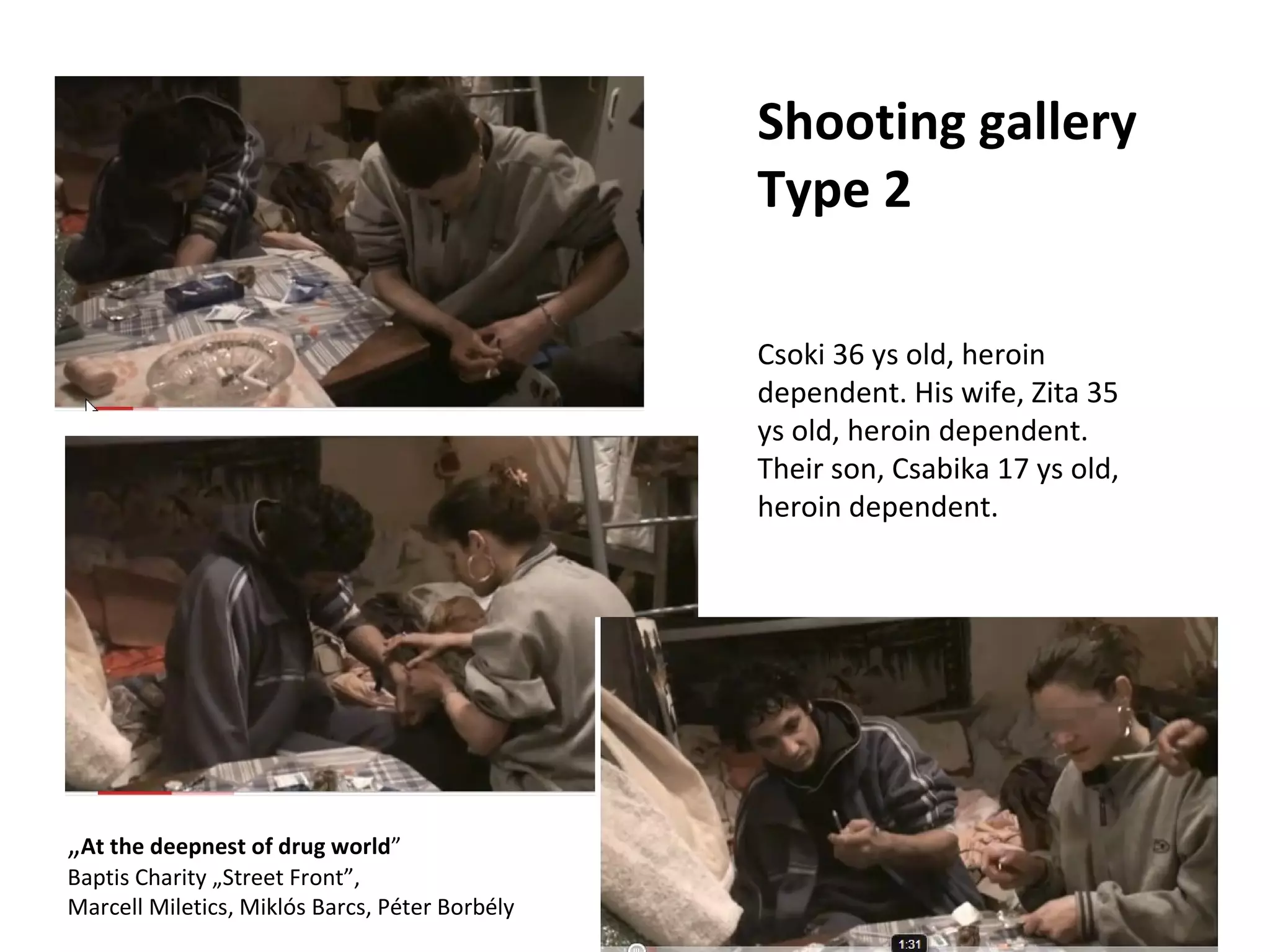
Shooting gallery Type 2 Csoki 36 ys old, heroin dependent. His wife, Zita 35 ys old, heroin dependent. Their son, Csabika 17 ys old, heroin dependent.  „ At the deepnest of drug world ” Baptis Charity „Street Front”,  Marcell Miletics, Miklós Barcs, Péter Borbély
Discarded needles, drug litter
 
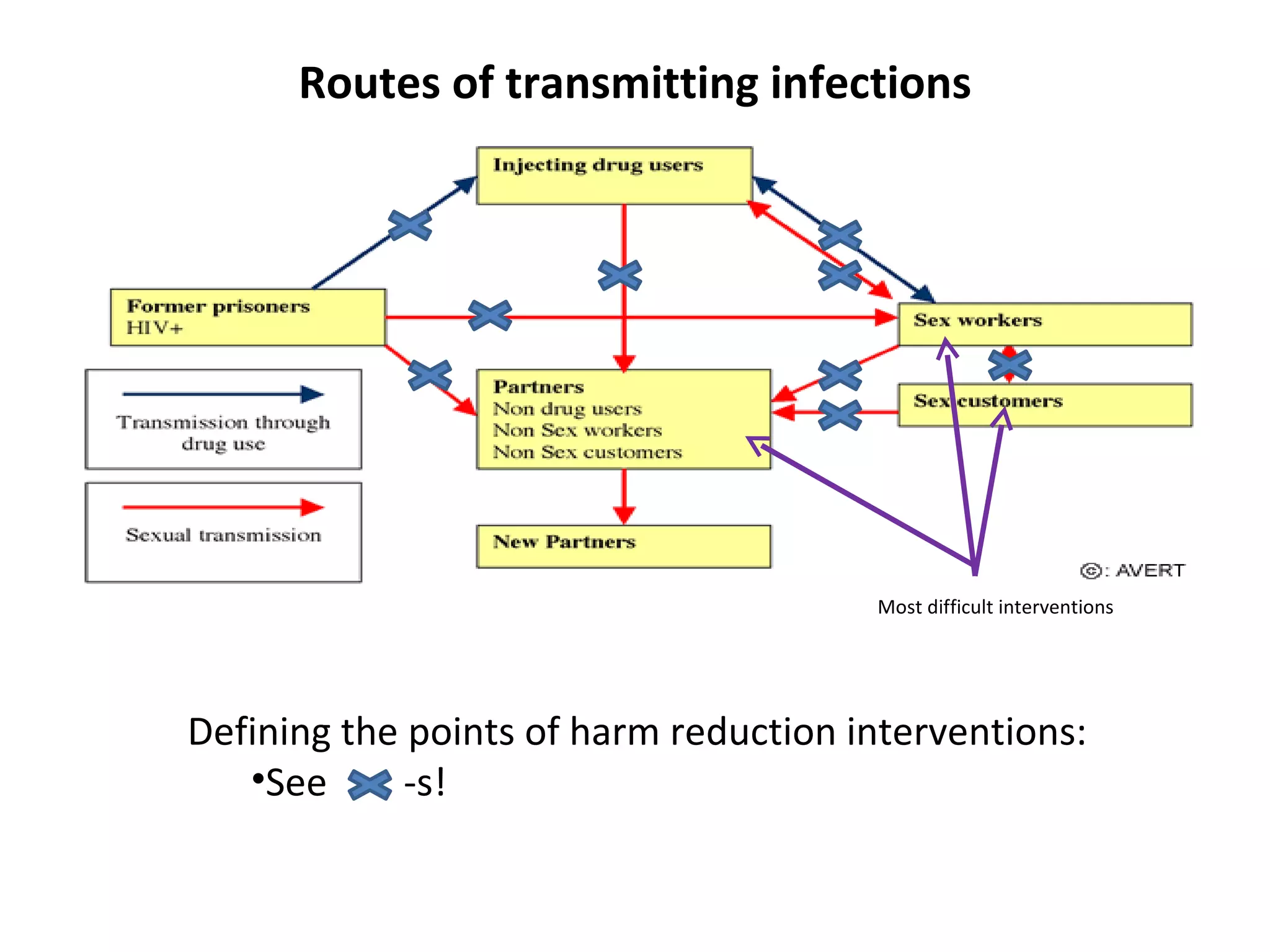
Routes of transmitting infections Defining the points of harm reduction interventions: See  -s! Most difficult interventions
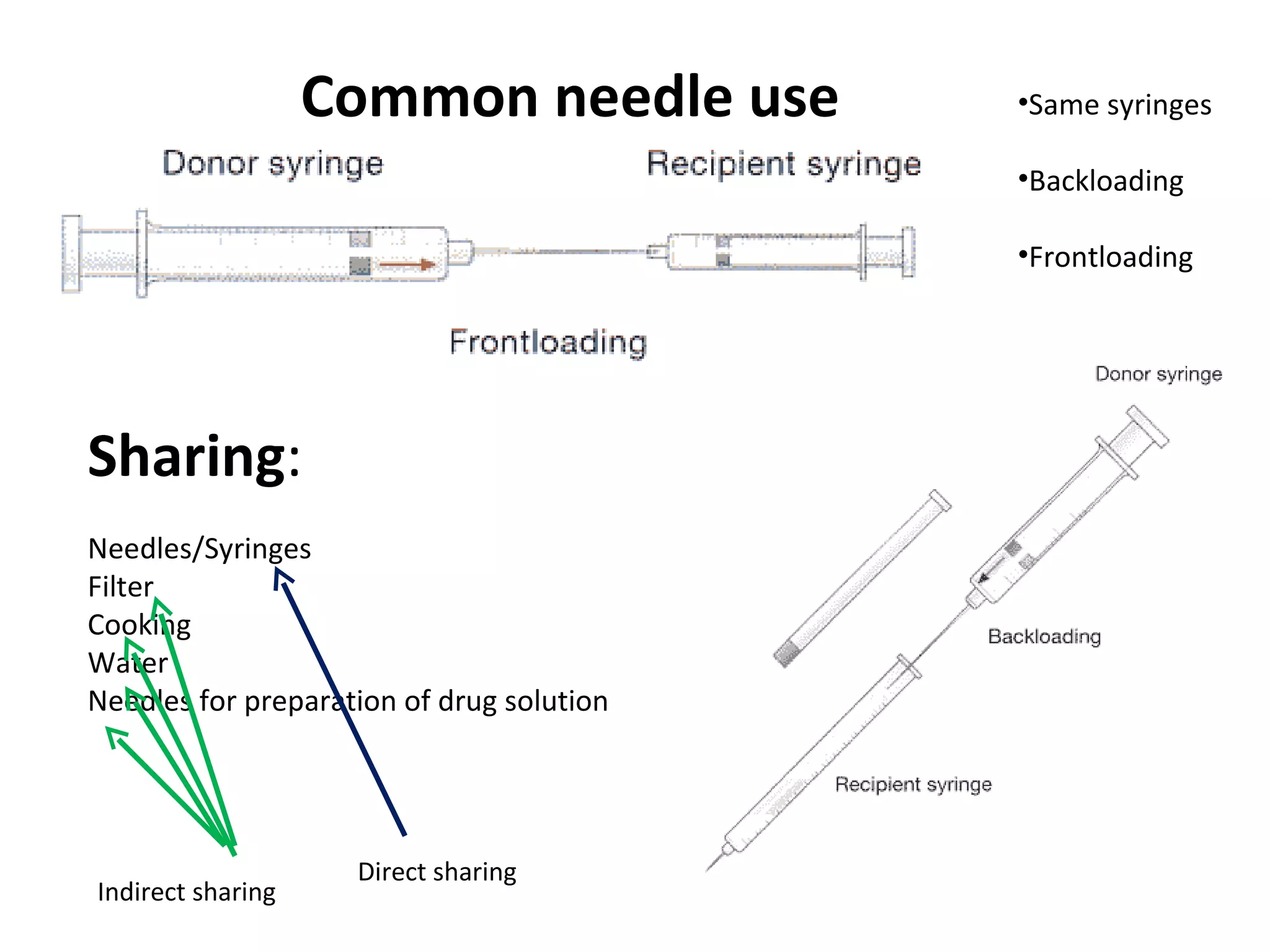
Common needle use Sharing : Needles/Syringes Filter Cooking Water Needles for preparation of drug solution Direct sharing Indirect sharing Same syringes Backloading Frontloading
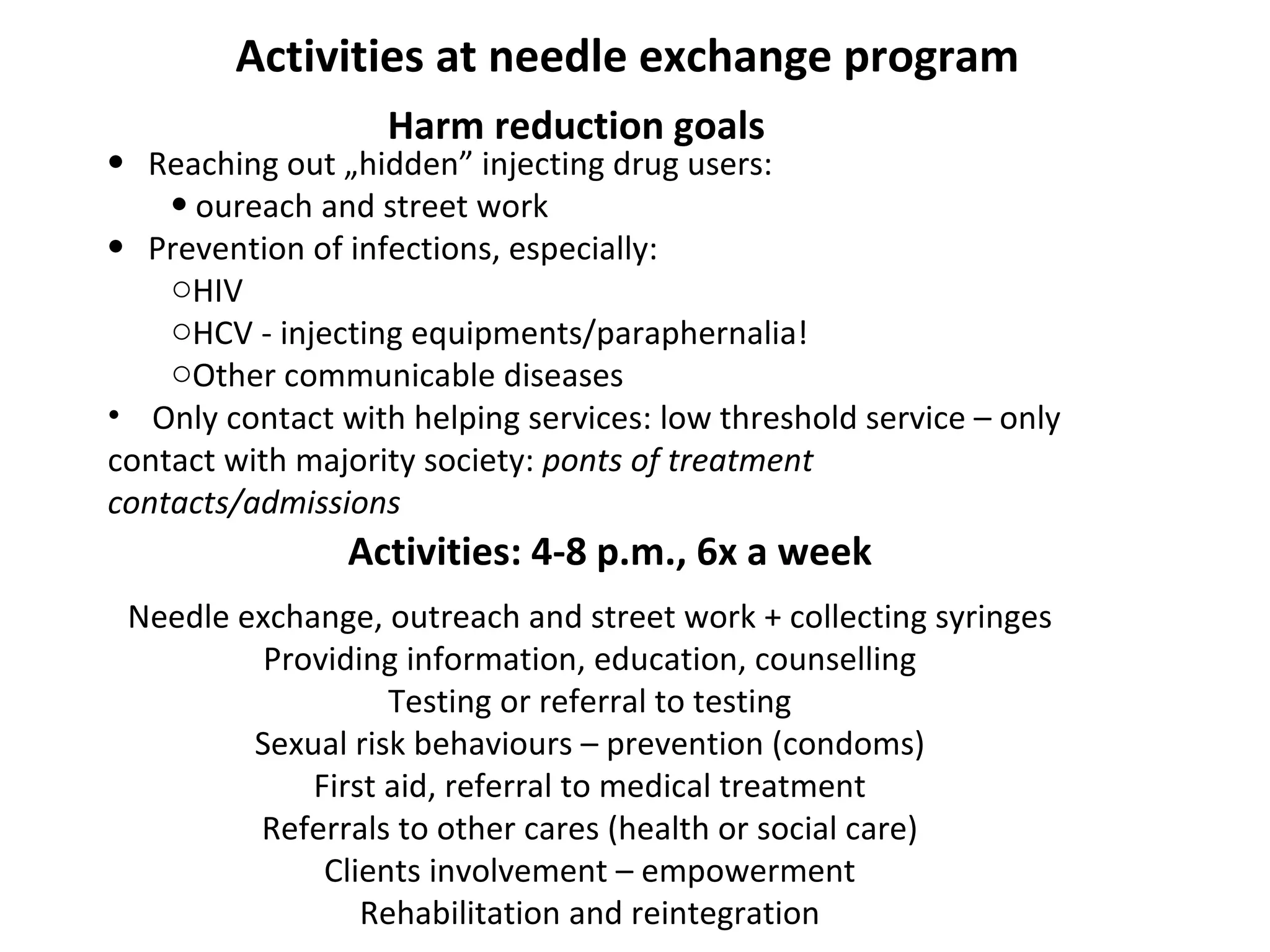
Activities at needle exchange program Harm reduction goals   R eaching out „hidden” injecting drug users:  oureach and street work P revention of infections, especially: HIV HCV - injecting equipments/paraphernalia! Other communicable diseases Only contact with helping services: low threshold service – only contact with majority society:  ponts of treatment contacts/admissions Needle exchange, outreach and street work + collecting syringes Providing information, education, counselling Testing or referral to testing Sexual risk behaviours – prevention (condoms) First aid, referral to medical treatment Referrals to other cares (health or social care) Clients involvement – empowerment Rehabilitation and reintegration Activities: 4-8 p.m., 6x a week
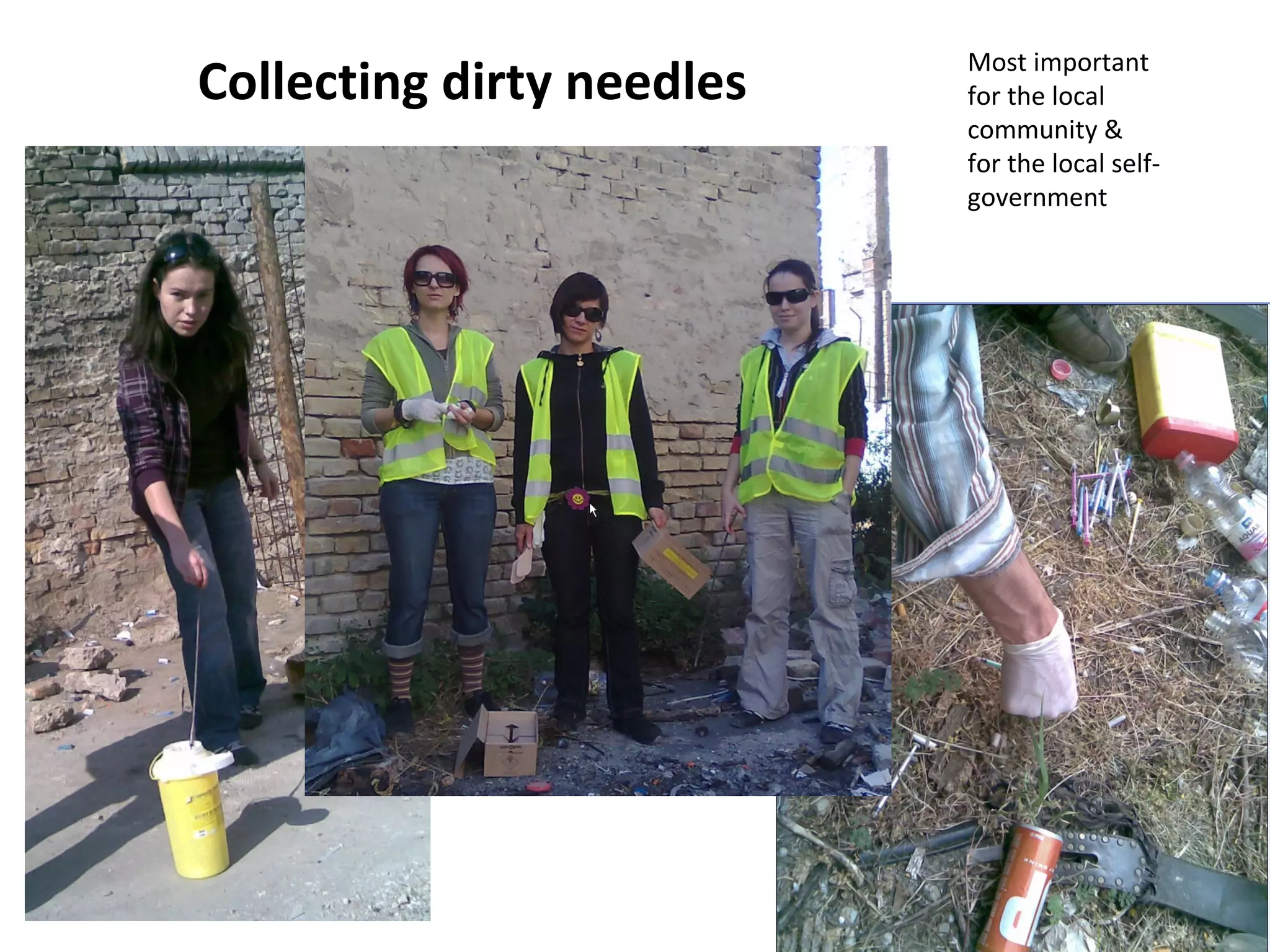
Collecting dirty needles Most important for the local community & for the local self-government
Special programs at needle exchange (Contact Cafe) Ladys’ Night: clients as well as helpers are women: once a week Traumatization PTSD Sex workers Sexual problems Cooperation with „Sober Babies” Association For pregnant injecting drug using women For mothers with babies Decreasing the digital edge Computer literacy + social network site use
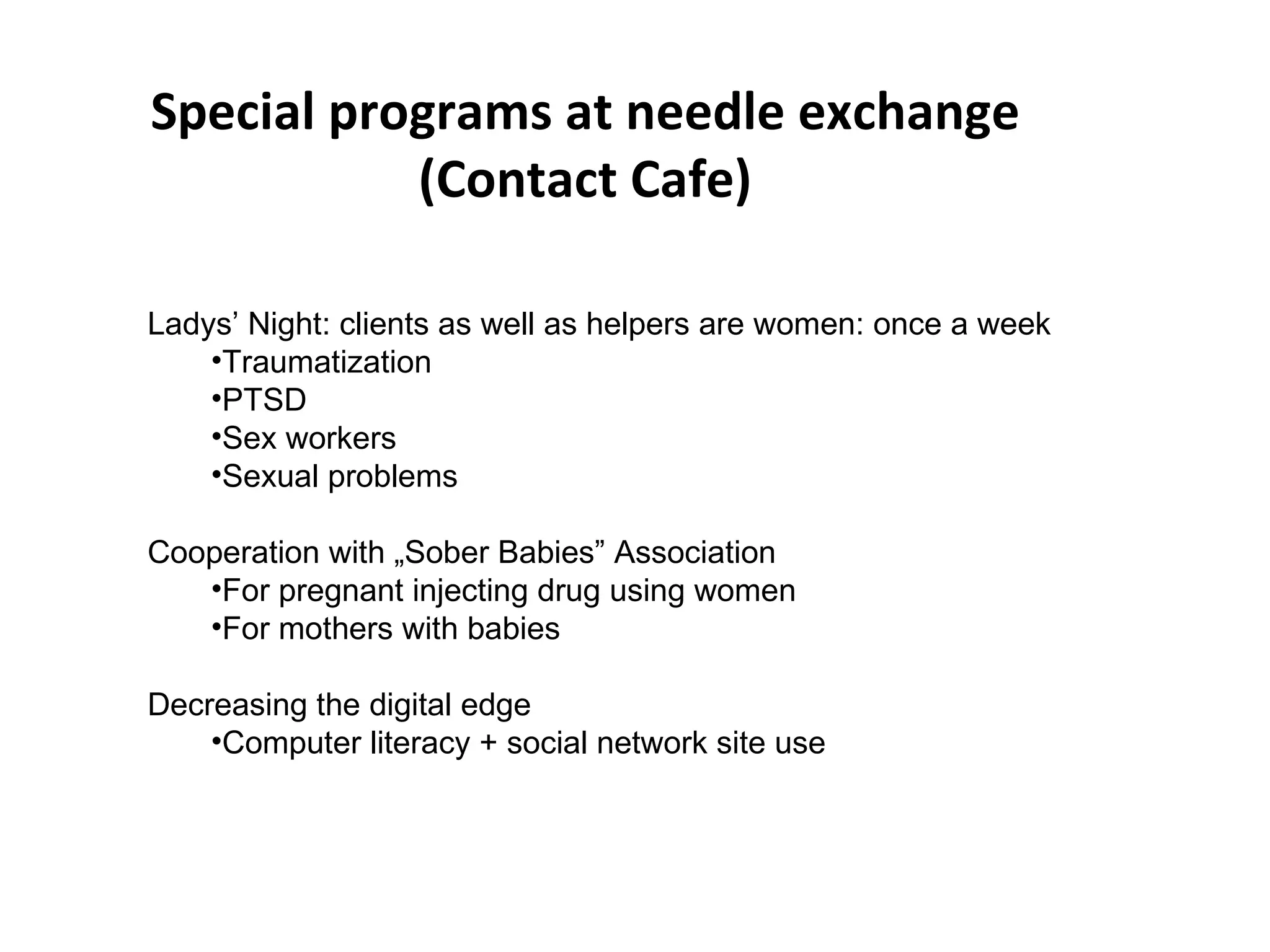
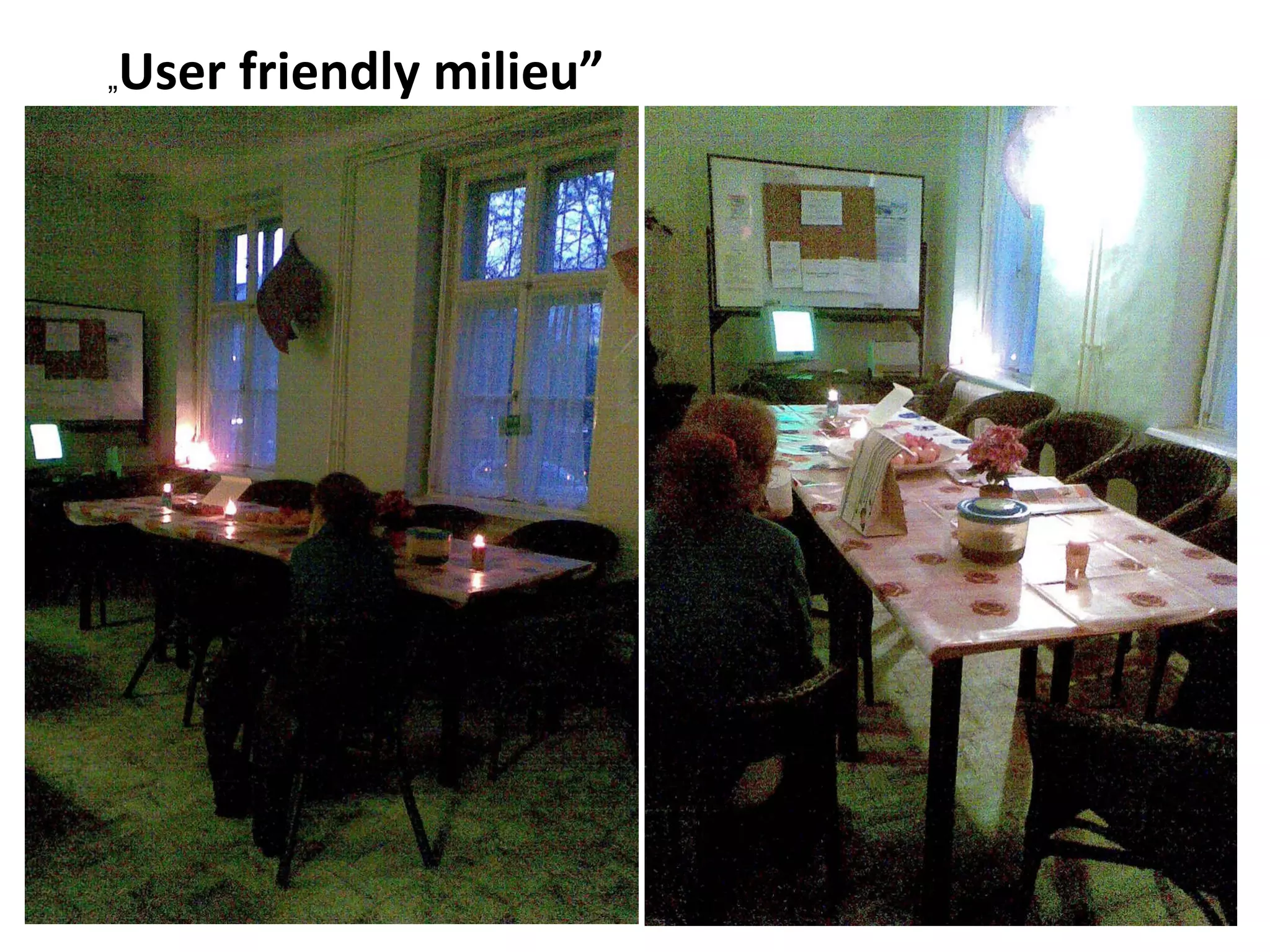
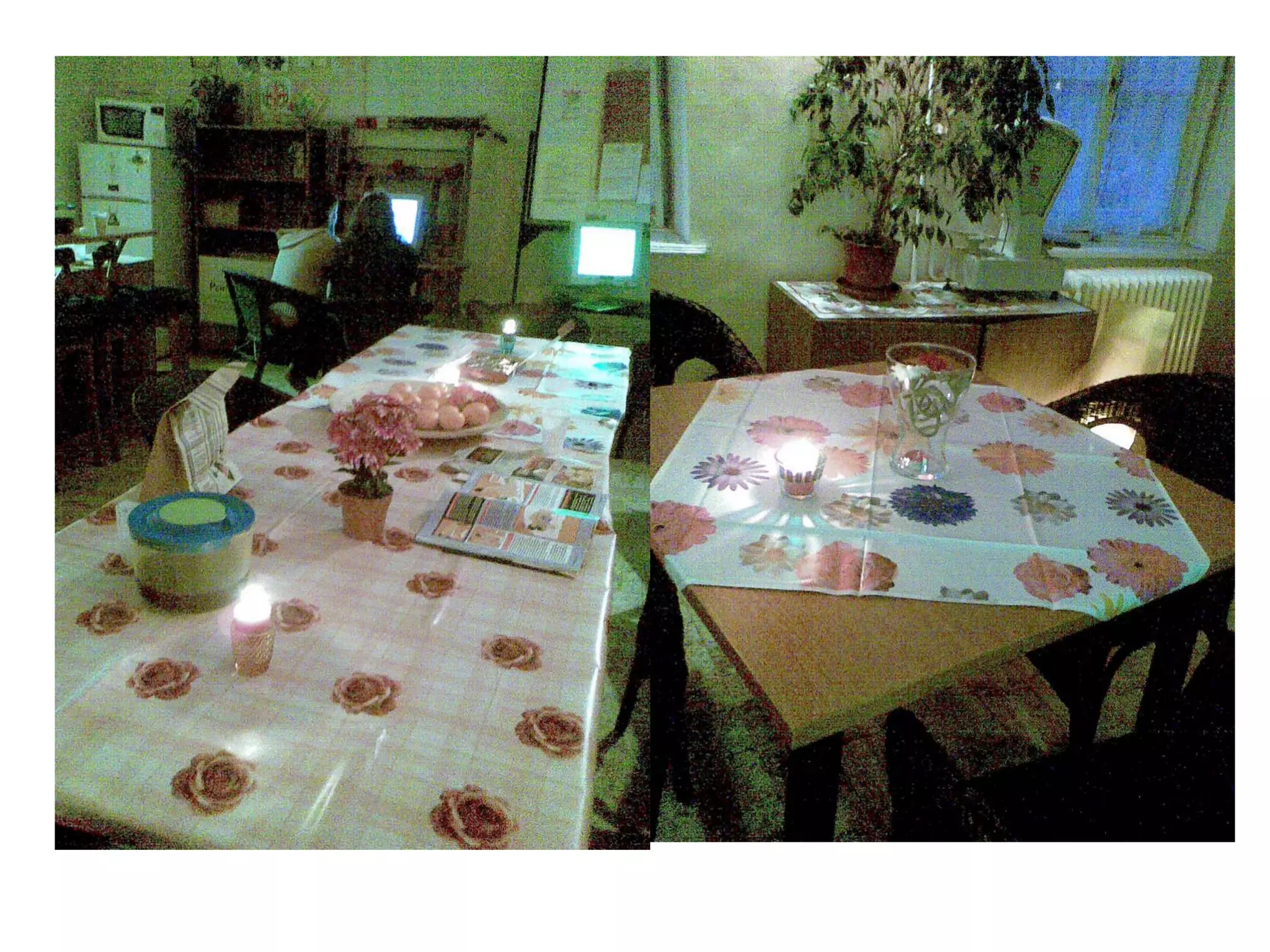
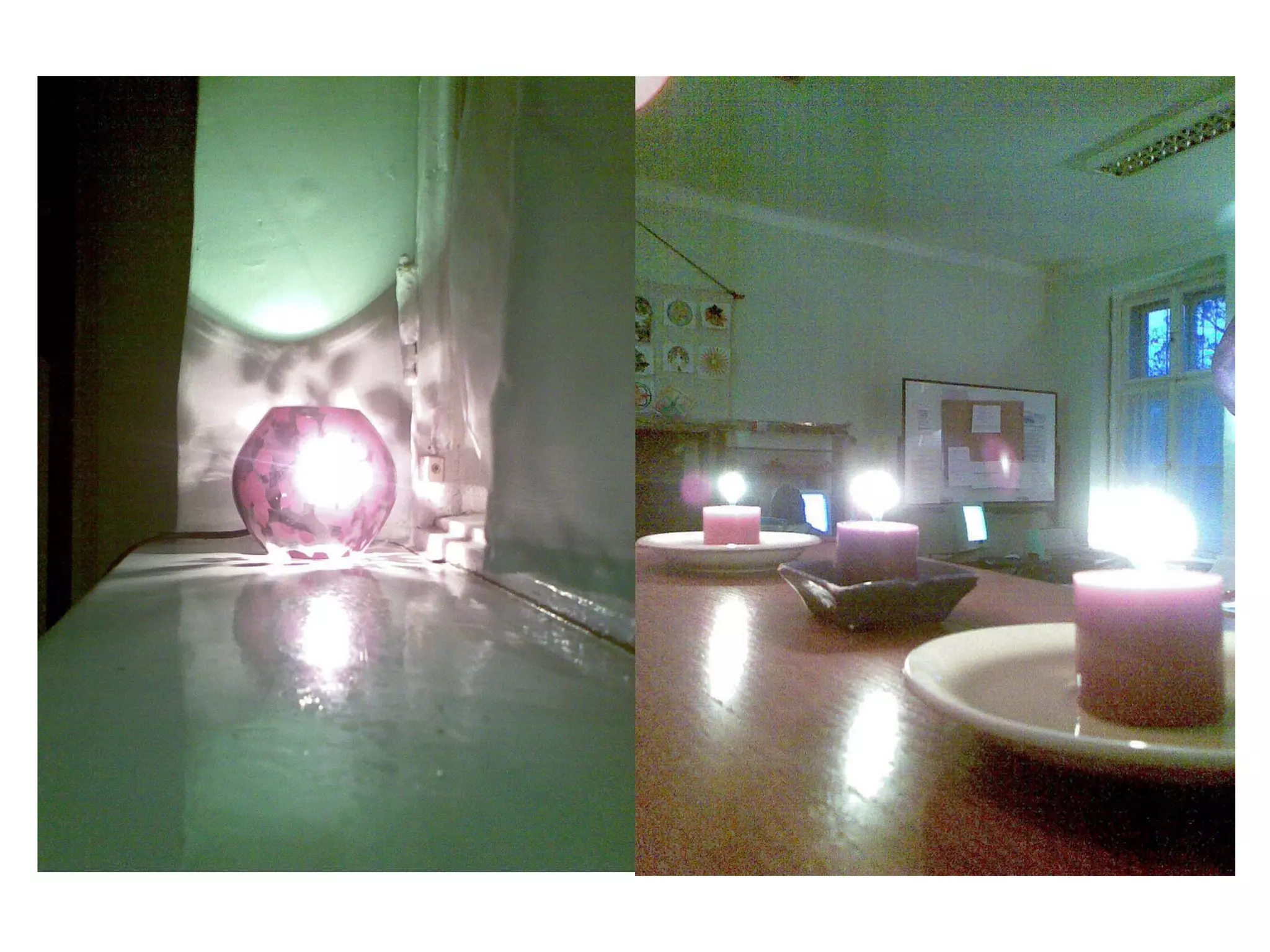
„ User friendly milieu”
 
 
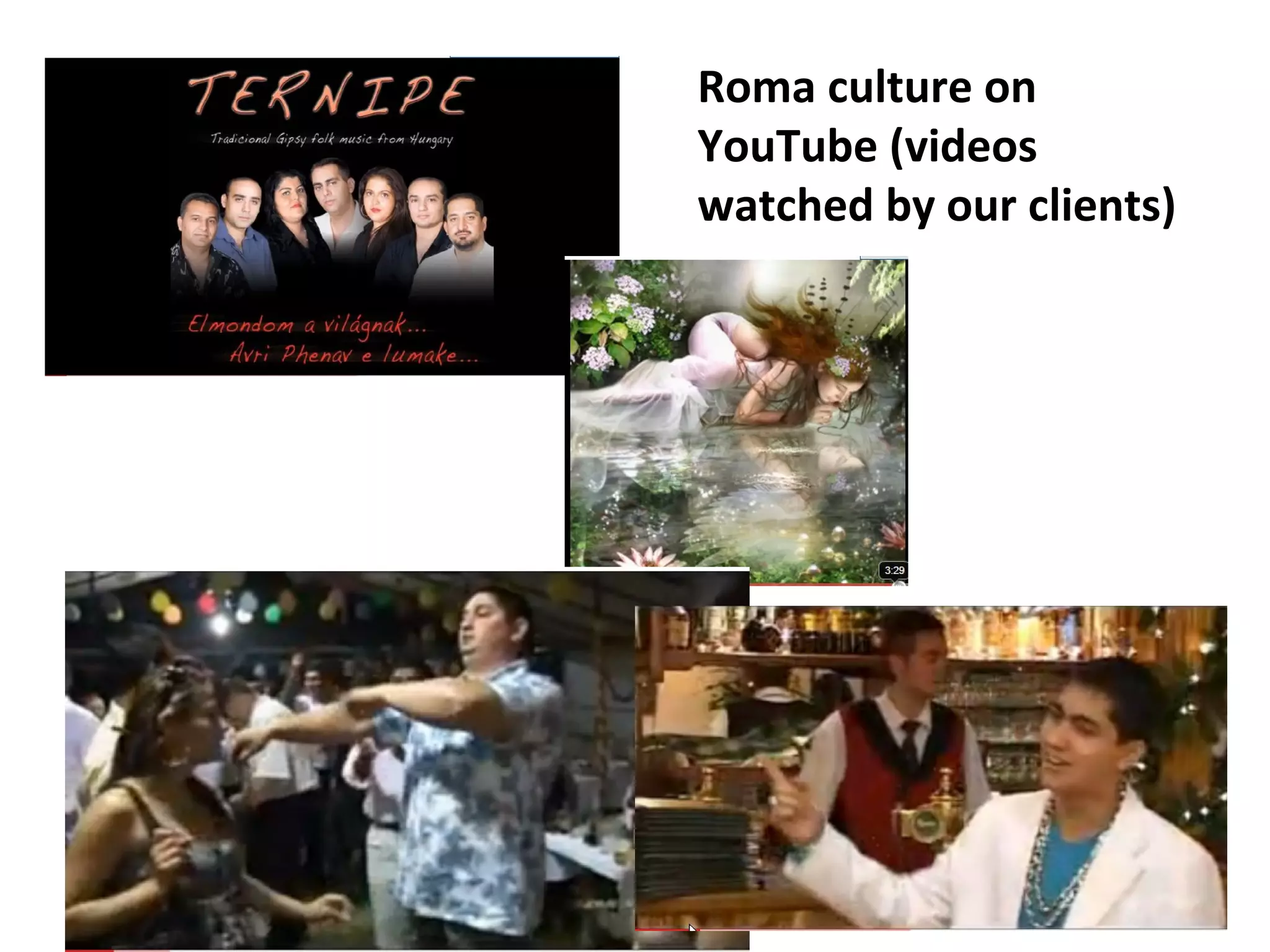
Roma culture on YouTube (videos watched by our clients)
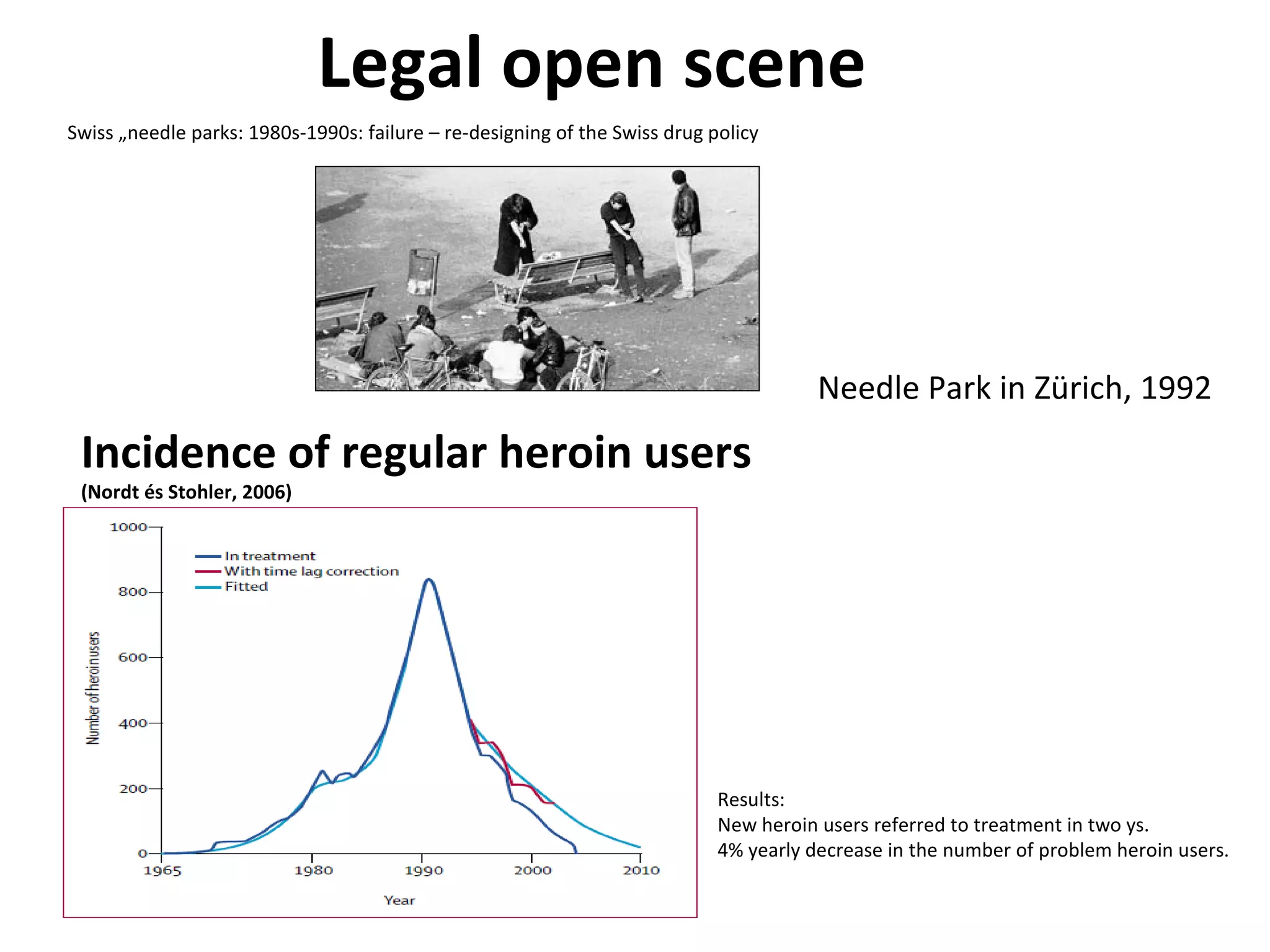
Legal open scene Swiss „needle parks: 1980s-1990s: failure – re-designing of the Swiss drug policy Incidence of regular heroin users (Nordt és Stohler, 2006) Results: New heroin users referred to treatment in two ys. 4% yearly decrease in the number of problem heroin users. Needle Park in Zürich, 1992
Risks of (public) injecting
The ranges around the estimates in this table define the boundaries within which the actual numbers lie, based on the best available information.  Regional HIV and AIDS statistics and features    2009 TOTAL 33.3 million [31.4 million – 35.3 million] 2.6 million [2.3 million – 2.8 million] Adults and children newly infected with HIV Adults and children living with HIV Sub-Saharan Africa  Middle East and North Africa South and South-East Asia East Asia  Central and South America Caribbean  Eastern Europe and Central Asia Western and Central Europe North America Oceania 22.5 million [20.9 million – 24.2 million] 4.1 million [3.7 million – 4.6 million] 1.4 million [1.2 million – 1.6 million] 1.4 million [1.3 million – 1.6 million] 1.5 million [1.2 million – 2.0 million] 1.8 million [1.6 million – 2.0 million] 270 000 [240 000 – 320 000] 92 000 [70 000 – 120 000] 130 000 [110 000 – 160 000] 70 000 [44 000 – 130 000] 460 000 [400 000 – 530 000] 770 000 [560 000 – 1.0 million] 240 000 [220 000 – 270 000] 820 000 [720 000 – 910 000] 57 000 [50 000 – 64 000] 75 000 [61 000 – 92 000] 82 000 [48 000 – 140 000] 17 000 [13 000 – 21 000] 31 000 [23 000 – 40 000] 4500 [3400 – 6000] 1.8 million [1.6 million – 2.1 million] Adult & child  deaths due to AIDS 1.3 million [1.1 million – 1.5 million] 260 000 [230 000 – 300 000] 58 000 [43 000 – 70 000] 76 000 [60 000 – 95 000] 26 000 [22 000 – 44 000] 24 000 [20 000 – 27 000] 36 000 [25 000 – 50 000] 12 000 [8500 – 15 000] 8500 [6800 – 19 000] 1400 [<1000 – 2400] 0.8% [0.7% - 0.8%] Adult prevalence (15‒49) [%] 5.0% [4.7% – 5.2%] 0.3% [0.3% – 0.3%] 0.5% [0.4% – 0.6%] 0.8% [0.7% – 0.9%] 0.5% [0.4% – 0.7%] 0.2% [0.2% – 0.3%] 0.1% [0.1% – 0.1%] 1.0% [0.9% – 1.1%] 0.2% [0.2% – 0.2%] 0.3% [0.2% – 0.3%]
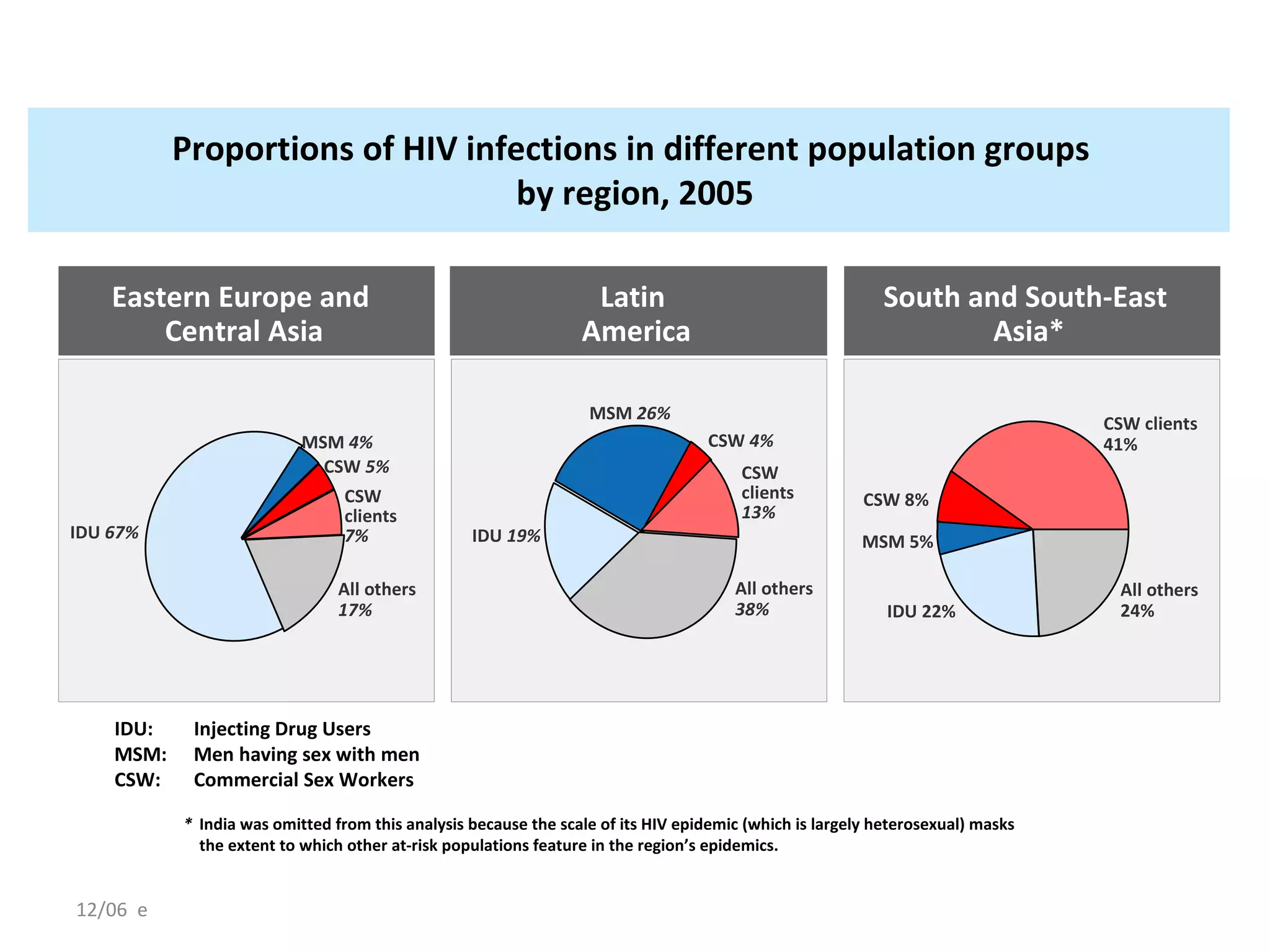
12/06  e Proportions of HIV infections in different population groups  by region, 2005 IDU:  Injecting Drug Users MSM:  Men having sex with men CSW:  Commercial Sex Workers Latin  America MSM  26% IDU  19% CSW  4% All others  38% South and South-East  Asia* CSW  clients  13% Eastern Europe and  Central Asia MSM  4% IDU  67% CSW  5%  All others  17% CSW  clients  7% *   India was omitted from this analysis because the scale of its HIV epidemic (which is largely heterosexual) masks  the extent to which other at-risk populations feature in the region’s epidemics. MSM 5% IDU 22% CSW 8% All others 24% CSW clients 41% Figure 2
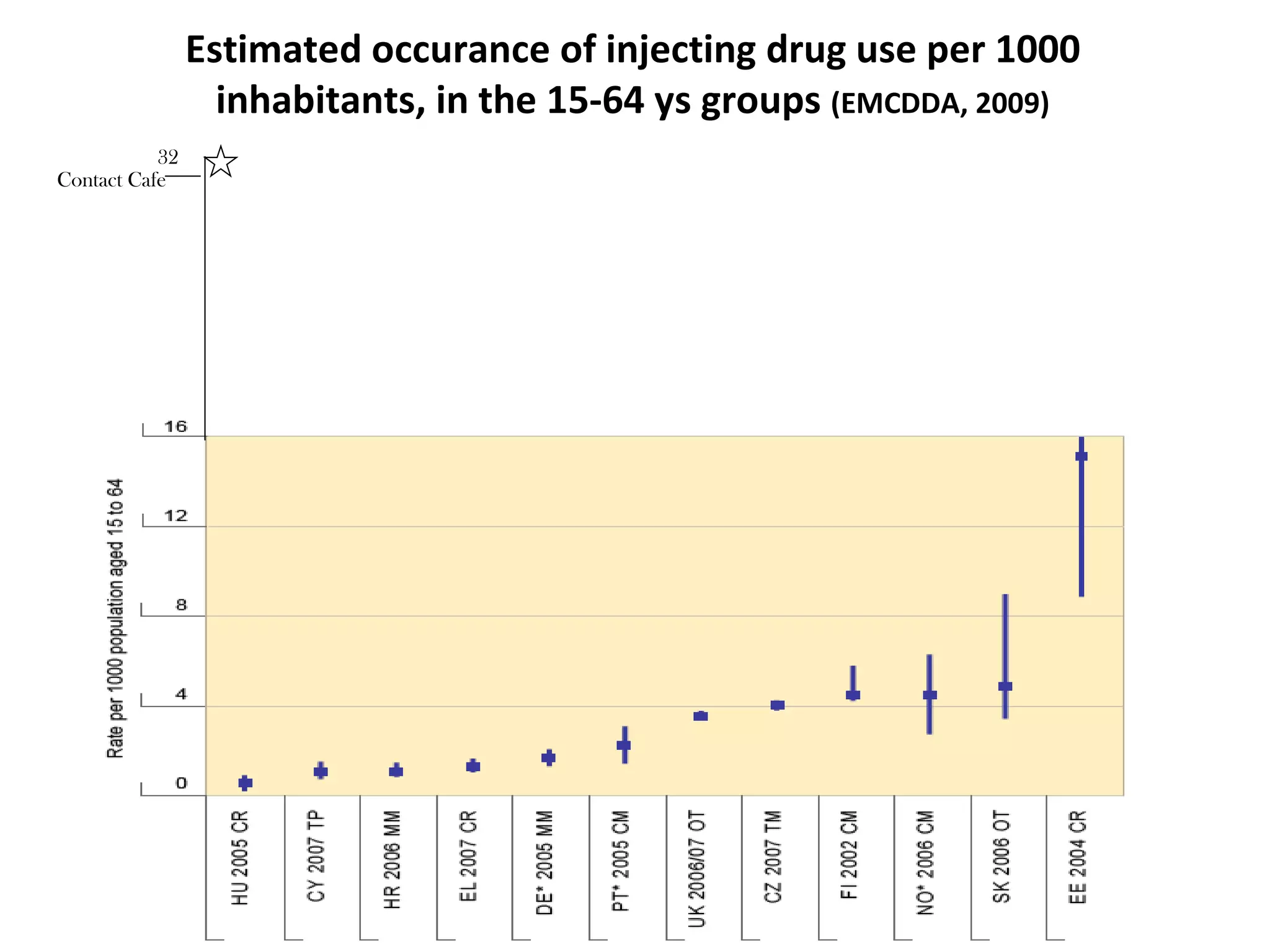
Estimated occurance of injecting drug use per 1000 inhabitants, in the 15-64 ys groups  (EMCDDA, 2009) Contact Cafe 32
Risks: The silent epidemic Sitting on a bomb…
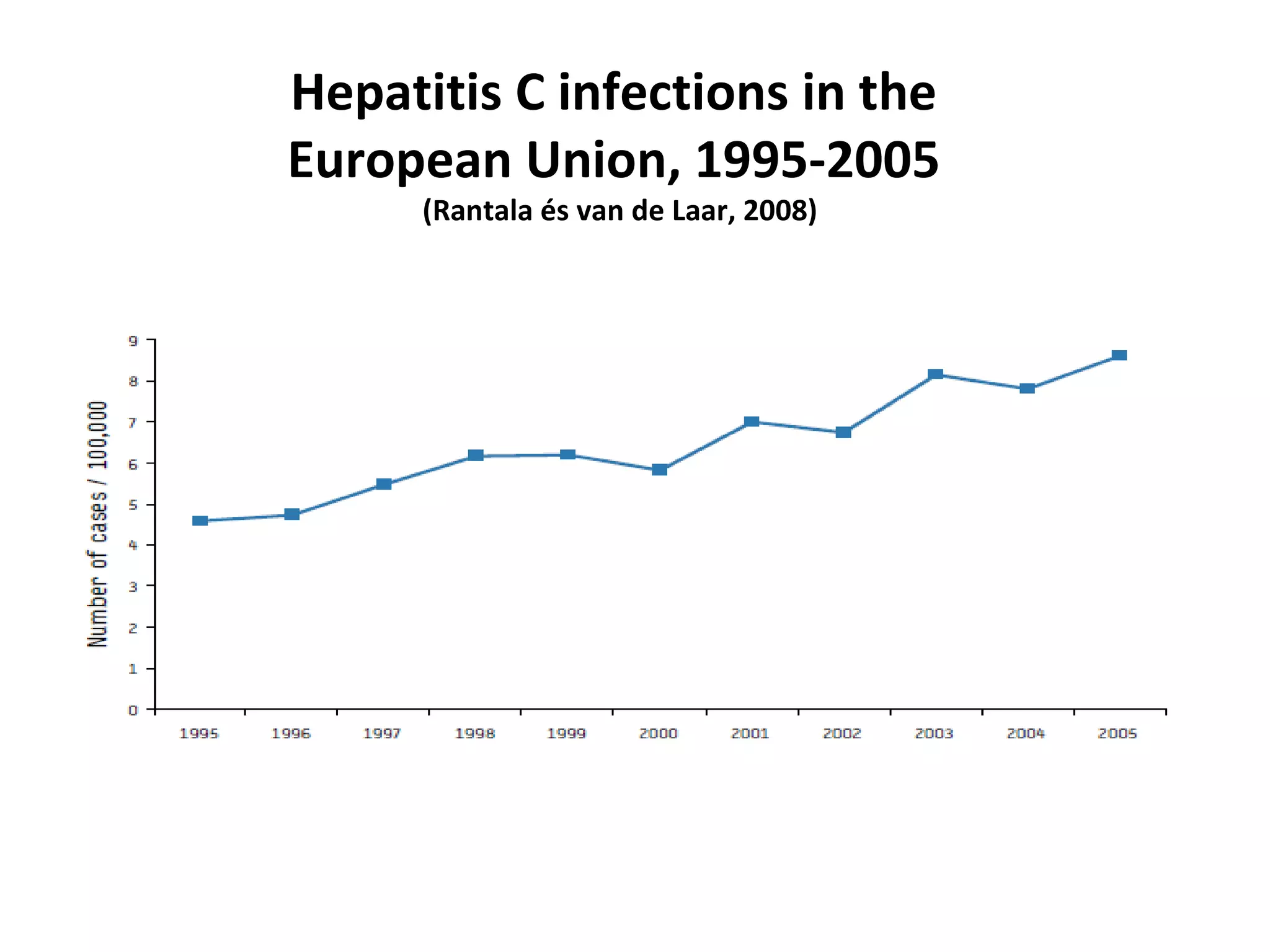
Hepatitis C infections in the  European Union, 1995-2005  (Rantala és van de Laar, 2008)
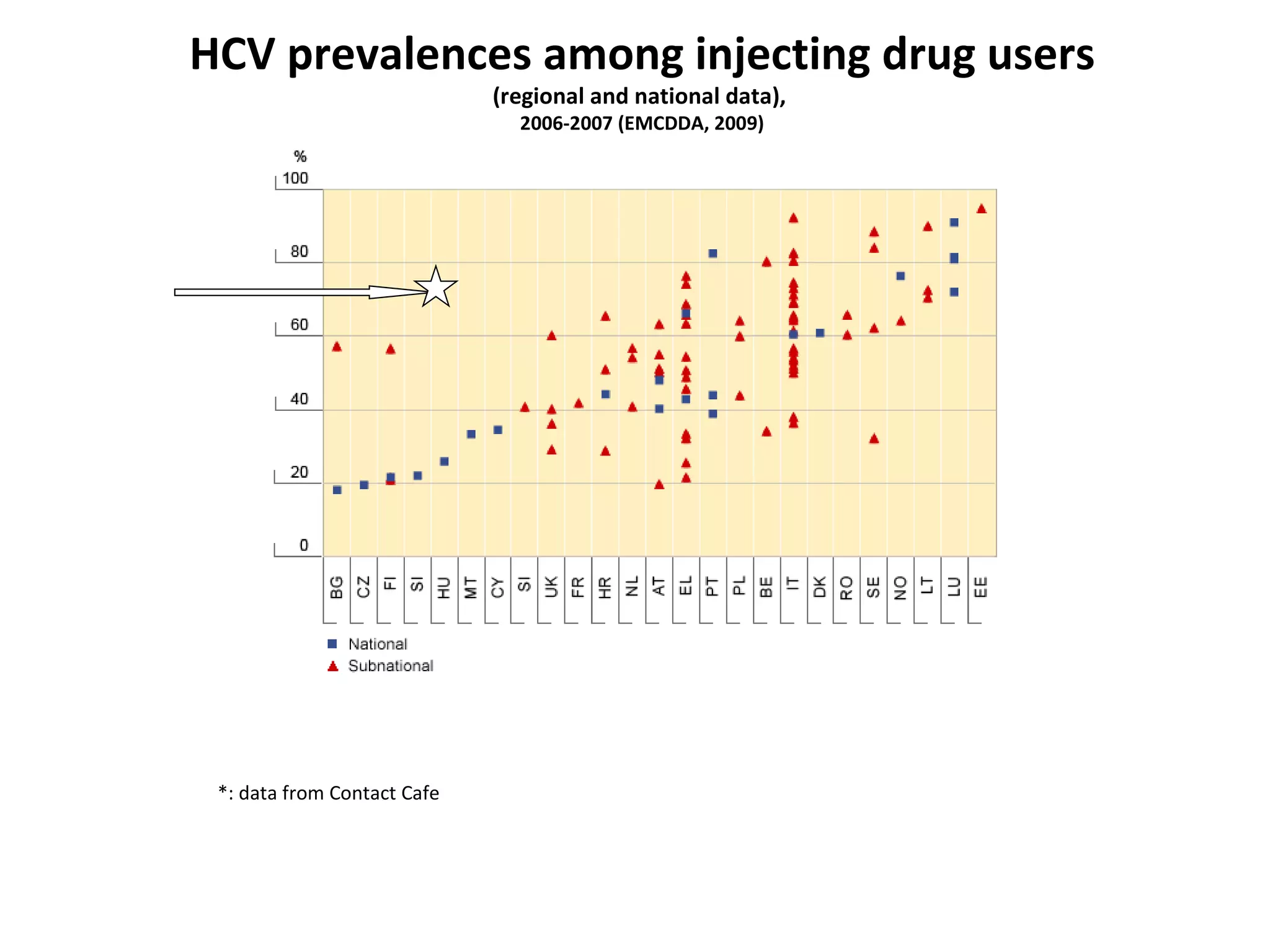
HCV prevalences among injecting drug users (regional and national data),  2006-2007 (EMCDDA, 2009) *: data from Contact Cafe
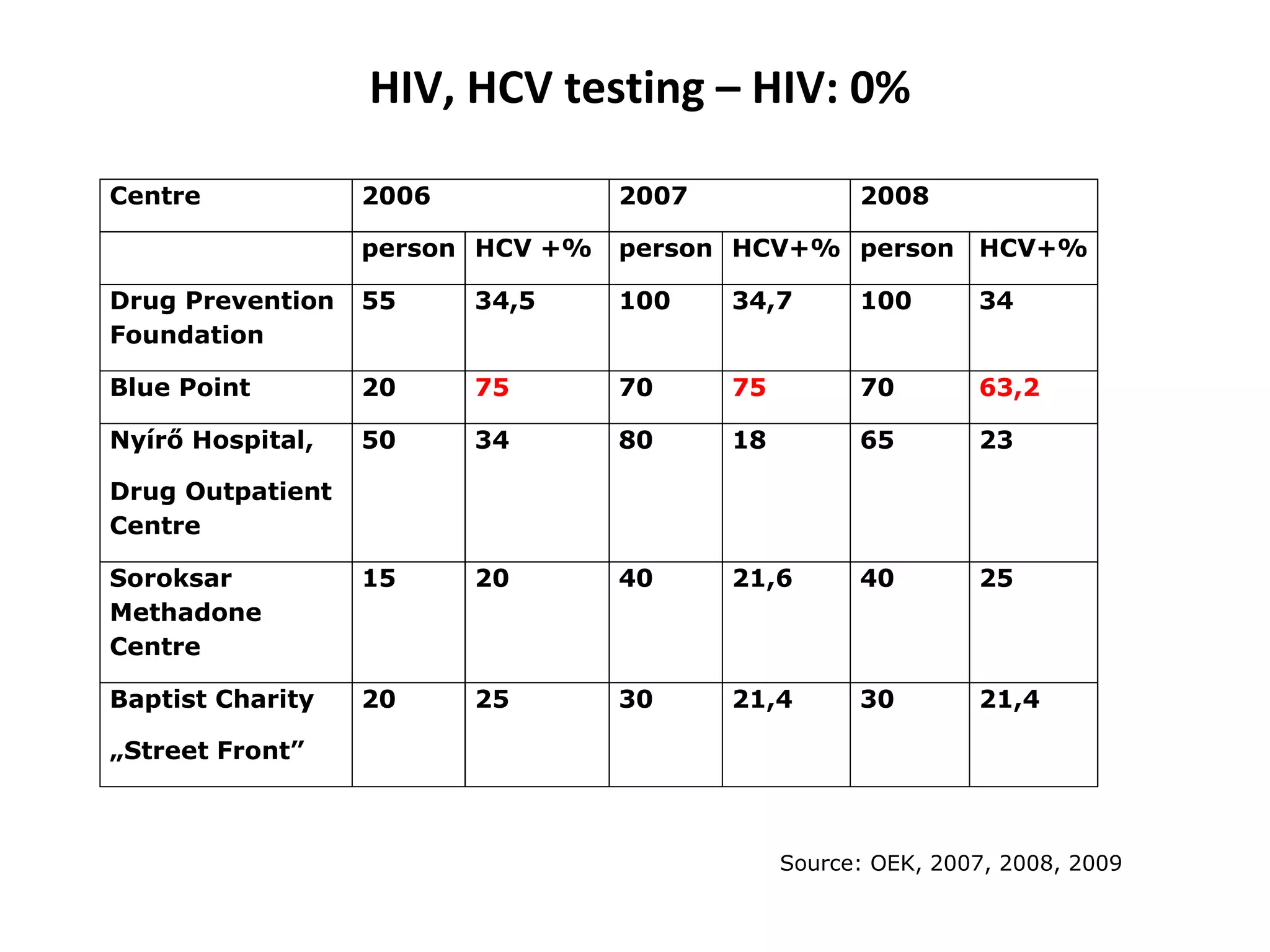
Source: OEK, 2007, 2008, 2009 HIV, HCV testing – HIV: 0%
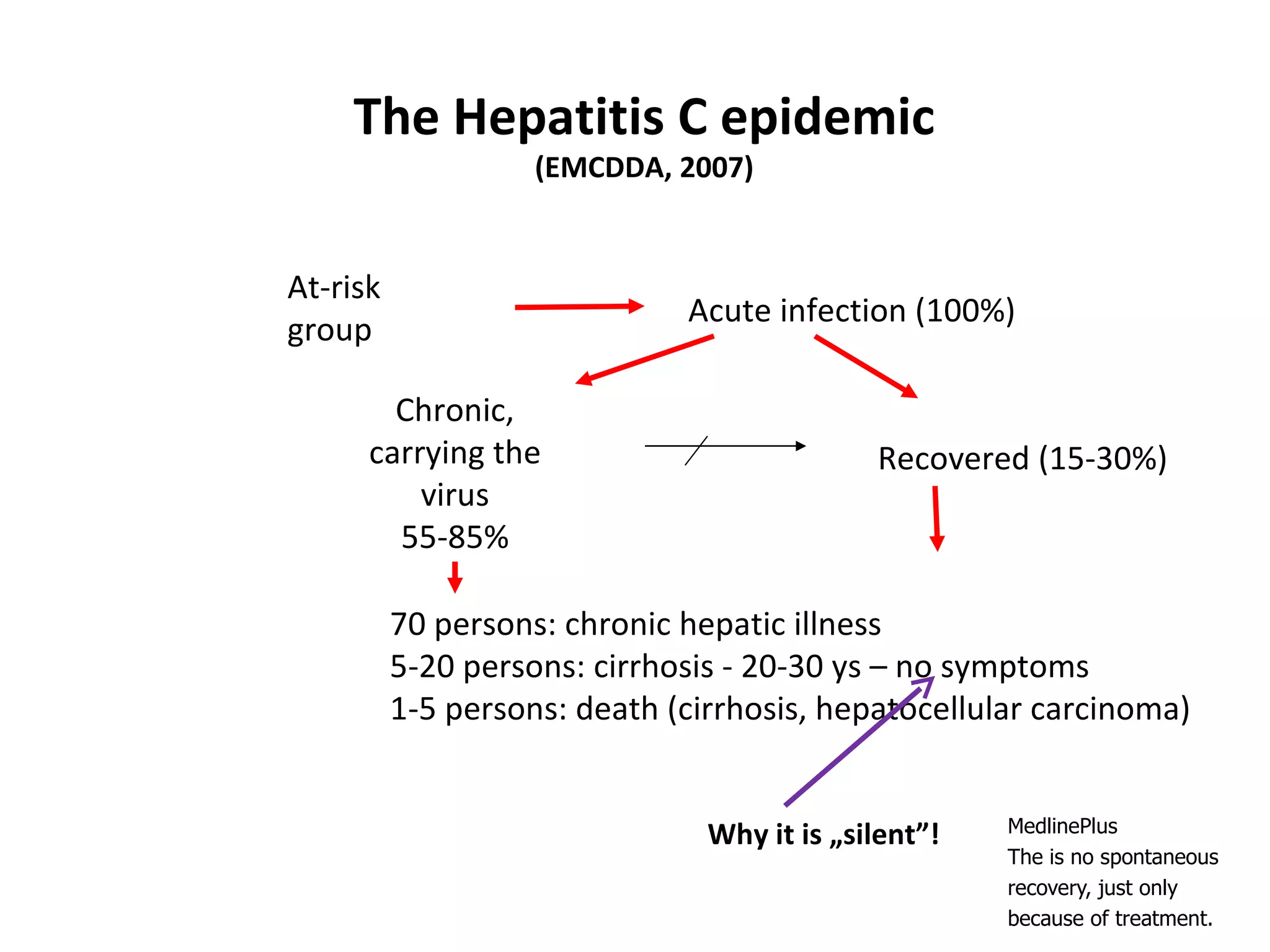
MedlinePlus The is no spontaneous recovery, just   only because of treatment. At-risk group  Acute infection (100%)  Recovered (15-30%)  Chronic, carrying the virus 55-85% 70 persons:  chronic hepa tic   ill ness 5-20  persons : cirrhosis - 20-30  ys – no symptoms 1-5  persons : death (cirrhosis, hepatocellular carcinoma ) The Hepatitis C epidemic (EMCDDA, 2007) Why it is „silent”!
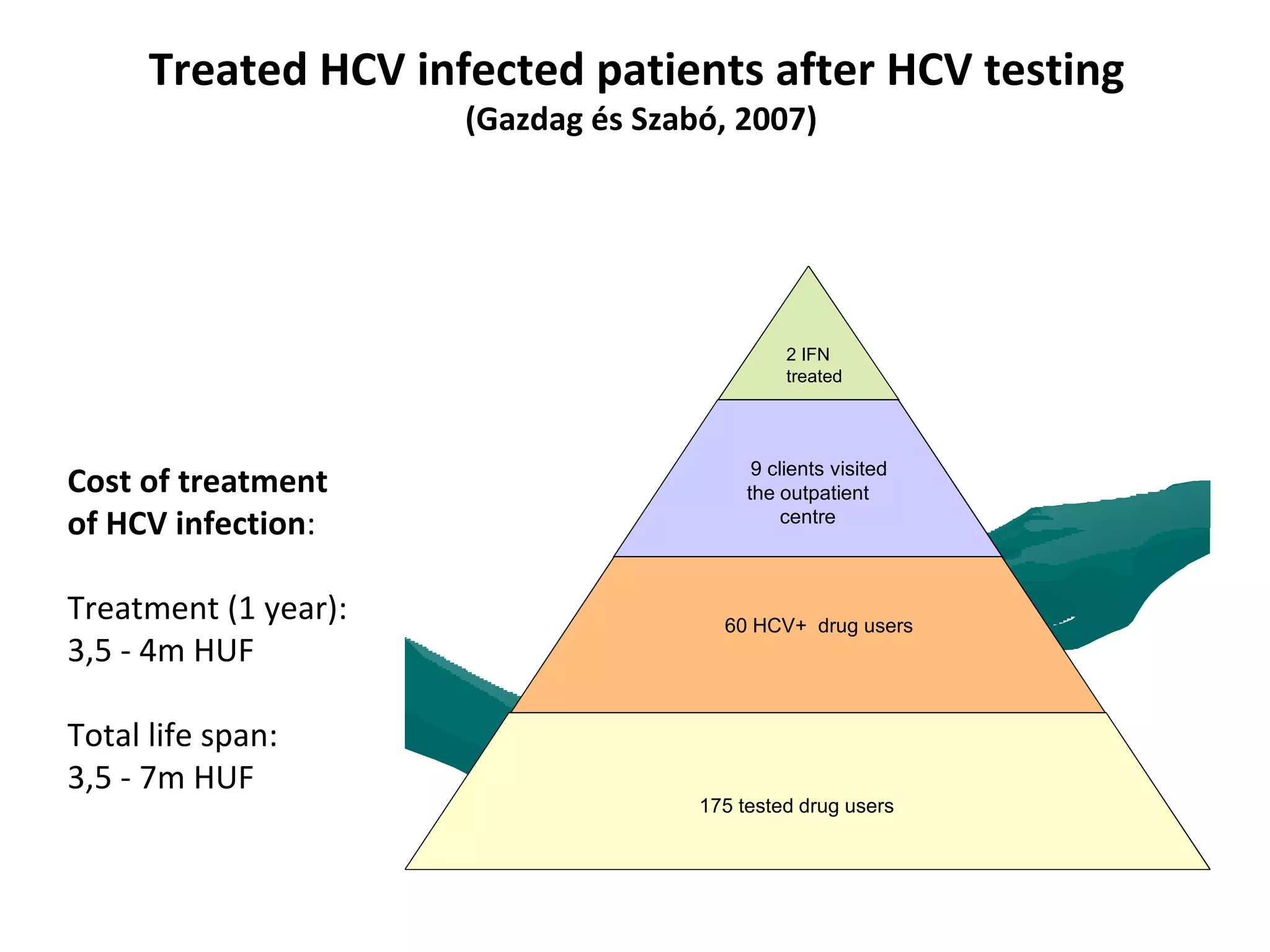
Treated HCV infected patients after HCV testing   (Gazdag és Szabó, 2007) Cost of treatment of HCV infection : Treatment (1 year): 3,5 - 4m HUF Total life span:  3,5 - 7m HUF
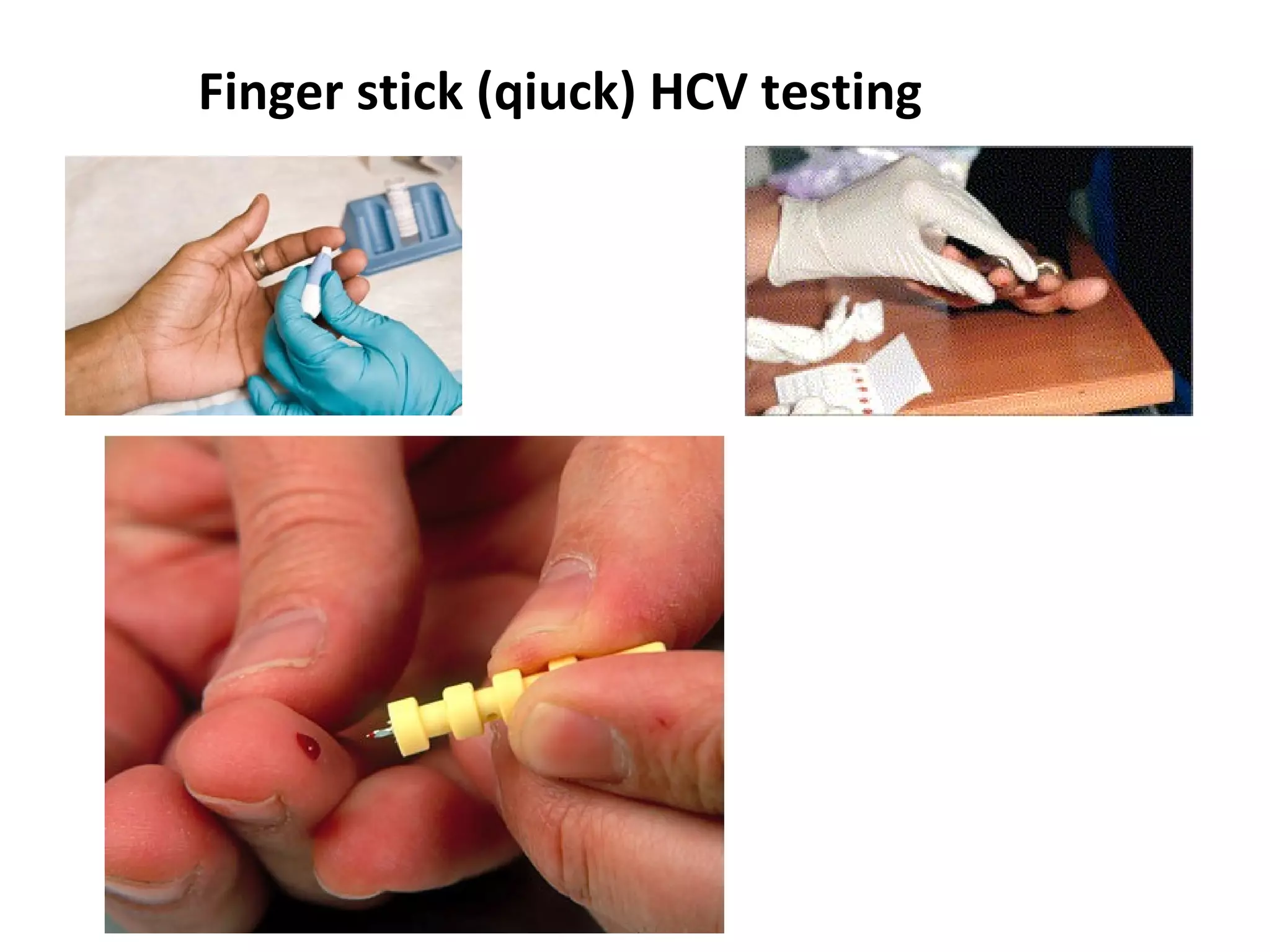
Finger stick (qiuck) HCV testing
Data on needle exchange program
Data Clients Visits (one client may have more visits) Needle: delivered & taken back
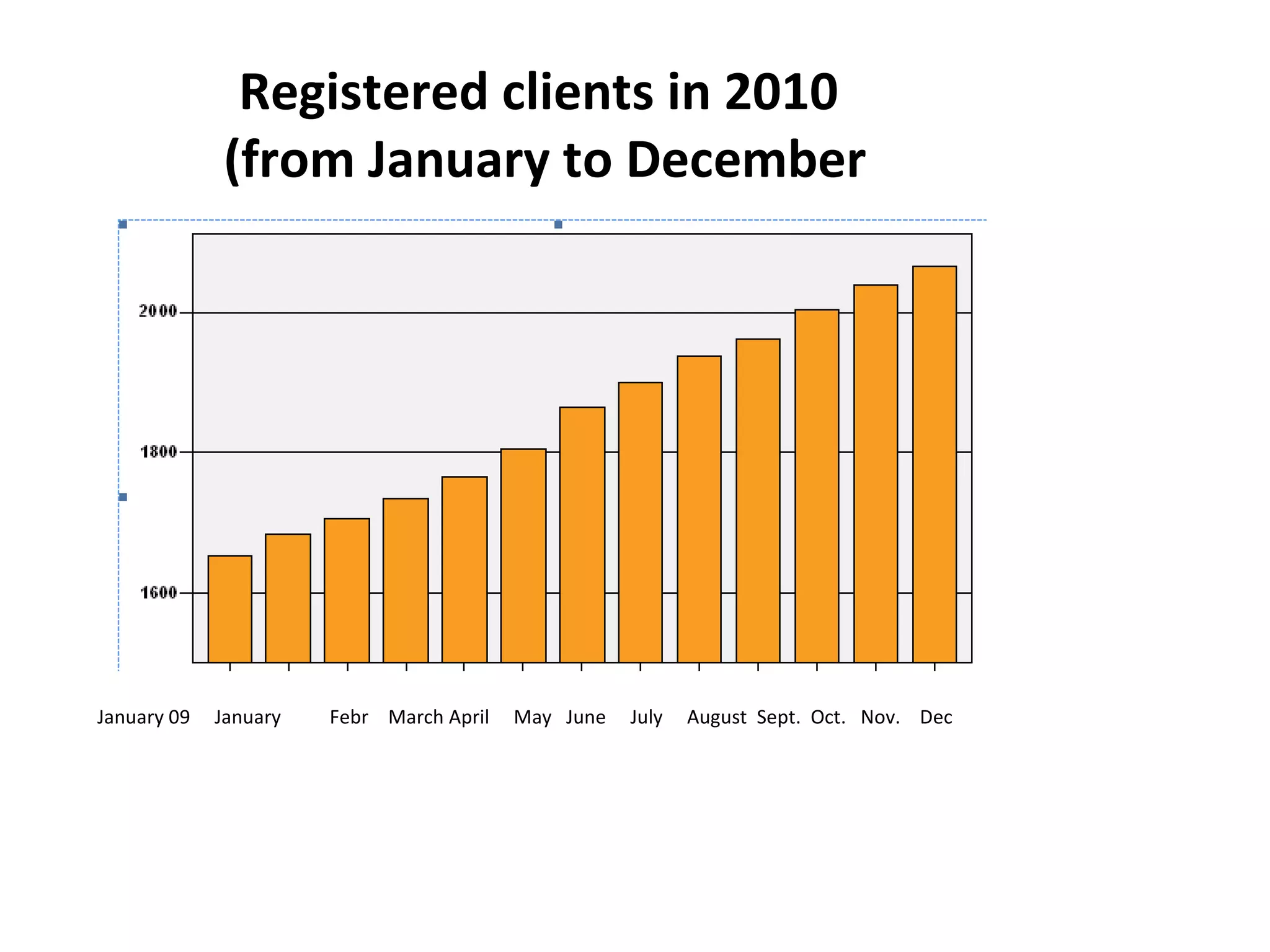
January 09  January  Febr  March April  May  June  July  August  Sept.  Oct.  Nov.  Dec Registered clients in 2010  (from January to December
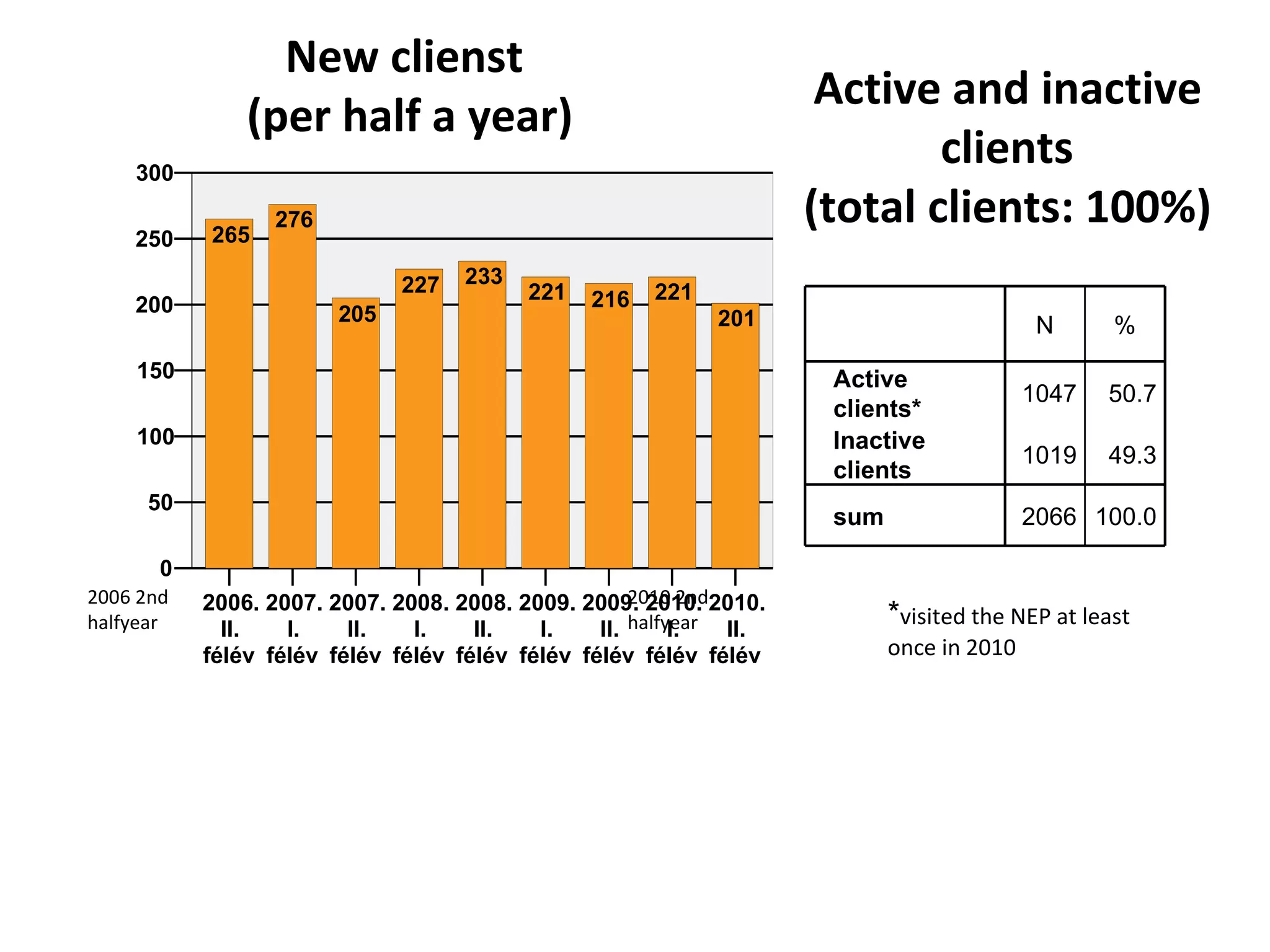
New clienst  (per half a year) 2006 2nd halfyear 2010 2nd halfyear Active and inactive clients (total clients: 100%) * visited the NEP at least once in 2010 N % Active clients* 1047 50.7 Inactive clients 1019 49.3 sum 2066 100.0
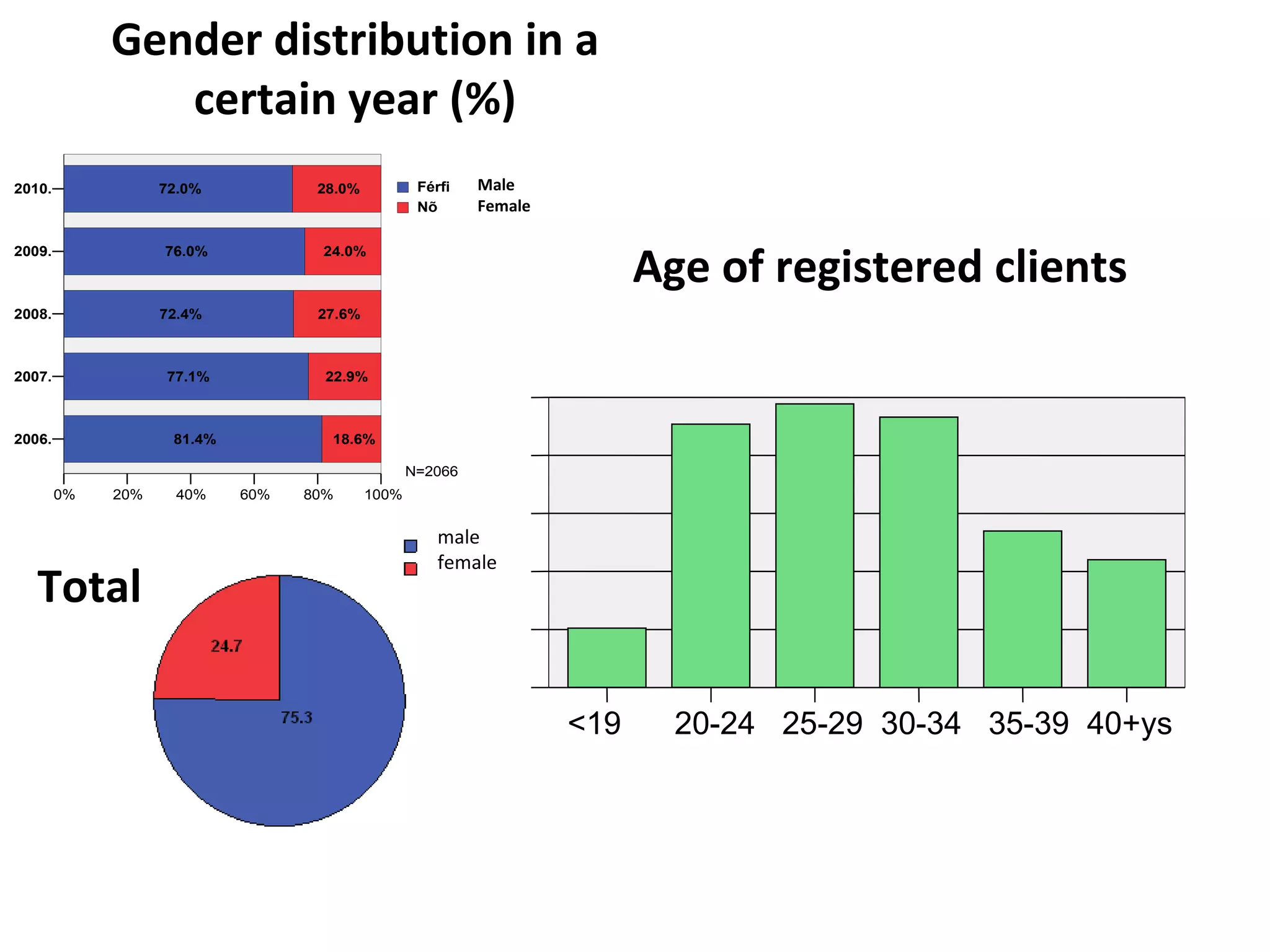
Gender distribution in a certain year (%) Male Female Age of registered clients <19  20-24  25-29  30-34  35-39  40+ys male female Total
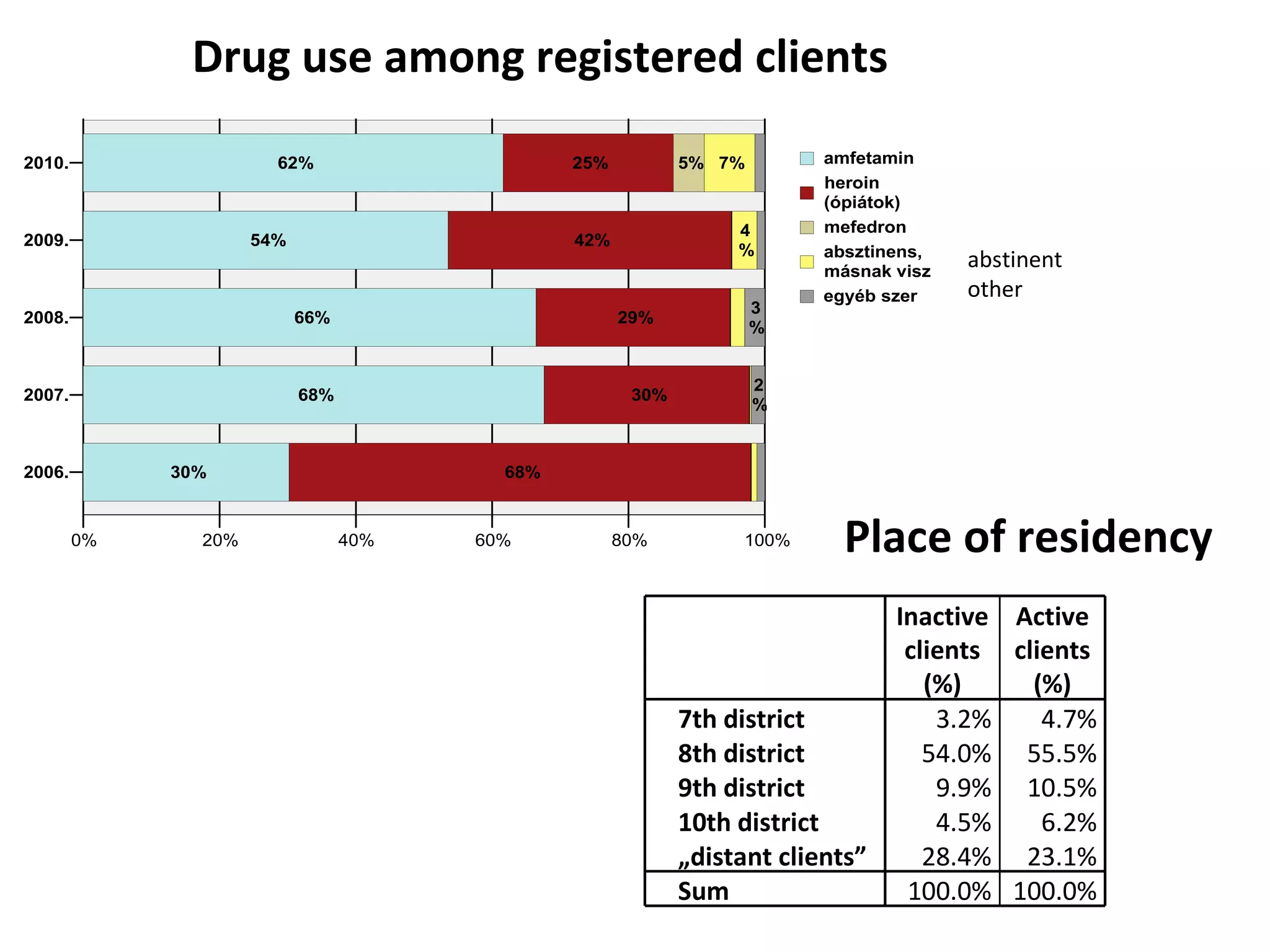
abstinent other Drug use among registered clients Place of residency Inactive clients (%) Active clients (%) 7th district 3.2% 4.7% 8th district 54.0% 55.5% 9th district 9.9% 10.5% 10th district 4.5% 6.2% „ distant clients” 28.4% 23.1% Sum 100.0% 100.0%
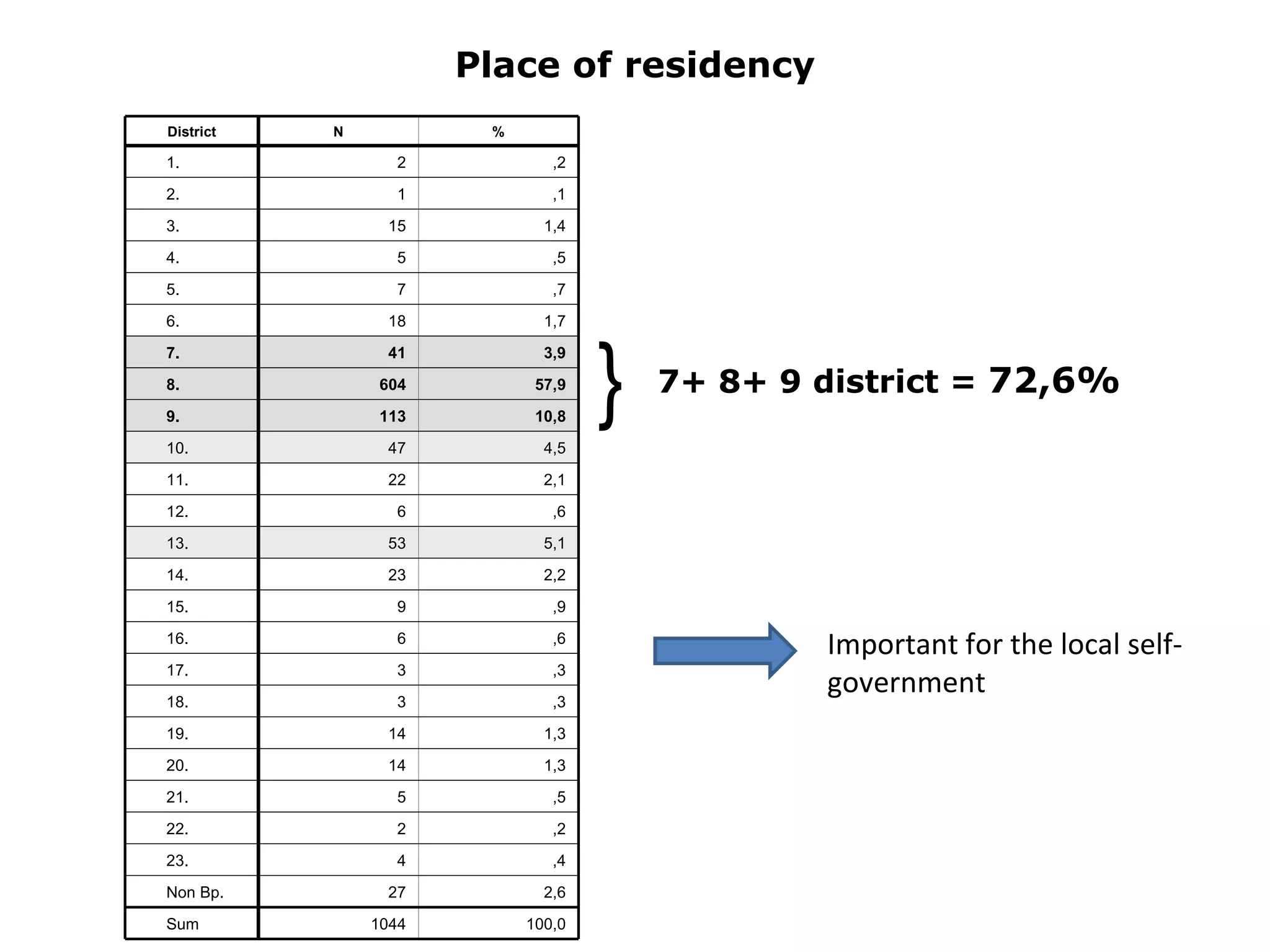
Place of residency } 7+ 8+ 9 district =  72,6% Important for the local self-government District N % 1. 2 ,2 2. 1 ,1 3. 15 1,4 4. 5 ,5 5. 7 ,7 6. 18 1,7 7. 41 3,9 8. 604 57,9 9. 113 10,8 10. 47 4,5 11. 22 2,1 12. 6 ,6 13. 53 5,1 14. 23 2,2 15. 9 ,9 16. 6 ,6 17. 3 ,3 18. 3 ,3 19. 14 1,3 20. 14 1,3 21. 5 ,5 22. 2 ,2 23. 4 ,4 Non Bp. 27 2,6 Sum 1044 100,0
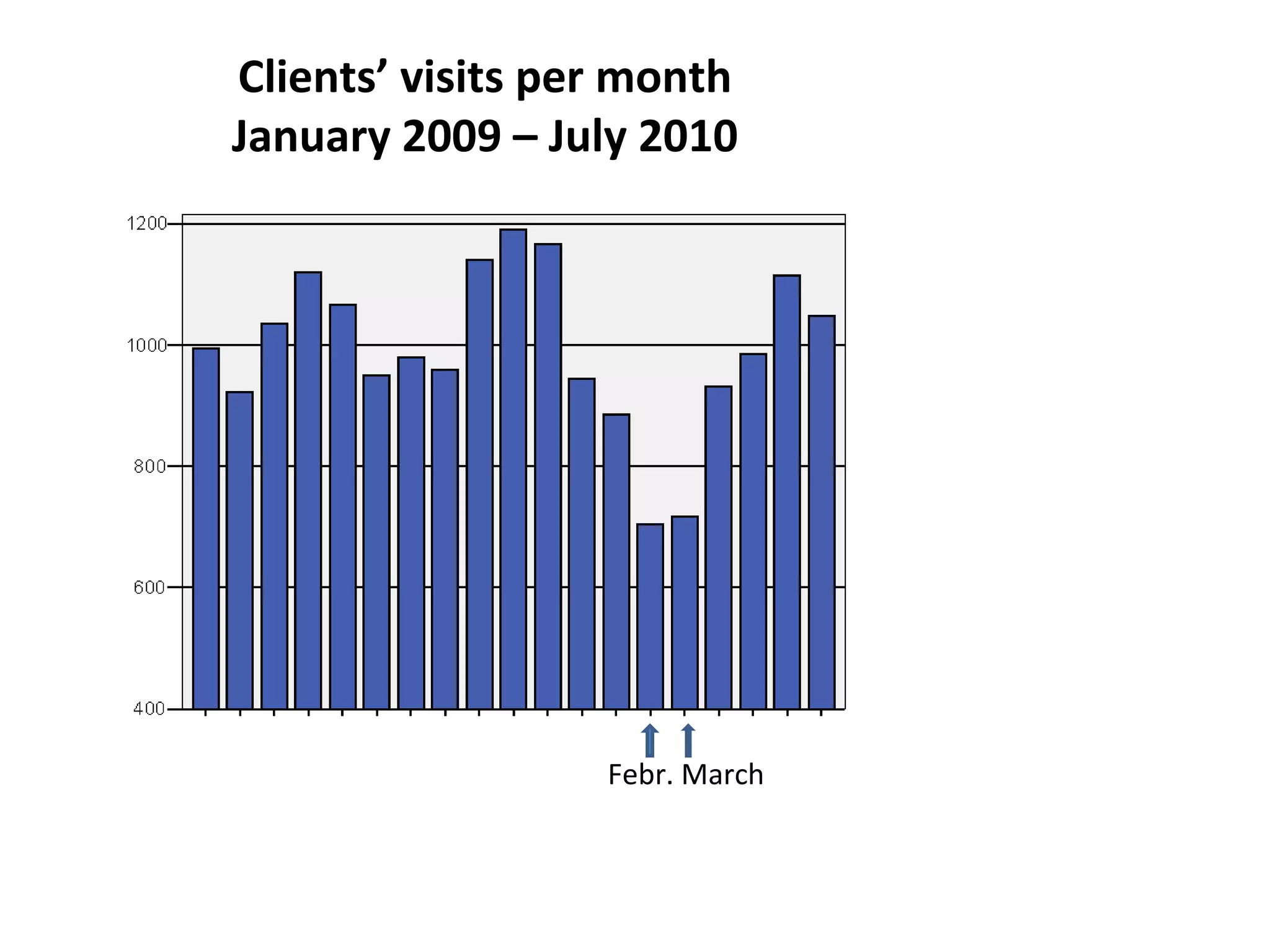
Clients’ visits per month January 2009 – July 2010 Febr. March
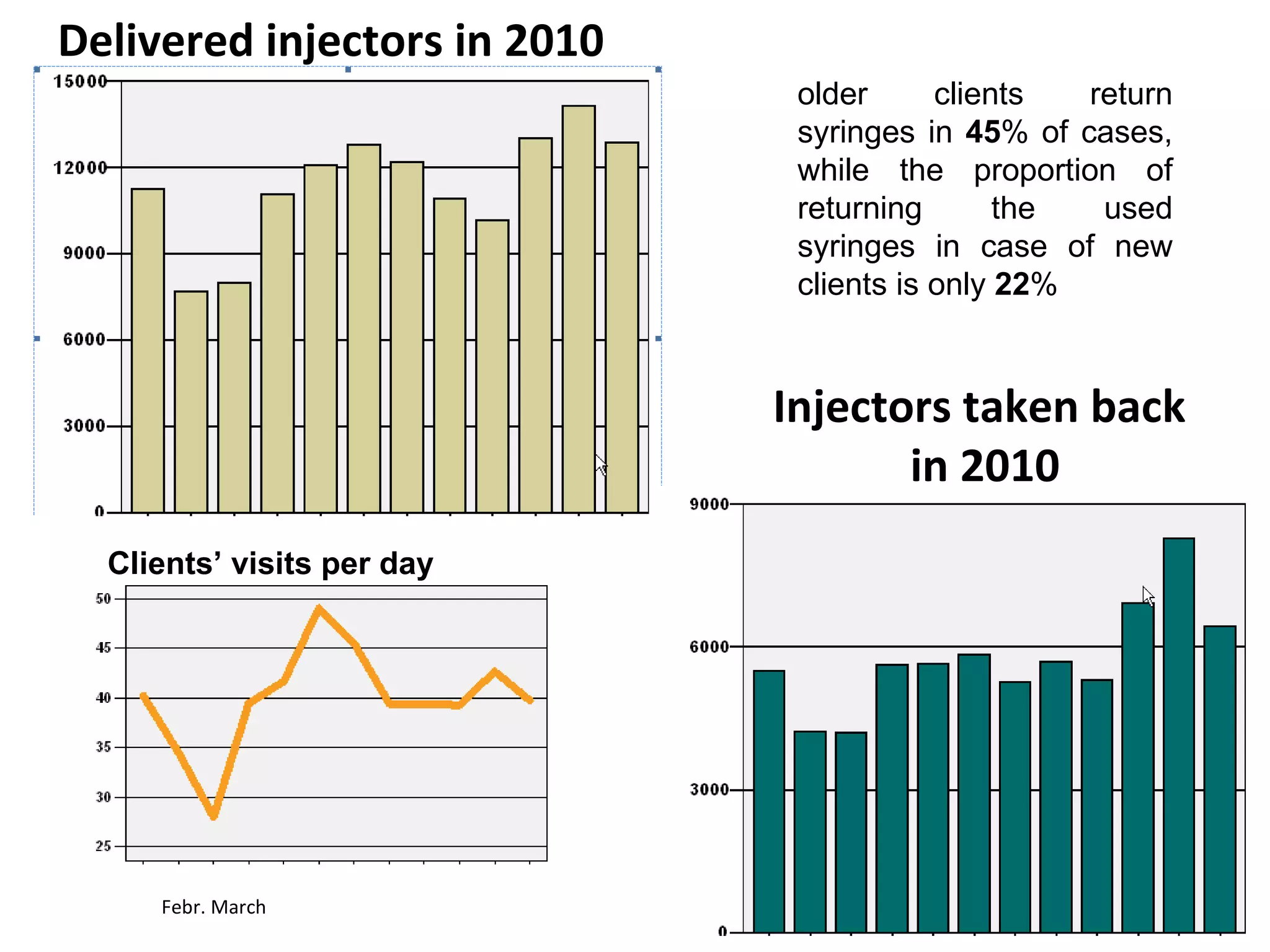
Delivered injectors in 2010 Injectors taken back  in 2010 Clients’ visits per day Febr. March older clients return syringes in  45 % of cases, while the proportion of returning the used syringes in case of new clients is only  22 %
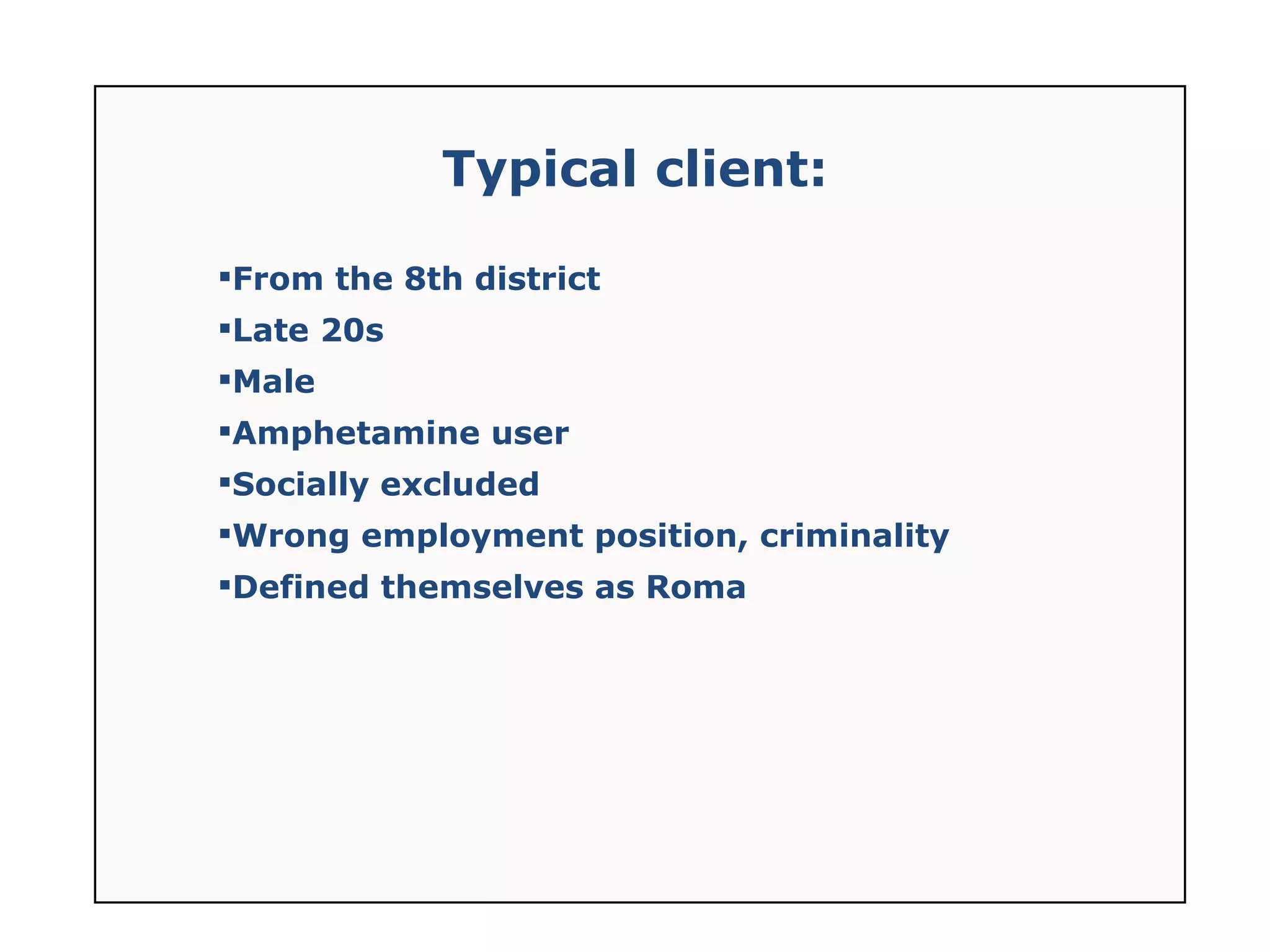
Typical client: From the 8th district Late 20s Male Amphetamine user Socially excluded Wrong employment position, criminality Defined themselves as Roma
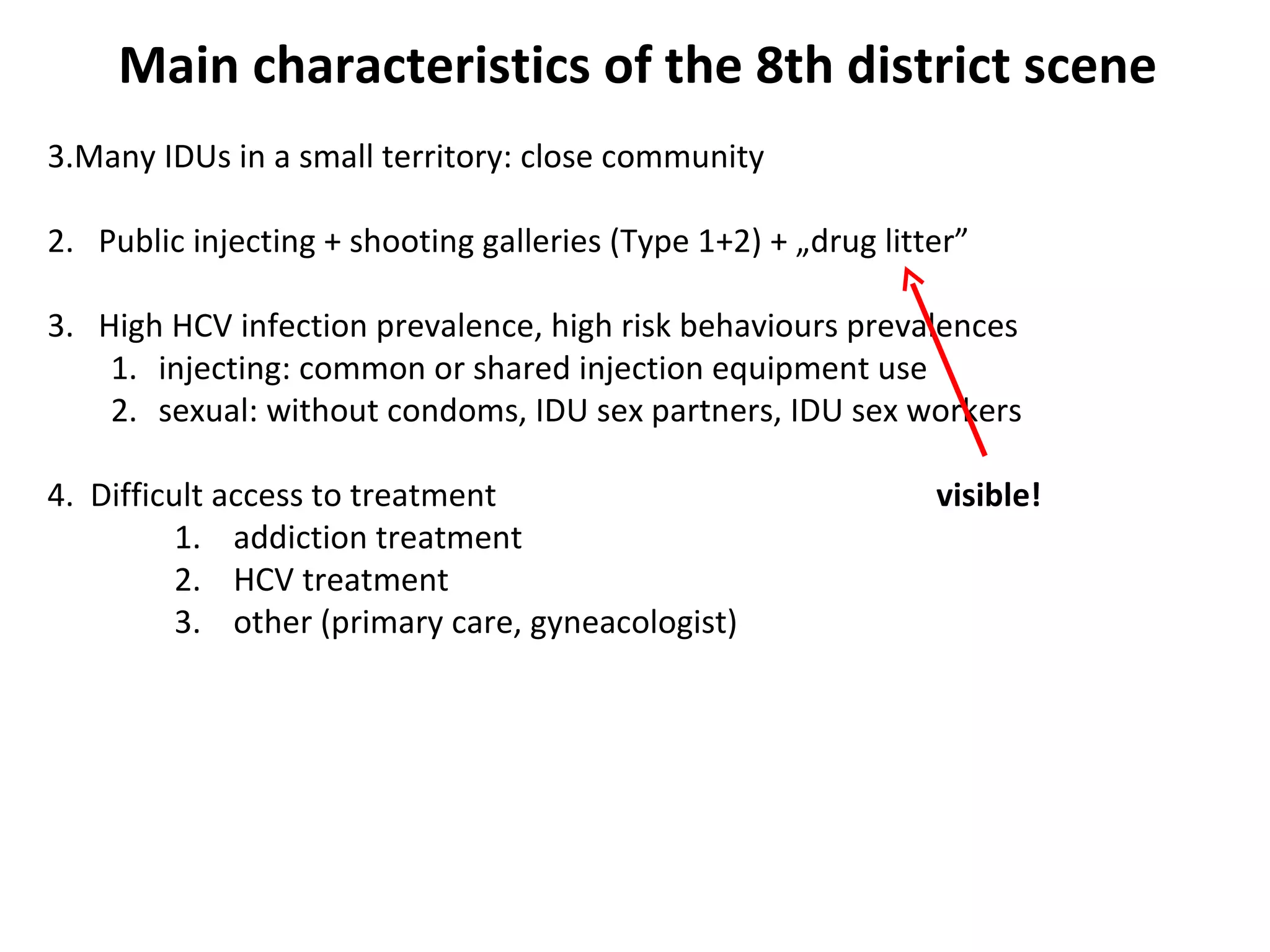
Main characteristics of the 8th district scene Many IDUs in a small territory: close community 2.  Public injecting + shooting galleries (Type 1+2) + „drug litter” 3.  High HCV infection prevalence, high risk behaviours prevalences injecting: common or shared injection equipment use sexual: without condoms, IDU sex partners, IDU sex workers 4.  Difficult access to treatment visible! 1.  addiction treatment 2.  HCV treatment 3.  other (primary care, gyneacologist)
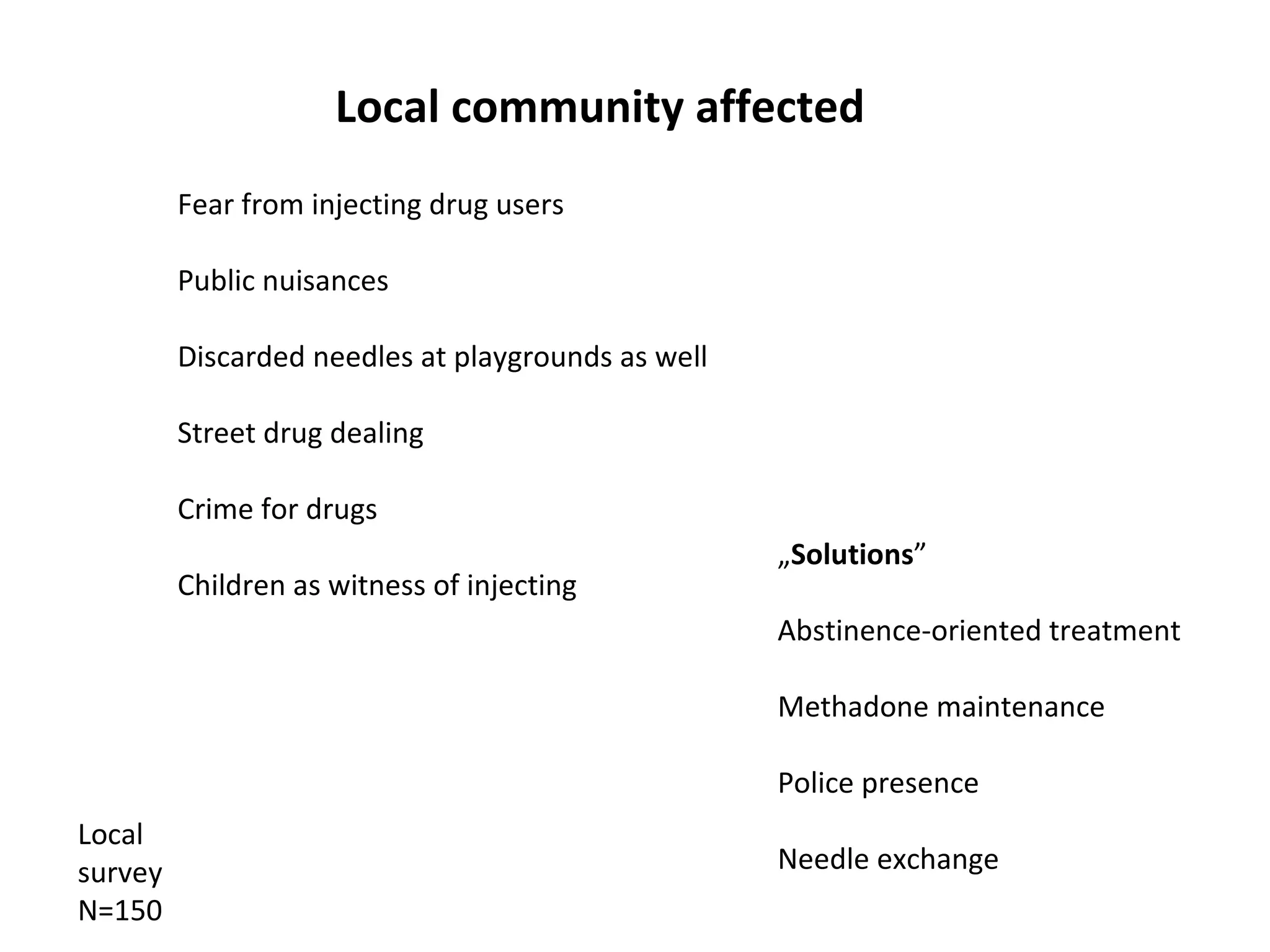
Local community affected Fear from injecting drug users Public nuisances Discarded needles at playgrounds as well Street drug dealing Crime for drugs Children as witness of injecting „ Solutions ” Abstinence-oriented treatment Methadone maintenance Police presence Needle exchang e Local survey N=150
What does the needle exchange program do: some examples?
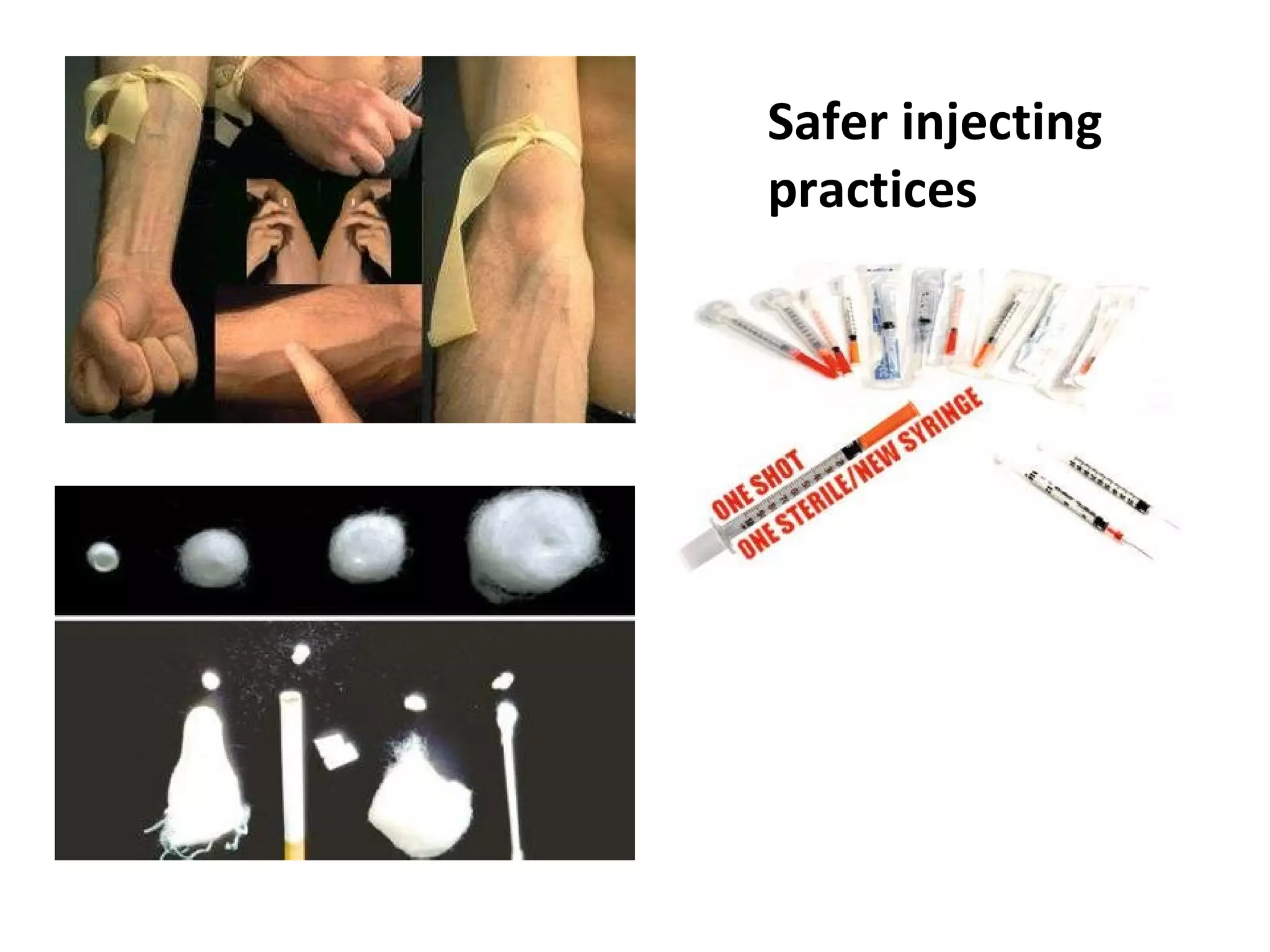
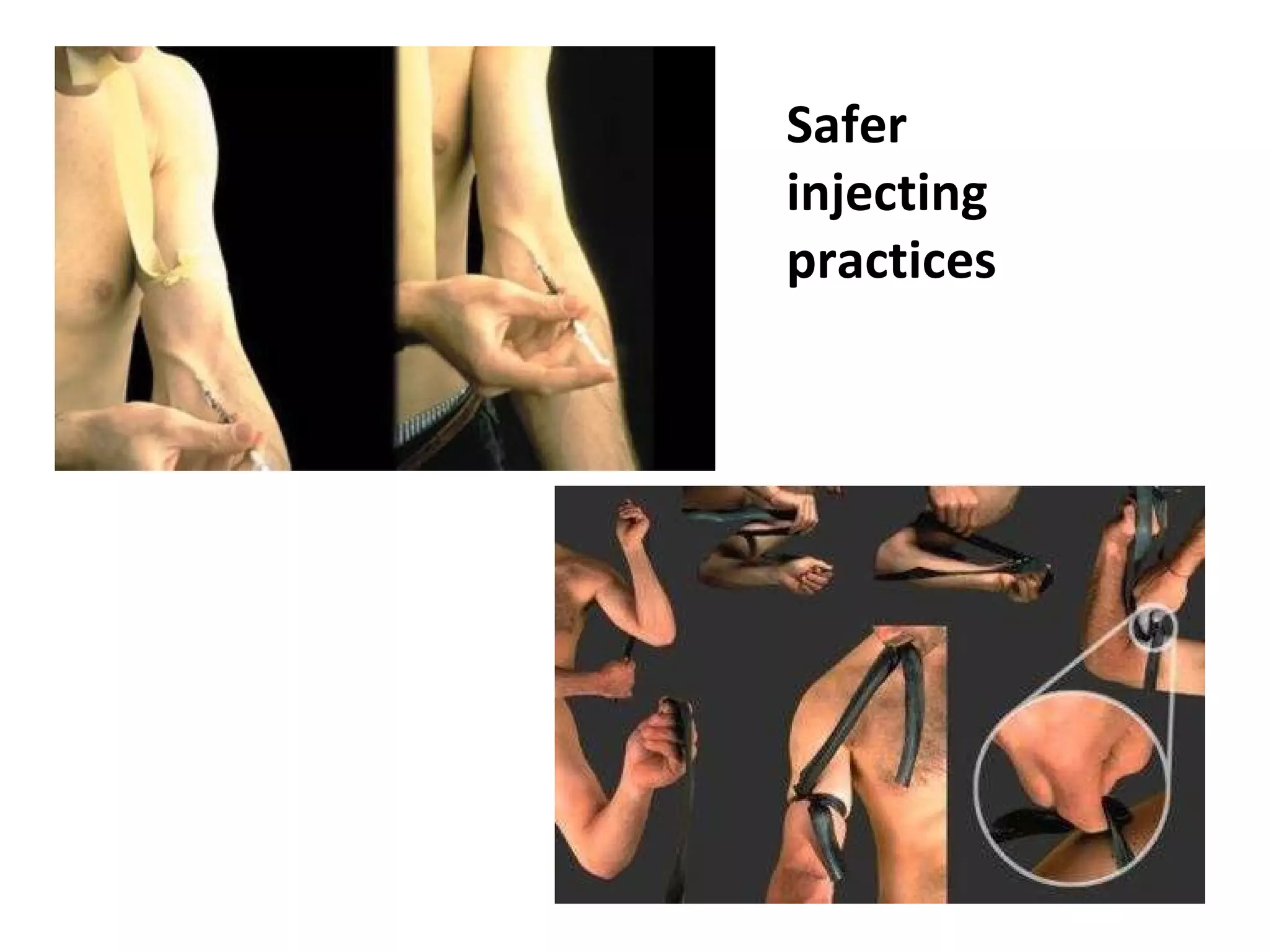
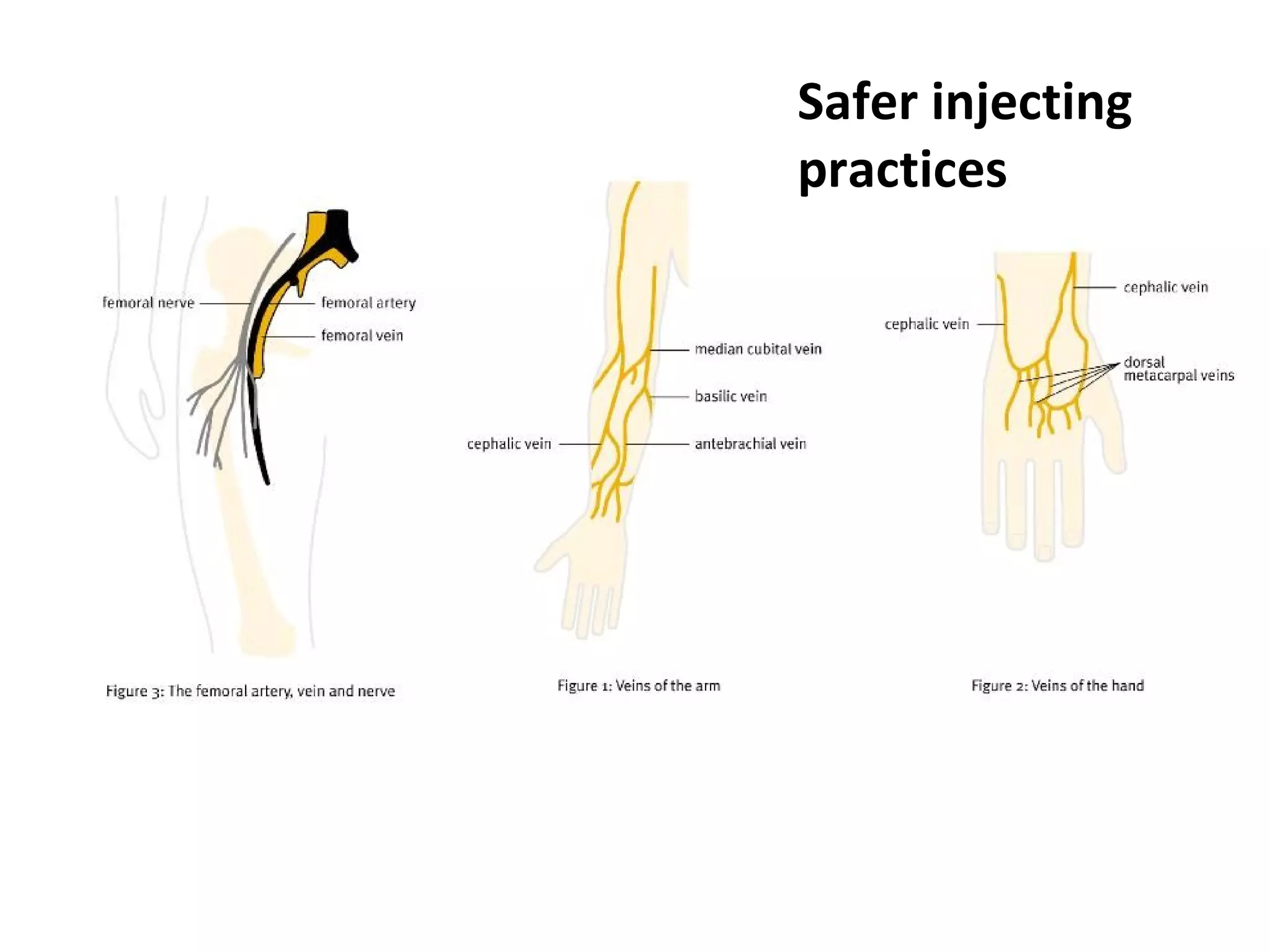
Safer injecting practices
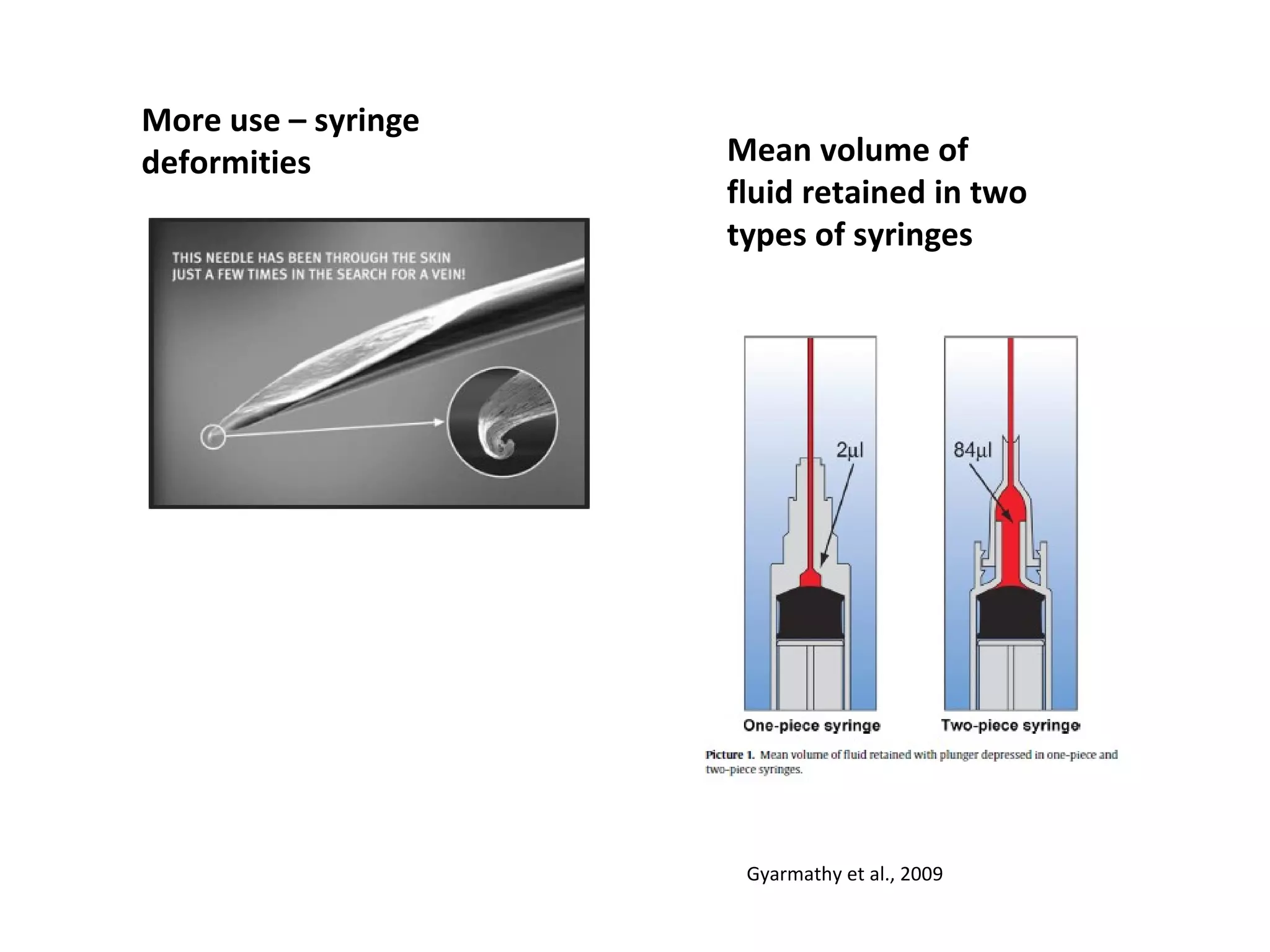
More use – syringe deformities Gyarmathy et al., 2009 Mean volume of fluid retained in two types of syringes
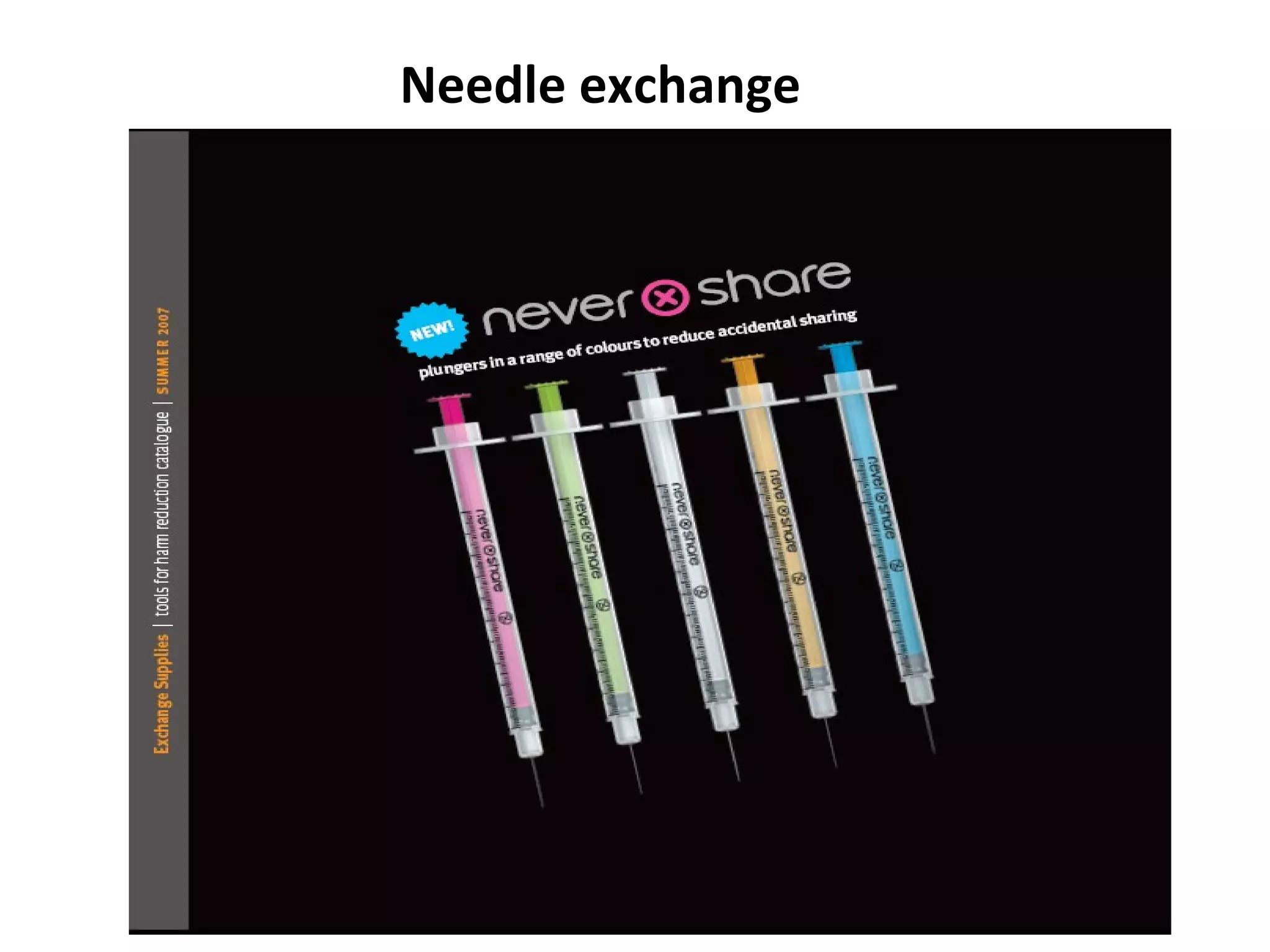
Needle exchange
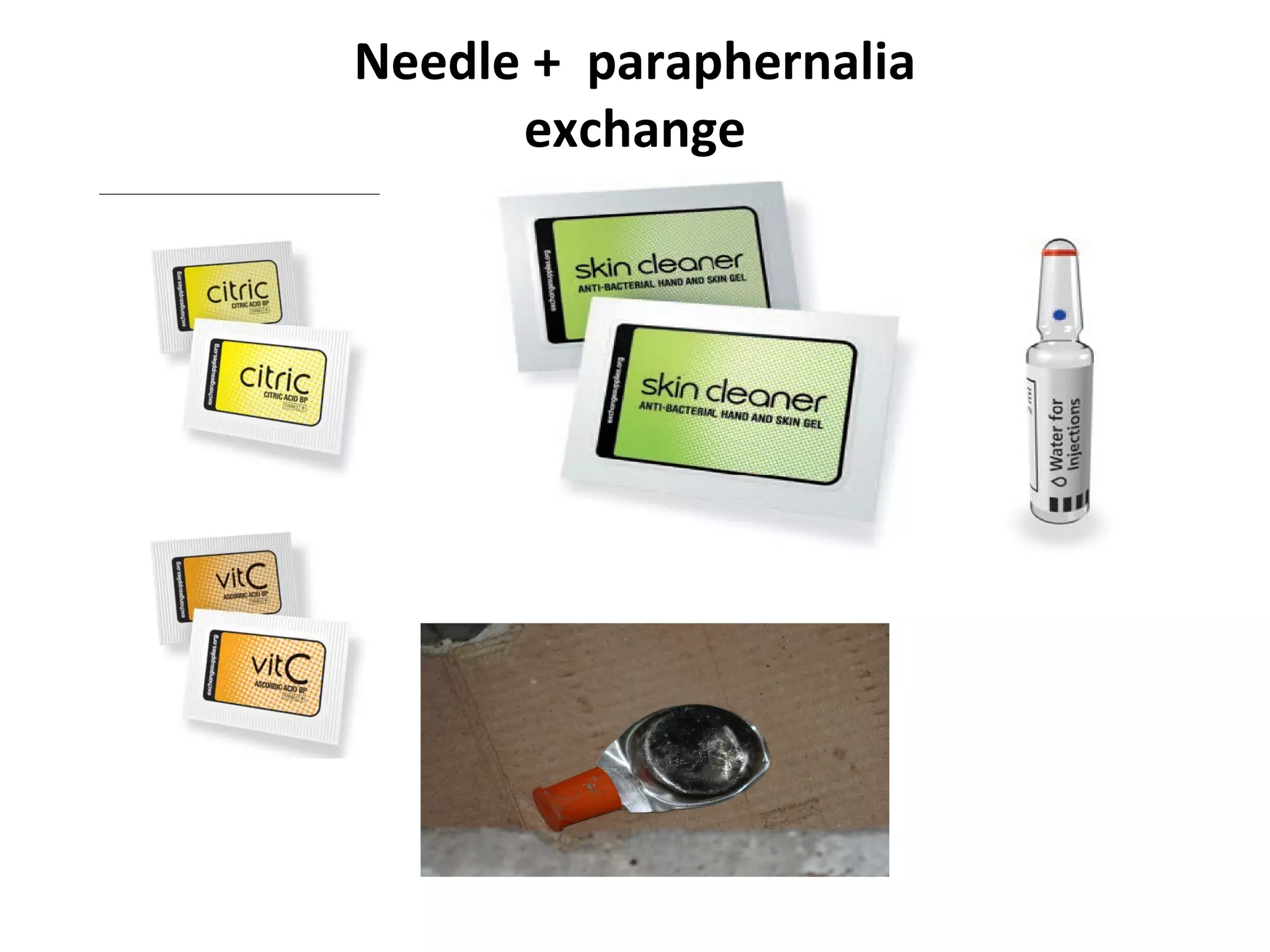
Needle +  paraphernalia exchange
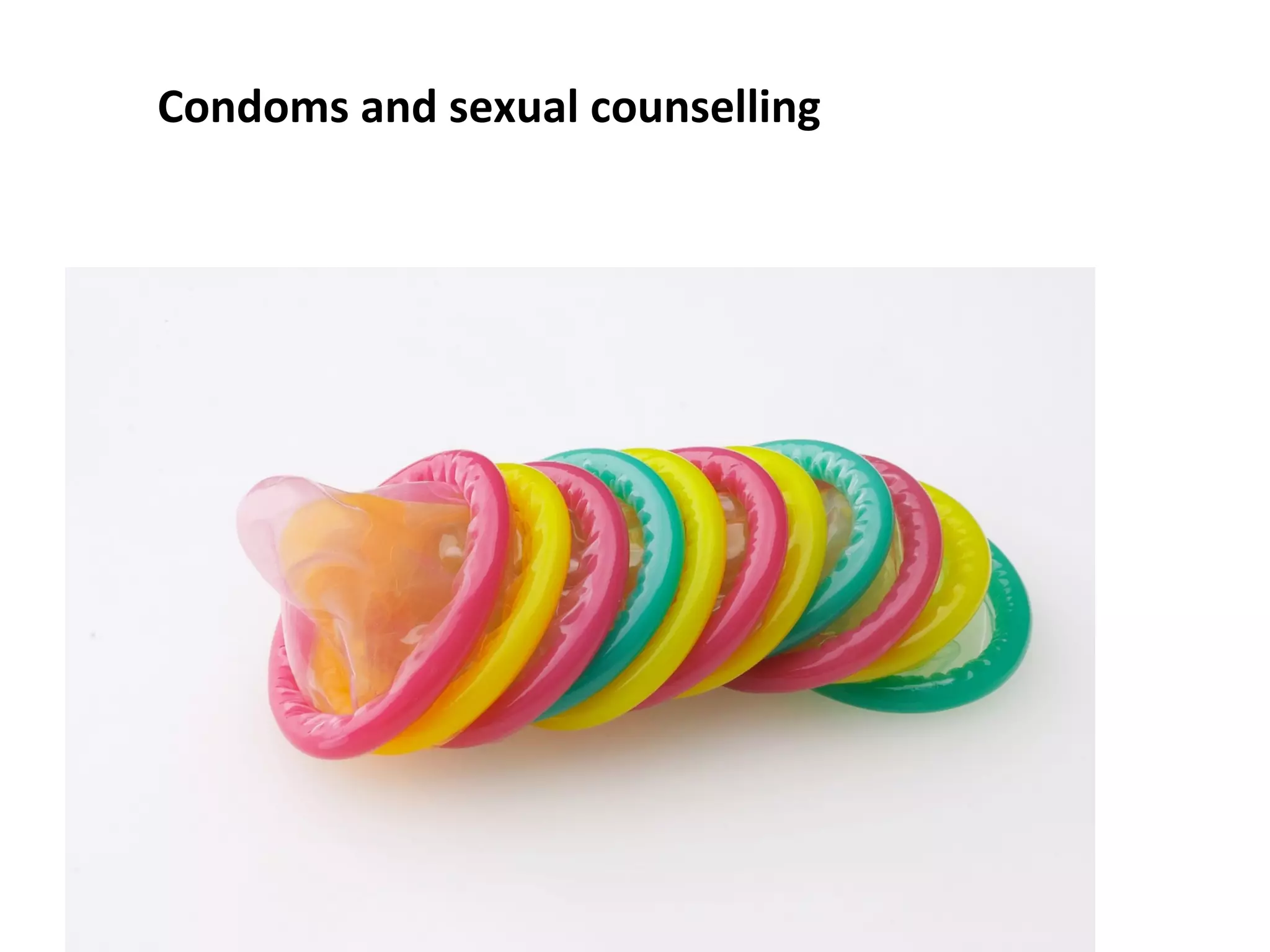
Condoms and sexual counselling
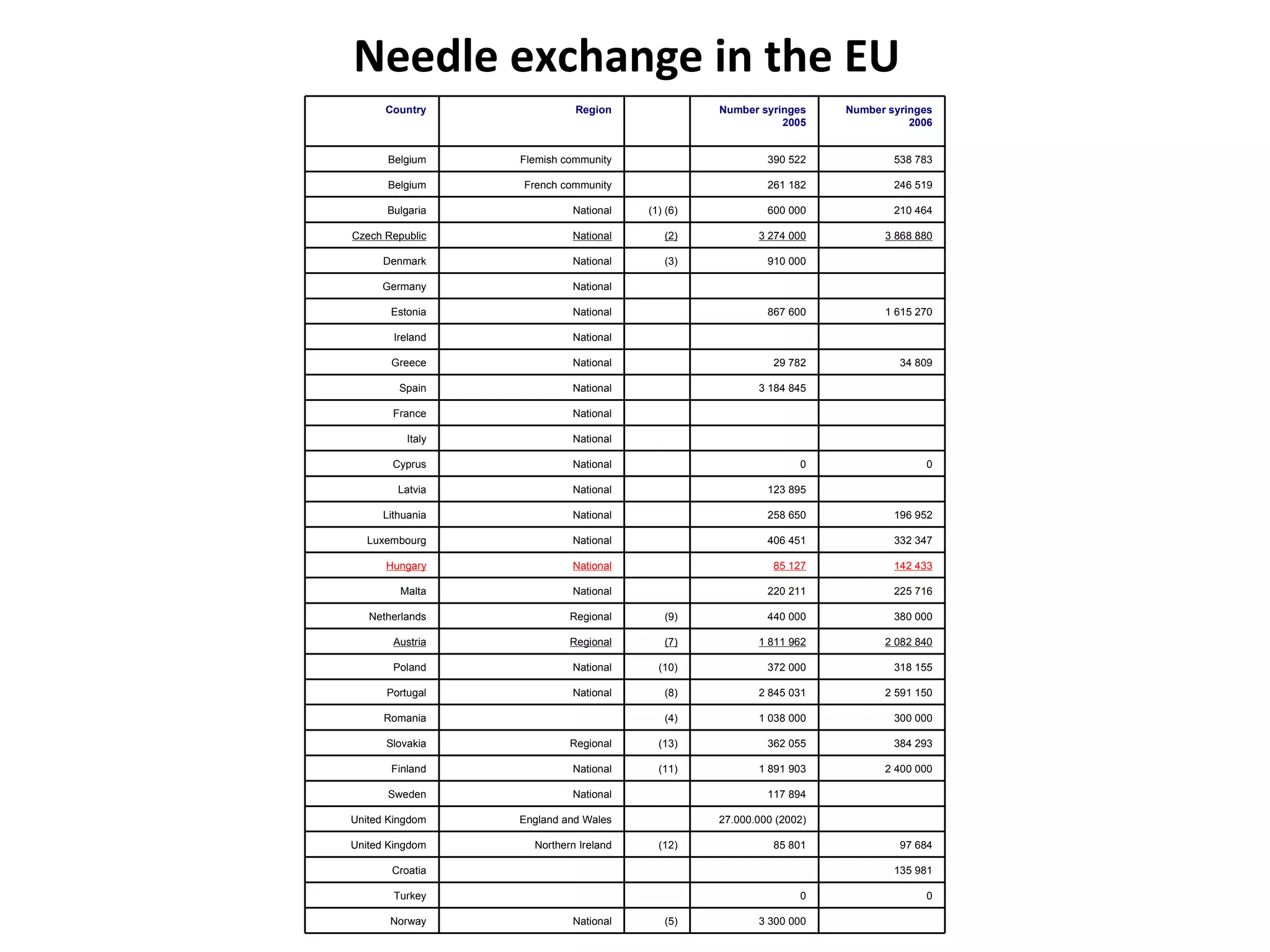
Needle exchange in the EU Country Region Number syringes 2005 Number syringes 2006 Belgium Flemish community 390 522 538 783 Belgium French community 261 182 246 519 Bulgaria National (1) (6) 600 000 210 464 Czech Republic National (2) 3 274 000 3 868 880 Denmark National (3) 910 000 Germany National Estonia National 867 600 1 615 270 Ireland National Greece National 29 782 34 809 Spain National 3 184 845 France National Italy National Cyprus National 0 0 Latvia National 123 895 Lithuania National 258 650 196 952 Luxembourg National 406 451 332 347 Hungary National 85 127 142 433 Malta National 220 211 225 716 Netherlands Regional (9) 440 000 380 000 Austria Regional (7) 1 811 962 2 082 840 Poland National (10) 372 000 318 155 Portugal National (8) 2 845 031 2 591 150 Romania (4) 1 038 000 300 000 Slovakia Regional (13) 362 055 384 293 Finland National (11) 1 891 903 2 400 000 Sweden National 117 894 United Kingdom England and Wales 27.000.000 (2002) United Kingdom Northern Ireland (12) 85 801 97 684 Croatia 135 981 Turkey 0 0 Norway National (5) 3 300 000
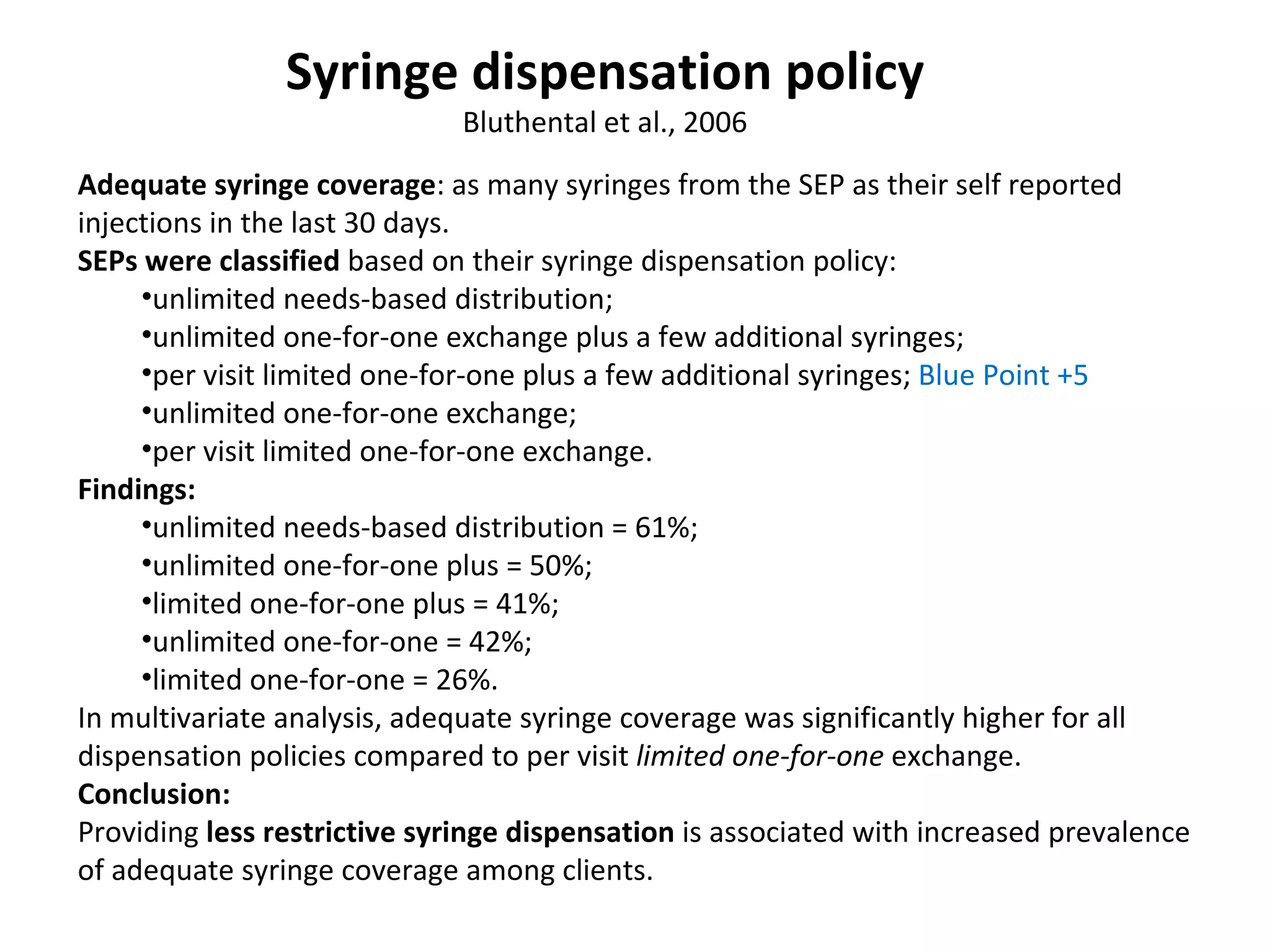
A dequate syringe coverage :  as many syringes from the SEP as their self   reported   injections in the last 30 days.  SEPs were classified  based on their syringe dispensation policy :   unlimited needs-based distribution;  unlimited one-for-one exchange   plus a few additional syringes;  per visit limited one-for-one plus a few additional syringes;  Blue Point +5 unlimited one-for-one   exchange;  per visit limited one-for-one exchange.  Findings : unlimited needs-based distribution = 61%;  unlimited one-for-one plus = 50%;  l imited   one-for-one plus = 41%;  unlimited one-for-one = 42%;  limited one-for-one = 26%.  In multivariate analysis,   adequate syringe coverage was significantly higher for all dispensation policies compared to per visit  limited one-for - one   exchange.  Conclusion :  Providing  less restrictive syringe   dispensation  is associated with increased prevalence of adequate syringe coverage among clients.  Syringe dispensation policy Bluthental et al., 2006
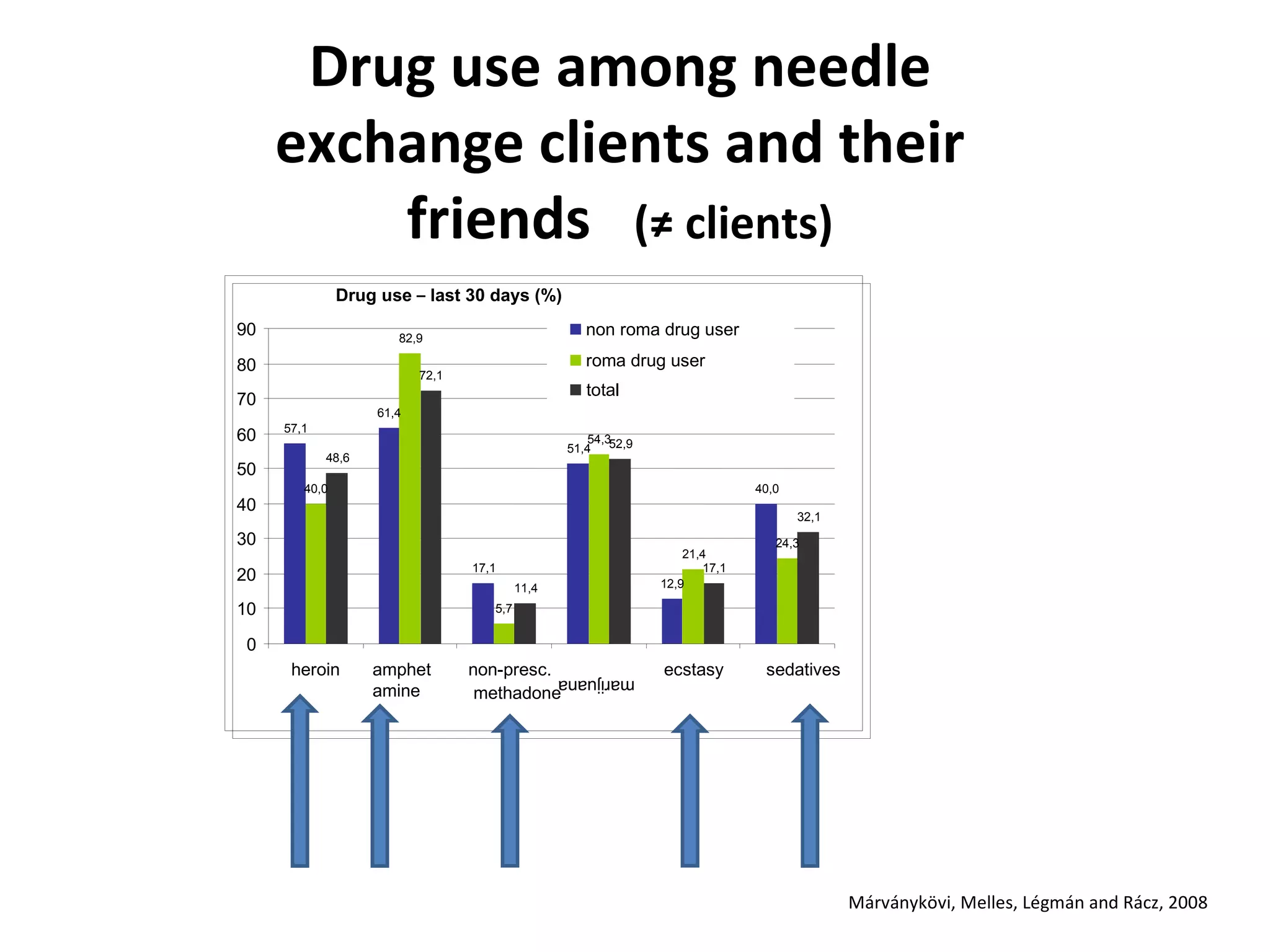
Drug use among needle exchange clients and their friends  (≠ clients) Márványkövi, Melles, Légmán and Rácz, 2008 Drug use  –  last 30 days (%) 57,1 61,4 17,1 51,4 12,9 40,0 40,0 82,9 5,7 54,3 21,4 24,3 48,6 72,1 11,4 52,9 17,1 32,1 0 10 20 30 40 50 60 70 80 90 heroin amphet amine non-presc.  methadone marijuana ecstasy sedatives non roma drug user roma drug user total
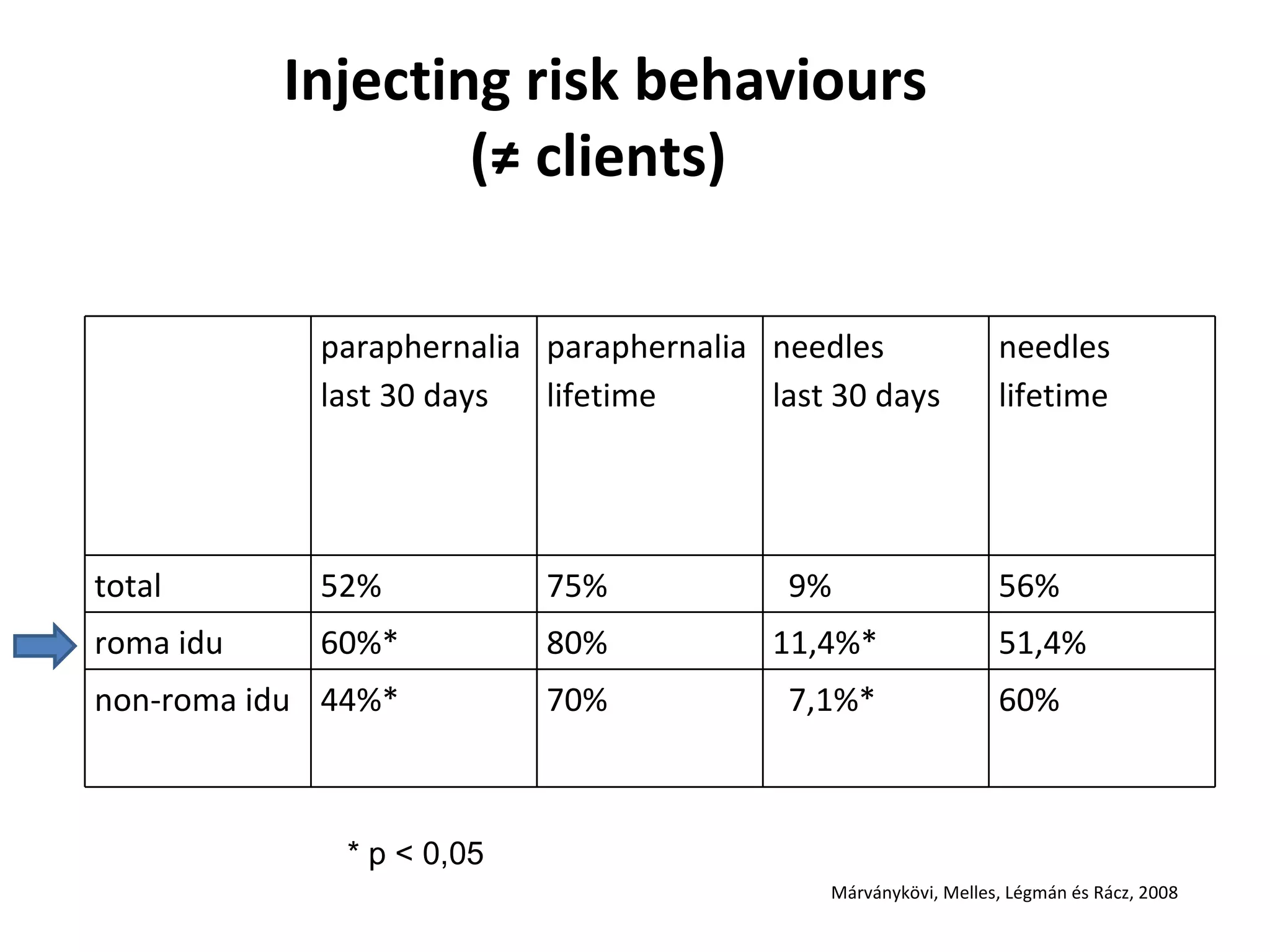
Márványkövi, Melles, Légmán és Rácz, 2008 Injecting risk behaviours (≠ clients)  * p < 0,05 paraphernalia last 30 days paraphernalia lifetime needles last 30 days needles lifetime total 52% 75% 9% 56% roma idu 60%* 80% 11,4%* 51,4% non-roma idu 44%* 70% 7,1%* 60%
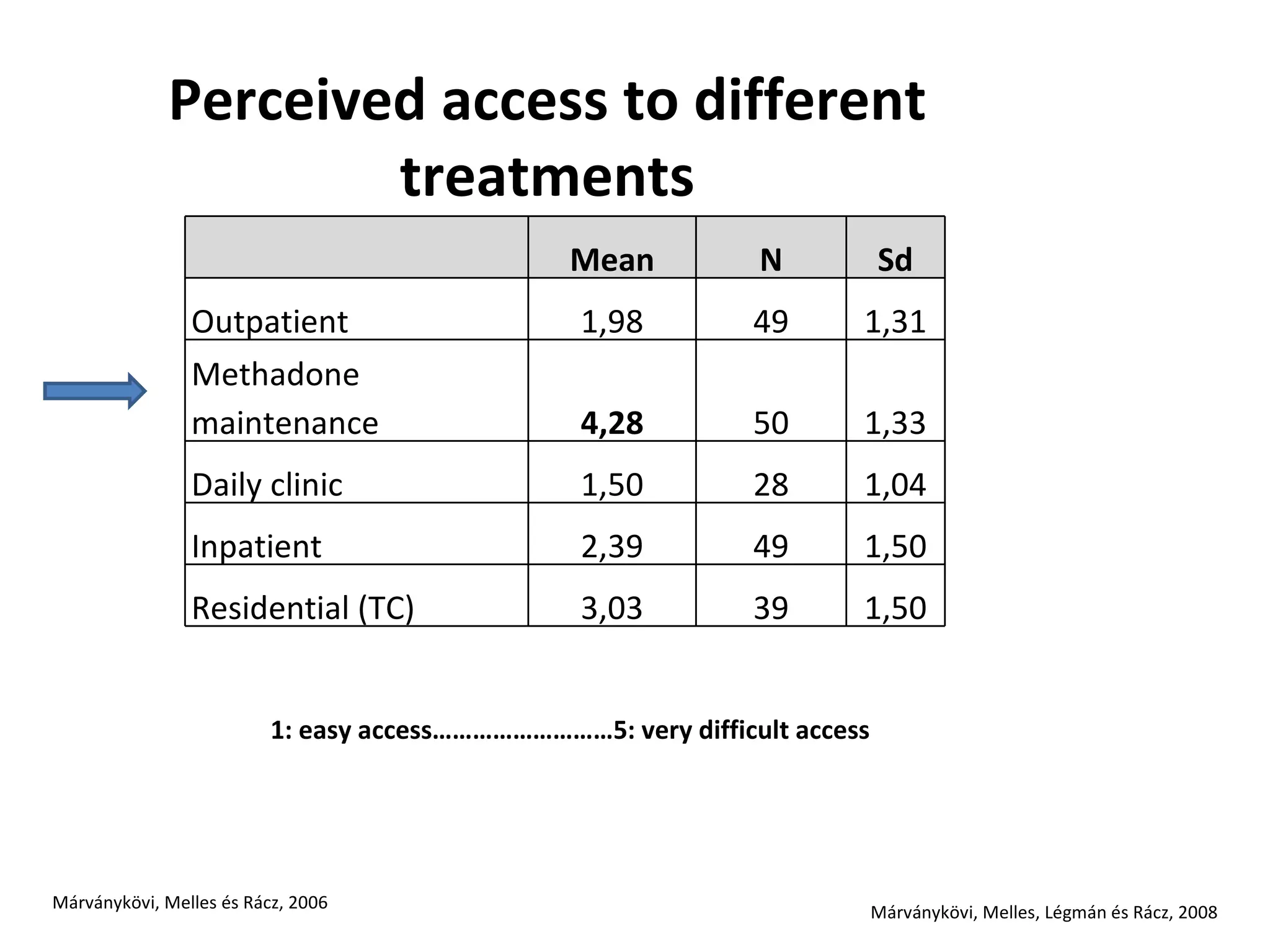
1: easy access………………………5: very difficult access Márványkövi, Melles, Légmán és Rácz, 2008 Márványkövi, Melles és Rácz, 2006 Perceived access to different treatments Mean N Sd Outpatient 1,98 49 1,31 Methadone maintenance 4,28 50 1,33 Daily clinic 1,50 28 1,04 Inpatient 2,39 49 1,50 Residential (TC) 3,03 39 1,50
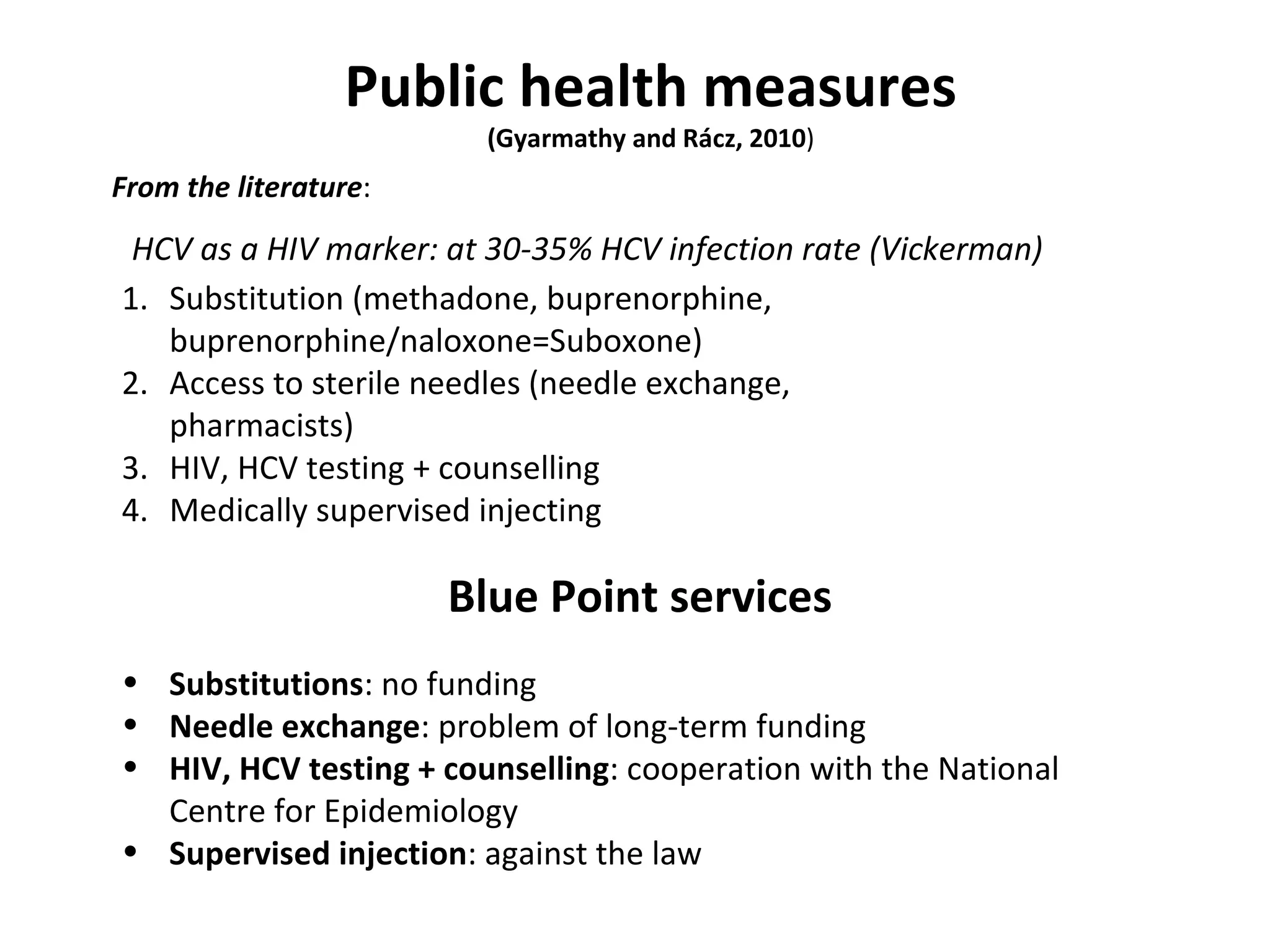
Public health measures (Gyarmathy and Rácz, 2010 ) HCV as a HIV marker: at 30-35% HCV infection rate (Vickerman) Substitution (methadone, buprenorphine, buprenorphine/naloxone=Suboxone) Access to sterile needles (needle exchange, pharmacists) HIV, HCV testing + counselling Medically supervised injecting Blue Point services Substitutions : no funding Needle exchange : problem of long-term funding HIV, HCV testing + counselling : cooperation with the National Centre for Epidemiology Supervised injection : against the law From the literature :
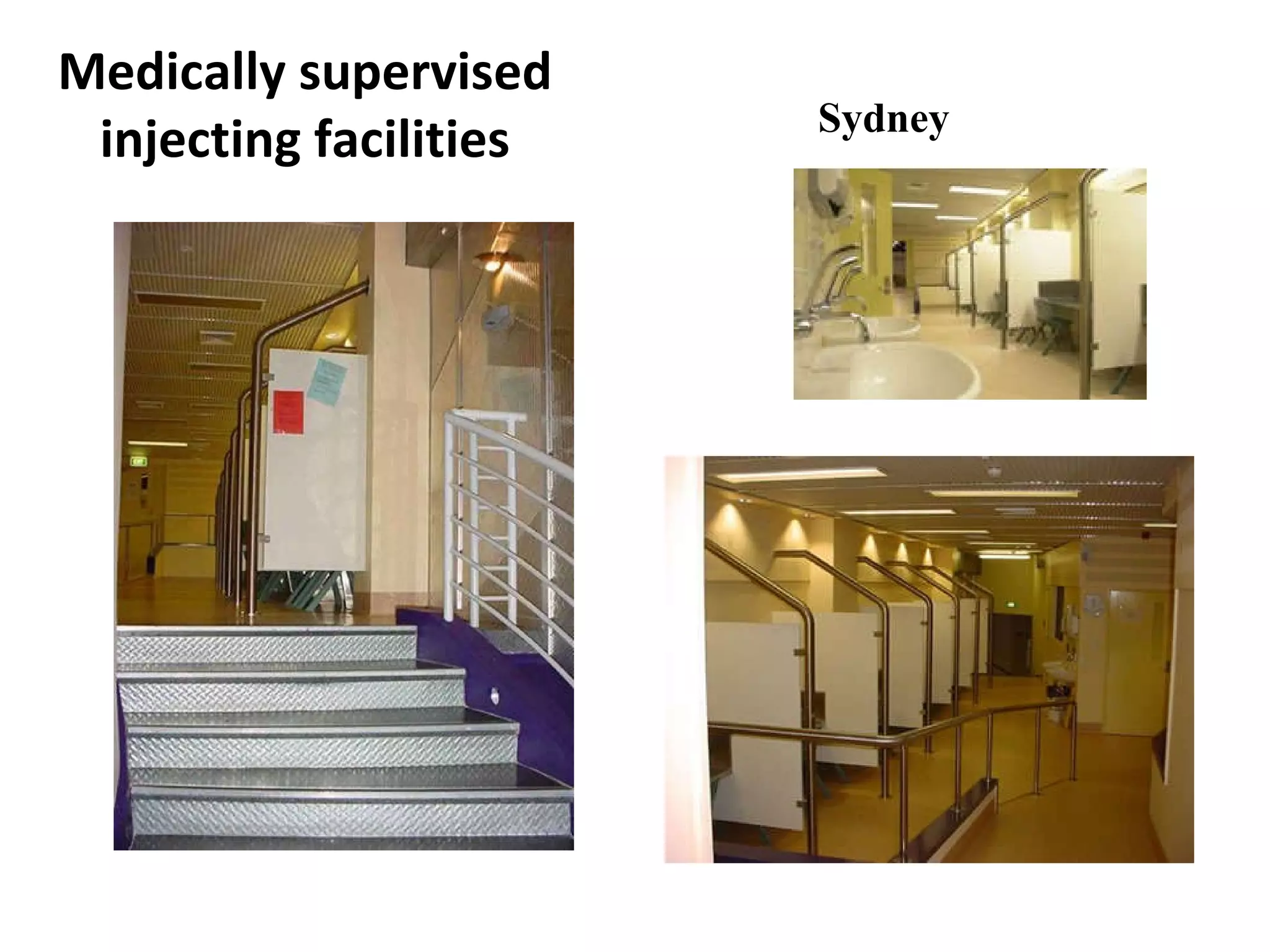
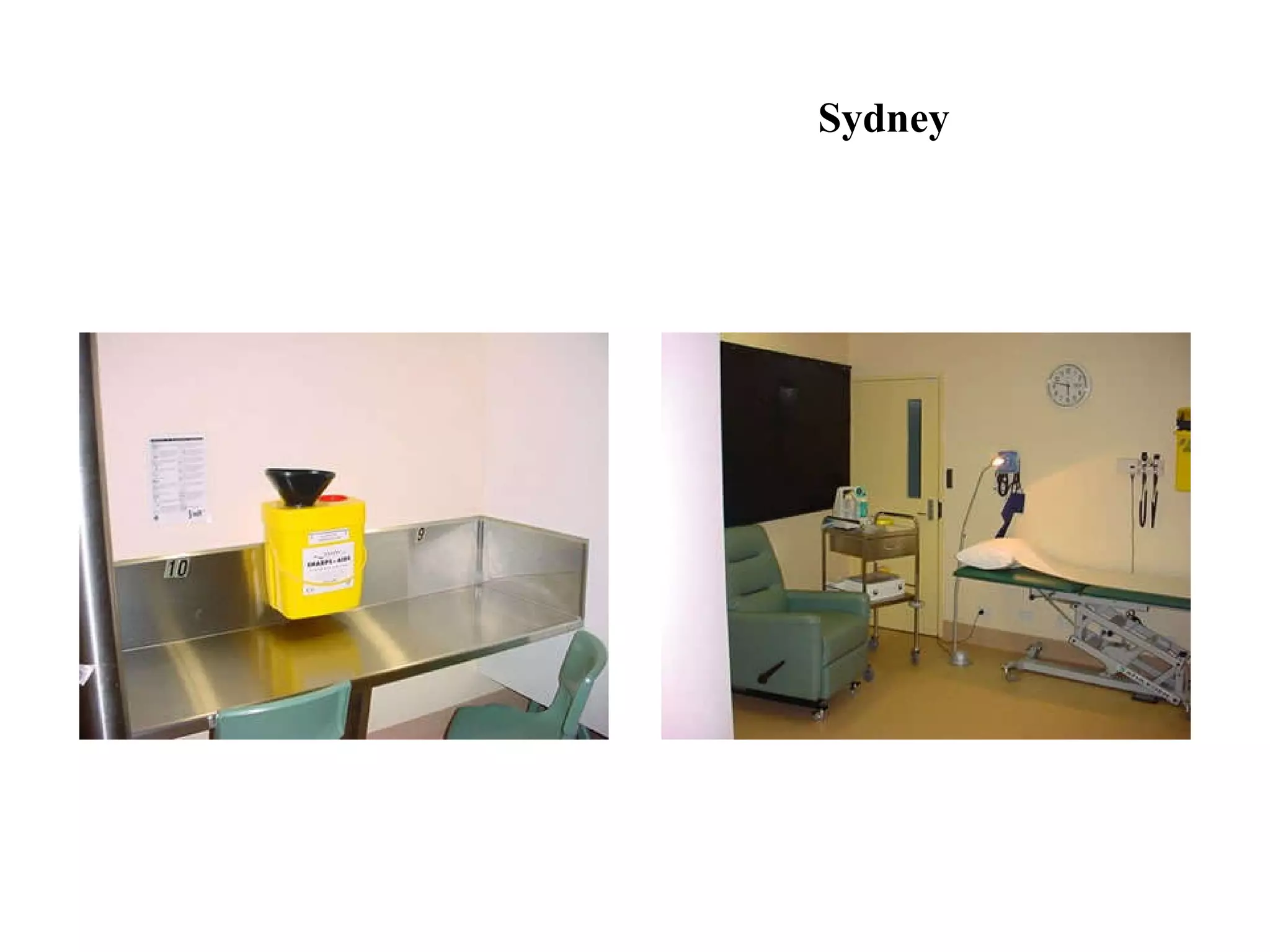
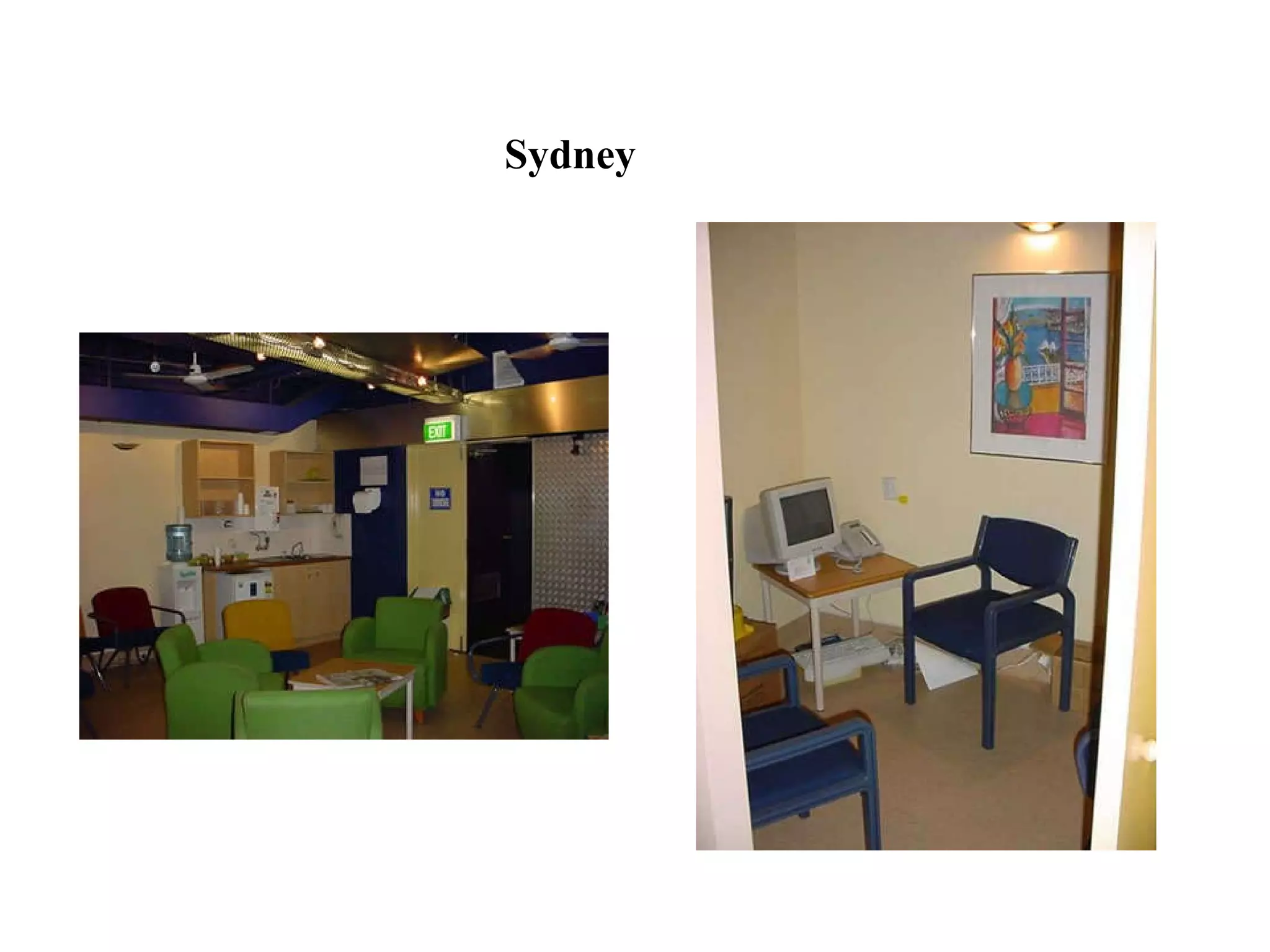
Sydney  Medically supervised injecting facilities
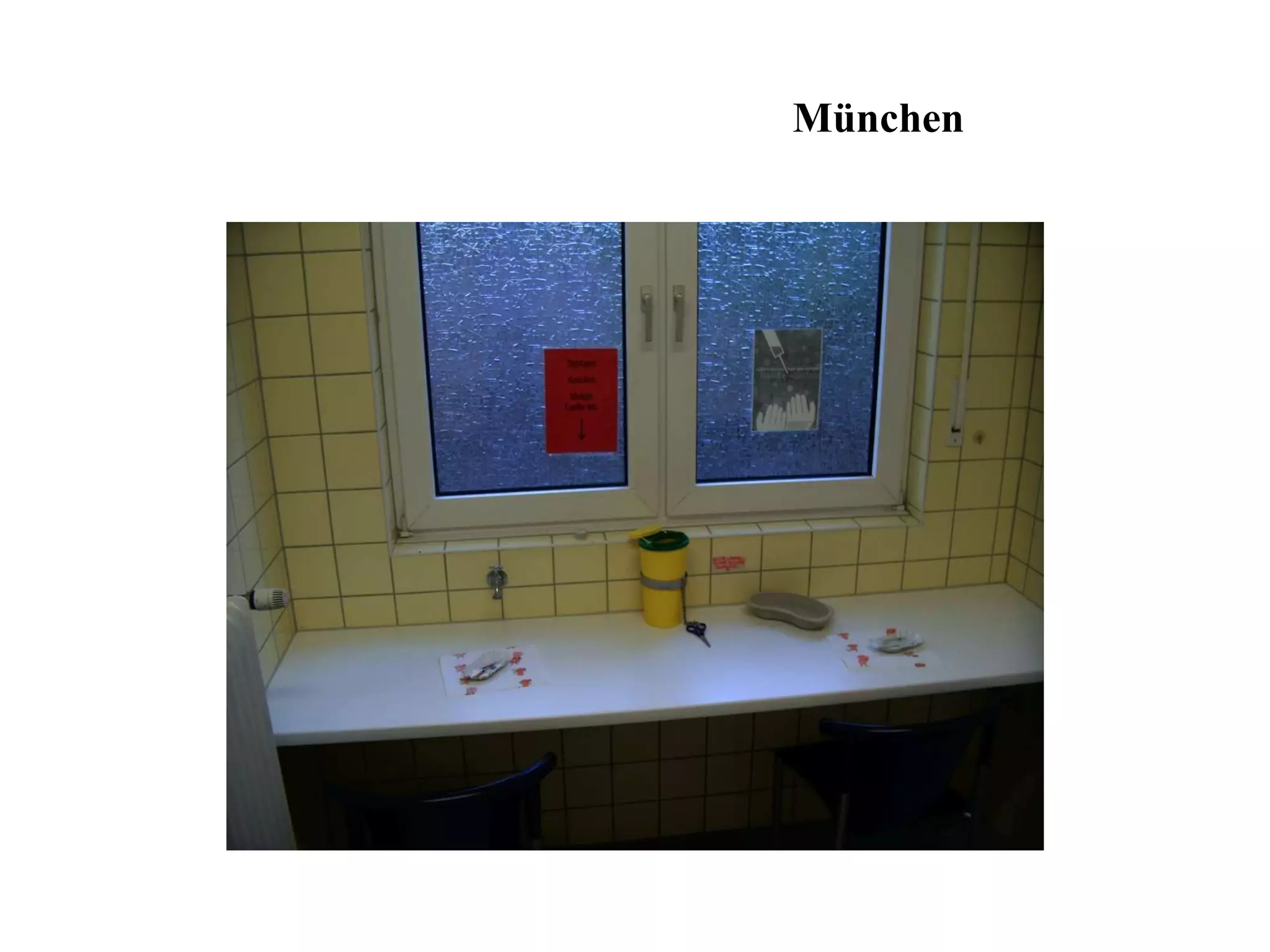
München
Sydney
Sydney
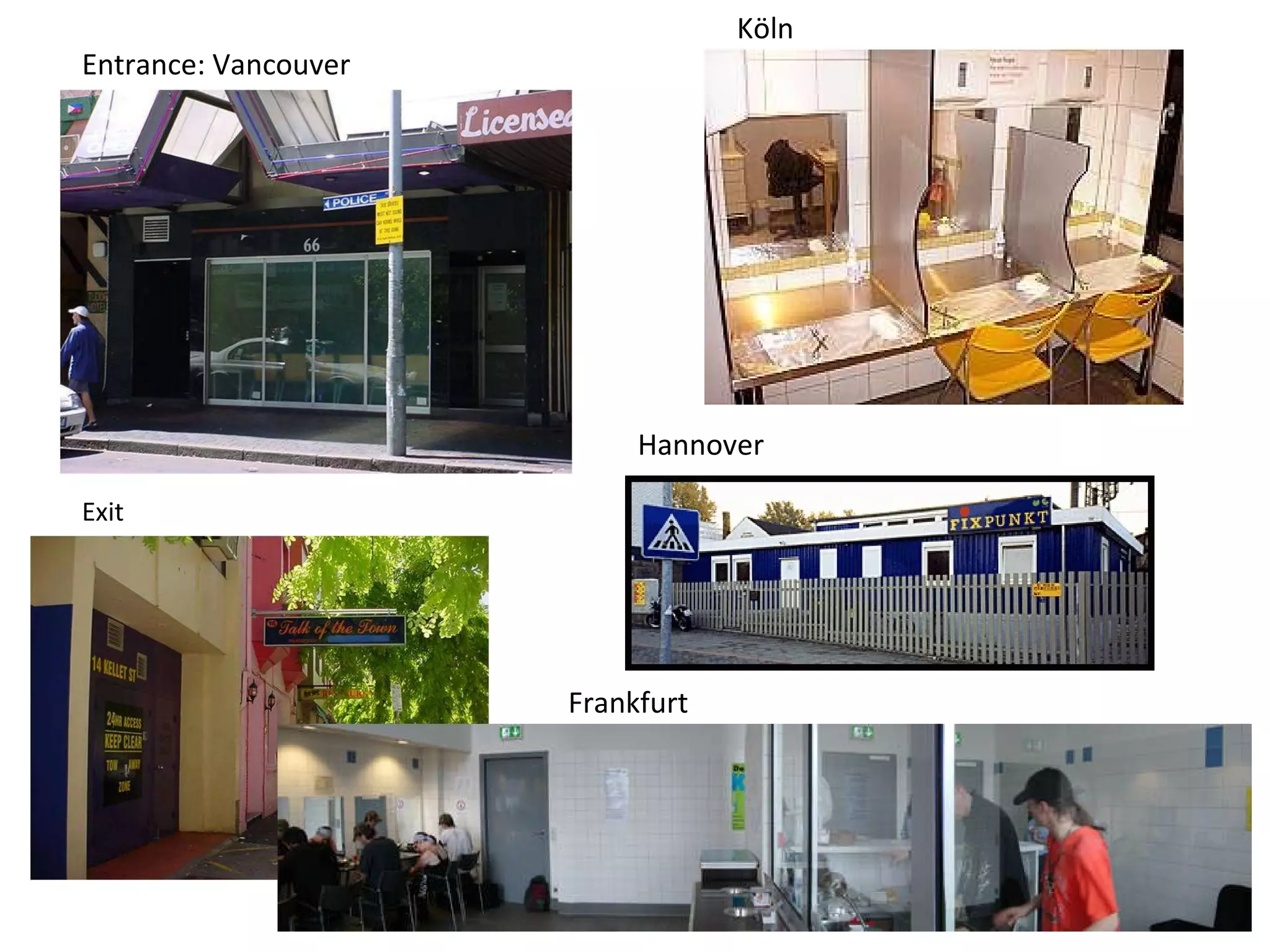
Entrance: Vancouver Exit Köln Hannover Frankfurt
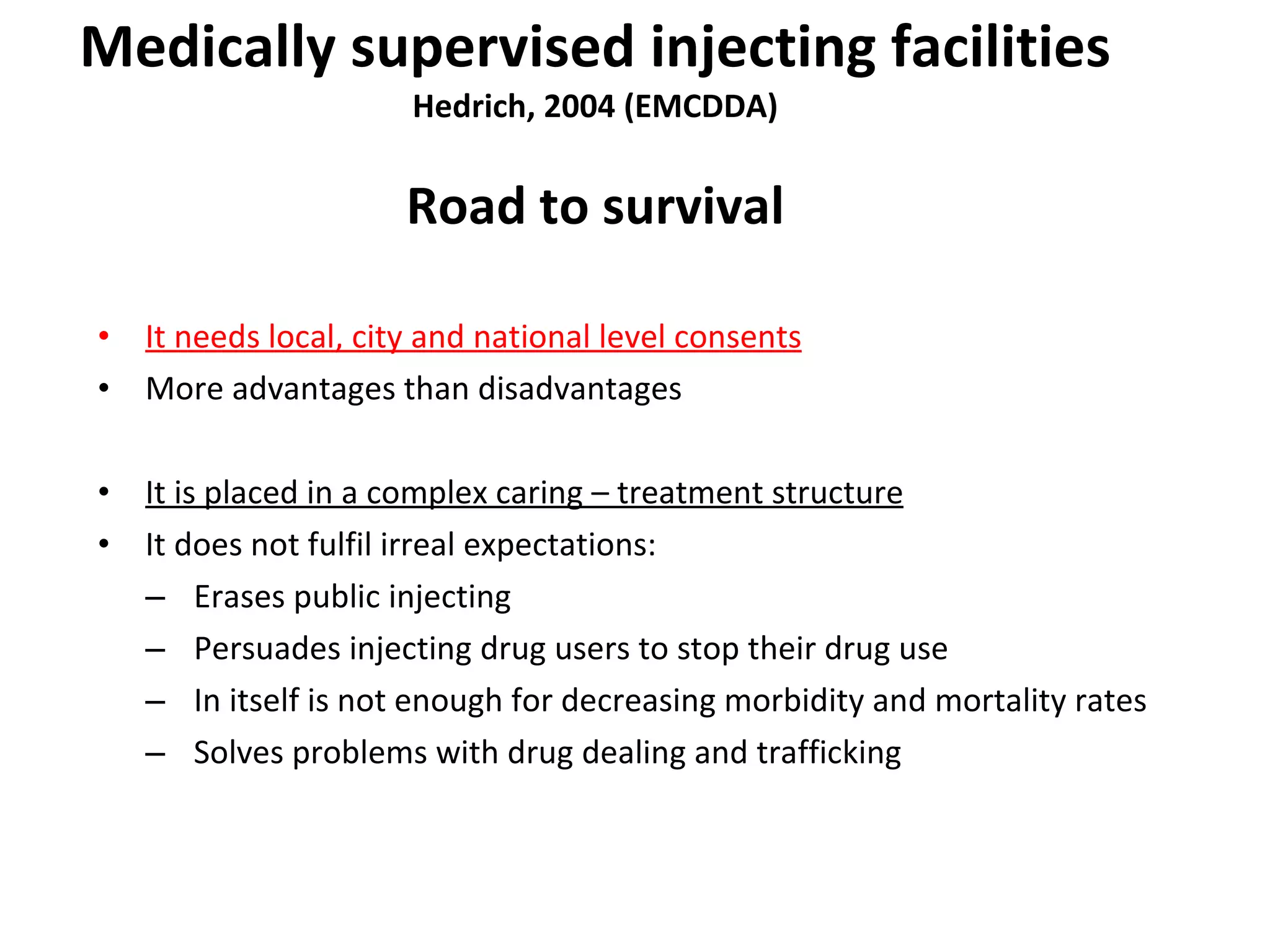
Medically supervised injecting facilities Hedrich, 2004 (EMCDDA) Road to survival It needs local, city and national level consents More advantages than disadvantages It is placed in a complex caring – treatment structure It does not fulfil irreal expectations: Erases public injecting Persuades injecting drug users to stop their drug use In itself is not enough for decreasing morbidity and mortality rates Solves problems with drug dealing and trafficking
Some experiences from a large scale Australian study on needle exchanges – 2000 - 2009
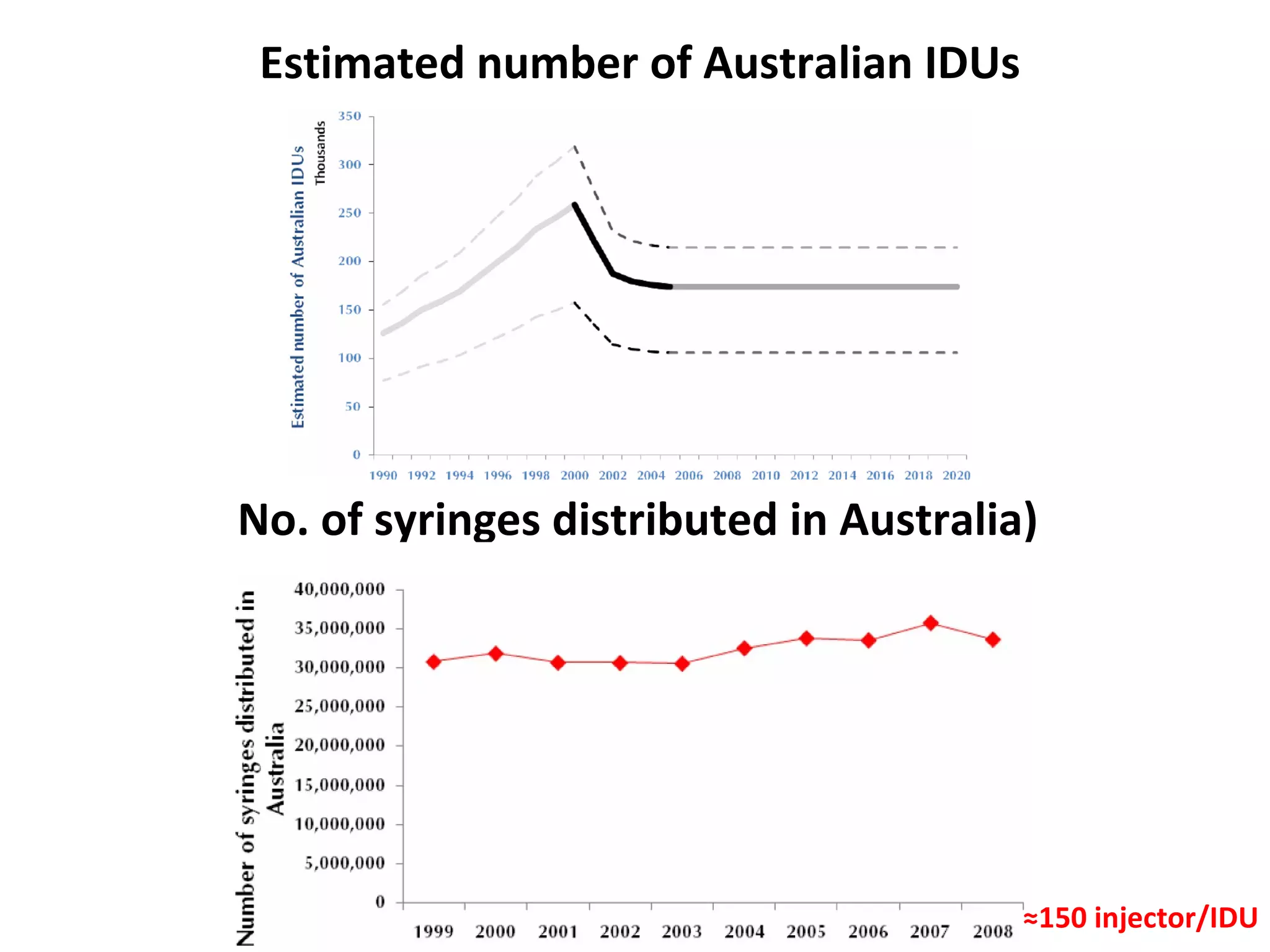
Estimated number of Australian IDUs No. of syringes distributed in Australia) ≈ 150 injector/IDU
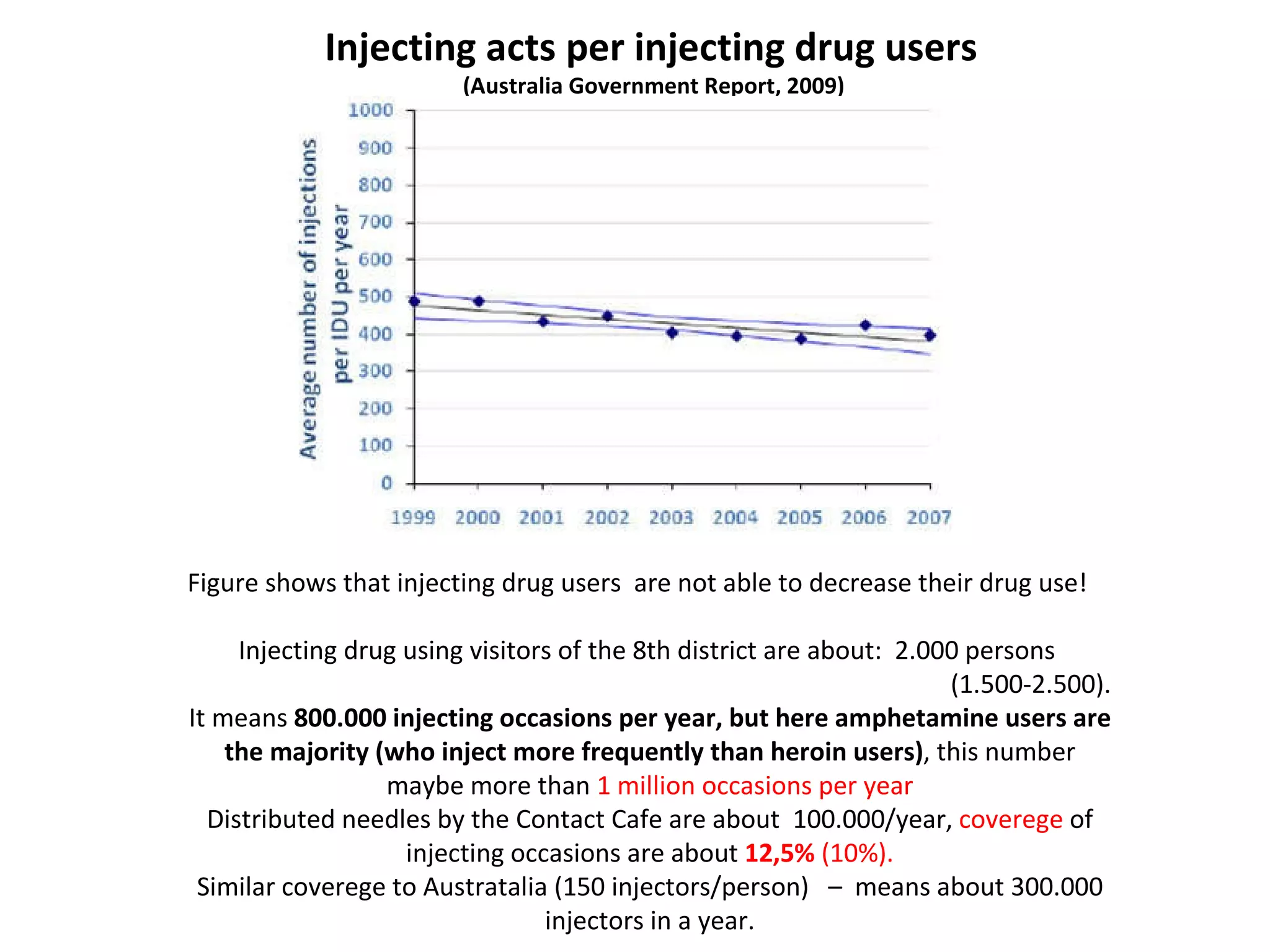
Injecting acts per injecting drug users (Australia Government Report, 2009) Figure shows that injecting drug users  are not able to decrease their drug use! Injecting drug using visitors of the 8th district are about:  2.000 persons  (1.500-2.500).  It means  800.000 injecting occasions per year, but here amphetamine users are the majority (who inject more frequently than heroin users) , this number maybe more than  1 million occasions per year Distributed needles by the Contact Cafe are about  100.000/year,  coverege  of injecting occasions are about   12,5%  (10%). Similar coverege to Austratalia (150 injectors/person)  –  means about 300.000 injectors in a year.
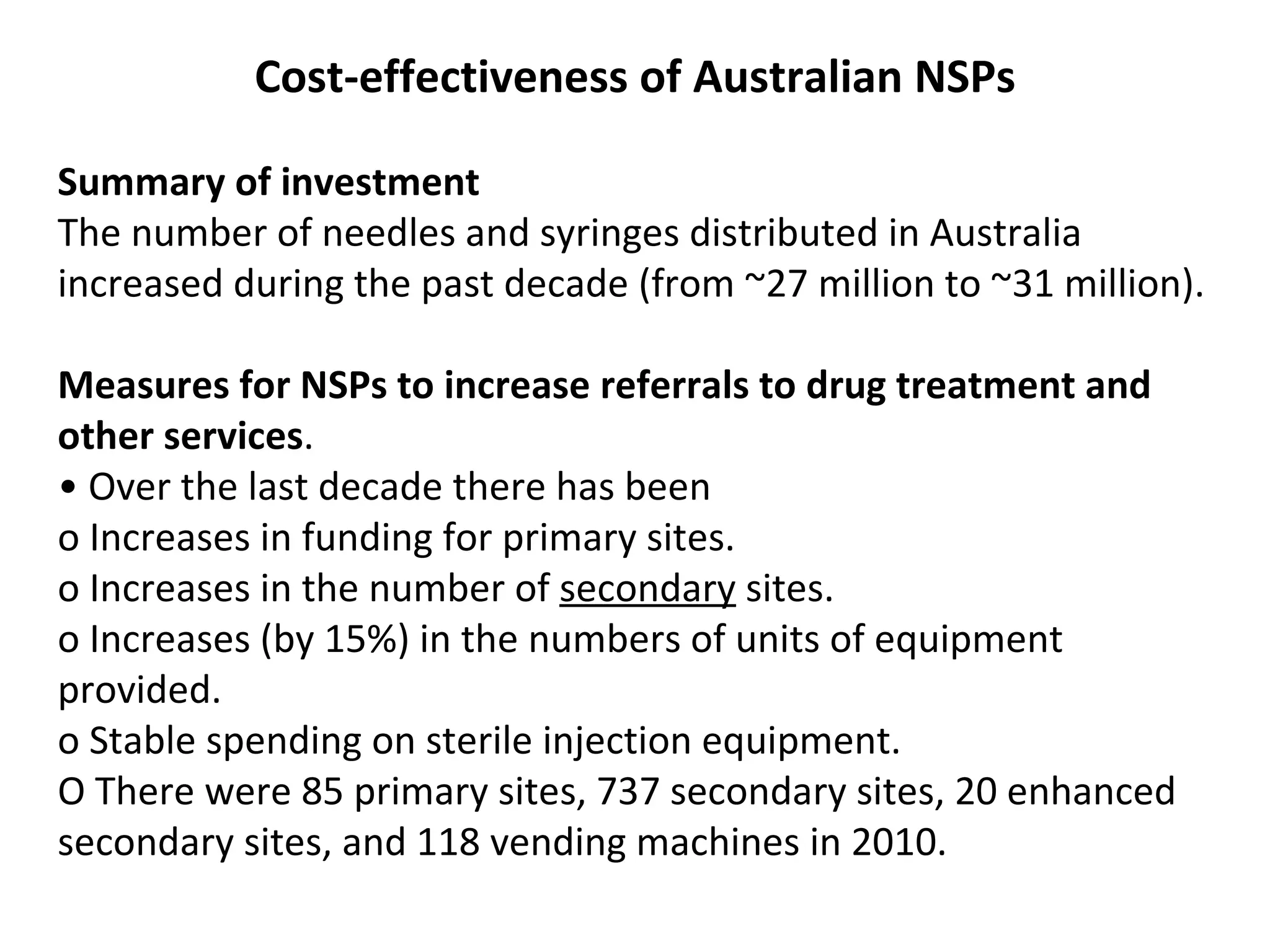
Cost-effectiveness of Australian NSPs Summary of investment The number of needles and syringes distributed in Australia increased during the past   decade (from ~27 million to ~31 million). Measures for NSPs to increase referrals to drug treatment and other services . •  Over the last decade there has been o Increases in funding for primary sites. o Increases in the number of  secondary  sites. o Increases (by 15%) in the numbers of units of equipment provided. o Stable spending on sterile injection equipment. O  T here were 85 primary sites, 737 secondary sites, 20   enhanced secondary sites, and 118 vending machines  in 2010.
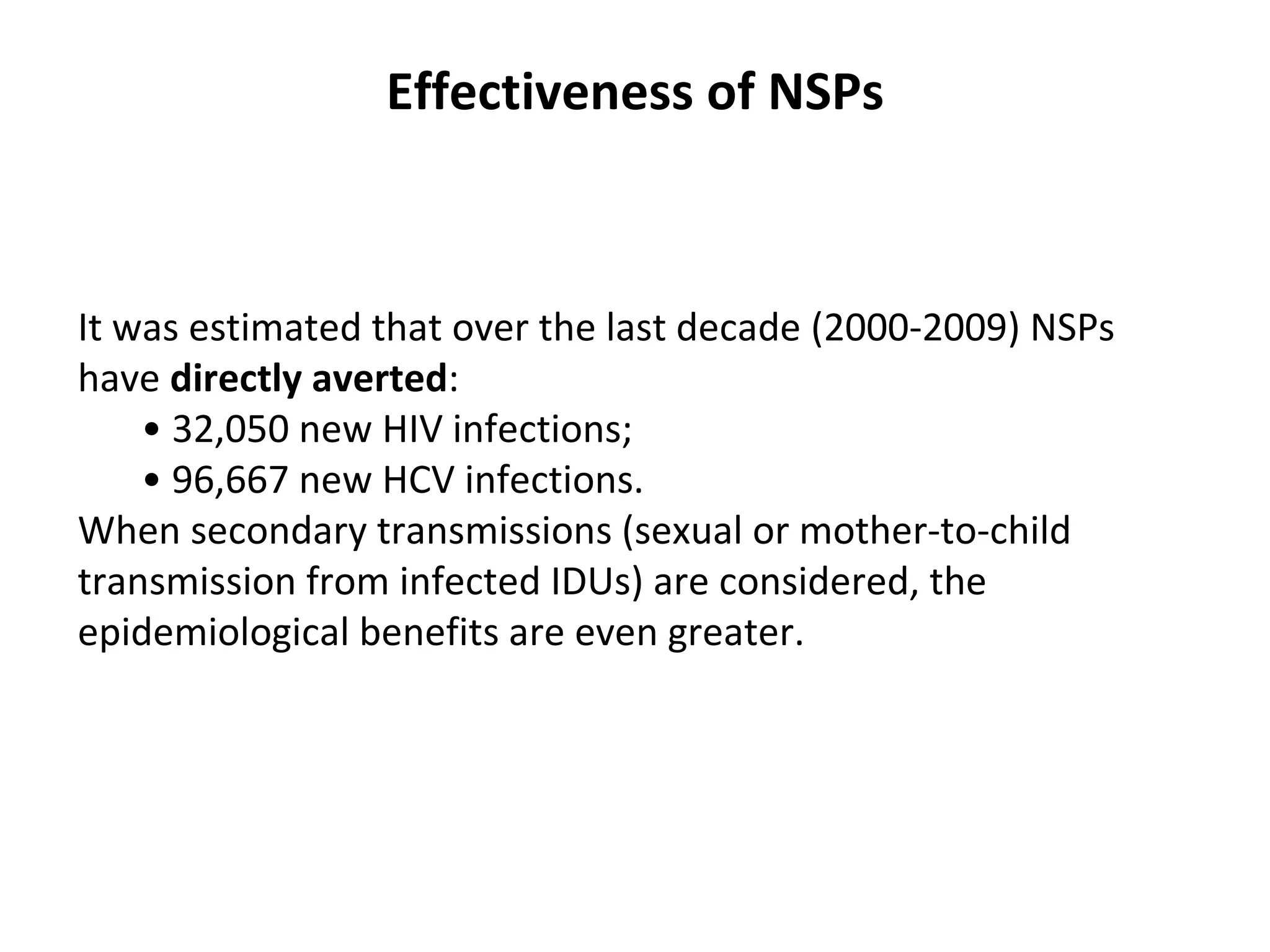
Effectiveness of NSPs It was estimated that over the last decade (2000-2009) NSPs have  directly averted : •  32,050 new HIV infections; •  96,667 new HCV infections. When   secondary transmissions (sexual or mother-to-child transmission from infected IDUs) are   considered, the epidemiological benefits are even greater.
Economic analysis of NSPs during 2000 - 2009 During 2000-2009, gross funding for NSP services was $243m. This investment yielded: •  Healthcare costs saved of $1.28 billion. •  Approximately 140,000 DALYs gained. •  Net financial cost-saving of $1.03 billion. It was estimated that : •  For every one dollar  invested in NSPs,  more than four dollars were returned in  healthcare cost-savings  in the short-term (ten years)   if only direct costs are included; greater returns are expected over longer time  horizons. •  The majority of the cost savings were found to be associated with  HCV-related outcomes . However, when only HIV-related outcomes were considered in the analysis, it cost $4,500 per DALY gained associated with HIV infection. •  If patient/client  costs and productivity gains and losses are included  in the analysis, then the net present value of NSPs is $5.85bn; that is, for  every one dollar  invested in NSPs (2000-2009),  $27 is returned in cost savings . This return increases  c onsiderably   over a longer time horizon. •  NSPs are very cost-effective compared to other common public health interventions . DALY: disability-adjusted life year
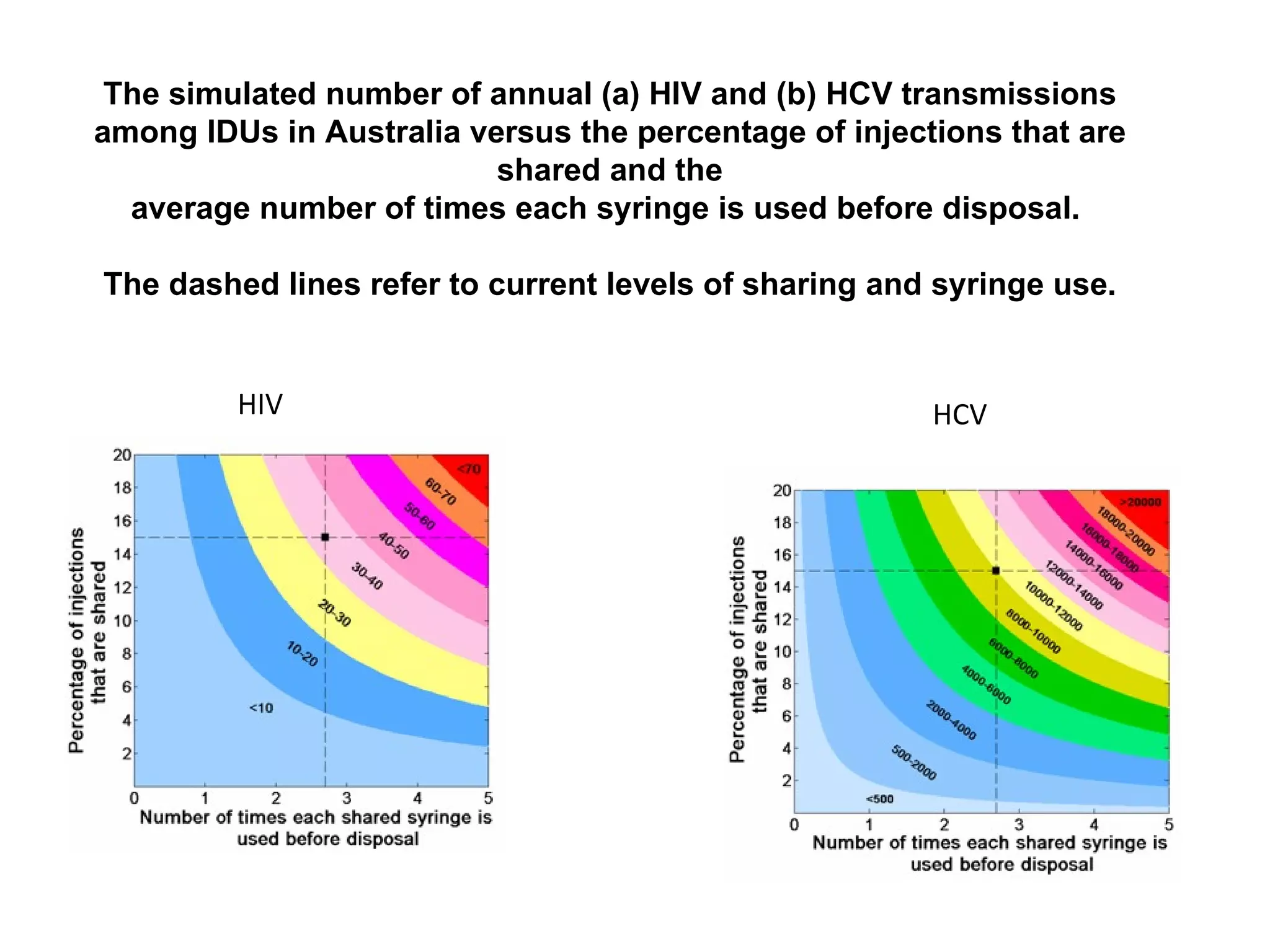
The simulated number of annual (a) HIV and (b) HCV transmissions among IDUs in Australia versus the percentage of injections that are shared and the average number of times each syringe is used before disposal.  The dashed lines refer to   current levels of sharing and syringe use. HIV HCV
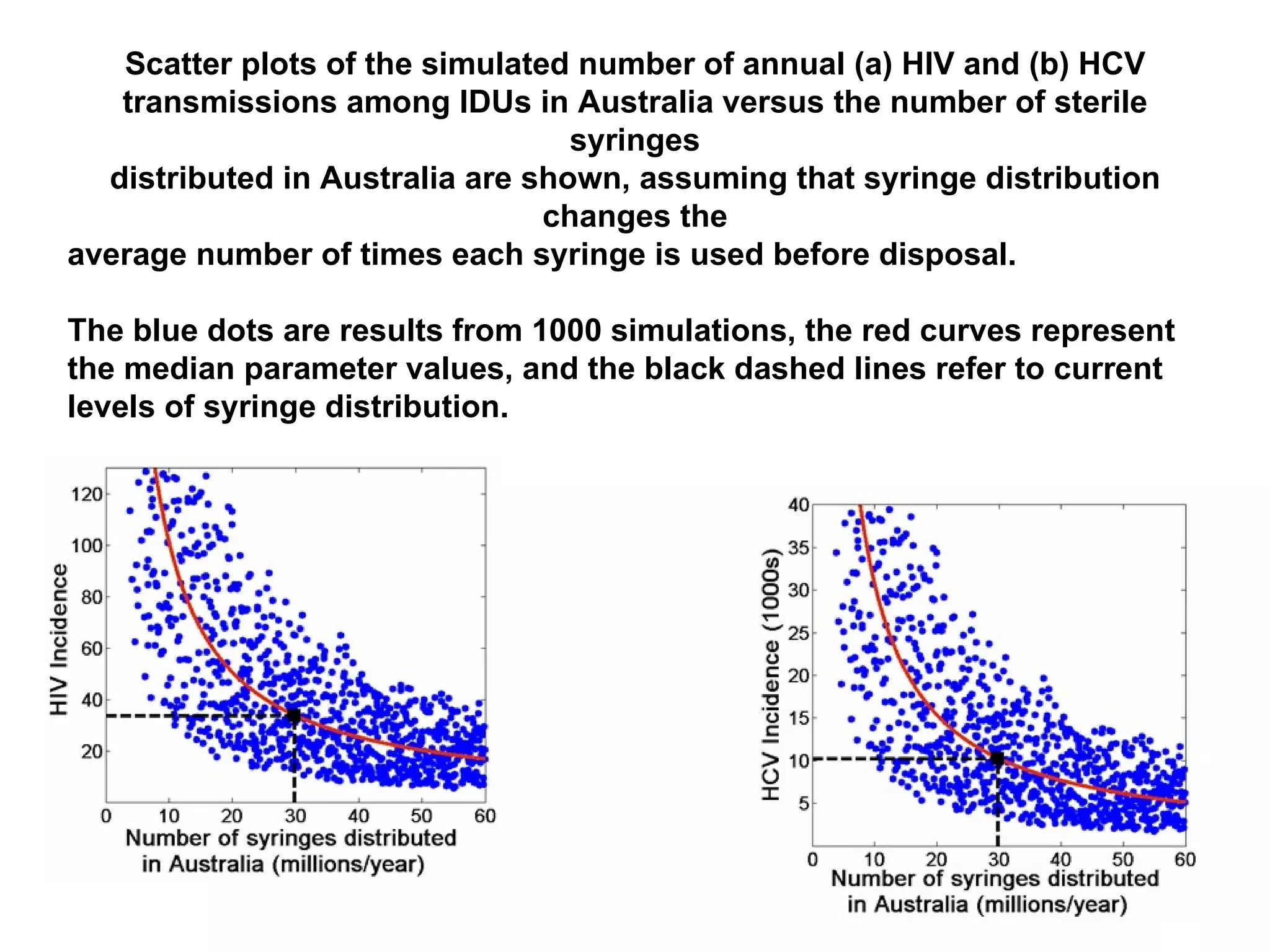
Scatter plots of the simulated number of annual (a) HIV and (b) HCV transmissions among IDUs in Australia versus the number of sterile syringes distributed in Australia are shown, assuming that syringe distribution changes the average number of times each syringe is used before disposal.  The blue dots are results   from 1000 simulations, the red curves represent the median parameter values, and the   black dashed lines refer to current levels of syringe distribution.
Thank you for your attention! [email_address]

Public injecting, harm reduction services

  • 1.
    Public injecting druguse and the local harm reduction services József Rácz
  • 2.
    Public injecting BluePoint Drug Counselling and Outpatient Centre: Contact Cafe 8th district of Budapest Injecting and sexual risk behaviours Local harm reduction services Risks of injecting: HIV, HCV Data on needle exchange Characteristics of the clientele Harm reduction methods Summary of a large scale study on needle exchange (Australia, 2009)
  • 3.
    Public injecting scenesand shooting galleries
  • 4.
    „ Hurry up”,„rushed” injecting : sharing, neglecting safer injecting, discarded needles, more difficult access to needle exchange services Searching clothes (jack-ups): needles’ legal status Greater use of ‘ discretion ’ on the part of police has also been recommended as a measure that may ensure that enforcement operations do not interfere with public health efforts – agreement between needle exchange services and police: this is not legal, but the police follows the recommendations (Hungary) Drug market enforcement approaches interact with and transform various practices and social dynamics in the broader risk environment of IDU, and thereby constitute a potent source of harm within drug markets Street-level drug problems will appear elsewhere when the police crack down the public drug scene Role of the police Kerr et al., 2005; Small et al., 2006 More illegal drug use More illegal drug using populations More difficult access to services New strategy maintaining public order and public health goals
  • 5.
    Blue Point DrugCounselling and Outpatient Centre
  • 6.
    8th district ofBudapest with the placement of needle exchange program of Blue Point: the Contact Cafe
  • 7.
  • 8.
    The VIII. districtof Budapest faces a number of difficulties. This is an area where there are multiple social, health, livelihood, community, etc.. problems. The drug and social problems are much higher compared to other districts. The legal and illegal drugs and the presence of a large number of consumers in a very open drugscene requires various and several care providers at different levels to be present. In particular, there are many addicts living in the district who are suspicious of institutional care , which is a high-threshold care service. The legal and illegal drug use associated with poor living conditions and low social status seriously increases the risk of spreading diseases. The clients with health problems often do not turn to a doctor or do not ask for care and treatment. Cultrual diversity – including Roma culture - is one of the characteristics of the disctrict. There are large differences of inhabitants concerning ethnicity, nationality, education and housing, and social status and health. (The „Integrated Rehabilitation Strategy for Urban Development” of the capital places an emphasis on refurbishing the district, but this is impossible without dealing with social problems.) The well-defined part of the disctict’s inhabitants are living in poor conditions, bad housing, has poor health culture, poor mental status and is low skilled and unemployed. The socio-cultural background
  • 9.
    Dezső Tamás’s photosFeeling of the 8th district
  • 10.
  • 11.
    social worker withvisibility coat Drug litter
  • 12.
  • 13.
  • 14.
  • 15.
  • 16.
  • 17.
  • 18.
    Shooting gallery Type2 Csoki 36 ys old, heroin dependent. His wife, Zita 35 ys old, heroin dependent. Their son, Csabika 17 ys old, heroin dependent. „ At the deepnest of drug world ” Baptis Charity „Street Front”, Marcell Miletics, Miklós Barcs, Péter Borbély
  • 19.
  • 20.
  • 21.
    Routes of transmittinginfections Defining the points of harm reduction interventions: See -s! Most difficult interventions
  • 22.
    Common needle useSharing : Needles/Syringes Filter Cooking Water Needles for preparation of drug solution Direct sharing Indirect sharing Same syringes Backloading Frontloading
  • 23.
    Activities at needleexchange program Harm reduction goals R eaching out „hidden” injecting drug users: oureach and street work P revention of infections, especially: HIV HCV - injecting equipments/paraphernalia! Other communicable diseases Only contact with helping services: low threshold service – only contact with majority society: ponts of treatment contacts/admissions Needle exchange, outreach and street work + collecting syringes Providing information, education, counselling Testing or referral to testing Sexual risk behaviours – prevention (condoms) First aid, referral to medical treatment Referrals to other cares (health or social care) Clients involvement – empowerment Rehabilitation and reintegration Activities: 4-8 p.m., 6x a week
  • 24.
    Collecting dirty needlesMost important for the local community & for the local self-government
  • 25.
    Special programs atneedle exchange (Contact Cafe) Ladys’ Night: clients as well as helpers are women: once a week Traumatization PTSD Sex workers Sexual problems Cooperation with „Sober Babies” Association For pregnant injecting drug using women For mothers with babies Decreasing the digital edge Computer literacy + social network site use
  • 26.
  • 27.
  • 28.
  • 29.
    Roma culture onYouTube (videos watched by our clients)
  • 30.
    Legal open sceneSwiss „needle parks: 1980s-1990s: failure – re-designing of the Swiss drug policy Incidence of regular heroin users (Nordt és Stohler, 2006) Results: New heroin users referred to treatment in two ys. 4% yearly decrease in the number of problem heroin users. Needle Park in Zürich, 1992
  • 31.
  • 32.
    The ranges aroundthe estimates in this table define the boundaries within which the actual numbers lie, based on the best available information. Regional HIV and AIDS statistics and features  2009 TOTAL 33.3 million [31.4 million – 35.3 million] 2.6 million [2.3 million – 2.8 million] Adults and children newly infected with HIV Adults and children living with HIV Sub-Saharan Africa Middle East and North Africa South and South-East Asia East Asia Central and South America Caribbean Eastern Europe and Central Asia Western and Central Europe North America Oceania 22.5 million [20.9 million – 24.2 million] 4.1 million [3.7 million – 4.6 million] 1.4 million [1.2 million – 1.6 million] 1.4 million [1.3 million – 1.6 million] 1.5 million [1.2 million – 2.0 million] 1.8 million [1.6 million – 2.0 million] 270 000 [240 000 – 320 000] 92 000 [70 000 – 120 000] 130 000 [110 000 – 160 000] 70 000 [44 000 – 130 000] 460 000 [400 000 – 530 000] 770 000 [560 000 – 1.0 million] 240 000 [220 000 – 270 000] 820 000 [720 000 – 910 000] 57 000 [50 000 – 64 000] 75 000 [61 000 – 92 000] 82 000 [48 000 – 140 000] 17 000 [13 000 – 21 000] 31 000 [23 000 – 40 000] 4500 [3400 – 6000] 1.8 million [1.6 million – 2.1 million] Adult & child deaths due to AIDS 1.3 million [1.1 million – 1.5 million] 260 000 [230 000 – 300 000] 58 000 [43 000 – 70 000] 76 000 [60 000 – 95 000] 26 000 [22 000 – 44 000] 24 000 [20 000 – 27 000] 36 000 [25 000 – 50 000] 12 000 [8500 – 15 000] 8500 [6800 – 19 000] 1400 [<1000 – 2400] 0.8% [0.7% - 0.8%] Adult prevalence (15‒49) [%] 5.0% [4.7% – 5.2%] 0.3% [0.3% – 0.3%] 0.5% [0.4% – 0.6%] 0.8% [0.7% – 0.9%] 0.5% [0.4% – 0.7%] 0.2% [0.2% – 0.3%] 0.1% [0.1% – 0.1%] 1.0% [0.9% – 1.1%] 0.2% [0.2% – 0.2%] 0.3% [0.2% – 0.3%]
  • 33.
    12/06 eProportions of HIV infections in different population groups by region, 2005 IDU: Injecting Drug Users MSM: Men having sex with men CSW: Commercial Sex Workers Latin America MSM 26% IDU 19% CSW 4% All others 38% South and South-East Asia* CSW clients 13% Eastern Europe and Central Asia MSM 4% IDU 67% CSW 5% All others 17% CSW clients 7% * India was omitted from this analysis because the scale of its HIV epidemic (which is largely heterosexual) masks the extent to which other at-risk populations feature in the region’s epidemics. MSM 5% IDU 22% CSW 8% All others 24% CSW clients 41% Figure 2
  • 34.
    Estimated occurance ofinjecting drug use per 1000 inhabitants, in the 15-64 ys groups (EMCDDA, 2009) Contact Cafe 32
  • 35.
    Risks: The silentepidemic Sitting on a bomb…
  • 36.
    Hepatitis C infectionsin the European Union, 1995-2005 (Rantala és van de Laar, 2008)
  • 37.
    HCV prevalences amonginjecting drug users (regional and national data), 2006-2007 (EMCDDA, 2009) *: data from Contact Cafe
  • 38.
    Source: OEK, 2007,2008, 2009 HIV, HCV testing – HIV: 0%
  • 39.
    MedlinePlus The isno spontaneous recovery, just only because of treatment. At-risk group Acute infection (100%) Recovered (15-30%) Chronic, carrying the virus 55-85% 70 persons: chronic hepa tic ill ness 5-20 persons : cirrhosis - 20-30 ys – no symptoms 1-5 persons : death (cirrhosis, hepatocellular carcinoma ) The Hepatitis C epidemic (EMCDDA, 2007) Why it is „silent”!
  • 40.
    Treated HCV infectedpatients after HCV testing (Gazdag és Szabó, 2007) Cost of treatment of HCV infection : Treatment (1 year): 3,5 - 4m HUF Total life span: 3,5 - 7m HUF
  • 41.
  • 42.
    Data on needleexchange program
  • 43.
    Data Clients Visits(one client may have more visits) Needle: delivered & taken back
  • 44.
    January 09 January Febr March April May June July August Sept. Oct. Nov. Dec Registered clients in 2010 (from January to December
  • 45.
    New clienst (per half a year) 2006 2nd halfyear 2010 2nd halfyear Active and inactive clients (total clients: 100%) * visited the NEP at least once in 2010 N % Active clients* 1047 50.7 Inactive clients 1019 49.3 sum 2066 100.0
  • 46.
    Gender distribution ina certain year (%) Male Female Age of registered clients <19 20-24 25-29 30-34 35-39 40+ys male female Total
  • 47.
    abstinent other Druguse among registered clients Place of residency Inactive clients (%) Active clients (%) 7th district 3.2% 4.7% 8th district 54.0% 55.5% 9th district 9.9% 10.5% 10th district 4.5% 6.2% „ distant clients” 28.4% 23.1% Sum 100.0% 100.0%
  • 48.
    Place of residency} 7+ 8+ 9 district = 72,6% Important for the local self-government District N % 1. 2 ,2 2. 1 ,1 3. 15 1,4 4. 5 ,5 5. 7 ,7 6. 18 1,7 7. 41 3,9 8. 604 57,9 9. 113 10,8 10. 47 4,5 11. 22 2,1 12. 6 ,6 13. 53 5,1 14. 23 2,2 15. 9 ,9 16. 6 ,6 17. 3 ,3 18. 3 ,3 19. 14 1,3 20. 14 1,3 21. 5 ,5 22. 2 ,2 23. 4 ,4 Non Bp. 27 2,6 Sum 1044 100,0
  • 49.
    Clients’ visits permonth January 2009 – July 2010 Febr. March
  • 50.
    Delivered injectors in2010 Injectors taken back in 2010 Clients’ visits per day Febr. March older clients return syringes in 45 % of cases, while the proportion of returning the used syringes in case of new clients is only 22 %
  • 51.
    Typical client: Fromthe 8th district Late 20s Male Amphetamine user Socially excluded Wrong employment position, criminality Defined themselves as Roma
  • 52.
    Main characteristics ofthe 8th district scene Many IDUs in a small territory: close community 2. Public injecting + shooting galleries (Type 1+2) + „drug litter” 3. High HCV infection prevalence, high risk behaviours prevalences injecting: common or shared injection equipment use sexual: without condoms, IDU sex partners, IDU sex workers 4. Difficult access to treatment visible! 1. addiction treatment 2. HCV treatment 3. other (primary care, gyneacologist)
  • 53.
    Local community affectedFear from injecting drug users Public nuisances Discarded needles at playgrounds as well Street drug dealing Crime for drugs Children as witness of injecting „ Solutions ” Abstinence-oriented treatment Methadone maintenance Police presence Needle exchang e Local survey N=150
  • 54.
    What does theneedle exchange program do: some examples?
  • 55.
  • 56.
  • 57.
  • 58.
    More use –syringe deformities Gyarmathy et al., 2009 Mean volume of fluid retained in two types of syringes
  • 59.
  • 60.
    Needle + paraphernalia exchange
  • 61.
    Condoms and sexualcounselling
  • 62.
    Needle exchange inthe EU Country Region Number syringes 2005 Number syringes 2006 Belgium Flemish community 390 522 538 783 Belgium French community 261 182 246 519 Bulgaria National (1) (6) 600 000 210 464 Czech Republic National (2) 3 274 000 3 868 880 Denmark National (3) 910 000 Germany National Estonia National 867 600 1 615 270 Ireland National Greece National 29 782 34 809 Spain National 3 184 845 France National Italy National Cyprus National 0 0 Latvia National 123 895 Lithuania National 258 650 196 952 Luxembourg National 406 451 332 347 Hungary National 85 127 142 433 Malta National 220 211 225 716 Netherlands Regional (9) 440 000 380 000 Austria Regional (7) 1 811 962 2 082 840 Poland National (10) 372 000 318 155 Portugal National (8) 2 845 031 2 591 150 Romania (4) 1 038 000 300 000 Slovakia Regional (13) 362 055 384 293 Finland National (11) 1 891 903 2 400 000 Sweden National 117 894 United Kingdom England and Wales 27.000.000 (2002) United Kingdom Northern Ireland (12) 85 801 97 684 Croatia 135 981 Turkey 0 0 Norway National (5) 3 300 000
  • 63.
    A dequate syringecoverage : as many syringes from the SEP as their self reported injections in the last 30 days. SEPs were classified based on their syringe dispensation policy : unlimited needs-based distribution; unlimited one-for-one exchange plus a few additional syringes; per visit limited one-for-one plus a few additional syringes; Blue Point +5 unlimited one-for-one exchange; per visit limited one-for-one exchange. Findings : unlimited needs-based distribution = 61%; unlimited one-for-one plus = 50%; l imited one-for-one plus = 41%; unlimited one-for-one = 42%; limited one-for-one = 26%. In multivariate analysis, adequate syringe coverage was significantly higher for all dispensation policies compared to per visit limited one-for - one exchange. Conclusion : Providing less restrictive syringe dispensation is associated with increased prevalence of adequate syringe coverage among clients. Syringe dispensation policy Bluthental et al., 2006
  • 64.
    Drug use amongneedle exchange clients and their friends (≠ clients) Márványkövi, Melles, Légmán and Rácz, 2008 Drug use – last 30 days (%) 57,1 61,4 17,1 51,4 12,9 40,0 40,0 82,9 5,7 54,3 21,4 24,3 48,6 72,1 11,4 52,9 17,1 32,1 0 10 20 30 40 50 60 70 80 90 heroin amphet amine non-presc. methadone marijuana ecstasy sedatives non roma drug user roma drug user total
  • 65.
    Márványkövi, Melles, Légmánés Rácz, 2008 Injecting risk behaviours (≠ clients) * p < 0,05 paraphernalia last 30 days paraphernalia lifetime needles last 30 days needles lifetime total 52% 75% 9% 56% roma idu 60%* 80% 11,4%* 51,4% non-roma idu 44%* 70% 7,1%* 60%
  • 66.
    1: easy access………………………5:very difficult access Márványkövi, Melles, Légmán és Rácz, 2008 Márványkövi, Melles és Rácz, 2006 Perceived access to different treatments Mean N Sd Outpatient 1,98 49 1,31 Methadone maintenance 4,28 50 1,33 Daily clinic 1,50 28 1,04 Inpatient 2,39 49 1,50 Residential (TC) 3,03 39 1,50
  • 67.
    Public health measures(Gyarmathy and Rácz, 2010 ) HCV as a HIV marker: at 30-35% HCV infection rate (Vickerman) Substitution (methadone, buprenorphine, buprenorphine/naloxone=Suboxone) Access to sterile needles (needle exchange, pharmacists) HIV, HCV testing + counselling Medically supervised injecting Blue Point services Substitutions : no funding Needle exchange : problem of long-term funding HIV, HCV testing + counselling : cooperation with the National Centre for Epidemiology Supervised injection : against the law From the literature :
  • 68.
    Sydney Medicallysupervised injecting facilities
  • 69.
  • 70.
  • 71.
  • 72.
    Entrance: Vancouver ExitKöln Hannover Frankfurt
  • 73.
    Medically supervised injectingfacilities Hedrich, 2004 (EMCDDA) Road to survival It needs local, city and national level consents More advantages than disadvantages It is placed in a complex caring – treatment structure It does not fulfil irreal expectations: Erases public injecting Persuades injecting drug users to stop their drug use In itself is not enough for decreasing morbidity and mortality rates Solves problems with drug dealing and trafficking
  • 74.
    Some experiences froma large scale Australian study on needle exchanges – 2000 - 2009
  • 75.
    Estimated number ofAustralian IDUs No. of syringes distributed in Australia) ≈ 150 injector/IDU
  • 76.
    Injecting acts perinjecting drug users (Australia Government Report, 2009) Figure shows that injecting drug users are not able to decrease their drug use! Injecting drug using visitors of the 8th district are about: 2.000 persons (1.500-2.500). It means 800.000 injecting occasions per year, but here amphetamine users are the majority (who inject more frequently than heroin users) , this number maybe more than 1 million occasions per year Distributed needles by the Contact Cafe are about 100.000/year, coverege of injecting occasions are about 12,5% (10%). Similar coverege to Austratalia (150 injectors/person) – means about 300.000 injectors in a year.
  • 77.
    Cost-effectiveness of AustralianNSPs Summary of investment The number of needles and syringes distributed in Australia increased during the past decade (from ~27 million to ~31 million). Measures for NSPs to increase referrals to drug treatment and other services . • Over the last decade there has been o Increases in funding for primary sites. o Increases in the number of secondary sites. o Increases (by 15%) in the numbers of units of equipment provided. o Stable spending on sterile injection equipment. O T here were 85 primary sites, 737 secondary sites, 20 enhanced secondary sites, and 118 vending machines in 2010.
  • 78.
    Effectiveness of NSPsIt was estimated that over the last decade (2000-2009) NSPs have directly averted : • 32,050 new HIV infections; • 96,667 new HCV infections. When secondary transmissions (sexual or mother-to-child transmission from infected IDUs) are considered, the epidemiological benefits are even greater.
  • 79.
    Economic analysis ofNSPs during 2000 - 2009 During 2000-2009, gross funding for NSP services was $243m. This investment yielded: • Healthcare costs saved of $1.28 billion. • Approximately 140,000 DALYs gained. • Net financial cost-saving of $1.03 billion. It was estimated that : • For every one dollar invested in NSPs, more than four dollars were returned in healthcare cost-savings in the short-term (ten years) if only direct costs are included; greater returns are expected over longer time horizons. • The majority of the cost savings were found to be associated with HCV-related outcomes . However, when only HIV-related outcomes were considered in the analysis, it cost $4,500 per DALY gained associated with HIV infection. • If patient/client costs and productivity gains and losses are included in the analysis, then the net present value of NSPs is $5.85bn; that is, for every one dollar invested in NSPs (2000-2009), $27 is returned in cost savings . This return increases c onsiderably over a longer time horizon. • NSPs are very cost-effective compared to other common public health interventions . DALY: disability-adjusted life year
  • 80.
    The simulated numberof annual (a) HIV and (b) HCV transmissions among IDUs in Australia versus the percentage of injections that are shared and the average number of times each syringe is used before disposal. The dashed lines refer to current levels of sharing and syringe use. HIV HCV
  • 81.
    Scatter plots ofthe simulated number of annual (a) HIV and (b) HCV transmissions among IDUs in Australia versus the number of sterile syringes distributed in Australia are shown, assuming that syringe distribution changes the average number of times each syringe is used before disposal. The blue dots are results from 1000 simulations, the red curves represent the median parameter values, and the black dashed lines refer to current levels of syringe distribution.
  • 82.
    Thank you foryour attention! [email_address]