Prevention of GI malignancy
G N Ramesh
PVS Memorial Hospital
Cochin
Schema
• Principles of prevention
• H pylori and gastric cancer – should we eradicate
in all?
• Barrett’s and malignancy – do we need to
bother?
• Hepatitis virus and liver cancers – how could we
do more?
• Colonic cancers – applying guidelines to our
population
• Pancreatic cancer – we know the preneoplastic
situations .. But can we prevent?
Principles of prevention
• Primary – preventing the intitiation of the
carcinogenic process – elimination , avoiding
or neutralising the carcinogen
• Secondary – interfering with the metabolism
of carcinogen or preventing it from reaching
the target ( tissue DNA)
• Tertiary – preventing precancerous lesions
from progressing to cancer ( surveillance)
My aim
• Summary of factors that can be changed in
our population to decrease and prevent GI
cancers
My aim
• Summary of factors that can be changed in
our population to decrease and prevent GI
cancers
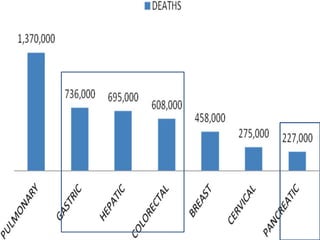
30% of cancer deaths are due to 5 behavioral risk factors
High BMI
Reduced intake of fruits/vegetables
Sedentary life style
Smoking
Alcohol use
Gastric cancer
The premalignant conditions
• Chronic atrophic gastritis
• Intestinal metaplasia
• H pylori
• Gastric adenoma
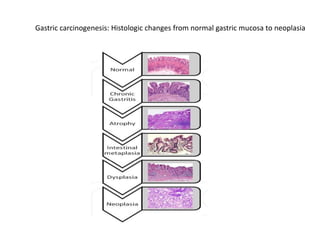
Gastric carcinogenesis: Histologic changes from normal gastric mucosa to neoplasia
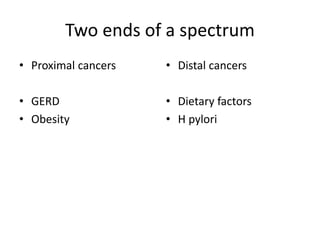
Two ends of a spectrum
• Proximal cancers
• GERD
• Obesity
• Distal cancers
• Dietary factors
• H pylori
Primary prevention
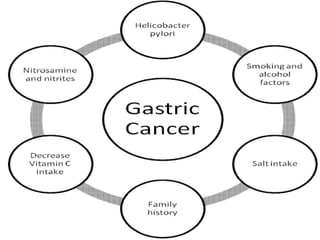
• Decreased salt intake
• Increased vitamin C consumption
• Quit smoking
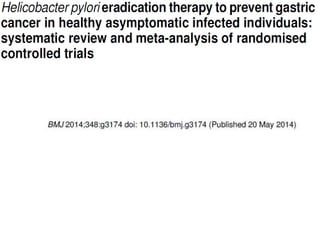
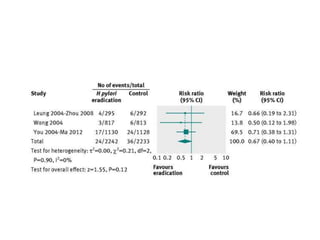
• H pylori eradication – class I carcinogen –
decreased Ca by 35%
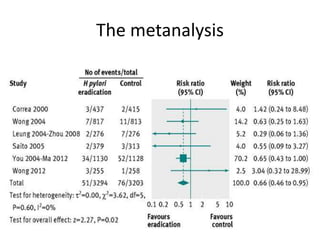
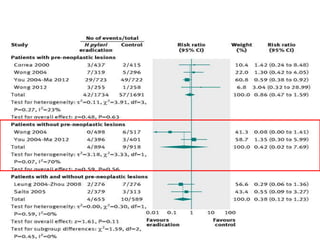
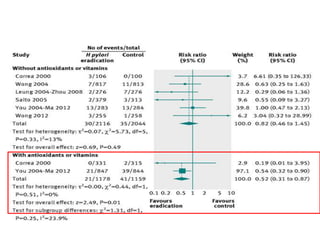
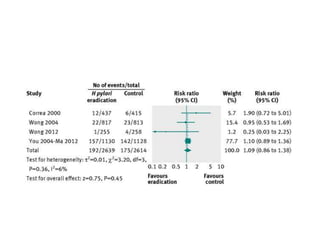
The metanalysis
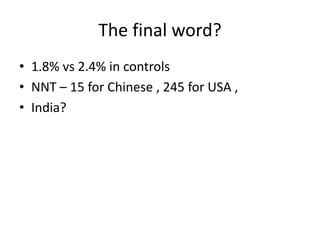
The final word?
• 1.8% vs 2.4% in controls
• NNT – 15 for Chinese , 245 for USA ,
• India?
Adenocarcinoma of the Esophagus
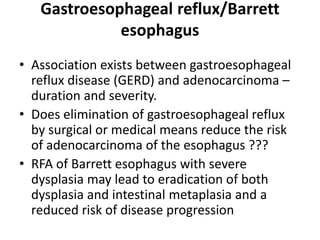
Gastroesophageal reflux/Barrett
esophagus
• Association exists between gastroesophageal
reflux disease (GERD) and adenocarcinoma –
duration and severity.
• Does elimination of gastroesophageal reflux
by surgical or medical means reduce the risk
of adenocarcinoma of the esophagus ???
• RFA of Barrett esophagus with severe
dysplasia may lead to eradication of both
dysplasia and intestinal metaplasia and a
reduced risk of disease progression
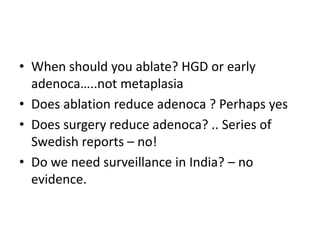
• When should you ablate? HGD or early
adenoca…..not metaplasia
• Does ablation reduce adenoca ? Perhaps yes
• Does surgery reduce adenoca? .. Series of
Swedish reports – no!
• Do we need surveillance in India? – no
evidence.
Hepatitis and liver cancer
Causes
• HBV and HCV – 80% of cases
• Cirrhosis
• Alcohol
• Steatosis and diabetes
• Medications/toxins
• Genetic / metabolic diseases
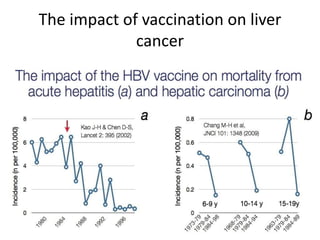
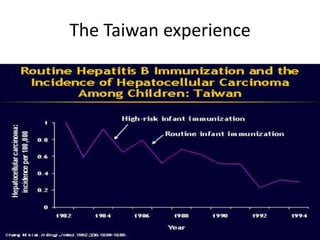
The impact of vaccination on liver
cancer
The Taiwan experience
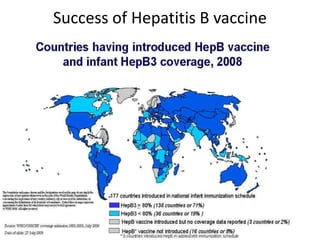
Success of Hepatitis B vaccine
Other issues
• Antivirals and the impact on carcinogenesis –
not recurrence
• Improving the efficacy of screening programs
• Effective modification of the modifiable
factors
HCV and liver cancer
• Safe practices to prevent HCV
• New age antivirals and their potential impact
on carcinogenesis
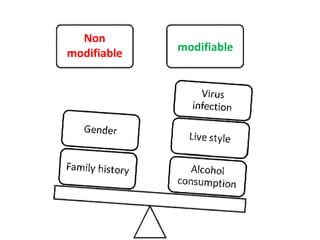
NAFLD , cirrhosis and cancer
Non
modifiable modifiable
The final word…
• We can do lots more
• We aren’t doing enough.
• Education and awareness are the key
Colon cancer
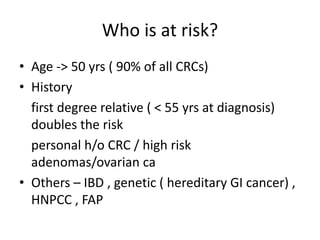
Who is at risk?
• Age -> 50 yrs ( 90% of all CRCs)
• History
first degree relative ( < 55 yrs at diagnosis)
doubles the risk
personal h/o CRC / high risk
adenomas/ovarian ca
• Others – IBD , genetic ( hereditary GI cancer) ,
HNPCC , FAP
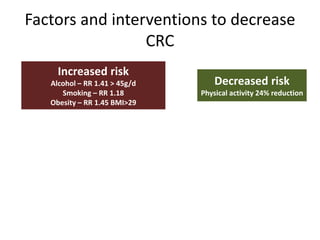
Factors and interventions to decrease
CRC
Increased risk
Alcohol – RR 1.41 > 45g/d
Smoking – RR 1.18
Obesity – RR 1.45 BMI>29
Decreased risk
Physical activity 24% reduction
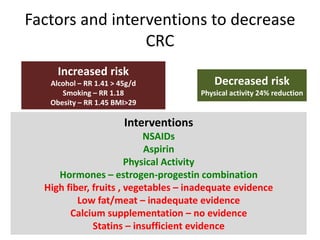
Factors and interventions to decrease
CRC
Increased risk
Alcohol – RR 1.41 > 45g/d
Smoking – RR 1.18
Obesity – RR 1.45 BMI>29
Decreased risk
Physical activity 24% reduction
Interventions
NSAIDs
Aspirin
Physical Activity
Hormones – estrogen-progestin combination
High fiber, fruits , vegetables – inadequate evidence
Low fat/meat – inadequate evidence
Calcium supplementation – no evidence
Statins – insufficient evidence
When to start?
• Average risk – 50 yrs
• Moderate risk – ( Blacks , MS , abdominal
obesity ) 45 yrs
• High risk – familial - earlier
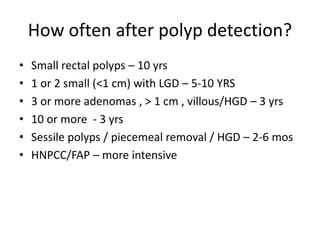
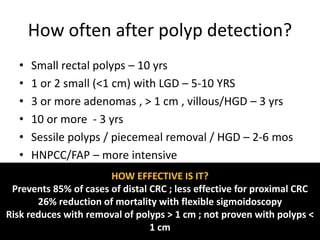
How often after polyp detection?
• Small rectal polyps – 10 yrs
• 1 or 2 small (<1 cm) with LGD – 5-10 YRS
• 3 or more adenomas , > 1 cm , villous/HGD – 3 yrs
• 10 or more - 3 yrs
• Sessile polyps / piecemeal removal / HGD – 2-6 mos
• HNPCC/FAP – more intensive
How often after polyp detection?
• Small rectal polyps – 10 yrs
• 1 or 2 small (<1 cm) with LGD – 5-10 YRS
• 3 or more adenomas , > 1 cm , villous/HGD – 3 yrs
• 10 or more - 3 yrs
• Sessile polyps / piecemeal removal / HGD – 2-6 mos
• HNPCC/FAP – more intensive
HOW EFFECTIVE IS IT?
Prevents 85% of cases of distal CRC ; less effective for proximal CRC
26% reduction of mortality with flexible sigmoidoscopy
Risk reduces with removal of polyps > 1 cm ; not proven with polyps <
1 cm
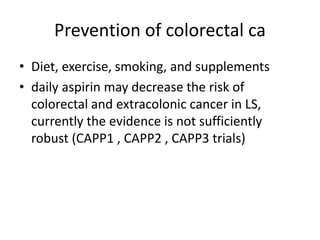
Prevention of colorectal ca
• Diet, exercise, smoking, and supplements
• daily aspirin may decrease the risk of
colorectal and extracolonic cancer in LS,
currently the evidence is not sufficiently
robust (CAPP1 , CAPP2 , CAPP3 trials)
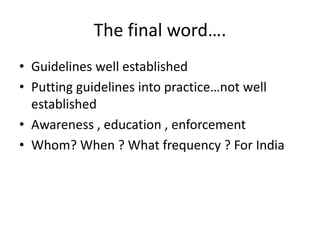
The final word….
• Guidelines well established
• Putting guidelines into practice…not well
established
• Awareness , education , enforcement
• Whom? When ? What frequency ? For India
Pancreatic cancer
• Lethal
• Stage at diagnosis
• Lack of effective medical therapy
• No effective screening methods
• Primary prevention – most effective way to
reduce burden
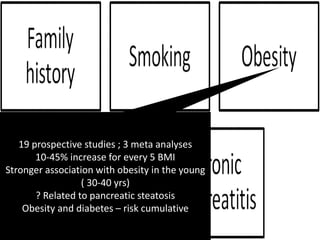
19 prospective studies ; 3 meta analyses
10-45% increase for every 5 BMI
Stronger association with obesity in the young
( 30-40 yrs)
? Related to pancreatic steatosis
Obesity and diabetes – risk cumulative
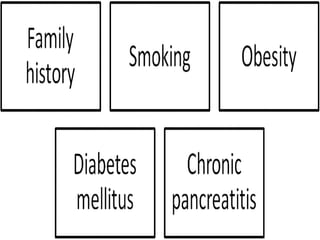
Who is at risk for adenoca?
• Genetic syndromes - hereditary breast–
ovarian cancer syndrome, familial
atypical multiple melanoma and mole
syndrome (FAMMM), PJS, LS, or other
gene mutations
• Three or more relatives with pancreatic
cancer
• Hereditary pancreatitis.
HOW?
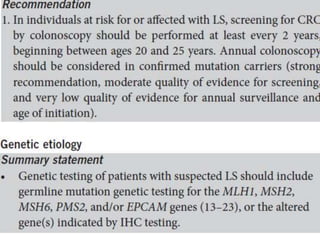
• Surveillance for PC should be with
endoscopic ultrasound and/or MRI of the
pancreas annually starting at age 50
years, or 10 years younger than the
earliest age of PC in the family.
• Patients with PJS should start surveillance
at age 35 years
Screening tools ..and I whom?
• No guidelines
• Chronic pancreatitis; hereditary
pancreatic cancer; hereditary
pancreatitis
• How? MRI/EUS
Jack Andraka, the Teen Prodigy of
Pancreatic Cancer
A high school sophomore won the youth achievement Smithsonian
American Ingenuity Award for inventing a new method to detect a
lethal cancer
he won the $75,000 grand prize at this past spring’s Intel International
Science and Engineering Fair,
“Edison of our times,”
Follow us: @SmithsonianMag on Twitter
Conclusions
• Sound knowledge of factors associated with GI
cancer
• Interventions need to be executed
• Awareness and education is the key
• Common risk factors – smoking , obesity ,
diets , physical inactivity , alcohol – reduced
burden by 25-40%
• HBV,HCV – another 10-15%
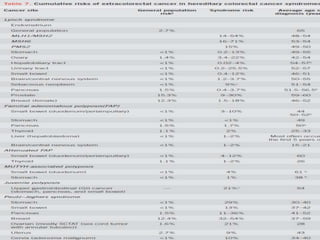
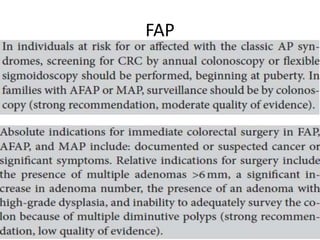
FAP
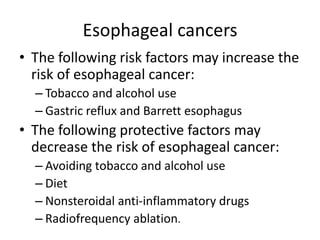
Esophageal cancers
• The following risk factors may increase the
risk of esophageal cancer:
– Tobacco and alcohol use
– Gastric reflux and Barrett esophagus
• The following protective factors may
decrease the risk of esophageal cancer:
– Avoiding tobacco and alcohol use
– Diet
– Nonsteroidal anti-inflammatory drugs
– Radiofrequency ablation.
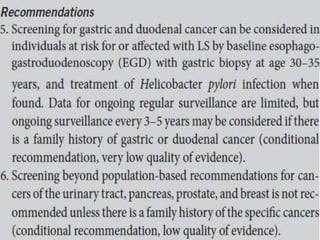
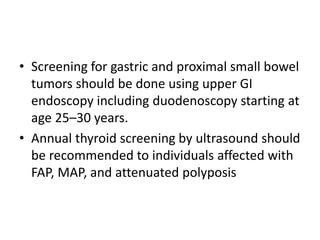
• Screening for gastric and proximal small bowel
tumors should be done using upper GI
endoscopy including duodenoscopy starting at
age 25–30 years.
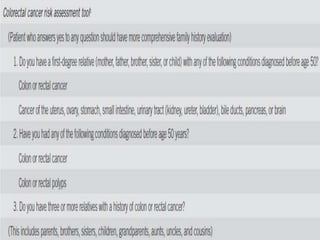
• Annual thyroid screening by ultrasound should
be recommended to individuals affected with
FAP, MAP, and attenuated polyposis
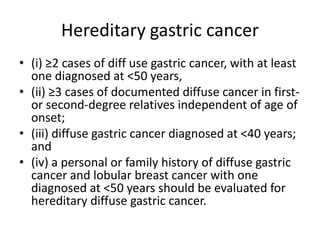
Hereditary gastric cancer
• (i) ≥2 cases of diff use gastric cancer, with at least
one diagnosed at <50 years,
• (ii) ≥3 cases of documented diffuse cancer in first-
or second-degree relatives independent of age of
onset;
• (iii) diffuse gastric cancer diagnosed at <40 years;
and
• (iv) a personal or family history of diffuse gastric
cancer and lobular breast cancer with one
diagnosed at <50 years should be evaluated for
hereditary diffuse gastric cancer.
Management
• (i) prophylactic gastrectomy after age 20 years
(>80% risk by age 80 years);
• (ii) breast cancer surveillance in women
beginning at age 35 years with annual
mammography and breast MRI and clinical
breast examination every 6 months,
• (iii) colonoscopy beginning at age 40 years for
families that include colon cancer

Prevention Of Gi Malignancy

  • 1.
    Prevention of GImalignancy G N Ramesh PVS Memorial Hospital Cochin
  • 3.
    Schema • Principles ofprevention • H pylori and gastric cancer – should we eradicate in all? • Barrett’s and malignancy – do we need to bother? • Hepatitis virus and liver cancers – how could we do more? • Colonic cancers – applying guidelines to our population • Pancreatic cancer – we know the preneoplastic situations .. But can we prevent?
  • 4.
    Principles of prevention •Primary – preventing the intitiation of the carcinogenic process – elimination , avoiding or neutralising the carcinogen • Secondary – interfering with the metabolism of carcinogen or preventing it from reaching the target ( tissue DNA) • Tertiary – preventing precancerous lesions from progressing to cancer ( surveillance)
  • 5.
    My aim • Summaryof factors that can be changed in our population to decrease and prevent GI cancers
  • 6.
    My aim • Summaryof factors that can be changed in our population to decrease and prevent GI cancers 30% of cancer deaths are due to 5 behavioral risk factors High BMI Reduced intake of fruits/vegetables Sedentary life style Smoking Alcohol use
  • 7.
  • 9.
    The premalignant conditions •Chronic atrophic gastritis • Intestinal metaplasia • H pylori • Gastric adenoma
  • 10.
    Gastric carcinogenesis: Histologicchanges from normal gastric mucosa to neoplasia
  • 11.
    Two ends ofa spectrum • Proximal cancers • GERD • Obesity • Distal cancers • Dietary factors • H pylori
  • 12.
    Primary prevention • Decreasedsalt intake • Increased vitamin C consumption • Quit smoking • H pylori eradication – class I carcinogen – decreased Ca by 35%
  • 14.
  • 17.
    The final word? •1.8% vs 2.4% in controls • NNT – 15 for Chinese , 245 for USA , • India?
  • 18.
  • 19.
    Gastroesophageal reflux/Barrett esophagus • Associationexists between gastroesophageal reflux disease (GERD) and adenocarcinoma – duration and severity. • Does elimination of gastroesophageal reflux by surgical or medical means reduce the risk of adenocarcinoma of the esophagus ??? • RFA of Barrett esophagus with severe dysplasia may lead to eradication of both dysplasia and intestinal metaplasia and a reduced risk of disease progression
  • 20.
    • When shouldyou ablate? HGD or early adenoca…..not metaplasia • Does ablation reduce adenoca ? Perhaps yes • Does surgery reduce adenoca? .. Series of Swedish reports – no! • Do we need surveillance in India? – no evidence.
  • 21.
  • 22.
    Causes • HBV andHCV – 80% of cases • Cirrhosis • Alcohol • Steatosis and diabetes • Medications/toxins • Genetic / metabolic diseases
  • 24.
    The impact ofvaccination on liver cancer
  • 25.
  • 26.
  • 27.
    Other issues • Antiviralsand the impact on carcinogenesis – not recurrence • Improving the efficacy of screening programs • Effective modification of the modifiable factors
  • 28.
    HCV and livercancer • Safe practices to prevent HCV • New age antivirals and their potential impact on carcinogenesis
  • 29.
  • 30.
  • 31.
    The final word… •We can do lots more • We aren’t doing enough. • Education and awareness are the key
  • 32.
  • 33.
    Who is atrisk? • Age -> 50 yrs ( 90% of all CRCs) • History first degree relative ( < 55 yrs at diagnosis) doubles the risk personal h/o CRC / high risk adenomas/ovarian ca • Others – IBD , genetic ( hereditary GI cancer) , HNPCC , FAP
  • 34.
    Factors and interventionsto decrease CRC Increased risk Alcohol – RR 1.41 > 45g/d Smoking – RR 1.18 Obesity – RR 1.45 BMI>29 Decreased risk Physical activity 24% reduction
  • 35.
    Factors and interventionsto decrease CRC Increased risk Alcohol – RR 1.41 > 45g/d Smoking – RR 1.18 Obesity – RR 1.45 BMI>29 Decreased risk Physical activity 24% reduction Interventions NSAIDs Aspirin Physical Activity Hormones – estrogen-progestin combination High fiber, fruits , vegetables – inadequate evidence Low fat/meat – inadequate evidence Calcium supplementation – no evidence Statins – insufficient evidence
  • 38.
    When to start? •Average risk – 50 yrs • Moderate risk – ( Blacks , MS , abdominal obesity ) 45 yrs • High risk – familial - earlier
  • 40.
    How often afterpolyp detection? • Small rectal polyps – 10 yrs • 1 or 2 small (<1 cm) with LGD – 5-10 YRS • 3 or more adenomas , > 1 cm , villous/HGD – 3 yrs • 10 or more - 3 yrs • Sessile polyps / piecemeal removal / HGD – 2-6 mos • HNPCC/FAP – more intensive
  • 41.
    How often afterpolyp detection? • Small rectal polyps – 10 yrs • 1 or 2 small (<1 cm) with LGD – 5-10 YRS • 3 or more adenomas , > 1 cm , villous/HGD – 3 yrs • 10 or more - 3 yrs • Sessile polyps / piecemeal removal / HGD – 2-6 mos • HNPCC/FAP – more intensive HOW EFFECTIVE IS IT? Prevents 85% of cases of distal CRC ; less effective for proximal CRC 26% reduction of mortality with flexible sigmoidoscopy Risk reduces with removal of polyps > 1 cm ; not proven with polyps < 1 cm
  • 42.
    Prevention of colorectalca • Diet, exercise, smoking, and supplements • daily aspirin may decrease the risk of colorectal and extracolonic cancer in LS, currently the evidence is not sufficiently robust (CAPP1 , CAPP2 , CAPP3 trials)
  • 43.
    The final word…. •Guidelines well established • Putting guidelines into practice…not well established • Awareness , education , enforcement • Whom? When ? What frequency ? For India
  • 44.
  • 45.
    • Lethal • Stageat diagnosis • Lack of effective medical therapy • No effective screening methods • Primary prevention – most effective way to reduce burden
  • 47.
    19 prospective studies; 3 meta analyses 10-45% increase for every 5 BMI Stronger association with obesity in the young ( 30-40 yrs) ? Related to pancreatic steatosis Obesity and diabetes – risk cumulative
  • 48.
    Who is atrisk for adenoca? • Genetic syndromes - hereditary breast– ovarian cancer syndrome, familial atypical multiple melanoma and mole syndrome (FAMMM), PJS, LS, or other gene mutations • Three or more relatives with pancreatic cancer • Hereditary pancreatitis.
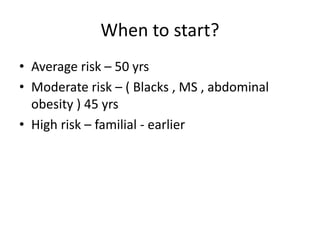
  • 49.
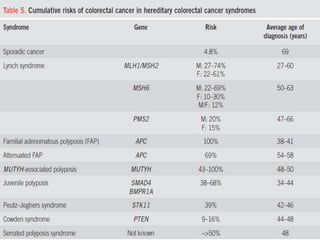
    HOW? • Surveillance forPC should be with endoscopic ultrasound and/or MRI of the pancreas annually starting at age 50 years, or 10 years younger than the earliest age of PC in the family. • Patients with PJS should start surveillance at age 35 years
  • 50.
    Screening tools ..andI whom? • No guidelines • Chronic pancreatitis; hereditary pancreatic cancer; hereditary pancreatitis • How? MRI/EUS
  • 51.
    Jack Andraka, theTeen Prodigy of Pancreatic Cancer A high school sophomore won the youth achievement Smithsonian American Ingenuity Award for inventing a new method to detect a lethal cancer he won the $75,000 grand prize at this past spring’s Intel International Science and Engineering Fair, “Edison of our times,” Follow us: @SmithsonianMag on Twitter
  • 52.
    Conclusions • Sound knowledgeof factors associated with GI cancer • Interventions need to be executed • Awareness and education is the key • Common risk factors – smoking , obesity , diets , physical inactivity , alcohol – reduced burden by 25-40% • HBV,HCV – another 10-15%
  • 58.
  • 59.
    Esophageal cancers • Thefollowing risk factors may increase the risk of esophageal cancer: – Tobacco and alcohol use – Gastric reflux and Barrett esophagus • The following protective factors may decrease the risk of esophageal cancer: – Avoiding tobacco and alcohol use – Diet – Nonsteroidal anti-inflammatory drugs – Radiofrequency ablation.
  • 60.
    • Screening forgastric and proximal small bowel tumors should be done using upper GI endoscopy including duodenoscopy starting at age 25–30 years. • Annual thyroid screening by ultrasound should be recommended to individuals affected with FAP, MAP, and attenuated polyposis
  • 61.
    Hereditary gastric cancer •(i) ≥2 cases of diff use gastric cancer, with at least one diagnosed at <50 years, • (ii) ≥3 cases of documented diffuse cancer in first- or second-degree relatives independent of age of onset; • (iii) diffuse gastric cancer diagnosed at <40 years; and • (iv) a personal or family history of diffuse gastric cancer and lobular breast cancer with one diagnosed at <50 years should be evaluated for hereditary diffuse gastric cancer.
  • 62.
    Management • (i) prophylacticgastrectomy after age 20 years (>80% risk by age 80 years); • (ii) breast cancer surveillance in women beginning at age 35 years with annual mammography and breast MRI and clinical breast examination every 6 months, • (iii) colonoscopy beginning at age 40 years for families that include colon cancer