Preventing
Network Security
Threats
www.digitdefence.com
Definition of Network Security Threats
01 02 03
Understanding Network
Security Threats
Significance of Threat
Prevention
Evolving Nature of
Threats
Network security threats refer to
any potential danger that can
compromise the integrity,
confidentiality, or availability of
networked systems and data,
including unauthorized access,
data breaches, and malware
attacks.
Preventing network security
threats is crucial for safeguarding
sensitive information, maintaining
operational continuity, and
protecting organizational
reputation against financial and
legal repercussions.
As technology advances, network
security threats continuously
evolve, necessitating ongoing
vigilance and adaptation of
security measures to address new
vulnerabilities and attack vectors
effectively.
www.digitdefence.com
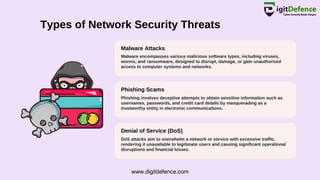
Malware Attacks
Phishing Scams
Denial of Service (DoS)
Malware encompasses various malicious software types, including viruses,
worms, and ransomware, designed to disrupt, damage, or gain unauthorized
access to computer systems and networks.
Phishing involves deceptive attempts to obtain sensitive information such as
usernames, passwords, and credit card details by masquerading as a
trustworthy entity in electronic communications.
DoS attacks aim to overwhelm a network or service with excessive traffic,
rendering it unavailable to legitimate users and causing significant operational
disruptions and financial losses.
Types of Network Security Threats
www.digitdefence.com
Impact of Network Security Threats on Organizations
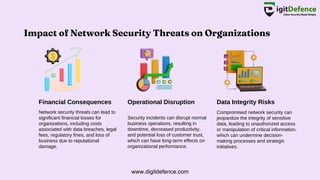
Financial Consequences Operational Disruption Data Integrity Risks
Network security threats can lead to
significant financial losses for
organizations, including costs
associated with data breaches, legal
fees, regulatory fines, and loss of
business due to reputational
damage.
Security incidents can disrupt normal
business operations, resulting in
downtime, decreased productivity,
and potential loss of customer trust,
which can have long-term effects on
organizational performance.
Compromised network security can
jeopardize the integrity of sensitive
data, leading to unauthorized access
or manipulation of critical information,
which can undermine decision-
making processes and strategic
initiatives.
www.digitdefence.com
Tools for Vulnerability Assessment
Automated Scanning Tools
Penetration Testing Software
Configuration Management Tools
Automated vulnerability scanning tools, such as Nessus and Qualys, systematically assess
network systems for known vulnerabilities, providing detailed reports that help organizations
prioritize remediation efforts based on risk levels.
Tools like Metasploit and Burp Suite enable security professionals to simulate attacks on their
networks, identifying weaknesses that could be exploited by malicious actors and allowing for
proactive security enhancements.
Solutions such as Chef and Puppet assist in maintaining secure configurations across network
devices by automating the deployment of security policies and ensuring compliance with
industry standards, thereby reducing the risk of misconfigurations.
www.digitdefence.com
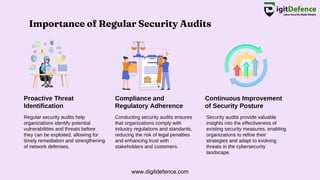
Importance of Regular Security Audits
Proactive Threat
Identification
Compliance and
Regulatory Adherence
Continuous Improvement
of Security Posture
Regular security audits help
organizations identify potential
vulnerabilities and threats before
they can be exploited, allowing for
timely remediation and strengthening
of network defenses.
Conducting security audits ensures
that organizations comply with
industry regulations and standards,
reducing the risk of legal penalties
and enhancing trust with
stakeholders and customers.
Security audits provide valuable
insights into the effectiveness of
existing security measures, enabling
organizations to refine their
strategies and adapt to evolving
threats in the cybersecurity
landscape.
www.digitdefence.com
Implementing Firewalls and Intrusion
Detection Systems
01 02 03
Role of Firewalls Intrusion Detection
Systems (IDS)
Integration for
Enhanced Security
Firewalls act as a barrier
between trusted internal
networks and untrusted
external networks,
controlling incoming and
outgoing traffic based on
predetermined security rules
to prevent unauthorized
access and potential threats.
IDS monitor network traffic
for suspicious activity and
known threats, providing
alerts to administrators
about potential security
breaches, thereby enabling
timely responses to mitigate
risks.
Combining firewalls with IDS
creates a multi-layered
security approach, allowing
organizations to not only
block unauthorized access
but also detect and respond
to intrusions in real-time,
significantly improving
overall network security.
www.digitdefence.com
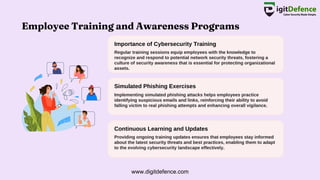
Importance of Cybersecurity Training
Simulated Phishing Exercises
Continuous Learning and Updates
Regular training sessions equip employees with the knowledge to
recognize and respond to potential network security threats, fostering a
culture of security awareness that is essential for protecting organizational
assets.
Implementing simulated phishing attacks helps employees practice
identifying suspicious emails and links, reinforcing their ability to avoid
falling victim to real phishing attempts and enhancing overall vigilance.
Providing ongoing training updates ensures that employees stay informed
about the latest security threats and best practices, enabling them to adapt
to the evolving cybersecurity landscape effectively.
Employee Training and Awareness Programs
www.digitdefence.com
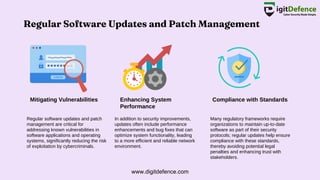
Regular Software Updates and Patch Management
Mitigating Vulnerabilities Enhancing System
Performance
Compliance with Standards
Regular software updates and patch
management are critical for
addressing known vulnerabilities in
software applications and operating
systems, significantly reducing the risk
of exploitation by cybercriminals.
In addition to security improvements,
updates often include performance
enhancements and bug fixes that can
optimize system functionality, leading
to a more efficient and reliable network
environment.
Many regulatory frameworks require
organizations to maintain up-to-date
software as part of their security
protocols; regular updates help ensure
compliance with these standards,
thereby avoiding potential legal
penalties and enhancing trust with
stakeholders.
www.digitdefence.com
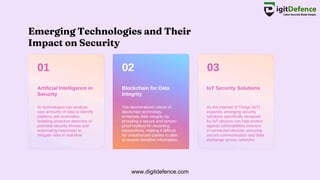
Emerging Technologies and Their
Impact on Security
01 02 03
Artificial Intelligence in
Security
Blockchain for Data
Integrity
IoT Security Solutions
AI technologies can analyze
vast amounts of data to identify
patterns and anomalies,
enabling proactive detection of
potential security threats and
automating responses to
mitigate risks in real-time.
The decentralized nature of
blockchain technology
enhances data integrity by
providing a secure and tamper-
proof method for recording
transactions, making it difficult
for unauthorized parties to alter
or access sensitive information.
As the Internet of Things (IoT)
expands, emerging security
solutions specifically designed
for IoT devices can help protect
against vulnerabilities inherent
in connected devices, ensuring
secure communication and data
exchange across networks.
www.digitdefence.com

Preventing Network Security Threats (1).pptx (1).pdf

  • 1.
  • 2.
    Definition of NetworkSecurity Threats 01 02 03 Understanding Network Security Threats Significance of Threat Prevention Evolving Nature of Threats Network security threats refer to any potential danger that can compromise the integrity, confidentiality, or availability of networked systems and data, including unauthorized access, data breaches, and malware attacks. Preventing network security threats is crucial for safeguarding sensitive information, maintaining operational continuity, and protecting organizational reputation against financial and legal repercussions. As technology advances, network security threats continuously evolve, necessitating ongoing vigilance and adaptation of security measures to address new vulnerabilities and attack vectors effectively. www.digitdefence.com
  • 3.
    Malware Attacks Phishing Scams Denialof Service (DoS) Malware encompasses various malicious software types, including viruses, worms, and ransomware, designed to disrupt, damage, or gain unauthorized access to computer systems and networks. Phishing involves deceptive attempts to obtain sensitive information such as usernames, passwords, and credit card details by masquerading as a trustworthy entity in electronic communications. DoS attacks aim to overwhelm a network or service with excessive traffic, rendering it unavailable to legitimate users and causing significant operational disruptions and financial losses. Types of Network Security Threats www.digitdefence.com
  • 4.
    Impact of NetworkSecurity Threats on Organizations Financial Consequences Operational Disruption Data Integrity Risks Network security threats can lead to significant financial losses for organizations, including costs associated with data breaches, legal fees, regulatory fines, and loss of business due to reputational damage. Security incidents can disrupt normal business operations, resulting in downtime, decreased productivity, and potential loss of customer trust, which can have long-term effects on organizational performance. Compromised network security can jeopardize the integrity of sensitive data, leading to unauthorized access or manipulation of critical information, which can undermine decision- making processes and strategic initiatives. www.digitdefence.com
  • 5.
    Tools for VulnerabilityAssessment Automated Scanning Tools Penetration Testing Software Configuration Management Tools Automated vulnerability scanning tools, such as Nessus and Qualys, systematically assess network systems for known vulnerabilities, providing detailed reports that help organizations prioritize remediation efforts based on risk levels. Tools like Metasploit and Burp Suite enable security professionals to simulate attacks on their networks, identifying weaknesses that could be exploited by malicious actors and allowing for proactive security enhancements. Solutions such as Chef and Puppet assist in maintaining secure configurations across network devices by automating the deployment of security policies and ensuring compliance with industry standards, thereby reducing the risk of misconfigurations. www.digitdefence.com
  • 6.
    Importance of RegularSecurity Audits Proactive Threat Identification Compliance and Regulatory Adherence Continuous Improvement of Security Posture Regular security audits help organizations identify potential vulnerabilities and threats before they can be exploited, allowing for timely remediation and strengthening of network defenses. Conducting security audits ensures that organizations comply with industry regulations and standards, reducing the risk of legal penalties and enhancing trust with stakeholders and customers. Security audits provide valuable insights into the effectiveness of existing security measures, enabling organizations to refine their strategies and adapt to evolving threats in the cybersecurity landscape. www.digitdefence.com
  • 7.
    Implementing Firewalls andIntrusion Detection Systems 01 02 03 Role of Firewalls Intrusion Detection Systems (IDS) Integration for Enhanced Security Firewalls act as a barrier between trusted internal networks and untrusted external networks, controlling incoming and outgoing traffic based on predetermined security rules to prevent unauthorized access and potential threats. IDS monitor network traffic for suspicious activity and known threats, providing alerts to administrators about potential security breaches, thereby enabling timely responses to mitigate risks. Combining firewalls with IDS creates a multi-layered security approach, allowing organizations to not only block unauthorized access but also detect and respond to intrusions in real-time, significantly improving overall network security. www.digitdefence.com
  • 8.
    Importance of CybersecurityTraining Simulated Phishing Exercises Continuous Learning and Updates Regular training sessions equip employees with the knowledge to recognize and respond to potential network security threats, fostering a culture of security awareness that is essential for protecting organizational assets. Implementing simulated phishing attacks helps employees practice identifying suspicious emails and links, reinforcing their ability to avoid falling victim to real phishing attempts and enhancing overall vigilance. Providing ongoing training updates ensures that employees stay informed about the latest security threats and best practices, enabling them to adapt to the evolving cybersecurity landscape effectively. Employee Training and Awareness Programs www.digitdefence.com
  • 9.
    Regular Software Updatesand Patch Management Mitigating Vulnerabilities Enhancing System Performance Compliance with Standards Regular software updates and patch management are critical for addressing known vulnerabilities in software applications and operating systems, significantly reducing the risk of exploitation by cybercriminals. In addition to security improvements, updates often include performance enhancements and bug fixes that can optimize system functionality, leading to a more efficient and reliable network environment. Many regulatory frameworks require organizations to maintain up-to-date software as part of their security protocols; regular updates help ensure compliance with these standards, thereby avoiding potential legal penalties and enhancing trust with stakeholders. www.digitdefence.com
  • 10.
    Emerging Technologies andTheir Impact on Security 01 02 03 Artificial Intelligence in Security Blockchain for Data Integrity IoT Security Solutions AI technologies can analyze vast amounts of data to identify patterns and anomalies, enabling proactive detection of potential security threats and automating responses to mitigate risks in real-time. The decentralized nature of blockchain technology enhances data integrity by providing a secure and tamper- proof method for recording transactions, making it difficult for unauthorized parties to alter or access sensitive information. As the Internet of Things (IoT) expands, emerging security solutions specifically designed for IoT devices can help protect against vulnerabilities inherent in connected devices, ensuring secure communication and data exchange across networks. www.digitdefence.com