Directions for ICT Research in Disease Prevention


 FP7-ICT-2009.5.1 – Support Action


                                           PREVE: Task 2.3

                                           Personal profile, motivation, user 
                                           segmentation
Introduction
                         I t d ti

• Primary prevention of diseases is a challenging task
   – Often, adopting healthy lifestyles require people to change their 
     familiar habits and give up their preferred ways of living
     familiar habits and give up their preferred ways of living
   – These changes are not easy, since they often require extra time, 
     strong willpower and considerable mental effort
   – The changes often affect parts of our lives not completely within
     The changes often affect parts of our lives not completely within 
     our control (e.g. work, family, economic situation)


 Why should I make these ”sacrifices” to prevent diseases 
  that are uncertain to occur even in the distant future 
  that are uncertain to occur even in the distant future ‐
        especially, when I feel completely healthy?


                     www.preve‐eu.org
Current status of work
                 C     t t t     f    k

• Identified different factors influencing health behavior 
  and behavior change 
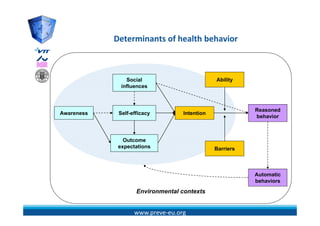
   –   Determinants of reasoned behavior 
       Determinants of reasoned behavior
   –   Habits and systematic biases
   –   Life stages and trigger events
   –   Environmental contexts
       E i          t l    t t
   –   Effective health communication
  High‐level intervention strategies
  Tentative plan for profiling and user segmentation

• Obj ti
  Objective of today: Validation of and feedback for the 
             f t d V lid ti       f d f db k f th
  work done so far


                      www.preve‐eu.org
Part I: Influences on health behavior


             www.preve‐eu.org
Determinants of health behavior
            D     i       fh l hb h i


                Social                        Ability
              influences


                                                         Reasoned
Awareness    Self-efficacy
             Self efficacy        Intention
                                                         behavior


               Outcome
               O t
             expectations                     Barriers


                                                         Automatic
                                                         behaviors
                    Environmental contexts
                    E i       t l    t t


                   www.preve‐eu.org
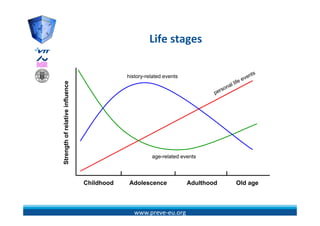
Life stages
                                                     Lif t

                                            history-related events
Strength of relativ influence
                  ve


                                                      age-related events
S


                                Childhood    Adolescence             Adulthood   Old age


                                               www.preve‐eu.org
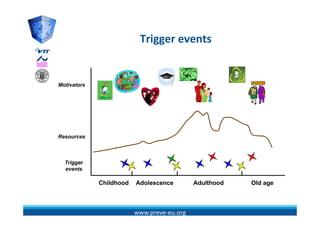
Trigger events
                          Ti          t


Motivators


Resources


  Trigger
  events

             Childhood   Adolescence        Adulthood   Old age


                         www.preve‐eu.org
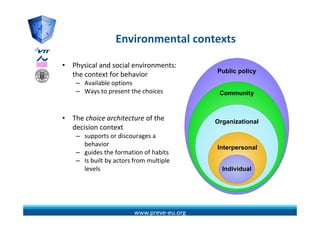
Environmental contexts
                   E i       t l    t t

•   Physical and social environments: 
                                             Public policy
    the context for behavior
     – Available options
     – Ways to present the choices            Community


•   The choice architecture of the           Organizational
    decision context 
     – supports or discourages a 
          pp                 g
       behavior                              Interpersonal
     – guides the formation of habits
     – Is built by actors from multiple 
       levels                                  Individual


                          www.preve‐eu.org
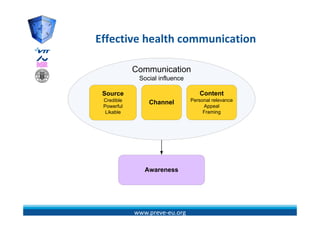
Effective health communication
Eff ti h lth           i ti

            Communication
             Social influence

 Source                            Content
 Credible                       Personal relevance
                Channel
 Powerful                            Appeal
  Likable                            Framing


               Awareness


            www.preve‐eu.org
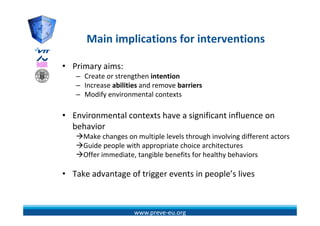
Main implications for interventions
      M i i li ti       f i t       ti

• Primary aims:
   – Create or strengthen intention
   – Increase abilities and remove barriers
     Increase abilities and remove barriers
   – Modify environmental contexts

• E i
  Environmental contexts have a significant influence on 
            t l    t t h         i ifi t i fl
  behavior
     Make changes on multiple levels through involving different actors
     Make changes on multiple levels through involving different actors
     Guide people with appropriate choice architectures
     Offer immediate, tangible benefits for healthy behaviors

• Take advantage of trigger events in people’s lives


                     www.preve‐eu.org
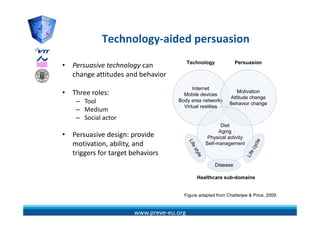
Technology‐aided persuasion
             T h l       id d        i

•   Persuasive technology can 
    change attitudes and behavior

•   Three roles:
     – Tool
     – Medium
     – Social actor

•   Persuasive design: provide 


                                                                          e
                                           Lif
    motivation, ability, and 


                                                                       ycl
                                               e


                                                                      ec
                                              sty
    triggers for target behaviors


                                                                     Lif
                                                   le
                                       Figure adapted from Chatterjee & Price, 2009.


                        www.preve‐eu.org
Part II: Profiling and segmentation


            www.preve‐eu.org
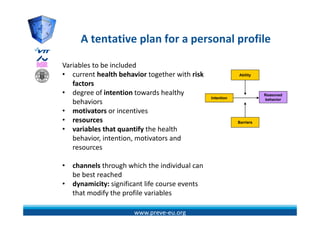
A tentative plan for a personal profile
      A t t ti     l f              l    fil

Variables to be included
• current health behavior together with risk                  Ability

   factors
• degree of intention towards healthy                                    Reasoned
                                                  Intention              behavior
   behaviors
• motivators or incentives
   motivators or incentives
• resources                                                   Barriers

• variables that quantify the health 
   behavior, intention, motivators and 
   behavior intention motivators and
   resources

•   channels through which the individual can 
     h     l th     h hi h th i di id l
    be best reached
•   dynamicity: significant life course events 
    that modify the profile variables

                        www.preve‐eu.org
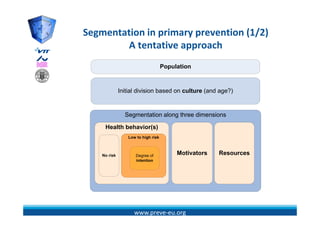
Segmentation in primary prevention (1/2)
  g             p     yp           ( / )
        A tentative approach
                                    Population


              Initial division based on culture (and age?)


                Segmentation along three dimensions
                S     t ti    l    th    di    i

     Health behavior(s)
                 Low to high risk


    No risk         Degree of            Motivators   Resources
                    intention


                    www.preve‐eu.org
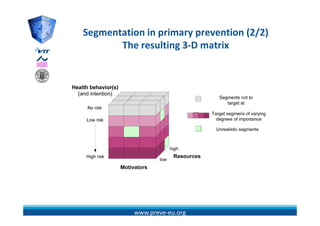
Segmentation in primary prevention (2/2)
  g             p     yp           ( / )
       The resulting 3‐D matrix


           www.preve‐eu.org
Targeting or tailoring?
               T    ti      t il i ?

• Targeting: defining a subgroup of a population based on 
  common characteristics for which an appropriate 
  intervention is created
  intervention is created

• Tailoring: fitting an intervention to meet the personal 
  needs and characteristics of a person rather than a group
  needs and characteristics of a person rather than a group

• Do‐It‐Yourself: provide a platform and let the person 
  personalize the interventions/services by himself
  Can effective interventions be designed based on 
        ff                           g
  segmentation (targeting), or are the individual needs 
  associated with health behavior change too complex for 
  this approach?
  this approach?

                   www.preve‐eu.org
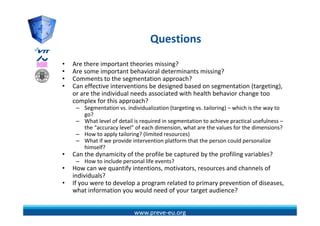
Questions
                                   Q ti
•   Are there important theories missing?
         h    i            h i      i i ?
•   Are some important behavioral determinants missing?
•   Comments to the segmentation approach?
•   Can effective interventions be designed based on segmentation (targeting), 
    Can effective interventions be designed based on segmentation (targeting)
    or are the individual needs associated with health behavior change too 
    complex for this approach?
     – Segmentation vs. individualization (targeting vs. tailoring) – which is the way to 
       go?
         ?
     – What level of detail is required in segmentation to achieve practical usefulness –
       the “accuracy level” of each dimension, what are the values for the dimensions?
     – How to apply tailoring? (limited resources)
     – What if we provide intervention platform that the person could personalize 
         h f            d                  l f     h h                 ld          l
       himself?
•   Can the dynamicity of the profile be captured by the profiling variables?
     – How to include personal life events? 
•   How can we quantify intentions, motivators, resources and channels of 
    individuals?
•   If you were to develop a program related to primary prevention of diseases, 
    what information you would need of your target audience?
    what information you would need of your target audience?


                            www.preve‐eu.org
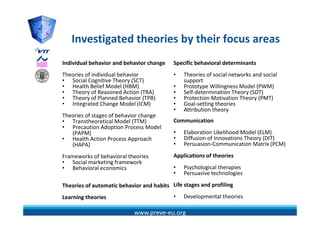
Investigated theories by their focus areas
   I    ti t d th i b th i f
Individual behavior and behavior change
I di id l b h i       db h i      h        Specific behavioral determinants
                                           S ifi b h i l d t         i   t
Theories of individual behavior            •   Theories of social networks and social 
• Social Cognitive Theory (SCT)                support
• Health Belief Model (HBM)
   Health Belief Model (HBM)               •   Prototype Willingness Model (PWM)
                                               Prototype Willingness Model (PWM)
• Theory of Reasoned Action (TRA)          •   Self‐determination Theory (SDT)
• Theory of Planned Behavior (TPB)         •   Protection Motivation Theory (PMT)
• Integrated Change Model (ICM)            •   Goal‐setting theories
                                           •   Attribution theory
Theories of stages of behavior change
• Transtheoretical Model (TTM)             Communication
• Precaution Adoption Process Model 
   (PAPM)                                  •   Elaboration Likelihood Model (ELM)
• Health Action Process Approach
   Health Action Process Approach          •   Diffusion of Innovations Theory (DIT)
                                               Diffusion of Innovations Theory (DIT)
   (HAPA)                                  •   Persuasion‐Communication Matrix (PCM)

Frameworks of behavioral theories          Applications of theories
• Social marketing framework
                 g
• Behavioral economics                     •   Psychological therapies
                                           •   Persuasive technologies

Theories of automatic behavior and habits Life stages and profiling
Learning theories                          •   Developmental theories

                            www.preve‐eu.org

Personal Profile, Motivation, User Segmentation

  • 1.
    Directions for ICTResearch in Disease Prevention FP7-ICT-2009.5.1 – Support Action PREVE: Task 2.3 Personal profile, motivation, user  segmentation
  • 2.
    Introduction I t d ti • Primary prevention of diseases is a challenging task – Often, adopting healthy lifestyles require people to change their  familiar habits and give up their preferred ways of living familiar habits and give up their preferred ways of living – These changes are not easy, since they often require extra time,  strong willpower and considerable mental effort – The changes often affect parts of our lives not completely within The changes often affect parts of our lives not completely within  our control (e.g. work, family, economic situation) Why should I make these ”sacrifices” to prevent diseases  that are uncertain to occur even in the distant future  that are uncertain to occur even in the distant future ‐ especially, when I feel completely healthy? www.preve‐eu.org
  • 3.
    Current status of work C t t t f k • Identified different factors influencing health behavior  and behavior change  – Determinants of reasoned behavior  Determinants of reasoned behavior – Habits and systematic biases – Life stages and trigger events – Environmental contexts E i t l t t – Effective health communication High‐level intervention strategies Tentative plan for profiling and user segmentation • Obj ti Objective of today: Validation of and feedback for the  f t d V lid ti f d f db k f th work done so far www.preve‐eu.org
  • 4.
  • 5.
    Determinants of health behavior D i fh l hb h i Social Ability influences Reasoned Awareness Self-efficacy Self efficacy Intention behavior Outcome O t expectations Barriers Automatic behaviors Environmental contexts E i t l t t www.preve‐eu.org
  • 6.
    Life stages Lif t history-related events Strength of relativ influence ve age-related events S Childhood Adolescence Adulthood Old age www.preve‐eu.org
  • 7.
    Trigger events Ti t Motivators Resources Trigger events Childhood Adolescence Adulthood Old age www.preve‐eu.org
  • 8.
    Environmental contexts E i t l t t • Physical and social environments:  Public policy the context for behavior – Available options – Ways to present the choices Community • The choice architecture of the  Organizational decision context  – supports or discourages a  pp g behavior Interpersonal – guides the formation of habits – Is built by actors from multiple  levels Individual www.preve‐eu.org
  • 9.
    Effective health communication Eff ti hlth i ti Communication Social influence Source Content Credible Personal relevance Channel Powerful Appeal Likable Framing Awareness www.preve‐eu.org
  • 10.
    Main implications for interventions M i i li ti f i t ti • Primary aims: – Create or strengthen intention – Increase abilities and remove barriers Increase abilities and remove barriers – Modify environmental contexts • E i Environmental contexts have a significant influence on  t l t t h i ifi t i fl behavior Make changes on multiple levels through involving different actors Make changes on multiple levels through involving different actors Guide people with appropriate choice architectures Offer immediate, tangible benefits for healthy behaviors • Take advantage of trigger events in people’s lives www.preve‐eu.org
  • 11.
    Technology‐aided persuasion T h l id d i • Persuasive technology can  change attitudes and behavior • Three roles: – Tool – Medium – Social actor • Persuasive design: provide  e Lif motivation, ability, and  ycl e ec sty triggers for target behaviors Lif le Figure adapted from Chatterjee & Price, 2009. www.preve‐eu.org
  • 12.
  • 13.
    A tentative plan for a personal profile A t t ti l f l fil Variables to be included • current health behavior together with risk  Ability factors • degree of intention towards healthy  Reasoned Intention behavior behaviors • motivators or incentives motivators or incentives • resources Barriers • variables that quantify the health  behavior, intention, motivators and  behavior intention motivators and resources • channels through which the individual can  h l th h hi h th i di id l be best reached • dynamicity: significant life course events  that modify the profile variables www.preve‐eu.org
  • 14.
    Segmentation in primary prevention (1/2) g p yp ( / ) A tentative approach Population Initial division based on culture (and age?) Segmentation along three dimensions S t ti l th di i Health behavior(s) Low to high risk No risk Degree of Motivators Resources intention www.preve‐eu.org
  • 15.
    Segmentation in primary prevention (2/2) g p yp ( / ) The resulting 3‐D matrix www.preve‐eu.org
  • 16.
    Targeting or tailoring? T ti t il i ? • Targeting: defining a subgroup of a population based on  common characteristics for which an appropriate  intervention is created intervention is created • Tailoring: fitting an intervention to meet the personal  needs and characteristics of a person rather than a group needs and characteristics of a person rather than a group • Do‐It‐Yourself: provide a platform and let the person  personalize the interventions/services by himself Can effective interventions be designed based on  ff g segmentation (targeting), or are the individual needs  associated with health behavior change too complex for  this approach? this approach? www.preve‐eu.org
  • 17.
    Questions Q ti • Are there important theories missing? h i h i i i ? • Are some important behavioral determinants missing? • Comments to the segmentation approach? • Can effective interventions be designed based on segmentation (targeting),  Can effective interventions be designed based on segmentation (targeting) or are the individual needs associated with health behavior change too  complex for this approach? – Segmentation vs. individualization (targeting vs. tailoring) – which is the way to  go? ? – What level of detail is required in segmentation to achieve practical usefulness – the “accuracy level” of each dimension, what are the values for the dimensions? – How to apply tailoring? (limited resources) – What if we provide intervention platform that the person could personalize  h f d l f h h ld l himself? • Can the dynamicity of the profile be captured by the profiling variables? – How to include personal life events?  • How can we quantify intentions, motivators, resources and channels of  individuals? • If you were to develop a program related to primary prevention of diseases,  what information you would need of your target audience? what information you would need of your target audience? www.preve‐eu.org
  • 18.
    Investigated theories by their focus areas I ti t d th i b th i f Individual behavior and behavior change I di id l b h i db h i h Specific behavioral determinants S ifi b h i l d t i t Theories of individual behavior • Theories of social networks and social  • Social Cognitive Theory (SCT) support • Health Belief Model (HBM) Health Belief Model (HBM) • Prototype Willingness Model (PWM) Prototype Willingness Model (PWM) • Theory of Reasoned Action (TRA) • Self‐determination Theory (SDT) • Theory of Planned Behavior (TPB) • Protection Motivation Theory (PMT) • Integrated Change Model (ICM) • Goal‐setting theories • Attribution theory Theories of stages of behavior change • Transtheoretical Model (TTM) Communication • Precaution Adoption Process Model  (PAPM) • Elaboration Likelihood Model (ELM) • Health Action Process Approach Health Action Process Approach  • Diffusion of Innovations Theory (DIT) Diffusion of Innovations Theory (DIT) (HAPA) • Persuasion‐Communication Matrix (PCM) Frameworks of behavioral theories Applications of theories • Social marketing framework g • Behavioral economics • Psychological therapies • Persuasive technologies Theories of automatic behavior and habits Life stages and profiling Learning theories • Developmental theories www.preve‐eu.org