WELCOME
INTRODUCTION
Adage/wise saying that has been applied
to many fields of endeavor, including
games and military combat.
Strong offensive action will preoccupy
the opposition and ultimately hinder its
ability to mount an opposing counterattack,
leading to a strategic advantage.
INTRODUCTION
Balancing offense and defense is not
always easy.
 "Suicide missions" are a sign of an
undisciplined powers.
If you can take your opponent out,
before he starts to consider taking your
rebellions out, you don't need any other
defense...
AIM
The main aim of this presentation is to
analyses and carry out research/study on
the offensive is the best form of defense.
SCOPE
Military strategy
offensive actions
Types of offensive
Defense and defensive actions
Types of defense
Defense Vs offense
Counter offensive
Risk strategy
Dirty war
MILATERY STRATEGY
A set of ideas implemented by military
organization to pursue desired strategic
goal.
In 8th century as the "art of the general",
'the art of arrangement' of troops.
MILATERY STRATEGY CON…
Deals with the planning and conduct of
campaigns, the movement and
disposition of forces, and the deception
of the enemy.
Asymmetric warfare and fooling of the
enemy.
OFFENCIVE ACTIONS
Military operation that seeks through
aggressive projection of armed force to
occupy territory, gain an objective or
achieve some larger strategic,
operational or tactical goal.
OFFENCIVE ACTIONS
Means to secure initiative in a
confrontation between opponents.
Can be waged on land, at sea or in the
air
TYPES OF OFFENSIVE
ACTIONS
Theatre offensive
Strategic offensive
Military incompetence
 Offensive operations
THEATER OFFENSIVE
Components of a war if a country is
involved in several Theatres(Security
force organizations).
Theatre offensives require over 250,000
troops to be committed to combat
operations.
STRAEGIC OFFENCE
A strategic offensive is the aggressive
expression of war planning and use of
strategic forces as a whole, combining
all resources available for achieving
defined and definitive goals.
 Involve use of over 100,000 troops as
part of a general Strategy.
MILITARY INCOMPETENCE
 Military incompetence refers to
incompetence and failures of military
organizations.
 Failure may be through incompetent
individuals or through a flawed/wrong
institutional culture.
 The most common cases of "military
incompetence" can be attributable to a
flawed organizational culture.
OFFENSIVE OPERATIONS
Harbor
FOB
QRT
Task Force
Patrolling
OFFENSIVE OPERATIONS
 Anti Ambush Drill
 Raid, CASO, Ambush
 CP, RB, Search
 SADO, ROAP
 Ambush The Ambusher
DEFENCE
Protection or the act of guarding.
Power of defending, or guarding against
the attacks, harm or danger.
State of being defended by the means of
resources for protection from external
attack is defense.
TYPES OF DEFENCE
Permanent defense
Temporary defense
 Positional defense
Strategically defense
PERMANENT DEFENCE
Defense of security forces in Permanent
bases.
Using all kinds of resources .
 All the security bases of security forces
are considered as the permanent bases.
 Consist of well managed sentry post,
coordinated fire power for safety of
bases.
TEMPORARY DEFENCE
Taken for certain duration unless the
security condition reaches in expected
condition.
Limited resources but improvisization
of local resource is in abundant.
Erected as per the situation and
frequently changed its location.
POSITIONAL DEFENCE
 Taken during the movement of troops or in
the time of operation.
 Chosen in tactical ground, obstacle system
and sentry post with defensibility measures
is erected during the halt.
 During the insurgency this shorts of defense
are used.
STRATEGIC DEFENCE
Psychologically in nature and it affects
the ops strategy of opponents.
 Increase in the number of troops by
recruiting and deployment of troops in
certain affected area.
 Opponents will be limited and are
obliged to change their strategy and
other aim is to limit insurgents.
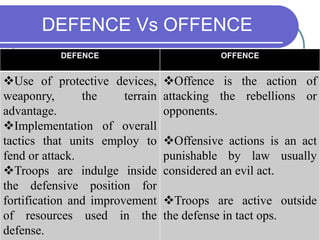
DEFENCE Vs OFFENCE
DEFENCE OFFENCE
Use of protective devices,
weaponry, the terrain
advantage.
Implementation of overall
tactics that units employ to
fend or attack.
Troops are indulge inside
the defensive position for
fortification and improvement
of resources used in the
defense.
Offence is the action of
attacking the rebellions or
opponents.
Offensive actions is an act
punishable by law usually
considered an evil act.
Troops are active outside
the defense in tact ops.
COUNTER OFFENSIVE
 Large-scale, usually strategic offensive
operations.
 A counterattack is the tactical and sometimes
smaller operational equivalent of the
counter-offensive.
 Counter-offensive is executed after
exhausting front line rebellions.
 Forcing the attacker to abandon offensive
plans.
RISK STRATEGY
 It mimics actual geopolitical maneuvering in
the diplomatic world.
 The strategy is risk rely on fundamental idea
around human relations and the national use
of forces or powers.
 The prime strategic consideration in risk is
the idea that if force at any point hold more
than half armies in the world.
RISK STRATEGY
 Behooves weaker party to ban together to
keep down, if not necessarily destroyed this
power.
 Should concentrate on one opponent at a
time, if possible.
 For every opponent eliminated is at least
three less armies he must confront every
turn.
DIRTY WAR
 An offensive conducted by secret police
or the military of a regime against
revolutionary and terrorist insurgents and
marked by the use of kidnapping and
torture and murder with civilians often
being the victims.
 Thousands of people disappeared and
were killed during Argentina's dirty war in
the late 1970s.
RECOMENDATION
Both actions to protect from opponents.
 Offensive actions are economical and
effective in comparison to defensive
actions.
Defense can be only in favor of SF but
offensive action provide sy to
populations as well.
CONCLUSION
The best defense is a good offense
Only real defense is active defense
Offensive action may have some effects
on the population
Strengthening the defense is wise to
have knowledge of surrounding and
keep the AOR under control
CONCLUSION
 Offensive operation vital for the delaying of
the execution of the insurgents or enemy
plan and security force troops can get general
idea about the modus of operandi of
opponent and can develop in skills for
countering them.
 Operate by keeping WHAMP as back bone
of countering the opponents.
THANK YOU

presentation.ppt

  • 1.
  • 2.
    INTRODUCTION Adage/wise saying thathas been applied to many fields of endeavor, including games and military combat. Strong offensive action will preoccupy the opposition and ultimately hinder its ability to mount an opposing counterattack, leading to a strategic advantage.
  • 3.
    INTRODUCTION Balancing offense anddefense is not always easy.  "Suicide missions" are a sign of an undisciplined powers. If you can take your opponent out, before he starts to consider taking your rebellions out, you don't need any other defense...
  • 4.
    AIM The main aimof this presentation is to analyses and carry out research/study on the offensive is the best form of defense.
  • 5.
    SCOPE Military strategy offensive actions Typesof offensive Defense and defensive actions Types of defense Defense Vs offense Counter offensive Risk strategy Dirty war
  • 6.
    MILATERY STRATEGY A setof ideas implemented by military organization to pursue desired strategic goal. In 8th century as the "art of the general", 'the art of arrangement' of troops.
  • 7.
    MILATERY STRATEGY CON… Dealswith the planning and conduct of campaigns, the movement and disposition of forces, and the deception of the enemy. Asymmetric warfare and fooling of the enemy.
  • 8.
    OFFENCIVE ACTIONS Military operationthat seeks through aggressive projection of armed force to occupy territory, gain an objective or achieve some larger strategic, operational or tactical goal.
  • 9.
    OFFENCIVE ACTIONS Means tosecure initiative in a confrontation between opponents. Can be waged on land, at sea or in the air
  • 10.
    TYPES OF OFFENSIVE ACTIONS Theatreoffensive Strategic offensive Military incompetence  Offensive operations
  • 11.
    THEATER OFFENSIVE Components ofa war if a country is involved in several Theatres(Security force organizations). Theatre offensives require over 250,000 troops to be committed to combat operations.
  • 12.
    STRAEGIC OFFENCE A strategicoffensive is the aggressive expression of war planning and use of strategic forces as a whole, combining all resources available for achieving defined and definitive goals.  Involve use of over 100,000 troops as part of a general Strategy.
  • 13.
    MILITARY INCOMPETENCE  Militaryincompetence refers to incompetence and failures of military organizations.  Failure may be through incompetent individuals or through a flawed/wrong institutional culture.  The most common cases of "military incompetence" can be attributable to a flawed organizational culture.
  • 14.
  • 15.
    OFFENSIVE OPERATIONS  AntiAmbush Drill  Raid, CASO, Ambush  CP, RB, Search  SADO, ROAP  Ambush The Ambusher
  • 16.
    DEFENCE Protection or theact of guarding. Power of defending, or guarding against the attacks, harm or danger. State of being defended by the means of resources for protection from external attack is defense.
  • 17.
    TYPES OF DEFENCE Permanentdefense Temporary defense  Positional defense Strategically defense
  • 18.
    PERMANENT DEFENCE Defense ofsecurity forces in Permanent bases. Using all kinds of resources .  All the security bases of security forces are considered as the permanent bases.  Consist of well managed sentry post, coordinated fire power for safety of bases.
  • 19.
    TEMPORARY DEFENCE Taken forcertain duration unless the security condition reaches in expected condition. Limited resources but improvisization of local resource is in abundant. Erected as per the situation and frequently changed its location.
  • 20.
    POSITIONAL DEFENCE  Takenduring the movement of troops or in the time of operation.  Chosen in tactical ground, obstacle system and sentry post with defensibility measures is erected during the halt.  During the insurgency this shorts of defense are used.
  • 21.
    STRATEGIC DEFENCE Psychologically innature and it affects the ops strategy of opponents.  Increase in the number of troops by recruiting and deployment of troops in certain affected area.  Opponents will be limited and are obliged to change their strategy and other aim is to limit insurgents.
  • 22.
    DEFENCE Vs OFFENCE DEFENCEOFFENCE Use of protective devices, weaponry, the terrain advantage. Implementation of overall tactics that units employ to fend or attack. Troops are indulge inside the defensive position for fortification and improvement of resources used in the defense. Offence is the action of attacking the rebellions or opponents. Offensive actions is an act punishable by law usually considered an evil act. Troops are active outside the defense in tact ops.
  • 23.
    COUNTER OFFENSIVE  Large-scale,usually strategic offensive operations.  A counterattack is the tactical and sometimes smaller operational equivalent of the counter-offensive.  Counter-offensive is executed after exhausting front line rebellions.  Forcing the attacker to abandon offensive plans.
  • 24.
    RISK STRATEGY  Itmimics actual geopolitical maneuvering in the diplomatic world.  The strategy is risk rely on fundamental idea around human relations and the national use of forces or powers.  The prime strategic consideration in risk is the idea that if force at any point hold more than half armies in the world.
  • 25.
    RISK STRATEGY  Behoovesweaker party to ban together to keep down, if not necessarily destroyed this power.  Should concentrate on one opponent at a time, if possible.  For every opponent eliminated is at least three less armies he must confront every turn.
  • 26.
    DIRTY WAR  Anoffensive conducted by secret police or the military of a regime against revolutionary and terrorist insurgents and marked by the use of kidnapping and torture and murder with civilians often being the victims.  Thousands of people disappeared and were killed during Argentina's dirty war in the late 1970s.
  • 27.
    RECOMENDATION Both actions toprotect from opponents.  Offensive actions are economical and effective in comparison to defensive actions. Defense can be only in favor of SF but offensive action provide sy to populations as well.
  • 28.
    CONCLUSION The best defenseis a good offense Only real defense is active defense Offensive action may have some effects on the population Strengthening the defense is wise to have knowledge of surrounding and keep the AOR under control
  • 29.
    CONCLUSION  Offensive operationvital for the delaying of the execution of the insurgents or enemy plan and security force troops can get general idea about the modus of operandi of opponent and can develop in skills for countering them.  Operate by keeping WHAMP as back bone of countering the opponents.
  • 30.

Editor's Notes